
In stock

LP
Chantal ACDA & Eric THIELEMANS
“Koyaanisqatsi, A New Score”
Dark-folk songwriter Chantal Acda and beyond drums-percussion musician extraordinaire Eric Thielemans propose a new score for Koyaanisqatsi, re-actualising the incredibly beautiful, raw, rhythmic and touching images of this 80-ties cinematographic masterpiece.
Slow deep electric waves, lonely synths in sonic desert landscapes, rhythmic pulses, transporting drums and bells, and deeply longing sounds and voices make up the audible fundamentals of this imagined, neo shamanic, ritualistic music to accompany the Earth as it keeps on supporting our post human frenetics even today.
This release contains a selection of the musical material scored for a live performance together with the screening of the movie. The live performance premiered on Film Festival Gent and Vooruit in the fall of 2022.
16,00€
In stock

LP
Phil MAGGI
“The Encrimsoned”
Sound architect and filmmaker from Liège, Belgium Phil Maggi is known as the lead singer of heavy-rock combo Ultraphallus. He has shared the bill with Jerusalem In My Heart, Keith Rowe, Phill Niblock, Tuxedomoon, Sote, Thisquietarmy, and many others. 'The Encrimsoned' is the second part of his diptych inspired by Henry Corbin's writings, which started with his previous album 'Animalwrath' (Sub Rosa SR423).
The Encrimsoned is a four-track album, harboring a few musical friends and usual collaborators (Maja Jantar, Tom Malmendier, Radwan Ghazi Moumneh, Sebastien Schmit, Gabriel Séverin, Xavière Fertin). Ranging from free-jazz to ambient-electronic contemporary art sound, this adventurous second and final chapter is an homage to Hardy Fox, pioneer and primary composer for The Residents.
LP Milky White Vinyl
16,00€
Out of stock

LP
Konstantin RAUDIVE
“The Voices of the Dead”
Original archives from Konstantin Raudive and Gerhard Stempnik + remixes by David Toop, DJ Spooky, CM von Hausswolff, Calla, Lee Ranaldo
THE REALITY OF THE TAPES
For many, the first traces of the Raudive Tapes were in William Burroughs fictions and articles. The fact is, these mysterious magnetic tapes, which capture the voices of the dead, and were recorded by the Baltic scientist Konstantin Raudive, are not a fiction but a reality (we are not here to judge their scientific objectivity ). These tapes, as rare as Lovecraft's Necronomicon, are now in our archives.
WHO WAS RAUDIVE ?
Dr. Konstantin Raudive, a student of Carl Jung, was a Latvian psychologist who taught at the University of Uppsala, Sweden, before devoting the last ten years of his life to electronic voice phenomenon (EVP). He published his book Breakthrough in 1971. His early collaborator F. Jurgenson, whom he met by the very beginning of 1965, awakened Dr. Raudive's interest in EVP research. Raudive spent endless hours for the thorough study of Jurgenson's books ("Voices from Space", 1964, and "Radio-Link with the Dead", 1967). From an overwhelming database (ranging about 72,000 samples!), Raudive's mother seems to be statistically the most frequently reported contact personality. She usually addressed her son in the Latgalian
WHAT WE CAN FIND IN THAT RECORD ?
1. A self introduction of Konstantin Raudive and a large session of exemples from his archives - July 17, 1965)
2. 9 extracts from the Gerhard Stempnik experiments - musician of the Berlin Philharmonic and close friend of Raudive (tapes from 1980)
3. A Raudive celebration including unpublished material by Scanner, Paul D. Miller aka dj Spooky/That subliminal kid, Calla, Lee Ranaldo (of Sonic Youth), Ensemble, Ramdom Inc., David Toop, Carl Michael von Hausswolff and Brett Dean. They have all composed an exclusive piece of music based on the Raudive material. It goes from a close examination of the material itself (CM Von Hausswolff, Lee Ranaldo) to a more evocative mood (Calla, Scanner, dj Spooky). The last piece, for viola solo, is a global homage to all the explorators of the unknown.
16,00€
In stock

CD
Milan KNIZAK & OPENING PERFORMANCE ORCHESTRA
“Broken Re/Broken”
*** 2022 restock ***
Milan Knizak (with Phaerentz) + Opening Performance Orchestra revisiting Broken Music in Berlin, 2014.
part one
Broken Music / 45 min.
Milan Knízak (with Phaerentz)
turntables & broken vinyls, CD players & CDs, cassette players
& cassettes, keyboard
part two
Re:Broken Music / 33 min.
Opening Performance Orchestra
5 laptops & fraction music (broken section, re:broken section,
fraction section)
'In 2008-9 we transferred the original recording from vinyl records into digital form. As we did so, we weren't interested in the precise, clean fidelity offered by the digital world, which fundamentally causes the fine structure of natural sound to be lost. Instead we were seeking the opposite: the world of errors and distortion, which remains hidden when digital audio is manipulated to be maximally accommodating for the listener. The transferred audio recording was digitally destroyed, shattered and uncompromisingly freed from all its original attributes. No melody, no rhythm, no harmony - this is fraction music'.
Milan Knizak (born 19 April 1940) is a Czech performance artist, sculptor, musician, installation artist, dissident, graphic artist, art theorist and pedagogue of art. Before everyone else - Christian Marclay, Philip Jeck, eRikm, Martin Tétreault, Otomo Yoshihide - there was Milan Knizak. In 1964, Milan Knizak, a member of Fluxus from behind the Iron Curtain, sat down on a sidewalk near the Charles Bridge in Prague, laid down a paper carpet right into the street, and starts tearing pages out of books and burning them... Around the same time, he began to create music from defective, worn, damaged or broken LP's. These Broken Music compositions, his classic collages of noises created during performances and happenings, are widely regarded as important sound art documents on record.
12,50€
In stock

LP
Milan KNIZAK
“Broken Music”
*** 2022 restock ***
Milan Knizak (born 19 April 1940) is a Czech performance artist, sculptor, musician, installation artist, dissident, graphic artist, art theorist and pedagogue of art.
Before everyone else – Christian Marclay, Philip Jeck, eRikm, Martin Tétreault, Otomo Yoshihide – there was Milan Knizak. In 1964, Milan Knizak, a member of Fluxus from behind the Iron Curtain, sat down on a sidewalk near the Charles Bridge in Prague, laid down a paper carpet right into the street, and starts tearing pages out of books and burning them… Around the same time, he began to create music from defective, worn, damaged or broken LP's. These Broken Music compositions, his classic collages of noises created during performances and happenings, are widely regarded as important sound art documents on record.
‘In 1963-64 I used to play records both too slowly and too fast and thus changed the quality of the music, thereby creating new compositions. In 1965 I started to destroy records: scratch them, punch holes in them, break them. By playing them over and over again (which destroyed the needle and often the record player too) an entirely new music was created - unexpected, nerve-racking, aggressive and even humorous. Compositions lasting one second or almost infinitely long (as when the needle got stuck in a deep groove and played the same phrase over
and over). I developed this system further. I began sticking tape on top of records, painting over them, burning them, cutting them up and gluing different parts of records back together, etc. to achieve the widest possible variety of sounds’. Milan Knízak, Broken Music
16,00€
In stock

2 CD
Jean DUBUFFET – Ilhan MIMAROGLU
“Musiques pour Coucou Bazar”
***2022 restock***
2CD + 40 page booklet
All musics done for Jean Dubuffet's Coucou Bazar show
CD1:
Ilhan Mimaroglu's soundtrack for Jean Dubuffet's articulated painting exhibition Coucou Bazar, which opened at the Guggenheim Museum in New York City on May 16, 1973.
CD2:
Jean Dubuffet's soundtrack of the Coucou Bazar show presented in Turin from June 16 to July 15, 1978 (based on Dubuffet's music recordings from 1961 and 1973-1974).
+ a never released before piece by Jean Dubuffet: Bal des Leurres (1972-73).
***
''(...) my music was slovenly and dirty, and therefore anti-musical, anti-humanistic" Jean Dubuffet
In 1965, Turkish composer Ilhan Mimaroglu, then residing in New York, sent a letter to Jean Dubuffet, to explain his experiments, inspired by the series of the artist's drawings.
In 1971 when Dubuffet started working on a new form of "show," Coucou Bazar, he decided to submit his project to Mimaroglu. Mimaroglu released his music for Coucou Bazar in 1973 under the title: Electronic Music for Jean Dubuffet's Coucou Bazar, accompanying the first version of the 'show' presented at the Solomon R. Guggenheim Museum in New York, from the 16th of May to the 29th of July 1973, and the second version at the Grand Palais in Paris, from the 2nd of November to the 1st of December 1973.
Following these first two versions of Coucou Bazar, Dubuffet quickly envisioned a third version. This third version of Coucou Bazar was finally produced in Turin in 1978, thanks to the FIAT company. And this time, it was accompanied by Dubuffet's music. Anna Sagna, the choreographer of this third version, took care of editing the tapes from 1961 and 1973-1974 into a collage.
16,00€
In stock

LP
GAMMELSÆTER & MARHAUG
“Higgs Boson”
Runhild Gammelsæter and Lasse Marhaug are two Norwegian musicians/sound artists. Both started in the early 1990s music underground and have worked in many constellations with a wide range of collaborators.
Despite knowing each other for a long time, Gammelsæter and Marhaug’s first collaborative work was the “Quantum Entanglement” LP in 2014. The album ignited a collective spark that both wanted to pursue further. Still, other commitments got in the way, and the project lay dormant until Stephen O’Malley, and Greg Anderson invited them to open for Sunn O))) for a special gig in the St. James Church of Culture in Oslo in the autumn of 2019. The two gathered for a long series of rehearsals, and after the successful performance, it was clear that it was time to start working on new compositions and recordings. That process initiated in late 2019 and continued to early 2021, encompassing before and after the world went through the lockdown. The result of this long development to be heard accumulated upon their new album “Higgs Boson” on Ideologic Organ Music.
Throughout the profound process of creating “Higgs Boson”, Gammelsæter and Marhaug drew inspiration from various subjects and artists. For Marhaug, it was concepts informed by the structuralist experimental cinema of Japanese directors Takashi Ito and Toshio Matsumoto, futurist worlds of French comic book artists Philippe Druillet and Jean Moebius Giraud, landscape photography of Fay Godwin, Kåre Kivijärvi, and Tamiko Nishimura, amongst others.
It became a metaphysical juxtaposition involving Gammelsaeter’s research and lyrical ideas based on several seemingly unrelated principles. A process of association inspired by “the Glass Bead Game” by Herman Hesse. The discovery of the Higgs Boson as a confirmation of the physical universe. The work of Ernst Schrödinger on the uncertainty principle. The four forces of physics. The Force. Helplessness under armed forces - as the war sailors in World War II. The influence of magic as expressed in tarot.
Gammelsæter experiments with a boundary involving the thresholds amongst various states of focus and legibility by forensic experimentation with techniques such as exclusive expression of consonants, syllabic repetition, retrograde text vocalisations and multi-lingual layering. Her vocal inspirational sources include Sidsel Endresen, Diamanda Galas, Natacha Atlas, the choral works of Rachmaninov, and the bands Carcass and Grave.
Two worlds coming together, making the music special. Mixing hard facts with science fiction helps create a kaleidoscopic cross point between the complex realities of the past and a possible future.
“Quantum Entanglement” featured two long-form pieces centred around a prepared piano and layered voice, while “Higgs Boson” developed a much more elaborate and ambitious compositional work. Across eight parts, the two artists brought a broad palette of instrumentation and sound. Electronic and acoustic, objects and field recordings, and pipe organ define the structures of which the centre is Gammelsæter’s magnificent voice. She has become known for her legendary voice, with her vast and unique range of inflective techniques and affective colour through her 30 years creating music. In the mix, Lasse approached the instrumental elements like landscapes, then Runhild’s vocals as characters that inhabit those worlds. Often, Gammelsæter multiple characters fused with the landscape. Make them occupy space, sometimes blend into it, sometimes dominate it. Constructing and setting visual guidelines helps set focus and open possibilities.
As an album, “Higgs Boson” is direct and focused, drawing on song structures. Within these tracks are vast strata of sound, an immersive multi-dimensional depth of music. Creating a feeling of depth while working with a flat two-channel stereo format - and how dimensions of texture and distortion can help develop the illusion of a space. The album structure is a story-like arc, a malleable subjective path, set as the album traverses oblique and suggestive areas, opening the concepts for the listener to unpack as they like.
– exclusive consultation with Gammelsæter & Marhaug, edited by Stephen O’Malley, June 2022
Runhild Gammelsæter – vocals, guitar, bells, digital piano/organ and processing
Lasse Marhaug – electronics, synth, objects and mixing
21,00€
In stock

2 LP
Jérôme NOETINGER
“Sur quelques mondes étranges”
The music on this long-awaited solo vinyl album by legendary tape artist Jérôme Noetinger was recorded live in the studio with no overdubs. Signals were sent through tube broadcast monitors and picked up with room microphones. Produced by Tobias Levin. Cover by Meeuw.
--
Long-time touchstone of international experimental music presents his monolithic (and first) solo vinyl Sur quelques mondes étranges on Felix Kubin’s Gagarin Records. Jérôme Noetinger is known to most for the audio-visual trio Cellule d’Intervention Metamkine, alongside his countless recorded & live collaborations, compositions for radio & stage, and breathtaking multi-channel diffusions in the acousmatic tradition.
Discovering the ReVox B77 tape machine as his tool for live electro-acoustic music in 1987, Noetinger has doggedly investigated his instrument over 35 years, establishing him as a vital contemporary composer/performer of the medium. His work is radical and interrogatory, using a pan-historical array of analogue devices to construct soundworlds which sidestep digital monochrome, landing in a galaxy of simmering malfunction, dynamic physicality & rhythmic debris. Programming Le 102 in Grenoble for over a decade, as well as directing Metamkine distribution for over three, his encyclopaedic knowledge of manifold sonic traditions is on display here; unified by a staunch discipline, impressive dedication and flat rejection of empty trends.
The results synthesise his tireless timbral research into 11 striking sonic investigations which combine modern studio possibilities with years of performance experience worldwide. An ominous malaise hovers over proceedings; yet it never feels nihilistic, presenting solutions which electrify the listener with ecstatic discovery. The perceptual orchestration therein - from throwing our ears right against the body of the tape machine to flinging them into cavernous space alive with the aurally strange - is both delirious & calming. Noetinger is all too aware things are bad, but his drive for discovery and joyous belief in music somehow coruscates brilliantly through contemporary gloom.
Meticulously recorded & produced with Tobias Levin in Hamburg, Sur quelques mondes étranges presents a detailed & rich vocabulary both real & unreal: gesture & repetition, structure & collapse, familiar & uncanny all dance with each in the most pumping discothèque concrète in this universe. This is a powerful and exacting statement from an elegant composer & extraordinary musician who has humbly dedicated his life to his practice.
– Anthony Pateras
30,00€
In stock

LP
BEUYS + PISSOFF
“Creamcheese Düsseldorf 1968”
The experimental project Pissoff was founded in the late '60s by multimedia-artist Eberhard Kranemann and some friends who studied together at the Düsseldorf Academy Of Fine Arts. The chaotic, loud, and, sound-wise, undisciplined band took part in various events at this location and other places. Due to the intense fluctuation of band-members the performances by Pissoff were characterized by continuously changing participants and variations of the involved equipment: cello, violin, clarinet, tenor saxophone, flute, vocals, electric guitar, electric bass guitar, organ, and drums.
In 1968, Pissoff performed together with Joseph Beuys, who was professor of sculpture at the Art Academy at that time. During this incomparable audiovisual interaction Joseph Beuys staged his Handaktion: in concentrated manner he moved his hands in front of his head while listening and visually reacting to the very loud and abstract staccato-rhythms by Pissoff. The event was recorded by Eberhard Kranemann on a Telefunken mono-tape-recorder and remains the only existing audio-material by Pissoff until today. On that night Eberhard played cello, clarinet, and tenor saxophone while the other members added sounds by electric guitar, electric bass, and drums.
Earliest musical experimentations that can be defined as the origins of the band Kraftwerk already started in 1967 by Eberhard Kranemann and Florian Schneider-Esleben. Sometimes Kranemann invited Florian Schneider-Esleben to join Pissoff.
22,50€
In stock

CD
BEUYS + PISSOFF
“Creamcheese Düsseldorf 1968”
The experimental project Pissoff was founded in the late '60s by multimedia-artist Eberhard Kranemann and some friends who studied together at the Düsseldorf Academy Of Fine Arts. The chaotic, loud, and, sound-wise, undisciplined band took part in various events at this location and other places. Due to the intense fluctuation of band-members the performances by Pissoff were characterized by continuously changing participants and variations of the involved equipment: cello, violin, clarinet, tenor saxophone, flute, vocals, electric guitar, electric bass guitar, organ, and drums.
In 1968, Pissoff performed together with Joseph Beuys, who was professor of sculpture at the Art Academy at that time. During this incomparable audiovisual interaction Joseph Beuys staged his Handaktion: in concentrated manner he moved his hands in front of his head while listening and visually reacting to the very loud and abstract staccato-rhythms by Pissoff. The event was recorded by Eberhard Kranemann on a Telefunken mono-tape-recorder and remains the only existing audio-material by Pissoff until today. On that night Eberhard played cello, clarinet, and tenor saxophone while the other members added sounds by electric guitar, electric bass, and drums.
Earliest musical experimentations that can be defined as the origins of the band Kraftwerk already started in 1967 by Eberhard Kranemann and Florian Schneider-Esleben. Sometimes Kranemann invited Florian Schneider-Esleben to join Pissoff.
16,00€
Out of stock

LP
Conrad SCHNITZLER & PHARMAKUSTIK
“Schubkraft”
“Kontraktion” and “Extruder” are the results of various tape-sessions by Conrad Schnitzler and Siegmar Fricke in Con’s former studio Leberstrasse in Berlin.The soundscapes on both records (produced in November 1986 and July 1987 with EMS-Synthi A, Korg MS 10 + MS 20 + delays) contain all the machinistic energy and infernal industrial sound-eruptions similar to Conrad’s first three albums “Schwarz”, “Rot” and “Blau” and to the rumbling train wheel rhythms of “Zug” (from the “Red Cassette” 1974). The albums also carry the spirit of the first “Cluster” album (released in 1971 on Philips) due to the imposing bruitiste elements and uneasy sci-fi atmospheres.
“Schubkraft”, the third and final album of the Schnitzler/Pharmakustik-triology (recorded during the same sessions in Berlin) contains two long pieces of thrust generated force and propulsive power. Soundwise an album combining mechanically driven rhythms and propelling velocity with rusty organic textures. The shiny yellow cover reflects the sheer explosive drive of the audio-material.
The complete session-material has been refurbished, restructured and recombined by Siegmar Fricke at Pharmakustik-studio Germany.
22,50€
In stock

2 LP
NURSE WITH WOUND
“Gyllensköld, Geijerstam And I At Rydberg’s” (silver)
Silver and black record
*
"This 1983 period in which Gyllensköld was recorded was a fantastic time for the evolution of Steven Stapleton's audio art. His collaborations with Diana Rogerson, Robert Haigh (Sema), David Tibet, and Thirlwell around this time elicited some of the most exciting work Nurse With Wound had yet recorded. Listen to this material and compare it to Chance Meeting and it becomes clear that in just a few years, Stapleton's art had grown by leaps and bounds. The production quality on these tracks is remarkable, and the widening out of the NWW soundworld opened up a whole new audio toybox that Stapleton has continued to experiment with up to today. This new sound encompasses vocal experiments, vintage LPs of easy listening music, demented nursery rhymes, lateral references to disposable pop music, avant-garde jazz and minimalistic piano composition, all glued together with evocative atmospheres redolent of things unholy, troubling and perverse, but always oddly indefinable and puzzlingly misshapen. In retrospect, Gyllensköld can be seen as the beginning of the 'mature;' period of NWW, and thus it is an indispensable release for fans of the project. Perhaps influenced by the obsessions of his friend and collaborator Tibet, Stapleton also began weaving religious and occult references into his usual name-dropping of avant-garde artists and movements . . . NWW's Gyllensköld comes across at times as the soundtrack to a schizoid episode: disembodied voices intoning nonsense, floating subliminally across the stereo channels, or cackling in evil delight. The sounds are denser here than on earlier works such as Homotopy To Marie. Areas of silence are mostly gone, replaced by layers of drone, cartoonish noises and mutated voices. 'Several Odd Moments Prior to Lunch' opens the brief album, setting the stage with its lysergically altered vocals and a frightening, yawning chasm of haunted, spectral sound. Stapleton, Thirlwell, and company learned how to wield the studio like an instrument on these and other recordings of the period. Effects such as reverb, delay, ring modulation and backwards tracking are utilized to create evolving textures and darkly psychedelic dreamspaces. 'Phenomenon of Aquarium and Bearded Lady' utilizes a number of instruments, including horns and piano, to create a bizarre dislocated funeral dirge in which the sounds of a slowly cycling jack-in-the-box are not out of place. For fans of musicians like Jacques Berrocal, who prefer their free jazz with a heavy dose of whacked-out eccentricity, this is about as good as it gets. 'Dirty Fingernails' is something else entirely, a longform exploration of outré textures, combining mysterious trebly noises with percussive bleeps of mysterious origin." --Brainwashed
35,00€
Out of stock
2 LP
NURSE WITH WOUND
“Gyllensköld, Geijerstam And I At Rydberg’s”
"This 1983 period in which Gyllensköld was recorded was a fantastic time for the evolution of Steven Stapleton's audio art. His collaborations with Diana Rogerson, Robert Haigh (Sema), David Tibet, and Thirlwell around this time elicited some of the most exciting work Nurse With Wound had yet recorded. Listen to this material and compare it to Chance Meeting and it becomes clear that in just a few years, Stapleton's art had grown by leaps and bounds. The production quality on these tracks is remarkable, and the widening out of the NWW soundworld opened up a whole new audio toybox that Stapleton has continued to experiment with up to today. This new sound encompasses vocal experiments, vintage LPs of easy listening music, demented nursery rhymes, lateral references to disposable pop music, avant-garde jazz and minimalistic piano composition, all glued together with evocative atmospheres redolent of things unholy, troubling and perverse, but always oddly indefinable and puzzlingly misshapen. In retrospect, Gyllensköld can be seen as the beginning of the 'mature;' period of NWW, and thus it is an indispensable release for fans of the project. Perhaps influenced by the obsessions of his friend and collaborator Tibet, Stapleton also began weaving religious and occult references into his usual name-dropping of avant-garde artists and movements . . . NWW's Gyllensköld comes across at times as the soundtrack to a schizoid episode: disembodied voices intoning nonsense, floating subliminally across the stereo channels, or cackling in evil delight. The sounds are denser here than on earlier works such as Homotopy To Marie. Areas of silence are mostly gone, replaced by layers of drone, cartoonish noises and mutated voices. 'Several Odd Moments Prior to Lunch' opens the brief album, setting the stage with its lysergically altered vocals and a frightening, yawning chasm of haunted, spectral sound. Stapleton, Thirlwell, and company learned how to wield the studio like an instrument on these and other recordings of the period. Effects such as reverb, delay, ring modulation and backwards tracking are utilized to create evolving textures and darkly psychedelic dreamspaces. 'Phenomenon of Aquarium and Bearded Lady' utilizes a number of instruments, including horns and piano, to create a bizarre dislocated funeral dirge in which the sounds of a slowly cycling jack-in-the-box are not out of place. For fans of musicians like Jacques Berrocal, who prefer their free jazz with a heavy dose of whacked-out eccentricity, this is about as good as it gets. 'Dirty Fingernails' is something else entirely, a longform exploration of outré textures, combining mysterious trebly noises with percussive bleeps of mysterious origin." --Brainwashed
29,00€
Out of stock

LP
Lasse MARHAUG
“Context”
Lasse Marhaug is one of those characters that operates at the nexus of so much stuff that’s important to us here - working as a producer (over the last couple of years alone he’s helped shape albums by Jenny Hval, Kelly Lee Owens, Okkyung Lee, Hillary Woods etc etc), a mastering engineer (far too many releases to mention), a prolific sleeve designer (likewise), publisher (his occasional Personal Best magazine is still going strong) and, perhaps most importantly - a recording artist in his own right. ‘Context’ is his most substantial release in years - a crushing assembly of bone-dry/darkside drone/machine malfunctions that’s bursting with a visceral, throbbing, mass of feeling. If yr into anything on the spectrum from Mika Vainio to Grouper to Kevin Drumm or Deathprod - this one’s as good as it gets
Over almost three decades of activity, Marhaug has carved out notoriety as a solo performer, a prolific collaborator (working with everyone from Sunn O))) to Jim O’Rourke) and as a busy producer, who’s notched up credits on some of the most striking-sounding albums of the last few years. This new album was created as a swan song for the infamous Oslo studio that he’s inhabited for 17 years, prior to his move back to the Arctic Circle where he originally came from. Recorded over a 14-month period and painstakingly edited from hours upon hours of material, it might just be the most impressive, moving record we’ve heard from him so far.
The interplay between piercing softness and deafening noise is the key to “Context”, displaying a philosophy Marhaug has been exploring for years. Few other artists are able to balance chaos and harmony with such ease; Marhaug does it without grandstanding, it’s music that sounds as simultaneously beautiful and as daunting as the Arctic landscape he’s returning to. At any moment a sound can be alluring or treacherous, like the frozen sun reflecting on a snowy mountaintop. Marhaug’s deftness with rhythm and bass emerges on ‘Context 3’, as he pairs Vainio-esque low-end pulses with crumpled noise and widescreen tones; as disquieting music-box chimes absorbed into the blasted soundscape on ‘Context 5’, while we’re thrust into the freezing cold on ‘Context 6’, subjected to punctuating gusts of white noise and trapped string loops.
Trust it’s a rare and near-mythical beast, conjuring vast, treacherous soundscapes illuminated with pangs of sentiment that naturally weave strands of his non-musical practice in their psychosensual lustre and gritty attrition. As he steps into a new phase of his career, we’re left with a concluding chapter that stands as a summation and open-ended post-credits reveal.
26,00€
Out of stock

LP
Pauline OLIVEROS & REYNOLS
“Half a Dove in New York, Half a Dove in Buenos Aires”
Recorded back in 1999, ‘Half a Dove in New York, Half a Dove in Buenos Aires’ is the recorded debut of a NetCast improv between deep listening pioneer Pauline Oliveros and Argentinian free music trio Reynols >> a fascinating early example of the internet’s capacity to foster remote creativity in-the-moment that deploys the slowest electronics, accordion, voice, trombone and computer sounds on a next level ritual drone incantation recorded in another era, but made for our time.
As the story goes, Oliveros first met Reynols in the mid ‘90s at a Deep Listening workshop she held in their home city, Buenos Aires, where they impressed her with an improvised brass serenade. Years later, in 1999, they met again via NetCast - a series of very early online live improvisations - to explore the Internet’s potential for collaborations between artists thousands of miles apart. Finally mixed down in 2021 and mastered by Helge Sten (aka Deathprod) after marinating in the archive for 22 years, the album resonates with the late, great Oliveros’ legendary work in exploring alternate tunings, spatial dynamics and methods of intuitive performance - a remarkable slab of omnidirectional drone bearing traces of Miguel Tomasin’s vox and Oliveros’ just-intoned accordion embedded in its cosmic roil.
Broadcasting from fabled record shop The Thing in NYC, with Oliveros (Accordion) joined by Jennifer McCoy (ICR), Kevin McCoy (Computer processing), and Monique Buzzarté (Trombone), and Reynols revolving Miguel Tomasin (Electronics, subliminal voice & Alclorse drums), Rob Conlazo electronics, leather gloves & e-gtr), and Anla Courtis (electronics, rubber foot & e-gtr) and dialling-in from Florida 943 in Buenos Aires, the results are an incredibly absorbing and consistently surprising testament to vanguard, experimental spirits prizing the internet’s nascent, unprecedented ability to connect minds and art across continents, language barriers, and modalities.
The album’s first side, titled ‘Micro Macro Wind Dance’, puts Oliveros’ accordion under a microscope, enhancing it with lower case rumble and noise from Reynolds’ arsenal. Shifting glacially over 22-minutes, Oliveros plays subtly and slowly at first, letting the accordion breathe in-and-out like a sleeping mythical beast, before she transitions to fluttering bird-like phrases by the end of the side.
‘Astral Netcast Pigeon’ expands the dissonant drones to widescreen, submerging Oliveros’ trills and drones beneath layers of dirt and grit. It’s time-altering music that dissasembles yr head before you’ve completely worked out what’s happening >> basically the perfect mid-point between Oliveros’ deep listening practices and Reynols’ wildly inspirational free-noise-drone freakouts
26,00€
In stock
2 LP
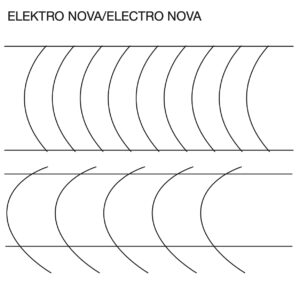
ELEKTRO NOVA
“Electro Nova”
Like a rediscovered Viking burial ship, Electro Nova compiles near-mythical drone recordings produced in 1998 and described by Helge Sten aka Deathprod as some of the most important music to ever come out of Norway. It’s the work of Kåre Dehlie Thorstad and compiles two of the earliest releases on Smalltown Supersound, back when it was basically no more than a bedroom operation. It’s taken over two decades, but finally the label have given the material a first ever proper release on vinyl, complete with mixing and mastering by Deathprod. If you’re into the ice cold swells of anyone from Thomas Köner to Harley Gaber, Biosphere, Kali Malone or, of course, Deathprod - this one’s as essential as they come.
Kaare Dehlie Thorstad’s Elektro Nova produced just two releases during the late ‘90s that have since slipped into drone lore - Trans-Inter-Ference and Elektro Nova/Electro Nova. Admired not only by Deathprod and Joakim Haugland of Smalltown, but also by his contemporaries Lasse Marhaug and Biosphere, his work has evaded pretty much any attention outside of Norway these last two decades. Following a chance meeting with Thorstad at Oslo airport a few years back, Smalltown were prompted to give the recordings a second wind, presenting what is essentially a captivating new release, and crucial addition to the Norsk drone canon.
As the story goes, Thorstad was studying photography in the late 90’s in Scotland, but instead of delivering a photo for his final exam he made a record - a double album (2CDs) and a 10” to be precise. That should provide some idea of the textural synaesthetic and landscaping qualities evoked by his music, which he ended up sending to a then-young Smalltown label, who were mostly issuing tapes at the time. With no proper distribution the records largely bypassed wider attention, and become a personal favourite of Smalltown’s Joakim Haugland, as well as avowed fan Helge Sten (Deathprod), who helped render its diaphanous scale in mix down, and Lasse Marhaug who describes them as “two perfect records that deserved much bigger attention”.
Between its jaw-dropping opener; the post-apocalyptic vision of its untitled part; and the cinematic white-out of the 10” tracks; Thorstad comes as close as we’ve ever heard to evoking the inhospitable nature and stark beauty of the wild far north. We can hear those landscapes palpably internalised and alchemically transmuted into its coarse grained textural swells and a reverberating multi-dimensionality, variously sustained to extents that evoke an abandonment of the senses, or likewise squashed and isolated to imply the relative anxiety relief of atmospheric flux, where a few degrees temperature rise or a drop in the wind speed can make the difference between life and death.
30,00€
Out of stock
LP
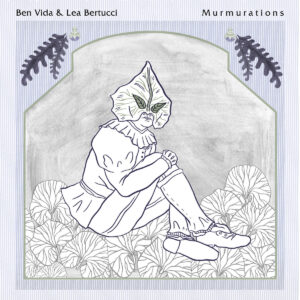
Ben VIDA & Lea BERTUCCI
“Murmurations”
Ben Vida and Lea Bertucci have been releasing exceptional material for years, but this collaboration - described by the two as a series of conversations that developed into a unique form of nonhierarchical improvisation - scrapes at spaces neither artist has fully explored on their own.
As the duo developed their ideas, both working from different sides of the same mountain in upstate New York, they watched as their artistic identities fell away and their language evolved into something altogether new. As a result. we get to hear two artists at the pinnacle of their respective practices rediscover the glee of improvisation and sonic experimentation.
Loosely, the pieces feature Vida working with modular synth, disintegrating a library of sounds recorded by Bertucci: bass clarinet, saxophone and wooden flute. Alongside, Bertucci stretches the limits of her instruments, eschewing harmony and expected tonality and wielding the arsenal to bring out guttural human sounds - breaths, finger presses, scraped squeals, unfurling giddy tape machine manipulations that abstract Vida’s modular concoctions to further blur the lines between the two artists.
Opening track ‘Gasps and Spasms’ sets the tone, accenting Bertucci and Vida’s voices and the interplay between mouth sounds and instrumental pops as elements tumble into each other like a snowball skating down a mountain. ‘Ghost Pipes’ splays dissonant specters of flute across rocky passes made up of ASMR particles and inverse drones to uncanny, goose-pimpling effect, somehow tangling folk, jazz, classical and avant garde traditions into ancestral sci-fi tapestries.
The album’s most surprising moments come when the duo fully lean into phonetic morphology, splattering words into dissociated delay patterns and white noise tides, dilating intimate moments (an impromptu laugh, a dropped phrase) into abstract verse. Those sounds build into the album’s title track, where a ticking clock underpins cosmic whirlpool delays and intense, hypogean groans.
28,00€
Out of stock
LP
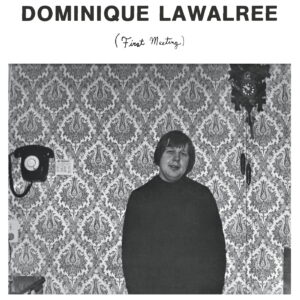
Dominique LAWALRÉE
“First Meeting”
Finally issued on vinyl again, the impossibly gentle, sad, life-affirming ‘First Meeting’ is a record we’ve described as one of the loveliest chance-encounters we’ve ever had with music, and by all measures one of our favourite albums of all time. If you’re into anything from Erik Satie to Virginia Astley, Brian Eno’s short-lived Obscure label to Laila Sakini, or if you like the idea of timeless outsider music for piano, wurlitzer, bells, flute and voice, this precious selection of intimate wonders is ready and waiting for you to melt into. It might just change your life too.
‘First Meeting’ is an indispensable introduction to the wonderfully moving and expressive parlour music of Dominique Lawalrée - a singular figure who sadly passed away in 2019. Lawalrée had been recording music since 1976, almost appeared on Brian Eno’s Obscure label and counted Gavin Bryars a long time friend and fan of his music. It took until the first edition of this set compiled by Adrian Rew in 2017, however, for us to first encounter his work. Drawn from self-released material recorded between 1978-1982 on his own Brussels-based Editions Walrus (what a name?!), First Meeting reveals a quietly sublime and intimately idiosyncratic sound in 9 parts (15 on the expanded download version) - so quiet and intimate in fact that we feel like a privileged fly on the high ceiling of his apartment studio, twitching our antenna whilst he strokes his keys and synths into almost indescribably beautiful tapestries.
In the enlightening liner notes by Britton Powell, Lawalree’s music is perfectly described as “wallpaper; ornate and repetitive” when compared with the music of Satie and Eno, with whom he clearly shares an affinity for subtle and meditative musicality, but the distinction lies in the inherent surreality of his music and its ability to entice and encourage closer listening. Lawalrée is kind and generous with memorable melodies too, but layers his recordings with incidental room sounds and touches of more exotic, Eastern influence that reveal themselves with each new listen, perhaps even more so now thanks to Rashad Becker’s exquisite remastering, which sound like he’s removed a veil of cobwebs we didn’t even realise was there in the first place.
There’s a beautiful nuance of consonance to Lawalrée’s music that tantalises the ear with its warbling harmonic complexity and elegant pacing, yet it’s never challenging; conveyed with an honesty that points to his equal appreciation of Satie, Feldman and Stockhausen as much as The Beatles or Led Zeppelin, the latter of whom Lawalrée analysed for a book of second-by-second analysis, culminating in a meeting with The Beatles’ engineer, Geoff Emerick, to whom he pointed out mistakes in the classic recordings which nobody else has ever noticed.
28,00€
Out of stock
LP
Kali MALONE
“Velocity of Sleep”
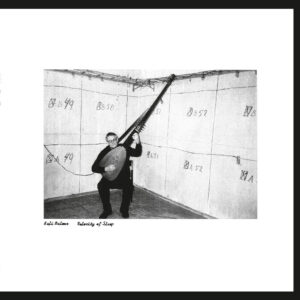
Composed, recorded and produced in Stockholm 2015-2016, ‘Velocity of Sleep’ sees Kali Malone’s work rendered in a septet of strings, gongs, lute, electronics and tape in the vast R1 Reaktorhallen (Sweden’s first nuclear reactor), the electroacoustic studio EMS, and at the Royal College of Music in Stockholm. Her presence is crucial, and liminal, making precise use of tuned sine waves and Studer B67 tape manipulation, while instrumental performance is handled by Peter Söderberg performing on the long-necked Theorbo (a large baroque lute, pictured on the sleeve), Samuel Löfdahl and Oskar Mattsson on Gongs, Vilhelm Bromander on Double Bass, Marta Forsberg on Viola and Adam Grauman on Viola de Gamba - all uniting to produce what feels like a geological time lapse and distillation of European and Indian classical drone musicks.
As far as opening solo statements go, ‘Velocity of Sleep’ is among the most memorable to have emerged this past decade from slow music and experimental classical paradigms. Its languorous yet rigorous consolidation of ideas from across the aeons crosses paths with others before her - the musics of Pauline Oliveros, Phill Niblock, Harley Gaber, Oren Ambarchi all spring to mind - but more importantly helped reset the limits of contemporary music in Malone’s own image. The 3-part, 43 minute work is an ideal example of how staid notions of early and classical music have been jettisoned to instead focus on fundamentals of tone, timbre, tuning, space and temporality with a radical and transfixing effect coolly detached from any directly traditional/sacred meanings.
Peter Söderberg’s justly tuned Theorbo plucks a slowly evolving additive pattern expanded by frippertronic tape delays on the 20 minute title piece, setting a stark tone for a quietly breathtaking resonance of gongs and floating sine waves in ‘1113’ that rest right on the biting point of sublime dissonance, while ‘In Light of Marwa’ pitches into a sort of raga-folk-drone tuned with the fine, durational intensity recalling Harley Gaber’s ‘The Winds Rise In The North’ and earthy cadence of Pauline Oliveros’ vision, yet somehow concentrated, refreshed in a way that’s best felt, and quite impossible to describe.
30,00€
Out of stock
LP
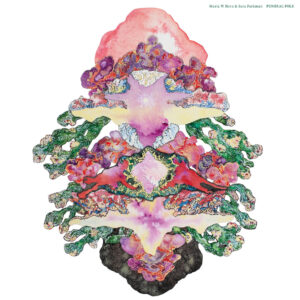
Maria W HORN & Sara PARKMAN
“Funeral Folk”
‘Funeral Folk’ pairs multi instrumentalist composer Maria W. Horn with violinist, singer and composer Sara Parkman on a soundtrack commission for Mattias Lech & Lisen Allard’s dance performance of the same name. Drawing on a shared, formative background playing in the same band as teenagers in their hometown Härnosand, Horn & Parkman naturally and skilfully collapse their worlds of influence, ranging from sacred songs and minimalist spectral music to Finnish black metal and Swedish folk, into epic arrangements for synths, zithers, hurdy gurdy, guitars, mellotrons and lamenting vocals. The results patently play into XKatedral’s love of slowly evolving harmonic and timbral sounds, but also reach to far more climactic appeal than we’ve come to expect from the label, edging on the sort of musical dramaturgy one might better expect from Anna von Hausswolff, or comparable to Okkyung Lee’s ‘Yeo-Nuen’. Stirring stuff, we tell thee.
Flocking around a mutual passion for the sort of progressive music coming from their native north Sweden as teenagers, as well as personal deep dives into their family’s Christian heritage of several generations, Horn & Parkman reassess the meaning of “rites of loss in a de-ritualised and dying civilisation” with a crafty blend of the sacred and profane guided by a heightened emotive intelligence.
Cinematic opener ‘Evighetens Sommar’ or ‘The Summer of Eternity’ establishes a grand sound stage spotlighting hushed vocals and luminous string swells, where ‘Till Margaretha’ follows with sky-clawing Finnish black metal riffs giving way to a keening Karelian vocal lament in staggering fashion. At its core ‘kyrie’ pushes this formula to its most impressively proggy peaks, and the choral vignette ‘Mementomori’ recalls Cucina Povera’s eyrie minimalism, seemingly prepping the way for the final send off ‘Hornalaten’, an unhurried 10 minutes of glistening timbral shifts and soothing drones that feels solemn yet optimistic, and as enchanting as Pauline Oliveros’ drone prayers.
33,00€
In stock

CD
INCIPIENTUM
“Study In Still Life”
Full sunken drone acousmagique from a lokey promising new Swedish artist, Incipientum, tipped for fans of Organum, NWW, Jeph Jerman, Litüus.
When iDEAL introduce a new artist to the fold it’s always worth paying attention, and Incipientum is a real one. Hailing from the bowels of Gothenburg’s underground, he makes a virtue of harnessing stark negative space and energy to his will on ’Study in Still Life’, which appears as his 2nd release and debut album, proper, after an early, super-limited CDr. Trust it’s not some overbearing drone wallow, though, instead expect a fine play of dark/light that reveals itself with full immersion.
Settling on the mind somewhere between the original post-industrial spectralism of Organum or NWW, and the likes of Lambda Sond or Litüus’s eerie chamber-like styles in the contemporary era, Incipientum trades in a very uncanny language of resonant minimalism, all shadowy tone and vaporous timbral suggestion that appears to flicker before the ear’s eye and create the eeriest sense of depth perception from ostensibly static elements.
Opener ‘The Object Of’ plumbs unfathomable, abyssopelagic subharmonics, before appearing to rise toward the light over its 12 min duration, where ‘Conveyed Visions’ feels just below the surface, bathed in refracted moonlit timbres that play out a shimmering isolationist nocturne, shoring up somewhere like a BoC vignette. ‘Orientation’ is the suite’s succinct sort of palate cleanser, introducing hallucinatory voices, and logically leads to relative relief of ‘The Object Is Terrifying’, ascending from the depths to an immanent calm, yet fraught with aleatoric interference that keeps us rapt and anticipating his next moves.
14,50€
In stock

CD
Otto MUEHL
“Musik 1982-90”
76 minutes collection of recordings made at the Friedrichshof commune between 1982 and 1990.
Performed by Otto Muehl and members of the commune.
Includes actionist group-music, improvised conceptual pieces, and barpianist-songs.
16,00€
Out of stock

2 CD
SELTEN GEHÖRTE MUSIK
“Sehr Selten Gehörte Tanzmusik”
Previously unpublished performance of the internationally renowned dance band Selten Gehörte Musik (on this occasion: Christian Attersee, Gerhard Rühm, Oswald Wiener) at the closing event of the "Literanover" Festival at the Kunstmuseum Hannover, on November 16th, 1980. Close to two hours of very rarely heard dance music, indeed.
22,00€
In stock
LP
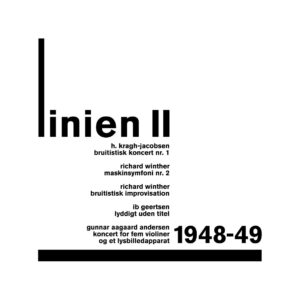
LINIEN II
“1948-49”
This release presents the earliest known Danish works of sound art. Five works from 1948-49 created by the visual artists Richard Winther (1926-2007), Hans “Bamse” Kragh-Jacobsen (1913-92), Niels Macholm (1915-1997), Ib Geertsen (1919-2009) and Gunnar Aagaard Andersen ( 1919-1982), all of whom were part of the artist group Linien II.
“This isn’t music; it is painters making noise paintings”
- Richard Winther
“One ought to be able to make a line that is free of the canvas, standing straight in the air – one ought to be able to do that with sounds”
- Gunnar Aagaard Andersen
The story of Linien II's sound experiments is a story about how a handful of young, idealistic, self-aggrandizing and silly Danish artist dandies in 1948 by a detour invented their own concrete sound art, almost exactly at the same time as radio technician and composer Pierre Schaeffer worked on developing his musique concréte in Paris – and even presented their concrete sound works to the public at an exhibition in Copenhagen before Schaeffer's first and landmark musique concréte work 'Cinq études de bruits' was premiered on French radio.
The release presents five experimental sound works that in different ways represent the artists’ attempts at finding new solutions to a set of formal aesthetic concerns in relation to concrete art by transposing them into the medium of sound. It is a story that hasn’t been told before, as the works until now have only existed in two sets of copies on the original fragile lacquer records, both of which have been locked deep inside museum archives. Now the historical sound works can finally be heard when the Institute for Danish Sound Archeology are releasing them on LP almost 75 years after their recording.
Accompanying the release, a comprehensive art historical text knits together the story about the creation and context of the experimental sound works.
25,00€
In stock

CD
MACHINEFABRIEK with Anne BAKKER
“Wisps”
On 5 April 2022 I e-mailed Anne about working on a follow-up to our album Oehoe (released by Where to Now? Records in 2020). On April 7 she recorded a bunch of violin, viola and vocal improvisations at home. Gorgeous sounds and melodies, a gold mine to work with. The material basically wrote itself. I started editing and adding electronics (mainly virtual instruments, I don’t own a real harp), and by the end of that month, the album was finished.
I always found the music that Anne and I make a bit pastoral, or eerie. Thinking about a title, will-o'-the-wisp came to mind, a ghost light in folklore. It fits the elusive quality of the music, I believe. As shorter is always better, we went for Wisps.
The cover art is a collage by Wytske van Veen. She posted the work on her Facebook page when I was busy with the album, and I immediately made the connection with the music. I love it when things fall into place like this.
So here it is, 28 minutes of (in Mariska Baars’ words) ‘pwetty weeeird’ music. Hope you’ll enjoy listening to it as much as we enjoyed making it.
Rutger Zuydervelt, May 2022
Constructed by Rutger Zuydervelt,
Rotterdam, April 2022.
Violin, viola and vocals performed
and recorded by Anne Bakker.
9,50€
Out of stock

CD
Gareth DAVIS & MACHINEFABRIEK
“Standards (Of Sorts)”
Standards (of Sorts) takes the most simple idea of the Jazz Standard, of improvising on a given theme, and puts this in a new perspective.
Using both 'standards' and how we can 'misremember' as starting concepts, rather than dive into the Great American Songbook, Gareth Davis and Rutger Zuydervelt (Machinefabriek) chose to use pieces of contemporary classical music as the material for their point of departure.
Tiny fragments of a few notes, sometimes misremembered, from various works, became the starting sounds to create something new. Five new pieces that explore not the idea of taking a theme and making a variation but rather remembering an idea and creating something out of that memory.
Clarinet and bass clarinet by Gareth Davis
Recorded between 2018 and 2020
Electronics and editing by Rutger Zuydervelt
11,00€
In stock

CD
Rutger ZUYDERVELT & Bruno DUPLANT
“Synchronicité”
"Bruno Duplant's collaborations come in two forms. As a composer, he sends a letter that doubles as a score, and looks forward to hearing what the recipient makes of his missive. As a musician, he is a true drone whisperer, capable of coaxing endless variety from elongated organ chords. That's exactly what he does to marvelous effect on Synchronicite, playing long tones that swell, loom and fade. Zuydervelt's contrasting contributions are strikingly animalistic, ranging from throaty purrs to repetitive, cricket-like chirrups. How he made them is not clear, but the effect they have is to open the windows of Duplant's virtual cathedral and let some wildlife in."
Bill Meyer, The Wire, May 2022.
__
This music can smuggle you to a dark park at night or a frosty forest in the morning, providing both comfort and anxiety. You shift to another time zone and bite into the sounds. The sounds you hear, tremble like warm air above cold sand.
It may sound both comforting and ominously dystopian at the same time, but it always holds a mysterious freshness, like traces and echoes of something fleeting and barely noticeable...
Organ by Bruno Duplant
Electronics by Rutger Zuydervelt
11,00€
In stock

CD
BAUMSCHULE
s/t
Baumschule was formed following the meeting in 2019 of three musicians with already expansive experimental practice: pianist Raphael Loher, drummer Julian Sartorius and guitarist Manuel Troller (whose solo album Vanishing Points had been released a year earlier on three:four). While Troller and Sartorius had been performing as a duo for some time, and Loher and Troller were already playing together on a more occasional basis, piecing together these three players was a first. After playing entirely improvised concerts, the trio started to explore a seemingly simple idea in the studio: to engage with a limited musical material and let it slowly unfold. A bit like planting a seed and watching it germinate. By setting themselves a set of limitations and rules, which in turn raise new musical questions to be solved, the three musicians have turned Baumschule into a creative playground which exude the sheer pleasure of playing together and listening to others.
The music which came out of the studio session is imposing in appearance: the single piece of the record is close to 40 minutes long. But truth is, it is based on a skillful balance between composition and improvisation, repeated patterns and blossoming micro-variations resulting from individual decisions, phase shifts and resynchronizations, linear progression and tabular strokes. In order to fully perceive these permanent oscillations, the trio invites us somehow to develop two simultaneous ways of listening: one that would focus on the instantaneous development of musical motifs; the other, based on the memory of forms, that would focus on the slow unfolding of the piece.
Listening to Baumschule gives a fascinating impression of musical twisting, as if their music propelled itself through a helical and upward movement. Most likely, this has to do with the fact that, while constantly reacting to one other, the three musicians seem to play on different planes and tempi: Loher works his material in a sprawling manner, Sartorius imperceptibly proliferates like a cellular network, while Troller moves forward with the regularity of a natural cycle.
If the respective trajectories of the three members seem to place them in the footsteps of a reductionist approach, one can just as easily listen to their project as a record of improvised music exploring the canvas of an invisible plan. This is to say how much the trio constantly thwarts what one may expect or discern from it: no sooner are one’s ears caught by some clear guitar lines, some elaborate texture of bowed piano strings or some identifiable rhythmic units, than the two other thirds are already reconfiguring the trio's material. Behind its apparent immobility, Baumschule ("nursery") is teeming. Behind the tree lies the forest.
Raphael Loher: Piano
Julian Sartorius: Drums
Manuel Troller: Guitar
16,00€
Out of stock

LP
Timothy ARCHAMBAULT
“Chìsake”
Chìsake [Algonquin]: to chant; to conjure; to cast a spell; this generally involves a shake-house, or shaking tent, in which the conjurer goes into a trance; the conjurer then has an out-of-body experience, going into the future to predict coming events, or into the past; as well as going into any locality in the universe to seek out someone or something generally practiced for ancestral divination.
The unaccompanied flute pieces within this album are adaptations of Anishinaabeg shaking tent chants. The Anishinaabeg also known as Anishinaabe are a group of culturally related Indigenous peoples that reside in areas now called Canada and the United States. They include the Odawa, Saulteaux, Ojibwe (including Mississaugas), Potawatomi, Oji-Cree and Algonquin peoples. The word Anishinaabeg translates to “people from whence lowered”. The Anishinaabeg origin myths describe their people originating by divine breath.
The shaking tent or conjuring lodge was the setting for a divinatory rite performed by specially trained shamans otherwise known as Chìsakewininì. During the shaking tent ceremony the Chìsakewininì would construct a special cylindrical framework typically of birch or spruce uprights planted in the ground with respective wood hoops to bind it together. This created a tensile structure of which birch bark, deer skin, or cloth was used as a covering. Rattles of caribou and deer hooves, or cups of lead shot, were tied to the frame. The floor was usually softened with freshly cut spruce boughs. The vertical axis of the shaking tent represents the realm of mediating beings, while the horizontal axis the earth or world of humans. The Chìsakewininì would enter the shaking tent at night and once inside would not be visible from onlookers. The singing of chants and drumming would summon the Chìsakewininì’s spirit helpers, whose arrival was signified by animal cries and erratic tent shaking. During this transcendent state, the Chìsakewininì could dispatch these spirit helpers or Manidò to distant regions to answer questions from the onlookers about the most auspicious places to hunt, the well-being of a distant relative, and what would happen in the future.
The chants were usually sung using vocables before, during, and after the Chìsakewininì entered the shaking tent. Like many other similar divination ceremonies, singular or collective, the opening chants begin lyrically. They gradually turn to more reductive abstract structures midway and then end in lyrical chants. This symbolizes the performer and listener leaving the external literal world, entering a more abstract state of mind, and then returning. Traditionally all songs were carved on birch bark for record-keeping with mnemonic pictographs or other marks for future use. Tally mark clustering, sometimes used for song-keeping throughout the Anishinaabeg, is used for this album’s track titles and numerical sequence.
The album intro begins with the shaking of a necklace of otter penis bone, fish spine, bear teeth, elk teeth and deer hide, gifted from Algonquin Elder Ajawajawesi. It is meant to focus the listener’s attention before the flute pieces begin. The warble or multi-phonic oscillation prevalent in the middle tracks traditionally represented the “throat rattling” vocalization of the tonic note or sometimes known as the horizon of which the melody floats off of. Due to the repetition of multi-phonic oscillation the performer will breathe erratically creating an altered state correlating with the Chìsakewininì ceremonial actions. All songs are repeated seven times to signify the seven sacred directions: east, south, west, north, above/sky, below/earth, and center.
-Timothy Archambault
*
Timothy Archambault is a Miami based Indigenous flute player, composer and architect. His repertoire includes traditional Canadian Algonquin flute songs (recorded for the Smithsonian National Museum of the American Indian Archives in 2007), early 20th-century Indigenous music and contemporary music by Indigenous composers. He has recorded extensively and received commissions from the Metropolitan Museum of Art, Agnes Etherington Art Centre, National Gallery of Art East Building, and the Winterville Mounds Association. He is a Hereditary Senator of the Kichesipirini Algonquin First Nation, a member of the Métis Nation of Quebec, First Nations Composer Initiative, and co-founder of The Creative Destruction.
21,00€
Out of stock

CD
KMRU
“Peel”
KMRU is the moniker of Joseph Kamaru, a sound artist, and producer based in Nairobi. One of the leading exponents of the burgeoning experimental music scene in Nairobi and beyond he was listed by Resident Advisor as one of ’15 East African Artists You Need To Hear’ in 2018 and is a regular performer at the fabled Nyegenyege Festival having also presented live performances at CTM festival and Gamma Festival. Peel is KMRU’s first release for Editions Mego. exquisite mix of field recordings and electronics unravelling at a repetitive and leisurely pace to expose a rich tapestry of sound that has been revered for it’s ability to cross bordear with the sheer undertow of emotional content. The subtle calming atmosphere within Peel belies the compositional prowess as layers of delicate sounds wrap around each other creating a hybrid new form ambient musics both captivating through it’s textural depth and kaleidoscopic patterns. The track titles lend themselves to the themes and mood set within: Why are you here, Well, Solace, Klang, Insubstantial and the title track. This is a deep heartfelt journey with a new strong voice being expressed through the means of organically presented electronic ambient sounds, one which reveals further layers on repeat listens.
All tracks written and produced by KMRU
Recorded and produced in Rimpa, (Nairobi, KE)
Mastered by Stephan Mathieu at Schwebung Mastering, June 2020
15,00€
In stock

LP
Peter REHBERG
“at GRM”
Shelter Press and Ina grm are pleased and moved to present two previously unreleased recordings of Peter Rehberg, two live performances given at the GRM which, each in their own way, vividly illustrate the extent of his sonic palette.
On 22 July 2021, Peter Rehberg passed away, leaving a great emptiness in his wake. Many initiatives have already celebrated or will soon celebrate his memory and the titanic work he put at the service of so many artists - a whole musical community, in fact - through Editions Mego. INA grm, Shelter Press and Stephen O’Malley, who are continuing some of the collaborative Editions Mego sub-labels (Recollection GRM, Portraits GRM and Ideologic Organ), wanted to pay tribute more specifically to the musician Peter Rehberg, and to his immense talent.
Peter Rehberg, as an artist, has collaborated with the GRM on numerous occasions, both with Stephen O’Malley (as KTL) and solo. This release features two concerts given for the GRM, each time as part of the Présences électronique festival. The first concert, given on 15 March 2009 at the Maison de la Radio in Paris, marked the first collaboration between Peter Rehberg and the GRM and the beginning of a long and fruitful friendship. The second concert took place on 6 March 2016. Between these two concerts, 7 years have passed, 7 years in which the ties between Peter Rehberg and the GRM have been strengthened, 7 years in which Peter Rehberg’s music has flourished. What is striking in these two concerts is how Peter Rehberg’s unique musical sensitivity and ‘grammar’ can be heard beyond the instruments. For while the first concert is pure laptop music, the second is extended to the field of modular synthesis. However, in both concerts, the elements that are so personal to Peter Rehberg’s music are present and combine in a layering of sonic abrasions, raw sensations and a sensitivity that is as much about formal awareness as it is about the invocation of overwhelming emotions, even though a little hidden behind a radicality that is always a bit provocative. Peter Rehberg offers us a “portrait music”, a music that gives some clues about the personality of its author and whose absence continues to deepen an inconsolable sadness.
Live performances by Peter Rehberg at le Centquatre-Paris for INA grm’s Présences électronique festival, recorded on March 15, 2009, and March 6, 2016.
Mastered by Giuseppe Ielasi
Cut by Andreas Kauffelt at Schnittstelle, Berlin
Photo by Magdalena Blaszczuk
Sleeve design by Stephen O’Malley
25,00€
In stock

2 LP
Robert TURMAN
“Flux” (clear)
"Flux" is the 1981 debut solo outing of Robert Turman, an American multi-instrumentalist and avant-garde composer. Until recently, Turman was perhaps best known for his contributions to the ballistic NON project with Boyd Rice, as well as other obscured U.S. industrial acts such as Z.O. Voider.
In the summer of 1981 Turman decided he would take a drastic turn from the noisy/electronic/industrial work of his compatriots, and began work on what is now the classic "Flux" cassette. "Flux" was originally self-released in extremely limited numbers. Weary of the noisescapes of old, he set out to create long-form minimalism utilizing kalimba, piano, "Mini-Pops Jr." drum machine, and tape loops to create a complex bed of interweaving micro-stasis'. The results of these new experiments were as beautiful as they were perplexing.
A curious dusty fidelity carries these classic tracks across four sides of vinyl, including all of the original "Flux" content. These compositions glow with a sprawling, slow motion haze that's light years ahead of its time. "Flux" reveals wide spectrums of sound from melancholic kalimba and percussion patterns to slowed down, syrupy Exotica. Turman had complex ideas in his mind yet only the simple technologies of the day were at hand. Hear the click of the stopping and starting Tascam 3340 open-reel tape machine as one hand presses the "record" and "play" buttons and the other plays piano phrases. While there are similarities in style to Classical Minimalism, Turman's sound and vision is his own and is exclusive to his limited discography.
Released in a limited edition 2xLP set, Lovingly remastered and cut by Rashad Becker at Dubplates and Mastering from the original c-60 cassette master.
Original cassette artwork and scans provided by Aaron Dilloway.
2022 repress, clear vinyl.
24,50€