
In stock

CD
Keith ROWE
“Absence”
"Friday the 6th of November 2015 was an important day for me. Christian Kobi had invited me to take part in his »zoom in« festival in Bern. Earlier that day I visited the Kunst Museum, looking at the work of Cuno Amiet (1868-1961), recalling the work of an earlier Camille Pissarro, interesting contributions from Felix Vallotton (1835-1925), also an very important exhibition of how photography had influenced Toulouse-Lautrec (1864-1901) called “Lautrec’s Photographic Eye”.
What struck me was how the fashion of the day became aged, yet the TL paintings stayed fresh, and that his drawings were fantastic. Connected to the TL photos was film of the American dancer Loie Fuller’s (1862-1928) Fire Dance. Adolf Wölfli’s (1864-1930) large work Memoriam (1926).
For my solo in the festival I used a long lapstick guitar, Boss RC-3, Boss PS-3, six band EQ, Sony ICF-SW22 and Roberts R984 radios. two contact mics, and a metal strip.
November 2015 marked the end of the first year of living with Parkinson's. During that year the right hand tremor was becoming more and more uncontrollable, to the point I could not conceive of how in the future I could manage solo performances. During that year I had experimented with different anti-shaking set-ups, in attempts to work around the tremor caused by stress and anxiety of performing solos.
It was during the 33min solo on the 6th of November in Bern that I concluded that I did not want to continue performing solos, and almost immediately from that day onwards I declined invitations to perform as a soloist. The only exception was three performances of a 20mins Click piece based on using pre-recorded material, meaning all I had to do was press the start button, these events were performed in complete darkness.
Retirement, or stepping away, is difficult and painful. It requires a recognition of certain realities, that you are not important, that the world does not care that you have stopped performing solos, actually the world does not notice that you have stopped, life outside your bubble continues, get used to it, you are not at the centre of anything. A part of the reality is to try not to leave a big mess for others to tidy up after you have left the departure lounge, retirement is an opportunity where you are able to discard all the junk you’ve accumulated.
I want to share with you a recording of that 33 mins solo from Bern before it too departs for the dustbin. An important moment in the solo is at 12:10 thru 12:21 where the Parkinson's tremor frequency (around 300bpm) can be heard, and it’s around this moment I decide not to solo again."
Keith Rowe
Mastered by Taku Unami
15,00€
In stock
CD
Yan JUN / Zhu WENBO
“Twice”
Yan Jun:
time assignment for layer B
voice on layer A
field recording with fingers and steps on layer B
Zhu Wenbo:
time assignment for layer A
snare drum, digital piano, upright piano, clarinet, audio signal generator on layer A
printer, cassette duplicator, scanner, audio signal generator, taped mandolin on layer B
Yan Jun: recorded in Beijing, Feb 2021
Zhu Wenbo: recorded in Qingdao and Beijing, Sept 2020 - Feb 2021
15,00€
Out of stock
CD
Anastassis PHILIPPAKOPOULOS
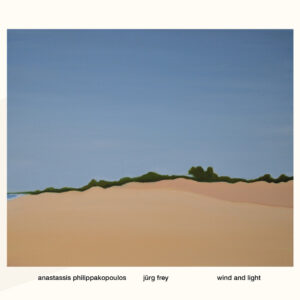
“Wind and light”
Greek composer Anastassis Philippakopoulos has been a member of the Wandelweiser composers collective since 2003. He pursues his own compositional style to create a new kind of tonal music, deeply associated with his individuality and the surroundings of his life in Athens, a unique blend of stoic minimalism, the warm colors of modern romanticism, and the introspective depth of Zen.
"For many years I have concentrated my attention on modal monophonic melodies. In my pieces I want to bring a balance between western and eastern musical traditions, but also between remote past and present. This balance is subjective. I care a lot to find a connectedness between the tones of the melodies. The deeper the connectedness I gradually find, the more simple and plain seems the melody." (Anastassis Philippakopoulos)
‘wind and light’ consists of four solo clarinet pieces and three solo piano pieces written by Philippakopoulos, inspired by nature in Greece. The clarinet pieces were performed by Swiss composer/clarinetist Jürg Frey, recorded in Athens in 2016, and the piano pieces were performed by Philippakopoulos himself, recorded in Athens in 2019 to complete this album.
“When I was listening to the seven pieces together, I experienced this feeling of ‘landscape/bell in a distance'. I hear the clarinet as the breath of a human being, and the piano as the sounds in the landscape I hear from a distance. This duality opens a wide space, and I was really surprised when I listened to this for the first time, because I didn't expect something like that in the context of an album, a poetic relationship between the human and the landscape.” (Jürg Frey)
15,00€
Out of stock

CD
Melaine DALIBERT
“Night blossoms”
'night blossoms' is French composer/pianist Melaine Dalibert’s sixth solo album, consisting of new compositions from 2019-2021. Of the six pieces on this album, 'A Rebours', 'Windmill', 'Eolian Scape', and 'Sisters' were written around the same time as most of the pieces for his 2020 album 'Infinite Ascent'. While 'Infinite Ascent' featured his intuitive compositions in a pop style, 'night blossoms' features works further developed with his algorithmic approach, which has been his long-term pursuit as a composer.
'A Rebours', which is a cousin to his 2019 piece 'Litanie', was written based on a binary coding of the retrograde sequence. 'Windmill' was composed based on a cellular automaton that generates patterns on a Lydian scale. 'Eolian Scape' is a toccata-style piece that makes a chain of different polyrhythmic states progressively integrating all the notes of the modal scale. 'Sisters', originally written for two pianos, takes the form of a canon, with the patterns of different periodicities superimposed, creating an undulating polyrhythm that gradually changes harmonic colors. The first three pieces were played on a muted upright piano to control the harmonic saturation which could result from the repetition of the patterns at a fast tempo, creating intimate colors.
The two pieces 'Yin' and 'Yang' are based on a random melodic thread running through the keyboard, with a zigzag of rising and falling musical intervals but following strict rules. Only the notes of the pentatonic mode of F-sharp mode (black keys) were played in 'Yin', while only those of the pentatonic mode of C (white keys) were played in 'Yang'. Deriving from the same algorithm, these two pieces complement each other while having different forms.
“Since my composition of 'ressac', I had the idea in mind to add a kind of electronic shadow, supporting the long moments of resonance, as a free counterpoint to my most minimal algorithmic compositions.” (Melaine Dalibert)
In response to Dalibert’s idea, David Sylvian contributed his sound work to 'Yin' and 'Yang', delicately fluctuating and echoing electronic shadows of piano tones, adding depth and dimensions to Dalibert's algorithmic compositions.
The album title 'night blossoms' was conceived by Sylvian, who also contributed his artwork for the album cover, as he also did for all three of Dalibert’s previous elsewhere CDs: ‘Musique pour le lever du jour’, ‘Cheminant’, and ‘Infinite Ascent’.
15,00€
In stock

2 LP
ORA CLEMENTI
“Sylva Sylvarum”
Black Truffle is pleased to present Sylva Sylvarum, an epic new work from Ora Clementi, the collaborative project of crys cole and James Rushford. Primarily conceived and recorded over several months together in Melbourne, Sylva Sylvarum is a stunning step forward from the mumbled, creaking sound world of the duo’s debut, Cover You Will Softer Me (Penultimate Press, 2014). From the opening ‘Peach of Immortality’, which takes an unpredictable journey from layers of chiming bells, vocal harmonies and lush synth pads to a desolate landscape of half-animal, half-digital wooshes and cries, it is immediately clear that cole and Rushford are working here with an entirely unique sound palette. Throughout the record’s four sides, we hear a large array of carefully detailed synthesizer sounds (many of them recorded at the remarkable Melbourne Electronic Sound Studio), sparse drum machine hits, wind instruments and field recordings of animals, often with a twistedly late 80s/early 90s flavour that at various points calls up New Age references, Robert Ashley’s later operas or the thinned-out textures of early digital GRM.
Threaded through this distinctive array of sounds are the two musicians’ voices, sometimes singing, sometimes speaking through varying degrees of manipulation. A guiding thread through the pair’s collaboration, beginning with their initial experiments with lip-readings, the presence of these two voices – cole’s crisp and sibilant, Rushford’s rich and low – reinforces the sense that the music is immersed in itself, less performed by two people than occurring between them. On Sylva Sylvarum, these voices first come to the forefront on the third piece, ‘Dialogue Between a Grandmaster of the Knights Hospitaller and a Genoese Sea Captain’, where in unison they intone fragments of a description of an imaginary space taken from a 17th century utopian text. The two voices resurface periodically thereafter, most stunningly in the unexpected turn into cushiony dream pop on ‘Magic Mountain’. At other points, the subtle manipulation of pitch and intonation in the close-miked vocal performances filters the recitations through a fog of abstraction that climaxes with the almost incomprehensible alternating syllables of the side-long closer ‘Forest of Materials’.
Like the album’s title, these textual elements are drawn from various literary descriptions of utopias, a theme that also informed the pair’s musical approach. Far from anything dryly illustrative, utopia figures into Sylva Sylvarum as an invitation to inhabit otherworldly spaces that, like the empirical details that proliferate in these literary utopias, are grounded in mundane reality but shot through with the eldritch. Admirably framed by the abstracted digital topographies of Sabrina Ratté’s artwork, the uncanny sweep of the album’s fifteen pieces is expansive enough to take in stretches of crackling austerity, warped microtonal keyboard etudes and moments of stunning beauty, the latter most strikingly when cole and Rushford are joined by Callum G’Froerer on trumpet and Joe O’Connor on trombone for a series of dream-like moments moving from growling overtones to poignant lyricism.
21,50€
In stock

2 LP
Remko SCHA
“Guitar Mural 1 feat. The Machines”
Black Truffle is pleased to announce the first-ever vinyl reissue of Remko Scha’s Guitar Mural 1 featuring The Machines, originally published as a rare cassette edition by Taal Beeld Geluid in 1982. A computational linguist by profession, Scha played an important role in the development of sound, installation, and digital art in the Netherlands from the late 1970s onward, co-founding the performance and exhibition space Het Appolohuis in Eindhoven in 1980. Alongside Paul Panhuysen and Jan Van Riet, Scha was a founding member of the radical improvisation group The Maciunas Ensemble, though he is best known for his work with mechanised electric guitars, documented on the legendary 1982 LP Machine Guitars.
Guitar Mural 1 documents an installation of Scha’s mechanical guitar ensemble The Machines held at a Groningen gallery space in 1982. Five electric guitars hang from the wall, their strings sounded by rotating rubber strings and a sabre saw controlled by a mechanical apparatus, as well as four ropes criss-crossing the five instruments on the wall. Once the mechanism was set up, Scha’s only intervention was to vary the speed at which it operated. Where Machine Guitars presents short excerpts clearly distinguished by rhythmic and timbral variation, here we are confronted with four enormous side-long slabs of percussive string attack and the resulting clouds of harmonics. Variation is minimal across the duration of each side, making for a sculptural listening experience, as if we are patiently examining each facet of a static object. But significant variety exists between the four sides, each of which shows off a different facet of what The Machines were capable of. The first two excerpts feature open strings sounded at rapid tempos, dissolving the percussive attack into a continuous stream of sound reminiscent of Charlemagne Palestine’s ‘strumming’ technique. On the third side, the strings are partly muted and the tempo slightly lowered, resulting in layers of relentlessly chugging rhythm somewhere between an ensemble of hand drums and an early Velvet Underground bootleg. On the fourth side, havoc breaks loose in percussive waves of asynchronous repetition that bring Scha’s sound world close to that of another pioneer experiment in musical mechanisation, the Solar Music of Joe Jones.
Presented as a limited edition 2LP set in a deluxe gatefold sleeve accompanied by stunning visual documentation of the original installation, remastered audio and new liner notes from Alan Licht and Van Lagestein, Guitar Mural 1 is an exhilarating document occupying a unique space between kinetic sculpture, hardcore minimalism and rock & roll.
25,00€
Out of stock

LP
Sam DUNSCOMBE
“Outside Ludlow / Desert Disco”
Outside Ludlow / Desert Disco is the first major solo release from Australian performer-composer Sam Dunscombe, now based in Berlin after residing for the past decade in San Diego and Tokyo. A virtuoso clarinettist who has performed in composed and improvised settings with artists such as Klaus Lang and Taku Sugimoto, their practice also embraces computer music, lo-fi electronics and field recordings, in addition to their long-term commitment to archiving, studying and performing the work of Romanian spectralist composer Horatiu Radulescu.
The two side-long pieces presented on this LP began from a chance encounter in a specific geographic location (documented in the photographs that grace the record’s sleeve). Exploring California’s Mojave desert with a friend, Dunscombe made the unlikely discovery of a tangle of quarter-inch tape snared on a cactus. The digitised version of this tape, variously edited and processed, as well as Dunscombe’s own transcription and embellished performance of some of its material on Hammond organ, makes up one of the main ingredients of the LP’s first side. The other is a field recording of the area outside the ghost town of Ludlow, where the tape was found, where haunted silence is punctuated by freight trains and clusters of explosions from gold mines and the local marine corps. Far from any kind of documentary approach, the resulting composition reaches back to the smeared atmospherics and overdriven tape crunch of Hands To, Small Cruel Party or Joe Colley, before the Hammond organ rises up to cast a spectral shimmer reminiscent of 1960s tape music classics like Arne Nordheim’s ‘Warszawa’.
On ‘Desert Disco’ (its title perhaps a clue to the content of the mysterious tape), Dunscombe zeroes in on a single fragment of the tape, accompanying it with analogue synthesis to craft an immersive work based on a single chord. Throughout the course of this work, the monolithic opening sonority gradually splits apart, revealing an infinity of rhythmically phasing lines that swarm like a cloud of insects and patter like falling rain, placing Dunscombe’s piece in a lineage of patient electronic exploration that includes landmarks like Costin Miereanu’s Derives and the contemporary work of Jim O’Rourke.
20,00€
In stock
2 CD
Dave SEIDEL
“Involution”
From the liner notes by Dean Rosenthal: XI Records announce the release of Dave Seidel's new double-CD, Involution. The work contained on this recording represents Dave Seidel's second foray into the realm of releasing a full-length recording. But this new milestone was not reached until he had long immersed himself in the experimental scene in NYC in the 1980s and 1990s, working closely with established experimental music pioneers Lois V Vierk and Guy Klucevsek among others. Seidel's own composing and performing grew, blossoming into live performances in the 2000s and 2010s, allowing further exploration into programming and experimenting with sonority and algorithmic sonification. What we hear on this recording is the care and detail of his passion for these two features of composition and a steady integration of them. This leads us to the two pieces heard here: "Involution" and "Hexany Permutations". In thinking of sonority, Seidel has spoken of the strong influence of La Monte Young's use of perfectly-tuned intervals and Young's ideal of previously unheard sounds, those that may engender new sensations and emotions in the listener. But Seidel also confirms the influence of the work of Alvin Lucier, in particular the Orpheus Variations. For Seidel and his sonorities, he has found little use for the 12-note chromatic tempered system, no doubt the ubiquity of this universal tuning of Western music having too few possibilities for his ear. The question then appears: how does he apply this desire to explore new forms of sonority outside the well-tempered system and, for our purposes, in these pieces? The first CD in this set presents Seidel's composition "Involution", heard in three sections. The music is presented as an expansion of slowly-changing sonorities that explore the harmonic spaces inherent in certain microtonal tunings and scales, or modes within those tunings. Each section employs a different tuning and a different set of scales or modes and uses a combination of all the different technologies Seidel has been working with over the past several years: Csound, modular synthesizer, and pedals. "Hexany Permutations", the music that the second CD of this release contains, hints at the same concerns of sonority heard in Involution but tackles the composing slightly differently, with musical results of differing proportions. In this piece, the structure of the piece plays an equal if not more dominant role than the microtonal sonorities explored.
14,00€
Out of stock
LP
Frantz LORIOT
“While Whirling”
On While Whirling, French-Japanese violist Frantz Loriot unleashes the essence of the viola as an explosive expressive force. Pushing the instrument to extremes, he ceaselessly explores its most subtle and unexpected sonorities. From a single acoustic string instrument, he miraculously teases and evokes hallucinatory impressions of harpsichords pounded, bells struck, electronics cracked, dirt shoveled; Loriot has created a unique, personal music filled with moments of textured transcendence and tension-filled tenderness. While Whirling is Loriot's second solo album and a masterclass on how to develop a radically personal musical language. As a third-generation classically-trained musician, Loriot's rupture with that tradition is striking as he continues to challenge every pre-conceived relationship between instrument and instrumentalist. Having first been inspired to rethink the physicality of musicianship by hearing Tom Cora's playing on his collaboration with the Dutch punk-rock band The Ex, Loriot sought out a series of teachers that could further expanded his sense of the musically possible/possibly musical. From Joëlle Léandre, he was opened up to the combination of aesthetics and politics; from Barre Phillips and his "large calm energy," Loriot learned about the necessity to get uncomfortable in his music-making. And from David S. Ware, he took an understanding of music as a matter of life and death. To his biological and pedagogical foundations in classical music, Loriot supplemented his understanding of music's force with realizations of vitality, awareness, and danger. While Whirling was recorded in the acoustically balanced space of Das Institut in Zürich, a small, intradisciplinary art space with angled walls on the top floor of a residential building on a quiet street. Because Loriot knew that he wanted to focus on both capturing and unspooling specific acoustic phenomena that he sought to manifest, he had to choose a place that would be ultra-conducive to intense focus, yet still casual enough to make room for life to burst in. As a sequence of solo excursions, each track on While Whirling rewrites the balance between improvisation and composition. The drama of Loriot struggling to complete a sequence after arriving at a texture he so clearly strove for puts the listener in an extremely privileged position; you have the pleasure of hanging on to each desperate subtlety of his decision-making process as he pushes himself and his music further and further across the vanishing edges of ever-expanding horizons. Deluxe LP with download; Heavy tip-on jacket with embossing and spot finishes; Full color inner sleeve and insert.
23,00€
Out of stock
2 LP
Jean-Luc GUIONNET
“L’épaisseur de l’air”
Thin Wrist Recordings release L'épaisseur de l'air (the thickness of air) by Jean-Luc Guionnet. After more than three decades playing the alto saxophone, this is the French artist's first solo saxophone album. Since the 1990s, Guionnet has built a renowned and thrilling oeuvre of works with pipe organs, electronics, and field recordings as both an improvisor and composer; L'épaisseur de l'air finally documents his dedication to exposing sides of the alto saxophone that quite simply never existed until he developed them. His tone is as clear as direct sunlight, so when he boils it in mud or scratches at it as if for air, his emotion is palpable. A double-LP masterpiece and a definitive statement about the profound physical relationship between an improvisor and their instrument. A student of Xenakis at the Sorbonne, Guionnet has constantly explored the philosophical side of music; his work interrogates fundamental questions about skill, intuition, experience, and performance that arise through improvisation. He has instigated and featured in unexpected collaborations such as performances with noted British philosopher Ray Brassier and artists Seijiro Murayama Mattin as well as his long running artistic partnerships with dancer and choreographer Lotus Edde Khouri. For this album, Guionnet retreated to a barn in Brittany, where he recorded by himself at night over the course of a few weeks. Each of the nine improvisations -- spanned across two LPs -- uncovers such particular sonic territory that it's a miracle the whole adds up to such a complete statement. But by pushing space and silence so startlingly and oblongly into the pieces, the gnarled, gritty textures of his tone begins to make sense as a response to time that is forever shifting in such unpredictable ways that you better get into it while it's still coming out. Direct metal mastering at Calyx Mastering Berlin. Pressed at Record Technology, Inc. (RTI). Deluxe gatefold double LP with download; Heavy tip-on jacket including debossed and embossed inserts.
34,00€
Out of stock

LP
Yoshi WADA
“The Appointed Cloud”
Saltern present the first-time vinyl edition of Yoshi Wada's The Appointed Cloud (1987), a work which Wada has often said is his favorite of his own. Staged at the Great Hall of the New York Hall of Science, The Appointed Cloud was Wada's first large-scale, interactive installation and featured a custom pipe organ, among other homemade instruments, controlled by a computer with a customized interface and software designed by engineer David Rayna, known for his work with La Monte Young. This recording captures the opening performance for which Wada brought together four musicians on bagpipes (Wada, Bob Dombrowski, and Wayne Hankin) and percussion (Michael Pugliese) to perform with the installation, operated by David Rayna. Remastered from the original master tape by Stephan Mathieu, and cut to vinyl via Direct Metal Mastering by Hans-Jörg Maucksch at Pauler Acoustics. Pressed at RTI and printed at Stoughton. Includes a digital download of the album. Edition of 600.
In Wada's own words: "This performance [of The Appointed Cloud] was one of most memorable performances I've done. The space itself -- the Great Hall of the New York Hall of Science -- was incredible. The building was designed for the 1964-65 World's Fair and had spaceships hanging from the ceiling so people felt like they were traveling in outer space. It was an amazing experience with the sound of the pipe organ, sheet metal, pipe gong, and bagpipes all together. 60 minutes may seem like a long duration, but it didn't feel like it."
26,00€
Out of stock

Book + CD
David TOOP
“Field Recording and Fox Spirits”
Field Recording and Fox Spirits is a collection of personal recordings -- from the field, from performance, from interviews -- that sketch out the breadth of David Toop's work over the past five decades. The recordings exist both as individual memories and as a hazy auditory daydream-like collage woven together by Lawrence English. Additionally, the edition includes a 40-page book, consisting of an extended in conversation with David Toop, which features extensive visual works and photographs from his archive.
From David Toop: "What are field recordings? 'My memory is not what it used to be, David,' my grandfather, Syd Senior, said to me as we huddled round a fireplace in 1979. Thanks to a cassette tape I have the memory of his gradual loss of memory, hearing him speak of Queen Victoria's funeral and the severity of patriotism back in those old days, 1901. Syd Senior is long dead, no longer part of the field of living relations but still within the field of memories that can be revived by technology, albeit an old one that squeaks like a mouse, hisses like a cat. Where is the field? The field is populated by all the ravishing, painful, poignant, nondescript moments of remembered life. Field recordings forget, just as memories forget. My recording of Ornette Coleman forgets that he fell asleep as we were talking together. I sat quietly, waiting for him to wake; the tape machine continued its work, oblivious. During lockdown, a warm spring day, I sat working in the garden. A small fox appeared close to me, started, retreated into the shelter of plants by my pond. I took a photo with my phone but when I looked at the image no fox was visible. Earlier that day I had been reading Strange Tales from a Chinese Studio, a collection of short stories written by Pu Songling during the course of his life in the late seventeenth/early eighteenth century. In many of these tales, fox spirits inhabit the physical spaces of living humans in a variety of guises. Some are malicious; some benign. Their presence in the material world is wrong and yet accepted as either a temporary nuisance or a blessing that would later be regretted..."
18,00€
Out of stock

LP
Philip CORNER
“Through Mysterious Barricades with George Maciunas”
New Philip Corner LP on Recital. Voice recordings from a small performance in Italy, early in 2020 -- Homages to/from George Maciunas (1931-1978). Corner's piano meditative playthroughs of Couperin's The Mysterious Barricades (1717), from 1989 and 1992. These two elements (voice and piano) superimposed by Sean McCann, edited during the first month of the pandemic. Manic exaltation, distorted harmony things. Album cover is a few PC scores soaked in olive oil and held in-front of the sun through my kitchen window. Booklet features passionate writings on the Couperin piece and its meaning by Corner. Philip wrote a new reflection for this LP edition, "The Mesure of the Mystery". This album is built from the finest ingredients: beautiful piano with stomach-c
lenching voice stretches. Edition of 250; 12-page pamphlet of scores and an essay by Corner.
27,00€
Out of stock
LP
Bill ORCUTT & Michael MORLEY
“Electric Guitar Duets”
LP reissue of Land And Sea's limited 2016 tape documenting a performance by guitarists Michael Morley and Bill Orcutt at the L&S gallery in Oakland.
"... Once regrettable antics were permanently affixed to the rearview mirror, the pair chauffeured across the bay to Land And Sea, the cozy gallery on San Pablo Avenue in Oakland and sobered up on vegan cocktail wieners and gummie vitamins. You may doubt, you may scoff -- have fun with it, champion, seriously -- but on July 6, 2016, they rendered a landscape where miniature squalls grind in between seamlessly intersecting improv, and they did it sharp as the slap of a palmful of plum-colored hazelmyer elixir following a good, close shave. The distinctive sound of the Fender Telecaster as played without effects by Orcutt ('one of music's premier abstractionists,' according to Osmo Montesanto) remains unblunted throughout the album, an aggressively serrated presence within Mr. Morley's contrapuntal flanking. This freely improvised performance is imbued with discipline and deliberate restraint, the better to connect the players more to the sound than to the instruments . . . The duo's number-one fan worldwide Cye Husain, pictured on the back cover, would surely attest that the singular structure-building of Orcutt and Morley defies and transcends most any 'well, actually' bloviature that the usual bore-splainers will need to hurl into the troposhere. For instance, that a third guitar is clearly audible at certain parts in the mix -- beautifully recorded by Gabie Strong, by the way -- can be accounted for most sensibly by Aotearoan metaphysics. Mr. Morley's ax of choice was 'Patu Tutae Opoko Nui, a 2006 Squire Telecaster made in Indonesia that I had modified over the years. It died and was ushered up to Valhöll in Gothenburg, Sweden in 2018.' Readers opting to take a moment to refer to Morley's Instagram post dated 6 June 2018 and view the last rites of this extraordinary combination of wood and metal should do so now. He cried. You should expect to do the same . . . Electric Guitar Duets is that otherworldly modulation we all crave and rarely find, hovering halfway between a deeply satisfying lattice of blurred sky roars and the soundtrack from a Stefan Jarworzyn biopic scored by Sergio Leone left on the floor out of its sleeve. Morley and Orcutt hold everything sideways at least as well as the centrifugal force required for slow-motion footage of mannequins riding tiny motorcyles around the inside of a chrome replica of Lee Van Cleef's skull. For other examples of fluid-splattered shards glistening inside crimson murk pulsations, only murder rolling through cold, cold blood comes to mind as superior to this 44-minute live recording." --S. Glass
21,00€
Out of stock

CD
Robert ASHLEY
“Foreign Experiences”
This new release from Lovely Music features Robert Ashley's famous ensemble, the "band" who interpreted his work for 20 years, from 1992 through 2012. They included Sam Ashley, Thomas Buckner, Marghreta Cordero, Tom Hamilton, Jacqueline Humbert, Joan La Barbara, and Amy X Neuburg. This recording was made at the Hebbel Theater, Berlin on May 12, 1995. The opera was also heard live at the Festival d'Avignon, the Brooklyn Academy of Music, Musica Strasbourg, and Site Santa Fe. Foreign Experiences is one of the opera tetralogy that Ashley wrote in the early 1990s, following Perfect Lives (LCD 4917CD/LDVD 4917DVD) and Atalanta (Act of God) (LCD 3301CD, LCD 3303CD). He would give it the overall title (also the name of one of the component operas) Now Eleanor's Idea. These four operas would follow the stories of some of the characters who populated Perfect Lives a decade earlier. We met Don last year when Lovely Music released a CD of a new Ashley "band" performing Improvement (Don Leaves Linda) (LCD 5002CD) at the Kitchen, New York. In Foreign Experiences "Don gets a job at a small college in the southwest. Once there, against all expectations, everything goes wrong. He loses his family and friends, he loses his car, he fears that he will lose his mind." He comes to believe that he has been given a mission, to learn about premonitions and he embarks on a journey to find the wise man who will give him priceless information. Linda thinks he plan is foolish; Don thinks he has no choice. But is the opera really "about" Don and Linda? "Opera likes to simplify and enlarge its characters to make them fit grand themes. Mr. Ashley goes in the opposite direction and arrives at the cosmos just as easily. Mundane chitchat about good eating habits or car repair turns to metaphysics, ontology, epistemology, not to mention psychiatry, before we know it." -- Bernard Holland, The New York Times (November 21, 1994) The live recording was made by Tom Hamilton and Cas Boumans, and this release has been edited mixed by Tom Hamilton. A slipcase includes a jewel case with a four-page folder, and a 96-page booklet of the full libretto.
18,00€
Out of stock

3 CD
David FIRST & THE WESTERN ENISPHERE
“The Consummation of Right and Wrong”
David First likes to use the phrase "the virtuosity of slowness" to describe his musical philosophy. In The Consummation of Right and Wrong, he and his eight-piece ensemble, The Western Enisphere, practice this virtuosity to great effect in closely examining the universes that fall between the cracks of convention, reflecting a wide continuum of complex relationships, all the while creating music that is simply ravishing to listen to. This is "drone music" as dynamic organism, moving from compact and ruminative to spacious and serene and back. In this triple-CD, two-and-half-hours of sonic tessellation, First has alchemized his own personal opposites like never before, combining and transmuting his free-jazz experience with avant-legend Cecil Taylor, his influential noise-rock n' roll band Notekillers, his long-abiding love for minimalist, mathematical excavation on dozens of instruments, and a highly refined ear for pop-melodic architectures into a singular, epic set of vibrational possibilities that leaves very few stones unturned in his ongoing quest for the resolution of all extremes.
18,00€
Out of stock

CD
Caterina BARBIERI
“Born again in the voltage”
“Born Again In The Voltage” is an astonishing collection of electro-acoustic pieces for Buchla 200 system, cello and voice composed and produced by Caterina Barbieri at Elektronmusikstudion (SE) between 2014 and 2015. Edition of 500.
Music produced by Caterina Barbieri between August 2014 and August 2015.
Recorded and mixed at EMS (Elektronmusikstudion) in Stockholm (SE).
Buchla 200 modular synthesizer + vocals + cello.
Cello by Antonello Manzo
Includes the bonus track "Bestie Infinite" from her 2018 split LP with Eleh.
13,00€
Out of stock

CD
Caterina BARBIERI
“Patterns of Consciousness”
Patterns Of Consciousness is the powerful second full length album from analog synth composer Caterina Barbieri. Gorgeous high resolution analog textures and algorithmic melodies unfold under Barbieri's careful control, exploring the basic nature of sound and consciousness. These pieces are minimal in arrangement but maximal in presence asserting Barbieri as a unique voice in contemporary electronic music composition. Highly recommended to fans of Alessandro Cortini and Eleh.
13,00€
Out of stock

CD
Judith HAMANN
“Music for cello and humming”
Nomadic Australian cellist and composer Judith Hamann presents two collections of her sonic inquiries into shaking and humming. Her CD, Music for Cello and Humming, features two pieces for cello and humming written specifically for Hamann by composers Sarah Hennies and Anthony Pateras alongside Hamann's own "Humming Suite" and "Study for Cello and Humming." Having arisen intuitively from Hamann's investigations into shaking, just intonation, psychoacoustic phenomena, and the voice in relation to the femme presenting body in performance, humming here also references dislocation, or ventriloquism. Although teetering on the edge of audibility, the intimate and vulnerable closed-mouth sounding enters into subtle interference with her cello, drifting into acoustical beating and bringing instability to otherwise more formal grid structures. The capacity for rupture of this volatile fragility reaches its apotheosis on Hennies' "Loss," a piece that deliberately instructs Hamann to hum beyond the limits of her voice range. Going against the grain of chamber music orthodoxy, the guaranteed failure set in motion by this instruction yields a generative sound of effort reminiscent of Xenakis's storied desire for an instrumentalist to play with the sorrow of knowing they can't do everything. With an arc suggestive of sudden life change, "Loss" casts queer epistemology onto composition, positioning failure, undoing, unbecoming, and transforming as alternative ways of knowing or being. Hennies's signature composite merging of individual components here brings oral sounds that include breathing and coughing together with humming, cello, and sine waves. Like Glenn Gould's 1982 Goldberg Variations or Pauline Oliveros's Accordion and Voice, this timbral meeting of bodily utterances with consummate musicianship imbues Hamann's humming work with a breakable, human strand, here as humbling as it is uncomfortable. Music for Cello and Humming is accompanied by an essay on both recordings by Nora Fulton. It's presented alongside the LP set, Shaking Studies (BF 017LP). Judith Hamann undertook her doctoral studies with renowned cellist Charles Curtis, with whom she is currently engaged in a discourse-based project, "Materialities of Realisation." She has additionally demonstrated a superlative capacity for improvisation and engagement with sonic arts through work with artists Dennis Cooper, Éliane Radigue, Áine O'Dwyer, Ilan Volkov, Toshimaru Nakamura, La Monte Young, and Marian Zazeela, Golden Fur, Jessika Kenney, Anna Homler, Yvette Janine Jackson, and Lori Goldston, among others. Her recorded appearances include Tashi Wada's Duets, Graham Lambkin's Community, Alvin Lucier's Illuminated By The Moon, and Gossamers, with Rosalind Hall. Edition of 500.
17,00€
In stock

LP
Judith HAMANN
“Shaking Studies”
Nomadic Australian cellist and composer Judith Hamann presents two collections of her sonic inquiries into shaking and humming. Her LP, Shaking Studies, is a collection of iterative cello performance that foregrounds shaking as a generative subject. In addition to an arsenal of techniques for registrable shaking, Hamann's conception of the term emphasizes micro and macro pulsing, including tremors, vibrato, wolf tones, and complex partial activity. Hamann begins with a sphygmological reading of the pulse of her cello, inciting it to shake audibly and visually as a symbiotic basis for determining the rate of her own left hand's tremor and consequent direction of resonant frequencies. Following a thorough harmonic investigation of her shaking practice in two parts, she directs us to look outwards, combining beating chordal structures with electronics and recordings of real world shaking. From inner pulse to more macrocosmic quaking, Hamann's alternative conception of shaking rejects measurement and regularity, order and control, instead alluding to a more responsive and intuitive mode of convulsive sounding. It's presented alongside the CD set, Music for Cello and Humming (BF 018CD). Judith Hamann undertook her doctoral studies with renowned cellist Charles Curtis, with whom she is currently engaged in a discourse-based project, "Materialities of Realisation." She has additionally demonstrated a superlative capacity for improvisation and engagement with sonic arts through work with artists Dennis Cooper, Éliane Radigue, Áine O'Dwyer, Ilan Volkov, Toshimaru Nakamura, La Monte Young, and Marian Zazeela, Golden Fur, Jessika Kenney, Anna Homler, Yvette Janine Jackson, and Lori Goldston, among others. Her recorded appearances include Tashi Wada's Duets, Graham Lambkin's Community, Alvin Lucier's Illuminated By The Moon, and Gossamers, with Rosalind Hall. Edition of 500.
21,50€
Out of stock

2 LP
Catherine Christer HENNIX – CHORA(S)SAN TIME-COURT MIRAGE
“Blues Alif Lam Mim”
Having already unearthed three collections of archival 1970s recordings by Catherine Christer Hennix, Blank Forms continues their annual illumination of the visionary Swedish composer's music by turning to more recent work with this first-time vinyl edition of Hennix's Blues Alif Lam Mim in the Mode of Rag Infinity/Rag Cosmosis, a 2014 piece first released as a CD in 2016. The double album captures the April 22, 2014 premiere of the composition by the Chora(s)san Time-Court Mirage, Hennix's expanded just intonation ensemble, featuring a brass section of Amir ElSaffar, Paul Schwingenschlögl, Hilary Jeffery, Elena Kakaliagou, and Robin Hayward; live electronics by Stefan Tiedje and Marcus Pal; and voice by Amirtha Kidambi, Imam Ahmet Muhsin Tüzer, and Hennix herself. Intended to reveal the origins of the blues in the Eastern musical traditions of raga and makam, Blues Alif Lam Mim in the Mode of Rag Infinity/Rag Cosmosis has its roots in Hennix's 2013 realization of an Illuminatory Sound Environment, a concept developed in 1978 by anti-artist Henry Flynt on the basis of Hennix's own The Electric Harpsichord. As Hennix explains in Other Matters, Blank Forms' 2019 collection of her writings: "Rag Infinity/Rag Cosmosis presents fragments of 'raga-like' frequency constellations following distinct cycles and permuting their order, creating a simultaneity of 'multi-universes.' When two such 'universes' come in proximity of each other and begin unfolding simultaneously along distinct cycles, there is a kaleidoscopic exfoliation of frequencies as one universe is becoming two, but not separated -- the effect of cosmosis is entrained, binding two or more frequency universes into proximity where their modal properties interact and blend, creating in the process entirely new microtonal constellations in an omnidirectional simultaneous cosmic order with phenomenologically 'transfinite' Poincaré cycles (cyclic returns to initial conditions). As with Hennix's best work, the organic unfolding of this quivering drone belies a precision that opens onto the infinitesimal. Over this mesmerizing ebb and flow, vocalists incant an Arabic-language devotional poem written by Hennix that features quotations in praise of Allah from the Quran. Also reproduced on the album's gatefold jacket is Hennix's elegant reduction of the sacred text, represented as the first letter of its first line gradually paired down to a single dot, which invites the contemplator to bring their inner knowledge to the composition for use as a meditation prompt. Listeners without spiritual inclinations, but who are willing to immerse themselves in the music, will find the work's serene intensity to be its own reward."
36,00€
Out of stock

book + 2 CD
Steve RODEN
“…i listen to the wind that obliterates my traces”
*** 2021 restock ***
Edited by Steve Roden. 184 page hardback book with 2 CDs. 150 full-color photographs. The CDs feature 51 vintage recordings from 1925-1955.
“… i listen to the wind that obliterates my traces brings together a collection of early photographs related to music, a group of 78rpm recordings, and short excerpts from various literary sources that are contemporary with the sound and images. It is a somewhat intuitive gathering, culled from artist Steve Roden’s collection of thousands of vernacular photographs related to music, sound, and listening. The subjects range from the PT Barnum-esque Professor McRea - “Ontario’s Musical Wonder” (pictured with his complex sculptural one man band contraption) - to anonymous African-American guitar players and images of early phonographs. The images range from professional portraits to ethereal, accidental, double exposures - and include a range of photographic print processes, such as tintypes, ambrotypes, cdvs, cabinet cards, real photo postcards, albumen prints, and turn-of-the-century snapshots. The two CDs bring together a variety of recordings, including one-off amateur recordings, regular commercial releases, and early sound effects records. there is no narrative structure to the book, but the collision of literary quotes (Hamsun, Lagarkvist, Wordsworth, Nabakov, etc.). Recordings and images conspire towards a consistent mood that is anchored by the book’s title, which binds such disparate things as an early recording of an American cowboy ballad, a poem by a Swedish Nobel laureate, a recording of crickets created artificially, and an image of an itinerant anonymous woman sitting in a field, playing a guitar. The book also contains an essay by Roden.”
37,00€
Out of stock

CD
Aki ONDA / Nao NISHIHARA
“Kouya-e-to”
ki Onda has lived and based his activities in New York for many years. His solo work includes "Cassette Memories," a field recording project using portable cassette recorders that has been ongoing for the past 30 years, as well as concerts, installations and exhibitions in countries around the world. Onda has collaborated frequently with a diverse range of artists including Akio Suzuki, Annea Lockwood, David Toop and Rie Nakajima. Additionally, as a curator and organizer he has planned and produced a variety of festivals and events. In 2020, Onda is bringing to a close his two decades in New York and beginning new endeavors in Mito, Ibaraki Prefecture.
Born in 1976, Nao Nishihara carries out sound-related activities including art and performance using sound, recordings, and musical instrument creation. Nishihara acquired a unique aesthetic and style through exchanges with dancer Min Tanaka and musician Keiji Haino, and the influences of ethnomusicologist Fumio Koizumi and Shoichi Ozawa, who was known for his folklore collection. This is apparent in his performances combining sound-making objects and bodily movement. He enthusiastically carries out installations, exhibitions and performances both inside and outside Japan.
Onda and Nishihara started collaborating in 2015, when the latter stayed for a time in New York. In November 2016, when Nishihara visited New York again, the two took advantage of the opportunity and gave a performance at ISSUE Project Room's theater at 22 Boerum Place in Brooklyn. The edited recording of that performance is contained in the five tracks on this CD.
Onda used tapes, feedback, amps, bells, cymbals and found objects, while Nishihara used bells, Chinese cymbals, bird and animal calls, wood and metal pieces, a self-made bowing instrument and more. The venue, with its marble floors and high, arched ceiling, produces out-of-the-ordinary sound reverberation. To make the best possible use of the space's characteristics, Onda and Nishihara placed various instruments, devices and objects here and there around the room, added physical movement, and produced diverse sounds that were rough and wild at times, subtle and delicate at others.
The CD includes detailed liner notes (in English and Japanese) by Nick Scavo, who experienced the performance live in the venue.
Aki Onda: tapes, feedback, amps, bells, cymbals, found objects
Nao Nishihara: bells, Chinese cymbals, bird & aminal calls, wood & metal pieces, self-made bowing instrument, "Sloth," Turkish sipsi, nose flute
Recorded by Bob Bellerue at ISSUE Project Room, Brooklyn, New York
Edited and mixed by Aki Onda
Mastered by Sean McCann
14,00€
Out of stock

CD
Ken IKEDA / Rie NAKAJIMA
“Signal and Signaless”
Ken Ikeda is a musician and artist who lived and worked for many years in New York and London. He has provided music for artists and video creators such as Mariko Mori, Tadanori Yokoo, Darren Almond and David Lynch, and released solo and collaboration CDs on labels including Touch (UK), Matchless (UK), Spekk (Japan) and Baskaru (France). From Ftarri, the year 2018 saw the release of the CD Ink on Paper (meenna-978), an improvised trio performance by Ikeda, Toshimaru Nakamura and Tomoyoshi Date. Ikeda moved back to Japan from London in 2020; he is currently based in Tokyo.
Rie Nakajima is an artist who lives in London and carries out numerous performance and installation projects throughout the world. These include collaborations with David Toop, David Cunningham, Phill Niblock, Pierre Berthet and others, and the duo project O YAMA O with Keiko Yamamoto. In recent years she has also been performing with alto sax/clarinet player Akira Sakata.
Ikeda and Nakajima have been acquainted and occasionally performed together since the time when both lived in London. A duo performance by the two was included as a track on the CD release Floating Weeds (901 Editions, 2019). When Nakajima made a homecoming trip to Japan at the end of 2020, she got in touch with Ikeda (who was then living in Tokyo) and a performance by the two at Ftarri was arranged for January 5, 2021. This CD is the complete recording of the two sets in that concert. Both artists used their main instruments of recent years: Ikeda placed a synthesizer on a table, while Nakajima arranged small objects such as dishes, wood chips and cans on the floor and placed small motors on them to produce sound. She also used Ftarri's upright piano. Imaginative, flexible, sometimes dynamic synthesizer sound overlaps with the colorfully, delicately penetrating sound of myriad small analog noises and piano keyboard sounds, creating an exquisite sonic space of a kind that could only be achieved by these two musicians.
Ken Ikeda: synthesizer
Rie Nakajima: objects, motors, piano
12,00€
Out of stock

2 CD
Frédéric TENTELIER
“On établit un temps, on creuse un épais”
Artist and musician Frédéric Tentelier creates musical theater shows and sound installations. He composes his music with field recordings, Fender Rhodes, organs, banjo, objects... His music is recorded in particular spaces, from graphic scores, topographic maps, harmonic translations or improvisations... He considers field recording as a harmonic and musical material, but also as a temporal material structuring musical forms. Time and silence are the bases of his musical forms. In this disc, he assembles various materials accumulated in the spring of 2020 for 50 days in a row. These are harmonic translations of words or sentences heard on the radio. It is a construction reflecting a particular period during which suspended time and introspection were favorable to him.
Composed, performed, recorded, assembled and mixed by Frédéric Tentelier, March-April 2020, at his studio Abri Noïr on the Opal Coast, France
Mastered by Bruno Duplant
18,50€
Out of stock

CD
Cyprien BUSOLINI / Seijiro MURAYAMA
“Busolini Murayama Duet”
Born in 1978, French viola player Cyprien Busolini is active mainly in the contemporary classical and improvised music fields. He is a member of the contemporary music groups Ensemble Daedalus and ONCEIM, and also performs in the early music group Ensemble Fratres. Seijiro Murayama, who lives in Paris and works mainly in Europe, is a Japanese drummer/percussionist as well as frequent voice performer. He has released numerous CDs (both solos and performances with other musicians) on the Ftarri labels.
It all began when Ensemble Dedalus, of which Busolini is a member, and Murayama (using voice and drums) played together in a live musical performance of the dance production Blow the Bloody Doors Off, choreographed by Catherine Diverrès (composer: Jean-Luc Guionnet). After that (starting around 2019) the two have regularly carried out duo rehearsals.
This CD contains a single improvised music piece which could be considered the result of those rehearsals. Busolini plays viola, while Murayama forgoes the use of drums and percussion and focuses entirely on voice. As he says, "Unlike so-called 'improvisers who use their voice,' I take an approach along the lines of 'Not even I really know what's going to come out.'" The 46-minute performance was recorded in Paris on February 11, 2021.
12,00€
Out of stock

CD
Jennifer ALLUM / John BUTCHER / Ute KANNGIESSER / Eddie PREVOST
“Sounds of Assembly”
This recording marks the second meeting of this quartet. The occasion was an afternoon session organised for inclusion in Stewart Morgan's film "Eddie Prévost's Blood". A special location had been chosen - the large assembly hall of Prévost's old senior school, Addey & Stanhope in Deptford, London, where he enrolled in the mid 1950s. Coincidentally, a dozen years later John Butcher began senior school a few miles further up the Thames in Bermondsey, the neighbourhood of Eddie's childhood home. Ute Kanngiesser and Jennifer Allum met each other and Eddie when, over a decade ago, they became regular attendees of his long-running weekly music workshop in Southwark. The track titles are borrowed fromJoyce Carey's Thames-side descriptions in his novel "The Horse's Mouth".
Jennifer Allum: violin
John Butcher: saxophones
Ute Kanngiesser: cello
Eddie Prévost: percussion
14,00€
In stock

CD
Michiko OGAWA
“Solo May / 2020”
Born in Tokyo, clarinetist Michiko Ogawa has studied clarinet performance and musicology at universities and graduate schools in Japan, Germany and the U.S. She earned a bachelor's and a graduate degree from Toho Gakuen School of Music and a master's degree from the Musikhochschule Freiburg, studied with composer Jo Kondo at Ochanomizu University, and received a doctorate in contemporary music performance from the University of California (San Diego). Ogawa has appeared in many festivals inside and outside Japan including Tokyo Experimental Festival (2013), Supersense Festival of Ecstatic Music (Melbourne, 2015), the Monday Evening Concert series (Los Angeles, 2016), BIFEM (Bendigo, Australia, 2016, 2017, 2019), Brisbane International Film Festival (Brisbane, 2018), and Maerzmusik (Berlin, Germany, 2018, 2019). In 2019 she performed at Ftarri Festival along with Klaus Lang (harmonium), Johnny Chang (violin), and Samuel Dunscombe (bass clarinet). She currently lives in Berlin, where she is active on the contemporary music and experimental/improvised music scene.
This solo album contains a solo performance by Ogawa--not on the clarinet, but on a Hammond organ. The dust-covered, long-abandoned organ from the 1970s had been purchased at a bargain price. At her home in Berlin in May 2020, during the coronavirus lockdown, Ogawa recorded three pieces (18, 28 and 23 minutes long) that she'd created alone during these strange times. The Hammond organ's distinctive warm, deep and mellow timbres multiply and overlap, continuing without pause along with changes in pitch and subtle sound vibrations.
12,00€
In stock

CD
AKAIHIRUME / Yasumune MORISHIGE
“Ricca”
Yasumune Morishige and Akaihirume are musicians based in Tokyo. Morishige is a cellist who primarily performs improvisation, and collaborates with many musicians and dancers from Japan and other countries. Akaihirume is a vocalist who improvises in addition to singing her own songs. In 2015 she and computer player Carl Stone started a duo project whose activities include performances in Asia and the United States. (They also performed at Ftarri Festival in 2019).
Separately from her work with Carl Stone, Akaihirume performs in a duo with Yasumune Morishige. Over the past few years they have appeared regularly at Ftarri, Tokyo. This CD documents their performance in a concert on February 24, 2020. Morishige's subtle yet free-spirited cello playing and Akaihirume's vocals, with her creative use of effects, intertwine exquisitely and permeate every corner of the space. Consisting mainly of improvisation, the recording also includes (at the beginning and end of the performance) Akaihirume singing her own songs, accompanied by graceful melodies. The superb performances beautifully channel the musical artistry of both musicians.
12,00€
Out of stock

CD
Magnus GRANBERG
“Come Down to Earth Where Sorrow Dwelleth (Revised version)”
Magnus Granberg is a composer/musician based in Stockholm, Sweden. Since 2005, through his own ensemble Skogen and other experimental music groups including Ordinary Affects, Ensemble Grizzana and Insub Meta Orchestra, he has been presenting high-quality works demonstrating new compositional possibilities. Granberg's works have been released on various labels including the UK's Another Timbre. His recent activities have received a great deal of attention.
Granberg originally composed "Come Down to Earth Where Sorrow Dwelleth" in spring 2019 for the Boston-based experimental music ensemble Ordinary Affects. For the performance of this piece at Ftarri Festival, he created a revised version for sho, koto, prepared piano and electronics, and made his first trip to Japan in November 2019. On November 8, just before the festival, the four musicians met at the studio GOK Sound in Kichijoji, Tokyo, for a rehearsal and recording. This CD documents that studio recording of a 52-minute performance by Ko Ishikawa (sho), Miki Maruta (20-string koto), Granberg (prepared piano) and Toshimaru Nakamura (no-input mixing board). (At Ftarri Festival, Granberg used a piano without preparations.)
Throughout the work there's a gravity and mystical quality to the sound and the uniqueness of Magnus Granberg's artistry is amply displayed. It's interesting to compare this performance with the original version (released on Meenna in July 2020 [meenna-970]), which was performed by Ordinary Affects on violin, cello, electric guitar, vibraphone and prepared piano.
Miki Maruta: 20-string koto
Ko Ishikawa: sho
Toshimaru Nakamura: no-input mixing board
Magnus Granberg: prepared piano
12,00€
In stock

CD
KRISHNAMURTI
“Thought is the enemy”
Krishnamurti is the duo project of Italian sound artists Giovanni Lami and Lorenzo Abattoir, who aim to create a new type of soundscape using the Indian drone instrument called the shruti box.
Originally from Ravenna, Giovanni Lami has since the 2010s been known for diverse activities including his work in artist-in-residence programs, festival appearances, and exhibitions. In recent years he's released numerous recordings, especially from cassette labels. Lorenzo Abattoir, who lives in Torino, has since the latter half of the 2010s been increasing his sound installation activities, festival appearances, etc. He has also released a larger number of recordings (CDs, cassette tapes, LPs), many of them collaborations with other musicians.
This CD is made up of four pieces recorded by Krishnamurti in Torino in September 2019. Multilayered sound overlaps and reverberates throughout all of the pieces. Over a central layer of sound, other sounds are produced in a granular or swath-like manner, murmuring and bubbling as they intertwine and adhere. Tinged with dark colors and at the same time imparting a pleasant feeling, this exceptional work abounds in mysterious charm.
Mastered by Giuseppe Ielasi
12,00€
In stock

CD
ORGANUM ELECTRONICS
“Solitude”
2021
Press release text:
"In the everlasting silence of the universe
Dark clouds reflect upon shimmering water
The voiceless radiance of solitude
Dissonant overtones in dark clouds
Pierce the eternal veil of night
The rivers rage ceaselessly
Burst
Swiftly, cloud-shadows and sunbeams
White flames burning through a dark sky
Wrapped in its own eternity
Wild and forsaken
No sound is tamed
Release and rebirth, revolve, subside and swell
Inescapable and incessant in motion
The path of that unfailing sound
A harmony
Ancient and solemn
The voiceless radiance of solitude"
David Jackman’s music, both as Organum and under his given name, is typically characterized by repetition, brevity and a deadpan aloofness. He’s made plenty of extremely short (sometimes one-sided) 7” singles, albums containing multiple slight variations on a single piece, and albums of compositional (if not sonic) minimalism. It’s Jackman’s typical move to provide very little information beyond a word, or sometimes an image. Lately, he’s been predisposed to not even providing an image; just as few words as possible on a white background, nothing more.
Naturally, he does not seem to do interviews and has no web presence. As listeners, we’re left to apprehend the music as itself. No guidance into his hermetic world. I find it refreshing. Whatever your experience of an Organum album is, that’s all you get. Thankfully, each emission is thought- provoking enough to get lost in and monolithic enough to encourage both passive and active engagement.
Howard Stelzer
14,50€