
Out of stock
LP
MATHS BALANCE VOLUMES
“A Year Closer”
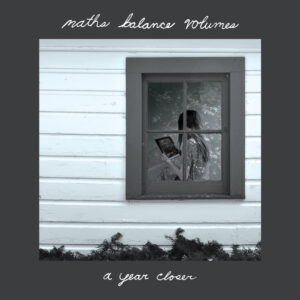
It makes less sense to say that Maths Balance Volumes formed in 2002 than to say that, since that year, they have been collapsing into something, again and again. Just as the three members fell together with no plan or allegiance to any style or genre, each track falls together as the broken pieces of songs and sounds meet to make a temporary and frightening whole. Things make their way into a Maths Balance Volumes song when they don’t or won’t work anymore, when they have escaped their owner, or hidden away where nobody is supposed to find them. When things fall together—when the wooden creaks and radio hisses gather for a minute alongside bass lines and melancholy voice—there is a beauty that sounds like it was made by nobody and for nobody.
The city of Mankato, Minnesota has been the steady gathering point for the band since its beginnings. Mankato had always provided an ominous backdrop: built on stolen Dakota land, the city was the site of the largest mass execution in US history, when 38 Dakota prisoners were hanged on in 1862 in a straightforward act of genocide. But in their music of the past twelve years, Maths Balance Volumes has made music in and of a hometown overshadowed and unsettled by its history, music for a world in which things have never been okay. Traditional American folk genres seep in at times, but never as the incarnation of a living popular culture—only as ghosts or unliving effigies.
A Year Closer tells us already in its title what its theme is: approaching death, time ticking away and getting closer with each track of the record. We are told in the first song that our protective mask isn’t working, warned by the storm clouds and a ticking bedroom clock in “Dark Skies.” We hear fears of death approaching in the sad words exchanged by lovers who see they will run out of time, or already have, as in “We Had Time” or the romantic lament of “When I Drink.” In “Work Last Monday,” all of life passes with cold automatism in an “office apartment,” as a narrator broods over early onset dementia, remembers the details of rituals for respecting the dead, and thinks of how a hole is opening up in reality itself. The singer of “Over the Hill” isn’t apparently afraid of growing older and becoming a “man,” but only leaks a few disjointed details of his plans for disappearing, collapsing, turning into a tree, and finding a home. “Angel of Mercy” tries to resurrect the Christian promise of a life after death, anxiously asking if anyone is up there waiting for us after the oblivion of this world.
But these are just the moments when A Year Closer speaks in words clear and audible enough to be understood. The giddy, agitated voice of “The Price” speaks only to itself in a private language, hidden away in a tin can somewhere. Musically, A Year Closer is a series of pieces that make symphonies out of separate processes of decay and disappearance: unidentified cracking and creaking objects, broken equipment, and lost melodies that seem to have escaped other songs and wandered into the room looking for a place to hide. These are the moments that the listener of Maths Balance Volumes always knows are coming, waits for, and settles in temporarily for a moment of repose. Maybe this is the meaning of A Year Closer: while waiting for the worst, things come together, a “we” with no name but with a rhythm, a tenuous but definite harmony to share as the clock ticks. Even if, when the lights are turned on, it turns out nobody was there. – Paul Buchholz
20,50€
In stock

CD
Aaron DILLOWAY & Jeph JERMAN
“Casual Collisions”
Casual Collisions is a collaborative album by two of the most prominent voices in experimental sound, Aaron Dilloway and Jeph Jerman. Recorded in 2013 and originally self-released on CDR by Jerman in a small edition, New Forces and White Centipede Noise are pleased to make these recordings widely available for the first time. Across four tracks the unique voices of these artists meld seamlessly together. Jerman's tactile, physical sounds are wrapped up in Dilloway's magnetic wizardry. Damaged electronics and hissing tapes form the canvas on which objects crunch, grind, and clatter. Temporality blurs as field recordings, loops, and live acoustic sounds meld together in sonic alchemy. Two masters in perfect sync. Remastered by BJ Nilsen, packaged in a full color 6-panel digipack.
10,00€
In stock
CD
Renato GRIECO & Bruno DUPLANT
“La Disparition”
Inspired by Georges Perec's lipogrammatic novel “La Disparition”, written without the use of the letter e. The music score and its interpretation reflect constraint as a process. The score is dedicated to Reinier Van Houdt.
12,00€
Out of stock

4 LP box
Graham LAMBKIN
“Solos”
The years between Graham Lambkin’s tenure with the legendary Shadow Ring and his more recent improvisational duos mark a distinct period of creative production within the artist’s insular career. Living with his family in Poughkeepsie, NY, from 2001 through 2011 Lambkin recorded and self-released four solo albums that valorized mundane domestic situations while reveling in the liminal spaces between the acts of listening, recording, and producing. Created through an ingenious economy of means, these solo records are as beguilingly seductive as they are uncanny. Perpetually laughing in his own duplicitous face, Lambkin breathed new life into musique concrète and sound poetry, giving outmoded forms a contemporary consciousness while setting the gold standard for a continuously unfolding canon of 21st century tape music.
Poem (For Voice & Tape), Salmon Run, Softly Softly Copy Copy, and Amateur Doubles are now remastered and finally back in print, with Salmon Run and Softly Softly Copy Copy available on vinyl for the first time. This deluxe boxed set of Graham Lambkin’s first four solo records includes an expansive 42-page book featuring unseen photos and reproductions of artworks as well as essays and anecdotal recollections providing fresh insight and divulging hermetic secrets by Ed Atkins, Mark Harwood, Matt Krefting, Lawrence Kumpf, Samara Lubelski, and Adrian Rew.
Graham Lambkin (b. 1973, Dover, England) is a multidisciplinary artist who first came to prominence in the early ‘90s through the formation of his experimental music group The Shadow Ring. As a sound organizer rather than music maker, Lambkin looks at an everyday object and sees an ocean of possibility, continually transforming quotidian atmospheres and the mundane into expressive sound art using tape manipulation techniques, chance operations, and the thick ambience of domestic field recordings. His Kye imprint, founded in 2001, was an instrumental platform for the dissemination of and dialogue between work by an intergenerational cast of artists using sound, including Henning Christiansen, Anton Heyboer, Moniek Darge, and Gabi Losoncy. He began showing his visual art in 2014 with Came To Call Mine, an exhibition curated by Lawrence Kumpf and Justin Luke at Audio Visual Arts in conjunction with the publication of Lambkin’s children’s book (for adults) of the same name, and has since exhibited his work at 356 Mission, Künstlerhaus, PiK, and Blank Forms.
99,00€
In stock
CD
Ben VIDA & Marina ROSENFELD
“Leaving”
‘Leaving’ is a generative four-loudspeaker composition created for Skanu Mežs by Marina Rosenfeld and Ben Vida, who perform as a duo and have recorded two albums in recent years, ‘Feel Anything’ and ‘Vertice’. Drawing from both records as well as a remote performance that was filtered through the empty volume of New York’s Fridman Gallery during the hot summer of the city’s Covid-19 quarantine, ‘Leaving’ is the artists’ meditation on the absence and presence, fragmentation and drift of our present reality — “a strange dialogue, dreaming of each other through communication of another order… (François Bonnet on ‘Vertice’)”
14,00€
In stock
3 CD
Robert CURGENVEN
“Beyond Enclosures”
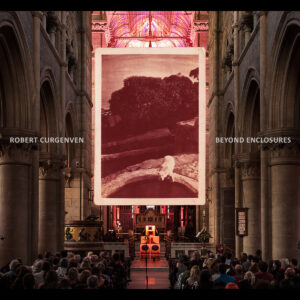
The 3 albums that comprise this set all, at their heart, concern air and the attendant inter-permeability and fluidity of volumes – be they discretionary or open volumes, architectural or spatiotemporal. Each volume is subject to the specificities of: their resonance; concomitant movements of volumes of air; their locational context and adjacent spaces. The 3 albums present different harmonic, gestural and durational possibilities to encourage us to step out of the perceptual frameworks that enclose us. Each album offers a unique instrumental foundation: experimental turntable techniques inter-woven with piano & pipe organ harmonics (Bardo); resonant architectural interventions in post-Communist architectures and their locational context via custom-made oscillators (SPECTRES); extended pipe organ techniques with an accompanying soundsystem that plumb architectural harmonics and corporeal resonances (Bronze Lands). These works entreat us to think and hear beyond the structures enclosing each instrumental- and performance- approach – the turntable body, the architectural, the pipe organ, the speaker enclosure itself, even the confines of an audience as a gathering – and also to consider these longform works as an inter-related suite of aural and conceptual worlds.
24,00€

LP
Steve RODEN
“the radio – airria (hanging garden) – vein stem is calm”
Sonoris is pleased to announce the release both on vinyl and cd, with a new mastering by Giuseppe Ielasi, of some important works from the influential and respected artist Steve Roden. These tracks, which mix conceptual composition and musicality, transcend the ambient or lowercase categories too quickly applied to his music, due to its ghostly beauty.
_
In the tradition of John Cage's Cartridge music amplified objects, Steve Roden extracts a fine and delicate music through his manipulation of specific objects, with an apparent simplicity that hides a captivating magic. Whilst reinventing a form of ambient music which is discreet and atmospheric, Steve Roden delivers sound textures, gives shape to color swatches, traces vibrant frequencies and creates visual art objects.
Roden, both a visual and a sound artist often tagged as minimal for want of a better description, builds the sound design of a life, a new construction for the future which encompasses architecture, visual arts, and painting in a single form.
• The radio (1996): The sound sources are derived from the object itself: the airwaves as well as the internal mechanics (aerial,springs, knobs ...). Originally released as a miniCD by Sonoris, this work centered on Roden's voice and found sound loops is now unexpectedly considered a classic and was seen as "a particularly modest form of genius" in a review by The Wire at the time.
• Airria ( hanging garden ) (2003): Arnold Schönberg's work " The book of hanging gardens " haunts the piece, and is used as a backbone over which a ghostly and exhilarating vocal hovers. Both unsettling and relaxing, this track from the "Speak no more about the leaves" CD has strangely become a mini phenomenon on youtube with its number of views and comments.
• Vein stem is calm (1996): A few seconds taken from a Ralf Wehowsky piece are shaped into a nocturnal raga imbued with substances of an indeterminate nature.
_
Steve Roden is a visual and sound artist from Los Angeles, living in Pasadena. His work includes painting, drawing, sculpture, film/video, sound installation, text and performance. In the sound works, singular source materials such as objects, architectural spaces, and field recordings, are abstracted through humble electronic processes to create new audio spaces, or possible landscapes. The sound works present themselves with an aesthetic Roden has described as lower case – sound concerned with subtlety and the quiet activity of listening.
_
Mastering by Giuseppe Ielasi.
Cut by Fred Alstadt at Studio Angström
18,00€

CD
Steve RODEN
“the radio – airria (hanging garden) – vein stem is calm”
Sonoris is pleased to announce the release both on vinyl and cd, with a new mastering by Giuseppe Ielasi, of some important works from the influential and respected artist Steve Roden. These tracks, which mix conceptual composition and musicality, transcend the ambient or lowercase categories too quickly applied to his music, due to its ghostly beauty.
_
In the tradition of John Cage's Cartridge music amplified objects, Steve Roden extracts a fine and delicate music through his manipulation of specific objects, with an apparent simplicity that hides a captivating magic. Whilst reinventing a form of ambient music which is discreet and atmospheric, Steve Roden delivers sound textures, gives shape to color swatches, traces vibrant frequencies and creates visual art objects.
Roden, both a visual and a sound artist often tagged as minimal for want of a better description, builds the sound design of a life, a new construction for the future which encompasses architecture, visual arts, and painting in a single form.
• The radio (1996): The sound sources are derived from the object itself: the airwaves as well as the internal mechanics (aerial,springs, knobs ...). Originally released as a miniCD by Sonoris, this work centered on Roden's voice and found sound loops is now unexpectedly considered a classic and was seen as "a particularly modest form of genius" in a review by The Wire at the time.
• Airria ( hanging garden ) (2003): Arnold Schönberg's work " The book of hanging gardens " haunts the piece, and is used as a backbone over which a ghostly and exhilarating vocal hovers. Both unsettling and relaxing, this track from the "Speak no more about the leaves" CD has strangely become a mini phenomenon on youtube with its number of views and comments.
• Vein stem is calm (1996): A few seconds taken from a Ralf Wehowsky piece are shaped into a nocturnal raga imbued with substances of an indeterminate nature.
_
Steve Roden is a visual and sound artist from Los Angeles, living in Pasadena. His work includes painting, drawing, sculpture, film/video, sound installation, text and performance. In the sound works, singular source materials such as objects, architectural spaces, and field recordings, are abstracted through humble electronic processes to create new audio spaces, or possible landscapes. The sound works present themselves with an aesthetic Roden has described as lower case – sound concerned with subtlety and the quiet activity of listening.
_
Mastering by Giuseppe Ielasi.
10,00€

LP
Jérôme NOETINGER & Lionel FERNANDEZ
“Outer Blanc”
Highly electrified guitar, anamorphosed, perforated, and tainted by all sorts of effects, implodes its rage and its urgency in the magnetic nets of a tape recorder as cannibal as it is destructive. From various recordings Lionel Fernandez & Jérôme Noetinger have created and produced these ten pieces: big, biting, dangerous and acerbic – like the intoxicated meeting of a chainsaw and a microphone. Real garage music: grease, gutted car bodies and outdated alternators, like a soundtrack ripped from an unreleased Tobe Hooper film.
Lionel Fernandez and Jérôme Noetinger: a musical encounter between two important and uncompromising figures in contemporary experimental music in France. This duo emerged during an evening of the label Premier Sang programmed at Instants Chavirés (Montreuil) in the 2010s… A few years and a few furious concerts later and it is now on the Sonoris label that they are releasing their first record.
Guitarist of the pioneering french free noise/no wave band Sister Iodine, Lionel Fernandez uses an out of norm practice of the electric guitar in a group or as solo playing, “a guitar used as a flame thrower thrashed and fiercely held up as machette totem, he chops through darkness with unsane anti-riffs and carved blocs of dirty sounds, where gargle in slow combustion gangreened micro-textures » (Le Non_Jazz)
He also plays in other deviant combos such as Antilles, Cobra Matal, Ibiza Death, Haine, Porsche, Discom, Minitel, Mauser M etc and has collaborated either live or on records with Masaya Nakahara, Meyna’ch/Mütiilation, Andy Bolus/Evil Moisture, Stephen Bessac/Kickback, Hendrik Hegray, Tujiko Noriko etc..
Jérôme Noetinger is a composer, improviser and sound artist who works with electroacoustic devices such as the Revox B77 reel-to-reel tape recorder and magnetic tape, analogue synthesisers, mixing desks, speakers, microphones, various electronic household/everyday objects and home-made electronica.
From 1987 to 2018, he was the director of Metamkine, a non-profit organisation dedicated to the distribution of improvised and electroacoustic music. Between 1987 and 2014 Jérôme was a member of the editorial committee of the quarterly journal of contemporary sound, poetry and performance, Revue & Corrigée. For ten years from 1989, he was a member and programming co-ordinator of exhibitions, gigs, and experimental cinema at le 102 rue d’Alembert, Grenoble.
_
Lionel Fernandez, guitar, electronics
Jérôme Noetinger, Revox B77, electronics
10 tracks, 42 minutes, master by Fred Alstadt at Studio Angström
18,00€

CD
Jérôme NOETINGER & Lionel FERNANDEZ
“Outer Blanc”
Highly electrified guitar, anamorphosed, perforated, and tainted by all sorts of effects, implodes its rage and its urgency in the magnetic nets of a tape recorder as cannibal as it is destructive. From various recordings Lionel Fernandez & Jérôme Noetinger have created and produced these ten pieces: big, biting, dangerous and acerbic – like the intoxicated meeting of a chainsaw and a microphone. Real garage music: grease, gutted car bodies and outdated alternators, like a soundtrack ripped from an unreleased Tobe Hooper film.
Lionel Fernandez and Jérôme Noetinger: a musical encounter between two important and uncompromising figures in contemporary experimental music in France. This duo emerged during an evening of the label Premier Sang programmed at Instants Chavirés (Montreuil) in the 2010s… A few years and a few furious concerts later and it is now on the Sonoris label that they are releasing their first record.
Guitarist of the pioneering french free noise/no wave band Sister Iodine, Lionel Fernandez uses an out of norm practice of the electric guitar in a group or as solo playing, “a guitar used as a flame thrower thrashed and fiercely held up as machette totem, he chops through darkness with unsane anti-riffs and carved blocs of dirty sounds, where gargle in slow combustion gangreened micro-textures » (Le Non_Jazz)
He also plays in other deviant combos such as Antilles, Cobra Matal, Ibiza Death, Haine, Porsche, Discom, Minitel, Mauser M etc and has collaborated either live or on records with Masaya Nakahara, Meyna’ch/Mütiilation, Andy Bolus/Evil Moisture, Stephen Bessac/Kickback, Hendrik Hegray, Tujiko Noriko etc..
Jérôme Noetinger is a composer, improviser and sound artist who works with electroacoustic devices such as the Revox B77 reel-to-reel tape recorder and magnetic tape, analogue synthesisers, mixing desks, speakers, microphones, various electronic household/everyday objects and home-made electronica.
From 1987 to 2018, he was the director of Metamkine, a non-profit organisation dedicated to the distribution of improvised and electroacoustic music. Between 1987 and 2014 Jérôme was a member of the editorial committee of the quarterly journal of contemporary sound, poetry and performance, Revue & Corrigée. For ten years from 1989, he was a member and programming co-ordinator of exhibitions, gigs, and experimental cinema at le 102 rue d’Alembert, Grenoble.
_
Lionel Fernandez, guitar, electronics
Jérôme Noetinger, Revox B77, electronics
10 tracks, 42 minutes, master by Fred Alstadt at Studio Angström
10,00€
12 CD box
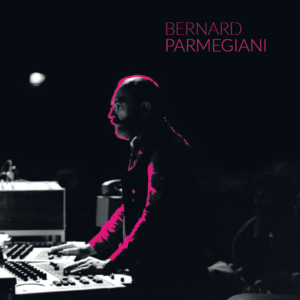
Bernard PARMEGIANI
“L’œuvre musicale en 12 CD”
2021 repress
Disc 1: Violostries (1964), 16:37 JazzEx (1966), 16:51 L’instant mobile (1966), 10:41 Capture éphémère (1967), 11:57 Disc 2 Bidule en ré (1969), 9:18 Pop’eclectic (1969), 10:59 Du pop à l’âne (1968), 10:09 Ponomatopées (1970), 6:17 Musico picassa (1978), 6:53 Et après (1973), 11:35 Disc 3 L’œil écoute (1970), 19:11 Pour en finir avec le pouvoir d’Orphée (1972), 23:27 La roue Ferris (1971), 10:40 Disc 4 Enfer (1972), 61:20 Disc 5 De natura sonorum (1975), 53:01 Disc 6 Dedans-dehors (1977), 22:24 La table des matières (1979), 19:02 Des mots et des sons (1977), 19:17 Disc 7 La création du monde (1982-84), 72:44 Disc 8 Exercisme 1 (1985), 17:22 Exercisme 2 (1985), 27:03 Exercisme 3 (1986), 24:13 Disc 9 Litaniques (1987), 21:23 Rouge-mort: Thanatos (1987), 16:48 È pericoloso sporgersi! (1991), 25:37 Disc 10 Le présent composé (1991), 23:45 Entre-temps (1992), 22:22 Plain temps (1991-93), 24:23 Disc 11 Sonare (1996), 21:22 Sons-jeu (1998, 2000), 21:09 La mémoire des sons (2000-01), 24:40 Disc 12 Immer / sounds (1999), 11:24 Espèces d’espace (2002-04), 21:47 Au gré du souffle… le son s’envole (2005-06), 20:03 Rêveries (2007), 13:46
60,00€
In stock

CD
Eliane RADIGUE
“occam ocean vol.3”
Occam river II, for violon and cello
Occam VIII, for cello
Occam delta III, for violon, viola and cello
Silvia Tarozzi, violon.
Deborah Walker, cello.
Julia Eckhardt, viola.
Recorded in 2019 at l'Abbazia di Santa Maria Assunta, Monteveglio (Bologna)
With a 32 page booklet.
22,00€
In stock

LP
SUN STABBED
“In Girum Imus Nocte Et Consumimur Igni”
"It has been roughly a decade since this French duo of gnarled guitar enthusiasts last surfaced as Sun Stabbed and I have certainly missed them, though Thierry Monnier and Pierre Faure's similarly excellent La Morte Young project helped fill the void nicely. Aside from the different line-ups, the main difference between the two projects is that this one is kind of a direct homage to some of New Zealand's most iconic purveyors of blacked drones and noisy guitars. While no discussion of that subject would be complete without Campbell Kneale, it is The Dead C and the woefully underheard Surface of the Earth that explicitly provide the most inspiration here. Characteristically, Monnier and Faure are admirably up to the task of continuing that fine tradition, as In Girum Imus Nocte Et Consumimur Igni is a feast of manipulated feedback, burned-out wreckage, and simmering drones. Occasionally it can be eerily beautiful and haunting, but I also like the parts that resemble an onstage brawl between Skullflower and Sunn O))). This is an instant noise/drone guitar classic."
Brainwashed
16,00€
Out of stock
CD
Carl Michael von HAUSSWOLFF
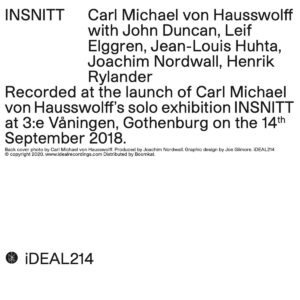
“INSNITT”
Arch explorer of EVP and paranormal recordings, CMvH is joined by John Duncan, Joachim Nordwall and other members of the Swedish avant fraternity at the opening of his 2018 solo exhibition in Gothenburg
‘INSNITT’ captures 30 minutes of roiling subharmonic frequencies and anxious scrabble made at 3:e Våningen, Gothenburg on September 14th 2018. It arrives over 40 years since his first recordings to witness the Swedish polymath flanked by a coterie of longtime collaborators including Leif Elggren, Jean Louis-Huhta, and Henrik Rylander, plus the aforementioned, charging the air with stressed electronics that resemble the sounds of shearing metal and hi-pitched, whirring mechanicals.
Their massed effect is saturated with sense of hyperrealist psychedelia, appearing to physically keen and lurch in 3D in a way that ultimately makes us feel seasick and rinsed out by the end. Perhaps it’s best recommend to those listeners with strong sea legs and a tolerance for this kind of northerly climate sounds.
13,00€
In stock
LP
James RUSHFORD
“Lake From The Louvers”
James Rushford tops over a decade of solo and collaboratibve work with Oren Ambarchi, Crys Cole, Will Guthrie, Graham Lambkin and Klaus Lang on this fathoms-deep, psychedelic treat, a next-level arrangement of microtonal drone, decaying concréte fuzz and windswept, somber melancholia recorded for the Shelter Press label.
James Rushford impressed earlier this year with his excellent Black Truffle collab with Will Guthrie “Real Real World”, and he here heads further into the nether-realm on ‘Lakes From The Louvers’, an album that draws its inspiration from the interplay of shadow and light he observed on the surface of the lake and through his window while at an artist residency at La Becque on the shores of Lake Geneva in Switzerland. Rushford’s detailed sound particles and concrète world-building echo the tantalising shimmer of light on water, with amplified movements, synthesized squawks, pings and harp notes rippling across the length of each track. It’s music that accurately represents the landscape but is far from ambient - instead Rushford sculpts soundscapes that demand patient, attentive listening.
The slow-moving, deliberate processes that Rushford has been honing over the last 15 years betray a sensitive ear, swerving pretentious, exclusionary art for arts sake nonsense. This is electro-acoustic experimentation with a beating heart, designed to trigger thought and self reflection. Just clap yr ears around ‘Hyaline Apples’ as it melts buzzing clouds of synth into jagged harp plucks and woodblock percussion, or standout track ‘The Bise’ and its disquieting haze of microtonal bliss. When the album comes to a satisfying close on ‘Dents Du Midi’, it feels like the finale of a muticolored odyssey, as tangled synth notes fold in on themselves like an MC Escher painting. Futuristic and ancient, ‘Lakes From The Louvers’ is a breathtaking album that unspools with the patience it no doubt took to create.
25,00€
Out of stock

LP
ALTAR OF FLIES
“Bortom Reven”
Cold crushed electronics and tape noise by iDEAL faithful, Altar of Flies, returning to his native Swedish label with a 3rd album of possessed and unsettling tonal abstraction and psychoacoustic isolationism
Known to the reaper as Mattias Gustafsson, Alter of Flies is the Mjölby-based sound artist’s most prolific alias, responsible for dozens of tapes and LPs for Chondritic Sound and White centipede Noise beside his trio of turns for iDEAL since the mid ‘00s. ‘Bortom Reven’ sticks closely to what he does best, conjuring bleakly depressive atmospheres ripe for inhabitation by the harder-to-please followers of North European ambient and industrial musicks, with an alchemic application of field recordings, tape loops, and primitive oscillators that vividly brings his thoughts into the dark light.
‘Bottom Reven’ is perhaps reflective of a certain, ascetic and isolated Swedish characteristic, enacting solitary rituals that better connect Altar of Flies with his environment, or simply entertain him during long, cold, dark nights. With hints of CMvH’s EVP and John Duncan’s searching shortwave radio textures to ‘Hur regn uppstår,’ and more ruptured reception of scrambled ether voices in ‘Terapimusik,’ alongside the title track’s worn-out nub of intrigue, and the damp basement clangour of ‘Under vår livstid’; its not one for those who get shook by the sight of their own shadow, but a real treat for listeners of a lonelier disposition who get off on the sound of the house creaking at night.
19,00€
Out of stock
LP
Jim O’ROURKE
“Too Compliment”
DDS catch enduringly absorbing sonic alchemist Jim O’Rourke at his knottiest and most ingenious in a wormholing suite of amorphous rhythm and psychedelic electronics - a massive RIYL Autechre, Roland Kayn, Bernard Parmegiani, NYZ, Keith Fullerton Whitman.
Playing up to and into DDS’ freeform aesthetics, O’Rourke renders 40 minutes shearing hyaline synth tones and ruptured rhythm generated at his Steamroom facilities in Tokyo, a modular out-zone trawling that harks back to his iconic Mego releases and some of the more recent Steamroom experiments. It’s an ideal addition to the ever expanding DDS cosmos, following Demdike’s recent ‘Drum Machine’ expo with a slice of purist and screwed modular magick that transcends early electronics and modern styles in pursuit of musical sensations that defy stylistic brackets.
‘Too Compliment’ was assembled using a bespoke Hordijk modular system, a rare West Coast-style setup hand made by Dutch engineer Rob Hordijk. O’Rourke focuses on the frequency shifter here, using it to coax out fluxing tone thickets, haphazard frequencies and elongated drone corridors. It’s transportive stuff, harking back to the early days of private press academic synth music but also sitting on edge alongside Autechre’s recent long-form work, as well as O’Rourke’s classic “I’m Happy, And I’m Singing, And A 1, 2, 3, 4”
In O’Rourke’s hands, the mass of electronics takes on throbbing, organic dimensions, congealing grey matter and purplish veins of fluid in viscous transitions that glisten and spark with invention as they form new tissue. What comes out is as unearthly as the earliest electronic music, but also blessed with a psychedelc spirit in a way that’s long kept O’Rourke right out on his own, teetering between paradigms yet never settling into any single style. If you’ve always been keen on finding a way into that sprawling soundworld, ‘Too Compliment’ is a perfect entry point into a highly rewarding creative macrocosm.
28,00€
Out of stock
LP
FUJITA
“Komori”
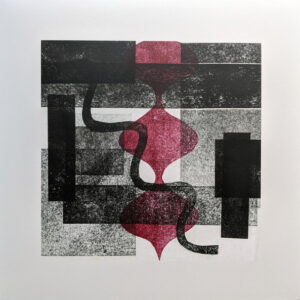
Japanese pipe-organ builder and sound artist Yosuke Fujita provided us with one of the prettiest, weirdest records that passed over our desk last year, essentially a custom-built organ duet with a bat colony, recorded in a cave beneath Mt. Fuji. It’s now been remastsred by Rashad Becker (with whom Fujita will be collaborating on a performance for Issue Project Room next month) and captures a sound somewhere between Sarah Davachi, Eleh, Pauline Oliveros and Kali Malone’s long-form organ dirges, with the bat calls sounding almost like a synthesizer piped thru an echo chamber.
Since 2009, Fujita has been recording almost exclusively with his custom-built pipe organ: a unique instrument made from 11 pipes and a blacksmith’s air pump. All of his recordings are worth hearing, but “KŌMORI” is among the most unusual and rewarding - 40 minutes of alien, pensive organ drone that echoes around the repeating, reverberating squeaks of a colony of bats.
Inspired by the fact that bats were the source of many recent viruses - like Ebola, Nipah and Hendra - Fujita grabbed a Sunken CO-100K microphone that was capable of picking up their ultrasonic echolocation. These sounds, captured in a cave beneath Mt. Fuji, are totally alien, like chattering sine waves or wobbling modular business. It’s the perfect foil for Fujita’s well-worn courtly organ variations that mirror traditional Japanese 7th century gagaku forms.
The rhythmic click of the air pump guides Fujita’s bellowing drones, drowning out the cave’s uneven spaces. Sometimes the bat sounds are reduced to a whisper, at others - such as on the crushing third part - they’re almost deafening. Fujita processes these sounds expertly, occasionally mirroring their fluttering tonalities, at others simply allowing the unusual frequencies to cascade through the empty caverns.
This is properly vital new music - sonically adjacent to Medieval church music, but also austere early electronics, spiked with a brilliantly asymmetric streak all of its own.
26,00€
In stock

CD
ID M THEFT ABLE
“Well I Fell in Love With the Eye at the Bottom of the Well”
"The initial idea for "Well I Fell in Love with the Eye at the Bottom of the Well" was actually to attempt to make a doo wop song with that as the title. I kept adding more and more ideas and those ideas blossomed into other ideas to the extent that there's only the faintest hint of that initial doo wop impulse on the album but a whole other sort of garden grew up around it and through it. It was probably a decade from the moment that that title popped into my head as an idea for a doo wop song to its completion as a full length album, one that has absolutely nothing whatsoever to do with doo wop."
But maybe think experimental/musique concrete/sound poetry/noise and all around amazingness...
id m theft able performs within and without the realms of noise, avant-improvisation, sound poetry, performance, et c. et c. et c. using voice, found objects, electronics, and whatever else is available......
He has given over a thousand performances across 4 continents, in 40 countries and 40 states in settings ranging from the scummiest of squats to the fanciest of festivals.
13,00€
In stock
CD
Phill NIBLOCK
“NuDaf”
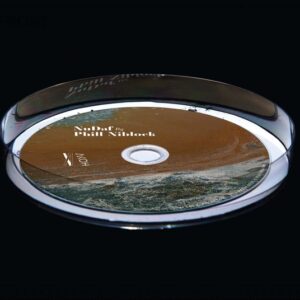
A 65-minute electroacoustic composition featuring Dafne Vicente-Sandoval, bassoon. "The aural effect is minimal to the max, but it isn't simplistic. The tones vibrate and glow, the densely packed texture shifting hues like a sonic aurora borealis" --John Rockwell, The New York Times. NuDaf (2020) is the second longest piece in Phill Niblock's repertoire of recorded audio works. NuDaf is a departure from his previous pieces in that he makes extensive use of multiphonics and constructed the work with fewer tracks than usual, creating uniquely transparent and ephemeral textures. The piece is the result of a collaboration between Niblock and the stellar bassoonist Dafne Vicente-Sandoval. Her musicality and breadth of knowledge, extended bassoon performance, and uncanny timing inspired the piece. This is the first of three collaborative projects between XI Records and Akoh Media. Akoh initiated the project, suggesting that Phill confront a longer form that also seemed eminently suitable to Dafne Vicente-Sandoval's interests. Akoh, as is its tradition, presents the work in a limited numbered edition of a one-of-a-kind Petri dish that incorporates Niblock's photos in an exquisite and unique design. From the liner notes by Michael Pisaro-Liu: "... over the course of the long duration of NuDaf we listen to a slow-motion explosion that frees it, creating a spectacular shape, right before our ears."
15,00€
In stock
2 CD
Tom CHIU
“The Live One”
XI Records announce the release of Tom Chiu's new double-CD, The Live One, a diverse and thoroughly engrossing album that showcases the multiple facets of Chiu's visions. Chiu is a polymath who is as comfortable with lyricism and the beauty of tonality as he is with process-based works and challenging conventions of composition. Chiu specializes in creating spatial experiences and altered states of mind with his music, with a singular, questing path. On the album opener, "Into The Forest", melancholic themes build and become wrapped in echoes that reverberate like a skipping stone casting ripples in a pond. Dry and delicate melodies emerge that float spatially. The piece is an assemblage of over 60 musical fragments composed by Chiu, which coalesce seamlessly into a homogeneous whole. "BABIP", a solo performance, begins with Chiu's pizzicato which evokes the spirit of gamelan, and builds through increasingly intense gestures, woozy double stops and extended techniques until he starts transforming the sound of his instrument with live effects. The functionally-titled "Duo Improvisation 16741" sees Chiu pairing with sound artist and composer Michael Schumacher. Together, they create a hypnotically jarring sonic whirling dervish. Chiu's live effects invoke undertones of Tuvan throat singing as glissandos layer with insistent bell tones. The insistent piece thrillingly morphs into electronic pulses and sirens, journeying deeply into sonic abstraction. The track "Birave Trifecta" sees Chiu performing with Dan Joseph on hammer dulcimer and Jason Cady on modular synthesizer under the moniker JCC Trio. The trio's piece begins as almost a folk stomp, with echoes of minimalism in its insistence. It builds to euphoric intensity with Chiu's bravura playing, sawing at his instrument with fierce abandon. "RETROCON" is a work performed by FLUX Quartet. The epic piece unfolds like a mini symphony, with the quartet creating a stunningly rich sonic world. The layers of the string quartet swell and undulate like a small boat in the middle of the ocean negotiating the waves of an impending storm, then wail plaintively before returning with clustered hives of notes. A startling and insistent monolithic pulsing then seems to summon dark deities before receding with a delicate beauty. The final piece on the album, "deKonstruct", is an improvisation which quotes from existing materials, colliding Bach and Chiu. Chiu uses a looping pedal to create a bed for his hyper-kinetic performance which mutates through his arsenal of sonic manipulation, to mesmerizing effect. (from the liner notes by JG Thirlwell)
13,00€
In stock
2 CD
Cecilia LOPEZ
“Red / Machinic Fantasies”
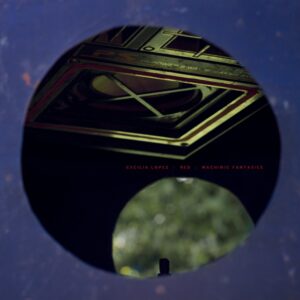
Cecilia Lopez's work is a perfect combination of flavors that slowly reveal themselves as you spend more time enjoying it. It has marvelous layers of sonic explorations that slowly unfold and draw you in. Red is more than a musical composition. It roots lie in its physicality. Nestled on a large cargo-like cable web are an array of small speakers and contact microphones. As this web sways the speakers and microphones come in and out of proximity and form an evolving feedback network, which slowly reveal themselves as a myriad of permutations accompanied by sympathetic synthesizer tones. Zero-input mixing works seem to be very popular now, but Red takes feedback further, beyond the electronic domain, by its use of a multi-faceted instrument creating a sonic architecture intertwined with the resonances of acoustical spaces. Her Machinic Fantasies, a kind of performed installation, explores another set of instruments she has constructed using two hand-rotated, 55-gallon drums each having a speaker inside with multiple cutouts that act as acoustical filters. Her sound materials, derived from field recordings to spoken word and live acoustic/electronic instruments, are fed into the oil drums and emanate through the holes and are at the same time amplified using microphones placed near the rotating holes. Driven by a detailed score, this recording resulted from a music commission at Roulette in Brooklyn, New York combining the two rotating drum instruments with instrumentalists Jean Carla Rodea, Julia Santoli, Christopher McIntyre, and Joe Moffett. Machinic Fantasies also has multiple dimensions with the resonances of the performance space excited by the instruments, the musicians weaving their sounds into the space from different locations, and the ongoing physical rotations of the spinning drums to create a swirling almost hypnotic music.
15,00€
In stock
LP
Neil LEONARD
“Sonance for the Precession”
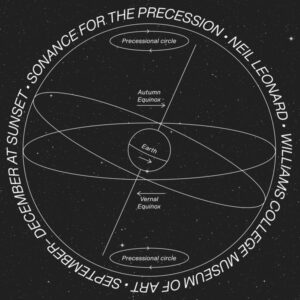
Excerpts from a sound installation based on alto saxophone recordings and electronic sound. "Mr. Leonard creates a haunting, rhythmic, chantlike score, secular spiritual music for a New World. After leaving the gallery I kept hearing it, with delight, in my head, on the street, all afternoon." --Holland Cotter, The New York Times.
The electroacoustic composition Sonance for the Precession was commissioned by Williams College Museum of Art (WCMA). The piece furthers Leonard's practice in large scale sound installation, with recent commissions by documenta, Venice Biennale, and Fujiko Nakaya of Experiments in Art at Technology. The original composition, created for the quad adjacent to WCMA, played from the dome of the historic Hopkins Observatory, the oldest working astronomical observatory in the United States. The durational work explored ancient ideas connecting the precession, or movement, of the equinox with the harmonic series. Each day, the music began just a minute or two earlier than the previous day -- mirroring the disappearing sunlight as day turned to night and autumn shifted to winter. 30 minutes of the composition played daily. The composition provided a context to reflect on how Hindu and Greek theories of astronomy and acoustics developed through intercultural exchange as far back as prehistoric times. Working closely with WCMA and producer/engineer Joe Branciforte, Leonard remixed Sonance for the Precession specially for LP and stereo listening. The result is a stunning long form composition that brings the sense of contemplation, cosmic motion and intimate timbral nuance of the installation to your living room, headphones and/or car stereo.
18,00€
Out of stock

LP
Allen RAVENSTINE
“Electron Music / Shore Leave”
Waveshaper Media presents Electron Music/Shore Leave, a new LP by former Pere Ubu synthesist and electronic music trailblazer, Allen Ravenstine. The LP is comprised of two EPs (1 per vinyl side), the first two parts in Raventine’s new Tyranny of Fiction series. Waveshaper Media first came into contact with Ravenstine when we interviewed him in 2012 for our modular synthesizer documentary I Dream Of Wires.
For those in the know, Allen Ravenstine has been one of the most creative synthesizer players of the past forty-plus years. Ravenstine started out in the mid-1970s experimenting in his Cleveland apartment with an analogue EML 200 synthesizer, eventually creating a piece in 1975 that became known as Terminal Drive. While he had no intention of releasing his compositions, word got out about the kind of sounds he was experimenting with, which led to an invitation to join pioneering “avant garage” group Pere Ubu for the recording of the group’s first 45, “Thirty Seconds Over Tokyo.” He soon joined Pere Ubu full-time, bringing to the band’s sound unpredictable textures, effects, bleeps, squalls, pulsating washes of sound—whatever he felt could enhance the soundscape of the band’s performances and recordings.
By the early 1990s, Ravenstine had grown sick of the road, band infighting and the music industry in general. Deciding a change was needed, he opted to forego music altogether, making his living as an airplane pilot. His music career remained in limbo until 2012, when an interview for the I Dream Of Wires documentary, alongside Robert Wheeler who had succeeded him as Pere Ubu’s synthesist, turned into a recording session for the duo, leading to a series of collaborative releases. As well as having his 1975 Terminal Drive recordings released to great acclaim in 2017, Ravenstine has been prolific in recent years, with Electron Music/Shore Leave now marking his 3rd solo full-length.
Electron Music/Shore Leave brings together ten of the prodigious composer’s most recent lyrical and abstract compositions collectively comprised of the sounds of analogue and digital synthesizers, traditional acoustic instruments and the sampled sounds of birds, dogs and other artifacts of nature. Working prodigiously on a daily basis, over the past two years Ravenstine has amassed a large number of atmospheric recordings that he has intuitively aggregated into groups of five pieces each. The first five recordings, subtitled Electron Music, are found on Side A of this LP while the second five, Shore Leave, comprise Side B.
Ravenstine played the majority of the sampled instruments on these recordings as well as piano, Moog theremin, a Roland Aerophone and a bevy of synthesizers including a Korg MS20, EML 200, and a Doepfer Dark Energy. Recording virtually over the internet due to the covid pandemic, collaborators from around the world contributed Ondes Martenot, prepared piano, transverse flute, trumpet, saxophone, double bass and percussion. The result is a heady, disparate brew of compositions that range from abstract to lyrical, in the process conjuring up a bricolage of ambient soundtracks, jazzy miniatures, space age exploration, world music, Erik Satie-like studies and the ghost of Harry Partch. As a collection Electron Music/Shore Leave is a stunningly mature work that provides new and surprising sonic rewards with each and every listen.
The album contains 10 songs on vinyl LP - limited to 300 copies.
19,00€
In stock

2 LP
Ellen FULLMAN
“In the sea”
Ellen Fullman began developing The Long String Instrument in her St. Paul, Minnesota studio in 1980 and moved to Brooklyn the following year. Inspired by composer and instrument builder Harry Partch, Fullman's large-scale work creates droning, organ-like overtones that are as unique in the world of sound as her vision of the instrument itself.
Along with her 1985 debut album – appropriately titled The Long String Instrument – Fullman's only output in the 1980s would be two self-released cassettes, In The Sea and Work For Four Players And 90 Strings, recorded in 1987 at an unfinished office tower in Austin, Texas. This double LP collection features music from both cassettes as well as a previously unreleased piece from 1988 at De Fabriek in Den Bosch, Holland.
Ethereal and exquisitely paced, these rare recordings capture minimalism's quiet radiance. Within a musical landscape that has seen the rise of contemporary drone practitioners like Ellen Arkbro and Kali Malone, Fullman is sure to find a legion of fans.
Superior Viaduct is honored to present this long overdue archival release that marks a particularly vibrant period of Fullman's pioneering and timeless work.
29,00€
Out of stock

CD
Phill NIBLOCK / OPENING PERFORMANCE ORCHESTRA
“Four Walls Full Of Sound”
"You should play the music very loud. If the neighbors don't complain, it's probably not loud enough." - Phill Niblock
Four Walls Full of Sound is an electronic interpretation of the works of Phill Niblock by the Prague-based group Opening Performance Orchestra. This studio version, recorded at the re-set studio, was preceded by a live performance at the 2017 Ostrava Days Festival of New and Experimental Music. The cover was designed by Jaroslav Buzek and the booklet includes essays by Kurt Gottschalk and Petr Ferenc. Sound designer Stephan Mathieu took part in shaping the resultant sound of the recording.
12,50€
Out of stock
LP
THE NECKS
“Mindset”
Long awaited re-issue of The Necks 2011 masterpiece. Always different, here the Necks resolutely layer polyrhythmic material to form seething blocks of sound - in two long pieces, one more stripped back to the live trio, the other featuring multiple strata of swirling Hammonds, noise-guitar and electronics. Their 16th release still resonates on its own.
21,00€
In stock
LP
Mark PERRY
“Snappy Turns”
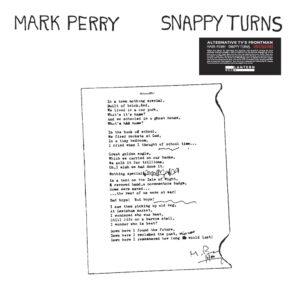
Debut solo album for Alternative Tv frontman and long-time running Uk punk scenester, originally released in 1980 on Deptford Fun City Records. Mark Perry was also the man behind the iconic Sniffin' Glue zine, founded in July 1976. The album was produced by Grant Showbiz, principally known for his work with The Fall, The Smiths and Billy Bragg, and it is literally an art-rock nugget. Sort of an autobiographical work, the record is full of twisted hooks, showing the dark side of post-punk. Less hysterical than the output released with Alternative Tv, Snappy Turns should be considered as a post-apocalyptic pop record. It could have been easily included in the infamous Nurse With Wound list (guess what, his former band was there) introducing several connections to the so-called ‘grey area’. In particular, the disturbing tape loops and the violin heard in Death Looks Down are perversely informed by late Throbbing Gristle, a band seriously informed by the same aesthetics (Alternative Tv used to rehearse in TG studio in Hackney back in the days, while former ATV member Alex Fergusson founded Psychic Tv with Genesis P-Orridge). As the shadow of doubt surrounds our nearby future, Snappy Turns could be easily an appropriate soundtrack.
Contains two bonus tracks from the 1980’s 7”: The Whole world’s down on me.
28,00€
In stock

LP
Marcus SCHMICKLER
“Sky Dice / Mapping the Studio”
Marcus Schmickler's music is designed for multi-channel sound projections and references German electronic music tradition, spectral music, experimentalism as well as 1990s club music. His artistic practice explores avant-garde trajectories in electronic music composition, formal systems, sonification and psychoacoustics. EMEGO 296 features two new major works from this audacious sound explorer.
Sky Dice / Mapping the Studio premiered at Donaueschinger Tage fur Neue Musik 10.20.2018 having being commissioned by SWR and realized at the Experimentalstudio (EXP) in Freiburg. This is a work for ARP 2500, Publison DHM89B, Publison Infernal Machine and Computer. Taking cues from Bruce Nauman's Mapping the Studio I (Fat Chance John Cage) (2001) the piece draws a fragmented acoustic map of the SWR facility itself; the studio serves as a source-model for the sonic display of historical signal flow graphs. Various acoustic and psychoacoustic effects come into play including the Larsen effect, as well as Style Transfer and Topological Sonification. The result is a daring and dizzying display of disorientating audio. Sound moves in most unusual ways, rising and falling simultaneously, appearing and disappearing like apparitions, nothing here behaves in expected ways. To paraphrase Albert Einstein’s now famous quote regarding quantum mechanics, this is spooky audio at a distance.
Fortuna Ribbon is a selection of sonic material that emerged from a research based on how DPOAEs (Distortion Product Otoacoustic Emission) can be designed in the context of musical frameworks, augmenting the compositional pallets in regard to spatial hearing. In this manifestation, the materials are presented without context. The resulting emissions from the ear that are excited in varying ways from the 6 examples on display here. Playback in undisturbed acoustic environments is recommended at >82 dB/A.
Schmickler’s ongoing investigation of sound matter conjures impossible audio that delight’s in the extremity of form and resulting effects on the listener. Schmickler’s audio invocations explore the capabilities of contemporary technology resulting in dizzying new worlds of sound.
20,50€
Out of stock

CD
Ron NAGORKA
“Lovregana, Music from a Tasmanian Forest / Soundscapes from Wilderness”
Ron Nagorcka (1948) is a composer, performer, and naturalist. In 1988 he moved to a remote forest in northern Tasmania, where he built his own house and solar-powered studio (some fascinating photos of his home-studio are present in the booklet attached to this release).
This CD collects his first works recorded in his forest residence in Tasmania, his music sites on the borderline between documentation and the fictional landscapes. Are among the strangest, most fascinating, most intense field recordings based works and an essential chapter in the history of Australian experimental music.
"I can only hope it will encourage people to discover for themselves the mysterious harmony that is wilderness." Ron Nagorcka 1988
200 copies
15,50€
Out of stock

4 CD box
Robert TURMAN
“Chapter Eleven (1976-1987)”
2021 repress.
"Debuting in 1988 as a self-released 8xCassette boxset, Chapter Eleven collects the solo recordings (1976 - 1987) from one of the earliest members of the US Industrial Noise scene, coalescing a wide swath of influences and culling experimental techniques into inventive new terrain. Carefully remastered from the original tapes, this deluxe reissue is a long-awaited rescue from obscurity. 4xCDs -- Over 4 hours of music. Remastered by John Wiese. Co-Released by Hanson Records and Helicopter."
"Turman seemed to have taken over where the last of the great synth based kraut artists left off in the 70's, infusing the spiritual meditation music with his own brand of loop hypnosis, slowly moving drones, industrial patterns, guitar fuzz, and even some in-your-face 80's style synth work" --IMPOSE Magazine.
45,00€
Out of stock

LP picture
Aaron DILLOWAY
“The Beauty Bath”
Restock 2021
"Alternate version of very limited LP (250 copies) on Japanese label Rockatansky. About 50% of this is actually different & reworked material than what is on the Rockatansky LP. This edition is a one time pressing limited to 500 copies. Recorded 2008 / 2013. Mastered for vinyl by Jason Lescalleet."
"...an amazing LP, with low-level battlefield tectonics and the sound of smeared and tortured magnetic tape coming over like a rusty, Industrial scale take on classic 20th century minimalism. Some of Dilloway's most barbarously vacated drone work here, with intense low-level fireworks reduced to inchoate shadow plays and rolling, planetary scale hypnotics. Then there are moments of glissing, echoing metal tones coming out of silence, suddenly morphing into sad feedback chorales ala Eliane Radigue's early workings but with a crude, lonely aspect that is extremely affecting. One of Dilloway's most personally expressive tone works with intensely sad feedback drones circling wraiths of clanking magnetic tape." ---David Keenan, Volcanic Tongue
26,00€