
In stock

CD
ORGANUM ELECTRONICS
“Stilness”
2020
Press release text:
"A constant flow of waves
Cold, light and fluorescent
Crystallise empty feelings
The howling echoes of a fox
Somewhere in a vast open plain
An asteroid collides with the others
Flickers in the ember hollow remain
Rust slowly nurtures the machine gun
Scarred for its life
The passage to the centre of the light
Phosphorescent, the dunes seem alight
The future has passed
The past is the present"
David Jackman’s music, both as Organum and under his given name, is typically characterized by repetition, brevity and a deadpan aloofness. He’s made plenty of extremely short (sometimes one-sided) 7” singles, albums containing multiple slight variations on a single piece, and albums of compositional (if not sonic) minimalism. It’s Jackman’s typical move to provide very little information beyond a word, or sometimes an image. Lately, he’s been predisposed to not even providing an image; just as few words as possible on a white background, nothing more.
Naturally, he does not seem to do interviews and has no web presence. As listeners, we’re left to apprehend the music as itself. No guidance into his hermetic world. I find it refreshing. Whatever your experience of an Organum album is, that’s all you get. Thankfully, each emission is thought- provoking enough to get lost in and monolithic enough to encourage both passive and active engagement.
Howard Stelzer
14,50€
In stock

CD
ORGANUM ELECTRONICS
“Organum Electronics”
2019
Press release text:
"In the birth of the universe
Time stands still amidst a wild and untamable energy
Radiant light bathes and purifies solid stone pillars
Both ancient and modern
Wild vibrations touch our most innermost core and perception
Organum Electronics exists in the clear moment of the present
But its mysterious compositions lay hidden in a timeless past
Modulating oscillations mirror our most fundamental sense of being
As though a living and breathing entity would
Communicating with a life-force and language we have all but forgotten"
David Jackman’s music, both as Organum and under his given name, is typically characterized by repetition, brevity and a deadpan aloofness. He’s made plenty of extremely short (sometimes one-sided) 7” singles, albums containing multiple slight variations on a single piece, and albums of compositional (if not sonic) minimalism. It’s Jackman’s typical move to provide very little information beyond a word, or sometimes an image. Lately, he’s been predisposed to not even providing an image; just as few words as possible on a white background, nothing more.
Naturally, he does not seem to do interviews and has no web presence. As listeners, we’re left to apprehend the music as itself. No guidance into his hermetic world. I find it refreshing. Whatever your experience of an Organum album is, that’s all you get. Thankfully, each emission is thought- provoking enough to get lost in and monolithic enough to encourage both passive and active engagement.
Howard Stelzer
14,50€
Out of stock
LP
Gaute GRANLI
“Blusens Fasong”
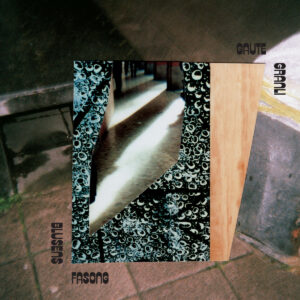
The Norwegian wunderking of demented psychedelic song (de)structure is back with a fantastic collection of soft madness. His Animalskt LP was played in the UE office until you could see through it. Gaute Granli is a one man band, taking a complete stranger with thirsty ears by the nose to leave him/her/them behind, confused and hungry for more recognizable hope.
There's a constant form of recognition going on here in these 8 stretched songs, these strange flirts with folk music you think you know from somewhere, vocals that don't sound like they consist of words one knows, and pop parts that are stripped by a psychedelic gnome messing with loop pedals. Although everything magically works, and made it into a song structure of sorts, a melancholic almost religious dust of desperation sits uncomfortably on all these tunes, like a frog that was already licked on the back.
Limited to 300 copies, comes with an insert, a download code and a UE sticker
20,00€
In stock
LP
OGON BATTO
“Browse”
Ōgon Batto is an exercise in patience; indeed, a model of restraint in these trying times. Although a fixture of the Belgian underground for over a decade (as part of the Hare Akedod label and band, the latter with DSR Lines’ David Edren), Bent Von Bent has released just two albums thus far.
A scroll through ‘Browse’ reveals a series of miniature compositions — bite-size psychedelic treats, a sequence of imaginary hyperlinks and clickbait for Generation Instant Gratification, reminiscent of the early work of Battiato, Francois De Roubaix, and Igor Wakhévitch.
Limited edition of 300 copies. Includes an insert, download code and a UE sticker.
20,00€
In stock
CD
Giovanni Di DOMENICO
“Dust bunnies”
Dust Bunnies is Giovanni Di Domenico's first solo release for 901 Editions. Recorded in Oude Kerk Charlois with the majestic 1784's Hess pipe organ and in Klangendum / Worm studio in Rotterdam, the album beautifully merges acoustic and synthetic sounds. As pressurized air flows through the pipes, the music reminds us of desertic wind, evoking introspective passages and expansive panoramas from above where large clumps of dust are destined to roll endlessly.
13,00€
In stock

Book + CD
Steve RODEN
“Gradual small fires (and a bowl of resonant milk)”
From Steve Roden:
"gradual small fires (and a bowl of resonant milk), was commissioned by the university of hong kong’s new media school, and more specifically, the work was created initially for daniel libeskind’s building for the university’s cmc (creative media center). for the grand opening of the building, several sound and new media artists were invited to create works on site.
the work consisted of 5 different pieces – each object constructed of plexiglass, and each sound work anchored by a recording of a fire that i had made in denmark 10 years or so ago. i added sounds (such as bells, rocks, guitar, field recordings), and everything was manipulated, for the most part with analog guitar pedals.
each sound/sculpture was placed in a discreet location, generally a space that seemed to have no use. the pieces were relatively quiet, and the hope was that a student or visitor would happen upon these works accidentally, and that the piece would then offer a diversion.
my goal was to complete a piece for every photo in ruscha’s book.
along with the five works exhibited at the cmc in hong kong, a 6th piece, gradual small fire 5, was commissioned for the exhibition “sound art. sound as a medium of art” at the zkm in karlsruhe."
60-page A5 colour sewn-bound book plus CD in a cardboard wallet.
Edition of 300 copies.
25,00€
In stock
CD
Fabio PERLETTA
“Un fiocco di neve”
"Un Fiocco Di Neve" (Italian word for snowflake) is one of the possible crystallisations of an ongoing project called Nucleazione (Nucleation), started in 2017 and consisting of the accumulation of over 200 sound files and silences pulled together and randomly overlapped with no control. The five compositions of this album originate from a series of auto-generative methods. Nucleazione is exhibited as an online project where listeners can themselves experiment the non-linear creation of unstable, undefined compositions with no predetermined beginning nor end.
14,00€
In stock
LP
PAPIRO
“La finestra dentata”
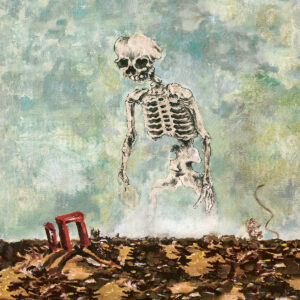
Papiro’s approach to music is never technical, but always personal. Since the mid-Nineties, he has released a handful of noteworthy albums, each carefully put together and seemingly self-contained, yet all sharing an unmistakable musical language and a certain escapist aura.
La finestra dentata (The Toothed Window), is no exception. It includes both studio and concert recordings from 2016–2020. The sounds on this album appear infinite and full of marvels, ingenious in portraying imaginary creatures and environments.
The title track and Anelli take up most of the first side and include live outtakes. Papiro likes to describe his performances as therapeutic. These swirly symphonies are specifically intended as immersive deep-listening experiences for concert venues, and have been edited for this album to meet the physical demands of vinyl and domestic use. Imagine the younger cousins of Laurie Spiegel’s Concerto Generator performance, or Terry Riley’s Shri Camel.
However, those who know Papiro only from the stage might be unaware of a different side to his oeuvre; starry-eyed miniatures that may appear frivolous in comparison to the more heady tracks, but are nonetheless well worth discovering. Each piece adds a chapter to a phantasmagoric world populated by such characters as "Giant Duckling", "King Hard-Beard", or the "Bodulator". Tracks like the opener Odilon or Il triciclo nascosto, meanwhile, emanate a candor rarely found in the domain of serious music, and revisit Papiro’s early days of instrumental storytelling.
24,00€
In stock
LP
David FENECH & KLIMPEREI
“Rainbow de nuit”
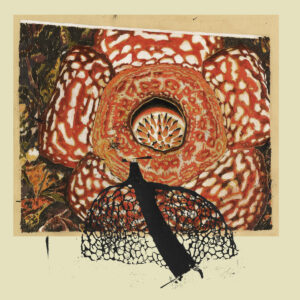
Maestro melodist Christophe Petchanatz (aka Klimperei) and all around music fanatic David Fenech engage remotely in a repetitive exchange of recordings and overdubs on their debut album titled ‘Rainbow de Nuit’, sporadically spanning over the last decade. Evocations of experimental and improvised jazz, chansonesque songs, bluesy folk, and outsider music undulate harmoniously across the record. From music boxes and walkie-talkies down to plastic straws, plucking various stringed instruments such as the charrango and banjo, kazoos and snake-charmer ocarina and flutes, all the way through the sweet accordion and melodica, found and traditional tuned percussion - there is far from a shortage of sound sources on this freakishly inviting record. What germinates as an imaginative and emotional chord progression played by Klimperei, evolves with Fenech layering additional recordings, which would then find their way back home to Klimperei yet again, and so on, and so forth. This recursive compositional and improvisational loop, combined with Fenech’s musique-concrete-like mixing and editing techniques, transforms the acoustic recordings by way of compression, saturation, and reverberation or simple pitch changes - resulting in the duo’s recordings seemingly sound like they may very well be an octet in real time. While the majority of the recordings have been ping-ponged remotely, David and Christophe unite under one roof to record the closing track of the album.
The pieces presented on ‘Rainbow de Nuit’ treat the ears to a carousel ride waltzing through a multiverse made up of surrealist puppet theaters, dramatic film noir act changes, and a mosaic of polyphonic instruments and toys alike. In other words, a score to a fable brought to life with haunting yet charming melodies and occasional hallucinatory voices reminiscent of laughter and infantile epiphanies which we hear on Tarzan en Tasmanie and Madrigal for Lola. This is taken a step further by Fenech, to a brief libretto of incomprehensible tongues on Pocarina. Amid the mysterious and dark (Septième Ciel and Rugit Le Coeur) also lies tender and simple compositions (Rainbow de Nuit and Chevalier Gambette), murky suspenseful melancholy (Levy Attend and Eno Ennio), and casually slipping into pensive psychedelic backdrops (Un Cercueil à Deux Places) - forming a colorful blend of sounds. A world of echoes. A tale of tales. One persistent earworm that you’ll likely be whistling and humming along to on a first listen.
24,00€
In stock

LP
Evan PARKER
“Monoceros”
Evan Parker's monolithic 1978 solo record Monoceros was originally released on Incus in 1978, and distinguishes itself in several respects: first, because it was recorded by the direct-cut process, whereby the sound pathway went directly from the microphone to a vinyl master. By virtue of eliminating the tape intermediate, the hope was to reduce noise and limit the need for processing and filters. The important functional consequence of this technology was that the musician (and the technicians) had to get it right the first time. In the context of free improvisation, direct-cut served as self-imposed discipline for purists only. In the present day, this process is mostly obsolete.
On Monoceros, Parker explores a wide range of soprano saxophone work, though most of it is hardly recognizable as such: squeaking, squawking, and birdlike noises persist throughout. The first piece on the record spans a long 21 minutes of essentially uninterrupted solo saxophone, facilitated by Parker's exceptional technical command of the instrument: circular breathing, triple-tonguing, false fingering, etc. The guiding principle of this music, as realized by Parker, was to use technical prowess to remove the barriers between the sounds in his head and the sounds coming from his horn. Generations of saxophone players who followed in Parker's footsteps owe a huge debt to his innovations on the instrument. Indeed, none of Monoceros is easy listening: Parker seems driven to play as freely and outspokenly as possible.
detail
In the pantheon of saxophone colossi, there is a special place reserved for Evan Parker. Taking late Coltrane as his jumping off point, Parker has expanded the language of the saxophone as much as anyone over the past three decades. A central figure in the European Free Improv scene alonside Derek Bailey, Peter Brotzmann, John Stevens, Alexander von Schlippenbach and many others, Parker has been a significant force for creative music in an astonishing array of settings.
"Eight years after Topography Of The Lungs, and two years after his Saxophone Solos, Monoceros was the most muscular statement of Evan Parker's solo saxophone muse. Superbly recorded, it seemed to place the listener within the chaotic air flows of the saxophone’s own tubing. Philip Clark said: “Parker’s dialogue with the saxophone throws up so much that is unexpected, and indeed unknowable, that the problem he faces is how to keep pace with his own invention.” TheWire Best Albums of 2015
21,00€
Out of stock
LP
Evan PARKER
“With birds”
2021 repress.
"One of Treader's most requested recordings sees the great UK free saxophonist Evan Parker on soprano and tenor saxophones, duetting with European birdsong. A fitting tribute to his friend, the celebrated soprano saxophone player Steve Lacy, who died in the year of its initial release."
One of Treader’s most requested recordings sees the great UK free saxophonist Evan Parker on soprano and tenor saxophones, duetting with European birdsong. A fitting tribute to his friend, the celebrated soprano saxophone player Steve Lacy, who died in the year of its initial release. A titan of British free jazz, Evan Parker needs no introduction. His output, both as a bandleader and collaborator, are the stuff of legend. Within the history of the European improvised music, he’s everywhere - having intertwined his singular approach with Peter Brötzmann, Manfred Schoof, Tony Oxley, Derek Bailey, Han Bennink, Alexander von Schlippenbach, Keith Rowe, Barry Guy, and countless others at a ferocious pace. Despite his renown for work within ensembles, Parker often becomes the most striking version of himself when he steps out onto his own, offering an unparalleled approach to the solo saxophone. Evan Parker With Birds is one of the more memorable versions of this. Recorded as a tribute to his friends and longtime collaborator, Steve Lacy, who had died shortly before its recordings, Evan Parker With Birds isn’t technically a solo work.
It features the veteran player consumed by, responding to, and playing against, a sonic landscape of field recordings by Ashley Wales, birdsong recorded by Geoff Sample, Charles & Heather Myers, Jean C. Roche, Myles North & Eric Simms, with further offerings and interventions by John Coxon. The result is so fantastic and engaging, it leaves little question of why it has been one of Treader’s most popular releases since it first emerged. A world of shimmering sonority and rippling, sometimes brittle texture - an album filled witth surprise - elements of nature and humanity forced into balance and harmony by Parker’s tones and ear. A wonderful rethinking a musical structure and creative approach, the announcement for the vinyl reissue of Evan Parker With Birds has already sent the heads scrambling to get a copy.
21,00€
Out of stock
CD
Michael RANTA
“The Great Wall / Chanta Khat”
Michael Ranta has collaborated with Takehisa Kosugi, Toshi Ichiyanagi, Jean-Claude Eloy, Conny Plank, Mike Lewis, and Hartmut Geerken, just to name a few. He was also assistant to Harry Partch and performer in the Gate 5 Ensemble in the 1960s. Additionally, Ranta performed in Stockhausen's ensemble during the 1970 World Expo in Osaka. Ranta's resume also includes recordings by Helmut Lachenmann, Herbert Brün, Toru Takemitsu, Josef Anton Riedl, Mauricio Kagel, among others. Throughout his extensive recordings and live performances, Ranta has furthered the trajectories of contemporary percussion composition alongside works for tape and electronics. His works are fully immersive which evoke vast spaces, ritual, and create an expansive presence for his accompanying multimedia commissions.
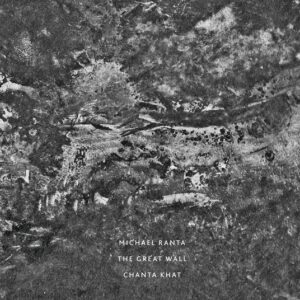
For this CD release, two of Ranta's longform pieces are included: "The Great Wall" and "Chanta Khat". Originally scored for the HT Chen Dance Company as a theater production, "The Great Wall" premiered in 1984 at the La MaMa experimental theater in New York. This highly detailed composition for electronics, voice, percussion, and tape offers a massive drone-based accompaniment for Chen's stage presentation of the legend of Meng Jiangnu. Yet, Ranta's composition also creates a fully formed soundtrack that stands beautifully on its own. The atmosphere is very much in the spirit of Kosugi's multimedia masterwork Catch Wave and Jean Claude Eloy's large-scale production Yo-In which also features Ranta.
"Chanta Khat" was completed in 1973. An early version of this piece originally premiered as part of a multimedia installation at the 1972 summer Olympics in Munich. This powerful work for tape and electronics includes Ranta's field recordings documenting his travel in Laos during a lunar eclipse earlier that same year. The piece is a haunting and equally frantic work where the local villagers are heard responding quite emotionally and viscerally to the celestial event of the day. "Chanta Khat" was later reworked and remixed in 1973 at the NHK electronic music studio in Tokyo. This version is featured here in its entirety. Packaged in a six-panel digipak with fully remastered and restored audio. Includes detailed notes by Michael Ranta and features new artwork by Timo van Luijk.
16,00€
In stock

LP
MUSICA ELETTRONICA VIVA
“Spacecraft”
Musica Elettronica Viva, or MEV for short, was formed in 1966 in Rome by Allan Bryant, Alvin Curran, Jon Phetteplace, Carol Plantamura, Frederic Rzweski, Richard Teitelbaum and Ivan Vandor. From the very beginning the group was based on musical freedom and the shunning of convention. Using contact microphones to record and manipulate sound wherever it could be found – from box springs to vibrators – and improvisationally combining those recordings with tenor sax, homemade synths and the very first Moog to trek cross the Atlantic, MEV made some of the most imaginative and abrasive sounds of the time.
Recorded in live performance at the Academy of Arts (Akademie der Künste) in Berlin on October 5, 1967, Spacecraft is made up of a single piece of the same name – a slow building, jarring and disquieting work that reveals the entire MEV ethos in its lone half hour. As group member Alvin Curran put it “The music could go anywhere, gliding into self-regenerating unity or lurching into irrevocable chaos - both were valuable goals. In the general euphoria of the times, MEV thought it had re-invented music; in any case it had certainly rediscovered it.” Our Swimmer is pleased to present this first ever vinyl issue of MEV’s Spacecraft, an early piece from the most free-spirited group of the 20th century avant-garde.
22,50€
In stock
LP
Alvin CURRAN
“The Works”
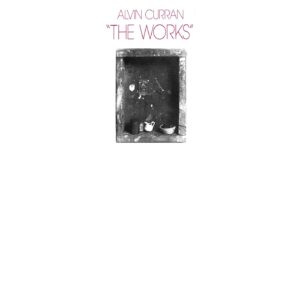
The Works - one of the most famous pieces by brilliant American composer Alvin Curran - was not created by will and direct purpose but, as the composer himself states, as a “providential accident” which is to say quite organically. Combining piano and voice with found sound and a custom-built Serge modular synthesizer, “The Works” is a slowly developing piece where space and ambient tape are eventually overtaken by raga-esque chanting and frenetic piano playing, where synthesizer washes become full-on workouts all leading to a coda where the listener is “finally carried off on the wheels of the Berlin U-Bahn.”
Curran - whose initial training and musical education was as a pianist - had been living in Roma, Italy, in the mid-‘70s returning to his roots and performing regularly in cocktail lounges on Via Veneto. It was this return to piano and vocals that became the genesis for The Works. In relearning the piano, a five-note “motive” took hold. Added to this was “a recording I had made of our 14 year old dachshund Caspar just before he died. It was, in fact, a love song which he persisted in singing all day after meeting a lovely bitch in heat in Piazza Navona. This I knew would be the beginning of the piece.” As the piece expands further the listener will hear “cows munching grass, the Rome-Florence express train, a horse-fly caught against a window pane, my footsteps approaching a Roman fountain and later going up the steps of my old studio, cicadas, an Amsterdam calliope, a tin can being kicked, and a series of sounds from La Serra di Lerici.”
Though “The Works” has been performed in many incarnations over the years, it’s this performance - captured on February 24, 1980, and originally released that same year by the short-lived Italian avant-garde label Fore - that is the definitive version, and one of the finest recordings ever made by the celebrated composer.
23,00€
Out of stock

LP
André STORDEUR
“Oberheim SEM 8 Voice 1979-80”
Sub Rosa presents in their Early Electronic series, the final chapter of music by Beglian key composer of early electronic experiments, André Stordeur (1941-2020). Side A features a previously unreleased, stark and poignant composition from 1979; while the B side is vibrant and almost playful of pieces from the 2000s.
André Stordeur His musical career started in 1973 with a tape composition for the soundtrack to a film on Gordon Matta-Clark titled Office Baroque. Later in the 1970s, he participated to avantgarde music ensemble Studio voor Experimentele Muziek, founded in Antwerp, Flanders, by Joris De Laet. Since 1980, Stordeur composes exclusively on Serge synthesizer, either a Serge series 79 and a Serge prototype 1980, which was especially built for him by Serge Tcherepnin himself. In 1981, Stordeur composed the music of Belgian film director Christian Mesnil's documentary Du Zaïre au Congo. He studied at IRCAM in 1981 with David Wessel and then flew to the US to study with Morton Subotnick. Stordeur became an influential sound synthesis teacher and, in 1997, completed his Art of Analog Modular Synthesis by Voltage Control,[4] a guide to everything modular.
Oberheim While 'Oberheim' is the centerpiece of this LP, we pressed for the first time on vinyl three pieces from the session André called 'Synthesis Studies,' previously featuring on Complete Analog and Digital Electronic Music, 1978-2000. 'I was helped in my studies by a must-have book: The Techniques of Electronic Music, by Thomas Wells and Eric Vogel (University Stores, 1974). That book aside, I learned synthesis on my own. After a trip to India in 1968, I discovered Indian music and took tabla and sitar classes in New Delhi; my teachers were students of Chatur Lal and Ravi Shankar. Later, in the 2000s, while living in the US, I tried to recreate through synthesis all the Indian musical instruments I loved so much.' 'Drone' is one of his most spectacular works.
15,00€
In stock

LP
Rip HAYMAN
“Waves: Real and Imagined”
Captain Rip Hayman (b.1951, New Mexico) has come ashore again, bearing fresh cargo. A student of John Cage, Ravi Shankar, and Philip Corner, Rip was a founding editor of the notable Ear Magazine (1975-1991), and since 1977 he has run New York's oldest bar, the Ear Inn. The focused minimalism of his new LP Waves: Real and Imagined varies from the collaged spectacle of his first Recital LP, Dreams of India & China (2019).
This oceanic dish holds two side-long works: “Waves for Flutes,” a multi-tracked flute composition recorded by the artist in 1977. ‘Angelic’, ‘Grave’, and ‘Sad’ modes overlap an effect of medieval choral organum, as shifting patterns evoke water and wind variations of the shore and vast sea beyond. An enchanting and arresting piece.
The second side holds “Seascapes,” which was recorded on the Pacific ocean in February and March of 2020 – through calm seas and tempestuous storms. The ship as the instrument played by the sea. We feel both lost and saved when at sea, the landfall feared or longed for.
The album is dedicated to all those whose souls have been lost and found at sea amidst the waves, for each sea wave is a child of Oceanus & Tethys, Greek gods of the sea, every one sent on their way to play...
27,00€
In stock

LP
KLEISTWAHR
“Winter”
Kleistwahr is the solo project of Gary Mundy, the legendary power electronic and noise-rock musician who is a founding member of Ramleh and runs the highly influential Broken Flag label. Solemn drones and elegiac long-form passages gird Kleistwahr’s Winter, which often chimes, glistens, and glows through a unhurried constructs for organ, synth, guitar, and electronics. Yet Mundy pivots throughout with triumphant explosions of shrill noise, redlined overload, and harrowingly anguished vocals from the great unknown. Quintessential Kleistwahr.
Winter was originally published as part of the instantly out of print On Corrosion - a 10 cassette anthology from 2019 that was housed in a handcrafted wooden box and featuring full albums from Kleistwahr, Neutral, Pinkcourtesyphone, Alice Kemp, She Spread Sorrow, G*Park, Relay For Death, Francisco Meirino, Fossil Aerosol Mining Project, and Himukalt. The collection also stood as the 50th release for The Helen Scarsdale Agency, an imprint founded in 2003 and dedicated to post-industrial research, recombinant noise, surrealist demolition, existential vacancy and then some.
With the necessary reissue of Winter, The Helen Scarsdale Agency will embark upon the reissue of much of that material from On Corrosion.
20,00€
Out of stock

2 LP
COMPILATION
“Strain Crack & Break Vol. 2, Music from the The Nurse With Wound List (Germany)”
With his ongoing commitment to like-minded archivist label Finders Keepers Records, industrial music pioneer Steven Stapleton further entrusts us to lift the veil and expose “the right tracks” from his uber-legendary and oft misinterpreted psych/prog/punk peculiarity shopping list known as The Nurse With Wound List. Following the critically lauded first instalment and it’s exclusively French tracklisting both parties now combine their vinyl-vulturous penchants to bring you the next Strain Crack & Break edition which consists of twelve lesser-known German records that played a hugely important part in the initial foundations of the list which began to unfold when Stapleton was just thirteen-years-old. From the perspective of a schoolboy Amon Düül (ONE) victim, at the start of a journey that commenced before phrases like kosmische and the xeno-ignant Krautrock tag had become mag hack currency, this compendium is devoid of the tropes that united what many would accurately argue to be the greatest progressive pop bands in Europe (namely CAN, Neu! and Kraftwerk) and rather shatters the ingredients across a ground zero landscape for both inquisitive fans and socially rehabbing musos to begin to assemble a unique self-styled identity. If Krautrock was the music that journalist told us lurked behind schlager (German pop) in the 1970s, then this record includes the music that skulked behind Krautrock and perhaps refused to polish its backhanded name belt. Including lesser-known artists like the late Wolfgang Dauner whose career proceeded and outlived the kosmische movement while consistently informing and outsmarting ‘em whenever they got stuck in their metronomic ruts, or how about Fritz Müller, the man who was to Kraftwerk what Stuart Sutcliffe was to The Beatles but had more in common with Yoko and quite rightly couldn’t give a shit about the Fab Four’s Hamburg roots. Elsewhere we have a plethora of German bands made for German audiences as they try and shed second hand flower power Americanisms and feel the benefits of much harder drugs and the realisations of difficult second album budgets while Kommune 1 newsflashes wipe smiles from everybody’s faces and replace them with opioid chic or acid-sarcastic grins. Bonzo Cockettes show us their Big Muffs and drummers ask for extra mics while Conny Plank goes for parliamentary office and gives babies good firm hand shakes for the camera. Strain Crack & Break Volume Two is the sound of Steve Stapleton’s sponge-like mind and the dividends of anyone who was brave enough to even peek inside those brick-thick gatefold covers never mind drop the needle, with tracks by Mr. and Mrs. Fuchs (aka Anima-Sound) who played their instruments completely naked throughout their anti- career alongside previously unpressed tracks by the scene’s leading Detroit-born African American drummer Fred Braceful who’s band Exmagma officially had the coolest record sleeves and track titles of ALL TIME (Torpedo Tits? Yes Please!). From an era where it was embarrassing to go into your local record shop and hum the tune over the counter, well that young lad Steve Stapleton was braver than that, and besides, these tracks are unhummable and at times unutterable. Did somebody in the crowd shout out for Joel Vandroogenbroeck! Good luck with that one. Stapleton is sharing. Even Stevens.
Over forty years since Nurse With Wound’s first album was released, Finders Keepers Records and Steve Stapleton take connoisseurs of OUR kind of music, back to the disused elevator shaft towards ground zero. Arrriving at the same checkout from different departments, Finders Keepers and Nurse With Wound continue to sing from the same hymnal with this ongoing collaborative attempt to officially, authentically and legally compile the best tracks from Steve’s list, where many overzealous nerds have faltered (or simply, got the wrong end of the stick). After Strain Crack & Break Volume One merely scratched the surface of this DIY dossier of elongated punk- prog peculiarities, our second lavish metallic gatefold double vinyl compendium drives a much deeper groove, which, in accordance with Steve’s wishes, focusses exclusively on individual tracks of German origin - the country whose music forged the prototype of the NWW inventory in the form of his secondary school vinyl want-list in the early 1970s. Comprising of disassembled free jazz, unshowered stoner psych, hypnotic prog, deranged monk funk and fuzzed out Deutschmark bin bonzo beats this second volume of the series throws us straight back in the deep end, putting the Bad in Baden and the odour in The Oder with little need for cheap Cologne.
Willkommen to another forgotten plateau found beneath the psychedelic underground, as Steve Stapleton and Finders Keepers dig new tunnels through the fabric of your vinyl wish-list, these German records are heavy, so find Solid Ground or watch you floorboards Strain Crack & Break before your bloody ears.
29,00€
Out of stock
LP
François J. BONNET & Stephen O’MALLEY
“Cylene Suisse redux”
Cylene Suisse Redux documents François J. Bonnet and Stephen O'Malley's Switzerland tour in December 2019, following the release of their first album, Cylene.
The two musicians chose to entrust sound material recorded on the tour to the expert ears of two friends and great musicians Jim O'Rourke and Ryoji Ikeda, giving them carte blanche, and each in turn chose a distinct personal approach. For Ryoji Ikeda, it was a question of finding a moment, circumscribing a fragment of time through his listening, with minimal intervention. For Jim O'Rourke, on the other hand, the live recordings became material to be deconstructed and reassembled, to tell, according to his musical sensibility, a path of metamorphosis for Bonnet and O'Malley's music.
Cylene Suisse Redux is a prismatic substrate of a series of concerts surrounded by friendship, lakes, mountains, and by nightfall.
21,00€
In stock

2 LP
Caterina BARBIERI
“Fantas Variations”
Fantas is the epic opening track on Caterina Barbieri’s acclaimed 2019 release Ecstatic Computation. The original Fantas laid out a magical path of patterns leading the listener on a journey into the sound itself. Fantas Variations maps out eight new potentials sprung from this initial path as constructed by a diverse mix of artists lending to a wide spectrum of new works extrapolated from the original work. For this project Barbieri invited friends and long time collaborators from a variety of musical backgrounds to create a more sustainable and inclusive landscape in terms of stylistic, geographical, gender and generational balance. The results are a diverse array of approaches and instrumentation which blur the boundaries between the acoustic and electronic.
Fantas Variations embraces a platform for mutual exchange and support between like-minded artists, where active and collective re-imagination is prioritised over the traditional model of remixes, which is often strategic, functional and more passive.
Longtime friend and collaborator Kali Malone rearranged Fantas to a slowed-down, austere and eerie version for two Organs. Evelyn Saylor created a piece for a vocal ensemble consisting of her, Lyra Pramuk, Stine Janvin and Annie Garlid, joining forces to express the choral, psychedelic and vitalistic nature of the piece. Barbieri’s former guitar professor at the Conservatory in Bologna, Walter Zanetti, composes Fantas for electric guitar, by translating every single gesture of the original electronic piece into a personal, nuanced and detailed interpretation. Bendik Giske’s reinterpretation for Saxophone and Voice captures the atmospheric essence of Fantas and its psychic meteorology. Longtime collaborator and along with Barbieri the other half of the outfit Punctum, Carlo Maria, resynthesizes Fantas for TR808 and MC202, bringing a more club-oriented dimension of the piece to life whilst unveiling the sonic continuum between rhythm and pitch through a sensitive timbral approach. Jay Mitta’s Singeli reinterpretation of Fantas transpires with pitched-up percussion and turbo-fast polyrhythmic patterns unleashing the frenetic, shifting, transformative matter within the piece to a higher plain of euphoric dance. Baseck’s variation is a rave fantasia, where the prismatic trance of the original is channeled into fierce, uncompromising hardcore, whilst Kara-Lis Coverdale’s take is a phantasmagoria for piano that gently, yet inexorably, captures the relentlessness chimerical qualities of the original, unveiling its spectral backbone.
Evelyn Saylor (feat. Lyra Pramuk, Annie Garlid & Stine Janvin) - Fantas Variation for Voices (7’38’’)
Composed by Evelyn Saylor. Performed by Evelyn Saylor, Lyra Pramuk, Stine Janvin and Annie Garlid. Recording, mix and additional production by Bridget Ferrill at Real Surreal Studio, Berlin 2021.
Bendik Giske - Fantas for Saxophone and Voice (7'31'')
Adapted and performed by Bendik Giske. Recorded, mixed, and produced by Bendik Giske in Funkhaus, Berlin 2020.
Kali Malone - Fantas for two Organs (10'21'')
Arranged for The Utopa Baroque Organ, The Sauer Organ and tuned sine waves. Recorded by Benny Nilsen at Orgelpark, Amsterdam 2020.
Walter Zanetti - Fantas for Electric Guitar (7'27'')
Recorded by Walter Zanetti, Bologna 2020.
Jay Mitta - Singeli Fantas (12'03'')
Recorded by Jay Mitta in Sisso Studios, Dar Es Salaam 2020.
Baseck - Fantas Hardcore (4'44'')
Mixed by Anthony Baldino, Los Angeles 2020.
Carlo Maria - Fantas resynthesized for 808 and 202 (4'29'')
Recorded by Carlo Maria, Milano 2020.
Kara-Lis Coverdale - Fantas Morbida (3'04'')
Performed, recorded and mixed at The Shop in Valens, Ontario by Kara-Lis Coverdale, January 2021. Engineering assistance from Robert Coverdale and Adam Feingold.
27,00€
Out of stock

LP
HECKER / Okkyung LEE
“Statistique Synthétique / Teum (the Silvery Slit)”
A split album as part of the GRM Portraits series with two electroacoustic pieces by Florian Hecker (computer-generated multiphonic sounds and resynthesized recordings of localized textures) and Okkyung Lee (an acousmatic piece written for computer-generated sounds, pre-recorded materials and cello that was developed for the Acousmonium sound diffusion system during a residence at Ina GRM, Paris, in January 2019).
Statistique Synthétique draws as much from the history of computer sound synthesis as from its latest developments. But well beyond developing simply as a proof of concept, this piece aims to transcend the abstract status of synthetic sound objects and lead them to a properly hallucinatory state, that is to say to a meeting point where the object and perception dissolve into each other, in a sort of transcendental field. Beyond, also, hylomorphism, to reach the world of matter-form fusions, where perception knows how to see “shoulders of hills”, as Cézanne wrote.
Teum (the Silvery Slit) is, as the title suggests, an overture, an opening to the game of multiplications, fragmentations, duplications. But it is also the opening understood as the void that blossoms between two borders, a break from which escapes a double tension, both the pulling force of these two edges which move apart and the opposite force of reconciliation, of compression. Okkyung Lee invites us to a truly telluric moment, a rare moment of expression where tectonic movements and shear stresses become music. If the earthquakes were, as we thought in the 18th century, due to underground thunderstorms, there is no doubt that this piece of music, both celestial and continental, could have been their audible manifestation.
In his sound installations and live performances, Florian Hecker (born 1975 in Augsburg, lives and works in Vienna) deals with specific compositional developments of post-war modernity, electro-acoustic music, and other, non-musical disciplines. He dramatizes space, time and self-perception in his sonic works by isolating specific auditory events in their singularity, thus stretching the boundaries of their materialization. Their objectual autonomy is exposed while simultaneously evoking sensations, memories, and associations in an immersive intensity.
Okkyung Lee (born 1975 in Daejeon, South Korea) is a cellist, composer, and improviser who moves freely between of artistic disciples and contingencies. Since moving to New York in 2000 she has worked in disparate contexts as a solo artist and collaborator with creators in a wide range of disciplines. A native of South Korea, Okkyung Lee has taken a broad array of inspirations—including noise, improvisation, jazz, western classical, and the traditional and popular music of her homeland—and used them to forge a highly distinctive approach. Her curiosity and a determined sense of exploration guide the work she has made in disparate contexts.
Okkyung Lee has appeared on more than 30 albums and has collaborated with Arca, David Behrman, Chris Corsano, Jacques Demierre, Mark Fell, Ellen Fullman, Douglas Gordon, Jenny Hval, Vijay Iyer, Christian Marclay, Ikue Mori, Phill Niblock, Bill Orcutt, Marina Rosenfeld, John Zorn, among others.
25,00€
In stock

2 LP
MUNE (J-L GUIONNET & C. BERGERAULT)
“Airs trouvés”
Jean-Luc Guionnet : organ
Claire Bergerault : voice
Cutting : Frédéric Alstadt - Ångström Mastering / Bruxelles january 2021.
28,00€
In stock

CD
Jean-Philippe GROSS & Jérôme NOETINGER
“Nos cadavres”
There is a great tradition of exchange and correspondence work in experimental music. In the 80's, there were a lot of cassettes with musicians who had never met each other but were exchanging sounds by post mail. Nowadays it's even simpler and more obvious.
The imposed period of confinement - in France between March 17 and May 11, and between October 30 and December 15 - was ideal for restarting such projects.
Jean-Philippe Gross and Jérôme Noetinger have had the opportunity to play several times as a duo since 2009. They decided to start this new email collaboration based on the idea of the exquisite corpse. One musician created a frst sequence and sent only the last 10 seconds to the
next one who then mixed or pasted his sequence into it, and so on. The frst two "Cadavre" were published by Cafe Oto new in-house label Takuroku.
Excited by this new way of working, Jean-Philippe Gross and Jérôme Noetinger decided to go deeper into it.
Each of the fourth "Cadavre" that you will fnd on this CD was realised in one day only, each musician having only 30 minutes to build his answer.
The final result was only slightly modifed in terms of volume. The rawness of the process itself creates music that would otherwise be impossible to make. It's as beautiful as it is strange, improbable and unexpected, absurd and playful, and it is not easy to guess who does what.
Jean-Philippe Gross: Serge modular system, mixer feedback, feld recordings, treatments, radio.
Jérôme Noetinger: Revox tape recorder, cassettes, CDJ, feld recordings, treatments, radio.
8,00€
In stock

CD
TARAB
“Holes”
All sounds borrowed from various rooms, the things that happened in them, and those that come in from outside. collected and re-arranged 2020. some recordings initially made for the Amplify 2020 series, others not.
Master: Phil Julian.
Print: Ben Owen/Middle Press.
HOLES were formed as part of a research project undertaken with support from RMIT, Melbourne.
13,00€
Out of stock
LP
GILBERT / LEWIS / MILLS
“Mzui”
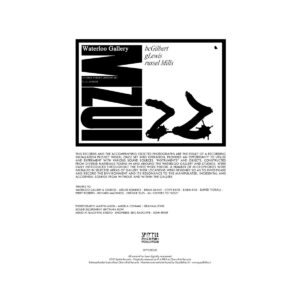
Originally conceived for a multi-media installation, the music contained in this album represents one of Lewis and Gilbert's earliest steps in their immediate post-WIRE period. With the band's break-up in February 1980, the duo began to take a more explorative approach through various projects (Dome, Kupol...). Clearly they needed something different and more open out. That's how they started to work on the Mzui multi-media installation, some sort of evolving work in progress that eventually took place at London's Waterloo Gallery in August 1981. Joined by artist Russell Mills, the ex-WIRE duo built an imaginary space where all sorts of sculptures, found objects, ambiance sounds and audience reactions were components of the same multiple experience. Some time afterward Cherry Red Records proposed a recording project based on the mixing of the resulting tapes. The whole MZUI album, originally released in 1982, is about the notion of sound as landscape, and the soundscape as a guide to an extended form of listening and a unique aural experience. Not a very different concept than Brian Eno's ambient experiments of the same period, but less lyrical and more dark-urban oriented. For too many years out of print, finally digitally remastered, here's the first vinyl reissue of this historical album. As for its 1981's first release, the record comes packaged in a six pages 12" foldable printed sheet with photos in a plain black sleeve, within a clear PVC cover. Ltd to 500 copies.
18,50€
In stock

LP
ALTERNATIVE TV
“Vibing Up The Senile Man (Part One)”
Possibly one of the weirdest experiment in the post-punk realm, Vibing Up the Senile Man (Part One) is the second studio album by English anti-heroes Alternative TV, released in March 1979 on small indie label Deptford Fun City. Forget about the influential 1978 debut - The Image Has Cracked – frontman Mark Perry is literally leaving the planet in this effort. ‘There are free jazz influences; I'd got into the Art Ensemble of Chicago, Sun Ra ..) I'd moved into this house with an amazing music room – pianos, clarinets, you name it – and we'd always be picking up stuff from junk shops.’ The description set the pace for a unique performance, not only the afro-american heritage , traces of the Canterbury school are almost evident as the early experiment of the BBC Radiophonic workshop. Is it safe to consider Vibing up The Senile Man on the same time-line as Robert Wyatt ‘The End Of An Ear’ and Throbbing Gristle ’20 Jazz Funk Greats’ (Genesis P-Orridge is on board on two tracks, playing assorted percussion) ? Judge by yourself and don’t be scared.
18,50€
Out of stock

2 CD
INTERSYSTEMS
“# IV”
Toronto’s infamous psychedelic multimedia collective, Intersystems, make a surprise return with a new full-length LP, #IV. Coming via Waveshaper Media, #IV is Intersystems’ first new material since 1968! Intersystems’ pioneering avant/electronic music sounded positively alien in the 1960s, and more than 50 years later, this latest body of work sounds just as otherworldly.
When they arrived on the scene in the late 1960s, Intersystems stood out from their peers. Comprised of architect Dik Zander, light sculptor Michael Hayden, poet Blake Parker, and musician John Mills-Cockell (of Syrinx, Kensington Market and more), the group mounted groundbreaking pan-sensory events and released a trilogy of defiantly disorienting records.
Where more conventional purveyors of sonic psychedelia were content with fuzztone guitar and orientalist tropes, Intersystems managed to approximate the full psychedelic experience in all its euphoric wonder and terror. Initially wrangling homespun gadgetry, feverishly spliced-together tapes, and mutant beat poetry, Intersystems were also among the very first to deploy a Moog Synthesizer; their Moog modular system was the first to be imported into Canada. Intersystems’ three vinyl LP recordings, meanwhile, justifiably became coveted collector's items given their scarce quantity and singular unsettling vision.
The reissue of Intersystems’ full discography in 2015 prompted acclaim from a number of major outlets. Among them, PopMatters hailed the set as "one of those great lost recordings (three of 'em actually) that comes from the lysergic era..." Mills-Cockell’s work in Syrinx has also been reissued to great acclaim in recent years.
Fifty-plus years after their 1968 album Free Psychedelic Poster Inside, Hayden and Mills-Cockell decided to revive the long-dormant project with a series of sessions at Hamilton's storied Grant Avenue Studio. The resultant music remains remarkably congruent with the project's original vision while clearly emerging from the present moment. With original poet/lyricist Blake Parker now deceased, Hayden and Mills-Cockell made the counterintuitive (yet strangely apt) decision to render Parker's words electronically. As the computer-synthesized voice alternates between an eerily life-like delivery and slurred cybernetic faltering, it brings a new dystopian tint to the group's anxious surrealism. Taking cues from its predecessor, Free Psychedelic Poster Inside, a modular Moog Synthesizer system is the primary instrument, yet here it offers a dynamic blend of different sonorities: barbed wire basslines, Subotnickesque chirping, gestural plumes of colour and percussive filigree.
While the group cut their teeth in the 1960s, make no mistake these new Intersystems recordings aren't a “comeback" or an attempt to rehash the "good old days". What one hears instead is the sound of Mills-Cockell and Hayden re-energizing the project, bringing with them the myriad experience they’ve accumulated in the intervening 50 years. These aural concoctions—no less perplexing than their 1960s predecessors—build upon the Intersystems foundation but very decidedly reside in the present moment, reminding listeners of just how forward-looking this group was in the first place.
12,00€
In stock
LP
Asmus TIETCHENS & Miki YUI
“Neues Boot”
TAL presents the first musical collaboration between Hamburg based Asmus Tietchens and Japanese artist Miki Yui, operating out of Düsseldorf for almost 20 years now. Highly respected and hugely influential artist Asmus Tietchens first made his mark on the electronic music scene in the late 1970s, whereas Miki Yui debuted her sonic settings in 1999.
Their first joint album NEUES BOOT envelops the listener with a poetic sound sensibility and a conceptual clarity which was processed and passed back and forth between their individual studios in Hamburg and Düsseldorf.
Asmus Tietchens: After Stefan Schneider suggested to release a Yui-Tietchens album on his TAL imprint Miki and I quickly developed some ideas towards our eventual collaboration.
We agreed upon an ongoing mutual exchange of material. We have both been very familiar with each other's music for a long time and we found our individual approach towards sound design to be uniquely compatible. We do not use our electronic tools in order to merely achieve the maximum of technical possibilities, but to illustrate aesthetic necessities. This entails a deliberate reduction and refined perception of the sonic characteristics of the material. Only this approach enabled us to fully realise the complete spectrum of the sounds and noises we were working with in order to construct this New Boat. Each and everyone of my treatments is e x c l u s i v e l y based on a track supplied by Miki. I added no new sound sources. Naturally the spatial and temporal dimensions of the source material were thus altered. These transformations are exactly what makes our collaboration special and unique. Very early on we had agreed on New Boat as a working title and a guiding light . Of course in the beginning we had no idea where this New Boat might take us. Now we do know. After several months of ship-building the boat has now set sails for new sonic horizons. Ahoi!
Miki Yui: The title of the album as well as the individual tracks have been inspired by conversations with Asmus. When we had a chat after one of his concerts, he told me about Kōdō, the Art or the Way of the Scent. It is a 8th century Japanese incense ceremony. Very frequently the names of Japanese incense sticks are derived from natural themes, e.g. Bairin is the plum grove, the scent of the first blossom heralding the end of winter.
This poetry, the ephemeral nature of the world reminded me of Kigo, words from a Haiku (a form of Japanese poetry), which reference a particular season or a natural phenomenon. So I chose the names of the individual pieces from Kigo as if The Boat was exploring nature whilst sailing through the seasons. Only in retrospect I realised that the titles combined create this poem:
Early spring a hazy view in the night (Oboro)
Plum groves (Bairin)
Over a Dayfly (Kagerou)
A Milkyway (Amanogawa)
Dawn (Akatsuki)
Art of fragrance (Kōdō)
On fragile thin ice (Usurai)
17,50€
Out of stock
CD
Asmus TIETCHENS & Miki YUI
“Neues Boot”
TAL presents the first musical collaboration between Hamburg based Asmus Tietchens and Japanese artist Miki Yui, operating out of Düsseldorf for almost 20 years now. Highly respected and hugely influential artist Asmus Tietchens first made his mark on the electronic music scene in the late 1970s, whereas Miki Yui debuted her sonic settings in 1999.
Their first joint album NEUES BOOT envelops the listener with a poetic sound sensibility and a conceptual clarity which was processed and passed back and forth between their individual studios in Hamburg and Düsseldorf.
Asmus Tietchens: After Stefan Schneider suggested to release a Yui-Tietchens album on his TAL imprint Miki and I quickly developed some ideas towards our eventual collaboration.
We agreed upon an ongoing mutual exchange of material. We have both been very familiar with each other's music for a long time and we found our individual approach towards sound design to be uniquely compatible. We do not use our electronic tools in order to merely achieve the maximum of technical possibilities, but to illustrate aesthetic necessities. This entails a deliberate reduction and refined perception of the sonic characteristics of the material. Only this approach enabled us to fully realise the complete spectrum of the sounds and noises we were working with in order to construct this New Boat. Each and everyone of my treatments is e x c l u s i v e l y based on a track supplied by Miki. I added no new sound sources. Naturally the spatial and temporal dimensions of the source material were thus altered. These transformations are exactly what makes our collaboration special and unique. Very early on we had agreed on New Boat as a working title and a guiding light . Of course in the beginning we had no idea where this New Boat might take us. Now we do know. After several months of ship-building the boat has now set sails for new sonic horizons. Ahoi!
Miki Yui: The title of the album as well as the individual tracks have been inspired by conversations with Asmus. When we had a chat after one of his concerts, he told me about Kōdō, the Art or the Way of the Scent. It is a 8th century Japanese incense ceremony. Very frequently the names of Japanese incense sticks are derived from natural themes, e.g. Bairin is the plum grove, the scent of the first blossom heralding the end of winter.
This poetry, the ephemeral nature of the world reminded me of Kigo, words from a Haiku (a form of Japanese poetry), which reference a particular season or a natural phenomenon. So I chose the names of the individual pieces from Kigo as if The Boat was exploring nature whilst sailing through the seasons. Only in retrospect I realised that the titles combined create this poem:
Early spring a hazy view in the night (Oboro)
Plum groves (Bairin)
Over a Dayfly (Kagerou)
A Milkyway (Amanogawa)
Dawn (Akatsuki)
Art of fragrance (Kōdō)
On fragile thin ice (Usurai)
13,00€
Out of stock
CD
Daniel MENCHE
“Dirge”
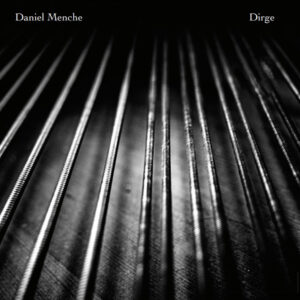
Daniel Menche has yet again utilized a piano to create a vast and immense storm of noise and drones. In 2011 he created a piano noise album titled “Guts” that was the sound of a piano being violently attacked and then electronically treated. Ten years later Daniel Menche worked with a grand piano that was in tune and located in a very acoustically sound studio. With carful elegance and care Daniel Menche wove long horse hairs in between the longest strings of this grand piano and bowed the strings for several hour to create massive amounts of overtones, drones and noise. Edited, mixed and subtly treated, “Dirge” is presented in a rather raw manner. The bowing acoustic movements was the main focus to the music rather than the electronic making this a unique recording in the ever growing discography of Daniel Menche. “Rawest Dirge” is a bonus track only on this CD release that is the raw recording of several objects placed on the strings with tone generators resonating the strings. “Rawest Dirge” is presented raw without any edits or treatments. “Dirge” was a very physical recording to make and therefore an album that truly needs to be heard physically loud and deep as possible.
Daniel Menche : Bowed Grand Piano and Noise
Recorded at the Hallowed Halls studio in Portland Oregon.
Great gratitude to Peter Drake who assisted me wit hthe creative recording process of the grand piano.
Recorded throughout January 2021
Mastered at the Stereophonic Mastering.
11,00€
In stock
LP
Mike VERNUSKY
“Aatma”
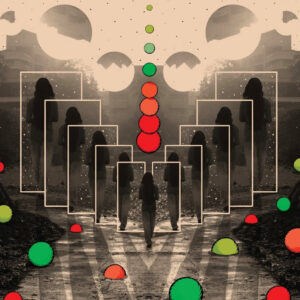
Aatma is the re-imagining of my recent journey into Mumbai through sound, place, and moment with a Nagra SD recorder. The work was composed immediately upon my return while these things were, in a very real sense, still resonating in my mind. Part 1 is the arrival. Echoes of the shanka can be heard from a distant past across the Arabian Sea, as waves wash debris ashore and push you deep into the tumult of the city. Here you may experience the current of life and ride old trains into spectral shadows of obscure & eccentric Bollywood and devotional vinyl records from a local music boutique. Part 2 is a precarious walk across the narrow causeway leading to Haji Ali Dargah, a 600-year-old mosque only accessible at low tide. It is difficult to reach the mosque without being taken aback by the disparate forms of life unfolding on the way in, both in the sky and on foot as can be heard here. Part 3, the final section, is a departure from the hustle of the city altogether. This section delves into the droning, colorful, and percussive instruments with their richly complex and evolving timbres. It culminates in a return to daily shanty life on the beach accompanied by transistor radios blasting modern bollywood music. Aatma is a tribute to Mumbai’s wonderful people and culture, and in the hope of representing different and altered states of listening, living, and celebrating. I hope you find this journey as inspiring as it was for me. - Mike Vernusky.
Music and field recordings by Mike Vernusky. Mastering and additional tempura by Cory Allen. Design by Noopur Choksi. Photography by James David Smith. Kind logistical support by Bhanuj Kappal, Damian O'Riain & Jay Kumar Singh. Special thanks to Manuella Blackburn and illapfest UK. Bollywood vinyl courtesy of Pilak Bhatt of MusicCircle.
150 copies
19,50€
Out of stock

LP
Anton BRUHIN
“Speech Poems / Fruity Music”
Black Truffle is delighted to offer up a rare serving of unheard works by legendary Swiss artist Anton Bruhin. Active as a visual artist, poet, and musician since the 1960s, Bruhin has created important work in forms as varied as concrete poetry and landscape painting, imbuing everything he does with wit, humility, and absurdist humour. A recognised master of the jew’s harp (or Trümpi, as this ancient folk instrument is known in Swiss German), Bruhin’s sound work also encompasses tape collage, sound poetry, and manipulated bird song.
On Speech Poems/Fruity Music we are treated to 26 short pieces made between 2006 and 2008 using the audio software Fruity Loops. These pieces carry on Bruhin’s long-running project of exploring the creative use and misuse of cheap, accessible technologies. In many of his analogue works, Bruhin explored the possibilities of simple cassette equipment. He invented DIY approaches to layering sounds by using multiple tape machines, experimented with distortion and tape speed, or, in his classic Inout (1981) created a maniacally single-minded audio monument to the pause button. Like the computer pixel drawings the artist produced around the same time as these recordings, Speech Poems/Fruity Music extends this approach to consumer software, presenting two parallel sequences of works that make use of Fruity Loops’ inbuilt synthetic instruments and its speech synthesis function. The instrumental works play like a twisted take on the aesthetics of 1980s video game soundtracks, using synthetic accordion and harpsichord sounds to realise jaunty little ditties that exploit their machine-realisation by making use of improbable pitch-bends and humanly impossible tempos and articulations.
Between these samples of Fruity Music, we are treated to the Speech Poems, a series of recitations by a lone computer-generated voice. Many of them are in fact songs, as the synthetic voice crudely and hilariously changes pitch as it moves through its fragmented syllables and odes to cream in coffee. Carrying on Bruhin’s interest in the creative misuse of technology, many of the Speech Poems attempt to force Fruity Loops’ voice synthesis, designed only to speak English, to speak German. By entering phonetic text into the program, Bruhin gets it to produce a passable German alphabet and a series of approximations to a proper pronunciation of his name.
Hilarious while strangely austere, entertaining but bizarre, Speech Poems/Fruity Music is classic Anton Bruhin, arriving in a beautiful mosaic cover by the artist, with the text of the ‘abc für anglophone’ on the back cover.
20,00€