
Out of stock

CD
MØHR – MAEROR TRI
“Hafenstadt”
Release date: 27.01.2015. Digipak designed by Tilmann Benninghaus. Limited to 500 copies.
“This music was originally planned to form a part of the third tape box in the Møhr interpretation series of ZNS Tapes. In this series different artists got an individual 30-minutes-piece of basic material by Møhr to be interpreted it in any way: Using it as a backing tape and adding some more tracks, getting inspired and doing something unique in the spirit of the basic material, deconstruct and arrange it anew. The invited artists had any opportunity to re-work the source material. For the actual release the basic material was placed on side A and the interpretation on side B, enabling the listener to compare the basic and the final sound. Three tapes were compiled as one tape box linked by a loose theme. The first box, Bürokratie, contained works by Das Konzentrat, Bestattunginstitut and Suicide Commando (released in 1990), the second, Kulturschock, contained works by Andrew Chalk / Darren Tate, Ectoplasmic Embryo Experience and Flagrants D’eli (released in 1991). The third one, which was to contain Hafenstadt by Maeror Tri (as well as material of PBK and The Haters), has never been released due to the sudden end of ZNS Tapes. We're convinced that this combination of basic stuff plus musical reworking is still an interesting and exciting experience for the audience, maybe especially after more than 20 years in the archives”. (Andreaz Vogel)
Møhr existed between 1986 and 1994 as the solo project of Andreaz Vogel.
Previously he had been active as a bass player and drummer in various post punk and noise rock groups.Since its inception the main aim with Møhr was
to create a dense and energetic sound without the use of conventional instruemnts. With this wall of sound the listeners were almost under attack and forced into a dark and brooding listening environment, both on the recordings and in the live situation. Andreaz also ran the important tape label ZNS recordings.
Maeror Tri existed from April 1988 to the end of 1996, coming from the very
north-western part of Germany. The three members were influenced by (post)
industrial, noise rock and experimental ambient and found a way to establish
their very own drone based style, using often guitars but also other instruments plus all kinds of (self build) objects and masses of sound effects. Their symbol, the triangle “Wheel” stood for “consciousness”, moving & shining in different colours and speed. The sound was meant as a tool for the listener to open the mind for transcension & sensitization: 'We want to transmit a total openness, the bursting and overcoming of all mental barriers, the breaking out of the enforced subject “Tunnel-Reality” of modern society. Out of Maeror Tri evolved the project Troum that is still very active.
5,00€
In stock

LP
Phil JULIAN
“Trace”
Phil Julian is a UK based sound artist, composer and improviser active since the late 1990’s, with a prolific output under the Cheapmachines alias and his own name. His work has been released on a catalogue of imprints and encompasses sonic textures ranging from harsh squalls of noise to compositions structured around hyper-minimalistic timbres and drones. Studio recordings and live performances within Europe and North America have focused on the use of electronics, particularly unstable and-or chaotic systems e.g. modular synthesisers, feedback, contact microphones, objects and surfaces and computer based works.
“Trace” was recorded at Stockholm’s EMS Elektronmusikstudion during Julian’s Guest Composer residency in 2013. Using a combination of the vintage analogue equipment at EMS and various computer processes, the material on “Trace” was recorded and mixed specifically for diffusion over the Audiorama 17.4 surround sound system, custom built and installed inside the commissioned torpedo workshop on Skeppsholmen island in Stockholm. “Open Form” which takes up the A side of the release is made up of much shorter pieces recorded
over the two week residency. “Corona” is an improvised piece using analogue electronics only and “Arrival” uses a custom computer patch alongside a complex set of processes running on the huge EMS Buchla synthesiser.
The recordings combine the dynamics and space associated with modern composition and electroacoustic works with the density and abrasive qualities more often encountered in noise and contemporary computer music.
Original price was: 18,00€.10,00€Current price is: 10,00€.
In stock
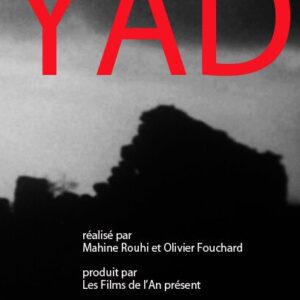
DVDR
Mahine ROUHI et Olivier FOUCHARD
“Yad”
Super 8 and video with images made in the mountains around Grenoble and all edited at home. Music taken from Ground Zero, Antez, Tibet’s Bonpos, Ali Reza Mashayeki, Ulan Bator. This film is a poem about life and death, life and war. Now it exists also with English subtitles.
5,00€
In stock

CD
Dave PHILLIPS
“Field recordings”
“This is a co-release with Tochnit Aleph. Recorded by Dave Phillips, January-March 2001 and January-February 2004. These recordings have been equalized, other than they have been left es arecorded. No mixing, no layering, non normalization or compression, no effects nor any other additions or manipulations. All cuts are indexed. Play loud. Alternate playback through earphones is highly recommended. Seriously.”
Original price was: 10,00€.5,00€Current price is: 5,00€.
Out of stock

LP
KOMMISSAR HJULER – Mama BÄR – Ninni MORGIA – Silvia KASTEL
“Live in Edinburgh”
In April 2011 the two couples formed by Kommissar Hjuler & Mama Baer and Ninni Morgia & Silvia Kastel ventured for a tour in the UK; it was the first time they played together but their shared common visions, attitude and general craziness actually gave life to an inspired team. Every show was different; in Edinburgh, they decided to perform a piece originally written by Ninni Morgia & Silvia Kastel, "Jericho", that Papa Baer liked. So before the show, the group pre-recorded a tape in a big theater-like room inside the venue, with a spoken version of the lyrics. On stage, Mama Baer projected a video made by her, depicting the four of them standing against a wall; the music starts off with Kommissar manipulating the tape, then the actual "Jericho" lyrics are sung by Mama Baer and Silvia Kastel while Ninni Morgia’s bends, buffs and brushes his guitar and Kastel’s synthesizer starts growling out of the monster’s belly. Tension, discomfort, love, pain, theatre? music? art? Four people, each of them immolates themselves for the cause.
8,00€
In stock

CD
COMPILATION
E84
Mecha/Orga (Greece). Mecha/Orga is the project of Yiorgis Sakellariou. Since its inception in 2003, Yiorgis has released a number of albums and performed his work internationally. He is actively involved with contemporary and experimental music in Greece through his CD-R label Echo Music and as a member of the Centre of Contemporary Music Research and the Hellenic Electroacoustic Composers Association. Adam Asnan (UK). This work, as its title suggests, can be best described as a presentation of materials analogous to a grumble, rustle, gurgle or rasp. As the dialogue and interplay between these materials takes form,
periodic lapses give way to variations of perceived obedience and stillness. The retention and encouragement of selected artifacts produced by technological idiosyncrasies or human agency in operation) provide for extra dimensions of punctuation, interruption and diversion. By allowing the sounds of the apparatus to remain, a juxtaposition between the acousmatic window and its inherent
artificiality is suggested. With a predilection for the classic theoretical/aesthetic framework of musique concrète, Adam’s work focuses primarily on the variable natures of sound capture, exploration and projection, often utilising the playback device and/or loudspeaker as an instrument in itself. Pauwel De Buck (Belgium). Neenah Foundry is a multi-channel composition constructed from field recordings which were made in the courtyard of an apartment building and in the cafeteria of Sint-Lukas art academy in Gent. The premise for this work was the contrast between these two sound environments. Due to the enclosed nature of these spaces, the surrounding sounds of the city were heavily filtered; only a residue was audible in the courtyard. The overpopulated cafeteria, in combination with its bad acoustics, created a complex frame of sound reflections and textures. Joshua Convey (USA). New York-based Joshua Convey creates textural, rhythmic and, perhaps surprisingly, melodic compositions by weaving traditional instrumentation (guitar, harmonica), field recordings and electronics to create moody tension between the different sounds. Joshua is also a member of Fessenden, a trio with Stephen Fiehn and Haptic’s Steven Hess.
Adrián Democ (Slovakia). For flute, soprano and string quartet. Adrián begun studying composition in Brno (Czech Republic) in 2003. Since then, his work has been commissioned and performed across Europe. He is also an improvising player of the fujara and other traditional Slovakian wind instruments. Mastered by Themistoklis Pantelopoulos. Edition of 500 copies.
5,00€