
In stock

Book, 2 CD
Philip SAMARTZIS
“Antartica, an absent presence”
Antarctica is a paradox of the sublime and prosaic: with its vast expanses of ice, snow and mountains—and traces of human habitation, from weathered huts to abandoned machinery. It is a blank space bordered by nothingness concealing a confounding set of encounters for those fortunate enough to breach its frozen perimeter. This book is an invitation to share in a remarkable journey to a place that is for all intents and purposes simply incomprehensible. The book is accompanied by two CDs of soundscape compositions documenting natural and anthropogenic characteristics of the frozen continent and its surrounding ocean.
Philip Samartzis is a sound artist, scholar and curator with a specific interest in the social and environmental conditions informing remote wilderness regions and their communities. His art practice is based on deep fieldwork where he deploys complex sound recording technology to capture natural, anthropogenic and geophysical forces. The recordings are used within various exhibition, performance and publication outcomes to demonstrate the transformative effects of sound within a fine art context. He is particularly interested in concepts of perception, immersion and embodiment in order to provide audiences with sophisticated encounters of space and place. Philip is an Associate Professor within RMIT School of Art, and the artistic director of the Bogong Centre for Sound Culture.
Hardcover, 208 pages (24.8 x 2.5 x 18.8 cm)
30,00€
In stock

LP
ORPHAX
“En de stilstaande tijd”
With ‘En de stilstaande tijd’ (roughly translated: ‘And the frozen time’ / ‘And the stillness of time’) Orphax (Sietse van Erve) returns with a new work that further explores the themes of time and perception of the listener.
The new album follows in line with Orphax works like ‘Time Waves’, ‘2.20’ and ‘Live Circles’, with added emotional depth. In this sense ‘En de stilstaande tijd’ is a continuation of ‘Piano Music’ – also based on the same original piano recordings.
Orphax: “During my studies of Geology in 2001 I visited several smaller villages in Spain. There I bought a postcard with a picture of the village as it was, taken during the early 60s. The picture always intrigued me, which is also the reason I never used it to send to someone. The tranquillity of the village with its small houses, typical church and the sand road present a certain feeling of freedom which up to this day grabs me. It might be connected with nostalgia, or a certain longing for a time that actually never was. But thinking back, almost 20 years after I got this card, it makes me think back also to how in these small villages in rural Spain time seems to stand still.”
This idea of a moment frozen in time, time itself frozen still, is present from the start of the record. And like the photograph of the card, reproduced on the sleeve, the music is filled with quietness and nostalgia. The organ-like sounds, however slightly dissonant, bring comfort and a sense of restive ease. The slow evolution of the work and deep, subtle changes embrace the listener – lets one forget time for a while, as if halted, frozen – by immersion in sound.
The second part starts with what, at first, appears to be quite a stark contrast to the lulling mood of the previous side. An array of organ-like sounds overwhelm the listener at first, giving way to this cherished and familiar feeling of nostalgia once again, with warm tones, unfolding in slow developments, in which more elements return over time.
With ‘En de stilstaande tijd’ Orphax presents a profoundly engaging and immersive soundscape which takes the listener on her/his own journey beyond time – in which time is forgotten, again, once more. A record to showcase there is much room for emotion within minimalist drone music; room Orphax shares with great composers like Eliane Radigue and Pauline Oliveros.
16,50€
In stock

LP
Coen Oscar POLACK
“Haarlemmerhout”
One look at the sleeve of Haarlemmerhout, the new album by Dutch electronic musician Coen Oscar Polack, and you immediately know he is a romantic soul: blossoming trees in spring and blue skies with fluffy clouds. It’s urban escapism. It's the park in which you want to get away from other people, it’s the place you want to forget time. And that is also what he wants his music to sound like.
Coen Oscar Polack made a name for himself on the Dutch Narrominded label. With The Skipping Monk (2009) he took us on a sound documentary through India, and on his last offering, Fathomless (2013), a collaboration with IDM-artist Herman Wilken from Hydrus, he made a soundtrack for an expedition to the depths of the arctic ocean and the inaccessible mangroves in the Bay of Bengal. After several collabs with the noise lords of Glice, Polack is finally back with a full solo album. For Haarlemmerhout he seeks inspiration closer to home, in his hometown of Haarlem, and guess what: he never sounded more exotic.
Haarlemmerhout is a park in the south of Haarlem, made famous in the book Camera Obscura (1839) by Romantic writer Nicolaas Beets. On his album, Polack gets really close to everything in the park and pulls you into the fiber. He uses local field recordings of pigs from the petting zoo and bird traveling northwards from Africa to their homes in the north. He tears the sounds apart and builds them up with layers of synths and electronics. It’s a thin line between reality and synthesis, and that’s exactly the point. Like a heavenly merge between the pristine field recordings of Chris Watson and the sweeping electronics of William Basinksi.
On Zelfopoffering in een zwemmer (‘Self-sacrifice in a swimmer’) you hear swirling streams and fluttering synths and in Welke bezweerende of magnetische kracht (‘What spellbinding or magnetic force’) Polack alters the sound of a squeaky fence into an emotional, tear jerking ambient-piece, before giving his take on new age on the breathtaking आवारा (Awaara (hindi), meaning: drifter). It’s not a slick piano playing to a backdrop of a friendly Bob Ross-like creek, but a true symbiosis of natural and synthetic sounds, reminiscent of the melancholic works of Fennesz.
16,50€
In stock

CD
CINEMA PERDU
“Vlakverdeling”
During my regular trips to the Dutch province of Friesland I became more and more aware of the strict demarcations in the Dutch landscape. Each time I travelled up and down the polder, the atmosphere of the landscape changed. These changes of atmosphere where not only influenced by natural phenomena like the weather and light but even much so through human presence reflected in the clear lines which define the landscape. While listening to the field recordings I made on various occasions and at various locations, the sounds started to translate into their own abstract form of the landscape. While transforming these abstract forms and colours into new sounds, a new imaginary landscape appeared in my mind, translated into a new composition: Vlakverdeling - Martijn Pieck /Cinema Perdu, June 2020.
10,50€
In stock

CD
Frans de WAARD & Martijn COMES
“Various Weights”
Various Weights is the first time the duo of Frans de Waard and Martijn Comes come together to present work.
On this album, their uniques styles are combined, where they work with each others sound materials to create truly unique compositions.
In sound art, concepts often take precedence over the actual music. Here, there were none. For their first collaboration, Frans de Waard and Martijn Comes decided on a strikingly simple approach: Each artist compiled a pool of sounds for the other to use as a point of departure. Comes worked with various analog synth- and field recordings by de Waard (including, among others, a Korg MS20 and Koma Field FX). The latter was sent a processed stylophone recording, a sample loop as well as recordings of the Web’s first Software-Defined Radio by the University of Twente.
The results, now released as Various Weights, are two epic and immersive pieces. On “Boundary of Intersections”, Comes focuses on deep sonorities and harmonics, developing his materials into a mind-expanding drone zone. De Waard’s “There are no two pianos” is more subdued, hovering mysteriously at the cusp of acousmatic research and sonic minimalism. Both pieces share a slightly uneasy, surreal feeling – perfectly captured by Bas Mantel’s artwork, which was a direct response to the sounds contained on the disc.
10,50€
In stock

LP
KOMARE
“The sense of hearing”
Penultimate Press is proud to present the debut full length from Komare, a UK outfit based somewhere between south-eastern edges of London borough and the Swale.
Komare is Dominic Goodman and Peter Blundell who also make up two thirds of Mosquitoes. Somewhat of an estranged cousin to Mosquitoes take on re-ruffled rock, Komare resides more as a dub influenced exploration of the outer fringes, creating a thick vibrational delusion.
Somehow like Zweistein mixing a Robert Ashley record, Komare is an exceptional space and time stretching disorientator. In the process of rendering reality redundant Komare gleefully lead the listener into a netherworld of holographic, hallucinatory audio. Shades of Monoton and Pyrolator may also be detected as can the impression of intoxicants wafting around the mixing console. This is a state where humans and machines, though present, are smeared of all traceable attributes. The depths of the journey moves further into a netherworld as the album progresses/disintergrates.
Not necessarily one for the beauty seekers, Komare is an extremely deep trip concocted by two unbridled creative crusaders.
Limited edition on clear vinyl in a screen printed wrap around sleeve in an edition of 400 copies.
22,00€
In stock

LP
Mark HARWOOD
“A perfect punctual paradise under my own name”
A Perfect Punctual Paradise Under My Own Name is a two part audio drama that charts the life of a middle-aged Australian man in the throes of an existential crisis, brought about through a series of unforeseen circumstances that collectively threaten to undermine the fundamentals of his existence. It’s a work that explores the sound of a mind collapsing under pressure, where lucidity is traded for mania, and eloquence reduced to a scattershot of primal rambling and abstract self-reflection. It’s man-as-animal, cowering in a cage, teeth exposed, as vulnerable as it is unpredictable. It’s the sad musings of a failed musician turned stand-up comic, left alone in his squalid flat to reflect on life’s undelivered promise with only the constant playback of his odd routines for distraction. It’s a palimpsest of derelict ideas and unloved skits, etched onto the tattered skin of Salmon Run and worn before an audience of no one. It’s a series of wrong turns and dead ends, a puzzle, a game, a confession, but above all else, A Perfect Punctual Paradise Under My Own Name is the greatest record Astor never made. – Graham Lambkin
20,50€
In stock

LP
Moniek DARGE
“Bratschebraut”
First time vinyl issue of key works from the Belgian artist-musician Moniek Darge.
Following a deep-excavation of the Logos archives London’s Horn of Plenty presents ‘Bratschebraut’ – four works utilising prepared violin, electronics, tapes, and voice. These recordings are from the same era as Moniek’s classic ‘Sounds of Sacred Places’ LP. ‘Bratschebraut’ extends the story of Moniek’s work during this period: playful, intimate, raw, and quite unique. Although they were recorded across a seven year period and were not intended to sit together, the music on ‘Bratschebraut’, seen retrospectively, captures a pivotal era in Moniek’s artistic development. A period that saw her challenge, destroy, then create anew.
‘Bratschebraut’ both a significant addition to Moniek’s catalogue and an essential historical document.
‘Bratschebraut’ comes in an edition of 300 on beautiful red vinyl, housed in a full-colour sleeve with deluxe PVC bag and a 28-page booklet containing artist’s notes, previously unpublished photos, and details from the original graphic score for ManMo.
24,00€
Out of stock

LP
Henning CHRISTIANSEN
“Op.201 L´Essere Umano Errabando La Voca Errabando”
The third release on the Henning Christiansen Archive features a previously unreleased work from 1991. The Wandering Human Being – The Wandering Voice, as the title suggest is a piece for voice and featurues Carlo Quartucci, Carla Tatò, Ursula Reuter Christiansen and Henning Christiansen.
Ursula and Henning met the couple Carlo Quartucci and Carla Tatò through the curator Johannes Gachnang on a visit to Genazzano in Italy 1983 and became close friends, collaborating on a variety of projects, most notably on Carlo and Carla’s epic adaptation of Heinrich von Kleist’s play Penthesilea (forthcoming on The Henning Christiansen archive).
The Wandering Human Being – The Wandering Voice came about from a conversation between the four of them whilst on a beach on the island of Møn in the eastern sea in Denmark, looking south. Here they all laughed at the realisation that on the other ide of Europe in this direction was Sicily where Carlo and Carla lived. The island Sicily, The island Møn. As Henning says “The human-being was wandering from sea to sea”. Henning saw no difference in their way over life ‘over there’ and mused on the means of which we cross over oceans and move around facilitating awareness of the same family of human being. People from islands meet people from islands and they can all look across vast waters and laugh together.
This conversation and collective realisation of the simplicity of it all lead to this work which is one of the finest in Henning’s vast catalogue. L´essere Umano Errabando La Voce Errabando is a mantra for four voices, the sound of the ocean, a pvc tube, effects and wind instument. The piece moves in an organic hypnotic fashion lulling and rolling, ebbing and flowing over the two sides of the record. Rudimentary phrases in various languages interlope and weave a mystical music, as primitive as it is ‘contemporary’.
The Wind, The Stars, etc are repeated over in random untrained fashion. The two couples from different countries weave voices, words and language into a common sonic fabric which eradicates identity, the idea of ‘national’, the idea of country, the idea of difference.
Unlike anything else in Henning’s output L´essere Umano Errabando La Voce Errabando is a calm and meditative work which rolls along two sides wrapping the listener in a random melancholic meditative mantra. Only Henning Christiansen could summon such haunting, beautiful, gothic music carved from political hope.
Limited LP in an edition of 500 copies with large bespoke fold out sleeve on grey board with white reverse, printed inner sleeve, 195 x 280 booklet.
Mastered by Giuseppe Ielasi
25,00€
In stock

LP
Henning CHRISTIANSEN
“Op. 41 Badet / Kom Frem For Satan / Min Døde Hest / Op.72 Bondeføreren Knud Lavard”
The second release on the Henning Christiansen Archive is a compilation of four works from 1967-1972 including a poem set in a bath, an unknown musical work, the musical backdrop to a horse sacrifice and a soundtrack to a school play. What binds these works together alongside the period when written is their basis in ‘song’ and some traditional ‘musical’ elements. What separates it from said tradition is that they were composed by Henning Christiansen.
Op.41 Badet is a simple work featuring 3 elements: Charlotte Strandgaard reading her poem Badet (The Bath), Henning playing melodica and the sound of water splashing in a bath. The result is an unusual and evocative lo-fi setting to the resigned nature of the reading.
Not a lot is known about Kom Frem For Satan (Come Forward Satan). Possibly a soundtrack of sorts? It certainly carries that mood with it’ jazz inflicted interludes, melodic organ moments all interlaced with the diegetic sounds of cars, footsteps, gunshots, etc. The result comes across like a gangster tinged musique concrete radio play. Kom Frem For Satan also shares musical motifs that appear in Op.72 on side two of the lp.
Min Død Hest was previously released as a single sided 10” under the name Hesteofringen, here restored under it’s correct name. Min Død Hest (My Dead Horse) was written to accompany the Bjørn Nørgaard performance Hesteofringen (The Horse Sacrifice) on the 30th of Jan 1970, one of the most notorious performances in Danish art history. Featuring a poem written by Lene Adler Pedersen, this is a recording made after the performance with Lene Adler Pedersen singing, accompanied by Christiansen on piano (as opposed to the green violin he used in the performance), Min Død Horse is a beautiful haunting fragile song laden with metaphor, a sad lullaby is as simple and unusual as anything in Christiansen’s output.
Op.72 Bondeføreren Knud Lavard is a the soundtrack to a school play performed on at the Fanefjord School on the island of Møn, Denmark, where he lived, in 1972. Another surprising work in Christiansen’s oeuvre the 6 pieces that make up this work shift between the sinister and sweet, often in the same track. Falling within the same period Henning made the soundtrack to The Executioner, Bondeføreren Knud Lavard mixes the melancholic romantic mood of that soundtrack whilst deep organ chords, military drumming and an acoustic guitar solo (played by Henning’s first son Esben Christiansen) all make an appearance.
This is an sublime collection from one the 20th Centuries most diverse composers at the bridge between his romantic and avant-garde phases.
Limited LP in an edition of 500 copies with large bespoke fold out sleeve on craft board with white reverse, printed inner sleeve, A2 poster, postcard.
Compiled by Thorbjørn Reuter Christiansen and Mark Harwood.
Mastered by Giuseppe Ielasi
25,00€
Out of stock

2 LP
COMPILATION
“Save The Nature – Use Fluxus, The Box Parking Lot, Los Angeles”
In November 17, 2019 a six hour performance was undertaken in the car park of The Box gallery in Los Angeles as a part of the Henning Christiansen / Ursula Reuter Christiansen exhibition They won't survive without the bird songs. Thorbjørn Reuter Christiansen, son of Ursula and Henning, developed a timeline for the performance which was essentially designed to encompass a contemporary community of like minded artists that spans generations and continents harnessing and continuing the work instigated by Henning during his lifetime. The resulting performance included archival recordings taken from the H.C. Archive, which houses a vast collection of compositions, scores and correspondence of the late Christiansen.
This limited edition 2LP collects edited highlights from the day capturing the unique and somewhat unsettling atmosphere provoked by a diverse range of performances.
Thorbjørn Reuter Christiansen developed a new action where he performed a sound piece on iconic instruments of Henning’s alongside recorded sounds of his father. Father and son re-united again in performance. The New Sound of the Living Dead.
Bjørn Nørgaard presented two new iterations of some of his historical actions; Homage to Henning and Joseph, Manresa, a piece he first collaborated on with Henning Christiansen and Joseph Beuys at Galerieleri Schmela in Düsseldorf in 1966, and The Cake, a live construction of a monolithic yet impermanent sculpture meant to decay over time. Mai Dengsøe Hansen performed EURASIENSTAB fluxorum organum op. 39, a piece for organ that Henning scored and used as the soundtrack for the film Eurasienstab, with Beuys.
The BOX gallery founder Mara McCarthy, along with her father Paul McCarthy and Chiara Giovando performed Knock Harder, a 20 min. improvisation that loosely recalls Knocking, a sound scape Henning used repeatedly throughout many of his own compositions. Chiara and Mara can be heard singing and playing a selection of small instruments, while Paul methodically slammed the back door of the gallery with a piece of scrap 2×4 pinewood – a kind of dedication to the monotony of Fluxus.
Mark Harwood, the founder of the expansive experimental independent label Penultimate Press performed an improvised musical protest incorporating fire, rhythm and chaos alongside field recordings of the civil unrest in Chile that he collected occurred just prior to the opening of this exhibition. Harwood’s contribution speaks to Hennings political activism and dedication.
Throughout SAVE THE NATURE —- USE FLUXUS all came together to celebrate these great artists and to embody the same spirit of communal collaboration that has so thoroughly been a part of both Ursula and Henning’s lifelong endeavors.
2LP’s held together with a printed rubber band, 4 large full colour double sided art cards documenting the performances, a substantial booklet/catalogue about the exhibition, a large poster featuring a drawing by Paul McCarthy made during the performance.
Limited to 500 copies worldwide (400 for sale)
36,00€
Out of stock

CD
Asmus TIETCHENS
“Raum 318”
Asmus Tietchens is a sound artist and composer from Hamburg, Germany. He got interested in Musique Concrete by listening to a German radio programme when he was 10 years old. In 1965, at the age of 18, Asmus started experimenting with tape loops and turned them into musical collages. Soon, the use of synthesizers was added. In 1980 his debut album Nachtstücke was released, produced by Peter Baumann of Tangerine Dream. This was soon followed by a series of albums of electronic pop music for the Sky label, home of many Krautrock bands. Tietchens often uses special source materials for his compositions such as water (Seuchengebiete), human voices (Von Mund zu Mund), paper (Papier ist geduldig). He is associated with the Industrial music scene through his collaborations and releases on labels such as United Dairies, Esplendor Geometrico or Dom Records. Tietchens never studied composition, he has no academic background, everything he does is self taught or learnign by doing. Nevertheless, he was professor for sound design in Hamburg in recent years. Raum 318 was originally released on cassette only in 1991 on the E'ostrate label in France, in an edition of only 138 hand-numbered copies. It is a part of Tietchens' more Industrial sounding body of work and was remastered for this edition. In addition, a long previously unreelased bonus track has been added.
12,00€
Out of stock

CD
Phil MINTON & DIEB13
“With, Without”
Phil Minton is a jazz/free-improvising vocalist and trumpeter. He is a highly dramatic baritone who tends to specialize in literary texts: he has sung lyrics by William Blake with Mike Westbrook's group, Daniil Kharms and Joseph Brodsky with Simon Nabatov, and extracts from James Joyce's Finnegans Wake with his own ensemble. Minton is perhaps best known, however, for his completely free-form work, which involves "extended techniques" that can be as unsettling as they can be mesmerising. His vocals often include the sounds of retching, burping, screaming, and gasping, as well as childlike muttering, whining, crying and humming; he also has an ability to distort his vocal cords to produce two notes at once. Dieter Kovačič aka Dieb13 is an Austrian improvisational musician who mostly works with turntables. Since the late 1980s he has been experimenting with cassette players, vinyl records, CDs and harddiscs. He has a duo with Billy Roisz which combines electronic music with experimental filmmaking. Their first collaborative album has been recorded live at various festivals, including Wels Unlimited, Disobedience Ljubljana or Instants Chavires, Montreuil.
Original price was: 12,00€.7,00€Current price is: 7,00€.
In stock
CD
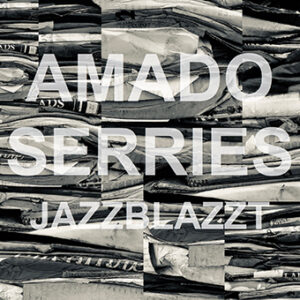
Rodrigo AMADO & Dirk SERRIES
“Jazzblazzt”
Rodrigo Amado was born in Lisbon, Portugal, in 1964 and took up the saxophone at the age of 17 while convalescing from an accident. Later he studied at the Hot Club Music School and was soon playing with numerous rock, pop and experimental projects. At the shifting boundary between free jazz and improvised music, Amado's position is clear: he plays jazz. He is so clearly a jazz musician that he doesn't require any pre-determined elements of rhythm, harmony, chorus lengths or melody to play jazz. There's a rhythmic impetus, a bite in his sound, and it drives his lines forward, a fundamental impress on the world that tenor saxophonists like Archie Shepp, Coleman Hawkins or Sonny Rollins have been making for generations.Dirk Serries is a Belgian musician who started as an ambient composer and musician under the name of Vidna Obmana (releases also on Klanggalerie). In 2007 he gave up thsi pseudonym to concentrate on work under his own name and under the name Fear Falls Burning. The collaboration "Jazzblazzt" was recorded live in in concert on August 28th, 2018 at the venue "Jazzblazzt" in The Netherlands. Amado plays tenor saxophone, Serries electric and acoustic guitars. It was mixed and mastered by Dirk Serries. Originally released as a very limited cassette only, we are happy to now offer you a CD of this fantastic duo collaboration.
12,00€
In stock
CD
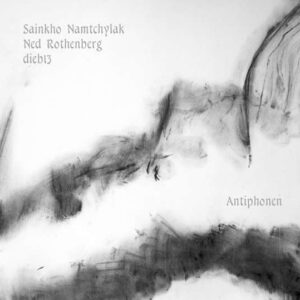
Sainkho NAMTCHYLAK – Ned ROTHENBERG – DIEB13
“Antiphonen”
Sainkho Namtchylak is a singer originally from Tuva, an autonomous republic in the Russian Federation just north of Mongolia. She is known for her Tuvan throat singing or Khöömei. Her music encompasses avant-jazz, electronica, modern composition and Tuvan influences. Once the Soviet Union had collapsed, she moved to Vienna, making it her base, although she traveled widely, working in any number of shifting groups and recording a number of discs that revolved around free improvisation. Amongst them are collaborations with Evan Parker, Ned Rothenberg, The Moscow Composers Orchestra and Wolfgang Puschnig.
Ned Rothenberg is an American multi-instrumentalist who was born in 1956 in Massachusetts. He has been internationally acclaimed for both his solo and ensemble music, presented for the past 33 years on 5 continents. He performs primarily on alto saxophone, clarinet, bass clarinet, and the shakuhachi - an endblown Japanese bamboo flute. His solo work utilizes an expanded palette of sonic language, creating a kind of personal idiom all its own.
die13 was born as Dieter Kovačič in 1973. He is a turntablist, hacker, filmmaker, autodidact, composer, collageur and conscientious copyright objector. Since the late 1980s he has explored the possibilities of vinyls, cassettes, harddisks, ip-protocols etc. as material for collages and compositions. Using various playing techniques and his own lathe cutter, he has pushed the development of turntables as instruments aside "classical dj techniques" and developed his very unique style.
Antiphonen was the first time this trio played together. Kazuhisha Uchihashi from Japanese group Altered States co-curated the festival and 2019 and invited the musicians to perform together.
12,00€
In stock
LP
KONSTRUKT & Otomo YOSHIHIDE
“Eastern Saga: Live at Tusk”
Turkish free jazzers Konstrukt continue their series of exciting collaborations with Otomo Yoshihide, highly reputated multi-instrumentalist and composer in the experimental world.
# 4 in the continuing series of Konstrukt collaborations on Karl is a live document of the concert by the Turkish freeform group with the Japanese experimental musician Otomo Yoshihide from the Tusk Festival 2018. Konstrukt, the Istanbul based free jazz / freeeform group founded and led by Umut Çağlar and Korhan Futacı, are known for their openness to and interest in collaborations – and regularly meet up and perform with new partners that range from Joe McPhee, William Parker, Akira Sakata, Marshall Allen, Evan Parker, Thurston Moore, Alexander Hawkins or Ken Vandermark. This latest release sees the quintet join forces with Otomo Yoshihide who entered the scene in the 1990s with his group Ground Zero and his since worked in all fields of adventurous music, from EAI to improv to turntablism, modern composition, jazz and soundtrack, documented on labels like Tzadik or Erstwhile and featuring collaborateurs such as Jim O’Rourke, John Zorn, Merzbow, Bill Laswell and endless more ...
"Eastern Saga: Live at Tusk" shows the multi-instrumentalist on his 2 key instruments guitar and turntables, while Konstrukt feature 2 drummers besides Korhan Futacı’s saxophone / flute , Umut Çağlar on guitar, synth, double reeds, flutes and double bass player Apostolos Sideris.
A furious gig, and a furious album!
Korhan Futacı: alto saxophone, flute, loops
Umut Çağlar: guitar, synth, double reeds, flutes
Apostolos Sideris: double bass
Erdem Göymen: drums
Ediz Hafızoğlu: drums
+
Otomo Yoshihide: guitar, turntables
19,00€
Out of stock
2 LP
Bérangère MAXIMIN
“Land of waves”
On her 6th album, the French electroacoustic composer Bérangère Maximin explores the idea of a kaleidoscopic world – a sonic aggregation of living creatures, plants, minerals, nature and buildings, using various sound objects, small percussions, synths, electric gui-tar, voice and electronics.
Working out of her private studio since 2008, Bérangère Maximin has developed her own ap-proach to sound art and electronic music, composing dense, immersive pieces with immediate im-pact. On five albums – released to critical acclaim on Tzadik, Sub Rosa, Crammed Discs and Craig Leon’s Atlas Realisations label – she has revealed a taste for mixing disparate sounds together with a sense of detail, effusive, lyrical playings with the digital material and tight nuanced writing. Bérangère Maximin’s music engages the listener in consideration of space and textures, the sound ambivalence and its independence from its original source being at the center of her work.
During her career, the French composer has obtained commissions and residencies in National Music Research Centres such as Paris‘ Ina-GRM, Stockholm’s EMS and received a grant from the ‘Villa Medicis Hors Les Murs’ program in New York City (Cultures France). She has performed in notable festivals, venues and concert halls from Paris’ Présences Electronique festival, London’s Hayward gallery, NYC’s Roulette, Hamburg’s Elbphilharmonie’s e-Phil series to major international festivals in Eastern Europe. Beside her solo performances, she also regularly shares the stage in duo with Fred Frith.
“Land of Waves”: three words evoking territories of plains and curves connected with each other by canals, footpaths, tunnels. The four parts of the album lead the listener into a hybrid land where the jungle meets the city … a succession of reliefs, surfaces, textures, layers create a large mosaic as if on a concrete wall which seems solid and definitive but is in fact penetrable, alterable.
For “Land of Waves”, Bérangère Maximin took inspiration from recordings she did in various city parks, abandoned properties and limits with the suburbs during her travels in Europe, the di-versity of sources, the variations of events and the contrasts between day and night they offered, and reinterpreted them in the studio.
Recorded, composed, arranged, mixed and produced by Bérangère Maximin at the Home Sweet Home Studio/BM and Studio Polyphone, France, 2019/2020.
Sound objects, small percussions, analog and digital synths, guitar, digital chimeras, voice.
Mastered by Kassian Troyer at D&M, Berlin, 2020.
25,00€
In stock

LP
die ANGEL
“Utopien I”
die ANGEL, the duo project of Ilpo Väisänen (ex-Pan Sonic) & Dirk Dresselhaus aka Schneider TM, starts its 3rd decade of sonic explorations with the release of album #10 which bears the programmatic title “Utopien I”.180g LP and DL on Karl.
die ANGEL (or just ANGEL in the early days) was born in 1999 during a joint European tour of Pan Sonic and Schneider TM with the aim to use electronics, string instruments and effect loops to develop a sonic world that goes beyond fixed structures and clearly defined genres. Coming from different musical backgrounds proved quite an advantage for the duo as it meant that Ilpo Väisänen & Dirk Dresselhaus had to find their particular modus operandi: communication through noise and action, instant composition, spirit.
Over the course of over 2 decades now, die ANGEL crafted a catalogue of 9 albums released on labels like Edition Mego or Edition Telemark that were recordings of either the core duo or featured like-minded artists like cellist Hildur Gudnadottir, Oren Ambarchi, Lucio Capece or BJ Nilsen. die ANGEL delve deep into the microcosms of tones, shaping nuanced layers of abstract sound that integrate elements of Musique Concrète, Minimal Music, Industrial, Noise, Blues and Psychedelia, and yet bear the unmistakable die ANGEL signature.
“Utopien I” is not only the duo’s latest effort (feat. Oren Ambarchi) but also a clear political call: in a world of a general decline, we need new ideas and approaches to design the future.
All tracks performed & recorded December 2015 – January 2016 by Ilpo Väisänen & Dirk Dresselhaus at ZONE, Berlin
Overdubs on ‚Cargo Cult’ by Oren Ambarchi (Milano, Italy) April – May 2016
Edited & mixed by Dirk Dresselhaus May 2016 at ZONE, Berlin
Mastered by Helmut Erler at D&M, Berlin, December 2019
Ilpo Väisänen : electronics & effects
Dirk Dresselhaus : electric guitar & effects
Oren Ambarchi : electric guitar & effects
19,00€
Out of stock
LP
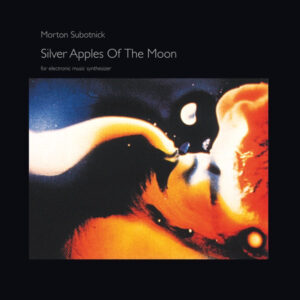
Morton SUBOTNICK
“Silver apples of the moon”
*** 2020 repress ***
Re-issued on vinyl for the first time since its original 1967 release! Morton Subotnick’s truly visionary electronic master piece “Silver Apples Of The Moon” on an audiophile 180gr LP, especially mastered for vinyl.
As composer, musician and initiator of the San Francisco Tape Music Center which he co-founded with Pauline Oliveros and Ramon Sender in 1961, Morton Subotnick (born 1933) has propelled the progress of electronic music in several significant ways. From 1963 on he worked with Don Buchla on the development of the early synthesizer “Buchla Series 100” before moving to New York where the artist-in-residence at the newly established Tisch School Of The Arts of the New York University was enabled to set up his own studio. That’s where Subotnick’s most popular work “Silver Apples Of The Moon” was commissioned by Nonesuch as the first electronic composition ever that was especially conceived for a vinyl release (in opposition to the common practice of performing live). Till the current day this seminal album has not lost his visionary power, has since long been considered one of the essential milestones in electronic music with great effect on later generations of artists – starting from the cult formation Silver Apples to Laika who titled their debut “Silver Apples Of The Moon” too. Now for the first time since its original 1967 release, Subotnick’s masterpiece (which was selected for the Library Of Congress in 2009) has finally been made available on vinyl at last: a new audiophile 180gm LP that was cautiosly remastered for vinyl.
19,00€
In stock
LP
Aidan BAKER & Gareth DAVIS
“Invisible Cities II”
Aidan Baker and bass clarinetist Gareth Davis continue their fruitful collaboration with "Invisible Cities II" – five new tracks of finest ambient / chamber jazz / subtle drones of a highly meditative quality. Available as 180gr LP and download.
2 years ago, the Canadian guitar player Aidan Baker and clarinetist Gareth Davis from Belgium released their duo debut "Invisible Cities" that surprised many by its quiet, even meditative quality. Davis had made himself a name in a wide range of fields, from the postrock of A-Sun Amissa or Oiseaux-Tempête, new music (Peter Ablinger, Bernhard Lang), or experimentation with the likes of Elliot Sharp, Merzbow or Scanner, while Baker is mostly known for his drone / postmetal duo Nadja, but that‘s just one out of several steady projects and a multitude of solo albums.
On "Invisible Cities" the duo explored the calmer side of things – from chamber jazz to ambient / drone and back, giving much space and air to breathe to their respective instrument. Subtle guitar drones, sonore clarinet sounds, a sonic scenery of peacefullness and meditative introspection – all this you‘ll also find on the new album "Invisible Cities II" which is an accomplished continuation and refinement of the duo‘s first collaborative effort from 2018.
Recorded between 2018 and 2019 in Berlin and Amsterdam, mastered and cut at D&M Berlin.
19,00€
Out of stock

2 LP
THE NECKS
“Unfold”
2018 repress. Warehouse find.
Ideologic Organ present Unfold, brand-new recordings from The Necks, the legendary Australian trio who excel in bypassing musical cliche whilst exploring and extending the practices embedded within improvisation, jazz, post rock, ambient, minimal, and textural, "sound based" music. The latest document from this long-running ensemble presents itself as a double LP, with four side-length tracks. A deliberate absence of numbered sides hands a substantial swatch of participation over to the listener, allowing her to navigate his own path through the soundscape at hand. The shorter length of the vinyl format, far from being a constraint upon the members of the ensemble, instead offers them a more compact horizon to contemplate, wherein the distance travelled is recalibrated to more immediate and dynamic textural concerns. The immediacy of "Rise" confirms this new path, as the mournful tones of Lloyd Swanton's bass swirl around Chris Abrahams's crystalline piano motif, with Tony Buck's percussion steering proceedings into enlightening free-jazz territories. "Blue Mountain" cuts a swathe through the sonic undergrowth, with soul organ, rattling percussion, whistles, and loping sound-waves all vying for the foreground. "Overhear" retains a sublime melancholic aura as the percussion and keyboards simultaneously embrace and fall apart, whilst "Timepiece" skips along as a gentle gesture of further possibilities. Exactly how The Necks conjure their particular magic - as deceptively simple as it seems - whilst always moving forward, is anyone's guess, but Unfold proves yet again that rules and schools are to be broken and re-formed into patterns and frameworks unlike those already known. Mastered & cut by Rashad Becker at Dubplates & Mastering.
22,00€
Out of stock

LP
KTL
VII
A new timley studio album from the duo of Peter Rehberg and Stephen O’Malley. Recorded and mixed during an unexpected extended stay in Berlin when the borders of the world suddenly closed. The claustrophobic urgency of this scenario is seared into the colossal vibrations set into this vinyl release.
Unlike many of their releases this is a studio record made unto itself as opposed to the many soundtracks they have made for theatre works and the like. It also stands as one of their most fully realised releases to date.
Proceedings are launched with The Director. Sitting somewhere between contemporary classical and doom this is a sliding and menacing mass of sound, more Masque of the Red Death than The Decameron. Silver lining is an alarming swooping buzzing track, looming and lowering only to rise and descend again. A delicate play with the Shepard-Risset glissando manifesting a delirious swarm of sound. Lee’s garlic orbits into a short fragmented zone with bursts of harsh feedback and crashing fx, all manner of audio enters and is discarded with an underlying sense of despair and frustration. Proceedings continue on Side B with Tea With Kali where a calmer plateau is embedded with oscillating guitar and fluttering electronics. Beating sine waves envelop the listener in a meditative thought piece of sound. Frostless concludes this epic dispatch as a subtle and gentle foray into twitching electronics as a light buzzsaw drone swirls as around your mind.
The interplay of sources (guitar, electronic equipment (hardware, software, speakers) is so entwined it’s often difficult to discern who is doing what amongst the broad sound field. KTL VII is instrumental music as visual narrative resulting in an exquisitely crafted release full of sophisticated and sublime illusory effects.
Written and produced by KTL, Stephen O’Malley & Peter Rehberg
Recorded & mixed at MOM Paraverse Studios, Berlin, March & May 2020
Engineer : Andi Toma (mix), 2nd Engineer : Constantin Carstens (recording)
Mastered at Zino Mikorey Mastering, Berlin, May 2020
18,00€
Out of stock

LP
Iannis XENAKIS
“GRM Works 1957-1962”
Concret PH (1958)
Brussels World Fair, 1958 : The industrialist Philips commissioned Le Corbusier's famous "Philips Pavilion": "I'll create an electronic poem for you, he said. Everything will happen inside: sound, light, colour and rhythm." Iannis Xenakis designed the architectural blueprint and composed "Concret PH", meant to psychologically prepare the public to the show created inside, accompanied by a musical piece by Varese.
The 400 speakers that lined the inner shell were meant to fill the space through the sound sparkles of "Concret PH" and achieve a joint emanation of architecture and music, conceived as a whole: the roughness of the concrete and its internal friction coefficient found an echo in the timbre of the sparkles.
Orient-Occident (1960)
The work was originally composed for a film by Enrico Fulchignoni for UNESCO. The film describes a visit to the museum suggesting to compare artefacts produced by various cultures and highlighting their interaction that dates back to the most ancient times.
From an abstract point of view, the composer regards this work as a solution to the problem of finding highly diversified means of transition, meant to link a type of material to another. One indeed witnesses a varied gradation of mutations, interplays, overlaps, cross-fading, sudden shifts and hidden junction points.
Diamorphoses (1957-58)
Continuity and discontinuity within evolution, here are two aspects of the being, whether in opposition or in communion. In "Diamorphoses" this antithesis was worked on in the sections of some sounds strongly opposed to others, and particularly in organisations of continuous variations of average or "statistical" heights.
Bohor (1962)
Bohor (referring to Bors the Younger, Lancelot's cousin), is a character from the medieval cycle of King Arthur and the Knights of the Round Table. “Bohor” is dedicated to Pierre Schaeffer. The author deliberately abstained from giving and descriptive information on his piece, letting the listener choose an imaginary route for himself. For this release, we have chosen the 1968 version, revised by Iannis Xenakis himself and as yet not made available to the public.
------------
Even though Iannis Xenakis never made "musique concrète" in the sense given by Pierre Schaeffer, the GRM was a locus for experimenting with his ideas about sound and sound structures. The works, composed between 1958 and 1962, show a boldness as advanced as in his orchestral approach.
The relationship between Xenakis and Schaeffer was often tense. It nevertheless entailed mutual recognition and respect towards each other's musical approach. Moreover, "Bohor" is dedicated to Schaeffer, as evidenced by the letter Xenakis sent him on October 8th, 1968: "Dear Pierre, I have decided to dedicate Bohor to you, out of friendship and gratitude for your contribution to music. I hope you are pleased with this." Schaeffer found the piece disproportionate in terms of intensity but was indeed pleased by the dedication.
The four pieces presented here, all produced at the GRM, undoubtedly demonstrate the experimental intent and the strictly "physical" character of Xenakis' music, in that it provides the audience with a listening experience of a rare intensity.
(François Bonnet & Christian Zanési)
18,00€
In stock

LP
Eiko ISHIBASHI
“Hyakki Yagyō”
Black Truffle is pleased to announce a new solo album by Eiko Ishibashi, her first for the label, following on from the duo recording Ichida alongside bassist Darin Gray. Hyakki Yagyō (Night Parade of One Hundred Demons) was produced for the ‘Japan Supernatural’ exhibition at The Art Gallery of New South Wales, Sydney focusing on ghost stories and folklore from the Edo period onwards. As with The Dream My Bones Dream (Drag City, 2018), the album is a response to troubling questions about Japanese history, and the influence of the past upon the present, but finds Ishibashi shifting further away from her earlier piano-led songwriting and showing a deepening interest in electronics and audio collaging.
The two sidelong parts of Hyakki Yagyō feature layered synthesisers, acoustic instrumentation, recited verse and field recordings, at times densely mixed but always with a subtle interplay of changing elements. The influence of European and American forerunners as diverse as Alvin Curran, David Behrman and Strafe Für Rebellion can be traced, yet at the same time Ishibashi evokes the flute and string sounds associated with Japanese storytelling, and draws directly on the subversive literary tradition of Kyoka (‘mad poetry’) with a verse by the 15th-century poet Ikkyū Sōjun repeated throughout the album. Revisiting what has gone before, re-thinking what is possible musically, as a way of articulating what else might be possible in the future.
As Ishibashi’s liner notes make clear, the album reflects an attention to persistent dangers, myths and evasions in Japanese culture – as well as the lurking uncertainties that might threaten positive change. This would seem to be manifested in the emerging melodies soon met by dissonance, erratic collisions and near silence, as well as the eerie manipulation of the double-tracked vocals. Ishibashi’s underlying concerns ring true more widely of course. Hyakki Yagyō is a work of multiplicities, and mystery, a landscape where nothing is as it seems at first, and everything is vulnerable to sudden violent interruptions.
The album was produced with regular collaborators Jim O’Rourke (double bass) and Joe Talia (percussion), and features dancer and choreographer Ryuichi Fujimura performing Ikkyū’s satirical tanka. O’Rourke’s immersive mix creates a three-dimensional effect, with Ishibashi’s various sound sources enmeshing and interacting in captivating ways.
Pressed on coloured vinyl and presented in a deluxe package with an inner sleeve featuring an artist portrait and liner notes from Eiko Ishibashi. Cover and label design by Shuhei Abe. Back cover design by Lasse Marhaug. Mixed and mastered by Jim O’Rourke.
24,50€
In stock

LP
Judith HAMANN
“Peaks”
Black Truffle is very proud to present Peaks by Australian cellist Judith Hamann, her debut release of electro-acoustic music. Known mostly for her live performance work with composers including Sarah Hennies, Yvette Janine Jackson, Alvin Lucier, Tashi Wada, and La Monte Young, here she steps away from the cello, moving into an intimate dreamscape woven from recordings gathered over years of itinerant touring.
Peaks is a work in two distinct parts, crossfading between different landscapes and apertures; from rooftop to church, from stasis to flares of momentary romanticism. Peaks considers summits as being both above and below, reframing the idea of apex from a more intimate perspective. Hamann considers how our domestic and personal geographies might form their own apogees, meridians, or nadirs.
Assembled in 2019 while an artist in residence in Krems, Austria, Peaks begins with Hamann’s more familiar cello but soon unravels into resonant electronic interiors; Southern California nightscapes heard through windows, San Francisco bathroom fans, snatches of recordings of friends, hand organs, and engines. signal/centinela draws primarily on recordings from Hamann’s time living in San Diego, and carries with it a certain sense of nostalgia in the sense of homesickness, longing, and displacement of distance and time. Side B is composed from recordings gathered on a different continent, Europe, weaving piano with recordings of sleep, breath, church organ, and the act of climbing. under/over emerges as it recedes, overlapping moments of arrival to create another kind of ‘spire’ in the sense of spir (breath). Peaks, with its omission of any recordings from Hamann’s home of Australia, hints at how the very construction of home itself, might be restless, untethered, changeable, and malleable.
On Peaks, Hamann interrogates tropes of ambient concrète musics, intentionally pivoting formally around material which teeters on the edge of cliche. This exploration asks whether familiar frames of harmony, field recordings and narrative trajectories can excavate new territories, or be ruptured. Peaks untangles a very personal sense of tension between beauty and shame in experimental music: treating lushness and harmony as possessing potentially muscular musical properties that might wrestle with or construct senses of belonging and home.
Design by Lasse Marhaug. Photos by Judith Hamann. Mixed and mastered by Alan F Jones.
18,50€
In stock
LP
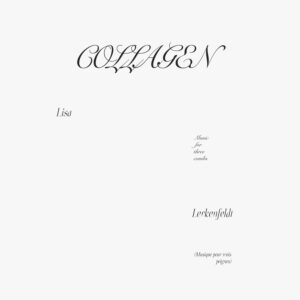
Lisa LERKENFELDT
“Collagen”
The full-length debut of Lisa Lerkenfeldt’s sanguine ambient drift marks the Aussie artist’s most significant release, slotting neatly into the roster of Félicia Atkinson & Bartolomé Sanson’s Shelter Press, and somewhere between Gas, Beatriz Ferreyra and Ben Bondy on your shelf.
Effectively her first album, proper, ‘Collagen’ introduces Lerkenfeldt’s sound like a wild meadow somewhere between the fields of modern classical, ambient, and musique concrète. Aspiring to “elevate the everyday”, her music feels naturally, gently ripe with variegated in/organic textures and slow, hypnotic melody that stealthily attunes listeners to her wavelength in a manner that she’s roughly finessed on previous tapes and digital releases with native label Longform Editions and Vienna Press and Canada’s Aught Void.
As the tracks unfold, Lerkenfeldt’s washed out strings and blanched electronics waver the weather vane between sombre and melancholy with a real windswept, isolationist feel that perhaps suggest best results when immersed by yourself, not as a communal experience. More like a solo hike with headphones or sheltering in front of a shifting landscape, the album plays thru Gas-like string pads gilded with elusive vocoder vox of ‘In Her Hair’ before dematerialising into elemental abstraction for 9 minutes of ‘Collagen’, whereas ‘Gates of Desire’ prove a tidier knack for arranging classically puckered ambient-pop keys, and the B-side expresses more liminal, hypnagogic states in the creaking gloom of ‘The Weight of History’. It all shares the same, rare air and sensitively perhaps errs best to the side of melancholy than anything overbearingly glum.
19,50€
Out of stock

LP
Maria W HORN & Mats ERLANDSSON
“Fältinspelningar från Terres de l’Ebre”
New on Kali Malone and Maria W. Horn’s XKatedral label, Eno-esque ambient gems and Fennesz-like lushness inspired by Catalonia’s agroindustrial land/sound-scape.•
Produced by Maria W. Horn, and composer/EMS studio assistant Erlandsson.
300 Copies
In August of 2016 Maria W Horn and Mats Erlandsson traveled to Balada in the Terres de I’Ebre region of Catalonia, Spain, for a two-week residency courtesy of the Eufonics festival in collaboration with EMS.
The geographical characteristics a visitor first encounters in the Terres de I’Ebre delta are defined by the development of industrial agriculture. Endless rice fields stretch through the flat landscape, framed by canals of water to sustain growth. Even the air is saturated with a vague scent of rice. This transmutation of the soil impacts the sonic environment, the buzzing of the irrigation system, the hypnotic constant chirping of crickets, the loud bang from the water pump that echoes through the delta at regular intervals.
Taking the opportunity to collaborate on a project specifically made within the context of the aural environment they found themselves in, and using the resources available to them, the pair decided to make a musical work based entirely on field recorded material transformed through extensive digital editing and processing. Working quickly in the isolation offered by the residency they recorded found material at night and spent the days shaping these recordings into four compositions that move on a dense continuum between drone, noise and generative music all imprinted with the textural characteristics of the immediate surroundings of that time and place.
Through the four compositions the work shows a sonic imprint of an environment shaped by human hands over an almost endless period of time, as heard through the ears of two transient visitors processing their sliver of time in the area as it was unfolding to them.
21,50€
In stock

Magazine
PERSONAL BEST
“N°8”
The 8th issue of Lasse Marhaug's fanzine Personal Best.
Features in-depth interviews with:
Rachel Shearer
Peter Rehberg
GX Jupitter-Larsen
Benjamin Nelson
Peter Brötzmann
Jana Winderen
Otomo Yoshihide
Ghédalia Tazartès
Richly illustrated throughout.
100 pages, CMYK offset print on uncoated paper, glued spine.
10,00€
Out of stock

magazine
PERSONAL BEST
“N°7”
Published August 2017. Format: 210 x 285 mm. 100 pages. Colour. Interviews with Tony Conrad (USA), Akira Sakata (Japan), Sarah Davachi (Canada), Omit (New Zealand), Stine Janvin Motland (Norway), Human Inferno (Norway), Stephen O'Malley (USA).
Topics covered include: frogs, location recordings, fake synthetic music, stepping off stage, confusion, playing naked, nihilistic anal punk, to be the drunk Klaus Schultze, less is less, being self-contained, grouping of sounds, sound maps, playing 18 gigs in 30 years, marine biology, moving the fingers very fast, the Shinjuku 60s art scene, doing interrail tours in the 1970s, knowing communists, lack of protest, secretly buying Pink Floyd records, karaoke with CC Hennix, incoherent notes, the history of clocks, extreme metal graphic design, the meaning of the goat, picture disc jokes, 3D waves, demo tape nostalgia gone deluxe, keys and symbol's relative power, the social aspect of record covers, Pythagoras, Ali Akbar Khan, how Cage was right, how Stockhausen stole ideas, recording the best album ever made, and much more.
10,00€
In stock

magazine
PERSONAL BEST
“N°6”
Published January 2016. Format: 210 x 285 mm. 100 pages. Colour.
Interviews with Skaset (Norway), Lucas Abela (Australia), Marcia Bassett (USA), Crys Cole (Canada), Joe McPhee (USA), Sodadosa (Indonesia), PBK (USA).
Topics covered includes: meeting Sun Ra, starting to play the sax at 28, Forbidden Planet, The Nihilist Spasm Band, PO, poerty, Chicago, UFO sightings, science fiction, politics, stagnation, the scary middle class, hatred of reverb, changing guitar strings in 23 seconds, that Manowar were never hip, 33 or 45 or in the middle, returning to rock, how play glass on your face, playing drums on a trampoline, playing power tools on turntables, Loop Station hatred, scares and scars, cutting your throat on purpose, noise scene guilt, INXS as the gateway, art scene carbon print, painting skulls, playing loud, eating lobsters, noise bombing in Indonesia, salt, broken radios, disco tracks that goes nowhere, Albert Ayler’s wonkyness, loosing faith in expressionism, lack of dynamic and textural shifts, shock aesthetics, preserving artist archives, and much more.
10,00€
Out of stock

2 LP
Kassel JAEGER
“Swamps / Things”
Over the last decade, Kassel Jaeger, the moniker of the Paris-based composer, writer / theorist, producer, and director of the Groupe de Recherches Musicales (GRM), François Bonnet, has meticulously sculpted a body of multidisciplinary work that rests at the forefront contemporary electronic and electroacoustic practice. On July 10th he will release his new album ‘Swamp / Things’ on Shelter-Press.
Rigorously experimental without sacrificing the intimacies of self, his efforts as a composer and musician extend across live contexts and numerous critically heralded solo releases, as well as collaborations with Jim O’Rourke and Lucy Railton, both contributing to the record, alongside Stephen O’Malley, Stephan Mathieu, Akira Rabelais, Oren Ambarchi, and James Rushford, and others.
Deeply invested in the potential of sound as an elemental form - a root phenomenon with a profound capacity for meaning, as much as a multidimensional material for creative process and ideas – Jaeger’s work across numerous fields, be it in text, action, or sound presents a crucial bridge between the optimistic, philosophical origins of electronic and electroacoustic music, the present and where they have yet to delve.
Sound is abstract. When the source is elusive, narrative and meaning shift between the concrete and obscure. With his first solo LP with Shelter Press, Swamps/Things, Kassel Jaeger wades into this foggy, conceptual realm. From memory and metaphor - sliding fluidly through the imagistic and emotive - emerges an immersive, cavernous world that rethinks electroacoustic music on organic terms.
‘Swamps / Things’ was conceived as an opera without distinct characters or text. It draws Kassel Jaeger into his own history, experiences, and the unlikely double of the swamp, a landscape that has held literal and metaphorical sway over him since childhood. Merging 8 works as a total environment, abstaining from distinct shape or discrete articulation, across the album's breadth, sound becomes a shifting mirror for the bubbling, ordered chaos of organic life.
Resting at the junction of concept, emotion, and phenomena - tapping the multidimensional potential for narrative and meaning possessed by each - Swamps / Things encounters an artist of remarkable craft, delving toward the unknown, deploying organized sonority as object and environment, as much as action, movement, passage, and arc. Seemingly possessed by an entropy entirely its own, the temporal gives way to the poetics of space, while the density of an endlessly evolving climate, laden with cacophonous happenings, renders itself still. Flickering images of the natural world - memory and the imagined reformed as sound - present an operatic double for human action and thought. From deep, fog like banks of minimalist long tone, to industrial clamors left as tracks in the mud, or the collisions of shifting pulses, overtones, and textures - captured from across the murky, drone laden waters between the acoustic and synthetic realms - moody, howling cries and tense meditations merge in ambient sheets, capturing a fleeting image of where decomposition gives way to new growth.
A remarkably intimate and forward-thinking aural balm, bristling with complex beauty, Shelter press is overjoyed to present Kassel Jaeger’s Swamps / Things. Two immersive, intoxicating sides overflowing with humanity and ideas.
Sound material collected and performed by François J. Bonnet
with additional help by Lucy Railton (River Wensum Roe Deers) and Jim O’Rourke (NYC Bobcats).
Artwork by Cameron Jamie.
Mastering by Giuseppe Ielasi.
Music composed by François J. Bonnet.
27,00€
Out of stock
LP
SENYAWA & Stephen O’MALLEY
“Bima Sakti”
Ancient Indonesian tradition meets doom rock in profoundly Ur ways on Stephen O’Malley and Senyawa’s collaborative commission for choreographer Gisèle Vienne
Following a decade of creative bonds forged between theatre director and choreographer Gisèle Vienne and doom sayer Stephen O’Malley that spans multiple soundtracks (solo and with Peter Rehberg in KTL) and visual artworks, the pair travelled to Indonesia on a commission to explore the country’s rich culture in 2018. They immersed in a magical world of performative rituals where they encountered Wukir Suryadi, an experimental musician and instrument builder whose acclaimed releases both solo and as half of Senyawa have invigorated the avant and experimental rock scene over the past decade.
The six tracks of ’Bimi Sakti’ document groundbreaking ventures between Senyawa and O’Malley, yielding an incredibly powerful mix of electric guitar and bass guitar amp worship blended with the remarkable range of tonalities from Senyawa’s custom-built bambuwukir, plus traditional pipes and possessed vocals.
Practically without precedent in the modern musical sphere, the 44’ release speaks to a resounding mutuality and common musical philosophy between two musicians who are usually geographically separated by a hemisphere. Slow to start, but culminating in a wholly dilated musical vision, the performance effectively collapses eons of musical practice and thought into a singular yet timeless expression of beauty and anguish that transcends the sum of its parts.
Fleshing out the frequency spectrum between flighty, avian flutes and sprawling subharmonic bass riffs, they come to inhabit a thrilling mid-ground over the course of the performance as O’Malley moves up the registers to thrashing mid-range riffs while Suryadi invokes a range of demonic voices and unearthly tones from his bamboo instrument. The results come to prod the pineal like little else beyond, say, O’Malley’s Nazoranai trio with Keiji Haino and Oren Ambarchi, or the Phurpa album on his Ideologic Organ label.
26,00€