
Out of stock

LP
MIRROR
“Some Days It Rains All Night”
La Scie Dorée presents a new album by Mirror (Christoph Heemann and Andrew Chalk) recorded at the Loft, Cologne. Christoph Heemann, with co-founder Achim P. Li Khan, was active in the celebrated group Hirsche Nicht Aufs Sofa in the 80's. In the mid-90's, Christoph concentrated on his solo career while collaborating with artists such as Jim O'Rourke and Edward Ka-Spel (Legendary Pink Dots) in the Mimir project. He also worked with Masami Akita (Merzbow) and with the Japanese duo Jack or Jive. Christoph contributed to several Current 93 albums. Andrew Chalk was similarly very active in the second half of the 80's, working in collaboration with David Jackman (Organum) and the Rupenus Brothers The New Blockaders), among several others. In 1993, Andrew joined forces with Darren Tate to form the collective Ora.
Since 1999, Andrew and Christoph worked together in the prolific collaboration known as Mirror. Mirror is the collaborative effort of Andrew and Christoph, with occasional participation of guest artists on some releases and live events. The guests in "Some Days It Rains All Night" are Vikki Jackman (Marsfield) and Timo van Luijk (Noise-Maker's Fifes, Af Ursin, Asra, La Poupée Vivante, In Camera).
Edition of 350 copies on transparent vinyl.
19,50€
In stock

LP
IN CAMERA
“Lost In Spice”
La Scie Dorée presents a new album by In Camera. In Camera is composed of Christoph Heemann and Timo van Luijk , both experienced and quite active in the contemporary experimental music world. In Camera was formed in 2003 out of a twenty year dialogue between the duo who have recorded two albums together. On these dates, Heemann plays the Moog and manipulates prerecorded sounds live to generate lush electronic drone-scapes while van Luijk symbiotically adds to the visual sound layers with his electronic and acoustic instruments, both of them balancing between the frontier of improvisation and composition, among drones, electronics and electroacoustics, the overall effect being of an intense beauty.
Edition of 400 copies
19,00€
Out of stock

3 CD
Kali MALONE
“The Sacrificial Code”
*** Repress ***
Kali Malone presents a quietly subversive new album featuring almost two hours of concentrated, creeping organ pieces governed by a strict acoustic and compositional code. It’s a major new work with ultimately profound emotional resonance.
‘The Sacrificial Code’ takes a more detailed approach to ideas first sketched out on last year’s ‘Organ Dirges’, which featured canon exercises spontaneously captured without much prior technical planning. By contrast, the recording of ‘The Sacrificial Code’ involved the more careful micing up of several organs in such a way as to eliminate acoustic impurities as far as possible - essentially removing the large hall reverb so inextricably linked to the instrument. The pieces were then performed free of gestural adornments and without expressive impulse - an approach that flows against the grain of the prevailing musical hegemony, where sound is so often manipulated, and composition often steeped in self indulgence. The question posed; can this strict methodology still speak to the listener in meaningful terms?
The answer is both obvious and entirely surprising; with its slow, purified and seemingly austere qualities ‘The Sacrificial Code’ guides us through an almost trance-inducing process where we become vulnerable receptors for every slight movement, where every miniature shift in sound becomes magnified through stillness.
As such, it’s a uniquely satisfying exercise in transcendence through self restraint - a stunning realisation of ideas borne out of academic and conceptual rigour which gradually reveals startling personal dimensions. It has a perception-altering quality that encourages self exploration free of signposts and without a preordained endpoint - the antithesis to the language of colourless musical platitudes weíve become so accustomed to.
25,00€
Out of stock
LP
Okkyung LEE
“Yeo-Neun”
Springing from a decades deep body of work, defined by a rigorously singular and adventurous approach to sound, cellist, composer, and improvisor, Okkyung Lee, returns with Yeo-Neun, her first outing with Shelter Press, and arguably her most groundbreaking and unexpected album to date.
A vital, present force in the contemporary global landscape of experimental music, Okkyung Lee is widely regarded for her solo and collaborative improvisations and compositions, weaving a continuously evolving network of sonority and event, notable for its profound depth of instrumental sensitivity, exacting intellect, and visceral emotiveness. Yeo-Neun, recorded by Yeo-Neun Quartet - an experimental chamber music ensemble founded in 2106 and led by Lee on cello, featuring harpist Maeve Gilchrist, pianist Jacob Sacks, and bassist Eivynd Opsvik - represents the culmination of one of longest and most intimate arcs in her remarkable career. A radical departure from much of the experimental language for which she has become widely known, it is equally a fearless return.
Yeo-Neun loosely translates to the gesture of an opening in Korean, presenting window into the poetic multiplicity that rests at the album’s core. Balanced at the outer reaches of Lee’s radically forward thinking creative process, its 10 discrete works are born of the ambient displacement of musician’s life; intimate melodic constructions and deconstructions that traces their roots across the last 30 years, from her early days spent away from home studying the cello in Seoul and Boston, to her subsequent move to New York and the nomadism of a near endless routine of tours. At its foundation, lay glimpses of a once melancholic teen, traces of the sentimentality and sensitivity (감성 / Gahmsung) that underpins the Korean popular music of Lee’s youth, and an artist for whom the notions of time, place, and home have become increasingly complex.
Elegantly binding modern classical composition and freely improvised music with the emotive drama of Korean traditional music and popular ballads, the expanse of Yeo-Neun pushes toward the palpably unknown, as radical for what it is and does, as it for its approachability. In Lee’s hands, carried by a body of composition that rests beyond the prescriptive boundaries of culture, genre, geography, and time, a vision of the experimental avant-garde emerges as a music of experience, humanity, and life. Meandering melodies, from the deceptively simple to the tonally and structurally complex, slowly evolve and fall from view, the harp, piano, and bass forming an airy, liminal non-place, through which Lee’s cello and unplaceable memories freely drift.
Remarkably honest, unflinchingly beautiful, and creatively challenging, Shelter Press is proud to present Yeo-Neun, an album that takes one the most important voices in contemporary experimental music, Okkyung Lee, far afield into an unknown future, bound to her past.
Mastered and cut by Rashad Becker, housed in reversed-board printed inner and outer sleeve with artwork by American photographer Ron Jude.
22,00€
In stock

2 LP
Alvin LUCIER
“Works for the Ever Present Orchestra”
Black Truffle's documentation of the prolific recent work of legendary American composer Alvin Lucier continues with Works for the Ever Present Orchestra. This is a very special release for the composer, as it presents pieces written for the thirteen-member Ever Present Orchestra, formed in 2016 exclusively to perform Lucier's works. At the heart of the ensemble are four electric guitars, an instrument Lucier began composing for in 2013 with Criss-Cross (recorded by two core members of the Ever Present Orchestra, Oren Ambarchi and Stephen O'Malley, for whom it was composed, on Black Truffle 033). Through the use of e-bows, the guitars take on a role akin to the slow sweep pure wave oscillators heard in many of Lucier's works since the early 1980s, but with added harmonic richness. Like much of Lucier's instrumental music, the pieces recorded here focus on acoustic phenomena, especially beating patterns, produced by the interference between closely tuned pitches. The work presented here is some of the richest and most inviting that Lucier has composed. Though all of the pieces clearly belong to the same continuing exploration of the behaviour of sound in physical space and make use of related compositional devices, each takes on a strikingly different character. Titled Arc, for the full ensemble of four guitars, four saxophones, four violins, piano and bowed glockenspiel inhabits a world of sliding, uneasy tones, punctuated by a single piano note. Where Double Helix, for four guitars, rests on a pillow of warm, low hum, EPO-5, for two guitars, saxophone, violin, and glockenspiel possess a limpid, crystalline quality. Accompanying the four new compositions are two adaptations of existing pieces for radically different instrumentation, demonstrating Lucier's excitement about the new possibilities suggested by this dedicated ensemble. Works for the Ever Present Orchestra is an essential document of the current state of Lucier's continuing exploration, as well as offering a seductive entry-point for anyone who might yet be unacquainted with his singular body of work.
Presented in a deluxe gatefold sleeve with cover artwork and liner notes from Alvin Lucier. Includes a download code featuring hi-res versions of the LP material. The download code also includes the bonus Adaptions for the Ever Present Orchestra featuring two pieces ("Two Circles" and "Braid") that are not included on the LP version. Mastered by Rashad Becker. Design by Lasse Marhaug.
26,00€
Out of stock
2 CD
Alvin LUCIER
“Works for the Ever Present Orchestra”
Black Truffle's documentation of the prolific recent work of legendary American composer Alvin Lucier continues with Works for the Ever Present Orchestra. This is a very special release for the composer, as it presents pieces written for the thirteen-member Ever Present Orchestra, formed in 2016 exclusively to perform Lucier's works. At the heart of the ensemble are four electric guitars, an instrument Lucier began composing for in 2013 with Criss-Cross (recorded by two core members of the Ever Present Orchestra, Oren Ambarchi and Stephen O'Malley, for whom it was composed, on Black Truffle 033). Through the use of e-bows, the guitars take on a role akin to the slow sweep pure wave oscillators heard in many of Lucier's works since the early 1980s, but with added harmonic richness. Like much of Lucier's instrumental music, the pieces recorded here focus on acoustic phenomena, especially beating patterns, produced by the interference between closely tuned pitches. The work presented here is some of the richest and most inviting that Lucier has composed. Though all of the pieces clearly belong to the same continuing exploration of the behaviour of sound in physical space and make use of related compositional devices, each takes on a strikingly different character. Titled Arc, for the full ensemble of four guitars, four saxophones, four violins, piano and bowed glockenspiel inhabits a world of sliding, uneasy tones, punctuated by a single piano note. Where Double Helix, for four guitars, rests on a pillow of warm, low hum, EPO-5, for two guitars, saxophone, violin, and glockenspiel possess a limpid, crystalline quality. Accompanying the four new compositions are two adaptations of existing pieces for radically different instrumentation, demonstrating Lucier's excitement about the new possibilities suggested by this dedicated ensemble. Works for the Ever Present Orchestra is an essential document of the current state of Lucier's continuing exploration, as well as offering a seductive entry-point for anyone who might yet be unacquainted with his singular body of work.
Presented in a deluxe gatefold sleeve with cover artwork and liner notes from Alvin Lucier. Includes a download code featuring hi-res versions of the LP material. The download code also includes the bonus Adaptions for the Ever Present Orchestra featuring two pieces ("Two Circles" and "Braid") that are not included on the LP version. Mastered by Rashad Becker. Design by Lasse Marhaug.
16,00€
In stock

LP
Kassel JAEGER – Jim O’ROURKE
“in cobalt aura sleeps”
Second outing from Jaeger and O’Rourke following the release Wakes on Cerulean on Editions Mego in 2017. Covering a vast terrain with delicacy and poise this new release unveils a spectral showcase for all manner of deep abstraction. The first side positions itself somewhere between stoned komische synth and more nuanced electroacoustic tactics, all weighted by a melancholic undertow. The second side builds on the tension of the former as an undulating drone teases all variety of matter to rise and fall amongst the foreign space it inhabits. The effect creates an enormous sense of deep space before subsiding into a smaller more anxious flickering world. All manner of machines fold into play; digital machines, industrial and analogue machines. The seemingly random yet ordered nature of events is reminiscent of the behaviour of the natural world providing this machine driven release a convincing organic feel. Whether invoking mirrors, distant galaxies or a pond of frogs it is a delightful challenge to focus and locate what is nature and what is nurture. To play this loud is to immerse oneself in a fascinating journey which carries the listener through an array of dizzying emotional states.
18,00€
Out of stock

2 LP
The TRANSCENDENCE ORCHESTRA
“Feeling The Spirit”
“Like La Monte Young and The Incredible String Band stuck in an elevator."
In the process of relocating to Den Bosch's Willem Twee Studios, The Transcendence Orchestra let love slip deftly out of its gate and reverberate around the walls of the studio's main hall, a high ceilinged former synagogue in the city's old town. Working intensively to capture its echoes, they coaxed it to appear in pipes and strings, directed it through resonant circuits and shepherded it round the room with beaters, horns and rattles.
Having returned home with the recordings, a purpose began to emerge. Through a process of extensive reconfiguration and testing it became clear that the love contained within could transform perception. Under the right circumstances, and accompanied by appropriate technology, it could serve as a map for navigating beginnings and endings. Like some distant mesmerising chant or a psychedelic folk song, it could connect us and reassure us that we can pass through the boundaries and survive. Perhaps not intact but at least whole.
Here is that map, love soaked diligently into its lines, ready to guide those at a loss or reassure those willing to explore.
Written and produced by Anthony Child and Daniel Bean
Mastered by Stephan Mathieu at Schwebung Mastering, January 2020
Cut by Andreas Kauffelt at Schnitstelle, Berlin, February 2020
25,00€
Out of stock
CD
The TRANSCENDENCE ORCHESTRA
“Feeling The Spirit”
“Like La Monte Young and The Incredible String Band stuck in an elevator."
In the process of relocating to Den Bosch's Willem Twee Studios, The Transcendence Orchestra let love slip deftly out of its gate and reverberate around the walls of the studio's main hall, a high ceilinged former synagogue in the city's old town. Working intensively to capture its echoes, they coaxed it to appear in pipes and strings, directed it through resonant circuits and shepherded it round the room with beaters, horns and rattles.
Having returned home with the recordings, a purpose began to emerge. Through a process of extensive reconfiguration and testing it became clear that the love contained within could transform perception. Under the right circumstances, and accompanied by appropriate technology, it could serve as a map for navigating beginnings and endings. Like some distant mesmerising chant or a psychedelic folk song, it could connect us and reassure us that we can pass through the boundaries and survive. Perhaps not intact but at least whole.
Here is that map, love soaked diligently into its lines, ready to guide those at a loss or reassure those willing to explore.
Written and produced by Anthony Child and Daniel Bean
Mastered by Stephan Mathieu at Schwebung Mastering, January 2020
Cut by Andreas Kauffelt at Schnitstelle, Berlin, February 2020
15,00€
In stock

LP
CHRA
“Seamons”
Chra is the artist moniker for Austrian Christina Nemec (Bray, Shampoo Boy). Seamons is the latest missive in her ongoing exploration of suffocating abstract audio. At once designed and falling apart Seamons is rough and crude, a stumbling and staggering electronic expedition where nothing presents itself explicit in intent. It’s a tense obscure record that teases you into it’s peculiar vortex from it’s suggestive nature of exploring the enigma beyond it’s haunted facade.
Vicious Water Regimes stutters along as an ‘ugly’ mass of grey electronica. Cast(o)ro shines from light from the depths with it’s occasional foray into glistening tones. Colonia Marina Serenella is a dank squelching backdrop for a dark age. Cast twists tension with flickering electronics chaotic in their perpetual design of order confronting inevitable collapse. Let Sharks Sleep is not only a great title but a mind tickling adventure of descending/rising digital dance that builds in intensity with it's relentless repetition. Widow Walks gallops and creaks along a path veiled in whispers. Eenge lunges through time with an air of deep uncertainty. Seamons hovers on the outskirts, crawling out of the speakers with endless surprising turns, few of them comfortable.
Seamons is progressive ambient, not the kind that makes you escape, but rather one you can't escape from. Seamons crawls into the very guts of sound to uncover and unravel the uneasy and unsettling underbelly within.
18,00€
In stock
CD
Mark TEMPLETON
“Ocean Front Property”
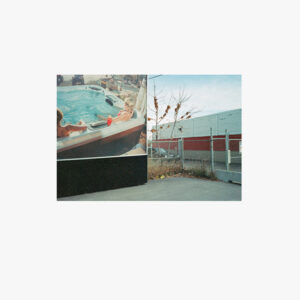
Ocean Front Property represents a desired experience juxtaposed with a banal reality. The work investigates the idea of longing to be somewhere else, a mirage of aspired imagery and sound, made within the landlocked province of Alberta, where the nearest ocean is over 1000 kilometres away. The objects, spaces and sounds act as metaphors, part of a concrete existence they reside in, but contrasted with the imagined existence they represent.
Ocean Front Property is a photobook and soundtrack. The photobook will be released in the fall of 2020.
Mark Templeton is a Canadian sound artist and photographer. Since 2007 his sound recordings have been released by Anticipate Recordings, Staalplaat, Sweat Lodge Guru, Under the Spire Recordings, Silentes and his own audiovisual label, Graphical Recordings, which he established in 2015. In the spring of 2018, he released his first photobook, Distorted Tourist, which included a series of five one-sided flexi records.
12,00€
In stock
CD
REIZEN
“Works, 2020”
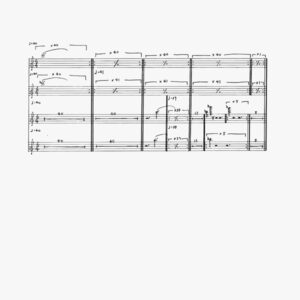
Two new works, "Different Speeds for Decay Instruments" (for electric piano; the score of this piece adorns the front cover) and "Music for Glass, Plastic and Rubber".
Japanese musician, based in Tokyo, who composes and performs using mainly drone and minimalist techniques. Plays electric guitar, the inside of pianos, and creates works of phonography. Formed the drone quartet NERAE in 2007. In 2011 he shifted to solo performance.
His work has been released on P.S.F. Records, Fylkingen Records and Edition Omega Point, etc.
Performs frequently around Tokyo. Notable performances outside Japan include TUSK Festival (UK, 2015),
UK tour with Elodie (2016), Empty Gallery (Hong Kong, 2017).
In June 2019 with some friends he founded edition zeroso, a small imprint and series of live performances based in Tokyo.
12,00€
Out of stock

CD
Christina KUBISCH
“Italienische Stücke”
Release of conceptual and perfomative pieces by Christina Kubisch composed & realised between 1974 and 1984, during Kubisch's years in Italy.
Christina Kubisch (born 1948 in Bremen, lives and works in Hoppegarten, Germany) studied painting, music and electronics in Hamburg, Graz, Zürich and Milano, where she graduated. Performances, concerts and works with video in the seventies, subsequently sound installations, sound sculptures and work with ultraviolet light. Her compositions are mostly electroacoustic, but she has written for ensembles as well. Since 2003 she works again as a perfomer and collaborates with various musicians and dancers.
Christina Kubisch has been a visiting professor in Maastricht, Paris and Berlin. She has been a professor for sound art at the Academy of Fine Arts, Saarbrücken, Germany, from 1994 to 2013. She is a member of the Akademie der Künste Berlin since 1997.
Six panel DVD-sized digipak, illustrated with archival photos of CK and extensive programme, notes in English. Edition of 300 copies.
14,50€
Out of stock
LP
15 KINDER & BRÖTZMANN – VAN HOVE – BENNINK
“Free Jazz und Kinder”
12" vinyl reissue of the rare & infamous double-7" originally published by FMP in 1973.
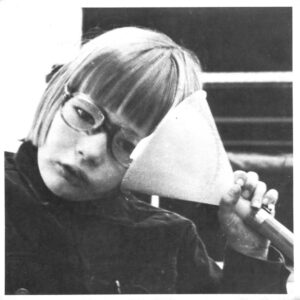
Recordings from a workshop at Akademie der Künste, Berlin, April 1972, featuring 15 children (aged 8-11) and Peter Brötzmann, Fred van Hove, Han Bennink.
19,00€
Out of stock

LP
Hermann NITSCH
“Akustisches Abreaktionsspiel”
Reissue of Nitsch's very first release, originally published 48 years ago by Edition Galerie Klewan in a limited edition of 100 copies.
Produced and recorded at the WDR Radio in Cologne, Germany, the Akustisches Abreaktionsspiel (Aktion 38b) is "neither a radioplay nor a work of music. it merely portrays the acoustic part of an "abreaktionsspiel" (a play of abreaction). the special and specific usage of the acoustic possibilities are in the foreground, while the visual part of the play is communicated by a narrator." A prime example of the intense & noisy wildness of Nitsch's early actions employing scream-choirs, beating, whistles, chaotic austrian folklore juxtapositions, rough brass sections and dissonant strings. Edition of 400 copies on vinyl and 200 copies on CD.
21,00€
Out of stock
CD
Hermann NITSCH
“Akustisches Abreaktionsspiel”
Reissue of Nitsch's very first release, originally published 48 years ago by Edition Galerie Klewan in a limited edition of 100 copies.
Produced and recorded at the WDR Radio in Cologne, Germany, the Akustisches Abreaktionsspiel (Aktion 38b) is "neither a radioplay nor a work of music. it merely portrays the acoustic part of an "abreaktionsspiel" (a play of abreaction). the special and specific usage of the acoustic possibilities are in the foreground, while the visual part of the play is communicated by a narrator." A prime example of the intense & noisy wildness of Nitsch's early actions employing scream-choirs, beating, whistles, chaotic austrian folklore juxtapositions, rough brass sections and dissonant strings. Edition of 400 copies on vinyl and 200 copies on CD.
12,00€
Out of stock

2 CD
Marcus SCHMICKLER
“Richters Patterns”
Double-CD collecting five of Schmicklers key-works composed & recorded between 2006 and 2016.
Edition of 400 copies in fullcolour digipak with 8-page booklet.Edition of 400 copies in fullcolour digipak with 8-page booklet.
"Richters Patterns (2016) is a collaboration among Marcus Schmickler, artist Gerhard Richter, director Corinna Belz and the Ensemble Musikfabrik. In 2011, Richter took an image of his work Abstract Painting (CR: 7244) and divided it vertically into strips and gave them to Belz who utilized specially developed software operations involving cuts, mirroring and reproduction to create a movie from these images. Schmickler and Belz worked in parallel, with the film and composition following their own independent logic. Schmickler’s idea was to extend Richter’s method to divide, mirror, repeat into sound and time. Richters Patterns was commissioned by Koeln Musik and had its premiere on September 9, 2016 at Cologne Philharmonic Hall. Marco Blaauw (Trumpet), Helen Bledsoe (Flute), Christine Chapman (Horn), Bruce Collings (Trombone), Diamanda Dramm (Violin), Florentin Ginot (Double Bass), Benjamin Kobler (Piano, Synthesizer), Ulrich Löffler (Piano), Heidi Mockert (Bassoon), Melvyn Poore (Tuba), Axel Porath (Viola), Carl Rosman (Clarinet), Dirk Rothbrust (Percussion), Marieke Schoenmakers (Harp), Peter Veale (Oboe), Hannah Weirich (Violin), Dirk Wietheger (Violoncello), Marcus Schmickler (Computer), Paul Jeukendrupp (Soundprojection).
"Kemp Echoes" (2013) refers to a physical phenomenon in the ear discovered by physicist David Kemp in 1978. Otoacoustic Emissions (OAE) are signals in the ear (that can be detected with high quality small microphones) that are emitted by the cochlea, either spontaneously or in response to stimuli (frequently clicks). I have strived to create a piece that can seem ‘electronic’ to the ear without actually utilizing electronics. With Helen Bledsoe (Flute), Peter Veale (Oboe), Carl Rosman (Clarinet), Heidi Mockert (Bassoon), Christine Chapman (Horn), Ales Klancar (Trumpet), Bruce Collings (Trombone), Melvyn Poore (Tuba), Ulrich Löffler (Synthesizer), Benjamin Kobler (Piano/Sampler), Dirk Rothbrust (Percussion), Thomas Meixner (Percussion), Juditha Haeberlin (Violin), Hannah Weirich (Violin), Axel Porath (Viola), Dirk Wietheger (Violoncello), Benedict Ziervogel (Bass), Marcus Schmickler (Computer), Paul Jeukendrup (Soundprojection). Conducted by Enno Poppe.
"Fokker Bifurcations" (2014) marks a departure into microtonal works for keyboards and mallets and maintains the composer’s penchant for juxtaposed fixed pitches with pitch continua. Recorded live at ISSUE Project Room, Brooklyn on Nov 7 2014. The recording has been edited for this publication. With Laura Barger (piano), Ning Yu (piano), Ian Antonio (percussion), Russell Greenberg (percussion).
"E-UROPAS / Plurality of Centers" (2006). Shall we say goodbye to modernism? I dare to confront the myths of new music in this music theater creation. Layers containing the manifestos of Cornelius Cardew, Guy Debord and sound materials from six decades of the avant-garde create a collage that utilizes some of the formal principles guiding John Cage’s Europera V. With Hayden Chisholm (Voice), Juditha Haeberlin (Violin), Axel Porath (Viola), Dirk Wietheger (Violoncello), Ulrich Löffler (Piano), Dirk Rothbrust (Percussion), Marcus Schmickler (Voice, Computer, Radios), Carsten Goertz (scenography).
"ATA OTO" (2017) for Robot instruments TEMBLO, TINTI, TROMS, XY by Logos Foundation & computer.
Original price was: 19,00€.10,00€Current price is: 10,00€.
In stock

LP
Gaudenz BADRUTT
“Ganglions”
Aussenraum records presents the first solo release of Swiss sound artist Gaudenz Badrutt. On Ganglions, Badrutt sculpts sinusoidal sounds, internal and external feedback as well as voice inputs and other sources into two pieces of otherworldly music. The release takes the listener into the realm of an arthropod central nervous system and its nerve cells processing tactile and visual information (Supraesophageal). The B-Side showcases a more primitive, destructive approach that could well be aligned with a nerve cluster that processes environmental feedback from the mouth and the legs of a creature with a ventral cord. Follow the input through the segments of the ladder. Appendages are damaged and lost along the way, scrambled information leaks into vessels unprepared. Balance is barely re-established, new pathways are carved out, raw strands maintain a steady gait. Ganglions is improvised and abstract, organic livesampling- computer music. 200 copies on 180g vinyl including a download code, cut by Flo Kaufmann.
14,00€
In stock
LP
Alvin LUCIER
“Criss Cross / Hanover”
*** Repress ***
Black Truffle is honoured to present the premier recordings of two recent works by legendary American experimental composer Alvin Lucier. A friend and contemporary of pioneers like Robert Ashley, David Behrman, Gordon Mumma, and Christian Wolff, Lucier has been crafting elegant explorations of the behavior of sound in physical space since the 1960s. Lucier is perhaps best known for I Am Sitting in a Room (1970), in which he repeatedly re-recorded his own speaking voice being played back into a room until the room’s resonant frequencies entirely obscure the spoken text. Beginning in the early 1970s, he has written a remarkable catalogue of instrumental works that focus on phenomena produced by the interference between closely tuned pitches, such as audible beating, often using pure electronic tones produced by oscillators in combination with single instruments.
Demonstrating the restless creative drive of an artist now in his 80s, the two recent works presented here both feature the electric guitar, an instrument Lucier has just recently begun to explore. In Criss-Cross, Lucier’s first composition for electric guitars, two guitarists using e-bows sweep slowly up and down a single semitone, beginning at opposite ends of the pitch range. The piece is a model of simplicity, exemplifying Lucier’s desire not to ‘compose’ in the conventional sense, but rather to eliminate everything that ‘distracts from the acoustical unfolding of the idea’. In this immaculately controlled performance of Criss-Cross by Oren Ambarchi and Stephen O’Malley, (for whom the piece was written in 2013), a seemingly simple idea creates a rich array of sonic effects – not simply beating patterns, which gradually slow down as the two tones reach unison and accelerate as they move further apart, but also the remarkable phenomenon of sound waves spinning in elliptical patterns through space between the two guitar amps.
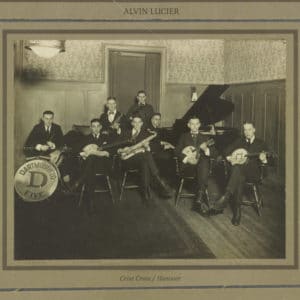
In the comparatively lush Hanover, Lucier draws inspiration from the beautiful photograph that provides the LP with its cover, an image of the Dartmouth Jazz Band taken in 1918 featuring Lucier’s father on violin. Using the instrumentation present in the photograph, Lucier creates an unearthly sound world of sliding tones from violin, alto and tenor saxophones, piano, vibraphone (bowed) and three electric guitars (which take the place of the banjos present in the photograph). Waves of slow glissandi create thick, complex beating patterns, gently punctuated by repeated single notes from the piano. The result is a piece that, like much of Lucier’s instrumental music, is simultaneously both unperturbably calm and constantly in motion.
Stunning LP design by Stephen O’Malley including an inner sleeve with a portrait of Alvin Lucier by Kris Serafin.
“Criss-Cross” recorded at Studios Ina GRM, Paris by Francois Bonnet and mixed by Alvin Lucier. “Hanover” recorded in Zurich and mixed by Alvin Lucier.
Mastered and cut by Rashad Becker at D&M Berlin.
20,50€
Out of stock
LP
Beatriz FERREYRA
“Echos+”
After a standout Recollections GRM side in 2015, Argentina’s Beatriz Ferreyra places more half a century of avant-garde knowledge at the service of this utterly enchanting new opus for Room40, ranging from elegiac vocal works to apocalyptic concrète composition... From Lawrence English: “I’m not really sure when I first heard Beatriz Ferreyra’s music. My best guess would be in the early to mid 2000s when I was working alongside the curatorial team at Liquid Architecture. Given the focus of the festival at that time, GRM and musique concrète more generally was very much a point of focus. That said, it wasn’t until this decade that her work was sharply in focus for me (and I am guessing a great many others). In 2017, I had the great pleasure to meet Beatriz in Braga, where we both were performing as part of the excellent Semibreve Festival. Subsequent to that I invited her to perform in Australia and we also had the pleasure to send time together this year in Rio during the Novas Frequencies Festival. Across these meetings, I have come to realise the incredible focus, generosity and vision that Beatriz has maintained across her life in sound. Beatriz Ferreyra is one of only a few female concrète composers who were active across the second half of the 20th century through to today. Her work, which is still very much an active investigation, is simultaneously complex and elegantly simple. Often drawing upon singular object of focus, Ferreyra’s use of tape and other forms of manipulation radically reconfigure her chosen sound materials, opening them outward. ‘Echos’ for example is sourced entirely from recordings of her niece who was killed in a car accident and ‘The Other Shore’ (composed as a response to the Tibetan Book Of The Dead) uses only percussion. Echos+ brings together three of Ferreyra’s most engaging compositions. Each of the works are deeply personal, but transcend that position, effortlessly welcoming us inside them. They collectively chart out a broad framework that not only defines her philosophical interests as a composer, but also marks out critical moments in her creative and technical approaches; shifting from her roots in tape music to more digital approaches.
26,00€
In stock
2 CD
The DORF / Phil NIBLOCK
“Baobad”
Co-released with Umland Records, Germany. On one night in 2019, The Dorf (German for "village") took a heavy dose of the music of Phill Niblock. The impact on the musicians, gathering to play a double-length version of Niblock's "Baobab" and (in a second set) three "Dorf" tunes, was deep. It felt a bit like going to church -- a truly spiritual experience. At first, the audience did not believe the announcement that the "drone" piece would last for 46 minutes. Afterwards, their reactions showed the impression Phill's music had made on them. After a 20-minute break, three pieces followed -- a different game altogether, but connected to "Baobab" in the way that the energy and the feel for the evening had been thoroughly set by Mr. Niblock. Already his physical presence changed the reception for both musicians and listeners and the taste for this "wall of sound" was palpable. The Dorf (in itself already an orchestra of something like 25 people) had been augmented by friends to a total of 35 musicians -- almost too big to be true. In the second part of the evening, Katherine Liberovskaya projected along to the music some of her outstanding video work, which is obviously not documented on this album. Play the record at a not-too-soft volume and stick with it. One way or another, the music will get to you. Recorded live on September 19, 2019, domicil Dortmund Germany. Personnel: Moritz Anthes - trombone; Marvin Blamberg - drums, sampler; Julia Brüssel - violin; Simon Camatta - drums, sampler; Denis Cosmar - sound; Marie Daniels - vocals; Felix Fritsche - saxophone; Sebastian Gerhartz - saxophone; Christian Hammer - guitar; Florian Hartlieb - computer; Stefanie Heine - saxophone; David Heiss - trumpet; Volker Kamp - bass; Oona Kastner - synth, vocals; Jan Klare - saxophone, directing; Anja Kreysing - accordeon; Maika Küster - vocals; Katherine Liberovskaya - visuals; Raissa Mehner - guitar; Alexander Morsey - sousaphone; Johannes Nebel - bass; Fabian Neubauer - keyboards; Phill Niblock - composition; Kai Niggemann - Buchla; Adrian Prost - trombone; Gilda Razani - Theremin; Guido Schlösser - synth; Ludger Schmidt - cello; Hanna Schörken - vocals; Oliver Siegel - synth; Maria Trautmann - trombone; Luise Volkmann - saxophone; Martin Verborg - violin; Andreas Wahl - guitar; Florian Walter - saxophone; Max Wehner - trombone; Emily Wittbrodt - cello; Achim Zepezauer - electronics.
16,00€
Out of stock

LP
Lucy RAILTON / Max EILBACHER
“Forma / Metabolist Meter”
Lucy Railton - Forma - 2019 / 23’19
Forma, for multichannel tape and live cello
Commissioned by INA GRM and first performed on the Acousmonium at INA GRM's Multiphonies Concert Series, Maison de la Radio, Paris on June 1st 2019.
Cello recorded live in concert, performed by Lucy Railton. Serge Synthesiser recorded at GRM Studios in April 2019.
Organ recorded in Skálholt Cathedral, Iceland, by Alex Bonney, performed by Kit Downes in 2017.
All other materials recorded, mixed and created by Lucy Railton at GRM Studios and in her Berlin studio between November 2018 and May 2019.
Mix by Lucy Railton / Premaster by Emmanuel Richier (GRM)
-
Forma by Lucy Railton, is a work that burrows deep inside. It disorientates and teases, without malice. Its beauty lies in gentle projections, which, though subtle, leave deep impressions, like the wings of a nocturnal moth reflecting dark light. Its path, too, is unpredictable, but such disorientation is not a reflection of chaos. Instead, a mysterious intention appears through an imperious unfolding - its logic escapes us, but nevertheless captivates us. It is the story of a becoming of forms, as well as of their fading away and their appearance as a disappearance .
----------
Max Eilbacher - Metabolist Meter (Foster, Cottin, Caetani and a Fly) - 2019 / 22’29
Created and recorded November 2018-March 2019 in Baltimore, Maryland.
Fly recording made September 2018 in Carrières-sous-Poissy, France.
Made for the Présences électronique festival 2019 in Paris, France.
Mixed from 8 channel to stereo August 2019.
Metabolist Meter (Foster, Cottin, Caetani and a Fly), by Max Eilbacher is a teeming piece, a matrix where textures and structures merge together, where the polyrhythmic instances become timbre, where the formal abstraction of the harmonic volutes coagulates around a vibrating form that is actualized in the dramatic reality of a dying fly. And this formal mastery is not disembodied in Max Eilbacher’s work and the kaleidoscopic forms of the sound spectra that he has deployed know how to resonate in the sensations and experiences of each one.
------
These two pieces have this in common, but each with their own agenda, that they evolve with grace and inspiration in the vast domain of the sound world and it is a great pride for us to present them in this new collection.
25,00€
Out of stock
CD
Taku SUGIMOTO
“Guitars”
Performed by Andrey Popovsky: electric guitar (1), semi-acoustic guitar (2), Denis Sorokin: classical guitar (2), electric guitar (3), Alexander Markvart: acoustic guitar (2).
Taku Sugimoto is a Tokyo-based guitarist and composer. Improvisation is one aspect of his work, but currently his main activities are composing and performing composed pieces (including those of other composers). He continues his global and concentrated interaction with composers from around the world, particularly those closely connected with Wandelweiser. Ftarri had previously released two albums under Sugimoto's name alone—Septet (2015) and Quintets: Berlin, San Diego (2017). On both CDs, his compositions are performed by other musicians (on Septet, Sugimoto also participates in the performance).
The CD Guitars, also released under Sugimoto's name, is comprised of three pieces that he wrote for that instrument. The first and third are guitar solos around 20 minutes long; the second is a guitar trio of about 10 minutes. The performers are three guitarists from Russia, and the pieces were recorded in St. Petersburg in 2017 and 2018. The solo compositions were performed by Andrey Popovsky (track 1) and Denis Sorokin (track 3); and the trio was performed by these two plus Alexander Markvart. All the performances are extremely simple and concise, but convey a feeling of complexity and richness. Abounding in an incomparable feeling of depth within their simplicity and candor, these are truly Sugimoto-like works.
13,00€
Out of stock

CD
Cristián ALVEAR – Klaus FILIP
“6 Chords”
Cristián Alvear: acoustic guitar. Klaus Filip: sine waves.
Guitarist Cristián Alvear was born in 1979 and lives in Santiago, Chile. Active on the international contemporary/experimental music scene, he has since 2010 released numerous recordings on labels in various countries. Musician and programmer Klaus Filip was born in 1963 and resides in Vienna, Austria. ppooll, the software he developed, is used regularly by many improvisers, including Filip himself.
This album is comprised of a single track of 40 min., 58 sec., divided into six parts. Klaus Filip continuously plays gentle-sounding sine tones, over which Cristián Alvear simply and steadily repeats the same chords and short phrases on acoustic guitar. While each of the six parts is different in form, the work as a whole is simple, clean-lined, and delicately refined, radiating an indefinably mysterious mood throughout. A masterpiece.
13,00€
Out of stock
CD
Makoto OSHIRO – Yan JUN
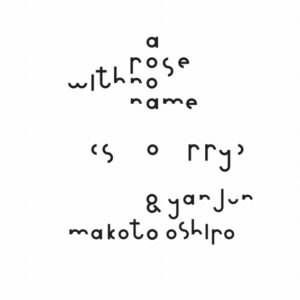
“A Rose with No Name (Sorry)”
Makoto Oshiro: objects. Yan Jun: feedback. Recorded at Yan Jun's residency studio (DAAD), Berlin, Germany, February 22, 2017.
Tokyo-based sound artist and improviser Makoto Oshiro carries out live performances and installations in which he creates sound using self-made devices and remodeled pre-existing objects. Beijing-based musician/poet Yan Jun, one of the leading Chinese artists on the experimental/improvised music scene, creates music and produces installations freely utilizing electronics, field recordings and voice.
This album was studio-recorded on February 22, 2017, when Oshiro was visiting Berlin and Yan Jun was in that city on a long-term residency. The two tracks are about 22 minutes each. The instruments listed on the album cover are "objects" (Oshiro) and "feedback" (Yan Jun). The noises produced include clattering, rotation noise and sustained sound. In Track 1, various low-volume noises are sent forth in a calm and simple way throughout the piece; while in Track 2, numerous multi-layered noises cover the space and also produce intervals of high volume. This album is remarkable not just for the straightforward expression of each artist's musicality, but also for the superb collaboration achieved in the performances.
13,00€
Out of stock
CD
Ami YOSHIDA
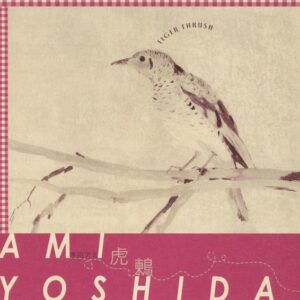
“Tiger Thrush”
Recorded by Ami Yoshida at her house in Tokyo, January-March 2003. Mastered by Toshimaru Nakamura, May 2003. Original CD released on Improvised Music from Japan (IMJ-504), July 2003.
In the early 2000s, improvisational music featuring elements such as extended techniques and many faint sounds and silences became a worldwide movement. Along with Berlin and London, Tokyo was one of the centers of this kind of music and the focus of much attention, as was the term onkyo-ha. The names most closely associated with this term were Taku Sugimoto, Sachiko M, Otomo Yoshihide, Toshimaru Nakamura. Another onkyo-ha musician was voice performer Ami Yoshida. Her amazing performances, comprised of high-pitched vocal sounds that seemed to be squeezed out through the tight constriction of the throat, astonished the international improvised music scene.
Tiger Thrush was released on the Improvised Music from Japan label in 2003, when the name Ami Yoshida, along with the term onkyo-ha, was becoming a worldwide phenomenon. Long out of print, it's just been re-released on the Hitorri label, with a simple two-sided paper sleeve replacing the original gatefold cardboard cover. The recording consists of 99 tracks, most less than a minute long. Yoshida's vocal sound is unaltered in some tracks and computer-processed in others. A famed recording of the 2000s has come back to life!!
13,00€
In stock

LP
France JOBIN
“Death is perfection, everything else is relative”
All sounds recorded at various locations in Europe, South America and at EMS, Stockholm using the Buchla 200 modular synthesizer. Mastered by Russell Haswell. January 2020.
The last two years have seen me maintaining an association with an unusual bedfellow, death. The loss of Mika Vainio, as well as three members of my own family, has had a profound effect on me and spurred a lengthy reflection on life, death, and everything in between. Parallelly, while studying the philosophy of science, I came across shadow photons: “Tangible photons are the ones we can see or detect with instruments whereas shadow photons are intangible (invisible) detectable only indirectly through the interference effects on the tangible photons.
There is no intrinsic difference between tangible and shadow photons: each photon is tangible in one universe and intangible in all the other parallel universes.
They travel at the speed of light, bounce off mirrors, are refracted by lenses, and are stopped by opaque barriers or filters of the wrong colour. Yet, they do not trigger even the most sensitive detectors. The only thing in the universe that a shadow photon can be observed to affect is the tangible photon that it accompanies.
This is the phenomenon of interference.
Shadow photons would go entirely unnoticed, were it not for this phenomenon and the strange pattern of shadows by which we observe it. Thus the existence of a seething, prodigiously complicated hidden world of shadow photons has been inferred.” (The fabric of reality, David Deutsch, Penguin Press 1997.
)
I have drawn a parallel between shadow photons and death. The interference phenomena, parallel universes, and how shadow photons affect tangible photons they accompany, offer, in my opinion, similarities, an unknown universe which is death and how we, remaining tangible human beings, are affected. This quest has led me to be more willing to accept chaos in my life and to conclude that Death is perfection, everything else is relative.
18,00€
Out of stock

CD
suzueri
“Fata Morgana”
suzueri: piano, gadgets.
Sound artist/improviser suzueri started her musical activity in the 1990s, and her wide-ranging work since then has included concerts, exhibitions and installations. It was in the late 2000s that she began the style of performance heard on this album, combining upright piano and handmade devices. She continued to develop her concerts featuring this combination, and in the 2010s she earned widespread recognition and praise among improvised/experimental music fans for her unique "suzueri" style.
Three CDs of suzueri's performances at Ftarri with upright piano and self-made devices have previously been released on the Ftarri label: Live at Ftarri (meenna-993), a 2013 concert by the trio of suzueri, Tetuzi Akiyama (guitar) and Makoto Oshiro (self-made instruments), plus a quartet by these three and British drummer Roger Turner; Ftarri de Solos (ftarri-887), pairing solos performed in 2017 by suzueri and Hong Kong sound artist Fiona Lee; and Duo (ftarri-886), a 2018 duo performance with Makoto Oshiro. While these three CDs are all live recordings, what might be called a "definitive" studio-recorded solo album by suzueri has now been released. Fata Morgana, made up of two tracks of 25-plus minutes each, was recorded in February 2019 by Makoto Oshiro (who has an established reputation as an engineer).
Various devices including a small electric fan, a motor and a radio are placed on, attached to or arranged near an upright piano whose upper and lower panels are removed and insides exposed. The devices themselves produce sounds; and when touched by these devices, the piano strings and keyboard emit sounds repetitively (every few seconds) or continuously. These myriad sounds overlap and become a united whole, and at the point when they fill the space like a foundational layer, suzueri strikes the keyboard with both hands, forcefully and persistently unleashing clusters of sounds. This album overflows with suzueri's magical appeal, which combines concentrated musical creativity with turbulence and disarray.
Original price was: 13,00€.7,00€Current price is: 7,00€.
Out of stock
CD
JUN – GUIONNET – SCHELLANDER – MURAYAMA
“Blue Mistake, Red Mistake”
Yan Jun: voice. Jean-Luc Guionnet: alto saxophone. Matija Schellander: contrabass. Seijiro Murayama: snare drum, voice.
Blue Mistake, Red Mistake is the project of four musicians: Matija Schellander, a contrabass player living in Vienna; Jean-Luc Guionnet, a sax player based Paris; Beijing-based Yan Jun, who was staying in Berlin on a residency when this album was recorded; and percussionist Seijiro Murayama, who at the time of the recording had been living in Japan for several years (but before then had lived for a long time in France and now resides in Paris). The four got together and launched the project in March 2017, when Schellander was carrying out a residency at the jazz/improvised music festival Artacts in St. Johann in Tirol, Austria. They gave four performances over a week-long period, starting at the Artacts festival and then in Graz (Austria), Vienna and Ljubljana (Slovenia).
This album's one track (about 44 minutes) is the performance in Ljubljana. Yan Jun, who usually plays electronics, performed with his voice only. Murayama used snare drum and voice. The interior of the venue, Galerija ŠKUC, was like a long, narrow hallway which had several adjoining rooms without doors in between (as if the walls had been taken out). For this project it had been agreed that, in each of the concerts, three of the musicians would play close together and one would be far away. In this concert, Schellander started performing quite far back, at a distance from the others, and during the concert he moved to different rooms.
The overall mood of the performance is minimalist, with a limited number of sounds, but occasionally there are intense percussion sounds. Together with a cool but strong feeling of tension, the sonic perspective and dynamism create an amazing effect which, in combination with the excellent recording quality, result in a truly superb album.
13,00€
In stock
CD
Junji HIROSE
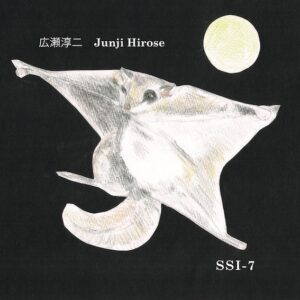
“SSI-7”
A leading sax player on the Japanese improvised music scene, Junji Hirose also plays his own self-made analog noise instruments. In the 1980s he started giving noise performances using his SSI (self-made sound instrument), created by combining everyday objects. Over the years he has remodeled the instrument a number of times, each time adding a different number to the name "SSI." Hirose's CDs SSI-4 (hitorri-997, 2013), SSI-5 (hitorri-993, 2015) and SSI-6 (hitorri-990, 2016) have been released on the Hitorri label. His new album featuring the SSI-7, recorded in December 2018, is now out.
Balls and other small objects are placed on a large, shallow, round metal plate. These objects are covered with a metal plate of the same type and size which is placed and secured in such a way that it seems to be subtly floating. With the use of an air compressor, blasts of air hit the instrument from various angles. The compressed air streaming between the two metal plates causes the objects in between to move around in a dynamic way. The noise of the air compressor, the sound of the compressed air hitting the metal plates, and the sounds produced by small objects moving around and hitting the metal plates all combine to produce a complex and dazzling conglomeration of sound. The album is made up of four tracks, and the sonic atmosphere of each track is altered through the use of different types of small objects. On the final track, no objects are placed between the metal plates; the compressed air hits only the plates. This album overflows with Hirose's creative dynamism and abundant originality.
13,00€
In stock
CD
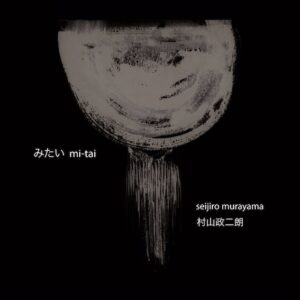
Seijiro MURAYAMA
“mi-tai”
Seijiro Murayama is a drummer/percussionist and improviser/composer living in Paris. Since around 2017 he's focused on creating electro-acoustic works using recordings of his own improvisations. The results of these efforts have been released as two highly praised solo albums from the Hitorri label: Downdate (hitorri-986, 2017) and The Empire of Slip of the Tongue (hitorri-984, 2018). In an about-face from these earlier releases, his new album, Mi-tai, consists of eight improvisational performances on percussion. It's as if Murayama were returning to his point of origin with this release.
Mi-tai is the first of two albums in which Murayama attempts to give a comprehensive account of his improvisation on percussion and drum set--his "principal occupation," so to speak--in this moment in time. This is a chance to experience the amazing creativity that sets Murayama apart from other percussionists/drummers.
13,00€
In stock
CD
Heather FRASCH / Ryoko AKAMA
“Linking”
A composition by Heather Frasch with Brice Catherin: cello, objects, Eleanor Cully: voice, objects, Ryoko Akama: organ, objects. A composition by Ryoko Akama with Heather Frasch: field recordings, objects, electronics.
Heather Frasch is a composer/musician living in the U.S. city of Charlottesville, Virginia. Ryoko Akama is a composer/musician living in Huddersfield, UK. Together they run Mumei Publishing, which issues mumei, a journal exploring the relationship between text and sound. French musician Bruno Duplant asked Frasch and Akama to create a CD, and the result was this three-track album. (Duplant served as producer throughout the project, but was not involved in the compositions or performances.)
In 2018, Frasch and Akama each composed a work using a written text; then they exchanged the compositions and recorded them separately. Akama's composition "For Heather's Day" was recorded and edited in several sessions by Frasch using field recordings, objects and electronics to create a work of 40 minutes in length. Frasch's composition "A Moment in My Day" was recorded by Akama with invited musicians Brice Catherin (cello, objects) and Eleanor Cully (voice, objects) as well as her own sounds (organ, objects), resulting in the creation of four different takes. Takes 1 and 3 (each about 20 minutes) are heard on this album.
On this superb CD, composer/performers Frasch and Akama draw out all the distinctiveness of text scores, both in their compositions and in their interpretation / realization of the works.
13,00€