
In stock

CD
Mathieu WERCHOWSKI
“Noir Paradis”
Mathieu Werchowski : violon, alto & voix A la mémoire de John Russell Cet album tire ses sons d’improvisations générées par un beau violon acoustique,...
12,00€
In stock

CD
Sébastien ROUX
“Musiques d’ordinateur”
Musiques d’ordinateur rassemble des pièces écrites entre 2011 et 2020. Les pistes de ce CD sont les résultats plus ou moins prévisibles de programmes plus...
12,00€
Out of stock

2 LP
Luc FERRARI
“Labyrinthe de Violence”
Capturing the four soundtracks conceived in 1975 for the multimedia/audiovisual performances at Galiéra Museum in Paris, the previously unreleased Labyrinthe de Violence stretching across two LPs represents a peek into Luc Ferrari's creations connected to his Atelier de Libération de la Musique experiences. Luc Ferrari was always keen to disrupt habits and engrained practices, to open his mind to new ways of apprehending the world of art, considering it not so much as a separate realm but as an inroad into society. In keeping with the spirit of 1968, he advocated taking part in daily life, casting a critical, but amazed, eye on the world around us, and always questioning the meaning of the occupations and preoccupations the world imposes. From the 1970s, Luc also wished to shed the solitary status of the artist, and to truly communicate with society. He thus gathered around him a group of people from different backgrounds with an aim to create, together, new ways of working and new forms of expression that would address unusual audiences rather than traditional concert audience. Having created his Studio Billig in Paris in 1973, Luc wanted to make the most of that place to promote exchanges with other artists, to share, think, and improvise together. This is what gave rise to the Atelier de Liberation de la Musique workshops, whose objective was to "Liberate music from the constraints of style and esthetics." The idea was precisely to free the artist from abstraction, leading him to perform accessible and intelligible actions; to promote the imagination; to use the dramatic dynamism of sound and image to trigger ideas; to ignore the sensational and instead to observe our social environment and daily life with an intuitive eye-ear; to invite the visitor to come up with their own analysis. This craving for collaboration led Luc Ferrari to create, in 1975, a collective of musicians with Martin Davorin Jagodic, Philippe Besombes, Alain Petit and David Jisse. That year, they worked at Labyrinthe de Violence, a looped audiovisual labyrinth which evoked the violence of contemporary society, and was a reaction to the political situation of the time. It was a multimedia work, spread across four rooms, on the following themes: Power/Profit/Violence/Pollution. Each side of this 2LP set reproduces the sonorization of one of the four rooms in the Museum, automatically mixing in the central space. The same recordings focus on questions of utopia through many of the same themes. As in the rest of his work, pleasure was also at the heart of these pieces. First press limited to 500 numbered copies; gatefold sleeve.
34,00€
Out of stock

LP
Elko BLIJWEERT
“De Nor Des Hoofds / Prison Of The Mind”
De Nor ('the can', or prison, in comic book Dutch) is an open-air venue/sculpture/pavillion at the Middelheim Museum in Antwerp. During its inaugural summer, Elko Blijweert played a live concert there that left an indelible mark on those lucky enough to witness it. What exactly did he do, you ask? Well, Blijweert basicly used the entire garden as an instrument alongside an array of pre-programmed pedals, keyboards, drum machines, guitars, a mandoline, and booze-bottle flutes.
This record, a re-created version of that fabled performance, is a concept album of sorts. Your personal prison experience begins on Side One. You will be miserable! Terrified! You will fantasise about being released, or escaping, every night. The entire ordeal is narrated song-by-song with Blijweert's liner notes.
20,00€
Out of stock
LP
IGNATZ & DE STERVENDE HONDEN
“Saturday’s Den”
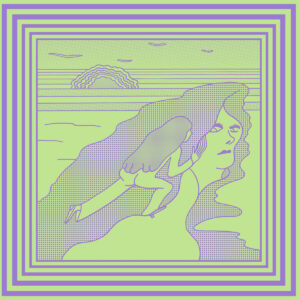
On their third LP for Ultra Eczema, psychedelic blues gloomers Ignatz & De Stervende Honden have driven off the bendy sideroads and onto a straight, if not exactly narrow, path. And there's new sounds coming out of the stereo: The Les Rallizes Dénudés-type guitar fuzz of previous journeys has been phased out in favour of softer, repetitive VU stumbling and even some Fleetwood Mac-esque romance. But it remains an unmistakenly Ignatz & De Stervende Honden record, with all the necessary ingredients for long car rides, living room break-ups, morning glory, sunsets and drunken rambles about length, size and whatever else matters.
20,00€
In stock

LP
Bernard PARMEGIANI
“Mémoire Magnétique, Vol 2.”
Transversales is very glad to announce the release of Mémoire Magnétique Vol. 2 spanning 1966-1993, revelatory collection of short and secret music by electronic music pioneer Bernard Parmegiani.
Since the late 50's, Bernard Parmegiani, a major figure of electroacoustic music and a founding member of GRM has created some eighty two concerts music. From the start, Parmegiani’s work was closely linked to the screen, with dozens of documentaries, films, long features, animation films but also musical pieces for dance, stage or television. If many of his pieces are landmarks in the history of electroacoustic music (De Natura Sonorum, La Roue Ferris…), his application music compositions are strongly embedded in the subconscious landscape of the French public (Stade 2, Roissy Paris Airport…).
The second volume of this compilation allows us to discover some of unreleased rarities from Bernard Parmegiani’s personal archives and unpublished recordings which were composed for the screen or the performing arts.
24,00€
In stock

LP
Sarah TERRAL (Clément VERCELLETTO)
“Le Ménisque Original”
Le ménisque original is Clément Vercelletto‘s (Orgue Agnès, kaumwald, Arlt, Les Sciences Naturelles, Tape Ensemble) first solo album under the Sarah Terral moniker.
The album was composed and played with a very small modular synthesizer in order to remain instinctive and minimal.
19,50€
In stock

LP
Yann GOURDON
s/t
One third of the drone trio France and part of the La Novia collective, Yann Gourdon's practice focuses on acoustic phenomena and dynamic relationships with the environment. Having learned to play traditional music from Auvergne by listening to field recordings, Gourdon re-orientates tradition via minimalism, honing in on a place or location's unique vibratory fields, volumes and surfaces.
Co-production La Nòvia / three:four records
19,50€
In stock

LP
Rafael TORAL & João Pais FILIPE
“Jupiter and beyond”
João Pais Filipe: Bass Drum, Gongs, Bells.
Rafael Toral: Feedback (modified MS-2 amplifier), Guitar.
Jupiter, the gas giant in our Solar System, with thunderstorms a thousand times more powerful than on Earth, rainfalls of diamonds in the atmosphere, temperatures below -100°C, plenty of hydrogen, 79 moons and a South pole that looks like an abstract painting, has just the kind of environment this music seems to emanate from.
Jupiter and Beyond, the second collaborative effort of composer/performer Rafael Toral and percussionist João Pais Filipe as a duo (after Saturn in 2016), is definitely not quite a record of Earth music. On the contrary, Jupiter and Beyond, is indeed gas music, unfolding over two long movements without solid body or any tangible outline, between ambient and noise. A music of sheer volume and beauty, icy, massive, in which the elements of Toral's signature, in particular his use of jazz-inspired electronics and feedback, dissolve to become a labile, nebulous, expansive material, occasionally struck by abyssal depressions and masterful densities, magnified by the return, after 17 years of silence, of the electric guitar in Rafael Toral's instrumentarium.
Towards the end of Beyond, the second piece on the record, lurking behind the volutes of feedback, a bell and a bass drum, one can detect from the distance... a barking dog, as a surreptitious and prosaic reminder of where we are here and now, a calling back to Earth. Between sadness and joy, anger and peace, movement and stillness, Jupiter and Beyond is indeed a mirror held out to us, music reflecting our times and that emotionally speaks first of all about us.
"While João Pais Filipe was drummer in the Space Quartet, we played a live duo set. During soundcheck we were jamming for a while on bowed gongs and feedback and lost track of time, it just flowed so well. I joked "we could make a whole record with this!". But later we took the idea seriously and set to record an improvised session at his cymbalsmith workshop (he made the gong on the cover and it was used in the recording). When we listened to the first take the mass of sound was amazing. At some point it reminded me of the complex clusters of sound in Ligeti's music as it appears on Kubrick's 2001 scene "Jupiter and Beyond the Infinite". In the end the title felt like an apt choice for Saturn's successor. Back at my studio I felt the need for some more layers of density in some sections. I thought of using trombones, but ended up picking up the electric guitar, which I hadn't used since 2003.” Rafael Toral
18,50€
Out of stock
CD
Rafael TORAL & João Pais FILIPE
“Jupiter and beyond”
João Pais Filipe: Bass Drum, Gongs, Bells.
Rafael Toral: Feedback (modified MS-2 amplifier), Guitar.
Jupiter, the gas giant in our Solar System, with thunderstorms a thousand times more powerful than on Earth, rainfalls of diamonds in the atmosphere, temperatures below -100°C, plenty of hydrogen, 79 moons and a South pole that looks like an abstract painting, has just the kind of environment this music seems to emanate from.
Jupiter and Beyond, the second collaborative effort of composer/performer Rafael Toral and percussionist João Pais Filipe as a duo (after Saturn in 2016), is definitely not quite a record of Earth music. On the contrary, Jupiter and Beyond, is indeed gas music, unfolding over two long movements without solid body or any tangible outline, between ambient and noise. A music of sheer volume and beauty, icy, massive, in which the elements of Toral's signature, in particular his use of jazz-inspired electronics and feedback, dissolve to become a labile, nebulous, expansive material, occasionally struck by abyssal depressions and masterful densities, magnified by the return, after 17 years of silence, of the electric guitar in Rafael Toral's instrumentarium.
Towards the end of Beyond, the second piece on the record, lurking behind the volutes of feedback, a bell and a bass drum, one can detect from the distance... a barking dog, as a surreptitious and prosaic reminder of where we are here and now, a calling back to Earth. Between sadness and joy, anger and peace, movement and stillness, Jupiter and Beyond is indeed a mirror held out to us, music reflecting our times and that emotionally speaks first of all about us.
"While João Pais Filipe was drummer in the Space Quartet, we played a live duo set. During soundcheck we were jamming for a while on bowed gongs and feedback and lost track of time, it just flowed so well. I joked "we could make a whole record with this!". But later we took the idea seriously and set to record an improvised session at his cymbalsmith workshop (he made the gong on the cover and it was used in the recording). When we listened to the first take the mass of sound was amazing. At some point it reminded me of the complex clusters of sound in Ligeti's music as it appears on Kubrick's 2001 scene "Jupiter and Beyond the Infinite". In the end the title felt like an apt choice for Saturn's successor. Back at my studio I felt the need for some more layers of density in some sections. I thought of using trombones, but ended up picking up the electric guitar, which I hadn't used since 2003.” Rafael Toral
11,00€
Out of stock

Book + CD
Yannick DAUBY
“Fushan & Taipingshan”
A project (Book+CD) by Yannick Dauby about sounds and stories of low and middle altitude mountains of Yilan, North East of Taiwan.
The book (in English and Chinese) features interviews with five persons who have special knowledge and experience about the forests of Taipingshan and Fushan : Lue Kuang-Yang, Kacuzi Hacyo, Wu Chiu-Hsiang, Lai Chun-Piao, Lai Bo-Shu. Notes about listening and sound recording practice by Yannick Dauby. Identification of animal sounds with Chinese, English and Latin names.
The 75 minutes audio CD contains field recordings realized in Fushan Botanical Garden and Taipingshan Forest Area between 2013 and 2015, edited and mixed in 2016.
15,00€
In stock

LP
Pierre-Yves MACÉ / Silvain VANOT
“Split LP”
Brocoli is pleased to announce a split LP release of two previously unpublished works that bring together two established composers for the first time. On one side (who knows if it is side A or side B?) we find Silvain Vanot, who was at the forefront of 90s French indie rock alongside the likes of Dominique A and Jean-Louis Murat. He has also collaborated with Jim O'Rourke. The other (side B or perhaps side A?) goes to Pierre-Yves Macé, a stalwart of the label. A composer of instrumental (his work is regularly performed by the Ensemble Intercontemporain) and electroacoustic music.
At first glance the reason for bringing these two artists together may not seem obvious. And yet... these two pieces are both built upon the same principle: they are both instrumental music set in urban outdoor spaces. For Silvain Vanot this meant walking at dawn with his portable recorder in the Butte Montmartre, Paris. Then, once in the studio, improvising over these field recordings. Five locations resulting in five tracks. All recorded in one take. Pierre-Yves Macé first wrote a score for trombone, horn, oboe and percussion. He then recorded each musician separately at a different location in Paris. Finally, reassembling the piece in the studio. He allowed himself to be guided as much by the score as from the happy coincidences which occurred during the recordings.
As coherent as it is surprising this split LP navigates with ease between field recording, contemporary music, improvisation, ambient and musique concrète.
19,00€
Out of stock
LP
Limpe FUCHS
“Solaia”
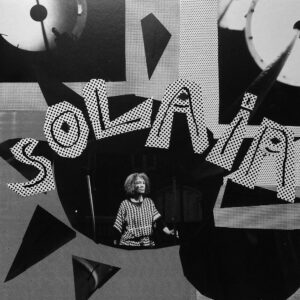
Limpe Fuchs' first solo record came about by accident. Initially, Christoph Heemann invited the famous Anima duo to do a studio record in his home-town Aachen, but Paul Fuchs decided not to join in, so Limpe went on her own - and the recording sessions taking place in late 1986 and early 1987 turned out to become "via", Limpe's first solo-record and the (visible) starting point of her ongoing exceptional career as an internationally performing, independent female improviser. Besides a plethora of (partly self-built) acoustic instruments that can also be heard on her legendary Anima (music) records, such as violin, saw blade, chimes, wood block and limpe's unmistakable unique vocals, "via" featured a korg-synthesizer, that drew Limpe's attention in the studio and she decided to give it a try and recorded a lot of electronic music for "via" - and in all the years to follow since then she never got near the instrument again; neither for studio recordings nor live performances . Fast forward to 2015: after not having met Christoph Heemann for many years, they got in contact again and performed selected dates (as Macchia Forest together with Timo van Luijk) when he proposed to Limpe another korg-synthesizer recording. not having touched the instruments in decades Limpe was reluctant at first but warmed up to the idea eventually and improvised a wonderfully meditative and soulful electronic piece of music. She also recorded five of her pendulum strings exclusively for the first time (with a bit of vocals, too) - huge self-built instruments of various size with an amazing sound rich of oscillating overtones. The both side-long recordings - one side korg, one side pendulum strings - featured on "solaia" are a visceral document of Limpe Fuchs' artistic versatility and musical sensibilities. It's fair to say: the spirit of her musical approach is captured perfectly on this new studio-album (mixed and mastered by her son Zoro Babel), which is released in conjunction with a first-time re-release of "via" - both to celebrate her long-standing musical career (and her eightieth birthday). "via" and "solaia" are available now as two separate lp's. Both records are released in an edition of 300 copies and accompanied by a 30-page longform interview with Limpe Fuchs and Christoph Heemann to give an insight in their collaborative history and portray Limpe's outstanding artistry.
19,00€
Out of stock

LP
Limpe FUCHS
“Via”
Limpe Fuchs' first solo record came about by accident. Initially, Christoph Heemann invited the famous Anima duo to do a studio record in his home-town Aachen, but Paul Fuchs decided not to join in, so Limpe went on her own - and the recording sessions taking place in late 1986 and early 1987 turned out to become "via", Limpe's first solo-record and the (visible) starting point of her ongoing exceptional career as an internationally performing, independent female improviser. Besides a plethora of (partly self-built) acoustic instruments that can also be heard on her legendary Anima (music) records, such as violin, saw blade, chimes, wood block and limpe's unmistakable unique vocals, "via" featured a korg-synthesizer, that drew Limpe's attention in the studio and she decided to give it a try and recorded a lot of electronic music for "via" - and in all the years to follow since then she never got near the instrument again; neither for studio recordings nor live performances . Fast forward to 2015: after not having met Christoph Heemann for many years, they got in contact again and performed selected dates (as Macchia Forest together with Timo van Luijk) when he proposed to Limpe another korg-synthesizer recording. not having touched the instruments in decades Limpe was reluctant at first but warmed up to the idea eventually and improvised a wonderfully meditative and soulful electronic piece of music. She also recorded five of her pendulum strings exclusively for the first time (with a bit of vocals, too) - huge self-built instruments of various size with an amazing sound rich of oscillating overtones. The both side-long recordings - one side korg, one side pendulum strings - featured on "solaia" are a visceral document of Limpe Fuchs' artistic versatility and musical sensibilities. It's fair to say: the spirit of her musical approach is captured perfectly on this new studio-album (mixed and mastered by her son Zoro Babel), which is released in conjunction with a first-time re-release of "via" - both to celebrate her long-standing musical career (and her eightieth birthday). "via" and "solaia" are available now as two separate lp's. Both records are released in an edition of 300 copies and accompanied by a 30-page longform interview with Limpe Fuchs and Christoph Heemann to give an insight in their collaborative history and portray Limpe's outstanding artistry.
19,00€
Out of stock

3 LP
COMPILATION
“The Harmonic Series Volume 2”
A collection of long-form works in just intonation by Kali Malone, Duane Pitre, Catherine Lamb, Tashi Wada, Byron Westbrook, and Caterina Barbieri. Each artist occupies an entire side of the collection's three LPs.
Curated by Duane Pitre, Important Records returns with its second volume of compiled works in just intonation. The Harmonic Series II, issued as a triple LP collection, features a series of long-form compositions by six of the most important emerging voices of contemporary experimental music;
Unlike equal temperament - the tuning system most commonly encountered in contemporary music - which equally divides an octave into 12 fixed notes, just intonation utilizes intervals of whole number ratios - chosen by a composer - to determine tonal positions, which can result in a highly individualised tonal language and holds the potential for more nuanced relationships and striking, sympathetic resonances. Rooted in ideas that trace their way across the last 2500 years - seeking to mirror the natural behaviour of sound within music - just intonation lays at the foundation for numerous Indian, Persian, and East Asian musical traditions, as well as a substantial amount of European music prior to the 17th century. Reintroduced into western music during the 20th century by composers like Harry Partch, Ben Johnston, Lou Harrison, James Tenney, Terry Riley, and La Monte Young, it has left an indelible mark on experimental practice ever since.
In the years following the appearance of The Harmonic Series in 2009 - presenting works by Ellen Fullman & Theresa Wong, Michael Harrison, Pauline Oliveros, Charles Curtis, and others - the broad interest in just intonation has continued to swell, inspiring Duane Pitre to curate a second compilation, exploring the work of a new generation of composers that have been drawn toward its remarkable potential.
The full scope of The Harmonic Series II engages the possibility of a multitude of intertwining sequences and relationships between its works. Kali Malone’s "Pipe Inversions” - played by Malone on a small pipe organ, joined by Isak Hedtjärn on bass clarinet - belongs to a larger body of microtonal organ works that have increasingly placed the composer at the forefront of contemporary minimalism and drone music. Thick blankets of shimmering harmonics - sliding at a glacial pace within a fractal structure of rhythmical and melodic sequence - converge as a poignant unwinding of cultural, temporal, and historical location, embedded within the disarming beauty of its interwoven tones.
Across the length of Duane Pitre’s "Three for Rhodes” - a chamber piece for ”unknown instrumentation” - deconstructed rhythms and melodic fragments swell in a dance of harmonic interplay, rising and falling within the work’s engrossing architectural complexity. Imbued with a startling sense of humanity, tonal footsteps and syntactic patterns flower with life, delivering an exacting image of the metaphorical potential of sound.
Catherine Lamb’s "inter sum” - one of a tiny number of available works to encounter the composer and renowned violist working on synthesizer - endeavours to break the visualisation of harmony as a vertical reality, rendering it multidimensionally in space. With its materiality drawn from Lamb’s own environmental field and filtered by the synth - presenting a radical rethinking of the terms of composition and musical mater - subtle tonalities and harmonics, embedded within sheets of textural atmosphere, culminate as a spectral vision of the latent musicality of the natural world.
A canon for eight-violins played by Marc Sabat, Tashi Wada’s "Midheaven (Alignment Mix)” - guided by the internal logic of its tuning system - shape-shifts into an elegantly poetic form of musical conceptualism. Interlacing long-tones bloom with complex harmonic interplay and delicate overtones, as two mirroring, overlain realizations of the composition - one moving forward as the other simultaneously moves backward - slowly converge toward a crescendo of dissonance at the midpoint, imbuing the work with emotive tension, before returning to a final ecstatic release.
Byron Westbrook’s "Memory Phasings”, composed and recorded on a combination of computer controlled modular synthesizers and a Yamaha TX802, employs the ratios of just intonation as harmonic building blocks for texture. Shifting long-tones and insectile buzzes underscore patterns of rapid appreciations and carefully balanced punctuations, forming a shimmering collective of abstractions, that blurs the lines between synthetic and organic readings of sound.
Deploying just intonation as a means for psycho-physiological exploration, Caterina Barbieri’s "Firmamento” - composed for synthesizer - deftly intervenes with the expectations of minimalism, durational music, and drone. Brooding and ecstatic - pushing the possibilities of organised sound into unexplored realms via the triggering of emotional and mental states of being - across the work’s slow evolution, sublime tonalities ride a razors edge between darkness and light, colliding in dense layers that rethink ancient modes in futuristic terms.
Taking form within the gestures of six crucial voices of contemporary experimental music - Malone, Pitre, Lamb, Wada, Westbrook, and Barbieri - The Harmonic Series II sculpts a profoundly human vision of the potential of art, where the historic becomes present and future, and the divisions imposed by cultural and temporal boundaries dissolve. Like the generations that have embraced it before them, each artist harnesses just intonation as a means to progress toward unknown territories of creative possibility and to readdress how we hear, arriving at a musical space that is highly individual and personal - captured by the diversity of the works presented within - while speaking within a collective whole.
45,00€
In stock

LP
Lawrence ENGLISH
“Observation of Breath”
Do you remember the last time you were breathing consciously? Either way, you are likely doing it now. On his new album "Observation of Breath" for the Swiss-based Hallow Ground label, Lawrence English worked exclusively with an organ for four compositions that are exercises in "maximal minimalism," as their creator himself notes in a nod to Charlemagne Palestine, who coined this term. While it seems somewhat fitting that those four pieces based on a steady flow of air were conceived and recorded in a situation of accelerated standstill caused by a respiratory disease, the Room40 founder is not so much concerned with capturing the zeitgeist than rather incorporating the spirit of time itself.
"It is a record about presence and patience," he explains. Exploring the unique sonic affordances of a singular instrument, "Observation of Breath" is not only devoted to the durability of sound but also to its density. That it marks his debut on Hallow Ground after having shaped its sound by mastering most of the label's releases in recent years is just as fitting then as its release following albums by Kali Malone and FUJI|||||||||||TA, whose innovative work with organ instruments have facilitated a rediscovery of their possibilities.
English's compositions however are neither directly indebted nor responding to these musicians. His exploration of the organ's many facets started a decade ago when the composer was given access to an instrument built in 1889 that is presently housed at The Old Museum in Brisbane. After it had already played a crucial role on his seminal albums "Wilderness Of Mirrors" and "Cruel Optimism," last year's self-released "Lassitude" was the first record that English entirely composed and recorded with that instrument. "During the soft lockdowns, I spent many days playing to an empty concert hall, recording the pieces that became >Lassitude< and then, this album," says English in regards to an unfortunate situation that fortunately provided him with time and space-two major themes but also key qualities of the four new compositions. In this sense, he goes on, "Observation of Breath" resolves a number of the questions originally raised by "Lassitude."
23,00€
In stock

LP
Jan JELINEK
“The Raw and the Cooked”
Faitiche releases an album version of the radio piece Vom Rohen und Gekochten (The Raw and The Cooked) originally composed and produced by Jan Jelinek for the state broadcaster SWR2. The album The Raw and The Cooked brings together five sound collages that deal with the consistency of material and its mutability.
Solid, raw, boiling, powdery, liquid, broken and folded - categories which describe the nature of material. They can also be read in a chronological sequence: solid becomes broken becomes liquid becomes powdery... Material tells of its essence as it drifts through its states, always in correspondence with external energies. The Raw and The Cooked observes the artists Thomas & Renée Rapedius as they design their paper and metal objects and the artist Peter Granser as he ritually prepares Japanese tea, it shatters glass, bends metal and burns wood. The resulting audio documents capture processes of material transformation as sound.
The Raw and The Cooked was created with the help of ITO Raum Stuttgart and Thomas & Renée Rapedius. Originally produced for radio broadcast on Südwestrundfunk in 2020 it contains a variation of the collage Zwischen/Raum that was made with funding from Musikfonds. Many thanks to Eckhart Holzboog and Beatrice Theil, as well as Frank Halbig/SWR.
19,00€
Out of stock

LP
Pascal COMELADE
“Sentimientos”
Originally released in 1982, Pascal Comelade's Sentimientos is one of the most elusive and sought after LPs in the French composer's vast catalogue. Recorded on a two-track Revox machine, the album is an eclectic series of brief pieces – only two of the twenty tracks exceed four minutes – showcasing his poetic imagination and impressive range.
While much of Comelade's early work hints at many of the major electronic movements to come, Sentimientos remains earthbound and organic. Melodic fragments performed on piano, organ, plastic saxophone, vibes, guitar, toy piano, ukulele and synthesizer place Comelade's boundless creative spirit on display.
It is telling that Comelade chooses to cover a Brian Eno tune not from the ambient pioneer's seminal Music For Airports, released just four years earlier, but rather the more traditional "Taking Tiger Mountain," here rendered to highlight the song's previously hidden hymn-like qualities.
Like fellow countryman Ghédalia Tazartès, there is something distinctly unclassifiable about Comelade's music. Undoubtedly, the two artists share a flair for the mischievous.
Sentimientos is an unapologetically whimsical, frequently dizzying and loveably anarchic album of manic energy and radiant mystery – a perfect introduction to Comelade's singular musical mind.
29,50€
In stock

CD
Asmus TIETCHENS
“Seuchengebiete 4”
Seuchengebiete 4, the continuation of Asmus Tietchens’ almost legendary series of treated water sounds, consists of six Hydrophonies. The sonic palette ranges from deep gurgling bass pulses to fragile movements of showering bright particles. The overall mood is ernest, contemplative and dark. Seuchengebiete 4 is perhaps the ultimate soundtrack for our crises-ridden times.
14,00€
Out of stock

2 LP
HEMATIC SUNSETS
“Aroma Club Adieu 5”
Final release by Asmus Tietchens’ death lounge project Hematic Sunsets
Farewell greetings by Michael Rother, Felix Kubin, Heinz Funk, Okko Bekker and more
The Hematic Sunsets shut down the Aroma Club with a final release. The album “Aroma Club Adieu” features 12 exquisite pieces of death lounge electronic pop performed on electronic organs and entertainment devices of various kinds. Under the moniker Hematic Sunsets, legendary avantgarde composer Asmus Tietchens has explored his love of the Darth Vader organ sound – a cheesy, spooky, deranged but still catchy form of electronic pop. The body of work of Hematic Sunsets stands out as unique, displaced and in a sexy way out of fashion. As a bonus to the final album of the project artist friends of Asmus Tietchens have composed short hommages and farewell greetings that are included here in the form of a single sided 12” on white vinyl. Among those saluting are such illustrious musicians as Heinz Funk, Felix Kubin and Michael Rother.
29,00€
In stock

LP
Annea LOCKWOOD
“Becoming Air / Into the Vanishing Point”
Following on from the acclaimed Tiger Balm / Amazonia Dreaming / Immersion LP (BT028), Black Truffle is thrilled to present two major new instrumental works from legendary sound artist and experimental composer Annea Lockwood. Demonstrating the ever evolving and radically open nature of Lockwood’s practice, these two recent works were developed in close collaboration with their performers. ‘Becoming Air’ (2018), developed with and performed by trumpeter Nate Wooley, uses extended technique and electronics to interfere with Wooley’s virtuosic control over his instrument, pushing him into areas of fluctuating pitch and timbral instability. Motivated by a desire for ‘the letting go of sound to be itself’, ‘Becoming Air’ unfolds as a series of texturally distinct moments separated by pauses, each fixing on a particular approach to the instrument (long tones, upper-register whistles, breathy wooshes) and maintaining it in an essentially static fashion, focussing our attention on subtle changes and variations. Dipping into near-inaudibility in the fragile high tones of its opening section, the piece dramatically increases in volume and intensity in its final third, climaxing with a passage of roaring distortion, where the interaction between feedback and trumpet pitches calls up the shuddering interference effects of Robert Ashley’s Wolfman.
‘Into the Vanishing Point’ (2019) is a collaborative work developed with New York piano and percussion quartet Yarn/Wire, who have performed work by major contemporary composers such as Olivia Block, Catherine Lamb and Klaus Lang. Carrying on the ecological and environmental concerns of some of Lockwood’s previous works, ‘Into the Vanishing Point’ was inspired by a devastating news article on the global collapse of insect populations. Discovering that the four members of Yarn/Wire had also read this text, Lockwood mapped out a loose structure for the piece that would allow the composer and four performers to explore their ‘feelings about what is happening ecologically’. Working with a huge variety of instruments, objects and techniques of sound production, the resulting work is an alluringly lush, organically unfolding tissue of unorthodox textures and haunting tones. Though not intended to sonically represent ecological issues in any direct way, its unique sound world of rubbed piano strings, gently handled objects and chiming pitches often calls up natural images: of insects and frogs, wind rushing through trees, a bird’s wings in flight.
Presented in a stunning gatefold cover with liner notes by Lockwood, Wooley and Yarn/Wire, Becoming Air/Into the Vanishing Point is a testament to the generosity and experimentation that continue to characterise the work of this extraordinary artist, active for over fifty years.
25,00€
Out of stock

LP
Amelia CUNI
“Parampara festival 13.3.1992”
Black Truffle is pleased to announce Parampara Festival 13.3.1992, a stunning performance by Amelia Cuni captured live in Berlin almost thirty years ago. Milanese by birth and resident in Berlin for many years, Cuni lived in India for over a decade, studying the classical vocal style of dhrupad under masters of the form. Though perhaps known to many listeners primarily through her performances of the vocal music of John Cage and collaborations with Werner Durand and Terry Riley, she is recognised internationally as one of the great contemporary proponents of traditional dhrupad singing. These recordings document her performance at the 1992 Parampara Festival at the Haus der Kulturen der Welt, a landmark event celebrating the global spread of Indian classical music, bringing together Indian teachers with their international students.
Accompanied by Gianni Ricchizzi on vichitra vina (a plucked zither played with a glass ball slide) and her own tanpura, Cuni stretches out for a languorous side-long performance of the late night Raag Bageshri, the limpid tones of her vocal improvisations illuminating the droning strings like flashes of the moon revealed by rushing clouds. Initially working patiently through a series of subtle dialogues between Cuni’s melodic extemporisations and phrases in response from Richizzi’s vichitra vina, the performance builds to a series of strikingly beautiful, virtuosic held notes from Cuni at the beginning of its second half, before picking up some brisker rhythmic articulation on the way to its conclusion.
On Devino Amor, Cuni presents her own composition, a setting of mystical texts by the 13th century Franciscan friar Jacopone da Todi, elaborated through various traditional raags. Like the words used for most dhrupad compositions, the text Cuni has selected from da Todi praises divine love, thus linking her otherwise unorthodox use of Italian text to the dhrupad tradition. The result is a performance of a yearning intensity that communicates across any language barrier. On the final performance, Cuni and Ricchizzi are joined by Helmut Waibl on the two-headed pakhawaj drum for a piece using a 14 beat rhythmic pattern that sets in motion a cycle of tension and release, metrical dissolution and resolution, possessing a subtle grandeur.
Illustrated with archival images of the performance and accompanied by new liner notes from Peter Pannke and Lars-Christian Koch, Parampara Festival 13.3.1992 invites listeners to lose themselves in Amelia Cuni’s unique approach to ancient tradition.
22,00€
Out of stock
LP
Dave PHILLIPS
“Disappear”
disappear was born of something that ceased to be, suddenly, unexpectedly, painfully. like two mirrors that reflected too strongly and burst. the shards that were left tell a story. of a trance meeting of an insect and a flower in a self-made paradise and the resulting journey that took them towards new dimensions but was brutally cut short before these could be explored. the sun disappeared. the resulting daze looked back and saw... mirrors don’t reflect what we want to see.
disappear consists of 7 pieces composed alongside a presence. the story linking the pieces unfolds when the presence disappears and the 8th, last piece of the album appears, a cleansing lament disguised as an abomination. marnować means waste in polish. composed between january 2018 and november 2019, a period also known as the berlin daze. mastered by riccardo mazza. edition of 300
18,00€
Out of stock

CD
Bernard PARMEGIANI
“Stries”
Bernard Parmegiani (1927–2013), the grand old man of French electroacoustic music, did not write much music for tape with live performers. Among them is “Stries” for the unusual combination of three live synthesizer players and tape.
Until recently, “Stries” had not been played live for some 30 years. This is the first complete recording, only part of it had been previously released on LP on the INA/GRM label.
“Stries” was written for the three synthesizer players of the Paris-based electroacoustic trio TM+, Yann Geslin, Laurent Cuniot and Denis Dufour, founded at the INA/GRM. Over the span of the ensemble’s lifetime, TM+ used a range of different instruments — analog synthesizers in the late 1970s and early digital synthesizers in the mid-1980s — and amassed a repertoire of about 40 compositions written especially for them.
Fortunately, Yann Geslin, of the INA/GRM, archived the original score by Parmegiani, as well as the parts for the instrumentalists. Also in GRM’s archives was the original analog reel-to-reel tape for the piece, as well as the analog 8-track recordings from the recording session.
Armed with this material, the electronic music trio of Colette Broeckaert, Martin Lorenz and Sebastian Berweck, together with Yann Geslin, recreated the piece with the aim of bringing it back to the stage as well as producing generic scores that could help get the piece into the repertoire of many instrumentalists. Their work is realized on this release.
“Stries” (1980) is a work in three parts based on the tapes of Parmegiani’s “Violostries” for violin & tape from 1963. The tape part is derived completely from recordings of the violin which Parmegiani masterfully alters to create an at times extremely dense, at other times pointillist piece of music.
The first part, “Strilento,” is a piece for tape solo and can as such be played alone, while the second and third movements — “Strio” and the eponymous “Stries” — make direct usage of the old tapes and the analog synthesizers of the players.
Sebastian Berweck’s liner notes detail the reconstruction of “Stries” for both performance and this recording.
Stries (1980) for 3 synthesizers and tape 44:59
1. Strilento 17:26
2. Strio 7:31
3. Stries 20:01
Broeckaert//Berweck//Lorenz, synthesizers
16,50€
Out of stock

CD
John CAGE
“The Works for Piano 11”
Cage – Satie – Feldman – Takahashi sums up the focus of this album. All of these works by Cage are influenced by Satie. Cage’s friend and colleague Morton Feldman made an arrangement of Cage’s solo piano “Cheap Imitation” for a trio of piano, flutes/piccolo and glockenspiel. Feldman’s admiration for the pianist Aki Takahashi caused him to gift this arrangement to her. And, full circle, we have the repertoire of this album.
The major discovery is Feldman’s arrangement of Cheap Imitation for this very Feldmanesque instrumental ensemble. It is unknown why Feldman made this arrangement in 1980. Knowing of Takahashi’s reputation as a pianist specializing in new music, Feldman had invited her to be an artist in residence at the university where he taught. When she was leaving, Feldman gave a musical score to Takahashi as a gift. It was a copy of John Cage’s solo piano piece Cheap Imitation with annotations by Feldman. He told her that this was an instrumental version of this piece: flute, piano, and glockenspiel. He signed the title page, just under the original title:
Instrumental Version (Fl, Pf, Glock)
Morton Feldman
Buffalo, N.Y. Winter 1980
Dedicated to Aki Takahashi
Cage was to create a two-piano transcription of Erik Satie’s Socrate for a Merce Cunningham choreography, but he was unable to get permission from the publisher. Even worse, he could not even get performance rights to use the published piano-vocal score of Socrate. Cage’s creative solution was to make a piano piece that maintained the exact metrical and phrase structure of Socrate, but with different notes to avoid copyright issues. He called this piece Cheap Imitation. Cunningham responded by calling his dance Second Hand.
The recital is completed by three short works under Satie’s influence. Perpetual Tango is derived from the “Tango” movement of Satie’s Sports et divertissements. Cage’s method was to take the rhythm of the original tango and erase parts of it. He does not specify pitches, but instead gives the pitch ranges of the original piece. The pianist chooses which pitches to play in the rhythm given. In 1989 he applied the same procedure on another piece from Sports et divertissements, “The swing;” he titled the result Swinging.
All sides of the small stone… is a composition with a completely unknown history, derived from Satie’s Gymnopédies. All we have is a page of musical manuscript written in the back of a score of a work by American composer James Tenney with the signature “John” and the date “7/78.” The manuscript was discovered when Tenney’s papers were being organized after his death. It has been attributed to Cage, but the handwriting doesn’t look like his. Neither Cage nor Tenney — nor anyone else, for that matter — said a word about this piece, so its definitive composer will remain a mystery. Aki Takahashi gives the first recording of this unpublished work.
Liner notes by James Pritchett.
16,50€
Out of stock

CD
Horatiu RADULESCU
“Works for Cello”
L’Exil Intérieur, op.98 for cello & piano (Ian Pace, piano); Das Andere, op.49 (version for cello); Pre-Existing Soul of Then, op.76 for 2 cellos; Lux Animae, op.97 for cello — Catherine Marie Tunnell, cello
16,50€
Out of stock

CD
Morton FELDMAN
“For Bunita Marcus”
Aki Takahashi, piano.
For Bunita Marcus opens with a clear call to our attention. With these first six notes, we step over the threshold and into the journey of the piece. We know that we are in this for the long haul: Morton Feldman’s late works are notorious for being marathons. He composed For Bunita Marcus in 1985, immediately after his four-hour For Philip Guston, and two years after his six-hour String Quartet (II) These earlier works make an hour-long solo piano piece seem short. Still, it is a long time to sustain a single movement, a single journey, and we inevitably have this in mind as we take the first step: so this is how it starts.
For Bunita Marcus, like all the late Feldman works, is an adventure that takes a relatively long time to play out, but which is remarkably lacking in heaviness. We may expect an epic, but we get something much subtler. Indeed, what we get is the present moment, in all its beauty, over and over again. If we surrender to the musical image that is right in front of us, a piece like For Bunita Marcus is an easy world to enter into and to explore with Feldman. We step into the silence after that first six-note motto, and we wonder: What comes next? The next hour and a quarter is spent doing nothing more than discovering what comes next—and the next thing after that, and the next after that.
For Bunita Marcus is performed here by Aki Takahashi, one of the greatest Feldman intrepreters. After Triadic Memories, Feldman composed all his piano music for Aki Takahashi. In remarks made before the U.S. premiere of Triadic Memories, he described Takahashi as “absolutely still,” “undisturbed, unperturbed, as if in a concentrated prayer.” He found that her concentration was transmitted to the audience; a performance by her was “like a séance.” Ms. Takahashi premiered the work in Middleburg, The Netherlands in 1985. Through her performance, the journey of For Bunita Marcus is rich in color, pacing and poetry.
The cover photo of Feldman, Bunita Marcus and Aki Takahashi was taken around the time of the premiere.
16,50€
Out of stock

CD
Horatiu RADULESCU
“Works for Organ & for Cello”
Works for Organ & for Cello: Christe eleison, op.69; You-tree kalotrope III; Amen, op.88 (Christoph Maria Moosmann, organ); Intimate Rituals III, op.63 for string instrument & sound icons (Catherine Marie Tunnell, cello. Horatiu Radulescu & Petra Junken, sound icons); Immersed in the Wonder II, op.96 (Stanley Clark, trombone. Catherine Marie Tunnell, cello).
16,50€
In stock

CD
Karlheinz STOCKHAUSEN
“Kurzwellen”
Kurzwellen (1968) Premier of the new performing version by C.L.S.I. for 4 instruments, 4 shortwave radios, 6 computers, and conductor — C.L.S.I. Ensemble, Paul Mefano, conductor.
16,50€
In stock
CD
MOONDOG
“Piano Trimba”
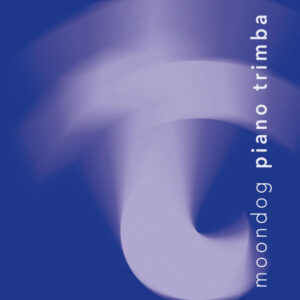
The project "Piano Trimba" by Dominique Ponty (piano) and Stefan Lakatos (trimba), gathering miniatures composed by Moondog during his life, is remarkable for more than one reason. On the one hand, because his performers have known and worked for many years with the composer. On the other hand because this very sensitive recording brings together known pieces and unpublished pieces of Moondog, most of which are dedicated to Dominique. In perfect resonance with the work of Moondog, Dominique and Stefanen are today the most authentic performers. The truly "unheard" character of these works, their faithful interpretation, attentive to every detail, make this record an indispensable testimony to the work of this luminous musician.
18,00€
In stock
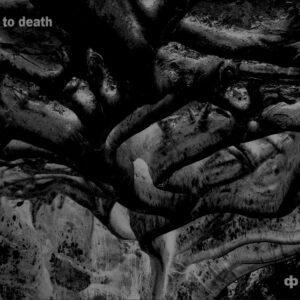
CD
Dave PHILLIPS
“To death”
this album is dedicated to death. not death the spectre that installs horror and fear in many (in the western world), nor death the enemy of the (western) for-profit medical system, but death as part of a cycle, like birth. death the only certainty in life. dying, like living, as something that can be done well - or not. death also something that can be a release, a relief, a liberation, the end of suffering, a freedom.
this album is inspired by my father's illness, deterioration and death, and my being his carer for the 15 last months of his life. recording this album started 6 months into that journey, from october 2020 on.
it was my father's wish to die at home, and my siblings and i granted him that wish. this album was sent off to press early june 2021, when my father found his peace.
13,00€
In stock

LP
Antoine CHESSEX
“Echo/cide / The Experience of Limit”
ECHO/CIDE (2018) - for 4 hammered dulcimers and cimbalum
Composed by Antoine Chessex. Performed by Ekleto ensemble.
Recorded by Thierry Simonot at l’Alhambra, Geneva, October 2018
THE EXPERIENCE OF LIMIT (2019) - for grand piano
Composed by Antoine Chessex. Performed by Tamriko Kordzaia.
Recorded by Nicolas Buzzi at Theater Rigiblick, Zurich, March 2019.
Mastered by Giuseppe Ielasi.
21,00€