
These items are available at distribution / wholesale price. If you are a store or a retailer, ask for the price list.
–
Ces produits sont disponibles à prix de gros. Si vous êtes un magasin ou un revendeur, merci de demander la liste de prix.

2 LP
Pascal COMELADE & Marc HURTADO
“Larme secrète”
2 LPS, gatefold cover, cut at 45rpm. With 3 bonus tracks exclusive for this vinyl edition.
"Larme secrète" is the result of an astonishing encounter between a minimal and discreet musician attracted as much by Erik Satie as he is by various pop classics, and a poet/performer who has worked with Lydia Lunch, Genesis P-Orridge , Michael Gira as well as Alan Vega. Pascal Comelade et Marc Hurtado (Étant Donnés) are two important figures of a french underground and alternative music scene which has always attempted to interfere with other musical genres. They are both also producers, fans and cultured listeners who meld a vast array of elements and references into a dark synthesis, a hypnotic and cosmic electroshock.
This project was born following the collaboration on stage by Pascal Comelade and Marc Hurtado during a tribute to Alan Vega that Marc Hurtado organized in Paris in 2018. Larme Secrète is the sound of an electric shock, the sound of two hearts beating at the same rhythm, united in the thrilling and hypnotic music of Pascal Comelade, melted in the fire of the celestial poems of Marc Hurtado. Synthesizers, guitars, drums, organ, piano, sound loops seem to collide high in the sky with whispered, yelled, possessed voices.
Pascal Comelade was born in Montpellier. After living in Barcelona for several years, he produced his first album, under the name of Fluence, influenced by electronic music and by the group Heldon. Since 1980, Pascal Comelade has released music under his own name. Since then, his music has become more acoustic and is often characterized by the sounds of toy instruments, used as solo instruments or as part of the sound of his group, the Bel Canto Orchestra.
Marc Hurtado is half of the French experimental duo Etant Donnés. Active since the late 1970s, the group has released several albums, also collaborating with people like Alan Vega, Lydia Lunch, Michael Gira or Genesis P-Orridge. Marc Hurtado has directed many films and has also released several solo albums under his own name.
27,00€
Out of stock

LP
Limpe FUCHS
“Via”
Limpe Fuchs' first solo record came about by accident. Initially, Christoph Heemann invited the famous Anima duo to do a studio record in his home-town Aachen, but Paul Fuchs decided not to join in, so Limpe went on her own - and the recording sessions taking place in late 1986 and early 1987 turned out to become "via", Limpe's first solo-record and the (visible) starting point of her ongoing exceptional career as an internationally performing, independent female improviser. Besides a plethora of (partly self-built) acoustic instruments that can also be heard on her legendary Anima (music) records, such as violin, saw blade, chimes, wood block and limpe's unmistakable unique vocals, "via" featured a korg-synthesizer, that drew Limpe's attention in the studio and she decided to give it a try and recorded a lot of electronic music for "via" - and in all the years to follow since then she never got near the instrument again; neither for studio recordings nor live performances . Fast forward to 2015: after not having met Christoph Heemann for many years, they got in contact again and performed selected dates (as Macchia Forest together with Timo van Luijk) when he proposed to Limpe another korg-synthesizer recording. not having touched the instruments in decades Limpe was reluctant at first but warmed up to the idea eventually and improvised a wonderfully meditative and soulful electronic piece of music. She also recorded five of her pendulum strings exclusively for the first time (with a bit of vocals, too) - huge self-built instruments of various size with an amazing sound rich of oscillating overtones. The both side-long recordings - one side korg, one side pendulum strings - featured on "solaia" are a visceral document of Limpe Fuchs' artistic versatility and musical sensibilities. It's fair to say: the spirit of her musical approach is captured perfectly on this new studio-album (mixed and mastered by her son Zoro Babel), which is released in conjunction with a first-time re-release of "via" - both to celebrate her long-standing musical career (and her eightieth birthday). "via" and "solaia" are available now as two separate lp's. Both records are released in an edition of 300 copies and accompanied by a 30-page longform interview with Limpe Fuchs and Christoph Heemann to give an insight in their collaborative history and portray Limpe's outstanding artistry.
19,00€

LP
Steve RODEN
“the radio – airria (hanging garden) – vein stem is calm”
Sonoris is pleased to announce the release both on vinyl and cd, with a new mastering by Giuseppe Ielasi, of some important works from the influential and respected artist Steve Roden. These tracks, which mix conceptual composition and musicality, transcend the ambient or lowercase categories too quickly applied to his music, due to its ghostly beauty.
_
In the tradition of John Cage's Cartridge music amplified objects, Steve Roden extracts a fine and delicate music through his manipulation of specific objects, with an apparent simplicity that hides a captivating magic. Whilst reinventing a form of ambient music which is discreet and atmospheric, Steve Roden delivers sound textures, gives shape to color swatches, traces vibrant frequencies and creates visual art objects.
Roden, both a visual and a sound artist often tagged as minimal for want of a better description, builds the sound design of a life, a new construction for the future which encompasses architecture, visual arts, and painting in a single form.
• The radio (1996): The sound sources are derived from the object itself: the airwaves as well as the internal mechanics (aerial,springs, knobs ...). Originally released as a miniCD by Sonoris, this work centered on Roden's voice and found sound loops is now unexpectedly considered a classic and was seen as "a particularly modest form of genius" in a review by The Wire at the time.
• Airria ( hanging garden ) (2003): Arnold Schönberg's work " The book of hanging gardens " haunts the piece, and is used as a backbone over which a ghostly and exhilarating vocal hovers. Both unsettling and relaxing, this track from the "Speak no more about the leaves" CD has strangely become a mini phenomenon on youtube with its number of views and comments.
• Vein stem is calm (1996): A few seconds taken from a Ralf Wehowsky piece are shaped into a nocturnal raga imbued with substances of an indeterminate nature.
_
Steve Roden is a visual and sound artist from Los Angeles, living in Pasadena. His work includes painting, drawing, sculpture, film/video, sound installation, text and performance. In the sound works, singular source materials such as objects, architectural spaces, and field recordings, are abstracted through humble electronic processes to create new audio spaces, or possible landscapes. The sound works present themselves with an aesthetic Roden has described as lower case – sound concerned with subtlety and the quiet activity of listening.
_
Mastering by Giuseppe Ielasi.
Cut by Fred Alstadt at Studio Angström
18,00€

CD
Steve RODEN
“the radio – airria (hanging garden) – vein stem is calm”
Sonoris is pleased to announce the release both on vinyl and cd, with a new mastering by Giuseppe Ielasi, of some important works from the influential and respected artist Steve Roden. These tracks, which mix conceptual composition and musicality, transcend the ambient or lowercase categories too quickly applied to his music, due to its ghostly beauty.
_
In the tradition of John Cage's Cartridge music amplified objects, Steve Roden extracts a fine and delicate music through his manipulation of specific objects, with an apparent simplicity that hides a captivating magic. Whilst reinventing a form of ambient music which is discreet and atmospheric, Steve Roden delivers sound textures, gives shape to color swatches, traces vibrant frequencies and creates visual art objects.
Roden, both a visual and a sound artist often tagged as minimal for want of a better description, builds the sound design of a life, a new construction for the future which encompasses architecture, visual arts, and painting in a single form.
• The radio (1996): The sound sources are derived from the object itself: the airwaves as well as the internal mechanics (aerial,springs, knobs ...). Originally released as a miniCD by Sonoris, this work centered on Roden's voice and found sound loops is now unexpectedly considered a classic and was seen as "a particularly modest form of genius" in a review by The Wire at the time.
• Airria ( hanging garden ) (2003): Arnold Schönberg's work " The book of hanging gardens " haunts the piece, and is used as a backbone over which a ghostly and exhilarating vocal hovers. Both unsettling and relaxing, this track from the "Speak no more about the leaves" CD has strangely become a mini phenomenon on youtube with its number of views and comments.
• Vein stem is calm (1996): A few seconds taken from a Ralf Wehowsky piece are shaped into a nocturnal raga imbued with substances of an indeterminate nature.
_
Steve Roden is a visual and sound artist from Los Angeles, living in Pasadena. His work includes painting, drawing, sculpture, film/video, sound installation, text and performance. In the sound works, singular source materials such as objects, architectural spaces, and field recordings, are abstracted through humble electronic processes to create new audio spaces, or possible landscapes. The sound works present themselves with an aesthetic Roden has described as lower case – sound concerned with subtlety and the quiet activity of listening.
_
Mastering by Giuseppe Ielasi.
10,00€

LP
Jérôme NOETINGER & Lionel FERNANDEZ
“Outer Blanc”
Highly electrified guitar, anamorphosed, perforated, and tainted by all sorts of effects, implodes its rage and its urgency in the magnetic nets of a tape recorder as cannibal as it is destructive. From various recordings Lionel Fernandez & Jérôme Noetinger have created and produced these ten pieces: big, biting, dangerous and acerbic – like the intoxicated meeting of a chainsaw and a microphone. Real garage music: grease, gutted car bodies and outdated alternators, like a soundtrack ripped from an unreleased Tobe Hooper film.
Lionel Fernandez and Jérôme Noetinger: a musical encounter between two important and uncompromising figures in contemporary experimental music in France. This duo emerged during an evening of the label Premier Sang programmed at Instants Chavirés (Montreuil) in the 2010s… A few years and a few furious concerts later and it is now on the Sonoris label that they are releasing their first record.
Guitarist of the pioneering french free noise/no wave band Sister Iodine, Lionel Fernandez uses an out of norm practice of the electric guitar in a group or as solo playing, “a guitar used as a flame thrower thrashed and fiercely held up as machette totem, he chops through darkness with unsane anti-riffs and carved blocs of dirty sounds, where gargle in slow combustion gangreened micro-textures » (Le Non_Jazz)
He also plays in other deviant combos such as Antilles, Cobra Matal, Ibiza Death, Haine, Porsche, Discom, Minitel, Mauser M etc and has collaborated either live or on records with Masaya Nakahara, Meyna’ch/Mütiilation, Andy Bolus/Evil Moisture, Stephen Bessac/Kickback, Hendrik Hegray, Tujiko Noriko etc..
Jérôme Noetinger is a composer, improviser and sound artist who works with electroacoustic devices such as the Revox B77 reel-to-reel tape recorder and magnetic tape, analogue synthesisers, mixing desks, speakers, microphones, various electronic household/everyday objects and home-made electronica.
From 1987 to 2018, he was the director of Metamkine, a non-profit organisation dedicated to the distribution of improvised and electroacoustic music. Between 1987 and 2014 Jérôme was a member of the editorial committee of the quarterly journal of contemporary sound, poetry and performance, Revue & Corrigée. For ten years from 1989, he was a member and programming co-ordinator of exhibitions, gigs, and experimental cinema at le 102 rue d’Alembert, Grenoble.
_
Lionel Fernandez, guitar, electronics
Jérôme Noetinger, Revox B77, electronics
10 tracks, 42 minutes, master by Fred Alstadt at Studio Angström
18,00€

CD
Jérôme NOETINGER & Lionel FERNANDEZ
“Outer Blanc”
Highly electrified guitar, anamorphosed, perforated, and tainted by all sorts of effects, implodes its rage and its urgency in the magnetic nets of a tape recorder as cannibal as it is destructive. From various recordings Lionel Fernandez & Jérôme Noetinger have created and produced these ten pieces: big, biting, dangerous and acerbic – like the intoxicated meeting of a chainsaw and a microphone. Real garage music: grease, gutted car bodies and outdated alternators, like a soundtrack ripped from an unreleased Tobe Hooper film.
Lionel Fernandez and Jérôme Noetinger: a musical encounter between two important and uncompromising figures in contemporary experimental music in France. This duo emerged during an evening of the label Premier Sang programmed at Instants Chavirés (Montreuil) in the 2010s… A few years and a few furious concerts later and it is now on the Sonoris label that they are releasing their first record.
Guitarist of the pioneering french free noise/no wave band Sister Iodine, Lionel Fernandez uses an out of norm practice of the electric guitar in a group or as solo playing, “a guitar used as a flame thrower thrashed and fiercely held up as machette totem, he chops through darkness with unsane anti-riffs and carved blocs of dirty sounds, where gargle in slow combustion gangreened micro-textures » (Le Non_Jazz)
He also plays in other deviant combos such as Antilles, Cobra Matal, Ibiza Death, Haine, Porsche, Discom, Minitel, Mauser M etc and has collaborated either live or on records with Masaya Nakahara, Meyna’ch/Mütiilation, Andy Bolus/Evil Moisture, Stephen Bessac/Kickback, Hendrik Hegray, Tujiko Noriko etc..
Jérôme Noetinger is a composer, improviser and sound artist who works with electroacoustic devices such as the Revox B77 reel-to-reel tape recorder and magnetic tape, analogue synthesisers, mixing desks, speakers, microphones, various electronic household/everyday objects and home-made electronica.
From 1987 to 2018, he was the director of Metamkine, a non-profit organisation dedicated to the distribution of improvised and electroacoustic music. Between 1987 and 2014 Jérôme was a member of the editorial committee of the quarterly journal of contemporary sound, poetry and performance, Revue & Corrigée. For ten years from 1989, he was a member and programming co-ordinator of exhibitions, gigs, and experimental cinema at le 102 rue d’Alembert, Grenoble.
_
Lionel Fernandez, guitar, electronics
Jérôme Noetinger, Revox B77, electronics
10 tracks, 42 minutes, master by Fred Alstadt at Studio Angström
10,00€
In stock

2 LP
MUNE (J-L GUIONNET & C. BERGERAULT)
“Airs trouvés”
Jean-Luc Guionnet : organ
Claire Bergerault : voice
Cutting : Frédéric Alstadt - Ångström Mastering / Bruxelles january 2021.
28,00€
Out of stock

4 CD
Jean-Claude ELOY
“Gaku-no-Michi (1977-78)”
“Gaku-no-michi”, Tao of music or Ways of music. Film without images for electronic and concrete sounds. Produced at the electronic music studio of NHK Radio, Tokyo 1977-78. Digitalized and revised version from 2006.
“Jean-Claude Eloy is a French composer, born in 1938. He studied at the Paris National Superior Conservatory of Music, where he won First Prizes in Piano, Chamber Music, Counterpoint, Ondes Martenot, and studied composition with Darius Milhaud. He attended summer courses at Darmstadt (Pousseur, Scherchen, Messiaen, Boulez, Stockhausen) and was a student in composition in Pierre Boulez’ master class at the Music Academy in Basel (1961-1963). Works by Jean-Claude Eloy have been performed all over the world. They have been conducted by Pierre Boulez, Ernest Bour, Michael Guilen, Bruno Maderna, Diego Masson, Michel Tabachnik, Arthur Weisberg and others ... He has lived in the United States (professor at the University of California, Berkeley, in the sixties), Germany (invited by the WDR studios in Cologne, the Technische Universität in Berlin, guest artist at the Berliner Künstlerprogramm), Holland, Japan (where he collaborated with NHK and the National Theater of Japan, among other activities). He participates regularly in numerous international festivals, principally in Europe, but also in Asia, the United States, Canada and Latin America as sound-projectionist for his electro-acoustic works and with the soloists closely associated with his compositions : Fatima Miranda (vocalist), Yumi Nara (soprano), Michael Ranta (percussionist), Junko Ueda (Shômyô singer and Satsuma-Biwa player), Kôshin Ebihara and Kôjun Arai (Buddhist monk singers), Mayumi Miyata (Shô player), etc.”
CD 1: “Pachinko” introduces “Tokyo” in a deliberately stiff, regular, almost mechanical and untranscended way while the big spiral of long successive waves, which further develops through Tokyo, becomes more and more varied in its material ending in the surpassing and searched-for transubstantiation taking place throughout the fi nal part.
CD 2: The second disc, “Fushiki-e”, takes us (through varied, complex, contrasted and sometimes violent sound episodes) towards the four “stages of contemplation” including the last one, “Mokuso”, which represents the ultimate stage of the contemplative. It is the longest part of the whole piece, lasting almost 80 minutes.
CD 3: “Banbutsu no Ryûdô” is a boundless continuous “weft” travelling so to say through all sorts of daily or exceptional « sound scenes » continually metamorphosing, going from political speeches to a Shishi Odoshi, transformed for a long time well before its pure, direct appearance.
CD 4: “Kaiso “ is a moment of gravity innervated and built around the annual commemorative ceremony of Hiroshima, which however leads us beyond the evoked drama to a place of surpassing with peace through the « Han » sound, extending the work to infinity…”
26,00€
Out of stock
book + 4 CD
Jean-Claude ELOY
“Gaku-no-Michi (1977-78)”
*** Book and CDs version ***
Book (in english, also available in french): “Between concrete and abstract. Gaku-No-Michi”
This publication is made of a group of varied texts published in different programs of festivals between 1978 and 2001, and a totaly new unpublished text : “Between concrete and abstract” (about “Gaku-no-Michi”) first interview with Avaera text n° 68 (2004). With photographies and reproductions of calligraphies made for “Gaku-no-Michi”.
“Gaku-no-michi”, Tao of music or Ways of music. Film without images for electronic and concrete sounds. Produced at the electronic music studio of NHK Radio, Tokyo 1977-78. Digitalized and revised version from 2006.
“Jean-Claude Eloy is a French composer, born in 1938. He studied at the Paris National Superior Conservatory of Music, where he won First Prizes in Piano, Chamber Music, Counterpoint, Ondes Martenot, and studied composition with Darius Milhaud. He attended summer courses at Darmstadt (Pousseur, Scherchen, Messiaen, Boulez, Stockhausen) and was a student in composition in Pierre Boulez’ master class at the Music Academy in Basel (1961-1963). Works by Jean-Claude Eloy have been performed all over the world. They have been conducted by Pierre Boulez, Ernest Bour, Michael Guilen, Bruno Maderna, Diego Masson, Michel Tabachnik, Arthur Weisberg and others ... He has lived in the United States (professor at the University of California, Berkeley, in the sixties), Germany (invited by the WDR studios in Cologne, the Technische Universität in Berlin, guest artist at the Berliner Künstlerprogramm), Holland, Japan (where he collaborated with NHK and the National Theater of Japan, among other activities). He participates regularly in numerous international festivals, principally in Europe, but also in Asia, the United States, Canada and Latin America as sound-projectionist for his electro-acoustic works and with the soloists closely associated with his compositions : Fatima Miranda (vocalist), Yumi Nara (soprano), Michael Ranta (percussionist), Junko Ueda (Shômyô singer and Satsuma-Biwa player), Kôshin Ebihara and Kôjun Arai (Buddhist monk singers), Mayumi Miyata (Shô player), etc.”
CD 1: “Pachinko” introduces “Tokyo” in a deliberately stiff, regular, almost mechanical and untranscended way while the big spiral of long successive waves, which further develops through Tokyo, becomes more and more varied in its material ending in the surpassing and searched-for transubstantiation taking place throughout the fi nal part.
CD 2: The second disc, “Fushiki-e”, takes us (through varied, complex, contrasted and sometimes violent sound episodes) towards the four “stages of contemplation” including the last one, “Mokuso”, which represents the ultimate stage of the contemplative. It is the longest part of the whole piece, lasting almost 80 minutes.
CD 3: “Banbutsu no Ryûdô” is a boundless continuous “weft” travelling so to say through all sorts of daily or exceptional « sound scenes » continually metamorphosing, going from political speeches to a Shishi Odoshi, transformed for a long time well before its pure, direct appearance.
CD 4: “Kaiso “ is a moment of gravity innervated and built around the annual commemorative ceremony of Hiroshima, which however leads us beyond the evoked drama to a place of surpassing with peace through the « Han » sound, extending the work to infinity…”
35,00€
book + CD
Jean-Claude ELOY
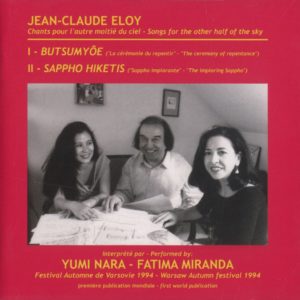
“Butsumyôe” – “Sappho hiketis”
*** Book and CD edition ***
A book (English or french text) around the cycle “Songs for the other half of the sky” with the following pieces “Butsumyoê”, “Sappho hikètis”, “Erkos”, “Galaxies”, “Gaia-songs”. Interview, documents, technicazl specification, photos. A CD with “Butsumyoê” and “Sappho hikètis”.
“Butsumyôe” (1989). For voices, percussions and electroacoustic. With Yumi Nara and Fatima Miranda, voice and percussions. In “Butsumyôe” (”The ceremony of Repentance”) the singer Yumi Nara (soprano) occupies the function of a first solo voice, whereas Fatima Miranda (vocalist) assures the function of the second accompanying voice. In Sappho hiketis, it is the opposite: Fatima Miranda occupies the function of the first solo voice, and Yumi Nara assures the function of the second accompanying voice. But in practice, the vocal activities are mixed, creating an actual creative vocal duet. These two works are freely conceived and of pure imagination, which lean on not any pre-existent "model". Butsumyôe is a long monologue for voice that sings, speaks, shouts, and is modulated with a host of techniques, punctuated by the exclamations of the accompanying voice and by various percussion instruments played by the two female singers. Basing myself on Saïkaku’s beautiful text, I have worked in the original language (ancient Japanese from the area of Osaka), striving to magnify the expressive capacity of each word. The point is to cause Western vocal techniques to expand towards more expressive possibilities, particularly in the very difficult and rich space between “sung” and “spoken” texts. Curiously, the recent practice of electro-acoustic techniques sheds light on these issues, forcing us to rediscover the acoustic, whose perception and conception had been gradually obscured, standardized and diminished by our cultural certainties.
“Sappho hiketis” (1989). For voice, percussions and electroacoustic. With Yumi Nara and Fatima Miranda, voice. A vocal duet articulated from an electro-acoustic piece (realized during the production of Anâhata at the Electronic Studio of the Sweelinck Conservatory in Amsterdam). The basic material is composed of pre-recorded metallic percussion instruments (samplings realized in 1984 by Michael W. Ranta).
Prosody and vocal technique: unlike the previous piece, the text is used in a very broken up mode, with somewhat scattered phonemes, also integrating a listing of the names of Sappho’s most famous female lovers. The adaptation of the text (in modern Greek) is totally free and makes no reference to the metrics or musical modes allegedly used by Sappho.
Prosody and vocal technique: unlike the previous piece, the text is used in a very broken up mode, with somewhat scattered phonemes, also integrating a listing of the names of Sappho’s most famous female lovers. The adaptation of the text (in modern Greek) is totally free and makes no reference to the metrics or musical modes allegedly used by Sappho.
18,00€
CD
Jean-Claude ELOY
“Butsumyôe” – “Sappho hiketis”
*** regular edition without book ***
“Butsumyôe” (1989). For voices, percussions and electroacoustic. With Yumi Nara and Fatima Miranda, voice and percussions. In “Butsumyôe” (”The ceremony of Repentance”) the singer Yumi Nara (soprano) occupies the function of a first solo voice, whereas Fatima Miranda (vocalist) assures the function of the second accompanying voice. In Sappho hiketis, it is the opposite: Fatima Miranda occupies the function of the first solo voice, and Yumi Nara assures the function of the second accompanying voice. But in practice, the vocal activities are mixed, creating an actual creative vocal duet. These two works are freely conceived and of pure imagination, which lean on not any pre-existent “model”.
Butsumyôe is a long monologue for voice that sings, speaks, shouts, and is modulated with a host of techniques, punctuated by the exclamations of the accompanying voice and by various percussion instruments played by the two female singers. Basing myself on Saïkaku’s beautiful text, I have worked in the original language (ancient Japanese from the area of Osaka), striving to magnify the expressive capacity of each word. The point is to cause Western vocal techniques to expand towards more expressive possibilities, particularly in the very difficult and rich space between “sung” and “spoken” texts. Curiously, the recent practice of electro-acoustic techniques sheds light on these issues, forcing us to rediscover the acoustic, whose perception and conception had been gradually obscured, standardized and diminished by our cultural certainties.
“Sappho hiketis” (1989). For voice, percussions and electroacoustic. With Yumi Nara and Fatima Miranda, voice. A vocal duet articulated from an electro-acoustic piece (realized during the production of Anâhata at the Electronic Studio of the Sweelinck Conservatory in Amsterdam). The basic material is composed of pre-recorded metallic percussion instruments (samplings realized in 1984 by Michael W. Ranta). Prosody and vocal technique: unlike the previous piece, the text is used in a very broken up mode, with somewhat scattered phonemes, also integrating a listing of the names of Sappho’s most famous female lovers. The adaptation of the text (in modern Greek) is totally free and makes no reference to the metrics or musical modes allegedly used by Sappho.
13,00€
book + 4 CD
Jean-Claude ELOY
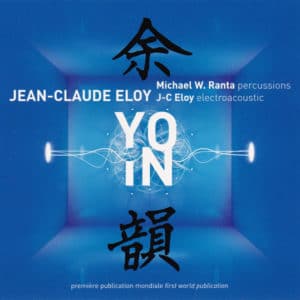
“Yo-In”
*** Book and CDs version ***
This is a book on the piece “Yo-in” + the piece on a digipack 4CDs. “Yo-In” (1980). Sound theater for an imaginary ritual, in four acts. For electronic and concrete sounds, fixed on multi-tracks. For a “percussionist-character” (solo percussionist). With about two hundred varied percussion instruments. Performed by Michael W. Ranta (solo percussionist) and Jean-Claude Eloy (electroacoustic projection, synchronisation, mixings). Recorded during a public concert given at the Warsaw Autumn festival Polish-Radio, Warsaw, September, 1994. Electro-acoustic production : Instituut voor Sonologie, Rijkuniversiteit, Utrecht. Institute of Sonology, State University, Utrecht. With the collaboration of NHK, Denshi Ongagu Studio, Tokyo. First world publication. Digipack 4 x CDs with a booklet of 20 pages.
The book on Yo-In : “Of literal and the oral”, documents (texts, photos, interview) from 1980 to 2010. Bilingual publication English-French, 154 pages, from which 20 pages of photos, format A5.
“Jean-Claude Eloy is a French composer, born in 1938. He studied at the Paris National Superior Conservatory of Music, where he won First Prizes in Piano, Chamber Music, Counterpoint, Ondes Martenot, and studied composition with Darius Milhaud. He attended summer courses at Darmstadt (Pousseur, Scherchen, Messiaen, Boulez, Stockhausen) and was a student in composition in Pierre Boulez’ master class at the Music Academy in Basel (1961-1963). Works by Jean-Claude Eloy have been performed all over the world. They have been conducted by Pierre Boulez, Ernest Bour, Michael Guilen, Bruno Maderna, Diego Masson, Michel Tabachnik, Arthur Weisberg and others ... He has lived in the United States (professor at the University of California, Berkeley, in the sixties), Germany (invited by the WDR studios in Cologne, the Technische Universität in Berlin, guest artist at the Berliner Künstlerprogramm), Holland, Japan (where he collaborated with NHK and the National Theater of Japan, among other activities). He participates regularly in numerous international festivals, principally in Europe, but also in Asia, the United States, Canada and Latin America as sound-projectionist for his electro-acoustic works and with the soloists closely associated with his compositions : Fatima Miranda (vocalist), Yumi Nara (soprano), Michael Ranta (percussionist), Junko Ueda (Shômyô singer and Satsuma-Biwa player), Kôshin Ebihara and Kôjun Arai (Buddhist monk singers), Mayumi Miyata (Shô player), etc.”
35,00€
4 CD
Jean-Claude ELOY
“Yo-In”
*** Regular edition without book ***
“Yo-In” (1980). Sound theater for an imaginary ritual, in four acts. For electronic and concrete sounds, fixed on multi-tracks. For a “percussionist-character” (solo percussionist). With about two hundred varied percussion instruments. Performed by Michael W. Ranta (solo percussionist) and Jean-Claude Eloy (electroacoustic projection, synchronisation, mixings). Recorded during a public concert given at the Warsaw Autumn festival Polish-Radio, Warsaw, September, 1994. Electro-acoustic production : Instituut voor Sonologie, Rijkuniversiteit, Utrecht. Institute of Sonology, State University, Utrecht. With the collaboration of NHK, Denshi Ongagu Studio, Tokyo. First world publication. Digipack 4 x CDs with a booklet of 20 pages.
26,00€

CD
Jean-Claude ELOY
“Etats-Limites ou les cris de Petra”
“Borderlines or Petra’s shouts. Songs for the other half of the sky N°VII” (2013) After some reissue or first edition of old composition, here’s a brand new composition from Jean-Claude Eloy. Made mostly with voice, bells and synthetic sounds this piece works like an electroacoustic lightning. “A kind of salutary madness”.
13,00€
CD
Jean-Claude ELOY
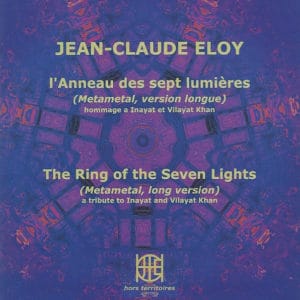
“L’anneau des sept lumières”
The Ring of the Seven Lights (Metametal, long version) (1994-95 / revision and new master: 2013). Seven continuous variations from a single Bonshô sample (Buddhist temple traditional bell from Japan), a tribute to Inayat and Vilayat Khan.
Jean-Claude Eloy: “I created and partially realized it in 1994-95 during this conversion of Anâhata into an electro-acoustic version alone. I first made a short version out of it which integrated into Electro-Anâhata and became the fourth station within the first part (around Âhata-Anâhata). It was an entirely new part that had never been realized during the final mixing of the original Anâhata cycle.”
13,00€

CD
Jean-Claude ELOY
“Galaxies full-electro”
“Galaxies” (Warsaw version), electro-acoustic alone. Fully electro-acoustic version of Anâhata / Galaxies realized on the composer’s personal computer from the original electro-acoustic recordings of this work.
Electronic music studios where the original Anâhata / Galaxies were produced (1984-86): Studio of the Sweelinck Conservatory of Music, Amsterdam (1984 and 1986): the entire production (pre-recorded material processing, new material generation, premixing) and all final mixing processes. Tokyo-Gakuso studio, Tokyo (1983): for the Shô and Ô-Shô (traditional mouth organs from Japan) sampling with Mayumi Miyata. Conny’s Studio, Neuenkirchen, near Cologne (1984) with Asian Sound and Michael W. Ranta: metal percussion instrument sampling, including Bonshôs (Buddhist temple bells from Japan) sampling. INA-GRM, Paris (1985): pre-recorded material processing. Studio ART, Geneva (1985): pre-recorded material processing and pre-mixing. Studio of Technische Universität (TU), Berlin (1985-86): pre-recorded material processing, new material production, pre-mixing. Jean-Claude Eloy: “In 1994 I had (for purely practical reasons) to remove these big electro-acoustic parts making up the two Galaxies works from the piece they were connected with until then: Part III of my Anâhata cycle, entitled Nimîlana-Unmîlana ("that which awakens - that which slumbers"). An electro-acoustic work integrating instrumental acoustic parts that required the performance of a Shô player from Japan.
Those electro-acoustic parts were substantial enough to warrant a new configuration ensuring their stand-alone nature, independent of whether a performer was available or not. Therefore I used (apart from the two Galaxies) a set of particular sounds that I had generated during that production (all of them resulting from Shô sampled sound processing and modulations) entitled sons d’infinitude ("sounds of indefiniteness"). These sustained sounds were very fixed, quite contemplative, almost motionless or maintained through short fluctuations that were more or less regular. They were five of them altogether. Four of them were grouped together into a consistent set and occurred after the first Galaxy, before the Shô solo. I had used them to compose a sequence called Awakening, which formed the first Shô appearance in the version realized for the Donaueschingen Festival in 1990. The fifth one took place at the end of the second Galaxy and was used to support the conclusion played on the Ô-Shô. In this purely electro-acoustic version the first four sons d’infinitude came quite naturally as a "bridge" between both Galaxies. The fifth sound kept its conclusive place, making it bigger and using it as a genuine "extension sound" that could be infinite, with no limit!”
Electronic music studios where the original Anâhata / Galaxies were produced (1984-86): Studio of the Sweelinck Conservatory of Music, Amsterdam (1984 and 1986): the entire production (pre-recorded material processing, new material generation, premixing) and all final mixing processes. Tokyo-Gakuso studio, Tokyo (1983): for the Shô and Ô-Shô (traditional mouth organs from Japan) sampling with Mayumi Miyata. Conny’s Studio, Neuenkirchen, near Cologne (1984) with Asian Sound and Michael W. Ranta: metal percussion instrument sampling, including Bonshôs (Buddhist temple bells from Japan) sampling. INA-GRM, Paris (1985): pre-recorded material processing. Studio ART, Geneva (1985): pre-recorded material processing and pre-mixing. Studio of Technische Universität (TU), Berlin (1985-86): pre-recorded material processing, new material production, pre-mixing. Jean-Claude Eloy: “In 1994 I had (for purely practical reasons) to remove these big electro-acoustic parts making up the two Galaxies works from the piece they were connected with until then: Part III of my Anâhata cycle, entitled Nimîlana-Unmîlana ("that which awakens - that which slumbers"). An electro-acoustic work integrating instrumental acoustic parts that required the performance of a Shô player from Japan.
Those electro-acoustic parts were substantial enough to warrant a new configuration ensuring their stand-alone nature, independent of whether a performer was available or not. Therefore I used (apart from the two Galaxies) a set of particular sounds that I had generated during that production (all of them resulting from Shô sampled sound processing and modulations) entitled sons d’infinitude ("sounds of indefiniteness"). These sustained sounds were very fixed, quite contemplative, almost motionless or maintained through short fluctuations that were more or less regular. They were five of them altogether. Four of them were grouped together into a consistent set and occurred after the first Galaxy, before the Shô solo. I had used them to compose a sequence called Awakening, which formed the first Shô appearance in the version realized for the Donaueschingen Festival in 1990. The fifth one took place at the end of the second Galaxy and was used to support the conclusion played on the Ô-Shô. In this purely electro-acoustic version the first four sons d’infinitude came quite naturally as a "bridge" between both Galaxies. The fifth sound kept its conclusive place, making it bigger and using it as a genuine "extension sound" that could be infinite, with no limit!”
13,00€

CD
Jean-Claude ELOY
“Kâmakalâ – Étude III – Fluctuante immuable”
CD with 60 pages booklet with photos + texts in French and English.
“Kâmakalâ. The Energy Triangle” (1971). For three orchestra ensembles, five chorus ensembles, with three conductors. Orchestra and chorus of the WDR, Schola Cantorum, Stuttgart. Conductors : Michel Tabachnik, Bernhard Kontarsky, Jacques Mercier. Kâmakalâ - a Sankrit term meaning energy triangle - refers to India’s philosophy (Tantric Shivaïsm) and is expresses here as the appearance of energy, which is the erotic and cosmic energy (Kama), that which helps Shiva uniting with his Shakti (feminine energy), create every self-subdivision (Kalâ), hence gradually generating the whole complexity of the universe. It is that idea of a vast and slow crescendo of the various parameters of a musical score, of an infinite division and infinite multiplication of the material contained in it that appealed to Eloy. At the time he would complain about a type of contemporary music aesthetics only focusing on the quick scattering of all kinds of points within short periods of time, sometimes in just a few seconds (pointillism). As a result music pieces were almost inevitably bound to be brief, unable to sustain time as it would distribute the entire sound energy from the very first minutes. On the contrary, Eloy wanted to create music in which the energy was sustained, non distributed and reserved to intense inner blossoming at a later point; music expanding very slowly as in Indian Raga, yet Western music definitely modern, atonal and athematic.
“Étude III” (1962) for orchestra, with piano and five percussionists. Orchestra of the SWF, Baden-Baden. Conductor : Ernest Bour. Etude III, which was composed in May and June of 1962 in Zurich and Paris, uses the configuration of a traditional orchestra (wood and brass instruments by pair) opposite to an ensemble of five percussionists, piano, harp and celesta. A dialectic stands out of this opposition as it is emphasized through the writing and conducting (measured for the orchestral mass, a-measured and cued for the entire ensemble on the foreground).
The instruments, which form cohesive timber families, come in according to an irregular pattern as the piece develops, with the entire configuration not coming into play until the last developments. The frequent use of very long durations, related to the steadiness of the pitch registers, leads to a rising static sound phenomenon reminiscent of oriental music in some regards: the tone and use of Shô in Japanese Gagaku, the slow and steady increase of complexity in Indian Raga. “Fluctuante - Immuable” (1977) for full orchestra. New Philharmonic Orchestra from Radio-France. Conductor : Gilbert Amy. Fluctuante-Immuable, which was composed in 1977 as Gaku-no-Michi was produced in the Nippon Hoso Kyokai (NHK) electronic studio in Tokyo, is the result of a commission by the Secretariat of Cultural Affairs made for the Orchestre de Paris, which premiered it in May 1977. This work clearly shows the influence and the alterations that electro-acoustic practices infer on orchestral writing practices. Besides Eloy’s long electro-acoustic productions, Fluctuante-Immuable suggested a new (theoretical and practical) way of addressing issues related to "composing with notes". The formal issue that the composer faces at the beginning is that of a dialectic between "Order and Disorder" (or between order and organized chaos) topped by an issue about the relation between the conductor and his orchestra (techniques of synchronization or desynchronization with the mass of musicians).
The instruments, which form cohesive timber families, come in according to an irregular pattern as the piece develops, with the entire configuration not coming into play until the last developments. The frequent use of very long durations, related to the steadiness of the pitch registers, leads to a rising static sound phenomenon reminiscent of oriental music in some regards: the tone and use of Shô in Japanese Gagaku, the slow and steady increase of complexity in Indian Raga. “Fluctuante - Immuable” (1977) for full orchestra. New Philharmonic Orchestra from Radio-France. Conductor : Gilbert Amy. Fluctuante-Immuable, which was composed in 1977 as Gaku-no-Michi was produced in the Nippon Hoso Kyokai (NHK) electronic studio in Tokyo, is the result of a commission by the Secretariat of Cultural Affairs made for the Orchestre de Paris, which premiered it in May 1977. This work clearly shows the influence and the alterations that electro-acoustic practices infer on orchestral writing practices. Besides Eloy’s long electro-acoustic productions, Fluctuante-Immuable suggested a new (theoretical and practical) way of addressing issues related to "composing with notes". The formal issue that the composer faces at the beginning is that of a dialectic between "Order and Disorder" (or between order and organized chaos) topped by an issue about the relation between the conductor and his orchestra (techniques of synchronization or desynchronization with the mass of musicians).
18,00€

CD
Jean-Claude ELOY
“Étude IV – … d’une étoile oubliée – La grande vague”
“Etude IV: points-lines-landscapes” (1979). This work is designed as an all-electronic piece without considering any configuration with soloist parts for later use (unlike the two following pieces featured on this CD). It was realized by Jean-Claude Eloy in 1979 on the CEMAMu’s UPIC upon Iannis Xenakis’s invitation to whom this work is dedicated as a friend. The UPIC (Unité Polyagogique Informatique du CEMAMu) is an electronic tool invented by Iannis Xenakis in the 1970s. It is a graphic interface designed to create sound and compose music, whose first version featured a big drawing board (a sort of architect desk) equipped with a ballpoint electromagnetic pencil, surrounded by a computer (mini-computer solar 16/55 ESMS - memory of 32 K) and a monitor. All kinds of forms could thus be drawn with the electronic pencil based on time parameters (moving from left to right) and frequency spaces (from bottom to top, from the lowest to the highest register). Before each drawing (or for every line or "arch" - from an architectural point of view) the appropriate banks would be successively selected with the electromagnetic pencil: a waveform bank, an envelope bank, which could also be drawn and stored in advance. Piling up such arches you could obtained more or less complex drawings filling a "page" that could be calculated by the computer upon completion. Today, such operations are widely used by every computer (including consumer computer) whiz. However, in 1979 (when this work was produced) such opportunities were unique and, as Eloy said "... were like a miracle for the instrumental and orchestral composer that I mostly was".
“…Of a Forgotten Star” (1986), electro-acoustic part alone from Sappho hiketis. Originally, this work was part of Anâhata but did not end up in its final production. It was later used as a supporting structure for the Sappho hiketis piece with the solo vocal parts especially written for Fatima Miranda and Yumi Nara. During the electro-acoustic production of Anâhata this mixing was entitled Indian-Plates. The basic material is exclusively made of prerecorded sounds from metal percussion instruments (sampled in 1984 in the early stage of the production of Anâhata with Michael W. Ranta, Asian Sound, Cologne).
“The Great Wave…” (1991) (a tribute to Hokusai), electro-acoustic part alone from She (from the Gaia-Songs cycle). This work was originally realized to fit into Erkos but was not used in the final production. It was later integrated into the Gaia-Songs cycle for the fourth piece: She ("The consecrating mother") based on Anne Sexton’s poem (integral part of Two American Women) serving as a backbone for a written piece completed in keeping with the sung-spoken voice technique (Sprechgesang). During the production of Erkos this terminal mixing was entitled Biwa-Tutti because of the various Biwa sounds and glissandi that were stacked and sampled at the studio by Junko Ueda, solo performer for Erkos. This work was completed in 1990-91 at the WDR (Westdeutscher Rundfunk) Electronic Studio of Cologne.
13,00€

3 CD box
Jean-Claude ELOY
“Anâhata”
“Anâhata” (1984-86). Primordial vibration. Sound ceremonial with a contemplative character for two voices of Japanese Buddhist monks (traditional Shômyô techniques - traditional temple chanting - in a larger, modern and creative form), three Japanese Gagaku instrumentalists (traditional court music in a modern and creative form), one percussionist (with a percussion instrument orchestra) and electro-acoustic (fixed interactive sounds). Electronic studio of the Sweelinck Conservatorium, Amsterdam (1984-86). With Ebihara Kôshin (Tendai sect): solo voice, Arai Kôjun (Shingon sect): solo voice, Yaotani Satoru: Ô-Hichiriki solo, Shiba Sukeyasu : solo Ryûteki, Miyata Mayumi: Shô solo, Ô-Shô, Alto-Sheng, Michael W. Ranta : solo percussions, Jean-Claude Eloy, electro-acoustic (sound projection, general coordination, mixing). Studio recording made during the Donaueschingen festival 1990 (Donaueschinger Musiktage) by the SWF (Südwestfunk), Baden-Baden. First World publication. Presented in a small box of 3 x CDs with 60 pages booklet.
“Jean-Claude Eloy is a French composer, born in 1938. He studied at the Paris National Superior Conservatory of Music, where he won First Prizes in Piano, Chamber Music, Counterpoint, Ondes Martenot, and studied composition with Darius Milhaud. He attended summer courses at Darmstadt (Pousseur, Scherchen, Messiaen, Boulez, Stockhausen) and was a student in composition in Pierre Boulez’ master class at the Music Academy in Basel (1961-1963). Works by Jean-Claude Eloy have been performed all over the world. They have been conducted by Pierre Boulez, Ernest Bour, Michael Guilen, Bruno Maderna, Diego Masson, Michel Tabachnik, Arthur Weisberg and others ... He has lived in the United States (professor at the University of California, Berkeley, in the sixties), Germany (invited by the WDR studios in Cologne, the Technische Universität in Berlin, guest artist at the Berliner Künstlerprogramm), Holland, Japan (where he collaborated with NHK and the National Theater of Japan, among other activities). He participates regularly in numerous international festivals, principally in Europe, but also in Asia, the United States, Canada and Latin America as sound-projectionist for his electro-acoustic works and with the soloists closely associated with his compositions : Fatima Miranda (vocalist), Yumi Nara (soprano), Michael Ranta (percussionist), Junko Ueda (Shômyô singer and Satsuma-Biwa player), Kôshin Ebihara and Kôjun Arai (Buddhist monk singers), Mayumi Miyata (Shô player), etc.”
35,00€
2 CD
Jean-Claude ELOY
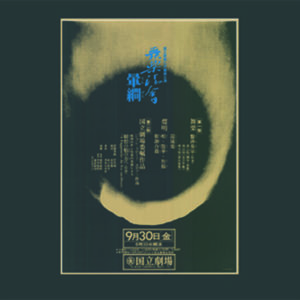
“A l’approche du feu méditant…”
“Approaching the meditative flame…” (1983).
Theater Music for a sound and visual ceremonial. A tribute to the goddess of the light, the sun, and the stars.
For 27 instrumentalists from the Gagaku Orchestra (divided in three separate ensembles), two choruses of Buddhist monk singers (Shômyo singing traditionnal school - Tendai and Shingon sects - divided in four separated ensembles, with four monk singer soloist voices), six percussionists, five Bugaku dancers.
Extracts of this piece were published by Harmonia Mundi on a double vinyl in 1985.
18,00€
2 CD
Jean-Claude ELOY
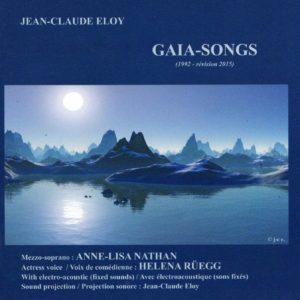
“Gaia-Songs”
“Gaia-Songs” (1992 - revision 2015). Songs for the other half of the sky n° V - VI. For a soprano (or mezzo-soprano) solo and an actress voice (Sprechgesang technique) with electro-acoustic (fixed sounds).
Anne-Lisa Nathan, mezzo-soprano. Helena Rüegg, actress voice.
“First there’s this relation between sung voices and spoken voices with regard to the electro-acoustic parts. The sung voice is quite often separated from the electro-acoustical parts accompanying it. They may sometimes overlap each other but rather briefly. Those parts often highlight octave ratios, fifth ratios, thirdratios, etc. Hence more harmonious and consonant acoustic ratios. By contrast the spoken voice fully covers the electro-acoustic parts dedicated to it and made out of more complex material. Hence more dissonant acoustic ratios turned towards noises spectrums.” JC Eloy from the liner notes
18,00€

2 CD
Jean-Claude ELOY
“Le minuit de la foi”
“Le minuit de la foi” (“The midnight of the faith”) (2014) for electronic and concrete sounds, around selected sentences by Edith Stein recorded by German actress Gisela Claudius. New work from Jean-Claude Eloy, a long piece under the power of expanded sounds and sacred words.
“Le minuit de la foi” is a double album, each CD of which forms a stand-alone entity. Each CD can therefore be listened to separetly. However, you do need to liSten to the full album for it to become meaningful through its complementary balances, and to grasp its very essence.
18,00€

2 CD
Jean-Claude ELOY
“Electro-Anâhata”
“Electro-Anâhata” (1986-1994). Fully electro-acoustic version of Anâhata realized on the composer’s personal computer from the original electro-acoustic recordings of this work.
Electronic music studios where the original Anâhata was produced (1984-86) : Studio of the Sweelinck Conservatory of Music, Amsterdam (1984 and 1986): the entire production (pre-recorded material processing, new material generation, premixing) and all final mixing processes. Tokyo-Gakuso studio, Tokyo (1983): for the Shô and Ô-Shô (traditional mouth organs from Japan) sampling with Mayumi Miyata. Conny’s Studio, Neuenkirchen, near Cologne (1984) with Asian Sound and Michael W. Ranta: metal percussion instrument sampling, including Bonshôs (Buddhist temple bells from Japan) sampling. INA-GRM, Paris (1985): pre-recorded material processing. Studio ART, Geneva (1985): pre-recorded material processing and pre-mixing. Studio of Technische Universität (TU), Berlin (1985-86): pre-recorded material processing, new material production, pre-mixing.
CD 1 Metal metamorphoses. Five electro-acoustic works of a contemplative nature. Electro-acoustic parts alone of Âhata-Anâhata (struck sound - unstruck sound) including a new unreleased part.
CD 2 The Bird-Mirror in the Magic Forest (a tribute to Paul Klee). Electro-acoustic parts alone of Akshara-Kshara (unchanging-changing). “The Reed, the Sea and the Stars” (1986-1994). Electro-acoustic parts alone of Nimîlana-Unmîlana (that which awakens - that which slumbers) among which a new unreleased part.
Jean-Claude Eloy: “In the past composers would often arrange or adapt their works themselves, often for practical or economic reasons. Let us take a look at the most prestigious examples… Take Wagner: Prelude and Love Death (Tristan and Isolde) is played two different ways. Sometimes the orchestral part alone is played as a concert piece. Other times the voice solo part is added as it is in the original opera (which then becomes the magnificent Liebestod). Such examples could be repeated endlessly among the greatest composers.
In the early 1990s I faced a challenging situation: the Japanese Gagaku musicians who had performed my work Anâhata for the first time in 1986 (for the Sigma Festival of Bordeaux and the Autumn Festival in Paris), and had performed it again in 1990 (for the Donaueschingen Festival) were not able to find time in their schedule to accept an important invitation to the Warsaw Autumn Festival. Only the two Buddhist monk singers were able to fit it in.
Before that and to complete the Anâhata project and its electro-acoustic parts I had to travel across part of Europe and spend two whole years commuting between Paris and Amsterdam several times, later between Paris and Berlin, then between Paris and Geneva… even within Paris, thanks to my friends from the GRM who had kindly let me use their studio for several weeks during night hours. Those were very precious nights for me.
During those two years I would always carry boxes of tapes and Betamax or U-Matic cassettes with two PCM Sony and two Betamax cassette decks that I had purchased a little earlier. For the first time I was then able to arrange digital recording sequences and carry out several mixing, recording and reading processes without compromising signal quality. I also had to carry boxes of multitrack bands of all types: the Amsterdam studio was equipped with a two-speed 16-track Studer, the Geneva studio with a three-speed 24- track Otari; the Berlin studio with two 8-track Telefunkens including a variable-speed one.”
During those two years I would always carry boxes of tapes and Betamax or U-Matic cassettes with two PCM Sony and two Betamax cassette decks that I had purchased a little earlier. For the first time I was then able to arrange digital recording sequences and carry out several mixing, recording and reading processes without compromising signal quality. I also had to carry boxes of multitrack bands of all types: the Amsterdam studio was equipped with a two-speed 16-track Studer, the Geneva studio with a three-speed 24- track Otari; the Berlin studio with two 8-track Telefunkens including a variable-speed one.”
18,00€

2 CD
Jean-Claude ELOY
“Chants pour l’autre moitié du ciel : III – Erkos. IV – Galaxies.”
Songs for the other half of the sky. With “Erkos” (1990-91) and “Galaxies” (1986-1996). Performed by Junko Ueda (satsuma biwa and voice) and Jean-Claude Eloy (sound projection).
Erkos is a word from the Indo-European language and means song, praise. It is close to the Sanskrit word Arkas (hymn, chant, radiance) and to the Tokharien term Yarke (reverence, homage). The texts consist of extracts from the Devî-Upanishad and Devî-Mâhâtmya writings, in Sanskrit. In those texts, an homage is paid to the Goddess who, in Indian philosophy, is considered as the mother of all energies. For this work, I have been inspired by Junko Ueda, a particularly gifted young musician whom I met in Japan in 1987, mastering at the same time the traditional technics : those from Japan (Shômyô and Satsuma-Biwa), those of the other countries of Asia (Gamelan), as well as the western technics (piano, composition). It was possible, with a performer of such a vast background, to translate these ancient and original techniques into a free contemporary creation without distorting their original nature. Erkos was commissioned by the Cologne Westdeutscher Rundfunk (WDR), at the invitation of Karlheinz Stockhausen, in collaboration with the Institut Français de Cologne and was produced in its entirety in 1990-91 at the WDR Electronic Studio.
The electroacoustic materials are essentially concrete in nature and have been drawn from three sources Junko Ueda’s voice, Satsuma Biwa (plucked string instrument with plectrum), Unban (metallic plate with complex resonance). Consequently, the recording studio is not used here as a generator but as a “multiplier-transformer” to the soloist, who is the real origin of all sounds. Symbolically, she is the source, the Goddess-mother as written about in the Sanskrit texts I have used here.
“Galaxies” is an electroacoustic work composed of two large groups of elements, contrasting with each other in function, construction, etc. but still unified as they are born from the same sources of timbre and treatment : the Japanese Shô (traditionnal mouth organ) from which all of the work’s sound material is taken, to which are added an ensemble of five Bonshô’s (temple bells from Japan and Korea).
18,00€

2 CD
Jean-Claude ELOY
“Shânti (1972-73)”
“Shânti” (1972-73) for electronic and concrete sounds. Electronic music studio, WDR, Cologne, Germany, 1972-73. Digitalized and revised version from 2001.
“The term “meditation music” triggered many conflicting comments including
positive ones (“... let us say that Shânti belongs to those very rare works that change you after listening to them. You are not exactly the same before and after.” - Gérard Mannoni, Le Quotidien de Paris, 1974). Others, wondering at the strong sound presence of the piece, consider such aspect as hardly helpful to their own meditation... Let us be clear: “what meditates” here (”that” who meditates) is the composer. He is the one who takes you on his journey and guides you through his work like in a classic or romantic symphony. As a listener you are invited to follow “his” meditation... The composition is the meditation.”
positive ones (“... let us say that Shânti belongs to those very rare works that change you after listening to them. You are not exactly the same before and after.” - Gérard Mannoni, Le Quotidien de Paris, 1974). Others, wondering at the strong sound presence of the piece, consider such aspect as hardly helpful to their own meditation... Let us be clear: “what meditates” here (”that” who meditates) is the composer. He is the one who takes you on his journey and guides you through his work like in a classic or romantic symphony. As a listener you are invited to follow “his” meditation... The composition is the meditation.”
18,00€