
Out of stock

CD
Takuma KURAGAKI
“Bottomless / Blank”
Electronic sound artist Takuma Kuragaki was born in 1968. Since he began his musical activity in the 1990s, he has presented his creations not only in live music venues, but also in museums and galleries. In 2009, Kuragaki earned an award for excellence in a contest featured in Sound & Recording Magazine in which entrants produced works incorporating material field-recorded by Ryuichi Sakamoto in the Arctic Circle. In 2017, Kuragaki took part in the 3-CD compilation album Prix Presque Rien Prize, made up of entries in the international contest Prix Presque Rien--a competition of outstanding works making use of French composer Luc Ferrari's sound archives. The newly released CD BOTTOMLESS / BLANK is Kuragaki's first full album.
Drawing inspiration from the activities and creations of Shusaku Arakawa and Madeline Gins, this album--with its key words ''bottomless'' and ''blank''--aims to have listeners become ''users'' who incorporate into their daily lives the experiences gained through the works. In contrast to conventional works of music, which stir up listeners' emotions and provide each individual with their own unique experience, this album--in which radically curtailed minimal sounds are placed sometimes regularly and sometimes at unpredictable intervals--will likely bring listeners the reality of time segmentation. This experience will surely be recalled at unexpected moments in daily life, which is overlaid with a network of various rhythms. How it is applied in these situations is left to each listener.
Original price was: 12,50€.6,00€Current price is: 6,00€.
Out of stock
2 CD
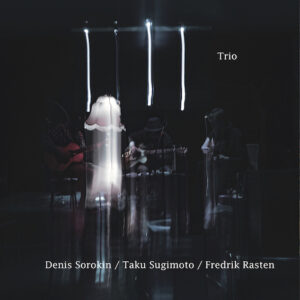
Taku SUGIMOTO – Denis SOROKIN – Fredrik RASTEN
“Trio”
Taku Sugimoto from Tokyo, Denis Sorokin from Saint Petersburg and Fredrik Rasten from Oslo. The three met in Berlin in early March, 2019, and immediately hit it off--not only because they're all guitarists, but also because they have similar musical leanings. Over the three-day period of March 7-9, they met for recording sessions at Petersburg Art Space Berlin. The ten tracks on this 2-CD set are trio performances recorded at that time.
For the recording, Taku Sugimoto provided six compositions and Fredrik Rasten prepared four. Some of Sugimoto's tracks include performances of more than one composition, and performances of six pieces are contained in five tracks. The remaining track is an improvised performance. All three musicians used acoustic guitars in every performance. Denis Sorokin also used pitch pipes and tuning forks on some tracks, and Fredrik Rasten's voice can be heard from time to time in the improvisation. Throughout, the pieces and performances are exquisitely matched and the beauty of the acoustic guitar ensembles is remarkable. The album is sure to give the listener a feeling of serene contentment.
Composer/guitarist Taku Sugimoto has earned critical praise and popularity inside and outside Japan, and has numerous CD releases on the Ftarri and Meenna labels. Guitarist Denis Sorokin, who is especially well known for his performances of Wandelweiser compositions, participated in Sugimoto's CD Guitars, released on Meenna in 2019. Fredrik Rasten is also a guitarist/composer active in the experimental music field. He has releases on labels such as Edition Wandelweiser (Germany) and Sofa (Norway).
21,00€
In stock
CD
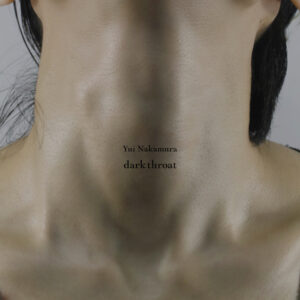
Yui NAKAMURA
“Darkthroat”
Voice performer Yui Nakamura produces delicate, minute vocalization using her mouth and throat. During performances, her voice takes on numerous forms and transformations according to the situation. In each case, it's as if her voice were an extension of the air drifting through the space.
When a live recording at Ftarri becomes a CD, it isn't often the case that the decision to produce a CD is made first and a public concert recording takes place afterwards--but this album is one of those rare occasions. In August 2015, six CD-Rs were produced to mark the third anniversary of the Ftarri store in Suidobashi, Tokyo. Volume 6 of this series includes a quiet, 10-minute-long solo piece recorded, together with neighborhood sounds, by Yui Nakamura at her home. The casual feeling in the combination of everyday sounds and voice performance was exquisite, and thus it was decided that, after the release of the CD-R, a public recording would be held at Ftarri and released as a CD. It took a few years for this to happen, but two concerts were finally performed on January 21 and February 25, 2018, by Nakamura and four invited musicians, each of whom has a superb musical affinity with her voice. In the January concert, Nakamura performed with Masahiko Okura (clarinet); and in February, with Madoka Kouno (tape recorders, mixer, speakers), Yoko Ikeda (viola) and Wakana Ikeda (flute). With the addition of a solo performance by Nakamura recorded at the January concert, the result is an album release made up of three tracks in solo, duo and quartet formats.
In each piece, Nakamura quietly produces a variety of vocalizations. Each of her fellow musicians coordinates with her voice while fully displaying their unique performance styles, making for performances of remarkable density. The result is an outstanding work in which a quiet awesomeness lurks within an atmosphere of nonchalance.
12,50€
In stock
CD
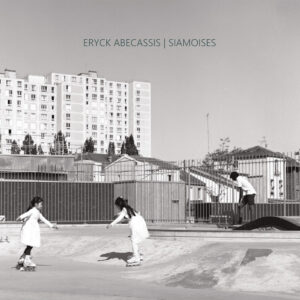
Eryck ABECASSIS
“Siamoises”
Eryck Abecassis (b 1956) is a french-algerian composer, musician and electric guitar player. He went to Paris in 1976 to study film at the CLCF (Conservatoire Libre du Cinéma Français) and worked as a photographer. From 1979 to 1983 he took private lessons in composition and harmony with Julien Falk (1902-1987) and studied Jazz orchestration with Derryl Hall at the Centre d'informations musicales in Paris. In the following years he took various courses at IRCAM, among others in instrumental research and computer music. He took lessons with Jean-Claude Risset and in 1994 with Pascal Dusapin at the Centre Acanthes. In 1997 he took part in the Cursus Annuel de Composition et Informatique Musicale at IRCAM.
From 1986 to 1992 Abecassis was director of the theatre academy L'Entreprise and received several commissions from Radio France, the French and Canadian governments, Gmem, INA GRM, Grame and Césaré. His music has been performed at various international music festivals such as Présences, Les Musiques-Marseille, Musiques en scènes-Lyon, Escales Improbables, SignalX-Cagliari, the Computer Art Festival Padova and others.
"Siamoises" is his 3rd solo album and 2nd contribution to the FF label catalogue (after "La Gueule Du Loup" w/ Francisco Meirino, 2017). Composed and recorded in Paris 2018, "Siamoises" is the pairing of Eryck's instrument of choice, an Ibanez 2404 double neck e-bass/guitar, with a modular synthesizer.
12,00€
In stock

CD, book
Phill NIBLOCK
“G2,44+/x2”
Liner Notes From Bill Meyer
In 2001, Phill Niblock wrote, "You should play the music very loud. If the neighbors don't complain, it's probably not loud enough."
In 2019, Niblock can no longer host his annual 6 hour-long solstice concert at the Experimental lntermedia loft; not only did the neighbors complain, the landlord sued. But the validity of his prescription is undiminished, for it takes sonic volume and spatial confinement to unlock his music's true nature. Give the sound waves a boost and something hard to smack against, and they begin to shiver and multiply so that tones transform tones and every turn of the head (or every new room) yields a new listening experience. But Guitar too, for four is notable in Niblock's oeuvre for its independence from loudness. While it sounds great turned up, the additive process that yielded the CD's two versions has resulted in music that changes most rewardingly, even when heard at modest volume.
Victor Frankl opined that in the hierarchy of essential human motivations, meaning eclipses pleasure. In some ways, this music hews closer to the pleasure principle. Once you let go of the yearning for tunes and grooves, it's a sensuous delight to dunk yourself in the warm sound-bath of his music. And Niblock would be the first person to scotch any efforts to assign the sort of cosmic significance fhaf certain other drone-oriented minimalists did to their art. But consider this notion; Niblock's music is fundamentally social. It only truly happens in spaces where people gather.
While he does much of the composing and assembling of this music alone, Niblock didn't treat Guitar too, for four as finished until he got some more people in on the act. He asked Rafael ToraI and Jim O'Rourke to contribute to a CD edition. And when O'Rourke declined to play on his own production, but instead invited Kevin Drumm, Alan Licht, Thurston Moore, and Lee Renaldo to do the honors, Niblock's reaction was the more, the merrier.
To the extent that connecting people is an essentially meaningful activity, this music is the connective tissue of meaning.
Matte laminate embossed sleeve, insert card, 24 page book with linear notes from Bill Meyer, interview and photos.
18,00€
In stock

CD, book
Philip SAMARTZIS
“Boleskine”
Boleskine comprises an unfolding set of sound recordings made over a three-mile stretch of General Wade’s Military Road set on the south-east shore of Loch Ness. Scattered throughout the luminous countryside are memorial stones, burial ground, and various ruins indicating a long and troubled history. Boleskine situates the metaphysical alongside the prosaic to offer an encounter with a place of curiosity, imbued with atmosphere and shrouded by intrigue.
Philip Samartzis is a sound artist, scholar and curator with a specific interest in the social and environmental conditions informing remote wilderness regions and their communities. His art practice is based on deep fieldwork where he deploys complex sound recording technology to capture natural, anthropogenic and geophysical forces. The recordings are used within various exhibition, performance and publication outcomes to demonstrate the transformative effects of sound within a fine art context. He is particularly interested in concepts of perception, immersion and embodiment in order to provide audiences with sophisticated encounters of space and place. Philip is an Associate Professor within RMIT School of Art, and the artistic director of the Bogong Centre for Sound Culture.
Comes with A4 Booklet Silver Printed on Black Stock.
15,00€
In stock

Book, 2 CD
Philip SAMARTZIS
“Antartica, an absent presence”
Antarctica is a paradox of the sublime and prosaic: with its vast expanses of ice, snow and mountains—and traces of human habitation, from weathered huts to abandoned machinery. It is a blank space bordered by nothingness concealing a confounding set of encounters for those fortunate enough to breach its frozen perimeter. This book is an invitation to share in a remarkable journey to a place that is for all intents and purposes simply incomprehensible. The book is accompanied by two CDs of soundscape compositions documenting natural and anthropogenic characteristics of the frozen continent and its surrounding ocean.
Philip Samartzis is a sound artist, scholar and curator with a specific interest in the social and environmental conditions informing remote wilderness regions and their communities. His art practice is based on deep fieldwork where he deploys complex sound recording technology to capture natural, anthropogenic and geophysical forces. The recordings are used within various exhibition, performance and publication outcomes to demonstrate the transformative effects of sound within a fine art context. He is particularly interested in concepts of perception, immersion and embodiment in order to provide audiences with sophisticated encounters of space and place. Philip is an Associate Professor within RMIT School of Art, and the artistic director of the Bogong Centre for Sound Culture.
Hardcover, 208 pages (24.8 x 2.5 x 18.8 cm)
30,00€
In stock

CD
CINEMA PERDU
“Vlakverdeling”
During my regular trips to the Dutch province of Friesland I became more and more aware of the strict demarcations in the Dutch landscape. Each time I travelled up and down the polder, the atmosphere of the landscape changed. These changes of atmosphere where not only influenced by natural phenomena like the weather and light but even much so through human presence reflected in the clear lines which define the landscape. While listening to the field recordings I made on various occasions and at various locations, the sounds started to translate into their own abstract form of the landscape. While transforming these abstract forms and colours into new sounds, a new imaginary landscape appeared in my mind, translated into a new composition: Vlakverdeling - Martijn Pieck /Cinema Perdu, June 2020.
10,50€
In stock

CD
Frans de WAARD & Martijn COMES
“Various Weights”
Various Weights is the first time the duo of Frans de Waard and Martijn Comes come together to present work.
On this album, their uniques styles are combined, where they work with each others sound materials to create truly unique compositions.
In sound art, concepts often take precedence over the actual music. Here, there were none. For their first collaboration, Frans de Waard and Martijn Comes decided on a strikingly simple approach: Each artist compiled a pool of sounds for the other to use as a point of departure. Comes worked with various analog synth- and field recordings by de Waard (including, among others, a Korg MS20 and Koma Field FX). The latter was sent a processed stylophone recording, a sample loop as well as recordings of the Web’s first Software-Defined Radio by the University of Twente.
The results, now released as Various Weights, are two epic and immersive pieces. On “Boundary of Intersections”, Comes focuses on deep sonorities and harmonics, developing his materials into a mind-expanding drone zone. De Waard’s “There are no two pianos” is more subdued, hovering mysteriously at the cusp of acousmatic research and sonic minimalism. Both pieces share a slightly uneasy, surreal feeling – perfectly captured by Bas Mantel’s artwork, which was a direct response to the sounds contained on the disc.
10,50€
Out of stock

CD
Asmus TIETCHENS
“Raum 318”
Asmus Tietchens is a sound artist and composer from Hamburg, Germany. He got interested in Musique Concrete by listening to a German radio programme when he was 10 years old. In 1965, at the age of 18, Asmus started experimenting with tape loops and turned them into musical collages. Soon, the use of synthesizers was added. In 1980 his debut album Nachtstücke was released, produced by Peter Baumann of Tangerine Dream. This was soon followed by a series of albums of electronic pop music for the Sky label, home of many Krautrock bands. Tietchens often uses special source materials for his compositions such as water (Seuchengebiete), human voices (Von Mund zu Mund), paper (Papier ist geduldig). He is associated with the Industrial music scene through his collaborations and releases on labels such as United Dairies, Esplendor Geometrico or Dom Records. Tietchens never studied composition, he has no academic background, everything he does is self taught or learnign by doing. Nevertheless, he was professor for sound design in Hamburg in recent years. Raum 318 was originally released on cassette only in 1991 on the E'ostrate label in France, in an edition of only 138 hand-numbered copies. It is a part of Tietchens' more Industrial sounding body of work and was remastered for this edition. In addition, a long previously unreelased bonus track has been added.
12,00€
Out of stock

CD
Phil MINTON & DIEB13
“With, Without”
Phil Minton is a jazz/free-improvising vocalist and trumpeter. He is a highly dramatic baritone who tends to specialize in literary texts: he has sung lyrics by William Blake with Mike Westbrook's group, Daniil Kharms and Joseph Brodsky with Simon Nabatov, and extracts from James Joyce's Finnegans Wake with his own ensemble. Minton is perhaps best known, however, for his completely free-form work, which involves "extended techniques" that can be as unsettling as they can be mesmerising. His vocals often include the sounds of retching, burping, screaming, and gasping, as well as childlike muttering, whining, crying and humming; he also has an ability to distort his vocal cords to produce two notes at once. Dieter Kovačič aka Dieb13 is an Austrian improvisational musician who mostly works with turntables. Since the late 1980s he has been experimenting with cassette players, vinyl records, CDs and harddiscs. He has a duo with Billy Roisz which combines electronic music with experimental filmmaking. Their first collaborative album has been recorded live at various festivals, including Wels Unlimited, Disobedience Ljubljana or Instants Chavires, Montreuil.
Original price was: 12,00€.7,00€Current price is: 7,00€.
In stock
CD
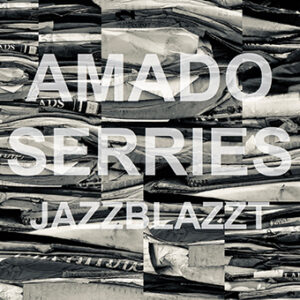
Rodrigo AMADO & Dirk SERRIES
“Jazzblazzt”
Rodrigo Amado was born in Lisbon, Portugal, in 1964 and took up the saxophone at the age of 17 while convalescing from an accident. Later he studied at the Hot Club Music School and was soon playing with numerous rock, pop and experimental projects. At the shifting boundary between free jazz and improvised music, Amado's position is clear: he plays jazz. He is so clearly a jazz musician that he doesn't require any pre-determined elements of rhythm, harmony, chorus lengths or melody to play jazz. There's a rhythmic impetus, a bite in his sound, and it drives his lines forward, a fundamental impress on the world that tenor saxophonists like Archie Shepp, Coleman Hawkins or Sonny Rollins have been making for generations.Dirk Serries is a Belgian musician who started as an ambient composer and musician under the name of Vidna Obmana (releases also on Klanggalerie). In 2007 he gave up thsi pseudonym to concentrate on work under his own name and under the name Fear Falls Burning. The collaboration "Jazzblazzt" was recorded live in in concert on August 28th, 2018 at the venue "Jazzblazzt" in The Netherlands. Amado plays tenor saxophone, Serries electric and acoustic guitars. It was mixed and mastered by Dirk Serries. Originally released as a very limited cassette only, we are happy to now offer you a CD of this fantastic duo collaboration.
12,00€
In stock
CD
Sainkho NAMTCHYLAK – Ned ROTHENBERG – DIEB13
“Antiphonen”
Sainkho Namtchylak is a singer originally from Tuva, an autonomous republic in the Russian Federation just north of Mongolia. She is known for her Tuvan throat singing or Khöömei. Her music encompasses avant-jazz, electronica, modern composition and Tuvan influences. Once the Soviet Union had collapsed, she moved to Vienna, making it her base, although she traveled widely, working in any number of shifting groups and recording a number of discs that revolved around free improvisation. Amongst them are collaborations with Evan Parker, Ned Rothenberg, The Moscow Composers Orchestra and Wolfgang Puschnig.
Ned Rothenberg is an American multi-instrumentalist who was born in 1956 in Massachusetts. He has been internationally acclaimed for both his solo and ensemble music, presented for the past 33 years on 5 continents. He performs primarily on alto saxophone, clarinet, bass clarinet, and the shakuhachi - an endblown Japanese bamboo flute. His solo work utilizes an expanded palette of sonic language, creating a kind of personal idiom all its own.
die13 was born as Dieter Kovačič in 1973. He is a turntablist, hacker, filmmaker, autodidact, composer, collageur and conscientious copyright objector. Since the late 1980s he has explored the possibilities of vinyls, cassettes, harddisks, ip-protocols etc. as material for collages and compositions. Using various playing techniques and his own lathe cutter, he has pushed the development of turntables as instruments aside "classical dj techniques" and developed his very unique style.
Antiphonen was the first time this trio played together. Kazuhisha Uchihashi from Japanese group Altered States co-curated the festival and 2019 and invited the musicians to perform together.
12,00€
Out of stock

3 CD
Kali MALONE
“The Sacrificial Code”
*** Repress ***
Kali Malone presents a quietly subversive new album featuring almost two hours of concentrated, creeping organ pieces governed by a strict acoustic and compositional code. It’s a major new work with ultimately profound emotional resonance.
‘The Sacrificial Code’ takes a more detailed approach to ideas first sketched out on last year’s ‘Organ Dirges’, which featured canon exercises spontaneously captured without much prior technical planning. By contrast, the recording of ‘The Sacrificial Code’ involved the more careful micing up of several organs in such a way as to eliminate acoustic impurities as far as possible - essentially removing the large hall reverb so inextricably linked to the instrument. The pieces were then performed free of gestural adornments and without expressive impulse - an approach that flows against the grain of the prevailing musical hegemony, where sound is so often manipulated, and composition often steeped in self indulgence. The question posed; can this strict methodology still speak to the listener in meaningful terms?
The answer is both obvious and entirely surprising; with its slow, purified and seemingly austere qualities ‘The Sacrificial Code’ guides us through an almost trance-inducing process where we become vulnerable receptors for every slight movement, where every miniature shift in sound becomes magnified through stillness.
As such, it’s a uniquely satisfying exercise in transcendence through self restraint - a stunning realisation of ideas borne out of academic and conceptual rigour which gradually reveals startling personal dimensions. It has a perception-altering quality that encourages self exploration free of signposts and without a preordained endpoint - the antithesis to the language of colourless musical platitudes weíve become so accustomed to.
25,00€
Out of stock

2 CD
Alvin LUCIER
“Works for the Ever Present Orchestra”
Black Truffle's documentation of the prolific recent work of legendary American composer Alvin Lucier continues with Works for the Ever Present Orchestra. This is a very special release for the composer, as it presents pieces written for the thirteen-member Ever Present Orchestra, formed in 2016 exclusively to perform Lucier's works. At the heart of the ensemble are four electric guitars, an instrument Lucier began composing for in 2013 with Criss-Cross (recorded by two core members of the Ever Present Orchestra, Oren Ambarchi and Stephen O'Malley, for whom it was composed, on Black Truffle 033). Through the use of e-bows, the guitars take on a role akin to the slow sweep pure wave oscillators heard in many of Lucier's works since the early 1980s, but with added harmonic richness. Like much of Lucier's instrumental music, the pieces recorded here focus on acoustic phenomena, especially beating patterns, produced by the interference between closely tuned pitches. The work presented here is some of the richest and most inviting that Lucier has composed. Though all of the pieces clearly belong to the same continuing exploration of the behaviour of sound in physical space and make use of related compositional devices, each takes on a strikingly different character. Titled Arc, for the full ensemble of four guitars, four saxophones, four violins, piano and bowed glockenspiel inhabits a world of sliding, uneasy tones, punctuated by a single piano note. Where Double Helix, for four guitars, rests on a pillow of warm, low hum, EPO-5, for two guitars, saxophone, violin, and glockenspiel possess a limpid, crystalline quality. Accompanying the four new compositions are two adaptations of existing pieces for radically different instrumentation, demonstrating Lucier's excitement about the new possibilities suggested by this dedicated ensemble. Works for the Ever Present Orchestra is an essential document of the current state of Lucier's continuing exploration, as well as offering a seductive entry-point for anyone who might yet be unacquainted with his singular body of work.
Presented in a deluxe gatefold sleeve with cover artwork and liner notes from Alvin Lucier. Includes a download code featuring hi-res versions of the LP material. The download code also includes the bonus Adaptions for the Ever Present Orchestra featuring two pieces ("Two Circles" and "Braid") that are not included on the LP version. Mastered by Rashad Becker. Design by Lasse Marhaug.
16,00€
Out of stock

CD
The TRANSCENDENCE ORCHESTRA
“Feeling The Spirit”
“Like La Monte Young and The Incredible String Band stuck in an elevator."
In the process of relocating to Den Bosch's Willem Twee Studios, The Transcendence Orchestra let love slip deftly out of its gate and reverberate around the walls of the studio's main hall, a high ceilinged former synagogue in the city's old town. Working intensively to capture its echoes, they coaxed it to appear in pipes and strings, directed it through resonant circuits and shepherded it round the room with beaters, horns and rattles.
Having returned home with the recordings, a purpose began to emerge. Through a process of extensive reconfiguration and testing it became clear that the love contained within could transform perception. Under the right circumstances, and accompanied by appropriate technology, it could serve as a map for navigating beginnings and endings. Like some distant mesmerising chant or a psychedelic folk song, it could connect us and reassure us that we can pass through the boundaries and survive. Perhaps not intact but at least whole.
Here is that map, love soaked diligently into its lines, ready to guide those at a loss or reassure those willing to explore.
Written and produced by Anthony Child and Daniel Bean
Mastered by Stephan Mathieu at Schwebung Mastering, January 2020
Cut by Andreas Kauffelt at Schnitstelle, Berlin, February 2020
15,00€
In stock
CD
Mark TEMPLETON
“Ocean Front Property”
Ocean Front Property represents a desired experience juxtaposed with a banal reality. The work investigates the idea of longing to be somewhere else, a mirage of aspired imagery and sound, made within the landlocked province of Alberta, where the nearest ocean is over 1000 kilometres away. The objects, spaces and sounds act as metaphors, part of a concrete existence they reside in, but contrasted with the imagined existence they represent.
Ocean Front Property is a photobook and soundtrack. The photobook will be released in the fall of 2020.
Mark Templeton is a Canadian sound artist and photographer. Since 2007 his sound recordings have been released by Anticipate Recordings, Staalplaat, Sweat Lodge Guru, Under the Spire Recordings, Silentes and his own audiovisual label, Graphical Recordings, which he established in 2015. In the spring of 2018, he released his first photobook, Distorted Tourist, which included a series of five one-sided flexi records.
12,00€
In stock
CD
REIZEN
“Works, 2020”
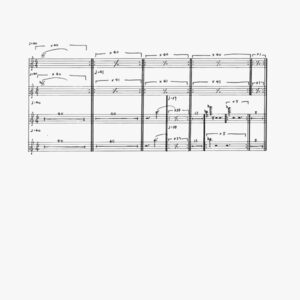
Two new works, "Different Speeds for Decay Instruments" (for electric piano; the score of this piece adorns the front cover) and "Music for Glass, Plastic and Rubber".
Japanese musician, based in Tokyo, who composes and performs using mainly drone and minimalist techniques. Plays electric guitar, the inside of pianos, and creates works of phonography. Formed the drone quartet NERAE in 2007. In 2011 he shifted to solo performance.
His work has been released on P.S.F. Records, Fylkingen Records and Edition Omega Point, etc.
Performs frequently around Tokyo. Notable performances outside Japan include TUSK Festival (UK, 2015),
UK tour with Elodie (2016), Empty Gallery (Hong Kong, 2017).
In June 2019 with some friends he founded edition zeroso, a small imprint and series of live performances based in Tokyo.
12,00€
Out of stock

CD
Christina KUBISCH
“Italienische Stücke”
Release of conceptual and perfomative pieces by Christina Kubisch composed & realised between 1974 and 1984, during Kubisch's years in Italy.
Christina Kubisch (born 1948 in Bremen, lives and works in Hoppegarten, Germany) studied painting, music and electronics in Hamburg, Graz, Zürich and Milano, where she graduated. Performances, concerts and works with video in the seventies, subsequently sound installations, sound sculptures and work with ultraviolet light. Her compositions are mostly electroacoustic, but she has written for ensembles as well. Since 2003 she works again as a perfomer and collaborates with various musicians and dancers.
Christina Kubisch has been a visiting professor in Maastricht, Paris and Berlin. She has been a professor for sound art at the Academy of Fine Arts, Saarbrücken, Germany, from 1994 to 2013. She is a member of the Akademie der Künste Berlin since 1997.
Six panel DVD-sized digipak, illustrated with archival photos of CK and extensive programme, notes in English. Edition of 300 copies.
14,50€
Out of stock

CD
Hermann NITSCH
“Akustisches Abreaktionsspiel”
Reissue of Nitsch's very first release, originally published 48 years ago by Edition Galerie Klewan in a limited edition of 100 copies.
Produced and recorded at the WDR Radio in Cologne, Germany, the Akustisches Abreaktionsspiel (Aktion 38b) is "neither a radioplay nor a work of music. it merely portrays the acoustic part of an "abreaktionsspiel" (a play of abreaction). the special and specific usage of the acoustic possibilities are in the foreground, while the visual part of the play is communicated by a narrator." A prime example of the intense & noisy wildness of Nitsch's early actions employing scream-choirs, beating, whistles, chaotic austrian folklore juxtapositions, rough brass sections and dissonant strings. Edition of 400 copies on vinyl and 200 copies on CD.
12,00€
Out of stock

2 CD
Marcus SCHMICKLER
“Richters Patterns”
Double-CD collecting five of Schmicklers key-works composed & recorded between 2006 and 2016.
Edition of 400 copies in fullcolour digipak with 8-page booklet.Edition of 400 copies in fullcolour digipak with 8-page booklet.
"Richters Patterns (2016) is a collaboration among Marcus Schmickler, artist Gerhard Richter, director Corinna Belz and the Ensemble Musikfabrik. In 2011, Richter took an image of his work Abstract Painting (CR: 7244) and divided it vertically into strips and gave them to Belz who utilized specially developed software operations involving cuts, mirroring and reproduction to create a movie from these images. Schmickler and Belz worked in parallel, with the film and composition following their own independent logic. Schmickler’s idea was to extend Richter’s method to divide, mirror, repeat into sound and time. Richters Patterns was commissioned by Koeln Musik and had its premiere on September 9, 2016 at Cologne Philharmonic Hall. Marco Blaauw (Trumpet), Helen Bledsoe (Flute), Christine Chapman (Horn), Bruce Collings (Trombone), Diamanda Dramm (Violin), Florentin Ginot (Double Bass), Benjamin Kobler (Piano, Synthesizer), Ulrich Löffler (Piano), Heidi Mockert (Bassoon), Melvyn Poore (Tuba), Axel Porath (Viola), Carl Rosman (Clarinet), Dirk Rothbrust (Percussion), Marieke Schoenmakers (Harp), Peter Veale (Oboe), Hannah Weirich (Violin), Dirk Wietheger (Violoncello), Marcus Schmickler (Computer), Paul Jeukendrupp (Soundprojection).
"Kemp Echoes" (2013) refers to a physical phenomenon in the ear discovered by physicist David Kemp in 1978. Otoacoustic Emissions (OAE) are signals in the ear (that can be detected with high quality small microphones) that are emitted by the cochlea, either spontaneously or in response to stimuli (frequently clicks). I have strived to create a piece that can seem ‘electronic’ to the ear without actually utilizing electronics. With Helen Bledsoe (Flute), Peter Veale (Oboe), Carl Rosman (Clarinet), Heidi Mockert (Bassoon), Christine Chapman (Horn), Ales Klancar (Trumpet), Bruce Collings (Trombone), Melvyn Poore (Tuba), Ulrich Löffler (Synthesizer), Benjamin Kobler (Piano/Sampler), Dirk Rothbrust (Percussion), Thomas Meixner (Percussion), Juditha Haeberlin (Violin), Hannah Weirich (Violin), Axel Porath (Viola), Dirk Wietheger (Violoncello), Benedict Ziervogel (Bass), Marcus Schmickler (Computer), Paul Jeukendrup (Soundprojection). Conducted by Enno Poppe.
"Fokker Bifurcations" (2014) marks a departure into microtonal works for keyboards and mallets and maintains the composer’s penchant for juxtaposed fixed pitches with pitch continua. Recorded live at ISSUE Project Room, Brooklyn on Nov 7 2014. The recording has been edited for this publication. With Laura Barger (piano), Ning Yu (piano), Ian Antonio (percussion), Russell Greenberg (percussion).
"E-UROPAS / Plurality of Centers" (2006). Shall we say goodbye to modernism? I dare to confront the myths of new music in this music theater creation. Layers containing the manifestos of Cornelius Cardew, Guy Debord and sound materials from six decades of the avant-garde create a collage that utilizes some of the formal principles guiding John Cage’s Europera V. With Hayden Chisholm (Voice), Juditha Haeberlin (Violin), Axel Porath (Viola), Dirk Wietheger (Violoncello), Ulrich Löffler (Piano), Dirk Rothbrust (Percussion), Marcus Schmickler (Voice, Computer, Radios), Carsten Goertz (scenography).
"ATA OTO" (2017) for Robot instruments TEMBLO, TINTI, TROMS, XY by Logos Foundation & computer.
Original price was: 19,00€.10,00€Current price is: 10,00€.
In stock
2 CD
The DORF / Phil NIBLOCK
“Baobad”
Co-released with Umland Records, Germany. On one night in 2019, The Dorf (German for "village") took a heavy dose of the music of Phill Niblock. The impact on the musicians, gathering to play a double-length version of Niblock's "Baobab" and (in a second set) three "Dorf" tunes, was deep. It felt a bit like going to church -- a truly spiritual experience. At first, the audience did not believe the announcement that the "drone" piece would last for 46 minutes. Afterwards, their reactions showed the impression Phill's music had made on them. After a 20-minute break, three pieces followed -- a different game altogether, but connected to "Baobab" in the way that the energy and the feel for the evening had been thoroughly set by Mr. Niblock. Already his physical presence changed the reception for both musicians and listeners and the taste for this "wall of sound" was palpable. The Dorf (in itself already an orchestra of something like 25 people) had been augmented by friends to a total of 35 musicians -- almost too big to be true. In the second part of the evening, Katherine Liberovskaya projected along to the music some of her outstanding video work, which is obviously not documented on this album. Play the record at a not-too-soft volume and stick with it. One way or another, the music will get to you. Recorded live on September 19, 2019, domicil Dortmund Germany. Personnel: Moritz Anthes - trombone; Marvin Blamberg - drums, sampler; Julia Brüssel - violin; Simon Camatta - drums, sampler; Denis Cosmar - sound; Marie Daniels - vocals; Felix Fritsche - saxophone; Sebastian Gerhartz - saxophone; Christian Hammer - guitar; Florian Hartlieb - computer; Stefanie Heine - saxophone; David Heiss - trumpet; Volker Kamp - bass; Oona Kastner - synth, vocals; Jan Klare - saxophone, directing; Anja Kreysing - accordeon; Maika Küster - vocals; Katherine Liberovskaya - visuals; Raissa Mehner - guitar; Alexander Morsey - sousaphone; Johannes Nebel - bass; Fabian Neubauer - keyboards; Phill Niblock - composition; Kai Niggemann - Buchla; Adrian Prost - trombone; Gilda Razani - Theremin; Guido Schlösser - synth; Ludger Schmidt - cello; Hanna Schörken - vocals; Oliver Siegel - synth; Maria Trautmann - trombone; Luise Volkmann - saxophone; Martin Verborg - violin; Andreas Wahl - guitar; Florian Walter - saxophone; Max Wehner - trombone; Emily Wittbrodt - cello; Achim Zepezauer - electronics.
16,00€
Out of stock
CD
Taku SUGIMOTO
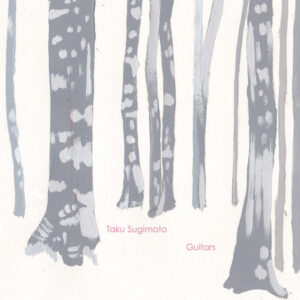
“Guitars”
Performed by Andrey Popovsky: electric guitar (1), semi-acoustic guitar (2), Denis Sorokin: classical guitar (2), electric guitar (3), Alexander Markvart: acoustic guitar (2).
Taku Sugimoto is a Tokyo-based guitarist and composer. Improvisation is one aspect of his work, but currently his main activities are composing and performing composed pieces (including those of other composers). He continues his global and concentrated interaction with composers from around the world, particularly those closely connected with Wandelweiser. Ftarri had previously released two albums under Sugimoto's name alone—Septet (2015) and Quintets: Berlin, San Diego (2017). On both CDs, his compositions are performed by other musicians (on Septet, Sugimoto also participates in the performance).
The CD Guitars, also released under Sugimoto's name, is comprised of three pieces that he wrote for that instrument. The first and third are guitar solos around 20 minutes long; the second is a guitar trio of about 10 minutes. The performers are three guitarists from Russia, and the pieces were recorded in St. Petersburg in 2017 and 2018. The solo compositions were performed by Andrey Popovsky (track 1) and Denis Sorokin (track 3); and the trio was performed by these two plus Alexander Markvart. All the performances are extremely simple and concise, but convey a feeling of complexity and richness. Abounding in an incomparable feeling of depth within their simplicity and candor, these are truly Sugimoto-like works.
13,00€
Out of stock

CD
Cristián ALVEAR – Klaus FILIP
“6 Chords”
Cristián Alvear: acoustic guitar. Klaus Filip: sine waves.
Guitarist Cristián Alvear was born in 1979 and lives in Santiago, Chile. Active on the international contemporary/experimental music scene, he has since 2010 released numerous recordings on labels in various countries. Musician and programmer Klaus Filip was born in 1963 and resides in Vienna, Austria. ppooll, the software he developed, is used regularly by many improvisers, including Filip himself.
This album is comprised of a single track of 40 min., 58 sec., divided into six parts. Klaus Filip continuously plays gentle-sounding sine tones, over which Cristián Alvear simply and steadily repeats the same chords and short phrases on acoustic guitar. While each of the six parts is different in form, the work as a whole is simple, clean-lined, and delicately refined, radiating an indefinably mysterious mood throughout. A masterpiece.
13,00€
Out of stock
CD
Makoto OSHIRO – Yan JUN
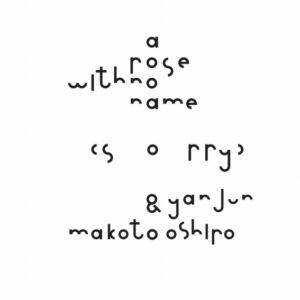
“A Rose with No Name (Sorry)”
Makoto Oshiro: objects. Yan Jun: feedback. Recorded at Yan Jun's residency studio (DAAD), Berlin, Germany, February 22, 2017.
Tokyo-based sound artist and improviser Makoto Oshiro carries out live performances and installations in which he creates sound using self-made devices and remodeled pre-existing objects. Beijing-based musician/poet Yan Jun, one of the leading Chinese artists on the experimental/improvised music scene, creates music and produces installations freely utilizing electronics, field recordings and voice.
This album was studio-recorded on February 22, 2017, when Oshiro was visiting Berlin and Yan Jun was in that city on a long-term residency. The two tracks are about 22 minutes each. The instruments listed on the album cover are "objects" (Oshiro) and "feedback" (Yan Jun). The noises produced include clattering, rotation noise and sustained sound. In Track 1, various low-volume noises are sent forth in a calm and simple way throughout the piece; while in Track 2, numerous multi-layered noises cover the space and also produce intervals of high volume. This album is remarkable not just for the straightforward expression of each artist's musicality, but also for the superb collaboration achieved in the performances.
13,00€
Out of stock
CD
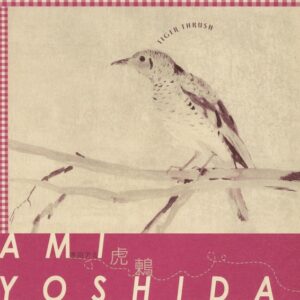
Ami YOSHIDA
“Tiger Thrush”
Recorded by Ami Yoshida at her house in Tokyo, January-March 2003. Mastered by Toshimaru Nakamura, May 2003. Original CD released on Improvised Music from Japan (IMJ-504), July 2003.
In the early 2000s, improvisational music featuring elements such as extended techniques and many faint sounds and silences became a worldwide movement. Along with Berlin and London, Tokyo was one of the centers of this kind of music and the focus of much attention, as was the term onkyo-ha. The names most closely associated with this term were Taku Sugimoto, Sachiko M, Otomo Yoshihide, Toshimaru Nakamura. Another onkyo-ha musician was voice performer Ami Yoshida. Her amazing performances, comprised of high-pitched vocal sounds that seemed to be squeezed out through the tight constriction of the throat, astonished the international improvised music scene.
Tiger Thrush was released on the Improvised Music from Japan label in 2003, when the name Ami Yoshida, along with the term onkyo-ha, was becoming a worldwide phenomenon. Long out of print, it's just been re-released on the Hitorri label, with a simple two-sided paper sleeve replacing the original gatefold cardboard cover. The recording consists of 99 tracks, most less than a minute long. Yoshida's vocal sound is unaltered in some tracks and computer-processed in others. A famed recording of the 2000s has come back to life!!
13,00€
In stock

CD
suzueri
“Fata Morgana”
suzueri: piano, gadgets.
Sound artist/improviser suzueri started her musical activity in the 1990s, and her wide-ranging work since then has included concerts, exhibitions and installations. It was in the late 2000s that she began the style of performance heard on this album, combining upright piano and handmade devices. She continued to develop her concerts featuring this combination, and in the 2010s she earned widespread recognition and praise among improvised/experimental music fans for her unique "suzueri" style.
Three CDs of suzueri's performances at Ftarri with upright piano and self-made devices have previously been released on the Ftarri label: Live at Ftarri (meenna-993), a 2013 concert by the trio of suzueri, Tetuzi Akiyama (guitar) and Makoto Oshiro (self-made instruments), plus a quartet by these three and British drummer Roger Turner; Ftarri de Solos (ftarri-887), pairing solos performed in 2017 by suzueri and Hong Kong sound artist Fiona Lee; and Duo (ftarri-886), a 2018 duo performance with Makoto Oshiro. While these three CDs are all live recordings, what might be called a "definitive" studio-recorded solo album by suzueri has now been released. Fata Morgana, made up of two tracks of 25-plus minutes each, was recorded in February 2019 by Makoto Oshiro (who has an established reputation as an engineer).
Various devices including a small electric fan, a motor and a radio are placed on, attached to or arranged near an upright piano whose upper and lower panels are removed and insides exposed. The devices themselves produce sounds; and when touched by these devices, the piano strings and keyboard emit sounds repetitively (every few seconds) or continuously. These myriad sounds overlap and become a united whole, and at the point when they fill the space like a foundational layer, suzueri strikes the keyboard with both hands, forcefully and persistently unleashing clusters of sounds. This album overflows with suzueri's magical appeal, which combines concentrated musical creativity with turbulence and disarray.
Original price was: 13,00€.7,00€Current price is: 7,00€.
Out of stock
CD
JUN – GUIONNET – SCHELLANDER – MURAYAMA
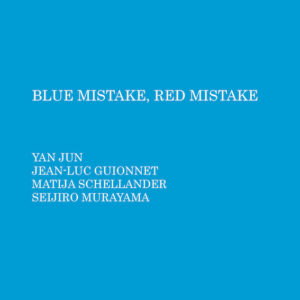
“Blue Mistake, Red Mistake”
Yan Jun: voice. Jean-Luc Guionnet: alto saxophone. Matija Schellander: contrabass. Seijiro Murayama: snare drum, voice.
Blue Mistake, Red Mistake is the project of four musicians: Matija Schellander, a contrabass player living in Vienna; Jean-Luc Guionnet, a sax player based Paris; Beijing-based Yan Jun, who was staying in Berlin on a residency when this album was recorded; and percussionist Seijiro Murayama, who at the time of the recording had been living in Japan for several years (but before then had lived for a long time in France and now resides in Paris). The four got together and launched the project in March 2017, when Schellander was carrying out a residency at the jazz/improvised music festival Artacts in St. Johann in Tirol, Austria. They gave four performances over a week-long period, starting at the Artacts festival and then in Graz (Austria), Vienna and Ljubljana (Slovenia).
This album's one track (about 44 minutes) is the performance in Ljubljana. Yan Jun, who usually plays electronics, performed with his voice only. Murayama used snare drum and voice. The interior of the venue, Galerija ŠKUC, was like a long, narrow hallway which had several adjoining rooms without doors in between (as if the walls had been taken out). For this project it had been agreed that, in each of the concerts, three of the musicians would play close together and one would be far away. In this concert, Schellander started performing quite far back, at a distance from the others, and during the concert he moved to different rooms.
The overall mood of the performance is minimalist, with a limited number of sounds, but occasionally there are intense percussion sounds. Together with a cool but strong feeling of tension, the sonic perspective and dynamism create an amazing effect which, in combination with the excellent recording quality, result in a truly superb album.
13,00€
In stock
CD
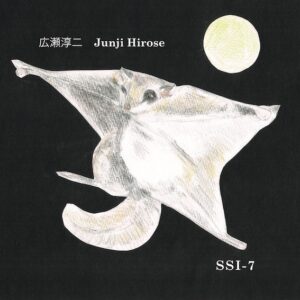
Junji HIROSE
“SSI-7”
A leading sax player on the Japanese improvised music scene, Junji Hirose also plays his own self-made analog noise instruments. In the 1980s he started giving noise performances using his SSI (self-made sound instrument), created by combining everyday objects. Over the years he has remodeled the instrument a number of times, each time adding a different number to the name "SSI." Hirose's CDs SSI-4 (hitorri-997, 2013), SSI-5 (hitorri-993, 2015) and SSI-6 (hitorri-990, 2016) have been released on the Hitorri label. His new album featuring the SSI-7, recorded in December 2018, is now out.
Balls and other small objects are placed on a large, shallow, round metal plate. These objects are covered with a metal plate of the same type and size which is placed and secured in such a way that it seems to be subtly floating. With the use of an air compressor, blasts of air hit the instrument from various angles. The compressed air streaming between the two metal plates causes the objects in between to move around in a dynamic way. The noise of the air compressor, the sound of the compressed air hitting the metal plates, and the sounds produced by small objects moving around and hitting the metal plates all combine to produce a complex and dazzling conglomeration of sound. The album is made up of four tracks, and the sonic atmosphere of each track is altered through the use of different types of small objects. On the final track, no objects are placed between the metal plates; the compressed air hits only the plates. This album overflows with Hirose's creative dynamism and abundant originality.
13,00€
In stock
CD
Seijiro MURAYAMA
“mi-tai”
Seijiro Murayama is a drummer/percussionist and improviser/composer living in Paris. Since around 2017 he's focused on creating electro-acoustic works using recordings of his own improvisations. The results of these efforts have been released as two highly praised solo albums from the Hitorri label: Downdate (hitorri-986, 2017) and The Empire of Slip of the Tongue (hitorri-984, 2018). In an about-face from these earlier releases, his new album, Mi-tai, consists of eight improvisational performances on percussion. It's as if Murayama were returning to his point of origin with this release.
Mi-tai is the first of two albums in which Murayama attempts to give a comprehensive account of his improvisation on percussion and drum set--his "principal occupation," so to speak--in this moment in time. This is a chance to experience the amazing creativity that sets Murayama apart from other percussionists/drummers.
13,00€
In stock
CD
Heather FRASCH / Ryoko AKAMA
“Linking”
A composition by Heather Frasch with Brice Catherin: cello, objects, Eleanor Cully: voice, objects, Ryoko Akama: organ, objects. A composition by Ryoko Akama with Heather Frasch: field recordings, objects, electronics.
Heather Frasch is a composer/musician living in the U.S. city of Charlottesville, Virginia. Ryoko Akama is a composer/musician living in Huddersfield, UK. Together they run Mumei Publishing, which issues mumei, a journal exploring the relationship between text and sound. French musician Bruno Duplant asked Frasch and Akama to create a CD, and the result was this three-track album. (Duplant served as producer throughout the project, but was not involved in the compositions or performances.)
In 2018, Frasch and Akama each composed a work using a written text; then they exchanged the compositions and recorded them separately. Akama's composition "For Heather's Day" was recorded and edited in several sessions by Frasch using field recordings, objects and electronics to create a work of 40 minutes in length. Frasch's composition "A Moment in My Day" was recorded by Akama with invited musicians Brice Catherin (cello, objects) and Eleanor Cully (voice, objects) as well as her own sounds (organ, objects), resulting in the creation of four different takes. Takes 1 and 3 (each about 20 minutes) are heard on this album.
On this superb CD, composer/performers Frasch and Akama draw out all the distinctiveness of text scores, both in their compositions and in their interpretation / realization of the works.
13,00€
In stock
CD
Jack PATTERSON
“Milk Thistle”
Includes recordings made at Riverside Park in New York and Rock Creek Park in DC.
Assembled summer 2018 and fall 2019. "During the period I worked the most on these, summer 2018, I was reading the Daoist Zhuangzi and some Stoics. That material is likely why this CD has to do with detachment and inaction, as well as unspecifiable emotions. The synthetic/concrete sound relationship seems post facto to engage with the above. Inside and outside interpenetrate and relate in tension – openness, suffering, trouvailles and surprises of sound and feeling. The composition involved many layers of mixes, seemingly to do with the fact I'd been looking at a ton of digital imaging of manuscript palimpsests". (Jack Patterson)
11,00€