
In stock

LP
Luc FERRARI
“Music Promenade / Unheimlich Schön”
2022 repress
Music Promenade (1964–1969), 20’29"
Electroacoustic Music
World premiere for the Théâtre de la musique, March 16, 1970
Permanent version for four stand-alone tape recorders. A series of colliding realistic sounds and sonic images. Whilst walking, a man is struck by the violence of his surroundings.
Nature has disappeared in a whirlwind of warfare and industry in the midst of which he encounters a dying folklore and a lost young girl.
The "Installation" version is used to sonify a place in which walkers are free to choose their musical itinerary.
Unheimlich Schön (1971), 15’40"
Musique concrète made in 1971 in the studios of the Südwestfunk in Baden-Baden.
Voice: Ilse Mengel.
“How does a young woman breathe when thinking about something else ?”
To be listened to at a low volume.
26,00€
Out of stock

CD
Marinos KOUTSOMICHALIS – Kasper T. TOEPLITZ
“w piwnicy”
Electronic music by Marinos Koutsomichalis and Kasper T. Toeplitz; the outcome of their 2016 studio sessions in Paris, FR. W piwnicy / στο υπόγειο has been self-released by the artists in an edition of 300 glass-mastered cds in 2022.
“They do their thing pretty good, but I expected nothing less from these two prolific computer musicians”. (Frans De Waard, Vital Weekly)
8,50€
Out of stock

CD
ZINC & COPPER – Kasper T. TOEPLITZ
“Vents stellaires”
ZINC & COPPER:
Eelena KAKAGLIOU, French Horn
Hilary JEFFERY, Trombone
Robin HAYWARD, Tuba
Kasper T. TOEPLITZ, Live electronics
Vital weekly :
There is a lot of studying here, music, scores and video. The latter is only for the first release. Zinc & Copper is a trio of wind instruments; Elena Kakaliagou on French horn, Hilary Jeffrey on trombone and Robin Hayward on tuba. Toeplitz is the composer of the piece and plays live electronics. On his website, you can find the score for this piece (fifteen pages) and on YouTube (use the title of the work), a different recording from the premiere of the music in Berlin. It was interesting to view the score while playing the CD and seeing the concert clip. I am sure my review would have been much different had I only heard the CD. Even with the knowledge of wind instruments being part of this, I would have to remark something about the noise element of the music. At times it is piercingly loud; in fact, a lot of times. We no longer recognise any of the instruments, even when, according to the score, I perhaps should hear them. When the noise is trimmed/cut/removed, we hear these instruments playing their long-sustaining sounds. In all its loudness and quietness, this is some intense music. From barely audible breathing to filtered white noise, the music seems to be moving from -40db to 0db, but with a lot of distortion. I recognised it from the CD only when I saw the music being performed. Here we have a more extensive section of wind instruments against a wall of distortion. On the CD, this is not always evidently clear. A very heavy work of modern composition and of a force that I seldom hear in this particular musical area. I wonder what real noise heads would make of this, and, of course, those who go to recitals of modern music. For both, it must be a strange affair.
8,50€
Out of stock

CD
Kasper T. TOEPLITZ
“Arche”
Composition & solo bass: Kasper T Toeplitz
Vital weekly:
His other new release is a solo affair, music-wise, as it was commissioned by the dance company Loldanse. The recording on CD was recorded live on November 25, 2021, during one of the performances. This piece is for solo electric bass and, so I assume, electronics. Even when the score is in French, it is easier to follow, as Toeplitz made some notes concerning timing this time.
Much of the piece doesn't sound like electric bass and is more like a piece of processed recordings of whatever kind. I wouldn't know what had I not known this is an electric bass. At seventy-one minutes, this is quite a long piece of music, and because of one heavy noise section (from the twenty-four to thirty-minute mark, not an easy-to-digest release. I admit that I skipped these sections a few times I played this piece. After thirty-five minutes, the high-frequency piece was also loud, but something that I enjoyed all the same. When it is dark, it is dark. Toeplitz once again proves that he is a fine master of radical music. Not that I needed more proof. Just like his disc with Zinc & Copper, the modern music version of Toeplitz is entirely different from many of his peers, and I wonder how such pieces are received. (FdW)
8,50€
Out of stock

LP
Eliane RADIGUE
“In Memoriam-Ostinato / Danse des Dakinis
Alga Marghen presents the last chapter from the Feedback Works documentation series, a brand-new LP including "In Memoriam-Ostinato" and "Danse des Dakinis", two previous unreleased tracks by Eliane Radigue. Among the works of fixed duration from the feedback period, "In Memoriam-Ostinato" is the link between "Jouet Electronique" and "Opus 17", and allows you to understand the evolution of her approach. "In Memoriam-Ostinato" is a game of mirroring symbols which glide into a non-measured, bent and elastic, temporality. Eliane Radigue's working method and her aesthetic direction are evident in this work from 1969: her very own unique temporal space of sonic experiences. Even though it bears the same name as the third part of "Adnos III", "Danse des Dakinis" is a peculiar work in Eliane's oeuvre. Conceived in a short time, with all kind of tapes from the composer's past work, it fluently shows a kaleidoscopic vision of Radigue's sensibility for sound. In 1998 she put together a curious self-portrait in sound. There is a feedback ostinato conceived around 1969 and which refers to "In Memoriam-Ostinato" and "Opus 17". All through "Danse des Dakinis" you plunge into the sound of a creek recorded at Mills College campus that brings you back to the field-recordings from the beginning of the 1960s, made on the coasts of the Mediterranean Sea. Such elements construct "Elemental1" as well. There are also some discreet interventions on the ARP 2500 synthesizer. It is indeed a peculiar work, which doesn't have the same features of her other compositions, especially at that time of her compositional path. There is an explanation for the composer producing this kind of sound material in 1998, and not limited to the sound waves of the ARP synthesizer. Invited to a workshop at Mills College in 1998, Eliane Radigue could not load herself down with her bulky instrument on such a trip. So, she left with just a few tapes taken from her own collection, drawn from different periods, and composed "Danse des Dakinis" with those old elements. There is tension in this composition, a certain wildness, an unpredictability of elements, those which are recognized as fundamental elements, which give structure to the universe. "Dance des Dakinis" is an intimate and wild symphony, alive and unpredictable, which is to be the next-to-last gesture of the composer before completely stopping her work with electronics.
23,50€
Out of stock

LP
Éliane RADIGUE
“Jouet électronique / Elemental I”
New 2022 edition.
alga marghen proudly presents the new edition of two sublime pieces by Eliane Radigue, “Jouet Electronique” (1967) for feedback on magnetic tape and “Elemental I” (1968) for feedback of natural sounds on magnetic tape. This LP was first issued in 2010 on the occasion of an alga marghen presentation at Centre Pompidou in Paris and included in the series of publications connected to the Oeuvres Sonores events. We thought, after a long time this wonderful record was sold out, it's time now to have it available again, presenting it for the first time with it's own specific artwork and layout.
Both works were recorded at Pierre Henry's Studio Apsome in Paris. Between 1967 and 1968, Eliane Radigue was the assistant of Pierre Henry in his studio, mainly for the editing of "L'Apocalypse de Jean". He also put her in charge of organizing his sound archive according to different criteria. It was endless work - there were incredible sounds, a true sound library! Eliane Radigue really enjoyed doing this work, even if it took a long time. So, sometimes she decided to set the machines of the studio to do some little work on her own. "Jouet Electronique" and "Elemental I" were born this way as a kind of recreation during her time as a studio assistant.
Working with feedback is something that Eliane Radigue learned through Pierre Henry. Do you remember "Voyage"? There's that fluid part which is made of feedback constructed with a microphone. Everything had to be set at a precise distance from the loudspeakers because that is the specific problem with feedback - you have to be at the right distance. Afterwards, these high tone recordings were slowed down in order to discover the deeper character of their color. This work with feedback was in the end quite limited and the composer preferred working with two reel tape machines to produce sounds. The first was set on the recording mode while the other was playing and it was the accidents happening in this phase that made the feedback richer. With some fine-tuning you could reach very beautiful results: low pulsations, very high-pitched sounds - sometimes both at the same time - or long sounds. All of these sounds could be slowed down or accelerated, which gave her a beautiful material to work with.
With "Jouet Electronique" Eliane Radigue had a lot of fun, hence the title. As far as "Elemental I" is concerned, it was the first attempt at something which was very important to her based on the theme of the basic elements: water, fire, air and earth. Eliane had the chance to record in open air thanks to a small Stella Vox that Arman gave her in the beginning of the 1960s. At the time she was still living in Nice and every now and then she went for a walk to do some recordings of the sea, the wind, the rain, the fire - Eliane Radigue continued this way to build her very minimal sound library, consisting of not more than ten reel tapes. This was the starting point and in 1968 she used these recordings for her work with two reel tape machines.
New edition of 200 copies, with liner notes by Eliane Radigue and portrait photos by Arman.
20,00€
Out of stock

LP
Eliane RADIGUE
“Feedback works 1969-1970”
New 2022 edition.
alga marghen very proudly presents a remastered version of the complete documentation of Eliane Radigue sound installations from 1969-1970, including the broad tectonic vibrations of “Omnht“, the celestial voices of “Usral”, “Stress Osaka” massive chant… or the works of the feedback period finally revealed! It is amazing that she could build such formidably organic sonic edifices in her home studio with the primitive machines given to her by Pierre Henry: three tape recorders, a mixing board, an amplifier, two loudspeakers and a microphone. Eliane previously worked for him at the Studio d’Essai of the R.T.F. from 1955 to 1957, after having met Pierre Schaeffer almost by chance who invited her to learn the techniques of Musique Concrète. Created 10 years after her Studio d’Essai experience, the Feedback works of Eliane Radigue immediately take a new direction from the explorations of Musique Concrète. Her adventure is intuitively going towards flux, towards contemplative stasis - a music of continuous sounds, of apparently simple structures, which permits the revelations and expansion of rich acoustic phenomena. It is as if her musical work was in some way a martial art… as if she meditated for 10 years before striking the first blow, with an impressive precision! This is the context in which Eliane composed “Omnht” in 1970 for the architectonic spaces of the visual artist Tania Mouraud titled “One More Night”, presented at the Gallery of the Rive Gauche in Paris; “Usral” (the title comes from a phonetic compression of ultrasounds slowed-down, in French “ultra-sons ralentis”), one of the first works by Eliane Radigue to be given in public as sound environment for a sculpture by Marc Halpern in the Salon des Artistes Décorateurs at the Grand Palais of Paris in 1969; “Stress-Osaka”, conceived when the artist was invited to create a sonic environment for the International Fair in Osaka in 1970. There is no doubt that Eliane Radigue vocabulary is based on observing and entering into dialog with the fundamental behaviour of sounds: pulsing, beating, sustained, very light, a subtle and delicate evolution. When she moved from feedback sounds to the ARP synthesizer she naturally continued the same music. A continuity where the original use of feedback sounds stands out for its cruder and more savage inner character. One could say that somehow it’s the very texture of the sounds, which leads the form of her compositions. At the same time this approach favors an intense sensuality in the listening.
23,50€
Out of stock

LP
Eliane RADIGUE
“Vice-Versa, Etc…”
New 2022 edition.
alga marghen very proudly presents a remastered version of “Vice-Versa, Etc…” LP originally included in the first 400 copies of the now sold out Eliane Radigue “Feedback Works” 2LP. “Vice-Versa, Etc...” was originally a small handmade box, signed and numbered, realized as art multiple on the occasion of a show at Lara Vincy’s gallery in 1970. The box contained a reel of magnetic tape and the instructions for use. It indicates that all playback speeds are possible, forward or backward, as well as any combination of two channels, on several recorders, ad libitum… This LP presents two versions done by Emmanuel Hoelterbach following the indications of Eliane Radigue to the letter, respecting her composition methods. There is no doubt that Eliane Radigue vocabulary is based on observing and entering into dialog with the fundamental behaviour of sounds: pulsing, beating, sustained, very light, a subtle and delicate evolution. When she moved from feedback sounds to the ARP synthesizer she naturally continued the same music. A continuity where the original use of feedback sounds stands out for its cruder and more savage inner character. One could say that somehow it’s the very texture of the sounds, which leads the form of her compositions. At the same time this approach favors an intense sensuality in the listening. This edition limited to 300 copies includes an insert with liner notes.
20,00€
Out of stock

2 LP
Eliane RADIGUE
“Opus 17”
Repress. Remastered, improved sound quality.
alga marghen very proudly presents “Opus 17”, a major turning-point in the sonic oeuvre of Eliane Radigue. Finished in 1970 it was the last work composed with feedback materials. From that experimental period “Opus 17” preserves the plastic character: a music made of rough sonic phenomena, at once harsh and granular, possessing a quality of materiality and tactility. Its vibrations structure the air surrounding the listener with densities, thicknesses, indeed with palpable movement. Her compositions are frames which let us hear these phenomena, open frameworks from the sonic installations of her Endless Musics (cf. “Feedback Works 1969-70” LP issued on alga marghen) and here reinserted in the five scenes making up “Opus 17”.
In 1970, in her studio of very rudimentary means, she developed a completely unique body of work centered on sounds produced by feedback. “Opus 17” has the quality of showing off the sum of the achieved techniques and methods. Eliane Radigue’s music has never been rooted in ideas but in practice, the intimate experience of things in the wild which she has known how to tame. This dialog both intense and poetic which she keeps up with the solid matter of sound finds a remarkable concretization in “Opus 17”.
It is to be underlined that with “Opus 17” Eliane Radigue inaugurates a technique of composition which will be her footprint, her trademark: imperceptible transformations. For that she has developed a technique of meticulous mixings, based on the slow passage from one section to the next. Imperceptible, all during the piece, we pass, ceaselessly and without noticing the changes, from one frequency flux to another. Time is suspended, smoothed out, stretched. It is this technique which Eliane Radigue will be essentially using for all the electronic works to come and which she will never cease to refine and render always more subtile.
“Opus 17” is the great panoramic voyage through material sound, its electronic phenomena detailed as if in a microscope. Could feedback really contain such a universe? “Yes”, the work of Eliane Radigue answers, but that exploration was not that easy: one had to learn to listen. It required Eliane Radigue’s great demands on listening which led her to the discovery of such treasures. Unknown wealth in a material often rejected as trivial.
As Rhys Chatham recalls: “Eliane Radigue (...) had just moved to New York and had the idea of acquiring an analog modular synthesizer, which is why she worked at NYU in order to try out the possibilities of the Buchla 100 series which we had there. One day, while gossiping, she invited me to her loft, which was just on the corner. She had me listen to a piece composed in France; the piece called ‘Opus 17’. (...) What I heard changed to course of my life as a composer. (...) That piece, impressive source of inspiration, gave the impression of being in a grand cathedral, both for the sensation of immensity of being in such a large cathedral, as for the effect of being so close to God”. This anecdote has its importance because it is evident when listening to the feedback works that Eliane Radigue had already put in place the essential part of her musical æsthetic.
“Opus 17” was created at the artistic center of Verderonne on May 23, 1970, for the Fête en blanc (i.e. White Festival) organized by the visual artists Antoni Miralda, Joan Rabascall, Dorothée Selz and Jaume Xifra.
Previously unreleased, “Opus 17” is now issued on alga marghen in a first edition of 400 copies in gatefold sleeve.
34,00€
In stock

CD
NURSE WITH WOUND
“The Ladies Home Tickler”
This expanded collection is the definitive version of The Ladies Home Tickler. An essential historical document for the new and lifelong NWW follower. Classic tape cut ups, radio sludge, surrealism and abstract chaos. The birth of NWW, a project that is now in its 5th decade: Recorded back 1980, the NWW line-up for these recordings was:
Steven Stapleton: Record player, cassette machine, noise.
Jim Thirlwell: Bass, ergonomic jack plug, Wasp.
William Bennett: Guitar, Wasp.
14,00€
Out of stock

DVD
Conor Mc GRADY / NURSE WITH WOUND
“Entering the Forbidden Zone”
An edition of 300 copies. 20 page colour zine. Fully recycled paper. Covers 250gm Shiro Echo paper. Photo pages on 160 Shiro echo paper. Uncoated and saddle stitched.
“Entering the Forbidden Zone” is a film by Conor McGrady, edited by John Buckley, with the soundtrack, “The Dream of Reason Brings Forth Monsters” by Nurse With Wound. The film was originally developed as a video projection for Nurse With Wound performances scheduled for Russia and for the Shepherds Bush Empire, London, but which were not able to take place due to the onset of the pandemic in 2020. The duration of the film corresponds with the duration of the planned performances. Imagery is taken from Conor McGrady’s artworks probing aspects of power or control. These often stark images have been combined with film footage to create a loose narrative journey into the dark, violent underbelly of contemporary society, generating a sense of unease or disquiet. Conor McGrady is an artist who has exhibited in New York, Chicago, Atlanta and Zagreb, Croatia. In 2022 his first solo museum exhibition “Entering the Control Zone” took place at the Museum of Fine Art, Split, Croatia. “Entering the Forbidden Zone” was premiered in conjunction with this exhibition.
29,00€
In stock
CD
Andrew CHALK
“The End Times”
ICR is happy to be releasing the first new solo album by Andrew in five years, completed in 2022 at Impression Lointaine.
Thirteen beautiful melodic tracks that weave in and out of focus in an almost hallucinatory manner, evoking many different moods and emotions.
13 tracks in a digipack sleeve, mastered by Dennis Blackham with artwork by Andrew.
12,50€
In stock

CD
MOULDYCLIFF – POTTER – MOULDYCLIFF
“Orbits”
ORBIT - course, path, circuit, trajectory, rotation, revolution, circle, cycle, circumgyration.
This sequence of pieces, composed in the main by Jackson Mouldycliff, with additional interventions & modifications from Colin Potter & Phil Mouldycliff, was started back in 2019 but because of the Covid pandemic it was only recently completed. The work centres on loops, repititions & recurrent elements of sound assembled by MPM to accompany a series of mixed-media drawings by Phil, which in turn, takes as its starting point, star charts, celestial globes, planeteria, orraries, armillary spheres, astrolabes & astronomical clocks. Each of the eleven pieces has a title taken from a particular type of celstial orbit.
11,50€
In stock

2 CD
Sam ESH
“Jack of Diamonds / Faro Goddamn”
If Alan Licht ever continues with his revered Minimal Top Ten lists then Sam Esh would surely be added to the pile.
Penultimate Press is proud to release one of the most audacious and unrelenting entries in the entire minimal cannon. A collection of recordings from a true American eccentric maverick pioneer, Sam Esh. Originally available as 2 x cassettes in tiny editions on Mike Rep Hummel’s Old Age / No Age label these are now bound together on a 2CD set which does not interrupt the unrelenting creativity of Mr Esh. What does it sound like? Picture Moondog taking a turn for the far worse morphing into a way further crazed Legendary Stardust Cowboy who eschews any song tradition for an unrelenting hypnotic acoustic hurricane complete with glossolalia vocals.
This is raw primitive repetitive street blues, an acoustic freight train barreling through your brain. It is unlike anything you have encountered prior.
20,50€
In stock

LP
Phill NIBLOCK – Kasper T. TOEPLITZ – Franck VIGROUX
“BestiaIRE”
2020.
A piece composed by Phill Niblock, performed live by Ensemble IRE trio: Kasper T. Toeplitz (ebass), Franck Vigroux (eguitar), Hélène Breschand (e harp) on side A / a piece composed and performed by Kasper T.Toeplitz (ebass) and Franck Vigroux (guitar, electronics) on side B.
18,00€
In stock

LP
Charlemagne PALESTINE – Oren AMBARCHI – Eric THIELEMANS
“KAANAL”
An original meeting, powerful and explosive, between Charlemagne Palestine, Eric Thielemans and Oren Ambarchi.
It was in Brussels, in October 2013, that Charlemagne Palestine and Eric Thielemans first met, during a residency organized by Ateliers Claus which also involved the Finnish electronic musician Mika Vainio (1963-2017), from the legendary duo Pan Sonic. The music composed over these four days, subsequently released on Charlemagne Palestine's Godbear label is at the root of this new performance, Palestine and Thielemans today being accompanied by guitarist Oren Ambarchi.
Charlemagne Palestine: piano, keyboard, voice.
Oren Ambarchi: guitar.
Eric Thielemans: drums, percussion.
Recorded live September 24, 2020 at KANAL-Centre Pompidou, Brussels.
26,00€
Out of stock

5 CD box
Henning CHRISTIANSEN
“OP.176 Penthesilea”
A previously unreleased project of Henning Christiansen, monumental in scope, traversing years, countries and now, formats. The Henning Christiansen Archive is proud to finally present one of the crown jewels of the archive, the masterpiece ‘Penthesilea’ as a 2LP and 5CD set.
Pentheseila is one of the most ambitious works in the entire Henning Christiansen oeuvre. A large-scale work from the mid eighties based on the play of the same name by Heinrich von Kleist (1808). Both Henning and his widow, Ursula Reuter Christiansen, were enthusiastic about Kleist’s text, both making works around the themes within this portent text.
Henning Christiansen first developed a work around this text for the Rosenfest festival performed in Berlin in 1984. Rosenfest was curated by René Block and featured a variety of composers presenting works in response to Kleist’s work including Robert Ashley, “Blue” Gene Tyranny etc. Henning formulated a composition utilising tape, field recordings, voice, soprano, and violoncello alongside the home made instruments of Werner Durand.
The live presentation was then expanded upon and first performed two years later at Teatro Olímpico, Rome on the 8th November 1986 as directed by Carlo Quartucci. The two releases presented here include a 2 x vinyl LP of the Rosenfest recordings in 1984 and a 5CD set sharing the four and a half hour backing track prepared for the Teatro Olímpico performance in Rome in 1986. Together these two releases make up a substantial overview of one of the most significant works in the entire Christiansen canon.
45,00€
Out of stock

2 LP
Henning CHRISTIANSEN
“OP.163 Penthesilea”
A previously unreleased project of Henning Christiansen, monumental in scope, traversing years, countries and now, formats. The Henning Christiansen Archive is proud to finally present one of the crown jewels of the archive, the masterpiece ‘Penthesilea’ as a 2LP and 5CD set.
Pentheseila is one of the most ambitious works in the entire Henning Christiansen oeuvre. A large-scale work from the mid eighties based on the play of the same name by Heinrich von Kleist (1808). Both Henning and his widow, Ursula Reuter Christiansen, were enthusiastic about Kleist’s text, both making works around the themes within this portent text.
Henning Christiansen first developed a work around this text for the Rosenfest festival performed in Berlin in 1984. Rosenfest was curated by René Block and featured a variety of composers presenting works in response to Kleist’s work including Robert Ashley, “Blue” Gene Tyranny etc. Henning formulated a composition utilising tape, field recordings, voice, soprano, and violoncello alongside the home made instruments of Werner Durand.
The live presentation was then expanded upon and first performed two years later at Teatro Olímpico, Rome on the 8th November 1986 as directed by Carlo Quartucci. The two releases presented here include a 2 x vinyl LP of the Rosenfest recordings in 1984 and a 5CD set sharing the four and a half hour backing track prepared for the Teatro Olímpico performance in Rome in 1986. Together these two releases make up a substantial overview of one of the most significant works in the entire Christiansen canon.
45,00€
In stock

CD
Christian WOLFF
“A complete anthology of solo and duo violin pieces”
Black Truffle is pleased to announce its second release from New York violin duo String Noise (Conrad Harris and Pauline Kim Harris), following on from their self-titled double-disc collection of compositions by Alvin Lucier (BT061). Here they present A Complete Anthology of Solo and Duo Violin Pieces by legendary American experimental composer Christian Wolff. The youngest and in some ways most radical of the composers of the New York School (alongside Brown, Cage, and Feldman), Wolff has ceaselessly rethought his approach throughout the seven decades of his composing career, moving from early experiments in radical reduction through indeterminacy, improvisation, and leftist political engagement to reach the limpid lyrical fragments of his most recent music.
Beautifully recorded across two days by Ryan Streber with Wolff in attendance, String Duo’s complete anthology of Wolff’s work for violin solo and duo covers the entirety of the composer’s career, from his earliest published work to a major new work written for this recording (presented in a tasteful non-chronological sequence). Written by the teenaged Wolff in 1950 during his brief period studying with Cage, Duo for Violins is a beautifully austere experiment in extreme reduction, using only three chromatically adjacent pitches without octave transpositions. Exploring the possible permutations of the limited material passing slowly between the two violins, the work prefigures the incessant worrying at small intervals of late Feldman works such as For Philip Guston or—fittingly—For Christian Wolff. This recording also presents premiere recordings of two other short duo pieces from the same year, recently rediscovered by Wolff in his papers, which use similarly reduced materials in a livelier, more dynamic manner.
Moving forward to the 1970s, the solo pieces Bread and Roses and The Death of Mother Jones belong to the period in which Wolff was drawing on political music, in this case two early 20th century songs that celebrate women labour activists. In both, arrangements of the traditional melodies are followed by a series of technically demanding free variations in a modernist style. The lyricism of these pieces is carried into the more fragmented, elusive works of the 90s onward. In the beautiful Six Melodies Variation (1993), written in tribute to Cage, fragments of Cage’s Six Melodies dissolve into anthemic snatches of the music of 18th century American composer William Billings (whose music Cage used in Apartment House 1776 and other works). The sixteen Small Duos for Violinists (2021) explore the radically disjunctive style of recent major Wolff works such as Long Piano (Peace March 11), where short ‘patches’ varying in style, density, and notation system are places next to each other without clear concern for conventional compositional principles. Here the individual duos range in length from a few seconds to just under two minutes, in energy from near stillness to churning rhythm, and in harmonic content from crystalline consonance to thorny dissonance. Including pieces inspired by the work of Rameau and Satie, like much of Wolff’s later music, the Small Duos manage to be at once lyrically immediate and subtly challenging: as Philip Thomas has written, ‘Our ears are not used to such a sustained rate of change’.
Published in a stylish digipak including extensive liner notes and wonderful reproductions of a series of Wolff’s delicate abstract works in pencil, crayon, and water colour, A Complete Anthology of Solo and Duo Violin Pieces is both an important addition to the documentation of Wolff’s oeuvre and an accessible survey of the many facets of his innovative music.
14,50€
Out of stock

3 CD box
Roland KAYN
“Infra (1978-79)”
Recent years have seen the release and reissue of dozens of hours of Roland Kayn's music, on several labels and in both physical and digital formats. Our interconnected yet chaotically imbued age seems to be the setting in which Kayn has truly found his audience. The scene is now set for one of the most momentous works in his oeuvre to return to the shelves. 'Infra'.
One of the titanic cybernetic works Kayn originally released on the Colosseum label in the late 70s and early 80s, 'Infra' (1978-79) has come to occupy a very special place in the hearts of fans lucky enough to have copies of the original vinyl box sets. Now lovingly remastered from the original archive masters by Kayn devotee Jim O'Rourke, 'Infra' has finally found its way to CD for a new generation of admirers to discover.
For the newcomer, it should be mentioned that Kayn's electronic music exists in a category all its own, bearing precious little resemblance to that of any of his composer peers. His work perhaps sits more naturally in today's non-idiomatic landscape of drones, field recordings, and modular synthesis, yet arrives accompanied by a poise and near-epic suggestion of natural phenomena simply found nowhere else. Stretching forwards across four decades to suggest new possibilities even now, 'Infra' represents a musical world ripe for rediscovery.
55,00€
In stock

2 LP
Kiyoshi MIZUTANI
“Inferior’s Betrayal”
Reissue of the self-produced K7 in 1994 on Kiyoshi Mizutani's Ulcer House label.
Mizutani was a member of Merzbow in the '80s and has done solo work since 1989. He has recordings on Ulcer House, ZSF Produkt, Shirocoal Recordings, NEdS, Sounds For Consciousness Rape, Pure, Artware, Kaon, e(r)ostrate, Povertech Industries, and Flenix Records.
27,00€
In stock

LP
SMALL CRUEL PARTY
“È Vago Fior Del Tempo”
"This record presents some work from the late 1980s, originally self-released for friends on various cassette editions of about 5 to 7 copies. These pieces, along with others from the same period, were then later released on limited cassette editions by Petri Supply. This vinyl edition presents them with the intended playing order on side one, in a silkscreened sleeve printed by Charlotte at zyx-éditions, at Bretoncelles in Basse Normandie." (William Ransone)
20,50€
Out of stock

CD
ORGANUM ELECTRONICS
“Wildness”
Label description :
Lighting flashes through the ether
And rain whips the earth violently
From the innermost depths, the pale light of candles
A constancy
A midnight torrent overflows and marks time in solitude
The cold air searches, sewing through the ground
Slowly changing and irresolute, nothing is lost
Paths are drawn, contorted by fierce winds that traverse the ground
In uncertain times and places
Order flows through chaos
Every step of the spiral is forever surging and altered
Yet everlasting
In a space, an electromagnetic ring swarms then rotates
The ring releases its own shackles and plunges through the depths of space
The sounds draw out to an inner sea
Turning to dark fundamental notes and overtones
Phenomena, life and sound, as it arises
To change the order of changes
The voice of wildness resonating in an impenetrable world
That continues to churn and swirl
Between cathode and anode – iron filings pattern around a magnet
Certainty changes, currents move the sand, heat dispatches the wind
The water rises, returning as rain
Changed to smoke and reappearing as vapour
The mass of the earth compressing the rocks
Fire changes everything, rising and falling, opening and closing
14,50€
In stock

CD
THE NEW BLOCKADERS
“Live At Morden Tower Newcastle-Upon-Tyne”
First CD re-edition including as bonus the track "Live At Anti-Fest".
All sounds remastered for CD production from original tapes recordings.
Cover designed using original art-works and statement used for the venue.
Comes in a 3panel digipak. Limited edition of 300 copies.
Live At Morden Tower was first released in 1983 and re-released many times through the years but never into CD format.
Finally here comes the very first CD re-edition of such seminal work including as bonus also the track "Live At Anti-Fest".
NB: all sounds remastered for CD production from original tapes recordings!
Cover designed using original art-works and statement used for the venue - comes in six pannels digipak
Changez Les Blockeurs (1982), is the first true Noise LP of the modern era.
Although Changez Les Blockeurs was undoubtedly hugely influential, TNB’s Live At Morden Tower cassette (1983) was perhaps even more so, just about every Noise artist / group on the planet has (either directly or indirectly) been influenced in one way or another by Live At Morden Tower.
*** Ron Lessard (RRRecords)
My first listening experience of TNB was Live At Morden Tower in 1983.
I marveled at the unbelievably relentless inaccessible intensity of their sound.
I became fascinated by them.
I became a kind of TNB groupie.
*** Toshiji Mikawa (Incapacitants / Hijokaidan)
The Crackle of broken amplifiers precipitates a whole new order of independently morphing soundforms, all giving shape via flashes of metallic lightening, smashed glass, trashed microphone feedback and acoustic low-end pellets that scale the walls like slugs.
Gradually accruing hypnotic significance, they birth spontaneous form in the shape of textures and recur with such accumulative force, they threaten to collapse the performance under its own weight.
*** David Keenan (The Wire)
Tracklist:
1. The New Blockaders - Live At Morden Tower, July 1983 22:40
2. The New Blockaders With Sir Ashleigh Grove - Live At Morden Tower, October 1983 16:30
3. The New Blockaders - Live at Anti-Fest, Morden Tower, January 1984 18:29
12,00€
Out of stock
LP
Valentina MAGALETTI & Yves CHAUDOUËT
“Batterie fragile”
London based Valentina Magaletti, is a composer, producer and percussionist experimenting with new materials and sounds. She is one of the most prominent musicians of the wide experimental world. The prolific drummer collaborates with many musicians and releases albums in all musical directions (from noise to jazz by way of dub...). She was part of the acclaimed duo Tomaga. Lately Valentina Magaletti collaborates with Joao Pais Filipe, Lafawndah, Marlene Ribeiro among many others and she is part of bands like Vanishing Twin, Better Corners, Holy Tongue ... She released 3 solo albums, La Tempesta Colorata (A Colourful Storm, 2022), A Queer Anthology Of Drums (Takuroku/Cafe Oto, 2020) and Valentina Plays The Batterie Fragile (Un je-ne-sais-quoi, 2017).
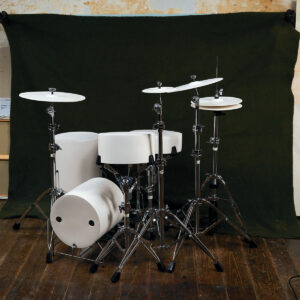
The Batterie fragile is a sculpture conceived by artist Yves Chaudouët. A drum-kit made out of porcelain.
Yves Chaudouët is a French visual artist. His first interest was painting. From the 1990s, he began to experiment with other art forms such as filmmaking, installation, theater and novels.
To create this new album, Magaletti says, "I applied wood and metal and rubber to the porcelain. My starting point is always textural, and I'm very interested and enchanted by friction."
This second installment of recording on that amazing drum kit is an important work in the career of one of the best drummers and composers of her time, which Un je-ne-sais-quoi is proud to share with you.
18,50€
Out of stock

CD
Richard PINHAS & MERZBOW
“Coda”
Masami Akita aka Merzbow is the forerunner of Japanese electronic music, and is recognized as being one of the earliest projects in what has become known as "Japanese noise".
Richard Pinhas is internationally recognized as one of France's major experimental musicians: the 'father' of French electronic music. He was the founder of Heldon, a band whose violent fusion of electronics and guitar in the 70s rivalled the German electronic school.
All titles composed and played by MERZBOW and Richard PINHAS.
Recorded from Tokyo to Nantes 2019 to 2021
Additional Friends and Musicians
Oren AMBARCHI : Motor guitar
Florian TATARD : Accordion
Senza TESTA : Synths
12,00€
Out of stock

CD
Marc BARON – Jean-Philippe GROSS
“Black, Pink and Yellow noises”
20 tracks recorded and assembled by Marc Baron and Jean-Philippe Gross between June 2021 and March 2022
Mastering : Taku Unami
8,00€
In stock
2 LP
Keiji HAINO – Jim O’ROURKE – Oren AMBARCHI
“Caught in the dilemma of being made to choose”
The renowned trio of Keiji Haino, Jim O’Rourke and Oren Ambarchi return to Black Truffle with their 11th release, “Caught in the dilemma of being made to choose” This makes the modesty which should never been closed off itself Continue to ask itself: “Ready or not?” Demonstrating once again their commitment to continual experimentation in instrumentation and approach, the record begins with a long-distance collaboration made in response to a commission from New York’s Issue Project Room in 2021 during widespread lockdowns and travel limitations. A unique piece in the trio’s extensive body of work, this side-long epic finds Haino performing on metal percussion, O’Rourke on electronics and Ambarchi on gongs and bells. Initially dominated by rapid patterns on resonant, high-pitched tuned percussion, the piece sets Haino’s dynamic and dramatic performance against a calm backdrop of cycling electronics, thrumming gong strikes and hanging bell tones. The performance develops a heightened, intensely concentrated atmosphere reminiscent of Haino’s classic Tenshi No Ginjinka or his Nijiumu project; when Haino moves to clashing hand cymbals in its second half, the piece’s ritualistic energy suggests aspects of the music of Tibetan Buddhism.
The remainder of the double LP documents the trio live at Tokyo’s SuperDeluxe (the location of all but their very first recording) in a wide-ranging set recorded in December 2017. The concert opens, in another first for the trio, with Haino on drums, O’Rourke on Hammond organ and Ambarchi on his signature Leslie cabinet guitar tones. Haino’s explosively untutored approach to the drumkit will be familiar to some listeners from the radical duo iteration of Fushitsusha heard on Origin’s Hesitation. Setting flurries of rapid activity against moments of silence, his drumming here at times suggests Milford Graves in its tumbling toms and thudding kick-drum propulsion. Accompanied by O’Rourke’s organ and Ambarchi’s guitar, which in their shared use of long tones and shifting modulation speeds almost blend into a single voice, the opening sections of this performance are some of the most magical music the trio has committed to tape thus far.
After an interlude of spoken vocals in both Japanese and English, Haino makes a dramatic entrance on guitar. Against O’Rourke and Ambarchi’s increasingly intense electronic backdrop, Haino unleashes a stunning passage of slowly moving chromatic melodies and sudden shrieking explosions bathed in distortion and reverb. By the time we reach the third side, the guitar/bass/drums power trio is established and lurches into a passage of massive, lumbering rock that threatens to fall apart at every beat, O’Rourke’s strummed chordal work on six string bass creating a harmonic density equivalent to a second guitar. An abrupt edit throws the listener in media res into a frantic locked groove grounded by fuzzed out bass patterns and caveman drums. As Haino moves through a variety of approaches, from massive edifices of stuttering fuzz to ominous swarms of feedback, the trio eventually stumble into a kind of Harmolodic military tattoo, Haino’s guitar weaving and slashing across the rhythm section’s irregular accents. Moving through an epic opening duet for O’Rourke on Hammond and Haino’s wailing guitar, the fourth side eventually ramps up into a frenetic finale of mad bass riffing, crackling snare hits and guitar squall.“Caught in the dilemma of being made to choose” This makes the modesty which should never been closed off itself Continue to ask itself: “Ready or not?” is a testament to the continuing power and invention of this trio, who continue to seek out new terrain after over a decade working together. 2LP set presented in a lavish gatefold sleeve on heavy stock along with inner sleeves containing live pics by Tsuyoshi Kamaike. Photography by Jim O’Rourke, design by Lasse Marhaug and translation by Alan Cummings.
32,00€
Out of stock
2 LP
Uri KATZENSTEIN
“Audio Works”
Black Truffle is pleased to announce Uri Katzenstein’s Audio Works, produced in collaboration with Holon’s Centre for Digital Art. Spanning sculptural installation, performance, video art, and many other media, Katzenstein’s absurdist, poetic, and often hilarious work made extensive use of sound and music. This, however, is the first release dedicated to the artist’s audio work, collecting 28 tracks produced between the early 1980s and 2017. Compiled from dozens of hours of recordings left uncatalogued (and in some instances unheard) at the artist’s death in 2018, these four sides are a treasure trove, offering a captivating glimpse into a uniquely uninhibited creative practice. Predominantly recorded alone, with some contributions from regular collaborators such as Ohad Fishof on the later pieces, many of these tracks stem from Katzenstein’s time living in New York in the 1980s. Feeding on the cross-pollination of post-punk energy, radical art practice, and new media possibilities that characterised the New York scene at this time, many of Katzenstein’s recordings squeeze multilayered vocal experimentation into synth-based miniatures with a distinctively pop twist, their forms ruptured with anarchic bursts of free-form electronics, sounds from self-built instruments, and field-recorded snatches of the outside world. Katzenstein’s electronic production calls up touchstones of skewed 80s art pop like Laurie Anderson, Ambitious Lovers, and Scritti Politti, but imbued with DIY directness and economy of means. The arrangements of synths, percussion, and noise elements are invigoratingly raw and, at times, almost austerely minimal. On ‘Intermission’, thick distorted chords accompany a wandering portamento melody, inhabiting the wayward carnival space of Roedelius’ most unhinged efforts. Many of the tracks centre on Katzenstein’s multi-tracked vocal performances, often moving between multiple languages, (most commonly English, German, French, and Hebrew). A bewildering range of vocal approaches are present on these pieces, from sweet wordless harmonies to hammed-up growls and monastic recitations. On ‘Skin O. Daayba – Complex Habits no. 3’, improvised resonance singing against a backdrop of echoing electronics and radio snatches. ‘Half Monk Half Herring’ layers multi-lingual syllabic fragments, crossing sound poetry techniques with melodic invention in a way rarely heard outside of Caetano Veloso’s Araçá Azul. On ‘Attempt to Raise Hell’, Katzenstein’s distorted voice spits out streams of alliterative nonsense (‘the hemlock of Henry, he was a hermit…purple pumpkin pulsates to pops’), while on the hilarious ‘Eric’, Katzenstein appears to instruct a small boy simultaneously in basic French and German conversation. On ‘Chicken’, vocal harmonies accompany the pecking and clucking of the titular fowl. Moving from bent, outsider synth pop to snatches of Jo Jones-esque automated instrumental clang and absurdist linguistic experiments, these are far more than footnotes to an artist’s gallery works. Accompanied by extensive, beautifully written liner notes by Roee Rosen and the little information that exists on the individual tracks, Katzenstein’s Audio Works inhabits an outer fringe of DIY pop and sonic experiment reminiscent of Pascal Comelade or Die Welttraumforscher, where accessible forms convey radical interrogations of song, word, and sound.
Deluxe 2LP set presented in a gatefold sleeve with extensive liner notes and an insert with track info.
29,00€
In stock
LP
Crys COLE
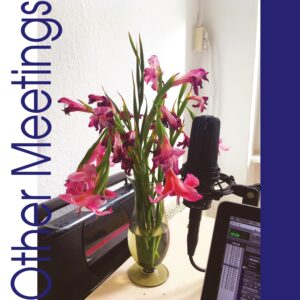
“Other Meetings”
Following on from last year’s acclaimed Sylva Sylvarum, the epic double LP from Ora Clementi (her collaborative project with James Rushford), crys cole returns to Black Truffle with Other Meetings. Originally commissioned and released on cassette by Boomkat Editions in 2021, Other Meetings is a major addition to the body of carefully hewn solo work cole has released over the last decade, offering up two side-long suites of her radically intimate approach to sound. After many years dominated by touring and travel, cole found herself in lockdown in her Berlin apartment, working in a limited space with minimal equipment. Digging through archives of recordings taken overseas and exploring the sonic potential hidden in the objects surrounding her (including a coffee pot and a vase of dying flowers), she crafted what in her liner notes she calls ‘an internal dérive, a journey that drifted through many places without a defining compass’. Totalling over 50 minutes, the two pieces unfold at an unhurried pace, each containing four individually titled subsections. Beginning with a sequence of the highly amplified small sounds characteristic of much of cole’s work, the opening moments of ‘The time between two durations of sleep’ are underpinned by a gentle rocking motion, weaving together contact mic crunch, metallic resonance, glimpses of bird song, and isolated drum machine hits, the sonic space expanding and contracting as focus moves between elements. Briefly side-lined by a tactile but unplaceable sizzling, this complex weave of voices then returns in a kind of dubbed-out ‘version’, the percussive accents echoing around the stereo space. In one of the record’s most beautiful and unexpected moments, these sounds are joined by a sparse melodic line performed on a broken 1980s digital synth, the vaguely New Age timbres being taken on a long, tonally ambiguous wander. Cole’s immersion in memories of travel comes to the fore in the final section of the first side, titled ‘Wat Paknam’ after a royal temple in Bangkok, where snatches of voices, ringing bells and distant waves of chanting blur together with synth tones into an increasingly abstracted wave of sound. The second side, ‘Slices of cake’, opens in a similarly hallucinatory outdoor space of echoing bird song and liquified traffic before abruptly zooming in on a microscopic world of subtly processed and highly amplified objects, explored with a starkness and quiet insistence that calls to mind the fringe not-quite-concrète of outsiders like Paul A.R. Timmermans or Knud Viktor, whose obsessive interrogation of dripping water might also serve as a point of reference for the following sub-section, the aptly titled ‘magischer Abfluss’ (magic drain).
While Other Meetings develops many aspects of cole’s previous work – the hyper-magnification of small gestures, the unsettling edits and fades partly inspired by hypnagogic states, the location recordings smeared into oneiric haze – it is almost as if these pieces are somehow songs, the remnants of an evaporated music of which nothing remains except isolated hits from a synthetic drum, a handful of notes, or simply a duration of emptied atmosphere. Radically reductive yet deeply musical, Other Meetings is a major work from an artist driven by an uncompromising and idiosyncratic vision.
Presented with an inner sleeve with photos and liner notes from the composer and remastered audio.
24,50€
Out of stock

2 LP
Amelia CUNI
“Mumbai 04.02.1996”
Following on from the stunning recording of her 1992 performance at the Berlin Parampara Festival (BT079), Black Truffle is pleased to continue its documentation of the work of Berlin-based Italian singer Amelia Cuni, one of the great contemporary exponents of dhrupad, the oldest surviving style of North Indian classical vocal music. Beautifully recorded in concert at Vishweshwarayya Hall, Mumbai. 04.02.1996 presents expansive performances of three ragas stretching across four sides and almost one and a half hours of music. Beginning with the serene Raga Lalit, Cuni dwells for over twenty-five minutes on its opening alap movement, accompanied only by tanpura, her limpid yet full-bodied voice moving from graceful exposition in free tempo to increasingly rhythmically active variations, gradually spiralling upward in register. She is then joined by master pakwahaj player Manik Munde for the raga’s dhrupad and dhamar sections, the resonant tone of the drum and his constant invention with the complex 14-beat cycle serving as the perfect accompaniment for Cuni’s ecstatic melodic developments. On the more solemn Raga Bhairav, Cuni’s alap, again stretching out over a whole side, is particularly notable for its powerful held notes and mastery of microtonal movement of pitch. After Munde returns for another rhythmically intricate dhamar movement, the record ends with the buoyancy of the Raga Alhaiya Bilaval, whose mode has, for the Western listener, an unmistakably ‘major’ quality. The rapturous applause that greets the performance is reflected in a remarkable selection of press clippings contemporary with the recording, which demonstrate Cuni’s success with Indian critics. Arriving in a gorgeous gatefold featuring stunning colour photographs of Cuni taken by legendary Australian fashion photographer Robyn Beeche (who resided in India from the early 90s), Mumbai. 04.02.1996 is a document of indescribable beauty and a moving testament to music’s ability to cross national and cultural borders.
32,00€
In stock
LP
Steve REICH – Ensemble AVANTGARDE
“Phase Patterns / Pendulum Music / Piano Phase / Four Organs”
2022 repress
Three early compositions (1968-1970) by Steve Reich, one of the most prolific exponents of minimal music, in stunning interpretations by the critically acclaimed Ensemble Avantgarde. Available on vinyl (180gr, gatefold sleeve incl. download code) for the first time ever!
Steve Reich (born 1936) is undoubtedly one of the key figures in 20th century contemporary music and along with Terry Riley or Philip Glass one of the founding fathers of so-called minimal music. With classics like “Music For 18 Musicians”, “Drumming” or “Different Trains” the American composer proved himself one of "a handful of living composers who can legitimately claim to have altered the direction of musical history" (The Guardian). The four pieces on this collection date back to the time before his famous master pieces (1967-1970): “Four Organs” and “Phase Patterns” build on short, repeated patterns that gradually go in and out of phase with each other, creating “a shimmering matrix of sound that is both hypnotic and fascinating in detail” (Allmusic.com) and anticipate Reich’s later trademark sound. “Pendulum Music” is a process piece where only a few starting parameters are given: four microphones are suspended within an array of amplifiers and speakers, then set in motion - the shifts in feedback as they move in space create the music, the results differ with each new performance (as can be experienced listening to the 2 versions here). Reich’s early works are presented on this LP in stunning interpretations by Leipzig based Ensemble Avantgarde whose dedicated, inspired renditions of essential masterpieces of modernism (documented on CDs on reputated labels such as Wergo or Hat Hut Records) won them the Ernst von Siemens Foundation Prize and the Schneider-Schott Prize of Mainz.
20,50€