
In stock
LP
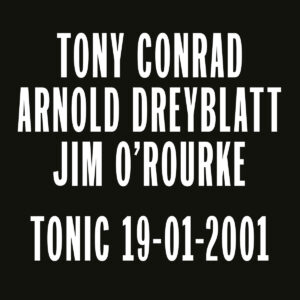
Tony CONRAD – Arnold DREYBLATT – Jim O’ROURKE
“Tonic 19-01-2001”
Celebrating its one hundredth release, Black Truffle is honoured to present a major archival discovery: a stunning document of the only performance by the trio of Tony Conrad, Arnold Dreyblatt and Jim O’Rourke. Across a two-night programme organised by David Weinstein at legendary New York experimental venue Tonic in January 2001, Conrad, Dreyblatt and O’Rourke presented individual projects before performing a collaborative set each night, the first with members of Dreyblatt’s ensemble and the second the trio heard here. As Dreyblatt points out in the wonderfully informative and reflective liner notes written for this release, this was a collaboration across generations, reflecting the profound impact of Conrad’s pioneering minimalism on Dreyblatt and O’Rourke. Both Dreyblatt and O’Rourke came to this collaboration armed with a deep appreciation of Conrad’s music and the just intonation principles at its core, Dreyblatt having first encountered the incredible power of Conrad’s precisely tuned violin chords during his tenure as an archivist for La Monte Young in 1975, while O’Rourke had performed with Conrad in various settings since the mid-1990s (as well as admiring, reissuing, and performing Dreyblatt's music).
The flyer for the concert promised ‘massive, ecstatic, pulsating overtones’, and the trio certainly delivered. From the moment this keening stream of bowed strings begins, it is clear, as Dreyblatt writes, that we are in ‘Tony’s sonic universe’, as massively amplified, slowly shifting combinations of precisely chosen pitches fill the room with complex beating patterns and ghostly difference tones. For more than twenty-five minutes, the music operates at a level of intensity comparable to classic recordings such as Conrad’s Four Violins, until the texture thins out slightly in the performance’s final quarter, allowing for the listener’s first recognition of the individual voices that make up this enormous, overwhelming harmonic edifice. The constant stream of bowed tones is broken by a beautifully rich pizzicato from Conrad on monochord, the sliding low tones and metallic shimmer of the other strings taking the set's final moments on an unexpected detour into spacious pastoral psychedelia.
Though produced by three individuals known for their own distinctive bodies of the work, this is egoless music, the perfect expression of Conrad's desire 'to move away from composing to listening', to 'working "on" the sound from "inside" the sound'. Historically important and overwhelming in sonic impact, this release also serves as a moving tribute to Tony Conrad from two musicians profoundly marked by the example set by his art and life.
24,50€
In stock
LP
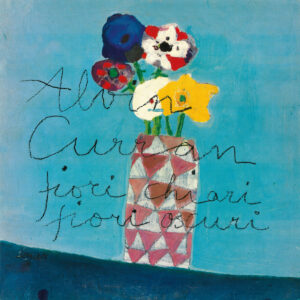
Alvin CURRAN
“Fiori Chiari, Fiori Oscuri”
2023 repress.
Black Truffle is pleased to announce the first-ever vinyl reissue of Alvin Curran’s classic Fiori Chiari, Fiori Oscuri, originally issued in 1978 on Ananda, the cooperative label run by Curran, Roberto Laneri, and Giacinto Scelsi. Fiori Chiari, Fiori Oscuri (Light Flowers Dark Flowers) – its title inspired by an intersection in Milan – is the second in the series of four solo recordings Alvin Curran issued in the 1970s and early 1980s, preceded by Songs and Views from the Magnetic Garden (1975), followed by The Works (1980) and Canti Illuminati (1982).
Each of these solo works combines field recordings with performances on synthesiser, various acoustic instruments, and voice, arranged in languorously paced, dreamy sequences. Far from the bracing pointillism of much musique concrete, the elements encountered on the meandering course followed by Fiori Chiari, Fiori Oscuri – whether a frenetic piano improvisation, dense layers of Serge synthesiser and ocarina, or a monologue from Frederic Rzewski’s five-year old son, Alexis – often occupy the foreground of our attention for minutes at a time. As Curran explains, his approach is like that of a filmmaker in the editing process, working with “whole blocks of recorded time”.
The purring of a cat, toy piano, a child counting, plaintive synthesiser tones, the cacophony of exotic birds at the London Zoo – each disappears into the next, until, on the LP’s second side, a solo piano performance takes centre stage, moving unexpectedly from percussive minimalist permutations to a halting rendition of Georgia on My Mind. A subtle yet stunning work that more than forty years on still seems charged with possibility, Fiori Chiari, Fiori Oscuri arrives in a loving reproduction of the original sleeve, featuring Edith Schloss’ beautiful cover painting, remastered audio and with new liner notes by Alvin Curran and Francis Plagne.
24,50€
Out of stock

3 CD
COPPICE
“Draw Agreement”
A spatiotemporal synthesis of Coppice's auditory and musical experiments (2009-2022) with custom, prepared, and modified musical instruments.
This 3CD set abridges Coppice's first three studies, artificially inserts them into the Yerkes Observatory in Williams Bay, WI, and binaurally captures their diffusion across Elastic's CLEAT (Chicago Laboratory for Electroacoustic Theatre), a 16-channel 96-speaker sound system.
21,00€
In stock

10"/25cm
SMALL CRUEL PARTY
“Ἡσυχασμός”
These two pieces were recorded in Paris in December of 2017 at the request of Banned Productions who then released them as a cassette. However, only very few copies of the tape were made and distributed, which is the reason for this new edition, mastered for the occasion by Paul Lavigne at Kontrast Mastering.
17,50€
In stock

LP
Christoph HEEMANN
“End of an Era”
"end of an era" was produced over a period of 23 years. It began with a few short recordings of lightly processed sine waves that came to me via Asmus Tietchens and Achim Wollscheid. The work on these resulted in a first version and release of "time is the simplest thing" (Three Poplars 2003) which I was never fully satisfied with, so I continued working on it further until a definitive version was completed in 2018.
I began work on "time and again ... and again" in 2013 when experimenting with analog electronics. Again I made a first version that I was not entirely happy with and picked up again and completed it in 2022 with the help of Ronnie Oliveras who engineered parts of the remix. The titles for the pieces are related to American writer Clifford Simak whose novels and short stories have been a source of inspiration since adolescent days.
300 copies, clear vinyl
23,00€
In stock

2 CD
Sylvain CHAUVEAU – Pierre-Yves MACÉ
“L’Effet Rebond”
L'effet Rebond is not one album but two. Two parallel albums sharing the same title. One by Pierre-Yves Macé, the other by Sylvain Chauveau -- two friends and regular collaborators for nearly twenty years. Both works come from the same original material: a few tracks of guitar, piano, harmonium, and vocals, initially recorded by Chauveau. The lyrics (in French, English, Japanese) are very short poems by or quotations from e.e. cummings, Thelonious Monk, John Cage, Basho, cult tennis player John McEnroe, Carla Demierre, Aram Saroyan, Joseph Guglielmi, and painter Philip Guston. From this common material, each of the two composers has built his own edifice, choosing the elements he keeps, the ones he abandons, adding little by little his own instruments, structures and ideas. In the end, two distinct and autonomous opuses are born. Double-CD; digipack inside a slipcase.
"Version Iridium": Pierre-Yves Macé has allowed himself to be guided by his long-standing obsessions: hybridization of genres and formats, balance between lyricism and formalism, intersection of chamber instrumental writing and chiseled electronics. But this time he pushes his penchant for sobriety further than ever. Whether it is a song-haiku, a miniature for piano or a long repetitive and rhythmic piece, the simplicity is at the service of the clarity of the ideas and the beauty of the timbres -- Maitane Sebastiàn's cello or Cédric Jullion's bass flute in mind.
"Version Silicium": Sylvain Chauveau has surrounded himself with his friends Peter Broderick (backing vocals), Machinefabriek (electronic processing), Lucille Calmel (field recordings), Romke Kleefstra (electric guitar), and Rainier Lericolais (electronic sounds) in order to develop more than ever his love of repetition and the ultra-short format. Here, the pieces often last only the time of a breath, of a few heartbeats. A musical form rarely explored in any musical genre, but one that Chauveau has been fond of since his early days and whose quintessence he seeks here.
16,50€
In stock

LP
David TOOP – Peter CUSACK – Steve BERESFORD – Terry DAY
“Alterations”
Never released before recordings from Logos Foundation live sessions at Logos Foundation, Gent, Belgium on January 3, 1981. "The music is free-improvisation -- that is we make our music co-operatively while playing: by listening, reacting, throwing in new ideas, not by following preplanned schemes. At its simplest the group's intention can be said to be to play together as well as possible and to enjoy ourselves while doing so. We are very interested in the result and intend that the audience is as well. As well as the musicians reacting to each other the music itself is pretty reactive to context. In other words, room acoustics, background noise, audience response have a strong effect on what happens. This is particularly true of the audience. We have done performances where conversation has broken out with some audience members. There is much to see as well as hear -- this is partly to do with the instruments. Together Terry, Steve and David have hundreds, all sizes, all sorts, most colors. They completely cover the floor. Many of these are non-western. The wide range of instruments means that an extremely broad sound spectrum is covered, from sudden bangs to very quiet low notes, from squeaks to normal guitar sounds. This is what fixes the overall group sound." Personnel: David Toop - flute, home-made reeds, percussion; Peter Cusack - guitar; Steve Beresford - piano, small instruments; Terry Day - percussion, home-made reeds.
Logos Foundation: Belgium Flanders' unique professional organization for the promotion of new music and audio-related arts by means of new music production, concerts, performances, composition, technological research and other activities related to contemporary music. This organization has been founded in 1968 by Godfried-Willem Raes.
16,00€
In stock

LP
Otto SIDHARTA
“Kajang”
Previously unreleased music by Otto Sidharta, pioneer of Indonesian electronic music. Inspired by Indonesia's multifarious styles of traditional music, that he tries to preserve, the four pieces on Kajang express a contemplation of the self. Otto Sidharta loves to travel, everywhere within Indonesia, in order to collect almost any environmental tones and harmonies he can gather, as an endless source of composition. He is also deeply inspired by Indonesia's multifarious styles of traditional music, that he tries to preserve, as in some remote places, they keep their own tradition very strongly. What really interests Sidharta is musicians not interacting with other kinds of music, as in those deep villages, where one might find sounds that feel like very "natural". It results in works expressing Sidharta's personal impression from their music: "I just use my own feeling, with no calculation", not using the tribals motif or style. Kajang is the name of a tribal people living in the south of Sulawesi, a giant island in eastern Indonesia, a closed community, that Sidharta visited twice: "They cut off their communication with the outside world. They live in a very traditional way and try to avoid any new development in culture that might impact their way of life." Sidharta's previous album collected early pieces under the title Indonesian Electronic Music 1979-92, released on Sub Rosa in 2017 (SR 452CD). Kajang gathers a quartet of compositions from 2015 to 2020. White vinyl.
16,00€
In stock

LP
SOTE
“Majestic Noise Made in Beautiful Rotten Iran”
Green vinyl.
It's an all-electronic affair, harmonically maximalist, predominantly symphonic-synthetic, requiring active listening. Some pieces function as challengers of musical structural habits, provoking the short attention span culture, others present a problem-solution scenario, collectively via a neoteric noise aesthetic and detailed melodic weaving. Ultimately, the objective was to engineer an assortment of works full of sound, euphonic, and vivid in nature. The making of this album was intentionally a very personal process, going into self-therapy territory at times interpreting the composer's contemplating mind dealing with tolerance, destruction, compassion, misery, grace and tyranny in an auditory manner. Some pieces function as challengers of musical structural habits, provoking the short attention span culture, others present a problem-solution scenario, collectively via a neoteric noise aesthetic and detailed melodic weaving. Ultimately, the objective was to engineer an assortment of works, awash with euphonic sound vivid in its essence, with a deep focus on various synthesis techniques within a compositional framework. Dedicated to Peter Rehberg aka Pita.
Ata "Sote" Ebtekar composes music with a deeply-held conviction that rules and formulas should be deconstructed and rethought. He alters musical modal codes from their original tonality and rhythmic tradition to achieve vivid, synthetic soundscapes. Over the last three decades, his work has been published by labels such as Warp, Sub Rosa, Opal Tapes, Diagonal, Mute, and Morphine, among others.
16,00€
Out of stock

2 LP
Julius EASTMAN
“Two Extended Pieces For Four Pianos”
2023 repress, black vinyl.
Four Pianos (1979-80): It is recognized today that these tutelary pieces for four pianos are among the most powerful in contemporary music, their impact is almost unparalleled. After the historical version recorded forty years ago, this one, featuring four of the greatest European performers, is now regaining its full power. High level recordings too.
Julius Eastman: There was some for John Cage, then came Christian Wolff, and finally Morton Feldman, from this school in New York. Only Julius Eastman remained outside the game, the last figure, the most solitary and enigmatic -- undoubtedly also one of the most powerful, and it is this power that is revealed through these recordings. In the 1970s and 1980s, Eastman was one of the very few African-Americans to gain recognition in the New York avant-garde music scene. He was politically committed, a figure of queer culture and a solar and solitary poet whose melancholy influenced his genius as well as his tragic destiny: suffering from various addictions, declared missing, actually homeless. During Winter of 1981-82, he got deported from his apartment by the police, who destroyed most of what he owned - including scores and recordings. He was found dead in 1990, on the streets of Buffalo, after years of vagrancy.
The Performers: Nicolas Horvath, pianist and electroacoustic composer; Melaine Dalibert, a French composer and pianist; Stephane Ginsburgh, a tireless surveyor of the repertoire but also explorer of new music; Wilhem Latchoumia, embraces both new music and the classical repertoire with success and charisma.
20,00€
In stock

LP
Jim HAYNES
“Turbulence”
Turbulence is a prequel of sorts, with two twenty minute studies in smoldering noise and concretized electricity, as evinced through shortwave radio, corroded metal-on-metal, and glass being vibrating just shy of the point for shattering.
Thick, fluttering, heated rays of sound building a slow tension of rhythmic, oppressive structures. Piercing, crackling tones increase and decrease, layered with icy cold precision. Muffled segments of basspressure enters and are abruptly cut short, leaving just enough room to breathe inside the mechanical stasis.
Edition of 250 copies in printed color sleeves with hand-drilled holes of varying amounts, size and placing.
26,00€
In stock

LP
Anthony PATERAS
“Two Solos”
Futura Resistenza is pleased to present the latest release from the prolific, restlessly creative composer-performer Anthony Pateras, two side-long pieces – one performed by Callum G'Froerer on double-bell trumpet, the other sung by Clara La Licata – in which soloists are accompanied by numerous pre-recorded tracks of their own instrument or voice, creating acoustic halls of mirrors where the distinction between live performer and recorded accompaniment becomes difficult to perceive.
Palimpsest Geometry (2020) for double-bell trumpet & tape works with rapidly pulsed single trumpet notes, at brisk tempos that hover at the perceptual threshold between rhythm and tremolo. The interaction between different rates of pulse produces skittering echoes, as if G'Froerer’s layers of trumpets were really a single sound bouncing around the sonic space. There Is A Danger Only Our Mistakes Are New (2021) for voice & tape goes to work on a see-sawing two-note melodic cell, insistently transposed and transposed again, hummed or sung with open vowels, contracting to a semitone and expanding to a minor third. More than anything in the canon of Western art music, the piece calls up the criss-crossing repeated figures of Inuit vocal games or the interlocking repetitions of Banda-Linda music, where rhythmic and harmonic displacements of repeated motifs fuse together individual parts into the illusion of an impossibly rich and multi-faceted unitary sonic organism.
Essentially homogeneous in texture yet built up from constantly changing details, broadly static yet always moving and shifting, these pieces exemplify Pateras’ recent work while also pushing it into a new, strikingly immediate direction. Here, form grows organically out of the material itself; the results are sparkling, immersive, and quietly uncompromising.
- Francis Plagne
22,00€
In stock

CD
Valerio TRICOLI
“Say Goodbye To The Wind”
First emerging during the early years of the new millennium, over the last two decades, the Palermo born, Munich based composer, Valerio Tricoli, has forged a singular path within experimental sound practice, continuously rethinking the relationship between electroacoustic composition and narrative possibility. Say Goodbye to the Wind, his first record with Shelter Press, stands among his most poetic and groundbreaking efforts to date. Across three intricate, deeply personal works of concrète music - dense with themes drawn from J.G. Ballard, Samuel Beckett, theosophy, and the temporal blur of DMT - the composer blurs the boundaries between the tangible and abstract, weaving complex allegories for the self.
Exploring auditory phenomena and the narrative potential of electronic and acoustic sound sources, Valerio Tricoli’s work - as it has appeared across a carefully executed body of solo recordings, as well as noteworthy collaborations with Stefano Pilia, Dean Roberts, Thomas Ankersmit, Hanno Leichtmann, and numerous others - rests at the shadowy juncture of internal and external worlds; a meeting place where the synthetic and organic give way to utterances of the existential, psychological, physical, and occult. Most commonly created on a Revox B77 reel-to-reel - manipulating, live sampling, and real-time editing / mixing of field and studio recordings - in Tricoli’s hands, estranged moments of sonorous ephemera transmogrify and intertwine as metaphorical and allegorical sums, far greater than their parts.
Say Goodbye to the Wind, Tricoli’s sixth full-length, gathers three works of musique concrete, thematically bound by notions of absence, loss, stillness, and release. The album’s title is taken from a story by J.G. Ballard, set in the desolation of a holiday resort that rests among a landscape of endless rolling dunes that are populated by ʻsound sculptures’ and monsters. The otherworldliness of this reference is further expanded by the depth exposed by the many possible implications and meanings implied by the combination of words; wind being a metaphor of the breath of life, and its absence meaning death. If the wind is a storm, what is the abstraction that remains in the absent void when it leaves?
Historically, one of the primary pursuits of musique concrete is the transformation of everyday sonority - field recordings, found / incidental sound, etc. - into abstractions of profound meaning and weight. While this process unquestionable played a heavy hand in the composition of Say Goodbye to the Wind, Tricoli’s approach to the idiom sets the stage for something entirely unique. Not only are the practices of tape music applied to field recordings, but to the sounds of piano, synthesizers, objects, and the composer’s voice, in addition to interventions by Ecka Mordecai on cello, Lucio Capece on soprano saxophone, and Ida Toninato on vocals. Further expanding to potential of meaning, are the references - literal and abstract - that guided each work into being.
A masterstroke of contemporary musique concrète and auditory conceptualism, dense with metaphor, allegory and meaning, Shelter Press is thrilled to present Valerio Tricoli’s ‘Say Goodbye to the Wind’. Issued in a limited edition CD and Digital, mastered by Rashad Becker, with artwork by Mårten Lange.
14,00€
In stock

LP
Joshua BONNETTA
“Innse Gall”
Bridging acoustic ecology and interdisciplinary creative practice, Joshua Bonnetta returns to Shelter Press with Innse Gall ‘The Islands of the Strangers’, his second LP for the label. Recorded and assembled between 2017 and 2020 and acting as a companion piece to Bonnetta’s film, An Dà Shealladh ‘The Two Sights’, these two interrelated side-long works - Innse Gall I and Innse Gall II - respectively deploy a rigorous approach to field recording and auditory phenomena, pursuing the complex relationship between landscape, place, language, and culture in the Outer Hebrides, where both the film and album’s source material was gathered. Representing a radical rethinking of the potential of sound collage, Innse Gall ‘The Islands of the Strangers’, is issued by Shelter Press as a limited edition, deluxe vinyl LP, housed in a 7mm reverse-board outer sleeve and a heavyweight reverse-board inner sleeve, accompanied by a sixty page booklet containing extensive photographic studies made for ‘The Two Sights’ by the artist and an essay by Erika Balsom, as well as a postcard to download the film An Dà Shealladh ‘The Two Sights’, generously provided by Cinema Guild, and Arsenal - Institut für Film und Videokunst.
While very much the byproduct of sound collage, rather than the states of abstraction and ‘pure’ sonority most often pursued by musique concrète, or an experimental music “free of individual taste and memory (psychology)”, as pursued by John Cage, Bonnetta’s work displays a deeper sympathy with Luc Ferrari’s notion of ‘anecdotal music’, in which the social and autobiographical contexts of the source material / recordings - with their embedded dimensions of meaning - is accounted for and retained. Rather than enforcing a fixed vision of the artist, the listener in encouraged construct a narrative of their own. This is no less the case for Innse Gall ‘The Islands of the Strangers’, comprising two audio works constructed by Bonnetta from field recordings made on the Outer Hebrides islands of Barra, Berneray, North Uist, Harris, & Lewis between 2017-19.
Drawing upon Bonnetta’s fascination with sound as a primary means to survey place and people, Innse Gall ‘The Islands of the Strangers’ draws upon a vast range of sonorous material: hydrophone recordings made over extended periods in lobster creels and of gases escaping a peat bog, interview fragments, and field recordings feature capturing the sounds of maritime industry, song, seals, corncrake, snipe, and other elements of the natural world. Meticulously collaged and reworked within an exploration of the interrelated acoustic ecology of these diverse elements of the islands’ make-up, the album’s two works - Innse Gall I and Innse Gall II - bristle with the subcutaneous narratives embedded within these ancient and modern landscapes, played against the disappearing Gaelic oral traditions which hold their memories, resulting in a deep, auditory reflection on the relationship between narrative, environment, and the reciprocal influences they exact upon one another.
Challenging the perceived boundaries and interconnectedness of place and occupation - to what extent the perception of an environment is modelled by language, culture, and myth, or that the environment underscores the very becoming of those things - Bonnetta’s Innse Gall ‘The Islands of the Strangers’, draws profound poetry, beauty, and meaning from the everyday, rethinking the terms of field recording and sound collage every step of the way.
27,50€
Out of stock

2 LP
Peter “Sleazy” CHRISTOPHERSON
“The Art Of Mirrors (Homage To Derek Jarman)”
2108, warhouse find. White/Black Splatter Vinyl.
Shortly before his musical partnership as Coil ended following the death of Jhon Balance, Peter Christopherson performed a live soundtrack to his old friend and collaborator Derek Jarman's abstract 1973 Super 8 short The Art Of Mirrors in Paris.
Sleazy had worked with Jarman on many occasions, including providing the music as a member of Throbbing Gristle for In The Shadow Of The Sun in 1974, Coil's highly-charged compositions for The Angelic Conversation, as well as their singularly psychedelic disco contributions to the director's final swansong, Blue.
Since The Art Of Mirrors is barely six minutes long, quite how Christopherson made more than an hour of music to accompany the film's screening is something those who were there can answer best, but ultimately it's more or less irrelevant to the music as it appears here.
Split carefully across three sides of vinyl, the LP divides a continuous performance into what are now essentially three interrelated movements.
Each ebbs and flows with the same hallucinatory feeling that so much of the music that Christopherson made with others has, especially in Coil, and it soon begins to seem that time itself has become far more of an unnecessary frippery than usual.
20,00€
Out of stock

LP
SMEGMA
“Infringements”
Alga Marghen's third installment of Smegma's original "Suburban Primitive Avant-folk music" period (1973-1975) based in Pasadena, featuring three previously unreleased tracks from the deep vault of their home recordings. In the beginning, the band Smegma had only one rule. No musicians. Starting from scratch, they took the road much less traveled. They were inspired by outsider musical artists of the time such as John Cage, Sun Ra, Captain Beefheart, Wild Man Fisher, Art Ensemble Of Chicago, etc. and they recorded every experiment with youthful enthusiasm. Mostly they only succeeded in tormenting their own friends and neighbors (except for the few who joined the band) but somehow, they never chose imitation, but stumbles on a path that allowed past (shamanistic) and future (space) sounds to lead the way. The titled track gently pulls you in and carries you off with a way-out inner-mind group jamming/not-jamming trip, featuring prepared piano, modular synthesizer, human mouth sounds, pan pipes, tabla, and electric bass guitar. "Rainy Day Mushroom Pillow" (defiantly not the 1960s pop hit) rips you straight into a high energy New Years Eve Party jam, in a romping free jazz style with stream of consciousness vocals and exuberant alto sax solos. Side B starts with Beatnik finger popping and wild dogs barking from a record player, while breathless flute playing leads you down the rabbit hole of mysterious group vocalizing, including imitating the cry of the wild tropical parrots that lived in the palm trees in the front yard of the house in Pasadena that they had lived in. Always out of sync with their own time, 49 years later these tracks still throb and pulsate Beautifully with their own inner logic. Edition of 230.
21,50€
10 CD
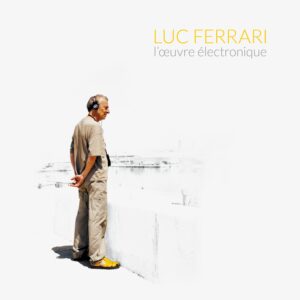
Luc FERRARI
“L’œuvre électronique”
2023 repress
The decision to assemble a boxed set titled Luc Ferrari, l’œuvre électronique [Luc Ferrari, Electronic Works], defining the word electronic in the widest sense possible, meant bringing together an essential part of the composer’s work: tape music without any classical instruments.
From Étude aux accidents (1958) to Arythmiques (2003), the 31 works in this compilation will help the listener to discover all the facets of his art based on “captured” sounds. He tried and tested all the different techniques of studio work: brilliantly elaborated electroacoustic works, radiophonic story-telling or Hörspiele, which he particularly relished, or other semi-improvised works.
This editorial choice is not a way of drawing a hierarchy between on the one hand so-called mixed music (with instruments), which he excelled at, and on the other hand the type of music published here, which only includes recorded sounds. On the contrary, what we aimed to do was to show the strong links he drew between natural sounds and the way he scored them. On this subject, Pierre Schaeffer often talked of the necessary balance between sounds and musicality. The power of recorded sounds alone (voices, landscapes, strange sounds, everyday scenes, etc.) without formal mastery is not enough to hold the listener's attention for long.
From that point of view, each work of Ferrari’s is a discrete lesson in music. Ferrari was always very lucid when he claimed that a composer was a little like a “journalist” who, through his compositions, witnessed the state of the world while at the same time creating a work of art.
This is another aspect of this edition: as we listen and in filigree, half a century unfolds before us. A committed artist bears witness to technological progress, political awareness, reports and crucial encounters. More than an essential compilation, this boxed set reflects the personality of a diverse, inventive and extraordinarily musical man.
Daniel Teruggi / David Jisse, 2008
CD1: “Étude aux accidents”, “Étude aux sons tendus”, “Étude floue”, “Échantillon pour mimes”, “Visage V”, “Tête et queue du dragon”, “Tautologos I”, “Tautologos II”, “Music Promenade”.
CD 2: “Hétérozygote”, “J’ai été coupé”, “Petite symphonie intuitive pour un paysage de printemps”.
CD 3: “Presque rien n°1 ou le lever du jour au bord de la mer”, “Presque rien n°2 ou Ainsi continue la nuit dans ma tête multiple”, “Presque rien avec filles”, “Presque rien n°4 La remontée du village”.
CD 4: “Danses organiques”.
CD 5: “Ouvert-Fermé”, “Unheimlich Schön”, “Dérivatif”.
CD 6: “Dialogue ordinaire avec la machine ou trois fables pour bande doucement philosophiques”, “Strathoven”, “Capricorne”, “Chute libre”.
CD7: “Far-West News 1 : De Santa Fé à Monument Valley”, “Far-West News 2 : De Page à Grand Canyon”.
CD 8: “Far-West News 3: De Prescott à Los Angeles”, “Archives génétiquement modifiées”.
CD 9: “Les Anecdotiques”.
CD 10: “L’escalier des aveugles”, “Les Arythmiques”.
60,00€
In stock

CD
Michael RANTA
“Azabu”
Even though only being fully terminated 50 years after its conception, ‘Azabu’ can be regarded as the starting point of Michael Ranta’s creative self-discovery. The recordings that form the base of ‘Azabu’ were mostly made in the Tokyo district with the same name (Azabu-Juban). Next to abstracted field recordings ‘Azabu’ is also pervaded by a rich variety of percussion, string and wind instruments, all played by Ranta himself. Subsequently Ranta edited, layered and processed the recordings at the NHK electronic music studio in Tokyo. Both pieces display a vast array of acoustic, electronic and concrete sound events meticulously sequenced to a complex fusion symbolizing the entire spectrum of earthly and heavenly sounds. Dynamic extremes evoke a restless flight through space, or through the depths of human subconsciousness, between dream and reality. Ultimately the music disappears, like a dot in the sky gradually fading into nothingness – an “ascension” that closes the loop in a ritual of life that can begin anew again at any time.
Michael Ranta: composition, performance, mixing (1971)
14,50€
In stock

LP
Jacques BEKAERT
“Jacques Bekaert”
…Gentle threads of instrumental and electronic sounds are mixed with outdoor rural field recordings and occasional voices of his friends speaking, whistling or singing. Bekaert creates a warm environment within which we can hear subtle individual voices of good musicians who are relating to his loosely-notated scores and verbal instructions… (David Behrman)
‘A Late Lunch’ is the soundtrack to Akiko Iimura’s eponymous movie realized in 1978. It is based on acoustic instruments and field recordings, brilliantly reconfigured and mixed by Bekaert to create a surreal, immersive soundscape. The technique used includes superposition and speed change of recordings, radical sound effects and juxtapositions of sounds. The players were prominent musicians of the 1970’s, including Maggi Payne, George Lewis, David Rosenboom and Blue Gene Tyranny.
‘A Summer Day at Stony Point’ was composed in 1969, with participation of David Behrman, Shigeko Kubota and Charlotte Warren. The piece was commissioned by English composer Hugh Davies who presented it at the Harrogate festival the same year. Stony Point is a small village in New York State where John Cage co-owned a small pseudo-commune art resort where like-minded artists gathered. ‘A Summer Day at Stony Point’ is nothing more than a page of a journal, a fragment of a notebook that utilizes a series of sound sources recorded at Stony Point on one beautiful day in the summer of 1968. Other electronic sound sources were recorded at the Brandeis University where Alvin Lucier was professor. The final realization of the piece was done at Henri Pousseur’s APELAC Studio in Brussels, 1969.
The soundtrack for Akiko Iimura’s ‘Mon Petit Album’ was composed on the basis of a simple description of the technique of the film and its time span. It includes David Behrman on alto, from an outdoor recording at Stony Point, plus excerpts from a Transition concert in London, the band Bekaert formed in 1971 with Michel Herr, Takehisa Kosugi and Ryo Koike, both members of the Taj Mahal Travelers. The atmosphere is quiet and pastoral throughout with a very dreamlike flavour.
Jacques Bekaert (1940-2020) was a man of many gifts: author, journalist, composer, photographer, visual artist, wine connoisseur, radio talk show host, diplomat and expert in Southeast Asian affairs. His whole life Bekaert has been actively involved in music but not much of his work got recorded or published. In the early 60’s Bekaert studied with Pousseur and through his frequent visits to the US he became friends with artists like John Cage, David Tudor, Charlotte Moorman and most of all David Behrman with whom he had a close friendship ever since. Bekaert helped organize the first European tour of The Sonic Arts Union (David Behrman, Robert Ashley, Gordon Mumma, Alvin Lucier) and in the early 70’s he formed the group Transition (with Belgian jazz pianist Michel Herr, Takehisa Kosugi and Ryo Koike, both members of the Taj Mahal Travelers). His meeting with Japanese experimental film-maker Akiko Iimura resulted in two film soundtracks featured on this one of a kind discreet avant garde album.
When asked in a 1979 interview about his double life as a musician and a journalist, Bekaert replied, “I suppose they’re both unsafe, unstable, questioning jobs—composing and reporting. Journalism takes me to places, shows me the world as it is. My music is my wish for the kind of world I’d want to live in. The little peaceful state I dream for everyone, where you can be yourself, and happy, and as collective as possible without giving up total privacy.”
Originally released in 1981 on the Belgian Igloo label this reissue comes with the same sleeve as originally designed by Alain Géronnez.
26,00€
In stock

LP
MARSFIELD
“The Innocents”
2019
Andrew Chalk & Brendan Walls
Played and arranged 2007-2019 at Impression Lointaine & Glen Huon.
Marsfield is a collaborative project that involves British musicians Andrew Chalk (Ora, Mirror, Isolde...), Robin Barnes and Vikki Jackman along with Australian Ambient practitioner Brendan Walls. Following Three Sunset Over Marsfield and The Towering Sky - both released on Faraway Press in 2010, The Innocents is the group's third full-lenght release and includes two long mesmerizing compositions.
21,50€
In stock

LP
Andrew CHALK
“Paradise Lost”
Recorded at Impression Lointaine 2016-2019
Vocals by Naoko Suzuki
1. This Pendent World (17:04)
Superb melancholic electronic minimal prog with an Italian 1970’s elegance.
2. Paradise Lost (17:09)
Invisible and intangible, like the wind touches your skin.
21,50€

LP
P16.D4
“Distruct”
Distruct
Directed by P16.D4
Assemblage of transformed, organized and (re)structed sound material submitted by:
Bladder Flask, Déficit Des Années Antérieures, De Fabriek, The Haters, Philip Johnson, Hiroki Kocha, Merzbow, Fredrik Nilsen, Nocturnal Emissions, Nurse With Wound, Onnyk, Harold Schellinx, Die Tödliche Doris, Vortex Campaign.
"On this, their second LP, P16.D4 solicited tapes from several artists from Europe, England, the U.S., Canada, and Japan, and mixed that with their own material. Though in the current digital age collaborations from artists thousands of miles apart is quite normal, this was a quite radical approach back in 1982, when work on this LP began – an interesting concept that actually works quite well, since these artists, which include Bladder Flask, DDAA, the Haters, Merzbow, Nocturnal Emissions, Nurse With Wound, and several others – work in a similar free-ranging experimentalism as P16.D4, and their particular elements, usually just vocals or one instrument or noise implement, blend well without diluting P16.D4’s own peculiar brand of avant-garde post-industrialism, but merely give it another facet. One of the best tracks, “Aufmarsch, Heimlich,” consists of a choir submitted anonymously from Eastern Europe phasing in and out of static while a skronky alto sax bleats away. Most of the pieces exist somewhere just beyond the borders of free jazz, industrial, and even classical avant-garde, full of jarring noises and strange transitions and with a heavy overlay of electronics. What started out as an experiment yielded one of P16.D4’s best albums."
Rolf Semprebon / AMG
"Distruct is organized around sounds provided by the cream of experimental musicians of the early '80s, from Nurse With Wound to Nocturnal Emissions, via De Fabriek, Die Todliche Doris, The Haters, Merzbow, and others. Obviously, there is no question of remixing here, and at no time do P16.D4 seek to hide its sources, clearly identifying the contribution of each artist in the liner notes. It would be futile to try to find the paw of each artist, the trio operating vis-à-vis its collaborators the same methods as in their own work. Reworked, distorted by various effects, cut, edited, aggregated with other sounds, produced by P16.D4 themselves, reprocessed. Exchange, communication, two other data that will constantly recur in the work of P16.D4, rich in external contributions and encounters of all kinds. Musically, and despite the diversity of sources treated, Distruct escapes the heterogeneous character, which often marks this type of collaboration, to offer a coherent whole: fragments of opera, Soviet speeches, out-of-tune guitar, saxophone, tattered violins, overdriven and metallic noisy attacks, jackhammers, field recordings, battered choirs, and many other less identifiable sounds. In addition to the desired dialogue between the artists, Distruct also offers a real reflection on listening, and on the expectations of the listener."
Dissolve
P16.D4 was a German electronic noise music collective, active primarily from 1980 to 1988. P16.D4 embraced tape cut-ups, musique concrète, endless recycling and transformation of previously published material, and many long-distance collaborations with like-minded artists such as DDAA, Vortex Campaign, Nurse With Wound, and Merzbow. Their active participation in the international industrial tape scene yielded collaborative output such as their release Distruct, where bands such as Nurse with Wound, Nocturnal Emissions, Die Tödliche Doris, and The Haters provided the source material. The longest-term collaboration was with the installation and conceptual artist Achim Wollscheid, who used P16.D4 sounds as the basis for LPs he recorded under the name SBOTHI. Ralf Wehowsky, the only constant member of the group, later released solo material under the alias RLW. Members of P16.D4 were also involved with Selektion, a collective of people involved with sound as well as the visual arts. Selektion published LPs, CDs, books, visual art and design. The collective worked in a strongly improvised, spontaneous and anti-professional way, using acoustic and electronic instruments, using existing sound fragments, duplicating and alienating them, using repetition, distortion, changes in speed and playing direction. For this they used not only sounds of other artists but also their own material from earlier productions. Late works of the collective are associated with musique concrete.
P16.D4 was a German electronic noise music collective, active primarily from 1980 to 1988. P16.D4 embraced tape cut-ups, musique concrète, endless recycling and transformation of previously published material, and many long-distance collaborations with like-minded artists such as DDAA, Vortex Campaign, Nurse With Wound, and Merzbow. Their active participation in the international industrial tape scene yielded collaborative output such as their release Distruct, where bands such as Nurse with Wound, Nocturnal Emissions, Die Tödliche Doris, and The Haters provided the source material. The longest-term collaboration was with the installation and conceptual artist Achim Wollscheid, who used P16.D4 sounds as the basis for LPs he recorded under the name SBOTHI. Ralf Wehowsky, the only constant member of the group, later released solo material under the alias RLW. Members of P16.D4 were also involved with Selektion, a collective of people involved with sound as well as the visual arts. Selektion published LPs, CDs, books, visual art and design. The collective worked in a strongly improvised, spontaneous and anti-professional way, using acoustic and electronic instruments, using existing sound fragments, duplicating and alienating them, using repetition, distortion, changes in speed and playing direction. For this they used not only sounds of other artists but also their own material from earlier productions. Late works of the collective are associated with musique concrete.
20,00€
CD
P16.D4
“Distruct”
Distruct
Directed by P16.D4
Assemblage of transformed, organized and (re)structed sound material submitted by:
Bladder Flask, Déficit Des Années Antérieures, De Fabriek, The Haters, Philip Johnson, Hiroki Kocha, Merzbow, Fredrik Nilsen, Nocturnal Emissions, Nurse With Wound, Onnyk, Harold Schellinx, Die Tödliche Doris, Vortex Campaign.
"On this, their second LP, P16.D4 solicited tapes from several artists from Europe, England, the U.S., Canada, and Japan, and mixed that with their own material. Though in the current digital age collaborations from artists thousands of miles apart is quite normal, this was a quite radical approach back in 1982, when work on this LP began – an interesting concept that actually works quite well, since these artists, which include Bladder Flask, DDAA, the Haters, Merzbow, Nocturnal Emissions, Nurse With Wound, and several others – work in a similar free-ranging experimentalism as P16.D4, and their particular elements, usually just vocals or one instrument or noise implement, blend well without diluting P16.D4’s own peculiar brand of avant-garde post-industrialism, but merely give it another facet. One of the best tracks, “Aufmarsch, Heimlich,” consists of a choir submitted anonymously from Eastern Europe phasing in and out of static while a skronky alto sax bleats away. Most of the pieces exist somewhere just beyond the borders of free jazz, industrial, and even classical avant-garde, full of jarring noises and strange transitions and with a heavy overlay of electronics. What started out as an experiment yielded one of P16.D4’s best albums."
Rolf Semprebon / AMG
"Distruct is organized around sounds provided by the cream of experimental musicians of the early '80s, from Nurse With Wound to Nocturnal Emissions, via De Fabriek, Die Todliche Doris, The Haters, Merzbow, and others. Obviously, there is no question of remixing here, and at no time do P16.D4 seek to hide its sources, clearly identifying the contribution of each artist in the liner notes. It would be futile to try to find the paw of each artist, the trio operating vis-à-vis its collaborators the same methods as in their own work. Reworked, distorted by various effects, cut, edited, aggregated with other sounds, produced by P16.D4 themselves, reprocessed. Exchange, communication, two other data that will constantly recur in the work of P16.D4, rich in external contributions and encounters of all kinds. Musically, and despite the diversity of sources treated, Distruct escapes the heterogeneous character, which often marks this type of collaboration, to offer a coherent whole: fragments of opera, Soviet speeches, out-of-tune guitar, saxophone, tattered violins, overdriven and metallic noisy attacks, jackhammers, field recordings, battered choirs, and many other less identifiable sounds. In addition to the desired dialogue between the artists, Distruct also offers a real reflection on listening, and on the expectations of the listener."
Dissolve
P16.D4 was a German electronic noise music collective, active primarily from 1980 to 1988. P16.D4 embraced tape cut-ups, musique concrète, endless recycling and transformation of previously published material, and many long-distance collaborations with like-minded artists such as DDAA, Vortex Campaign, Nurse With Wound, and Merzbow. Their active participation in the international industrial tape scene yielded collaborative output such as their release Distruct, where bands such as Nurse with Wound, Nocturnal Emissions, Die Tödliche Doris, and The Haters provided the source material. The longest-term collaboration was with the installation and conceptual artist Achim Wollscheid, who used P16.D4 sounds as the basis for LPs he recorded under the name SBOTHI. Ralf Wehowsky, the only constant member of the group, later released solo material under the alias RLW. Members of P16.D4 were also involved with Selektion, a collective of people involved with sound as well as the visual arts. Selektion published LPs, CDs, books, visual art and design. The collective worked in a strongly improvised, spontaneous and anti-professional way, using acoustic and electronic instruments, using existing sound fragments, duplicating and alienating them, using repetition, distortion, changes in speed and playing direction. For this they used not only sounds of other artists but also their own material from earlier productions. Late works of the collective are associated with musique concrete.
P16.D4 was a German electronic noise music collective, active primarily from 1980 to 1988. P16.D4 embraced tape cut-ups, musique concrète, endless recycling and transformation of previously published material, and many long-distance collaborations with like-minded artists such as DDAA, Vortex Campaign, Nurse With Wound, and Merzbow. Their active participation in the international industrial tape scene yielded collaborative output such as their release Distruct, where bands such as Nurse with Wound, Nocturnal Emissions, Die Tödliche Doris, and The Haters provided the source material. The longest-term collaboration was with the installation and conceptual artist Achim Wollscheid, who used P16.D4 sounds as the basis for LPs he recorded under the name SBOTHI. Ralf Wehowsky, the only constant member of the group, later released solo material under the alias RLW. Members of P16.D4 were also involved with Selektion, a collective of people involved with sound as well as the visual arts. Selektion published LPs, CDs, books, visual art and design. The collective worked in a strongly improvised, spontaneous and anti-professional way, using acoustic and electronic instruments, using existing sound fragments, duplicating and alienating them, using repetition, distortion, changes in speed and playing direction. For this they used not only sounds of other artists but also their own material from earlier productions. Late works of the collective are associated with musique concrete.
12,00€

LP
P16.D4
“Kühe in 1/2 trauer”
"Though this German group started out as a the new wave band P.D., by the time of Kuhe in 1/2 Trauer, their first LP under the P16.D4 name from 1984, they had developed far beyond into extremely experimental music similar to other post-industrial artists working with abstract avant-garde soundscapes. There's a bleak industrial feel to the gritty, lo-fi electronics and tape loops, while the group throws in enough curve balls to keep it interesting. On some pieces, strange, looped choirs bubble out of throbbing pulses and drones of feedback, while others have clanging and clattering, and elements of musique concrète and improvisation blur the boundaries even further. The opening track, "Default Value," is one of those disorienting pieces with noises flying everywhere, while "Paris Morgue" takes excerpts from one of their old P.D. tracks and messes it up with additional instruments, while the ungainly titled fourth track throws in a heavy texture of percussive noises to create an edgy ambience about to teeter off the edge, and the even darker and more ambient title track takes the tension even further. Arrhythmic and amorphous and capable at moments of becoming quite noisy and abrasive, while at others far more somber and quiet, Kuhe in 1/2 Trauer is quite a fascinating release."
Rolf Semprebon / AMG
P16.D4 was a German electronic noise music collective, active primarily from 1980 to 1988. P16.D4 embraced tape cut-ups, musique concrète, endless recycling and transformation of previously published material, and many long-distance collaborations with like-minded artists such as DDAA, Vortex Campaign, Nurse With Wound, and Merzbow. Their active participation in the international industrial tape scene yielded collaborative output such as their release Distruct, where bands such as Nurse with Wound, Nocturnal Emissions, Die Tödliche Doris, and The Haters provided the source material. The longest-term collaboration was with the installation and conceptual artist Achim Wollscheid, who used P16.D4 sounds as the basis for LPs he recorded under the name SBOTHI. Ralf Wehowsky, the only constant member of the group, later released solo material under the alias RLW. Members of P16.D4 were also involved with Selektion, a collective of people involved with sound as well as the visual arts. Selektion published LPs, CDs, books, visual art and design. The collective worked in a strongly improvised, spontaneous and anti-professional way, using acoustic and electronic instruments, using existing sound fragments, duplicating and alienating them, using repetition, distortion, changes in speed and playing direction. For this they used not only sounds of other artists but also their own material from earlier productions. Late works of the collective are associated with musique concrete.
P16.D4 was a German electronic noise music collective, active primarily from 1980 to 1988. P16.D4 embraced tape cut-ups, musique concrète, endless recycling and transformation of previously published material, and many long-distance collaborations with like-minded artists such as DDAA, Vortex Campaign, Nurse With Wound, and Merzbow. Their active participation in the international industrial tape scene yielded collaborative output such as their release Distruct, where bands such as Nurse with Wound, Nocturnal Emissions, Die Tödliche Doris, and The Haters provided the source material. The longest-term collaboration was with the installation and conceptual artist Achim Wollscheid, who used P16.D4 sounds as the basis for LPs he recorded under the name SBOTHI. Ralf Wehowsky, the only constant member of the group, later released solo material under the alias RLW. Members of P16.D4 were also involved with Selektion, a collective of people involved with sound as well as the visual arts. Selektion published LPs, CDs, books, visual art and design. The collective worked in a strongly improvised, spontaneous and anti-professional way, using acoustic and electronic instruments, using existing sound fragments, duplicating and alienating them, using repetition, distortion, changes in speed and playing direction. For this they used not only sounds of other artists but also their own material from earlier productions. Late works of the collective are associated with musique concrete.
20,00€
CD
P16.D4
“Kühe in 1/2 trauer”
"Though this German group started out as a the new wave band P.D., by the time of Kuhe in 1/2 Trauer, their first LP under the P16.D4 name from 1984, they had developed far beyond into extremely experimental music similar to other post-industrial artists working with abstract avant-garde soundscapes. There's a bleak industrial feel to the gritty, lo-fi electronics and tape loops, while the group throws in enough curve balls to keep it interesting. On some pieces, strange, looped choirs bubble out of throbbing pulses and drones of feedback, while others have clanging and clattering, and elements of musique concrète and improvisation blur the boundaries even further. The opening track, "Default Value," is one of those disorienting pieces with noises flying everywhere, while "Paris Morgue" takes excerpts from one of their old P.D. tracks and messes it up with additional instruments, while the ungainly titled fourth track throws in a heavy texture of percussive noises to create an edgy ambience about to teeter off the edge, and the even darker and more ambient title track takes the tension even further. Arrhythmic and amorphous and capable at moments of becoming quite noisy and abrasive, while at others far more somber and quiet, Kuhe in 1/2 Trauer is quite a fascinating release."
Rolf Semprebon / AMG
P16.D4 was a German electronic noise music collective, active primarily from 1980 to 1988. P16.D4 embraced tape cut-ups, musique concrète, endless recycling and transformation of previously published material, and many long-distance collaborations with like-minded artists such as DDAA, Vortex Campaign, Nurse With Wound, and Merzbow. Their active participation in the international industrial tape scene yielded collaborative output such as their release Distruct, where bands such as Nurse with Wound, Nocturnal Emissions, Die Tödliche Doris, and The Haters provided the source material. The longest-term collaboration was with the installation and conceptual artist Achim Wollscheid, who used P16.D4 sounds as the basis for LPs he recorded under the name SBOTHI. Ralf Wehowsky, the only constant member of the group, later released solo material under the alias RLW. Members of P16.D4 were also involved with Selektion, a collective of people involved with sound as well as the visual arts. Selektion published LPs, CDs, books, visual art and design. The collective worked in a strongly improvised, spontaneous and anti-professional way, using acoustic and electronic instruments, using existing sound fragments, duplicating and alienating them, using repetition, distortion, changes in speed and playing direction. For this they used not only sounds of other artists but also their own material from earlier productions. Late works of the collective are associated with musique concrete.
P16.D4 was a German electronic noise music collective, active primarily from 1980 to 1988. P16.D4 embraced tape cut-ups, musique concrète, endless recycling and transformation of previously published material, and many long-distance collaborations with like-minded artists such as DDAA, Vortex Campaign, Nurse With Wound, and Merzbow. Their active participation in the international industrial tape scene yielded collaborative output such as their release Distruct, where bands such as Nurse with Wound, Nocturnal Emissions, Die Tödliche Doris, and The Haters provided the source material. The longest-term collaboration was with the installation and conceptual artist Achim Wollscheid, who used P16.D4 sounds as the basis for LPs he recorded under the name SBOTHI. Ralf Wehowsky, the only constant member of the group, later released solo material under the alias RLW. Members of P16.D4 were also involved with Selektion, a collective of people involved with sound as well as the visual arts. Selektion published LPs, CDs, books, visual art and design. The collective worked in a strongly improvised, spontaneous and anti-professional way, using acoustic and electronic instruments, using existing sound fragments, duplicating and alienating them, using repetition, distortion, changes in speed and playing direction. For this they used not only sounds of other artists but also their own material from earlier productions. Late works of the collective are associated with musique concrete.
12,00€

LP
BLADDER FLASK
“One Day I Was So Sad …”
Bladder Flask
"One Day I Was So Sad That The Corners Of My Mouth Met & Everybody Thought I Was Whistling"
Bladder Flask's debut (in fact only) LP, originally issued by Orgel Fesper Music in 1981, is one of the most eclectic albums of the post-Industrial era. It is both challenging and perplexing... So, put down your puny instruments of normality and breathe in the frenzied fungal spores of Bladder Flask!
The fact that Steven Stapleton of Nurse With Wound is a big fan of this album is testament to its greatness:
'I love Bladder Flask's One Day I Was So Sad That The Corners Of My Mouth Met & Everybody Thought I Was Whistling and what a great title, perhaps my favourite ever. I must have listened to the album so much in the '80s. I listened to it again recently and it was like welcoming an old friend.'
Personnel: Richard Rupenus, Philip Rupenus + Sean Breadin, John Mylotte, Nigel Jacklin
Recorded at Wrongrong Studio and Spectro Arts Workshop 1980 – 1981
Audio Restoration & Mastering: Colin Potter @ IC Studio
LP tracklisting :
I: It Takes A Bliss
II: Musical Behind Head
A selection of comments & reviews: Very scrap merchant, very Dada... Comparisons could be made to NWW's Merzbild Schwet: a mixture of Musique Concrete and instrumental collages, but more intense and compact than NWW. An extremely interesting album and very cleverly done, especially the editing of complex tape treatments. Neumusik A puzzlingly great album. Ah, the halcyon days of bungled Kurt Weill renditions, overactive splicing hands and tape-loops lasting only a few seconds before being smudged by hyper fast-forwarding, like a random, operatic battle of thermopylae as re-created by members of NWW. Faced with omnipresent latter-day refined-aesthetic cognescenti, whose duty it is to remind one of the gravity of modern music, I find myself defending such gut-level joyous stupidity and its gung-ho determination to vertiginously swirl about all manner of daft sundries, with no regard for the mess that may be left afterwards. This is why I like this stuff and some of the worries of the world can be, if not alleviated, at least disguised in the scent of Bladder Flask's audio compost pot-pourri. Bananafish A masterpiece of unrestrained Dada music, Musique Concrete and Electro-Acoustic Improv. Primitive electronics meet the sounds, or rather shreds thereof, of various acoustic instruments, field recordings, found objects, mysterious devices as well as body slapping, whistles and smacks. An augury of what the radicals of Electro-Acoustic music do nowadays, but here you also get surreal humour that could safely rank alongside the best, wildest works of NWW. Activists One Day I Was So Sad... comprises two side-long tracks of extended Dadaist reverie, a sublime mix of Musique Concrete and instrumental collages. Bladder Flask and their ilk were spiritual forefathers to today's 'clicks and cuts' generation, creating a slapdash Industrial experimental music which exploited the idiosyncrasies of analogue tape assemblage and editing. I love this album to pieces and it gets my highest recommendation. Other Music This packs a helluva lot into its generous playing-time. The side-long 'It Takes A Bliss' ranges from free sounding structures of various instruments (played with relish) to a sometimes unnerving encounter with distorted piano strings, guitars and less identifyable sounds. The chemistry which prevents this from becoming self-indulgent is what makes Bladder Flask tick. They wind through an unsettling amount of images and the recording, mixing and editing must have taken a very long time. Most of the music is very spontaneous with even 'Goon' type voices appearing before being shredded by the next 'act.' It's like a successive queue of cameos all awaiting and clambering for your attention. Side two, 'Musical Behind Head,' has slightly more direction and cohesion (or perhaps I just began to adjust to the music?) I was rather stupefied by the contents of this strange menagerie of experimental dialogue. A unique album. Outlet Mind-boggling Fluxus, Dada, Improv, Sound Art and cut-up queasy lunacy. When the LP was originally issued in 1981 it left all those who heard it (including an awe struck Steven Stapleton) flat on their backs. Its two sides of collage combines spoken word samples, people shouting and going mad, hammered piano keys, strummed, out of tune guitars, honking saxophones, wheezy melodicas, sci-fi bloops, tape splurge, preset keyboard beats, train whistles, rattled cutlery drawers, clockwork toys, clanging steel pipes, records spinning at the wrong speed. A myriad of juxtaposed sounds and atmospheres of utter strangeness and beguiling entropy. A sound world that up until 1981 I doubt barely existed. An intriguing, delightful and, at times, unsettling experience. Idwal Fisher One Day I Was So Sad... is that ne plus ultra of cut-up sound art. It is an extremely strange - at times, quite hilarious - experiment in fast-moving cut-ups. Its sheer incoherence starts from the get-go and doesn't release its hold on your poor cerebellum until you too are dragged down to a state of lunatic frenzy. It's not a record you would play for fun, but its fractured consciousness, incoherence, and sheer Dadaist lunacy are considerable. God alone knows what sources were used to create it: screaming and coughing, all-manner of acoustic instruments are mauled and mutilated; a trumpet blown by a fat whaler, violins scraped by cretinous monkeys. Aiming for maximum disorientation, it challenges you to keep up with its restless and intense flow of ideas and you're challenged to see past the apparent silliness of it all. Sourced presumably from multiple found sounds, tapes, and records, the piece was assembled in a deliberately fragmented fashion, each sample lasting only a few seconds and bearing no connection whatever to the next. One of the striking aspects of this concoction is the odd and ill-fitting mix of vulgar, crass humour with moments of near-pathological darkness. It's like watching a slapstick movie from the 1930s spliced with a low-budget Italian zombie movie – custard pie fights morphing into monstrous flesh-eating, similar to how Dali and Bunuel claimed that they assembled the first Surrealist movie, Un Chien Andalou. You're pulled in both directions at once until you can hear your own sinews snapping. It's not a record you would play for fun, but its fractured consciousness, incoherence, and sheer Dadaist lunacy are considerable. It's as if Bladder Flask were possessed by some fevered desire to surpass the worst excesses of the lunatic fringe end of the United Dairies catalogue. But this LP had the underlying sinister aim of sending all those who heard it mad, through highlighting the complete absurdity and futility of everything. A gibbering masterpiece. The Sound Projector One Day I Was So Sad... comprises, for the most part, a series of short collages which are seemingly disparate and fragmented: humorous vocal exercises, detuned piano, excerpts from Pop music and Free Jazz, electronics, tape-loops, accelerated scrolling of tapes, excerpts from film dialogues, among a thousand other things that are more difficult to identify. The flirtation with Dadaism, in particular the humour, joyful absurdity and disparate elements, is obvious. Virtuosity doesn't seem to be of any concern to the 'musicians' and it seems rather inconceivable that Bladder Flask are themselves the performers of all that can be heard. Although apparently totally random, the structure, if it can be called that, is more complex than it first appears and this is in fact a very meticulous work which must have been extremely laborious considering all the tape-splicing and editing involved. Industrial Musics One Day I Was So Sad... is one of those records which could be described as abstract but it's much more than that with elements of Musique Concrete, Free Jazz and Free Improvisation although it doesn't sit comfortably in any particular genre. It has a total disregard for the constraints of Western music, be it song structure, tunes, harmony, scales, metrics, notations and other rules which are generally followed by musicians who pretentiously pose as experimental. To accurately describe this album would be very difficult, if not impossible. However, if you're looking for comparisons then I'd have to mention other records of an extreme, free-form nature such as The Faust Tapes or, maybe the most fitting of all, Frank Zappa's 'Nasal Retentive Calliope Music' which is one of the first and best examples of 'maniac' tape-manipulation. One Day I Was So Sad... is one of the most genuinely experimental (in the true sense of the word) records ever conceived and will appeal to those who like to push musical boundaries as far as possible. The fact that Steven Stapleton of NWW, who is considered by many to be a genius of experimentation and a living encyclopaedia of all things avant-garde, is a big fan of this album is proof of its greatness. One Day I Was So Sad... is a masterpiece of experimentation and a totally unclassifiable record. Debaser
A selection of comments & reviews: Very scrap merchant, very Dada... Comparisons could be made to NWW's Merzbild Schwet: a mixture of Musique Concrete and instrumental collages, but more intense and compact than NWW. An extremely interesting album and very cleverly done, especially the editing of complex tape treatments. Neumusik A puzzlingly great album. Ah, the halcyon days of bungled Kurt Weill renditions, overactive splicing hands and tape-loops lasting only a few seconds before being smudged by hyper fast-forwarding, like a random, operatic battle of thermopylae as re-created by members of NWW. Faced with omnipresent latter-day refined-aesthetic cognescenti, whose duty it is to remind one of the gravity of modern music, I find myself defending such gut-level joyous stupidity and its gung-ho determination to vertiginously swirl about all manner of daft sundries, with no regard for the mess that may be left afterwards. This is why I like this stuff and some of the worries of the world can be, if not alleviated, at least disguised in the scent of Bladder Flask's audio compost pot-pourri. Bananafish A masterpiece of unrestrained Dada music, Musique Concrete and Electro-Acoustic Improv. Primitive electronics meet the sounds, or rather shreds thereof, of various acoustic instruments, field recordings, found objects, mysterious devices as well as body slapping, whistles and smacks. An augury of what the radicals of Electro-Acoustic music do nowadays, but here you also get surreal humour that could safely rank alongside the best, wildest works of NWW. Activists One Day I Was So Sad... comprises two side-long tracks of extended Dadaist reverie, a sublime mix of Musique Concrete and instrumental collages. Bladder Flask and their ilk were spiritual forefathers to today's 'clicks and cuts' generation, creating a slapdash Industrial experimental music which exploited the idiosyncrasies of analogue tape assemblage and editing. I love this album to pieces and it gets my highest recommendation. Other Music This packs a helluva lot into its generous playing-time. The side-long 'It Takes A Bliss' ranges from free sounding structures of various instruments (played with relish) to a sometimes unnerving encounter with distorted piano strings, guitars and less identifyable sounds. The chemistry which prevents this from becoming self-indulgent is what makes Bladder Flask tick. They wind through an unsettling amount of images and the recording, mixing and editing must have taken a very long time. Most of the music is very spontaneous with even 'Goon' type voices appearing before being shredded by the next 'act.' It's like a successive queue of cameos all awaiting and clambering for your attention. Side two, 'Musical Behind Head,' has slightly more direction and cohesion (or perhaps I just began to adjust to the music?) I was rather stupefied by the contents of this strange menagerie of experimental dialogue. A unique album. Outlet Mind-boggling Fluxus, Dada, Improv, Sound Art and cut-up queasy lunacy. When the LP was originally issued in 1981 it left all those who heard it (including an awe struck Steven Stapleton) flat on their backs. Its two sides of collage combines spoken word samples, people shouting and going mad, hammered piano keys, strummed, out of tune guitars, honking saxophones, wheezy melodicas, sci-fi bloops, tape splurge, preset keyboard beats, train whistles, rattled cutlery drawers, clockwork toys, clanging steel pipes, records spinning at the wrong speed. A myriad of juxtaposed sounds and atmospheres of utter strangeness and beguiling entropy. A sound world that up until 1981 I doubt barely existed. An intriguing, delightful and, at times, unsettling experience. Idwal Fisher One Day I Was So Sad... is that ne plus ultra of cut-up sound art. It is an extremely strange - at times, quite hilarious - experiment in fast-moving cut-ups. Its sheer incoherence starts from the get-go and doesn't release its hold on your poor cerebellum until you too are dragged down to a state of lunatic frenzy. It's not a record you would play for fun, but its fractured consciousness, incoherence, and sheer Dadaist lunacy are considerable. God alone knows what sources were used to create it: screaming and coughing, all-manner of acoustic instruments are mauled and mutilated; a trumpet blown by a fat whaler, violins scraped by cretinous monkeys. Aiming for maximum disorientation, it challenges you to keep up with its restless and intense flow of ideas and you're challenged to see past the apparent silliness of it all. Sourced presumably from multiple found sounds, tapes, and records, the piece was assembled in a deliberately fragmented fashion, each sample lasting only a few seconds and bearing no connection whatever to the next. One of the striking aspects of this concoction is the odd and ill-fitting mix of vulgar, crass humour with moments of near-pathological darkness. It's like watching a slapstick movie from the 1930s spliced with a low-budget Italian zombie movie – custard pie fights morphing into monstrous flesh-eating, similar to how Dali and Bunuel claimed that they assembled the first Surrealist movie, Un Chien Andalou. You're pulled in both directions at once until you can hear your own sinews snapping. It's not a record you would play for fun, but its fractured consciousness, incoherence, and sheer Dadaist lunacy are considerable. It's as if Bladder Flask were possessed by some fevered desire to surpass the worst excesses of the lunatic fringe end of the United Dairies catalogue. But this LP had the underlying sinister aim of sending all those who heard it mad, through highlighting the complete absurdity and futility of everything. A gibbering masterpiece. The Sound Projector One Day I Was So Sad... comprises, for the most part, a series of short collages which are seemingly disparate and fragmented: humorous vocal exercises, detuned piano, excerpts from Pop music and Free Jazz, electronics, tape-loops, accelerated scrolling of tapes, excerpts from film dialogues, among a thousand other things that are more difficult to identify. The flirtation with Dadaism, in particular the humour, joyful absurdity and disparate elements, is obvious. Virtuosity doesn't seem to be of any concern to the 'musicians' and it seems rather inconceivable that Bladder Flask are themselves the performers of all that can be heard. Although apparently totally random, the structure, if it can be called that, is more complex than it first appears and this is in fact a very meticulous work which must have been extremely laborious considering all the tape-splicing and editing involved. Industrial Musics One Day I Was So Sad... is one of those records which could be described as abstract but it's much more than that with elements of Musique Concrete, Free Jazz and Free Improvisation although it doesn't sit comfortably in any particular genre. It has a total disregard for the constraints of Western music, be it song structure, tunes, harmony, scales, metrics, notations and other rules which are generally followed by musicians who pretentiously pose as experimental. To accurately describe this album would be very difficult, if not impossible. However, if you're looking for comparisons then I'd have to mention other records of an extreme, free-form nature such as The Faust Tapes or, maybe the most fitting of all, Frank Zappa's 'Nasal Retentive Calliope Music' which is one of the first and best examples of 'maniac' tape-manipulation. One Day I Was So Sad... is one of the most genuinely experimental (in the true sense of the word) records ever conceived and will appeal to those who like to push musical boundaries as far as possible. The fact that Steven Stapleton of NWW, who is considered by many to be a genius of experimentation and a living encyclopaedia of all things avant-garde, is a big fan of this album is proof of its greatness. One Day I Was So Sad... is a masterpiece of experimentation and a totally unclassifiable record. Debaser
20,00€

CD
BLADDER FLASK
“One Day I Was So Sad …”
Bladder Flask "One Day I Was So Sad That The Corners Of My Mouth Met & Everybody Thought I Was Whistling"
Bladder Flask's debut (in fact only) LP, originally issued by Orgel Fesper Music in 1981, is one of the most eclectic albums of the post-Industrial era. It is both challenging and perplexing... So, put down your puny instruments of normality and breathe in the frenzied fungal spores of Bladder Flask!
The fact that Steven Stapleton of Nurse With Wound is a big fan of this album is testament to its greatness:
'I love Bladder Flask's One Day I Was So Sad That The Corners Of My Mouth Met & Everybody Thought I Was Whistling and what a great title, perhaps my favourite ever. I must have listened to the album so much in the '80s. I listened to it again recently and it was like welcoming an old friend.'
Personnel: Richard Rupenus, Philip Rupenus + Sean Breadin, John Mylotte, Nigel Jacklin
Recorded at Wrongrong Studio and Spectro Arts Workshop 1980 – 1981
Audio Restoration & Mastering: Colin Potter @ IC Studio
CD tracklisting :
I: It Takes A Bliss
II: Musical Behind Head
Bonus tracks:
III. The Groping Fingers Of This Vulgar Intruder Have Strummed The Toppling Byzantine Organ Of His Mind
IV: I Am As I Have Spoken
V: Zzzeut-Zzt-Zzt-Zzt (Pour Chapeaux, Manteaux Et Parapluies)
A selection of comments & reviews: Very scrap merchant, very Dada... Comparisons could be made to NWW's Merzbild Schwet: a mixture of Musique Concrete and instrumental collages, but more intense and compact than NWW. An extremely interesting album and very cleverly done, especially the editing of complex tape treatments. Neumusik A puzzlingly great album. Ah, the halcyon days of bungled Kurt Weill renditions, overactive splicing hands and tape-loops lasting only a few seconds before being smudged by hyper fast-forwarding, like a random, operatic battle of thermopylae as re-created by members of NWW. Faced with omnipresent latter-day refined-aesthetic cognescenti, whose duty it is to remind one of the gravity of modern music, I find myself defending such gut-level joyous stupidity and its gung-ho determination to vertiginously swirl about all manner of daft sundries, with no regard for the mess that may be left afterwards. This is why I like this stuff and some of the worries of the world can be, if not alleviated, at least disguised in the scent of Bladder Flask's audio compost pot-pourri. Bananafish A masterpiece of unrestrained Dada music, Musique Concrete and Electro-Acoustic Improv. Primitive electronics meet the sounds, or rather shreds thereof, of various acoustic instruments, field recordings, found objects, mysterious devices as well as body slapping, whistles and smacks. An augury of what the radicals of Electro-Acoustic music do nowadays, but here you also get surreal humour that could safely rank alongside the best, wildest works of NWW. Activists One Day I Was So Sad... comprises two side-long tracks of extended Dadaist reverie, a sublime mix of Musique Concrete and instrumental collages. Bladder Flask and their ilk were spiritual forefathers to today's 'clicks and cuts' generation, creating a slapdash Industrial experimental music which exploited the idiosyncrasies of analogue tape assemblage and editing. I love this album to pieces and it gets my highest recommendation. Other Music This packs a helluva lot into its generous playing-time. The side-long 'It Takes A Bliss' ranges from free sounding structures of various instruments (played with relish) to a sometimes unnerving encounter with distorted piano strings, guitars and less identifyable sounds. The chemistry which prevents this from becoming self-indulgent is what makes Bladder Flask tick. They wind through an unsettling amount of images and the recording, mixing and editing must have taken a very long time. Most of the music is very spontaneous with even 'Goon' type voices appearing before being shredded by the next 'act.' It's like a successive queue of cameos all awaiting and clambering for your attention. Side two, 'Musical Behind Head,' has slightly more direction and cohesion (or perhaps I just began to adjust to the music?) I was rather stupefied by the contents of this strange menagerie of experimental dialogue. A unique album. Outlet Mind-boggling Fluxus, Dada, Improv, Sound Art and cut-up queasy lunacy. When the LP was originally issued in 1981 it left all those who heard it (including an awe struck Steven Stapleton) flat on their backs. Its two sides of collage combines spoken word samples, people shouting and going mad, hammered piano keys, strummed, out of tune guitars, honking saxophones, wheezy melodicas, sci-fi bloops, tape splurge, preset keyboard beats, train whistles, rattled cutlery drawers, clockwork toys, clanging steel pipes, records spinning at the wrong speed. A myriad of juxtaposed sounds and atmospheres of utter strangeness and beguiling entropy. A sound world that up until 1981 I doubt barely existed. An intriguing, delightful and, at times, unsettling experience. Idwal Fisher One Day I Was So Sad... is that ne plus ultra of cut-up sound art. It is an extremely strange - at times, quite hilarious - experiment in fast-moving cut-ups. Its sheer incoherence starts from the get-go and doesn't release its hold on your poor cerebellum until you too are dragged down to a state of lunatic frenzy. It's not a record you would play for fun, but its fractured consciousness, incoherence, and sheer Dadaist lunacy are considerable. God alone knows what sources were used to create it: screaming and coughing, all-manner of acoustic instruments are mauled and mutilated; a trumpet blown by a fat whaler, violins scraped by cretinous monkeys. Aiming for maximum disorientation, it challenges you to keep up with its restless and intense flow of ideas and you're challenged to see past the apparent silliness of it all. Sourced presumably from multiple found sounds, tapes, and records, the piece was assembled in a deliberately fragmented fashion, each sample lasting only a few seconds and bearing no connection whatever to the next. One of the striking aspects of this concoction is the odd and ill-fitting mix of vulgar, crass humour with moments of near-pathological darkness. It's like watching a slapstick movie from the 1930s spliced with a low-budget Italian zombie movie – custard pie fights morphing into monstrous flesh-eating, similar to how Dali and Bunuel claimed that they assembled the first Surrealist movie, Un Chien Andalou. You're pulled in both directions at once until you can hear your own sinews snapping. It's not a record you would play for fun, but its fractured consciousness, incoherence, and sheer Dadaist lunacy are considerable. It's as if Bladder Flask were possessed by some fevered desire to surpass the worst excesses of the lunatic fringe end of the United Dairies catalogue. But this LP had the underlying sinister aim of sending all those who heard it mad, through highlighting the complete absurdity and futility of everything. A gibbering masterpiece. The Sound Projector One Day I Was So Sad... comprises, for the most part, a series of short collages which are seemingly disparate and fragmented: humorous vocal exercises, detuned piano, excerpts from Pop music and Free Jazz, electronics, tape-loops, accelerated scrolling of tapes, excerpts from film dialogues, among a thousand other things that are more difficult to identify. The flirtation with Dadaism, in particular the humour, joyful absurdity and disparate elements, is obvious. Virtuosity doesn't seem to be of any concern to the 'musicians' and it seems rather inconceivable that Bladder Flask are themselves the performers of all that can be heard. Although apparently totally random, the structure, if it can be called that, is more complex than it first appears and this is in fact a very meticulous work which must have been extremely laborious considering all the tape-splicing and editing involved. Industrial Musics One Day I Was So Sad... is one of those records which could be described as abstract but it's much more than that with elements of Musique Concrete, Free Jazz and Free Improvisation although it doesn't sit comfortably in any particular genre. It has a total disregard for the constraints of Western music, be it song structure, tunes, harmony, scales, metrics, notations and other rules which are generally followed by musicians who pretentiously pose as experimental. To accurately describe this album would be very difficult, if not impossible. However, if you're looking for comparisons then I'd have to mention other records of an extreme, free-form nature such as The Faust Tapes or, maybe the most fitting of all, Frank Zappa's 'Nasal Retentive Calliope Music' which is one of the first and best examples of 'maniac' tape-manipulation. One Day I Was So Sad... is one of the most genuinely experimental (in the true sense of the word) records ever conceived and will appeal to those who like to push musical boundaries as far as possible. The fact that Steven Stapleton of NWW, who is considered by many to be a genius of experimentation and a living encyclopaedia of all things avant-garde, is a big fan of this album is proof of its greatness. One Day I Was So Sad... is a masterpiece of experimentation and a totally unclassifiable record. Debaser
A selection of comments & reviews: Very scrap merchant, very Dada... Comparisons could be made to NWW's Merzbild Schwet: a mixture of Musique Concrete and instrumental collages, but more intense and compact than NWW. An extremely interesting album and very cleverly done, especially the editing of complex tape treatments. Neumusik A puzzlingly great album. Ah, the halcyon days of bungled Kurt Weill renditions, overactive splicing hands and tape-loops lasting only a few seconds before being smudged by hyper fast-forwarding, like a random, operatic battle of thermopylae as re-created by members of NWW. Faced with omnipresent latter-day refined-aesthetic cognescenti, whose duty it is to remind one of the gravity of modern music, I find myself defending such gut-level joyous stupidity and its gung-ho determination to vertiginously swirl about all manner of daft sundries, with no regard for the mess that may be left afterwards. This is why I like this stuff and some of the worries of the world can be, if not alleviated, at least disguised in the scent of Bladder Flask's audio compost pot-pourri. Bananafish A masterpiece of unrestrained Dada music, Musique Concrete and Electro-Acoustic Improv. Primitive electronics meet the sounds, or rather shreds thereof, of various acoustic instruments, field recordings, found objects, mysterious devices as well as body slapping, whistles and smacks. An augury of what the radicals of Electro-Acoustic music do nowadays, but here you also get surreal humour that could safely rank alongside the best, wildest works of NWW. Activists One Day I Was So Sad... comprises two side-long tracks of extended Dadaist reverie, a sublime mix of Musique Concrete and instrumental collages. Bladder Flask and their ilk were spiritual forefathers to today's 'clicks and cuts' generation, creating a slapdash Industrial experimental music which exploited the idiosyncrasies of analogue tape assemblage and editing. I love this album to pieces and it gets my highest recommendation. Other Music This packs a helluva lot into its generous playing-time. The side-long 'It Takes A Bliss' ranges from free sounding structures of various instruments (played with relish) to a sometimes unnerving encounter with distorted piano strings, guitars and less identifyable sounds. The chemistry which prevents this from becoming self-indulgent is what makes Bladder Flask tick. They wind through an unsettling amount of images and the recording, mixing and editing must have taken a very long time. Most of the music is very spontaneous with even 'Goon' type voices appearing before being shredded by the next 'act.' It's like a successive queue of cameos all awaiting and clambering for your attention. Side two, 'Musical Behind Head,' has slightly more direction and cohesion (or perhaps I just began to adjust to the music?) I was rather stupefied by the contents of this strange menagerie of experimental dialogue. A unique album. Outlet Mind-boggling Fluxus, Dada, Improv, Sound Art and cut-up queasy lunacy. When the LP was originally issued in 1981 it left all those who heard it (including an awe struck Steven Stapleton) flat on their backs. Its two sides of collage combines spoken word samples, people shouting and going mad, hammered piano keys, strummed, out of tune guitars, honking saxophones, wheezy melodicas, sci-fi bloops, tape splurge, preset keyboard beats, train whistles, rattled cutlery drawers, clockwork toys, clanging steel pipes, records spinning at the wrong speed. A myriad of juxtaposed sounds and atmospheres of utter strangeness and beguiling entropy. A sound world that up until 1981 I doubt barely existed. An intriguing, delightful and, at times, unsettling experience. Idwal Fisher One Day I Was So Sad... is that ne plus ultra of cut-up sound art. It is an extremely strange - at times, quite hilarious - experiment in fast-moving cut-ups. Its sheer incoherence starts from the get-go and doesn't release its hold on your poor cerebellum until you too are dragged down to a state of lunatic frenzy. It's not a record you would play for fun, but its fractured consciousness, incoherence, and sheer Dadaist lunacy are considerable. God alone knows what sources were used to create it: screaming and coughing, all-manner of acoustic instruments are mauled and mutilated; a trumpet blown by a fat whaler, violins scraped by cretinous monkeys. Aiming for maximum disorientation, it challenges you to keep up with its restless and intense flow of ideas and you're challenged to see past the apparent silliness of it all. Sourced presumably from multiple found sounds, tapes, and records, the piece was assembled in a deliberately fragmented fashion, each sample lasting only a few seconds and bearing no connection whatever to the next. One of the striking aspects of this concoction is the odd and ill-fitting mix of vulgar, crass humour with moments of near-pathological darkness. It's like watching a slapstick movie from the 1930s spliced with a low-budget Italian zombie movie – custard pie fights morphing into monstrous flesh-eating, similar to how Dali and Bunuel claimed that they assembled the first Surrealist movie, Un Chien Andalou. You're pulled in both directions at once until you can hear your own sinews snapping. It's not a record you would play for fun, but its fractured consciousness, incoherence, and sheer Dadaist lunacy are considerable. It's as if Bladder Flask were possessed by some fevered desire to surpass the worst excesses of the lunatic fringe end of the United Dairies catalogue. But this LP had the underlying sinister aim of sending all those who heard it mad, through highlighting the complete absurdity and futility of everything. A gibbering masterpiece. The Sound Projector One Day I Was So Sad... comprises, for the most part, a series of short collages which are seemingly disparate and fragmented: humorous vocal exercises, detuned piano, excerpts from Pop music and Free Jazz, electronics, tape-loops, accelerated scrolling of tapes, excerpts from film dialogues, among a thousand other things that are more difficult to identify. The flirtation with Dadaism, in particular the humour, joyful absurdity and disparate elements, is obvious. Virtuosity doesn't seem to be of any concern to the 'musicians' and it seems rather inconceivable that Bladder Flask are themselves the performers of all that can be heard. Although apparently totally random, the structure, if it can be called that, is more complex than it first appears and this is in fact a very meticulous work which must have been extremely laborious considering all the tape-splicing and editing involved. Industrial Musics One Day I Was So Sad... is one of those records which could be described as abstract but it's much more than that with elements of Musique Concrete, Free Jazz and Free Improvisation although it doesn't sit comfortably in any particular genre. It has a total disregard for the constraints of Western music, be it song structure, tunes, harmony, scales, metrics, notations and other rules which are generally followed by musicians who pretentiously pose as experimental. To accurately describe this album would be very difficult, if not impossible. However, if you're looking for comparisons then I'd have to mention other records of an extreme, free-form nature such as The Faust Tapes or, maybe the most fitting of all, Frank Zappa's 'Nasal Retentive Calliope Music' which is one of the first and best examples of 'maniac' tape-manipulation. One Day I Was So Sad... is one of the most genuinely experimental (in the true sense of the word) records ever conceived and will appeal to those who like to push musical boundaries as far as possible. The fact that Steven Stapleton of NWW, who is considered by many to be a genius of experimentation and a living encyclopaedia of all things avant-garde, is a big fan of this album is proof of its greatness. One Day I Was So Sad... is a masterpiece of experimentation and a totally unclassifiable record. Debaser
12,00€
In stock

LP
Daniel TERUGGI
“Sphæra”
« Sphæra » (1984/89), 42’09
Between 1984 and 1989, my acousmatic work was focused on processing and merging the four fundamental substances. Each « element » gradually became articulated with the others, thus crystallizing my subjective perception of their materiality. Over the years, helped by the enthusiasm of a Greek friend who propelled me into the Socratic universe, what started out as an exploratory path has become a circular, spherical unity, in which each occurrence simultaneously belongs to one of the four substances as well as the whole.
These four sections, of uneven durations, embody the different resonances of each « element » upon my imagination. The movements are ordered compositionally and range from the intangibility of the air to the extreme density of the earth.
In Eterea, the dual nature of air, a space for the dissemination of sounds and an environment for mobile masses, shaped the work and the development of its forms. Whether it be the vast expanse of particles as organised movement or the displacement of sources in our three-dimensional perception, ethereal air fills the space and drives the immaterial motions and gestures.
Aquatica locates the materiality of water in relation to its amazing extremes: from the drop to the ocean, an extensive journey unfolds through the various phases of the reinvented liquid. Still waters, deadly waters, raging waters follow one another, leading to the aerial fusion of a primordial equilibrium eventually retrieved.
Then comes Focolaria and the unsteady fires, the elusive and wild will-o’-the-wisps that open and adorn the gates leading to the depths of the earth.
The land of Terra is devoid of atmosphere, a land of matters before the advent of life. The sounds of the original matter merge and evolve into purer forms. The motions trigger progressions towards new equilibriums of forces, the ultimate fusion, the very last attempt, needed for the emergence of life.
The sphere is now complete, the world ready for creation…
Daniel Teruggi
While the theme of the four elements has been a constant source of inspiration in the arts, its setting to music using electroacoustic techniques seems highly auspicious, since the notion of matter and its transformation is consubstantial with the concrete approach. In Sphæra, Daniel Teruggi precisely addresses this question, transcending matter with the help of novel digital audio techniques so as to draw out forms, trajectories, layers, and musical objects, all of which result from the merging or sublimation of primordial sounds. Indeed, this is where Daniel Teruggi’s music and compositional approach stand out: by engaging sounds, with strength, will and inspiration, in a close encounter with energies, whether tectonic or electrical. Such collisions, such metamorphoses, are then appeased in the whole space of the composition, a fascinating landscape, the final destination of all transmutations.
François Bonnet, Paris, 2021
26,00€
In stock

LP
Beatriz FERREYRA
“Senderos de luz y sombras”
Senderos de luz y sombras (Paths of Light and Shadows) – Commissioned by the French State for INA grm – 2016-2020
In memoriam Bernard Baschet, Bernard Parmegiani and Carlos Pellegrino.
A 16-channel piece inspired by astrophysics, the mystery of the pre-Big Bang era and some of the uncanny motions of the unconscious mind, where strangeness meets the ordinary.
The themes that permeate Senderos de luz y sombras simultaneously engage the overwhelming, unyielding immensity of the beginnings of the universe and the forces at work in the unconscious mind. What connects these themes are the dark energies operating outside our knowledge, far beyond the conceptual scope of our limited thinking. How to convey all this and build music from these concealed forces? What Beatriz Ferreyra achieves, thanks to her trademark virtuosity, is precisely to summon energies, to bring in the raw forces that govern the laws of Acoustics, so as to trigger sonic storms as one would call the rain, to transform all sound matters into the core of a ritual. Indeed, Beatriz Ferreyra addresses the mind-body reconciliation, for in providing this unique sound and musical experience, with a rare sensitive intensity, the great composer simultaneously invites us to engage in a personal experience.
François Bonnet, Paris, 2021
26,00€
In stock

LP
Lionel MARCHETTI
“La grande vallée / Micro-climat”
2022 repress
LA GRANDE VALLÉE (1993/95), 20’41
Musical composition, design and sound production carried out at the INA grm Studios (Paris) in 1993/95
Original audio recordings in the Drôme and the Mont Ventoux areas
Voice: Hélène Bettencourt
Vocal occurrences: Frédéric Malenfer, Bruno Roche, Lionel Marchetti
Bass clarinet (for processing): Jean Andréo
Commissioned by INA GRM and produced in its studios
Premiered during the Cycle Acousmatique/Maison de Radio France, INA grm (Paris) — 1996
Thanks: François Donato, Jérôme Nœtinger, William Pellier, Bruno Roche, Daniel Teruggi and Christian Zanési
MICRO-CLIMAT (1989/90), 21’33
Micro-climat is the first movement of the Sirrus cycle (Micro-climat, Passerelle, Sirrus) composed in 1989/90.
Musical composition, sound design and production, audio recordings in 1989/90 at the CFMI studios in Lyon (Lumière University, Lyon 2)
Premiered at Cycle Acousmatique/Maison de Radio France, INA grm (Paris) — 1991
Special thanks to Xavier Garcia
*
"Lionel Marchetti is a major figure of the “third generation” of concrète musicians, a term he values. Listening to these works, imbued with poetry and traversed by micro-narratives, one can indeed retrieve the original concrète spirit, the one that draws from the sonic world, with ears wide open, so as to extract a fertile, rich and multiple substance then shaped and conveyed towards a formal and musical abstraction. Lionel Marchetti has mastered this process, but his real distinctive feature is a truly unique talent for setting climates (as one sets traps) and keeping us on constant alert. The two pieces in this record perfectly illustrate the entrancing dimension of Lionel Marchetti's music, whose charm leads us, through each successive listening, to become voluntary captives so as to better liberate ourselves."
François Bonnet, Paris, 2020
20,00€
In stock

LP
Bernard FORT
“Fractals / Brain Fever”
2022 repress
FRACTALS (1981), 21’26
Composed at the GMVL from December 1979 to September 1981, this work was commissioned by Fnac.
Fractals are mathematical oddities that, when crossing our path, turn the smallest island into an immensity to be explored.
FRACTALS is a series of short studies, all based on the same sound source. Seeking in the sound and its very logic a proposal upon which a construction is elaborated, each Fractal remains open and is a mere fragment of itself.
FRACTALS, music pieces sculpted in four dimensions, are vast microcosms that can only be inhabited by the mind. Each Fractal can be approached from several angles, far, near, etc. Some can be listened to at different speeds, forwards or backwards.
FRACTALS: amorphous and endless music pieces whose centre is everywhere and circumference nowhere.
Brain Fever (2017), 18'00
Wherever you may be in the forest of South India, the Brain Fever bird, together with the Seven Sisters, literally gets into your head. Whether it be early morning, daytime, or nighttime, amidst the stridulations of insects, its song utterly reflects Indian life: sonorous, noisy, insistent, dense, overcrowded, mobile, swarming, frantic, overheated, deprived of rest and sleep.
Brain Fever echoes sonic images caught in the Aurovillian forest, near Pondicherry, and rich fragments of improvisations made in Lyon on analog sound synthesis or feedback devices, the kind I used to do in the first GMVL studios.
Brain Fever is dedicated to Sofia Jannok, a musician and sàmi singer.
26,00€
Out of stock

2 LP
Bernard PARMEGIANI
“De Natura Sonorum”
2022 repress
"De Natura Sonorum, Première série, 1975 (28'03)
- incidences / résonances
- accidents / harmoniques
- géologie sonore
- dynamique de la résonance
- étude élastique
- conjugaison du timbre
De Natura Sonorum, Deuxième série, 1975 (28'40)
- incidences / battements
- natures éphémères
- matières induites
- ondes croisées
- pleins et déliés
- points contre champs
Premiered at the Salle Wagram in Paris on 3rd June 1975.
A suite of twelve movements, divided into two series of six."
25,00€