
Out of stock

4 LP box
Graham LAMBKIN
“Solos”
The years between Graham Lambkin’s tenure with the legendary Shadow Ring and his more recent improvisational duos mark a distinct period of creative production within the artist’s insular career. Living with his family in Poughkeepsie, NY, from 2001 through 2011 Lambkin recorded and self-released four solo albums that valorized mundane domestic situations while reveling in the liminal spaces between the acts of listening, recording, and producing. Created through an ingenious economy of means, these solo records are as beguilingly seductive as they are uncanny. Perpetually laughing in his own duplicitous face, Lambkin breathed new life into musique concrète and sound poetry, giving outmoded forms a contemporary consciousness while setting the gold standard for a continuously unfolding canon of 21st century tape music.
Poem (For Voice & Tape), Salmon Run, Softly Softly Copy Copy, and Amateur Doubles are now remastered and finally back in print, with Salmon Run and Softly Softly Copy Copy available on vinyl for the first time. This deluxe boxed set of Graham Lambkin’s first four solo records includes an expansive 42-page book featuring unseen photos and reproductions of artworks as well as essays and anecdotal recollections providing fresh insight and divulging hermetic secrets by Ed Atkins, Mark Harwood, Matt Krefting, Lawrence Kumpf, Samara Lubelski, and Adrian Rew.
Graham Lambkin (b. 1973, Dover, England) is a multidisciplinary artist who first came to prominence in the early ‘90s through the formation of his experimental music group The Shadow Ring. As a sound organizer rather than music maker, Lambkin looks at an everyday object and sees an ocean of possibility, continually transforming quotidian atmospheres and the mundane into expressive sound art using tape manipulation techniques, chance operations, and the thick ambience of domestic field recordings. His Kye imprint, founded in 2001, was an instrumental platform for the dissemination of and dialogue between work by an intergenerational cast of artists using sound, including Henning Christiansen, Anton Heyboer, Moniek Darge, and Gabi Losoncy. He began showing his visual art in 2014 with Came To Call Mine, an exhibition curated by Lawrence Kumpf and Justin Luke at Audio Visual Arts in conjunction with the publication of Lambkin’s children’s book (for adults) of the same name, and has since exhibited his work at 356 Mission, Künstlerhaus, PiK, and Blank Forms.
99,00€

LP
Steve RODEN
“the radio – airria (hanging garden) – vein stem is calm”
Sonoris is pleased to announce the release both on vinyl and cd, with a new mastering by Giuseppe Ielasi, of some important works from the influential and respected artist Steve Roden. These tracks, which mix conceptual composition and musicality, transcend the ambient or lowercase categories too quickly applied to his music, due to its ghostly beauty.
_
In the tradition of John Cage's Cartridge music amplified objects, Steve Roden extracts a fine and delicate music through his manipulation of specific objects, with an apparent simplicity that hides a captivating magic. Whilst reinventing a form of ambient music which is discreet and atmospheric, Steve Roden delivers sound textures, gives shape to color swatches, traces vibrant frequencies and creates visual art objects.
Roden, both a visual and a sound artist often tagged as minimal for want of a better description, builds the sound design of a life, a new construction for the future which encompasses architecture, visual arts, and painting in a single form.
• The radio (1996): The sound sources are derived from the object itself: the airwaves as well as the internal mechanics (aerial,springs, knobs ...). Originally released as a miniCD by Sonoris, this work centered on Roden's voice and found sound loops is now unexpectedly considered a classic and was seen as "a particularly modest form of genius" in a review by The Wire at the time.
• Airria ( hanging garden ) (2003): Arnold Schönberg's work " The book of hanging gardens " haunts the piece, and is used as a backbone over which a ghostly and exhilarating vocal hovers. Both unsettling and relaxing, this track from the "Speak no more about the leaves" CD has strangely become a mini phenomenon on youtube with its number of views and comments.
• Vein stem is calm (1996): A few seconds taken from a Ralf Wehowsky piece are shaped into a nocturnal raga imbued with substances of an indeterminate nature.
_
Steve Roden is a visual and sound artist from Los Angeles, living in Pasadena. His work includes painting, drawing, sculpture, film/video, sound installation, text and performance. In the sound works, singular source materials such as objects, architectural spaces, and field recordings, are abstracted through humble electronic processes to create new audio spaces, or possible landscapes. The sound works present themselves with an aesthetic Roden has described as lower case – sound concerned with subtlety and the quiet activity of listening.
_
Mastering by Giuseppe Ielasi.
Cut by Fred Alstadt at Studio Angström
18,00€

LP
Jérôme NOETINGER & Lionel FERNANDEZ
“Outer Blanc”
Highly electrified guitar, anamorphosed, perforated, and tainted by all sorts of effects, implodes its rage and its urgency in the magnetic nets of a tape recorder as cannibal as it is destructive. From various recordings Lionel Fernandez & Jérôme Noetinger have created and produced these ten pieces: big, biting, dangerous and acerbic – like the intoxicated meeting of a chainsaw and a microphone. Real garage music: grease, gutted car bodies and outdated alternators, like a soundtrack ripped from an unreleased Tobe Hooper film.
Lionel Fernandez and Jérôme Noetinger: a musical encounter between two important and uncompromising figures in contemporary experimental music in France. This duo emerged during an evening of the label Premier Sang programmed at Instants Chavirés (Montreuil) in the 2010s… A few years and a few furious concerts later and it is now on the Sonoris label that they are releasing their first record.
Guitarist of the pioneering french free noise/no wave band Sister Iodine, Lionel Fernandez uses an out of norm practice of the electric guitar in a group or as solo playing, “a guitar used as a flame thrower thrashed and fiercely held up as machette totem, he chops through darkness with unsane anti-riffs and carved blocs of dirty sounds, where gargle in slow combustion gangreened micro-textures » (Le Non_Jazz)
He also plays in other deviant combos such as Antilles, Cobra Matal, Ibiza Death, Haine, Porsche, Discom, Minitel, Mauser M etc and has collaborated either live or on records with Masaya Nakahara, Meyna’ch/Mütiilation, Andy Bolus/Evil Moisture, Stephen Bessac/Kickback, Hendrik Hegray, Tujiko Noriko etc..
Jérôme Noetinger is a composer, improviser and sound artist who works with electroacoustic devices such as the Revox B77 reel-to-reel tape recorder and magnetic tape, analogue synthesisers, mixing desks, speakers, microphones, various electronic household/everyday objects and home-made electronica.
From 1987 to 2018, he was the director of Metamkine, a non-profit organisation dedicated to the distribution of improvised and electroacoustic music. Between 1987 and 2014 Jérôme was a member of the editorial committee of the quarterly journal of contemporary sound, poetry and performance, Revue & Corrigée. For ten years from 1989, he was a member and programming co-ordinator of exhibitions, gigs, and experimental cinema at le 102 rue d’Alembert, Grenoble.
_
Lionel Fernandez, guitar, electronics
Jérôme Noetinger, Revox B77, electronics
10 tracks, 42 minutes, master by Fred Alstadt at Studio Angström
18,00€
In stock

LP
SUN STABBED
“In Girum Imus Nocte Et Consumimur Igni”
"It has been roughly a decade since this French duo of gnarled guitar enthusiasts last surfaced as Sun Stabbed and I have certainly missed them, though Thierry Monnier and Pierre Faure's similarly excellent La Morte Young project helped fill the void nicely. Aside from the different line-ups, the main difference between the two projects is that this one is kind of a direct homage to some of New Zealand's most iconic purveyors of blacked drones and noisy guitars. While no discussion of that subject would be complete without Campbell Kneale, it is The Dead C and the woefully underheard Surface of the Earth that explicitly provide the most inspiration here. Characteristically, Monnier and Faure are admirably up to the task of continuing that fine tradition, as In Girum Imus Nocte Et Consumimur Igni is a feast of manipulated feedback, burned-out wreckage, and simmering drones. Occasionally it can be eerily beautiful and haunting, but I also like the parts that resemble an onstage brawl between Skullflower and Sunn O))). This is an instant noise/drone guitar classic."
Brainwashed
16,00€
In stock
LP
James RUSHFORD
“Lake From The Louvers”
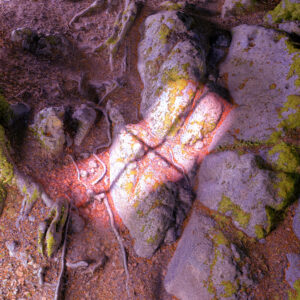
James Rushford tops over a decade of solo and collaboratibve work with Oren Ambarchi, Crys Cole, Will Guthrie, Graham Lambkin and Klaus Lang on this fathoms-deep, psychedelic treat, a next-level arrangement of microtonal drone, decaying concréte fuzz and windswept, somber melancholia recorded for the Shelter Press label.
James Rushford impressed earlier this year with his excellent Black Truffle collab with Will Guthrie “Real Real World”, and he here heads further into the nether-realm on ‘Lakes From The Louvers’, an album that draws its inspiration from the interplay of shadow and light he observed on the surface of the lake and through his window while at an artist residency at La Becque on the shores of Lake Geneva in Switzerland. Rushford’s detailed sound particles and concrète world-building echo the tantalising shimmer of light on water, with amplified movements, synthesized squawks, pings and harp notes rippling across the length of each track. It’s music that accurately represents the landscape but is far from ambient - instead Rushford sculpts soundscapes that demand patient, attentive listening.
The slow-moving, deliberate processes that Rushford has been honing over the last 15 years betray a sensitive ear, swerving pretentious, exclusionary art for arts sake nonsense. This is electro-acoustic experimentation with a beating heart, designed to trigger thought and self reflection. Just clap yr ears around ‘Hyaline Apples’ as it melts buzzing clouds of synth into jagged harp plucks and woodblock percussion, or standout track ‘The Bise’ and its disquieting haze of microtonal bliss. When the album comes to a satisfying close on ‘Dents Du Midi’, it feels like the finale of a muticolored odyssey, as tangled synth notes fold in on themselves like an MC Escher painting. Futuristic and ancient, ‘Lakes From The Louvers’ is a breathtaking album that unspools with the patience it no doubt took to create.
25,00€
Out of stock

LP
ALTAR OF FLIES
“Bortom Reven”
Cold crushed electronics and tape noise by iDEAL faithful, Altar of Flies, returning to his native Swedish label with a 3rd album of possessed and unsettling tonal abstraction and psychoacoustic isolationism
Known to the reaper as Mattias Gustafsson, Alter of Flies is the Mjölby-based sound artist’s most prolific alias, responsible for dozens of tapes and LPs for Chondritic Sound and White centipede Noise beside his trio of turns for iDEAL since the mid ‘00s. ‘Bortom Reven’ sticks closely to what he does best, conjuring bleakly depressive atmospheres ripe for inhabitation by the harder-to-please followers of North European ambient and industrial musicks, with an alchemic application of field recordings, tape loops, and primitive oscillators that vividly brings his thoughts into the dark light.
‘Bottom Reven’ is perhaps reflective of a certain, ascetic and isolated Swedish characteristic, enacting solitary rituals that better connect Altar of Flies with his environment, or simply entertain him during long, cold, dark nights. With hints of CMvH’s EVP and John Duncan’s searching shortwave radio textures to ‘Hur regn uppstår,’ and more ruptured reception of scrambled ether voices in ‘Terapimusik,’ alongside the title track’s worn-out nub of intrigue, and the damp basement clangour of ‘Under vår livstid’; its not one for those who get shook by the sight of their own shadow, but a real treat for listeners of a lonelier disposition who get off on the sound of the house creaking at night.
19,00€
Out of stock
LP
Jim O’ROURKE
“Too Compliment”
DDS catch enduringly absorbing sonic alchemist Jim O’Rourke at his knottiest and most ingenious in a wormholing suite of amorphous rhythm and psychedelic electronics - a massive RIYL Autechre, Roland Kayn, Bernard Parmegiani, NYZ, Keith Fullerton Whitman.
Playing up to and into DDS’ freeform aesthetics, O’Rourke renders 40 minutes shearing hyaline synth tones and ruptured rhythm generated at his Steamroom facilities in Tokyo, a modular out-zone trawling that harks back to his iconic Mego releases and some of the more recent Steamroom experiments. It’s an ideal addition to the ever expanding DDS cosmos, following Demdike’s recent ‘Drum Machine’ expo with a slice of purist and screwed modular magick that transcends early electronics and modern styles in pursuit of musical sensations that defy stylistic brackets.
‘Too Compliment’ was assembled using a bespoke Hordijk modular system, a rare West Coast-style setup hand made by Dutch engineer Rob Hordijk. O’Rourke focuses on the frequency shifter here, using it to coax out fluxing tone thickets, haphazard frequencies and elongated drone corridors. It’s transportive stuff, harking back to the early days of private press academic synth music but also sitting on edge alongside Autechre’s recent long-form work, as well as O’Rourke’s classic “I’m Happy, And I’m Singing, And A 1, 2, 3, 4”
In O’Rourke’s hands, the mass of electronics takes on throbbing, organic dimensions, congealing grey matter and purplish veins of fluid in viscous transitions that glisten and spark with invention as they form new tissue. What comes out is as unearthly as the earliest electronic music, but also blessed with a psychedelc spirit in a way that’s long kept O’Rourke right out on his own, teetering between paradigms yet never settling into any single style. If you’ve always been keen on finding a way into that sprawling soundworld, ‘Too Compliment’ is a perfect entry point into a highly rewarding creative macrocosm.
28,00€
Out of stock
LP
FUJITA
“Komori”
Japanese pipe-organ builder and sound artist Yosuke Fujita provided us with one of the prettiest, weirdest records that passed over our desk last year, essentially a custom-built organ duet with a bat colony, recorded in a cave beneath Mt. Fuji. It’s now been remastsred by Rashad Becker (with whom Fujita will be collaborating on a performance for Issue Project Room next month) and captures a sound somewhere between Sarah Davachi, Eleh, Pauline Oliveros and Kali Malone’s long-form organ dirges, with the bat calls sounding almost like a synthesizer piped thru an echo chamber.
Since 2009, Fujita has been recording almost exclusively with his custom-built pipe organ: a unique instrument made from 11 pipes and a blacksmith’s air pump. All of his recordings are worth hearing, but “KŌMORI” is among the most unusual and rewarding - 40 minutes of alien, pensive organ drone that echoes around the repeating, reverberating squeaks of a colony of bats.
Inspired by the fact that bats were the source of many recent viruses - like Ebola, Nipah and Hendra - Fujita grabbed a Sunken CO-100K microphone that was capable of picking up their ultrasonic echolocation. These sounds, captured in a cave beneath Mt. Fuji, are totally alien, like chattering sine waves or wobbling modular business. It’s the perfect foil for Fujita’s well-worn courtly organ variations that mirror traditional Japanese 7th century gagaku forms.
The rhythmic click of the air pump guides Fujita’s bellowing drones, drowning out the cave’s uneven spaces. Sometimes the bat sounds are reduced to a whisper, at others - such as on the crushing third part - they’re almost deafening. Fujita processes these sounds expertly, occasionally mirroring their fluttering tonalities, at others simply allowing the unusual frequencies to cascade through the empty caverns.
This is properly vital new music - sonically adjacent to Medieval church music, but also austere early electronics, spiked with a brilliantly asymmetric streak all of its own.
26,00€
In stock
LP
Neil LEONARD
“Sonance for the Precession”
Excerpts from a sound installation based on alto saxophone recordings and electronic sound. "Mr. Leonard creates a haunting, rhythmic, chantlike score, secular spiritual music for a New World. After leaving the gallery I kept hearing it, with delight, in my head, on the street, all afternoon." --Holland Cotter, The New York Times.
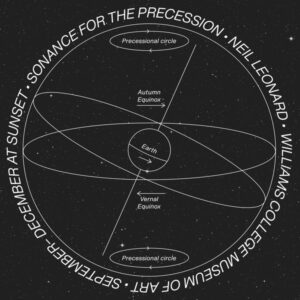
The electroacoustic composition Sonance for the Precession was commissioned by Williams College Museum of Art (WCMA). The piece furthers Leonard's practice in large scale sound installation, with recent commissions by documenta, Venice Biennale, and Fujiko Nakaya of Experiments in Art at Technology. The original composition, created for the quad adjacent to WCMA, played from the dome of the historic Hopkins Observatory, the oldest working astronomical observatory in the United States. The durational work explored ancient ideas connecting the precession, or movement, of the equinox with the harmonic series. Each day, the music began just a minute or two earlier than the previous day -- mirroring the disappearing sunlight as day turned to night and autumn shifted to winter. 30 minutes of the composition played daily. The composition provided a context to reflect on how Hindu and Greek theories of astronomy and acoustics developed through intercultural exchange as far back as prehistoric times. Working closely with WCMA and producer/engineer Joe Branciforte, Leonard remixed Sonance for the Precession specially for LP and stereo listening. The result is a stunning long form composition that brings the sense of contemplation, cosmic motion and intimate timbral nuance of the installation to your living room, headphones and/or car stereo.
18,00€
Out of stock

LP
Allen RAVENSTINE
“Electron Music / Shore Leave”
Waveshaper Media presents Electron Music/Shore Leave, a new LP by former Pere Ubu synthesist and electronic music trailblazer, Allen Ravenstine. The LP is comprised of two EPs (1 per vinyl side), the first two parts in Raventine’s new Tyranny of Fiction series. Waveshaper Media first came into contact with Ravenstine when we interviewed him in 2012 for our modular synthesizer documentary I Dream Of Wires.
For those in the know, Allen Ravenstine has been one of the most creative synthesizer players of the past forty-plus years. Ravenstine started out in the mid-1970s experimenting in his Cleveland apartment with an analogue EML 200 synthesizer, eventually creating a piece in 1975 that became known as Terminal Drive. While he had no intention of releasing his compositions, word got out about the kind of sounds he was experimenting with, which led to an invitation to join pioneering “avant garage” group Pere Ubu for the recording of the group’s first 45, “Thirty Seconds Over Tokyo.” He soon joined Pere Ubu full-time, bringing to the band’s sound unpredictable textures, effects, bleeps, squalls, pulsating washes of sound—whatever he felt could enhance the soundscape of the band’s performances and recordings.
By the early 1990s, Ravenstine had grown sick of the road, band infighting and the music industry in general. Deciding a change was needed, he opted to forego music altogether, making his living as an airplane pilot. His music career remained in limbo until 2012, when an interview for the I Dream Of Wires documentary, alongside Robert Wheeler who had succeeded him as Pere Ubu’s synthesist, turned into a recording session for the duo, leading to a series of collaborative releases. As well as having his 1975 Terminal Drive recordings released to great acclaim in 2017, Ravenstine has been prolific in recent years, with Electron Music/Shore Leave now marking his 3rd solo full-length.
Electron Music/Shore Leave brings together ten of the prodigious composer’s most recent lyrical and abstract compositions collectively comprised of the sounds of analogue and digital synthesizers, traditional acoustic instruments and the sampled sounds of birds, dogs and other artifacts of nature. Working prodigiously on a daily basis, over the past two years Ravenstine has amassed a large number of atmospheric recordings that he has intuitively aggregated into groups of five pieces each. The first five recordings, subtitled Electron Music, are found on Side A of this LP while the second five, Shore Leave, comprise Side B.
Ravenstine played the majority of the sampled instruments on these recordings as well as piano, Moog theremin, a Roland Aerophone and a bevy of synthesizers including a Korg MS20, EML 200, and a Doepfer Dark Energy. Recording virtually over the internet due to the covid pandemic, collaborators from around the world contributed Ondes Martenot, prepared piano, transverse flute, trumpet, saxophone, double bass and percussion. The result is a heady, disparate brew of compositions that range from abstract to lyrical, in the process conjuring up a bricolage of ambient soundtracks, jazzy miniatures, space age exploration, world music, Erik Satie-like studies and the ghost of Harry Partch. As a collection Electron Music/Shore Leave is a stunningly mature work that provides new and surprising sonic rewards with each and every listen.
The album contains 10 songs on vinyl LP - limited to 300 copies.
19,00€
In stock

2 LP
Ellen FULLMAN
“In the sea”
Ellen Fullman began developing The Long String Instrument in her St. Paul, Minnesota studio in 1980 and moved to Brooklyn the following year. Inspired by composer and instrument builder Harry Partch, Fullman's large-scale work creates droning, organ-like overtones that are as unique in the world of sound as her vision of the instrument itself.
Along with her 1985 debut album – appropriately titled The Long String Instrument – Fullman's only output in the 1980s would be two self-released cassettes, In The Sea and Work For Four Players And 90 Strings, recorded in 1987 at an unfinished office tower in Austin, Texas. This double LP collection features music from both cassettes as well as a previously unreleased piece from 1988 at De Fabriek in Den Bosch, Holland.
Ethereal and exquisitely paced, these rare recordings capture minimalism's quiet radiance. Within a musical landscape that has seen the rise of contemporary drone practitioners like Ellen Arkbro and Kali Malone, Fullman is sure to find a legion of fans.
Superior Viaduct is honored to present this long overdue archival release that marks a particularly vibrant period of Fullman's pioneering and timeless work.
29,00€
Out of stock
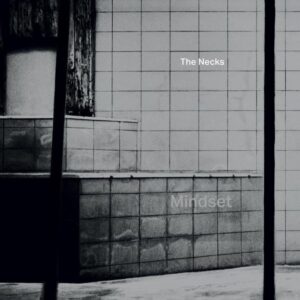
LP
THE NECKS
“Mindset”
Long awaited re-issue of The Necks 2011 masterpiece. Always different, here the Necks resolutely layer polyrhythmic material to form seething blocks of sound - in two long pieces, one more stripped back to the live trio, the other featuring multiple strata of swirling Hammonds, noise-guitar and electronics. Their 16th release still resonates on its own.
21,00€
In stock
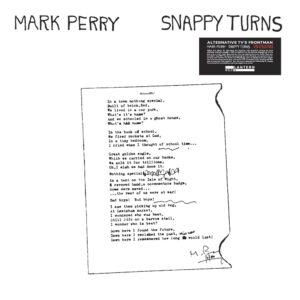
LP
Mark PERRY
“Snappy Turns”
Debut solo album for Alternative Tv frontman and long-time running Uk punk scenester, originally released in 1980 on Deptford Fun City Records. Mark Perry was also the man behind the iconic Sniffin' Glue zine, founded in July 1976. The album was produced by Grant Showbiz, principally known for his work with The Fall, The Smiths and Billy Bragg, and it is literally an art-rock nugget. Sort of an autobiographical work, the record is full of twisted hooks, showing the dark side of post-punk. Less hysterical than the output released with Alternative Tv, Snappy Turns should be considered as a post-apocalyptic pop record. It could have been easily included in the infamous Nurse With Wound list (guess what, his former band was there) introducing several connections to the so-called ‘grey area’. In particular, the disturbing tape loops and the violin heard in Death Looks Down are perversely informed by late Throbbing Gristle, a band seriously informed by the same aesthetics (Alternative Tv used to rehearse in TG studio in Hackney back in the days, while former ATV member Alex Fergusson founded Psychic Tv with Genesis P-Orridge). As the shadow of doubt surrounds our nearby future, Snappy Turns could be easily an appropriate soundtrack.
Contains two bonus tracks from the 1980’s 7”: The Whole world’s down on me.
28,00€
In stock

LP
Marcus SCHMICKLER
“Sky Dice / Mapping the Studio”
Marcus Schmickler's music is designed for multi-channel sound projections and references German electronic music tradition, spectral music, experimentalism as well as 1990s club music. His artistic practice explores avant-garde trajectories in electronic music composition, formal systems, sonification and psychoacoustics. EMEGO 296 features two new major works from this audacious sound explorer.
Sky Dice / Mapping the Studio premiered at Donaueschinger Tage fur Neue Musik 10.20.2018 having being commissioned by SWR and realized at the Experimentalstudio (EXP) in Freiburg. This is a work for ARP 2500, Publison DHM89B, Publison Infernal Machine and Computer. Taking cues from Bruce Nauman's Mapping the Studio I (Fat Chance John Cage) (2001) the piece draws a fragmented acoustic map of the SWR facility itself; the studio serves as a source-model for the sonic display of historical signal flow graphs. Various acoustic and psychoacoustic effects come into play including the Larsen effect, as well as Style Transfer and Topological Sonification. The result is a daring and dizzying display of disorientating audio. Sound moves in most unusual ways, rising and falling simultaneously, appearing and disappearing like apparitions, nothing here behaves in expected ways. To paraphrase Albert Einstein’s now famous quote regarding quantum mechanics, this is spooky audio at a distance.
Fortuna Ribbon is a selection of sonic material that emerged from a research based on how DPOAEs (Distortion Product Otoacoustic Emission) can be designed in the context of musical frameworks, augmenting the compositional pallets in regard to spatial hearing. In this manifestation, the materials are presented without context. The resulting emissions from the ear that are excited in varying ways from the 6 examples on display here. Playback in undisturbed acoustic environments is recommended at >82 dB/A.
Schmickler’s ongoing investigation of sound matter conjures impossible audio that delight’s in the extremity of form and resulting effects on the listener. Schmickler’s audio invocations explore the capabilities of contemporary technology resulting in dizzying new worlds of sound.
20,50€
Out of stock

LP picture
Aaron DILLOWAY
“The Beauty Bath”
Restock 2021
"Alternate version of very limited LP (250 copies) on Japanese label Rockatansky. About 50% of this is actually different & reworked material than what is on the Rockatansky LP. This edition is a one time pressing limited to 500 copies. Recorded 2008 / 2013. Mastered for vinyl by Jason Lescalleet."
"...an amazing LP, with low-level battlefield tectonics and the sound of smeared and tortured magnetic tape coming over like a rusty, Industrial scale take on classic 20th century minimalism. Some of Dilloway's most barbarously vacated drone work here, with intense low-level fireworks reduced to inchoate shadow plays and rolling, planetary scale hypnotics. Then there are moments of glissing, echoing metal tones coming out of silence, suddenly morphing into sad feedback chorales ala Eliane Radigue's early workings but with a crude, lonely aspect that is extremely affecting. One of Dilloway's most personally expressive tone works with intensely sad feedback drones circling wraiths of clanking magnetic tape." ---David Keenan, Volcanic Tongue
26,00€
In stock

2 LP
ORA CLEMENTI
“Sylva Sylvarum”
Black Truffle is pleased to present Sylva Sylvarum, an epic new work from Ora Clementi, the collaborative project of crys cole and James Rushford. Primarily conceived and recorded over several months together in Melbourne, Sylva Sylvarum is a stunning step forward from the mumbled, creaking sound world of the duo’s debut, Cover You Will Softer Me (Penultimate Press, 2014). From the opening ‘Peach of Immortality’, which takes an unpredictable journey from layers of chiming bells, vocal harmonies and lush synth pads to a desolate landscape of half-animal, half-digital wooshes and cries, it is immediately clear that cole and Rushford are working here with an entirely unique sound palette. Throughout the record’s four sides, we hear a large array of carefully detailed synthesizer sounds (many of them recorded at the remarkable Melbourne Electronic Sound Studio), sparse drum machine hits, wind instruments and field recordings of animals, often with a twistedly late 80s/early 90s flavour that at various points calls up New Age references, Robert Ashley’s later operas or the thinned-out textures of early digital GRM.
Threaded through this distinctive array of sounds are the two musicians’ voices, sometimes singing, sometimes speaking through varying degrees of manipulation. A guiding thread through the pair’s collaboration, beginning with their initial experiments with lip-readings, the presence of these two voices – cole’s crisp and sibilant, Rushford’s rich and low – reinforces the sense that the music is immersed in itself, less performed by two people than occurring between them. On Sylva Sylvarum, these voices first come to the forefront on the third piece, ‘Dialogue Between a Grandmaster of the Knights Hospitaller and a Genoese Sea Captain’, where in unison they intone fragments of a description of an imaginary space taken from a 17th century utopian text. The two voices resurface periodically thereafter, most stunningly in the unexpected turn into cushiony dream pop on ‘Magic Mountain’. At other points, the subtle manipulation of pitch and intonation in the close-miked vocal performances filters the recitations through a fog of abstraction that climaxes with the almost incomprehensible alternating syllables of the side-long closer ‘Forest of Materials’.
Like the album’s title, these textual elements are drawn from various literary descriptions of utopias, a theme that also informed the pair’s musical approach. Far from anything dryly illustrative, utopia figures into Sylva Sylvarum as an invitation to inhabit otherworldly spaces that, like the empirical details that proliferate in these literary utopias, are grounded in mundane reality but shot through with the eldritch. Admirably framed by the abstracted digital topographies of Sabrina Ratté’s artwork, the uncanny sweep of the album’s fifteen pieces is expansive enough to take in stretches of crackling austerity, warped microtonal keyboard etudes and moments of stunning beauty, the latter most strikingly when cole and Rushford are joined by Callum G’Froerer on trumpet and Joe O’Connor on trombone for a series of dream-like moments moving from growling overtones to poignant lyricism.
21,50€
In stock

2 LP
Remko SCHA
“Guitar Mural 1 feat. The Machines”
Black Truffle is pleased to announce the first-ever vinyl reissue of Remko Scha’s Guitar Mural 1 featuring The Machines, originally published as a rare cassette edition by Taal Beeld Geluid in 1982. A computational linguist by profession, Scha played an important role in the development of sound, installation, and digital art in the Netherlands from the late 1970s onward, co-founding the performance and exhibition space Het Appolohuis in Eindhoven in 1980. Alongside Paul Panhuysen and Jan Van Riet, Scha was a founding member of the radical improvisation group The Maciunas Ensemble, though he is best known for his work with mechanised electric guitars, documented on the legendary 1982 LP Machine Guitars.
Guitar Mural 1 documents an installation of Scha’s mechanical guitar ensemble The Machines held at a Groningen gallery space in 1982. Five electric guitars hang from the wall, their strings sounded by rotating rubber strings and a sabre saw controlled by a mechanical apparatus, as well as four ropes criss-crossing the five instruments on the wall. Once the mechanism was set up, Scha’s only intervention was to vary the speed at which it operated. Where Machine Guitars presents short excerpts clearly distinguished by rhythmic and timbral variation, here we are confronted with four enormous side-long slabs of percussive string attack and the resulting clouds of harmonics. Variation is minimal across the duration of each side, making for a sculptural listening experience, as if we are patiently examining each facet of a static object. But significant variety exists between the four sides, each of which shows off a different facet of what The Machines were capable of. The first two excerpts feature open strings sounded at rapid tempos, dissolving the percussive attack into a continuous stream of sound reminiscent of Charlemagne Palestine’s ‘strumming’ technique. On the third side, the strings are partly muted and the tempo slightly lowered, resulting in layers of relentlessly chugging rhythm somewhere between an ensemble of hand drums and an early Velvet Underground bootleg. On the fourth side, havoc breaks loose in percussive waves of asynchronous repetition that bring Scha’s sound world close to that of another pioneer experiment in musical mechanisation, the Solar Music of Joe Jones.
Presented as a limited edition 2LP set in a deluxe gatefold sleeve accompanied by stunning visual documentation of the original installation, remastered audio and new liner notes from Alan Licht and Van Lagestein, Guitar Mural 1 is an exhilarating document occupying a unique space between kinetic sculpture, hardcore minimalism and rock & roll.
25,00€
Out of stock

LP
Sam DUNSCOMBE
“Outside Ludlow / Desert Disco”
Outside Ludlow / Desert Disco is the first major solo release from Australian performer-composer Sam Dunscombe, now based in Berlin after residing for the past decade in San Diego and Tokyo. A virtuoso clarinettist who has performed in composed and improvised settings with artists such as Klaus Lang and Taku Sugimoto, their practice also embraces computer music, lo-fi electronics and field recordings, in addition to their long-term commitment to archiving, studying and performing the work of Romanian spectralist composer Horatiu Radulescu.
The two side-long pieces presented on this LP began from a chance encounter in a specific geographic location (documented in the photographs that grace the record’s sleeve). Exploring California’s Mojave desert with a friend, Dunscombe made the unlikely discovery of a tangle of quarter-inch tape snared on a cactus. The digitised version of this tape, variously edited and processed, as well as Dunscombe’s own transcription and embellished performance of some of its material on Hammond organ, makes up one of the main ingredients of the LP’s first side. The other is a field recording of the area outside the ghost town of Ludlow, where the tape was found, where haunted silence is punctuated by freight trains and clusters of explosions from gold mines and the local marine corps. Far from any kind of documentary approach, the resulting composition reaches back to the smeared atmospherics and overdriven tape crunch of Hands To, Small Cruel Party or Joe Colley, before the Hammond organ rises up to cast a spectral shimmer reminiscent of 1960s tape music classics like Arne Nordheim’s ‘Warszawa’.
On ‘Desert Disco’ (its title perhaps a clue to the content of the mysterious tape), Dunscombe zeroes in on a single fragment of the tape, accompanying it with analogue synthesis to craft an immersive work based on a single chord. Throughout the course of this work, the monolithic opening sonority gradually splits apart, revealing an infinity of rhythmically phasing lines that swarm like a cloud of insects and patter like falling rain, placing Dunscombe’s piece in a lineage of patient electronic exploration that includes landmarks like Costin Miereanu’s Derives and the contemporary work of Jim O’Rourke.
20,00€
Out of stock
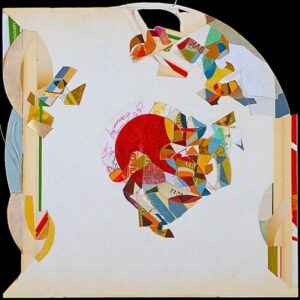
LP
Frantz LORIOT
“While Whirling”
On While Whirling, French-Japanese violist Frantz Loriot unleashes the essence of the viola as an explosive expressive force. Pushing the instrument to extremes, he ceaselessly explores its most subtle and unexpected sonorities. From a single acoustic string instrument, he miraculously teases and evokes hallucinatory impressions of harpsichords pounded, bells struck, electronics cracked, dirt shoveled; Loriot has created a unique, personal music filled with moments of textured transcendence and tension-filled tenderness. While Whirling is Loriot's second solo album and a masterclass on how to develop a radically personal musical language. As a third-generation classically-trained musician, Loriot's rupture with that tradition is striking as he continues to challenge every pre-conceived relationship between instrument and instrumentalist. Having first been inspired to rethink the physicality of musicianship by hearing Tom Cora's playing on his collaboration with the Dutch punk-rock band The Ex, Loriot sought out a series of teachers that could further expanded his sense of the musically possible/possibly musical. From Joëlle Léandre, he was opened up to the combination of aesthetics and politics; from Barre Phillips and his "large calm energy," Loriot learned about the necessity to get uncomfortable in his music-making. And from David S. Ware, he took an understanding of music as a matter of life and death. To his biological and pedagogical foundations in classical music, Loriot supplemented his understanding of music's force with realizations of vitality, awareness, and danger. While Whirling was recorded in the acoustically balanced space of Das Institut in Zürich, a small, intradisciplinary art space with angled walls on the top floor of a residential building on a quiet street. Because Loriot knew that he wanted to focus on both capturing and unspooling specific acoustic phenomena that he sought to manifest, he had to choose a place that would be ultra-conducive to intense focus, yet still casual enough to make room for life to burst in. As a sequence of solo excursions, each track on While Whirling rewrites the balance between improvisation and composition. The drama of Loriot struggling to complete a sequence after arriving at a texture he so clearly strove for puts the listener in an extremely privileged position; you have the pleasure of hanging on to each desperate subtlety of his decision-making process as he pushes himself and his music further and further across the vanishing edges of ever-expanding horizons. Deluxe LP with download; Heavy tip-on jacket with embossing and spot finishes; Full color inner sleeve and insert.
23,00€
Out of stock
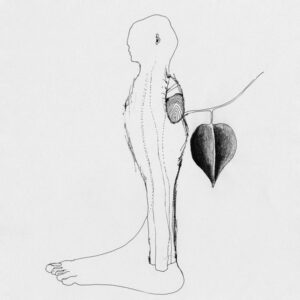
2 LP
Jean-Luc GUIONNET
“L’épaisseur de l’air”
Thin Wrist Recordings release L'épaisseur de l'air (the thickness of air) by Jean-Luc Guionnet. After more than three decades playing the alto saxophone, this is the French artist's first solo saxophone album. Since the 1990s, Guionnet has built a renowned and thrilling oeuvre of works with pipe organs, electronics, and field recordings as both an improvisor and composer; L'épaisseur de l'air finally documents his dedication to exposing sides of the alto saxophone that quite simply never existed until he developed them. His tone is as clear as direct sunlight, so when he boils it in mud or scratches at it as if for air, his emotion is palpable. A double-LP masterpiece and a definitive statement about the profound physical relationship between an improvisor and their instrument. A student of Xenakis at the Sorbonne, Guionnet has constantly explored the philosophical side of music; his work interrogates fundamental questions about skill, intuition, experience, and performance that arise through improvisation. He has instigated and featured in unexpected collaborations such as performances with noted British philosopher Ray Brassier and artists Seijiro Murayama Mattin as well as his long running artistic partnerships with dancer and choreographer Lotus Edde Khouri. For this album, Guionnet retreated to a barn in Brittany, where he recorded by himself at night over the course of a few weeks. Each of the nine improvisations -- spanned across two LPs -- uncovers such particular sonic territory that it's a miracle the whole adds up to such a complete statement. But by pushing space and silence so startlingly and oblongly into the pieces, the gnarled, gritty textures of his tone begins to make sense as a response to time that is forever shifting in such unpredictable ways that you better get into it while it's still coming out. Direct metal mastering at Calyx Mastering Berlin. Pressed at Record Technology, Inc. (RTI). Deluxe gatefold double LP with download; Heavy tip-on jacket including debossed and embossed inserts.
34,00€
Out of stock

LP
Yoshi WADA
“The Appointed Cloud”
Saltern present the first-time vinyl edition of Yoshi Wada's The Appointed Cloud (1987), a work which Wada has often said is his favorite of his own. Staged at the Great Hall of the New York Hall of Science, The Appointed Cloud was Wada's first large-scale, interactive installation and featured a custom pipe organ, among other homemade instruments, controlled by a computer with a customized interface and software designed by engineer David Rayna, known for his work with La Monte Young. This recording captures the opening performance for which Wada brought together four musicians on bagpipes (Wada, Bob Dombrowski, and Wayne Hankin) and percussion (Michael Pugliese) to perform with the installation, operated by David Rayna. Remastered from the original master tape by Stephan Mathieu, and cut to vinyl via Direct Metal Mastering by Hans-Jörg Maucksch at Pauler Acoustics. Pressed at RTI and printed at Stoughton. Includes a digital download of the album. Edition of 600.
In Wada's own words: "This performance [of The Appointed Cloud] was one of most memorable performances I've done. The space itself -- the Great Hall of the New York Hall of Science -- was incredible. The building was designed for the 1964-65 World's Fair and had spaceships hanging from the ceiling so people felt like they were traveling in outer space. It was an amazing experience with the sound of the pipe organ, sheet metal, pipe gong, and bagpipes all together. 60 minutes may seem like a long duration, but it didn't feel like it."
26,00€
Out of stock

LP
Philip CORNER
“Through Mysterious Barricades with George Maciunas”
New Philip Corner LP on Recital. Voice recordings from a small performance in Italy, early in 2020 -- Homages to/from George Maciunas (1931-1978). Corner's piano meditative playthroughs of Couperin's The Mysterious Barricades (1717), from 1989 and 1992. These two elements (voice and piano) superimposed by Sean McCann, edited during the first month of the pandemic. Manic exaltation, distorted harmony things. Album cover is a few PC scores soaked in olive oil and held in-front of the sun through my kitchen window. Booklet features passionate writings on the Couperin piece and its meaning by Corner. Philip wrote a new reflection for this LP edition, "The Mesure of the Mystery". This album is built from the finest ingredients: beautiful piano with stomach-c
lenching voice stretches. Edition of 250; 12-page pamphlet of scores and an essay by Corner.
27,00€
Out of stock
LP
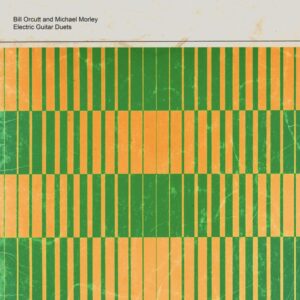
Bill ORCUTT & Michael MORLEY
“Electric Guitar Duets”
LP reissue of Land And Sea's limited 2016 tape documenting a performance by guitarists Michael Morley and Bill Orcutt at the L&S gallery in Oakland.
"... Once regrettable antics were permanently affixed to the rearview mirror, the pair chauffeured across the bay to Land And Sea, the cozy gallery on San Pablo Avenue in Oakland and sobered up on vegan cocktail wieners and gummie vitamins. You may doubt, you may scoff -- have fun with it, champion, seriously -- but on July 6, 2016, they rendered a landscape where miniature squalls grind in between seamlessly intersecting improv, and they did it sharp as the slap of a palmful of plum-colored hazelmyer elixir following a good, close shave. The distinctive sound of the Fender Telecaster as played without effects by Orcutt ('one of music's premier abstractionists,' according to Osmo Montesanto) remains unblunted throughout the album, an aggressively serrated presence within Mr. Morley's contrapuntal flanking. This freely improvised performance is imbued with discipline and deliberate restraint, the better to connect the players more to the sound than to the instruments . . . The duo's number-one fan worldwide Cye Husain, pictured on the back cover, would surely attest that the singular structure-building of Orcutt and Morley defies and transcends most any 'well, actually' bloviature that the usual bore-splainers will need to hurl into the troposhere. For instance, that a third guitar is clearly audible at certain parts in the mix -- beautifully recorded by Gabie Strong, by the way -- can be accounted for most sensibly by Aotearoan metaphysics. Mr. Morley's ax of choice was 'Patu Tutae Opoko Nui, a 2006 Squire Telecaster made in Indonesia that I had modified over the years. It died and was ushered up to Valhöll in Gothenburg, Sweden in 2018.' Readers opting to take a moment to refer to Morley's Instagram post dated 6 June 2018 and view the last rites of this extraordinary combination of wood and metal should do so now. He cried. You should expect to do the same . . . Electric Guitar Duets is that otherworldly modulation we all crave and rarely find, hovering halfway between a deeply satisfying lattice of blurred sky roars and the soundtrack from a Stefan Jarworzyn biopic scored by Sergio Leone left on the floor out of its sleeve. Morley and Orcutt hold everything sideways at least as well as the centrifugal force required for slow-motion footage of mannequins riding tiny motorcyles around the inside of a chrome replica of Lee Van Cleef's skull. For other examples of fluid-splattered shards glistening inside crimson murk pulsations, only murder rolling through cold, cold blood comes to mind as superior to this 44-minute live recording." --S. Glass
21,00€
In stock

LP
Judith HAMANN
“Shaking Studies”
Nomadic Australian cellist and composer Judith Hamann presents two collections of her sonic inquiries into shaking and humming. Her LP, Shaking Studies, is a collection of iterative cello performance that foregrounds shaking as a generative subject. In addition to an arsenal of techniques for registrable shaking, Hamann's conception of the term emphasizes micro and macro pulsing, including tremors, vibrato, wolf tones, and complex partial activity. Hamann begins with a sphygmological reading of the pulse of her cello, inciting it to shake audibly and visually as a symbiotic basis for determining the rate of her own left hand's tremor and consequent direction of resonant frequencies. Following a thorough harmonic investigation of her shaking practice in two parts, she directs us to look outwards, combining beating chordal structures with electronics and recordings of real world shaking. From inner pulse to more macrocosmic quaking, Hamann's alternative conception of shaking rejects measurement and regularity, order and control, instead alluding to a more responsive and intuitive mode of convulsive sounding. It's presented alongside the CD set, Music for Cello and Humming (BF 018CD). Judith Hamann undertook her doctoral studies with renowned cellist Charles Curtis, with whom she is currently engaged in a discourse-based project, "Materialities of Realisation." She has additionally demonstrated a superlative capacity for improvisation and engagement with sonic arts through work with artists Dennis Cooper, Éliane Radigue, Áine O'Dwyer, Ilan Volkov, Toshimaru Nakamura, La Monte Young, and Marian Zazeela, Golden Fur, Jessika Kenney, Anna Homler, Yvette Janine Jackson, and Lori Goldston, among others. Her recorded appearances include Tashi Wada's Duets, Graham Lambkin's Community, Alvin Lucier's Illuminated By The Moon, and Gossamers, with Rosalind Hall. Edition of 500.
21,50€
Out of stock

2 LP
Catherine Christer HENNIX – CHORA(S)SAN TIME-COURT MIRAGE
“Blues Alif Lam Mim”
Having already unearthed three collections of archival 1970s recordings by Catherine Christer Hennix, Blank Forms continues their annual illumination of the visionary Swedish composer's music by turning to more recent work with this first-time vinyl edition of Hennix's Blues Alif Lam Mim in the Mode of Rag Infinity/Rag Cosmosis, a 2014 piece first released as a CD in 2016. The double album captures the April 22, 2014 premiere of the composition by the Chora(s)san Time-Court Mirage, Hennix's expanded just intonation ensemble, featuring a brass section of Amir ElSaffar, Paul Schwingenschlögl, Hilary Jeffery, Elena Kakaliagou, and Robin Hayward; live electronics by Stefan Tiedje and Marcus Pal; and voice by Amirtha Kidambi, Imam Ahmet Muhsin Tüzer, and Hennix herself. Intended to reveal the origins of the blues in the Eastern musical traditions of raga and makam, Blues Alif Lam Mim in the Mode of Rag Infinity/Rag Cosmosis has its roots in Hennix's 2013 realization of an Illuminatory Sound Environment, a concept developed in 1978 by anti-artist Henry Flynt on the basis of Hennix's own The Electric Harpsichord. As Hennix explains in Other Matters, Blank Forms' 2019 collection of her writings: "Rag Infinity/Rag Cosmosis presents fragments of 'raga-like' frequency constellations following distinct cycles and permuting their order, creating a simultaneity of 'multi-universes.' When two such 'universes' come in proximity of each other and begin unfolding simultaneously along distinct cycles, there is a kaleidoscopic exfoliation of frequencies as one universe is becoming two, but not separated -- the effect of cosmosis is entrained, binding two or more frequency universes into proximity where their modal properties interact and blend, creating in the process entirely new microtonal constellations in an omnidirectional simultaneous cosmic order with phenomenologically 'transfinite' Poincaré cycles (cyclic returns to initial conditions). As with Hennix's best work, the organic unfolding of this quivering drone belies a precision that opens onto the infinitesimal. Over this mesmerizing ebb and flow, vocalists incant an Arabic-language devotional poem written by Hennix that features quotations in praise of Allah from the Quran. Also reproduced on the album's gatefold jacket is Hennix's elegant reduction of the sacred text, represented as the first letter of its first line gradually paired down to a single dot, which invites the contemplator to bring their inner knowledge to the composition for use as a meditation prompt. Listeners without spiritual inclinations, but who are willing to immerse themselves in the music, will find the work's serene intensity to be its own reward."
36,00€
Out of stock
LP
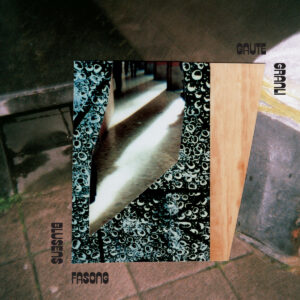
Gaute GRANLI
“Blusens Fasong”
The Norwegian wunderking of demented psychedelic song (de)structure is back with a fantastic collection of soft madness. His Animalskt LP was played in the UE office until you could see through it. Gaute Granli is a one man band, taking a complete stranger with thirsty ears by the nose to leave him/her/them behind, confused and hungry for more recognizable hope.
There's a constant form of recognition going on here in these 8 stretched songs, these strange flirts with folk music you think you know from somewhere, vocals that don't sound like they consist of words one knows, and pop parts that are stripped by a psychedelic gnome messing with loop pedals. Although everything magically works, and made it into a song structure of sorts, a melancholic almost religious dust of desperation sits uncomfortably on all these tunes, like a frog that was already licked on the back.
Limited to 300 copies, comes with an insert, a download code and a UE sticker
20,00€
In stock
LP
OGON BATTO
“Browse”
Ōgon Batto is an exercise in patience; indeed, a model of restraint in these trying times. Although a fixture of the Belgian underground for over a decade (as part of the Hare Akedod label and band, the latter with DSR Lines’ David Edren), Bent Von Bent has released just two albums thus far.
A scroll through ‘Browse’ reveals a series of miniature compositions — bite-size psychedelic treats, a sequence of imaginary hyperlinks and clickbait for Generation Instant Gratification, reminiscent of the early work of Battiato, Francois De Roubaix, and Igor Wakhévitch.
Limited edition of 300 copies. Includes an insert, download code and a UE sticker.
20,00€
In stock
LP
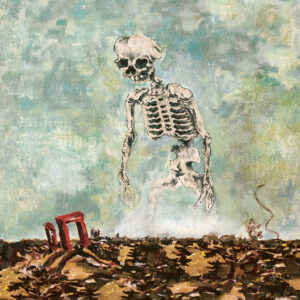
PAPIRO
“La finestra dentata”
Papiro’s approach to music is never technical, but always personal. Since the mid-Nineties, he has released a handful of noteworthy albums, each carefully put together and seemingly self-contained, yet all sharing an unmistakable musical language and a certain escapist aura.
La finestra dentata (The Toothed Window), is no exception. It includes both studio and concert recordings from 2016–2020. The sounds on this album appear infinite and full of marvels, ingenious in portraying imaginary creatures and environments.
The title track and Anelli take up most of the first side and include live outtakes. Papiro likes to describe his performances as therapeutic. These swirly symphonies are specifically intended as immersive deep-listening experiences for concert venues, and have been edited for this album to meet the physical demands of vinyl and domestic use. Imagine the younger cousins of Laurie Spiegel’s Concerto Generator performance, or Terry Riley’s Shri Camel.
However, those who know Papiro only from the stage might be unaware of a different side to his oeuvre; starry-eyed miniatures that may appear frivolous in comparison to the more heady tracks, but are nonetheless well worth discovering. Each piece adds a chapter to a phantasmagoric world populated by such characters as "Giant Duckling", "King Hard-Beard", or the "Bodulator". Tracks like the opener Odilon or Il triciclo nascosto, meanwhile, emanate a candor rarely found in the domain of serious music, and revisit Papiro’s early days of instrumental storytelling.
24,00€
In stock
LP
David FENECH & KLIMPEREI
“Rainbow de nuit”
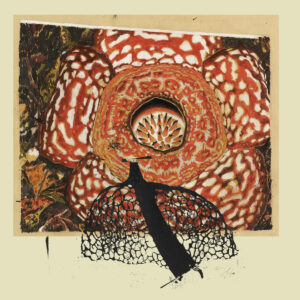
Maestro melodist Christophe Petchanatz (aka Klimperei) and all around music fanatic David Fenech engage remotely in a repetitive exchange of recordings and overdubs on their debut album titled ‘Rainbow de Nuit’, sporadically spanning over the last decade. Evocations of experimental and improvised jazz, chansonesque songs, bluesy folk, and outsider music undulate harmoniously across the record. From music boxes and walkie-talkies down to plastic straws, plucking various stringed instruments such as the charrango and banjo, kazoos and snake-charmer ocarina and flutes, all the way through the sweet accordion and melodica, found and traditional tuned percussion - there is far from a shortage of sound sources on this freakishly inviting record. What germinates as an imaginative and emotional chord progression played by Klimperei, evolves with Fenech layering additional recordings, which would then find their way back home to Klimperei yet again, and so on, and so forth. This recursive compositional and improvisational loop, combined with Fenech’s musique-concrete-like mixing and editing techniques, transforms the acoustic recordings by way of compression, saturation, and reverberation or simple pitch changes - resulting in the duo’s recordings seemingly sound like they may very well be an octet in real time. While the majority of the recordings have been ping-ponged remotely, David and Christophe unite under one roof to record the closing track of the album.
The pieces presented on ‘Rainbow de Nuit’ treat the ears to a carousel ride waltzing through a multiverse made up of surrealist puppet theaters, dramatic film noir act changes, and a mosaic of polyphonic instruments and toys alike. In other words, a score to a fable brought to life with haunting yet charming melodies and occasional hallucinatory voices reminiscent of laughter and infantile epiphanies which we hear on Tarzan en Tasmanie and Madrigal for Lola. This is taken a step further by Fenech, to a brief libretto of incomprehensible tongues on Pocarina. Amid the mysterious and dark (Septième Ciel and Rugit Le Coeur) also lies tender and simple compositions (Rainbow de Nuit and Chevalier Gambette), murky suspenseful melancholy (Levy Attend and Eno Ennio), and casually slipping into pensive psychedelic backdrops (Un Cercueil à Deux Places) - forming a colorful blend of sounds. A world of echoes. A tale of tales. One persistent earworm that you’ll likely be whistling and humming along to on a first listen.
24,00€
In stock

LP
Evan PARKER
“Monoceros”
Evan Parker's monolithic 1978 solo record Monoceros was originally released on Incus in 1978, and distinguishes itself in several respects: first, because it was recorded by the direct-cut process, whereby the sound pathway went directly from the microphone to a vinyl master. By virtue of eliminating the tape intermediate, the hope was to reduce noise and limit the need for processing and filters. The important functional consequence of this technology was that the musician (and the technicians) had to get it right the first time. In the context of free improvisation, direct-cut served as self-imposed discipline for purists only. In the present day, this process is mostly obsolete.
On Monoceros, Parker explores a wide range of soprano saxophone work, though most of it is hardly recognizable as such: squeaking, squawking, and birdlike noises persist throughout. The first piece on the record spans a long 21 minutes of essentially uninterrupted solo saxophone, facilitated by Parker's exceptional technical command of the instrument: circular breathing, triple-tonguing, false fingering, etc. The guiding principle of this music, as realized by Parker, was to use technical prowess to remove the barriers between the sounds in his head and the sounds coming from his horn. Generations of saxophone players who followed in Parker's footsteps owe a huge debt to his innovations on the instrument. Indeed, none of Monoceros is easy listening: Parker seems driven to play as freely and outspokenly as possible.
detail
In the pantheon of saxophone colossi, there is a special place reserved for Evan Parker. Taking late Coltrane as his jumping off point, Parker has expanded the language of the saxophone as much as anyone over the past three decades. A central figure in the European Free Improv scene alonside Derek Bailey, Peter Brotzmann, John Stevens, Alexander von Schlippenbach and many others, Parker has been a significant force for creative music in an astonishing array of settings.
"Eight years after Topography Of The Lungs, and two years after his Saxophone Solos, Monoceros was the most muscular statement of Evan Parker's solo saxophone muse. Superbly recorded, it seemed to place the listener within the chaotic air flows of the saxophone’s own tubing. Philip Clark said: “Parker’s dialogue with the saxophone throws up so much that is unexpected, and indeed unknowable, that the problem he faces is how to keep pace with his own invention.” TheWire Best Albums of 2015
21,00€
Out of stock
LP
Evan PARKER
“With birds”
2021 repress.
"One of Treader's most requested recordings sees the great UK free saxophonist Evan Parker on soprano and tenor saxophones, duetting with European birdsong. A fitting tribute to his friend, the celebrated soprano saxophone player Steve Lacy, who died in the year of its initial release."
One of Treader’s most requested recordings sees the great UK free saxophonist Evan Parker on soprano and tenor saxophones, duetting with European birdsong. A fitting tribute to his friend, the celebrated soprano saxophone player Steve Lacy, who died in the year of its initial release. A titan of British free jazz, Evan Parker needs no introduction. His output, both as a bandleader and collaborator, are the stuff of legend. Within the history of the European improvised music, he’s everywhere - having intertwined his singular approach with Peter Brötzmann, Manfred Schoof, Tony Oxley, Derek Bailey, Han Bennink, Alexander von Schlippenbach, Keith Rowe, Barry Guy, and countless others at a ferocious pace. Despite his renown for work within ensembles, Parker often becomes the most striking version of himself when he steps out onto his own, offering an unparalleled approach to the solo saxophone. Evan Parker With Birds is one of the more memorable versions of this. Recorded as a tribute to his friends and longtime collaborator, Steve Lacy, who had died shortly before its recordings, Evan Parker With Birds isn’t technically a solo work.
It features the veteran player consumed by, responding to, and playing against, a sonic landscape of field recordings by Ashley Wales, birdsong recorded by Geoff Sample, Charles & Heather Myers, Jean C. Roche, Myles North & Eric Simms, with further offerings and interventions by John Coxon. The result is so fantastic and engaging, it leaves little question of why it has been one of Treader’s most popular releases since it first emerged. A world of shimmering sonority and rippling, sometimes brittle texture - an album filled witth surprise - elements of nature and humanity forced into balance and harmony by Parker’s tones and ear. A wonderful rethinking a musical structure and creative approach, the announcement for the vinyl reissue of Evan Parker With Birds has already sent the heads scrambling to get a copy.
21,00€
In stock

LP
MUSICA ELETTRONICA VIVA
“Spacecraft”
Musica Elettronica Viva, or MEV for short, was formed in 1966 in Rome by Allan Bryant, Alvin Curran, Jon Phetteplace, Carol Plantamura, Frederic Rzweski, Richard Teitelbaum and Ivan Vandor. From the very beginning the group was based on musical freedom and the shunning of convention. Using contact microphones to record and manipulate sound wherever it could be found – from box springs to vibrators – and improvisationally combining those recordings with tenor sax, homemade synths and the very first Moog to trek cross the Atlantic, MEV made some of the most imaginative and abrasive sounds of the time.
Recorded in live performance at the Academy of Arts (Akademie der Künste) in Berlin on October 5, 1967, Spacecraft is made up of a single piece of the same name – a slow building, jarring and disquieting work that reveals the entire MEV ethos in its lone half hour. As group member Alvin Curran put it “The music could go anywhere, gliding into self-regenerating unity or lurching into irrevocable chaos - both were valuable goals. In the general euphoria of the times, MEV thought it had re-invented music; in any case it had certainly rediscovered it.” Our Swimmer is pleased to present this first ever vinyl issue of MEV’s Spacecraft, an early piece from the most free-spirited group of the 20th century avant-garde.
22,50€