
In stock
LP
Phill NIBLOCK
“Exploratory II”
Vol.2 performed by Phoenix Ensemble Basel.
We have the honor to present to you the new masterful work of Phill Niblock: Exploratory
One of the most beautiful and powerful works that Phill Niblock has ever offered to us! Phill reinvents and probes the oceans of drone music possibilities deeper than ever.
This piece has been performed and recorded for over a year by many great musicians around the world, under the supervision and direction of Phill.
Arditti String Quartet, David Watson, Lucy Railton, Phoenix Ensemble Basel, David Maranha, Ben Richter, David First, Andre Goncalves, and many more.
Matière Mémoire is now bringing the first two volumes to you by Arditti String Quartet, David Watson & Phoenix Ensemble Basel.
Each Vinyl is limited to 300 copies in transparent (Vol I) and transparent red (Vol II) vinyl. Also available on CD
26,00€
In stock
LP
Will GUTHRIE – Jean-Luc GUIONNET
“Electric Rag”
Jean-Luc Guionnet - electric organs, electronics, alto saxophone
Will Guthrie - drums, percussion, microphones
Maxed out and burning hot nasty, Electric Rag brings together the electric organs, electronics and alto sax of Jean-Luc Guionnet, with the closely amplified drums and percussion of Will Guthrie.
After years of playing together in the minimalist pointillist free jazz noise core trio ‘The Ames Room’ (with Clayton Thomas on bass) Electric Rag offers up another point of view on a musical history of nearly 15 years of playing together.
The 8 titles of Electric Rag draw on their various experience in electronic music, free improvisation and experimental sound research, however the music is deeply rooted in their love of jazz, in its most potent, aggressive and antisocial form.
Ali Buh Baeh Records / Editions Memoire
White Vinyl. Edition of 300
Mastered by Joe Talia
17,00€
In stock
LP
BUNTE TRUPPE
“Träumen Ohne Dinge”
"Bunte Truppe came together in 2017 and consists of Limpe Fuchs, Ruth-Maria Adam, Ignaz Schick and Ronnie Oliveras, who play a variety of percussion, wind and string instruments as well various electronic means in front of their audience. At this point it is absolutely necessary to point out how such a 'colorful troupe acts at the height of its time and improvisedly moves beyond so-called genre boundaries and musical conventions. Of course, this full-bodied announcement includes that the Colorful Troupe knows how to challenge their audience! Naturally.
What else?
Evidence of historical contexts or other cultural contexts, such as that Limpe Fuchs has been internationally known as a musician since God knows how long (and many years of it in the free improv duo Anima-Sound) and is on the move, The fact that Ruth-Maria Adam and Ronnie Oliveras also make a noise at Datashock and the Flamingo Creatures, while Ignaz Schick hurries from artist residency to artist residency with the record player under his arm, is (not) important. It may also be (un) helpful to use one or the other international benchmark to classify the music for orientation. But before we get lost in the music library, we prefer to prick up our ears and dedicate ourselves to the astonishing sounds that this record contains: lively and seemingly carefree, But the colorful troupe starts to play with each other attentively and free themselves, and so supposedly incompatible, musically disparate things come together casually. The material does not want to be mastered, it has suffered enough." - Holger Adam
17,50€
In stock

2 LP
Luc FERRARI – Ensemble LABORINTUS
“…et après”
PLANAM presents "...et après" a suite created by Ensemble Laborintus highlighting their collaboration with Luc Ferrari and well underlining the creative heights reached by the composer during the last years of his career.
Laborintus, so named in homage to Luciano Berio, was an ensemble born in 1993 and dissolved in 2014, formed by Hélène Breschand (harp), César Carcopino (percussions), Sylvain Kassap (clarinets), Franck Masquelier (flutes) and Anaïs Moreau (cello). The main vocation of the ensemble was to give voice to the music of today by working in close collaboration with living and active composers, confronting current technologies, as well as practicing improvisation and musical theater. Laborintus developed a special relationship with composers, with Luc Ferrari in particular. Each creation was the occasion for an in-depth encounter.
For Laborintus the music of Luc Ferrari was always a bearer of joy, a carnal joy - a joy of sound, and a joy of playing. There is a balance between the concrete character of the sounds that builds a poetic topology, and the virtuosity of the score, which allows a pleasurable physical involvement in the heart of sound. This music, and the state of being beyond music itself, has ever since been with the ensemble.
Bristling with stunning dances of acoustic and electronic sound, "...et après" - collecting a full two LPs worth of material - presents the final unreleased work that Ensemble Laborintus created in collaboration with Ferrari, including "Bonjour, comment ça va?", two realizations of "Tautologos III" featuring the voice of Brunhild Ferrari and a new version of Ferrai's work "À la recherche du rythme perdu", created under the supervision of Brunhild Ferrari for harp and percussion; as well as an homage to the composer, composed by Sylvain Kassap titled "Arezzo" (after the name of the city where Luc died, who that day was to join Laborintus to record and together play "Archives sauvées des eaux") and Hélène Breschand "L", for flute, clarinet, cello, harp, percussion & fixed sounds. Both "Arezzo" and "L" were composed using sound archives by Luc Ferrari. This double LP also includes as a 'bonus' the realization of Ferrari's "À la recherche du rythme perdu", recorded live by Hélène Breschand and eRikm in 2019.
The selection of tracks and the title of the album "...et après" were chosen in the spirit of a continuation with the legacy of Luc Ferrari: a balance between heritage, transmission, and continuity, transformation over time.
Like Russian dolls that fit together Luc encouraged encounters and bonds are still forged today, through his music.
Privately produced by Laborintus and issued by PLANAM, this double LP is limited to 500 copies of which only 250 are made available for distribution.
34,00€
In stock
2 LP
NIHILIST SPASM BAND
“Concert Villa Arson Nice”
Lorsque le premier album du Nihilist Spasm Band sort en 1968, aucun autre groupe au monde n’a enregistré pareil boucan. Chez ces Canadiens, qui s’exercent...
25,00€

2 LP
Pascal COMELADE & Marc HURTADO
“Larme secrète”
2 LPS, gatefold cover, cut at 45rpm. With 3 bonus tracks exclusive for this vinyl edition.
"Larme secrète" is the result of an astonishing encounter between a minimal and discreet musician attracted as much by Erik Satie as he is by various pop classics, and a poet/performer who has worked with Lydia Lunch, Genesis P-Orridge , Michael Gira as well as Alan Vega. Pascal Comelade et Marc Hurtado (Étant Donnés) are two important figures of a french underground and alternative music scene which has always attempted to interfere with other musical genres. They are both also producers, fans and cultured listeners who meld a vast array of elements and references into a dark synthesis, a hypnotic and cosmic electroshock.
This project was born following the collaboration on stage by Pascal Comelade and Marc Hurtado during a tribute to Alan Vega that Marc Hurtado organized in Paris in 2018. Larme Secrète is the sound of an electric shock, the sound of two hearts beating at the same rhythm, united in the thrilling and hypnotic music of Pascal Comelade, melted in the fire of the celestial poems of Marc Hurtado. Synthesizers, guitars, drums, organ, piano, sound loops seem to collide high in the sky with whispered, yelled, possessed voices.
Pascal Comelade was born in Montpellier. After living in Barcelona for several years, he produced his first album, under the name of Fluence, influenced by electronic music and by the group Heldon. Since 1980, Pascal Comelade has released music under his own name. Since then, his music has become more acoustic and is often characterized by the sounds of toy instruments, used as solo instruments or as part of the sound of his group, the Bel Canto Orchestra.
Marc Hurtado is half of the French experimental duo Etant Donnés. Active since the late 1970s, the group has released several albums, also collaborating with people like Alan Vega, Lydia Lunch, Michael Gira or Genesis P-Orridge. Marc Hurtado has directed many films and has also released several solo albums under his own name.
27,00€
In stock

LP
Costin MIERANU
“Luna Cinese”
At long last, after decades out of print, the Milan based imprint, Dialogo, dives into the legendary catalog of Cramps, bringing forth the first ever vinyl reissue of Costin Miereanu's "Luna Cinese", part of an ongoing initiative dedicated to bring the imprint’s seminal output back into the light. Easily one of the most singular and important experimental albums of the 1970s that remains as engrossing, creatively riveting, and as ahead of its time today as it was in 1975, this is as exciting as reissues come. Complete with new English translation of their original liner notes.
Edition of 300 LP on black vinyl. Audiophile pressing, including printed inner. Perfect replica of the original packaging and newly remastered for optimal sound.
The course of Luna Cinese (side X or Y) consists of continuous low-density repetitions – the kind of “woven” silence you find on mountains – occasionally disturbed by irregular and very dense insertions – the kind of intense noise you find in the city.
The purpose of these subsequent insertions is, on the one hand, given their relentless character, to deceive any desire of discovering a linear evolution, and on the other hand, due to their composite nature (= stasis of the present moment, in which past-present-future are mixed, as in a tourbillon), to break the straight-forward logic of development, thus assuming working as an interference. It is not about a “negative”, aphasic interference, but on the contrary a ‘positive’ burst of quantitatively immeasurable super-memorization.
Hence a constant ambiguity in the text’s montage – scattered fragments or a continuous series of rings as in a rosary: several stories develop together or in parallel lines, without being able to know which one is the real one. This kind of development recalls those tales – apparently all true and based on the same real facts, although they change from time to time – which are told on different occasions by those people who, in medical terms, are said to suffer from a certain mental disorder. Artistically speaking, I believe that such examples speak of an extraordinary ability to produce surrealism in its pure and/or unconscious state. Basing my work on this kind of ‘schizoid’ development, I have recently produced a number of “plural” works, which are both sonic and visual.
The formal structure of Luna Cinese (side X or Y) is circular and symmetrical on all sides, like a sphere that could be spun in any direction without shaking its perfect balance, transient and smooth as it is. It is a simple dreamy image of a sphere rotating around an axis that is itself the object of a rotating motion. It is likewise the simple, mechanical image of a spinning disc.
Semantically speaking, it is the superimposition of concentric spherical layers, like parallel, autonomous levels – a bit akin to geological strata’s curves. Many stories (German text) gravitate independently from each other around this sort of centre. They appear as fast as meteors (once only) or in subtle ways (2 to 7 times), creating a linear discourse and thus a meaning through disparate fragments, only to then destroy (erase) it, or to repeat the same mood over and over again, etc.
Such texts, short and to the point, will trigger, at each burst-flash, characteristic musical mini-situations that will always accompany them as involuntary leitmotifs.
Cooking recipes, childish songs, sarabandes of messy memories, mental transcriptions of actual or only imaginary discussions, will cross their paths in a rather sophisticated and structuralist montage. A musical science fiction tale, built from the smallest and most insignificant elements of everyday life.
A reading over time could, among other things, show a slow motion photoflash from “Journey to the Centre of the Earth”, an initiation journey towards the discovery of the idea of “centre”, the erotic-hermetic symbolism of the “shell”, the spiral of Marxist dialectics, the mechanical operation of the record player, the needle passing through coil after coil until the final stop, the empty centre, the silence of sound, the absence of music. Now, it is here that the initial ambiguity finally blooms: what do we find at the bottom of this “final” point, of this centre, shell, cul de sac or mantra? First of all, the progressive cancellation of every sonic being and the clear enunciation of the title itself, Luna Cinese (“Kinesische Mond”, “lune chinoise”, “Chinese Moon”) – a large and round flying disc. Theoretically, we can call the record’s A or B side a meaning-making process, a creeping or nascent process. Through a progressive (re)discovery that reached the title itself, we have now achieved a sonic seeding.
26,00€
Out of stock
LP
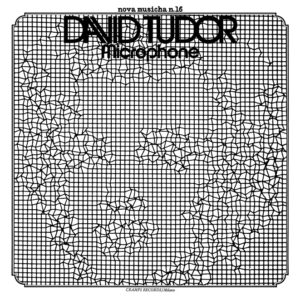
David TUDOR
“Microphone”
At long last, after decades out of print, the Milan based imprint, Dialogo, dives into the legendary catalog of Cramps, bringing forth the first ever vinyl reissue of David Tudor’s legendary LP, "Microphone", part of an ongoing initiative dedicated to bring the imprint’s seminal output back into the light. Still mind-blowing nearly half a century after it was first released, now complete with a new English translation of the album’s original liner notes, this is just about as exciting as reissues come and not to be missed.
Edition of 300 LP on black vinyl. Audiophile pressing, including printed inner. Perfect replica of the original packaging and newly remastered for optimal sound.
The only source of Microphone’s sound is the modulation of a microphone feedback produced in a distant echo chamber. The incidence and duration of the sounds are produced by the action of extremely close (narrow band) peak/notch filters (used in both modes), inserted into the lead signal. Each of the 9 versions is performed by the composer and simultaneously recorded on four tracks. Then the four tracks are spliced onto two, using a pan-matrix. The final product is a library of 9 stereo tapes, each about 32 min. long, which can be used in any combination, for live performances or for electronic installations. In these performances the tapes are played and stopped at any point, rewound and played again, altered in amplitude and/or equalisation, rotated on any given channel, etc., at will, for any period of time.
A live performance of Microphone (for instance without tapes) can be achieved by employing (a minimum of 4) performers using duplication systems, each one with 2 speakers.
This 1973 instantiation of Microphone covers a work originally conceived for the Pepsi Pavilion of Expo ‘70, in Osaka, Japan. Conceptually, the original work derives from discoveries made through the composer’s collaboration in the design of the Pavilion’s acoustic system. Sound diffusion was achieved through the use of 37 loudspeakers placed in a rhomboid grid system covering 3/4 of the sphere.
The loudspeakers could be “temporalised” at the entrance and exit of sounds, at variable speeds, following predetermined spatial models. The composer experimented with highly directional microphones, randomly pointed in space and amplified at the feedback level. The resulting signals were controlled in incidence and duration solely by the action of the loudspeaker’s temporaliser. Modulators, with variable features, designed and incorporated into the sound system by Gordon Mumma, were placed in the lead signals in order to vary the musical content of the feedback signals.
These experiments, although carried out through a compositional process, were not recorded in the Pavilion, due to the presence of “ambient noise” created by the multiple electrical fields. However, since the “tuned space” concept is now involved in Tudor’s compositional processes, the work could be recovered using variable bandpass filters (but capable of accommodating or excluding a cycle), and “q” variables, such as “tuning” elements, instead of operative loudspeakers. The used filters are manufactured by Ling Electronics, California.
The original tapes for Microphone were recorded in May 1973, at the Mills College Centre for Contemporary Music, using funds from their multi-track recording research project.
The recordings were conducted by Robert Sheff, with assistance from John Bischoff.
The two versions of Microphone featured in this recording were made with the assistance of the ZBS Foundation, Fort Edward, New York. Such grants were possible thanks to the public funds from the New York State Council of the Arts.
26,00€
Out of stock
LP
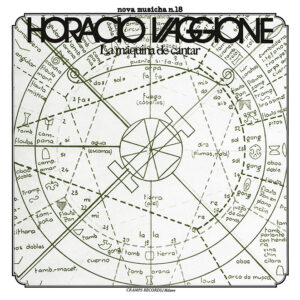
Horacio VAGGIONE
“La Maquina de Cantar”
At long last, after remaining out of print for decades, the Milan based imprint, Dialogo, dives into the legendary catalog of Cramps, bringing forth the first ever vinyl reissue of Horacio Vaggione’s LP, "La Maquina de Cantar", issued as the 18th instalment of the label’s Nova Musicha series in 1978 and among the most important examples of Latin American experimental music from the 1970s. Engrossing and creatively riveting, heard more than 40 years on its rippling electronic tones recast the terms of minimal music and shatter the historic perceptions of these sounds.
Edition of 300 LP on black vinyl. Audiophile pressing, including printed inner. Perfect replica of the original packaging and newly remastered for optimal sound.
Horacio Vaggione was born in Cordoba (Argentina) in 1943. He co-founded, in 1965, the Centro de Música Experimental de la Universidad de Cordoba, Argentina.
In 1966, he was awarded a Fullbright scholarship that allowed him to travel through the USA, where he visited several electronic music studios (Columbia, Illinois, California) and met John Cage. From 1969 to 1972, while living in Madrid, he belonged to a “live” electronic music group with Eduardo Polonio and Luis de Pablo. He was also in charge of the ALEA group’s electronic music studio.
In 1973, he visited the Far East. In 1974/75 he toured in the USA and Europe, more precisely with E. Wiener and the Kevan Cleary and Dance Company, while he was working in various electronic music studios (New York, Oakland, Montreal and Paris).
La Maquina de Cantar was produced in 1971, using the IBM 7090 computer owned by the data processing centre of the University of Madrid. Sound synthesis was carried out by a team under the technical advice of Florentino Briones, director of the centre.
The complete system is a “hybrid”, as it is made up of digital and analogue operations. To begin, the composer writes his “score” in musical notation and then transcribes it into decimal numerical notation. This numerical notation is then transcribed into the machine’s language, in the form of punch cards; in this way, the computer receives all the data that it has to process and translate into sound. At the same time, the POPOVA program, which supports all the operations, is also launched. The sound is produced in the central unit of the IBM 7090, via high-speed magnetisation changes. So, the sound values will be expressed in the form of the number of magnetisation changes (bits). Once the sound and its envelope have been generated through this digital process, the next step is to send this information to an analogue section, consisting of a series of filters, a VCO (voltage-controlled oscillator), and an echo chamber.
Contrastingly, Ending is a work for live electronic keyboards. In this version, three Minimoog synthesisers (played by the composer) and a Yamaha organ (played by E. Wiener) were used. The work is dedicated to Robert Ashley.
26,00€
Out of stock
LP
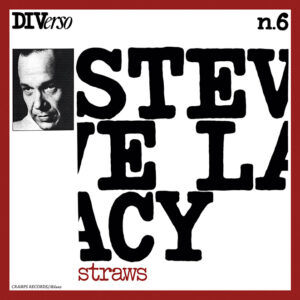
Steve LACY
“Straws”
At long last, after remaining out of print for decades, the Milan based imprint, Dialogo, dives into the legendary catalog of Cramps, bringing forth the first ever vinyl reissue of Steve Lacy’s LP, "Straws", issued as the sixth instalment of the label’s DIVerso series in 1977. Truly singular in the legendary American saxophonist’s discography - featuring stunning solo excursions and dialogs with himself - it remains one of the great documents of 1970s improvisation, and is as engrossing, creatively riveting, and as ahead of its time today as it was when it was laid to tape. Complete with original liner notes penned by Lacy himself.
Edition of 300 LP on black vinyl. Audiophile pressing, including printed inner. Perfect replica of the original packaging and newly remastered for optimal sound.
I can’t explain my work in words. For me, the music explains itself in sounds.
The saxophone is a machine like another, and it is only by breathing life into it, that it becomes of human interest. When I began to explore the possibilities in the soprano sax in 1950, it was in almost total disuse. By now, due largely to the example and inspiration of John Coltrane, but also somewhat to my own efforts, this instrument is in full flower.
Performance and composition are the two principal sides of my musical activities. Naturally, there is a constant feedback from one to the other. However, a musician is a sort of «medium», and quite often, the work is done in a state of trance, and only afterwards, can one realise what has happened, especially in a music which deals in large doses of improvisation.
This record contains two solo pieces, two more with celeste accompaniment, as well as two collages with background tapes.
Pinochle is a game of cards, enjoyed by the great pianist, Art Tatum. One of the most important «players» in jazz, Tatum had an enormous influence on me, especially as virtuoso, self-contained, soloist. In the course of this interpretation, I quote from a standard tune that Tatum used to like to play («Get happy» by Vincent Youmans).
Straws was written when Igor Stravinsky died, but has not been played ‘til now. This version uses a single strand of the melody, superimposed on a tape I made of three clarinet players and two saxophonists (myself included), trying out reeds, in a room at the Vandoren Reed factory in Paris. The piece is a solemn blues with joyou’s interferences.
Hemline is a recent tune, dedicated to Janis Joplin, the rock star, who was a tragic swinger, and one of the more interesting of the «new style» ladies on the scene in the late 60’s.
Bound to Irene Aebi, my «old» lady, whose voice I prefer to all others. This song (written in 1971), begins as a ballad, then turns blue (finally becoming grey and wise, at the and.
Feline (portrait of Marilyn Monroe). I wanted to capture the allure of the ordinary girl within the goddess, and the solitary space surrounding a «star». The celeste was discovered in the studio. The pussy-cat improvisation was sipped through the saxophone, as if it were a straw.
The rise is built upon a tape recording of sounds from the construction of the, still unfinished, centre culturel de Beaubourg, in Paris. Five layers of soprano sax are added on, all of them, improvised. A sort of « poeme sonore », it is dedicated to my good friend, Brion Gysin, the many-sided artist, who is himself, a «rising star».
Steve Lacy
26,00€
Out of stock
LP
Francisco LÓPEZ
“Animast”
"Few albums would be as fitted for vinyl release as this one. Drawing on both analog-material and digital-immaterial undisclosed sources, "Animast" plays with the sonic textures and responses most suited for the characteristics of this particular analog medium: noisy crispness, compositional 'loopiness', contrasting sharp-and-thick textures and cycling dynamics. A must for experimental heads and adventurous DJs alike!"
untitled #369
Created at mobile messor (Anatananarivo, Dublin, Madrid, Den Haag and Dune Studio (Loosduinen), 2018-2019
untitled #365
Created at mobile messor (Paris, Valencia, Oslo, Venice and Dune Studio (Loosduinen), 2018-2019
20,00€
In stock

LP
Pascal BATTUS & Magali SANHEIRA
“Froid solaire”
Pascal Battus : guitar pickups, objects
Magali Sanheira : microphones, metal, stone, motorized bow, effects
Coming from different backgrounds and driven by an experimental (and plastic) relationship to music, these two improvisers come together through the choice of their instruments and aggregates of so-called poor materials, which they use for their qualities of texture and color, in order to create a composition where the importance of the sound gesture is primordial.
It is this gesture, always delicate, which by insistence or intermittence comes to draw fleeting figures of a bottomless background, thus developing an abstract and vibrant landscape that invites the listener to travel in the sound wave.
100 copies.
22,00€
Out of stock

2 LP
Luc FERRARI
“Labyrinthe de Violence”
Capturing the four soundtracks conceived in 1975 for the multimedia/audiovisual performances at Galiéra Museum in Paris, the previously unreleased Labyrinthe de Violence stretching across two LPs represents a peek into Luc Ferrari's creations connected to his Atelier de Libération de la Musique experiences. Luc Ferrari was always keen to disrupt habits and engrained practices, to open his mind to new ways of apprehending the world of art, considering it not so much as a separate realm but as an inroad into society. In keeping with the spirit of 1968, he advocated taking part in daily life, casting a critical, but amazed, eye on the world around us, and always questioning the meaning of the occupations and preoccupations the world imposes. From the 1970s, Luc also wished to shed the solitary status of the artist, and to truly communicate with society. He thus gathered around him a group of people from different backgrounds with an aim to create, together, new ways of working and new forms of expression that would address unusual audiences rather than traditional concert audience. Having created his Studio Billig in Paris in 1973, Luc wanted to make the most of that place to promote exchanges with other artists, to share, think, and improvise together. This is what gave rise to the Atelier de Liberation de la Musique workshops, whose objective was to "Liberate music from the constraints of style and esthetics." The idea was precisely to free the artist from abstraction, leading him to perform accessible and intelligible actions; to promote the imagination; to use the dramatic dynamism of sound and image to trigger ideas; to ignore the sensational and instead to observe our social environment and daily life with an intuitive eye-ear; to invite the visitor to come up with their own analysis. This craving for collaboration led Luc Ferrari to create, in 1975, a collective of musicians with Martin Davorin Jagodic, Philippe Besombes, Alain Petit and David Jisse. That year, they worked at Labyrinthe de Violence, a looped audiovisual labyrinth which evoked the violence of contemporary society, and was a reaction to the political situation of the time. It was a multimedia work, spread across four rooms, on the following themes: Power/Profit/Violence/Pollution. Each side of this 2LP set reproduces the sonorization of one of the four rooms in the Museum, automatically mixing in the central space. The same recordings focus on questions of utopia through many of the same themes. As in the rest of his work, pleasure was also at the heart of these pieces. First press limited to 500 numbered copies; gatefold sleeve.
34,00€
Out of stock

LP
Elko BLIJWEERT
“De Nor Des Hoofds / Prison Of The Mind”
De Nor ('the can', or prison, in comic book Dutch) is an open-air venue/sculpture/pavillion at the Middelheim Museum in Antwerp. During its inaugural summer, Elko Blijweert played a live concert there that left an indelible mark on those lucky enough to witness it. What exactly did he do, you ask? Well, Blijweert basicly used the entire garden as an instrument alongside an array of pre-programmed pedals, keyboards, drum machines, guitars, a mandoline, and booze-bottle flutes.
This record, a re-created version of that fabled performance, is a concept album of sorts. Your personal prison experience begins on Side One. You will be miserable! Terrified! You will fantasise about being released, or escaping, every night. The entire ordeal is narrated song-by-song with Blijweert's liner notes.
20,00€
Out of stock
LP
IGNATZ & DE STERVENDE HONDEN
“Saturday’s Den”
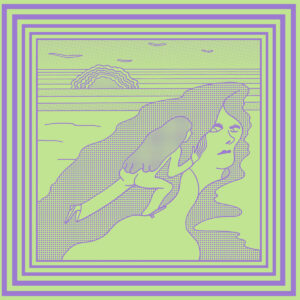
On their third LP for Ultra Eczema, psychedelic blues gloomers Ignatz & De Stervende Honden have driven off the bendy sideroads and onto a straight, if not exactly narrow, path. And there's new sounds coming out of the stereo: The Les Rallizes Dénudés-type guitar fuzz of previous journeys has been phased out in favour of softer, repetitive VU stumbling and even some Fleetwood Mac-esque romance. But it remains an unmistakenly Ignatz & De Stervende Honden record, with all the necessary ingredients for long car rides, living room break-ups, morning glory, sunsets and drunken rambles about length, size and whatever else matters.
20,00€
In stock

LP
Bernard PARMEGIANI
“Mémoire Magnétique, Vol 2.”
Transversales is very glad to announce the release of Mémoire Magnétique Vol. 2 spanning 1966-1993, revelatory collection of short and secret music by electronic music pioneer Bernard Parmegiani.
Since the late 50's, Bernard Parmegiani, a major figure of electroacoustic music and a founding member of GRM has created some eighty two concerts music. From the start, Parmegiani’s work was closely linked to the screen, with dozens of documentaries, films, long features, animation films but also musical pieces for dance, stage or television. If many of his pieces are landmarks in the history of electroacoustic music (De Natura Sonorum, La Roue Ferris…), his application music compositions are strongly embedded in the subconscious landscape of the French public (Stade 2, Roissy Paris Airport…).
The second volume of this compilation allows us to discover some of unreleased rarities from Bernard Parmegiani’s personal archives and unpublished recordings which were composed for the screen or the performing arts.
24,00€
In stock

LP
Sarah TERRAL (Clément VERCELLETTO)
“Le Ménisque Original”
Le ménisque original is Clément Vercelletto‘s (Orgue Agnès, kaumwald, Arlt, Les Sciences Naturelles, Tape Ensemble) first solo album under the Sarah Terral moniker.
The album was composed and played with a very small modular synthesizer in order to remain instinctive and minimal.
19,50€
In stock

LP
Yann GOURDON
s/t
One third of the drone trio France and part of the La Novia collective, Yann Gourdon's practice focuses on acoustic phenomena and dynamic relationships with the environment. Having learned to play traditional music from Auvergne by listening to field recordings, Gourdon re-orientates tradition via minimalism, honing in on a place or location's unique vibratory fields, volumes and surfaces.
Co-production La Nòvia / three:four records
19,50€
In stock

LP
Rafael TORAL & João Pais FILIPE
“Jupiter and beyond”
João Pais Filipe: Bass Drum, Gongs, Bells.
Rafael Toral: Feedback (modified MS-2 amplifier), Guitar.
Jupiter, the gas giant in our Solar System, with thunderstorms a thousand times more powerful than on Earth, rainfalls of diamonds in the atmosphere, temperatures below -100°C, plenty of hydrogen, 79 moons and a South pole that looks like an abstract painting, has just the kind of environment this music seems to emanate from.
Jupiter and Beyond, the second collaborative effort of composer/performer Rafael Toral and percussionist João Pais Filipe as a duo (after Saturn in 2016), is definitely not quite a record of Earth music. On the contrary, Jupiter and Beyond, is indeed gas music, unfolding over two long movements without solid body or any tangible outline, between ambient and noise. A music of sheer volume and beauty, icy, massive, in which the elements of Toral's signature, in particular his use of jazz-inspired electronics and feedback, dissolve to become a labile, nebulous, expansive material, occasionally struck by abyssal depressions and masterful densities, magnified by the return, after 17 years of silence, of the electric guitar in Rafael Toral's instrumentarium.
Towards the end of Beyond, the second piece on the record, lurking behind the volutes of feedback, a bell and a bass drum, one can detect from the distance... a barking dog, as a surreptitious and prosaic reminder of where we are here and now, a calling back to Earth. Between sadness and joy, anger and peace, movement and stillness, Jupiter and Beyond is indeed a mirror held out to us, music reflecting our times and that emotionally speaks first of all about us.
"While João Pais Filipe was drummer in the Space Quartet, we played a live duo set. During soundcheck we were jamming for a while on bowed gongs and feedback and lost track of time, it just flowed so well. I joked "we could make a whole record with this!". But later we took the idea seriously and set to record an improvised session at his cymbalsmith workshop (he made the gong on the cover and it was used in the recording). When we listened to the first take the mass of sound was amazing. At some point it reminded me of the complex clusters of sound in Ligeti's music as it appears on Kubrick's 2001 scene "Jupiter and Beyond the Infinite". In the end the title felt like an apt choice for Saturn's successor. Back at my studio I felt the need for some more layers of density in some sections. I thought of using trombones, but ended up picking up the electric guitar, which I hadn't used since 2003.” Rafael Toral
18,50€
In stock

LP
Pierre-Yves MACÉ / Silvain VANOT
“Split LP”
Brocoli is pleased to announce a split LP release of two previously unpublished works that bring together two established composers for the first time. On one side (who knows if it is side A or side B?) we find Silvain Vanot, who was at the forefront of 90s French indie rock alongside the likes of Dominique A and Jean-Louis Murat. He has also collaborated with Jim O'Rourke. The other (side B or perhaps side A?) goes to Pierre-Yves Macé, a stalwart of the label. A composer of instrumental (his work is regularly performed by the Ensemble Intercontemporain) and electroacoustic music.
At first glance the reason for bringing these two artists together may not seem obvious. And yet... these two pieces are both built upon the same principle: they are both instrumental music set in urban outdoor spaces. For Silvain Vanot this meant walking at dawn with his portable recorder in the Butte Montmartre, Paris. Then, once in the studio, improvising over these field recordings. Five locations resulting in five tracks. All recorded in one take. Pierre-Yves Macé first wrote a score for trombone, horn, oboe and percussion. He then recorded each musician separately at a different location in Paris. Finally, reassembling the piece in the studio. He allowed himself to be guided as much by the score as from the happy coincidences which occurred during the recordings.
As coherent as it is surprising this split LP navigates with ease between field recording, contemporary music, improvisation, ambient and musique concrète.
19,00€
Out of stock
LP
Limpe FUCHS
“Solaia”
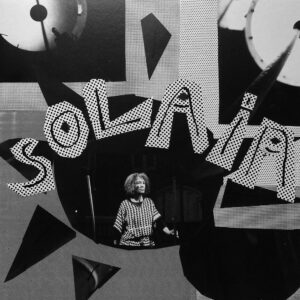
Limpe Fuchs' first solo record came about by accident. Initially, Christoph Heemann invited the famous Anima duo to do a studio record in his home-town Aachen, but Paul Fuchs decided not to join in, so Limpe went on her own - and the recording sessions taking place in late 1986 and early 1987 turned out to become "via", Limpe's first solo-record and the (visible) starting point of her ongoing exceptional career as an internationally performing, independent female improviser. Besides a plethora of (partly self-built) acoustic instruments that can also be heard on her legendary Anima (music) records, such as violin, saw blade, chimes, wood block and limpe's unmistakable unique vocals, "via" featured a korg-synthesizer, that drew Limpe's attention in the studio and she decided to give it a try and recorded a lot of electronic music for "via" - and in all the years to follow since then she never got near the instrument again; neither for studio recordings nor live performances . Fast forward to 2015: after not having met Christoph Heemann for many years, they got in contact again and performed selected dates (as Macchia Forest together with Timo van Luijk) when he proposed to Limpe another korg-synthesizer recording. not having touched the instruments in decades Limpe was reluctant at first but warmed up to the idea eventually and improvised a wonderfully meditative and soulful electronic piece of music. She also recorded five of her pendulum strings exclusively for the first time (with a bit of vocals, too) - huge self-built instruments of various size with an amazing sound rich of oscillating overtones. The both side-long recordings - one side korg, one side pendulum strings - featured on "solaia" are a visceral document of Limpe Fuchs' artistic versatility and musical sensibilities. It's fair to say: the spirit of her musical approach is captured perfectly on this new studio-album (mixed and mastered by her son Zoro Babel), which is released in conjunction with a first-time re-release of "via" - both to celebrate her long-standing musical career (and her eightieth birthday). "via" and "solaia" are available now as two separate lp's. Both records are released in an edition of 300 copies and accompanied by a 30-page longform interview with Limpe Fuchs and Christoph Heemann to give an insight in their collaborative history and portray Limpe's outstanding artistry.
19,00€
Out of stock

LP
Limpe FUCHS
“Via”
Limpe Fuchs' first solo record came about by accident. Initially, Christoph Heemann invited the famous Anima duo to do a studio record in his home-town Aachen, but Paul Fuchs decided not to join in, so Limpe went on her own - and the recording sessions taking place in late 1986 and early 1987 turned out to become "via", Limpe's first solo-record and the (visible) starting point of her ongoing exceptional career as an internationally performing, independent female improviser. Besides a plethora of (partly self-built) acoustic instruments that can also be heard on her legendary Anima (music) records, such as violin, saw blade, chimes, wood block and limpe's unmistakable unique vocals, "via" featured a korg-synthesizer, that drew Limpe's attention in the studio and she decided to give it a try and recorded a lot of electronic music for "via" - and in all the years to follow since then she never got near the instrument again; neither for studio recordings nor live performances . Fast forward to 2015: after not having met Christoph Heemann for many years, they got in contact again and performed selected dates (as Macchia Forest together with Timo van Luijk) when he proposed to Limpe another korg-synthesizer recording. not having touched the instruments in decades Limpe was reluctant at first but warmed up to the idea eventually and improvised a wonderfully meditative and soulful electronic piece of music. She also recorded five of her pendulum strings exclusively for the first time (with a bit of vocals, too) - huge self-built instruments of various size with an amazing sound rich of oscillating overtones. The both side-long recordings - one side korg, one side pendulum strings - featured on "solaia" are a visceral document of Limpe Fuchs' artistic versatility and musical sensibilities. It's fair to say: the spirit of her musical approach is captured perfectly on this new studio-album (mixed and mastered by her son Zoro Babel), which is released in conjunction with a first-time re-release of "via" - both to celebrate her long-standing musical career (and her eightieth birthday). "via" and "solaia" are available now as two separate lp's. Both records are released in an edition of 300 copies and accompanied by a 30-page longform interview with Limpe Fuchs and Christoph Heemann to give an insight in their collaborative history and portray Limpe's outstanding artistry.
19,00€
Out of stock

3 LP
COMPILATION
“The Harmonic Series Volume 2”
A collection of long-form works in just intonation by Kali Malone, Duane Pitre, Catherine Lamb, Tashi Wada, Byron Westbrook, and Caterina Barbieri. Each artist occupies an entire side of the collection's three LPs.
Curated by Duane Pitre, Important Records returns with its second volume of compiled works in just intonation. The Harmonic Series II, issued as a triple LP collection, features a series of long-form compositions by six of the most important emerging voices of contemporary experimental music;
Unlike equal temperament - the tuning system most commonly encountered in contemporary music - which equally divides an octave into 12 fixed notes, just intonation utilizes intervals of whole number ratios - chosen by a composer - to determine tonal positions, which can result in a highly individualised tonal language and holds the potential for more nuanced relationships and striking, sympathetic resonances. Rooted in ideas that trace their way across the last 2500 years - seeking to mirror the natural behaviour of sound within music - just intonation lays at the foundation for numerous Indian, Persian, and East Asian musical traditions, as well as a substantial amount of European music prior to the 17th century. Reintroduced into western music during the 20th century by composers like Harry Partch, Ben Johnston, Lou Harrison, James Tenney, Terry Riley, and La Monte Young, it has left an indelible mark on experimental practice ever since.
In the years following the appearance of The Harmonic Series in 2009 - presenting works by Ellen Fullman & Theresa Wong, Michael Harrison, Pauline Oliveros, Charles Curtis, and others - the broad interest in just intonation has continued to swell, inspiring Duane Pitre to curate a second compilation, exploring the work of a new generation of composers that have been drawn toward its remarkable potential.
The full scope of The Harmonic Series II engages the possibility of a multitude of intertwining sequences and relationships between its works. Kali Malone’s "Pipe Inversions” - played by Malone on a small pipe organ, joined by Isak Hedtjärn on bass clarinet - belongs to a larger body of microtonal organ works that have increasingly placed the composer at the forefront of contemporary minimalism and drone music. Thick blankets of shimmering harmonics - sliding at a glacial pace within a fractal structure of rhythmical and melodic sequence - converge as a poignant unwinding of cultural, temporal, and historical location, embedded within the disarming beauty of its interwoven tones.
Across the length of Duane Pitre’s "Three for Rhodes” - a chamber piece for ”unknown instrumentation” - deconstructed rhythms and melodic fragments swell in a dance of harmonic interplay, rising and falling within the work’s engrossing architectural complexity. Imbued with a startling sense of humanity, tonal footsteps and syntactic patterns flower with life, delivering an exacting image of the metaphorical potential of sound.
Catherine Lamb’s "inter sum” - one of a tiny number of available works to encounter the composer and renowned violist working on synthesizer - endeavours to break the visualisation of harmony as a vertical reality, rendering it multidimensionally in space. With its materiality drawn from Lamb’s own environmental field and filtered by the synth - presenting a radical rethinking of the terms of composition and musical mater - subtle tonalities and harmonics, embedded within sheets of textural atmosphere, culminate as a spectral vision of the latent musicality of the natural world.
A canon for eight-violins played by Marc Sabat, Tashi Wada’s "Midheaven (Alignment Mix)” - guided by the internal logic of its tuning system - shape-shifts into an elegantly poetic form of musical conceptualism. Interlacing long-tones bloom with complex harmonic interplay and delicate overtones, as two mirroring, overlain realizations of the composition - one moving forward as the other simultaneously moves backward - slowly converge toward a crescendo of dissonance at the midpoint, imbuing the work with emotive tension, before returning to a final ecstatic release.
Byron Westbrook’s "Memory Phasings”, composed and recorded on a combination of computer controlled modular synthesizers and a Yamaha TX802, employs the ratios of just intonation as harmonic building blocks for texture. Shifting long-tones and insectile buzzes underscore patterns of rapid appreciations and carefully balanced punctuations, forming a shimmering collective of abstractions, that blurs the lines between synthetic and organic readings of sound.
Deploying just intonation as a means for psycho-physiological exploration, Caterina Barbieri’s "Firmamento” - composed for synthesizer - deftly intervenes with the expectations of minimalism, durational music, and drone. Brooding and ecstatic - pushing the possibilities of organised sound into unexplored realms via the triggering of emotional and mental states of being - across the work’s slow evolution, sublime tonalities ride a razors edge between darkness and light, colliding in dense layers that rethink ancient modes in futuristic terms.
Taking form within the gestures of six crucial voices of contemporary experimental music - Malone, Pitre, Lamb, Wada, Westbrook, and Barbieri - The Harmonic Series II sculpts a profoundly human vision of the potential of art, where the historic becomes present and future, and the divisions imposed by cultural and temporal boundaries dissolve. Like the generations that have embraced it before them, each artist harnesses just intonation as a means to progress toward unknown territories of creative possibility and to readdress how we hear, arriving at a musical space that is highly individual and personal - captured by the diversity of the works presented within - while speaking within a collective whole.
45,00€
In stock

LP
Lawrence ENGLISH
“Observation of Breath”
Do you remember the last time you were breathing consciously? Either way, you are likely doing it now. On his new album "Observation of Breath" for the Swiss-based Hallow Ground label, Lawrence English worked exclusively with an organ for four compositions that are exercises in "maximal minimalism," as their creator himself notes in a nod to Charlemagne Palestine, who coined this term. While it seems somewhat fitting that those four pieces based on a steady flow of air were conceived and recorded in a situation of accelerated standstill caused by a respiratory disease, the Room40 founder is not so much concerned with capturing the zeitgeist than rather incorporating the spirit of time itself.
"It is a record about presence and patience," he explains. Exploring the unique sonic affordances of a singular instrument, "Observation of Breath" is not only devoted to the durability of sound but also to its density. That it marks his debut on Hallow Ground after having shaped its sound by mastering most of the label's releases in recent years is just as fitting then as its release following albums by Kali Malone and FUJI|||||||||||TA, whose innovative work with organ instruments have facilitated a rediscovery of their possibilities.
English's compositions however are neither directly indebted nor responding to these musicians. His exploration of the organ's many facets started a decade ago when the composer was given access to an instrument built in 1889 that is presently housed at The Old Museum in Brisbane. After it had already played a crucial role on his seminal albums "Wilderness Of Mirrors" and "Cruel Optimism," last year's self-released "Lassitude" was the first record that English entirely composed and recorded with that instrument. "During the soft lockdowns, I spent many days playing to an empty concert hall, recording the pieces that became >Lassitude< and then, this album," says English in regards to an unfortunate situation that fortunately provided him with time and space-two major themes but also key qualities of the four new compositions. In this sense, he goes on, "Observation of Breath" resolves a number of the questions originally raised by "Lassitude."
23,00€
In stock

LP
Jan JELINEK
“The Raw and the Cooked”
Faitiche releases an album version of the radio piece Vom Rohen und Gekochten (The Raw and The Cooked) originally composed and produced by Jan Jelinek for the state broadcaster SWR2. The album The Raw and The Cooked brings together five sound collages that deal with the consistency of material and its mutability.
Solid, raw, boiling, powdery, liquid, broken and folded - categories which describe the nature of material. They can also be read in a chronological sequence: solid becomes broken becomes liquid becomes powdery... Material tells of its essence as it drifts through its states, always in correspondence with external energies. The Raw and The Cooked observes the artists Thomas & Renée Rapedius as they design their paper and metal objects and the artist Peter Granser as he ritually prepares Japanese tea, it shatters glass, bends metal and burns wood. The resulting audio documents capture processes of material transformation as sound.
The Raw and The Cooked was created with the help of ITO Raum Stuttgart and Thomas & Renée Rapedius. Originally produced for radio broadcast on Südwestrundfunk in 2020 it contains a variation of the collage Zwischen/Raum that was made with funding from Musikfonds. Many thanks to Eckhart Holzboog and Beatrice Theil, as well as Frank Halbig/SWR.
19,00€
Out of stock

LP
Pascal COMELADE
“Sentimientos”
Originally released in 1982, Pascal Comelade's Sentimientos is one of the most elusive and sought after LPs in the French composer's vast catalogue. Recorded on a two-track Revox machine, the album is an eclectic series of brief pieces – only two of the twenty tracks exceed four minutes – showcasing his poetic imagination and impressive range.
While much of Comelade's early work hints at many of the major electronic movements to come, Sentimientos remains earthbound and organic. Melodic fragments performed on piano, organ, plastic saxophone, vibes, guitar, toy piano, ukulele and synthesizer place Comelade's boundless creative spirit on display.
It is telling that Comelade chooses to cover a Brian Eno tune not from the ambient pioneer's seminal Music For Airports, released just four years earlier, but rather the more traditional "Taking Tiger Mountain," here rendered to highlight the song's previously hidden hymn-like qualities.
Like fellow countryman Ghédalia Tazartès, there is something distinctly unclassifiable about Comelade's music. Undoubtedly, the two artists share a flair for the mischievous.
Sentimientos is an unapologetically whimsical, frequently dizzying and loveably anarchic album of manic energy and radiant mystery – a perfect introduction to Comelade's singular musical mind.
29,50€
Out of stock

2 LP
HEMATIC SUNSETS
“Aroma Club Adieu 5”
Final release by Asmus Tietchens’ death lounge project Hematic Sunsets
Farewell greetings by Michael Rother, Felix Kubin, Heinz Funk, Okko Bekker and more
The Hematic Sunsets shut down the Aroma Club with a final release. The album “Aroma Club Adieu” features 12 exquisite pieces of death lounge electronic pop performed on electronic organs and entertainment devices of various kinds. Under the moniker Hematic Sunsets, legendary avantgarde composer Asmus Tietchens has explored his love of the Darth Vader organ sound – a cheesy, spooky, deranged but still catchy form of electronic pop. The body of work of Hematic Sunsets stands out as unique, displaced and in a sexy way out of fashion. As a bonus to the final album of the project artist friends of Asmus Tietchens have composed short hommages and farewell greetings that are included here in the form of a single sided 12” on white vinyl. Among those saluting are such illustrious musicians as Heinz Funk, Felix Kubin and Michael Rother.
29,00€
In stock

LP
Annea LOCKWOOD
“Becoming Air / Into the Vanishing Point”
Following on from the acclaimed Tiger Balm / Amazonia Dreaming / Immersion LP (BT028), Black Truffle is thrilled to present two major new instrumental works from legendary sound artist and experimental composer Annea Lockwood. Demonstrating the ever evolving and radically open nature of Lockwood’s practice, these two recent works were developed in close collaboration with their performers. ‘Becoming Air’ (2018), developed with and performed by trumpeter Nate Wooley, uses extended technique and electronics to interfere with Wooley’s virtuosic control over his instrument, pushing him into areas of fluctuating pitch and timbral instability. Motivated by a desire for ‘the letting go of sound to be itself’, ‘Becoming Air’ unfolds as a series of texturally distinct moments separated by pauses, each fixing on a particular approach to the instrument (long tones, upper-register whistles, breathy wooshes) and maintaining it in an essentially static fashion, focussing our attention on subtle changes and variations. Dipping into near-inaudibility in the fragile high tones of its opening section, the piece dramatically increases in volume and intensity in its final third, climaxing with a passage of roaring distortion, where the interaction between feedback and trumpet pitches calls up the shuddering interference effects of Robert Ashley’s Wolfman.
‘Into the Vanishing Point’ (2019) is a collaborative work developed with New York piano and percussion quartet Yarn/Wire, who have performed work by major contemporary composers such as Olivia Block, Catherine Lamb and Klaus Lang. Carrying on the ecological and environmental concerns of some of Lockwood’s previous works, ‘Into the Vanishing Point’ was inspired by a devastating news article on the global collapse of insect populations. Discovering that the four members of Yarn/Wire had also read this text, Lockwood mapped out a loose structure for the piece that would allow the composer and four performers to explore their ‘feelings about what is happening ecologically’. Working with a huge variety of instruments, objects and techniques of sound production, the resulting work is an alluringly lush, organically unfolding tissue of unorthodox textures and haunting tones. Though not intended to sonically represent ecological issues in any direct way, its unique sound world of rubbed piano strings, gently handled objects and chiming pitches often calls up natural images: of insects and frogs, wind rushing through trees, a bird’s wings in flight.
Presented in a stunning gatefold cover with liner notes by Lockwood, Wooley and Yarn/Wire, Becoming Air/Into the Vanishing Point is a testament to the generosity and experimentation that continue to characterise the work of this extraordinary artist, active for over fifty years.
25,00€
Out of stock

LP
Amelia CUNI
“Parampara festival 13.3.1992”
Black Truffle is pleased to announce Parampara Festival 13.3.1992, a stunning performance by Amelia Cuni captured live in Berlin almost thirty years ago. Milanese by birth and resident in Berlin for many years, Cuni lived in India for over a decade, studying the classical vocal style of dhrupad under masters of the form. Though perhaps known to many listeners primarily through her performances of the vocal music of John Cage and collaborations with Werner Durand and Terry Riley, she is recognised internationally as one of the great contemporary proponents of traditional dhrupad singing. These recordings document her performance at the 1992 Parampara Festival at the Haus der Kulturen der Welt, a landmark event celebrating the global spread of Indian classical music, bringing together Indian teachers with their international students.
Accompanied by Gianni Ricchizzi on vichitra vina (a plucked zither played with a glass ball slide) and her own tanpura, Cuni stretches out for a languorous side-long performance of the late night Raag Bageshri, the limpid tones of her vocal improvisations illuminating the droning strings like flashes of the moon revealed by rushing clouds. Initially working patiently through a series of subtle dialogues between Cuni’s melodic extemporisations and phrases in response from Richizzi’s vichitra vina, the performance builds to a series of strikingly beautiful, virtuosic held notes from Cuni at the beginning of its second half, before picking up some brisker rhythmic articulation on the way to its conclusion.
On Devino Amor, Cuni presents her own composition, a setting of mystical texts by the 13th century Franciscan friar Jacopone da Todi, elaborated through various traditional raags. Like the words used for most dhrupad compositions, the text Cuni has selected from da Todi praises divine love, thus linking her otherwise unorthodox use of Italian text to the dhrupad tradition. The result is a performance of a yearning intensity that communicates across any language barrier. On the final performance, Cuni and Ricchizzi are joined by Helmut Waibl on the two-headed pakhawaj drum for a piece using a 14 beat rhythmic pattern that sets in motion a cycle of tension and release, metrical dissolution and resolution, possessing a subtle grandeur.
Illustrated with archival images of the performance and accompanied by new liner notes from Peter Pannke and Lars-Christian Koch, Parampara Festival 13.3.1992 invites listeners to lose themselves in Amelia Cuni’s unique approach to ancient tradition.
22,00€
Out of stock
LP
Dave PHILLIPS
“Disappear”
disappear was born of something that ceased to be, suddenly, unexpectedly, painfully. like two mirrors that reflected too strongly and burst. the shards that were left tell a story. of a trance meeting of an insect and a flower in a self-made paradise and the resulting journey that took them towards new dimensions but was brutally cut short before these could be explored. the sun disappeared. the resulting daze looked back and saw... mirrors don’t reflect what we want to see.
disappear consists of 7 pieces composed alongside a presence. the story linking the pieces unfolds when the presence disappears and the 8th, last piece of the album appears, a cleansing lament disguised as an abomination. marnować means waste in polish. composed between january 2018 and november 2019, a period also known as the berlin daze. mastered by riccardo mazza. edition of 300
18,00€
In stock

LP
Antoine CHESSEX
“Echo/cide / The Experience of Limit”
ECHO/CIDE (2018) - for 4 hammered dulcimers and cimbalum
Composed by Antoine Chessex. Performed by Ekleto ensemble.
Recorded by Thierry Simonot at l’Alhambra, Geneva, October 2018
THE EXPERIENCE OF LIMIT (2019) - for grand piano
Composed by Antoine Chessex. Performed by Tamriko Kordzaia.
Recorded by Nicolas Buzzi at Theater Rigiblick, Zurich, March 2019.
Mastered by Giuseppe Ielasi.
21,00€
Out of stock
LP
MATHS BALANCE VOLUMES
“A Year Closer”
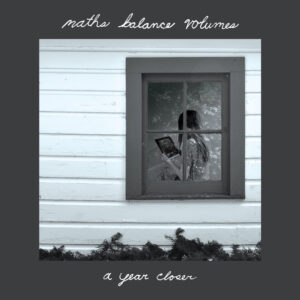
It makes less sense to say that Maths Balance Volumes formed in 2002 than to say that, since that year, they have been collapsing into something, again and again. Just as the three members fell together with no plan or allegiance to any style or genre, each track falls together as the broken pieces of songs and sounds meet to make a temporary and frightening whole. Things make their way into a Maths Balance Volumes song when they don’t or won’t work anymore, when they have escaped their owner, or hidden away where nobody is supposed to find them. When things fall together—when the wooden creaks and radio hisses gather for a minute alongside bass lines and melancholy voice—there is a beauty that sounds like it was made by nobody and for nobody.
The city of Mankato, Minnesota has been the steady gathering point for the band since its beginnings. Mankato had always provided an ominous backdrop: built on stolen Dakota land, the city was the site of the largest mass execution in US history, when 38 Dakota prisoners were hanged on in 1862 in a straightforward act of genocide. But in their music of the past twelve years, Maths Balance Volumes has made music in and of a hometown overshadowed and unsettled by its history, music for a world in which things have never been okay. Traditional American folk genres seep in at times, but never as the incarnation of a living popular culture—only as ghosts or unliving effigies.
A Year Closer tells us already in its title what its theme is: approaching death, time ticking away and getting closer with each track of the record. We are told in the first song that our protective mask isn’t working, warned by the storm clouds and a ticking bedroom clock in “Dark Skies.” We hear fears of death approaching in the sad words exchanged by lovers who see they will run out of time, or already have, as in “We Had Time” or the romantic lament of “When I Drink.” In “Work Last Monday,” all of life passes with cold automatism in an “office apartment,” as a narrator broods over early onset dementia, remembers the details of rituals for respecting the dead, and thinks of how a hole is opening up in reality itself. The singer of “Over the Hill” isn’t apparently afraid of growing older and becoming a “man,” but only leaks a few disjointed details of his plans for disappearing, collapsing, turning into a tree, and finding a home. “Angel of Mercy” tries to resurrect the Christian promise of a life after death, anxiously asking if anyone is up there waiting for us after the oblivion of this world.
But these are just the moments when A Year Closer speaks in words clear and audible enough to be understood. The giddy, agitated voice of “The Price” speaks only to itself in a private language, hidden away in a tin can somewhere. Musically, A Year Closer is a series of pieces that make symphonies out of separate processes of decay and disappearance: unidentified cracking and creaking objects, broken equipment, and lost melodies that seem to have escaped other songs and wandered into the room looking for a place to hide. These are the moments that the listener of Maths Balance Volumes always knows are coming, waits for, and settles in temporarily for a moment of repose. Maybe this is the meaning of A Year Closer: while waiting for the worst, things come together, a “we” with no name but with a rhythm, a tenuous but definite harmony to share as the clock ticks. Even if, when the lights are turned on, it turns out nobody was there. – Paul Buchholz
20,50€