
Out of stock

LP
Beatriz FERREYRA
“Canto+”
From Lawrence English
I’m not really sure when I first heard Beatriz Ferreyra’s music. My best guess would be in the early to mid 2000s when I was working alongside the curatorial team at Liquid Architecture. Given the focus of the festival at that time, GRM and musique concrète more generally was very much a point of focus.
That said, it wasn’t until this decade that her work was sharply in focus for me (and I am guessing a great many others). In 2017, I had the great pleasure to meet Beatriz in Braga, where we both were performing as part of the excellent Semibreve Festival. Subsequent to that I invited her to perform in Australia and we also had the pleasure to send time together this year in Rio during the Novas Frequencies Festival. Across these meetings, I have come to realise the incredible focus, generosity and vision that Beatriz has maintained across her life in sound.
Beatriz Ferreyra is one of only a few female concrète composers who were active across the second half of the 20th century through to today. Her work, which is still very much an active investigation, is simultaneously complex and elegantly simple. Often drawing upon singular object of focus, Ferreyra’s use of tape and other forms of manipulation radically reconfigure her chosen sound materials, opening them outward.
Canto+, collects works from almost 40 years of her life in music and pays homage to her unerring interests in dynamism, rhythm, voice and the morphic potentials of concrète materials. Two of the works are also dedication to close friends; Jingle Bayle’s (to François Bayle) and Au revoir l’Ami (to Bernard Bashet). This edition picks up where Echos+ leaves off and opens her sound worlds even further.
22,00€
In stock

LP
Mike COOPER
“Playing With Water”
From Mike Cooper
Playing With Water is a novel written by James Hamilton-Paterson. I was introduced to his writing by the Australian poet Peter Bakowski who gave me a copy of his book ‘Seven Tenths - The Sea And Its Thresholds’; a book that influenced my record Globe Notes and subsequent works immensely. Another of his books ‘Playing With Water: Passion And Solitude On A Philippine Island’ is about exactly what the title describes it as and provided me with the title.
The first edition on my Hipshot c.d.r label in 1999 was titled Kiribati and was dedicated to the people of that Pacific Island nation as I shared their concern, then as now, with the fact of rising sea levels due to global warming which threatens to destroy or make uninhabitable their low lying island homes. That album was the start of a long musical and artistic journey for me.
In the years that followed I have visited many places around the North and South Pacific, South East Asia and The Caribbean that are also in danger of being inundated as water levels rise, both coastal and inland, due to melting ice or weather patterns that change drastically bringing untypical amounts of rainfall.
Cities such as Venice, Bangkok, Jakarta, London, Manhattan or any coastal, or near a major river, city will be subject to serious flooding and subsidence and may well become uninhabitable in the same way in the very near future.
Bangkok was previously known as ‘The Venice Of South East Asia’ and its now roads were once canals. I have been in that city during the monsoon season and seen water coming up through the floor of shops and houses exiting to the street through the door. Jakarta is currently sinking at such an alarming rate that the Indonesian Government is building a new capital city in Kalimantan (Borneo)
Several of my albums subsequent to Kiribati - Globe Notes, Rayon Hula, Reluctant Swimmer/Virtual Surfer, Fratello Mare, Raft, Oceanic Feeling-Like (with Chris Abrahams) and now Playing With Water are all conceptually concerned with this same subject.
Another conceptual thread connecting them is my concern for the co-habitation of the human and non-human world expressed through my use of unprocessed avian or insect field recordings of song, signs and signals. Climate change, as well as the destruction by humans of the natural habitat of many species, is disturbing the balanced relationship we need to have with nature. Indigenous and small, often nomadic, coastal communities are very aware of this balance and the incursion of the industrial world into their way of life is having disastrous effects which will ( if not already ) have similar effects and repercussions on ours.
There are field recordings on this edition from Pulau Ubin, Ko Phayan, Ko Lanta, Sri Lanka, Bangkok, St.Lucia and Martinique; all places that can look forward to or are already witnessing the Postdiluvian Future.
We could quite possibly all be looking forward to an island existence in that future where all of our cities, or Wetropolis, will be floating worlds of Aquatecture and Aquaculture will provide all our food, powered by wind, solar or mechanical energy from the tides and the waves. Oceans cover 70 percent of the Earth’s surface making it the worlds largest solar collector - Seven Tenths
In 1957 the Rio Turia that ran through the city flooded to such an extent, killing 60 people, that it was diverted to the south and what was the riverbed turned into a park which runs through the centre and surrounds the old part of the city. Within a few weeks after finishing recording this collection in my studio in Valencia the city experienced the biggest storm recorded in over a hundred years. Within a day the normally 135 metre wide, several kilometres long, Malvarrosa beach and the 10 metre paseo and road beyond it was completely flooded, as were the restaurants lining it. After cleaning and repairs some weeks later they re-opened only to be closed again two weeks after by the pandemic and subsequent lockdown in which I am now writing this.
My guitar playing here, as always, draws on a number of styles and genres influenced by Hawaiian Slack Key and Lap Steel guitar.
22,00€
Out of stock

LP
Akio SUZUKI
“Zeitstudie”
Referring to "Study Time", Zeitstudie presents two works each for two instruments developed by sound artist Akio Suzuki and recorded in Germany in 1984: the ANALAPOS, an echo instrument used to project the performer's voice across a coil spring; and the "De Koolmees" glass harmonica, 5 glass tubes in a metal frame that are struck or rubbed to create unique sounds.
22,00€
Out of stock

LP
Joe COLLEY
“Deformation Of Tone”
Joe Colley’s skeleton key is an intra-dimensional sense of humor. It exists in a place between and beyond dry, deadpan, and defeatist, and is not actually funny. He has a knack for unlocking the essence of the absurdly uncomplicated, elevating it to a place of near-iconic significance and leaving it there. Hovering in a void. Or mashed in the jowl of an insect getting doused with regurgitated chyme and rumen bacteria. Consistent with his past efforts, Deformation Of Tone contains no sturm und drang or exhausting drama. This spectacle-free album delivers abrasive-adjacent electronic judders cloaked in a feeling of intimacy distilled from primordial ooze. Opening voices dissolve into Lucierian mosaic yammer, and plummet into a negative space populated by an unadorned clicking, that most elemental physical manifestation of audio phenomena, the antithesis of awareness and enlightenment and transcendence. Of sentience, even. A quintessential example of his streamlined, efficient hilarity. The episodes continue without pause, as if one is moving through an exhibition. Compared to Colley’s work, which he once described as “little noises arranged on a piece of plastic,” a lot of other noise seems hell-bent on shameless over-compensation. Embarrassingly so. His material has always been low-key, and Deformation Of Tone finds him shuffling in a colder, harsher, more desolate direction. The single-malt rasp of an unnamed conspiracy theorist / motivational speaker, present more for his intonation than anything else, punctuates this rather sculptural 33 minutes of machines whirring, devices beeping, blank-face rotary drones swelling and merging with unnaturally regimented hive rustlings and perfectly unpleasant high-gain squelch — all constructed with a master’s timing and sense of scale.
- Seymour Glass / Bananafish
21,00€
In stock
LP
Mark HARWOOD
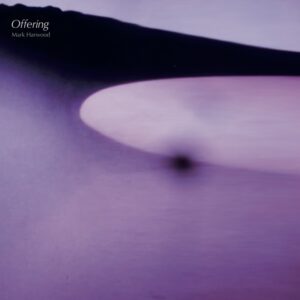
“Offering”
Offering is Mark Harwood’s second LP and is an album of songs about geography and placement and the way people choose to move across the surface of our planet. His simple tools of acoustic guitar, voice, tapes and bric-a-brac give Mark the freedom and clarity of vision to offer hope in song to those who choose to hear him. Offering is more than we deserve in these lousy times – it is calm and it is forgiving, but it is also sharp and can cut. It is wise and all-inclusive but Offering is never blind and sees the world as truth, as if on a TV screen. Recorded in Berlin 2021 and mixed/edited in London by Graham Lambkin, Offering is only that, but it asks to be accepted.
Recorded in Berlin, Winter/Spring 2021
All music/words Mark Harwood
Mixed/edited by Graham Lambkin
Mastered by Bhob Rainey
Artwork by Graham Lambkin and Mark Harwood
25,00€
In stock
LP
Tim GOSS
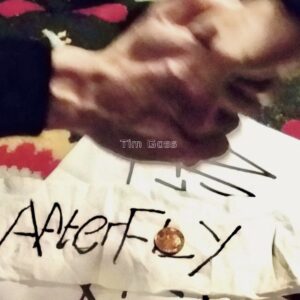
“Afterfly”
Tim Goss (The Shadow Ring / Call Back The Giants) returns with his first outing under his birth name. Afterfly is a mature and compelling work that observes life as a set of repeating patterns, no matter the apparent differences everything has already happened. After one fly comes another and another and another ad infinitum.
You have the face of an old man, catch me if you can.
Afterfly serves as an initiation into a more thorough overview of Tim’s current practise followed with a book of recent illustrations to be released on Penultimate Press in 2022.
Edition of 300 copies. Comes with a booklet with a story to be read alongside Fly 4 (merely a rehash of the conquistadors, life forever repeating with no obvious improvement).
25,00€
Out of stock
2 LP
ETANT DONNES
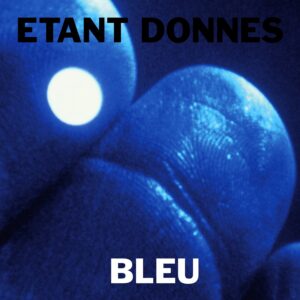
“Bleu”
Following the first ever vinyl reissues of Aurore and Royaume, Aimant + Aimant – Penultimate Press is finally proud to make available the final part of this extraordinary trilogy.
Bleu is the final gesture and culmination of this period of creation where poésie and la nature form a magical alliance that resonates as an alchemical wedding. Having the conviction that Bleu was the ultimate arc based on the purity of natural sound and poetry, leaning towards a mystical spiritual search towards their own souls the band moved into commadere and collaboration with friends and ideals such as Lydia Lunch and Alan Vega.
33,00€
In stock
LP
Drew DANIEL – John WIESE
“Continuous Hole”
2018 release
Gilgongo Records is pleased to announce “Continuous Hole”, a collaborative album by Drew Daniel and John Wiese. The fruit of over ten years of home recordings in San Francisco, Los Angeles and Baltimore, “Continuous Hole” melds improvisation and musique concrète composition into a uniquely sweaty document of labor-intensive rhythm. A finger puzzle of reconciled opposites: lockstep structure and constant flux. Many of the tracks reflect the unique blending of the disparate backgrounds of its creators: on “Abhorred Shears”, “Sleek Disorder” and “Cosmic Joke” the relentlessly variable source material is relegated to precisely timed gated forms and patterns. Without using any sampling or MIDI sequencing, the rhythmic cuts evoke the tempo/BPM of footwork, juke or gabber, but they are constructed entirely from volcanic, gnarled abstraction, and eschew typical genre elements.
“Progress Bar” goes from frantic cuts to weightless slo-mo freefall and back to frenzy. Moving from mayhem to menace, “Surprise” concludes the album with ominous flutters of a pedal steel guitar and the sound of a dog’s toenails scraping a stone floor. In the final milliseconds of the song, the dog leaps for the listener’s throat. Raw yet precise, it’s a dynamic conclusion to an album of strong contrasts from two American artists discovering common ground in the joy of frenzied cutting. A prolific recording artist and visual artist with an extensive discography under his own name, and with grindcore stalwarts Sissy Spacek, John Wiese is currently based in Cleveland. One half of the electronic band Matmos and all of The Soft Pink Truth, Drew Daniel is based in Baltimore.
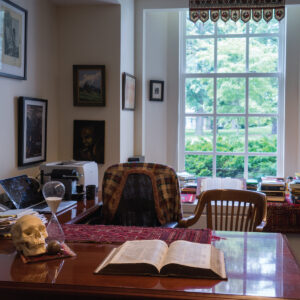
The album was mastered by Thomas Dimuzio. The cover photograph was shot by John Wiese in Drew Daniel’s office on the campus of Johns Hopkins University where Daniel is a Shakespeare professor. Videos for album tracks are slated from John Wiese, Max Eilbacher, M.C. Schmidt, and Ola Vasiljeva. Summer concerts in support of the album are currently being planned.
16,00€
In stock
LP
SISSY SPACEK
“Blear”
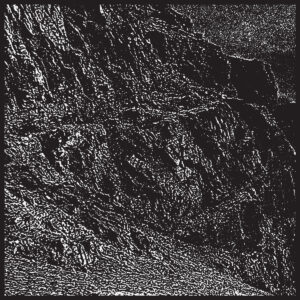
Widening their scope from recent grindcore on Nuclear War Now! Productions, Sissy Spacek’s Blear LP explores a much more dynamic and spacious approach to sound—an entropic vortex of full-room tear-up texture. Duo lineup of Charlie Mumma and John Wiese, released in an edition of 300. The group’s 8th release on Gilgongo Records. —Label Description
16,00€
Out of stock
LP
HIJOKAIDAN / SISSY SPACEK
“Entropic”
2019 release
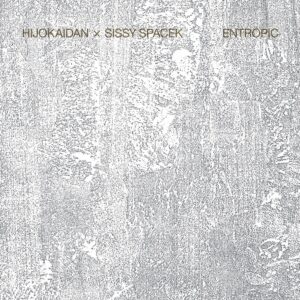
On the verge of their 40th and in the midst of their 20th anniversaries, respectively, Hijokaidan and Sissy Spacek merge in Tokyo for their first collaboration, featuring Jojo Hiroshige, Junko, T. Mikawa, Charlie Mumma, Futoshi Okano, Tentenko (guest), and John Wiese.
Hijokaidan formed in 1979, marking the first wave of groups in Japan exploring extreme noise. Sissy Spacek formed in 1999, often playing in large ensembles of players, and frequently exploring grindcore as a base for creating extreme music, often while eschewing the notion of music altogether.
During Sissy Spacek’s 20th anniversary tour in Japan, the recordings of “Amok Time” and “Seven Directions” were made with Hijokaidan in collaboration. While Hijokaidan’s sound has been described as a continuous climax of your entire progressive rock collection, Sissy Spacek’s “Twenty-Five Fragments” is a sequence of peak chaos from their 2018 tour, recorded on walkman for maximum effect.
Additionally, the CD edition contains Hijokaidan’s full live set at Akihabara Club Goodman.
18,00€
In stock

LP
Francis PLAGNE
“The Refrain”
"Black Truffle proudly present The Refrain from Melbourne-based artist Francis Plagne, whose growing catalog of collaborative and solo releases range from song-based work to abstract audio collages. Closely aligned with Plagne's Moss Trumpet LP (released by Penultimate Press in 2018, PP 038LP), The Refrain's two side-long tracks mix sounds of the mundane with the otherworldly; rising, receding and overlapping. The result feels like being led through a series of scenes devoid of context or direction. Furthermore, it's hard to define the scenes as either inviting or disconcerting, as they're often both at the same time. As the record progresses sounds reappear and are juxtaposed so as to only hint at the familiar. A hall of mirrors, perhaps? Completed in 2020 using material recorded from 2012-2020, the record uses tapes of shelved, unfinished, and forgotten projects that featured field recordings from various locations, domestic sounds of plastic bottles, bubble wrap, creaking chairs, voice, and instrumental recordings, including an appearance from crys cole on Casio. These pieces were re-amped, processed and edited, then additional instrumental pieces featuring synths, guitars, plastic saxophone, melodica, and percussion were added, the results shaped into drifting, episodic assemblages. Although essentially a tape piece, The Refrain presents as a crude, non-idiomatic composition that feels both timeless and transitory. It's a million miles from the polish and rigor of GRM, perhaps more in line with Jacques Bekaert's eponymous Igloo LP, or Costin Miereanu's Luna Cinese. The Refrain could be read as a psychedelic Krapp's Last Tape; one man's response to listening through forgotten and discarded tapes, reflecting, reconciling, and forging a new path. A potent tonic for these absurd times." --Nick Hamilton, August 2021
25,00€
In stock

LP
Eiko ISHIBASHI
“For McCoy”
Black Truffle is pleased to announce For McCoy, a new work by Eiko Ishibashi dedicated to the widely loved character of Jack McCoy, portrayed by Sam Waterston in Law & Order. Following on from Hyakki Yagyō (BT064), For McCoy finds Ishibashi further exploring the unique space she has carved out in recent years, bringing together musique concrète techniques, ECM-inspired jazz, lush layers of synths and hints of pop into immersive and affecting structures crafted in her home studio, aided by a group of close collaborators.
Beginning with overlapping layers of descending flute lines, the expansive ‘I Can Feel Guilty About Anything’ (whose two parts stretch out over more than thirty minutes) unfolds with a free-associative logic, embracing dreamlike transitions and unexpected cinematic cuts. As a hovering cloud of synthetic tones and multi-tracked voices fans out from the spare opening moments, Joe Talia’s skittering cymbals settle into a gently propulsive groove, soon joined by melodic fragments performed by Daisuke Fujiwara on multi-tracked saxophone. As the drums cede to field recordings and ominous synth figures, the uncommon meeting of saxophone and electroacoustic techniques call to mind the more spacious moments of Michel Redolfi and André Jaume’s Synclavier-propelled oddity Hardscore or the early work of Gilbert Artman’s Urban Sax. As the piece continues on the LP’s second side, distant dialogue rumbles beneath a surface of processed flutes, blurring into a cavernously reverberant backdrop for stark ascending lines performed by MIO.O on violin. Eventually, the piece settles into a gorgeous passage of abstracted dream pop, where Ishibashi’s multitracked vocal harmonies glide atop synth chords, errant pings and snatches of outdoor sound.
Fragments of melodic material reappear throughout the spacious opening piece, finally stepping to the forefront on the closing track, ‘Ask Me How I Sleep at Night’. Here, over a shuffling groove supplied by Jim O’Rourke on double bass and Tatsuhisa Yamamoto on drums, layers of flutes, saxophones and guitars sound out melodies whose combination of twisting irregularity and soulful immediacy calls up prime Keith Jarrett, while their closely voiced harmonies suggest Kenny Wheeler or even Wayne Shorter’s Atlantis. In a classical gesture of closure, the web of melodic lines eventually leads back to the descending flute figures with which the record began. Presented in an immersive, impeccably detailed mix by Jim O’Rourke and arriving in a sleeve featuring Ishibashi’s beautiful drawings of Jack McCoy, For McCoy is an essential release for anyone following the enchanted and unique path being forged by Eiko Ishibashi.
24,50€
In stock

LP
David BEHRMAN
“ViewFinder / Hide & Seek”
Black Truffle is thrilled to announce ViewFinder / Hide & Seek, a new release from acclaimed American experimental composer David Behrman, presenting recordings made in collaboration with Jon Gibson and Werner Durand between 1989 and 2020. Last heard from on Black Truffle as part of the collaborative art song/live electronics madness of She’s More Wild, these recordings find Behrman continuing the pioneering work in interactive electronics that have established him as one of the major living experimental composers.
Side A presents excerpts from two live realisations of Unforeseen Events (1989), the fourth in a series of pieces focussing on the interactions between instrumental performers and responsive software. Like the classic earlier works in the series, On the Other Ocean (1977), Interspecies Smalltalk (1984) and Leapday Night (1986), Unforeseen Events is an “unfinished composition” in which a computer system listens for and responds to specific pitch cues from an instrumentalist. Performed by the composer on electronics and Werner Durand on soprano saxophone in Berlin in 1989, the first realisation immediately ushers the listener into an environment of long soprano notes, lush, sustained synth harmonies, randomised percussive interjections and distantly burbling arpeggiated patterns.
The 1999 realisation recorded in New York with Jon Gibson on soprano shows how much room for the instrumentalist to affect the course of the music exists in Behrman’s interactive pieces, in which, as he notes, ‘performers have options rather than instructions’. Beginning in a roughly similar area to the version with Durand, this later recording eventually becomes substantially more active, as polyrhythmically layered arpeggios and percussive patterns respond to fast chromatic lines and dynamic phrases from the saxophone, moving Gibson in turn to respond with cycling figures and moments of extended technique that touch on the soprano languages pioneered by players like Steve Lacy and Evan Parker. Yet even at its most active, the lack of conventional forward movement in the music allows it to retain what Behrman’s friend Jacques Bekaert called its ‘fragile tranquillity’, as episodes of activity appear only as momentary disruptions of an underlying calm.
On the B side, we are treated to a new collaborative work from Behrman and Werner Durand, building on the 2002 installation work ViewFinder, in which a camera detecting physical motion triggered changes to electronic sound. The piece presented here is a long-distance studio construction, recorded by Behrman in the Hudson Valley and Durand in Berlin, offering up an expansive duet between Behrman’s lush, gliding synth tones and the alien, untempered tones of Durand’s invented and adapted wind instruments. Presented in a stunning gatefold sleeve with art from Terri Hanlon, archival photographs and new liner notes from Behrman and Durand,ViewFinder / Hide & Seek is an essential release showcasing the continuing vitality of a legendary figure in experimental music.
20,00€
Out of stock

LP
Richard YOUNGS
“CXXI”
Black Truffle is pleased to announce the latest offering from underground legend Richard Youngs. Hyperactive since the late 1980s, Youngs is widely celebrated for his remarkably extensive and varied body of recordings. His works range freely over a vast terrain, wandering from tender acoustic balladry to raging psychedelic noise and orchestral D-beat, always imbued with his distinctive, often mournful, melodic sensibility and irrepressible sense of joyous experimentation.
Comprised of two side-long pieces, CXXI carried on the experiments with chance operations used to generate material on many of Youngs’ recent releases. On ‘Tokyo Photograph’, a slowly changing, randomly generated sequence of 121 minor chords played by sine waves and accented with a brushed snare hit on every change provides the harmonic foundation for Youngs’ fragile yet impassioned vocal performance, shards of field recordings and electronics and Sophie Cooper’s long, tape-echoed trombone notes. While the melancholic drift of the chords calls up prime Robert Wyatt sides like Old Rottenhat or Dondestan, only the most vestigial sense of song remains here, as Youngs arranges his minimal ingredients over a spacious fifteen-minute expanse that often drops to nothing more than the rich hum of sine waves.
‘The Unlearning’ carries on directly from the first side, presenting another, more harmonically varied, sequence of randomly generated chords played by sine waves, distressed with tape echo flourishes and sparsely sprinkled with electronic touches. Like some of Youngs’ most single-minded instrumental works in recent years, such as his recordings of foot-played guitar or his shakuhachi pieces, ‘The Unlearning’ is deeply meditative but entirely remote from ambient or minimalist cliches.
Named after the number of chord changes on the opening piece and (Chicago-style) the number of records Youngs has released, CXXI arrives in a striking monochrome sleeve featuring play-along chord charts for both pieces. Both rigorously conceptual and endearingly off-the-cuff, CXXI is classic Richard Youngs.
20,00€
In stock
LP
Das Os
“Data Divinarum”
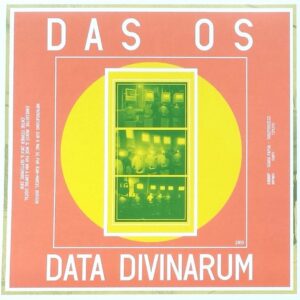
jean-marcel busson is controlling 6 altered/mistreated mac SE
performative installation, organic technology, acoustic persistence, electrical ceremony, computer spectra
6 mac SE are controlling jean-marcel busson
co-produced w/ a1000p & suara papua
recording, editing & mix by mim
_
Excellent !
13,50€
In stock

LP
Duane PITRE
“Omniscient Voices”
Duane Pitre returns to Imprec with Omniscient Voices, an articulate, intense and emotionally resonant set of five pieces for justly tuned piano and electronics.
Omniscient Voices is a uniquely distinct work that follows Pitre's trilogy of releases which culminated with 2015’s Bayou Electric and included the critically acclaimed Feel Free (2012) and Bridges (2013) albums. Where those albums were rooted in long form pieces, Omniscient Voices is a collection of shorter pieces, offering more harmonic variety than previous works, with a unique sound and feel that is still unmistakably the work of Duane Pitre.
25,00€
In stock

LP
ELEH
“Snoweight”
Recorded during two days of extreme weather, ELEH's Snoweight conveys the mesmerizing force of a winter storm with sonic realism and romanticism.
These two new compositions evoke both warm security and wild, blanketing intensity in ways that are both emotionally arresting and time stopping.
LP is pressed in a hand numbered edition of 305.
Paste on covers screen printed by Monoroid.
33,00€
Out of stock

2 LP
Pauline OLIVEROS – Stuart DEMPSTER – PANAIOTIS
“Deep Listening”
To celebrate the 30th anniversary of Deep Listening, we offer you the definitive double LP combining the classic, complete original 1989 release with selected tracks from the Deep Listening Band’s 1991 album The Readymade Boomerang.
This elegant double LP is packaged in a gatefold sleeve with original and updated recollections from the performers, the recording engineer and a mesostic from John Cage, to which these recordings are inextricably linked.
Recorded in a cistern, this double LP reverberates with brilliant sonic clarity and masterfully improvised performances combining live electronics, vocals, trombone and accordion. Deep Listening is a classic in the fields of improvisation, minimalism, ambient/drone and modern classical.
Listen with attentiveness, listen while lying down, listen with headphones - as recording engineer Al Swanson entices the listener to become a virtual performer in selecting the many different ways to perceive these phenomenal tracks. Whatever you do, listen deeply.
33,00€
In stock
LP
Harry BERTOIA
“Glowing Sounds”
Harry Bertoia's Glowing Sounds LP contains three versions of the same composition, each transferred at different tape speeds in accordance with the artist's instructions. This is the third LP to be released from Bertoia's extensive tape archive and it's the first, of many, to be released using instructions left behind by the artist himself.
Bertoia wrote the concept for this Glowing Sounds LP on a note in 1975 and slipped it into the master tape case where it sat unread for 45 years. The idea was simple, transfer the original recording at its original speed and two slower speeds. Bertoia noticed that the results, however, were profound.
Recorded on January 20, 1975 using two large gongs, Glowing Sounds is one of the most powerfully minimal recordings yet discovered in Bertoia's collection. The artist's note left with the tape indicated that it was recorded at a speed of 15 IPS (inches per second) but slowing it down to speeds of 7.5 IPS and 3.25 IPS were quite effective for enhanced playback. Side A features the original 15 IPS recording and the 50% slower 7.5 IPS recording. Side B features a 20 minute, ultra-slow version at 3.25 IPS.
Long, deep drones and powerful overtones define the sound of this recording. Comparison of the three speeds provides a revealing magnification of Bertoia's gongs, overtones and the artist's inventive approach to performance, composition and recording.
24,00€
In stock

LP
FUSILLER
“Le monde supérieur”
Fusiller is Jo from [Tanzprocesz] label. He's also half of Opéra Mort (with Èlg) half of Femme (with Arno Bruil) and a third of Reine d'Angleterre (with Èlg and Ghédalia Tazartès).
Fusiller does music with crafted electronic instruments of his own. His work is chirurgical, precise with everything under control. Nothing is unnecessary.
From some underground world, I hear a debate within GRM pioneers.
Pierre Schaeffer : " I like this succession of miniatures, it sounds like études, but it’s all electronic, such a shame"
Bernard Parmegiani : "I wonder why I didn’t use this kind of voices in L’enfer ?"
François Bayle : "Here is a composer"
Luc Ferrari : "Oh, there is some kind of humour here !"
Pierre Henry : " Well, I’ve done better work"
**
Behind the name Fusiller we find Jo, who runs the Tanzprocesz label. He is also one half of Opéra Mort, Femme and one third of Reine d'Angleterre. However, the latter may not be an ongoing concern anymore since the passing of Ghedalia Tazartes. Fusiller created his own electronic instruments and loves to edit his music until whatever is there is necessary. There is a funny little text on Bandcamp about this LP (or 12"? It spins at 45 rpm, but still is about 32 minutes), with imaginary quotes from French luminaries from the world of electronic music. The two Pierre's, Paremgiani, Bayle and Ferrari, perhaps indicate that we should see the pieces in that tradition and not in the tradition of noise music. You could easily think that some of this music is in that tradition of noise music, but this is not your (standard?) noise wall type. For one, this is not something that deals only with heavy noise. It also works with very brief pieces of music. In the download, they are cut together as one track but listen to the record, and you'll notice that each piece is a rounded thing by itself. Fusiller uses organ-like sounds, as drones as rapid arpeggio's (none of the pieces have a title, so I can only say, 'that bit on side 2'). Still, there are oscillating sounds and sine waves, and the record again goes into total noise territory, microphone and voice abuse. Why not an imaginary quote from Henry Chopin (not connected to GRM, but surely in his tradition). A noise track like this can be thirty seconds before it leaps back into the controlled chaos of modular electronics. It's hard to say if the people at GRM might laugh at this, dismiss or applaud it. If I'm honest, I'd say, why would Fusiller care what they think? Or I, for that matter? Oh, right, they do care what I say, as I got the promo. I very much enjoyed this LP (12"?) for its brief character. Miniatures or etudes, whatever you wish to call these, Fusiller aims and shoots all the time, bull's eye. (FdW)
VITAL WEEKLY issue 1314
17,00€
In stock
LP
Henri CHOPIN
“Les gouffres des bronches sont des cavernes infinies”
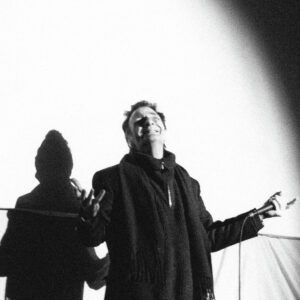
Henri Chopin came to perform in Besançon in 1995 at Garage Caméléon the birthplace of Erratum Musical activities and the label. People involved were Michel Giroud (who introduced Henri Chopin to us and helped to publish “Poésie Sonore Internationale”), Joachim Montessuis, Yvan Etienne and Masahiro Handa. This place used to be a 300m2 garage where we lived, worked and organised noise performances and poetry actions from 1993 to 1998. When Henri Chopin arrived, he was 72 years old, calm and slow, and was delighted to meet a younger generation interested in sound art and electronic sound poetry experiments. He brought his tapes and we rented a powerful sound system that would be perfect to fill all of the space with his mouth noises. He then asked us to project the sound and follow his gestures concerning volumes and dynamic panning, and the resulting high pitch echos and feedback intensity along with the slowly melting speakers (audible here) gave him an incredible excitation and joy that we all could witness - and it was a contagious enthousiasm. Direct energy ! Later in 2004 Henri Chopin gave us two tapes to release, the first one was for the CD “La danse des tonneaux roulants et brisés” and the second one was “Les gouffres des bronches sont des cavernes infinies”, which was aired for the first time on France Culture radio in 2013 thanks to Thomas Baumgartner. Henri Chopin was born in 1922, this LP is echoing his 100th anniversary and celebrates the passion he channeled and transmitted to many artists along his life and beyond.
23,00€
Out of stock

LP
THE NEW BLOCKADERS
“Changez les blockeurs”
Within the history of noise music, there are few artefacts, as seminal as The New Blockaders' Changez Les Blockeurs. Anyone who has even a casual interest in noise music should need no introduction to The New Blockaders. Hailed by Ron Lessard (of legendary US noise label RRR) as, ‘The first truly devoted noise artists,’ TNB self-released their debut LP in 1982. That original LP is now one of the most sought-after (and expensive) noise records ever.
The fact that Changez Les Blockeurs is held in such high esteem by the likes of Steven Stapleton (Nurse With Wound), who was the first person to hear the LP back in 1982 and recently reworked the album as NWW Plays Changez Les Blockeurs, David Jackman (Organum), Thurston Moore (Sonic Youth), Masami Akita (Merzbow), Toshiji Mikawa (Incapacitants) and countless others is testament to its greatness and well-deserved legendary status.
Laying in wait for almost 40 years, the LP emerged again in 2004 as a limited edition on the German Vinyl-On-Demand label, and since then has remained rare, elusive, and coveted - until now. 2022 will mark the 40th anniversary (or, more accurately, antiversary) of Changez Les Blockeurs and in celebration of this Urashima is proud to present a limited reissue which has been expertly remastered at Audiplex Studio in Hamburg by Asmus Tietchens, himself a well-know German avant-garde composer.
‘’Changez Les Blockeurs caused a lot of fuss back in the early ’80,with its two ‘tracks’ of disorientating junk noise, squeaks, scrapes and the pitter-patter of rain on a tin roof. Lumps of metal get thrown around in a bid to resurrect the ghost of Tristan Tzara, two invalids in wheelchairs fencing with broken car aerials, two elephants fencing on bicycles, two squeaky wheelchairs fighting over a slack spring, or an army of tin men dismantling a Jean Tinguely sculpture while bouncing around on pogo sticks in need of 3-in-1. We’ll never know, and that’s half of the appeal. Changez Les Blockeurs sounds like nothing else before or since. It’s magnificent in its absurdity. Its construct is simple but yet devastatingly effective. Today you’d be hard pressed to find anyone involved in Noise who doesn’t cite TNB as an influence. ‘’ Mark Wharton
Pressed on 100% black virgin vinyl to ensure optimum audio quality, Changez Les Blockeurs is a true wonder to behold. A beautifully presented LP which includes a 12”x12” insert, limited to just 199 copies.
22,00€
Out of stock

LP
Anne GILLIS
“…”
French musician & performance artist Manon Anne Gillis came to Japan to perform in 2016 following the 2015 release of the 5-CD archive box set from Art Into Life, which was a compilation of earlier recordings. Now at last, for the first time in 27 years since 1994’s “Euragine” in CD format, her long-awaited 7th solo album is completed. As she still continues to progress and evolve musically, this work is constructed primarily around primitive hiss noise and error sounds. Here she has woven a musical tapestry that is more blurred, obscured, and noise-oriented than her earlier work. With the strong cohesiveness of her disquieting singing voice in a thunderous roar bellowing from the inner depths, the repetition of the dense glitch sounds, and the nostalgic concept of the obscure rhythm track (track 5) will remind us of her days when she went by the alias Devil’s Picnic.
Mastered by Takumi Akaishi who was Anne’s supporting act for her 2016 performance in Japan.
The LP issue comes with a download code and is limited to 300 copies.
25,50€
Out of stock

LP
Takumi AKAISHI
“Memoria”
Takumi Akaishi’s music is like a delicate shadow box garden, a miniature sonic world unto itself. Following the release of his debut LP Music for Hurdy Gurdy (2012) and first cassette tape Naked Tape and Others (2013), Akaishi garnered critical acclaim for his fidelity to the hurdy gurdy mantle, filtered through a uniquely gentle, almost hazy touch. His tracks are interjected with ambient noise culled from the quotidian cityscape, complementing the characteristic “flatness” underpinning his oeuvre. Memoria represents the culmination of six years in incubation, the distillation of experience relived in the form of beautifully distorted memory.
Handmade album jacket swathed in dyed gauze. Each jacket features a one-of-a-kind collage by Akaishi.
Limited edition of 200.
27,50€
In stock

2 LP + CD
MACIUNAS ENSEMBLE
“YoplaBoum + Permanent Wave”
Third release by the Maciunas Ensemble on Edition Telemark after 1976 (2015) and the self-titled 50th anniversary LP from 2018. The group had been founded in Eindhoven, The Netherlands, in 1968 with the aim of realizing the score "Music for Everyman" by Fluxus initiator George Maciunas, which they interpreted as allowing total freedom in the sounds being produced. The group met regularly, usually once a week during their heyday, and improvised on instruments that were at hand. Every session was recorded to be played back and discussed before the next session. This method meant that small changes and subtle new ideas could be integrated from one session to the next, eventually leading into completely new directions over a longer course. Paul Panhuysen linked this approach to the oral traditions of folk music.
One of their most productive periods were the early 1980s where, after settling on a stable line-up of Paul Panhuysen, Jan van Riet, Leon van Noorden and Mario van Horrik, the group developed their own brand of minimalist rhythmic music, inspired in equal parts by rock, post-punk, drone and minimal music of the time. A selection of named pieces had crystallized from the improvised sessions that were worked on and refined, many of them having long durations and featuring wordless vocals by Paul Panhuysen that added another unique rhythmic layer to the music. Phill Niblock, while visiting the ensemble's home base Het Apollohuis in Eindhoven, called some of these pieces "rhythmic drones", drones produced by repetitive rhythmic strokes, simultaneously on various instruments. Some recordings from this period can be heard on the LP "Music for Everyman 861" (released in 1986 on Apollo Records) and the above-mentioned self-titled LP.
Virtually unknown until now have been five more pieces that were released by the band in 1983 and 1984 on two cassettes named "YoplaBoum" and "Permanent Wave", in editions of 25 and 30 copies, respectively. They are re-released here for the first time, with a double LP featuring the whole "YoplaBoum" cassette – the 43-minute title piece split across the first two sides, the two others on sides C and D – and a CD including the two tracks from "Permanent Wave".
The double LP is housed in a single sleeve with two printed inner sleeves featuring liner notes by Leon van Noorden and Mario van Horrik, and a selection of photos and artwork from the period. The CD comes in its own cardboard sleeve and is attached to the outer LP sleeve with a removable glue dot. Edition of 300.
33,00€
Out of stock
LP
Michèle BOKANOWSKI
“Rhapsodia / Battements solaires”
*** Repressed ***
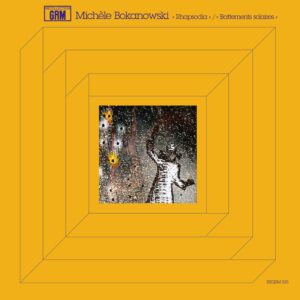
Michèle Bokanowski's art is one of densities, much like the density of a given colour, a given depth. Her sound textures are, indeed, profound, both in the space occupied by their frequencies and the sharp temporal trail they leave behind. Here lies the composer's immense talent that finds the right development for each sound, letting it blossom before altering it, adapting the musical structure to let the sounds “be”, even if it sometimes means returning to the most basic form, such as a loop. This is a sign of great honesty and artistic sensitivity; able to stand back and let the music become music. It is the most radical, the most accurate gesture of composition. The two pieces on this record, dissociated in time, both in their approach and destination, nevertheless reflect, each in its own way, Michèle Bokanowski's highly singular and insightful musical intuition. - François Bonnet, Paris, 2020
20,00€
In stock

LP
Marja AHTI
“Still Lives”
“Still Lives” is the third solo full length by the Finnish composer Marja Ahti, following a pair of releases on the Hallow Ground imprint. As a collection, it may be seen as a series of studies on the liminality of the listening act and an investigation into the physicality of sound. Ahti forges vivid electroacoustic environments from field recordings, analog synthesizers, acoustic feedback, magnetic tape and digital processing, resulting in a set of articulate, prickly, and surprising compositions. In the artist’s words, “These pieces could be conceived of as vanitas paintings of a kind – selections of mundane or archetypal objects, sounds that have their own distinct qualities, but exist only by virtue of being temporary events. From another angle, one could think of them as shrines – objects assembled and set in a particular relationship to each other, charging each other in their given constellations.” Marja Ahti (b. 1981) is a musician and composer based in Turku, Finland. Originally from Sweden, Ahti has been a part of the Finnish experimental music scene for more than ten years in different constellations. She is currently active in the duo Ahti & Ahti with her partner and as a member of the Himera artist/organizer collective.
18,50€
Out of stock
LP
Ghedalia TAZARTES & Rhys CHATHAM
“Two men in a boat”
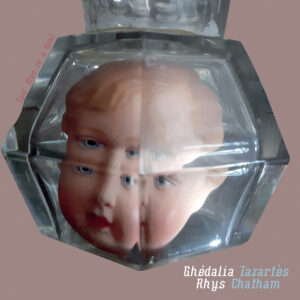
"The beauty of all this, as well as its sorrowful brutality, is even more powerful and stupefying since Ghédalia's sudden departure. Because retrospectively, not only is this recording the trace of a rare moment in a Parisian garden, it also summons a ghost, that of a loved one that is gone, and of his voice, which is fully alive here."
Tazartes and Chatham had met once in 1977 at CBGC's and had not seen each other since then when they were asked by their mutual agent to play a private show in Paris. This happened in September 2018 in a house with a garden where sax player Steve Lacy had lived back in the 1990s. This album presents the recording of this show plus another show at La semaine du bizarre festival in Montreuil, France a year later, mixed with a couple of studio sessions. This was probably the last music Tazartès, who died in February 2021, recorded. His unique singing blends perfectly with Chatham's loops on electric guitar, trumpet and flute.
Rhys Chatham is a composer, guitarist, trumpet player and flutist from Manhattan, currently living in Paris, who altered the DNA of rock and created a new type of urban music by fusing the overtone-drenched minimalism of the early 60s with the relentless, elemental fury of the Ramones — the textural intricacies of the avant-garde colliding with the visceral punch of electric guitar-slinging punk rock. Starting with Guitar Trio in the 1970s and culminating with A Crimson Grail for 200 electric guitars in 2009, Chatham has been working for over 30 years to make use of armies of electric guitars in special tunings to merge the extended-time music of the sixties and seventies with serious hard rock. Parallel with his rock-influenced pieces, Chatham has been working with various brass configurations since 1982, and recently has developed a completely new approach to collaborations, improvised and compositional pieces involving trumpet through performances and recordings that started in 2009. Chatham’s trumpet work deploys extended playing techniques inherited from the glory days of the early New York minimalist and 70s loft jazz period. Starting in 2014, Rhys has been touring a solo program featuring an electric guitar in a Pythagorean tuning, Bb trumpet, and bass, alto and C flutes. Rhys was introduced to electronic music and composition by Morton Subotnick in the late 60s, and in the early seventies he studied composition with La Monte Young and played in Tony Conrad’s early group. These composers are, along with Terry Riley, the founders of American minimalism and were a profound influence on Chatham’s work. Chatham’s instrumentation ranges from the seminal composition composed in 1977 entitled Guitar Trio for 3 electric guitars, electric bass and drums, to the epoch evening-length work for 100 electric guitars, An Angel Moves Too Fast to See, composed in 1989… all the way to Chatham’s recent composition for 200 electric guitars, Crimson Grail, which was commissioned by the City of Paris for La Nuit Blanche Festival in 2005. A completely new version of the piece was commissioned by the Lincoln Center Outdoor Summer Festival in 2009. What does a composer do after mounting many performances with forces of 100-200 electric guitars? The composer gets back to basics, at least that’s what Rhys does! Along with the G100 and G3 programs, Chatham is currently offering a solo program, an evening length work with the composer performing himself on electric guitar, trumpets and bass alto and C flutes.
French cult artist Ghedalia Tazartes is an uncompromising character who defied categorization. He recorded alone more than 20 albums, calling his Art “Impromuz” for lack of a better term. Before the years 2000s, his public appearances remained exceptional events. Ghédalia Tazartès’ music has always been a mystery. It switches from musique concrète to – existing or invented – ethnic music, from poetry to noise, or from loops and collages to sad and extremely beautiful tunes in a second, but it constantly is in flux and coherent. In 2004, Ghedalia finally decided to do live performances again. He first worked with other musicians (Les Reines d’Angleterre, David Fenech & Jac Berrocal, Norscq & Black Sifichi, Nicolas Lelièvre) then went solo for ten years. Since then Tazartes has played many shows across Europe including a show in the Patti Smith exhibition at Fondation Cartier in Paris and a cinemix to the “Haxan” silent movie in 2008. In 2018 Ghedalia decided to stop playing solo and to collaborate with other musicians again: Maya Dunietz, Rhys Chatham, Chris Corsano and Dennis Tyfus, Quentin Rollet and Jérôme Lorichon. Ghedalia died at his home in Paris on 9th February 2021.
18,50€
In stock

LP
Michel REDOLFI
“Sonic Waters, Underwater Music 1979-1987”
A work that literally immerses the listener into an acoustical substance. The sound becomes almost like matter, like jelly. Soon, you're swimming in sound, getting lost inside it.
With the Sonic Waters project initiated in 1978, my aim was to situate field of electronic music within a liberating and futuristic experience, outside the concert halls and in sync with the development of new instruments - in particular the Synclavier digital synthesizer, the first model of which I acquired in 1977. As concert space, the Pacific Ocean seemed to me to be the ideal experimental medium for both acoustic and cultural reasons. I then developed the aesthetic and technical elements that would contribute to the conception of Underwater Music. Numerous performances would follow spanning four decades, in natural sites or in large public pools such as those of Sydney, Paris or Venice during the 2006 Biennale.
Michel Redolfi (1951), French composer and sound artist, is the founder of Underwater Music. The natural elements captured and highlighted by experimental technology are a constant in Redolfi's catalogue: many compositions explore the earth environments such as in 'Pacific Tubular Waves', 'Jungles', 'Desert Tracks' (re-released on Sub Rosa records) and especially with 'Sonic Waters', a work that literally immerses the listener into an acoustical substance. During the mid-seventies Redolfi carried out his electro-acoustic research in the United States, with major electronic music centers including the California Institute of the Arts and chiefly the University of California in San Diego. As invited resident of their studios, Michel Redolfi launched the underwater music concerts, with the series 'Sonic Waters' performed in the Pacific Ocean. Michel Redolfi's underwater creations have since been regularly programmed by major international festivals, with multi-media installations held in ecological marine reserves or in historical city pools. Among them, the Sydney Festival, Paris 'Nuit Blanche', Ars Electronica in Linz, the 2006 Venice Biennale (nominated Golden Lion) and lately the 2018 Ars Musica festival in Brussels. This record presents different variations of Sonic Waters from 1980 to 1987, alternating studio mixes with their re-recordings in the depths of the Pacific. Michel Redolfi CD's and LP's are currently published by Sub Rosa, INA-GRM and Radio France.
16,50€
Out of stock

2 LP
Mika VAINIO
“Last live”
*** Repress ****
This edition was produced and finalized in a particular context, Mika Vainio having left us on 12.04.2017 This material is the last concert he has gave. It took place at Cave12 on 02.02.2017. We needed time to listen to this archive again, which we did in situ in June 2020 with Cindy Van Acker.
After this listening, we felt invested in having to make this archive public.
In order to edit and work on this material, we asked Carl Michael von Hausswolff to do the mixing. At our request, this recording was organized in 4 movements. Stephen O’Malley kindly joined in the pre-edit process that took place on August 24 2020 at EMS Studios, Stockholm. Denis Blackham did the mastering.
This process was carried out in collaboration with Rikke Lundgreen.
Recorded 02.02.2017 at Cave12, Geneva by Benjamin Ephise
Edit by Stephen O'Malley & Carl Michael von Hausswolff at EMS, Stockholm.
Mastered by Denis Blackham
Vinyl cut by Andreas Kauffelt at Schnittstelle, Berlin
Artworks by Franz Graf, Mika Vainio Archive, Oslo and Cm von Hausswolff collection,
Cave12 / Editions Mego co-release
27,00€
Out of stock

LP
Aaron DILLOWAY & Lucrecia DALT
“Lucy & Aaron”
Repressed !
Lucy & Aaron is the debut collaboration LP from the duo of Lucrecia Dalt (RVNG Intl.) and Aaron Dilloway (Dais Records). Full length LP in full color cover with printed inner sleeve featuring art by artist Pieter Schoolwerth.
File under Electronic / Tape Music.
“I met Aaron in Madeira around 10 years ago, and I was blown away by his set, when I was going to tour the US for the first time, Forest, my US my booking agent asked me if I wanted to tour with someone from his roster and I suggested Mr Dilloway, the first show we played together was in Toronto, he started with a very groovy loop, some kind of soul extract that felt just right. With that, he levelled the dynamics and the atmosphere of the room, moving back and forth from the stage to the audience to double check if everything was sounding right. I have never seen such an elegant, disturbing and powerful show at the same time, it was a wild combination. We played a couple more shows together and on my journey throughout the states I was never in a place where his name didn’t pop up with a positive comment of admiration. We became extremely close and utopian. We started this record during a two week visit of mine in NYC, we crossed our signals, sometimes his affecting mine, or the other way around, we just wanted to make a fun, weird and inevitably emotive record that somehow captured so many things we love about music, to put oneself in character and go with the flow.”
-- Lucrecia Dalt
“Lucrecia and I met briefly 10 years ago while performing at a festival together. We traded some releases and I was very excited by what I heard. Her records stuck out to me over the years as something very special. I was a fan. We met again recently while performing on a bill together in Toronto, and while watching her perform, I was mesmerized by her selections of sounds, as well as her movements and control of the mixing board. I felt like we worked similarly. We struck up a very close friendship and what followed was a year of intense discussions about art, music, performance and recording. Immediately we began working on music together and her expertise in mixing and her highly trained ears and overall drive were very inspirational. This album was recorded in 3 different locations, Pioneer Works in Brooklyn, NY where Lu was doing a residency, sessions at Lu’s home in Berlin, Germany and finally at my home in Oberlin, OH. It was one of the most inspirational periods of my life and helped me overcome some intense musical and psychological obstacles. I learned so much by making this record.”
-- Aaron Dilloway
Recorded by Lucrecia Dalt & Aaron Dilloway 2019 - 2020
Mastered by Rashad Becker
Cut by Warren Defever
Art by Pieter Schoolwerth
22,00€
In stock
LP
Phill NIBLOCK
“Exploratory I”
Vol. 1 performed by Arditti String Quartet & David Watson
We have the honor to present to you the new masterful work of Phill Niblock: Exploratory
One of the most beautiful and powerful works that Phill Niblock has ever offered to us! Phill reinvents and probes the oceans of drone music possibilities deeper than ever.
This piece has been performed and recorded for over a year by many great musicians around the world, under the supervision and direction of Phill.
Arditti String Quartet, David Watson, Lucy Railton, Phoenix Ensemble Basel, David Maranha, Ben Richter, David First, Andre Goncalves, and many more.
Matière Mémoire is now bringing the first two volumes to you by Arditti String Quartet, David Watson & Phoenix Ensemble Basel.
Each Vinyl is limited to 300 copies in transparent (Vol I) and transparent red (Vol II) vinyl. Also available on CD
26,00€