
Out of stock
CD
Masamichi KINOSHITA
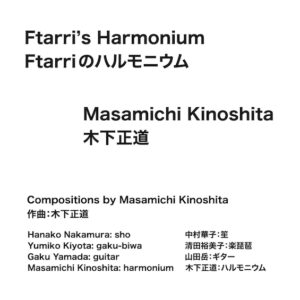
“Ftarri’s Harmonium”
Why is there a harmonium (reed organ) at Ftarri? It all goes back to the Ftarri Festival held in Tokyo in November 2019. A quartet made up of Klaus Lang (harmonium), Johnny Chang (violin), Samuel Dunscombe (bass clarinet) and Michiko Ogawa (clarinet) was planned for the festival's final day, so Ogawa quickly purchased a used harmonium for Lang. As she lives in Berlin, Ogawa and Ftarri decided that the harmonium would be housed there temporarily and used in Ftarri concerts.
Composer Masamichi Kinoshita, who often performs at Ftarri, was interested in holding concerts featuring the harmonium. He planned the series "Ftarri's Harmonium," the first concert of which took place in February 2020. The second concert, on March 14, was performed by Kinoshita and three other musicians, and it was decided that three pieces composed for the concert by Kinoshita would be released on an album. Composer Masamichi Kinoshita was born in Fukui Prefecture in 1969. He has long been known for his diverse and fascinating musical activities--in addition to composing many pieces each year, with a particular focus on chamber music, he plans concerts and performs improvisation using junk electronics.
For the second concert of the "Ftarri's Harmonium" series, Kinoshita invited three energetic musicians active in the fields of gagaku (traditional Japanese court music) and contemporary music--Hanako Nakamura (sho), Yumiko Kiyota (gaku-biwa) and Gaku Yamada (guitar)--and Kinoshita himself played the harmonium. This CD is made up of three pieces composed by Kinoshita and performed by all four musicians--"47/19=2 . 9/19" (19 minutes), "Count to 11!" (8 minutes), and "17 Melodies, 13 Sustained Sounds, 1 Silence" (22 minutes). Through the combination of Japanese/western stringed instruments with Japanese/western instruments producing sustained tones, compositional structures highlighting the special qualities of the harmonium and other instruments--as well as the musicians' superb performances--can be savored to the fullest in this endlessly fascinating album.
All compositions by Masamichi Kinoshita
Hanako Nakamura: sho
Yumiko Kiyota: gaku-biwa
Gaku Yamada: guitar
Masamichi Kinoshita: harmonium
Recorded live at Ftarri, Tokyo, March 14, 2020
Recorded and mastered by Masamichi Kinoshita
11,00€
In stock
CD
Per Oddvar JOHANSEN – Seijiro MURAYAMA
“Dented Time”
Jazz drummer Per Oddvar Johansen was born in Oslo, Norway, in 1968. He has earned six Spellemannsprisen, Norway's equivalent to Grammy Awards. One of Norway's leading drummers, he has participated in over 80 albums. Paris-based drummer/percussionist Seijiro Murayama is familiar to Ftarri listeners for his many releases of solo and collaborative performances on the Ftarri, Hitorri and Meenna labels.
The eight tracks on this CD (each 5 to 10 minutes long) are duo performances by Johansen and Murayama, recorded in Norway in July 2019. Six of the tracks are improvisation, and the last two are composed pieces. Both musicians used very simple sets combining snare drum with small objects and cymbals. There's a notable restraint in terms of both the volume and the number of sounds. Together, the two veteran drummers play in similar styles, producing simmering, rattling, bubbling and clinking sounds. More than "playing," one might say they're releasing sounds. Though it's a performance by two drummers, there's no clumping together and leaping about of many percussive sounds; one can almost distinguish each individual sound. Naturally, even in this type of performance, the musicians' amazing technique and musicality are fully and clearly heard. Far removed from images commonly associated with a duo drum performance, this album abounds in fascinating qualities of a completely different kind.
Per Oddvar Johansen (right side): snare drum, etc.
Seijiro Murayama (left side): snare drum, etc.
Recorded at Steinsrud, Lommedalen, Norway, July 2019.
12,50€
Out of stock

CD
Takuma KURAGAKI
“Bottomless / Blank”
Electronic sound artist Takuma Kuragaki was born in 1968. Since he began his musical activity in the 1990s, he has presented his creations not only in live music venues, but also in museums and galleries. In 2009, Kuragaki earned an award for excellence in a contest featured in Sound & Recording Magazine in which entrants produced works incorporating material field-recorded by Ryuichi Sakamoto in the Arctic Circle. In 2017, Kuragaki took part in the 3-CD compilation album Prix Presque Rien Prize, made up of entries in the international contest Prix Presque Rien--a competition of outstanding works making use of French composer Luc Ferrari's sound archives. The newly released CD BOTTOMLESS / BLANK is Kuragaki's first full album.
Drawing inspiration from the activities and creations of Shusaku Arakawa and Madeline Gins, this album--with its key words ''bottomless'' and ''blank''--aims to have listeners become ''users'' who incorporate into their daily lives the experiences gained through the works. In contrast to conventional works of music, which stir up listeners' emotions and provide each individual with their own unique experience, this album--in which radically curtailed minimal sounds are placed sometimes regularly and sometimes at unpredictable intervals--will likely bring listeners the reality of time segmentation. This experience will surely be recalled at unexpected moments in daily life, which is overlaid with a network of various rhythms. How it is applied in these situations is left to each listener.
Original price was: 12,50€.6,00€Current price is: 6,00€.
Out of stock
2 CD
Taku SUGIMOTO – Denis SOROKIN – Fredrik RASTEN
“Trio”
Taku Sugimoto from Tokyo, Denis Sorokin from Saint Petersburg and Fredrik Rasten from Oslo. The three met in Berlin in early March, 2019, and immediately hit it off--not only because they're all guitarists, but also because they have similar musical leanings. Over the three-day period of March 7-9, they met for recording sessions at Petersburg Art Space Berlin. The ten tracks on this 2-CD set are trio performances recorded at that time.
For the recording, Taku Sugimoto provided six compositions and Fredrik Rasten prepared four. Some of Sugimoto's tracks include performances of more than one composition, and performances of six pieces are contained in five tracks. The remaining track is an improvised performance. All three musicians used acoustic guitars in every performance. Denis Sorokin also used pitch pipes and tuning forks on some tracks, and Fredrik Rasten's voice can be heard from time to time in the improvisation. Throughout, the pieces and performances are exquisitely matched and the beauty of the acoustic guitar ensembles is remarkable. The album is sure to give the listener a feeling of serene contentment.
Composer/guitarist Taku Sugimoto has earned critical praise and popularity inside and outside Japan, and has numerous CD releases on the Ftarri and Meenna labels. Guitarist Denis Sorokin, who is especially well known for his performances of Wandelweiser compositions, participated in Sugimoto's CD Guitars, released on Meenna in 2019. Fredrik Rasten is also a guitarist/composer active in the experimental music field. He has releases on labels such as Edition Wandelweiser (Germany) and Sofa (Norway).
21,00€
In stock
CD
Yui NAKAMURA
“Darkthroat”
Voice performer Yui Nakamura produces delicate, minute vocalization using her mouth and throat. During performances, her voice takes on numerous forms and transformations according to the situation. In each case, it's as if her voice were an extension of the air drifting through the space.
When a live recording at Ftarri becomes a CD, it isn't often the case that the decision to produce a CD is made first and a public concert recording takes place afterwards--but this album is one of those rare occasions. In August 2015, six CD-Rs were produced to mark the third anniversary of the Ftarri store in Suidobashi, Tokyo. Volume 6 of this series includes a quiet, 10-minute-long solo piece recorded, together with neighborhood sounds, by Yui Nakamura at her home. The casual feeling in the combination of everyday sounds and voice performance was exquisite, and thus it was decided that, after the release of the CD-R, a public recording would be held at Ftarri and released as a CD. It took a few years for this to happen, but two concerts were finally performed on January 21 and February 25, 2018, by Nakamura and four invited musicians, each of whom has a superb musical affinity with her voice. In the January concert, Nakamura performed with Masahiko Okura (clarinet); and in February, with Madoka Kouno (tape recorders, mixer, speakers), Yoko Ikeda (viola) and Wakana Ikeda (flute). With the addition of a solo performance by Nakamura recorded at the January concert, the result is an album release made up of three tracks in solo, duo and quartet formats.
In each piece, Nakamura quietly produces a variety of vocalizations. Each of her fellow musicians coordinates with her voice while fully displaying their unique performance styles, making for performances of remarkable density. The result is an outstanding work in which a quiet awesomeness lurks within an atmosphere of nonchalance.
12,50€
Out of stock
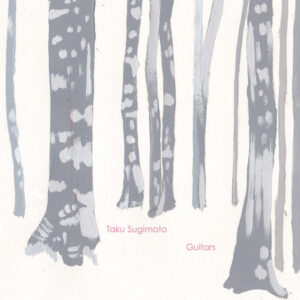
CD
Taku SUGIMOTO
“Guitars”
Performed by Andrey Popovsky: electric guitar (1), semi-acoustic guitar (2), Denis Sorokin: classical guitar (2), electric guitar (3), Alexander Markvart: acoustic guitar (2).
Taku Sugimoto is a Tokyo-based guitarist and composer. Improvisation is one aspect of his work, but currently his main activities are composing and performing composed pieces (including those of other composers). He continues his global and concentrated interaction with composers from around the world, particularly those closely connected with Wandelweiser. Ftarri had previously released two albums under Sugimoto's name alone—Septet (2015) and Quintets: Berlin, San Diego (2017). On both CDs, his compositions are performed by other musicians (on Septet, Sugimoto also participates in the performance).
The CD Guitars, also released under Sugimoto's name, is comprised of three pieces that he wrote for that instrument. The first and third are guitar solos around 20 minutes long; the second is a guitar trio of about 10 minutes. The performers are three guitarists from Russia, and the pieces were recorded in St. Petersburg in 2017 and 2018. The solo compositions were performed by Andrey Popovsky (track 1) and Denis Sorokin (track 3); and the trio was performed by these two plus Alexander Markvart. All the performances are extremely simple and concise, but convey a feeling of complexity and richness. Abounding in an incomparable feeling of depth within their simplicity and candor, these are truly Sugimoto-like works.
13,00€
Out of stock

CD
Cristián ALVEAR – Klaus FILIP
“6 Chords”
Cristián Alvear: acoustic guitar. Klaus Filip: sine waves.
Guitarist Cristián Alvear was born in 1979 and lives in Santiago, Chile. Active on the international contemporary/experimental music scene, he has since 2010 released numerous recordings on labels in various countries. Musician and programmer Klaus Filip was born in 1963 and resides in Vienna, Austria. ppooll, the software he developed, is used regularly by many improvisers, including Filip himself.
This album is comprised of a single track of 40 min., 58 sec., divided into six parts. Klaus Filip continuously plays gentle-sounding sine tones, over which Cristián Alvear simply and steadily repeats the same chords and short phrases on acoustic guitar. While each of the six parts is different in form, the work as a whole is simple, clean-lined, and delicately refined, radiating an indefinably mysterious mood throughout. A masterpiece.
13,00€
Out of stock
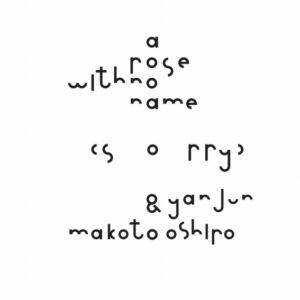
CD
Makoto OSHIRO – Yan JUN
“A Rose with No Name (Sorry)”
Makoto Oshiro: objects. Yan Jun: feedback. Recorded at Yan Jun's residency studio (DAAD), Berlin, Germany, February 22, 2017.
Tokyo-based sound artist and improviser Makoto Oshiro carries out live performances and installations in which he creates sound using self-made devices and remodeled pre-existing objects. Beijing-based musician/poet Yan Jun, one of the leading Chinese artists on the experimental/improvised music scene, creates music and produces installations freely utilizing electronics, field recordings and voice.
This album was studio-recorded on February 22, 2017, when Oshiro was visiting Berlin and Yan Jun was in that city on a long-term residency. The two tracks are about 22 minutes each. The instruments listed on the album cover are "objects" (Oshiro) and "feedback" (Yan Jun). The noises produced include clattering, rotation noise and sustained sound. In Track 1, various low-volume noises are sent forth in a calm and simple way throughout the piece; while in Track 2, numerous multi-layered noises cover the space and also produce intervals of high volume. This album is remarkable not just for the straightforward expression of each artist's musicality, but also for the superb collaboration achieved in the performances.
13,00€
Out of stock
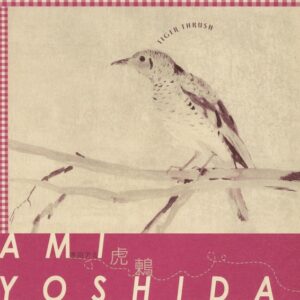
CD
Ami YOSHIDA
“Tiger Thrush”
Recorded by Ami Yoshida at her house in Tokyo, January-March 2003. Mastered by Toshimaru Nakamura, May 2003. Original CD released on Improvised Music from Japan (IMJ-504), July 2003.
In the early 2000s, improvisational music featuring elements such as extended techniques and many faint sounds and silences became a worldwide movement. Along with Berlin and London, Tokyo was one of the centers of this kind of music and the focus of much attention, as was the term onkyo-ha. The names most closely associated with this term were Taku Sugimoto, Sachiko M, Otomo Yoshihide, Toshimaru Nakamura. Another onkyo-ha musician was voice performer Ami Yoshida. Her amazing performances, comprised of high-pitched vocal sounds that seemed to be squeezed out through the tight constriction of the throat, astonished the international improvised music scene.
Tiger Thrush was released on the Improvised Music from Japan label in 2003, when the name Ami Yoshida, along with the term onkyo-ha, was becoming a worldwide phenomenon. Long out of print, it's just been re-released on the Hitorri label, with a simple two-sided paper sleeve replacing the original gatefold cardboard cover. The recording consists of 99 tracks, most less than a minute long. Yoshida's vocal sound is unaltered in some tracks and computer-processed in others. A famed recording of the 2000s has come back to life!!
13,00€
In stock

CD
suzueri
“Fata Morgana”
suzueri: piano, gadgets.
Sound artist/improviser suzueri started her musical activity in the 1990s, and her wide-ranging work since then has included concerts, exhibitions and installations. It was in the late 2000s that she began the style of performance heard on this album, combining upright piano and handmade devices. She continued to develop her concerts featuring this combination, and in the 2010s she earned widespread recognition and praise among improvised/experimental music fans for her unique "suzueri" style.
Three CDs of suzueri's performances at Ftarri with upright piano and self-made devices have previously been released on the Ftarri label: Live at Ftarri (meenna-993), a 2013 concert by the trio of suzueri, Tetuzi Akiyama (guitar) and Makoto Oshiro (self-made instruments), plus a quartet by these three and British drummer Roger Turner; Ftarri de Solos (ftarri-887), pairing solos performed in 2017 by suzueri and Hong Kong sound artist Fiona Lee; and Duo (ftarri-886), a 2018 duo performance with Makoto Oshiro. While these three CDs are all live recordings, what might be called a "definitive" studio-recorded solo album by suzueri has now been released. Fata Morgana, made up of two tracks of 25-plus minutes each, was recorded in February 2019 by Makoto Oshiro (who has an established reputation as an engineer).
Various devices including a small electric fan, a motor and a radio are placed on, attached to or arranged near an upright piano whose upper and lower panels are removed and insides exposed. The devices themselves produce sounds; and when touched by these devices, the piano strings and keyboard emit sounds repetitively (every few seconds) or continuously. These myriad sounds overlap and become a united whole, and at the point when they fill the space like a foundational layer, suzueri strikes the keyboard with both hands, forcefully and persistently unleashing clusters of sounds. This album overflows with suzueri's magical appeal, which combines concentrated musical creativity with turbulence and disarray.
Original price was: 13,00€.7,00€Current price is: 7,00€.
Out of stock
CD
JUN – GUIONNET – SCHELLANDER – MURAYAMA
“Blue Mistake, Red Mistake”
Yan Jun: voice. Jean-Luc Guionnet: alto saxophone. Matija Schellander: contrabass. Seijiro Murayama: snare drum, voice.
Blue Mistake, Red Mistake is the project of four musicians: Matija Schellander, a contrabass player living in Vienna; Jean-Luc Guionnet, a sax player based Paris; Beijing-based Yan Jun, who was staying in Berlin on a residency when this album was recorded; and percussionist Seijiro Murayama, who at the time of the recording had been living in Japan for several years (but before then had lived for a long time in France and now resides in Paris). The four got together and launched the project in March 2017, when Schellander was carrying out a residency at the jazz/improvised music festival Artacts in St. Johann in Tirol, Austria. They gave four performances over a week-long period, starting at the Artacts festival and then in Graz (Austria), Vienna and Ljubljana (Slovenia).
This album's one track (about 44 minutes) is the performance in Ljubljana. Yan Jun, who usually plays electronics, performed with his voice only. Murayama used snare drum and voice. The interior of the venue, Galerija ŠKUC, was like a long, narrow hallway which had several adjoining rooms without doors in between (as if the walls had been taken out). For this project it had been agreed that, in each of the concerts, three of the musicians would play close together and one would be far away. In this concert, Schellander started performing quite far back, at a distance from the others, and during the concert he moved to different rooms.
The overall mood of the performance is minimalist, with a limited number of sounds, but occasionally there are intense percussion sounds. Together with a cool but strong feeling of tension, the sonic perspective and dynamism create an amazing effect which, in combination with the excellent recording quality, result in a truly superb album.
13,00€
In stock
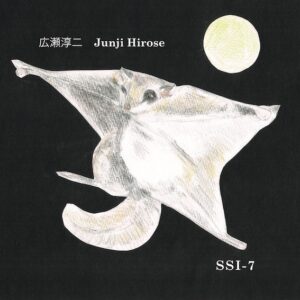
CD
Junji HIROSE
“SSI-7”
A leading sax player on the Japanese improvised music scene, Junji Hirose also plays his own self-made analog noise instruments. In the 1980s he started giving noise performances using his SSI (self-made sound instrument), created by combining everyday objects. Over the years he has remodeled the instrument a number of times, each time adding a different number to the name "SSI." Hirose's CDs SSI-4 (hitorri-997, 2013), SSI-5 (hitorri-993, 2015) and SSI-6 (hitorri-990, 2016) have been released on the Hitorri label. His new album featuring the SSI-7, recorded in December 2018, is now out.
Balls and other small objects are placed on a large, shallow, round metal plate. These objects are covered with a metal plate of the same type and size which is placed and secured in such a way that it seems to be subtly floating. With the use of an air compressor, blasts of air hit the instrument from various angles. The compressed air streaming between the two metal plates causes the objects in between to move around in a dynamic way. The noise of the air compressor, the sound of the compressed air hitting the metal plates, and the sounds produced by small objects moving around and hitting the metal plates all combine to produce a complex and dazzling conglomeration of sound. The album is made up of four tracks, and the sonic atmosphere of each track is altered through the use of different types of small objects. On the final track, no objects are placed between the metal plates; the compressed air hits only the plates. This album overflows with Hirose's creative dynamism and abundant originality.
13,00€
In stock
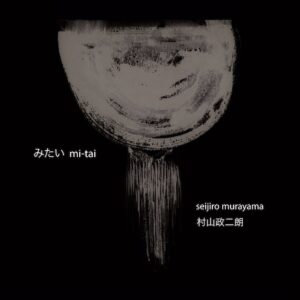
CD
Seijiro MURAYAMA
“mi-tai”
Seijiro Murayama is a drummer/percussionist and improviser/composer living in Paris. Since around 2017 he's focused on creating electro-acoustic works using recordings of his own improvisations. The results of these efforts have been released as two highly praised solo albums from the Hitorri label: Downdate (hitorri-986, 2017) and The Empire of Slip of the Tongue (hitorri-984, 2018). In an about-face from these earlier releases, his new album, Mi-tai, consists of eight improvisational performances on percussion. It's as if Murayama were returning to his point of origin with this release.
Mi-tai is the first of two albums in which Murayama attempts to give a comprehensive account of his improvisation on percussion and drum set--his "principal occupation," so to speak--in this moment in time. This is a chance to experience the amazing creativity that sets Murayama apart from other percussionists/drummers.
13,00€
In stock
CD
Heather FRASCH / Ryoko AKAMA
“Linking”
A composition by Heather Frasch with Brice Catherin: cello, objects, Eleanor Cully: voice, objects, Ryoko Akama: organ, objects. A composition by Ryoko Akama with Heather Frasch: field recordings, objects, electronics.
Heather Frasch is a composer/musician living in the U.S. city of Charlottesville, Virginia. Ryoko Akama is a composer/musician living in Huddersfield, UK. Together they run Mumei Publishing, which issues mumei, a journal exploring the relationship between text and sound. French musician Bruno Duplant asked Frasch and Akama to create a CD, and the result was this three-track album. (Duplant served as producer throughout the project, but was not involved in the compositions or performances.)
In 2018, Frasch and Akama each composed a work using a written text; then they exchanged the compositions and recorded them separately. Akama's composition "For Heather's Day" was recorded and edited in several sessions by Frasch using field recordings, objects and electronics to create a work of 40 minutes in length. Frasch's composition "A Moment in My Day" was recorded by Akama with invited musicians Brice Catherin (cello, objects) and Eleanor Cully (voice, objects) as well as her own sounds (organ, objects), resulting in the creation of four different takes. Takes 1 and 3 (each about 20 minutes) are heard on this album.
On this superb CD, composer/performers Frasch and Akama draw out all the distinctiveness of text scores, both in their compositions and in their interpretation / realization of the works.
13,00€
Out of stock
CD
Tetuzi AKIYAMA
“Misrepresenting Memory”
A solo album by guitarist Tetuzi Akiyama, who carries out an energetic performance schedule in and out of Japan. Amazingly, this is his first solo album since the 2008 release of The Ancient Balance to Control Death on the U.S. label Western Vinyl. That album included both acoustic guitar and singing, so Misrepresenting Memory is actually Akiyama's first instrumental solo album with guitar in 13 years, since the release of the CD-R Terrifying Street Trees in January 2006 on the Portuguese label Esquilo Records.
Misrepresenting Memory consists of one piece (31 min. 27 sec.) performed in concert at the Tokyo venue Apollo on December 14, 2018. The performance—using electric guitar and tape echo—was recorded directly to cassette tape. Making full use of soft, lo-fi tones and distorted choppy sounds, this extremely high-quality work is a fascinating expression of Akiyama's musical artistry. Limited edition of 200, numbered consecutively.
12,00€
Out of stock
CD
Yasumune MORISHIGE – Yoko IKEDA – Takashi MASUBUCHI
“Shade”
This CD documents the complete first and second sets (each a little over 30 minutes) of a concert at Ftarri on September 29, 2018, performed by Yasumune Morishige (cello) Yoko Ikeda (viola), and Takashi Masubuchi (guitar), three improvisers active mainly in Tokyo. The tones produced by the three acoustic stringed instruments are rich and vivid, and the listener can't help but be mesmerized by the interweaving of the sounds. And although the performances are improvised, they're so superbly structured that they could almost be compositions comprised of several movements. You can listen to this recording again and again and always hear something new. This was the first time the three musicians had ever performed together. That first encounter produced a rare masterpiece.
12,00€
Out of stock

CD
Bruno DUPLANT
“Deux songes (les jours sont faits pour expliquer les nuits)”
French musician Bruno Duplant is one of the most talked-about artists on the experimental music scene today. In recent years he's presented many outstanding composed pieces and released a succession of excellent recordings on labels around the world. The abundance and vitality of his work are remarkable.
On this album, two compositions by Duplant are performed by Ordinary Affects, led by Boston-based musician/composer Morgan Evans-Weiler. Ordinary Affects is an experimental music ensemble with an established reputation for performing works by contemporary composers such as Christian Wolff, Antoine Beuger, Michael Pisaro, Jürg Frey, and Kyoko Akama. Track 1 (21 minutes) is a quintet and Track 2 (26 minutes) is a string quartet. The performers are Laura Cetilia (cello), Jordan Dykstra (viola), Morgan Evans-Weiler (violin), J.P.A. Falzone (Fender Rhodes, Track 1 only), Luke Martin (guitar, Track 1 only), and Ashley Frith (viola, Track 2 only).
Each piece has a highly controlled, spacious tempo throughout. The sounds' overlapping and their successive emergence have a dreamlike quality that gently beckons the listener into a state of abstraction. Bruno Duplant's talent and originality as a composer and Ordinary Affects' excellence as performers are fully on display in this superb recording.
12,00€
In stock

CD
Axel DÖRNER – Toshimaru NAKAMURA
“In Cotton and Wool”
With his innovative performances, Berlin-based trumpeter Axel Dörner has been a leading figure on the improvised music scene since the 1990s. Internationally popular no-input mixing board player/improviser Toshimaru Nakamura structures sound by controlling mixer feedback. These two musicians released the CD Vorhernach on the Ftarri label in 2007, and In Cotton and Wool is their second duo album.
The four tracks on this album (each between 7 and 12 minutes) were recorded in a studio in Berlin in May 2017. Dörner uses electronics in addition to trumpet. In striking contrast with the 2007 first release, which is permeated with delicate sound creation making extensive use of soft tones, this second album is sure to overwhelm listeners with its radical, aggressive musical back-and-forth. What's more, there's never a monotonous moment--the overall structure is diverse and richly varied. This is a powerful masterpiece born of the two musicians' incomparable technique and musicianship.
13,00€
In stock
CD
Zhao CONG
“Rotating, Rotating”
Zhao Cong is a Beijing-based experimental/improvisational musician. In addition to performing in live events in Beijing such as Zooming' Night, organized by composer/performer Zhu Wenbo, she has in recent years been expanding her range of activity, visiting Japan each year and performing in various locations around the country. She has also released solo and duo albums on Zhu Wenbo's cassette label, Zoomin' Night.
This CD contains three solo tracks by Zhao Cong. Tracks 1 and 2, each about 20 minutes, were recorded at her home in Beijing in June 2016. Track 3 (about 29 minutes) was recorded in concert at Ftarri, Tokyo, in January 2018. Only the second track is previously released--on Zhao Cong's debut solo album, Afternoon, a cassette tape that came out on Zoomin' Night in 2016 and has since sold out. On that album the title was "Twice, or More," and on this CD it has changed to "Electric Rotating." Tracks 1 and 3, respectively called "Acousting Rotating" and "Rotating, Rotating," are previously unreleased works.
Zhao Cong arranges a mixer, a cardboard cylinder, household items, and a hemispherical lamp (whose small light has a visual effect) on the same table, manipulates mixer feedback and contact mike, and produces delicate sustained sounds and (as if inserting them into the sustained sounds) numerous and varied noises. While her performance style and sounds are restrained, listeners drifting along in these sounds and the gentle flow of time are left with an indescribable and vivid impression. A masterpiece.
Mastered by Hiroyuki Ura in January 2019
Artwork and design by Cathy Fishman
13,00€
Out of stock
CD
Seijiro MURAYAMA
“The Empire of Slip of the Tongue”
Percussionist/voice performer Seijiro Murayama previously lived for a long time in France, and he moved back to that country in 2018 after several years back in Japan. His extremely original performances, using a drum set or some parts thereof, have been highly acclaimed in Europe and throughout the world. The two tracks on this CD, which follows Murayama's album Downdate (released on the Hitorri label in November 2017), are solo performances by Murayama using voice, percussion, and sign waves mixed with field recordings. Densely structured and mysterious, this is an overpowering, incomparable masterpiece.
12,50€
In stock
CD
Toshimaru NAKAMURA / Ken IKEDA / Tomoyoshi DATE
“Ink on Paper”
No-input mixing board player Toshimaru Nakamura makes wide-ranging use of mixer feedback in his many performances in Japan and other countries. London-based electronics player Ken Ikeda has released albums on a number of labels including Touch (UK), Matchless (UK), and Spekk (Japan). Tomoyoshi Date uses both electronic and acoustic instruments and specializes in ambient styles. This is the second CD release by these three musicians. (The first, Green Heights, was recorded in 2011 and released on the French label Baskaru in 2013.) In Ink on Paper, myriad longish sustained sounds and short tones bearing a variety of sonic qualities and timbres appear and disappear, followed by the emergence of new and different sounds. Flowing on the whole in a smooth, gentle and relaxed way, these sounds are infused with a comfortable and unique atmosphere. The single 40-minute track, divided into five parts, is an improvised performance recorded in 2013.
12,50€
Out of stock
CD
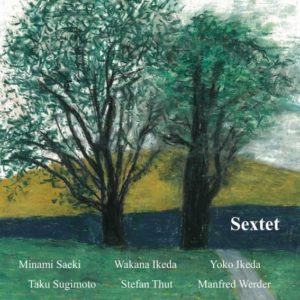
Minami SAEKI / Wakana IKEDA / Yoko IKEDA / Taku SUGIMOTO / Stefan THUT / Manfred WERDER
“Sextet”
While touring Europe in autumn 2017, Minami Saeki (voice), Wakana Ikeda (flute), Yoko Ikeda (viola), and Taku Sugimoto (guitar) visited Switzerland and joined up with Swiss composer/musicians Stefan Thut and Manfred Werder. This CD is a recording of five pieces they performed at the concert venue Theater Delly in Solothurn, Switzerland, on October 9, 2017. Thut played cello, and Werder used glockenspiel and typewriter. Each of the five musicians other than Saeki provided a composition of his or her own, and the five pieces were performed by all six. While Sugimoto's composition is just a minute and a half long, each of the Ikedas' respective compositions is 14 minutes, and those by Thut and Werder are over 20 minutes each. All the compositions call for effectively controlled, minimalistic playing. Maintaining a high level of concentration, the six musicians gave sensitively synchronized, truly superb ensemble performances.
11,90€
Out of stock

CD
Zhu WENBO / Zhao CONG / Takashi MASABUSHI / Masahide TOKUNAGA / Yuma TAKESHITA / Yuji ISHIHARA / Hiroyuki URA
“Trio and Septet”
This is the 3rd CD release commemorating the 6th anniversary of Ftarri, the CD shop in Suidobashi, Tokyo. It documents a concert held at Ftarri in June 2018, featuring Beijing-based musicians Zhu Wenbo and Zhao Cong. The first set was an improvised performance by Zhao Cong (electronics, objects), guitarist Takashi Masabuchi, and alto sax player Masahide Tokunaga (25 minutes). In the second set, a septet consisting of these three musicians plus Zhu Wenbo (buzzer, clarinet, whistle), Yuma Takeshita (remodeled bass guitar), Yuji Ishihara (drums, percussion), and Hiroyuki Ura (percussion) perform Zhu Wenbo's composition "Noise Music" (17 minutes). Both are carefully controlled, finely detailed, superb performances.
Original price was: 11,00€.5,00€Current price is: 5,00€.
In stock
CD
Seijiro MURAYAMA – Toshihiro KOIKE – Martin TAXT
“Duo and Trio”
This is the 1st CD release commemorating the 6th anniversary of Ftarri, the CD shop in Suidobashi, Tokyo. Seijiro Murayama, who lives in France, is active mainly in Europe, giving truly original performances using drums, percussion and voice. Toshihiro Koike is a trombone player who lives in Nagoya. He is the leader of the trio Fuigo, whose other members are Kanji Nakao and Takero Sekijima; and he is also a member of the Satoko Fujii Orchestra. His improvised performances freely using expanded playing methods have an established reputation. Martin Taxt is a tuba player from Norway, and an owner of the Norwegian improvised/experimental music label Sofa. Taxt frequently visits Japan and often performs with Japanese musicians. In 2017, he and Toshimaru Nakamura released the duo CD Listening to the Footsteps of Living Ones Who Are Still on the Ground (ftarri-988) on the Ftarri label. Murayama, Koike, and Taxt performed at Ftarri on April 23, 2016. This CD is made up of two minimal improvised performances (each about 20 minutes)--a duo by Murayama and Koike, and a trio with these two musicians plus Taxt. These are compelling performances born of the musical sympathy among the three musicians.
200 copies
11,00€
Out of stock

2 CD
Taku SUGIMOTO – Minami SAEKI
“Songs”
The concept of Songs, the duo project of guitarist Taku Sugimoto and vocalist Minami Saeki, came about in the second half of 2016. By that December they had already made recordings of their music, and the following February they released their debut album, Songs (CD), on Sugimoto's label, slubmusic. Since then, the duo has had an active performance schedule in Japan and overseas, including European tours in 2017 and 2018. Now they have released their second album, the 2-CD set Songs.
Most of the tracks are short songs between one and four minutes long. All 40 songs (22 on CD 1 and 18 on CD 2) were recorded in Japan and Europe in 2017 and 2018. Lyrics are by Saeki, and compositions are by Sugimoto (except for one song composed by Saeki). Some songs were performed with guest musicians Takashi Masabuchi (guitar), Wakana Ikeda (flute), French musician Léo Dupleix (computer, objects, sine-tones), and Finnish musician Lauri Hyvärinen (guitar).
The basic format consists of extremely short, simple songs performed slowly and quietly, with few sounds, using vocals and guitar only. But if you listen carefully, you'll hear within the simplicity a mysteriously well thought out organization. Both extremely unique and abundantly charming, this is a song album that makes you feel as if you could listen forever.
19,90€
In stock
CD
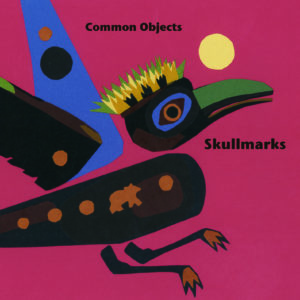
COMMON OBJECTS
“Skullmarks”
The group Common Objects was formed in 2005 by the British harpist/composer Rhodri Davies. The group has had a fluid membership, but in recent years its core members have been the six musicians performing on this album: John Butcher, Angharad Davies, Lina Lapelyte, Lee Patterson, Pat Thomas, and Rhodri Davies. Common Objects performs a wide range of music, from composed works to improvisation. Skullmarks documents the group's first project in which objects are used as scores.
In 2016 Common Objects selected three museums as performance venues and carried out a mini-tour called "Sonorous Matter." Each of the six musicians had chosen items from among the museums' collections as the basis of a score to be performed by the group. "Skullmarks," the work recorded on this album, was based on four historical objects that John Butcher selected from the huge ethnographic collection at the Pitt Rivers Museum in Oxford. These objects were displayed to the musicians and audience during the performance held at the museum on March 22, 2016. The concert, which had a strange and mysterious mood due to the shamanic objects and the atmosphere of the museum at night, resulted in a superb performance with a rare aura and energy.
"Skullmarks" was performed by John Butcher (soprano and tenor saxes), Angharad Davies (violin), Rhodri Davies (electric harp), Lina Lapelyte (violin), Lee Patterson (amplified devices and processes), and Pat Thomas (electronics).
14,50€
In stock

CD
Jean-Luc GUIONNET / Seijiro MURAYAMA
“Idiophonic”
Seijiro Murayama (percussion, voice) lived in France for many years and is currently based in Paris. Alto sax player Jean Luc Guionnet, who lives in Paris, is also known as a pipe organist. The two musicians have released three CDs to date: “Le Bruit du Toit” (Xing-Wu Records, 2007), “Window Dressing” (Potlatch, 2011), and “Mishima, Day & Night” (Ftarri, 2015). Guionnet played the sax on each of these albums. Their fourth release, Idiophonic, is the first on which Murayama performs with Guionnet the organist.
This album contains three improvised pieces. Two of them were performed at a church in Berlin, Germany, in June 2015, and the third at a church in Ljubljana, Slovenia, in September 2012. Murayama plays only the snare drum. (His voice is also heard from time to time on the first track.) The sound of Guionnet’s organ--at different times loud, soft, majestic, and rough--is both noise-like and expressive. Murayama, meanwhile, effectively fires out sharp, striking sounds as he switches between sticks and brush. Each of them plays with restraint and a high degree of tension, never producing too much sound. Their musical compatibility, combined with the richly reverberating church acoustics, make for truly impressive performances.
12,00€
Out of stock
CD
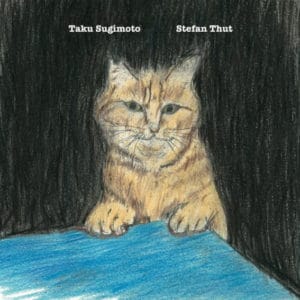
Taku SUGIMOTO / Stefan THUT
Guitarist, composer and improviser Taku Sugimoto frequently performs overseas as well as in Japan. He’s also a member of the Suidobashi Chamber Ensemble, which consists of five Japanese musicians. Stefan Thut is a Swiss cellist and composer. Both Sugimoto and Thut are known as unique performers and composers, and both have close ties with the contemporary classical Wandelweiser group. The two have a long association, performing together when Sugimoto visits Switzerland and when Thut comes to Japan.
Sugimoto and Thut performed in Geneva and Basel during Sugimoto’s 2015 European tour. (They'd previous collaborated in larger formations, but this was their first duo performance.) The concert in Basel on March 21 is documented on this CD. The duo of Thut (cello) and Sugimoto (guitar) performed Thut's 2015 composition “Ten Strings, 1-24” (which includes the sound of rolling dice) and Sugimoto's 2014 composition “Mada”. The two pieces (each about 25 minutes long) are presented here as a single 49-minute track instead of separate tracks. (Thut’s piece is heard before Sugimoto’s) Each work displays the special character of these two highly individual composers, whose performances on this collaboration album are endlessly fascinating.
12,00€
Out of stock
2 CD
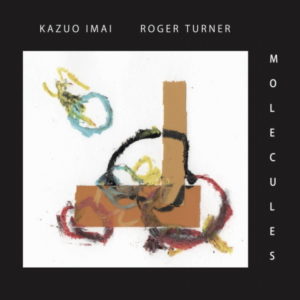
Kazuo IMAI / Roger TURNER
“Molecules”
This masterful performance was born of the meeting of two master improvisers, Kazuo Imai of Japan and Roger Turner of the UK.
Imai, who studied with Masayuki Takayanagi and Takehisa Kosugi, is one of Japan’s leading improvisers and guitarists.
Turner is a drummer and percussionist who has been actively performing throughout the world since the beginning of the 1970s.
His Japan tour in October 2017 included concerts with Japanese musicians in various locations, including his performance with Kazuo Imai at Bar Isshee in Tokyo on October 11. In this duo concert, Imai played one nylon string guitar, while Turner used only snare drum, tom tom, cymbals, metal and wood instead of setting up a complete drum set; and the sound was acoustic, without electric amplification. The overall sound is somewhat controlled, in keeping with the nylon string guitar volume; and within that context the musicians’ interacting sounds are remarkably diverse, dynamic, and beautiful. The concert’s first and second set are documented in their entirety on this album.
Imai, who studied with Masayuki Takayanagi and Takehisa Kosugi, is one of Japan’s leading improvisers and guitarists.
Turner is a drummer and percussionist who has been actively performing throughout the world since the beginning of the 1970s.
His Japan tour in October 2017 included concerts with Japanese musicians in various locations, including his performance with Kazuo Imai at Bar Isshee in Tokyo on October 11. In this duo concert, Imai played one nylon string guitar, while Turner used only snare drum, tom tom, cymbals, metal and wood instead of setting up a complete drum set; and the sound was acoustic, without electric amplification. The overall sound is somewhat controlled, in keeping with the nylon string guitar volume; and within that context the musicians’ interacting sounds are remarkably diverse, dynamic, and beautiful. The concert’s first and second set are documented in their entirety on this album.
17,00€
Out of stock
CD
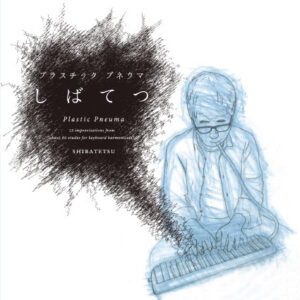
SHIBATETSU
“Plastic Pneuma”
Shibatetsu was born in Tokyo in 1959. Since the 1980s he has been active as a piano and keyboard harmonica player, improviser, and composer. This album is made up of his improvisational performances on keyboard harmonica. Each of the 13 tunes, recorded in 2013, are about 1-3 minutes in length (total time, 28 minutes 26 seconds). The keyboard harmonica’s distinctive quality is its simple, comfortable tone, and from this instrument Shibatetsu’s technique and sensitivity create amazingly varied sound textures, and striking melodies even amid abstractness.
Original price was: 12,00€.5,00€Current price is: 5,00€.
In stock

CD
COMPILATION
FTARRI AFTER TOMORROW
It’s been five years since Ftarri, an online CD shop and record label specializing in improvised music, opened a physical store of the same name in Suidobashi, Tokyo.
This is the first title in a four-CD series celebrating the store's fifth anniversary.
It consists of four performances (three solos and one duo) by a total of five musicians.
The first track is an electronic sound piece by Hideki Umezawa (born in 1986) in which myriad wriggling, slithering sounds are released little by little in an enjoyable way.
In track 2, Yoko Ikeda (violin, etc.) and Wakana Ikeda (flute, etc.)--both members of Suidobashi Chamber Ensemble--perform a composition by Wakana. This work, in which sound parts using instruments and other objects alternate with silences, conveys a sense of Wakana's unique ideas.
In track 3, Yoichi Kamimura (born in 1982) takes field recordings gathered in various locations, seasons them with electronic sounds, and processes and edits the work with superb artistry.
Tracks 4 and 5 are improvised performances by Takashi Masabuchi (acoustic guitar). Both proceed in a relaxed way, with beautiful sound sequencing and resonance.
Limited edition of 200, consecutive numbering.
11,00€
Out of stock
CD
COMPILATION
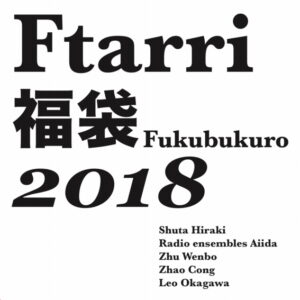
FTARRI FUKUBUKURO 2018
Fukubukuro are special surprise gift bags sold at stores in Japan at the New Year. This fukubukuro CD is being released by the CD shop/label Ftarri to celebrate its fresh start for 2018. Each of the 5 tracks is a solo piece by a different musician. Shuta Hiraki is an electronics musician who creates mainly drone music. He released the CD Unicursal on Kyou Records in 2017. Radio ensembles Aiida, a solo project by A. Mizuki, presents unique performances using shortwave radios as “instruments.” Her 2017 CD In a Room (Radio of the Day
1) was released on VLZ Produkt. Leo Okagawa takes field recordings and concrete sounds and processes them electronically to create music. He released the CD-R The Notional Terrain on Glistening Examples in 2017. Beijing residents Zhu Wenbo and Zhao Cong have for several years been carrying out musical exchanges with Yan Jun, one of China's leading experimental/improvisational musicians. Zhu Wenbo specializes in conceptual creative styles; his track on this CD is a composition consisting entirely of hand claps. Zhao Cong constructs works of music by amplifying the sounds produced by an array of small objects.
11,00€