
In stock
CD
Toshimaru NAKAMURA – Martin TAXT
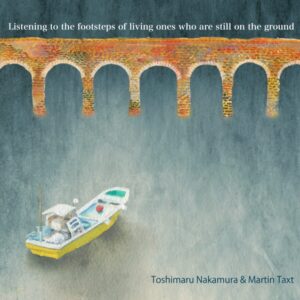
“Listening to the Footsteps of Living Ones Who Are Still on the Ground”
This is a duo album by Toshimaru Nakamura, a mixer player based in Tokyo, and Martin Taxt, a tuba player living in Oslo. Instead of a conventional tuba, Taxt plays a custom-made “microtonal tuba” capable of producing microtones. In this album, Nakamura incorporates Taxt’s tuba sounds in his mixer through a microphone instead of playing his usual instrument, the no-input mixing board, which does not take in external sounds.
The project started with the concept of Nakamura processing the tuba sounds in real time as they played. But in their actual performances, the opposite often occurred: Taxt’s tuba sound directed and obstructed Nakamura’s feedback. This completely unexpected outcome astonished both musicians and spurred them on to new forms of creation. The three tracks on this album were recorded in Japan in April 2016.
13,00€
Out of stock
CD
Tetuzi AKIYAMA – Makoto OSHIRO – SUZUERI – Roger TURNER
“Live at Ftarri”
The 2 tracks on this CD document a concert held at Ftarri, Tokyo, on February 19, 2013, featuring the famed drummer Roger Turner, a leading figure on the British improvised music scene. The opening act, a trio performance (41 minutes 55 seconds) by Tetuzi Akiyama (guitar), Makoto Oshiro (self-made instruments) and Suzueri (piano, toy piano, objects, voice), was followed by a quartet performance (15 minutes 38 seconds) made up of these three musicians plus Turner (drums, percussion). Played at relatively low volume, the various murmuring, clattering sounds that emerge and transform with the passage of time fully demonstrate the special appeal of improvisational performance. Superb.
12,00€
Out of stock
CD
Taku SUGIMOTO
“Quintets: Berlin, San Diego”
In recent years, guitarist Taku Sugimoto has been active as a composer, providing works to musicians inside and outside Japan, and also as an improvisational musician. He often works with composers and musicians in the sphere of the Wandelweiser school, and gives many performances overseas. Sugimoto is also a member of the Suidobashi Chamber Ensemble, which is made up of five Japanese musicians.
This CD, Sugimoto’s first release since Septet (on Meenna) in 2015, is made up of two versions, both about 30 minutes long, of his 2017 composition “Quintet,” recorded in Berlin and San Diego (U.S.A.). It is performed by five musicians on flute, two clarinets, violin and cello. Track 1, the Berlin version, is a live performance that took place on August 6, 2017. Track 2, the San Diego version, was studio-recorded on March 15, 2017. Clarinetists Samuel Dunscombe, from Australia, and Michiko Ogawa performed on both tracks. Other performing musicians were Rebecca Lane (flute), Johnny Chang (violin), and Lucy Railton (cello) in Berlin; and Michael Matsuno (flute), Erik Carlson (violin), and Judith Hamann (cello) in San Diego. Sugimoto composed the work but did not participate in the performances. The frequently overlapping and interfering long tones and the short tones nonchalantly plucked on the strings continue throughout the performances. Simple structural beauty and a tranquil resonance pervade the performances. A masterpiece.
12,00€
Out of stock
CD
Taku SUGIMOTO
“Septet”
Guitarist Taku Sugimoto continues his long-term musical activities, with a focus on composing, and also collaborates closely with some of the composers in the Wandelweiser Group. This release is one of the summits of his recent work.
Septet is a work of just under 40 minutes, performed by seven musicians on clarinet, flute, viola, contrabass, cello, electric guitar and sine-tones. Throughout, numerous diffuse sound reverberations emerge and overlap, then fade away. The sound progression is simple and unhurried, but the work is permeated with tension from start to finish. A masterpiece. This is the live recording of the work's world premiere in Berlin in March 2015. The performers are Rebecca Lane (flute), Michael Thieke (clarinet), Johnny Chang (viola), Koen Nutters (contrabass), Derek Shirley (cello), Taku Sugimoto (electric guitar) and Bryan Eubanks (sine-tones).
“This composition is conceived of as a sort of double concertino for clarinet, flute, and small ensemble. However, the two main instruments, clarinet and flute, make no melody: the one tone is shared and repeated by them. I want to have the other instruments (viola, cello, contrabass, guitar, and sine-tone generator) work as if they are drawing several spectrums with the sound of the clarinet or flute, so each of these instruments has a specific set of microtones to play. In order to make it easier to produce those microtones, the stringed instruments are tuned anomalously; only harmonics or open strings are played. The very low frequencies are produced only by the sine-tone generator, since these frequencies are too low to play with any musical instrument except piano.” T. S.
13,00€
Out of stock
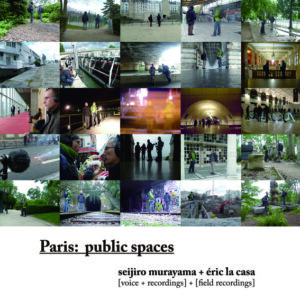
CD
Seijiro MURAYAMA – Eric LA CASA
“Paris: public spaces”
Seijiro Murayama is a drummer-percussionist-voice performer currently working in Japan again after living for a number of years in France. Éric La Casa is a French sound artist well known for site-specific field recordings with a strong improvisational element. The two have been working together on numerous projects for nearly a decade. For six months starting in January 2012, La Casa and Murayama took portable tape recorders out to parks, subway stations, streets and other public spaces in Paris and separately made individual recordings in the same place and time frame, then edited the recordings. The result is the 12 tracks on this CD. Murayama frequently produced his unique vocal sounds while recording. This odd and unexpected voice sneaks into the varied and lively sounds that fill the public spaces, creating curious accents.
13,00€
Out of stock
CD
Seijiro MURAYAMA
“Downdate”
Seijiro Murayama, a percussionist/drummer currently based in Japan, lived in France for a number of years and has received acclaim in the west for his musicianship. He performs frequently both inside and outside Japan. This is Murayama’s first solo album since “Broken Iteration” was released on the Herbal International label four years ago, in 2013. It consists of two tracks of about 20 minutes and one of about 7 minutes (3 in total). Overlapping and combining with percussion and scraping sounds are electronic sounds, field recordings of sounds like birdsong and flowing water, and vocal sounds. Rich in creativity and fantasy, this is an album that could only have been made by Seijiro Murayama.
12,00€
Out of stock
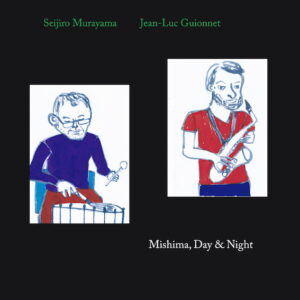
CD
Seijiro MURAYAMA – Jean-Luc GUIONNET
“Mishima, Day & Night”
Seijiro Murayama (percussion), who is currently based in Japan, lived in France for a number of years and since that time has performed frequently with the French alto sax player Jean-Luc Guionnet. “Mishima, Day & Night” is their third duo album after “Le Bruit du Toit” (Xing-Wu Records, 2007) and “Window Dressing” (Potlatch, 2011). These four tracks document their improvised music performances in Mishima City at Hongaku Temple (day) and Teke Bar (night) on the same day in July 2013. Murayama uses just one or two elements of the drum set (a cymbal and a snare drum on the first track, and only a snare drum on other tracks), Guionnet plays alto sax, and together they freely create a unique and inimitable sound. The three superb tracks from the performance at Hongaku Temple vividly demonstrate the special qualities of two artists at the forefront of the international improvised music scene and retain a consistent tension from start to finish. Track 4, a live concert held in the more relaxed atmosphere of Teke Bar, is a performance that develops through the perfect pairing of the two musicians, while fully displaying their respective characters.
12,00€
Out of stock
CD
Ryoko AKAMA – Ko ISHIKAWA – Bruno DUPLANT
“2 Compositions”
Ryoko Akama is a sound artist/composer living in the UK. Her prolific activity in recent years, not only in the UK but throughout the world, has been remarkable. Over the past several years she has released a succession of recordings of her compositions and performances. Ko Ishikawa plays the sho, an instrument used in gagaku, traditional Japanese court music. While active in the world of gagaku, the incomparable Ishikawa has also established a firm foothold on the improvised music scene. Bruno Duplant is a French musician who has become widely known, particularly since 2010, for his unique approach to music. Akama and Duplant have been collaborating since 2013 and have released several CDs and CD-Rs. In the album 2 Compositions, the newest product of their collaboration--this time with Ishikawa--the three artists perform Akama’s compositions using scores consisting of text and graphics. Akama (electronics), Ishikawa (sho) and Duplant (contrabass and electronics) bring out all the beauty of Akama’s succinct and elegant compositions generously incorporating “space.”
13,50€
Out of stock
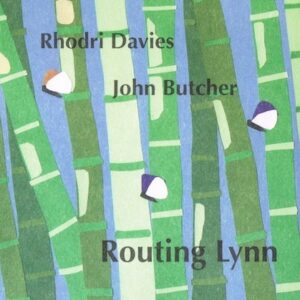
CD
Rhodri DAVIES – John BUTCHER
“Routing Lynn”
This is the first duo album since 2010 by leading British improvisers Rhodri Davies (harp) and John Butcher (saxophone). In January 2014, together with respected musician and sound recordist Chris Watson, they visited Routing Lynn, an area of ancient rock carvings in Northumberland, northern England. In this natural setting, Davies and Butcher played music and Watson recorded. Two months later, at a festival in Gateshead, England, Davies and Butcher performed along with the 4-channel playback of the recording made by Watson in Routing Lynn. The performance is documented on this CD as a single 35-minute track.
Powerful and exquisite instrumental sounds blend with the sounds of nature (water, warbling birds) from this area of ancient rock. Davies and Butcher’s performance combines with Watson’s recording to create a masterpiece!
14,00€
In stock
CD
Masashi TAKASHIMA – Yuma TAKESHITA – Yuji ISHIHARA – Atsushi ARAKAWA – Fiona LEE
“Ftarri Jam”
It’s been five years since Ftarri, an online CD shop and record label specializing in improvised music, opened a physical store of the same name in Suidobashi, Tokyo. This is the second title in a four-CD series celebrating the store's fifth anniversary. The single 33-minute track is a group improvisation by all five musicians who appeared at Ftarri on May 5, 2017, performed at the end of the concert. Masashi Takashima (drums, electronics), who lives in the city of Koriyama in Fukushima Prefecture, is a talented composer as well as a drummer. He participated as a composer and player on the CD Astrocyte, which was released on the label Meenna in 2016. Atsushi Arakawa (electric guitar), who also lives in Koriyama, is a member of RedTemple, a rock trio which gained attention on the improvised music scene for its LP release in collaboration with Otomo Yoshihide. Yuma Takeshita (remodeled bass guitar) and Yuji Ishihara (drums) perform together frequently, mainly in Tokyo. For the past several years they have been performing as the duo project Tumo. Fiona Lee (self-made electronics, objects) is a Hong Kong-based sound artist who has recently been gaining widespread recognition. She has performed in Japan several times, including at the Asian Meeting Festival 2016, and this was her first appearance at Ftarri. The concert that day was probably the first and last by this rare combination of musicians. The many sounds produced by each of them overlapped and combined in an organic way in this lively and impressive performance. Limited edition of 200, consecutive numbering.
11,00€
Out of stock
CD
Masahide TOKUNAGA
“Alto Saxophone 2”
Masahide Tokunaga, born in 1982, is an alto sax player & improviser active on the Tokyo scene. This CD is his second solo album, and his first since the 2009 release of “Alto Saxophone” on the Slub Music label five and a half years ago. Like that CD, these 7 tracks (recorded in January 2015) are made up entirely of subtly changing long tones played on the alto sax. This album is just as unique, but compared to the previous CD, which is made up entirely of soft playing, its sound is a great deal bigger, deeper and more powerful. Tokunaga continues his steady advancement as an incomparably original, extremely impressive sax player. A highly satisfying album.
12,00€
In stock
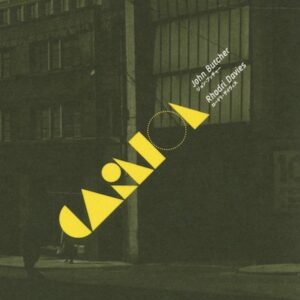
CD
John BUTCHER – Rhodri DAVIES
“Carliol”
John Butcher: tenor or soprano saxophones - plus feedback, motors, embedded harp speaker. Rhodri Davies: pedal harp, lever harp with embedded speaker and electric harp, aeolian electric harp. John Butcher is one of the leading sax players on the free improvisation scene. Rhodri Davies transcends conventional ideas about the harp-an instrument rarely associated with improvised music--in his wide-ranging projects. The two British musicians have worked together in a variety of contexts since 1997 and gave their first duo concert in 2000. As a duo they toured the UK and the U.S. in 2002, and Japan in 2004. In their performances they draw upon extended and unique playing methods mastered over the course of their careers, leaving far behind the imagined limits of their respective instruments. Carliol contains 7 tracks studio-recorded between August 2007 and April 2009. With its multi-hued timbres and textures, sonic beauty, conceptual freedom, experimental spirit and sophisticated structure, this CD dazzles on many levels. While the 2001 album Vortices & Angels (on the UK label Emanem) includes duo tracks by these two artists as well by Butcher and Derek Bailey, Carliol is the first all Butcher & Davies duo album to be released since the start of their duo collaboration a decade ago.
13,00€
In stock
CD
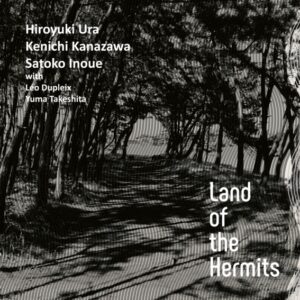
Hiroyuki URA – Kenichi KANAZAWA – Satoko INOUE – Léo DUPLEIX – Yuma TAKESHITA
“Land of the Hermits”
Improviser/composer Hiroyuki Ura, sculptor Kenichi Kanazawa, and classical pianist Satoko Inoue released two CDs on the Meenna label in 2017, and the three artists are united again in Hermits.
The earlier CDs, Scores and Scores at Ftarri (both released in 2017), are made up of their live performances of a composition by Ura, which was based on a sculptural work by Kanazawa. The performance heard on Scores took place at The Museum of Modern Art, Gunma, in October 2016; the performance on Scores at Ftarri was held at Ftarri in January 2017.
The single track on Hermits (29 min. 50 sec.) is a live performance of Ura’s composition “Duration, Dynamics and Pitch” that was held at Tokyo Art Museum in Chofu, Tokyo, on November 3, 2017. Ura played keyboard and percussion; Kanazawa, steel; and Inoue, toy piano. The performance also featured guest musicians Yuma Takeshita, who plays a remodeled bass guitar he calls an electro-bass; and Paris resident Léo Dupleix, who uses a computer and a vibrating tin can.
The 26-page score of this work consists of extremely simple instructions made up of one, two, or all three of the elements of sound duration, dynamics, and pitch--for example, “Long,” “Soft,” “Low-pitched,” “Long, Soft,” “Short, Loud, High-pitched.” Each player makes one sound per page; and when those sounds are finished, they all turn the page and proceed to the next page. Though it's a composition, the simple score means there are a great many sections left up to the players' discretion.
Successions of small sounds from the toy piano hop and leap, intense percussive sounds tear up the space, and then there is quiet. Throughout, sound clusters appear and continue, interspersed with short periods of silence. Exquisite sound-making by each player, along with an overall structural beauty and high level of tension, make for a truly superb performance.
12,00€
Out of stock
CD
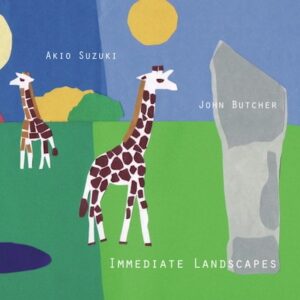
Akio SUZUKI – John BUTCHER
“Immediate Landscapes”
Sound artist Akio Suzuki crisscrosses the world with his self-made instruments. British tenor/soprano sax player John Butcher is a leading figure in improvised music. These two musicians have been carrying out duo performances since 2002. The six tracks on this CD are recordings of their duos in Scotland in 2006 and Tokyo in 2015.
In June 2006, an event was held in which Suzuki and Butcher visited and performed in places around Scotland that have highly distinctive acoustic characteristics. Butcher's solo performances from this event were released in the CD Resonant Spaces (Confront, 2008). Recordings had also been made of the duo performances, and these are being released for the first time on this CD. The fascinating performances on these five tracks, each of which is 5-8 minutes long, made use of the special acoustic environments of five locations: the underground Wormit Reservoir in Fife; the Hamilton Mausoleum in Hamilton, well known as a manmade structure with long reverberation; the gigantic Smoo Cave in Durness; the large Tugnet Ice House in Spey Bay; and the Lyness Oil Tank in the Orkney Islands, which was used during World War Two. Suzuki and Butcher also performed together nine and a half years later, in November 2015, at Ftarri Festival2015, held at SuperDeluxe, Tokyo. In this 27-minute-long performance, they exchange myriad sounds in a flexible, spontaneous manner.
15,00€
Out of stock

7 CD
COMPILATION
FTARRI COLLECTION
This 7-CD set contains 19 selected performances from the Ftarri Festival, held in April 2008 (Kyoto / Tokyo), and the Ftarri doubtmusic Festival, held in September 2010. The 7 CDs, together with a sequentially numbered Ftarri Collection card, come in a special handmade felt bag about 18 cm high and 17 cm wide. Each bag has a different design.
Ftarri Collection 1 with Opera Southern Cross (Taku Sugimoto: composition, images. Katsuaki Iida: words, reading. Toshimaru Nakamura: no-input mixing board. Taku Unami: computer). John Butcher / Toshimaru Nakamura / Tetuzi Akiyama. Otomo Yoshihide / Toshimaru Nakamura / Ryu Hankil.
Ftarri Collection 2 with Noid / Kai Fagaschinski / Axel Dörner / Taku Unami. Eddie Prévost / Sachiko M.
Ftarri Collection 3 with gnu (Masahiko Okura: compositions, bass clarinet, alto saxophone. Shinichi Tsukamoto: keyboards. Yukiya Taneishi: electric bass. Tadashi Kumada: drums. Itoken: drums). Ami Yoshida. Tim Olive / Anthony Guerra / Makoto Oshiro.
Ftarri Collection 4 with Los Glissandinos (Klaus Filip: lloopp + Kai Fagaschinski: clarinet). Bunsho Nishikawa / Tim Olive / Haco. Katsura Yamauchi / Ko Ishikawa / Tetsu Saitoh.
Ftarri Collection 5 with Naoaki Miyamoto. Chie Mukai / Tetragrammaton.
Ftarri Collection 6 with Chihei Hatakeyama / Kiyoshi Mizutani. Hello (Takahiro Kawaguchi: composition, bass guitar. Shinjiro Yamaguchi: guitar. Satoshi Kanda: bass guitar).
Ftarri Collection 7 with Seiichi Yamamoto / Umeda Tetsuya, VOIMA (Yasufumi Suzuki: computer. Tetsuro Yasunaga: computer). Tetuzi Akiyama / Utah Kawasaki / Katsura Yamauchi.
Numbered limited edition of 300
69,00€
Out of stock
3 CD
MARGINAL CONSORT
“08.09.13”
Marginal Concert is the collective improvisation project made up of Kazuo Imai, Tomonao Koshikawa, Kei Shii, and Masami Tada. All of the members were students of Takehisa Kosugi at Bigakko art school in 1975. They started the project on the invitation of Imai in 1997. Each year Marginal Consort holds from one to several concerts in which they perform continuously, without interruption, for two to four hours. Various electronic and acoustic sounds blend and coexist, and myriad sound colors/textures and reverberations flow in a free and spacious way while making large-scale transformations over time. Superb. These 3 CDs document Marginal Consort's live performance at a gallery in London in September 2013.
27,00€