
In stock
LP
DRØNE
“The Stilling”
The 4th album by drøne, (Mark Van Hoen & Mike Harding), is the 3rd for Anna von Hausswolff's label, Pomperipossa Records. Featuring Zachary Paul on violins, Charlie Campagna (bass and ‘cello) and Katt Newlon on ‘cello, the strings add lush, warm layers to a darker, edgier sound. Gabi Strong debuts on guitar and the voices of a host of vocalists inc. Claire Belhassine, Celia Eydeland, Bana Haffar, Pepa Ivanova, Nour Mobarak & Brisa Romero.
With the trademark drøne sounds of static, radio voices, field recordings, modular synthesizer and found sounds, recording chance sounds right up to the final mix add to the dynamism and energy of the album.
16,00€
In stock
LP
Brunhild FERRARI & Jim O’ROURKE
“Le piano englouti”
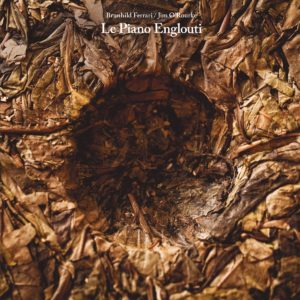
Black Truffle announce the release of Le Piano Englouti (The Sunken Piano), the first collaboration between Brunhild Ferrari and Jim O'Rourke, offering up two side-long realisations of Ferrari's tape compositions recorded in concert at Tokyo's SuperDeluxe in 2014, revised and mixed by O'Rourke in 2019.
The title piece weaves an immersive web of electronics, pre-recorded piano, and field-recorded sounds, including the raging Aegean sea, the tranquil atmospherics of a Japanese island, and the roar of a pachinko parlour. Far from a slice of audio vérité, these geographically distant sites intermingle in an unreal space where they often become indistinguishable. Shadowed by electronics and reverberant snatches of piano, the field recordings rise up and recede like ocean waves, creating a constantly shifting texture that is nonetheless warmly inviting. Chirping birds are confused with their electronic doubles; snatches of footsteps and voices are engulfed by ambience of unclear origin. Increasingly present throughout the piece, the piano rises up one last time before being swallowed up for good by the pachinko parlour.
Tranquilles Impatiences (Quiet Impatiences) takes as its source material the electronic sounds produced by Luc Ferrari for his 1977 Exercises d'Improvisation, seven tapes intended to be heard alongside instrumental improvisation. Brunhild Ferrari's piece layers Luc Ferrari's sounds into a dense new work that emphasises the insistently pulsing rhythms of the source material. In this realisation with O'Rourke, the piece becomes a monumental sound-object, a slowly shifting mass of skittering electronic tones, shimmering reverb, and growling bass from which field-recorded events occasionally arise. At times, the placement of these fragments of real life in a pulsing, insistent musical landscape calls up Luc Ferrari's classic Petit Symphonie; at other points, the swarming electronics bring to mind O'Rourke's Steamroom work or even the vast expanses of Roland Kayn.
Presented in a deluxe gatefold sleeve with liner notes from Brunhild Ferrari.
23,50€
Out of stock
LP
Luc FERRARI
“Dialogue ordinaire avec la machine – Sexolidad”
Edition of 300 copies in gatefold cover. Comes with a 30x30cm 4-page booklet with bilingual (French-English) versions of the integrated text from "Sexolidad" and the lyrics to "Love Song with the Machine".
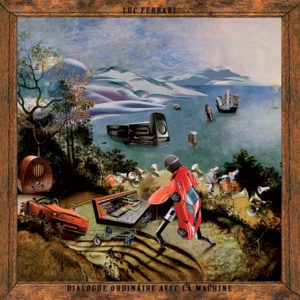
“Dialogue ordinaire avec la machine, ou trois fables pour bande doucement philosophiques” (1984). Ordinary dialogue with the machine or three gently philosophical tales for tape. Luc Ferrari in conversation with the machine and Yannick Gornet (stereo magnetic tape). Song: Michel Musseau. “Sexolidad” (1982-83). in six parts: eyes, hands, sight, mouth and tongue, sex and ears and for 15 instruments: flute, oboe, bass clarinet, bassoon, trumpet, trombone, violin, viola, cello, doublebass, piano, 2 percussion, celesta-glockenspiel. Live recording by the Ives Ensemble.
"Dialogue Ordinaire Avec la Machine" describes the not so chance meeting between the artists (Ferrari helped by Yannick Gornet) and the mysteriously working machine (a sampler), between the curiosity, amusement, surprise, ineptitude and excitement of the musicians and the machine with its appeal, complexity, stubbornness and synthetic eruptions. A rollercoaster through exploration, seduction, observations, misunderstandings, purrs, moans, gurgles, whooshes, loops and mechanical rhythms from which Ferrari builds his own synthesized folklore, ending with one of the most unusual episodes in the composer's production, the rather graphically explicit and apocalyptic "Love Song With the Machine" (which, to make an unlikely comparison with younger artists, one could imagine the music of the New York duo Suicide mixed by Nurse With Wound's Steven Stapleton).
"Sexolidad" is one of Ferrari's most seductive instrumental pieces, representing a journey over the body, in which tonalities and their mix create "a particular harmonic climate [...]. What is important is the expression this pseudo-tonal atmosphere should bring out, as a sort of sensual, and even carnal, satisfaction". The curious concept and its musical composition result in an extremely enjoyable piece which is continuously intriguing, evocative, dauntless, persuasive and highly satisfying, exquisitely performed here by the Ives Ensemble.
24,00€
Out of stock
LP
Will GUTHRIE
“Nist-Nah”
Nantes-based Australian drummer and percussionist Will Guthrie returns to Black Truffle with Nist-Nah. Like his previous solo record on the label, the abrasive hip-hop concrète of People Pleaser (BT027), Nist-Nah finds Guthrie branching out in a new direction, this time in a suite of six percussion pieces primarily using the metallaphones, hand drums and gongs of the Gamelan ensembles of Indonesia. The music presented here is grounded in Guthrie’s travels in Indonesia and study of various forms of Gamelan music, from the stately suspended temporality of the courtly Javanese Gamelan Sekatan, to the delirious, thuggish repetition that accompanies the Javanese trance ritual Jathilan, to the shimmering acoustic glitch of contemporary Balinese composer Dewa Alit and his Gamelan Salukat.
However, far from an exercise in exoticism, Nist-Nah develops out of Guthrie’s extensive work with metal
percussion in recent years (as heard, for example, on his 2015 LP for iDEAL, Sacrée Obsession), where gongs, singing bowls and cymbals are used to build up walls of hovering tones and sizzling details. Though Guthrie is broadening his palette to explore Gamelan instrumentation and pay tribute to his love of this sophisticated yet elemental percussion music, the pieces presented here are equally informed by Guthrie’s interests in free jazz, electro-acoustic music and diverse experimental music practices, exploring long tones, extended techniques, and non-metered pulse.
Nist-Nah presents a variety of approaches across its six pieces, from the crisp, precise rhythmic complexity of the opening title track to the droning textures of ‘Catlike’ and ‘Elders’. On the epic closing ‘Kebogiro Glendeng’, Guthrie offers an extended, layered rendition of a Javanese piece belonging to a repertoire primarily used for warmups, beginner’s groups and children first learning Gamelan, elegantly gesturing to his own amateur status while using the piece’s insistently repeated melody as an extended exploration of the hypnotic effects of repetition, falling in and out of time with himself to create woozy, narcotic effects until the piece eventually dissolves into a wavering fog.
Recorded in 2019 by Lucas Pizzini. Mixed and mastered by Joe Talia at Good Mixture, Tokyo. Cut by Kassian Troyer at D&M, Berlin. Images by Sylvie Meunier.
18,00€
Out of stock
CD
Will GUTHRIE
“Nist-Nah”
Nantes-based Australian drummer and percussionist Will Guthrie returns to Black Truffle with Nist-Nah. Like his previous solo record on the label, the abrasive hip-hop concrète of People Pleaser (BT027), Nist-Nah finds Guthrie branching out in a new direction, this time in a suite of six percussion pieces primarily using the metallaphones, hand drums and gongs of the Gamelan ensembles of Indonesia. The music presented here is grounded in Guthrie’s travels in Indonesia and study of various forms of Gamelan music, from the stately suspended temporality of the courtly Javanese Gamelan Sekatan, to the delirious, thuggish repetition that accompanies the Javanese trance ritual Jathilan, to the shimmering acoustic glitch of contemporary Balinese composer Dewa Alit and his Gamelan Salukat.
However, far from an exercise in exoticism, Nist-Nah develops out of Guthrie’s extensive work with metal
percussion in recent years (as heard, for example, on his 2015 LP for iDEAL, Sacrée Obsession), where gongs, singing bowls and cymbals are used to build up walls of hovering tones and sizzling details. Though Guthrie is broadening his palette to explore Gamelan instrumentation and pay tribute to his love of this sophisticated yet elemental percussion music, the pieces presented here are equally informed by Guthrie’s interests in free jazz, electro-acoustic music and diverse experimental music practices, exploring long tones, extended techniques, and non-metered pulse.
Nist-Nah presents a variety of approaches across its six pieces, from the crisp, precise rhythmic complexity of the opening title track to the droning textures of ‘Catlike’ and ‘Elders’. On the epic closing ‘Kebogiro Glendeng’, Guthrie offers an extended, layered rendition of a Javanese piece belonging to a repertoire primarily used for warmups, beginner’s groups and children first learning Gamelan, elegantly gesturing to his own amateur status while using the piece’s insistently repeated melody as an extended exploration of the hypnotic effects of repetition, falling in and out of time with himself to create woozy, narcotic effects until the piece eventually dissolves into a wavering fog.
Recorded in 2019 by Lucas Pizzini. Mixed and mastered by Joe Talia at Good Mixture, Tokyo. Cut by Kassian Troyer at D&M, Berlin. Images by Sylvie Meunier.
13,00€
Out of stock

CD
FEN
“No one’s island”
FEN (Far East Network) is a group project made up of musicians from Singapore, Japan, China, and South Korea who play improvised music. It was first started on the suggestion of globally renowned musician Otomo Yoshihide in 2008 for a French festival MIMI. Each member is an artist who works individually on the experimental music scene in his respective country. They have been supporting each other's activities by organizing concerts in their own countries, and this relationship became the motivation to form FEN, and to extend their network to react with the reality of Asia in artistic means.
From their activities, they realized that unlike artists in Europe, those in Asian countries had difficulty communicating due to differences in their cultures, languages, historical backgrounds and political situation. FEN originated from their thinking about not only practical and productive but also aesthetic ways to solve this problem. They soon found out that working as an organizer and as an invited artist didn't help them to sustain their relationship. Certainly, a relationship between collaborators with common interests and concerns was more productive than one arising merely from invitation and acquaintance.
They pursue "performing together through improvisation" as a method and "never talk about music" as a private code. FEN is a musical group and at the same time it is a form that maintains unique aesthetics and sustainable relationships in diverse Asian cultures. Also through FEN's activity they explore the aesthetic possibilities of a new form of music which is different from music in the Western world. FEN's goals are to become a foundation and to organize diverse meetings to support other sustainable networks and cultural exchanges among many experimental musicians in Asia. Therefore they withdraw their ego from controlling and designing music.
“No One’s Island” is their third album and the first studio recording. Here they explore the nuances of the current political situations worldwide which is a mesh of inner and outer laws and decisions taken everywhere and all the time such as visa system, and the gap between official political tension and people’s everyday life. All this affects our understanding and expressing, making human condition complex and inefficient. Why human spend so much time for applying visa instead of creating art and listening to each other?
The musicians change their instrument and method without letting the other members know. They almost have never done a rehearsal. They agree with any suggestion from other members. They let go. Here in their first studio album recorded in New York they reproduced their attitude to the strange world with electronic feedback, computer noises and variations of rock guitar motifs. All merge into an unfamiliar structure, an ever-changing and unbalanced form. The album trying to add their own, personal, ways of playing and thus undermining the overall similarity of everything, making the reality no one’s island their own. It’s a voice from no master, an organ within no body, an essential chapter in the body of oeuvres of Otomo Yoshihide, Yan Jun, Yuen Chee Wai and Ryu Hankil.
Otomo Yoshihide: guitar, Ryu Hankil: max/msp, Yan Jun: electronics, Yuen Chee Wai; guitar and electronics.
Produced, mixed and mastered by Lasse Marhaug
13,50€
In stock

CD
Lars AKERLUND – Eryck ABECASSIS
“Falls”
Eryck Abecassis and Lars Åkerlund started their Falls project to investigate the possibilities of achieving instability with synthesizers and electronic instruments. With only one dramatic change in their strategy: they employed both the same branded instruments to do that and it worked.
Eryck Abecassis is a French musician who has been working in diverse areas of music production: producing his own albums and works for chamber orchestras, theaters, installations and cinema. He got commissions from such institutions like INA-GRM, Radio France and Institut Français and played at many festivals like Amplitude, Presences, IRCAM. Now he mostly works with modular synthesizer and computer.
Lars Åkerlund is a sound artist and composer and performer of electronic as well as electroacoustic music hailing from Sweden. With a classical training, he also works in the music underground scene. He founded bands such as P.I.T.T. (among others, with Zbigniew Karkowski) and the Lucky People Center and recently the LLLSD (Lab for Life-Long Sound Dysfunctions) which toured in South East Asia, China and Japan during 2018 and 2019.
He performs solo and in collaboration with other artists, film makers and choreographers. Åkerlund lives in Stockholm working in the studio with computers, controllers and live electronic equipment such as an amplified monochord.
In eight tracks of “Falls” they drive you to the state of ecstasy. Working with a minimal and an accurate attention for the structures, they gain such a level when they lose control of their two Doepfer Dark Energies that it starts hypnotizing the brains. Subliminal thoughts, experiences and sonic hallucinations may suddenly erupt to the surface. Take care when using these powerful and uncompromising musical dream machine which will disorientate you in its subversive sonic masses and spectrum.
13,50€
In stock

CD
Burkhard STANGL & DIEB13
“Jardins des bruits”
Burkhard Stangl: guitar, electronics
Dieb13: acoustic and electronic gramophones and electronics
Burkhard Stangl and dieb13 live and work in Vienna, both being long time protagonists of the local scene as well as travelling and collaborating with musicians from all over the planet. Many of those collaborations and connections have been documented on the double-CD compilation”klingt.org: 10 Jahre Bessere Farben” [mikroton cd 5 | 6] commemorating the first ten years of existence of named online platform, which was founded and is since being run by dieb13.
Burkhard Stangl needs no further introduction being a remarkable and highly acclaimed guitarist. He explores the full range of sonic possibilities on his guitar, its dynamic, harmonic, melodic and noisy spectrum. This adaptability allows him to get to work in a variety of musical contexts, from collective improvised music projects like Polwechsel (until 2004), Efzeg and Schnee to written contemporary music for various ensembles and from solo works to collaborations with Angélica Castelló, Christof Kurzmann, Christian Fennesz and others.
dieb13, also based in Vienna like Stangl, is a particularly active musician, filmmaker, software programmer and theorist. Being a valued improviser and a proven specialist for the musical and technical aspects of turntablism, he played and plays in various groups like Swedish Azz, Efzeg, (Fake) The Facts and collaborated with countless musicians from local and international scenes, among them Billy Roisz, eRikm, Phil Minton, Hans Koch, Mats Gustafsson, Camille Emaille, Anna Högberg, Susanna Gartmayer.
In 2002 Stangl and dieb13 released their duo album “eh”, which gave a very thorough and entertaining insight in the possibilities of interactions between guitars and record players. Now, 17 years later, on “Jardin Des Bruits”, or “Garden Of Noises” they explore and expand the sonic properties of their group sound and include plenty of soundscapes from Paris and Montreuil, where the recordings took place in May 2019. Burkhard Stangl once said that he allows himself to play his special so-called “eh”-tuning only in this project, because of its high emotional tension verging on nostalgia. A pair of tracks on “Jardin Des Bruits” sounds like a farewell to their sonic adventures from 2002 which they masterfully convert to their current musical ideas. Their themes remain particularly alluring and bruitfully fruitful as ever, with each track telling its own engrossing story. This is sharp, focused contemporary music of the kind, where minimalist motifs meet maximalist outbreaks. “Jardin Des Bruits” is another landmark recording made by two of the most prolific experimental explorers of sound and music active today.
Recorded at Instants Chavires and the streets and metro trains of Paris and Montreuil in May 2019.
13,50€
In stock

LP
Phill NIBLOCK
“Music for organ”
Music for Organ is comprised of two, sidelong works - Unmounted / Muted Noun, composed in 2019 for organ and four pre-recorded tracks, and Nagro (aka - Organ), for organ and tape, from 2007. In the case of later, the tape material was recorded in 2007 by Emanuel Schmelzer-Ziringer, on an 18th century organ in Austria. The remaining recordings were made by Hampus Lindwall, in presence of the Niblock, in Belgium earlier this year.
Unmounted/ Muted Noun, 2019, for organ AND 4 pre-recorded tracks. Hampus Lindwall, organ.Nagro (aka - Organ), 2007, for organ and tape Tape material was recorded May 1, 2007 at the Joseph Gatto Organ (1787) in Sankt Kirchberg am Wagram, Austria by Emanuel Schmelzer-Ziringer.
Edition of 300 copies on ultra clear Vinyl.
23,00€
Out of stock
CD
Phill NIBLOCK
“Music for organ”
Music for Organ is comprised of two, sidelong works - Unmounted / Muted Noun, composed in 2019 for organ and four pre-recorded tracks, and Nagro (aka - Organ), for organ and tape, from 2007. In the case of later, the tape material was recorded in 2007 by Emanuel Schmelzer-Ziringer, on an 18th century organ in Austria. The remaining recordings were made by Hampus Lindwall, in presence of the Niblock, in Belgium earlier this year.
Unmounted/ Muted Noun, 2019, for organ AND 4 pre-recorded tracks. Hampus Lindwall, organ.Nagro (aka - Organ), 2007, for organ and tape Tape material was recorded May 1, 2007 at the Joseph Gatto Organ (1787) in Sankt Kirchberg am Wagram, Austria by Emanuel Schmelzer-Ziringer.
16,00€
In stock
LP
Manuel PESSÔA DE LIMA
“Realejo”
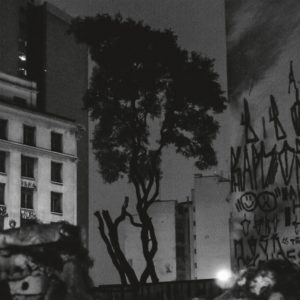
Black Truffle is pleased to present Realejo, the first vinyl release from Brazilian sound artist and composer
Manuel Pessoa de Lima. Having composed works for diverse contexts including cinema, contemporary dance, theatre and television, Lima’s live appearances often take the form of self-reflexive lecture performances that combine electro-acoustic sound, red light, video and spoken text, moving unpredictably from the hilarious to the distressing.
Realejo consists of two side-long pieces of highly idiosyncratic electro-acoustic collage, beginning with recordings Lima made of himself playing the organ in the Schloss Solitude Chapel in Stuttgart. Exploring the peculiarities of the instrument’s mechanics, Lima made hours of recordings with the organ stops half-way open, moving from haunting gliding tones to oddly tuned fair-ground melodies reminiscent of the record’s namesake realejo, a hand-cranked organ traditionally found in Brazil as the musical accompaniment to the work of fortune-telling parrots.
To these organ sounds, Lima added recordings of a security guard made in São Paulo: ‘Just before coming to Stuttgart, I started making field recordings of a security guard in São Paulo. It’s something pretty common in residential areas: they sit in a chair with a whistle, and use that to signal when people arrive, leave or pass by in the street. This particular security guard, Miguel Viana, works on the same street my parents live, and where I had my childhood, and he has worked there since I was a small child. He has watched the street at night, from 8PM to 6AM, every single day, except Sundays, for over 30 years’.
The poignant sounds of the security guard’s whistles punctuate Lima’s electro-acoustic environment, which also includes raw digital synthesis, recordings of his friends’ infant child, audio lifted from Youtube, and, on the LP’s second side, elements taken from an earlier work, ‘36 English to Portuguese Lessons’.
Finely chiselled from dozens of hours of source material into a detail-rich, mercurial structure, Realejo is alternately jarring and seductive, introducing listeners to a young composer with a powerfully individual voice.
Pipe Organ, Electronics, Voice: Manuel Pessoa de Lima
Whistling: Miguel José Viana
Baby: Hanako
Mixing: Joe Talia
Limited Edition pressed on red vinyl
23,00€
In stock

LP
Julia REIDY
“In real life”
Black Truffle present In Real Life, the latest in a flurry of releases from Berlin-based guitarist and composer Julia Reidy. Having drawn acclaim for solo performances on 12-string acoustic guitar that bridge microtonality, 'American primitive' stylings and classic minimalism, Reidy's recent releases have utilised an increasingly broad sonic palette, fleshing out guitar-based composition with electronics, field recordings, and – most strikingly – heavily auto-tuned vocals. On In Real Life, Reidy pushes one step further, crafting an epic LP-length suite that moves from abstracted song to lush electronics and explorations in contemporary musique concrète.
Beginning with a passage of eerie electronics and creaking percussive interjections, Reidy's heavily auto-tuned voice quickly takes centre stage. Surrounded by explosions of electric guitar and synthesised arpeggios, the auto-tuned voice delivers a melancholic ode, bringing together poetic images to reflect on the instability of experience and mutability of identity in a contemporary world saturated by digital technology. This concern with the unsettled relationship between the physical and digital is reflected musically by the constantly shifts in emphasis between Reidy's physically demanding guitar-picking and the various forms of synthesis deployed. Similarly, the dynamic imagery of cutting, shattering, and 'racing streams' present in Reidy's lyrics also serves to characterise the structure of In Real Life, which ceaselessly shifts between distinct episodes. The song-based opening, long sequences of frenetic 12-string guitar shadowed and eventually overtaken by synth tones, passages of delicate chiming harmonics, electro-acoustic cut-ups – each flows seamlessly into the next, often recurring throughout the record's duration, which lingers over interstitial moments between these episodes.
Mixed and mastered by Joe Talia at Good Mixture, Tokyo.
Vinyl cut by Rashad Becker at D&M, Berlin.
20,00€
Out of stock
2 LP
Luigi ARCHETTI – Bo WIGET
“Weltformat”
Edition of 200 copies pressed on 2x 180g clear vinyl housed in a six-panel gatefold cover that unfolds to reveal the musical score of the album.
Ending the decade of silence which followed more than ten years of remarkable, critically acclaimed activity by the partnership of veteran experimentalists, Luigi Archetti and Bo Wiget, the duo returns with what may be their most ambitions effort to date, "Weltformat", issued by Die Schachtel.
Switzerland-based Luigi Archetti and Bo Wiget began collaborating in 1998, the fruits of which initially emerged as the critically heralded, three-part "Low Tide Digitals" series, released by Rune Grammofon between 2001 and 2009. "Weltformat", like its predecessors, builds on decades of solo and collaborative efforts by its creators - Archetti with famed Krautrock pioneers, Guru Guru, among many others, and Wiget with Werner Lüdi, Taku Sugimoto, Tetuzi Akiyama, and others. Sculpted from the intricate tonal interventions and responses of Archetti on guitar, mandolin, and electronics, and Wiget on cello, electronics, and vocals, across the album's four sides the duo constructs a remarkably diverse landscape in sound, folding touchstones of modern classical, free improvisation, minimalism, harsh noise, and ambient music, into a seamless, singular expanse.
Clusters of tone and dissonance merge, collide, and abrade against drones, textures, and pulsing electronics, each element a representative voice of its creator, caught in an imagistic conversation beyond words, which feels as immediate and intuitive, as it does perfectly balanced and thoughtful. "Weltformat", encountering Archetti and Wiget just past the 20 year mark of their collaborative partnership, bears the fruit of rigorous experiments in sound - an immersive, effortless form of sonic realism, built from the optimism and hope which lays at the root of the avant-garde. As beautiful, inviting, immersive, and slow moving, as it is challenging, destabilizing, and thought provoking, Die Schachtel is overwhelmingly proud to release "Weltformat" in both clear double LP and CD formats.
Original price was: 27,50€.15,00€Current price is: 15,00€.
In stock
CD
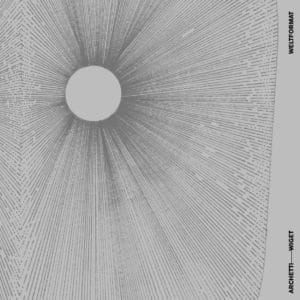
Luigi ARCHETTI – Bo WIGET
“Weltformat”
Edition of 300 copies housed in a six-panel gatefold cover that unfolds to reveal the musical score of the album.
Ending the decade of silence which followed more than ten years of remarkable, critically acclaimed activity by the partnership of veteran experimentalists, Luigi Archetti and Bo Wiget, the duo returns with what may be their most ambitions effort to date, "Weltformat", issued by Die Schachtel.
Switzerland-based Luigi Archetti and Bo Wiget began collaborating in 1998, the fruits of which initially emerged as the critically heralded, three-part "Low Tide Digitals" series, released by Rune Grammofon between 2001 and 2009. "Weltformat", like its predecessors, builds on decades of solo and collaborative efforts by its creators - Archetti with famed Krautrock pioneers, Guru Guru, among many others, and Wiget with Werner Lüdi, Taku Sugimoto, Tetuzi Akiyama, and others. Sculpted from the intricate tonal interventions and responses of Archetti on guitar, mandolin, and electronics, and Wiget on cello, electronics, and vocals, across the album's four sides the duo constructs a remarkably diverse landscape in sound, folding touchstones of modern classical, free improvisation, minimalism, harsh noise, and ambient music, into a seamless, singular expanse.
Clusters of tone and dissonance merge, collide, and abrade against drones, textures, and pulsing electronics, each element a representative voice of its creator, caught in an imagistic conversation beyond words, which feels as immediate and intuitive, as it does perfectly balanced and thoughtful. "Weltformat", encountering Archetti and Wiget just past the 20 year mark of their collaborative partnership, bears the fruit of rigorous experiments in sound - an immersive, effortless form of sonic realism, built from the optimism and hope which lays at the root of the avant-garde. As beautiful, inviting, immersive, and slow moving, as it is challenging, destabilizing, and thought provoking, Die Schachtel is overwhelmingly proud to release "Weltformat" in both clear double LP and CD formats.
15,50€
In stock
CD
SABOTEUR
“Saboteur”
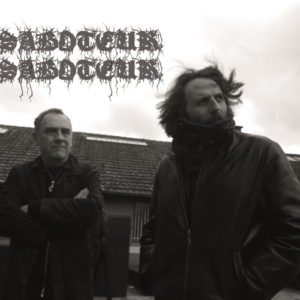
This new CD works somehow as a sequel to the first collaboration between Roro Perrot and Yves Botz, released on tape by Decimation Sociale, during the early days of the label, and once again brings together two undisputed masters of french coprophony.
What we have here is the trademark “shit folk for a shit world”: retarded, inhuman growls against a barrage of out-of-tune six string mayhem, an uncompromising vomit towards all that is polished and clean, and yet, this album manages to combine the usual elements present on previous releases with a few more layers of absurdity.
It consists of a single track, sprawling over 45 minuts of object banging, annoying clavier chaos, obtuse de-composition and cavernous no-fi psychosis, with a distinctive “live recording” fee that evokes contemporary urban collapse as much as animalistic reclusion - the bootleg soundtrack to sociopathic acts of sabotage and mongoloid abomination.
8,00€
In stock
CD
MAGINOT
s/t
Dead frequencies, parasites recodings, sounds of the ground, while objects are cracking, music, noise. Romain Perrot (VOMIR) and Paul Hegarty (SAFE) being determined the final failure of the noise, through a rigidity both relentless and brittle.
200 copies, digisleeve.
8,00€
Out of stock

6CD box
VOMIR
“Black Box”
Vomir announces the cover box, with laser engraving on black wood, who is the best HNW artist around. HNW stands Harsh Noise Wall, better known as Wall of Noise, and Vomir is Romain Perrot, who's best known for his habit of wearing a black bag over his head when playing live. Six solid CDs that comes with a wooden box, which resolutely occupy a narrow and strictly defined dynamic band, with shifting textures of distortion and heavy low end. In retrospect it's surprising it's taken noise artists this long to notice the appeal of stasis -- its ear-fooling potential amplifies minor structural changes and renders small sound events disproportionately large, as well as allowing them to generate a genre variant which is both intensively aggressive and strangely calming. Nothing is progress. Everything repeats itself endlessly and nothing stands out as important. Nothing more should be undertaken. We will never arrive at the final destination. The truth is over, comes the loneliness. These are definitive new CDs of total static harsh noise, crusting, crushing, crackling of 75 minutes each by the master of the HNW Romain Perrot. No ideas, no changes, no development, no entertainment, and no remorse. Urashima continue the tribute of the genre with more than seven-and-a-half hours of monolithic HNW on six-CD set with an astonishing black wooden box. Each single CD comes in black wallet with no graphics plus individually numbered certificate in 200 copies and foldable color poster with picture and text in French and English.
45,00€
In stock
CD
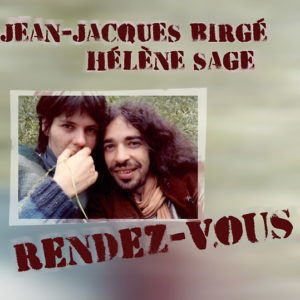
Jean-Jacques BIRGÉ & Hélène SAGE
“Rendez-vous”
"French group Un Drame Musical Instantané was founded in 1976. They present an original, unclassifiable, inventive music, which drifts from jazz to electronic sounds and contemporary music. Klanggalerie has started an extensive re-issue program with these unique avantgarde pioneers which will bring back their classic albums but also side projects like this one. Rendez-Vous was recorded in 1981 but never released. This is what group founder Birgé has to say about the recording: 'I met Hélène when she was doing a performance at Espace Palikao in Paris with choreographer Lulla Card Chourlin. She was singing whilst driving an old Mercedes Benz, trying to run over Lulla, and playing double bass on its roof! I proposed her to record some improvisations at Studio GRRR as I've always done with new musicians and as I'm still doing. The connection was so great, as one can hear on this record 37 years later, that I asked her to join the 15-piece orchestra of Un Drame Musical Instantané which had just been founded. She brought some crazy stuff into the group, playing strange instruments she had invented herself. She is a wonderful flute player, but I asked her to play all kinds of instruments and also to sing, leaving her often free to improvise besides the written score. In the next years we both played as a duo and she became the fourth member of the Drame. When I listen to these pieces today, I'm surprised by the high degree of composition, the quality and variety of our inventions. The mix of acoustic and electronic instruments sounds totally contemporary, plus with the energy of youth and the absolute love for innovative forms.'"
12,00€
In stock

LP
Donald McPHERSON
“Some Songs”
Alga Marghen present a reissue of Donald McPherson's Some Songs LP, self-released in 1994 in an edition of 20 lathe-cut. As Stefan Neville, coordinator for this edition, suggests: "... the first time I heard anything about Donald McPherson was when my friend David Muir told me excitedly about this guitarist from Ravensbourne who could play really beautifully properly but also just as wonderfully wrongly. I first heard him playing a rare live performance in Dunedin in about 1997. It remains one of the most heavily self-deprecating sets I've ever seen. Abandoning songs halfway through, Donald couldn't contain his belief that his efforts were worthless and that he hadn't practiced as much as we were idiots for listening. He made a good show of appearing not to care but the quality of the few pieces of music he did play showed a personality and idiosyncratic natural ability that could only come from the most meaningful places. And he was totally right... we were idiots tolerating any old shit, just as he was an idiot for being so ridiculously good. Donald is most well-known for the free range guitar instrumentals of his Bramble CD (Metonymic, 2001) and the Vinegar & Rum (WEAVIL 012CD/LP, 2006) collaboration with Tetuzi Akiyama, but it's his 1994 album Some Songs that his friends and fans hold in the highest regard. It sparkles with beauty, wit, and wonder and it crumbles under its own self-sabotaging cynicism. Lyrical flowing folk melodies with playful irritations and grafted on textures, bare-boned hyper-sensitive pop songs, and scrambled spontaneous sketches. Donald always sounds to me like he is resisting his talents as they are too embarrassing, but at the same time embracing the chance to express everything he is feeling no matter how awkward or humiliating it may be. It seems like such a crippling difficult perspective to create from but Some Songs always sounds playful, honest, humble and hopeful to me!" Includes extra tracks taken from Decap (1995) and The Trees (1996) 7" lathe editions. Edition of 200.
Original price was: 23,50€.12,00€Current price is: 12,00€.
In stock
LP
LITTLE SKULL
“A Light In The Window Will Guide Us Safely Home”
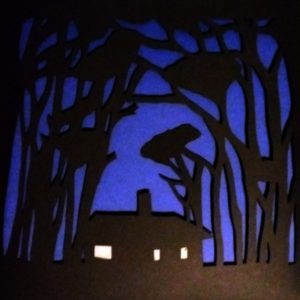
A Light In The Window Will Guide Us Safely Home, the new and unique LP by Little Skull, is an album defined by places, journeys between them, and the traces we leave: Warbly guitars and a town hall in rural Waikato; Wheezing melodicas and a train through Tongariro; Tinny autoharps and a bus stop on the Canterbury coast; Scratching violins and mattresses on the floor in flats in Dunedin and Wellington; Squalling saws and the detritus of a life abandoned and rediscovered in Waitati -- These all jostle to be heard over the murk and cassette hiss whether they deserve to be or not. Insignificant instrumentation congregates on insignificant locations, leaving behind ghosts in a place of their own. We each choose our own light to follow in the hope it is the right one. Handmade paper-cut, fold-out sleeves; micro-edition of 200.
23,50€
In stock

LP
Katalin LADIK
“Phonopoetics”
Phonopoetics is the first ever survey of seminal Hungarian artist Katalin Ladik's sonic efforts. A thing of beauty, drawing from the period between 1968 and 1993, its two stunning sides shatter the lines between performance, the spoken word, fine art, and experimental music, offering the terms to rethink how each is understood. Born in 1942, Katalin Ladik has lived a wild and multifaceted creative life -- beginning primarily as a poet of the written word, expanding into experimental theatre during the mid-1970s, and ultimately becoming an artist whose practice also incorporates sound and visual poetry, performance art, experimental music, audio plays, happenings, mail art, collage, and photography, built around visual and vocal expression, as well as movement and gesture. Phonopoetics, Alga Marghen's remarkably diverse survey of Ladik's audio work, is a refracting lens into this dense and dynamic world -- a totem which belongs to a sprawling puzzle of highly nuanced personal, social, political, and existential themes, springing from the feminist and gender neutral concerns of Eastern Europe during the 1960s and '70s. The totality of Ladik's practice, particularly as it unfolds across the two sides of Phonopoetics, can be understood as a radical rethinking of the potential, manifestation, and application of poetry, as well as the fundamentals of vocalization. Delving toward the very origins of consciously created sound -- spoken or otherwise, her efforts unseat the divisions placed between literary, musical, theatrical, and visual disciplines, joining them through the fundamental need and right to express. With the excepting of two works, "Shaman Song / Sámánének" (1968), and "Ufo-Nopoetica" (1976-1993), the featured body of work was created between 1974 and 1979, a prolific period which also witnessed her working within the Novi Sad Theatre and Radio Novi Sad. Primal and poetic, with shamanic overtones and therapeutic mechanisms of liberation, capturing the image of an almost entirely unheard history within the field of feminist expression developed by pioneering figures like Simone Forti and Joan La Barbara. In the words of visionary sound poet Henri Chopin, Ladik is "a great, magical voice." Alga Marghen's issue of Phonopoetics places this little heard, and profoundly important artist into the center of your consciousness where she will no doubt remain. A vital entry in the field of sound art, historic Eastern European experimental practice, and sound poetry. Introduction by Henri Chopin. Edition of 300.
20,00€
In stock
LP
Michael ZERANG
“Assyrian Caesarean”
Chicago-based percussionist Michael Zerang presents his first solo recording after a long career as an exploratory musician and composer. Recorded and mixed by Matt Bordin in the woods at (the new) Outside Inside Studio, the album features a range of approaches to percussion that Zerang has developed over the years, including the use of vibrating drumhead surfaces, expressive friction passages, multiple timbre percussion, and straight up trap-set drumming - all infused with a rich sense of melodic, rhythmic and textural innovation.
Zerang has performed and recorded with some of the most adventurous artists of his era, including a fourteen-year stint with The Peter Brotzmann Chicago Tentet, Joe McPhee’s Survival Unit III, and an extended collaboration with drummer and percussionist Hamid Drake. Frequent collaborators also include cellist Fred Lonberg-Holm, pianist and synthesist Jim Baker, bassist Kent Kessler, trumpeter Axel Dorner, along with an ever-widening pool of international improvisors. He also recently began performing with the experimental Middle-Eastern super group Karkhana - with Mazen Kerbaj, Sharif Sehnaoui, Maurice Louca, Tony Elieh, Sam Shalabi and Umut Çağlar.
19,00€
In stock
2 LP
Hüseyin ERTUNÇ Sextet
“A new world”
We consider ourselves extremely fortunate having met Hüseyin Ęrtunc during his terrestrial transit. After we reissued his wonderful album Mûsikî (privately released on Intex Sound in 1974) and a few collaborative albums with the Konstrukt collective, in 2017 we finally managed to invite him, Doğan Doğusel, Cem Tan and Umut Çağlar to play some shows in Italy as a quartet. Things got really complicated when their visas got rejected - one week before their plane was scheduled to take off - but we found a stalwart supporter of free jazz music at the phone when we contacted the Italian Embassy with a tiny bit of hope and (incredibly) we got the visas in time so we could spend a whole week with Hüseyin and his band, touring Italy and playing four shows of the best spiritual free jazz we heard in a long while.
Right after that, we took the chance to book a recording session at the good old Outside Inside Studio where our loyal partner Matt Bordin captured on tape two days of improvisation by Hüseyin Ęrtunc (Fender Rhodes electric piano, Philicorda organ and chant), Umut Çağlar (percussion and bamboo flutes), Doğan Doğusel (double bass), Cem Tan (drums), joined for this special occasion by the Jooklos Virginia Genta (tenor and sopranino saxophones, clarinet, flutes), and David Vanzan (percussion) leaving an incredible musical document, not only for the fact that - unfortunately - it was Hüseyin's last session on this world.
"Most of Ertunç’s recorded appearances have been on drum set, where he’s employed a massive and materialist cymbal approach that takes Sunny Murray’s explosive chatter as a lifting-off point. Ertunç waxed one LP as a leader in 1974, Mûsikî (with then-regular partners Michael Cosmic and Phill Musra, issued on the tiny Intex label), and returned to Turkey in the early 1990s. Ertunç’s playing, relentless as it might be, evinces a strident, swinging quality that reaches back decades. His pianistic approach is rooted in the outpouring of voluminous, allover rhythm in concentrated shards. One might first think of early Cecil Taylor, though another Boston resident is also worth mentioning – Jaki Byard, who could move from barrelhouse to crepuscular romanticism and dense chordal superimpositions at the drop of a hat. If he and Ertunç didn’t necessarily work together, their spirits are kindred." (Clifford Allen)
Original price was: 30,00€.18,00€Current price is: 18,00€.
In stock

LP
Robert ASHLEY
“Automatic Writing”
“Robert Ashley, Cynthia Liddell, Mary Ashley, Mary Lucier, and Barbara Lloyd,The Brandeis University Chamber Chorus, Alvin Lucier, Director. Three of Ashley’s landmark recordings, Automatic Writing (1979), Purposeful Lady Slow Afternoon (1971) and She Was A Visitor (1967). Composed in recorded form over a period of five years, Automatic Writing is the result of Robert Ashley’s fascination with involuntary speech. He has recorded and analyzed the repeated lines of his own mantra and extracted four musical characters. The result is quiet, mysterious, melancholy and an early form of ambient music. Purposeful Lady Slow Afternoon, and She Was a Visitor are excerpts from an opera entitled That Morning Thing that was composed in 1966-67, as a result of Ashley’s impulse to express something about the suicides of three friends, in particular the intellectual problem of the idea of suicide. The opera takes the form of an alternation of scenes of rationalizations (or explanations) and scenes of descriptions. Purposeful Lady Slow Afternoon is a woman’s description of a sexual experience. It is Ashley’s attempt "to demonstrate the dichotomy between the rational-whatever can be explained in words-and its opposite-which is not irrational or a-rational, but which cannot be explained in words." The lead voice, the processed back-up chorus, the recurring bell tone, and the pervading tape hiss, create an unsettling mood. She Was a Visitor is another form of description, it is intended to be understood as a form of rumor. The chorus is divided into groups, each headed by a leader. A lone speaker repeats the title sentence throughout the entire performance. The separate phonemes of this sentence are picked up freely by the group leaders and are relayed to the group members, who sustain them softly and for the duration of one natural breath. The time lag between the group leaders’ phoneme choices and those phonemes being picked up by members of the group produces a staggered, chant-like effect, with the sounds moving outward from the nearest performer to the farthest. Booklet notes by Robert Ashley.”
27,00€
In stock
2 CD
Robert ASHLEY
“Improvement (Don Leaves Linda)”
"Like John Bunyan's Pilgrim's Progress (1678), Improvement (Don Leaves Linda) is an allegory for an individual's self-realization. The opera takes its imagery from the history of the Jews --beginning with their expulsion from Spain in 1492 and ending 500 years later in the United States. Improvement (Don Leaves Linda) was first conceived as a recording for Nonesuch Records (1991). Ashley followed with three other operas, making up a quartet or tetralogy under the name Now Eleanor's Idea (LCD 1009CD), and all four operas were performed often during the first half of the 1990s. The opera was revived in 2018-19, with a new cast: Gelsey Bell as Linda; Brian McCorkle as Don, Mr. Payne, and Companion; Paul Pinto as Junior, Jr.; Aliza Simons as Now Eleanor; Dave Ruder as The Doctor; Amirtha Kidambi as Mr. Payne's Mother; Robert Ashley (on tape) as Narrator I; Amirtha Kidambi and Aliza Simons as Narrator II. Improvement (Don Leaves Linda) was presented by the Kitchen, February 7th through 16th, 2019. Live Sound and Processing: Tom Hamilton. Live cast recording by Eric Sherman and Tom Hamilton. CD mixed by Tom Hamilton."
27,00€
Out of stock

3 LP Box
Jac BERROCAL
“1973-1976-1979”
This luxurious pink Cadillac colour box set, “1973-1976-1979” brings back the first 3 albums of Jac Berrocal (Musiq Musik – Paralleles – Catalogue) in which countless personalities of the crossover music of the hexagon participate. 200g vinyl records remastered colorful metal covers, an impressive booklet of photos and unpublished documents come to decorate this numbered and limited edition.
MUSIQ MUSIK
First album of Berrocal, recorded in 1973 with excessives reverberations of the crypt of the church Saint-Savinien in Sens, is a real notebook of sound travels, of instruments reported by jac Berrocal and Roger Ferlet during their numerous journeys : Pakistan, Afghanistan, Nepal, India, Jordan, Iraq, Syria, various instruments: bells, muezzins, conches, shenaïs, cymbals, gongs … embellished with urban and incongruous sounds: horns, whistles, chickens, harmonium and washing machine, the all installed on a kiosk. The idea? Make music together, Jac Berrocal, Roger Ferlet, Dominique Coster.
PARALLELES
1976, Vince Taylor, the Black Archangel of Rock’n’roll, agrees to come and record “Rock’n’Roll Station”, a piece of futuristic clinking of a bicycle wheel. Other sessions contrary to custom, a pigsty with microphones mired in the middle of unruly pigs, towels shaken by Pierre Bastien in the middle of this “bric-a-brac” a noisy piece in homage to Luigi Russolo repertoire reorganized by bonuses and unpublished from the same period.
CATALOGUE
1979, the year of the album Catalogue. Jac Berrocal and his “Marquises of disorder” make the guitars rattle in primrose-sprayed vomit, patchwork of uncontrollable slows, furious accordion (Claude Parle) and martial rocks. Kind of “Micro-cinemas put end-to-end”, a maelstrom of cries and saturation which, paradoxically, an album that is worth the respect of the Punks and the contempt of jazz purists. Berrocal is certainly the only French cousin of New York’s no wave.
75,00€
In stock

CD
SILVER APPLES
“Contact”
New edition + new mastering of 1968 album in deluxe A5 Digipak (DVD Format).
Formed in 1967 as an electronic rock duo featuring Dan Taylor on drums and Simeon on a homemade synthesizer consisting of 12 oscillators and an assortment of sound filters, telegraph keys, radio parts, lab gear and a variety of second hand electronic junk, the band quickly gained a reputation as New York’s leading underground musical expression.
First full-length album was released in 1968 on KAPP Records. The self titled album rode the Billboard Magazine Top 100 list for 10 weeks.
The second full length album was released in 1969, titled “Contact”. A national tour was launched by the band’s recording popularity. A third album was recorded in 1970, but not released when KAPP folded.
Without a record label the band disbanded, and, except for an occasional bootleg release, was not heard from again until 1994, when a German label named TRC, without license, re-released the first two albums in a 2 CD version, complete with poster. Since then numerous artists around the world have released covers, tributes and samplings of Silver Apples material.
16,00€
In stock

CD
SILVER APPLES
“Silver apples”
New edition + new mastering of 1968 album in deluxe A5 Digipak (DVD Format).
Formed in 1967 as an electronic rock duo featuring Dan Taylor on drums and Simeon on a homemade synthesizer consisting of 12 oscillators and an assortment of sound filters, telegraph keys, radio parts, lab gear and a variety of second hand electronic junk, the band quickly gained a reputation as New York’s leading underground musical expression.
First full-length album was released in 1968 on KAPP Records. The self titled album rode the Billboard Magazine Top 100 list for 10 weeks.
The second full length album was released in 1969, titled “Contact”. A national tour was launched by the band’s recording popularity. A third album was recorded in 1970, but not released when KAPP folded.
Without a record label the band disbanded, and, except for an occasional bootleg release, was not heard from again until 1994, when a German label named TRC, without license, re-released the first two albums in a 2 CD version, complete with poster. Since then numerous artists around the world have released covers, tributes and samplings of Silver Apples material.
16,00€

4 CD box
Jim O’ROURKE
“to magnetize money and catch a roving eye”
A 4-hour work recorded at Steamroom (composer’s studio) between 2017 and 2018.
Detailed and delicate electronic layers, processed instruments, and ambiguous field recordings come together in a slow-moving, fascinating kaleidoscope with multiple reflections and wrong turns, always in constant state of flux. The finely crafted art of subterfuge.
“To magnetize money and catch a roving eye”, four CD’s – a hypnotic, multi-faceted, labyrinthine piece which flows as slowly as a river while speeding back through memory, and shows all the talent of Jim O'Rourke.
Composer, performer, multi-instrumentalist, born in Chicago in 1969, Jim O’ Rourke is a veritable chameleon, working at the frontiers of very diverse musical genres.
30,00€
Out of stock

10 CD boxset
FORMANEX
“20 years of experimental music”
Nantes trio Formanex celebrates 20 years of activism in experimental music with a 10 CD edition full of amazing collaborations with ONsemble (contemporary music group from Nantes and Saint-Nazaire) and composers they have worked with. The box set includes early works by Formanex’s own Julien Ottavi, unique compositions created by Keith Rowe, pieces by Kasper T. Toeplitz, Ralf Wehowsky, Seth Cluett, Michael Pisaro, Radu Malfatti, as well as other giants of contemporary music from the last 50 years; such as Phill Niblock and Christian Wolff.
A rare collection of CDs, this box set represents a broad vision of experimental music from noise to electronic abstract composition, radical minimalism, contemporary and improvised music.
85,00€
Out of stock
3 CD
Rudolf EB.ER
“Om Kult : Ritual Practice of Conscious Dying – Vol I-III”
"Om Kult 1-3 - the complete Om Kult 3CD triptych, recorded and processed at Om Kult Osaka between 2016 and 2018. Evolving from his extended “Brainnectar” studies on psycho-spiritual cleansing rituals derived from various shamanic and yogatantric traditions - and his examinations of aural hallucinations and paranormal perceptions - Eb.er focuses now on the occult knowledge and techniques for the transition from life to death, on the ejecting mind as well as on the decomposing human body.Field recordings of Japanese forests, creeks and waterfalls, haystacks and dirt piles, maggots and flies feeding on carcasses, monks chanting and obscured voices from occult activities meet complex structures of seemingly minimalist sine wave and noise compounds, moldy tape hiss, rattling and drumming at absurd covens, digging in dirt and scraping on wood, decaying drones, abrupt bewildering noises and blackmetalesque grunts. And the mind leaks into non-dual awareness."
38,00€
Out of stock

LP
DOME
“Dome 4”
"With the demise of the group Wire in 1980, founder members Bruce Gilbert and Graham Lewis joined forces to create Dome. With the assistance of engineer Eric Radcliffe and his Blackwing Studio Dome took the ethic of “using the studio as a compositional tool” and recorded and released three Dome albums on their own label in the space of 12 months: DOME (July 1980), DOME 2 (October 1980) and DOME 3 (October 1981). A final fourth album, WILL YOU SPEAK THIS WORD: DOME IV was released on the Norwegian Uniton label in May 1983. These albums represent some of the most beautifuly stark and above all timeless exercises in studio experimentation from early 1980s alternative music scene."
16,00€