
In stock

LP
OTO HIAX
“Two”
"Second phantasmagorical audio outing from former Seefeel and Loops Haunt members, Mark Clifford and Scott Gordon. ‘Two’ expands the duo’s unique take on spectral synthesis incorporating a diverse amount of approaches to experimental sound. Two expounds a hybrid mix of acoustic based audio design, ambient tonality, sound effects, music, abstraction and world’s hybrid video game soundtrack.There is something of an onomatopoeia quality to the release as the six tracks take on the character of their individual title. Silt, Dapple, Overcurve, Scutter, Strain and Plates appear as extremely well executed versions of the inferred intent of their namesake. This inquisitive approach will appeal to those interested in the more exploratory end of sound production providing hope as newly formed methods and colours are exposed from the duo’s contemporary audio tactics.
Seasoned veterans can lie in a bed of laurels whereas ‘Two’ is an exemplary release revelling in the enthusiasm that comes from the joy of nabated exploration."
Original price was: 17,00€.10,00€Current price is: 10,00€.
Out of stock
LP
Gaël SEGALEN
“Sofia says”
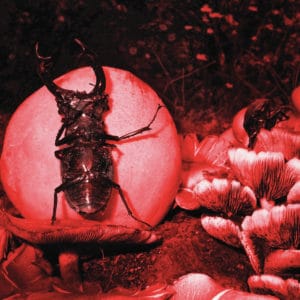
"Three years after the danceable field recordings of her "L'Ange Le Sage" debut LP, the Parisian sound artist, activist and musician Gaël Segalen delivers her third album, "Sofia Says", picking up where her "Memoir of My Manor" cassette stopped. Gaël connects here to a complex mythological entity, Sofia, in a spontaneous mediumnic way - and through her own filtered integration she presents a dynamic sample of her compositional psyche, creatinga compelling mixture of abstract noise experimentations, field recordings and ecstatic electronic manipulation."
17,00€
In stock
CD
Pierre-Yves MACÉ
“Rhapsodie sur fond vert”
"Six long years have passed since Pierre-Yves Macé's last album on John Zorn's prestigious Composer Series. In the meantime, the talented composer has been working hard and has gained eminence in the world of contemporary music. He has produced works for Ensemble Intercontemporain (founded by Pierre Boulez), the Paris Chamber Orchestra, and the Hong Kong Sinfonietta and has collaborated with directors Joris Lacoste and Sylvain Creuzevault on ambitious works mixing theatre and opera. Much to our surprise, he returned to his first love—the studio—a few weeks before the birth of his son, which resulted in a series of highly contrasted yet straightforward tracks. Here, Macé deploys an abundance of forms and sounds: a detuned piano triptych, a Bertolt Brecht sound archive, abrasive electronics, some melancholic ambient escapades, an elegant cello solo, a miniature for bass and celesta flute, or funeral melodies for trélombarde, a peculiar instrument from Brittany. With this very personal record, Pierre-Yves Macé pushes further his exploration of "disturbing strangeness"."
12,50€
In stock

LP
Sir Richard BISHOP & Ed YAZIJIAN
“s/t”
"Ex-Sun City Girls master guitarist Richard Bishop teams up with Cul De Sac’s long time Girls live collaborator Ed Yazijian. Two Grand Seigneurs of underground deliver an unique album deeply Western rooted, filled with the musical spirit and structures of Indian music at the same time. Elegant interplay, brilliantly arranged, using mostly guitar (lapsteel, tenor) and strings (viola), and some Indian stringed instrument which I can’t pronounce, and some piano… A classic Saraswati Series sonic adventure. A contemporary polaroid, state of the art in today’s underground music."
Original price was: 21,50€.12,00€Current price is: 12,00€.
In stock

LP
William ENGELEN
“32 bpm”
After "Today, the organ has played beautifully again", released earlier in 2019, Edition Telemark presents the second instalment of what will become a series of LPs of sound works by Dutch artist William Engelen. "32 bpm" was recorded at Kunsthalle Mannheim for an exhibition in summer 2019 and is a slowed down version of "38 bpm", previously released on Engelen's double LP "Partitur Belval" in 2016.
The piece – played here by Mannheimer Schlagwerk – is written for 8 percussionists, each using a set of 9 different instruments varying in their timbre and in the duration of their resonance. The composition is played in a monorhythmic pulse of 32 beats per minute and in unison. To determine the order in which the instruments are played, each percussionist draws their own path through the score consisting of a 32x32 grid of dots of different sizes, with larger dots representing instruments with long resonance and smaller dots those with short resonance. Because each musician has chosen their own path, different instruments are played at each pulse. Neither does the pulse ever change nor do the musicians play out-of-sync at any time. As the piece progresses through its 5 parts, more and more dots are skipped, leaving only 64 beats per musician in part 5, as opposed to 320 in part 1.
The composition "38 bpm" was written in 2016 and now adapted by Engelen to take into account the acoustic qualities of the atrium of the Kunsthalle Mannheim, leading to the slower tempo and a different selection of instruments, now focusing on more resonant ones. The instruments played are mokushos, wood blocks, bongos, reyongs, crotales, triangles, timpanis, gongs, and tubular bells. For the performance, each player stood at a different spot and the audience moved freely between them, feeling out the space by listening to the resonance. The piece thus turned into a sound sculpture inside the architecture of the museum.
The LP is a co-release between Edition Telemark and Kunsthalle Mannheim and comes in a full-color gatefold sleeve with a 12-page LP-sized booklet with photos, a reproduction of the score, and extensive liner notes by Björn Gottstein, director of the Musiktage festival in Donaueschingen, and Sebastian Baden, curator at Kunsthalle Mannheim.
Original price was: 21,50€.12,00€Current price is: 12,00€.
In stock

2 LP
The OVAL LANGUAGE
“Waldkonzerte”
Second LP release by The Oval Language on Edition Telemark after "Hibernation" in 2017, this time showcaseing Klaus-Peter John's Waldkonzerte (woodland concerts), recorded in 2016. The Oval Language is an autonomous art project founded in 1987 in Leipzig, East Germany, by Klaus-Peter John and Frank Berendt. Since Berendt left in 1995, it has been continued by John, sometimes with collaborators, but recently mostly for solo activities. Its fields of activity have included sound-noise performances, conceptual works in open spaces, installations, land art projects, photography, and more.
From the beginning, the space or location itself has been a central aspect within many of their site-specific sound-noise performances. When working at a certain location, the performers tried to not bring in anything from outside, but exclusively use material already available at the space. This way, it becomes possible to thoroughly feel out and explore the site, allowing a distinct site-specific sound to emerge that is integrated into the performance. Throughout the 1990s, the sites used often were abandoned buildings in Leipzig, available in nearly unlimited quantity, from vacant factories to unused former public bathing facilities. During the recent years, Klaus-Peter John has focused on a minimisation of means and developed a unique vocal technique without amplification that he has used in a number of performances. In 2016, he attempted to integrate his voice into pure nature, in his own words the biggest challenge to date. His goal was not to perform any kind of singing or the like, but to use voice as a means similar to the site-specific tools used in previous performances by The Oval Language. He performed five concerts without audiences in a forest ravine in Döben, near Grimma, between June and November. The concerts parallel the course of the seasons and their related acoustic changes and conditions.
This double LP is presented in a die-cut single sleeve with two printed inner sleeves. The inner sleeves contain one photo made during a Waldkonzert on each side. By switching the order of the inner sleeves, four different front sleeves can be generated. Edition of 200.
32,00€
In stock

LP
Arturas BUMSTEINAS
“Bad Weather Long Play”
"Bad Weather" is a performative sound art event of a group of performers engaging with reconstructions of Baroque theater noise machines. The project started in 2017 when Lithuanian artist Arturas Bumšteinas teamed up with theater carpenter Ernestas Volodzka to re-create wind, rain, sea and thunder imitation devices, identical to the ones whose canon settled in European theater in the 17th century. Commissioned and produced by contemporary music theater production house Operomanija, "Bad Weather" events have since been presented in Lithuania and Poland. During each performance, the ensemble plays the machines in keeping with meteorological maps and charts from various centuries that serve as scores. Contemporary artist Ivan Cheng was invited to write and perform a libretto that is integrated into every performance in different ways. In the Baroque era, the noise machines constituted only a small part of the theatrical illusion, lurking behind the scenes, invisible to the audience. Meanwhile in "Bad Weather", they take the spotlight and become generators of conceptual climate.
"Bad Weather Long Play" is a collage of sound materials from performances, rehearsals, soundchecks and other occasions related to the project, as documented with various recording devices between 2017 and 2019. The sides of the LP don't function as A and B sides but can be played in any order. The LP is presented in a full-color sleeve with a printed inner sleeve containing photos of the various stages of the project and liner notes by Salomé Voegelin. An included 8-page booklet reproduces Ivan Cheng's libretto.
"Produced from a selection of recordings made at rehearsals, workshops and performances with an alternating team of seven performers, Bumšteinas convokes a work that sounds its process on the mobile blueprint of meteorological maps as scores. Creating a mis-en-scène of invisible occurrences that talk with each other in the language of a storm that is brewing, raising and petering out, and that leaves a trace in our ears, an imprint and a movement that might only clear the next day." (from the liner notes by Salomé Voegelin)
Arturas Bumšteinas (b. 1982 in Vilnius, Lithuania) is an artist working within the intersections of sound, music and art. His practices include performative sound art, radio art, exhibitions, experimental acoustic and electronic music. He started exploring theater noise machines in 2012 when he was commissioned by Deutschlandradio Kultur to compose "Epiloghi. Six Ways of Saying Zangtumbtumb".
21,50€
In stock
LP
Aki ONDA + Paul CLIPSON
“Make visible the ghosts”
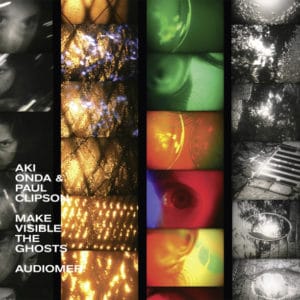
audioMER. is honoured to announce the release of a new LP; Make Visible the Ghosts with music by Aki Onda (US/JP) and artwork by Paul Clipson (US). This album is the follow-up of Aki Onda's Cinemage project Lost City—with Loren Connors and Alan Licht—released on audioMER. in 2015.
On Make Visible the Ghosts, New York-based musician Aki Onda composed the soundtrack for the images of the San Francisco experimental filmmaker Paul Clipson, who suddenly passed away on February 3, 2018.
In 2009, Clipson and Onda met at the Amsterdam Schiphol Airport for the first time and shared a ride to the International Film Festival Rotterdam, where they presented audio-visual works in the same bill. Since then, the two artists – known for their highly personal approach with Super 8, 16mm, cassette Walkman and radio – maintained a close friendship over the next nine years. Their works deal with memory, time, space, and those reflections, and they had a lot to share.
Onda and Clipson completed their collaboration work Make Visible The Ghosts—a combination of vinyl LP of Onda's music and large-size collage artwork by Clipson—a few months before Clipson's departure from life. The work is composed of the materials they used for their performance in New York in 2012 and developed over the three years from 2015 to 2017. Onda notes: "The loss of Paul has left a huge hole in our mind including his friends and collaborators. Paul is no longer here, and this is a chance to remember him and his images that extended and expanded our perception of how the world can be seen and heard."
21,50€
Out of stock
LP
NEF
“Mais alors !!?… c’est à l’envers”
In 1983, NEF released their first and only album, Mais Alors !!?... c’est à l’envers. At that point, the band already had a long history, interwoven with that of various musical trends and alternative movements from the late sixties to the early eighties. That’s certainly what makes this record so special and able to conciliate such different worlds as Electronic Prog, Film Score, New Wave …
The band’s destiny was most certainly tied to their native region, the South of France, an idyllic environment that attracted a number of musicians during the 1970s, allowing the group to attend many concerts or share the bill with several groups that have gone on to become well known: Can, Ash Ra Tempel, Magma, Catherine Ribeiro, Zao, Chêne Noir, Art Zoyd …
Founded in 1975 by Richard Lorenzi, NEF started as a kind of Free Rock band with multiple influences, going from Prog to Musique Concrete, in which any method of making sound, any way of bringing out sounds was good … 2 musicians and a photographer, full member of the band who was projecting slides over the music and influenced their dreamlike universe. In 1978, Vincent Tronc came on board with his keyboards and synths. While the group had been influenced by electroacoustic techniques until then, Vincent broadened NEF’s horizons, bringing in a host of new influences: Ash Ra Tempel, Kraftwerk, Klaus Schulze … the beginnings of electronic music.
When the album is recorded in 1983, new directions were taken and changed NEF’s usual sound. First, the idea of playing the accordion, clearly not a common thing and a new Drum Machine, the Roland CJ-5000. Pressed the day a figure of French Chanson died, NEF’s pressing is botched up, a good part of the records were unusable since the records came out totally warped. Then, at the end of the eighties the small stock of remaining records is lost in the sadly famous flood of Nîmes. 2000 records had been pressed, but very few survived!
All the more reason to reissue Mais Alors !!?... c’est à l’envers, an unsung record, free and multifaceted, a quirky and daring musical ovni, transcending eras and genres, between synthetic Krautrock and Film Score, reminiscent of NEU! (with a red nose), François de Roubaix and Pascal Comelade.
22,50€
In stock

CD
TONUS
“Segment Tones”
Dirk Serries: soprano melodica, accordeon.
Martina Verhoeven: concertina, cello.
Colin Webster: clarinet, alto sax.
Performed, recorded, mixed and mastered at the Sunny Side Inc. Studio, Anderlecht (Belgium) on November 24th 2018.
"Despite the low volumes, the generous use of space, the long, explorative tones and surprisingly subtle harmonies, the subdued and intimate music on Segment Tones (and other related albums) keeps the flame of dissent burning. Just as the clattering of rambunctious free jazz can be regarded as a tumultuous answer to political provocations and general madness, the minimalist means of this album are as determined in their refusal to comply. While all these droning textures and unusual techniques might sound like a concentrated private affair, bundled together they also turn into an act of resistance, showing there is an alternative to greed, rancor and prejudice, and also to fear and uncertainty. This might be a ‘small’ release on a little DIY- label from Belgium (of all places), but it represents a larger world of possibilities. " Guy Peter
Original price was: 9,00€.5,00€Current price is: 5,00€.
In stock

CD
SERRIES / VANDERSTRAETEN / VERHOEVEN
“Impetus”
Dirk Serries: acoustic guitars - Kris Vanderstraeten: percussion - Martina Verhoeven: piano.
Performed, recorded, mixed and mastered at the Sunny Side Inc. Studio, Anderlecht (Belgium) on December 16th 2018.
"With all its creaking, rustling, quacking, plucking and plonking sounds and restlessness, this album is a feast of abstraction, but listen carefully, and you will find so much more between all those awkward sounds. This is strikingly open, spontaneous and intimate music, but there’s a glue that keeps it all together. Not childish, but repeatedly childlike in its sense of wonder. With music as free as this, it is hard to put your finger on what exactly it is that makes it tick, but the explanation might be a simple one. Amidst this colorful, intricately detailed sound painting, there is the realization that these three artists speak the same language indeed. " Guy Peters
Original price was: 9,00€.5,00€Current price is: 5,00€.
In stock

CD
Daniel THOMPSON & Colin WEBSTER
“Boskage”
Daniel Thompson: acoustic guitar.
Colin Webster: alto saxophone.
Recorded on 15th June 2018 at Soundsavers, London by Mark Jasper.
Mixed by Dirk Serries. Mastered at the Sunny Side Inc. studio, Anderlecht (Belgium).
"Thompson and Webster excel in interaction that verges from minimalist flourishes to nervous interaction that demands the listener’s utmost concentration, testing the elasticity of their connection with a dualism that Evan Parker once described so aptly: “The last thing you need to do is rely on material that’s already fixed in your mind, but if you don’t have anything fixed in your mind, you have no starting point. That’s the central paradox, really: the more control you have, the freer you are.”" Guy Peters
Original price was: 9,00€.5,00€Current price is: 5,00€.
In stock

CD
Benedict TAYLOR & Anton MOBIN
“Close – Quarters”
Benedict Taylor: viola
Anton Mobin: prepared chamber
Recorded on 4 & 5 September 2017 and mixed in 2018 by Anton Mobin at La Ferme Ta Gueule, Olivet, France. Mastered at the Sunny Side Inc. studio, Anderlecht (Belgium).
"The end result effortly straddles the lines between free improvisation, musique concrète and minimalist noise music. And even though it might sound unconventional and quite demanding without any visual aid, it is guaranteed to set both your ears and your imagination on fire." Guy Peters
Original price was: 9,00€.5,00€Current price is: 5,00€.
Out of stock
LP
FENNESZ
“Agora”
Agora is Christian Fennesz's first solo album since 'Mahler Remixed' [Touch, 2014] and 'Bécs' [Editions Mego, 2014]. Fennesz writes: "Its a simple story. i had temporarily lost a proper studio workspace and had to move all my gear back to a small bedroom in my flat where I recorded this album. It was all done on headphones, which was rather a frustrating situation at first but later on it felt like back in the day when I produced my first records in the 1990s. In the end it was inspiring. I used very minimal equipment; I didn't even have the courage to plug in all the gear and instruments which were at my disposal. I just used what was to hand.
Fennesz uses guitar and computer to create shimmering, swirling electronic sound of enormous range and complex musicality. "Imagine the electric guitar severed from cliché and all of its physical limitations, shaping a bold new musical language." - (City Newspaper, USA). His lush and luminant compositions are anything but sterile computer experiments. They resemble sensitive, telescopic recordings of rainforest insect life or natural atmospheric occurrences, an inherent naturalism permeating each piece. He lives and works in Vienna.
19,00€
Out of stock

2 LP
RENALDO AND THE LOAF
“The elbow is taboo / Elbonus”
The Elbow is Taboo was Renaldo & The Loaf's fourth and last album of their initial phase prior to their return in 2010. Released by Ralph in America and Some Bizzare in the UK in 1987 this work represents a development in the overall sound as they utilize an 8 track recorder along with early digital effects. A large arsenal of acoustic instrumentation gives the record an additional unsettling atmosphere. Recorded over a 3 year period this remains the definitive statement by the group in this early period.
As clarified by Brian from the band, the themes remain as obtuse and alluring as ever with each song containing it’s own story. “be it a child's desire to control (A Street Called Straight), the ridiculous purdah of an innocent part of the body (The Elbow is Taboo), a call for help in times of angst (Here's To the Oblong Boys), the rigours of a bread fetish (The Bread Song), the anger of a dance teacher to the terminally inept (Critical/Dance) or a ritual call to prayer, somewhere (Extracting the Re-re)”.
Disorientating and delightful this is a must for all fans of the Loaf and for those tickled by the more deranged spectrum of song.
Original price was: 24,00€.15,00€Current price is: 15,00€.
In stock

LP
Thomas BRINKMANN
“Raupenbahn”
Editions Mego is proud to present the latest addition to the compelling discography of Thomas Brinkmann. Throughout his career Brinkmann has focussed on the human operating amongst industry alongside rhythms that manifest as a result of technological advancement. With this new release Brinkmann makes a u-turn, looking back to the early industrial age. Comprised of recordings of various looms, Raupenbahn investigates the sonic properties and consequences of the first automatic loom as constructed by Jacques de Vaucanson in 1745. Thomas Brinkmann once again adheres to his tendency for clarity and simplicity whilst further investigating not only the sound and rhythms of the machines (looms) but also what role they serve in society and what consequences they have on the environment. Raupenbahn presents 21 tracks in total, 11 feature on the vinyl, the remaining 10 as digital bonus tracks. The majority of recordings were undertaken by Brinkmann in 2017 with a Neumann KM 184 stereo set. Additional recordings were sourced with permission from Monika W. recs. from 2014 Central Museum of Textiles Łódź, Poland. Each piece presents a diversity of material which borders on the breathtaking and beautiful in richness and complexity. The various looms unravel rhythms and patterns unexpected from machines of the early industrial age.
The loom holds a significant role in shaping our world being the catalyst for Charles Babbage’s Analytical Engine which, alongside the subsequent work of Byron’s daughter Ada Lovelace, paved the way for modern computing. There is a linage of the loom that fits succinctly in Brinkmann’s overall argument. Here we encounter a parallel between machine driven economies and the music that rose from such places, consider the Sheffield steel industries, the Manchester weaving industry or the Rhineland / Düsseldorf loom and machine industry. Is it a coincidence that the practice of such machines in the environment gave rise to today’s predilection for electronic dance music, in pop, soundtracks, etc
Raupenbahn features no treatment or processing and explicitly displays varying tempo and timbres which ascertain a wide range of acoustic structures. The artwork features Ingrid Wiener, Rosemarie Trockel and Alexandra Bircken, three different generations who would with ideas of fabric weaving, loming and the like. This exceptional release works on a number of levels alongside it’s striking sonic palette.
Original price was: 17,00€.10,00€Current price is: 10,00€.
In stock
2 LP
FIRST TONE
“Reactions”
"Reactions" is the debut album from First Tone, the musical partnership of New Orleans-based artists Turk Dietrich (Second Woman, Belong) and composer Duane Pitre (Important Records). While the project has been at work quietly sculpting their sound for years, "Reactions" is the first available set of recordings. Those familiar with the respective works of the two artists will be happy to find a collection of music that is very much of the duo, and yet totally unlike anything they've produced before.
Over six tracks, First Tone unfurl poignant, flickering compositional works that utilize pitch material that is tuned using the system known as Just Intonation (which Pitre has studied for nearly 15 years) in conjunction with various software and a single hardware synth. The result is a collection of music that is both organic and alien. Layers of tone and texture build and dissolve from the ultra minimal to the enormous, on occasion seamlessly blending the two. A wide array of striking timbres patiently wash over one another, at times sounding like organic instruments, at other times sounding completely otherworldly.
"Reactions" is a masterclass not only in sound design and dynamic range, but also in sonic depth. The album’s approach to the usage of time and dynamics work together to create the perception of a three-dimensional spaciousness of sound. The holographic effects produced from the spaces between the album’s sounds are mesmerizing, with discreet arrangements that demand repeat listens to fully absorb.
23,00€
In stock

LP
Yoshi WADA
“Lament for the rise and fall of the elephantine crocodile”
Yoshi Wada's Lament For The Rise And Fall Of The Elephantine Crocodile, originally released in 1982 on India Navigation, remains one of the most remarkable flowers to grow in the rarefied air of American minimalism – akin to Terry Riley's Reed Streams and Pauline Oliveros' Accordion & Voice, yet with a wild, liberated energy all of its own.
After graduating from Kyoto University of Fine Arts with a degree in sculpture, Wada moved to New York City in 1967 and quickly fell in with the community of artists known as Fluxus. In the early '70s, he began building his own instruments and writing musical compositions, studying with La Monte Young and Hindustani singer Pandit Pran Nath.
Recorded during an epic three-day session in an empty swimming pool in upstate New York, Wada's first album brings together two of the oldest drone instruments – the human voice and bagpipes – to simple and glorious effect. A visit to the Scottish Highlands spurred Wada's interest in bagpipes, which the composer integrated into these sparse, otherworldly sounds heard on Lament.
"That swimming pool was quite hallucinatory," recalls Wada. “It was another world. I felt it in terms of resonance. I slept in the pool, and whenever I moved, I woke up because of the reverberations.... The piece itself is an experiment with reeds and improvisational singing within the modal structure."
This first-time vinyl reissue is limited to 750 numbered copies. Comes with poster.
28,00€
In stock

LP
TAJ MAHAL TRAVELLERS
“July 15, 1972”
For over half a century, Takehisa Kosugi was one of the most unique and enduring figures in the Japanese underground. As an art student in Tokyo in the early '60s, he joined the Fluxus-styled performance unit Hi Re Centre and founded the improvisational ensemble Group Ongaku, but his most legendary project was The Taj-Mahal Travelers – a multicellular organism that included Kosugi, Ryo Koike, Yukio Tsuchiya, Seiji Nagai, Michihiro Kimura, Tokio Hasegawa and sound engineer Kinji Hayashi.
With a penchant for long psychedelic jams (some lasting 12 hours or more) The Taj-Mahal Travelers lived up to their name. Touring in a Volkswagen van across Europe and Asia in the early '70s, they eventually reached the actual Taj Mahal in India. Upon their return to Japan, they held a concert to raise more touring funds and released their very first recordings. Their debut album, July 15, 1972, would extend the band's matter-of-fact titling: all the tracks were named precisely for the times they began and ended.
With a grab bag of instrumentation (electric violin, double bass, santoor, vibraphone, harmonica, radio oscillators, sheet iron, etc.), The Taj-Mahal Travelers weave together mesmerizing waves of sonic texture. Featuring longtone concepts that Kosugi discovered while working with sound generators in New York in the mid-'60s, July 15, 1972 remains just as much a collective tone poem as psych workout. These leader-less sounds coalesce into a unified whole that feels both subconscious and sublime, as if the waveforms bypass the listener's ears and land directly inside one's synapses.
This first-time vinyl reissue is limited to 900 numbered copies. Comes with poster.
32,00€
In stock

2 LP
Eliane RADIGUE
“Chry-Ptus”
Eliane Radigue's Chry-Ptus is her very first piece for the modular synthesizer. It was composed in 1971 using a Buchla 100 which had recently been installed at NYU by Morton Subotnick.
This double LP was mastered by Golden and pressed at RTI for maximum fidelity.
From the original press release:
'Chry-Ptus' (1971). Originally two tapes which were to be played simultaneously, with or without synchronisation, which does not affect the structure of the work, but creates changes in the game of sub-harmonics and overtones.
Three variations on this piece were performed at the New York Cultural Center in 1971, with variations of amplitude and location modulation as well as synchronisation. Realized on the Buchla Synthesizer at the New York University.
The booklet contains a text by painter Paul Jenkins, who also realised the watercolor on the front cover, written on occasion of Radigue's first concert in New York, April 6th, 1971.
“It’s with the Buchla that I constructed Chry-ptus, a piece made up of two tapes with an analogue duration, 22 or 23 minutes, which could be played either simultaneously or with a slight time difference, so as to establish slight variations every time the piece was played. I spent the first months eliminating everything I did not want; I even used a notebook in which I tried to determine a writing system resembling chemical formulae.” Eliane Radigue
32,00€
In stock

CD
SHASTA CULTS
“Configurations”
A ship sinks beneath the silver mirror of the sea-top, temple gongs ring through an empty valley, industrial machinery sputters, heaves, lurches forward, stops, falls apart… These sound events may be the most acute musical referents of Shasta Cults, the music project of Canadian synthesizer technician Richard Smith. Using obsolete electronics, Shasta Cults pursues the true sound of the instrument, freed from the tyranny of emulation, no strings/woodwinds/piano presets. Shasta Cults' compositions seek out unchartered territories where sustained drones may swell, build, or evaporate; where timbres collide, amplitudes fluctuate, sounds emerge, raw, primeval, new hybrids form from the collisions of electricity and frequency. There may be stretches of silence punctuated by bell-ish tones from futures unheard; a sequence of notes may verge upon melody before mutating into ugly moans, the sonic equivalent of funhouse mirrors. But the end result is far more than chance operation, sporadic sound fields, or indeterminate academic exercise. Instead, Shasta Cults brings us back to nature, back to the possibilities inherent in nature, to the truth of evolution, stitching both musical tones, and the sounds of 21st century living into a form which is as real, as imponderable, and as ungovernable as our own memories.
Recorded in 2017, employing the processes of non-linear waveshaping, frequency modulation and feedback, Configurations consists of eight programs captured live to multitrack using a rare, fully functional Buchla 700 digital-hybrid instrument designed in the late 1980s. Whereas previously released works made with the 700 almost always consist in simple manipulations of the single factory preset, this album delves deep into the instrument's rich sonic vocabulary to offer the listener a more elaborate demonstration of the system's capabilities.
Presented here in limited quantities this release is intended as a high fidelity audio archive of this obscure musical artifact.
Original price was: 12,50€.7,00€Current price is: 7,00€.
Out of stock

LP
RTVS
“1981-2001 … approximately”
"The connection with and love for Radio Centraal runs through Ultra Eczema’s veins. The Antwerp-based station has functioned as a voice for myriad local underground movements for nearly forty years. From its inception, architect and ex-Situationist Rudi Renson and restaurateur Roland Rom were a critical, hilarious, and provocative voice in its repertoire of weirdos, chiefly via the weekly RTVS (Radio & Television Salon) programme. Lots of ‘music’ was made within this show, largely enabled by its presenters’ revolving door policy of regularly inviting others to contribute or host: musician and artist George Smits, actionist and performer Jacques ‘Jack The Rapper’ Ambach, artist Jörgen Voordeckers, jazz saxophonist Mike Zinzen, aspiring philosopher and bass player Filip Baert, political activist Peter Terryn, troublemaker Jan ‘JAC’ Van Den Eynde, renaissance man Mark Meulemans, graphic designer Dominic Gregoire, fashion photographer Ronald Stoops, communist activist Leo Dierckx, feminist Ellen Verryt, translator and teacher Linda Greeve, biologist and Cassis Cornuta’s sole member Daniel Renders… You get the picture.
This compilation is far from complete. It is merely a selection from over 200 cassettes from the archives of Rudi Renson and Roland Rom’s families. The book features interviews (in Dutch) with some of the show’s main protagonists, and a long essay by Peter Terryn (in English).
Limited edition of 250 copies.
Original price was: 24,50€.12,00€Current price is: 12,00€.
In stock
LP
W. RAVENVEER
“Fuzzy Hair Electronics Vol. 1”
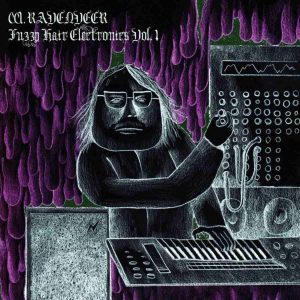
"W. Ravenveer – Erwin Van Looveren – has been a friend for over 20 years. Erwin is a magnet and connoisseur of strange and obscure music, and prone to nervous sweating should you mention a band or weirdo he doesn’t know. His early guitar gigs (as Schidzoid) are the stuff of legend, a reputation largely based on altercations with members of the audience. Having thumped everyone in sight, Erwin’s focus shifted to buying and mastering synthesizers with his customary zeal. After self-publishing a dozen or so cassettes, usually adorned with his neon horror vacui drawings, UE is pleased to present the first W. Ravenveer LP.
Synth blubber! Mental boogie! Spoken intro and outro!
And still in your face: the front cover is a portrait of the artist.
Glossy, full-colour sleeve.
Limited edition of 250 copies"
19,50€
Out of stock

LP
Frank HURRICANE
“Pymp World”
"Frank Hurricane’s legend is such that many have heard his name years before hearing his music. Hurricane Frank, if you will, is the kind of character that can spin an audience into a psychedelic vortex that will have you yelping HOLY PYMP BREW repeatedly as you zigzag your way back home. His music possesses a nagging quality: a dizzying mix of scruffy rap, Casio tones and raw dictaphone poetry that sounds like it always existed in that quattro formaggi part of your mind. Originally released as a self-published cassette, and subsequently on CDR by Joshua Burkett’s Mystra label; both in ridiculously small runs.
Limited to 250 numbered copies. Includes insert."
19,50€
In stock

LP
PITA
“Get on”
With over 2 decades of formal exploration and exhilarating abstraction Get On is, somewhat surprisingly, only the fourth solo Pita full length. Peter Rehberg has always been vouched for pushing the very limits of the technology du jour, be it software or in recent years a complex modular set. Rehberg’s motives are one of unbridled exploration often resulting in extreme and exhilarating audio works.
Having spearheaded the contemporary electronic sound with his uncompromising explorations of noise, rhythm and extreme computer music, he has also worked with numerous experimental musicians in collaboration. Rehberg stands in the wake of a sonic revolution, once fringe, which transformed over time into the sound of a generation of experimental geeks and club freaks worldwide.
Get On follows on from the 2016 release Get In. As with other titles in his ‘Get’ series we have an unwieldy blend of noise, abstraction, gnarled rhythm and blurred melody. Both analogue and digital tools are deployed as a means of expressing something outside of everyday electronics. ‘AMFM’ launches proceedings with some delightfully disorientating ricocheting electronics setting off a subversive sonic spectrum. ‘Frozen Jumper’ presents some ugly skittering electronics which rotate into exquisitely mangled forms before launching into an unsettling euphoria. The last piece ‘Motivation’ is a towering sensitive work, simultaneously haunted and emotionally moving. Get On marks another monumental work in the ongoing evolution from one of the ground zero pioneers of contemporary radical electronic music. As uncompromising as ever this is Pita in his prime. Emotion rung from the most twisted of frames.
Recorded and mixed by Peter Rehberg at Twisted, Wien, 2018/2019
Mastered by Russell Haswell, July 2019
Cut by Rashad Becker at D&M, Berlin, August 2019
Original price was: 17,00€.10,00€Current price is: 10,00€.
In stock
CD
Sébastien ROUX
“Inevitable music #5”
Inevitable music is a collection of pieces based on the work of American artist Sol Lewitt, initiated by Sébastien Roux in 2012. Each piece is a sonic translation of a wall drawing using the instructions given by Lewitt for the realization of the drawing, or the drawing itself, as partition. This fifth installment is the first to propose instrumental compositions for guitar, bassoon, clarinet, trumpet, violin, cello, viola and voice. The pieces were composed in 2016 during a residency at the Villa Medici for and with the experimental contemporary music ensemble Dedalus.
Sébastien Roux (born 1977) writes electronic music, and presents it in diverse formats, from CD’s and records, to public listening sessions, sound installations, sound walks, and radio pieces. He experiments with listening conditions, with the concept of soundscape, and with composition using formal constraints. In 2011 he began to develop an approach focused on principles of translation, analyzing the structures of pre-existing art works (visual, musical, literary) and transposing them into musical scores for new works. This process has led to the creation of Quatuor (2011, released on Brocoli records) and Nouvelle (2012). The most recent development out of this process of translation is Inevitable Music, a long-term examination and development of a methodology for applying the rules and means of the wall drawings of Sol Lewitt to sonic ends. Along with his solo works Roux maintains significant collaborations with writers (Célia Houdart), designers (Olivier Vadrot), choregraphers (DD Dorvillier, Sylvain Prunenec and Rémy Héritier). He worked at Ircam, Paris as a musical assistant to Georges Aperghis, Bruno Mantovani and Gérard Pesson, and was a musical assistant to Morton Subtonick, for “Parades and Changes, replays” by Anne Collod/Anna Halprin. He is a Rome Prize Winner and was in residence at the French Academy in Rome for 2015 – 2016.
12,50€
Out of stock

10 CD box
Roland KAYN
“Scanning (1982-1983)”
A hitherto-unreleased electronic masterpiece from Roland Kayn, singular pioneer of cybernetic music.
Over a period spanning the late 70s through the early 80s, Kayn (1933–2011) issued a quintet of extended works that quietly but definitively redrew the map of electronic music. Informed by cybernetics and a desire to actualise analogue circuitry as an agency in the compositional process, this music adopted a form that can only be described as oceanic, as side after side of vinyl allowed a wholly new vocabulary of electronic sound to find its shape.
In the decades that followed, these multi-LP boxed-set releases became hallowed documents of contemporary music (as well as highly prized collectors' items). Kayn's initially subtle influence belied a gradual shift towards the widespread adoption of his ideas and practices in the 21st century, incorporating both the rise in popularity of modular synthesis as a music-making tool, and the huge advancements in machine learning and AI.
Following the recent reissue of 'Simultan' (1977) and the first-time release of late work 'A Little Electronic Milky Way of Sound' (2009), it was clear that a new generation of listeners and musicians were eager to discover Kayn's vision in all its vastness.
Kayn's own label, Reiger Records Reeks, has been reawakened by his daughter Ilse, and her long-cherished dream of releasing this music is now finally a reality. Across 10 CDs of immersive audio, expertly remastered by Kayn aficionado Jim O'Rourke, listeners are now finally able to digest Kayn's little-known masterpiece, and to inhabit sonic territory that has waited unspoilt for decades.
CD 1: Sonagram, Nomogram, Polygram
CD 2: Cycloids I, Cycloids II
CD 3: Anisotropic Modulations I & II
CD 4: Anisotropic Modulations III & IV
CD 5: Anisotropic Modulations V, VI (Part 1) & VII (Part 2)
CD 6: Networks I, II & III
CD 7: Networks IV & V
CD 8: Radi, Intermodulation, Allotropic Radi
CD 9: Inverted Spaces, Counter Radi
CD 10: Array, Scanned Modulation
Recorded 1982-1983. This CD edition was mastered from the original archive tapes.
90,00€
Out of stock

LP
Jérôme NOETINGER – Anthony PATERAS
“A Sunset for Walter”
Penultimate Press present A Sunset for Walter, the first duo release from long-time collaborators Jérôme Noetinger and Anthony Pateras. "Having worked together in a number of different collaborative contexts over the years, the pair used Pateras' 2018 residency at Schloss Solitude in Stuttgart as an opportunity to develop a major durational work for Steinway piano and multiple Revox tape machines. Presenting four excerpts from a three-hour concert, the LP's opening moments immediately establish its distinctive sound-world: an austere sequence of octaves slowly sounded by the piano gradually develops into passages of fragmentary lyricism as Noetinger's tape manipulations dilate the sonic space with rumbling sub-bass, distant echoes, and hints of uncanny backmasking. A Sunset for Walter was conceived as a loose tribute to the piano works of Walter Marchetti, particularly the slowed-down subaquatic expanse of Nel Mari Del Sud. As Marchetti described his own work, A Sunset for Walter is 'music without beginning, or end, or development', where the lack of obvious structural divisions creates something like an endless present. But where the monochrome surface of Marchetti's work — in its willingness to descend, in his own words to the 'pits of aesthetic poverty' — often approaches total stasis, A Sunset for Walter is calmly immovable in its overall texture but perpetually changing in detail, as the performers respond intuitively to each other, their instruments, and the environment. Noetinger's tape manipulations range from nearly imperceptible shadowing of the live piano to anarchic bursts of rewinding tape, floating wisps of feedback, and dreamlike concrète interjections of children's voices and splashing water. Pateras' piano performance moves from single pitches left hanging over a backdrop of silence to almost Messiaen-esque sequences of complex chords and arpeggios, all sounded within a temporal framework that seems to follow internal rhythms of breath and bodily movements. Caught in this hall of mirrors, the listener is often unable to distinguish the live piano from its tape-manipulated reflection. Like the sunset of the title, here outlines blur into a crepuscular haze, as fleeting effects of light and shade catch our attention just as they disappear." – Francis Plagne
20,00€
In stock
2 LP
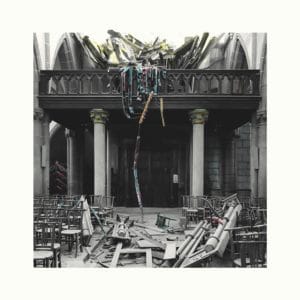
PANCRACE
“The Fluid Hammer”
Music for Organous (spatialized and midi controlled pipe organ), Uilleann Pipes, Pi-Synth, Piano, Motorised Bow, Boîte à Bourdons, Gaida, Baroque Violin, Hurgy Toys, Toy Piano, Componium, Bodhran, Low Whistle, Bird Calls, AM-Radio and Shaker.
Pancrace is a quintet from France comprising Prune Bécheau, Arden Day, Julien Desailly, Léo Maurel and Jan Vysocky. Pancrace began with a residence in 2015 at the Saint Pancrace church in Dangolsheim where the instrument inventor Léo Maurel resides.
The approach of Pancrace is based on the physicality of sound, a choice of specific tone qualities within a given spatial contextual awareness. Therefore the manufacturing and usage of the musical instrument are constantly reassessed. Consequently, playing with the mechanical aspect of the instruments is central to their musical approach and narrative. Designing an unbound pipe organ – though emulating some of the mechanical idiomatics of the initial Pancrace church organ – seemed the obvious way to gain more spatial control over a vast choice of places. This allowed them to approach their music from a totally new angle and work from within the organ. The results of these experiments are captured here, on their second opus, Fluid Hammer.
“ During the 2017 OrgelFesl in Waldkirch, we discovered Wolfram Stuetzle’s workshop, he is a church organ maker. In his attic we discovered thousands of old pipes and other elements for organ making. It was here we had the idea we could one day have our own organ for Pancrace. Thanks to his help, we started to collect some parts in his attic. We also met another organ maker Stefan Freisen who gave us an old bellow which he used as a flower pot in his garden and I also bought some of his 80 year old electromagnets. In January 2018, we were all together in Marmoutier to discover the possibilities of MIDI controlled organs. A month later, the organ “ORGANOUS “ was built in my workshop.” – Léo Maurel
This new beast of an instrument, somewhere between a spider or an octopus, lead Pancrace to compose from the frontality of the instrument as well as with the interactive tone possibilities brought by other instruments. With its six panels display (two bass registers, two treble and a pair of crumhorns) the organ projects sound like the musique concrèt Acousmonium giving the listener a spatialised perception of a wide range of tones and harmonics. Unbounded, the pancrace people have achieved a whole new cosmos of sounds focusing on sources rather than reverberation. Here the ORGANOUS is both the process and the context.
Throughout the double albums 17 tracks one is exposed to a wide variety of Pancrace potential along with the sprinkled conversation with the makers of the water pumps, (reproduced in English inside the sleeve). At once playful, intriguing, surprising and warm this is an exceptional sonic experience from one of today’s most exceptional units.
25,00€
Out of stock
LP
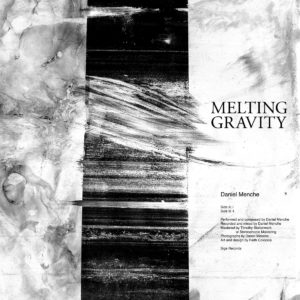
Daniel MENCHE
“Melting Gravity”
Daniel Menche follows up his triple CD opus Sleeper with the razor drone constructs of Melting Gravity. Hailing from Portland, Oregon, Menche is an iconic musician with three decades working with intense noise, immersive ambience, and turbulent field recordings. With Melting Gravity, Menche continues to carve his spot as a figurehead in the experimental community.
The title of Melting Gravity refers to an allegory on the human pursuit of transcendence with all of its connotations to weightlessness, ascension, flight, out-of-body experiences, and just getting high. Gravity, on the other hand, becomes that which negates and nullifies those transcendent pursuits. In the context of this particular allegory, gravity is the devil. Music, long a vehicle aimed towards transcendent ideals, becomes the weapon to defeat gravity, to defeat the devil. Daniel Menche wields the weapon of music in composing the mercurial grandeur that is Melting Gravity.
Implementing an elegant arc of acceleration and dissolve, Menche presents a slow-motion tumble of drones from his signature manipulation of FM synthesis, oscillators, and sustained tones from various stringed instruments. The tangles and tendrils of these extended frequencies are bright and liquid, rich in harmonic complexities though mottled with a scrap metal discord. Menche balances these slippery, luminous overtones with a dub-inspired lattice of recursive bass tones. Read as an industrial mantra or as amplified minimalism, Melting Gravity stands as an exemplary work in Menche’s storied catalogue of recordings.
Daniel Menche’s lengthy discography contains over 60 albums, many of which have been published by some of the most esteemed experimental record labels. Over the years he has worked with Editions Mego, Sige, Touch Music, Alien8 Records, Ash International, Utrecht Records, and many others. He has collaborated with Mamiffer, Andrew Liles, KK Null, John Wiese, Aaron Bradford Turner, Joe Preston, Anla Courtis, Zbigniew Karkowski, Kiyoshi Mizutani, and Kevin Drumm. He has performed extensively in North America, Japan, Europe, and Australia.
- Jim Haynes
20,00€
In stock
LP
Jon MUELLER
“Canto”
Jon Mueller is a multi-faceted percussionist, presenting his latest body of work in Canto for gongs, voice, and percussion. In his solo work that spans two decades, Mueller has embarked on a lengthy exploration of the timbres, the dissonance, and the physicality of repetition from his array of percussive instruments. Gongs had long been a part of his repertoire, but here on Canto he addresses their specific sonic attributes in conjunction with extended vocal techniques bolstered through his studies with the legendary NYC minimalists LaMonte Young and Marian Zazeela. In ruminating upon this shift in focus for ‘Canto,’ Mueller explains that “The driving energy of drums is replaced by deep contemplation and wonder, questions, confusion, darkness and ultimately, calm.”
The three tracks to Canto — entitled “Oil,” “Wick,” and “Flame” — have their names taken from a Sufi text, representing parts that create a whole, just as a canto is a part of a longer poem. “Oil” is an expansive piece that builds upon frameworks that build gradual crescendos from his gongs through volume and complexity of frequency. This unfurls into an eerie yet beautifully rendered sound bath of metallic resonance and reverberation girded by slowly paced vocal melodies. “Wick” stems from Mueller’s lessons with Young and Zazeela. While his goal was not to become an Indian classical singer, he adopts those techniques in this vigorous concentration of sustained vocal tones for a piece that is as trenchant as it is meditative. “Flame” reprises the combination of gong overtones that amass out of a deep somatic chant. Canto stands as a bold, expressive album that follows a long line of avant-garde percussionists that include Eddie Prevost, Jason Kahn, Daniel Schmidt, and Christopher Tree’s Spontaneous Sound.
20,00€
In stock
CD
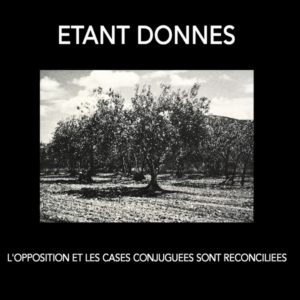
ETANT DONNES
“L’opposition et les cases conjuguées sont réconciliées”
Etant Donnes is a French duo named after Marcel Duchamp's last major work. The group consists of brothers Marc and Eric Hurtado, born in Morocco and working mainly as performance artists and musicians. Their sound can be described as a mix of field recordings, found sounds and sometimes whispered, sometimes violent vocals. They describe their sounds like this: "Through Marc and Eric, it is the volume of each word that becomes an object-sculpture, together with the power of their bodies expressing their voices. Each event is a scream - indeed even the glissando - of the strength of the word that sometimes abruptly becomes a rock, a solid surface, not in the least fluvial, as is the narrative of a tale, novel or poetic epic. With both of them, there is no more trace of ancient prosodies, no more trace of the incomprehensible Sainte-Beuve who could claim: "I have to collect a volume of prose". The word, the voice, the volume take shape with each other, unveiling a theatre that theatre usually ignores, which has given it such things as a Samuel Beckett's Fin de Partie." Over the years Etant Donnes have collaborated with people like Lydia Lunch, Michael Gira, Alan Vega and Genesis P-Orridge. L'Opposition Et Les Cases Conjuguées Sont Réconciliées was the band's second album, originally released in 1981 on French label Bain Total, run by die Form, on cassette only. For this CD re-issue we have added a long bonus track not on the original album.
12,00€