
In stock
CD
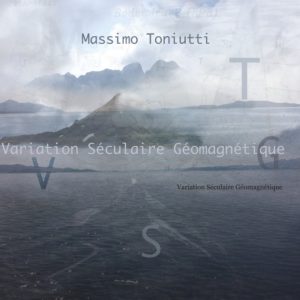
Massimo TONIUTTI
“Variation séculaire géomagnétique (Antidocument/Groundwork)”
"Massimo Toniutti is an Italian sound designer and experimental musician. He is the brother of Giancarlo Toniutti who is best known for his dark ambient masterpiece La Mutazione which was originally released on the Broken Flag label in the UK and later reissued by Klanggalerie. Massimo started working with sound when he was a teenager, collecting and playing recordings of all kinds. In th 1980s he released four cassettes on his own label, all heavily influenced by the experimental musis scene of that time. He soon developped a strong relation to electroacoustic structures, space/environment and silence. In the 1990s, he began investigating radio, creating his own sound archive and producing unusual broadcasts. He released an album entitled Il Museum Selvatico, which was reissued in Australia in 2018 on Oren Ambarchi's label Black Truffle. A documentation of his radio work can be heard on the CD Le Gabbiette Di Faraday, collecting radio pieces from 1996 to 1998. After a twenty year break, the cassette Antidocument/Groundwork was released in 2016 in a tiny edition of only 100 copies. Klanggalerie asked Massimo Toniutti to reissue this composition on CD to which he agreed. When work was started, Massimo decided to extend it to a much longer piece which became Variation Séculaire Géomagnétique. if you are into Musique Concrete, Dark Ambient or simply beautifully crafted atmospheric music, then this release is for you."
12,00€
In stock
CD
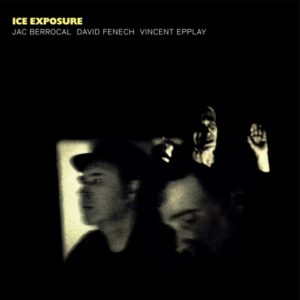
Jac BERROCAL – David FENECH – Vincent EPPLAY
“Ice Exposure”
Jac Berrocal is a 1946-born musician (trumpet player), poet and sometime film actor who came of age in the ‘70s Paris improv scene, where the boundaries between music, art and theatre were porous and begging to be breached. Inspired by bebop, chanson, free jazz, beat poetry, early rock ‘n roll and myriad Eastern influences, and with an iconoclastic, anything-goes approach to instrumentation and technique that would later align him with post-punk sensibilities, Berrocal blazed an eccentric and unstoppable trail across the underground throughout the ‘70s and ‘80s, both solo and as part of the Catalogue group he co-founded. During this time his uproarious performances routinely wound up jazz and rock audiences alike, but earned the admiration of many musicians: Steven Stapleton invited him to perform on two Nurse With Wound albums, and other notable collaborators in his career include Sunny Murray, Lizzy Mercier-Descloux, Lol Coxhill, Yvette Horner and James Chance.
In the 90s his protean achievements were celebrated on the Fatal Encounters compilation, but far from slowing down in the autumn of his life, Berrocal has maintained an extraordinary work-rate, keeping studio dates with Pascal Comelade, Telectu and Jaki Liebezeit, among others.
Now Berrocal has found the perfect foil in David Fenech and Vincent Epplay, two fearlessly inventive improvisers, composers and catalysts who create challenging, acutely modernist yet historically aware settings – wrought out of synthesis, guitars, computer processing, field recordings and unorthodox percussions – for Berrocal’s unmistakeable voice and breathtakingly lyrical horn sound to flourish. Fenech cut his teeth in the mail-art scene of the early ‘90s, leading the Peu Importe collective in Grenoble. His 2000 solo debut was recently reissued by Felix Kubin’s Gagarin label, and he has also worked as a software developer at IRCAM, and played with Jad Fair, Tom Cora, Rhys Chatham and James Plotkin; in 2011 he formed a trio with Berrocal and Ghedalia Tazartes for the Superdisque LP. Epplay is a highly regarded sonic and visual artist with a particular interest in aleatory composition and autonomous pieces, concrète, and the puckish reappropriation of vintage sound and film material, with dozens of published works to his name on labels like Planam/Alga Marghen and PPT/Stembogen. Ice exposure is the sequel and companion piece to 2015’s Antigravity, its title couldn’t be more apt: sonically it is both colder, and more exposed – in the sense of rawer, more volatile, more vulnerable – than its predecessor, capturing the combustible energy and barely suppressed violence of the trio’s celebrated live performances with aspects of noir jazz, musique concrète, no wave art-rock, sound poetry and spectral electronics all interpenetrating in unpredictable and exhilarating ways. While there are moments of great sensitivity and even a cautious romanticism, the prevailing mood is one of anxiety, paranoia, and mounting psychodrama: close your eyes and Ice Exposure feels like a dissociative Hörspiel broadcasting from the seedy backstreets of your own troubled mind. This CD version also has two bonus tracks that have not been available before.
12,00€
Out of stock
LP
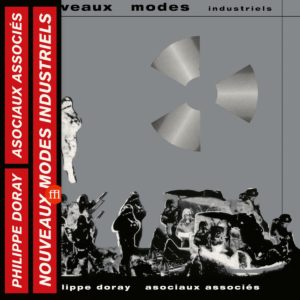
Philippe DORAY & Les ASOCIAUX ASSOCIÉS
“Nouveaux Modes Industriels”
Between 1978 and 1980, the Asociaux Associés (antisocial associates, TN) recorded the second of the two albums which appeared under their name: Nouveaux Modes Industriels. Philippe Doray, with the help of his 'Associés, evermore iconoclastic and numerous, backs up his anguished poetry with customised krautrock, hallucinatory pop and rock Suicide. Much more than a memory of the then surprising (and disturbing) Swinging Rouen, this album is an intergalactic ambush.
Following the publication, in 1977, of the first of two albums under his own name, Ramasse-Miettes Nucléaires, on the label Gratte-Ciel, Philippe Doray didn’t waste any time before writing new obscure and experimental songs. As proof, between May 1978 and January 1980, with his Asociaux Associés (antisocial associates, TN), he recorded ten of them in the farm in which he lived (and shared) close to Rouen.
In 1980, Nouveaux Modes Industriels was published thanks to the support of Invisible, the label of the Société Coopérative d'Ouvriers-Producteurs Artistiques (S.C.O.P.A., the Cooperative Society of Artistic Worker/Producers,TN) run by, amongst others, the ex-manager of Crium Delirium Jacques Pasquier. This meant that Doray had free rein for his electric poetry, his personal delirium, to be heard. He had already shaken up French music with his mix of pop, krautrock and free jazz; a few months later he would undergo a change which would be the precursor of his future projects.
Before collaborating with Thierry Müller under the names Ruth and Crash, Doray let loose one last time, with his Asociaux Associés, his anguished poetry into the face of the urban labyrinth, his nuclear dynamite… It is no coincidence if the album cover is similar to those by Urban Sax, the spirit of the times was anguish as a creator of beauty. Doray’s version had the advantage of still knowing how to sing.
Never forgetting his interest for dance, the musician gets Cluster moving to a boogaloo, foments a Suicide on synthetic jaw harp or invents elevator music for tower blocks… All of which hotchpotch feeds into his Nouveaux Modes Industriels. If the last track of the album states “no after-sales service”, it is simply because there is no need.
20,00€
Out of stock
LP
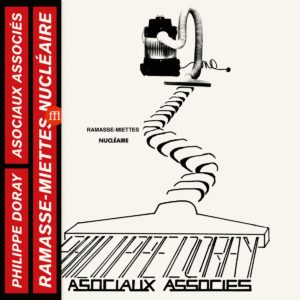
Philippe DORAY & Les ASOCIAUX ASSOCIÉS
“Ramasse Miettes Nucléaire”
In 1976, the Asociaux Associés (antisocial associates, TN) led by Philippe Doray (Rotomagus, Ruth, Crash), recorded the first of the two albums under their own name: Ramasse-Miettes Nucléaires. On synthesiser, Doray fires off his disturbing poetry over psychedelic pop, voodoo rock, off-kilter krautrock, approximate swing … But if the music is iconoclastic (bringing to mind as much Hendrix as Areski, Ash Ra Tempel as Berrocal…), one thing is certain: Ramasse-Miettes Nucléaires is one of the best albums of obscure experimental song ever recorded.
It is no surprise that, on the Nurse With Wound List that Steven Stapleton inserted in the first album of his legendary musical project, the name of Philippe Doray can be found between that of the Doo-Dooettes and Jean Dubuffet: his music is genuinely original and, what is more, ahead of its’ time.
It was in 1977 that the first album by Philippe Doray, Ramasse-Miettes Nucléaires, was published on Gratte-Ciel, a label created by the journalist from Rock & Folk Jean-Marc Bailleux and run by Jean-Marc Patrat and José Serré. Encouraged by his wild experience in Rotomagus, a formidable rock band which swept through Rouen, for sure, but also further afield – as Julian Cope was himself inspired, years later, by their explosivity – Doray brought a team to this album which was both untamed and ready to fight to defend it’s terrible (and trembling) poetry.
Backed by his ‘Asociaux Associés’ (antisocial associates, TN), our man from Rouen let his fantasy run wild and cried out again: “sing with me, and don’t be afraid to clap your hands!” And so, much of French popular music was shaken: the ball in Doray’s pinball machine had struck Jimi Hendrix then Alain Goraguer, then Ash Ra Tempel and onto Areski, then T-Rex followed by Jac Berrocal…
As far as the texts are concerned, just take a listen. Doray’s poetry is schizophrenic: nurtured in the Normandy countryside, it relates paranoid tales of booby-trapped towns, Levis jeans, Prisunic supermarkets and plastic dolls… Crumbs of reality which he sucked up to create the album that Souffle Continu and Thierry Müller, mastering (with Ruth, Crash, and Illitch too) spit out again fifty years later, with many good memories.
20,00€
Out of stock

LP
Jasmine GUFFOND
“Microphone Permission”
Editions Mego release the new album by Australian producer Jasmine Guffond. Developed over a two-year period, Microphone Permission is an unsettling musical journey utilizing contemporary tools of communication to display Guffond's ongoing research into online surveillance and sound as a method of investigation. Source material on Microphone Permission are from various projects Guffond has been working on; a commission to sonify the data of the city of Melbourne, a dance performance about the future sounds of an extinct forest, an installation that sonifies Twitter meta data in real time, a job as a composer for a theater work about music and feminism by five young female identifying performers in Western Sydney and a site specific installation at the Linachtalsperre dam that employed the harmonic frequencies of electric currents. The results are a stark, brooding, disorientating journey into a paranoid musical field that sits somewhere between ambient club music and a dystopian soundtrack. Elements of techno, classical music, and sound art form a dark intriguing masterwork that questions the nature of invasive, algorithmic, and computational listening practices. For example, Microphone Permission refers to the consent we routinely give when installing various apps onto our smart devices. Inspired by a 2018 scandal in which fans of Spain's most popular soccer team were effectively turned into unwitting spies by granting the La Liga application microphone permission. No matter which make or model, all smart devices are built with a microphone that is by default, forever listening. Listening in these situations often takes on an algorithmic form that enables tech developers to bypass public response to what is intuitively considered invasive practice, that is, traditional modes of eavesdropping such as using the microphone to listen and record audio. Composed, recorded, and produced by Jasmine Guffond. Image by Ilan Katin; layout by Nik Void.
17,00€
Out of stock

LP
GOLEM MÉCANIQUE
“Nona, Decima et Morta”
Stephen O'Malley on the release (Paris, January 2020):"My first encounter with Karen Jebane (aka Golem Mecanique) was in the context of Echoés above the village of Le Saix in Haut-Ales, in 2016. This tremendous location runs along a deep river canyon with a long cliff on one side and a small mountainside slope on the other. Importantly, and uniquely, some mad acoustician geniuses have built massive concrete amplified horns into the hillside to project sound against the cliff, activating the landscape's natural resonance and delay patterns. The Echoés organizers exploit this system once per year, in a type of private weekend. People arrive for a few evenings of music and enjoy the summer and loosen their minds a bit. I was to be performing later in the night (under the stars, one of my most memorable and moving experiences with music ever), but Karen began her performance directly at sunset, the color saturating the sky and shadows growing deep purple and reds. Instantly and for the next hour I felt like I had descending into the Neolithic/Mythological age. And into the pre-renaissance mindset of time where linearity was absent, cyclic experience unnecessary... just when it was/is. Karen's deep and evocative chanting voice reflected and called forth in multitude amongst the landscape. Bone-chilling, or, perhaps, penetrating down through the bone. A thick and immaterial drone wove itself into the air. Voices began emerging from the cliff's face, the stones itself were singing, seemingly liberated from their geological time space. I understood more about why archetypal memory forms of seers, divinatory, witches and sorceresses exist in our cultural long storylines, our shared sociopsychological neurological rationalization constructs. Those necessary systems of attempting to interpret and communicate the world. It was an incredible moment within the blur between the night and the day. Although Karen's main instrument are her voice, and her mind, she also performs on organ, and also together with the Mediterranean folk music impressionada Marion Cousin on this deeply moving album. Karen also utilizes a very special French instrument known as the BAB, a kind of mechanized vielle (hurdy-gurdy)... one of the more incredible inventions of the La Nòvia group's legendary instrument builder Léo Maurel. Basically, the instrument sounds like an arcane goth/spirit interpreting Phill Niblock's string pieces, in monochrome on the very edge of the invention of color grain. Marvelous." Recorded and mixed by Borja Flames on 2019 New Year's Eve. Mastered and cut by Rashad Becker at Dubplates & Mastering, Berlin July 2019.
17,00€
In stock

CD
David JACKMAN
“Silence in that time”
The follow up to last year’s critically acclaimed album Herbstonne, Silence in that time is a direct offshot of the former album, adding more sounds to the overall sound palette. Recorded at RMS Studios South London in 2019, the single 42 min. long track stands as another distinctively beautiful and haunting work in the artist’s discography.
Artwork by Jonathan Coleclough.
14,00€
Out of stock

CD
Fani KONSTANTINIDOU
“Winter Trilogy / The Big Fall”
Fani Konstantinidou is a composer and sound artist living and working in the Netherlands. She has a particular interest in cultural and social identities and their influence in music composition. Since 2015 she works on her personal artistic project, Sound Topographies, where she uses a variety of sound sources inspired by her own surroundings. From musical instruments to spoken language and from everyday sound[scape]s to computer-generated sounds, her music is characterized by shifting
sonic textures that circulate between drones, noise, arrhythmic melodies, and atonal rhythms.
Inspired by the influence of space and time in music, she creates and recreates timelines of sonic events aiming at musical dialogues and public communication through sound.
The two trilogies were realized between 2015-2019 in the Netherlands and implemented into a sequence of live shows during the same period. Both inspired by cultural sonic imprints, the Winter Trilogy (computer & accordion) and The Big Fall (computer & analogue synthesizer) explore the potential and the antitheses between analogue versus digital while expressing a personal view of particular rural landscapes.
11,00€
Out of stock

2 CD
Alvin CURRAN – Reinier van HOUDT
“Dead Beats”
Moving Furniture Records is proud to present to you the composition Dead Beats by Alvin Curran (US), commissioned by Moving Furniture Records for pianist Reinier van Houdt (NL).
This production is a collaboration between Moving Furniture Records, Willem Twee Studies, ‘s-Hertogenbosch, and Martijn Comes.
This is the start of a new series on Moving Furniture Records under the name Contemporary Series in which we will focus on new works by contemporary composers and musicians.
"Early in his career, composer Alvin Curran turned away from piano—the instrument he was trained on—in favor of all manner of sound-making, rejecting the classical tradition. His work as a member of Musica Elettronica Viva opened up new possibilities for art music, drawing heavily upon improvisation. In the last installment of this column I discussed one of his singular solo recordings from the ‘70s, where his compositions were utterly liberated from any given tradition. He eventually returned to piano, but created music from a much freer point of view.In 1991 he began writing what would amount to the 12-movement, six-hour opus “Inner Cities,” studies of the teeming energy and contradictory impulses of urban centers. Curran composed the ninth movement for Dutch pianist Reinier van Houdt. Curran wrote of the work as a whole: “My goal, as always, was to reduce the musical elements to their ultimate essences, to repudiate and embrace dualism, and to emulate, even in permanent notation, the feel of spontaneous music-making.”
On this new recording, van Houdt illustrates that goal brilliantly in a 30-minute journey marked by thrilling and unnerving polarities of density and energy, freely arranging ideas gleaned from all across history. “Dead Beats” is a new work written for the pianist which remaps those earlier concepts into a far more elliptical and shape-shifting five-movement expedition, where it’s hard not to delight in getting lost over and over again."
16,00€
In stock

LP
Gareth DAVIS & MERZBOW
“Broken Landscapes”
Following on from their 2016 Moving Furniture release, Atsusaku, Broken Landscapes is a new collaboration between Gareth Davis (Oiseaux Tempete, Scanner, Elliott Sharp, Machinefabriek) and Merzbow, Japanese noise mastermind Masami Akita.
The theme of mechanical compression explored in the first album is taken further this time, being looked at in the context of the fears of mechanisation in the environment. A torrent of noise reimagines the North Sea wind farms, the industrialisation in Southern California and the fight for the survival of animals in their overrun habitats. Through three tracks, the sounds of these spaces are crushed and distorted, the sense of air being saturated by the shifting low-end drones and hum of machines, howling reeds and dense white noise pushing away the breathing space.
The acoustic sound almost suffocated beneath the dense mechanical sweep of furiously abusive digital cross-fire and unrelenting production line intensity. Hints of recognition as a voice from the environment shines through before moving abruptly back into the mechanical barrage of looping textures. Broken Landscapes is built on impenetrably thick walls of manipulated field recordings while the bass clarinet saturates the midrange, the massive swirling mesh of analogue and digital material painting pictures of the magnified terrain that surrounds us.
16,00€
Out of stock

10" + CD
FOVEA HEX
“The salt garden III”
"The starlit nocturnes of Fovea Hex bind electronics, drones and voices into song-spells that are untimely in the best possible sense; their intimacy and raw emotional power feel centuries old, but the experimental sound-design can be shockingly modern." Drew Daniels (Matmos)
The frequently claimed "impossible to categorise" tag applies well to Fovea Hex. The songs are dominated by a voice that's too strong to be deigned ethereal, but remains too otherworldly to file alongside more conventional female singer-songwriters. The pace tends to be languid, the arrangements intricate and fragile. Comparisons have been made to This Mortal Coil, Emily Dickinson, Nico, Dead Can Dance, and even Schubert, but really this music is quite unique, a mix of electronic and acoustic sounds from a palette which ranges from state-of-art to ancient and arcane.
Original price was: 17,50€.10,00€Current price is: 10,00€.
Out of stock

CD
Asmus TIETCHENS + CV LIQUIDSKY
“Monoposto”
17th and final part in the re-release series of all early Tietchens albums between 1980—1991.
Originally released on Dragnet, Dom Elchklang in 1991. This new version incl. 3 Bonus tracks and is another joint release by German labels Die Stadt and aufabwegen. Jewel case with full color artwork and poster booklet also feat. the original front and back cover. First edition of 600 copies.
"It was just before the end of the heroic times when CV Liquidsky and I decided to record a studio album together. Almost too late considering that Liquidsky already lived and worked in Hamburg since 1979. Our ways had crossed many times since and a mutual friendship developed. Actually we discussed a possible collaboration several times. Liquidsky was a graphic designer, journalist, musician and someone who really moved things in all these areas. I got to know Liquidsky's musical side as him being one half of the industrial music duo 'Cinema Verite', and at the same time through his journalistic skill's, writing excellent reports about the Hamburg and International music and cultural scenes. As a trained artist he also did record covers and posters, illustrated Fanzines and created some disturbing free works. It was no secret that his chosen artist name derived from both ,Cabaret Voltaire'(CV) and 'Liquid Sky'(Liquidsky). His real name was Andreas Hoffmann. The recordings for 'Monoposto' were made between 1988-1990. The mention of the years 1981-1990 on the cover was deliberately misleading. Our work scheme was to try and record one track per nightly session, and when ever we met in the studio we stuck / clung to this strict working method. It was our intention to avoid making a perfect studio album. Improvisation, chance, errors and spontaneous decisions were the game plan. After a track was recorded it was mixed the same night or even early the next morning, so it was finished. No ironing out and no corrections were made, no matter if the raw diamonds we created started to shine or not. It was Liquidsky who persuaded me to accept this almost Dadaistic concept, as I'm basically someone who takes longer to create a track. He concentrated on his guitar and I concentrated on the electrical treatments. Later a good friend of ours described the music as a mixture of apathy and ecstasy, beauty and ugliness. In fact I never worked on an album with such a melancholic note before of ever after. The cover was created by Liquidsky within a couple of hours. The word 'Monoposto' has actually no meaning. It's a Blindtest to show the actual look of a certain typography common in the analog world back then. Liquidsky was fast and he always stood on the right side. Andrea Hoffmann died on 6th of September 1998."
15,00€
Out of stock

3 CD
Charles CURTIS
“Performances and recordings 1998-2018”
Saltern presents its fifth release, Performances & Recordings 1998-2018, the first comprehensive collection of recordings surveying the career of renowned, American cellist Charles Curtis. Selected by Curtis and Tashi Wada from recordings spanning the past two decades, the collection offers a broad, inclusive view of Curtis's activities across the diverse worlds of music he inhabits, containing rare, unreleased recordings, and never-before-released music by Terry Jennings, Richard Maxfield, Éliane Radigue, Alison Knowles, and Curtis. The wide-ranging scope of this release speaks not to a musical restlessness, but to a genuine spirit of inquiry, as these areas of activity for Curtis have existed concurrently in dialogue, not simply in succession, for decades. Over two hours of music by composers and artists with whom Curtis is closely associated including Éliane Radigue, Guillaume de Machaut, Tobias Hume, Silvestro di Ganassi, Terry Jennings, Morton Feldman, Anton Webern, Olivier Messiaen, Alison Knowles, Richard Maxfield, and Curtis himself. Mastered by Stephan Mathieu with liner notes by La Monte Young, Spencer Gerhardt, and Tashi Wada. Custom packaging and screen printing by Alan Sherry; Edition of 500.
27,00€
Out of stock
LP
Mark VERNON
“An annotated phonography of chance”
‘An Annotated Phonography of Chance’ expands upon the soundtrack to an uncompleted 16mm film made in collaboration with English filmmaker Martha Jurksaitis and the Portuguese artist duo Von Calhau! The film ‘Nossos Ossos’ was shot largely on location in the Alentejo region of Portugal in 2013.
Mark Vernon is a Glasgow-based artist whose work exists on the fringes of sound art, music and broadcasting.
At the core of his practice lies a fascination with the intimacy of the radio voice, environmental sound, obsolete media and the re-appropriation of found recordings. He incorporates these diverse elements into radiophonic compositions for broadcast, fixed media and live performances.
His solo and collaborative music projects have been published through labels including Kye, Staalplaat, Ultra Eczema, Entr’acte, 3Leaves, Staubgold and Gagarin Records, as well as a series of small CDR and LP editions on his own Meagre Resource imprint.
13,00€
In stock

LP
Jan St. WERNER
“Molocular Meditation”
Molocular Meditation is a bespoke light and sound environment featuring the voice of the Fall’s Mark E Smith. Smith is heard making observations on mundane objects, events and a range of meditation techniques basically associating his discontent with an apolitical british upper class. His voice forms the narrative component of an electroacoustic composition by Jan St. Werner placed in a hyper-real scenario evoking a state of transformation and deceleration. Molecular Meditation premiered at Cornerhouse, Manchester in 2014. This album presents a re-edited stereo version of the original multi-channel installation. Voice and guitar feedbacks were recorded by Werner and Smith at Blueprint Studios Manchester, electronics in Werner’s Studio in Berlin.
The B-side consists of unreleased new work partly written around the same time as Molocular Meditation in context of Werner's Fiepblatter Catalogue on Thrill Jockey. Back to Animals is a non-metric rhythm exercise frantically hybridizing percussive accents with synthesized pulse. On the Infinite of Universe and Worlds is the layout for an electronic opera on Giordano Bruno’s Renaissance writings which Werner was asked to conceptionalize for Finish festival Musica Nova. VS Canceled finds Mark E. Smith reading an email from Domino Records explaining their discontinuation of Von Sudenfed, a band Mark E. Smith had founded with Mouse on Mars' Jan St. Werner and Andi Toma in 2006. Their debut album Tromatic Reflexxions came out on Domino in 2007.
The vinyl record, cut with a diamond needle, delivers as much dynamic range as the digital format.
Music & Production Jan St. Werner
Words Mark E Smith
Words B2 Giordano Bruno performed by Guiseppe Maria Zevola
17,00€
Out of stock

LP
TANZ MEIN HERZ
“Dosses”
In 2015 Tanz Mein Herz welcome a new arrival among its ever-evolving roster of musicians, the self-taught hurdy-gurdy wizard Alexis Degrenier (from La Tène among other bands).
With a tour already in the works, the musicians settle on a set consisting of old material (Magical Stones and Shiny Mud) as well as new themes such as Spiegel Haus, both built around the new instrumentation.
The selection presented on Dosses is taken from the very first rehearsals around these themes, as the musicians strive and wander about freely in search of new musical vistas and promising friendship.
With Ernest Bergez, Pierre Bujeau, Alexis Degrenier, Pierre-Vincent Fortunier, Guilhem Lacroux, Jeremie Sauvage and Mathieu Tilly.
LP, 500 copies, silkscreened covers with stamped labels.
18,00€
In stock
2 LP
Stine JANVIN
“Fake Synthetic Music”
PAN tout a real beauty with Stine Janvin’s scintillating vocal suite ‘Fake Synthetic Music’ - a transfixing and distinguished demonstration of the voice as a hugely flexible instrument, presented in a range of minimalist yet extreme, probing scenarios providing a radical new perspective on familiar sounds.
Conceived as a full-body physical and ambient live performance for theatres, clubs and galleries, ‘Fake Synthetic Space’ is an intently focussed and singular follow-up to Stine’s previous solo LP ‘In Labour’ [Pica Disk, 2014] and her input to last year’s Native Instrument release ‘Camo’ for Shelter Press. Where both of those releases found her vocals combined with field recordings in myriad ways, the Norwegian artist’s latest side is stripped right back to vocals and FX, offering a visceral investigation of her full frequency range with results that explore the deeply uncanny auditory phenomena of otoacoustic emissions in melodic, minimal sequences referencing pop, techno, and trance.
Placed in a broad history of extended vocal investigation ranging from Dadaist poetry to the resonant acoustics of Alvin Lucier, the minimalist abstraction of Steve Reich, and the unearthly sonic spectrum covered by Maja Ratkje, ‘Fake Synthetic Music’ is anchored in the modern day by its use of clinically technoid pulses and repetition, and not least by its ambiguous title, especially in the age of fake news. Through the prism of the voice, Stine both literally and metaphorically reflects contemporary obsessions with authenticity and artifice, using trickery and illusion to strangely reinforce her own sense of self and likewise provide listeners with a life affirming experience.
Between the alien cadence of ‘Mood’, the playfully invasive sounds elicited from Glitch’, and most strikingly in the mesmerising stereo swing of ‘Like Right Now’, Stine presents genuinely shocking rearrangements of her voice quite unlike anything out there right now, and by the time the escalating pitches of ‘Tripple A’ and the whooping avant-jazz-techno of ‘Zen Garden’ have exerted their effect, it’s becomes patently, piercingly clear that Stine’s sound art operates on a remarkably incisive plane of synaesthetic perception
27,00€
In stock

LP
Jenna SUTELA
“Nimiia vibié”
Aspiring to connect with a world beyond our consciousness and our planet, nimiia vibié sounds the interactions between a neural network, audio recordings of early Martian language, and microscopic footage of extremophilic space bacteria. Here, the computer is a medium, channeling messages from entities that usually cannot speak.
However, it is also an alien of our creation. Drawing on nimiia cétiï, Jenna Sutela’s project on machine learning and interspecies communication, the record manifests a more-than-human language. This language is based on the computer’s interpretation of a Martian tongue from the late 1800s, originally channeled by the French medium Hélène Smith and now voiced by Sutela, as well as the movement of Bacillus subtilis, an extreme loving bacterium that, according to recent spaceflight experimentation, can survive on Mars. The bacterium is also present in nattō, or fermented soybeans, a probiotic food considered as a secret to long life. Beyond Bacterial-Martian culture, or Martian gut bacteria, the project attempts to express the nonhuman condition of computers that work as our interlocutors and infrastructure.
Jenna Sutela works with words, sounds, and other living materials. Her audiovisual pieces, sculptures, and performances seek to identify and react to precarious social and material moments, often in relation to technology. Sutela’s work has been presented at museums and art contexts internationally, including Guggenheim Bilbao, Museum of Contemporary Art Tokyo, and Serpentine Galleries. She is a Visiting Artist at The MIT Center for Art, Science & Technology (CAST) in 2019-20. The project originates in n-dimensions, Google Arts & Culture’s artist-in-residence program at Somerset House Studios. Machine learning in collaboration with Memo Akten and Damien Henry. Miako Klein in the contrabass recorder and Shin-Joo Morgantini in the flute, with sound production by Ville Haimala.
Original price was: 20,50€.12,00€Current price is: 12,00€.
Out of stock
2 CD
Matt SHOEMAKER
“Tropical Amnesia Two & Three”
Double CD limited edition of 300 copies.
All sound recorded November 2007 in/at/around Mamori Lake, Amazonas, Brazil.
Material culled and assembled December 2007/January 2008 in Seattle.
13,00€
In stock
2 LP
Joe COLLEY
“Psychic Stress Soundtracks”
First time vinyl pressing of Joe Colley’s Prix Ars Electronica award winning album. Mastered for vinyl by Giuseppe Ielasi and pressed across 2 LPs, packaged in gatefold jacket with expanded artwork.
"Failure, self-loathing and abject monstrosity continue unabated as the primary themes for Joe Colley's electro-shock minimalism. as with his previous, equally impressive Desperate Attempts At Beauty, he shifts through a seemingly endless supply of antiquated electric gear and forces these dilapidated machines to grind, crush, whirl and twist under conditions they were not originally designed for. On Psychic Stress Soundtracks, Colley astutely transcribes the machines' smouldering march to oblivion, granting them the emphatic capacity for pain and the recognition of existential despair. The ozone smell of melting circuity lingers above the nervous Geiger counter clicks and toxic hums of his electric dynamos. Colley is a gifted, if sometimes under-appreciated composer whose successes rely upon the manifestation of the paradox of building something extraordinary out of junk." - Jim Haynes (The Wire)
28,00€
In stock

CD
Christine ABDELNOUR & Joachim NORDWALL
“A higher state of body and mind”
Lebanese saxophonist Christine Abdelnour brings an impressive, extended instrumental vocabulary to Joachim Nordwall’s cryptic electronics in this live recording made at Ystad Konstmuseum for Sweden’s Firework Edition Recordings
Falling deeply within the label’s taste for sounds that exist on the liminal edge of perception, ‘A Higher State of Body and Mind’ sees Abdelnour coaxing spittle-inflected small sounds and bestial whimpers from her brass tool while Nordwall colours the negative space in elemental, greyscale drones and sheets of coruscating electronic texture.
Their results are organic and drily, soberly expressive in a transfixing style of sonic dialogue that covers all tiers of the frequency spectrum. As the release’s title implies, ‘A Higher State of Body and Mind’ is attuned to extremes of penetrative highs and rich, sonorous low end, but neither dominate the other, rather they buoy and balance each other in their quest to elevate listeners to experience, feel and perceive the recording on its purely sensual, synaesthetic terms.
Original price was: 12,50€.7,00€Current price is: 7,00€.
Out of stock

CD
SINK
s/t
Andrea Ermke, minidiscs - Chris Abrahams, DX-7 - Marcello Busato, drums - Arthur Rother, electric guitar.
It took 15 years since its foundation to release their first album. Sink was formed in Berlin in 2004. Though their music is improvised, Sink play, perform, sound and feel as a band with a distinct band sound. Their sound ranges from typically Berlin Echtzeitmusik related mixed electroacoustic and acoustic soundscapes which can, but need not, result in a minimalistic groove. Sink already appeared on “Echtzeitmusik Berlin” compilation we produced in 2012.
“Sink” is a perfect blend of diverse sound sources. Rother’s minimal chord playing and guitar arpeggios mix with Abrahams’ masterful knowledge of the depths of Yamaha DX-7 which sometimes emits typically electronic timbres and sometimes he makes it sound like an organ. All this coalesces with Ermke’s sonic intrusions from her minidiscs and Busato’s wide range of playing techniques on percussion and drums, now shadowy, then outbursting. “Sink” is a staggering feast of the joys found in the process of sonic research with their own instruments. A malleable bubble of hovering excitement, romantic slowdowns and joyous refrain. A perfect musical match for your post-Techno after party.
13,50€
In stock
LP
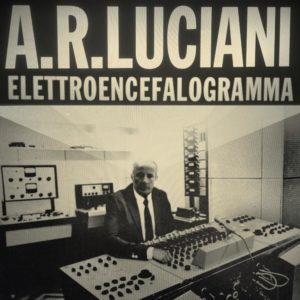
A.R LUCIANI
“Elettroencefalogramma”
‘Elettroencefalogramma’ scans the full breadth of electronic composition by Italian musical mastermind Antonino Riccardo Luciani, who’s perhaps best known for his library records, but on the showing here had a strong, prescient line in mind-bending, fathoms-deep experimental and academic work with tape and early, pre-synth devices.
Awarded unprecedented access to polymath composer “Tony” Luciani’s archive of inter-disciplinary work, Finders Keepers’ Andy Votel follows his pressing of Maria Teresa Luciani’s ‘Sounds of The City’ with a first compilation survey of her sibling’s vast catalogue, newly issued via the Dead-Cert label he curates alongside Sean Canty and Doug Shipton. The set falls deep within the label’s remit of reissued and previously unreleased work by overlooked and undocumented pioneers of 20th century sound, revealing a distinctive mix of material that nods to contemporary, tape music, neo-classical, jazz, electro-acoustic and counterpoint composition.
Drawn from original tapes recorded during the 1970s, ‘Elettroencefalogramma’ spans the heyday of Luciani’s work, before synth music was popularised. In this sense it’s worth noting Luciani’s links with Teresa Rampazzi and the pioneering electroacoustic group NPS - and namely Serenella “Serena” Marega - with whom he shares a strong affiliation toward embracing the possibilities of new music at the dawn of an unprecedented sonic epoch.
There’s a sense of being in transition between worlds and eras in the opening blend of melancholy strings and bubbling electronic rhythm ‘Battery Farm’, and likewise the cranky mixture of bestial growls and dissonance in ‘The Zoo’, while the rattly rhythm of ‘Offices’ uncannily recalls Trunk’s recent issue of ‘Mechanical Keyboard Sounds’ from the modern day. But Luciani excels at quieter, introspective styles, as with the flute-led vision of ‘Desol 2’, and most remarkably in the stygian, primitive drum machine pulse and clammy string droens of ‘Forest of Chimneys’, which is surely crying out for imagery of Satanic mills, while the rupturing tape of ‘Bombardment’ sets him firmly in a lane of advanced Italian noise that connects him to Gruppo’s Roland Kayn and Maurizio Bianchi.
21,00€
In stock
2 LP
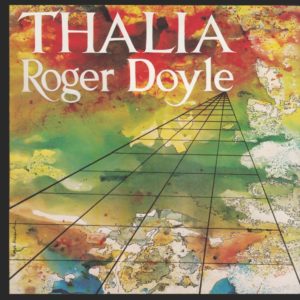
Roger DOYLE
“Thalia”
The concrète riddle of ’Thalia’ is the Nurse With Wound-listed and cultishly desired Roger Doyle album withdrawn by CBS Classics shortly after its release in 1978. Less than 200 copies reached shops some three years after his distinctive debut ‘Oizzo No’ (1975) - which was reissued by Finders Keepers Cacophonic label to receptive ears in 2018 - and in retrospect the resurfacing of ‘Thalia’ follows that wonderfully odd LP to cement Doyle’s place among the outsider pioneers of ‘70s electronic and avant-garde tape composition
Arguably one of the most important experimental records to emerge from 20th century Ireland, ‘Thalia’ is coveted for its inventive, unpredictable, near-psychedelic brilliance, yet has remained scarce due to major label politics, meaning listeners had to fork out a ton for a 2nd hand copy.
Now readily available on its intended format, the keening, breezy logic and abstract theatric dramaturgy of Doyle’s work on ‘Thalia’ has been reshuffled to highlight its apparent surreality and frolicking apparitions. Combining his studious research and prep work at Utrecht Institute of Sonology (then home to Roland Kayn, Leo Küpper, Jaap Vink) and the studios of Finnish Radio (Yleisradio) Helsinki with a finely honed improvisational intuition at his home studio in Malahide, Dublin, the record yields a poetic diffusion of electro-acoustic phantasms meshed with politicised and unsettling field recordings, alongside a mad, experimental solo piano piece.
The 3-part title track is the biggest attraction on ‘Thalia.’ Acting as a sort of shamanic extension of Gaelic bardic traditions, Doyle guides the listener through labyrinthine dimensions, vacillating tape FX with stark synth pulses, fragments of ‘Danny Boy’ and the unsettling sound of a woman wailing or even keening (a lament for the dead) in only the first minutes, the piece spirals over two sides between obtuse electronics and jump-cuts to melancholy strums, airborne melody and rabid dissonance with the natural quality of Ireland’s ever-shifting interplay of sun, rain and clouds. The relatively brief ‘Baby Grand’ follows as a sort of playful solo piano palate cleanser for the LP’s purest electronic piece ‘Solar Eyes’, which surely recalls the iridescent expanses of Roland Kayn or Jaap Vink.
24,00€
In stock
LP
Louise LANDES LEVI – Timo van LUIJK – Bart de PAEPE
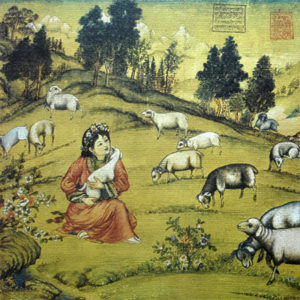
“Kami”
Like the ever changing shapeshifting nature of Kami in Japanese Shinto faith, the music on this new collaborative lp is itself a mirror reflecting, obscuring or modifying the ever changing rivers of sounds.
Louise Landes Levi has a long history in music from studying sarangi with Annapurna Devi and La Monte Young to performing with like minded poets as Ira Cohen and Simon Vinkenoog. As on the previous Ikiru lp she collaborates with Timo van Luijk (Af Ursin, Elodie, Asra, In Camera etc) and Bart De Paepe (Ilta Hämärä, Bombay Lunatic Ensemble etc). The trio weaves several delicate threads together into a surrealist, organic and overall poetic language.
Includes a postcard. Limited to 500 copies.
18,50€
In stock

LP
ELODIE
“Le nid d’ivoire”
Seven track studio album by Andrew Chalk & Timo van Luijk, recorded and mixed at Kulta Saha and Impression Lointaine, 2016-2018.
Edition of 500 copies on transparent vinyl, including reproduction of art-print and postcard.
19,00€
In stock

LP
Timo van LUIJK & Frederik CROENE
“Ipnopedion”
On the frigid moonless night of December 6th, 1978, a 26 year-old night watchman named Pier Zanfretta was on a routine patrol in the village of Torriglia, where he stumbled into a horrifying encounter with aliens from Taetonia. In order to get more clarity about what happened that night Pier Zanfretta agreed to undergo hypnosis, to let his subconscious speak about his abduction by these aliens.
As his discours under hypnosis sounded uncannily musical and mesmerizing, even without understanding the words, it became the basis of this Ipnopedion album.
For the recording of the title track ‘Ipnopedion’ (side 1) Zanfretta’s speech was played back on headphones, then phonetically reproduced by FC and TVL, lying down in darkness as being hypnotised. Apart from this transposed text only piano and a few hypnosis inducing atmospherics and spatialisations were added.
The ‘Taetonia’ track (side 2) opens with a naieve and enticing piano play slowly being beamed into a vacuum void towards Taetonia. As Zanfretta’s words were vague it remained unclear what happened in Taetonia but things certainly had changed…
Ipnopedion became a ritual invitation to withdraw from the concrete world, returning to it as uncanonical aliens from Taetonia.
Edition of 300 copies on transparent vinyl, with printed insert.
19,00€
In stock

CD
Michael RANTA
“Die Mauer”
11 track album of previously unreleased music for a ballet choreographed by Philippe Talard.
Composed, performed and recorded by Michael Ranta in 1988/1989.
CD in 6 panel fold out sleeve. Edition of 500 copies
14,00€
In stock
LP
Abul MOGARD
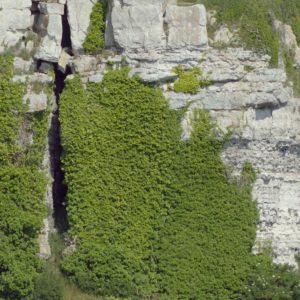
“Kimberlin (Original Soundtrack)” (clear)
Clear vinyl edition.
Visionary synthesist Abul Mogard renders a darkly sublime soundtrack for ‘Kimberlin’ , an experimental film about the Isle of Portland on the English south coast, which coincidentally doubles up as metaphor for the mood of an increasingly inward-looking UK.
Taking its name from the local word for an outsider or “foreigner”, the short film ‘Kimberlin’ was filmed on location during the months following the advisory referendum of 2016 which lead to the current, purgatory state of “Brexit”. Combining mostly wordless, lingering shots of the Isle of Portland’s bleak and rugged landscape with Abul Mogard’s washed out but richly evocative music, made with manipulated field recordings, modular synth and layered Farfisa organ, the project came to reflect a sense of (be)longing, loneliness and outsiderness that also perhaps uncannily mirrors the putative collective feeling since that darkly historic vote, over three years ago.
Taking cues from the evocative poetry of lifelong islander, stonemason and poet Cecil “Skylark” Durston (1910-1996), as well as a news report on the discovery of a mysterious cinema found interred by foliage in the Isle’s cave systems, the merging of image and sound speak to their subject in an organic, impressionistic manner that leaves billowing room for imagination.
Mogard’s soundtrack opens out with a slow-burning, greyscale iridescence, tenderly manipulating the sound of fog horns and bird calls in briny modular spray and gloaming Farfisa organ swells that, when combined with song titles such as ‘Flooding Tide’ and ‘Playing On The Stones’, serve to evocatively connote the film’s subject matter.
The results can be heard as echoes in the digital future of an England that’s now difficult to grasp, most hauntingly transposing the meaning of Cecil “Skylark” Durston’s description of the Isle of Portland as a place where “quarry bells no longer ring, except in old men’s dreams” to the ever-present, never-ending riddle of Brexit and its generationally devastating bleakness.
23,00€
In stock
LP
Abul MOGARD
“Kimberlin (Original Soundtrack)” (black)
Black vinyl.
Visionary synthesist Abul Mogard renders a darkly sublime soundtrack for ‘Kimberlin’ , an experimental film about the Isle of Portland on the English south coast, which coincidentally doubles up as metaphor for the mood of an increasingly inward-looking UK.
Taking its name from the local word for an outsider or “foreigner”, the short film ‘Kimberlin’ was filmed on location during the months following the advisory referendum of 2016 which lead to the current, purgatory state of “Brexit”. Combining mostly wordless, lingering shots of the Isle of Portland’s bleak and rugged landscape with Abul Mogard’s washed out but richly evocative music, made with manipulated field recordings, modular synth and layered Farfisa organ, the project came to reflect a sense of (be)longing, loneliness and outsiderness that also perhaps uncannily mirrors the putative collective feeling since that darkly historic vote, over three years ago.
Taking cues from the evocative poetry of lifelong islander, stonemason and poet Cecil “Skylark” Durston (1910-1996), as well as a news report on the discovery of a mysterious cinema found interred by foliage in the Isle’s cave systems, the merging of image and sound speak to their subject in an organic, impressionistic manner that leaves billowing room for imagination.
Mogard’s soundtrack opens out with a slow-burning, greyscale iridescence, tenderly manipulating the sound of fog horns and bird calls in briny modular spray and gloaming Farfisa organ swells that, when combined with song titles such as ‘Flooding Tide’ and ‘Playing On The Stones’, serve to evocatively connote the film’s subject matter.
The results can be heard as echoes in the digital future of an England that’s now difficult to grasp, most hauntingly transposing the meaning of Cecil “Skylark” Durston’s description of the Isle of Portland as a place where “quarry bells no longer ring, except in old men’s dreams” to the ever-present, never-ending riddle of Brexit and its generationally devastating bleakness.
20,50€
In stock

CD
Stéphane GARIN & Jean-Philippe GROSS
“Dénombrement”
For percussions, electronics and recorded sounds.
Recorded between 2017 and 2019 by Benjamin Maumus, Richard Comte, Nils De Deyne and Jean-Philippe Gross, “Dénombrement” regroups a series of connections between percussion and electronics. The placement of percussion in different phonographies, with an intense and sustained mix of live or pre-recorded sonic data results in a highly synchronised merging of sources. Not only does this create a complete ambiguity and a loss of frame of references in an aesthetic that approaches a study, but transcends it, by recordings of the creation of the piece itself, imbuing it with humanity and distance, humour and anecdotes.
Originally a drummer, he has played in the field of electronics, experimental and improvised music since 2001. He is curently playing with Stéphane Garin (Dénombrement), Jean-Luc Guionnet (Angle), Jérôme Noetinger, Axel Dörner, Clare Cooper (Nevers), John Hegre.
Recent works included music for theater, dance and performances, as well as compositions, Cutting Lines for the ensemble Dedalus, and Sécante for the project Phonoscopie.
From october 2001 to june 2009 he was engaged as a music program curator for Fragment (Metz, France).
Eich is a new label created by musician and composer Jean-Philippe Gross to release his collaborations and solo work.
8,00€
In stock
LP
FRANCE SAUVAGE
“L’homme à zéro”
Genre defying, post-industrial adventures from France Sauvage, a DIY trio mixing outsider art, collage and darkwave influences in their own style of “Free Rural” and “Bruit Concret” music for Paris-based label; In Paradisum
France Sauvage play their own custom-built instruments in a way that shirks showing-off and doesn’t pay heed to trend, while fully entrusting in the power of their collective instinct. ‘L’Homme À Zero’ is the band’s cyborganically diverse debut LP for In Paradisum and their first record since 2015’s ‘Jeux vocaux des bords de Dronne.’ It yields a half-true image of the band in action, using edited recordings to construct an album that demonstrates their tastes for off-kilter, hypnotic sounds and rhythms between the piercing folk rituals of ‘La folie chez les animaux’, the black metal techno grind of ‘Parle-toi de nous’, and the Ghédalia Tazartès-like avant-chanson of ‘Je suis sorti de ma maison.’
Essentially the band specialise in avant-garde music without pretension. There are no grand concepts or to fall back on or mask a lack of original music. On the contrary, ‘L’Homme À Zero’ is fizzing with effortlessly tight and playful invention and tonal contrasts. From the cyber-folk fanfare of their puckered intro, the album saddles up a trip of Jodorowskian dimensions; traversing from desert-at-night scenes in ‘Brex me down’ to passages of psycho-cinematic harps and something like trembling R&B emoted by John Duncan, and sideways, ever sideways into chunks of Pan Sonic-like gristle and disorienting field recordings that recall a 4.1 world parallel to David Toop’s General Strike.
While narrative form surely emerges from the album’s mazy structure, it was never intended as such. It’s more testament to the band’s loose yet focussed intuition and naturally sprawling, explorative tendencies that a surreal tale emerges which will have different meanings for every listener
18,00€