
In stock
LP
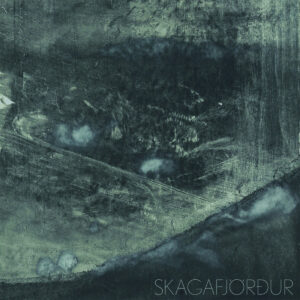
Andrew CHALK & Timo van LUIJK
“Skagafjördur”
Soundtrack to the silent film ‘Skagafjördur’ by Peter Hutton
Recorded live in Ghent, 14 April 2018 during
‘Night of the Experimental Film’ an event by Art Cinema OFFoff.
Originally released on cassette by B.A.A.D.M.
“A sea of clouds casting silent shadows on frozen time
A sky of flickering waters curling over the immense permanence Fractured light shrouded in
mist dissolving into shaded pigment The frontier of solitude melting in the winds of patient
eternity.”
12” LP in black vinyl, includes a duotone printed insert and set of three postcards.
19,00€
In stock

CD
Michael RANTA
“Taiwan Years”
Three previously unreleased works from the 1970’s recorded and mixed in Japan and Taiwan.
1-Kagaku Henka (1971) 18’40”
2-China Filch (1975) 27’06”
3-At Night (1978) 23’06”
More than any other of Ranta’s releases this album shows his multiple roots and ideas as a composer, percussionist and concrete/electronic musician, building a seamless bridge between Eastern and Western tradition and avantgarde. Ranta is one of those rare composers able to organically melt his wide artistic span into a singular but yet diverse universe, morphing his rich vocabulary as a percussionist with the Oriental esoteric tradition, the psychedelic underground and the realm of electronic minimalism.
14,00€
In stock

LP
AF URSIN
“Trois mémoires discrètes”
New edition 2022. 3 introspective instrumental (English horn, flute, percussion, double bass, Hammond organ) compositions performed, recorded and mixed by Timo van Luijk during 2010 - 2012 at Kulta Saha. In memory of Hugo Billens, Anja Hiilesmaa, Dirk de Hollander, Ger Boeske, Ourgon and Tosca.
21,00€
Out of stock
LP
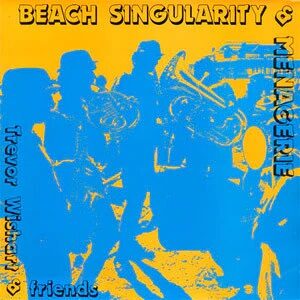
Trevor WISHART
“Beach Singularity – Menagerie”
Trevor discovered a long-forgotten box of this LP, which had never been opened. All copies are "new" but there is some age-related wear & fading to the sleeves, nothing too bad.
Beach Singularity was performed on the beaches at Morecambe, Cleveleys, St Anne's & Southport in the summer of 1977. Beach Singularity is an excerpt from a day long happening in which the composer performed with an ensemble that featured saxophonist Lyn Dobson avant-tuba player Melvyn Poore, vocalist Poppy Holden and clarinet improviser Robin Coombes. This performance was designed somewhat like a social intervention, where the musicians performed in conjunction with tape-music and electronics broadcast from small portable stereo systems scattered along the English sea-side. Menagerie began life in 1974 when Trevor Wishart asked a number of well known British performance artistis to build small assemblages for an exhibition in which each object would be accompanied by appropriate taped sounds. The exhibition, consisting of eleven assemblages, was first prepared for the Birmingham Arts Lab and presented there in January 1975. The accompanying tapes were all made at The University of York Electronic Music Studio by Trevor Wishart.
26,50€
Out of stock

CD
NURSE WITH WOUND
“Man With The Woman Face”
Originally this was only available for a short period of time before World Serpent went bust and is often thought of as a ‘lost’ NWW work.
Review from brainwashed.com : Longtime NWW fans are going to be very very very pleased with this album. Shaved down to a mere duo featuring Steven Stapleton and Colin Potter, this is almost a tribute to the more ambient and free-form early to mid-period Nurse with Wound. The original mission statement from 1978 included a provision that Steven Stapleton didn't like "songs" and the last few full-length albums ('An Awkward Pause', 'Acts of Senseless Beauty', 'Who Can I Turn To Stereo' and 'Rock 'n Roll Station') have all been heavily song-based. Clocking in at under 40 minutes, this particular journey is comprised of three pieces: the two endpieces which linger around the 15-minute mark and the 8+ minute middle piece, whose title loosely translates to "Up in the Air, Singing" in Gaelic. Musically, it's perhaps the most intimate Nurse with Wound has been, with a particular, almost personal subtlety which I haven't detected probably since 'A Missing Sense.' The album opens with a warm underscore, scatterings of organic and electronic noises twitter and scurry by, accented with quiet, mumblesome voices, bees, finger piano or marimba (I can't tell) and various other sound effects -NOT- simply recycled from previous projects. It continues with an almost arguably surprising twist of events as the "band" jumps into full-force instrumental hyper Kraut-rock mode towards the end of the second track. The music and feel of the last track almost echoes the 'Musical Pumpkin Cottage'-era work from Stapleton with Tibet. The vocals repeat the title over and over again, comfortably easing any listener into utter bliss. This album can easily become one of my most listened-to records for 2002.
Jon Whitney
11,00€
Out of stock

Book + CD
NURSE WITH WOUND
“Gyllensköld, Geijerstam And I At Rydberg’s”
Art Book CD – Silver Collection 24 page Deluxe Art Book with augmented CD album. All artworks by Babs Santini.
22,00€
Out of stock
2 CD
NURSE WITH WOUND
“The Surveillance Lounge”
Long out of print and much in demand, this classic NWW CD is now back. This time as a double CD set with a CD of unreleased alternate mixes of each track.
It’s packaged in a stunning matt digipack, with all the information in a clear gloss spot varnish. This is only visible from certain angles!
NURSE WITH WOUND playing ‘The Surveillance Lounge’ were and are Steven Stapleton, Andrew Liles, David Tibet, Nadja Belabidi, Lynn Jackson, Ollie Mathura O’Keeffe, Freek Kinkelaar, Miranda Kinkelaar, Melon Liles and Maude Swift.
18,50€
In stock

CD
Lasse MARHAUG / Jérôme NOETINGER
“Top”
When our friend and inspiration Peter Rehberg passed suddenly in July 2021, I felt like I had to do something, and what I’m good at is something Peter deeply loved, producing records. so I put together this project with some of his longtime collaborators and friends, Lasse and Jérôme, Marcus Schmickler mastering and Tina Frank designing.
it’s titled Top for multiple reasons but one is that Top was often Peter’s entire reply to a message you’d sent, both concise and supportive. a second is that it can also be read ‘To P’, we miss you buddy.
— Jon Abbey
Lasse Marhaug: MacBooks 2003/2007/2011 with SuperCollider Keränen patches
Jérôme Noetinger: Revox, modular synth, CD player
recorded Sortland/Rives September-November 2021
mastered by Marcus Schmickler
design by Tina Frank
produced by Jon Abbey
for Peter Rehberg (1968-2021)
15,00€
In stock

LP
Charlemagne PALESTINE / Simone FORTI
“Illuminations”
Alga Marghen proudly presents the first ever release of "Illuminations", or Charlemagne Palestine and Simone Forti duo interactions, illuminated with dim red lights. In early 1970 Mort Subotnick asked Charlemagne Palestine to join his soon to be created Media Department at the new 'Dream School of the Future' endowed by the Disneys to be called the California Institute of the Arts.
Charlemagne and Simone Forti met there in 1970, when La Monte Young asked them to arrange a California concert for Pandit Pran Nath. They decided to try an improvisation session together and Charlemagne invited Simone the first time to the electronic music studio where he worked regularly. Their medium blended as a play of interacting sound waves and solid matter in motion as Charlemagne and Simone shared energy and focus.
The three previously unreleased recordings on this LP were made between October and December 1971. The first take, titled 'Illumination,' is for two voices moving in the space with small bells and crystal glasses while Simone Forti plays the molimo, a corrugated tube meant for connecting the gas stove. The second take titled, 'Wed Oct 13th 1971,' has Simone and Charlemagne in a song dialogue as animals do. It was also at Cal Arts that Charlemagne Palestine first encountered a Bosendorfer Imperial Piano of Vienna. He played it often as Simone danced during their 'Illuminations'. Take three is a song sang in falsetto while playing the Bosendorfer Imperial in an arpeggiated style that predates the 'strummings'. Listening to these 'three takes' 40 years later, they ooze a timeless, carefree mystical, magical, dreamy atmosphere that evoked the times of the late 60s to early 70s in Charlemagne and Simone part of the California Art Scene. 'Illuminations' were a unique open spontaneous form of performance, ritual and prayer.
Edition limited to 365 copies with an essay by both Charlemagne Palestine and Simone Forti, as well as photos of the performances reproduced on the LP front sleeve.
20,50€
In stock

LP
Charlemagne PALESTINE / Simone FORTI
“Meditative Sound Environments”
Alga marghen presents the second and final chapter in documenting Charlemagne Palestine and Simone Forti seminal collaborations. The new "Meditative Sound Environments" LP is more centered around electronic music and also includes a unique two-voice work based on Simone's chanting, the magically suspended "Simone Tape". All the tracks of this new LP present only previously unreleased recordings.
Charlemagne Palestine met Simone Forti through Dr. Richard Alpert, a professor at Columbia University who went to India to study with a Hindu guru and he himself became a guru afterwards called Baba Ram Dass. Coming back to US he brought Pandit Pran Nath with him. It was a time when everybody was experimenting. All came with a lot of orientalism because people were into timelessness, meditation and being stoned. It was in that atmosphere that Charlemagne met Simone because she also knew Pran Nath. Around that time Palestine moved from NY to California to work with electronic music at the newly invented school California Institute of the Arts. Simone was also living in LA and even though she was not officially connected to CalArts she knew many of the artists who were teaching there.
In summer 1970 Simone Forti was invited by Allan Kaprow (one of the Deans of CalArts) to do an evening of dance at the Pasadena Art Museum and for this performance she asked Charlemagne Palestine to try developing a new kind of work together. It immediately clicked!!!! In January 1971 in Pasadena they did their first "Illuminationss". All of a sudden they were doing a new kind of jamming together. Everybody in the audience loved it because it was so dreamy and they found amazing how a man and a woman can act in that strange, very dreamlike oriental way as in trance,,,,,together. This kind of collaboration between man and woman was uncommon at that time. Mostly other artists were doing very structural works while with "Illuminations" it was totally like they were on magicness drugs.
These performances had certain fixed elements... the piano or some electronics like in "Meditative Sound Environment", the title track of this LP. It turned out they liked red lights so they started to always do it in red light. Also they liked to do it in a resonant spaces. It became more an approach than a piece, because there were never two "Illuminations" that were alike.
The aspect of Charlemagne's music that most inspired Simone Forti's imagination was his melodies. Sometimes their texture of repetitions and evolving variations were so close that the term melody doesn't seem to apply. What most determined the "Illuminations" was Charlemagne's way of letting the elements in the music develop only very gradually.
As Simone Forti recalls: "Once, just before a performance, Charlemagne sang 'Simoney don't worry, you will dance and sing all right.' And of course i did as we walked arm in arm circling the wide-open space, a grand piano to one side shining black and covered with Teddy Bear deities, Charlemagne reflecting his childhood time as devotional cantor, and me, my childhood time striding along in the Tuscan hills, belting out Italian folksongs with her cousins". The recurring melodies were mostly Charlemagne's. But Simone Forti brought one too, with a beautiful song about not drifting away into the beyond that you can hear as the last track on this LP.
Edition limited to 365 copies with liner notes by Charlemagne Palestine and Simone Forti.
20,50€
In stock

CD
SMALL CRUEL PARTY
“Cervorum Simulacra”
"Cervorum simulacra" was originally released as a lathe-cut LP limited to 30 copies ; "Pour Eric S-W" has never been released.
Cervorum Simulacra (live à Qui Plume La Lune, Paris, 11.iv.08)
Pour Eric S.-W. (live, Radio KSER, Everett, Washington, 15.iv.92)
11,50€
In stock

CD
TARAB
“Rooms”
Between 2019 and 2021 I presented three installations. Seeking to move away from sharing borrowed representations of things, spaces and actions in the form of recordings, to instead shape spaces or situations with sounds and rooms, things and an audience. If we understand space not as physical, but as shaped through use, it raises the somewhat rhetorical or even quixotic question: can a space be shaped by sound? Can one space be shaped inside another?
However, ROOMS is not intended to act as a straight document of these installations, despite drawing heavily upon them. Rather, it has been made to explore some of the ideas and methods which emerged from the process, within the space formed by a pair of stereo speakers situated in yet another room. It is not intended as a re-presentation of those assembled spaces, but works towards being its own listening space within the rooms and ears of a listener.
Recorded audio material is explored as a shifting series of perceivable surfaces, textures and depths; traces of places and actions; points in space; vibration of speaker cone and microphone diaphragm; resonant objects acting as small sounding containers within larger containers; movements of air; a constant shifting set of perspectives; the traces that are left behind; debris gathered up and pawed over. Recorded sound is gathered and understood as partial, fragmentary, incomplete.
While ROOMS is a construction, it is presented not quite as an abstraction nor as a re-presentation, but as a form of both-ness or an inbetween-ness; somehow inside-out and outside-in. An interaction or assemblage of shifting, sounding elements and things. (Eamon Sprod)
11,50€
Out of stock
CD
Artur ZMIJEWSKI
“Singing Lesson”
First published as a Vinyl-LP in 2011 (Tochnit Aleph TA099) this extraordinary work by Polish conceptual artist Artur Żmijewski is finally available again!
"In 2001 ARTUR ŻMIJEWSKI created the first part of the project "SINGING LESSON" in the Augsburg Evangelical Holy Trinity church in Warsaw. Accompanied by an organ a choir of 'deaf-mute' children sang the "Kyrie" from the "Polish Mass" by Jan Maklakiewicz (1899-1954). Among the cacophony of sounds uttered by them you can hear the words of the confession of faith: "In this holy place, in this holiest place, our voice rises to you and erupts as the sea roars from the deep abyss. O Christ, hear us! O Christ, listen to us!". The second part of the project ("Deaf Bach") was realized in 2002 in St. Thomas Church in Leipzig, in which Johann Sebastian Bach for many years was a cantor and where he was buried. 'Deaf-mute' or severely hearing-impaired children sang Bach's cantata "Herz und Mund und Tat und Leben" (Heart and Lips and Deed and Life)." (from the liner-notes)
"Along with admiration for the efforts of the deaf we feel an uneasiness caused by our deeply hidden aversion towards that which – like cripplehood – was removed from our consciousness: fear of ourselves, which is an inner mold of repulsion projected onto outside phenomena. Żmijewski's works convince us that neither suffering nor different kinds of physical dysfunction or social norms are able to kill the joy of life. The children singing Bach every so often snort with laughter as if they were trying to accustom themselves to the situation in which they found themselves, thus making it "normal". They whoop it up, forgetting the fact that the lesson in which they participate is beyond the social role ascribed to them, that it is an anomaly, a freaky idea. It is also a musical hybrid, a mix of the sounds uttered by the deaf children and the voice of a professional singer, a negation of all the rules, a mixture of the evenly-tempered baroque system and elements of modal and atonal music." (Violetta Sajkiewicz)
Polish artist Artur Żmijewski (born 1966 in Warsaw) is one of the most consistently challenging, provocative and profoundly thoughtful artists working today. He is an author of short video movies and photography exhibitions, which were shown all over the world. Żmijewski does not shy away from putting the generally accepted rules of Political Correctness into question. His works on the mentally and physically handicapped has drawn significant public attention. He appears to be an artist always in constant search of the next modality of artistic expression, ever striving to amplify the impact of his art on its subjects, enlarging its territory beyond its conventional borders. During the 1990s, Żmijewski was a leading force in the realm of critical art, his point of departure being the problems of body and The Other. In 2005 he represented Poland at the 51st Venice Biennale. He exhibited at Documenta 12 (2007), Manifesta 4 (2002), Wattis Institute for Contemporary Art, San Francisco (2005), Kunsthalle, Basel (2005), National Gallery of Art Zacheta, Warsaw (2005), Kunstwerke, Berlin (2004), Museum of Modern Art, New York (2009), Cornerhouse, Manchester (2009) and many more. He was the curator of the Berlin Biennale 2012.
CD in 8-panel digipak. Edition of 300 copies.
14,00€
Out of stock
2 LP + 7"
INCAPACITANTS
“As Loud As Possible”
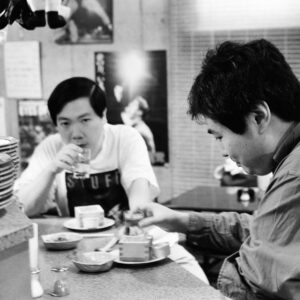
The mid-90s were particularly abundant years for harsh noise, producing many albums which are now considered masterpieces. One of the most beloved classics from this period is "As Loud As Possible" by Incapacitants. Active since 1981, the duo of Toshiji Mikawa and Fumio Kosakai found their stride in the early 90s and set off on an unrelenting course which produced countless gems of noise. Many of these have been well preserved and documented elsewhere, compiled on "Box Is Stupid" and "Alchemy Box Is Stupid", however, "As Loud As Possible" has never been reissued since its original release on Zabriskie Point. It is now made available for the first time since 1995, with no corner cut in preparation of its reissue. The audio was transferred from the original tapes by Din-I-Ilahi, and re-mastered for digital and vinyl formats by Rashad Becker. The iconic cover photographs by Naomi Hosokawa have been scanned from the original negatives and enlarged for the expanded format, along with outtakes and unused shots, which are now included here for the first time. T. Mikawa also dug into the Incapacitants archives and unearthed two additional tracks of previously unreleased material, recorded around the same time as the album. These two tracks, entitled "As Loud As Possible Revisited" are included as a bonus 7" with alternate picture sleeve. Features extensive liner notes written by Sam McKinlay aka The Rita. A personal all-time favourite, it is an honour to present "As Loud As Possible" as a double LP in deluxe gatefold sleeve. Includes digital download.
Incapacitants are T. Mikawa & F. Kosakai:
All electronics, voice
Edited by T. Mikawa
Photographs taken by Naomi Hosokawa at Factory Pub Bon-Ba-Ye
(Special thanks to Mr. Ohba)
Originally released by Zabriskie Point, 1995
Transferred from original master tape by Din-I-Ilahi
Remastered by Rashad Becker
31,00€
In stock

7" single
NURSE WITH WOUND
“Shipwreck’n’Roll”
The 2 tracks on this record have been constructed from flotsam, jetsam & driftwood gathered in the Lofoten Islands by Steven Stapleton & Colin Potter in 2004 & reassembled at IC Studio, London 2021. The single is a prelude to the vinyl release of ‘Shipwreck Radio Volume 1/Lofoten Deadhead’, but getting vinyl manufactured is difficult & slow (the single itself was many months late), so we're not sure when the boxset will be available....
16,00€
In stock
LP
Antoine CHESSEX – Francisco MEIRINO – Jérôme NOETINGER
“Maiandros”
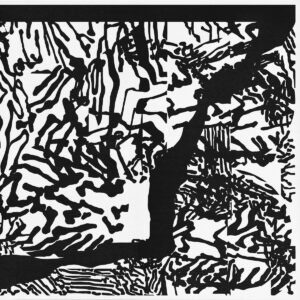
Testimony to the first encounter of the trio during a concert given at the cave12 on the 28.10.2020, on the same evening of the new Covid announcements which brought on a re-confinement in France, and eve to a six-month long shutdown of cultural places in Switzerland. A concert from which we emerged staggering and with burning ears due to the ongoing crisis surrounding us. A masterful sonic performance. Before silence.
Drawing from the dense and intense sound material of the evening, Francisco Meirino carried out a work of mixing and cutting, thus releasing an account of it, conceived for vinyl support and domestic use, an auditory result with a fascinating tension/frame.
Swirling field recordings, urban/mechanical sounds, ghostly radio, cannibal revoxian magnetic tape, unrecognizable saxophone chants from hell, synthesizer manipulations, intermingle and merge into a sonic flow of pure permanent tension. An uncompromising and hallucinating sound journey of the very first order. A captivating back-and-forth, rich and spiralling between different levels of listening, filled with recognizable or unrecognizable sound materials and disturbing textures à la perfectly mastered dynamics, on a knife edge of abyss & time. And with, on the album, a simply gargantuan, corrosive, and overwhelming B-side!
Antoine Chessex: Tenor saxophone, amplifier, electronics
Francisco Meirino: Modular synthesizer, contact microphone and transducer
Jérôme Noetinger: Revox B77, electronics
19,00€
In stock

LP
ENSEMBLE NIST-NAH
“Elders”
Elders is the debut release from Ensemble Nist-Nah, a nine-piece percussion group led by Nantes-based Australian drummer and percussionist Will Guthrie. The diverse group of French musicians that make up Ensemble Nist-Nah – whose collective experience encompasses traditional Gamelan performance, contemporary composition, noise, jazz, and everything in between – perform on drum kits, traditional and junk percussion, and a complete set of Javanese Gamelan instruments. Though building on the foundations of Guthrie’s solo work with Gamelan instruments (Nist-Nah, BT057) and primarily performing his compositions, Ensemble Nist-Nah is a collective endeavour, propelled by a breathtaking enthusiasm that has seen the ensemble manage to rehearse, perform, and even tour Europe during the Covid-19 pandemic.
From the first seconds of opening track ‘Geni / Tirta’, it becomes immediately obvious that this is no dry academic exercise or exotic indulgence. Rapid arpeggiated figures are propelled by manically busy kit drumming while slow-motion melodic lines float above. After a series of abrupt tempo changes and fragmented unison passages that crossbreed the rhythmic intensity of the Balinese Kecak with the joyride of an Ornette Coleman head, the music slows to a monumental groove, equal parts Javanese court music and Dark Magus. Another sequence of thrilling divagations leads us to the unexpected guest appearance of acclaimed vocalist Jessica Kenney, who elaborates a haunting Javanese Bedhaya across a spacious backdrop of massive gong hits, shimmering cymbals, rustling bells, and gritty textures.
The remaining pieces that make up Elders explore a dizzying variety of approaches, from the shifting rapid-fire muted textures of ‘Overtime’ to the ghostly bowed tones and ominous swells of the title piece (developed from a track on Guthrie’s solo Nist-Nah release), which gradually builds into waves of shuddering low resonance and asynchronous percussive clicks like a haunted clock mechanism. On the aptly titled ‘Rollin’, virtuosic twin drum kits criss-cross errant metallophone patterns in propulsive polyrhythms, while ‘Planeker’ manages to achieve a bizarrely effective fusion of Harry Partch and Autechre. Arriving bedecked in beautiful monochrome images of gongs drawn by ensemble member Charles Dubois, Elders is a feast for the ears: music that burrows deep into timbral and rhythmic possibility while possessing an intoxicating physicality and revelling in the joy of collective performance.
Ensemble Nist-Nah is:
Prune Bécheau, Charles Dubois, Thibault Florent, Will Guthrie, Amélie Grould, Mark Lockett, Sven Michel, Lucas Pizzini, Arno Tukiman
Playing Gamelan Kyai Bremånå
Special Guests:
Jessika Kenney
Toma Gouband
Annalee-Rose Guthrie
25,00€
Out of stock
CD
ENSEMBLE NIST-NAH
“Elders”
Elders is the debut release from Ensemble Nist-Nah, a nine-piece percussion group led by Nantes-based Australian drummer and percussionist Will Guthrie. The diverse group of French musicians that make up Ensemble Nist-Nah – whose collective experience encompasses traditional Gamelan performance, contemporary composition, noise, jazz, and everything in between – perform on drum kits, traditional and junk percussion, and a complete set of Javanese Gamelan instruments. Though building on the foundations of Guthrie’s solo work with Gamelan instruments (Nist-Nah, BT057) and primarily performing his compositions, Ensemble Nist-Nah is a collective endeavour, propelled by a breathtaking enthusiasm that has seen the ensemble manage to rehearse, perform, and even tour Europe during the Covid-19 pandemic.
From the first seconds of opening track ‘Geni / Tirta’, it becomes immediately obvious that this is no dry academic exercise or exotic indulgence. Rapid arpeggiated figures are propelled by manically busy kit drumming while slow-motion melodic lines float above. After a series of abrupt tempo changes and fragmented unison passages that crossbreed the rhythmic intensity of the Balinese Kecak with the joyride of an Ornette Coleman head, the music slows to a monumental groove, equal parts Javanese court music and Dark Magus. Another sequence of thrilling divagations leads us to the unexpected guest appearance of acclaimed vocalist Jessica Kenney, who elaborates a haunting Javanese Bedhaya across a spacious backdrop of massive gong hits, shimmering cymbals, rustling bells, and gritty textures.
The remaining pieces that make up Elders explore a dizzying variety of approaches, from the shifting rapid-fire muted textures of ‘Overtime’ to the ghostly bowed tones and ominous swells of the title piece (developed from a track on Guthrie’s solo Nist-Nah release), which gradually builds into waves of shuddering low resonance and asynchronous percussive clicks like a haunted clock mechanism. On the aptly titled ‘Rollin’, virtuosic twin drum kits criss-cross errant metallophone patterns in propulsive polyrhythms, while ‘Planeker’ manages to achieve a bizarrely effective fusion of Harry Partch and Autechre. Arriving bedecked in beautiful monochrome images of gongs drawn by ensemble member Charles Dubois, Elders is a feast for the ears: music that burrows deep into timbral and rhythmic possibility while possessing an intoxicating physicality and revelling in the joy of collective performance.
Ensemble Nist-Nah is:
Prune Bécheau, Charles Dubois, Thibault Florent, Will Guthrie, Amélie Grould, Mark Lockett, Sven Michel, Lucas Pizzini, Arno Tukiman
Playing Gamelan Kyai Bremånå
Special Guests:
Jessika Kenney
Toma Gouband
Annalee-Rose Guthrie
15,00€
In stock

LP
Oren AMBARCHI
“Sagittarian Domain”
10th anniversary reissue of this rhythmically churning one-man-band monster of an album, recorded in a single inspired studio session & originally released in 2012 on Editions Mego.
From the original Editions Mego press release:
“For anyone who still associates Oren Ambarchi exclusively with the clipped, bass-heavy tones of solo electric guitar works such as Suspension, this rhythmically churning one-man-band monster of an album-length piece might seem to come out of nowhere. However, listeners who have followed the breadth of his work for the last few years (solo and in projects with collaborators from Jim O’Rourke to Stephen O’Malley and Keith Rowe to Keiji Haino) will have noted how Ambarchi has allowed increasingly clear traces of his enthusiasms as a music listener (for classic rock, minimal techno and 70’s fusion, among other areas) to surface in his performances and recordings, all the time filtering them through his signature long-form structures and psychoacoustic sonics.
Recorded in a single inspired studio session, Sagittarian Domain displaces Ambarchi’s trademark guitar sound from the centre of the mix, its presence felt only as an occasional ghostly reverberated shimmer. Endlessly pulsating guitar and bass lines sit alongside electronic percussion and thundering motorik drumming (familiar from his work with Keiji Haino) at the core of the piece, locking into a voodoo groove like Faust covering a 70’s cop show theme. The work is founded on hypnotic almost-repetition, the accents of the drum hits and interlocking bass and guitar lines shifting almost imperceptibly back and forwards over the beat as they undergo gradual transformations of timbre. Cut-up and phase-shifted strings enter around the half-way mark like an abstracted memory of the eastern-tinged fusion of the Mahavishnu Orchestra’s classic Visions of the Emerald Beyond, before returning for an extended, stark yet affecting come-down coda, equal parts Gavin Bryars and Purple Rain.
While Sagittarian Domain contains traces of a diversity of influences, it mines all of them to uncover something that is clearly an extension of Ambarchi’s own investigations up to this point, exhibiting the same care for micro-detail and surrender to the physicality of sound that are present in all of his work, extending them in new ways to repetition, pulse and rhythm”.
25,00€
Out of stock
CD
Oren AMBARCHI
“Sagittarian Domain”
10th anniversary reissue of this rhythmically churning one-man-band monster of an album, recorded in a single inspired studio session & originally released in 2012 on Editions Mego.
From the original Editions Mego press release:
“For anyone who still associates Oren Ambarchi exclusively with the clipped, bass-heavy tones of solo electric guitar works such as Suspension, this rhythmically churning one-man-band monster of an album-length piece might seem to come out of nowhere. However, listeners who have followed the breadth of his work for the last few years (solo and in projects with collaborators from Jim O’Rourke to Stephen O’Malley and Keith Rowe to Keiji Haino) will have noted how Ambarchi has allowed increasingly clear traces of his enthusiasms as a music listener (for classic rock, minimal techno and 70’s fusion, among other areas) to surface in his performances and recordings, all the time filtering them through his signature long-form structures and psychoacoustic sonics.
Recorded in a single inspired studio session, Sagittarian Domain displaces Ambarchi’s trademark guitar sound from the centre of the mix, its presence felt only as an occasional ghostly reverberated shimmer. Endlessly pulsating guitar and bass lines sit alongside electronic percussion and thundering motorik drumming (familiar from his work with Keiji Haino) at the core of the piece, locking into a voodoo groove like Faust covering a 70’s cop show theme. The work is founded on hypnotic almost-repetition, the accents of the drum hits and interlocking bass and guitar lines shifting almost imperceptibly back and forwards over the beat as they undergo gradual transformations of timbre. Cut-up and phase-shifted strings enter around the half-way mark like an abstracted memory of the eastern-tinged fusion of the Mahavishnu Orchestra’s classic Visions of the Emerald Beyond, before returning for an extended, stark yet affecting come-down coda, equal parts Gavin Bryars and Purple Rain.
While Sagittarian Domain contains traces of a diversity of influences, it mines all of them to uncover something that is clearly an extension of Ambarchi’s own investigations up to this point, exhibiting the same care for micro-detail and surrender to the physicality of sound that are present in all of his work, extending them in new ways to repetition, pulse and rhythm”.
15,00€
Out of stock
3 CD box
NURSE WITH WOUND
“Soliloquy For Lilith”
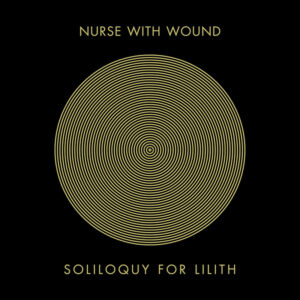
The NWW classic 3CD set is back in stock. For those of you that missed out on the green foil version, it’s now repressed with “iridescent” foil on the front and spine. It changes colour as the light catches it. 500 copies of this new edition
Originally a limited-edition three-album set housed in a handsome 12-inch gold and black foil embossed box, this new edition, a CD facsimile of the original vinyl set, contains the entire album plus 40 minutes of superb quality, previously unreleased music from the original sessions.
23,00€
In stock
LP
Colin POTTER
“A Long Time”
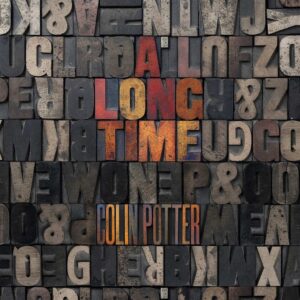
Released by the wonderful Polytechnic Youth, this is a selection of tracks made in the 80s for the two 'Recent History' ICR cassettes, which escaped in 1989. First time on vinyl (except for 'The State') with a wonderful cover by Jonathan Coleclough.
Rough Trade Review : This release is a collection of first-time-on-vinyl tracks from the 1989 cassette only releases Recent History Vols. I and II on ICR. 8 fantastic experimental, synth pieces recorded at his then home of Tollerton nr. York at various points between 1982 and 1989 and remastered by Colin in 2020. He says of this collection: “Over 30 years does seem like a long time, but in terms of how I worked then and how I work now, it seems even longer. The way these tracks were made feels like another world. Yet I’m still very connected to them and when I remastered them I was taken back to when I was exploring new equipment and ways of working. Primitive sampling and looping had arrived, to use alongside older analogue machines, guitars and early digital synths and effects processors. Happy daze……”
18,00€
In stock

LP + CD
LE UN
“Le Havre”
Large ensemble improvisation has a history and already many historical references such as Globe Unity Orchestra, King Übü Örchestrü, The Celestrial Communication Orchestra, London Improvisers Orchestra... or more recent ones like Splitter Orchester, Insub Meta Orchestra, GGRIL, ONCEIM...
How to combine energy, individuality, unexpectedness... with 26 people?
How to develop different improvisation strategies without falling into the obvious drone?
How can you simply improvise freely with 26 people?
Le UN (new version) was initiated by David Chiesa in 2019.
Le UN acts as an improvisation society: each member is involved in the artistic realisation as much as in the social, non-hierarchical organisation of the ensemble.
The individual and their practice - and not its dilution in the collective - are at the centre of this orchestral experimentation. Importantly, each individual preserves their singularity within a protean mass without obstructing the collective space.
This LP (+ CD) was recorded during a three-day residency at Le Volcan, Scène Nationale du Havre, in April 2021.
This recording is a manifestation of a collective practice of free improvisation beyond genres, a music full of effervescence and turbulence, where the acoustic and electric sources attempt the wager of spontaneous collective fabrication without any direction, irradiated by strong flickering light, with a flight of incongruous actions!
Sophie AGNEL, piano
Pascal BATTUS, rotating surfaces
Claire BERGERAULT, voice and accordion
Benjamin BONDONNEAU, clarinet
Christophe CARDOEN, lighting apparatus
Patrick CHARBONNIER, trombone
David CHIESA, double bass
Michel DONEDA, soprano saxophone
Camille EMAILLE, percussion
Nina GARCIA, electric guitar
Amanda GARDONE, double bass
Bertrand GAUGUET, alto saxophone
Anouck GENTHON, violin
Rozemarie HEGGEN, double bass
Benoit KILIAN, percussion
Soizic LEBRAT, cello
Lionel MARCHETTI, electronics
Michel MATHIEU, actions
Natacha MUSLERA, voice
Jérôme NOETINGER, electronics
Jean-Luc PETIT, contrabass clarinet, sopranino saxophone
Christian PRUVOST, trumpet
Aude ROMARY, cello
Mathieu WERCHOWSKI, violin and viola
20,00€
In stock
LP
Guilhem LACROUX
“Libellule Ebouli”
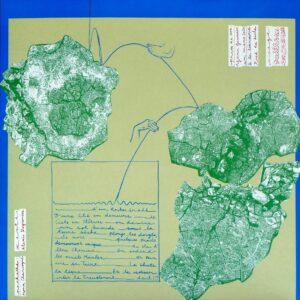
LP, 300 copies. 45rpm and 33rpm. Offset printed cover with two Pantones, offset printed, blank labels.
Released March 2022 in coproduction with la Novià and Mental Groove.
Normal speed runs in 45rpm and enables the listener to access a time suspending version while on 33rpm mode.
Interview between Guilhem Lacroux and Alexis Degrenier where they exchange on their latest albums.
Recorded by Yann Gourdon on the 13th of March 2020 in Haute-Loire.
Mixed and mastered by Guilhem Lacroux
Cut by Daniel Krieger
Cover artwork by Mona Chancogne
Texte pochette par Alexis Degrenier
17,50€
Out of stock
LP
SOCIÉTÉ ÉTRANGE
“Chance”
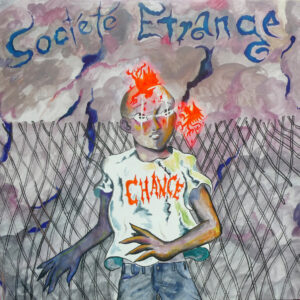
Chance, is the second album of Société Étrange,composed of 6 love songs without words, with equivocal rhythms, glaucous turquoise bass and melodies affectionately tinged with melancholy.The album was recorded in July 2020 in Vaulx-en-Velin from a collection of materials and collective drift. Composed in studio, it is by the live that is shaped their pieces, several years to test them together so that these three musicians let us glimpse a possible civilization. Not fantasies that cannot be apprehended, but a future that we can hope to desire. Their hypnotic compositions, drunk with dub, iron harmonics and polymetric measures, play a music that is a bit shady, one of those that provoke the space for the dance to happen, without anesthesia.
Mixing : D'Incise
Mastering : Ernest Bergez
Illustrations : Gaia Vincensini
Artwork : Félicité Landrivon
17,50€
Out of stock
LP
FRANCE
“Do Den Haag Church”
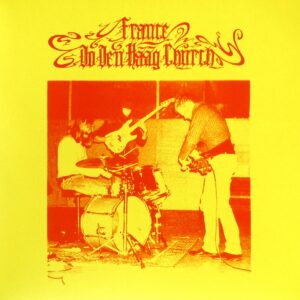
LP, 500 copies. 180g vinyl, offset printed uncoated cover with Pantone 803U and 2028U,
paste-on stamped credit-etiquette and offset printed labels.
Released November 2021 in coproduction with Stoned To Death and Mental Groove
An eastern-europe special-run of the band's natural reverb drenched classic.
Recorded back in 2008 in minus zero temperatures and hosted by none other than mighty-maryjane-huffing John Bangma.
Mental Groove and Standard In-Fi are very glad to add Czech based label Stoned To Death to the DDHC adventure.
This edition is the occasion to visualy revisit the original Cdr aesthetic and enhancing the title's typography.
Recorded on H2 by who-ever on the 15th of December 2008 in Den Haag
24,50€
Out of stock
LP
FRANCE
“Meltdown Of Planet Earth”
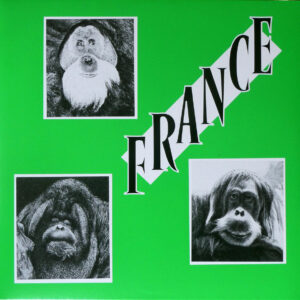
LP, 500 copies. Offset printed coated cover with Pantone 2271C, offset printed insert and offset printed labels.
Released November 2021 in coproduction with Desastre records.
Live in Paris, 12th of June 2014... top-notch re-issue of this classic slice.
Recorded on H2 by who-ever
Mixed and mastered by Vincent Mare
Cover artwork by Sauvage, cover typography by Lionel Catelan, insert artwork by Donnie K.
24,50€
In stock

LP
Rudolf EB.ER & Will GUTHRIE
“Hilt”
Based in Osaka and Nantes respectively, Rudolf Eb.er and Will Guthrie have both forged unique and quite different paths in numerous disciplines of experimental music over the past decades and created extensive bodies of work, both as soloists and in collaboration with other artists from around the world.
Austrian-born Eb.er (aka Runzelstirn & Gurgelstøck) might be best known as the initiator and head of the Swiss artist collective Schimpfluch-Gruppe, which has constantly been pushing the boundaries of extreme music and performance art since its foundation in 1987. Among his many audio releases, »Hilt« is his third work for Fragment Factory, following »Nigredo« (as Schimpfluch-Gruppe, 2013) and »Wellenfeld« (with Joke Lanz, GX Jupitter-Larsen and Mike Dando, 2014).
Australian-born Guthrie, on the other hand, has become synonym for breaking new grounds in drumming and percussion, delivering the missing link between radical and forward-thinking jazz, traditional musics and experimental/improvised electronic music. Rather recent collaborators include the likes of Jean-Luc Guionnet (note: »Stones, Air, Axioms / Delme« w/ Thomas Tilly, Fragment Factory, 2015), Mark Fell and Oren Ambarchi.
»Hilt« is the first collaboration of two artists who, based on their previous musical work, seem very different at first glance. However, it quickly becomes apparent, that the distinct approaches to composition and sound complement each other perfectly and make this album a very special and exciting affair. The closer you listen, the more you will be drawn into it and realize that the rhythmic drumming, the careful arrangements of hiss, crackle and eerie muttering paired with fragmented bits of percussive noises make »Hilt« a very coherent whole. A very organic and ritual-like album I would say, captivating and a little daunting at the same time.
Fragment Factory is thrilled to present »Hilt« in its final revelation, pressed in an edition of 300 copies on black vinyl with smashing artwork by Alice Kemp, long-time friend and co-conspirator of the label and Herrn Eb.er.
Drums, Percussion, Microphones – Will Guthrie
Electro-Acoustics, Artwork, Layout, Microphone – Rudolf Eb.er
Dolls, Photography – Alice Kemp
19,50€
In stock
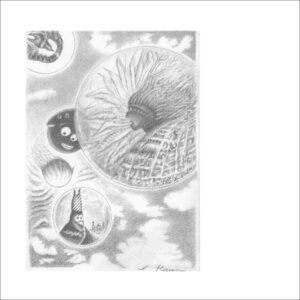
LP
BJ NILSEN – Judith HAMANN – Sigtryggur Berg SIGMARSSON
“Heiligenstadt”
BJ Nilsen is a Swedish composer and sound artist based in Amsterdam. His work primarily focuses on the sounds of nature and how they affect humans. Recent work has explored the urban acoustic realm and industrial geography and mining in the Arctic region of Norway and Russia. His original scores and soundtracks have featured in theatre, dance performances and film.
Judith Hamann is a cellist and performer/composer from Melbourne, Australia, now based in Berlin. Her performance practice stretches across various genres encompassing elements of improvised, contemporary classical, experimental, and popular music. She has studied contemporary classical repertoire with renowned cellists including Charles Curtis and Séverine Ballon, and developed a strong practice in improvisation and sonic arts through collaborative projects both in Australia and internationally.
Sigtryggur Berg Sigmarsson is an Icelandic musician, painter, sound- and performance artist and founding member of Stilluppsteypa. He studied sound art in Hannover, Germany from 1998 to 2003, where he is currently living. His musical output has been variously described as collage, quiet drone manipulations, and calm and minimal, which offers a range of still, contemplative momants, contrasted with more discordant (though not necessarily noisy) ones.
Heiligenstadt is the documentation of an encounter of the three artists in 2018.
19,50€
In stock

CD
ILLUSION OF SAFETY
“New Rules, Same Game, Less Instruction”
Chicago's post ambient industrial legend is back with a work that combines electronic sounds and field recordings: microscopic audio events, loops, heavily processed material of all kinds form seven multi-layered collages that seem to be full of electro-magnetic static, morphing and transforming like a hallucinogenic object in every second and in all possible directions... in all it's subtleness this is far away from the shock treatment noises of the early IOS times.
'New Rules, Same Game, Less Instruction' is the first release of new IOS compositions since 'Surrender' in 2015.
Featuring extensive synthesizer source material as well as other now familiar electro-acoustic techniques it is conceived as a follow up to the 1995 3” CD release of 'Rules Of The Game', alluding to the social, political, and psychological games humans engage in for validation, survival, or dominance. New Rules, same game, less instruction, harsher penalty.
Illusion Of Safety now more than ever.
Mastering: Thomas Dimuzio / Artwork: Dan Burke
13,50€
In stock

CD
DDAA
“Objet: when a cap is raising”
Jean-Luc André, Sylvie Martineau-Fee and Jean-Philippe Fee started DDAA (Deficit Des Annees Anterieures) in 1977. They are pioneers of the French experimental and indie scene, also connected with Industrial 80s music and audiovisual projects. Approaching music in a completely unique way, and brilliantly produced by their own Illusion Production label (with more 40 published items), DDAA was and is undoubtedly one of the most legendary groups of the French underground for the past 30 years. Their early albums are classics - the self-titled debut, Action and Japanese Demonstration or Les Ambulants (re-issued and still available on Klanggalerie) are a must-have for every connoisseur of usual music. They appeared on the compilation album of music by outsider artist Adolf Wölfli alongside Nurse With Wound and Graeme Revell of SPK. The 10" album When A Cap Is Raising came out originally in 1988 on UK label Big Noise in Archgate. For this re-issue, the band has remastered the music and added bonus tracks from the compilation album Objet, and other sources, some previously unavailable.
12,50€
In stock

CD
GEINS’T NAÏT
“L’Or’n’Cät”
Geins't Naït was founded in Nancy, France, in 1986 by Thierry Merigout and Vincent Hachet, both students at the Architecture School of Nancy. A year later Laurent Petitgrand joined the band. Their sound is often described as an equivalent of bands like Einstürzende Neubauten, Coil or Test Dept., but Geins't Naït is not pure classic Industrial. While Geins't Naït offers rough pieces of music as an extension of its punk attitude, Petitgand refines them to create some musicality within the post-industrial collages, adding guitars, piano, and classical instruments. Geins't Naït and Laurent Petitgand sharpen sounds, giving them a kind of balance and density and ensuring that the musical language evokes a deep experience. Their music is raw and fascinating, and largely influenced by Surrealists and Situationists. Their early albums were released by French label Permis De Construire, with L'Or'n Cat being the second, released in 1987. It features ten tracks which have been carefully remastered for this first ever CD re-issue by Martin Bowes.
12,50€