
Out of stock

DVD
Conor Mc GRADY / NURSE WITH WOUND
“Entering the Forbidden Zone”
An edition of 300 copies. 20 page colour zine. Fully recycled paper. Covers 250gm Shiro Echo paper. Photo pages on 160 Shiro echo paper. Uncoated and saddle stitched.
“Entering the Forbidden Zone” is a film by Conor McGrady, edited by John Buckley, with the soundtrack, “The Dream of Reason Brings Forth Monsters” by Nurse With Wound. The film was originally developed as a video projection for Nurse With Wound performances scheduled for Russia and for the Shepherds Bush Empire, London, but which were not able to take place due to the onset of the pandemic in 2020. The duration of the film corresponds with the duration of the planned performances. Imagery is taken from Conor McGrady’s artworks probing aspects of power or control. These often stark images have been combined with film footage to create a loose narrative journey into the dark, violent underbelly of contemporary society, generating a sense of unease or disquiet. Conor McGrady is an artist who has exhibited in New York, Chicago, Atlanta and Zagreb, Croatia. In 2022 his first solo museum exhibition “Entering the Control Zone” took place at the Museum of Fine Art, Split, Croatia. “Entering the Forbidden Zone” was premiered in conjunction with this exhibition.
29,00€
Out of stock

6 CD, DVD, box
REYNOLS
“Minecxio Emanations 1993-2018”
Pica Disk is extremely proud to present "Minecxio Emanations 1993-2018" - a box-set dedicated to the cult Argentinian band Reynols that features 52 audio tracks (mostly previously unreleased), 90 minutes of video and extensive liner notes and visuals.
Reynols started in 1993 in Buenos Aires and is famous amongst many things for its unique Down’s syndrome drummer/vocalist Miguel Tomasín, who is the band's spiritual architect. Reynols is also known its musical diversity, which spans everything from cosmic free rock and lo-fi drone electronic music, to conceptual sound art and social/political/esoteric observations. The world of Reynols is a universe completely of its own, and inhabits so much that even an extensive box like this only scratches the surface. Although Reynols have worked with an open-process DIY philosophy and been subject to multiple documentaries the band has still managed to sustain an element of mystery, so the release of "Minecxio Emanations 1993-2018" marks the first time the band has allowed an extensive overview of their work to be made. Fans of the band will also be happy to learn that most of the material is previously unreleased, including two albums from the early 2000s that were completed but never released; the earliest recordings from 1993; collaborations with artists Acid Mother's Temple and Pauline Olivers; conceptual pieces; and more. There's also a DVD with 90 minutes of videos. This box-set shows the full range of Reynols, and has been six years in the making and is the most extensive box-set project by Pica Disk.
Reynols is Miguel Tomasín, Roberto Conlazo and Anla Courtis
Details:
Booklet 1: The story of Reynols
A 3000 word new piece by Marc Masters which covers the history, culled from new interviews with Anla Courtis, Roberto Conlazo and Miguel Tomasín. Also included are shorter text/appreciations by Lasse Marhaug, Oren Ambarchi, Sindre Bjerga, Sixto Fernando, Sigtryggur Berg Sigmarsson, C. Spencer Yeh, John Olson and others.
Booklet 2: Visuals
A full booklet of photos, artwork, press clippings, quotes, flyers and posters. Most of this material have not been published before.
7 x Discs:
Disc 1: Early Reynols
Early recordings from the birth of Reynols in 1993-94, some material from small edition cassettes, some previous unreleased.
Disc 2: Vedeosmas Tecretre
An album made in 2001-2003, but never released.
Disc 3: Jaz Ronco Jits
A selection of the “Jaz Ronco Japi Javas” sessions from 2001-2002, only previously available as very limited CDRs.
Disc 4: Conceptual Mogal
A disc of Reynols conceptual pieces, including performances at the Eiffel Tower in Paris, NASA in Houston, the Atomium in Brussels, outtakes from the 10.000 Chickens Symphony and from public street protests in Buenos Aires during the December 2001 crisis. All previously unreleased.
Disc 5: Roniles Dasa Selebro
Another previously unreleased album from 2000-2001.
Disc 6: Reynols and Friends
A collection of collaborations with artists like Dr.Socolinsky, Pauline Oliveros, Nelson Gastaldi, Jazzy Mel and Acid Mothers Temple. Recorded between 1998 and 2018. Previously unreleased.
Disc 7: DVD
A 90 minute collage of live performances and other videos that offer a rare portal to the world of Reynols.
All discs come in individual printed wallets.
All audio have been remastered from the original masters.
Limited edition of 500 copies.
Digital version available from Bandcamp comes with all booklet and artwork, but DVD material is exclusive to the physical box-set.
A limited amount of t-shirts will also be made to celebrate the release of the box-set.
"Long may they confuse"
- John Olson (Wolf Eyes)
“I know Reynols indeed: they are among the most experimental and wild people I’ve heard”
- Thurston Moore
“Reynols is a super band to me. Someday, I wanna fly to Mars with Anla, Rob and Miguel all together. Let’s do asado there.”
- Mitsuru Tabata (Zeni Geva, Acid Mothers Temple, Boredoms)
“One of the most bizarre musical/social units to function. Ever”
- Muckraker Magazine
"The Reynols frontier is, in terms of sheer sonic, aesthetic, and conceptual creativity, an infinite expanse. It doesn’t break out of barriers so much as it evaporates them. It’s not that the rules don’t apply in Reynols music. It’s that nothing applies. The sound is itself, and everything else." - Marc Masters, from the liner notes of the box
40,00€
In stock

LP + DVD
BALLISTER
“Low Level Stink”
Dave Rempis: Alto & Tenor Saxophone. Fred Lonberg-Holm: Cello & Electronics. Paal Nilssen-Love: Drums & Percussion. Recorded by Michael Huon at the Oorstof concert series, DE Studio, Antwerp March 22, 2015. Mixed and mastered by Dave Zuchowski, Chicago 2016. Filmed at the Oorstof concert series, DE Studio, Antwerp March 22, 2015
When Ballister – the fearsome trio of Dave Rempis (saxophones), Fred Lonberg-Holm (cello) and Paal Nilssen-Love (drums) – performed in Antwerp in March of 2015, they played the kind of music you know some musicians are capable of, but rarely get to experience. It was a magnificent concert that grabbed you by the collar and took you for an adrenaline-fueled ride. There were some quieter moments when you could enjoy the view and take a breath, but the impression that lingered on was one of fearless exploration, tremendous sway and primal joy. Free music in its superlative form: adventurous, cohesive and forceful as a hand grenade.
Edition of 300
Original price was: 24,00€.15,00€Current price is: 15,00€.
In stock

DVD
COMPILATION
LIQUIFIED SKY
Line is pleased to announce its latest edition featuring astoundingly detailed audio/visual works by six internationally recognized artists: Evelina Domnitch + Dmitry Gelfand, COH, Paul Prudence, Francisco López, and Asmus Tietchens.
The fluidity and even the granularity of light can be unfolded by the senses through active attunement coupled with meticulously orchestrated conditions. Though formerly considered impossible to imagine, let alone perceive, recently, a variety of quantum behavior
has been observed on macroscopic scales, from colloidal liquids to biological systems. Liquified Sky documents a series of artworks that pierce this slippery, mesoscopic threshold, departing from the antiquated cult of the illusory, solid-state image.
1. “Mucilaginous Omniverse, part 1”, installation & video documentation: Evelina Domnitch & Dmitry Gelfand / sound: COH.
2. “Mucilaginous Omniverse, part 2”, installation, video documentation & sound: Evelina Domnitch & Dmitry Gelfand.
3. “Hydro Acoustic Study”, video: Paul Prudence / sound: Francisco López.
4. “Memory Vapor”, installation & video documentation: Evelina Domnitch & Dmitry Gelfand / sound: Asmus Tietchens.
The sensorial demands of processing quantum behavior incite adaptive resonances, comprising a multidimensional perceptual navigator. Though brains have been compared to clocks, telegraphs, computers and holograms, they are “not like any artificial machine. If anything, they are like natural self-organizing processes such as stars and hurricanes.” [W. Freeman, Neurodynamics: An Exploration in Mesoscopic Brain Dynamics] Occurring on many different scales of time and space, cascades of standing and traveling waves outline the adaptively resonating lattice of intercellular communication. These resonances can be finely tuned through a mesoscopic self-observation system, which translates quantum harmonic pattern, phase and amplitude recognition across the cerebrospinal sea of neuromodulators.
Due to the detailed nature of these works, this edition is a data DVD containing high resolution audio-visual files. To ensure proper playback, these files will need to be transferred from the data dvd to a hard drive. They can then be viewed in a variety of programs including Itunes and Quicktime.
Original price was: 17,00€.9,00€Current price is: 9,00€.
In stock

blu-ray
John CAGE
“Music for Speaking Percussionist”
John Cage allowed for some of his works to be combined and performed simultaneously. Percussionist Bonnie Whiting has created uniquely virtuosic solo-simultaneous realizations of some of these works for “speaking percussionist.”
“A Flower” (1950).
“51’15.657” for a speaking percussionist (2010), a solo-simultaneous realization of 45’ for a speaker (1954) and 27’10.554” for a percussionist (1956). Realization by Bonnie Whiting.
“Music for Two (By One)” (2011), a solo-simultaneous realization of “Music for _____” (1984-1987) for solo voice and solo percussion. Realization by Bonnie Whiting.
“The Wonderful Widow of Eighteen Springs” (1942)
“Connecting Egypt to Madison through Columbus Ohio, Cage, and the History of the American Labor Movement” (2011) by Allen Otte and John Cage. Incorporating Music for Marcel Duchamp and Variations 2. Allen Otte, voice, prepared piano & frame drums.
Bonnie Whiting, voice, percussion, piano.
The Blueray version includes full HD video for all of the works directed by Anton Cabaliero, uncompressed PCM 48khz/24-bit audio, 73 minute video interview with Whiting and Otte, discussing Cage and his processes, the works and how they assembled them.
Original price was: 28,00€.12,00€Current price is: 12,00€.
In stock

DVD + Blu-ray
Patrick BOKANOWSKI
“Un rêve solaire”
This boxset contains the second and latest feature film by Patrick Bokanowski (2015-2016) as well as a new making-of by Pip Chodorov, along with a 16-page booklet.Unlike “L’ange” shot in the studio, “Un rêve solaire” is largely made up of real shots. The actors are no longer played under masks. The actors are us, spectators of unknown representations, or maybe even stellar spectators, a crowd of anonymous spectators standing out on skies of fire and water, but surely a part of a childhood dream during a journey by train.“There are not, or very few, words in my films. The music of Michèle Bokanowski plays a decisive role because it tells in its own way and in counterpoint what images or characters do not say.” Patrick Bokanowski“Un rêve solaire tells, concretely, of a struggle between shadow and light. These two simultaneous movements give the film its dynamic principle and its plastic energy.” Jacques Kermabon“Un rêve solaire”, Patrick Bokanowski (2015-2016), HD video, color, sound, 63’.Bonus: “Patrick Bokanowski - Genesis of “Un rêve solaire””, Pip Chodorov, 2017, HD video, color, sound, 7’.
29,90€
In stock

DVD + Blu-ray
Patrick BOKANOWSKI
“Courts-métrages”
This boxset contains 10 short films by Patrick Bokanowsk as well as one documentary about Patrick Bokanowski, as well as a booklet of 44 pages.Blu-ray / DVD Pal Interzone · 4:3/16:9 · Stereo · 126 mins · English subtitles. Films by Patrick Bokanowski, musics by Michèle Bokanowski.“La Femme qui se poudre”, 35mm, 1972. “Déjeuner du matin”, 35mm, 1974. “La Plage”, 35mm, 1991. “Au bord du lac”, 35mm, 1993. “Flammes”, 35mm, 1998. “Eclats d’Orphée”, 35mm, 2002. “Le Canard à l’orange”, 35mm, 2002. “Battements solaires”, 35mm, 2008. “L'Envol”, HD, 2018. “L’Indomptable”, HD, 2018. Bonus : “Visit à l'atelier”, a film by Pip Chodorov, 2017, HD video, color.“Télévision de chambre”, title animation by Patrick Bokanowski, ©1984 Ina, 35mm.“A work of experimentation? Sure - but in which beauty and sensitivity, humor and anxiety creep in as Patrick Bokanowski recomposes, in his own way, these primordial elements, as one might rebuild a figure from the remnants of the exploded bits of an academic statue.” Jean-Michel Frodon, Le Monde“Do not attempt to understand the signification of these disturbing images. The work is visually superb. It touches us physically before reaching us metaphysically. In a field of shadows, these disoriented peasants harvest the invisible. Déjeuner du matin (Morning Breakfast) is a masterpiece.” Claude Mauriac, VSD“The brilliance of an ochre sea gives way to the rushing sparkles of fireworks, a rain of colors, a swarm of matter, to abstraction. There may be a thousand ways to fail to describe what is played out between Battements solaires and its beholder, the spectator transfixed by this symphony of colors and mysteries. Michèle Bokanowski's music provides an equally indefinable dimension.” Jaques Kermabon, Bref“La Femme qui se poudre had already shown us that this filmmaker, relentlessly transforming 'real' images through techniques borrowed from painting and animation, was capable of creating a world of madness and cataclysm and of beauty beyond words. Déjeuner du matin (Morning Breakfast) is a quite worthy successor. Simply put, it's a magnificent piece of cinema.” Michel Perez, Le Matin de Paris.
29,90€
In stock
DVD
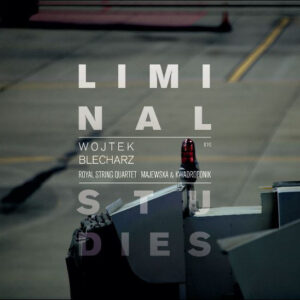
Wojtek BLECHARZ
“Liminal studies”
Wojciech Blecharz is somewhat an exhibitionist. An emotional one, of course.
With his music, he doesn’t create a vision of the contemporary world burdened with disasters, being neither a “digital indigent” nor a fan of algorithmic passages. He’s not even recognized as a political rebel who discloses his outlook on life between the notes. In the centre of his interest remains what’s closest to him – the human psychological condition in the context of experiencing crises and break-ups, traumatic memories. And he is not ashamed of deriving from life experiences, talking about them in interviews, private conversations, programmatic notes but also through musicians performing on stage. He, therefore, creates music that is emotional, even autobiographical and he has no problem with sharing it with the wider audience.
Born in Gdynia (Poland) in 1981, in 2006 he graduated with honors from Frederic Chopin Music Academy in Warsaw (Master of Arts), in 2015 received a Ph. D. in music composition at University of California San Diego. Since 2012 Blecharz has been curating the Instalakcje music festival at Warsaw’s Nowy Theater, featuring non-concert music: sound installations, performance installations, sound sculptures, music videos, music theater and Blecharz has also directed both of his opera-installations Transcryptum (2013) commissioned by Grand Theater National Opera in Warsaw and Park-Opera (2016) commissioned by Theater Powszechny in Warsaw. Currently preparing the third opera installation Body-Opera commissioned by Huddersfield Contemporary Music Festival (premiere November 2016).
Recently composed pieces for Kwadrofonik Ensemble (Warsaw), Forbidden City Chamber Orchestra (Beijing), Klangforum Wien (Vienna), Royal String Quartet (Warsaw), Aviva Endean (Melbourne), International Contemporary Ensemble (New York), Musiques Nouvelles (Brussels).
Original price was: 13,00€.5,00€Current price is: 5,00€.
In stock

DVDR
iMPROKUP!
This release comes with a DVDR containing mp3 files (3.22 GB, 14 files with a total duration of 39 hours, 56 minutes, 14 seconds). These are exactly the same fils as the ones recorded with the recorder Zoom H2. No mastering or editing has been done. “A group of diverse people calls a meeting, setting a place and a time. They meet. Each one brings the things they think are necessary. The “opening-up” to action is big. They disuss and reach agreements. They have to manage that shared time in the search for freedom. They select a place, make it theirs, precariously theirs. What is the potential of that meeting, of that time lived in common? They have to make decisions and try to create a collective space, not exempt from disapprovals. Apart from the physical space they might find (that could not be found), first there is a social space that has to be built up to very basic levels. Many of the problems come directly from that. How long can they endure? What will they be able to do? How much of the potential of the action lies in their own capacity for meeting together and dealing with uncertainty? What would be left if they didn’t do anything except be in an abnormal situation? How many different situations can the general situation contain? What is it that will give the right levels of intensity?”
4,00€
In stock

DVD
Ivan PALACKY & VJ Vera LUKASOVA aka CARPETS CURTAINS
Ivan Palacky - dictaphones, MD, amplified knitting machine Dopleta 160. Filip Cenek aka VJ Vera Lukasova - real-time image manipulation in interaction with sound.
“Combining live audio "micro-improvisations" (refined by musician Ivan Palacky) with live video manipulations (by video and VJ-artist Filip Cenek aka VJ Vera Lukasova), Carpets Curtains express an engaging and nuanced interplay of audio and visual material. With live visuals being mostly based on self-made video sequences in which emphasis is placed on ambiguous "narration" whilst VJ software-mistakes are used to reach new amoebic image qualities, the result is a principle or method of remaining fixed to moving images while vacating the essential aspects for building concrete meaning. Such visual approaches find parallel in Palacky’s delicate musicalities, in which found objects and minimal electronics are fused to create elegantly small sound mixtures.
Ivan Palacky has (in the 80s and the beginning of the 90s) played with various groups and taken part in several music projects. He was a member of the guitar/doublebass/bassoon group "Slede, zive slede" (Herring, live herring) - and currently performs in a duo called "Tilko" (Singlet) and audiovisual project Koberce, zaclony (Carpets, Curtains). He "writes" a sound diary from all his journeys - collects excerpts of stories, weird sounds and various "acoustic mistakes". He likes to take part in one-shot improvisational groups or duos (with Cremaster, Ruth Barberán and Margarida Garcia, Will Guthrie, Andrea Neumann...) as well as playing solo performances. Since 2005 his main interest has been to "dig out" sounds from an amplified Dopleta 160 knitting machine from the 70s.
Filip Cenek (born 1976 in Jesenik, Czech Rep.) is educated projectionist, graduated from the Faculty of Fine Arts Brno, Video Studio (Keiko Sei), where he currently teaches. From 2004 he has been a postgraduate student at the FAMU Centre of Audiovisual Studies in Prague. He is the co-author (predominantly with Jiri Havlicek) of several short films and animations presented at various fine art exhibitions and experimental film festivals (Centre Pompidou, Paris. L’immagine leggera, Palermo. EMAF, Osnabruck. Wardrobe, Leeds. Parker`s Box, New York. MNAC, Bucurest. Among others). He is represented in the National Gallery Collection of Modern and Contemporary Art in Prague. He was awarded the Developmental Grant of Tranzit for his work in the field of visual media last year, which allowed him to realize "Carpets Curtains" DVD-Video disk, documenting his cooperation with musician Ivan Palacky.”
DVD Pal 4:3 Dolby digital 2.0 Region free.
5,00€
In stock

book + DVD
Nicolas COLLINS
“Micro analyses”
Texts in French only from Nicolas Collins around John Cage, Alvin Lucier, David Tudor, around experimentation in “Pea soup” or “Devil’s Music”, and around do-it-yourself with differents examples.
The book comes with a DVD presenting seven different pieces from Nicolas Collins.
28,00€
In stock

book + DVD
Éric LA CASA-Jean-Luc GUIONNET
“Reflected waves (Ondes réfléchies)”
Bilingual edition (English / French). 21 x 25 cm (softcover). 60 pages (ill.), DVD video 108’.
First published in 2010 in a limited edition of 100 copies .
This publication documents the making of a sound mapping project of the city of Melbourne by musicians and artists Jean-Luc Guionnet and Eric La Casa.
In 2005, Jean-Luc Guionnet and Eric La Casa were invited by the Festival Liquid Architecture to lead a topographical and sound research on Melbourne, Australia. The artists sound mapped the city’s four cardinal points as well as the Central Business District to work with the landscape's reflected waves. The result was shown at West Space Gallery in the form of an audiovisual installation. This edition offers a complete description of the process as well as an analysis of the recordings and mixing protocols.
20,00€
In stock

CD + DVD
Harry BERTOIA
“Sonambients: The Sound Sculpture”
Sonambients: The Sound Sculpture Of Harry Bertoia is a deluxe CD/DVD package containing historic recordings made in Harry Bertoia’s Sonambient barn.
The DVD, a film titled Sonambients: The Sound Sculpture of Harry Bertoia, by Jeffrey & Miriam Eger, was shot in 1971 and follows Harry Bertoia in performance and interview throughout his Sonambient barn deep in the Pennsylvania woods. This film offers a rare opportunity to follow the artist in practice, listening carefully as he moves contemplatively through his sculptures and gongs. Interview footage offers rare insight into Bertoia's inspiration and process.
A separate CD contains four exclusive, recently discovered audio recordings. Included are the two earliest known collaborative tapes from Harry and brother Oreste, morning and evening sessions dated October 12, 1969, as well as a collaboration between the Bertoia brothers and their sister Ave who sings in careful unison with the overtones being produced by the sculptures. With the passing of Oreste Bertoia in 1972, these recordings mark the last meeting of all three Bertoia siblings.
A 16 page booklet includes many never before seen production stills shot by Jeffrey Eger. These iconic images capture the essence of the artist in practice. All of this is packaged in a heavy duty, tip-on style, gatefold sleeve printed with metallic inks at Stoughton Printing in California.
23,00€
In stock

DVD
Patrick BOKANOWSKI
“Courts métrages”
Patrick Bokanowski : Short films. P. Bokanowski employs an extraordinary range of technical invention - combining live-action with optical experiments, drawing, performance, painting, and animation - to conjure magical forays into a parallel universe. All musics made by Michèle Bokanowski. “La Femme qui se Poudre” (1972), “Déjeuner du Matin” (1974), “La Plage” (1992), “Au Bord du Lac” (1994), “Flammes” (1998), “Le Canard à l’Orange” (2002), “Eclats d’Orphée” (2002), “Battements solaires” (2008). Bonus: Interviews with Patrick Bokanowski (English subtitles). Pal. Region Free. (We also have copies in NTSC, ask for it if you need).
29,00€
In stock

DVD
Anne MAREGIANO
“Charlemagne Palestine, The golden sound”
“Born in New York City, composer, performer, and visual artist Charlemagne Palestine was a contemporary of Steve Reich and Phillip Glass in the avantgarde classical music scene of the 1960s and 1970s. On stages filled with his own home-made stuffed animals, Palestine performs his trance-like strumming music. He is often referred to as a minimal composer, but rejects that in favour of "maximalism". Anne Maregiano’s documentary about Palestine, The Golden Sound (2011), allows the artist to tell his own story while putting his music and performance, in long, unedited takes, at the centre of the film…” - Michael Garrad, (Close Up)
Bonus Films: “The Red Suitcase” by Anne Maregiano (2011). “Body Music “by Charlemagne Palestine (1975). “Charlemagne 2 : Piltzer” by Pip Chodorov (2002).
“Sound Recording: March 7, 1975” by Charlemagne Palestine.
Book (44 pages) with texts written by Ingram Marshall, Roland Spekle, Pip Chodorov and Anne Maregiano. Photos by Kathleen Agnoli, Elaine Hartnett, James Lapine, Charlemagne Palestine.
English with French subtitles.
19,90€
Out of stock

DVD
Patrick BOKANOWSKI “L’Ange”
“L’Ange” (1982). “Dubbed ‘the artist-alchemist of celluloid’ avant-garde filmmaker Patrick Bokanowski’s legendary opus defies all categorisation, in its unique combination of experimental cinema, photography, animation and painting”. Bonus features: The Making of L’Ange & Interview with composer Michèle Bokanowski. (English subtitles). Pal. Region Free. (We also have copies in NTSC, ask for it if you need).
29,00€
In stock

DVDR
Oswald WIENER
“Dominik Steiger als Kind”
A Film by Oswald Wiener, Vienna 1965. Austrian artist Domink Steiger (born 1940) as ’a child’. Dressed up in a sailor suit, playing with himself and toys on a roof-top and out in the streets and at a playground with other children under the suspicious eyes of mid 1960’s Vienna inhabitants. This work could be seen as some sort of an (unintended) Steiger-esque version of the "Wiener Spaziergang" action by Günter Brus which coincidently happened the same year in the same city. But this film is not just a documentation of a happening but an experimental film by Oswald Wiener (b.1935), one of the founding members of the ’Wiener Gruppe’. Filmed with a Super 8 camera and edited by hand, with fast cut’s and short bursts of over-exposure. Edition of 100 numbered copies of which 50 copies are available to distributors.
17,00€
In stock

DVD
Jeff MERTENS
“Borbetomagus : A Pollock of Sound”
Filmmaker Jef Mertens brings a raw, urgent, and unpolished vision focusing on a band that has spent almost four decades defining and redefining not just their music, but the boundaries of music itself. Band members Don Dietrich, Donald Miller, and Jim Sauter tell their story with the help of artists, writers, photographers, and filmmakers that include noted critic Byron Coley, drummer Chris Corsano, guitarist Thurston Moore, groundbreaking Japanese noise unit Hijokaidan, and Switzerland's masters of “cracked electronics,” Voice Crack. Includes never-before-seen archival footage, amazing photographic finds, and previously unreleased recordings.
“The group drive furiously into the promise of freedom offered by improvised music to build their own unpredictable edifice. if there's a lesson to be drawn, it's that borbetomagus's focused, lateral expansion is an endlessly fertile plane in itself, regardless of the specifics of form. Mertens's film deftly navigates this idea without ever being overly prescriptive or sentimental. By allowing the work and its ambiguities to stay firmly in the foreground, any conclusions about how to evaluate the music are left up to the audience. Borbetomagus have always thrived on precisely this physical and conceptual interaction. The questions are the answers and vice versa, like two bells locked together.” (Matt Krefting, The Wire)
Region 0. NTSC.
15,00€
In stock

DVD
Phill NIBLOCK
“Thir”
A milestone film from American composer and filmmaker Phill Niblock, presented for the first time in DVD with two alternate soundtracks. T H I R is a mesmerizing and hypnotic film from his Environments series shot in upstate New York in 1972. This film is one of Niblock’s finest and undiscovered jewels. A must have classic release.
18,00€
In stock

DVD
Thomas RIEDELSHEIMER
“Evelyn GLENNIE – Fred FRITH. Touch the sound”
“Subtitled "A Sound Journey with Evelyn Glennie," German director Thomas Riedelsheimer’s exquisite Touch the Sound is nominally a portrait of the Scottish musician known as "the first full-time solo percussionist." Glennie is certainly a fascinating subject. Profoundly deaf since childhood, she disdains the use of hearing aids and sign language, relying instead on lip reading and, more crucially, on the use of all of her senses, especially touch, to "hear" with her entire body. The film reveals Glennie’s extraordinary skills in a variety of settings: playing a snare drum for bemused New Yorkers in cavernous Grand Central Station; improvising with guitarist Fred Frith in an empty warehouse in Cologne, Germany (their final vibes-guitar duet is one of the film’s musical highlights); working with hearing-impaired students in her native Aberdeenshire; jamming with taiko drummers in Japan, and later delighting customers in a Tokyo bar with a spontaneous workout involving chopsticks, dishes, cans, and glassware (the woman can make music with virtually anything). But Riedelsheimer, who was also the film’s editor and cinematographer, has a broader agenda here--namely, to intensify our awareness of the sounds that surround us everywhere, in every moment. From the streets of New York to the beaches of Santa Cruz, from the rocky Scottish coastline to a tranquil Japanese rock garden, he links heightened audio, as clear and natural as the best ECM recordings, to a succession of gorgeous visual images to create a balance of complex detail and overall sparseness, resulting in a kind of Zen feast. Even more of the same is found in a "making of" featurette that’s the highlight of the bonus material, making Touch the Sound easily one of the most rewarding documentaries in recent years”. --Sam Graham
21,00€
In stock

LP + DVD audio
Russell HASWELL & Florian HECKER
“Kanal Gendyn”
“Editions Mego is happy to announce the release of “Kanal Gendyn”, a Vinyl and DVD set by Russell Haswell & Florian Hecker. This is the first full length release by the artists following their highly acclaimed albums, ’Blackest Ever Black (Electroacoustic UPIC Recordings)’ (Warner Classics, 2007), and ’UPIC Warp Tracks’ (Warp, 2008), in addition to their remix’s of Popol Vuh, and Voice Crack. In the late 90s, early 2000s, it became common for bands, or solo artists to perform live - often alternative - soundtracks to feature films or silent classics. Critical of obvious instrumentation and the combination with known classic film, the artists Russell Haswell & Florian Hecker chose to create a real-time soundtrack, to an unscored film, ’Kanal Video’ (1992, 60 min) by the Swiss artist duo Peter Fischli & David Weiss. Core to Kanal Gendyn is Haswell & Hecker’s ongoing research on the legacies of polymath Iannis Xenakis (1922-2001) and in particular his concept of the Dynamic Stochastic Synthesis, an abstract sound synthesis procedure that creates ‘sound out of nothing’. In an interview with Peter Hoffmann, the artists recall: “This video, which consists of an hour long ‘ride’ through the Zurich sewage system, with a remotely controlled maintenance vehicle equipped with a video camera to survey the sewers for eventual irregularities of defects - struck us both as an ideal piece to be projected in a ‘nightclub’ or music venue with a Gendyn only performance. We found twisted relations with such an hour long ‘tunnel vision’. Once with the seemingly endless amount of computer generated video projections used as visuals accompanying raves and techno parties during the 1990’s - and also to the accounts of visual hallucinations induced by Mescaline as described by Heinrich Klüver in the 1920’s - with the so called ‘form constants’ - where he mentions amongst others, ‘tunnel like’ patterns. The particularities of Gendyn, with its ever changing and meandering waveforms appeared to us as an ideal counterpart.” Kanal Gendyn was performed on the occasion of the event ‘Musterraum 9. Dual Presentation - Peter Fischli & David Weiss - Russell Haswell & Florian Hecker’ at Musterraum, Munich, 30.01.2004. Originally constructed as an experimental building, ‘Musterraum’ - German for sample or reference room - was a freestanding cube with a base area of 10 12 meters. Built as a test and reference space for the planning and construction of the adjacent Pinakothek der Moderne. Two stereo feeds were crossed for quadraphonic (4.0) diffusion using a L&B F12 / B12 loudspeaker system. Performed concurrently to the Peter Fischli & David Weiss, ‘Kanal Video’ (1992, 60 min.) screened on three facing walls. Kanal Gendyn is released as stereo vinyl LP + 4.0 DTS 24 Bit / 48 KHz DVD (audio only) set. The cover features 10 stills from the original Fischli & Weiss video, included inside is a 30 x 30 cm 170 gramm paper insert with a further, full-page still, plus extensive sleeve notes by musicologist and software developer Peter Hoffmann, and everything was designed by NORM, Zurich. Its also worth noting that, with a running time of over a hour, this is one of the longest single LP releases you will come across ! Cut by Rashad ’the Master’ Becker at Dubplates & Mastering, Berlin, September 2011.”
22,00€
In stock

DVD
Götz ROGGE+Frédéric LE JUNTER+Chiharu SHIOTA
“Streaming poesy-Urwald”
“Streaming poesy is devoted to environment and time. As a platform for multi-media collaborations, the project is an ongoing series realised at particular places; in 2006 Streaming poesy settled in the utopia of wilderness (Urwald). The commercial vice has been taking off what’s called a forest - a mere farmland for growing trees - that is now “allowed” to run to seeds. Thereby the sometimes graphical structures of cultural activity of hundreds of years are dissolving with the abstractions of scrubs and fallen trees (this even provocted regional political tensions). The painstaking subtlety in this work is a provocation to the conditioned eye of our time; it’s simplicity is akin to the japanese HAIKU. Though original aimed to be a stream on the internet in 3 parts, this dvd presents a unique version in one piece without interruption - it can be screened continuously. It presents sound recordings and visual mechanics on site by Frédéric le Junter (F) as well as the installation “Dialogue from DNA” by Chiharu Chiota (Jap): 500 shoes on red strings where exposed for the 3 month of autumn. Streaming poesy was commisioned by “URWALD vor den Toren der Stadt”, Saarbrücken-Germany and made possible by Deutsche Bundesstiftung Umwelt (DBU) as part of a innovative communication. DVD PAL length: 2h41min -16:9 HD (4:3 compatible).”
25,00€
Out of stock

2 DVD
Gérard PATRIS-Luc FERRARI
“Les grandes répétitions”
Back in stocjk with a lower price !
On two dvds five films by Gérad Patris and Luc Ferrari. Produced: Service de La Recherche by Pierre Schaeffer for ORTF. In french only. “Olivier Messiaen : Et Expecto Resurrectionem Mortuorum” (1965). “Karlheinz Stockhausen : Momente” (1965). “Hommage à Edgar Varèse” (1965). “Herman Scherchen : Quand un homme consacre sa vie à la musique” (1967). “Cecil Taylor à Paris” (1966).
On two dvds five films by Gérad Patris and Luc Ferrari. Produced: Service de La Recherche by Pierre Schaeffer for ORTF. In french only. “Olivier Messiaen : Et Expecto Resurrectionem Mortuorum” (1965). “Karlheinz Stockhausen : Momente” (1965). “Hommage à Edgar Varèse” (1965). “Herman Scherchen : Quand un homme consacre sa vie à la musique” (1967). “Cecil Taylor à Paris” (1966).
33,00€
In stock

LP + DVD
ETANT DONNES
“Le paradis blanc”
This album, recorded in 1983, is also the music of a movie directed by Etant Donnés the same yearand titled “Le paradis blanc”. Mastering Norscq.
The album Le Paradis Blanc was recorded in 1983. This unreleased album until today is also the music of a film directed by Etant Donnés the same year.
The film and music were part of a three days installation and performance of Etant Donnés in the ELAC (Espace Lyonnais d’Art Contemporain) at the Fifth Symposium of Art Performance in Lyon in 1983 : one day for the construction of the installation, one day with a performance and one day for the destruction.
The film on the DVD is an edit made with the movies of the construction and the destruction of the installation.
This music like all first works of Etant Donnés was made without any instrument or effect but is the fruit of a long work on a raw sound material coming from nature field recordings and other source like TV, films, radio, streets, factorys, etc.
In 1977, Eric and Marc Hurtado founded Etant Donnés that quickly became essential in the field of experimental films, performance and experimental and industrial music, recording approximately 30 albums and counting numerous collaborations with major artists of the international music scene and cinema : Alan Vega, Genesis P.Orridge, Michael Gira, Lydia Lunch, Philippe Grandrieux, Mark Cunningham, Bachir Attar and the Master Musicians of Jajouka, etc.
23,00€
In stock

DVD audio
Mathew ADKINS
“Mondes inconnus”
Mapping (1995-97). Aerial (2002). Deepfield (2000). Still Time (2001) for flûte and electronics. Melt (1994). Symbiont (2002). Silk to Steel (2005). Cortex (2004-05). DVD-Audio with several versions: Surround 5.1, Stéréo and Stéréo (Dolby Digital). “Composition is, for me, like a giant puzzle in which the overall shape is fixed but the pieces and the picture itself change and undergo subtle transformations as one is constructing it. The computer tools that I use, enable me to fix the edges - the large scale rhythmic and harmonic movement and other global parameters, whilst also allowing me to improvise with these materials at the surface level. Using these tools allows me to manipulate and play with sound - like a child with a chemistry kit - reveling in the novel colours and explosive concoctions that result.” Mathew Adkins. “Mathew Adkins is a composer, performer and lecturer in electroacoustic music. He read music at Pembroke College (Cambridge, UK) and then, in 1993, became a member of the BEAST (Birmingham ElectroAcoustic Sound Theatre). He studied electronic music with Jonty Harrison and then Simon Waters. It was at the age of 22 that he first came to international attention with the electroacoustic works Melt and Clothed in the Soft Horizon. Between them these works were awarded the Stockholm Electronic Arts Award (Sweden), the Résidence Prize (Bourges, France) and the Grand Prix of Musica Nova (Prague, Czech Republic). He has since won more than a dozen international prizes for his work, which has been performed and broadcasted throughout Europe, USA, Canada, Australasia, China, and Asia. He has worked in a number of prestigious European studios, including EMS (Stockholm, Sweden), Ina-GRM and IRCAM (Paris, France), Césare (Reims, France), and Heinrich Strobel Studio (Freiburg, Germany). In the early 1990s, Adkins concentrated predominantly on acousmatic concert music but has since diversified into composing electronic works for contemporary dance, multimedia works, and electroacoustic music. What he is particularly drawn to in writing such works is the collaborative process that evolves between the composer and artist-performers. The most notable of these have been Neurotransmission (1998), an hour-long acousmatic dance score written for Wayne McGregor and Random Dance in 1998, Still Time (2001) for the flutist Alejandro Escuer, Symbiont (2002) a multimedia collaboration with Miles Chalcaft, and nights bright daies (2003) for the Ictus piano and percussion quartet; the latter premiered in June 2004 at the Festival Agora No 7 at IRCAM (Paris, France).”
12,00€
In stock

2 DVD
Jacqueline CAUX
“Anna Halprin. “Out of boundaries”. “Who says I have to dance in a theater”
These two films captures, from videotaped conversations and numerous excerpts of rehearsals, performances and rare archival footage, of fundamental changes made by Anna Halprin in the field of dance. As soundtrack its have musics by Pauline Oliveros and Terry Riley who both have, at various times, worked with her.
It was born in California, in the mid-fifties, long before swarm in New York, this form of artistic expression so peculiar that we later gave the name of “Post Modern Dance”. All those who participated in the outbreak of this phenomenon know Anna Halprin is an important pioneer. Born in 1920, she has literally exploded all agreements remained in contemporary dance by supporting research on the everyday actions, and taking into account the anatomy of men as well as his unconscious desires and his sexual impulses. She introduces in 1957 the concept of “task” (to perform actions such as dressing, undressing, walking...). Floor of sneakers or shoes with high heels, she improvises in parking lots, construction sites, in the street…
On the set dancing outdoors that her architect husband Lawrence Halprin has built below their house near San Francisco, she drives in her crazy adventures - to the extreme by galvanizing their own creativity - young artists from different fields still completely unknown. Dancers such as Simone Forti, Yvonne Rainer, Trisha Brown, Meredith Monk, as well as Robert Morris (before he choose the sculpture), which then introduce in New York on radical innovations of Anna Halprin, forming the core of “Judson Dance Theater”, composers like La Monte Young and Terry Riley, she called in 1959 co-musical directors, and experimenting with her music minimalist and repetitive they are inventing. Other artists such as Charles Ross, a poet like James Broughton, filmmaker Stan Brakhage...
An important step while leading it to take into account more than ever the real in work, will Anna Halprin media spotlight away from the city of New York with all the artistic means at its disposal, it will be his fight against the cancer she suffered in 1972 with a recurrence in 1975. Cured, that’s when she began working with cancer patients, and later of AIDS. “I’m not a therapist”, she is to clarify, “I am an artist who seeks to develop imaginative and personal social issues. For me, art is this: bring in a creative process things imposed on us”. Environment California has strengthened the inspiration of Anna Halprin and has enabled her to celebrate away from demonstrative virtuosity, beauty of the natural movement of the human body. This, combined with its long association with disease and death, leading to her most recent improvisations in nature such as “Returning Home” and “Season” or “Rocking Seniors” with more than fifty old persons”. Jacqueline Caux
36,00€
Out of stock

CD + DVD
Anne-James CHATON + Andy MOOR + Thurston MOORE
“Heretics”
‘Heretics’ is a series of portraits of radical heretical figures found throughout the history of schismatic thinking.
Heretics like Caravaggio, William Burroughs, Jose Mujica, Marquis de Sade and Johnny Rotten, fascinated the artists. These influential figures are presented here in the form of poetic texts and catchy melodies combined with experimental noise.
With the addition of ex-Sonic Youth guitarist, singer and songwriter Thurston Moore – Anne-James Chaton and Andy Moor’s more than a decade long collaboration becomes an exciting trio. They researched and created the material for Heretics during a residency in the French port of St Nazaire, in July 2014. They used voice, guitars and electronics in solo, duo or trio, to collaboratively explore their ideas and co-write texts and music.
Moore and Moor both emerged from the punk/post-punk scene – albeit on different continents. This familiarity with each other’s background and music meant they were able to work at an intuitive fast pace during the making of these pieces, and subsequent recordings. Chaton’s powerful delivery and hypnotic style holds it’s own amidst the two guitarists building a rich wall of sound, melody and noise around him. Chaton and Moore’s contrasting voices and choice of words ring out in the tradition of non-conformist poetry. Shaped by jagged distorted guitars and penetrating chords, the trio’s combination of guitar and poetry evokes a new genre.
‘Heretics’ was recorded at La Muse en Circuit (Paris), and first performed live at the Theatre de Saint Nazaire, in 2015. The making of Heretics is documented in a film made by Benoît Bourreau.
This release, containing a CD, book of texts, and DVD - is designed by Isabelle Vigier. There is also a signed edition of ‘Heretics’, including original prints by the three authors. This release was made possible with support from lebeau et associes (Paris) Herezie (Paris) Mona Films (Paris) la Muse en Circuit (Paris) .
18,00€
In stock

DVD audio
Gilles GOBEIL
“Trilogie d’ondes”
Works for ondes martenot and tape. DVD audio. DVD vidéo. DVD rom.
“Voix blanche” (1988-89), “Là où vont les nuages...” (1990-91), “La perle et l’oubli” (1999-2002). All works were recorded and mixed in 2004-05.
About this Trilogy by Suzanne Binet-Audet. Gilles Gobeil’s body of work to date has been characterized by a rupture or break æsthetics, in which large-scale musical gestures are developed and brought to their acme before being immediately crushed into silence. It is a musical way of being, of breathing, a natural mark, a style, immediately identifiable and thus much more than a habit. The Trilogie d’ondes is testimony to this approach, so deeply rooted in the composer’s musical thought. The ondes Martenot’s electronic timbre and acoustic resonance are perfectly suited to the musical fabric of the electroacoustic tape part, turning it into a rich and complex mixed work. In places the instrument melds almost perfectly with the tape, while in others the ondes stand out from the sonic material, due either to the expressive quality of some melodic interventions or the contrast between the ethereal quality of the timbre and the colorful complexity of the tape sounds. In this case, Gilles Gobeil has chosen to rely mostly on the musician’s expressive accuracy in addition to virtuosity. Among the various contributions from the ondes, two themes stand out and underpin the entire structure: the “wrench theme,” which is always tightly woven into the tape and manifests itself through a long rising glissando, and the “cell theme” - or “soul theme” -, a cell consisting of four neighboring, distempered notes.
“Voix blanche” (1988-89)
The wrench theme, with its slow dramatic build-up, appears at the very beginning of this movement. Halfway through, the soul theme emerges, very legato. Following its long unfolding, it will be reintroduced in a form that is more spelled-out than linear, a form which will become definitive in the other two parts of the trilogy. Inhabited by a subtle form of poetry, this is the most lyrical movement of the cycle.
“Là où vont les nuages…” (1990-91)
This movement features a different technique. The ondes are almost always used as a trigger for prerecorded sound elements that are juxtaposed with the ondist’s playing. Through the ondes’ various interventions, the aforementioned themes are transformed into something more closely related to a sense of traveling. This movement is full of vitality and playfulness; at times, sound masses are built and taken down at vertiginous speed.
“La perle et l’oubli” (1999-2002)
Inspired by an apocryphal initiatory text from the second century, this piece consists of twelve sequences, six of which are variations on the “soul theme” cell played by the ondes. In this movement, the ondes play the part of the soul in its journey of incarnation. The final coda brings back the wrench and soul themes. The latter, modified one last time, closes the work in the bass register; its missing fourth note seems to irradiate from the dark aura of the last note played.
Suzanne Binet-Audet, iii-2005 [English translation: François Couture
“Voix blanche” (1988-89), “Là où vont les nuages...” (1990-91), “La perle et l’oubli” (1999-2002). All works were recorded and mixed in 2004-05.
About this Trilogy by Suzanne Binet-Audet. Gilles Gobeil’s body of work to date has been characterized by a rupture or break æsthetics, in which large-scale musical gestures are developed and brought to their acme before being immediately crushed into silence. It is a musical way of being, of breathing, a natural mark, a style, immediately identifiable and thus much more than a habit. The Trilogie d’ondes is testimony to this approach, so deeply rooted in the composer’s musical thought. The ondes Martenot’s electronic timbre and acoustic resonance are perfectly suited to the musical fabric of the electroacoustic tape part, turning it into a rich and complex mixed work. In places the instrument melds almost perfectly with the tape, while in others the ondes stand out from the sonic material, due either to the expressive quality of some melodic interventions or the contrast between the ethereal quality of the timbre and the colorful complexity of the tape sounds. In this case, Gilles Gobeil has chosen to rely mostly on the musician’s expressive accuracy in addition to virtuosity. Among the various contributions from the ondes, two themes stand out and underpin the entire structure: the “wrench theme,” which is always tightly woven into the tape and manifests itself through a long rising glissando, and the “cell theme” - or “soul theme” -, a cell consisting of four neighboring, distempered notes.
“Voix blanche” (1988-89)
The wrench theme, with its slow dramatic build-up, appears at the very beginning of this movement. Halfway through, the soul theme emerges, very legato. Following its long unfolding, it will be reintroduced in a form that is more spelled-out than linear, a form which will become definitive in the other two parts of the trilogy. Inhabited by a subtle form of poetry, this is the most lyrical movement of the cycle.
“Là où vont les nuages…” (1990-91)
This movement features a different technique. The ondes are almost always used as a trigger for prerecorded sound elements that are juxtaposed with the ondist’s playing. Through the ondes’ various interventions, the aforementioned themes are transformed into something more closely related to a sense of traveling. This movement is full of vitality and playfulness; at times, sound masses are built and taken down at vertiginous speed.
“La perle et l’oubli” (1999-2002)
Inspired by an apocryphal initiatory text from the second century, this piece consists of twelve sequences, six of which are variations on the “soul theme” cell played by the ondes. In this movement, the ondes play the part of the soul in its journey of incarnation. The final coda brings back the wrench and soul themes. The latter, modified one last time, closes the work in the bass register; its missing fourth note seems to irradiate from the dark aura of the last note played.
Suzanne Binet-Audet, iii-2005 [English translation: François Couture
13,00€
Out of stock

DVDR
ÉPHÉMÉRIDES
“Éphémérides nocturnes”
Kasper T. Toeplitz, bass and Strom Varx, moving images. Slow and low !
5,00€
In stock

DVD data
COMPILATION
NO BULLSHIT. A SONIC TRIBUTE TO ZBIGNIEW KARKOWSKI (1958-2013)
Data DVD with 5 hours of uncompressed audio. Pieces created by friends of the late Zbigniew Karkowski using his music /noise. Compiled between December 2013 and February 2014. Initiated and coordinated by Francisco López. Released in May 2014 (edition 1000 copies) by SONM: Sound Archive of Experimental Music and Sound Art.
With pieces by Tito Diaz, Pablo Reche, Alan Courtis, Francisco Meirino, Eric Mattson, Strom Varx, MAZK (Masami Akita & Zbigniew Karkowski), Thomas BW Bailey, Antoine Chessex, EVOL, He Felt His Body Divide, Una Lee & Peter Wullen, Seitz, Jupitter-Larsen, John Duncan + Zbigniew Karkowski, Carl Michael von Hausswolf, Leif Elggren, Jorge Castro, Eric Lanzillotta, Daniel Menche, Francisco López, Rubén García, Francisco Ali Brouchoud, ruidobello], JGRUU (Luis Alvarado & Ignacio Briceño), Chop Shop, Joachim Montessuis, Amy Denio, Domenico Sciajno, Milos Tatarevic, ILIOS, Le Depeupleur (Zbigniew Karkowski & Kasper T. Toeplitz), Peter Rehberg, Brian O’Reilly, Jorge Haro, Gen Ken Montgomery, Xopher Davidson, Destruction Des Animaux Nuisibles (Marta Sainz-Miguel A Garcia-Enrique Zaccagnini), Michael Gendreau, Gil Kuno, Phill Niblock, Marcus Schmickler, Industria Masoquista, Zbigniew Karkowski & Robert Piotrowicz, Dennis Wong, Dario Moratilla (Games Addiction), Manongo Mujica, Scott Arford, Jorge Vicario, Michael Mykola Haleta, Cal Lyall & Manuel Knapp, Dickson Dee, Zeitkratzer, Aquiles Hadjis, Gustavo Serpa, Piotr Grygor, Damion Romero, Christophe Charles, Robert B. Lisek, Naut Humon, Luis Marte, Marek Choloniewski, Chrs Galarreta, Anton Lukoszevieze, Eduardo Imasaka, Komora A (Karol Koszniec-Dominik Kowalczyk-Jakub Mikolajczyk), Massimo Pupillo.
Any and all income from distribution of any copies of this release will
directly go to Atsuko Nojiri, partner of Zbigniew Karkowski.
Original price was: 12,00€.5,00€Current price is: 5,00€.
In stock
DVDR
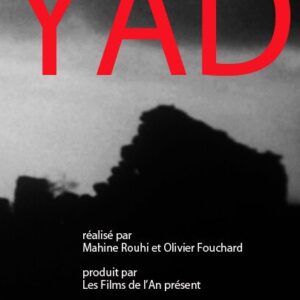
Mahine ROUHI et Olivier FOUCHARD
“Yad”
Super 8 and video with images made in the mountains around Grenoble and all edited at home. Music taken from Ground Zero, Antez, Tibet’s Bonpos, Ali Reza Mashayeki, Ulan Bator. This film is a poem about life and death, life and war. Now it exists also with English subtitles.
5,00€