
Out of stock

CD
ORGANUM ELECTRONICS
“Wildness”
Label description :
Lighting flashes through the ether
And rain whips the earth violently
From the innermost depths, the pale light of candles
A constancy
A midnight torrent overflows and marks time in solitude
The cold air searches, sewing through the ground
Slowly changing and irresolute, nothing is lost
Paths are drawn, contorted by fierce winds that traverse the ground
In uncertain times and places
Order flows through chaos
Every step of the spiral is forever surging and altered
Yet everlasting
In a space, an electromagnetic ring swarms then rotates
The ring releases its own shackles and plunges through the depths of space
The sounds draw out to an inner sea
Turning to dark fundamental notes and overtones
Phenomena, life and sound, as it arises
To change the order of changes
The voice of wildness resonating in an impenetrable world
That continues to churn and swirl
Between cathode and anode – iron filings pattern around a magnet
Certainty changes, currents move the sand, heat dispatches the wind
The water rises, returning as rain
Changed to smoke and reappearing as vapour
The mass of the earth compressing the rocks
Fire changes everything, rising and falling, opening and closing
14,50€
In stock

CD
THE NEW BLOCKADERS
“Live At Morden Tower Newcastle-Upon-Tyne”
First CD re-edition including as bonus the track "Live At Anti-Fest".
All sounds remastered for CD production from original tapes recordings.
Cover designed using original art-works and statement used for the venue.
Comes in a 3panel digipak. Limited edition of 300 copies.
Live At Morden Tower was first released in 1983 and re-released many times through the years but never into CD format.
Finally here comes the very first CD re-edition of such seminal work including as bonus also the track "Live At Anti-Fest".
NB: all sounds remastered for CD production from original tapes recordings!
Cover designed using original art-works and statement used for the venue - comes in six pannels digipak
Changez Les Blockeurs (1982), is the first true Noise LP of the modern era.
Although Changez Les Blockeurs was undoubtedly hugely influential, TNB’s Live At Morden Tower cassette (1983) was perhaps even more so, just about every Noise artist / group on the planet has (either directly or indirectly) been influenced in one way or another by Live At Morden Tower.
*** Ron Lessard (RRRecords)
My first listening experience of TNB was Live At Morden Tower in 1983.
I marveled at the unbelievably relentless inaccessible intensity of their sound.
I became fascinated by them.
I became a kind of TNB groupie.
*** Toshiji Mikawa (Incapacitants / Hijokaidan)
The Crackle of broken amplifiers precipitates a whole new order of independently morphing soundforms, all giving shape via flashes of metallic lightening, smashed glass, trashed microphone feedback and acoustic low-end pellets that scale the walls like slugs.
Gradually accruing hypnotic significance, they birth spontaneous form in the shape of textures and recur with such accumulative force, they threaten to collapse the performance under its own weight.
*** David Keenan (The Wire)
Tracklist:
1. The New Blockaders - Live At Morden Tower, July 1983 22:40
2. The New Blockaders With Sir Ashleigh Grove - Live At Morden Tower, October 1983 16:30
3. The New Blockaders - Live at Anti-Fest, Morden Tower, January 1984 18:29
12,00€
Out of stock

CD
Richard PINHAS & MERZBOW
“Coda”
Masami Akita aka Merzbow is the forerunner of Japanese electronic music, and is recognized as being one of the earliest projects in what has become known as "Japanese noise".
Richard Pinhas is internationally recognized as one of France's major experimental musicians: the 'father' of French electronic music. He was the founder of Heldon, a band whose violent fusion of electronics and guitar in the 70s rivalled the German electronic school.
All titles composed and played by MERZBOW and Richard PINHAS.
Recorded from Tokyo to Nantes 2019 to 2021
Additional Friends and Musicians
Oren AMBARCHI : Motor guitar
Florian TATARD : Accordion
Senza TESTA : Synths
12,00€
Out of stock

CD
Marc BARON – Jean-Philippe GROSS
“Black, Pink and Yellow noises”
20 tracks recorded and assembled by Marc Baron and Jean-Philippe Gross between June 2021 and March 2022
Mastering : Taku Unami
8,00€
In stock

CD
SMALL CRUEL PARTY
“Do you believe in a pencil”
Reissue of the first Small Cruel Party CD with different artwork done by Abo (Mark Schomburg/Petry Supply).
200 copies.
12,50€
Out of stock

CD
Bruno DUPLANT
“Zone Habitable”
Zone Habitable is as its name suggests, in astronomy and exobiology, a region of space where conditions are favorable for the appearance of life as we know it on Earth and therefore potentially capable of supporting extraterrestrial life. Like a fiction, Habitable Zone is a translation, a musical interpretation (using various instruments, electronic processing and field recordings) of what this exoplanet could be. (Bruno Duplant).
100 copies
11,00€
In stock

11 CD
Pauline OLIVEROS
“Reverberations : Tape & electronic music 1961-1970”
Reissue 2022, new version with 11 cds..
“Dense 11 disc collection of Pauline Oliveros’ early and unreleased electronic work including her very first piece for tape made in 1961. The majority of these pieces have never before been released.Organized chronologically by studio this set not only documents Pauline’s earliest electronic music but it also functions as an early history of electronic music itself. Extensive liner notes including essays from Pauline Oliveros, Alex Chechile, Ramon Sender, David Bernstein, Corey Arcangel and Benjamin Tinker. This box set is being released in conjunction with Pauline Oliveros’ 80th birthday celebrations. Pauline Oliveros, composer, performer and humanitarian is an important pioneer in American Music. Acclaimed internationally, for four decades she has explored sound -- forging new ground for herself and others. Through improvisation, electronic music, ritual, teaching and meditation she has created a body of work with such breadth of vision that it profoundly effects those who experience it and eludes many who try to write about it. "On some level, music, sound consciousness and religion are all one, and she would seem to be very close to that level." John Rockwell Oliveros has been honored with awards, grants and concerts internationally. Whether performing at the John F. Kennedy Center in Washington D.C., in an underground cavern, or in the studios of West German Radio, Oliveros’ commitment to interaction with the moment is unchanged. She can make the sound of a sweeping siren into another instrument of the ensemble.
Through Deep Listening Pieces and earlier Sonic Meditations Oliveros introduced the concept of incorporating all environmental sounds into musical performance. To make a pleasurable experience of this requires focused concentration, skilled musicianship and strong improvisational skills, which are the hallmarks of Oliveros’ form. In performance Oliveros uses an accordion which has been re-tuned in two different systems of her just intonation in addition to electronics to alter the sound of the accordion and to explore the individual characteristics of each room. (Tuning Chart)
Pauline Oliveros has built a loyal following through her concerts, recordings, publications and musical compositions that she has written for soloists and ensembles in music, dance, theater and interarts companies. She has also provided leadership within the music community from her early years as the first Director of the Center for Contemporary Music (formerly the Tape Music Center at Mills), director of the Center for Music Experiment during her 14 year tenure as professor of music at the University of California at San Diego to acting in an advisory capacity for organizations such as The National Endowment for the Arts, The New York State Council for the Arts, and many private foundations. She now serves as Distinguished Research Professor of Music at Rensselaer Polytechnic Institute and Darius Milhaud Composer in Residence at Mills College. Oliveros has been vocal about representing the needs of individual artists, about the need for diversity and experimentation in the arts, and promoting cooperation and good will among people.
“Time Perspectives”, “Mnemonics I”, “Mnemonics II”, “Mnemonics III”, “Mnemonics IV”, “Mnemonics V”, “II Of IV”, “III Of IV”, “IV Of IV”, “V Of IV”, “III”,
“Team & Desecrations Improvisation”, “The Day I Disconnected The Erase Head And Forgot To Reconnect It”, “Jar Piece”, “Another Big Mother”, “Fed Back 1”, “Fed Back 2”, “5000 Miles”, “Angel Fix”, “Bottoms Up 1”, “Nite”, “Ringing The Mods 1 Heads”, “Ringing The Mods 2 Tails”, “Three Pieces I”, “Three Pieces II”, “Three Pieces III”, “Big Slow Bog”, “Boone Bog”, “Bog Bog”, “Mind Bog”, “Mewsack”, “50-50 1 Heads”, “50=50 2 Tails”, “A Little Noise In The System”, “Red Horse Headache”.
85,00€
In stock

CD
Asmus TIETCHENS
“Schatten Ohne Licht”
Black Rose Recordings are proud to present the exceptional new album by Asmus Tietchens. E.M. Cioran plays a very important role in most of Tietchen's work and this release is no different. For this release Cioran has a fellow anthropofugal thinker: Ulrich Horstmann. The theme of this release deals with a return to a mineral world without any organic species, and therefore uninhabitable for human beings. This very radical dystopia serves as a foil to the six chapters of "Schatten ohne Licht". There is something profound about the music. It can be slow and is certainly contemplative. Maybe the music is a sign of the state of our times?
As a pioneer of electronic composition his work spans over four decades and doesn't fit easily into any one category. Early recordings ranged from experiments with tape machines and electronic sound through to experimental pop. Later works were a more sculptural blend of abstract microelectronics, industrial sounds and musique concrete.
Never straightforward or obvious, always unpredictable and innovative. His ground-breaking music influences many working in today's electronic music scene. He has worked almost exclusively as a solo artist, but other releases have seen him collaborate with well-known and diverse artists such as Dieter Moebius (Cluster & Harmonia), Thomas Koener, Richard Chartier, and Merzbow.
12,00€
In stock

CD
SRMEIXNER
“A Silent War”
This project started out during the first lockdown as means of communication and a basis for further recordings (when physical meetings were not possible). Initial inspiration came from the 1980s recycling projects such as “Captured Music” and “Destruct”, both released on the Selektion label who described recycling as “a procedure concentrating on materials already existing on their own or as separate sources as a practical base for further reworkings”. As the project was progressing news was sent across the world of the death of George Floyd whilst in police custody. Sadly, not a new phenomenon, but a repeat of past events highlighting the unfinished business of needing to change the future. I decided to incorporate the events into the initial theme using words and specific references to carry on a dialogue that interacts with the re-interpretations of previous sound sources.
11,00€
Out of stock

CD
RLW
“Agnostic Diaries”
2021
The common factor linking these recordings are projects that were never fully realized. The basic recordings started in 2005, however the period of reworking and transformation (2016 to 2017) is more important. All vocal parts and general revisions were done during this period. Agnosticism was the basic idea for the vocal/musical re-working of the pieces with the vocals implanted into the basic pieces, not just as simple overdubs, but inserted in a dialectical confrontation with the basic sounds and structures. "Le Ballet" relies on George Antheil's Ballet Mecanique; "For Gerald" on a co-operation with Anla Courtis using some sounds by Ovary Lodge planned for the Gerald Jupitter-Larssen series which stopped far too early. "Without M.B." includes RLW's parts for a collaboration with Marc Baron whilst "Monotype #6" includes vocals by Dylan Nyoukis, also used for a collaborative CD-r with him.
Ralf Wehowsky is one of the most respected electronic composers of our day and was also a founder member of the seminal German group P16.D4 and label Selektion whose ground-breaking releases influenced many working in today's experimental music scene. Previous releases have seen him collaborate with such well known and diverse artists such as Merzbow, Bernhard Guenter, Jim O'Rourke, Achim Wollscheid, and Lionel Marchetti. His music is impossible to pigeonhole into one simple bracket. It is neither industrial or musique concrete, nor computer music nor improvisation. In fact, it could be all of these.
10,00€
In stock

CD
Cyprien BUSOLINI – Bertrand GAUGUET
“Miroir”
Cyprien and Bertrand have been playing together for several years. Their music, improvised, sober and tenuous, invites the listener to immerse himself in a state of intense listening. The materials of the viola and the saxophone cross, criss-cross, detach, move away and come closer as in a game of chase where each movement transforms the landscape, where each light variation modifies the environment in an imperceptible way.
10,50€
In stock

CD
Pascal BATTUS
“Cymbale ouverte”
Pascal Battus plays an instrument that he invented himself: inspired by the principle of the hurdy-gurdy, the rotating surfaces are driven by an electric motor. Pascal Battus uses many materials to rub, hit, play with the pitches, timbres and sounds produced.
With Cymbale Ouverte, the musician decided to use only cymbals to produce different types of resonances.
Four pieces make up the album and each one offers four sonic expanses that follow their own path, always guided by the spirit of improvisation.
10,50€
In stock

CD
Milan KNIZAK
“Another State of Stagnation / Piano Pieces (1991-2021)”
My piano compositions are a mixture of musical reminiscences and a confession of my love for disharmonic chords on the one hand, and lascivious melodies on the other. As in the case of almost all my pieces, I wrote them "dry", at a desk, without using any musical instruments. I only worked with memory and a little bit of imagination. The compositions often come across as randomly taken out of a pot, which contains a blend of fragments of works of a variety of periods, styles and creators. (Milan Knízák, Mongrelised Piano)
Another State of Stagnation contains six unreleased piano pieces by Milan Knízák, written between 1991 and 2021. Played by Czech piano virtuoso Miroslav Beinhauer in August 2020 and recorded in August 2021 at Czech Radio Ostrava under the Petr Bakla's recording direction. The author of the title and cover is Milan Knízák. Produced by re-set production.
In the second movement, at least two references to Czech "tramping" (hiking, country) music can be read or heard: Ceka huãí and Táboráku, plápolej. They are among the numerous references to other pieces, while they can concurrently be something else - for instance, a Beethoven minuet. Beinhauer pointed out: "Milan KníÏák's piano works abound in these 'quotations', some of which are just very similar to well-known melodies, while others are true quotations, I do not even recognise some of them at first listen, but that is not actually the point. If someone does identify these quoted fragments when listening, they can feel good about themselves or can even remember the whole piece better, but I myself do not deem it essential in the case of Milan's compositions. Alternation of styles is more important."
(Boris Klepal, Score and Performance - Milan Knízák: Tramp Sonate or Looking for Context)
Prof. Milan Knízák, Dr.A.
Multimedia artist working in fine art (actions, paintings, sculptures), music, literature, architecture, fashion and furniture design. Member of the international art group FLUXUS. Featured in majorgalleries around the world as well as archives, catalogues, encyclopaedias and dictionaries. His BROKEN MUSIC (SRV400 LP) was included among the 1000 most important compositions of the 20th century. One of the 500 artists in the 20th Century Art Book (Phaidon Press, London and New York). A dictionary of designers published by Ambiente lists him as "a central figure in modern Czech design". Curatorial work, theoretical essays, exhibition architecture. Extensive teaching, lecturing and publishing activities. Collector and expert on the history of puppet theatre (puppets, set design) and author of the only encyclopaedia of Czech and Slovak puppet theatre designers.
Under the communist regime he was arrested, searched and detained by the police approximately 300 times, spending several months in custody in total. He was convicted of failing to prevent a friend from deserting and of harming Czechoslovakia's interests abroad, and in 1968 he was arrested in Vienna for attacking two policemen. From 1966 onwards he was listed as an enemy of the state. His final prohibited exhibition was to have been held in November 1989.
Milan Knízák has had more than 120 solo exhibitions and hundreds of group exhibitions throughout almost the entire world. He has published approximately 80 books and catalogues and released many music recordings, as well as creating a number of design projects.
12,50€
Out of stock

2 CD
COMPILATION
“Exploring Gong Culture of Southeast Asia: Massif and Archipelago”
Recorded by Yasuhiro Morinaga + intro by David Toop
Gongs have played an integral role in the mythogeography of Asia. This is not music that aligns with national borders or ideas of homogenous populations, let alone racial stereotypes and exotic clichés. What connects all of these tracks is a simultaneous feeling of entrancement and social cohesion. Communal and collaborative, its form is hypnotically repetitious, melodies and rhythms spread out among the players using the technique of hocketing in which a flowing line is distributed among all the musicians. The effect is mesmerising, immediately intoxicating to anybody who loves Chicago footwork, free improvisation, Sun Ra or young hip hop producer Jetsonmade. The music is simple yet mysterious and enveloping, a sound world in which to disappear. A theory exists but this is not explained.
David Toop (extracts from the liner notes)
This project, Massif and Archipelago, is a field recording project initiated by Japanese sound artist Yasuhiro Morinaga, documenting traditional gong music by different Southeast Asian ethnic groups. The project aimed to examine the impact of the natural and social environment on the gong music culture of Southeast Asia.
During the project, he visited over 50 different ethnic groups and made hundreds of recordings. This album presents a selection of the unique gong music from different ethnic minorities.
The selected music has been divided into two broad sections: one focussing on the music from the Massif, i.e. mainland Southeast Asia (Central Highland of Vietnam and Northeast Cambodia), the other on music from the Archipelago, maritime Southeast Asia (the Luzon Islands of the Philippines, Borneo, Sulawesi, and the Flores Islands of Indonesia).
18,00€
In stock

CD
Milan KNIZAK & OPENING PERFORMANCE ORCHESTRA
“Broken Re/Broken”
*** 2022 restock ***
Milan Knizak (with Phaerentz) + Opening Performance Orchestra revisiting Broken Music in Berlin, 2014.
part one
Broken Music / 45 min.
Milan Knízak (with Phaerentz)
turntables & broken vinyls, CD players & CDs, cassette players
& cassettes, keyboard
part two
Re:Broken Music / 33 min.
Opening Performance Orchestra
5 laptops & fraction music (broken section, re:broken section,
fraction section)
'In 2008-9 we transferred the original recording from vinyl records into digital form. As we did so, we weren't interested in the precise, clean fidelity offered by the digital world, which fundamentally causes the fine structure of natural sound to be lost. Instead we were seeking the opposite: the world of errors and distortion, which remains hidden when digital audio is manipulated to be maximally accommodating for the listener. The transferred audio recording was digitally destroyed, shattered and uncompromisingly freed from all its original attributes. No melody, no rhythm, no harmony - this is fraction music'.
Milan Knizak (born 19 April 1940) is a Czech performance artist, sculptor, musician, installation artist, dissident, graphic artist, art theorist and pedagogue of art. Before everyone else - Christian Marclay, Philip Jeck, eRikm, Martin Tétreault, Otomo Yoshihide - there was Milan Knizak. In 1964, Milan Knizak, a member of Fluxus from behind the Iron Curtain, sat down on a sidewalk near the Charles Bridge in Prague, laid down a paper carpet right into the street, and starts tearing pages out of books and burning them... Around the same time, he began to create music from defective, worn, damaged or broken LP's. These Broken Music compositions, his classic collages of noises created during performances and happenings, are widely regarded as important sound art documents on record.
12,50€
In stock

2 CD
Jean DUBUFFET – Ilhan MIMAROGLU
“Musiques pour Coucou Bazar”
***2022 restock***
2CD + 40 page booklet
All musics done for Jean Dubuffet's Coucou Bazar show
CD1:
Ilhan Mimaroglu's soundtrack for Jean Dubuffet's articulated painting exhibition Coucou Bazar, which opened at the Guggenheim Museum in New York City on May 16, 1973.
CD2:
Jean Dubuffet's soundtrack of the Coucou Bazar show presented in Turin from June 16 to July 15, 1978 (based on Dubuffet's music recordings from 1961 and 1973-1974).
+ a never released before piece by Jean Dubuffet: Bal des Leurres (1972-73).
***
''(...) my music was slovenly and dirty, and therefore anti-musical, anti-humanistic" Jean Dubuffet
In 1965, Turkish composer Ilhan Mimaroglu, then residing in New York, sent a letter to Jean Dubuffet, to explain his experiments, inspired by the series of the artist's drawings.
In 1971 when Dubuffet started working on a new form of "show," Coucou Bazar, he decided to submit his project to Mimaroglu. Mimaroglu released his music for Coucou Bazar in 1973 under the title: Electronic Music for Jean Dubuffet's Coucou Bazar, accompanying the first version of the 'show' presented at the Solomon R. Guggenheim Museum in New York, from the 16th of May to the 29th of July 1973, and the second version at the Grand Palais in Paris, from the 2nd of November to the 1st of December 1973.
Following these first two versions of Coucou Bazar, Dubuffet quickly envisioned a third version. This third version of Coucou Bazar was finally produced in Turin in 1978, thanks to the FIAT company. And this time, it was accompanied by Dubuffet's music. Anna Sagna, the choreographer of this third version, took care of editing the tapes from 1961 and 1973-1974 into a collage.
16,00€
In stock

CD
BEUYS + PISSOFF
“Creamcheese Düsseldorf 1968”
The experimental project Pissoff was founded in the late '60s by multimedia-artist Eberhard Kranemann and some friends who studied together at the Düsseldorf Academy Of Fine Arts. The chaotic, loud, and, sound-wise, undisciplined band took part in various events at this location and other places. Due to the intense fluctuation of band-members the performances by Pissoff were characterized by continuously changing participants and variations of the involved equipment: cello, violin, clarinet, tenor saxophone, flute, vocals, electric guitar, electric bass guitar, organ, and drums.
In 1968, Pissoff performed together with Joseph Beuys, who was professor of sculpture at the Art Academy at that time. During this incomparable audiovisual interaction Joseph Beuys staged his Handaktion: in concentrated manner he moved his hands in front of his head while listening and visually reacting to the very loud and abstract staccato-rhythms by Pissoff. The event was recorded by Eberhard Kranemann on a Telefunken mono-tape-recorder and remains the only existing audio-material by Pissoff until today. On that night Eberhard played cello, clarinet, and tenor saxophone while the other members added sounds by electric guitar, electric bass, and drums.
Earliest musical experimentations that can be defined as the origins of the band Kraftwerk already started in 1967 by Eberhard Kranemann and Florian Schneider-Esleben. Sometimes Kranemann invited Florian Schneider-Esleben to join Pissoff.
16,00€
In stock

CD
INCIPIENTUM
“Study In Still Life”
Full sunken drone acousmagique from a lokey promising new Swedish artist, Incipientum, tipped for fans of Organum, NWW, Jeph Jerman, Litüus.
When iDEAL introduce a new artist to the fold it’s always worth paying attention, and Incipientum is a real one. Hailing from the bowels of Gothenburg’s underground, he makes a virtue of harnessing stark negative space and energy to his will on ’Study in Still Life’, which appears as his 2nd release and debut album, proper, after an early, super-limited CDr. Trust it’s not some overbearing drone wallow, though, instead expect a fine play of dark/light that reveals itself with full immersion.
Settling on the mind somewhere between the original post-industrial spectralism of Organum or NWW, and the likes of Lambda Sond or Litüus’s eerie chamber-like styles in the contemporary era, Incipientum trades in a very uncanny language of resonant minimalism, all shadowy tone and vaporous timbral suggestion that appears to flicker before the ear’s eye and create the eeriest sense of depth perception from ostensibly static elements.
Opener ‘The Object Of’ plumbs unfathomable, abyssopelagic subharmonics, before appearing to rise toward the light over its 12 min duration, where ‘Conveyed Visions’ feels just below the surface, bathed in refracted moonlit timbres that play out a shimmering isolationist nocturne, shoring up somewhere like a BoC vignette. ‘Orientation’ is the suite’s succinct sort of palate cleanser, introducing hallucinatory voices, and logically leads to relative relief of ‘The Object Is Terrifying’, ascending from the depths to an immanent calm, yet fraught with aleatoric interference that keeps us rapt and anticipating his next moves.
14,50€
In stock

CD
Otto MUEHL
“Musik 1982-90”
76 minutes collection of recordings made at the Friedrichshof commune between 1982 and 1990.
Performed by Otto Muehl and members of the commune.
Includes actionist group-music, improvised conceptual pieces, and barpianist-songs.
16,00€
Out of stock

2 CD
SELTEN GEHÖRTE MUSIK
“Sehr Selten Gehörte Tanzmusik”
Previously unpublished performance of the internationally renowned dance band Selten Gehörte Musik (on this occasion: Christian Attersee, Gerhard Rühm, Oswald Wiener) at the closing event of the "Literanover" Festival at the Kunstmuseum Hannover, on November 16th, 1980. Close to two hours of very rarely heard dance music, indeed.
22,00€
In stock

CD
MACHINEFABRIEK with Anne BAKKER
“Wisps”
On 5 April 2022 I e-mailed Anne about working on a follow-up to our album Oehoe (released by Where to Now? Records in 2020). On April 7 she recorded a bunch of violin, viola and vocal improvisations at home. Gorgeous sounds and melodies, a gold mine to work with. The material basically wrote itself. I started editing and adding electronics (mainly virtual instruments, I don’t own a real harp), and by the end of that month, the album was finished.
I always found the music that Anne and I make a bit pastoral, or eerie. Thinking about a title, will-o'-the-wisp came to mind, a ghost light in folklore. It fits the elusive quality of the music, I believe. As shorter is always better, we went for Wisps.
The cover art is a collage by Wytske van Veen. She posted the work on her Facebook page when I was busy with the album, and I immediately made the connection with the music. I love it when things fall into place like this.
So here it is, 28 minutes of (in Mariska Baars’ words) ‘pwetty weeeird’ music. Hope you’ll enjoy listening to it as much as we enjoyed making it.
Rutger Zuydervelt, May 2022
Constructed by Rutger Zuydervelt,
Rotterdam, April 2022.
Violin, viola and vocals performed
and recorded by Anne Bakker.
9,50€
Out of stock

CD
Gareth DAVIS & MACHINEFABRIEK
“Standards (Of Sorts)”
Standards (of Sorts) takes the most simple idea of the Jazz Standard, of improvising on a given theme, and puts this in a new perspective.
Using both 'standards' and how we can 'misremember' as starting concepts, rather than dive into the Great American Songbook, Gareth Davis and Rutger Zuydervelt (Machinefabriek) chose to use pieces of contemporary classical music as the material for their point of departure.
Tiny fragments of a few notes, sometimes misremembered, from various works, became the starting sounds to create something new. Five new pieces that explore not the idea of taking a theme and making a variation but rather remembering an idea and creating something out of that memory.
Clarinet and bass clarinet by Gareth Davis
Recorded between 2018 and 2020
Electronics and editing by Rutger Zuydervelt
11,00€
In stock

CD
Rutger ZUYDERVELT & Bruno DUPLANT
“Synchronicité”
"Bruno Duplant's collaborations come in two forms. As a composer, he sends a letter that doubles as a score, and looks forward to hearing what the recipient makes of his missive. As a musician, he is a true drone whisperer, capable of coaxing endless variety from elongated organ chords. That's exactly what he does to marvelous effect on Synchronicite, playing long tones that swell, loom and fade. Zuydervelt's contrasting contributions are strikingly animalistic, ranging from throaty purrs to repetitive, cricket-like chirrups. How he made them is not clear, but the effect they have is to open the windows of Duplant's virtual cathedral and let some wildlife in."
Bill Meyer, The Wire, May 2022.
__
This music can smuggle you to a dark park at night or a frosty forest in the morning, providing both comfort and anxiety. You shift to another time zone and bite into the sounds. The sounds you hear, tremble like warm air above cold sand.
It may sound both comforting and ominously dystopian at the same time, but it always holds a mysterious freshness, like traces and echoes of something fleeting and barely noticeable...
Organ by Bruno Duplant
Electronics by Rutger Zuydervelt
11,00€
In stock

CD
BAUMSCHULE
s/t
Baumschule was formed following the meeting in 2019 of three musicians with already expansive experimental practice: pianist Raphael Loher, drummer Julian Sartorius and guitarist Manuel Troller (whose solo album Vanishing Points had been released a year earlier on three:four). While Troller and Sartorius had been performing as a duo for some time, and Loher and Troller were already playing together on a more occasional basis, piecing together these three players was a first. After playing entirely improvised concerts, the trio started to explore a seemingly simple idea in the studio: to engage with a limited musical material and let it slowly unfold. A bit like planting a seed and watching it germinate. By setting themselves a set of limitations and rules, which in turn raise new musical questions to be solved, the three musicians have turned Baumschule into a creative playground which exude the sheer pleasure of playing together and listening to others.
The music which came out of the studio session is imposing in appearance: the single piece of the record is close to 40 minutes long. But truth is, it is based on a skillful balance between composition and improvisation, repeated patterns and blossoming micro-variations resulting from individual decisions, phase shifts and resynchronizations, linear progression and tabular strokes. In order to fully perceive these permanent oscillations, the trio invites us somehow to develop two simultaneous ways of listening: one that would focus on the instantaneous development of musical motifs; the other, based on the memory of forms, that would focus on the slow unfolding of the piece.
Listening to Baumschule gives a fascinating impression of musical twisting, as if their music propelled itself through a helical and upward movement. Most likely, this has to do with the fact that, while constantly reacting to one other, the three musicians seem to play on different planes and tempi: Loher works his material in a sprawling manner, Sartorius imperceptibly proliferates like a cellular network, while Troller moves forward with the regularity of a natural cycle.
If the respective trajectories of the three members seem to place them in the footsteps of a reductionist approach, one can just as easily listen to their project as a record of improvised music exploring the canvas of an invisible plan. This is to say how much the trio constantly thwarts what one may expect or discern from it: no sooner are one’s ears caught by some clear guitar lines, some elaborate texture of bowed piano strings or some identifiable rhythmic units, than the two other thirds are already reconfiguring the trio's material. Behind its apparent immobility, Baumschule ("nursery") is teeming. Behind the tree lies the forest.
Raphael Loher: Piano
Julian Sartorius: Drums
Manuel Troller: Guitar
16,00€
Out of stock

CD
KMRU
“Peel”
KMRU is the moniker of Joseph Kamaru, a sound artist, and producer based in Nairobi. One of the leading exponents of the burgeoning experimental music scene in Nairobi and beyond he was listed by Resident Advisor as one of ’15 East African Artists You Need To Hear’ in 2018 and is a regular performer at the fabled Nyegenyege Festival having also presented live performances at CTM festival and Gamma Festival. Peel is KMRU’s first release for Editions Mego. exquisite mix of field recordings and electronics unravelling at a repetitive and leisurely pace to expose a rich tapestry of sound that has been revered for it’s ability to cross bordear with the sheer undertow of emotional content. The subtle calming atmosphere within Peel belies the compositional prowess as layers of delicate sounds wrap around each other creating a hybrid new form ambient musics both captivating through it’s textural depth and kaleidoscopic patterns. The track titles lend themselves to the themes and mood set within: Why are you here, Well, Solace, Klang, Insubstantial and the title track. This is a deep heartfelt journey with a new strong voice being expressed through the means of organically presented electronic ambient sounds, one which reveals further layers on repeat listens.
All tracks written and produced by KMRU
Recorded and produced in Rimpa, (Nairobi, KE)
Mastered by Stephan Mathieu at Schwebung Mastering, June 2020
15,00€
Out of stock

CD
Kali MALONE
“Living Torch”
Living Torch, through its unique structural form and harmonic material, is a bold continuation of Kali Malone’s demanding and exciting body of work, while opening new perspectives and increasing the emotional potential of the music tenfold. As such, Living Torch is a major new piece by the composer and adds a significant milestone to an already fascinating repertoire.
Departing from the pipe organ that Malone’s music is most notable for, Living Torch features a complex electroacoustic ensemble. Leafing through recordings from conventional instruments like the trombone and bass clarinet to more experimental machines like the boîte à bourdon, passing through sinewave generators and Éliane Radigue’s ARP 2500 synthesizer. Living Torch weaves its own history, its own genealogy, and that of its author. It extends her robust structural approach to a liberated palette of timbre.
Living Torch was initially commissioned by GRM for its legendary loudspeaker orchestra, the Acousmonium, and premiered in its complete multichannel form at the Grand Auditorium of Radio France in a concert entirely dedicated to the artist.
Composed at GRM studios in Paris between 2020-2021, Living Torch is a work of great intensity, an oeuvre-monde that is singularly placed at the crossroads of instrumental writing and electroacoustic composition. Living Torch proceeds from multiple lineages, including early modern music, American minimalism, and musique concrète. It’s a work as much turned towards exploring justly tuned harmony and canonic structures as towards the polyphony of unique timbres, the scaling of dynamic range, and the revelation of sound qualities.
GRM (Groupe de Recherches Musicales), the pioneering institution of electroacoustic, acousmatic, and musique concrète, has been a unique laboratory for sonorous research since 1958. Witnessing the extreme vitality of the music championed by GRM, the Portraits GRM record series extends and expands this momentum with Kali Malone’s Living Torch.
The French label-partner Shelter Press is proud to continue the collaboration with GRM, which Peter Rehberg of Editions MEGO set the foundation for in 2012.
Composed & Produced by Kali Malone at INA GRM 2020-2021
Trombone & Bass Clarinet recorded at EMS Elektronmusikstudion 2020
Pre-mastered by Emmanuel Richier at INA GRM
Mastered by Stephan Mathieu at Schwebung Mastering
Cut by Andreas Kauffelt at Schnittstelle, Berlin.
Photograph by Estelle Hanania
Painting by Ross Caliendo
Sleeve design by Stephen O’Malley
Trombone: Mats Äleklint
Bass Clarinet: Isak Hedtjärn
ARP 2500, Modular Synthesis, Pura Data & Boîte à Bourdons: Kali Malone
15,50€
Out of stock

2 CD
NURSE WITH WOUND
“The Continuous Accident / Circumventing Angels”
DISC I - THE CONTINUOUS ACCIDENT
DISC II - CIRCUMVENTING ANGELS (Previously unreleased art project radio broadcast)
19,00€
Out of stock

CD
NURSE WITH WOUND
“Deadlined”
Reflections on reading ‘Landscapes of the Metropolis of Death’ by Otto Dor Kulka.
15,00€
Out of stock

2 CD
NURSE WITH WOUND
“Salt Marie Celeste – Salt”
A welcome re-release, as an expanded version, of one of Nurse With Wound’s most notable albums. Originally recorded in 2002 by Steven Stapleton and Colin Potter, the piece ‘Salt’ was a limited edition release to accompany an exhibition of Stapleton’s artwork at The Horse Hospital in London. The following year ‘Salt Marie Celeste’ was released as a single 61 minute long piece of droning atmospheric sound that manages to be both minimal and maximal at the same time. A parade of strange, often unlikely, sounds appear and disappear during the voyage from Z to A. Described by many as being one of the most unsettling and/or engaging NWW recordings, it went on to feature in many ‘albums of the year’ lists in 2003.
This new edition comes in a six-panel digipack with stunning all-new artwork by Babs Santini. Remastered by Colin Potter, IC Studio, London 2022.
15,00€
In stock

2 CD
NURSE WITH WOUND
“Spaced Muzak”
Space Musik was officially commissioned by the Melbourne Planetarium 'Science In The Dark' series 2009.
Per the NWW website, this is a remastered version of the original plus three previously unreleased tracks.
17,00€
In stock

Book + 2CD
KRISTOFF K.ROLL – Jean-Michel ESPITALLIER
“World is a blues”
"Immersed in the Calais Jungle to record the refugees' memories of their dreams in all their languages, such as Farsi, Sudanese Arabic, Foor, Pashto, Eritrean, Tigrinya, we sensed these dream stories drifting to life stories, reality's violence penetrating the dream. Thereafter, we surveyed other territories, attentive to the refugees' testimonies, and were struck by the epic and tragedy they summoned. We then invited authors Jean-Michel Espitallier and Anne Kawala to translate them into their poetic language."
20,00€
In stock
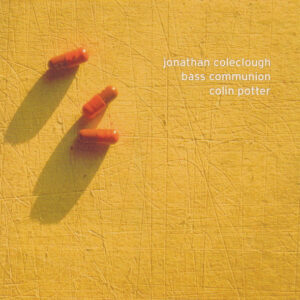
2 CD
BASS COMMUNION / Jonathan COLECLOUGH / Colin POTTER
s/t
Another re-release, on the Aquarellist label, of this double collaborative CD, which has long been out of print, becoming a collectors item. The new issue is housed in a high-quality gatefold sleeve.
Here's what Lucas Schleicher said about it on Brainwashed. "Jonathan Coleclough, Steven Wilson, and Colin Potter are all gurus of the meditative and sublime, crafting from seemingly thin air the most delicate and shattering of sounds. Every track has a heaviness or a weight that can feel paranoid or transcendental. ‘Pethidine’ is a twenty-eight minute pause, frozen perfectly in space and time. It develops and unfolds slowly, revealing each of its particularities only to show that they are indeed one entity turning inside out. Being surrounded physically by this sound has literally kept me warm at night. ‘Epidural’ manages to erase all memory, all sensation, and leave only the truth of intuition in its wake. Its immediacy, weight, and thrust is unequalled in much of the music I know."
17,00€