
In stock

2 CD
Hermann NITSCH
“6. Sinfonie”
Hermann Nitsch’s Sixth Symphony for large orchestra performed and recorded November 1, 1980 at Museum des 20. Jahrhunderts, Vienna. Edition of 500 copies in big 2CD jewel-case with 12 page booklet with a text by Günter Brus (German only).
14,00€
Out of stock

2 CD
Tony CONRAD
“Ten Years Alive On The Infinite Plain”
Ten Years Alive On The Infinite Plain is the quintessential work of artist/filmmaker/composer Tony Conrad. Comprised of both film installation and minimalist score for amplified strings, Ten Years leaps across genre and medium to connect his revolutionary structural filmmaking with the experiments in long-duration sound that Conrad had begun in the 1960s as part of the Theatre of Eternal Music.
“Ten Years began with image before sound,” writes Andrew Lampert, “a row of quadruple projections arranged side-by-side, all the shuffling stripes cascading into each other. Over the next two hours the music throbbed and the projectors incrementally shifted inwards, their beams gradually uniting to form one pulsating, overlapping picture.”
For its 1972 premiere at New York’s The Kitchen, Ten Years included Conrad on violin as well as Rhys Chatham and Laurie Spiegel performing on instruments of the composer’s own making. Chatham played the Long String Drone – a 6-foot long strip of wood with bass strings, electric pickup, tuning keys, tape, rubber band and metal hardware – while Spiegel carried out an arrhythmic bass pulse throughout.
Superior Viaduct is honored to present this previously unreleased recording of Ten Years Alive On The Infinite Plain’s breathtaking premier performance. As Chatham recounts in the liner notes, “When I first listened to this recording after not hearing it for over 40 years, it transported me back to the early Kitchen and the heyday of early minimalism, played outside the Dream Syndicate.”
19,00€
Out of stock

2 CD
Bernard DONZEL-GARGAND
“Music works 1977-2015”
Bernard Donzel-Gargand (1955-2015) was a French electro-acoustic composer. He did found the studio Collectif & Cie in 1982 in Annecy and worked there until 1998. Then he was part of Studio Forum with Philippe Blanchard (Lieutenant Caramel) who produced this 2 CD. A nice introduction to his electroacoustic and instrumental works from 1977 to 2015.
“For me, Bernard, was always the best example of real artist-enthusiast, professional and talented. His music is an incredibly poetic and subtle, exceptional… I can’t manage to find the right words to explain why he was so important. Except the Music, Bernard was one grown-up, I will never forget his hospitality, of care and kindness when I visited him in Annecy six years ago. I still remember everything. The best of the people left noiselessly. I am proud to have published his album and to have made known his music in Russia and all over the world. Thank you for everything”. Dmitry Vasilyev, manager of the label MonochromeVision.
15,00€
Out of stock

2 CD
Éliane RADIGUE
“occam ocean vol.1”
“occam river I” for birbyné and alto, 2012. Carol Robinson, birbyné, Julia Eckhardt, alto.
“occam I” for harp, 2011. Rhodri davies, harp.
“occam III” for birbyné, 2012. Carol Robinson, birbyné.
“occam IV” for alto, 2012. Julia Eckhardt, alto.
“occam delta II” for bass clarinet, alto and harp, 2012. Carol Robinson, bass clarinet, Julia Eckhardt, alto, Rhodri Davies, harp.
“It all began with an image seen so long ago at the Natural History Museum in Los Angeles, the image of a long chart showing known wavelengths. It was clear that in addition to the wavelength from the earth to the sun, there were long waves stretching between other planets, solar systems and galaxies. Our immersion in this wave-filled universe makes our heads spin. In the same way, our bodies are also driven by undulations and multiple rhythms. It is just as dizzying to move toward the minute: X-rays, gamma rays and other “nanos.” In these unfathomable dimensions, there is also that very tiny regionn between 50 and 60 Hertz, and for some species up to 12,000 Hz or more, where these vibrations become sounds.
To avoid succumbing to this dizziness, closer to us on this earth, there is the ocean. Through this ocean, contemplation becomes more accessible. Beyond its own cycle, it also gathers the rivers that nourish it. For that reason there are many river themes in the OCCAM pieces: tributaries, waterfalls, springs, wells, etc. All of the themes are inevitably associated with water. It is the element that moves through them, the image of life, life in its fluidness, like the flow of blood.
What I ask of the musicians is highly demanding. Rather than the virtuosity of speed, it concerns the virtuosity of absolute control of the instrument, an extreme, subtle and delicate kind of virtuosity. What I did with my synthesizer was almost comparable. Turning a potentiometer the value of a hair could change everything. During my feedback period, the same delicate protocol was necessary when working with microphones and speakers. There is a distance that must be respected very carefully: moving too far away, the sound disappears, moving too close, the sound explodes into feedback. You have to keep everything in control. I do not renounce my electronic work, though I never accomplished anything that completely satisfied me. The end result was always a compromise between what I wanted to do and what I was technically able to do using the means available. Conversely, with these musicians, I was finally able to hear, for the first time, the music that I call “my sound fantasies.”
Regardless of what is being used, the essential goal is to produce and bring out the partials, the overtones, the harmonics and sub harmonics, these vibrations in the air, not only those of the string or the breath, but the intangible contents of sound. An instrument vibrating beyond the fundamental(s) generates an extraordinary richness that turns into fascination. This calls for extreme simplicity, i.e. sounds maintained between piano and mezzo forte dynamic levels, beyond which the fundamental again becomes predominant. Hence the famous law from Occam’s Razor, never overdo anything, concentrate instead on breath control, or a gentle stroke, that caress of a key or a string that is sufficient to develop and enrich this infinite universe.” Éliane Radigue
“occam I” for harp, 2011. Rhodri davies, harp.
“occam III” for birbyné, 2012. Carol Robinson, birbyné.
“occam IV” for alto, 2012. Julia Eckhardt, alto.
“occam delta II” for bass clarinet, alto and harp, 2012. Carol Robinson, bass clarinet, Julia Eckhardt, alto, Rhodri Davies, harp.
“It all began with an image seen so long ago at the Natural History Museum in Los Angeles, the image of a long chart showing known wavelengths. It was clear that in addition to the wavelength from the earth to the sun, there were long waves stretching between other planets, solar systems and galaxies. Our immersion in this wave-filled universe makes our heads spin. In the same way, our bodies are also driven by undulations and multiple rhythms. It is just as dizzying to move toward the minute: X-rays, gamma rays and other “nanos.” In these unfathomable dimensions, there is also that very tiny regionn between 50 and 60 Hertz, and for some species up to 12,000 Hz or more, where these vibrations become sounds.
To avoid succumbing to this dizziness, closer to us on this earth, there is the ocean. Through this ocean, contemplation becomes more accessible. Beyond its own cycle, it also gathers the rivers that nourish it. For that reason there are many river themes in the OCCAM pieces: tributaries, waterfalls, springs, wells, etc. All of the themes are inevitably associated with water. It is the element that moves through them, the image of life, life in its fluidness, like the flow of blood.
What I ask of the musicians is highly demanding. Rather than the virtuosity of speed, it concerns the virtuosity of absolute control of the instrument, an extreme, subtle and delicate kind of virtuosity. What I did with my synthesizer was almost comparable. Turning a potentiometer the value of a hair could change everything. During my feedback period, the same delicate protocol was necessary when working with microphones and speakers. There is a distance that must be respected very carefully: moving too far away, the sound disappears, moving too close, the sound explodes into feedback. You have to keep everything in control. I do not renounce my electronic work, though I never accomplished anything that completely satisfied me. The end result was always a compromise between what I wanted to do and what I was technically able to do using the means available. Conversely, with these musicians, I was finally able to hear, for the first time, the music that I call “my sound fantasies.”
Regardless of what is being used, the essential goal is to produce and bring out the partials, the overtones, the harmonics and sub harmonics, these vibrations in the air, not only those of the string or the breath, but the intangible contents of sound. An instrument vibrating beyond the fundamental(s) generates an extraordinary richness that turns into fascination. This calls for extreme simplicity, i.e. sounds maintained between piano and mezzo forte dynamic levels, beyond which the fundamental again becomes predominant. Hence the famous law from Occam’s Razor, never overdo anything, concentrate instead on breath control, or a gentle stroke, that caress of a key or a string that is sufficient to develop and enrich this infinite universe.” Éliane Radigue
28,00€
In stock
2 CD
Rudolf EB.ER
“Brainnectar”
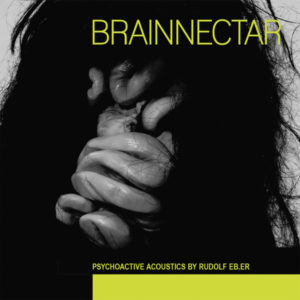
Brainnectar is Eb.er’s most developed program to date, combining psychodynamic audio-environments built from specific nature-sounds and extreme acoustics, often including ecstatic elements on instruments of shamanic origin. Binaural beats as well as isochronic tones stimulate a direct neural reaction to this unique and unheard audio-art. In addition, the grand lady of japanese extreme music - screamvocalist Junko Hiroshige (Hijokaidan) - participates on several tracks throughout this 2 CD package. The title Brainnectar is derived from tantric techniques raising psycho-physical energy, or inner fire, from the perineum up to the top of the brain, from where it drips (as nectar). This consciousness-expanding heating and dripping during creation and/or reception of Brainnectar is given priority over any musical aesthetics.
“Once we open up to the flow of the energy within our own body, we also open up to the flow of energy in the universe.” - Wilhelm Reich
2 compact discs, 42 tracks, 128 minutes, 6-panel booklet. Shrink-wrapped with obi. Artdirection by Eb.er
22,00€
Out of stock
2 CD
Dave PHILLIPS
“Homo animalis”
A landmark release in dp’s discography and the first release on the new Schimpfluch Associates label. Dave Phillips, *1969, living and working in Zürich Switzerland, has been a purveyor of radical sound since the mid 80's as a
founding member of the influential Fear of God. In 1991 he met rudolf eb.er and has been part of the schimpfluch-gruppe since. working solo since 1987, dp has appeared on 150+ releases and has played around 400 concerts in 40 countries.
schimpfluch associates is a label founded in 2013 by dave phillips (zürich) and rudolf eb.er (osaka). its focus is on works of reference by sound artists associated with schimpfluch.
homo animalis collects some of dp’s most accomplished work to date. composed between 2009 and 2011 (with two from 2007). these pieces originally appeared on limited edition cassettes in russia, poland and the US. in the winter of 2012 they were reworked and conceived as an album. this album is no compilation but describes a phase in dp’s life and work marked by incisive personal experiences formed into sound. an intensification of the compositional approach and the increased use of classical elements are two noticable sonic aspects. begun on “?”, “homo animalis” takes a turn for the more sinister and satirical and contains the quintessence of this phase. the inclusion of an elaboration on humanimalism adds to the significance of this album. dp’s humanimalism is a concept worded here for the first time. it describes a developed humanoid existence that has overcome the erroneous religious and material phases and has grown into an empathic creature that has made a clear shift towards an emotion-based existence, with social and environmental senses as primary and inherent functions.
19,00€
In stock
2 CD
Rüdiger CARL – Sven-Ake JOHANSSON
“D’accord”
Rüdiger Carl, accordion, clarinet. Sven-Ake Johansson, speech, accordion, drums. CD1 recorded in Stockholm in May 1997. CD2 recorded in Darmstadt in November 2002. “A relaxed yet highly eventful converation between this pair of old hands from the European free music community”.
24,00€
In stock
2 CD
Jean SCHWARZ
“Year of the Horse and other electroacoustic works 1974-1986”
Born (1939) in Lille, France, Jean Schwarz studied music in Paris and at Versailles Conservatory. He divided his activities between jazz drumming, composition, and the study of non-European music. In 1969, he joined the GRM (Groupe de Recherches Musicales) contributing his unique vision to musique concrète. In the same year, he also worked as an engineer and researcher at the Centre National de Recherche Scientifique in the ethnomusicology department of the Musée de l’Homme in Paris. In 1977, Schwarz created courses for electroacoustic music at Gennevilliers Conservatory. He founded Celia Records in 1980 releasing a vast catalogue of his own works as well as many collaborations.
As a composer, Schwarz favors electronic sounds – the raw material from which he creates large architectural forms and powerful, vigorous sonic structures. Schwarz also takes inspiration from non-European and indigenous musical forms. In his works involving live instruments, he often combines a prerecorded tape with brilliant improvisations by jazz musicians. His compositions include works for concert performance (some purely acousmatic, others employing live instruments), for cinema (music for Jean-Luc Godard, Serge Moati, Michel Deville, Gérard Follin, Michel Léviant, Gérard Blain, Charles Belmont, Mosco, Marlène Ionesco, and Alain Resnais), dance (for the choreographers Carolyn Carlson, Dominique and Françoise Dupuy, Larrio Ekson, Serge Campardon), and equestrian theatre for the French horse trainer Bartabas.
This 2CD collection contains selections from six compositions focusing on Schwarz's theatre and multimedia work. Year of the Horse (1978), Still Waters (1986), and Undici Onde (1978) contain pieces for choreographer and dancer Carolyn Carlson. With performances premiering at l’Opera de Paris, Teatre de Ville (Paris), and La Fenice in Venice, these scores give an in-depth insight into Schwarz and Carlson’s collaborative process. Some scenes incorporate rhythmic or cyclical elements, field recordings, electronics, and others detail purely acoustic resonance. Each musical section relates closely with Carlson's expansive visual poetry. Schwarz’s collaborations in theater continued with L'Enfance De Vladimir Kobalt (1979) for set designer and playwright Petrika Ionecso as well as Maison Rouge (1980) for director Pierre Sala. Both works evoke a wonderfully filmic structure, while integrating key themes across each scenic palette. The earliest work in the set is Fotoband (1974), a 21-minute composition to specifically accompany a 76-meter visual installation piece by German artist Ekkehart Raumstrausch. During the exhibition, loudspeakers were placed every 15 yards to allow the music to be heard while moving horizontally along the painting.
All compositions were originally issued as small edition LP’s on Schwarz’s own Celia Records, except Undici Onde and Fotoband which are previously unpublished and available here for the first time. This 2 CD set has fully remastered audio, including a 12-page booklet of photos, visuals, and detailed notes by the composer.
Year of the Horse and other electroacoustic works 1974-1986 (re)collects nearly two-and-a-half hours of highly evocative surroundings from one of the early visionaries of electroacoustic composition.
23,50€
Out of stock
2 CD
Michael ADAMIS
“A selection of electroacoustic works 1964 – 1977”
Michael Adamis (1929 - 2013). “Absolutely essential release of one of the most prominent personalities in the music world. Michael Adamis was recognised as a pioneering composer who created a contemporary musical genre upon the Greek tradition. He has managed to create an original electroacoustic soundscape, leaving a clear aesthetic mark among contemporary and Byzantine music. These works offer a remarkable example of his pioneering and diverse creative course, revealing a search for new means of expression. Tape, voice, distortion, concrete and electronic sounds, use of early synths. For the first time a Super Deluxe 2 CD & Booklet edition is released with a selection of previously unreleased electroacoustic works from the 1964-1977 period.” “Minyrismos” (1966) for tape, “Glaros II” (1977-2006) for flute and tape, “Piece one” (1964) for tape, “Piece two” (1964) for tape, “Lament” (1970) for two psaltes, two isokrates, percussion and tape, “Kratema” (1971) for psaltis, oboe, tuba and electroacoustic. “Proschemata” (1964) for tape, “Endon” (2001) for alto saxophone and electroacoustic, “Paegma” (1976) for tape, “Iphigenia in Aulis” (1970) for tape, “Kraterna” (2001) for psaltis, oboe, tuba and electroacoustic.
25,00€
Out of stock
2 CD
Peter EVANS
“Nature-Culture”
“A 2008 sequel to his highly-acclaimed first solo CD “More is More” on psi 06.08. Peter Evans writes: Over the past couple of years one of my main creative outlets has been solo trumpet performance. These discs are meant to show various aspects of my music’s development and were recorded in two different settings (studio and concert) and under two different circumstances. Jazz musicians have often referred to the playing of a solo as “telling a story”, which is essentially how I look at this music; it is an opportunity to state possibilities and tell stories that are short, long, true, false, unfinished, overlapping, fantastic and mundane.”
21,00€
In stock

2 CD
Alvin LUCIER
“Almost New York”
“CD 1 - Twonings: Charles Curtis, cello; Joseph Kubera, piano; Almost New York: Robert Dick, flutes; Broken Line: Robert Dick, flute; Danny Tunick, vibraphone; Joseph Kubera, piano. CD 2 - Coda Variations: Robin Hayward, tuba. Pogus is extremely delighted to be release this 2 CD set of recordings of works by Alvin Lucier. He is one of the key experimental artists of the 20th and 21st centuries, and is one of my favorite composers. A unique and individual artist: No one sounds quite like Alvin Lucier. Lucier writes about the genesis of the works on this release: Since the early 1980’s I have made a series of works for conventional musical instruments. Before that time I had been mainly occupied with the exploration of such phenomena as echolocation, brain waves, room acoustics and the visual representation of sound. Often these works required special equipment hand held pulse wave oscillators (Vespers), differential amplifiers (Music for Solo Performer), horseshoe magnets Music on a Long Thin Wire). Then players began asking me for pieces. Now I needed to find a way of achieving the same poetry with acoustic instruments as I did with electronic means. One of the things I discovered was that players could create rhythmic patterns by closely tuning with electronically generated pure waves or with each other, producing audible beats. Often, to get continuous motion, I have one or more voices sweep up or down at various speeds against fixed sustained pitches. As a wave approaches a sustained pitch the audible beating slows down to zero when it reaches unison, then speeds up again as the wave leaves the pitch. Almost New York employs slow sweep pure wave oscillators, Broken Line, flute glissandi. In Twonings two different tuning systems collide and in Coda Variations slight variations in pitch are heard chronologically. Recorded by Charles Curtis, Joseph Kubera, Robert Dick, Danny Tunick, and Robin Hayward - some of the leading new music performers of our era, these works are essential additions to the Alvin Lucier oeuvre, as well as satisfying anyone interested in great experimental music.” label info
18,50€
Out of stock
2 CD
Henning CHRISTIANSEN
“OP.192 UMWÄLZUNG”
CD1: Op.192 Umwälzung - fluxorum organum 1990 Eurasienstab ist immernoch Angelpunkt.
CD2: Op.192 Grundband Umwälzung - fluxorum organum 1990 Eurasienstab ist immernoch Angelpunkt
“Op.192 Umwälzung - fluxorum organum 1990 Eurasienstab ist immernoch Angelpunkt” is a previously unissued work by Henning Christiansen from 1990. Around the formation of the European Union Henning approached his original Eurasienstab organ recordings from 1968 as a platform to remold a vast amount of audio he made over the subsequent years. This special 2CD release comprises two different mixes of Umwälzung that were made for Werner Durand in 1990 to be used as backing tapes for a performance at Ballhaus Naunynstrasse in February 1990.
Umwälzung is unique in Henning’s output as it resides in a more contemporary landscape positioning itself more as a ‘mix’ than a stand alone recording. One which retains the skewered sensibility that only Henning could conjure. The two hour long versions of Umwälzung are haunted with tape hiss, weird interference and a deeply melancholic aura that moves from the original Eurasienstab organ recordings through to the somewhat hysterical 180 Hammer Blows Against War Monkeys resulting in an epic and hypnotic excursion. As unusual and inspired as the best of Henning’s works Penultimate Press, in full cooperation with the Henning Christiansen estate, is extremely proud to release this 2CD in a mini album gatefold sleeve in an edition of 500 copies.
CD2: Op.192 Grundband Umwälzung - fluxorum organum 1990 Eurasienstab ist immernoch Angelpunkt
“Op.192 Umwälzung - fluxorum organum 1990 Eurasienstab ist immernoch Angelpunkt” is a previously unissued work by Henning Christiansen from 1990. Around the formation of the European Union Henning approached his original Eurasienstab organ recordings from 1968 as a platform to remold a vast amount of audio he made over the subsequent years. This special 2CD release comprises two different mixes of Umwälzung that were made for Werner Durand in 1990 to be used as backing tapes for a performance at Ballhaus Naunynstrasse in February 1990.
Umwälzung is unique in Henning’s output as it resides in a more contemporary landscape positioning itself more as a ‘mix’ than a stand alone recording. One which retains the skewered sensibility that only Henning could conjure. The two hour long versions of Umwälzung are haunted with tape hiss, weird interference and a deeply melancholic aura that moves from the original Eurasienstab organ recordings through to the somewhat hysterical 180 Hammer Blows Against War Monkeys resulting in an epic and hypnotic excursion. As unusual and inspired as the best of Henning’s works Penultimate Press, in full cooperation with the Henning Christiansen estate, is extremely proud to release this 2CD in a mini album gatefold sleeve in an edition of 500 copies.
17,00€
Out of stock
2 CD
Max EASTLEY
“Installation recordings (1973-2008)”
“This 2CD is essentially a retrospective of Eastley’s installation work. As such, it updates and adds many new examples to the 1975 release “New and Rediscovered Musical Instruments”, which was released as a split LP with David Toop on Brian Eno’s Obscure Records. This is Eastley’s first solo CD. Of the 35 tracks, only the last 2 have any guests or “playing” (the most virtuosic moment being George Lewis playing a grass blade). All the other pieces are either powered by the natural forces of wind and water, or else are motor driven gallery installations. The etherial sounds of the aoelian harps, the haunting aeolian flutes, and the violent tension of his aerophone installations are hallmark Eastley sounds. These sounds, and many others, sit amidst a wide range of acoustic settings, from windy hill tops to quiet brooks, residential street scenes to coastal shores. The indoor recordings are no less varied, ranging across a rich variety of acoustics and gallery spaces from tiny micro sounds to large scale amplification. Wood, metal and stone are brought to life with electricity. Although there are many photos in the 20 pages booklet, much is left to the imagination to work out how the sounds are made. With this limited access to the visual, the focus is pulled towards the musicality of the sounds themselves. This musicality is reinforced by the slow crossfades of most of the pieces from indoors to outdoors to form a series of suites. The recordings mostly date from the mid 70s, but there are pieces from later decades. Nearly everything was recorded either to Revox or Uher and occasionally cassette, using what microphones were available at the time. Recent recordings are digital. The varying quality of the recording set-ups across this 2CD adds yet another dimension to the shifting sound fabric of this anthology.”
20,00€
In stock
2 CD
Gus COMA
“Color him coma”
“The first CD in this set is a reissue of an obscure cassette release from 1983 that was originally released in a small edition on the London based, It’s War Boys label. This C60 consisted of 2 distinct halves. Side 1 was formed around several mixes of an experimental track, constructed from a room-sized 24 track loop. A version of this track first appeared on the LP Flagellation by The Just Measurers (who were C. D. Greyt, Yakkö Banovic and Narki Brillans).
Side 2 is a collage of mostly unused (and some remixed), excerpts from what became the title track of the Milk From Cheltenham LP, Triptych of Poisoners. This LP track consisted of a tape collage of the live mixdown of 17 cassette recordings of locked record grooves, simultaneously, with stray radio and an infernal matchbox. The full Milk LP is now available on CD via Alga Marghen. Both these LPs were also originally It’s War Boys projects.
As with other releases by these guys nobody worked under the same name twice, but if you are familiar with their soundworld then there will be no mystery, only astonishment. Nearly all the session material here was engineered by Chris Grey, best known for his work with The Homosexuals.
No production master was ever found for CD1, so one of the actual cassette edition had to be used in its place. However, whilst looking through the archive for the master tape, an alternative version of the tape was found, which although it followed a similar blueprint to CD1 it also contained some very different music, some primitive disco drum programming, and a somewhat more sophisticated sound quality. It was difficult to choose which version to release, so both versions appear here, but at the generous price of a single CD.
Each CD also contains an additional much longer bonus track at the end that was originally intended as working material for the unfinished Milk From Cheltenham LP 2.
The guest musicians on this CD set are many and varied, but it’s all put together by Gus Coma, Lepke B’s dwarfish cousin, who renounced show-biz to work as a Heavy Goods Vehicle driver. All in, the material here is the strangest and most experimental music to come from the It’s War Boys scene. Expect gigantic tape loop symphonies, sundry plunderphonics, lo- fi Sparks and the voice of JFK, a William Burroughs interview (on one track), and a worn out teach yourself English tape. Color Him Coma !” label info
Side 2 is a collage of mostly unused (and some remixed), excerpts from what became the title track of the Milk From Cheltenham LP, Triptych of Poisoners. This LP track consisted of a tape collage of the live mixdown of 17 cassette recordings of locked record grooves, simultaneously, with stray radio and an infernal matchbox. The full Milk LP is now available on CD via Alga Marghen. Both these LPs were also originally It’s War Boys projects.
As with other releases by these guys nobody worked under the same name twice, but if you are familiar with their soundworld then there will be no mystery, only astonishment. Nearly all the session material here was engineered by Chris Grey, best known for his work with The Homosexuals.
No production master was ever found for CD1, so one of the actual cassette edition had to be used in its place. However, whilst looking through the archive for the master tape, an alternative version of the tape was found, which although it followed a similar blueprint to CD1 it also contained some very different music, some primitive disco drum programming, and a somewhat more sophisticated sound quality. It was difficult to choose which version to release, so both versions appear here, but at the generous price of a single CD.
Each CD also contains an additional much longer bonus track at the end that was originally intended as working material for the unfinished Milk From Cheltenham LP 2.
The guest musicians on this CD set are many and varied, but it’s all put together by Gus Coma, Lepke B’s dwarfish cousin, who renounced show-biz to work as a Heavy Goods Vehicle driver. All in, the material here is the strangest and most experimental music to come from the It’s War Boys scene. Expect gigantic tape loop symphonies, sundry plunderphonics, lo- fi Sparks and the voice of JFK, a William Burroughs interview (on one track), and a worn out teach yourself English tape. Color Him Coma !” label info
13,00€
Out of stock
2 CD
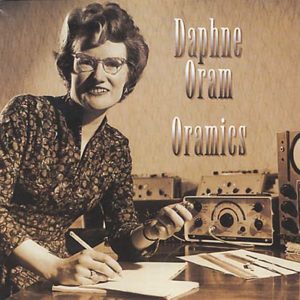
Daphne ORAM
“Oramics”
“Daphne Oram is best known for her design of her Oramics system, and also for co-founding the BBC Radiophonic Workshop in 1957, but until now the only easily available piece of music by her on CD has been the 8 minute long ‘Four Aspects’. There was also a 7” EP from 1962 on HMV, released as part of the ‘Listen, Move and Dance’ series that was specifically designed to help children dance. Although the short pieces on this record are very basic it could be argued that this is the first ever electronic dance record !
Now for the first time is a survey of nearly all the major pieces that she produced since her departure from the BBC in January 1959 until her final tape piece in 1977. During this time she worked independently in her home studio, and thanks to a grant from the Gulbenkian Foundation in 1962 she was able to persue her interests. In Britain there were no state funded studios other than the Radiophonic Workshop which mainly existed at the behest of the drama studio and was not generally seen as a place to develop personal artistic ideas. There were also no university studios at this time, so it was necessary for British electronic composers to be self funded. Throughout this period she devoted her attention to developing her Oramics ‘drawn sound’ system, which consisted of a large machine that enabled drawn patterns to be converted into sound. This system was eventually fully realised in the late 60’s and several pieces here incorporate its use.
The 2 and a half hours of music on this 2CD set covers the whole range of Oram’s post BBC output. All of the music is electronic with some occassional use of real instruments, especially small percussion and piano frame. There is also some use of musique concrète techniques. The works fall roughly into the following catagories: works for TV and cinema advertising, film soundtracks, music for theatre productions, installations and exhibitions as well as concert pieces and several studio experiments. There are also a few short pieces that resulted from an experimental music course given by Oram at a high school in Yorkshire in 1967.”
Now for the first time is a survey of nearly all the major pieces that she produced since her departure from the BBC in January 1959 until her final tape piece in 1977. During this time she worked independently in her home studio, and thanks to a grant from the Gulbenkian Foundation in 1962 she was able to persue her interests. In Britain there were no state funded studios other than the Radiophonic Workshop which mainly existed at the behest of the drama studio and was not generally seen as a place to develop personal artistic ideas. There were also no university studios at this time, so it was necessary for British electronic composers to be self funded. Throughout this period she devoted her attention to developing her Oramics ‘drawn sound’ system, which consisted of a large machine that enabled drawn patterns to be converted into sound. This system was eventually fully realised in the late 60’s and several pieces here incorporate its use.
The 2 and a half hours of music on this 2CD set covers the whole range of Oram’s post BBC output. All of the music is electronic with some occassional use of real instruments, especially small percussion and piano frame. There is also some use of musique concrète techniques. The works fall roughly into the following catagories: works for TV and cinema advertising, film soundtracks, music for theatre productions, installations and exhibitions as well as concert pieces and several studio experiments. There are also a few short pieces that resulted from an experimental music course given by Oram at a high school in Yorkshire in 1967.”
17,00€
Out of stock

2 CD
Eliane RADIGUE
“PSI 847”
Long awaited first ever release of one of Éliane Radigue’s masterpiece. She mentioned once that with PSI 847, she reached at that time exactly what she intended to do with the ARP synthetizer. Deluxe version with 2 CDs + 24 pages booklet, in French and English. Composition : Éliane Radigue. 1972. Interpretation : Lionel Marchetti. 2012. Textes : Lionel Marchetti, Thibaut de Ruyter. A short history of 847. 11.1972 - ARP 2500 Synthesizer on magnetic tapes. Produced at the composer’s studio. Final mixdown at GMEB, Bourges. 02.1973 - First creation while in residence at the Electronic Music Studios of the University of Iowa. 31.01.2012 - Concert : Club Transmediale, Berlin. Interpretation Lionel Marchetti’s interpretation with original magnetic tapes Direction : Éliane Radigue. 11.2012 - ORAL 57 : CD 1: Version concert. Live recording of the spatial interpretation by Lionel Marchetti. Stereophonic recording directed by Marcus Gammel (Deutschlandradio), mastered and remixed by Lionel Marchetti. CD 2: Version studio. Original magnetic tape, size 6/25, 19 cm/s, mastered by Lionel Marchetti, autumn 2012. “The performance of PSI 847 is about to begin. Once again, Radigue has employed one of her favoured sound dissemination tricks: directing the banks of loudspeakers not toward the audience, but toward the building…The soundboard is at the rear of the house, and Marchetti will be playing the tapes from there. Radigue is in a seat, like any other audience member. There will be nothing to see, no one on stage, no visual distractions. But what happens when you listen to this music? What sensations, feelings or thoughts emerge? Obviously, any drone-based music generates, first of all, a physical experience… You must give in, abandon yourself, forget about trying to figure out whether three minutes or an hour have elapsed. This is… truly an experience of slowness. A rare moment for which you must prepare, and be in the right condition (no need to meditate, or try to achieve a trance state, either: a little concentration will suffice!)… Once you’ve accepted the loss of physical bearings, you can then attempt to grasp Radigue’s compositional talent: locating motifs that modulate and transform at varying intervals; appreciating the evolution, the appearance of a new movement, or, as in the case of PSI 847, the insensible dissolution of the music.” Thibaut de Ruyter, Berlin 2012.
24,00€
Out of stock

2 CD
Lionel MARCHETTI
“Adèle et Hadrien. Le livre des vacances”
Digipack. Limited to 300 copies. “Adèle et Hadrien (le livre des vacances)”. A new piece of musique concrete in two books and ten notebooks (1999-2006) from French composer Lionel Marchetti. A piece of musique concrete around the universe of children. Lionel Marchetti has compositions on differents labels like Metamkine, Selektion, Crouton, Absurd, Auscultare, Ground Fault, Musica Genera… He is also an improvisor playing with Jérôme Noetinger among others. And he’s part of the Quintet Avant.
20,00€
Out of stock
2 CD
Toshi ICHIYANAGI + Kenji KOBAYASHI
“Duo Recital – The Night before JOHN CAGE SHOCK”
600 copies as regular edition. Text in Japanese and English (track explanation).
In 1961, soon after Toshi Ichiyanagi returned from the USA, two concerts were performed at the Sogetsu Art Center ; “Toshi Ichiyanagi Concert”, at which some member of ‘Group Ongaku’ joined, as well as “Toshi Ichiyanagi and Kenji Kobayashi Duo Recital”, which recording is used for this album. It was a major opportunity for its audience to experience the works of Toshi Ichiyanagi and the
avant-garde philosophy directly in front of their eyes. Six months later, John Cage made his first visit to Japan for a concert tour. Of course, then the Japanese music scene would be struck by a huge“shock”. So we can consider the recital by Ichiyanagi as a “quiet shock” before the “storm”.
Sylvano Bussotti (1931-), “Music for violin”. Morton Feldman (1926-87), “Duet for violin and piano”. Toshi Ichiyanagi (1933-), “The Pile / For String
2”. Anton Webern (1883-1945), “4 Pieces for violin and piano, Op.7”. La Monte Young (1935-), “561 to Henry Flynt”. John Cage (1912-92), 34’46.776”
Sylvano Bussotti (1931-), “Music for violin”.
Italy-born Bussotti is a composer, a director and a designer but also well known as a multitalented person. At an early age, he began work on a graphic score. The music he wrote had quality but it was also visually interesting. For this performance, Kobayashi took a unique style. They used overdubbed violin sounds from a tape, which perhaps Kobayashi helped to record, and added a live performance of piano and percussion as well as some [sounds of] object.
Morton Feldman (1926-87), “Duet for violin and piano”.
Along with John Cage, Feldman is one of the leading figures from the New York experimental music scene. He is also well known as a soft sound composer as well as for an interesting episode when he invented graphic notation. Feldman was a productive composer but he often gave less creative simple titles to his music, for example, by referring a composition to the musical instruments.
Toshi Ichiyanagi (1933-), “The Pile / For String
2” (simultaneous performance).
‘The Pile’ is a piece composed for arbitrary musical instruments. At the concert, the composer himself performed with a method of playing the internal parts of a piano along with Yoko Ono’s voice while Juunosuke Okuyama assisted him as an engineer, which made it the first and only real piece with live electronics [3]. Like John Cage often taking this method for his work, they made a simultaneou
s performance for this piece, ‘For stringed instruments, the second movement’ by Kenji Kobayashi.
The only instruction in the score was; “Through the whole performance one should only play one note” [4]. The piece was not only performed throughout the sixties but also is played today.
Anton Webern (1883-1945), “4 Pieces for violin and piano, Op.7”.
Along with Schoenberg and Berg, Webern belonged to the New Wienna School of music. Preceding Feldman, he was a soft sound composer and had a particular taste about extremely conscious tones. Unlike other pieces on this album, this piece was composed in the very early period in 1910.
La Monte Young (1935-), “561 to Henry Flynt”.
La Monte was one of the composers who created pieces that were later categorized as Minimal Music. But most notably, he was a member of Fluxus, which we shouldn’t forget. This piece is very conceptual. The same note should be played for arbitrary number of times that was pre-determined. It was perf
ormed at this concert for the first time and Ichiyanagi played clusters with both arms. By the way, Henry Flynt (1940-) was a musician belonging to Fluxus.
John Cage (1912-92), 34’46.776”
A piece composed in 1954 and performed in the same year on October 17th for the first time at Donaueschinger Musiktage, a music festival, (simultaneous performance with ‘31'57.9864" for a pianist’).
Later that year, a score was published under the title ‘31'57.9864" for one pianist’. In this recording, apart from Toshi Ichiyanagi’s piano and Kenji Kobayashi’s violin, one can hear female narration in English and Japanese, about which there was no mention in any document at the time (assuming it as Yoko Ono’s voice however it is not confirmed). Perhaps, Ichiyanagi reproduced it by referring to an early performance method of the piece [6] In a promotional document of the concert, Yuji Takahashi’s name is written as another pianist. However, according to the musician, he canceled it after he got an offer of a simultaneous performance due to a technical reason.
In 1961, soon after Toshi Ichiyanagi returned from the USA, two concerts were performed at the Sogetsu Art Center ; “Toshi Ichiyanagi Concert”, at which some member of ‘Group Ongaku’ joined, as well as “Toshi Ichiyanagi and Kenji Kobayashi Duo Recital”, which recording is used for this album. It was a major opportunity for its audience to experience the works of Toshi Ichiyanagi and the
avant-garde philosophy directly in front of their eyes. Six months later, John Cage made his first visit to Japan for a concert tour. Of course, then the Japanese music scene would be struck by a huge“shock”. So we can consider the recital by Ichiyanagi as a “quiet shock” before the “storm”.
Sylvano Bussotti (1931-), “Music for violin”. Morton Feldman (1926-87), “Duet for violin and piano”. Toshi Ichiyanagi (1933-), “The Pile / For String
2”. Anton Webern (1883-1945), “4 Pieces for violin and piano, Op.7”. La Monte Young (1935-), “561 to Henry Flynt”. John Cage (1912-92), 34’46.776”
Sylvano Bussotti (1931-), “Music for violin”.
Italy-born Bussotti is a composer, a director and a designer but also well known as a multitalented person. At an early age, he began work on a graphic score. The music he wrote had quality but it was also visually interesting. For this performance, Kobayashi took a unique style. They used overdubbed violin sounds from a tape, which perhaps Kobayashi helped to record, and added a live performance of piano and percussion as well as some [sounds of] object.
Morton Feldman (1926-87), “Duet for violin and piano”.
Along with John Cage, Feldman is one of the leading figures from the New York experimental music scene. He is also well known as a soft sound composer as well as for an interesting episode when he invented graphic notation. Feldman was a productive composer but he often gave less creative simple titles to his music, for example, by referring a composition to the musical instruments.
Toshi Ichiyanagi (1933-), “The Pile / For String
2” (simultaneous performance).
‘The Pile’ is a piece composed for arbitrary musical instruments. At the concert, the composer himself performed with a method of playing the internal parts of a piano along with Yoko Ono’s voice while Juunosuke Okuyama assisted him as an engineer, which made it the first and only real piece with live electronics [3]. Like John Cage often taking this method for his work, they made a simultaneou
s performance for this piece, ‘For stringed instruments, the second movement’ by Kenji Kobayashi.
The only instruction in the score was; “Through the whole performance one should only play one note” [4]. The piece was not only performed throughout the sixties but also is played today.
Anton Webern (1883-1945), “4 Pieces for violin and piano, Op.7”.
Along with Schoenberg and Berg, Webern belonged to the New Wienna School of music. Preceding Feldman, he was a soft sound composer and had a particular taste about extremely conscious tones. Unlike other pieces on this album, this piece was composed in the very early period in 1910.
La Monte Young (1935-), “561 to Henry Flynt”.
La Monte was one of the composers who created pieces that were later categorized as Minimal Music. But most notably, he was a member of Fluxus, which we shouldn’t forget. This piece is very conceptual. The same note should be played for arbitrary number of times that was pre-determined. It was perf
ormed at this concert for the first time and Ichiyanagi played clusters with both arms. By the way, Henry Flynt (1940-) was a musician belonging to Fluxus.
John Cage (1912-92), 34’46.776”
A piece composed in 1954 and performed in the same year on October 17th for the first time at Donaueschinger Musiktage, a music festival, (simultaneous performance with ‘31'57.9864" for a pianist’).
Later that year, a score was published under the title ‘31'57.9864" for one pianist’. In this recording, apart from Toshi Ichiyanagi’s piano and Kenji Kobayashi’s violin, one can hear female narration in English and Japanese, about which there was no mention in any document at the time (assuming it as Yoko Ono’s voice however it is not confirmed). Perhaps, Ichiyanagi reproduced it by referring to an early performance method of the piece [6] In a promotional document of the concert, Yuji Takahashi’s name is written as another pianist. However, according to the musician, he canceled it after he got an offer of a simultaneous performance due to a technical reason.
28,00€
Out of stock
2 CD
Michel CHION
“La Tentation de saint Antoine”
Another master piece from Michel Chion reissued by Nuun in this serie directed by Lionel Marchetti. “Concrète series by Lionel Marchetti. A concrete melodrama consisting of a prologue and nine tableaux adapted from Flaubert. With Pierre Schaeffer (as St Anthony), Michèle Bokanowski Ennoïa, the Narrator), Art Leroi-Bibbs (the Preacher), Korinna Rahls-Frisius (the Queen of Sheba), Michel Chion (the Announcer). Jointly commissioned by the French Ministry of Culture, the INA.GRM and radio France-Culture. Produced at the INA.GRM studios between 1981 and 1984.”
20,00€
Out of stock
2 CD
James TENNEY
“Postal pieces”
James Tenney (b. 1934) is one of the most important American composers and theorists of the past fifty years. For a very long time, his work was known mainly to other musicians and its tremendous influence was belied by its obscurity. In the past twenty years, however, as his music and writings have been more and more published, recorded, performed, and studied, his place in the context of American contemporary music has become far better understood. He has pioneered musical fields as diverse as computer music, tuning theory, and integrating ideas from acoustics and music cognition into his work. Tenney has also been important as a teacher, performer, and scholar of other radical American composers.
This CD contains recordings of the complete set of his Postal Pieces, written primarily during a very brief tenure at California Institute of the Arts in the early 1970s. These works, although frequently performed over the years, have not been recorded (with a few exceptions). This recording is a natural and important companion to the recent New World reissue of Tenney’s computer and electronic music from the 1960s. Both collections represent complete, highly individualistic and essential bodies of work by a major American artist.
The postal pieces, which Tenney called “Scorecards,” are a remarkable series of eleven short works printed on postcards. Each card contains a complete if minimally stated work to be performed by instrumentalists. These pieces elucidate to a large degree some of Tenney’s bedrock compositional ideas. Each is a kind of meditation on acoustics, form, or hyper-attention to a single performance gesture. This set is essential listening for anyone interested in the evolution of American experimental music.
Maximusic (1965), Swell Piece (1967), A Rose Is a Rose Is a Round (1970), Beast (1971), Swell Piece
2 (1971), Having Never Written a Note for Percussion (1971), Koan (1971), For Percussion Perhaps, Or . . . (night) (1971), Swell Piece
3 (1971), Cellogram (1971), August Harp (1971).
The Barton Workshop (Jos Zwaanenburg, flutes; Alex Geller, cello; Nina Hitz, cello; Marieke Keser, violin; Jacob Plooij, violin; Judith van Swaaij, cello; Elisabeth Smalt, viola; John Anderson, clarinets; Gertjan Loot, trumpet; Krijn van Arnhem, bassoon, contrabassoon; Frank Denyer, melodica; Charles van Tassel, baritone; Theo van Arnhem, contrabass; Jos Tieman, contrabass; James Fulkerson, conductor).
This CD contains recordings of the complete set of his Postal Pieces, written primarily during a very brief tenure at California Institute of the Arts in the early 1970s. These works, although frequently performed over the years, have not been recorded (with a few exceptions). This recording is a natural and important companion to the recent New World reissue of Tenney’s computer and electronic music from the 1960s. Both collections represent complete, highly individualistic and essential bodies of work by a major American artist.
The postal pieces, which Tenney called “Scorecards,” are a remarkable series of eleven short works printed on postcards. Each card contains a complete if minimally stated work to be performed by instrumentalists. These pieces elucidate to a large degree some of Tenney’s bedrock compositional ideas. Each is a kind of meditation on acoustics, form, or hyper-attention to a single performance gesture. This set is essential listening for anyone interested in the evolution of American experimental music.
Maximusic (1965), Swell Piece (1967), A Rose Is a Rose Is a Round (1970), Beast (1971), Swell Piece
2 (1971), Having Never Written a Note for Percussion (1971), Koan (1971), For Percussion Perhaps, Or . . . (night) (1971), Swell Piece
3 (1971), Cellogram (1971), August Harp (1971).
The Barton Workshop (Jos Zwaanenburg, flutes; Alex Geller, cello; Nina Hitz, cello; Marieke Keser, violin; Jacob Plooij, violin; Judith van Swaaij, cello; Elisabeth Smalt, viola; John Anderson, clarinets; Gertjan Loot, trumpet; Krijn van Arnhem, bassoon, contrabassoon; Frank Denyer, melodica; Charles van Tassel, baritone; Theo van Arnhem, contrabass; Jos Tieman, contrabass; James Fulkerson, conductor).
27,00€
In stock
2 CD
David TUDOR – John CAGE
“Rainforest II” – “Mureau”
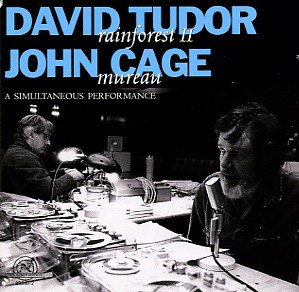
David Tudor, live electronics. John Cage, voice, pre-recorded tape. “This historic release of a simultaneous performance by David Tudor and John Cage of Rainforest II and Mureau, recorded live by Radio Bremen on May 5, 1972, preserves the only surviving performance of the second of Tudor’s Rainforest series. In addition, it documents one of the precious few recorded collaborations between these two visionaries. In 1970 Cage composed the piece called Mureau, in which phrases from Thoreau’s journals (in particular, passages which touch on the subject of music) are used as the springboard for an elaborate collage. The resultant fabric combines elements of sense and nonsense, as it veers between contextual meaning and a sort of abstract, linguistic vocalise. In Cage’s public readings of Mureau, he explored a number of performance variables-differences in tempo, vocal timbre, pitch, register, and dynamics. A similar range will be apparent, in fact, when listening to this recorded performance. This simultaneous performance of Mureau and Rainforest II took place in a large concert hall before an audience, rather than privately in a recording studio. Whereas in other performance realizations (such as their legendary Indeterminacy collaboration) the two men had been placed in separate isolation booths, here the two shared the same performance space, so that each could hear and see the other person’s activity. In fact, Cage and Tudor sat quite close to one another at the center of the stage, Cage performing Mureau as a four-channel realization-one live channel against three pre-recorded tracks, all of them his own voice-and Tudor actively engaged in real-time processing of Cage’s vocal material, using it to generate electronic loudspeaker-filter events. Essential listening for anyone interested in the work of either composer.”
24,00€
Out of stock
2 CD
Alvin CURRAN
“Maritime rites”
“In the middle 1970s I began to formulate ideas and projects leading to the making of music outside the concert halls-often in large open and naturally beautiful sites. Ports, rivers, lakes, caves, quarries, fields, and woods, always ready sources of my musical inspiration, now became my new music theaters.” - Alvin Curran
Maritime Rites is a series of ten environmental concerts for radio composed by Alvin Curran (b. 1938) in 1985. This series features the Eastern Seaboard of the United States as a musical source in collaboration with improvised musical performances by ten distinguished artists in the American new-music scene: John Cage, Joseph Celli, Clark Coolidge, Jon Gibson, Malcolm Goldstein, Steve Lacy, George Lewis, Pauline Oliveros, Leo Smith and Alvin Curran. The programs use specifically recorded natural sounds as musical counterpoint to the soloists whose improvisations are freely restructured and mixed by Curran. Featured here are the foghorns of Virginia, Maryland, Delaware, New Jersey, New York, Connecticut, Rhode Island, Massachusetts, New Hampshire, Maine and New Brunswick, Canada. Also included are maritime bells, gongs, whistles and regional bird and animal life. Comments from lighthouse keepers, Coast Guard personnel and other local people are woven impressionistically throughout.
Rich in ambient detail, Maritime Rites presents the foghorn as indigenous American “found” music par excellence and the source of one of the most enduring minimal musics around us. The series is also a comprehensive aural documentary of our regional and national maritime heritage including such historical sounds as the Nantucket II Lightship, now out of service and doing service as a museum docked in Boston Harbor. The Lightship’s horn is the only one of its kind (and the loudest!) on the East coast and was recorded extensively during an exclusive session ten miles off shore with the special cooperation of the ship’s crew. As the foghorn gives way to other electronic navigational aids, this work may serve as a historical document of some of the most beautiful and mysterious sounds of the sea.
As an expression of sonic geography, Maritime Rites brings together different areas of the Seaboard in a single musical moment. The series was expressly conceived for radio, the only medium that can safely accommodate over sixty foghorns at once and bring an entire coastline, seemingly live, into anyone’s home! An essential document for anyone interested in sound art.
24,00€
Out of stock
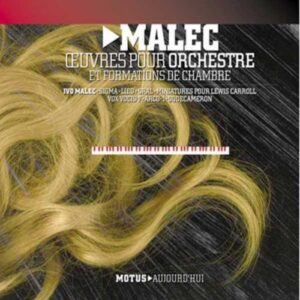
2 CD
Ivo MALEC
“Œuvres pour orchestre et formations de chambre”
“Sigma” (1963) for orchestra. “Lied” (1969) for 39 strings and 18 voices. “Oral” (1967) for performer and big orchestra. “Miniatures pour Lewis Carroll” (1964) for recorder, violin, harp and percussions. “Vox, vocis, F.” (1979) for 3 woman voices and 9 instruments. “Arco-I” (1987) for cello. “Dodecameron” (1970) for 12 voices.
24,00€
Out of stock
2 CD
WE WILL FAIL
“Hand that heals – Hand that bites”
Arriving like the mysterious fully formed monoliths in Stanley Kubrick’s 2001: A Space Odyssey is the new album from Warsaw, Poland based artist Aleksandra Grünholz aka We Will Fail. Despite the fact this isn’t her debut (that was 2014’s “Verstorung” also for Monotype Rec.), this new double barreled shotgun of an album entitled “Hand That Heals / Hand That Bites” rings with the boldest sense of arrival you could possibly imagine. With a unique sound that is neither electronic, noise nor experimental but a unique off-cut of the three assembled into a style all her own, Grünholz’s sound runs parallel to artists like Scott Walker, Autechre, Pharmakon, Daphne Oram, Pansonic, Grouper, Laurel Halo, Demdike Stare, Vessel and beyond.
Both dark and anxious, the seven “Hand That Bites” tracks follow the blood reds of its cover art, deeply rhythmic, pulsing, energetic and brimming with the intensity of an artist who has clearly arrived at an important place. Aleksandra notes “This part is ruder, more brutal, stronger, but at the same time more basic. The pulse, the harshness and the anxiety were really important to me. I know that some sounds are even dull. I left some parts dirty, raw. I wanted to show the strength that can seduce and mesmerize at the same time.” The rhythms here have some associations with Techno and club music, but for the artist this is music for listening rather than dancing. Like Emptyset and other sonic explorers Techno elements embedded are merely part of the construction – a sound reaching beyond any kind of norm.
The companion eight tracks, an alternative version of the same story according to Aleksandra, make up the “Hand That Heals” segment of the album. Again like its artwork, these tracks are lighter in touch, focused on atmosphere and experiments yet equally compelling and unique. Grünholz notes „I wanted one part to be more subtle with rich sound that was intricately constructed. I was concerned to make compositions that are really refined, full of details, so that each listening would allow listeners to find something new. There was some room for field recordings. I intentionally have chosen recordings of common situations – overheard conversation, some sounds recorded during travels – that in the same time are notations of specific memories.” Being a visual artist as well as a sound artist Grünholz works in ways that can sometimes be conceptual: “The titles were created before work on the album started – Hand that Heals / Hand that Bites – it was an irrational string of thoughts in my head for a long time – two inseparable elements that somehow make a complete configuration.” Yet the end result has proven here to be quite immediate.
The title of Aleksandra’s project We Will Fail comes from an observation – “I often think about perceiving reality. Everyone sees it a little bit differently. Our thinking affects how we interpret things that we see. Watching is not equal with seeing things how they really are. In conflict someone’s victory is always someone else’s failure. The fact that something could be black and white at the same time was the starting point to work on this new album.” We Will Fail has performed live on many European stages including at festivals such as CTM, Unsound Krakow and Unsound Toronto. The album will be accompanied by stunning visuals developed by the artist who also works as a graphic artist.
Both dark and anxious, the seven “Hand That Bites” tracks follow the blood reds of its cover art, deeply rhythmic, pulsing, energetic and brimming with the intensity of an artist who has clearly arrived at an important place. Aleksandra notes “This part is ruder, more brutal, stronger, but at the same time more basic. The pulse, the harshness and the anxiety were really important to me. I know that some sounds are even dull. I left some parts dirty, raw. I wanted to show the strength that can seduce and mesmerize at the same time.” The rhythms here have some associations with Techno and club music, but for the artist this is music for listening rather than dancing. Like Emptyset and other sonic explorers Techno elements embedded are merely part of the construction – a sound reaching beyond any kind of norm.
The companion eight tracks, an alternative version of the same story according to Aleksandra, make up the “Hand That Heals” segment of the album. Again like its artwork, these tracks are lighter in touch, focused on atmosphere and experiments yet equally compelling and unique. Grünholz notes „I wanted one part to be more subtle with rich sound that was intricately constructed. I was concerned to make compositions that are really refined, full of details, so that each listening would allow listeners to find something new. There was some room for field recordings. I intentionally have chosen recordings of common situations – overheard conversation, some sounds recorded during travels – that in the same time are notations of specific memories.” Being a visual artist as well as a sound artist Grünholz works in ways that can sometimes be conceptual: “The titles were created before work on the album started – Hand that Heals / Hand that Bites – it was an irrational string of thoughts in my head for a long time – two inseparable elements that somehow make a complete configuration.” Yet the end result has proven here to be quite immediate.
The title of Aleksandra’s project We Will Fail comes from an observation – “I often think about perceiving reality. Everyone sees it a little bit differently. Our thinking affects how we interpret things that we see. Watching is not equal with seeing things how they really are. In conflict someone’s victory is always someone else’s failure. The fact that something could be black and white at the same time was the starting point to work on this new album.” We Will Fail has performed live on many European stages including at festivals such as CTM, Unsound Krakow and Unsound Toronto. The album will be accompanied by stunning visuals developed by the artist who also works as a graphic artist.
16,00€
Out of stock
2 CD
Lionel MARCHETTI – Jean-Baptiste FAVORY
“100 000 années”
“Musique concrète composed in 1990-93. "Kitnabudja Town" was previously released by Metamkine (MKCD XXX, France, 1997). This is new version assembled in 2007 by Lionel Marchetti. Jean-Baptiste Favory: “Des sphères”. Electronic music recorded in 2005.”
17,00€
Out of stock
2 CD
Günter MÜLLER
“Buenos aires tapes”
Günter Müller (ipod, electronics) with Disc 1: Alan Courtis (unstringed guitar & tapes), Pablo Reche (sampler, md’s, electronics). Disc 2: Sergio Merce (4-track portastudio without tape, WX7), Gabriel Paiuk (piano, tapes). Disc 1 was recorded live February 9th and disc 2 February 10th, 2006 at Fundación Cultural Surdespierto, Buenos Aires by Gabriel Paiuk. Mixed and mastered by Günter Müller at Remisch Lupsingen. Cover art by Günter Müller.
17,00€
In stock
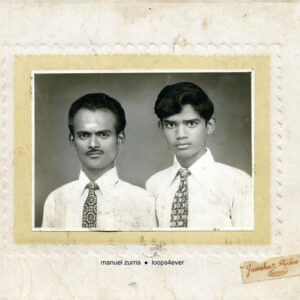
2 CD
Manuel ZURRIA
“Loops4ever”
“CD, 3 panels carton packaging with 12pp booklet. music by Alvin Lucier, William Basinski, John Duncan, Terry Riley, Pauline Oliveiros, Giancinto Scelsi among others...
[...] Foremost in my mind was the idea of being able to manipulate some compositions for flute, that were not original or were “extremely free ” in their conception, personalizing them to the extreme with the use of multitrace or electronics. Only a work conceived in this way has led me to reflect on this music from its inside, introjecting the point of observation in order to discover a new projection of the sound. In a certain sense the two discs represent the two ends of the repetitive element, Loops4ever is as valid as its homologous and antithetic Drones4ever.[...]“M. Z. (from CD’s notes).
With music from Giacinto Scelsi, Pauline Oliveros, Alvin Lucier, Alvin Curran, John Duncan, Jacob, Eve Beglarian, Jacob, Clarence Barlow, William Basinski, Frederic Rzewski, Terry Riley.”
21,00€
Out of stock
2 CD
AMM & MEV
“Apogee”
The first CD features a joint recording of the six musicians of Musica Eletttronica Viva and AMM together: Alvin Curran, Eddie Prévost, Keith Rowe, Frederic Rzewski, Richard Teitelbaum and John Tilbury. It was recorded April 30th 2004. The 2nd CD contains separate performances that MEV and AMM gave at the ’Freedom of the City’ festival, London on May 1st 2004. "After the generally low dynamic levels and relatively slow pace of the AMM trio set on 1 May, the MEV trio opened with the blast of Alvin Curran playing the sho far, a trumpet made from a ram’s horn, a ’defiantly primitive’, prototypical music, fit to leave the walls of the Conway Hall, like some new Jericho, pitched down fiat. If I spoke earlier of the way in which AMM might deal, in Reeve and Kerridge’s phrase, with the internal, microscopically-enlarged body surface which becomes a landscape - and the same is true of some of Teitelbaum and Curran’s quieter use of radically pitch-shifted and extended samples - particularly that ululating operatic-theatrical voice, coming to sound almost like something from AMM’s label-mates FURl - then this is the extrovert mode, which refuses any easy accommodations. Which division is inherent; as Bourdieu explains, the culture which unifies via the medium of communication is also the culture which separates via the culture of distinction, and which legitimates distinctions. It may be, as Adorno remarks, that a work of art is great insofar as it registers a failed attempt to reconcile such objective antinomies; failure then being in the highest sense the measure of success."
21,00€
Out of stock
2 CD
PARKER & PRÉVOST
“Most materiali”
Evan Parker: saxophones & Eddie Prévost: percussion. Recorded in 1997.
27,00€
Out of stock
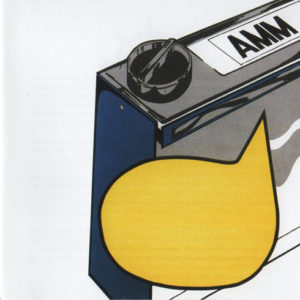
2 CD
AMM
“The crypt – 12th June 1968”
“This 2 CD version of The Crypt - 12th June 1968 is the third edition of this recording and contains all the material that was recorded at the session in question. The fades are at places where the tapes ran out. So there was some music that escaped into the ether. The earlier vinyl pressings limited the amount of material that could be published. And to be honest, after such a long time, we had forgotten about the material excluded hitherto. Despite being (arguably) the most ‘difficult’ material on Matchless, The Crypt has been a mainstay for the label. It obviously pays not to underestimate the audience. Its continued success has enabled us to release other works. So we felt committed, obliged almost, to keep it available. But as stocks ran low it became obvious that we would have to rethink its presentation. One CD would have meant omitting material contained in the double album boxed set. Two CDs enabled us to release the complete session. We took the plunge even though it was (is) a considerable strain on our cash-flow. But this music has proved itself not to be ephemeral.” Eddie Prévost - February 1992.
21,00€
In stock
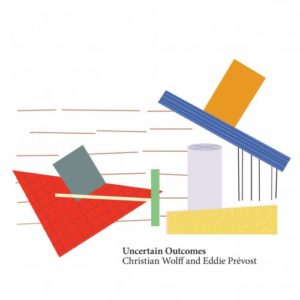
2 CD
Christian WOLFF and Eddie PRÉVOST
“Uncertain Outcomes”
Christian Wolff, piano and Eddie Prévost, percussion.
There are two concerts featured on this 2 CD album.
CD1 at Iklectik on 26th September 2015, London.
CD2 at the Faulkner Auditorium, Dartmouth College, Hanover, New Hampshire,
July 13, 2016.
There are two concerts featured on this 2 CD album.
CD1 at Iklectik on 26th September 2015, London.
CD2 at the Faulkner Auditorium, Dartmouth College, Hanover, New Hampshire,
July 13, 2016.
20,00€
Out of stock
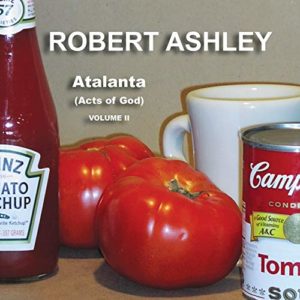
2 CD
Robert ASHLEY
“Atalanta (Acts of God) Volume II”
Robert Ashley, Jacqueline Humbert, voices; Tom Hamilton, mixing and electronics. Three of the satellite songs from Ashley’s opera Atalanta (Acts of God) - each inspired or revolving around one of the main characteris of the opera, Max, Willard and Bud. Atalanta (Acts of God) was written in the 1980s, begin while Ashley was still in production for the television opera, Perfect Lives. The many hours of material were performed throughout the world in many different configurations, but this is the first time these songs have been available on CD.
26,00€