
Out of stock

2 LP
Ustad Zia Mohiuddin DAGAR
“Raga Yaman (Rudra Veena // Seattle // 15 March 1986)”
Zia Mohiuddin Dagar : rudra veena. Manik Munde : pakhawaj. Gayathri Rajapur & Annie Penta : tanpuras. Recorded by unknown at the University of Washington, HUB Auditorium, Seattle, Washington 15 March 1986 ; concert co-sponsored by the UW Ethnomusicology Division and Ragamala.Original digitally processed audio recording made with Panasonic PV-9000 VCR, Sony PCM-F1, PZM mics. Mastered & Cut by Rashad Becker at Dubplates & Mastering 1117 & 0318.Liner notes by Renaud Brizard, edited by Ian Christe.“Around ten years ago, deep into a cozy and hazy night following a concert with my sound brothers Daniel O'Sullivan and Kristoffer Rygg in London (as Æthenor), they graciously introduced me to a recording of rudra veena (a kind of noble deeper bass relative to the sitar, in a way) as performed by dhrupad master Zia Mohiuddin Dagar.Dhrupad, for those who do not know, is a branch of Hindustani classical music said to "show the raga in its clearest and purest form". It's pacing concentrates heavily on the slow, contemplative alap section and works with specific microtonal gestures and deep characteristics of resonance ... in short I was hooked on this new (to me) and ancient form of music from the first listen, and feel that a more or less continual listening & reviewing of Zia Mohiuddin Dagar's recordings in the years that followed have influenced my own approach to music quite heavily (if, albeit, indirectly).In early 2015 I was able to make contact with Zia Mohiuddin Dagar's son Bahauddin and some of his American students/disciples, primarily Jeff Lewis. Over time we developed a friendly and educational exchange, access a massive archive of recordings and developed these two paired titles for my label. It's been a long path to arrive at actually releasing them but also probably in many ways one of the most significant releases I've worked on. And I'm proud to be able to reveal these to date unreleased archival recordings of one of the masters of dhrupad, Z. M. Dagar, to the public for the first time.Zia Mohiuddin Dagar was the nineteenth generation in a family tradition known as Dagar gharana, a rich lineage which continued and performed the musical form of dhrupad (Bahauddin Dagar continues the lineage as a master rudra veena dhrupad player of note today). Initially, dhrupad was a rigorous, austere, devotional genre that was sung in Hindu temples. But between the 16th and the 18th centuries, it became the preeminent genre in royal courts in North and Central India, and the Dagar gharana developed and continued publicly following the eventual loss of court patronage for dhrupad in the 19th century. The French ethnomusicologist Renaud Brizard covers the story of Zia Mohiuddin Dagar's life and teaching (a long story also in Seattle, my hometown!), the Dagar family and gharana, the rudra veena and more topics in an extensive set of liner notes in this release.Raga Yaman was recorded at a public concert in Seattle at the HUB Ballroom at the University of Washington in March 1986 (the week after the accompanying release SOMA028 Ragas Abhogi & Vardhani was recorded) at the end of his last tour of the United States. Yaman was a special raga for Zia Mohiuddin Dagar, one of his signature raags. For centuries, Yaman has been considered as one of the most fundamental ragas in Hindustani music and is one of the first ragas which is taught to students. A deep knowledge of Yaman gives a key for understanding many other ragas. It's filled with tranquility, contemplation, pathos and spiritual yearning.”-Stephen O'Malley, March 2018, Paris, France
23,00€
Out of stock

2 LP
Ustad Zia Mohiuddin DAGAR
“Ragas Abhogi & Vardhani”
Zia Mohiuddin Dagar : rudra veena. Annie Penta : tanpura.Concert recorded at the home of Shantha and Niranjan B. Benegal, Seattle, Washington 9 March 1986. Recorded by Niranjan Benegal. Files obtained from Jeff Lewis. Mastered & Cut by Rashad Becker at Dubplates & Mastering. Liner notes by Renaud Brizard, edited by Ian Christe.“Around ten years ago, deep into a cozy and hazy night following a concert with my sound brothers Daniel O’Sullivan and Kristoffer Rygg in London (as Æthenor), they graciously introduced me to a recording of rudra veena (a kind of noble deeper bass relative to the sitar, in a way) as performed by dhrupad master Zia Mohiuddin Dagar.Dhrupad, for those who do not know, is a branch of Hindustani classical music said to "show the raga in its clearest and purest form". It's pacing concentrates heavily on the slow, contemplative alap section and works with specific microtonal gestures and deep characteristics of resonance ... in short I was hooked on this new (to me) and ancient form of music from the first listen, and feel that a more or less continual listening & reviewing of Zia Mohiuddin Dagar's recordings in the years that followed have influenced my own approach to music quite heavily (if, albeit, indirectly).In early 2015 I was able to make contact with Zia Mohiuddin Dagar’s son Bahauddin and some of his American students/disciples, primarily Jeff Lewis. Over time we developed a friendly and educational exchange, access a massive archive of recordings and developed these two paired titles for my label. It’s been a long path to arrive at actually releasing them but also probably in many ways one of the most significant releases I’ve worked on. And I’m proud to be able to reveal these to date unreleased archival recordings of one of the masters of dhrupad, Z. M. Dagar, to the public for the first time.Zia Mohiuddin Dagar was the nineteenth generation in a family tradition known as Dagar gharana, a rich lineage which continued and performed the musical form of dhrupad (Bahauddin Dagar continues the lineage as a master rudra veena dhrupad player of note today). Initially, dhrupad was a rigorous, austere, devotional genre that was sung in Hindu temples. But between the 16th and the 18th centuries, it became the preeminent genre in royal courts in North and Central India, and the Dagar gharana developed and continued publicly following the eventual loss of court patronage for dhrupad in the 19th century. The French ethnomusicologist Renaud Brizard covers the story of Zia Mohiuddin Dagar's life and teaching (a long story also in Seattle, my hometown!), the Dagar family and gharana, the rudra veena and more topics in an extensive set of liner notes in this release.Ragas Abhogi & Vardhani were recorded in a private house concert in Seattle at the home of the Benegals in March 1986 (the week before the accompanying release SOMA029 Raga Yaman was recorded). The Benegals were friends (& Shantha Benegal was also a student) of Dagarsahib who sometimes hosted Hindustani music concerts in their home. It's a rare glimpse of a more intimate, personal and perhaps different kind of performance considering the form of dhrupad.”-Stephen O'Malley, March 2018, Paris, France.
23,00€
Out of stock

2 LP
Ragnar JOHNSON
“Crying Bamboos: Ceremonial Flute Music from New Guinea Madang”
Recorded by Ragnar Johnson. Notes by Ragnar Johnson and Jessica Mayer. Photographs by Ragnar Johnson. Tape to digital transfer and mastering by Dave Hunt at Dave Hunt Audio, London. Cut by Rashad Becker at Dubplates and Mastering, Berlin.Crying Bamboos is a translation of the pidgin description of the sound of sacred flutes: “Mambu i cry, i cry, i cry”.Sacred flutes are blown to make the cries of spirits by adult men in the Madang region of Papua New Guinea. Pairs of long bamboo male and female flutes are played for ceremonies in the coastal villages near the Ramu River. There are seven male initiation flute cries from Bosmun, four flute cries from Bak: Borai with occasional single garamut percussion and two flute cries from Kaean, one with vocals and hand drums. The flute players were of the last generation to have learned this skill during a complete cycle of male initiation. These previously unreleased recordings were made in 1979.
23,00€
In stock

LP
Jacques THOLLOT’S INTRA MUSIQUE
“More Intra Musique”
Produced in collaboration with the legendary Jac Berrocal’s label d’Avantage, “More Intra Musique” is the second LP in alga marghen’s series dedicated to previously unreleased recording by the drummer and experimentalist Jacques Thollot. While the furious “Intra Musique” free jazz first LP was centered on a live recording with Michel Portal, Eddie Gaumont and Mimi Lorenzini at the Faculty of Law in Paris, on an evening in 1969, it is an unexpected Jacques Thollot that we encounter on this second LP, vivid and blazing even more than we already knew.Jacques Thollot was a major force in the French free jazz scene, collaborating with artists at the level of Don Cherry, Steve Lacy, Sonny Sharrock, Joachim Kühn as well as with French pioneers Jef Gilson and Barney Wilen. Starting from 1971 he released “Quand le son devient aigu, jeter la giraffe a la mer” or “Watch Devil Go” on Futura and Palm Records, or some of the most relevant and revolutionary sonic masterpieces in France.“More Intra Musique” is free improvisations of course, but also synthetic jitters, musique concrète and loop experiments, sketched pop songs, minimalist trances with African accents, or simply the promiscuity of a lullaby or the voice of a child posed like a bird in a Norman garden. These long lost visionary recordings featuring Eddie Gaumont on prepared piano and Jacques Thollot on drums, piano, prepared piano, synth and tapes are an absolute revelation which make us rethink everything we know about French free improvisation.Tape manipulation created as a potential background for a live set?Bursting rehearsal with Eddie Gaumont? Is the piano well prepared?Besides the stingy mention “Intra Musique” sticked on the reel, nothing is known of this recording. Who cares really? Let’s just play it loud!Edition of 350 copies.
19,00€
In stock
LP
David GRUBBS & Taku UNAMI
“Failed Celestial Creatures”
The release was recorded by Taku Unami at Soto, Kyoto, August 7th and 9th, 2017 and mastered by Rashad Becker at D&M. The LP is produced in an edition of 500 on 180 gram vinyl.Empty Editions is pleased to present Failed Celestial Creatures, an unexpected collaboration between composer-guitarist David Grubbs (Gastr Del Sol, The Red Krayola) and Tokyo-based musician Taku Unami. Primarily recorded in Kyoto, the album takes inspiration from the duo’s shared musical and literary influences, emerging just as much from their improvisatory explorations as from an eclectic reading list exchanged prior to the recording sessions. The album’s narrative inclinations are rooted in both artists’ previous experiments with the complex reciprocity between sound and text, including Grubbs’ work with the poet Susan Howe and Unami’s collaborations with writers such as Eugene Thacker and Evan Calder Williams.Failed Celestial Creatures draws in particular upon a group of short stories by the short-lived Japanese author Atsushi Nakajima (1909-42) - perhaps best known for inflecting Classical Chinese folktales with a modernist vein of absurdist and existential foreboding - as the imaginary backdrop for its set of guitar-based instrumental explorations.The album’s title-track consists of a side-long progression of dirge-like riffs enveloped by clouds of vaporous electronics - eventually erupting into unruly squalls of feedback as Unami joins Grubbs on electric guitar. The B-side features a cluster of luminous guitar duets which are beguiling in their seeming effortlessness and simplicity. Threadbare and fallen, Grubbs and Unami invoke the failed ritual, the spilling at the altar, always suggested at the precipice of sonic emergence.
24,00€
In stock

3 LP
Paul PANHUYSEN
“Long String Installations”
After two LPs in 2014 and 2017, Edition Telemark now turns to the group of works that is probably the most well-known within the vast oeuvre of Dutch sound and visual artist Paul Panhuysen (1934–2015): his long string installations. Using this term, he referred to all of his works involving strings and sounds. They were realized all around the world between 1982 and 2012 – until 1991 mostly together with Johan Goedhart –, each installation made specifically for the site where it was displayed.Unlike other artists working with long strings around the same time, e.g. Ellen Fullman and Terry Fox, Panhuysen’s strings were instruments or performative material only secondarily. Rather, his installations can be considered sculptural and sounding events in space, operating in between two lines of tradition, constructivism and situationism, that are evident also in many other parts of his oeuvre.The first recordings of Panhuysen’s long string installations were published in the 1980s, most famously on a 3-LP box set edited on Apollo Records in 1986.This new 3-LP set includes solely unreleased recordings made between 1982 and 2012, with one recording added posthumously in 2017. It is presented in a triple gate-fold sleeve with printed inner sleeves containing liner notes by Rolf Sachsse and Stephan Wunderlich as well as various high-resolution photos.Regular edition of 250.
60,00€
In stock
LP
Pali MEURSAULT
“Stridulations”
Pali Meursault is a sound artist, composer and sound designer. His electroacoustic and sound art research takes different shapes: compositions for records, radio works, installations or performances. Environmental sound recording is central in his work, which takes from Musique Concrète and the sonic exploration of soundscapes.For stridulations, Meursault confronts recorded and performed sounds, composition and improvisation: field-recordings of animal communication (insects, birds and bats recorded in France, Japan and South America over almost ten years) mix and dialog with the ‘sonification’ of fluorescents tubes.Both the environmental sound matter composition and the electromagnetic instrument have evolved with performances between 2014 and 2017. Little by little, new recordings were collected and new electrical and electronic supplies were added to the setup. The record is altogether the outcome of that process and a different take on the project, leaving the synesthetics of the flickering lights but embracing the deepness of ‘blind’ listening.For Pali Meursault, the long research for stridulations has been a practice for deconstructing binary oppositions between nature and machine, bio- and anthropo-phony, and instead to explore the strange sonic affinities that exist between some animal voices and technological phenomena. The performances were a way of switching from a contemplative and ideologic relation to the soundscape to a praxis of noise, using animals and electromagnetic sounds as sonic qualities, possibilities, and intensities. Mastered and Cut by Rashad Becker.
16,50€
In stock
LP
The DWARFS OF EAST AGOUZA
“Rats Don’t Eat Synthesizers”
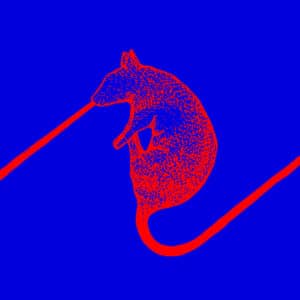
Alan Bishop: acoustic bass, alto sax. Sam Shalabi: electric guitar. Maurice Louca: organ, synthesizers, beats.Akuphone in collaboration with Annihaya is very proud to present “Rats Don’t Eat Synthesizers” the long-awaited second album by the Dwarfs of East Agouza. Hailing from the Agouza district of Cairo, Egypt, this brilliant trio consists of Alan Bishop (Acoustic Bass & Alto Sax), Maurice Louca (Keyboards & Drum Machine) and Sam Shalabi (Electric Guitar).Following their acclaimed first album “Bes “, this new long play is composed of two hypnotic journeys: “Rats Don’t Eat Synthesizers” and “Ringa Mask Koshary”which was recorded in Cairo in September of 2015.Mesmerizing electric guitar parts, frenetic beats, both supported by the deep sound of Alan’s acoustic bass create a new magical Egyptian soundscape.Vinyl version is coming with a beautiful hot-foil stamped sleeve that magnifies the red metallic rats and a wonderful printed inner sleeve. Includes redeem code. Limited Edition.
21,00€
In stock
7"
KONSTRUKT
“Bloppin’”
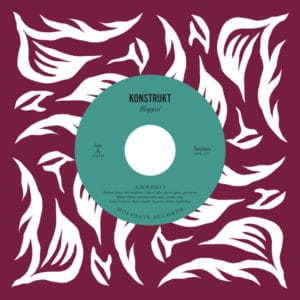
To be considered a twin release of the previous For Ornette 7”. The single consists of two more short tracks - taken from the same Hayyam session - where the five-piece goes bebop, building some rhythmic and harmonic complexity filled by solo virtuosisms of core-members Korhan Futacı (saxophone) and Umut Çağlar (electric guitar).Limited one-time pressing of 200 copies on black.
10,00€
Out of stock

LP
BELONG
“October Language”
“October Language” is the debut album by New Orleans based duo Belong, comprised of Turk Dietrich and Mike Jones.Since it's release in early 2006, Belongs debut masterpiece has accumulated a dedicated cult following, with comparisons to the work of Christian Fennesz and Gas, with some claims that it plays like My Bloody Valentine’s “Loveless” sans the songs. While these comparisons are useful for filing this album into a particular bin in the record shop, time has proven that “October Language” is a unique album which remains unmatched by its contemporaries.Despite the warm and welcome accolades of the albums arrival, there was no vinyl pressing until 2009, of which a limited one-time pressing vanished immediately. Spectrum Spools is pleased to present a pristine vinyl cut to go with reimagined album art for the definitive edition of this legendary classic.Physical copies include a download card with 3 extra tracks from the impossibly rare Tour EP from the same era. These tracks are exclusive to the vinyl purchase and are not available through digital outlets.
16,00€
Out of stock
LP
Tasos STAMOU
“Musique con Crète”
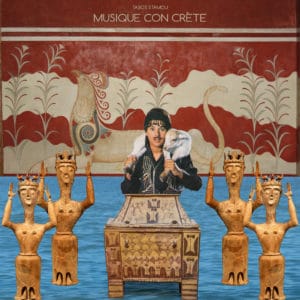
Limited pressing of 300 units.The project is the result of a three-year creative research project across Crete (GR). Starting with an artist residency the musician visited the Greek island over the course of three summers, collecting field recordings, performing with local musicians, producing electronic compositions and gathering old records and tapes of traditional music of the region. The project resulted in the assembling of a unique sound collage which reflects his personal experience as a music visitor to this part of the Mediterranean with one of the richest ancient history and living traditions.About the artist: Tasos Stamou is an electroacoustic music composer, performer, alternative music technologist and tutor. He has collaborated in recording and performing projects with a wide range of free improvisers and sound experimentalists (Adam Bohman, Steve Beresford, Sharon Gal, Alan Wilkinson, London Improvisers Orchestra, Mike Cooper, Andrea Parkins, Kuupuu & Lau Nau, Terry Day, Adachi Tomomi, Ignaz Schick, Magda Mayas, Arma Agharta, Thodoris Ziarkas, etc.).
15,00€
In stock

LP
Henning CHRISTIANSEN
“Den Røde Skov”
Edition: 500 copies.Second in a series of two previously unreleased soundtracks Henning Christiansen made for the films made by his partner and collaborator Ursula Reuter Christiansen. Den Røde Skov (The Red Forest) was Ursula’s second film made in 1986.In stark contrast to the exquisite romantic melancolia of their first collaboration, The Executioner, Den Røde Skov resides as one of the wildest recordings in the entire Christiansen catalogue. Aligned more with works like the legendary collaboration with Nam June Paik and Joseph Beuys, Abschiedssymphonie, Den Røde Skov unfolds as a delirious and demonic audio exhibit, at once deeply e ccentric and utterly enthralling. Featuring the exceptional sound work of Ernst Kretzer and contributions from Ursula Reuter Christiansen, Addamaria Reuter Christiansen, Bjørnstjerne Reuter Christiansen, Carla Tató and Werner Durand this is a rich tapestry of sounds, voice and obtuse atmospheres drifting from the deeply meditative to the outright hysterical. Den Røde Skov was remastered by Giuseppe Ielasi from the original master tapes sourced from the Henning Christiansen Archive and comes as a deluxe limited edition of 500 copies on red vinyl housed in a full colour gatefold sleeve incorporating a full sized 8 page booklet featuring a selection of striking images from the original film.
27,00€
Out of stock

LP
Luc FERRARI
“Atelier de Libération de la Musique”
alga marghen proudly presents Luc Ferrari’s Atelier de Libération de la Musique, a collective he created together with Martin Davorin Jagodic, Philippe Besombes and Alain Petit in 1975 for a series of performances at the Galliera Museum in Paris.It was in those years that Luc Ferrari investigated open forms and created some of the most experimental and elusive works of his entire catalogue. “Exercices d’improvisation”, first recorded by Brunhild Ferrari with GOL, issued on PLANAM in 2010 (very last copies still available); but specially “Ou donc est-t-on?”, a very complex piece soon to be documented on alga marghen including both “Dance”, issued on alga marghen on the occasion of the presentations at Centre Pompidou in 2009 (now sold out) and “Ephemere”, issued on CD by alga marghen in 2010 (still available), as well as the “Labyrinthe de la violence”, an audio-visual permanent labyrinth for which Ferrari created four fantastic electronic music pieces soon to be published on alga marghen. After these experiences the composer decided to discontinue these open practices for a more controlled work in the studio.And within the “Labyrinthe de la violence” installation Luc Ferrari conceived a series of electro-visual concerts to be performed by the newly created Atelier de Libération de la Musique. The collective included some of the most creative artists of the time: together with Luc Ferrari playing the electric organ we find on electric piano Martin Davoric Jagodic (whose masterpiece of electronic music titled “Tempo Furioso” was issued on Cramps in Italy that same year), on synthesizer Philippe Besombes (of Pole fame) and on sax, flute and clarinet Alain Petit (who was at the time collaborating with Besombes at the wonderful “Besombes / Rizet” double LP). These four artists met in February and March of 1975, rehearsing for a series of concerts to take place within the audio-visual labyrinth. It is the previously unheard recordings from these wild rehearsals which make up this incredible LP. The sound of Atelier de Libération de la Musique is a thrilling and overwhelming ride. Rattling, difficult polyrhythms play against droning, pulsing and simmering sonorities. These recordings are human and open, wild and incredibly ahead of their time.First edition limited to 500 numbered copies with obi.
22,50€
In stock
LP
Anne-James CHATON & Andy MOOR
“Tout ce que je sais”
The duo Anne-James Chaton and Andy Moor has produced original works where poetry and guitar combine in explorations of thematic axes. With the project ‘Heretics’, of which Tout Ce Que Je Sais (All I know) is the second part, they revive the most obscure, violent, erotic passions, summoning the great figures of their personal mythologies. In the company of Caravaggio, Marquis de Sade, William Burroughs and figures such as Jose Mujica, the duo immerses the listener in another world history peopled by radical thinkers. 'Heretics' pays homage to those heroes who used transgression and excess as a necessary means for the advance of humanity. In this new album, recorded live at the Carreau du Temple in Paris on the occasion of Périphérie du 35e Marché de la Poésie (2017), Anne-James Chaton and Andy Moor deliver a radical work at the confines of literary and musical creation.
15,50€
In stock

LP
Steve LACY / Yuji TAKAHASHI / Takehisa KOSUGI
“Distant Voices”
High quality reissue of Steve Lacy’s rare Japanese collaboration album Distant Voices. 180gr. vinyl and 4 page insert with liner notes by Julian Cowley.Thelonious Monk, Mal Waldron, Don Cherry, Roswell Rudd, Derek Bailey, Musica Elettronica Viva – saxophonist Steve Lacy played with them all. Renowned for remarkable solo concerts that confirmed his mastery of the soprano horn and that carried its instrumental language into previously unexplored regions, Lacy also loved to collaborate with musicians who could inspire him to stretch the boundaries of his own artistry.During the summer of 1975 Lacy toured Japan, and on June 24th he entered a Nippon Columbia studio in Tokyo with Yuji Takahashi and Takehisa Kosugi, two adventurous kindred spirits, guaranteed to fire Lacy’s creative imagination. The fascinating outcome of that dynamic session is Distant Voices, an album without parallel in Lacy’s extensive discography.On 24th June 1975 Takahashi sat at a grand piano, with celeste and vibraphone alongside him and small bells attached to his hands. Kosugi was equipped with violin, flute, mouth organ, an electronic modulator, porcelain bowls and at times he used his voice. Lacy played soprano saxophone, of course. Now and then he pressed the mouth of the instrument against the skin of a kettle drum. He occasionally fiddled with a transistor radio, and also found uses for a stepladder, a toothbrush and a spinning wheel. This was in no sense a routine musical session. Distant Voices preserves a unique occasion when three singular musicians joined together to embrace the unknown.
23,00€
In stock

LP
John TILBURY / Keith ROWE / Kjell BJØRGEENGEN
“Sissel”
John Tilbury and Keith Rowe have performed together within the legendary improvising ensemble AMM, as well as in numerous other contexts over the years. Duos for Doris (2003) was their first meeting as a duo, E.E. Tension and Circumstance (2010) was the second before the 4CD box on SOFA, enough still not to know, was released in 2015. enough still not to know also introduces the Norwegian video artist Kjell Bjørgeengen as a collaborator, in this case credited as the producer of the album. Bjørgeengen, being a long time collaborator with both Tilbury and Rowe, became an integral part of the group with Sissel.SOFA is proud to continue to present the work of Tilbury and Rowe's long time collaboration, but also equally proud to hear Kjell Bjørgeenges as a performer on this deeply moving album captured by Espen Reinertsen at the concert series Moving Sound in Stavanger 2016. The album is dedicated to the memory of Kjell's wife Sissel, who passed away some weeks before the performance.Keith Rowe writes the following about Sissel:When Kjell suggested a painting by Nicolas Poussin “The gathering of the ashes of Phocion by his widow” (1648) as a possible focal point for our performance in Stavanger, his suggestion immediately resonated. At the National Gallery London we have stood in front of this very painting, I got a sense on how we might share a reading of this painting largely based on TJ Clark’s book The Sight of Death.In “The gathering of the ashes of Phocion by his widow”, we find in the foreground the central figure of Phocion’s widow on her hands and knees surreptitiously gathering the ashes of the executed Phocion, who had become a victim of political manoeuvring, while her maid standing behind keeps watch. Phocion has been denied a proper burial, his body burned on open ground, by necessity his widow must collect his remains secretively.In the middle ground are the local people going about their daily tasks. Overseeing all of this are two large trees, bearing witness to the comings and goings of human life, they watch, observe, track, without words, they are mute, and it’s this muteness that interest me. It’s where my music has been heading for during the past decade, a mute scratching in the foreground, and the chatter and clatter of human life somewhere vaguely behind. During the performance in Stavanger a recording of JS Bach’s Chaconne BWV1004-5 (Tayiana Nikolayeva) is played, but you cannot hear it, it is silent, it is mute.I ask myself, why for such a distressing event as the death of a dear precious friend Sissel finds its expression in muteness, why muteness? I think it relates to another Poussin painting Landscape with a Calm (1650-51). In this painting we see, in the exact same spot as the widow, a curly haired shepherd gazing out over a lake. But there is something strange here, the sky is full of turbulent stormy clouds, but the reflection on the lake is completely calm. Maybe it’s here where the disruptive turbulent shocking distressing news of the death of a dear friend who we loved locates its muteness.Again the trees are watching.
17,00€
In stock

LP
Joe TALIA
“Tint”
Tint is the first new solo recording from Joe Talia in over a decade. Australian-born but now based in Tokyo, Talia is known to many listeners as a drummer (frequently collaborating both live and in the studio with artists such as Oren Ambarchi and Jim O’Rourke) and as a recording and mixing engineer responsible for dozens of releases across the fields of contemporary experimental music, wayward pop, and jazz. Alongside James Rushford, he is also responsible for one of the most legendary releases in the Kye records catalog, the creaking electronic morass of Manhunter (2013). Lovingly crafted over many months in his tiny Tokyo studio, Tint is an album-length electroacoustic suite that brings together Talia’s expertise as percussionist, studio engineer, and performer on analog electronic instruments (primarily modular synth and Revox tape machine). Ranging from minimalist austerity to kosmische lushness, Tint refreshingly refuses the dark and moody sonic palette of much contemporary electroacoustic music in favor of an airy, at times almost weightless sound-world of gliding tones, skittering percussion, and burbling field recordings. Drawing inspiration from Jean-Claude Eloy’s epic concrète love letter to Tokyo, “Gaku-No-Michi”, Talia makes extensive use of his own recordings of his new home, but removes any sense of audio verite, abstracting them into transparent glosses of outdoor ambience or unidentifiable chimes and creaks. Flowing seamlessly between distinct episodes, Tint is compositionally controlled while retaining a sense of played spontaneity, eventually building to a maelstrom of analog synth zaps and tape manipulated percussion that reflects Talia’s deep engagement with the relentless yet constantly shifting dynamics of free jazz. Stunning photographs by Joe Talia. Album design by Stephen O’Malley. Mastered and cut by Rashad Becker at Dubplates & Mastering, Berlin.
Original price was: 23,00€.14,00€Current price is: 14,00€.
In stock
LP
Charlemagne PALESTINE
“Aa Sschmmettrroossppecctivve”
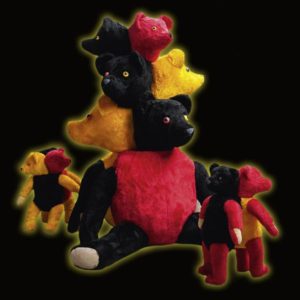
Available on June 1.Published on the occasion of Charlemagne’s “Aa Sschmmettrroossppecctivve” exhibition, audioMER. is proud to present historical piano recordings dating from circa 1974. They were played on a Bösendorfer model 220, regarded by some as the “Rolls Royce” of pianos, at Charlemagne’s 64 North Moore Street studio, Tribeca in New York.The music here represents Charlemagne’s infamous “strumming” technique, which he describes himself in a 2002 interview with Perfect Sound Forever as follows: “My first piano music resembles impressionists like Debussy or Ravel but it’s played through four or five hours, including some little arpeggios and played over and over again in thousands of different ways… Later on, I began to see that I’d played the piano like a flamenco guitar, that many overtones could change and the music that came out had a density and verticality – thanks to the overtones – which was extraordinary.”Based in Brussels for 20 years now, his iconic work consisting of teddy bears, divinities and other enchanting encounters is now exhibited in Bozar (“Aa Sschmmettrroossppecctivve”, 18 May – 26 August 2018). For the occasion, Charlemagne Palestine also presents two exceptional musical performances at the Kunstenfestivaldesarts.
22,00€
Out of stock

LP
Francisco MEIRINO
“La Plainte”
Jungle spirits, shamanism, trance music and other “surprises” are stacked, superimposed and spiral in space and our ears in a powerfully captivating way. A first-rate cathartic whirlwind, for a fireworks display highlighting the swarming material and meta-sounds of human population. This piece by Francisco Meirino is largely composed by using samples from the sound archives of the MEG (Ethnographic Museum of Geneva).Highly recommended.
20,00€
In stock

2 LP
TAJ MAHAL TRAVELLERS
“August 1974”
High quality reissue of the monumental work August 1974 by Japanese experimental music ensemble Taj Mahal Travellers. Pressed on 180gr. vinyl with extensive liner notes by Julian Cowley.In April 1972 a group of Japanese musicians set off from Rotterdam in a Volkswagen van. As they crossed Europe and then made their way through Asia they made music in a wide range of locations. They also paid close attention to the changing scene and to differing ways of life. Midway through May they reached their destination, the iconic Taj Mahal on the bank of the Yamuna river in Agra, India. The Taj Mahal Travellers had fulfilled physically the promise of the name they adopted when they formed in 1969. But their music had always been a journey, a sonic adventure designed to lead any listener’s imagination into unfamiliar territory.The double album August 1974 was their second official release. The first July 15, 1972 is a live concert recording, but on 19th August 1974 the Taj Mahal Travellers entered the Tokyo studios of Nippon Columbia and produced what is arguably their definitive statement. The electronic dimension of their collective improvising was coordinated, as usual, by Kinji Hayashi. Guest percussionist Hirokazu Sato joined long-term group members Ryo Koike, Seiji Nagai, Yukio Tsuchiya, Michihiro Kimura, Tokio Hasegawa and Takehisa Kosugi.August 1974 captures vividly the characteristic sound of the Taj Mahal Travellers, haunting tones from an unusual combination of instruments, filtered through multiple layers of reverb and delay. Their music has strong stylistic affinities with the trippy ambience of cosmic and psychedelic rock, but the Taj Mahal Travellers were tuning in to other vibrations, drawing inspiration from the energies and rhythms of the world around them rather than projecting some alternative reality. Films of rolling ocean waves often provided a highly appropriate backdrop for their lengthy improvised concerts. This is truly electric music for the mind and body.
28,00€
In stock

LP
Oren AMBARCHI / Kassel JAEGER / James RUSHFORD
Face Time”
Available on June 1.Comes in neon orange coloured vinyl !Face Time is the second release from the trio of Oren Ambarchi, Kassel Jaeger, and James Rushford, following on from their 2016 debut Pale Calling. Recorded at the GRM studios in Paris in June 2017, the record immediately returns to the idiosyncratic sound-world of the trio’s first release, a simmering stew of electronic smears, pitched-down animal moans, and mysteriously emotive microtonal organ chords. But before long the record takes an unexpected turn, as sounds that initially enter as occasional percussive pitter-patter build to a halting rhythm. Equally reminiscent of Basic Channel-style dub techno and the sound of a microphone loose in a pocket, these stumbling rhythmic figures provide the framework for the remainder of the record’s two sides, occasionally receding into the background to allow squelching electronics, chiming bells, distorted autoharp, inchoate grunts and the sound of a Cristal Baschet to take centre stage, but each time returning with the inevitability of a an idée fixe.Eschewing any clear sense of form, the two side-long pieces move seamlessly through episodes with the organic flow of improvisation, embracing the happy accidents of events conjoined by chance and lingering on liminal moments. Gradually washing out into a cavernous roar, the record’s final moments are suddenly enlivened by shimmering metallic percussion and a sequence of woozy synth chords, combining with the muted rhythms and a distant thunderstorm to become a sort of oneiric tribute to the work of Wally Badarou. Bringing together three of contemporary experimental music’s most individual voices, Face Time is an essential slice of outsider electro-acoustics.
21,00€
In stock

LP
Marta DE PASCALIS – HOWLROUND
Edition of 200 copies.
Marta De Pascalis “Her Core” /Howlround “Hard Core”.
The shadowy forces behind The Tapeworm are delighted to announce the latest release to come flying out of The Wormhole. On a limited edition split LP two of Europe’s foremost exponents of the tape loop go head-to-head, recorded within the hallowed environs of a former Buddhist Monastery – with dramatically un-Zen results.
On one side, Italian composer Marta De Pascalis mixes loops and analogue synthesis to create densely layered collages of glowing melodic shards and growling bass distortion, her hypnotic minimal synth figures warping and whirling around each other before dissolving into entropic oblivion. ‘Her Core’ is a rusty, sand-blasted slab of heaviness that provides the perfect continuation from her two solo albums – a hall of mirrors collapsing in on itself, over and over.
Meanwhile, Howlround is in full contraction mode on ‘Hard Core’, heading directly into the murky innards of a quartet of vintage reel to reel machines and using live tape delay to create syncopated rhythmic pulses, crackles and squelches that founder member Robin The Fog describes as ‘accidental gabber’. Originally rising to notoriety through sonic portraits of entire buildings, here Howlround dramatically scale down the subject matter to concentrate on mapping out the endless psychedelic dimensions of a circuit board, discovering a whole new world of creative potential in the process.Both sets were recorded live at London venue Iklectik during the fall of 2017 at “A Can of Worms”, an event to celebrate The Tapeworm’s 100th release. What’s perhaps most remarkable about this LP is that it captures a pair of artists in a snapshot, in parallel. Here, Howlround shakes off the back catalogue, stepping out of the comforting confines of the studio. De Pascalis plays harder than ever before. Both artists taken by a moment, into the harsh glare of the unknown. The fact that each has created their noisiest and most abrasive work yet will surely be seen as a happy coincidence. A can of worms, indeed…
16,00€
Out of stock

2 LP
Sergei TCHEREPNIN
“Quasar <-> Lanterns”
Sergei Tcherepnin’s Quasar <-> Lanterns was originally produced in 2009 as an 8-channel installation with Ei Arakawa at Künstlerhaus Stuttgart. Remixed to stereo for this release, Tcherepnin’s trio of works combine analog synthesizer recordings and other instrumental sources with field recordings captured during the artists’ travels to Turkey and Georgia. Each piece introduces a separate facet of Tcherepnin’s compositional practice, respectively probing the boundaries between perception/hallucination, active/passive listening, and form/fiction. In the first piece, titled “Death (Quasar)”, recordings of an acoustic bass played by Adam Linson function as “sound meteors,” creating fissures and tears as they rip through a stable yet shifting aural field. “Sky” follows with a series of clear and high ear tones, unfolding as a succession of subtle sonic events. The final piece “Horse” explores the rhythmic and textural qualities of recorded horse hooves moving across stone, assembling the sounds into a sonic fiction in which horses and their riders leave the earth via flying carpets (objects referenced in the original installation).
Sergei Tcherepnin is a Brooklyn-based artist and musician. His work constructs temporary architectural interventions that push phenomena of the sonorous towards the haptic through performance, composition, and installation, exploring the materiality of sound and its physical and psychological effects on the listener. Recent performances and installations have been held at the 2014 Whitney Biennial, the 30th Sao Paulo Biennial, Guggenheim Museum, Audio Visual Arts, Murray Guy, and ISSUE Project Room.
Sergei Tcherepnin is a Brooklyn-based artist and musician. His work constructs temporary architectural interventions that push phenomena of the sonorous towards the haptic through performance, composition, and installation, exploring the materiality of sound and its physical and psychological effects on the listener. Recent performances and installations have been held at the 2014 Whitney Biennial, the 30th Sao Paulo Biennial, Guggenheim Museum, Audio Visual Arts, Murray Guy, and ISSUE Project Room.
Original price was: 28,00€.10,00€Current price is: 10,00€.
In stock

2 LP
Sabisha FRIEDBERG with Peter EDWARDS
“The hant variance”
Sabisha Friedberg’s 2 LP The Hant Variance was recorded at EMPAC with Peter Edwards in a custom-tuned environment using advanced multi-channel recording techniques to capture a configuration of spatialized sound sources. Combining granular synthesis, analogue synthesizers, tone oscillators and field recordings, the composition is comprised of three movements. The low-end bass, which was recorded live with a subwoofer configuration that allowed for rapid directional shifts, serves as a sonic armature for the piece. Sustained pure tones shift minimally and the allocation of sound engenders a sense of aural disorientation. This landscape, with the premise of summoning a new phantom or haunted sonic space, exists in an interstitial, albeit present zone.
Born in Johannesburg South Africa, Sabisha Friedberg’s composition, performance and installation work draws on the phenomenological and phantasmagorical, exploring perceptual delineation of space through sound, and low-end experiential thresholds. She has performed and presented installations widely in Western and Eastern Europe, Russia, Japan, and the US, and recently received commissions through residencies at ISSUE Project Room, EMPAC, and The Clocktower Gallery. In 2013 she presented the solo exhibition “Levitation” at Audio Visual Arts. Friedberg received her MFA from Bard College following undergraduate studies at San Francisco Art Institute. Peter Edwards is an American artist and musician living in Holland, best known for his DIY experimental electronics website casperelectronics. His work has been presented internationally at venues including The MIT Media Lab, Transmediale, Dutch Electronic Arts Festival, New York Electronic Arts Festival, and Performa, among others.
Born in Johannesburg South Africa, Sabisha Friedberg’s composition, performance and installation work draws on the phenomenological and phantasmagorical, exploring perceptual delineation of space through sound, and low-end experiential thresholds. She has performed and presented installations widely in Western and Eastern Europe, Russia, Japan, and the US, and recently received commissions through residencies at ISSUE Project Room, EMPAC, and The Clocktower Gallery. In 2013 she presented the solo exhibition “Levitation” at Audio Visual Arts. Friedberg received her MFA from Bard College following undergraduate studies at San Francisco Art Institute. Peter Edwards is an American artist and musician living in Holland, best known for his DIY experimental electronics website casperelectronics. His work has been presented internationally at venues including The MIT Media Lab, Transmediale, Dutch Electronic Arts Festival, New York Electronic Arts Festival, and Performa, among others.
Original price was: 28,00€.10,00€Current price is: 10,00€.
In stock

LP
Kan MIKAMI – John EDWARDS – Alex NIELSON
“Live at Cafe Oto”
Japanese bluesman Kan Mikami is nothing less than an unalloyed force of nature. A skin-shredding blast of frozen wind from the poor, rural north of Japan that he calls home. In the late 1960s, like thousands of other Japanese young people Mikami made his way to Tokyo in search of a life different from that of his parents. Since then he has forcefully carved out a space for himself in the culture as a modernist poet, a raging folk singer, an author, a actor, an engaging TV personality, and one of Japan’s most uniquely powerful performers.
For most of Mikami’s career as a singer, he has performed solo. Just him and his electric guitar against the world, creating jagged A-minor vamps to drive along the surreal wisdom of his lyrics. But he’s equally at home in more demanding improvisational contexts such as those provided here by John Edwards on bass and Alex Nielson on drums. Their dense propulsive textures seem to spur on Mikami, his voice arcing powerfully into fragmented spaces, his guitar darting, colliding, shedding jagged and angular splinters of sound. A pulsing, raging maelstrom of serrated-edged energy. Gruff, rough, honest and very, very real.
Original price was: 19,50€.10,00€Current price is: 10,00€.
In stock

LP
Cathy HEYDEN
“Badlands”
Imagined while crossing the great american plains, “Badlands” is the first solo album by saxophonist Cathy Heyden. Each side of the record reveals a different facet of the (the devil's) instrument and of the (accomplished) instrumentist. 'Coyotes' pulls out of studio recording the tour de force of a radical evocation of the wild and nocturnal immensity of the desert ; while 'Soda Lake' meticulously explores unexpected patterns and matters.
While expanding the possibilities of the solo instrument (one might think of Michel Doneda, Stéphane Rives, Nmperign...), the sonic exploration and soundscape-like approach of “Badlands” finds a natural way to the catalog of Universinternational.
Original price was: 15,50€.8,00€Current price is: 8,00€.
In stock

LP
René BERTHOLO
“Um Argentino No Deserto”
Composer’s text : “This story began when I had to learn something about electronics, in order to make objects with electric movement, which I call “small-scale models”, and which I was making between 1963 and 1973.
In 1973, when tired of repairs I had decided to give up making them, a friend gave me one of those musical boxes with a handle, a drum bristling with prickles and a steel comb. Although I had seen similar ones, that particular one fascinated me and I had an urge to make one like it, but using electronics. That is how my first “Makina” was born – one could describe it as of a digital, programmable type of synthesizer which has gone through different phases since then and taken on various shapes which even today are still ongoing. At first it was a machine which produced sounds, but I inevitably became more and more interested in its musical possibilities.
Not having had any musical training, and knowing little of electronics I wanted to learn by “trial and error” and had doubts as to whether the sounds I produced could be considered as music. For this reason I calledit “Mosik”. I wanted to “play” a different kind of music from what we hear on records and tapes. I am not trying to imitate sounds made by the instruments we are familiar with today, but, if similarity does exist, I am not going to turn my back on it.
This “Makina” which plays by itself is made up two parts: one that allows the programming of a fixed electronic memory which we refer to as the program, and one that plays and contains the “instruments”. Only this part is present when we give a “disconcert” in public.
It is composed of three melodic units, two of them with eight octaves and three voices, and one with eight octaves and two voices. Three units consist of noises made by birds, frogs and other sounds of nature and 3 mini-samplers, two 16 seconds long and two lasting one minute. There are also 3 percussion instruments. The melodic units may produce very different sounds which make it difficult to hear how many are involved. The same could be said about the percussion elements because they have filters which may modify the basic sounds, and so on. The animal noises have twenty four basic sounds. These are modified by variations in the frequency of the oscillation which produces them. Finally there is a unit where the usual commands of a pre-amplifier: flats, sharps, balance and volume are programmed.
The different sounds made by the “instruments” are programmed in this unit to come out up to six loud-speakers, thus enabling the sound to “travel” from one side to another around the room.
Except for the integrated microcircuits, transistors, capacitors, etc, that have to be produced industrially, all the other elements, taht make up this “Makina” were created, designed and built by me.”
Production of the 1st edition, Sirr.ecords 2000.
200 copies.
Original price was: 19,00€.12,00€Current price is: 12,00€.
In stock

LP
The OVAL LANGUAGE
“Hibernation”
The Oval Language is an autonomous art project founded in 1987 in Leipzig, East Germany, by Klaus-Peter John and Frank Berendt, and continued to this day by John. Its fields of activity are multifaceted and have included sound-noise performances, conceptual works in open spaces, installations, land art projects, photography, etc. The Oval Language has collaborated extensively with various artists, among others Nicolai Angelov, Koyo Axel Guhlmann, and Guido Hübner of Das Synthetische Mischgewebe.
Around 1991, the then members of the group – John, Berendt, and Peter Schüler – were exploring the irrational impact of the Monument to the Battle of the Nations (Völkerschlachtdenkmal) near Leipzig and presented the tri-media project "Hibernation", based around their attempts at approaching the undercurrents that are conserved within the imagery associated with the monument. Hibernation comprised live performances at the Academy of Fine Arts Leipzig (Hochschule für Grafik und Buchkunst, HGB) and at the Museum of Ethnography, an event sculpture in front of the monument which involved the burning of large amounts of straw, and an installation at the briquette factory Zechau near Altenburg.
“Hibernation is about the Monument to the Battle of the Nations near Leipzig. We don't look at it through the historical prism of the 1813 Battle of the Nations, though. We are concerned with the monument as a Gesamtkunstwerk, as a manifestation of irrational German thinking in previous times and its impact on today's generation.” (The Oval Language)
This LP reproduces the sound layer of Hibernation and includes a recording of a live performance at the HGB, made in 1991. Printed inner sleeve with photos of each stage of the project and texts. Edition of 300.
Around 1991, the then members of the group – John, Berendt, and Peter Schüler – were exploring the irrational impact of the Monument to the Battle of the Nations (Völkerschlachtdenkmal) near Leipzig and presented the tri-media project "Hibernation", based around their attempts at approaching the undercurrents that are conserved within the imagery associated with the monument. Hibernation comprised live performances at the Academy of Fine Arts Leipzig (Hochschule für Grafik und Buchkunst, HGB) and at the Museum of Ethnography, an event sculpture in front of the monument which involved the burning of large amounts of straw, and an installation at the briquette factory Zechau near Altenburg.
“Hibernation is about the Monument to the Battle of the Nations near Leipzig. We don't look at it through the historical prism of the 1813 Battle of the Nations, though. We are concerned with the monument as a Gesamtkunstwerk, as a manifestation of irrational German thinking in previous times and its impact on today's generation.” (The Oval Language)
This LP reproduces the sound layer of Hibernation and includes a recording of a live performance at the HGB, made in 1991. Printed inner sleeve with photos of each stage of the project and texts. Edition of 300.
Original price was: 21,00€.14,00€Current price is: 14,00€.
Out of stock

LP single-sided
Maurizio ABATE
“Live at eLaSTiCo”
Another wonderful live session by the multi-instrumentalist Maurizio Abate, captured by Ulrich Rois (Bird People) in 2014 during his exhibition at the old location of the art association eLaSTiCo - in the centre of Bologna - then mixed and edited by Maurizio himself. To be considered a twin release of the Live from the border EP published in 2012, this single-sided release features a twenty-minute track building a ritual and meditative soundscape made with the processed sound of a hurdy-gurdy and a harmonica. Limited to 150 copies.
Original price was: 15,00€.8,00€Current price is: 8,00€.
In stock

LP
INTERSYSTEMS
“Number One”
LSD and other hallucinogens were very popular sources of inspiration in the late 1960’s. While Intersystems work was also fixated on inebriated euphoria and perceptual distortion, their sonic barrages also evoked the heightened awareness, intermittent psychosis, intellectual overstimulation and giddy nihilism of an acid expedition.
“Orange Juice and Velvet Underwear” may indeed be the most typically capital-p Psychedelic cut of Intersystems entire catalog. Its saturated crypto-Indian drone and bent acoustic guitar notes, the most audibly ‘psych’ elements, are upstaged by Parker’s lurid-sounding declamations and Mills-Cockell’s fierce industrial clatter. From there, it all spirals further into a vortex of frayed cacophony and chilling sober-yet-surreal orations.
The sixteen-minute “Blackout Mix” is a perfect demonstration of just how tenuous their relationship was to even the furthest-out reaches of psychedelia in spite of their own pronounced use of related terminology. All curdled puddles of synth noise and caustic electronic howls, Parker’s fragmentary deadpan bark both penetrates, and is enveloped by, the sticky sonic tapestry. He unfurls a series of disparate images, more-than-flirting with the mundane horror enumerated later (and more explicitly) by the likes of Throbbing Gristle.
“Vox 3/13/67” is “Number One Intersystems”’s second longest and arguably most varied piece. John’s contributions span dimly elegiac textures, evoking distant chimes and striated choral voices, over to his most brusque and intemperate interjections. Parker, whose appearances are as jarring as they are intermittent, delivers his writing as staunchly as ever, yet hacks certain words into syllabic mincemeat that spills violently and incoherently into the middles of sentences. It’s by no means less anxious than other pieces on the album, but its tension is achieved through an eerily pronounced sense of breath and movement rather more aggressive means, foreshadowing the approach found on the latter two albums. Where elsewhere “Number One Intersystems” seems to forecast post-punk excursions into avant-noise antagonism, here there’s more indication of Mills-Cockell’s training and more canonical influences in its careful phrase-shaping.
Featured throughout the album was a homespun instrument devised by John, dubbed "The Coffin", which was also employed live in their Presentations. Mills-Cockell recalls: “It was a 6 foot long box line with purple satin, housing a long plank strung with many parallel lengths of piano wire held in place with tuning pegs which were adjustable with a wrench we kept on board for the purpose. There were contact mikes which were switchable, just like on a Telecaster except that the switches could permit not only selection of different harmonic spectra when the instrument sounded, but of a variety of loudspeakers in various locations in (a) performance space. The switches were invisible, covered by the fabric lining the interior of the box”.
This edition of “Number One Intersystems” LP presents the correct Side A / Side B sequence as well as the original tracks sub-section divisions. Re-mastered by John Mills-Cockell. Mastered for cutting by Giuseppe Ielasi.
Edition of 300 copies presented in the original Allied Records sleeve.
“Orange Juice and Velvet Underwear” may indeed be the most typically capital-p Psychedelic cut of Intersystems entire catalog. Its saturated crypto-Indian drone and bent acoustic guitar notes, the most audibly ‘psych’ elements, are upstaged by Parker’s lurid-sounding declamations and Mills-Cockell’s fierce industrial clatter. From there, it all spirals further into a vortex of frayed cacophony and chilling sober-yet-surreal orations.
The sixteen-minute “Blackout Mix” is a perfect demonstration of just how tenuous their relationship was to even the furthest-out reaches of psychedelia in spite of their own pronounced use of related terminology. All curdled puddles of synth noise and caustic electronic howls, Parker’s fragmentary deadpan bark both penetrates, and is enveloped by, the sticky sonic tapestry. He unfurls a series of disparate images, more-than-flirting with the mundane horror enumerated later (and more explicitly) by the likes of Throbbing Gristle.
“Vox 3/13/67” is “Number One Intersystems”’s second longest and arguably most varied piece. John’s contributions span dimly elegiac textures, evoking distant chimes and striated choral voices, over to his most brusque and intemperate interjections. Parker, whose appearances are as jarring as they are intermittent, delivers his writing as staunchly as ever, yet hacks certain words into syllabic mincemeat that spills violently and incoherently into the middles of sentences. It’s by no means less anxious than other pieces on the album, but its tension is achieved through an eerily pronounced sense of breath and movement rather more aggressive means, foreshadowing the approach found on the latter two albums. Where elsewhere “Number One Intersystems” seems to forecast post-punk excursions into avant-noise antagonism, here there’s more indication of Mills-Cockell’s training and more canonical influences in its careful phrase-shaping.
Featured throughout the album was a homespun instrument devised by John, dubbed "The Coffin", which was also employed live in their Presentations. Mills-Cockell recalls: “It was a 6 foot long box line with purple satin, housing a long plank strung with many parallel lengths of piano wire held in place with tuning pegs which were adjustable with a wrench we kept on board for the purpose. There were contact mikes which were switchable, just like on a Telecaster except that the switches could permit not only selection of different harmonic spectra when the instrument sounded, but of a variety of loudspeakers in various locations in (a) performance space. The switches were invisible, covered by the fabric lining the interior of the box”.
This edition of “Number One Intersystems” LP presents the correct Side A / Side B sequence as well as the original tracks sub-section divisions. Re-mastered by John Mills-Cockell. Mastered for cutting by Giuseppe Ielasi.
Edition of 300 copies presented in the original Allied Records sleeve.
20,00€
In stock
LP
PEOPLE LIKE US – POREST
“Optimized!”
Third volume of our irregular split series. This time pairing two artists at the top of their ‘collagist’ game, People Like Us and Porest.
Two A sides of parallel radio broadcasts, for beautiful and not so beautiful days.
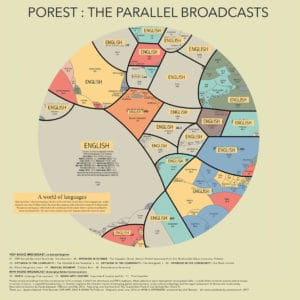
The Parallel Broadcasts presents Porest’s recordings from the covert sector of his archives. Culled from shortwave and FM broadcasts, these selections were intercepted via prepared radio – finely tuned to receive what is known in certain circles as parallel broadcasting. Content explores the trauma of emerging global consciousness, acute cultural antipology and the urgent placement of democratic music today. Recorded on location in Jan/Feb, 2016 – Featuring contributions from Paul Staufenbiel and Michael Darr.
All On A Beautiful Day was recorded in Spring 2016 by People Like Us for “Optimized!” - a week-long online a/v radio station programmed by Vicki Bennett, housed on WFMU.org which experimented with ideas of what radio might be in the world of high speed internet broadcasting. The content included 26 new a/v artist works, including both this and Porest’s Parallel Broadcasts, where people were invited to respond to the word “optimized”.
Original price was: 16,00€.10,00€Current price is: 10,00€.
Out of stock

2 LP
THALASSA
“Bonds of Prosperity”
Thalassa is the avant-drone project for Aaron Turner (Sumac, Isis, Mamiffer, House Of Low Culture, etc.) and William Fowler Collins. In his many guises, Turner articulates a chimerical aesthetic that intrepidly explores beyond the scope of sludge, hardcore and post-rock. In Collins’ blackened earth drones, he steadfastly engages in the elemental exploration of the New Mexican landscape that often inspire comparisons to the potency of black metal without the need for a single blast beat. It makes a hell of a lot of sense these two would eventually cross paths and collaborate.
The project name Thalassa harkens to ancient Greek mythology of a primordial sea-goddess, later reprised in the early 20th century through an obscure psychoanalytic treatise by Sándor Ferenczi who posited ideas of human sexuality in symbolic return to the sea. For Turner, the project's name was sparked by a blood disorder called Thalassemia, whose root name is that very same Greek goddess. The ocean, blood, rain, sand, the desert, heat, fog -- all of these elemental / environmental forces are at play in the heavily sedimental drones and crumbled noise from Turner and Collins on their debut release, Bonds of Prosperity.
Pressurized torrents of sound build incrementally through layers upon layers of
aggregated grit, soot and flotsam. Given the ecological and mythic references, these tracks suitably take the long-view through a uniquely muscular approach to American minimalism. Thalassa finds itself in very good company with Maeror Tri, Deathprod, Sunn O))) and Lustmord.
2XLP edition of 300 copies, housed in a custom printed 2LP sleeve, pressed on black vinyl only.
Original price was: 25,00€.12,00€Current price is: 12,00€.