
In stock

LP
David TOOP – Peter CUSACK – Steve BERESFORD – Terry DAY
“Alterations”
Never released before recordings from Logos Foundation live sessions at Logos Foundation, Gent, Belgium on January 3, 1981. "The music is free-improvisation -- that is we make our music co-operatively while playing: by listening, reacting, throwing in new ideas, not by following preplanned schemes. At its simplest the group's intention can be said to be to play together as well as possible and to enjoy ourselves while doing so. We are very interested in the result and intend that the audience is as well. As well as the musicians reacting to each other the music itself is pretty reactive to context. In other words, room acoustics, background noise, audience response have a strong effect on what happens. This is particularly true of the audience. We have done performances where conversation has broken out with some audience members. There is much to see as well as hear -- this is partly to do with the instruments. Together Terry, Steve and David have hundreds, all sizes, all sorts, most colors. They completely cover the floor. Many of these are non-western. The wide range of instruments means that an extremely broad sound spectrum is covered, from sudden bangs to very quiet low notes, from squeaks to normal guitar sounds. This is what fixes the overall group sound." Personnel: David Toop - flute, home-made reeds, percussion; Peter Cusack - guitar; Steve Beresford - piano, small instruments; Terry Day - percussion, home-made reeds.
Logos Foundation: Belgium Flanders' unique professional organization for the promotion of new music and audio-related arts by means of new music production, concerts, performances, composition, technological research and other activities related to contemporary music. This organization has been founded in 1968 by Godfried-Willem Raes.
16,00€
In stock

LP
Otto SIDHARTA
“Kajang”
Previously unreleased music by Otto Sidharta, pioneer of Indonesian electronic music. Inspired by Indonesia's multifarious styles of traditional music, that he tries to preserve, the four pieces on Kajang express a contemplation of the self. Otto Sidharta loves to travel, everywhere within Indonesia, in order to collect almost any environmental tones and harmonies he can gather, as an endless source of composition. He is also deeply inspired by Indonesia's multifarious styles of traditional music, that he tries to preserve, as in some remote places, they keep their own tradition very strongly. What really interests Sidharta is musicians not interacting with other kinds of music, as in those deep villages, where one might find sounds that feel like very "natural". It results in works expressing Sidharta's personal impression from their music: "I just use my own feeling, with no calculation", not using the tribals motif or style. Kajang is the name of a tribal people living in the south of Sulawesi, a giant island in eastern Indonesia, a closed community, that Sidharta visited twice: "They cut off their communication with the outside world. They live in a very traditional way and try to avoid any new development in culture that might impact their way of life." Sidharta's previous album collected early pieces under the title Indonesian Electronic Music 1979-92, released on Sub Rosa in 2017 (SR 452CD). Kajang gathers a quartet of compositions from 2015 to 2020. White vinyl.
16,00€
In stock

LP
SOTE
“Majestic Noise Made in Beautiful Rotten Iran”
Green vinyl.
It's an all-electronic affair, harmonically maximalist, predominantly symphonic-synthetic, requiring active listening. Some pieces function as challengers of musical structural habits, provoking the short attention span culture, others present a problem-solution scenario, collectively via a neoteric noise aesthetic and detailed melodic weaving. Ultimately, the objective was to engineer an assortment of works full of sound, euphonic, and vivid in nature. The making of this album was intentionally a very personal process, going into self-therapy territory at times interpreting the composer's contemplating mind dealing with tolerance, destruction, compassion, misery, grace and tyranny in an auditory manner. Some pieces function as challengers of musical structural habits, provoking the short attention span culture, others present a problem-solution scenario, collectively via a neoteric noise aesthetic and detailed melodic weaving. Ultimately, the objective was to engineer an assortment of works, awash with euphonic sound vivid in its essence, with a deep focus on various synthesis techniques within a compositional framework. Dedicated to Peter Rehberg aka Pita.
Ata "Sote" Ebtekar composes music with a deeply-held conviction that rules and formulas should be deconstructed and rethought. He alters musical modal codes from their original tonality and rhythmic tradition to achieve vivid, synthetic soundscapes. Over the last three decades, his work has been published by labels such as Warp, Sub Rosa, Opal Tapes, Diagonal, Mute, and Morphine, among others.
16,00€
Out of stock

2 LP
Julius EASTMAN
“Two Extended Pieces For Four Pianos”
2023 repress, black vinyl.
Four Pianos (1979-80): It is recognized today that these tutelary pieces for four pianos are among the most powerful in contemporary music, their impact is almost unparalleled. After the historical version recorded forty years ago, this one, featuring four of the greatest European performers, is now regaining its full power. High level recordings too.
Julius Eastman: There was some for John Cage, then came Christian Wolff, and finally Morton Feldman, from this school in New York. Only Julius Eastman remained outside the game, the last figure, the most solitary and enigmatic -- undoubtedly also one of the most powerful, and it is this power that is revealed through these recordings. In the 1970s and 1980s, Eastman was one of the very few African-Americans to gain recognition in the New York avant-garde music scene. He was politically committed, a figure of queer culture and a solar and solitary poet whose melancholy influenced his genius as well as his tragic destiny: suffering from various addictions, declared missing, actually homeless. During Winter of 1981-82, he got deported from his apartment by the police, who destroyed most of what he owned - including scores and recordings. He was found dead in 1990, on the streets of Buffalo, after years of vagrancy.
The Performers: Nicolas Horvath, pianist and electroacoustic composer; Melaine Dalibert, a French composer and pianist; Stephane Ginsburgh, a tireless surveyor of the repertoire but also explorer of new music; Wilhem Latchoumia, embraces both new music and the classical repertoire with success and charisma.
20,00€
In stock

2 LP
Léo KUPPER
“Electronic Works & Voices 1977-1987”
Perfect follow up to our precedent 2LP (Electronic Works & Voices 1961-1979), this release highlights Leo Kupper's earliest compositions with his GAME machine - Générateur Automatique de Musique Electronique (Automatic Generatorof Electronic Music) constructed during the 1960's. Purely electronic sounds into new structures, Leo Kupper shows through his 4 tracks a real spirit of renewal.
Leo Kupper was born in Nidrum, Hautes Fagnes (Eastern Belgium)`on the 16th of April 1935. He studied musicology at the Liège Conservatory, then became the assistant of Henri Pousseur who, in 1958, had just founded the Apelac Studio in Brussels. Kupper started to work on his first pieces there, but he would finalize them only upon putting together his own studio in 1967: the Studio de Recherches et de Structurations Electroniques Auditives (which means 'studio of audio electronic research & structuring'). That is where he would compose, to this day, over forty works, most of them on instruments of his own design. In the '70s and '80s, he built a series of Sound Domes (briefly established in Rome, Linz, Venice, and Avignon), places where every sound, every phonem uttered by the listening audience was transformed by hundreds of loudspeakers of various sizes organized in a dome shape.
This device transformed sounds through space AND time: something said could be morphed into another sound hours, days, perhaps years later.
Leo had envisioned that a device like his, a place for contemplation, would be much-needed in cities where Nature had been evacuated.
In the late '70s, after discovering Iranian music master Hussein Malek, Kupper became one of the very few Western virtuosos of the santur.
His first pieces were released by Deutsche Grammophon and, later, Igloo.
His latest works have been released by the New York-based label Pogus.
The GAME machine
In 1961, having terminated his musicology studies, Leo Kupper left Liège for Brussels. By that time, centres for music research such as those in Cologne, Paris and Milan had already produced works of experimental music, where pioneers were forging new and diverse routes in electronic music, 'musique concrète' and electro-vocal music. The GAME machine - Générateur Automatique de Musique Electronique (Automatic Generator of Electronic Music) was constructed during such period and spirit of renewal and technical exploration. The GAME consisted of a collection of variable 'sonic cells' sensitive to modulations of positive and negative voltages and programmable manually through the aid of colour-coded cables. Complex electronic loops and sound from loudspeakers and from microphone pick-ups were then either recorded by tape-machines or performed and interpreted by musicians who opened automatic channels, thus triggering automatic sound to exit the speakers. This in turn penetrated the machines by means of microphones and was replayed. Here then was an entirely new way of playing a musical instrument and how the works here were composed and performed.
20,00€
In stock

CD
Milan KNIZAK
“Another State of Stagnation / Piano Pieces (1991-2021)”
My piano compositions are a mixture of musical reminiscences and a confession of my love for disharmonic chords on the one hand, and lascivious melodies on the other. As in the case of almost all my pieces, I wrote them "dry", at a desk, without using any musical instruments. I only worked with memory and a little bit of imagination. The compositions often come across as randomly taken out of a pot, which contains a blend of fragments of works of a variety of periods, styles and creators. (Milan Knízák, Mongrelised Piano)
Another State of Stagnation contains six unreleased piano pieces by Milan Knízák, written between 1991 and 2021. Played by Czech piano virtuoso Miroslav Beinhauer in August 2020 and recorded in August 2021 at Czech Radio Ostrava under the Petr Bakla's recording direction. The author of the title and cover is Milan Knízák. Produced by re-set production.
In the second movement, at least two references to Czech "tramping" (hiking, country) music can be read or heard: Ceka huãí and Táboráku, plápolej. They are among the numerous references to other pieces, while they can concurrently be something else - for instance, a Beethoven minuet. Beinhauer pointed out: "Milan KníÏák's piano works abound in these 'quotations', some of which are just very similar to well-known melodies, while others are true quotations, I do not even recognise some of them at first listen, but that is not actually the point. If someone does identify these quoted fragments when listening, they can feel good about themselves or can even remember the whole piece better, but I myself do not deem it essential in the case of Milan's compositions. Alternation of styles is more important."
(Boris Klepal, Score and Performance - Milan Knízák: Tramp Sonate or Looking for Context)
Prof. Milan Knízák, Dr.A.
Multimedia artist working in fine art (actions, paintings, sculptures), music, literature, architecture, fashion and furniture design. Member of the international art group FLUXUS. Featured in majorgalleries around the world as well as archives, catalogues, encyclopaedias and dictionaries. His BROKEN MUSIC (SRV400 LP) was included among the 1000 most important compositions of the 20th century. One of the 500 artists in the 20th Century Art Book (Phaidon Press, London and New York). A dictionary of designers published by Ambiente lists him as "a central figure in modern Czech design". Curatorial work, theoretical essays, exhibition architecture. Extensive teaching, lecturing and publishing activities. Collector and expert on the history of puppet theatre (puppets, set design) and author of the only encyclopaedia of Czech and Slovak puppet theatre designers.
Under the communist regime he was arrested, searched and detained by the police approximately 300 times, spending several months in custody in total. He was convicted of failing to prevent a friend from deserting and of harming Czechoslovakia's interests abroad, and in 1968 he was arrested in Vienna for attacking two policemen. From 1966 onwards he was listed as an enemy of the state. His final prohibited exhibition was to have been held in November 1989.
Milan Knízák has had more than 120 solo exhibitions and hundreds of group exhibitions throughout almost the entire world. He has published approximately 80 books and catalogues and released many music recordings, as well as creating a number of design projects.
12,50€
Out of stock

2 CD
COMPILATION
“Exploring Gong Culture of Southeast Asia: Massif and Archipelago”
Recorded by Yasuhiro Morinaga + intro by David Toop
Gongs have played an integral role in the mythogeography of Asia. This is not music that aligns with national borders or ideas of homogenous populations, let alone racial stereotypes and exotic clichés. What connects all of these tracks is a simultaneous feeling of entrancement and social cohesion. Communal and collaborative, its form is hypnotically repetitious, melodies and rhythms spread out among the players using the technique of hocketing in which a flowing line is distributed among all the musicians. The effect is mesmerising, immediately intoxicating to anybody who loves Chicago footwork, free improvisation, Sun Ra or young hip hop producer Jetsonmade. The music is simple yet mysterious and enveloping, a sound world in which to disappear. A theory exists but this is not explained.
David Toop (extracts from the liner notes)
This project, Massif and Archipelago, is a field recording project initiated by Japanese sound artist Yasuhiro Morinaga, documenting traditional gong music by different Southeast Asian ethnic groups. The project aimed to examine the impact of the natural and social environment on the gong music culture of Southeast Asia.
During the project, he visited over 50 different ethnic groups and made hundreds of recordings. This album presents a selection of the unique gong music from different ethnic minorities.
The selected music has been divided into two broad sections: one focussing on the music from the Massif, i.e. mainland Southeast Asia (Central Highland of Vietnam and Northeast Cambodia), the other on music from the Archipelago, maritime Southeast Asia (the Luzon Islands of the Philippines, Borneo, Sulawesi, and the Flores Islands of Indonesia).
18,00€
In stock
LP
COMPILATION
“Exploring Gong Culture of Southeast Asia: Massif and Archipelago”
Recorded by Yasuhiro Morinaga + intro by David Toop
Gongs have played an integral role in the mythogeography of Asia. This is not music that aligns with national borders or ideas of homogenous populations, let alone racial stereotypes and exotic clichés. What connects all of these tracks is a simultaneous feeling of entrancement and social cohesion. Communal and collaborative, its form is hypnotically repetitious, melodies and rhythms spread out among the players using the technique of hocketing in which a flowing line is distributed among all the musicians. The effect is mesmerising, immediately intoxicating to anybody who loves Chicago footwork, free improvisation, Sun Ra or young hip hop producer Jetsonmade. The music is simple yet mysterious and enveloping, a sound world in which to disappear. A theory exists but this is not explained.
David Toop (extracts from the liner notes)
This project, Massif and Archipelago, is a field recording project initiated by Japanese sound artist Yasuhiro Morinaga, documenting traditional gong music by different Southeast Asian ethnic groups. The project aimed to examine the impact of the natural and social environment on the gong music culture of Southeast Asia.
During the project, he visited over 50 different ethnic groups and made hundreds of recordings. This album presents a selection of the unique gong music from different ethnic minorities.
The selected music has been divided into two broad sections: one focussing on the music from the Massif, i.e. mainland Southeast Asia (Central Highland of Vietnam and Northeast Cambodia), the other on music from the Archipelago, maritime Southeast Asia (the Luzon Islands of the Philippines, Borneo, Sulawesi, and the Flores Islands of Indonesia).
16,00€
In stock

LP
Chantal ACDA & Eric THIELEMANS
“Koyaanisqatsi, A New Score”
Dark-folk songwriter Chantal Acda and beyond drums-percussion musician extraordinaire Eric Thielemans propose a new score for Koyaanisqatsi, re-actualising the incredibly beautiful, raw, rhythmic and touching images of this 80-ties cinematographic masterpiece.
Slow deep electric waves, lonely synths in sonic desert landscapes, rhythmic pulses, transporting drums and bells, and deeply longing sounds and voices make up the audible fundamentals of this imagined, neo shamanic, ritualistic music to accompany the Earth as it keeps on supporting our post human frenetics even today.
This release contains a selection of the musical material scored for a live performance together with the screening of the movie. The live performance premiered on Film Festival Gent and Vooruit in the fall of 2022.
16,00€
In stock

LP
Phil MAGGI
“The Encrimsoned”
Sound architect and filmmaker from Liège, Belgium Phil Maggi is known as the lead singer of heavy-rock combo Ultraphallus. He has shared the bill with Jerusalem In My Heart, Keith Rowe, Phill Niblock, Tuxedomoon, Sote, Thisquietarmy, and many others. 'The Encrimsoned' is the second part of his diptych inspired by Henry Corbin's writings, which started with his previous album 'Animalwrath' (Sub Rosa SR423).
The Encrimsoned is a four-track album, harboring a few musical friends and usual collaborators (Maja Jantar, Tom Malmendier, Radwan Ghazi Moumneh, Sebastien Schmit, Gabriel Séverin, Xavière Fertin). Ranging from free-jazz to ambient-electronic contemporary art sound, this adventurous second and final chapter is an homage to Hardy Fox, pioneer and primary composer for The Residents.
LP Milky White Vinyl
16,00€
Out of stock

LP
Konstantin RAUDIVE
“The Voices of the Dead”
Original archives from Konstantin Raudive and Gerhard Stempnik + remixes by David Toop, DJ Spooky, CM von Hausswolff, Calla, Lee Ranaldo
THE REALITY OF THE TAPES
For many, the first traces of the Raudive Tapes were in William Burroughs fictions and articles. The fact is, these mysterious magnetic tapes, which capture the voices of the dead, and were recorded by the Baltic scientist Konstantin Raudive, are not a fiction but a reality (we are not here to judge their scientific objectivity ). These tapes, as rare as Lovecraft's Necronomicon, are now in our archives.
WHO WAS RAUDIVE ?
Dr. Konstantin Raudive, a student of Carl Jung, was a Latvian psychologist who taught at the University of Uppsala, Sweden, before devoting the last ten years of his life to electronic voice phenomenon (EVP). He published his book Breakthrough in 1971. His early collaborator F. Jurgenson, whom he met by the very beginning of 1965, awakened Dr. Raudive's interest in EVP research. Raudive spent endless hours for the thorough study of Jurgenson's books ("Voices from Space", 1964, and "Radio-Link with the Dead", 1967). From an overwhelming database (ranging about 72,000 samples!), Raudive's mother seems to be statistically the most frequently reported contact personality. She usually addressed her son in the Latgalian
WHAT WE CAN FIND IN THAT RECORD ?
1. A self introduction of Konstantin Raudive and a large session of exemples from his archives - July 17, 1965)
2. 9 extracts from the Gerhard Stempnik experiments - musician of the Berlin Philharmonic and close friend of Raudive (tapes from 1980)
3. A Raudive celebration including unpublished material by Scanner, Paul D. Miller aka dj Spooky/That subliminal kid, Calla, Lee Ranaldo (of Sonic Youth), Ensemble, Ramdom Inc., David Toop, Carl Michael von Hausswolff and Brett Dean. They have all composed an exclusive piece of music based on the Raudive material. It goes from a close examination of the material itself (CM Von Hausswolff, Lee Ranaldo) to a more evocative mood (Calla, Scanner, dj Spooky). The last piece, for viola solo, is a global homage to all the explorators of the unknown.
16,00€
In stock

CD
Milan KNIZAK & OPENING PERFORMANCE ORCHESTRA
“Broken Re/Broken”
*** 2022 restock ***
Milan Knizak (with Phaerentz) + Opening Performance Orchestra revisiting Broken Music in Berlin, 2014.
part one
Broken Music / 45 min.
Milan Knízak (with Phaerentz)
turntables & broken vinyls, CD players & CDs, cassette players
& cassettes, keyboard
part two
Re:Broken Music / 33 min.
Opening Performance Orchestra
5 laptops & fraction music (broken section, re:broken section,
fraction section)
'In 2008-9 we transferred the original recording from vinyl records into digital form. As we did so, we weren't interested in the precise, clean fidelity offered by the digital world, which fundamentally causes the fine structure of natural sound to be lost. Instead we were seeking the opposite: the world of errors and distortion, which remains hidden when digital audio is manipulated to be maximally accommodating for the listener. The transferred audio recording was digitally destroyed, shattered and uncompromisingly freed from all its original attributes. No melody, no rhythm, no harmony - this is fraction music'.
Milan Knizak (born 19 April 1940) is a Czech performance artist, sculptor, musician, installation artist, dissident, graphic artist, art theorist and pedagogue of art. Before everyone else - Christian Marclay, Philip Jeck, eRikm, Martin Tétreault, Otomo Yoshihide - there was Milan Knizak. In 1964, Milan Knizak, a member of Fluxus from behind the Iron Curtain, sat down on a sidewalk near the Charles Bridge in Prague, laid down a paper carpet right into the street, and starts tearing pages out of books and burning them... Around the same time, he began to create music from defective, worn, damaged or broken LP's. These Broken Music compositions, his classic collages of noises created during performances and happenings, are widely regarded as important sound art documents on record.
12,50€
Out of stock

LP
Milan KNIZAK
“Broken Music”
*** 2022 restock ***
Milan Knizak (born 19 April 1940) is a Czech performance artist, sculptor, musician, installation artist, dissident, graphic artist, art theorist and pedagogue of art.
Before everyone else – Christian Marclay, Philip Jeck, eRikm, Martin Tétreault, Otomo Yoshihide – there was Milan Knizak. In 1964, Milan Knizak, a member of Fluxus from behind the Iron Curtain, sat down on a sidewalk near the Charles Bridge in Prague, laid down a paper carpet right into the street, and starts tearing pages out of books and burning them… Around the same time, he began to create music from defective, worn, damaged or broken LP's. These Broken Music compositions, his classic collages of noises created during performances and happenings, are widely regarded as important sound art documents on record.
‘In 1963-64 I used to play records both too slowly and too fast and thus changed the quality of the music, thereby creating new compositions. In 1965 I started to destroy records: scratch them, punch holes in them, break them. By playing them over and over again (which destroyed the needle and often the record player too) an entirely new music was created - unexpected, nerve-racking, aggressive and even humorous. Compositions lasting one second or almost infinitely long (as when the needle got stuck in a deep groove and played the same phrase over
and over). I developed this system further. I began sticking tape on top of records, painting over them, burning them, cutting them up and gluing different parts of records back together, etc. to achieve the widest possible variety of sounds’. Milan Knízak, Broken Music
16,00€
In stock

2 CD
Jean DUBUFFET – Ilhan MIMAROGLU
“Musiques pour Coucou Bazar”
***2022 restock***
2CD + 40 page booklet
All musics done for Jean Dubuffet's Coucou Bazar show
CD1:
Ilhan Mimaroglu's soundtrack for Jean Dubuffet's articulated painting exhibition Coucou Bazar, which opened at the Guggenheim Museum in New York City on May 16, 1973.
CD2:
Jean Dubuffet's soundtrack of the Coucou Bazar show presented in Turin from June 16 to July 15, 1978 (based on Dubuffet's music recordings from 1961 and 1973-1974).
+ a never released before piece by Jean Dubuffet: Bal des Leurres (1972-73).
***
''(...) my music was slovenly and dirty, and therefore anti-musical, anti-humanistic" Jean Dubuffet
In 1965, Turkish composer Ilhan Mimaroglu, then residing in New York, sent a letter to Jean Dubuffet, to explain his experiments, inspired by the series of the artist's drawings.
In 1971 when Dubuffet started working on a new form of "show," Coucou Bazar, he decided to submit his project to Mimaroglu. Mimaroglu released his music for Coucou Bazar in 1973 under the title: Electronic Music for Jean Dubuffet's Coucou Bazar, accompanying the first version of the 'show' presented at the Solomon R. Guggenheim Museum in New York, from the 16th of May to the 29th of July 1973, and the second version at the Grand Palais in Paris, from the 2nd of November to the 1st of December 1973.
Following these first two versions of Coucou Bazar, Dubuffet quickly envisioned a third version. This third version of Coucou Bazar was finally produced in Turin in 1978, thanks to the FIAT company. And this time, it was accompanied by Dubuffet's music. Anna Sagna, the choreographer of this third version, took care of editing the tapes from 1961 and 1973-1974 into a collage.
16,00€
Out of stock
2 LP
Julius EASTMAN
“Two Extended Pieces For Four Pianos”
Four Pianos (1979-80): It is recognized today that these tutelary pieces for four pianos are among the most powerful in contemporary music, their impact is almost unparalleled. After the historical version recorded forty years ago, this one, featuring four of the greatest European performers, is now regaining its full power. High level recordings too. Red vinyl; includes color insert.
Julius Eastman: There was some for John Cage, then came Christian Wolff, and finally Morton Feldman, from this school in New York. Only Julius Eastman remained outside the game, the last figure, the most solitary and enigmatic -- undoubtedly also one of the most powerful, and it is this power that is revealed through these recordings. In the 1970s and 1980s, Eastman was one of the very few African-Americans to gain recognition in the New York avant-garde music scene. He was politically committed, a figure of queer culture and a solar and solitary poet whose melancholy influenced his genius as well as his tragic destiny: suffering from various addictions, declared missing, actually homeless. During Winter of 1981-82, he got deported from his apartment by the police, who destroyed most of what he owned - including scores and recordings. He was found dead in 1990, on the streets of Buffalo, after years of vagrancy.
The Performers: Nicolas Horvath, pianist and electroacoustic composer; Melaine Dalibert, a French composer and pianist; Stephane Ginsburgh, a tireless surveyor of the repertoire but also explorer of new music; Wilhem Latchoumia, embraces both new music and the classical repertoire with success and charisma.
20,00€
In stock

CD
Pauline OLIVEROS – Gyorgy LIGETI
“Musica Nuvolosa”
After its reading of Julius Eastman's Feminine, released in 2021 (SR 501CD), the Ensemble 0 revisit the repertoires of Pauline Oliveros and György Ligeti from another angle. From the works of Oliveros, they exhumed a deeply meditative piece for accordion and voice, giving it a new life in the form of vaporous, cloud-riding chamber music. With Ligeti, the piano radicalism of the Musica Ricercata miniatures crop up again in a new and as yet unreleased orchestration.
György Ligeti (1923-2006): György Ligeti was a Hungarian-Austrian composer of contemporary classical music. He has been described as "one of the most important avant-garde composers in the latter half of the twentieth century" and "one of the most innovative and influential among progressive figures of his time."
Pauline Oliveros (1932-2016): Pauline Oliveros was an American composer, accordionist and a central figure in the development of post-war experimental and electronic music.
Ensemble 0: "Music that's immediately attractive and persistently elusive" --The Wire, UK. The Ensemble 0 (pronounced "zero") is a collective created in 2004 whose full-time members are Stéphane Garin, Joël Merah, and Sylvain Chauveau. They are based in Bayonne (France), Barcelona (Spain), and Brussels (Belgium). The ensemble performs mainly pieces by living composers, as well as compositions by its members. The band has many regular collaborators and guests, allowing the line-up to increase or decrease according to each specific project. The ensemble 0 has played live around Europe (France, Switzerland, Spain, Belgium, Netherlands, Portugal, Germany) and in Asia (Japan, Taiwan). They have released a number of records on international labels and have been reviewed or interviewed in magazines and websites such as The Wire, Vital Weekly, Fluid Radio, Mouvement, Ecocolo, The Sound Projector, Textura.
13,00€
In stock

CD
SOTE
“Majestic Noise Made in Beautiful Rotten Iran”
It's an all-electronic affair, harmonically maximalist, predominantly symphonic-synthetic, requiring active listening. Some pieces function as challengers of musical structural habits, provoking the short attention span culture, others present a problem-solution scenario, collectively via a neoteric noise aesthetic and detailed melodic weaving. Ultimately, the objective was to engineer an assortment of works full of sound, euphonic, and vivid in nature. The making of this album was intentionally a very personal process, going into self-therapy territory at times interpreting the composer's contemplating mind dealing with tolerance, destruction, compassion, misery, grace and tyranny in an auditory manner. Some pieces function as challengers of musical structural habits, provoking the short attention span culture, others present a problem-solution scenario, collectively via a neoteric noise aesthetic and detailed melodic weaving. Ultimately, the objective was to engineer an assortment of works, awash with euphonic sound vivid in its essence, with a deep focus on various synthesis techniques within a compositional framework. Dedicated to Peter Rehberg aka Pita.
Ata "Sote" Ebtekar composes music with a deeply-held conviction that rules and formulas should be deconstructed and rethought. He alters musical modal codes from their original tonality and rhythmic tradition to achieve vivid, synthetic soundscapes. Over the last three decades, his work has been published by labels such as Warp, Sub Rosa, Opal Tapes, Diagonal, Mute, and Morphine, among others.
13,00€
In stock

LP
Carl Michael von HAUSSWOLFF
“Conductor / Life and Death of Pboc”
Two rare historical recordings (1983 and 1986) originally released as single sides and gathered here for the first time. Carl Michael von Hausswolff on the pieces: "'Conductor' might be my favorite composition and 'Life and Death of Pboc' might be my most sincere. 'Conductor' was my first composed piece with no obvious reference points . . . 'Life and Death of Pboc' was the second. These two compositions gave me the title Godfather of Dark Ambient." Edition of 300.
Carl Michael von Hausswolff (b. 1956 in Linköping, Sweden, lives and works in Stockholm): Since the end of the '70s, von Hausswolff has worked as a composer using recording technology as his main instrument and as a visual artist using light projections, film/video and still photography as well as other media. He has exhibited at dOCUMENTA (Kassel), the biennials in Venice, Moscow, Liverpool, Istanbul, Sarajevo etc. and in Copenhagen, Stockholm, Nicosia, Kaliningrad, Tokyo, London, New York, Philadelphia etc. His music has been played in festivals such as Sonar (Barcelona), CTM (Berlin), L'audible (Paris), el niche Aural (Mexico City), MUTEK, (Montreal) etc. and release works on LP, CD, and download by labels like Erototox (Ashevile), Sub Rosa (Brussels), Touch (London), Pomperipossa (Göteborg), and iDeal (Göteborg). He recently curated the second part the sound-installation FREQ_OUT named freq_wave in co-operation with TBA21-Academy and collaborates with artist Leif Elggren, EVP re-searcher Michael Esposito, composers Hans-Joachim Roedelius, Mark Fell, Jim O'Rourke, author Leslie Winer and as Dark Morph (with Jónsi of Sigur Rós). He has also collaborated with Pan Sonic, The Hafler Trio, Freddie Wadling, and Erik Pauser (as PHAUSS).
15,00€
In stock

2 LP
Reinhold WEBER
“Complete Electronic And Phonetic Works 1968-74”
Reinhold Weber, born in 1927, was known as a pioneer of electronic music. In his compositions, Weber placed a focus on twelve-tone music, he became increasingly fascinated in the field of computer music since the 1970s. He produced numerous works at the Studio for Electronic Music at the University of Karlsruhe. Released in Sub Rosa's Early Electronic series.
Reinhold Weber was born in Gießen on July 18, 1927. He studied at Robert Schumann Conservatory in Düsseldorf (including composition with Jürg Baur, piano with Max Martin Stein) and passed his exam in composition, theory, piano, and ear training with distinction. He completed further masterclasses with Wolfgang Fortner, Hermann Heiss, Oliver Messiaen (composition), Kurt Thomas (choral conducting), Andor Foldes (piano), and Gerhard Nestler (electronic music). Reinhold Weber was a professor at the Baden Conservatory of Music in Karlsruhe and also worked in the Studio for Electronic Music of the University of Karlsruhe. His works have been performed in numerous concerts and were broadcasted by SDR, WDR, NDR, HR, SWF, and Radio Bremen. Reinhold Weber died March 25, 2013.
Actor Kurt Müller-Graf was born in 1913. After visiting the Theater Academy of Baden in Karlsruhe, he appeared on stage at National Theaters of Karlsruhe, Kassel and Munich since 1935. During World War II, he performed in about ten feature films by Bavaria Film Munich. After 1945, he played at National Theaters in Karlsruhe, Stuttgart and at Theaters in Nuremberg, Cologne, Munich, Mannheim, Baden-Baden and Burgtheater Vienna. Furthermore, he had guest performances in Zurich, Basel, Salzburg and Heidelberg. Kurt Müller-Graf was touring and had broadcasts on radio and television shows at home and abroad. Kurt Müller-Graf died August 10, 2013.
19,00€
Out of stock

3 CD
Léo KUPPER
“Complete Electronic & Voices Works 1961-1987”
The complete works of one of the pioneers of Belgian early electronics. This three-CD set highlights Leo Kupper's earliest unique compositions produced during the '60s to '90s when he was ardently seeking out structures distinctly applicable to purely electronic sounds. His GAME machine -- Générateur Automatique de Musique Electronique (Automatic Generator of Electronic Music) was constructed during such period and spirit of renewal and technical explorations. Released in Sub Rosa's Early Electronic series. Includes 20-page booklet.
Leo Kupper was born in Nidrum, Hautes Fagnes (Eastern Belgium) on April 16th, 1935. He studied musicology at the Liège Conservatory, then became the assistant of Henri Pousseur who, in 1958, had just founded the Apelac Studio in Brussels. Kupper started to work on his first pieces there, but he would finalize them only upon putting together his own studio in 1967: the Studio de Recherches et de Structurations Electroniques Auditives (Studio Of Audio Electronic Research And Structuring). That is where he would compose, to this day, over forty works, most of them on instruments of his own design. In the '70s and '80s, he built a series of Sound Domes (briefly established in Rome, Linz, Venice, and Avignon), places where every sound, every phoneme uttered by the listening audience was transformed by hundreds of loudspeakers of various sizes organized in a dome shape. This device transformed sounds through space and time: something said could be morphed into another sound hours, days, perhaps years later. Leo had envisioned that a device like his, a place for contemplation, would be much-needed in cities where nature had been evacuated. In the late '70s, after discovering Iranian music master Hussein Malek, Kupper became one of the very few Western virtuosos of the santur. His first pieces were released by Deutsche Grammophon and, later, Igloo. His latest works have been released by the New York-based label Pogus.
The GAME machine: In 1961, having terminated his musicology studies, Leo Kupper left Liège for Brussels. By that time, centers for music research such as those in Cologne, Paris, and Milan had already produced works of experimental music, where pioneers were forging new and diverse routes in electronic music, "musique concrete", and electro-vocal music. The GAME machine was constructed during such period and spirit of renewal and technical exploration. The GAME consisted of a collection of variable "sonic cells" sensitive to modulations of positive and negative voltages and programmable manually through the aid of color-coded cables. Complex electronic loops and sound from loudspeakers and from microphone pick-ups were then either recorded by tape-machines or performed and interpreted by musicians who opened automatic channels, thus triggering automatic sound to exit the speakers.
18,00€
In stock

CD
Frederic RZEWSKI
“Speaking Rzewski: Performed by Stephane Ginsburgh”
Released in Sub Rosa's Unclassical series. "This album is the result of years of work and friendship with the composer. It started with 'De Profundis', a piece which has had a deep impact on me as a musician and a person, and ended with it. Frederic attended many of my performances of the piece, the last one during our last public concert together in early 2020 in Brussels. In the meantime, he wrote 'Dear Diary' (2014) and 'America: A Poem' (2020) for me which were both premiered at Ars Musica festival. I am very happy to present these pieces to you on this new and special album coming out on Sub Rosa." --Stephane Ginsburgh
Frederic Rzewski (1938-2021): Frederic Rzewski was born in Westfield, Massachusetts in 1938. He initially studied piano with Charles Mackey in Springfield and went on to study composition with Walter Piston (orchestration) and Randall Thompson at Harvard University and with Roger Sessions and Milton Babbitt at Princeton University, where he also took courses in philosophy and Greek. A Fulbright-Scholarship enabled him to study with Luigi Dallapiccola in Florence in 1960-61. His musical collaboration with Dallapiccola marked the beginning of his career as a pianist for contemporary piano music. His friendship with Christian Wolff and David Behrman and his acquaintance with John Cage and David Tudor influenced his development, both as a composer and as a pianist. During the 1960s, Rzewski taught and took part in the first performances of Karlheinz Stockhausen's "Klavierstück X" (1962) and "Plus Minus" (1964). From 1977 to 2003, he was a professor for composition at the Conservatoire Royal in Liège, Belgium. He also taught at various other universities, among them Yale University, the California Institute of the Arts and the Berlin University of the Arts. Rzewski founded the live electronics ensemble Musica Elettronica Viva with Alvin Curran and Richard Teitelbaum in Rome in 1966. After his return to New York in the early 1970s, his politically outspoken compositions probably made it difficult for him to obtain a long-term teaching position in the US. Frederic Rzewski lived and worked in Brussels. He left us on June 24, 2021 in his Italian home in Montiano.
Stephane Ginsburgh (1969): A tireless surveyor of the repertoire but also explorer of new combinations including voice, percussion, performance or electronics, Stephane Ginsburgh performs as a soloist in many international festivals such as Ars Musica (Brussels), Quincena Musical (San Sebastian), ZKM Imatronic (Karksruhe), Agora (Paris), Bach Academie Brugge, Ultima Oslo, Darmstadt Internationale Ferienkurse, Gaida (Vilnius), Warsaw Autumn, Klara Festival (Brussels), Festival Forum (Moscow), and Musica Strasbourg. He has collaborated with many contemporary composers such as Frederic Rzewski, James Tenney, Philippe Boesmans, Jean-Luc Fafchamps, Stefan Prins or Matthew Shlomowitz as well as with choreographers such as Anne Teresa de Keersmaeker (Rosas) and visual artists such as Peter Downsbrough and Kurt Ralske.
12,50€
In stock

CD
Milan KNIZAK
“Aktual Univerzita”
Milan Knízak canonical text Aktual University, dating from 1967, contains ten short lectures outlining the university's character -- On Conflict, On Dreams, On Revolutions, On Love, On Belief, On Art, etc. These lectures were to serve as inspirational schemes for lectures, seminars and discussions held at an ideal university. In the first piece, Aktual University, Milan Knízak reads his own text, with Opening Performance Orchestra providing the musical accompaniment. It was performed live in October 2019 at the Movement-Sound-Space festival in Opava, where this recording was made. The second track, titled "Broken Suite", is a studio remix, in which Opening Performance Orchestra used fragments and quotations from Milan Knizák's compositions, conceived over the past fifty years, applying the "broken" method. The majority of them are made public for the very first time in the newly created "Broken Suite". The booklet features English translations of ten Aktual University lectures, as well as Milan Knizak's contemporary initiation text. Includes 12-page booklet.
12,50€
Out of stock

LP
Maurice LOUCA
“Saet El-Hazz (The Luck Hour)”
Maurice Louca is one of the most gifted musicians and composers on Egypt's thriving underground music scene. This forthcoming full-length album draws voraciously on Arabic music, psychedelic folk. The title Saet El-Hazz is a coded saying in Egypt to refer to a good time and usually implies a great deal of debauchery. "When you mention to someone that you've had a saet hazz, there are no questions asked. It is what it is." The initial spark for Saet El-Hazz (The Luck Hour) was Louca's desire to collaborate with "A" Trio, the Lebanese improvisational group featuring Mazen Kerbaj on prepared trumpet, Sharif Sehnaoui on prepared guitar, and Raed Yassin on prepared double bass. "When the three of them come together they create a sonic cosmos entirely their own. I started by composing music that I wanted to have exist within this sonic world- at times in harmony, or clashing with it, and all the emotional ranges in between." Just as "A" Trio served as the spark, a commission from Mophradat, an arts organization based out of Brussels, was the tinder. The commission was for a new composition to be performed using instruments that Louca would modify to play microtonally. This led him to Turkey and Indonesia. In Istanbul, he worked with a luthier to custom-make a guitar. In Surakarta, he ended up with an instrument maker tuning a Serang-referred to as the Indonesian xylophone, part of the family of Gamelan tuned percussion instruments. These new modified instruments opened up the composition to new tonal possibilities which drove Louca to expand his line up to include Khaled Yassine, a longtime collaborator and versatile percussionist and drummer, Christine Kazaryan, a dynamic harpist whom he met via Praed Orchestra, and Anthea Caddy, a cellist who came highly recommended from the Berlin free improv scene. Saet El-Hazz (The Luck Hour) is a long form composition of six movements, recorded over the course of a week in August 2019 at A/B studios in Brussels. RIYL: Sun City Girls, Tortoise, Nadah El Shazly, Amirtha Kidambi, Don Cherry, Jaubi, Pharoah Sanders, Sunil Ganguly. Marbled vinyl with insert.
15,00€
Out of stock

2 LP
Joris DE LAET
“Experimental & Parametric Music 1976-2017”
Double LP version. Includes insert. Through Experimental & Parametric Music 1976-2017, more than 40 years of composer Joris De Laet's work is unveiled. The collection discovers for the first time the great coherence of this work: from "Signalisations" (1976) to "Mnemosyne Pour Une Acousmaman" (2017). The compositions are annotated and explained in detail by the composer, as well as a kind of wild autobiography. Released in Sub Rosa's Early Electronic series.
Joris De Laet was born in 1947. Belgian by birth, self-taught by definition, parametric music and art video composer by choice. Founder of the S.E.M. (Studio voor Experimentele Muziek) in Antwerp, 1973. Internships at the IPEM (Instituut voor Psychoakoestiek en Elektronische Muziek) in Ghent, 1972-1975, under Karel Goeyvaerts, Lucien Goethals, and Dr. Herman Sabbe. De Laet is the founder of the SEMensemble, a group of musicians-composers specialized in performing experimental music and live electronics. From 1975 until 1990, he gave concerts with this ensemble throughout Europe (Germany, France, The Netherlands, Austria, Poland, Croatia, etc.) and in Canada (Montreal, Kingston, Toronto). Inspired by the deep control on electronic sonics, De Laet has been defining his work since 1979 as "Parametric Music", music where composition is based on transformation flows of one or several parameters, selected by the composer, that form, through their converging (or diverging) processes the main characteristics of the regulated sonics of the composition.
19,00€
Out of stock

2 CD
Julius EASTMAN
“Three extended pieces for four pianos”
Four Pianos (1979-80)
It is recognized today that these tutelary pieces for four pianos are among the most powerful in contemporary music, their impact is almost unparalleled. After the historical version recorded forty years ago, this one, featuring four of the greatest European performers, is now regaining its full power. High level recordings too.
Julius Eastman
There was some for John Cage, then came Christian Wolff, and finally Morton Feldman, from this school in New York. Only Julius Eastman remained outside the game, the last figure, the most solitary and enigmatic - undoubtedly also one of the most powerful, and it is this power that is revealed through these recordings. In the 1970s and 1980s, Eastman was one of the very few African-Americans to gain recognition in the New York avant-garde music scene. He was politically committed, a figure of queer culture and a solar and solitary poet whose melancholy influenced his genius as well as his tragic destiny : suffering from various addictions, declared missing, actually homeless. During Winter of 1981-82, he got deported from his apartment by the police, who destroyed most of what he owned - including scores and recordings. He was found dead in 1990, on the streets of Buffalo, after years of vagrancy.
The Performers
Nicolas Horvath, pianist and electroacoustic composer. He is known for his boundariesless musical explorations - he has collaborated with leading contemporary composers from around the world, including Alvin Lucier, Alvin Curran and Valentyn Silvestrov - the recordings of his complete works for piano by Phil Glass made a lasting impression. He has collaborated recently with Lustmord on the Deconstruction of November by Dennis Johnson (Sub Rosa SR502: The Fall).
Melaine Dalibert, a French composer and pianist, fascinated by natural phenomena which are both expected and unpredictable, Dalibert has developed his own algorithmic procedures of composition which contain the notion of stretched time evoking Morton Feldman, minimal and introspective, adopting a unique concept of fractal series.
Stephane Ginsburgh, a tireless surveyor of the repertoire but also explorer of new music, collaborated with composers such as Philippe Boesmans, Jean-Luc Fafchamps, Stefan Prins, Frederic Rzewski and Matthew Shlomowitz of whom he premiered works, as well as with choreographers such as Anne Teresa De Keersmaeker (Rosas) and recorded Feldman, Duchamp and Satie for Sub Rosa and the complete set of Prokofiev piano sonatas for Cypres.
Wilhem Latchoumia, he embraces both new music and the classical repertoire with success and charisma. His two last recordings for La Dolce Volta (Prokofiev and de Falla) have been highly acclaimed by critics with a FFFF in Télérama. Winner of the Hewlett-Packard Foundation and the Montsalvatge International Piano Competition, he brilliantly won the First Prize in the 2006 Orléans International Piano Competition.
16,00€
Out of stock
LP
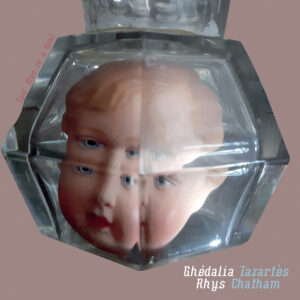
Ghedalia TAZARTES & Rhys CHATHAM
“Two men in a boat”
"The beauty of all this, as well as its sorrowful brutality, is even more powerful and stupefying since Ghédalia's sudden departure. Because retrospectively, not only is this recording the trace of a rare moment in a Parisian garden, it also summons a ghost, that of a loved one that is gone, and of his voice, which is fully alive here."
Tazartes and Chatham had met once in 1977 at CBGC's and had not seen each other since then when they were asked by their mutual agent to play a private show in Paris. This happened in September 2018 in a house with a garden where sax player Steve Lacy had lived back in the 1990s. This album presents the recording of this show plus another show at La semaine du bizarre festival in Montreuil, France a year later, mixed with a couple of studio sessions. This was probably the last music Tazartès, who died in February 2021, recorded. His unique singing blends perfectly with Chatham's loops on electric guitar, trumpet and flute.
Rhys Chatham is a composer, guitarist, trumpet player and flutist from Manhattan, currently living in Paris, who altered the DNA of rock and created a new type of urban music by fusing the overtone-drenched minimalism of the early 60s with the relentless, elemental fury of the Ramones — the textural intricacies of the avant-garde colliding with the visceral punch of electric guitar-slinging punk rock. Starting with Guitar Trio in the 1970s and culminating with A Crimson Grail for 200 electric guitars in 2009, Chatham has been working for over 30 years to make use of armies of electric guitars in special tunings to merge the extended-time music of the sixties and seventies with serious hard rock. Parallel with his rock-influenced pieces, Chatham has been working with various brass configurations since 1982, and recently has developed a completely new approach to collaborations, improvised and compositional pieces involving trumpet through performances and recordings that started in 2009. Chatham’s trumpet work deploys extended playing techniques inherited from the glory days of the early New York minimalist and 70s loft jazz period. Starting in 2014, Rhys has been touring a solo program featuring an electric guitar in a Pythagorean tuning, Bb trumpet, and bass, alto and C flutes. Rhys was introduced to electronic music and composition by Morton Subotnick in the late 60s, and in the early seventies he studied composition with La Monte Young and played in Tony Conrad’s early group. These composers are, along with Terry Riley, the founders of American minimalism and were a profound influence on Chatham’s work. Chatham’s instrumentation ranges from the seminal composition composed in 1977 entitled Guitar Trio for 3 electric guitars, electric bass and drums, to the epoch evening-length work for 100 electric guitars, An Angel Moves Too Fast to See, composed in 1989… all the way to Chatham’s recent composition for 200 electric guitars, Crimson Grail, which was commissioned by the City of Paris for La Nuit Blanche Festival in 2005. A completely new version of the piece was commissioned by the Lincoln Center Outdoor Summer Festival in 2009. What does a composer do after mounting many performances with forces of 100-200 electric guitars? The composer gets back to basics, at least that’s what Rhys does! Along with the G100 and G3 programs, Chatham is currently offering a solo program, an evening length work with the composer performing himself on electric guitar, trumpets and bass alto and C flutes.
French cult artist Ghedalia Tazartes is an uncompromising character who defied categorization. He recorded alone more than 20 albums, calling his Art “Impromuz” for lack of a better term. Before the years 2000s, his public appearances remained exceptional events. Ghédalia Tazartès’ music has always been a mystery. It switches from musique concrète to – existing or invented – ethnic music, from poetry to noise, or from loops and collages to sad and extremely beautiful tunes in a second, but it constantly is in flux and coherent. In 2004, Ghedalia finally decided to do live performances again. He first worked with other musicians (Les Reines d’Angleterre, David Fenech & Jac Berrocal, Norscq & Black Sifichi, Nicolas Lelièvre) then went solo for ten years. Since then Tazartes has played many shows across Europe including a show in the Patti Smith exhibition at Fondation Cartier in Paris and a cinemix to the “Haxan” silent movie in 2008. In 2018 Ghedalia decided to stop playing solo and to collaborate with other musicians again: Maya Dunietz, Rhys Chatham, Chris Corsano and Dennis Tyfus, Quentin Rollet and Jérôme Lorichon. Ghedalia died at his home in Paris on 9th February 2021.
18,50€
In stock

LP
Michel REDOLFI
“Sonic Waters, Underwater Music 1979-1987”
A work that literally immerses the listener into an acoustical substance. The sound becomes almost like matter, like jelly. Soon, you're swimming in sound, getting lost inside it.
With the Sonic Waters project initiated in 1978, my aim was to situate field of electronic music within a liberating and futuristic experience, outside the concert halls and in sync with the development of new instruments - in particular the Synclavier digital synthesizer, the first model of which I acquired in 1977. As concert space, the Pacific Ocean seemed to me to be the ideal experimental medium for both acoustic and cultural reasons. I then developed the aesthetic and technical elements that would contribute to the conception of Underwater Music. Numerous performances would follow spanning four decades, in natural sites or in large public pools such as those of Sydney, Paris or Venice during the 2006 Biennale.
Michel Redolfi (1951), French composer and sound artist, is the founder of Underwater Music. The natural elements captured and highlighted by experimental technology are a constant in Redolfi's catalogue: many compositions explore the earth environments such as in 'Pacific Tubular Waves', 'Jungles', 'Desert Tracks' (re-released on Sub Rosa records) and especially with 'Sonic Waters', a work that literally immerses the listener into an acoustical substance. During the mid-seventies Redolfi carried out his electro-acoustic research in the United States, with major electronic music centers including the California Institute of the Arts and chiefly the University of California in San Diego. As invited resident of their studios, Michel Redolfi launched the underwater music concerts, with the series 'Sonic Waters' performed in the Pacific Ocean. Michel Redolfi's underwater creations have since been regularly programmed by major international festivals, with multi-media installations held in ecological marine reserves or in historical city pools. Among them, the Sydney Festival, Paris 'Nuit Blanche', Ars Electronica in Linz, the 2006 Venice Biennale (nominated Golden Lion) and lately the 2018 Ars Musica festival in Brussels. This record presents different variations of Sonic Waters from 1980 to 1987, alternating studio mixes with their re-recordings in the depths of the Pacific. Michel Redolfi CD's and LP's are currently published by Sub Rosa, INA-GRM and Radio France.
16,50€
In stock
CD
Michel REDOLFI
“Sonic Waters, Underwater Music 1979-1987”
A work that literally immerses the listener into an acoustical substance. The sound becomes almost like matter, like jelly. Soon, you're swimming in sound, getting lost inside it.
With the Sonic Waters project initiated in 1978, my aim was to situate field of electronic music within a liberating and futuristic experience, outside the concert halls and in sync with the development of new instruments - in particular the Synclavier digital synthesizer, the first model of which I acquired in 1977. As concert space, the Pacific Ocean seemed to me to be the ideal experimental medium for both acoustic and cultural reasons. I then developed the aesthetic and technical elements that would contribute to the conception of Underwater Music. Numerous performances would follow spanning four decades, in natural sites or in large public pools such as those of Sydney, Paris or Venice during the 2006 Biennale.
Michel Redolfi (1951), French composer and sound artist, is the founder of Underwater Music. The natural elements captured and highlighted by experimental technology are a constant in Redolfi's catalogue: many compositions explore the earth environments such as in 'Pacific Tubular Waves', 'Jungles', 'Desert Tracks' (re-released on Sub Rosa records) and especially with 'Sonic Waters', a work that literally immerses the listener into an acoustical substance. During the mid-seventies Redolfi carried out his electro-acoustic research in the United States, with major electronic music centers including the California Institute of the Arts and chiefly the University of California in San Diego. As invited resident of their studios, Michel Redolfi launched the underwater music concerts, with the series 'Sonic Waters' performed in the Pacific Ocean. Michel Redolfi's underwater creations have since been regularly programmed by major international festivals, with multi-media installations held in ecological marine reserves or in historical city pools. Among them, the Sydney Festival, Paris 'Nuit Blanche', Ars Electronica in Linz, the 2006 Venice Biennale (nominated Golden Lion) and lately the 2018 Ars Musica festival in Brussels. This record presents different variations of Sonic Waters from 1980 to 1987, alternating studio mixes with their re-recordings in the depths of the Pacific. Michel Redolfi CD's and LP's are currently published by Sub Rosa, INA-GRM and Radio France.
12,50€
In stock
CD
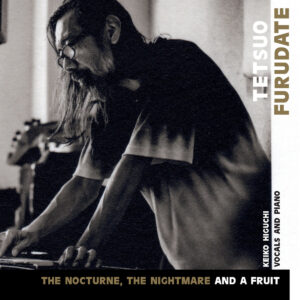
Tetsuo FURUDATE
“The nocturne, the nightmare and a fruit”
Tetsuo Furudate has been working on projects including electronic music, films, videos creating time passages between old and new pieces, re-reading the past through re-appropriations. All his recent pieces can be watched or just listened to. It is also a cultural mix embracing all eastern and western cultures (from JS Bach to Merzbow). Here he recreates a borderless and timeless universe, where voices and pianos reach emotional moments of great depth. The whole is driven by Tetsuo who, by a continuous mixing, conceives these different pieces as an editor would a film made of borrowings images, archives material and unpublished fragments.
Tetsuo Furudate was first the collaborator and friend of Zbigniew Karkowski in Japan, together they created some of the most radical but complex pieces under the name of "World as Will" (after Arthur Schopenhauer's book), some of which were rewritten for the viennese Zeitkratzer Ensemble (received worldwide attention when they created and performed a new version of Metal Machine Music by Lou Reed - including Ulrich Krieger and Anton Lukoszevieze).
Keiko Higuchi is above all a pianist and performer, linked to jazz and improvisation. She was revealed by Love Hotel (2008), her concerts are like real performances, she is considered as one of the most singular and impressive performing artists of her generation.
Olga Magieres, Russian pianist living in Denmark, specializes in improvised music and the syntactic relationship of languages. She has already collaborated with Tetsuo in 2010 with Introduction Of Blue Of Noon, her first opus Piano and Poetry had been praised.
14,50€
Out of stock

CD
Phill NIBLOCK / OPENING PERFORMANCE ORCHESTRA
“Four Walls Full Of Sound”
"You should play the music very loud. If the neighbors don't complain, it's probably not loud enough." - Phill Niblock
Four Walls Full of Sound is an electronic interpretation of the works of Phill Niblock by the Prague-based group Opening Performance Orchestra. This studio version, recorded at the re-set studio, was preceded by a live performance at the 2017 Ostrava Days Festival of New and Experimental Music. The cover was designed by Jaroslav Buzek and the booklet includes essays by Kurt Gottschalk and Petr Ferenc. Sound designer Stephan Mathieu took part in shaping the resultant sound of the recording.
12,50€
Out of stock

LP
André STORDEUR
“Oberheim SEM 8 Voice 1979-80”
Sub Rosa presents in their Early Electronic series, the final chapter of music by Beglian key composer of early electronic experiments, André Stordeur (1941-2020). Side A features a previously unreleased, stark and poignant composition from 1979; while the B side is vibrant and almost playful of pieces from the 2000s.
André Stordeur His musical career started in 1973 with a tape composition for the soundtrack to a film on Gordon Matta-Clark titled Office Baroque. Later in the 1970s, he participated to avantgarde music ensemble Studio voor Experimentele Muziek, founded in Antwerp, Flanders, by Joris De Laet. Since 1980, Stordeur composes exclusively on Serge synthesizer, either a Serge series 79 and a Serge prototype 1980, which was especially built for him by Serge Tcherepnin himself. In 1981, Stordeur composed the music of Belgian film director Christian Mesnil's documentary Du Zaïre au Congo. He studied at IRCAM in 1981 with David Wessel and then flew to the US to study with Morton Subotnick. Stordeur became an influential sound synthesis teacher and, in 1997, completed his Art of Analog Modular Synthesis by Voltage Control,[4] a guide to everything modular.
Oberheim While 'Oberheim' is the centerpiece of this LP, we pressed for the first time on vinyl three pieces from the session André called 'Synthesis Studies,' previously featuring on Complete Analog and Digital Electronic Music, 1978-2000. 'I was helped in my studies by a must-have book: The Techniques of Electronic Music, by Thomas Wells and Eric Vogel (University Stores, 1974). That book aside, I learned synthesis on my own. After a trip to India in 1968, I discovered Indian music and took tabla and sitar classes in New Delhi; my teachers were students of Chatur Lal and Ravi Shankar. Later, in the 2000s, while living in the US, I tried to recreate through synthesis all the Indian musical instruments I loved so much.' 'Drone' is one of his most spectacular works.
15,00€