
In stock
CD
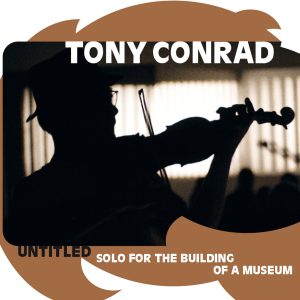
Tony CONRAD
“Untitled (Solo for the Building of a Museum)”
This recording (2002) captures the two instruments central to Conrad's practice at the time: his self-built Long String Instrument and his amplified violin. He performed hidden behind a large sheet, and the nature of what unfolded behind it was never disclosed to the audience.
Mudam
Recorded at the construction site of the future Mudam - Musée d'Art Moderne Grand-Duc Jean, Luxembourg, designed by I. M. Pei - during the Museum Night of October 12, 2002, by invitation of Marie-Claude Beaud. The concert was co-organized by Transhistorics, a coproduction by Sub Rosa and Philippe Franck's Transcultures. Conrad also performed several times in Europe alongside Charlemagne Palestine in the following years, including the October 2005 concert An Aural Symbiotic Mystery.
Short Bio
Tony Conrad (1940-2016) was an American musician, experimental
filmmaker, and composer, active across media since the early 1960s. A pioneer of drone music, he was a central figure in the New York scene of the 1960s and performed as part of the Theatre of Eternal Music. He became known as a filmmaker for his 1966 film The Flicker. Over the following decades he performed and collaborated with a wide range of artists.
Interview
The recording is accompanied by an extended interview conducted by Philippe Franck, published here as a tribute to him.
- Doesn't this relate to intensity - the kind of theatrical intensity largely absent from computer music performance?
- When I started performing again with the violin in the 1980s, some people described what I was doing as "expressionism." I was surprised at first - in my own arrogance I thought: this is mine, I invented it. But I took the criticism seriously, and it led me to ask what actually distinguishes expressionism from other forms of expression.
- Perhaps we should simply speak of expression, rather than 'Expressionism'?
- Exactly. In performance, I like to work at what I'd call the zero degree of sound - harmonic structure itself. I can be entirely satisfied with a pure open fifth: dance, meditation, heroism, all of it is contained within a fifth, provided I can find my way into that sonic space. Once, a student who admired La Monte Young told me I was playing out of tune. I remember thinking thinking: I'm playing music, not notes. I'm making music that speaks to people.
13,50€
In stock
CD
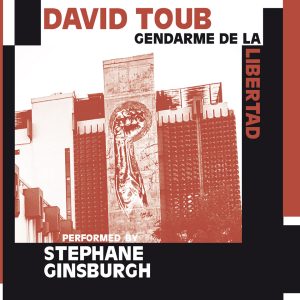
David TOUB
“Gendarme de la Libertad”
David Toub is a unique voice in American minimalism, a genre that has produced quite a few composers over the past 80 years. Our first contact dates back about fifteen years, and from the very beginning, David struck me as a committed composer, dedicated to building a coherent body of work. But he is also an engaged individual, deeply concerned with the challenges of our time and genuinely generous. In other words, a mensch—a rare kind of person. His music, in some ways, reflects today’s anxieties and uncertainties: repetitive, obsessive, often dark, and questioning.
This is the second album of his music that I have recorded, and this time, David has incorporated the human voice to feature a speech given by Che Guevara in 1964. The speech addresses the contradiction between a state's founding principles and its actions. How can a nation advocate for freedom year-round while deliberately acting against minorities, particularly those historically oppressed? The piece does not provide an answer—this question remains just as relevant today, 60 years later.
(Stephane Ginsburg)
David Toub (b. 1961, Newark, NJ) is largely self-taught, with the only formal composition education consisting of attending music school (Mannes College of Music; Juilliard Pre-College Division) during weekends while in high school.
He remains an active composer. While Toub composed serial and dodecaphonic music until 1982, his subsequent works have been described as “minimalist,” although the durations of a subset of his compositions are not at all minimal (1.5 to over 4 hours in some cases).
13,00€
In stock
LP
ErikM – Pierre BASTIEN
“Observations”
Limited edition of 250. Textured sleeve. Marbled yellow flame color. Jean Dubuffet used to define his music as something disordered and dirty. But here, it is a Dubuffet returning from a long journey in Africa, with haunting rhythms that reach trance-like states, corrupted by ErikM's UK Drill.
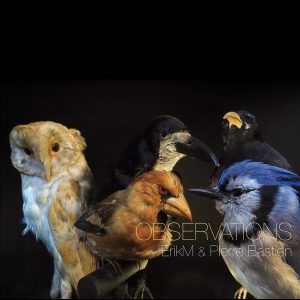
"With one exception, this disc is a recording of a concert given at the Ateliers Claus in Brussels in March 2024. It was preceded by three short hours of improvisation the day before and the day before that, during which ErikM and I made a series of careful observations of each other's playing. It must be said that neither of us had skimped on transporting a few cases, the contents of which would have allowed us to play several concerts in a row without ever repeating ourselves. Erik had brought his turntables to Brussels, as well as sophisticated electronic machines, accompanied by a virtually infinite sound bank. For my part, I had both a mechanical orchestra and a range of acoustic instruments at my disposal. In two sessions, we eliminated the superfluous and the ineffective. On the evening of the concert, it was through close observation-of each sound, each direction taken by one or the other, each intention, each break-that we composed this record in the moment: vigilant and scrutinizing, like the pairs of eyes on the cover of this album." --Pierre Bastien
16,50€
In stock
CD
Miroslav BEINHAUER
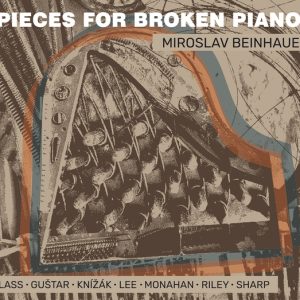
“Pieces For Broken Piano”
Grand Piano Gebrüder Stingl from 1916. The year is 2021. The piano is in the garden; the sun shines on it and rain falls on it. The piano cannot be tuned. Some keys work only partially, some not at all. It is Broken Piano. The first pieces for Broken Piano were recorded on this piano in 2021 and became part of the Fluxus editions Stolen Symphony (2023) and Keep Together (2024). The pieces for this edition were written and provided by Terry Riley and Milan Knízák. "Broken Piano," which was acquired by the Opening Performance Orchestra to make live and studio recordings, was the focus of both volumes of this edition between 2021 and 2023. Compositions for Broken Piano intended for Fluxus editions were recorded by Czech pianist Miroslav Beinhauer. During this time, other new works for Broken Piano were written by a variety of Fluxus and non-Fluxus composers. In the spring of 2022, the Opening Performance Orchestra and Broken Piano participated in an event hosted by Mieko Shiomi. This was a new version of her early work "Spatial Poem": it was a moving event, documentation of which was presented at the Aichi Triennale 2022 in Tokyo. During this performative event, consisting of moving any object, Broken Piano was moved from the village Vyzlovka to Unhost, where the SONO music studio is located. It is in the SONO studio that the new compositions for Broken Piano were recorded, written by Terry Riley, Philip Glass, Milan Knízák, Gordon Monahan, Elliot Sharp, Milan Gustar, and Yoon-Ji Lee, which form the content of this album. All the new compositions were recorded by pianist Miroslav Beinhauer.
13,50€
In stock

LP
Bernard PARMEGIANI
“Lac Noir – La Serpente 1992”
Unreleased material composed by Bernard Parmegiani in 1992. Lac Noir - La Serpente is part of Emmanuel Raquin-Lorenzi's Lac Noir, a composite work inspired by a serpentine female creature or "snake-woman" that he saw in Transylvania in 1976, with a total of 33 pieces using various media, 24 by himself and 9 by other artists. All the materials used in Lac Noir were gathered on the land of the snake-woman between 1990 and 1992. The first coordinated broadcast ran from June to October 2019, like a theatrical display of media.
"At the end of May 1992, in Provence, in his Summer studio not far from the Montagne Sainte-Victoire, Bernard Parmegiani played the first musical moments he had worked on from the sounds he and Christian Zanési had collected in Negreni in October 1990. A few days after this listening session, on 4th June, I wrote him a letter. I didn't mean to take control of what was to become the ninth movement of his composition, but to share with him some of the resonances I had heard in what he had composed, which mingled with my dreams and memories of the Transylvanian snake-woman, and outlined possible concordances with the other pieces underway for Lac Noir. In the midst of the garish chaos of the fair and its spectacular stunts, there could spread out -- still, silent eye of the cyclone -- the long waters of a lake. Calm waters. Patches cool but sensitive as skin. Between the waters there flows and ripples, there shows up and dives again a snake-woman born of the still waters. A sweet, good serpent whose song -- strange and melodious, sensual, yet already tinged, as if bitten by the black depths, with bitterness; that of prescience, shading it with melancholy -- is her very undulation, the rings of which appear, together or in turn, the way translucent veins overlap, slither over one another in a moving braid of metamorphoses." (Extracts from notes by E. Raquin-Lorenzi)
17,00€
Out of stock
CD
Bernard PARMEGIANI
“Lac Noir – La Serpente 1992”
Unreleased material composed by Bernard Parmegiani in 1992. Lac Noir - La Serpente is part of Emmanuel Raquin-Lorenzi's Lac Noir, a composite work inspired by a serpentine female creature or "snake-woman" that he saw in Transylvania in 1976, with a total of 33 pieces using various media, 24 by himself and 9 by other artists. All the materials used in Lac Noir were gathered on the land of the snake-woman between 1990 and 1992. The first coordinated broadcast ran from June to October 2019, like a theatrical display of media.
"At the end of May 1992, in Provence, in his Summer studio not far from the Montagne Sainte-Victoire, Bernard Parmegiani played the first musical moments he had worked on from the sounds he and Christian Zanési had collected in Negreni in October 1990. A few days after this listening session, on 4th June, I wrote him a letter. I didn't mean to take control of what was to become the ninth movement of his composition, but to share with him some of the resonances I had heard in what he had composed, which mingled with my dreams and memories of the Transylvanian snake-woman, and outlined possible concordances with the other pieces underway for Lac Noir. In the midst of the garish chaos of the fair and its spectacular stunts, there could spread out -- still, silent eye of the cyclone -- the long waters of a lake. Calm waters. Patches cool but sensitive as skin. Between the waters there flows and ripples, there shows up and dives again a snake-woman born of the still waters. A sweet, good serpent whose song -- strange and melodious, sensual, yet already tinged, as if bitten by the black depths, with bitterness; that of prescience, shading it with melancholy -- is her very undulation, the rings of which appear, together or in turn, the way translucent veins overlap, slither over one another in a moving braid of metamorphoses." (Extracts from notes by E. Raquin-Lorenzi)
13,50€
In stock

LP
COMPILATION
“Miao Mouthorgans & Other Rare Instruments In Guizhou, Sichuan, China”
"The term 'Miao' is a very ancient Chinese misleading pseudo-ethnic categorization, the Hmong in western languages, a term recognized by colonial French Indochina. Miao became a generic term which does not reveal the diversity of 38 subgroups or 9 million people, mostly in Southern China Guizhou Province. China, since having moved towards the market economy, now includes a large number of minority regions that are marketed a commodity available only to them: their ethnicity itself. Ethnic tourism has developed in a big way in China since the 1990s, for both Chinese and foreign tourists, and it is often promoted as the way to generate income in those areas for development. I usually stay away from Ethnotouristic shows and try to get music that is not a commodity! I was based in Dali, Yunnan, China between 2006 and 2013." --Laurent Jeanneau
Recorded by Laurent Jeanneau and Shi Tanding. Notes By Laurent Jeanneau. "Miao Three Mouthorgans In Guizhou China" features three men each using a different size lushen or gué and four women each blowing in a different mantong. Recorded in Paisha village. "Hua Miao Wedding Dance In Sichuan China" features an instrument called the lushen, the predominant kind of mouth organ being used for entertainment. "Hmoob Dongliang In Guizhou China" was recorded in Biasha village, composed of two reeds instruments and male and female singers, intended as love songs. "Hua Miao Hulushen In Sichuan China" was performed by one man. The main music instrument is the small mouth organ, hulushen, the predominant mouth organ used for entertainment, where the long tubes lushen is mounted on a wooden resonance box. "Hmoob Mouthorgans In Guizhou China" was recorded in Biasha village, and features a Miao (they call themselves Hmoob). This is part of musical demonstration for tourists. Armed with heavy cameras, six men using six lushen of various sizes. "Gelao Gupiaoqin In Guizhou China" was recorded in Songlong village, where people identify themselves not as Miao but as Gelao, using a very rare string instrument called the Gupiaoqin. "Gelao Canon Singing In Guizhou China" features two old ladies performing canon singing in Songlong village. "Shui Miao Travelling Song Guizhou China" features the Shui Miao (water Miao), a sub group of the Miaos of Guizhou, based in the Shidong area outside of Kali in Guizhou.
17,00€
In stock

2 LP
DEDALUS ENSEMBLE – Philip GLASS
“Music with Changing Parts”
Founding work of minimalism, Music with Changing Parts is a piece with free instrumentation. The musicians choose which part to play among the eight staves of the score. At each indicated cue, the musicians can change part, which produces an abrupt change of instrumentation. While the music is based on a melodic material limited to a few notes that are repeated in patterns that expand or contract, the changes in orchestration refresh the listening experience by producing sonic contrasts. These techniques at work in Music with Changing Parts, written in 1970, will lead Philip Glass to renew his language and move from the monochromatic works that precede it to more dramatic works such as music in 12 parts and especially the opera Einstein on the Beach. When Philip Glass began rehearsing the piece, he was surprised to hear long notes when everything was written in eighth notes. After making sure that none of the musicians were playing held notes, he realized that the fact that the same notes were played by all the instruments in the ensemble produced, through a psycho-acoustic effect, a harmonic substrate of resonant frequencies. He then decided to add to the score the possibility of playing long notes to reinforce this effect. "For this recording, we chose to record first the eighth notes, then the long notes in re-recording. This utopian version, with each musician playing short and long notes at the same time (!), illustrates the minimalist aesthetic that plays with our perception and allows us to reconcile opposites and cultivate the apparent paradox of a music that moves forward without Moving and changes constantly while remaining the same." --Dedalus Ensemble
20,00€
Out of stock
CD
DEDALUS ENSEMBLE – Philip GLASS
“Music with Changing Parts”
Founding work of minimalism, Music with Changing Parts is a piece with free instrumentation. The musicians choose which part to play among the eight staves of the score. At each indicated cue, the musicians can change part, which produces an abrupt change of instrumentation. While the music is based on a melodic material limited to a few notes that are repeated in patterns that expand or contract, the changes in orchestration refresh the listening experience by producing sonic contrasts. These techniques at work in Music with Changing Parts, written in 1970, will lead Philip Glass to renew his language and move from the monochromatic works that precede it to more dramatic works such as music in 12 parts and especially the opera Einstein on the Beach. When Philip Glass began rehearsing the piece, he was surprised to hear long notes when everything was written in eighth notes. After making sure that none of the musicians were playing held notes, he realized that the fact that the same notes were played by all the instruments in the ensemble produced, through a psycho-acoustic effect, a harmonic substrate of resonant frequencies. He then decided to add to the score the possibility of playing long notes to reinforce this effect. "For this recording, we chose to record first the eighth notes, then the long notes in re-recording. This utopian version, with each musician playing short and long notes at the same time (!), illustrates the minimalist aesthetic that plays with our perception and allows us to reconcile opposites and cultivate the apparent paradox of a music that moves forward without Moving and changes constantly while remaining the same." --Dedalus Ensemble
13,50€
In stock

LP
Ahmed ESSYAD
“Moroccan Electroacoustic Music 1972-74”
Composer Ahmed Essyad was born in Salé, Morocco, in 1938. After studying music at the Rabat Conservatoire (Morocco) he moved to Paris in 1962, where he became a student of Max Deutsch and, later, his assistant. Trained in the avant-garde practices of Western musical composition, he also claimed the Amazigh folk music of Morocco as a fundamental source of inspiration for his work. In 1965, he was already incorporating elements of oral tradition in his work so as to question the language of his time, and therefore had to cope with the limits of musical notation and communication with musicians who did not share his cultural references. It was difficult to agree on what was implicit, "behind the notes," especially regarding the management of musical time and micro-intervals. In search of new compositional tools, he turned to electro-acoustic music. Working in a studio made it possible for him to be the interpreter of his own work, which ensured a certain continuity with music of oral tradition. The pieces presented here were produced between 1972 and 1974 in a studio dedicated to electro-acoustic music, the S.M.E.C.A, which was part of the Music Workshop founded by Jorge Arriagada in Paris. The studio was equipped with EMS and Minimoog synthesizers, a piano, a marimba, a xylophone, as well as various percussion instruments and a tape delay system. The practice of electro-acoustics may have been a mere parenthesis in Ahmed Essyad's long and prolific career as a composer of contemporary music, but the works presented here are nonetheless important. They show how strongly he both supported North African popular forms of expression and opposed its folklorizing through simplistic and "exotic" representations. It's not about fusing together East and West -- impossible, he says: "the real point is to open up an imaginary space where another modernity can exist outside the largely Eurocentric framework of avant-garde music. Synthesis means anticipation, knowledge. As for me, I'm increasingly ignorant. I write to discover what I don't know. Music feeds me, it pollinates me. It's my daily wine."
17,00€
In stock
CD
Ahmed ESSYAD
“Moroccan Electroacoustic Music 1972-74”
Composer Ahmed Essyad was born in Salé, Morocco, in 1938. After studying music at the Rabat Conservatoire (Morocco) he moved to Paris in 1962, where he became a student of Max Deutsch and, later, his assistant. Trained in the avant-garde practices of Western musical composition, he also claimed the Amazigh folk music of Morocco as a fundamental source of inspiration for his work. In 1965, he was already incorporating elements of oral tradition in his work so as to question the language of his time, and therefore had to cope with the limits of musical notation and communication with musicians who did not share his cultural references. It was difficult to agree on what was implicit, "behind the notes," especially regarding the management of musical time and micro-intervals. In search of new compositional tools, he turned to electro-acoustic music. Working in a studio made it possible for him to be the interpreter of his own work, which ensured a certain continuity with music of oral tradition. The pieces presented here were produced between 1972 and 1974 in a studio dedicated to electro-acoustic music, the S.M.E.C.A, which was part of the Music Workshop founded by Jorge Arriagada in Paris. The studio was equipped with EMS and Minimoog synthesizers, a piano, a marimba, a xylophone, as well as various percussion instruments and a tape delay system. The practice of electro-acoustics may have been a mere parenthesis in Ahmed Essyad's long and prolific career as a composer of contemporary music, but the works presented here are nonetheless important. They show how strongly he both supported North African popular forms of expression and opposed its folklorizing through simplistic and "exotic" representations. It's not about fusing together East and West -- impossible, he says: "the real point is to open up an imaginary space where another modernity can exist outside the largely Eurocentric framework of avant-garde music. Synthesis means anticipation, knowledge. As for me, I'm increasingly ignorant. I write to discover what I don't know. Music feeds me, it pollinates me. It's my daily wine."
13,50€
In stock
LP
Alain PIERRE
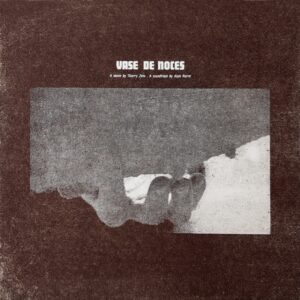
“Vase de Noces”
The first ever publication of the original soundtrack composed by Alain Pierre for the Belgian cult film Vase de noces, directed by Thierry Zeno in 1974. Limited edition of 400 copies with screen-printed sleeve. Vase de Noces wasn't released in Belgium. The only distribution Thierry's films might have accessed here was the "Swedish distribution," a code for distribution around adult movie theaters. Films by major directors such as Bergman or Polanski were released this way. In memory of Alain Pierre (1948-2024).
"Vase de noces was made with very little money. Thierry used 16mm reversal film, utilizing the ends of reels he obtained from friends who worked as TV cameramen. Similarly, I salvaged magnetic tape from my workplace, the Équipe sound studio. Film professionals looked down on him because he filmed everything on his own, without relying on technicians. The remarks became even more disparaging when they saw the quality of the result. Thierry shot this film gradually, just getting by, progressing intermittently, but he had a precise idea and memory of the framing and sequences. He really did a great job, as if he had the entire edit in mind from the start. The first shot had to be the right one. He showed me the film sequence by sequence when the editing was over. This was how he worked, and that's why it took him so long getting the right splices, the right light, etc. Thierry handled the framing and the lighting himself. His black-and-white work is unique; he operated within constraints, which is how creativity often flourishes. Thierry had a story in mind, and in the end, he achieved exactly what he wanted. The performance of actor Dominique Garny, for instance, and his aptitude -- it helped a lot. They spent hours together in the cold, in the mud. As the shooting progressed, I suggested samples of sounds obtained from my machine. This was what he wanted: bottle sounds. There isn't a single direct sound in the film -- it's all dubbed. I never distinguished music from the rest of the soundtrack. The idea of a 'sound object' never left me, and I've always kept that direction in mind when composing. One day, Thierry stopped by while I was working on a documentary about Saint Augustine, for which I was using a tune by Monteverdi. He told me about a certain sequence from his film, and I had the feeling that this music would work wonderfully with that sequence if I slowed it down to the extreme, to the point that it would be unrecognizable. Very rudimentary special effects. I had manipulated music sung by castrati this way for O Sidarta (FKR 107LP), and he liked it. My suggestion was accepted." -- Alain Pierre
21,50€
In stock
2 LP
COMPILATION
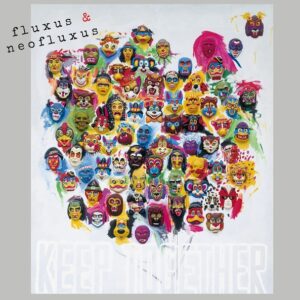
“Fluxus & Neofluxus: Keep Together (Part II)”
In April 2023, the first part of the Fluxus edition called Stolen Symphony was released. Now, in 2024, there is the second part, called Keep Together. At the center of this edition was a broken piano, acquired by the Opening Performance Orchestra for the purpose of making live and studio recordings. During this time other new works for this broken piano were written by diverse Fluxus and non-Fluxus composers. In the spring of 2022, the Opening Performance Orchestra and the broken piano participated in an event hosted by Mieko Shiomi. This was a new version of her early work Spatial Poem, documentation of which was presented at the 2022 Aichi Triennale in Tokyo. At present, the broken piano lies in the open air in Prague and is subject to gradual decay. This edition contains new and old pieces, live and studio recordings, finished pieces and scores to be performed, solos and pieces for ensemble, using classical and special instruments from 33 Fluxus artists, which have been played by ten soloists and four ensembles. There are new essays and articles from 15 writers on the theme Fluxus, as well as original photos and other documentation in the booklets. The Belgian label Sub Rosa provided technical support and a good place for the grand-scale release. The audio restauration and mastering were done by Gabriel Séverin at Laboratoire central, Brussels, and Kakaxa, 3bees, Prague. Archivio Conz in Berlin provided access to their extensive archives and Edizioni Conz provided co-production. Ursula and René Block made possible the realization of John Cage's historical composition "Mozart Mix" from the Edition Block archive. The photographic material comes from Marie Knízáková and Milan Knízák's private archive, the German photographer Wolfgang Träger, Archivio Conz's Fluxus archive, the private archives from diverse Fluxus artists and Opening Performance Orchestra's digital archive. Milan Knízák, Henning Christiansen, La Monte Young, Philip Corner, Bengt af Klintberg, George Maciunas, Takako Saito, Toshi Ichiyanagi, John Cage, Geoffrey Hendricks, Nam June Paik, Sara Miyamoto, Ken Friedman, Yoko Ono, Josef Anton Riedl, Giancarlo Cardini, Ay-O, and George Brecht.
27,00€
In stock
2 CD
COMPILATION
“Fluxus & Neofluxus: Keep Together (Part II)”
In April 2023, the first part of the Fluxus edition called Stolen Symphony was released. Now, in 2024, there is the second part, called Keep Together. At the center of this edition was a broken piano, acquired by the Opening Performance Orchestra for the purpose of making live and studio recordings. During this time other new works for this broken piano were written by diverse Fluxus and non-Fluxus composers. In the spring of 2022, the Opening Performance Orchestra and the broken piano participated in an event hosted by Mieko Shiomi. This was a new version of her early work Spatial Poem, documentation of which was presented at the 2022 Aichi Triennale in Tokyo. At present, the broken piano lies in the open air in Prague and is subject to gradual decay. This edition contains new and old pieces, live and studio recordings, finished pieces and scores to be performed, solos and pieces for ensemble, using classical and special instruments from 33 Fluxus artists, which have been played by ten soloists and four ensembles. There are new essays and articles from 15 writers on the theme Fluxus, as well as original photos and other documentation in the booklets. The Belgian label Sub Rosa provided technical support and a good place for the grand-scale release. The audio restauration and mastering were done by Gabriel Séverin at Laboratoire central, Brussels, and Kakaxa, 3bees, Prague. Archivio Conz in Berlin provided access to their extensive archives and Edizioni Conz provided co-production. Ursula and René Block made possible the realization of John Cage's historical composition "Mozart Mix" from the Edition Block archive. The photographic material comes from Marie Knízáková and Milan Knízák's private archive, the German photographer Wolfgang Träger, Archivio Conz's Fluxus archive, the private archives from diverse Fluxus artists and Opening Performance Orchestra's digital archive. Milan Knízák, Henning Christiansen, La Monte Young, Philip Corner, Bengt af Klintberg, George Maciunas, Takako Saito, Toshi Ichiyanagi, John Cage, Geoffrey Hendricks, Nam June Paik, Sara Miyamoto, Ken Friedman, Yoko Ono, Josef Anton Riedl, Giancarlo Cardini, Ay-O, and George Brecht.
20,00€
In stock
2 CD
Stefan PRINS
“Inhabit”
Inhabit, the second release by Stefan Prins on Sub Rosa, brings together four recent, large-scale compositions in which traditional instruments-from bass woodwind trio to electric guitar and symphonic orchestra-merge seamlessly with electronics, feedback, and field recordings. inhabit once again serves as a testament to how Prins, whose work is performed worldwide by some of the most celebrated musicians, ensembles, and orchestras, continues to stay attuned to the pulse of contemporary music. His compositions offer a refreshing, gripping, and consistently surprising exploration of the increasingly porous boundaries between the acoustic and electronic realms. The first disc of this double album, co-produced by Deutschlandfunk Kultur, opens with "Inhibition Space #1," a piece for amplified bass woodwind trio and feedback, delivered in a masterful performance by the Berlin-based Ensemble Mosaik. This exploration of instrumentally controlled feedback is juxtaposed with an acoustic chamber orchestra in the multidimensional "inhabit_inhibit," captured during a gripping live performance by Ensemble Kollektiv Berlin, conducted by Max Murray at Ultraschall Berlin in 2023. The second disc features Prins' provocative electric guitar concerto, "under_current," performed by the formidable Yaron Deutsch on electric guitar and the dream-team of the BBC Scottish Symphony Orchestra under the baton of conductor Ilan Volkov. In this expansive sonic landscape, ranging from delicate flageolet whispers to ear-splitting outbursts-the orchestra functions as an acoustic meta-amplifier for the electric guitar, enhanced by a range of effect pedals. The album concludes with "Mesh" for five instruments, feedback, electronics, and field recordings, in which the traditional boundaries between human, technology, and nature are completely deconstructed. In their place, Prins creates a world where unexpected sonic connections emerge and dissolve, like acoustic mirages. The Belgian Nadar Ensemble, which Prins co-directs, once again demonstrates why it is such a sought-after ensemble on the international concert stage, and one of Prins' principal musical ambassadors. Additionally, this release includes an exclusive, insightful 12-page booklet on these compositions by music journalist, researcher, and novelist Joep Christenhusz. This release is a co-production with Deutschlandfunk Kultur and BBC Radio 3 and was made possible by the generous support of the Flemish Community (Flanders State of the Art), the Nadar Ensemble, Ensemble Mosaik, and Ensemble Kollektiv Berlin, along with all the musicians involved.
16,00€
In stock
CD
MERZBOW + Nicolas HORVATH
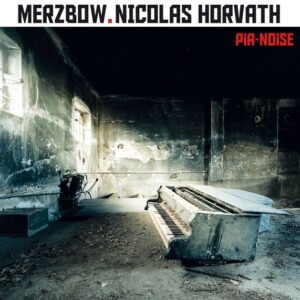
“Pia-Noise”
Even the most experienced ear will not come out of Pia-Noise unscathed. Consecrating the meeting of two consummate artists, this release confronts their universe like a massive head-on shock in the eye of a sound storm. Masami Akita (Merzbow) has been surveying the territories of noise music for more than forty years, directing all sorts of instrumentaria, analogical or digital, instrument or software-based. For this record he relied on his favorite combination, a mix of various effects pedals and noise generators. Nicolas Horvath is a pianist of exceptional sensibility. More than well-versed in the classical repertoire, he also is fundamentally curious and multifaceted, as evidenced by his rescuing works and composers from oblivion, championing them on stage and patiently, carefully recording them. Nicolas Horvath also improvises and composes electronic music. Since the early 2000s, he has been active in the experimental and underground scene under many different names, especially Dapnom. A collaboration with Merzbow had already been considered some fifteen years ago. In the midst of forced isolation, it was all the more tempting to meet symbolically, following the ways of the World Wide Web. Pia-Noise is actually a project born from the health crisis and lockdowns, carried out from different homes in days of anguish and uncertainty. Both artists thus projected their worries about the ongoing crisis and today's ecological disaster. The music produced took on the shape of a constant struggle between, on the one hand, Merzbow's continuous release of energy, saturated sounds, masses, stridencies, powerful granulations, surrounding textures, chaotic rhythms and organized chaos, and on the other, Nicolas Horvath's improvisations, sometimes lyrical, sometimes harmonic, always deeply rooted in his classical culture and personal pantheon, like a memory of a golden age forever lost. No listener will escape it as they lend a careful and sometimes all but desperate ear to the raging soundwaves. The two continuous musical lines often collide and even seem to ignore each other every so often, but they also meet and complete each other, helping the compositions breath. This confrontation generates a great opulence of sound calling for an extremely active form of listening. In the midst of a global wreck and a period of upheaval, two artists still manage to communicate from one digital raft to another, and render the poetry of a moment. Comes in four-panel digipack with eight-page booklet.
13,50€
In stock
CD
COMPILATION
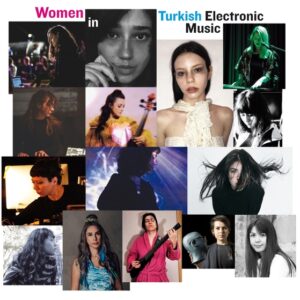
“Women In Turkish Electronic Music”
After the release of the Anthology of Turkish Experimental Music 1961-2014 (SR 390CD, 2016), this new series of recordings unveils the diverse creativity of young Turkish female artists. The majority of these compositions were crafted between 2021 and 2024. The anthology presents works from 15 Turkish female artists, each contributing to the album's beauty through their multifaceted creations. It encompasses various styles, ranging from purely formal music to innovative electronica, incorporating remnants of Turkish harmonies, as well as pieces with conceptual or political undertones, varying in intensity from subtle to overt. Featuring Aslz Kobaner, Eda Er, Elif Yalvaç, Eylül Deniz, Fulya Uçanok, Gökçe Uygun, Gülce Özen Gürkan, Güls¸ah Erol, KAOSMOS, MelteM Ural, Mine Pakel, Pervin Güzeldere, Senem Pirler, Seinemis, and Zeynep SarÏkartal.
13,50€
In stock
CD
Jean-Luc FAFCHAMPS
“Ensemble(s)”
Seen from the outside, Ensemble(s) is in a sense a kind of compilation of unreleased or rare pieces covering nearly three decades. Five essential pieces that count in the evolution of the Jean-Luc Fafchamps' writing. Post-spectral works that definitively position Fafchamps as one of the important European composers. It also weaves subtle links between him and Jean-Paul Dessy and Musiques Nouvelles, once created by Henri Pousseur. This disc is undoubtedly the best introduction to his work. Performed by Musiques Nouvelles. Conducted by Jean-Paul Dessy.
"At the instigation of Jean-Paul Dessy, the Musiques Nouvelles ensemble initiated all sorts of configurations to which I was often associated, and glad to be. This album is the journal of these criss-crossing collaborations: sometimes as part of the ECO (European Contemporary Orchestra) project, through which Musiques Nouvelles met the Ensemble Télémaque (from France) and Orkest de ereprijs (from the Netherlands) in a large orchestral formation; sometimes for a project produced with Art Zoyd (France); sometimes as a string ensemble or with Claire Bourdet as a soloist. I am glad to present, united in one album, such different periods, contrasting collaborations and multiple encounters not merely due to coincidence but also to affinities. May my style, and the story of my questionings, give a certain consistency to this ensemble of beautiful collaborations." --Jean-Luc Fachamps
13,00€
In stock
2 CD
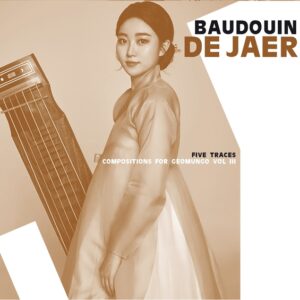
Baudouin De JAER
“Five Traces: Geomungo Compositions Vol. III”
Five Traces is a wordless opera in three acts. Its sound includes words and images. The notes must speak: "This wordless opera is certainly my most daring experiment with text in sound. Over the ten years I spent discovering the majestic Geomungo, the six-string Korean bass zither played with a suldae plectrum, working on Héros de la pensée gave soft, poetic, melodious and appeasing sounds. Some of my studies continued the reduction process I had started for the piano and the violin (and then for the Gayageum), in the compositions I wrote between 1986 and 2023, attempts at extreme reducing and simplifying down to lines, music stated on one and single note (with exceptions). Lines allows the interpreter to express themselves within the scope of rhythm, nuance, vibratos, stresses and attacks, and to show the many unheard orchestral possibilities at the root of this unique instrument. In stark contrast, Chanson Cubique (Vol II) or Trace III include moments with an excessive variety of notes driving the instrument into a corner. With the warm timbres of the recordings featuring on the first two CD volumes, the listener is an accomplice to the interpreter, standing in the wings while they rub strings on fret, prepare their fingers and release the strings, tune the instrument while playing, etc. On the other hand, 'Traces' (once every five of them have been listened to) offers a more panoramic view, a look at the geometric structures of the compositions. Vol I was my doorway to the geomungo, while the compositions gathered in Vol II were explorations (experiments, studies) with a more technical aspect, in preparation for the writing of Five Traces." --Baudouin De Jaer
16,00€
In stock
2 CD
David TOOP
“Mondo Black Chamber”
Sub Rosa recordings 1996-2003: the complete series of works made by David Toop for their label. David Toop (born May 5, 1949) is an English musician and author, and as of 2001, was visiting Research Fellow in the Media School at London College of Communication. He was notably a member of The Flying Lizards. He released New and Rediscovered Musical Instruments (with Max Eastley) on Brian Eno's Obscure label (1975) plus many solo albums including 37th Floor at Sunset (2000) and Black Chamber (2003) on Sub Rosa. He was a prominent contributor to the British magazine The Face. He is a regular contributor to The Wire. Toop published his pioneering book on hip-hop, Rap Attack, in 1984. Eleven years later, Ocean of Sound appeared, described as Toop's "poetic survey of contemporary musical life from Debussy through ambient, techno, and drum 'n' bass."
17,00€
Out of stock
LP
COMPILATION
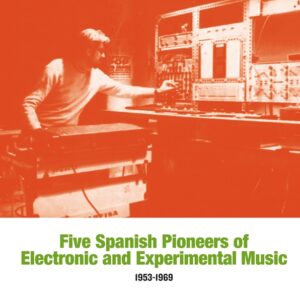
“Five Spanish Pioneers of Electronic and Experimental Music: 1953-1969”
This LP reveals the extraordinary diversity of research -- almost all hidden -- by Spanish musicians in the '50s and '60s. Those pieces were composed while the country was under the tyranny of Francisco Franco. It is truly the ultimate grail, developed by musicologist Miguel Álvarez-Fernández: he is its curator, editor and commentator. This undoubtedly marks a major step in the approach and understanding of this music which had to fight to exist before the death of Franco in 1975. Miguel Álvarez-Fernández (Madrid, 1979) is a writer. He hosts the weekly radio broadcast Ars Sonora -- dedicated to sound art and experimental music, and offering hundreds of freely available podcasts on Radio Clásica (Spanish National Radio). Five Spanish Pionniers of Eletronic and Experimental Music aims to present five composers who most often work outside the rules and without the possibility of help from their own country. Jose Val del Omar (1904-1982) is essentially a creator, a filmmaker developing a dreamlike art -- not without links with Federico Garcia Lorca or Luis Buñuel. Eduardo Polonio (b. 1941) has published, in forty years, more than a hundred works. Josep Maria Mestres Quadreny (1929-2011) joined the Manuel de Falla Circle in 1952 and in 1974 he founded the Laboratori de Música Electroacústica Phonos. During his life he collaborated with Joan Miró and Antoni Tàpies. Juan Hidalgo (1927-2018) participated in the music festival XII Internationale Ferienkurse Fur Neue Musik in Darmstadt in 1957. The following year he met the American composers John Cage and David Tudor. A member of Fluxus, in 1966 he participated with Gustav Metzger, Otto Muehl, Wolf Vostell, and Hermann Nitsch in the Destruction in Art Symposium in London. Cristóbal Halffter (1930-2021) was soon considered one of the most important composers of his generation. As a lecturer at the Internationale Ferienkurse für Neue Musik in Darmstadt, he worked with Pierre Boulez, Karlheinz Stockhausen, and Luciano Berio.
16,00€
In stock
CD
COMPILATION
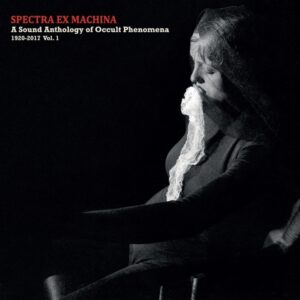
“Spectra Ex Machina: A Sound Anthology of Occult Phenomena, 1920-2017 Vol.1”
The anthology Spectra Ex Machina brings together rare documents pertaining to so-called occult phenomena, most of them taken from little-known archives. In the course of three volumes, this series traces an audio history of parapsychology through the exploration of spiritualism and haunted houses (Vol. 1); musician mediums (Vol. 2); experiences of extrasensory perceptions (clairvoyance, psychokinesis, etc.) and electronic voice phenomena (Vol. 3). The documents gathered here are, by their extravagance and far-fetched aspects, more than the mere objects of belief one would be tempted to reduce them to. They are vestiges of aberrant phenomena, fossils of an unknown civilization buried in the depths of the unconscious that are revived, in a way, when audiences listen to them. They can be understood as "works," in the full artistic sense of the word, and constitute a kind of "cabinet of sound curiosities" that is worthy of aesthetic interest. Sometimes imbued with a disconcerting dramatic intensity, these documents bear the features of an authentic time machine, placing the listener in the position of a witness of the time immersed in the dim darkness of the experimental hall. And it is at that precise moment that the aesthetic power of these archives takes precedence over their probative value. Their somewhat old-fashioned charm, maintained by the surface noise of magnetic tapes and old wax disks, gets stronger with each listen. Comes with 32-page booklet.
14,50€
In stock
CD
COMPILATION
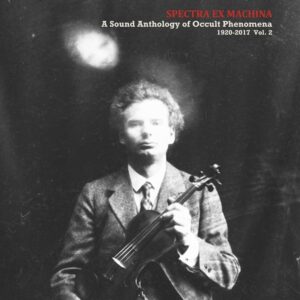
“Spectra Ex Machina: A Sound Anthology of Occult Phenomena 1920-2017 Vol. 2”
The anthology Spectra Ex Machina brings together rare documents pertaining to so-called occult phenomena, most of them taken from little-known archives. In the course of three volumes, this series traces an audio history of parapsychology through the exploration of spiritualism and haunted houses (Vol. 1); musician mediums (Vol. 2); experiences of extrasensory perceptions (clairvoyance, psychokinesis, etc.) and electronic voice phenomena (Vol. 3). The link between music, sound and the paranormal is manifested in many different ways. Gerard van der Leeuw, the Dutch historian and philosopher, wrote "Music represents the great struggle of reaching the wholly other, which it can never express." Furthermore, "The effect of music on the emotions is so mysterious as to seem magical. There is no logical explanation why a particular combination of musical notes, whether in the form of a tune or of a simple chord, can affect the heart. Nothing in nature has perhaps so persistently resisted explanation," as said Derek Parker, the British journalist. Since music is arguably the most intangible of the arts and since the paranormal, in all its manifestations, continues to intrigue people, the placing of these two subjects together seems obvious. This second volume of musical and audio anomalies continues and expands upon the works initially reproduced in the latter. Rosemary Brown makes a welcome re-appearance, especially with a performance of Grübelei via Liszt, as well as the Caruso-inspired tenor Leo May making a repeat performance. Few people realize that both Anton LaVey and Aleister Crowley were quite fine musicians and Alex Sanders was also interested in music. The background music of Wagner's Tannhäuser used by the latter combines both pagan and Christian elements. So close your eyes and let the magic of sound take over! Also featuring David Behr, Jack Webber, Robert, Rita Goold, Leslie Flint, Leo, Carmen Rogers, Uri Geller, Jean-Louis Victor, Joe Meek, Howard Menger, Barbara The Gray Witch, and Rev. Patrick J. Berkery, Ph. D.
14,50€
In stock

LP
COMPILATION
“Funeral Gongs Ceremonies in Ratanakiri, Cambodia”
Those recordings of gongs orchestras were produced in 2003 and 2004 during funeral ceremonies in two Kung villages and one Jaraï village in Ratanakiri province, Cambodia by Laurent Jeanneau (Kink Gong), during a time when the jungle had not been replaced by rubber plantations. Focusing on funeral ceremonies, these hypnotics pieces are intense and haunting sonic experiments.
16,00€
In stock
2 CD
Milan KNIZAK & PHAERENTZ & OPENING PEFORMANCE ORCHESTRA
“It’s Not Quite That Inventive (Sixty Years with Broken Music)”
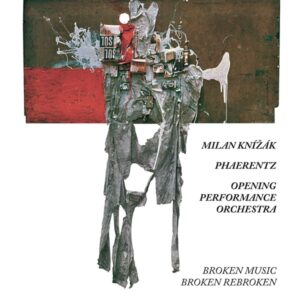
The album, featuring Milan Knizak, Petr Ferenc (aka Phaerentz) and Opening Performance Orchestra, includes Knizak's 1973 private recording Broken Music, released as a multiple of forty copies by Armin Hundertmark in 1983 on Edition Hundertmark, and a live version of Broken Rebroken, performed in January 2020 at the Museum of Czech Music in Prague. The album comes with a comprehensive 24-page booklet that includes an interview with Milan Knizak on the topic of Broken Music, an extended essay by Petr Ferenc that originally appeared in Czech Music Quarterly, visual documentation from the archives of Maria Knizakova and Opening Performance Orchestra, as well as Anna Bastyrova photographic documentation from the 2020 performance of Broken Rebroken. The cover of the album consists of photographs of Milan Knizak's now-defunct 1963 assemblage. Mastering was done by Stephan Mathieu and Gabriel Séverin, who also made the audio restoration of the archival recording Broken Music.
15,00€
Out of stock

2 CD
COMPILATION
“Fluxus & NeoFluxus: Stolen Symphony (Part I)”
Double-CD version comes in digipack; includes 72-page booklet.
All in all, there are more than 50 pieces, new and old, live and studio, finished pieces and scores to be performed, acoustic and classical, solos and pieces for ensemble, using classical and special instruments. This Fluxus edition features (in alphabetical order): Eric Andersen, Ay-O, George Brecht, John Cage, Giancarlo Cardini, Giuseppe Chiari, Henning Christiansen, Philip Corner, Öyvind Fahlström, Ken Friedman, Sten Hanson, Geoffrey Hendricks, Toshi Ichiyanagi, Joe Jones, Bengt af Klintberg, Milan Knízák, Alison Knowles, Larry Miller, George Maciunas, Sara Miyamoto, Nam June Paik, Yoko Ono, Opening Performance Orchestra, Benjamin Patterson, Josef Anton Riedl, Terry Riley, Takako Saito, Tomas Schmit, Dieter Schnebel, Mieko Shiomi, Yasunao Tone, Ben Vautier, Yoshi Wada, and La Monte Young. The musicians and performers Anna Clementi, Agnese Toniutti, Deborah Walker, Werner Durand, Luciano Chessa, Miroslav Beinhauer, Petr Bakla, Nicolas Horvath, Petr Ferenc, and Premysl Ondra have played, performed and declaimed the Fluxus pieces, Arditti Quartet and S.E.M. Ensemble provided one piece from their archives. Milan Knízák, Petr Rezek, Petr Kotík, Olaf Hanel, Eric Andersen, Per Brunskog, Peter van der Meijden, Pavlína Morganová, Natasha Lushetich, Joseph Nechvatal, Natilee Harren, Martin Patrick, Diedrich Diederichsen, Christopher M. Reeves, and Hubertus von Amelunxen have written Fluxus-themed texts. Archivio Conz in Berlin provided access to their extensive Fluxus archives and Edizioni Conz provided coproduction. Ursula and René Block made possible the realization of John Cage's historical composition "Rozart Mix" from the Edition Block archive. The photographic material comes from Marie Knízáková and Milan Knízák's private archive, the German photographer Wolfgang Träger, Archivio Conz's Fluxus archive and Opening Performance Orchestra's digital archive. The cover themes are paintings by Milan Knízák, while the graphic design is the work of Jaroslav Buzek.
20,00€
In stock
2 LP book
COMPILATION
“Fluxus & NeoFluxus: Stolen Symphony (Part I)”
Double LP version. Gatefold sleeve; includes 24-page large booklet. All in all, there are more than 50 pieces, new and old, live and studio, finished pieces and scores to be performed, acoustic and classical, solos and pieces for ensemble, using classical and special instruments. This Fluxus edition features (in alphabetical order): Eric Andersen, Ay-O, George Brecht, John Cage, Giancarlo Cardini, Giuseppe Chiari, Henning Christiansen, Philip Corner, Öyvind Fahlström, Ken Friedman, Sten Hanson, Geoffrey Hendricks, Toshi Ichiyanagi, Joe Jones, Bengt af Klintberg, Milan Knízák, Alison Knowles, Larry Miller, George Maciunas, Sara Miyamoto, Nam June Paik, Yoko Ono, Opening Performance Orchestra, Benjamin Patterson, Josef Anton Riedl, Terry Riley, Takako Saito, Tomas Schmit, Dieter Schnebel, Mieko Shiomi, Yasunao Tone, Ben Vautier, Yoshi Wada, and La Monte Young. The musicians and performers Anna Clementi, Agnese Toniutti, Deborah Walker, Werner Durand, Luciano Chessa, Miroslav Beinhauer, Petr Bakla, Nicolas Horvath, Petr Ferenc, and Premysl Ondra have played, performed and declaimed the Fluxus pieces, Arditti Quartet and S.E.M. Ensemble provided one piece from their archives. Milan Knízák, Petr Rezek, Petr Kotík, Olaf Hanel, Eric Andersen, Per Brunskog, Peter van der Meijden, Pavlína Morganová, Natasha Lushetich, Joseph Nechvatal, Natilee Harren, Martin Patrick, Diedrich Diederichsen, Christopher M. Reeves, and Hubertus von Amelunxen have written Fluxus-themed texts. Archivio Conz in Berlin provided access to their extensive Fluxus archives and Edizioni Conz provided coproduction. Ursula and René Block made possible the realization of John Cage's historical composition "Rozart Mix" from the Edition Block archive. The photographic material comes from Marie Knízáková and Milan Knízák's private archive, the German photographer Wolfgang Träger, Archivio Conz's Fluxus archive and Opening Performance Orchestra's digital archive. The cover themes are paintings by Milan Knízák, while the graphic design is the work of Jaroslav Buzek.
27,00€
In stock

LP
HASTINGS OF MALAWI
“Choreological Exchanges”
Recorded at the height of the global pandemic, and at a time when remote communication was becoming increasingly prevalent, Choreological Exchanges is part of Hastings Of Malawi's continuing investigations into the medium of communication itself. Prior to telephony becoming digital, all phone calls were routed through mechanical telephone exchanges, and the majority of the sounds on side one are the sounds of these exchanges and some of the voices of the engineers who worked with them. Hastings Of Malawi make strange records and this one is no exception although it has a more linear narrative structure in opposition to what critics have described as their Dadaist approach. Their records certainly resist genre classification and do not really fall into the category of music. Hastings Of Malawi have themselves described previous records as films without light, radio plays and as poems. This one is a dance -- a dance that takes place within the chain, or pipe, that is brain -- mouth -- telephone -- telephone exchange -- telephone -- ear -- brain.
16,00€
In stock

LP
THE DWARFS OF EAST AGOUZA
“High Tide in the Lowlands”
Hailing from the Agouza district of Cairo, Egypt, this brilliant trio consists of Alan Bishop (acoustic bass, vocals, alto sax), Maurice Louca (keyboards, drum machine), and Sam Shalabi (electric guitar). Born in 2012 when the three were living in the same apartment building in Cairo's Agouza district, the trio's instrumental improvisation-based explorations are propelled by Louca's North African percussion loops and shimmering keys, Shalabi's West African tinged free jazz guitar and grounded by Bishop's driving Krautrock-style acoustic bass. High Tide in the Lowlands was recorded in Brussels at Les Ateliers Claus on September 5, 2017 and is quite an intense experience. Most performances and recording sessions are improvised and this set is no different and even though the group opened the show with "Baka of the Future" from their first album Bes, it is almost unrecognizable and everything the trio plays is continually morphing into the next unknown idea. As the sound, energy, and instantaneous composition flows, the trance is growing and growing, ranging from raw shapeshifting "no (un)wave", free jazz, traditional Arabic, and modern experimental explorations to a concrete mystic trip from a universe expanding and contracting constantly. This is earth interrogating the sky, the sky rejoining the earth, an unknown and unwritten cosmogony.
Maurice Louca is an Egyptian musician and composer born in Cairo where he lives and works. As well as being the co-founder of the bands Bikya, Alif, and Lekhfa, Louca lends his sound to numerous other projects, composing for theatre, film, dance and contemporary art. Previous releases on Sub Rosa: Elephantine (SR 474LP), Saet El-Hazz (SR 519LP). Alan Bishop is a founding member of Phoenix/Seattle avant-garde trio Sun City Girls, who, for 27 years, explored the outer reaches of improvisation and composition (from free jazz/post rock psychedelic, and sound collage to outernational Arabic and Asian inspired folk music). As founder of the Sublime Frequencies record label, Bishop has released over 100 records, introducing previously ignored musical genres from Asia, the Middle East, and Africa. Sam Shalabi is a prolific Egyptian-Canadian composer and improviser living between Montreal, Quebec and Cairo, Egypt. As the founder of Land of Kush, Shalabi Effect, and many other projects, he began with punk rock in the late '70s and his work has evolved into a fusion of experimental music that incorporates modern/traditional Arabic, shaabi, noise, and classical music with spoken word, free improvisation and jazz.
16,00€
In stock

2 LP
DEDALUS ENSEMBLE
“Brian Eno Performed by Dedalus Ensemble”
Double LP version. With Discreet Music (1975), Music for Airports (1978), and Thursday Afternoon (1985), Brian Eno invented a new music genre, ambient music, which he defined as "able to accommodate many levels of listening attention without enforcing one in particular; it must be as ignorable as it is interesting." These versions performed and arranged by Dedalus Ensemble, according to the musicians and the critics who listened to it, goes beyond what you expect from it. A mental base that takes you far away. One of the only music without beginning or end in which we want to stay as long as possible.
Dedalus Ensemble: Founded in 1996 by Didier Aschour, Dedalus is a contemporary music ensemble based in Toulouse. Its repertoire includes works by classics of minimalism: Christian Wolff, Phill Niblock, Frederic Rzewski, Tom Johnson, Moondog, or Philip Glass. Personnel: Didier Aschour - guitar, arrangements and artistic direction; Denis Chouillet - piano; Amélie Berson - flute; Fabrice Villard - clarinet; Pierre-Stéphane Meugé - saxophone; Christian Pruvost - trumpet; Thierry Madiot - trombone; Silvia Tarozzi - violin; Cyprien Busolini - viola; Deborah Walker - cello; Eric Chalan - double bass, vibraphone.
Inspired by Erik Satie's furniture music, Cage's indeterminacy and La Monte Young's drones, Eno's series of compositions were based on strict formal protocols bringing the listener into an enthralling world of sounds. Brian Eno was widely seen as a pioneering and influential figure of popular music and worked with icons of pop culture such as David Bowie, U2, etc.
20,00€
In stock

LP
PUCE MOMENT
“Epic Ellipses”
Puce Moment is part of the French contemporary music scene. Their music is climatic, often inhabited by a strong emotional power. A procession of harmonic structures organized in a ritual way, sometimes close to trance. It can be written or improvised, vocal or instrumental. The electronic and electroacoustic arrangements summon new spaces and abstract landscapes, which can go from the purest sound to the rawest distortions. Vast, slower, deeper -- distant echoes of half-faded things -- and when you are lost, voices appear. Voices whose only reference would be the timeless SeeFeel. Nicolas Devos and Pénélope Michel are visual and sound artists, one trained at the Beaux-Arts and the Fresnoy studio national des arts contemporains and the other a classically trained cellist, singer, and multi-instrumentalist. They created Puce Moment, envisaged as a sound research laboratory open to experimentation, to multi-disciplinary encounters and to decompartmentalization. Their work is akin to a fictional ethnology expressed through protean projects and mutant visual, sound and musical creations. Epic Ellipses is their fourth album. They have composed the original soundtracks of more than a dozen dance performance, fiction or documentary films, virtual reality in variable formats (Christian Rizzo, Mylène Benoit, Vania Vaneau, Benjamin Nuel, Laurent Pernot, Carolina Gonçalves). Or in the form of film-concerts including David Lynch's cult film Eraserhead with which they have toured intensively since 2012 in France and Europe, and since 2019 Koyaanisqatsi, the cult experimental documentary by Godfrey Reggio.
16,00€
In stock

2 CD
Sylvain CHAUVEAU – Pierre-Yves MACÉ
“L’Effet Rebond”
L'effet Rebond is not one album but two. Two parallel albums sharing the same title. One by Pierre-Yves Macé, the other by Sylvain Chauveau -- two friends and regular collaborators for nearly twenty years. Both works come from the same original material: a few tracks of guitar, piano, harmonium, and vocals, initially recorded by Chauveau. The lyrics (in French, English, Japanese) are very short poems by or quotations from e.e. cummings, Thelonious Monk, John Cage, Basho, cult tennis player John McEnroe, Carla Demierre, Aram Saroyan, Joseph Guglielmi, and painter Philip Guston. From this common material, each of the two composers has built his own edifice, choosing the elements he keeps, the ones he abandons, adding little by little his own instruments, structures and ideas. In the end, two distinct and autonomous opuses are born. Double-CD; digipack inside a slipcase.
"Version Iridium": Pierre-Yves Macé has allowed himself to be guided by his long-standing obsessions: hybridization of genres and formats, balance between lyricism and formalism, intersection of chamber instrumental writing and chiseled electronics. But this time he pushes his penchant for sobriety further than ever. Whether it is a song-haiku, a miniature for piano or a long repetitive and rhythmic piece, the simplicity is at the service of the clarity of the ideas and the beauty of the timbres -- Maitane Sebastiàn's cello or Cédric Jullion's bass flute in mind.
"Version Silicium": Sylvain Chauveau has surrounded himself with his friends Peter Broderick (backing vocals), Machinefabriek (electronic processing), Lucille Calmel (field recordings), Romke Kleefstra (electric guitar), and Rainier Lericolais (electronic sounds) in order to develop more than ever his love of repetition and the ultra-short format. Here, the pieces often last only the time of a breath, of a few heartbeats. A musical form rarely explored in any musical genre, but one that Chauveau has been fond of since his early days and whose quintessence he seeks here.
16,50€