
Out of stock
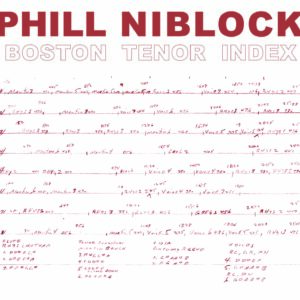
CD
Phill NIBLOCK
“Boston Tenor Index”
Phill Niblock "Boston / Tenor / Index", presents for the first time some of the earliest works by the American composer, inluding the three never before released "Index" (1969), "Tenor" and "Boston III" (both from 1972), thus making it possible to discover Niblock's starting point as a composer.
A filmmaker and photographer, Niblock began composing in the late 60s, while collaborating with the Judson Dance Theater in NY. As a composer his interest and field of research was connected to the layering of pre-recorded acoustic instruments into microtonal drones, which eventually led him to create some of the most unique tape collages in the second half of the 20th century minimal music. His earliest records, "Nothin To Look At Just A Record" and "Niblock For Celli / Celli Plays Niblock" were both issued by India Navigation in the first half of the 80s. Until now, it's been impossible to encounter Niblock's compositions from earlier than that period, a reality thankfully rectified by the long overdue publication of this "Boston / Tenor / Index" now on CD on alga marghen.
"Tenor" (1972) represents the first evolution of Niblock's musical thought towards the aesthetics of microtones, overtones, and drones which the composer would develop in following decades. The piece was recorded by the photographer Martin Bough on tenor saxophone and gradually dubbed back and forth by the composer in his New York studio. The sounds by the performer are submitted to the composer's techno-imaginative "acoustic optics" and deconstructed on behalf of structure, time and loudness. These specific aspects started to play an extremely important role in the artist's path as a composer.
The audio materials activated in "Tenor" through technologically de- and re-composed sounding textures, became a vehicle for those sound anomalies that would determine Niblock's audio poetics. Performing gestures are deconstructed though disseminating and editing processes by the imperceptible gestures of the composer. With its smooth flowing structure, "Boston III" (1972) stands at the very beginning of this illusion. It was recorded at the Intermedia Sound studio in Boston with Rhys Chatham (flute, voice), Martin Bough (tenor saxophone), Gregory Reeve (viola, voice); the composer himself also contributed with his voice. Using a 16-track Ampex tape recorder, at that time the world's newest recording device, Niblock was able to superimpose the recorded tones obtaining the desired aesthetic result which finally led him to a mesmerizing, immersive sound, a "very big, fat sound at fairly large volumes".
"Index" (1969) is an improvised sound performance by the composer himself. The listener is lucky to listen to (and imagine) the movements of the artist's fingers hitting a guitar string and the soundboard in breathtaking tempo. The piece itself represents early minimalism in its virgin state, untouched by distancing technology. Persistent percussive rhythm and corresponding resonances are irregular, the finger beats suffer natural dysrhythmia. Niblock's way of playing is very muscular here. It is more devoted to pure sensuality than to an intelligible order. This music is inscribed in the performer's body, it is a "body in a state of music". Guitar (both its body and strings), fingers and fingering fuse in a vehement action around which barely listenable sounds and resonances vibrate. Considering the extended pulsation as an organic blend of impulse, rhythm, drive, strength, vitality and passion, the end of this sole solo in Niblock's complete oeuvre is not defined by the fixed duration of the piece but as the consequence of the tiredness of the performer.
The CD also includes "Boston I" (1972), or the first chapter of the "Boston" series. This 25 minute bonus track is less massive than "Boston III"; still this version is much richer in dynamics and presents a more recognizable voice of each instrument.
As Niblock stated "This music is architectural. The intent is to fill the space. It's non-frontal music, non-proscenium space, anti-stage, not about an ensemble sitting in front of an audience, not about a single sound source. At least four speakers systems are desirable, arrayed around the periphery of the room, saturating the total space, engaging the air".
The music changes according to the loudness of playback. The interaction of the upper harmonics changes especially, with much richer overtone patterns being produced at louder levels.
Edition of 300 copies in digipak sleeve, including an 8-page booklet with photos and liner notes.
16,00€
Out of stock

LP
Phill NIBLOCK
“Boston Tenor Index”
Phill Niblock "Boston / Tenor / Index", presents for the first time some of the earliest works by the American composer, inluding the three never before released "Index" (1969), "Tenor" and "Boston III" (both from 1972), thus making it possible to discover Niblock's starting point as a composer.
A filmmaker and photographer, Niblock began composing in the late 60s, while collaborating with the Judson Dance Theater in NY. As a composer his interest and field of research was connected to the layering of pre-recorded acoustic instruments into microtonal drones, which eventually led him to create some of the most unique tape collages in the second half of the 20th century minimal music. His earliest records, "Nothin To Look At Just A Record" and "Niblock For Celli / Celli Plays Niblock" were both issued by India Navigation in the first half of the 80s. Until now, it's been impossible to encounter Niblock's compositions from earlier than that period, a reality thankfully rectified by the long overdue publication of this "Boston / Tenor / Index" LP on alga marghen.
"Tenor" (1972) represents the first evolution of Niblock's musical thought towards the aesthetics of microtones, overtones, and drones which the composer would develop in following decades. The piece was recorded by the photographer Martin Bough on tenor saxophone and gradually dubbed back and forth by the composer in his New York studio. The sounds by the performer are submitted to the composer's techno-imaginative "acoustic optics" and deconstructed on behalf of structure, time and loudness. These specific aspects started to play an extremely important role in the artist's path as a composer.
The audio materials activated in "Tenor" through technologically de- and re-composed sounding textures, became a vehicle for those sound anomalies that would determine Niblock's audio poetics. Performing gestures are deconstructed though disseminating and editing processes by the imperceptible gestures of the composer. With its smooth flowing structure, "Boston III" (1972) stands at the very beginning of this illusion. It was recorded at the Intermedia Sound studio in Boston with Rhys Chatham (flute, voice), Martin Bough (tenor saxophone), Gregory Reeve (viola, voice); the composer himself also contributed with his voice. Using a 16-track Ampex tape recorder, at that time the world's newest recording device, Niblock was able to superimpose the recorded tones obtaining the desired aesthetic result which finally led him to a mesmerizing, immersive sound, a "very big, fat sound at fairly large volumes".
The LP also includes "Index" (1969), an improvised sound performance by the composer himself. The listener is lucky to listen to (and imagine) the movements of the artist's fingers hitting a guitar string and the soundboard in breathtaking tempo. The piece itself represents early minimalism in its virgin state, untouched by distancing technology. Persistent percussive rhythm and corresponding resonances are irregular, the finger beats suffer natural dysrhythmia. Niblock's way of playing is very muscular here. It is more devoted to pure sensuality than to an intelligible order. This music is inscribed in the performer's body, it is a "body in a state of music". Guitar (both its body and strings), fingers and fingering fuse in a vehement action around which barely listenable sounds and resonances vibrate. Considering the extended pulsation as an organic blend of impulse, rhythm, drive, strength, vitality and passion, the end of this sole solo in Niblock's complete oeuvre is not defined by the fixed duration of the piece but as the consequence of the tiredness of the performer.
As Niblock stated "This music is architectural. The intent is to fill the space. It's non-frontal music, non-proscenium space, anti-stage, not about an ensemble sitting in front of an audience, not about a single sound source. At least four speakers systems are desirable, arrayed around the periphery of the room, saturating the total space, engaging the air".
The music changes according to the loudness of playback. The interaction of the upper harmonics changes especially, with much richer overtone patterns being produced at louder levels.
21,50€
Out of stock

LP
Aldo CLEMENTI
“Collage”
Alga Marghen proudly presents the previously unreleased “Collage 2” and “Collage 3 (Dies irae)” for magnetic tape, both realised at the Studio di Fonologia Musicale RAI in Milan with the technical collaboration of Marino Zuccheri. These pieces are precious testimonials to Aldo Clementi’s intense and ongoing interest in electronic music in the 1960s. “Collage”, presents some of the most extreme musics ever issued by the label, at the same level as Robert Ashley's “Wolfman”, Max Neuhaus' “Fontana-Mix Feed” or Philip Corner's “Oracle”. Representing an entirely singular sound and approach to tape music that was unique to Clementi alone, once again Alga Marghen has cracked it wide open and rewritten our understanding of the history of sound
The electronic composition “Collage 2” dates from 1960. It was the first experiment with electronic music for Clementi whose original and consistence adherence to structuralism is reflected in several of his instrumental works written around that time. About this piece the composer has commented: «The title and the technique, both of the same name, are the result of my having conceived the work in terms of compositional planes created independently and later superimposed; this gives rise to absorption or emergence, intersection or isolation, all absolutely and deliberately unpredictable. The difficulties implicit in the acoustics, and consequently in the effect, of this kind of treatment, are taken for granted and accepted from the start». The first idea of “Collage 3” dates back to 1966, in the form of a short electronic collage on the Beatles’ song “Michelle”. The composer wanted to replace old concepts and clichés which had become popular and common, through the use of «natural wells of timbre, live and organic, springing from a world of symmetry and fixed blocks». This original idea underwent a drastic transformation when the RAI (the Italian radio) commissioned Clementi to write a longer work. To his initial desire to start from scratch was added the problem of a longer duration. It was only when Clementi had almost completed the piece that he gave it its final title of “Dies irae”, owing to the extreme tension that accompanied its composition.
This LP is completed by “Fantasia su roBErto FABbriCiAni” (1982) in a brand new realization live recorded on October 13th, 2022 with Alvise Vidolin as sound engineer. Following a practice adopted most famously by Bach, Brahms and Shostakovich, the “Fantasia su roBErto FABbriCiAni” for flute and tape is based on the notes corresponding to the letters in Fabbriciani’s name according to the German musical nomenclature (B flat, E, F, A, B flat, C, A). This is how Clementi describes his approaches to the electronic processing of the pre-recorded tape: «My stylistic purpose was to create a delirious labyrinth around the solo instrument like an enormous growth of vegetation that chokes out a little plant».
«Today it is incumbent on music to ponder anew upon itself, just as music has an urgent need for self-reflection». This is how Adorno expressed himself, at a time long gone but focusing on a need that is perhaps still close to us. It is precisely in this need for “self-reflection”, in this continuous and inexhaustible “questioning” that perhaps one of the most profound teachings of Aldo Clementi compositional mastery resides; a musical legacy of rare coherence and fascination that constitutes an inescapable point of reference for the ethical ideal and the palpable existential tension it testifies to us. In its highest expressions, music allows one to subtly perceive its inherent gnoseological vocation. The work of Aldo Clementi embodies one of the most striking and exemplary demonstrations of this.
21,50€
Out of stock

LP
SMEGMA
“Infringements”
Alga Marghen's third installment of Smegma's original "Suburban Primitive Avant-folk music" period (1973-1975) based in Pasadena, featuring three previously unreleased tracks from the deep vault of their home recordings. In the beginning, the band Smegma had only one rule. No musicians. Starting from scratch, they took the road much less traveled. They were inspired by outsider musical artists of the time such as John Cage, Sun Ra, Captain Beefheart, Wild Man Fisher, Art Ensemble Of Chicago, etc. and they recorded every experiment with youthful enthusiasm. Mostly they only succeeded in tormenting their own friends and neighbors (except for the few who joined the band) but somehow, they never chose imitation, but stumbles on a path that allowed past (shamanistic) and future (space) sounds to lead the way. The titled track gently pulls you in and carries you off with a way-out inner-mind group jamming/not-jamming trip, featuring prepared piano, modular synthesizer, human mouth sounds, pan pipes, tabla, and electric bass guitar. "Rainy Day Mushroom Pillow" (defiantly not the 1960s pop hit) rips you straight into a high energy New Years Eve Party jam, in a romping free jazz style with stream of consciousness vocals and exuberant alto sax solos. Side B starts with Beatnik finger popping and wild dogs barking from a record player, while breathless flute playing leads you down the rabbit hole of mysterious group vocalizing, including imitating the cry of the wild tropical parrots that lived in the palm trees in the front yard of the house in Pasadena that they had lived in. Always out of sync with their own time, 49 years later these tracks still throb and pulsate Beautifully with their own inner logic. Edition of 230.
21,50€
Out of stock

LP
Eliane RADIGUE
“In Memoriam-Ostinato / Danse des Dakinis
Alga Marghen presents the last chapter from the Feedback Works documentation series, a brand-new LP including "In Memoriam-Ostinato" and "Danse des Dakinis", two previous unreleased tracks by Eliane Radigue. Among the works of fixed duration from the feedback period, "In Memoriam-Ostinato" is the link between "Jouet Electronique" and "Opus 17", and allows you to understand the evolution of her approach. "In Memoriam-Ostinato" is a game of mirroring symbols which glide into a non-measured, bent and elastic, temporality. Eliane Radigue's working method and her aesthetic direction are evident in this work from 1969: her very own unique temporal space of sonic experiences. Even though it bears the same name as the third part of "Adnos III", "Danse des Dakinis" is a peculiar work in Eliane's oeuvre. Conceived in a short time, with all kind of tapes from the composer's past work, it fluently shows a kaleidoscopic vision of Radigue's sensibility for sound. In 1998 she put together a curious self-portrait in sound. There is a feedback ostinato conceived around 1969 and which refers to "In Memoriam-Ostinato" and "Opus 17". All through "Danse des Dakinis" you plunge into the sound of a creek recorded at Mills College campus that brings you back to the field-recordings from the beginning of the 1960s, made on the coasts of the Mediterranean Sea. Such elements construct "Elemental1" as well. There are also some discreet interventions on the ARP 2500 synthesizer. It is indeed a peculiar work, which doesn't have the same features of her other compositions, especially at that time of her compositional path. There is an explanation for the composer producing this kind of sound material in 1998, and not limited to the sound waves of the ARP synthesizer. Invited to a workshop at Mills College in 1998, Eliane Radigue could not load herself down with her bulky instrument on such a trip. So, she left with just a few tapes taken from her own collection, drawn from different periods, and composed "Danse des Dakinis" with those old elements. There is tension in this composition, a certain wildness, an unpredictability of elements, those which are recognized as fundamental elements, which give structure to the universe. "Dance des Dakinis" is an intimate and wild symphony, alive and unpredictable, which is to be the next-to-last gesture of the composer before completely stopping her work with electronics.
23,50€
Out of stock

LP
Éliane RADIGUE
“Jouet électronique / Elemental I”
New 2022 edition.
alga marghen proudly presents the new edition of two sublime pieces by Eliane Radigue, “Jouet Electronique” (1967) for feedback on magnetic tape and “Elemental I” (1968) for feedback of natural sounds on magnetic tape. This LP was first issued in 2010 on the occasion of an alga marghen presentation at Centre Pompidou in Paris and included in the series of publications connected to the Oeuvres Sonores events. We thought, after a long time this wonderful record was sold out, it's time now to have it available again, presenting it for the first time with it's own specific artwork and layout.
Both works were recorded at Pierre Henry's Studio Apsome in Paris. Between 1967 and 1968, Eliane Radigue was the assistant of Pierre Henry in his studio, mainly for the editing of "L'Apocalypse de Jean". He also put her in charge of organizing his sound archive according to different criteria. It was endless work - there were incredible sounds, a true sound library! Eliane Radigue really enjoyed doing this work, even if it took a long time. So, sometimes she decided to set the machines of the studio to do some little work on her own. "Jouet Electronique" and "Elemental I" were born this way as a kind of recreation during her time as a studio assistant.
Working with feedback is something that Eliane Radigue learned through Pierre Henry. Do you remember "Voyage"? There's that fluid part which is made of feedback constructed with a microphone. Everything had to be set at a precise distance from the loudspeakers because that is the specific problem with feedback - you have to be at the right distance. Afterwards, these high tone recordings were slowed down in order to discover the deeper character of their color. This work with feedback was in the end quite limited and the composer preferred working with two reel tape machines to produce sounds. The first was set on the recording mode while the other was playing and it was the accidents happening in this phase that made the feedback richer. With some fine-tuning you could reach very beautiful results: low pulsations, very high-pitched sounds - sometimes both at the same time - or long sounds. All of these sounds could be slowed down or accelerated, which gave her a beautiful material to work with.
With "Jouet Electronique" Eliane Radigue had a lot of fun, hence the title. As far as "Elemental I" is concerned, it was the first attempt at something which was very important to her based on the theme of the basic elements: water, fire, air and earth. Eliane had the chance to record in open air thanks to a small Stella Vox that Arman gave her in the beginning of the 1960s. At the time she was still living in Nice and every now and then she went for a walk to do some recordings of the sea, the wind, the rain, the fire - Eliane Radigue continued this way to build her very minimal sound library, consisting of not more than ten reel tapes. This was the starting point and in 1968 she used these recordings for her work with two reel tape machines.
New edition of 200 copies, with liner notes by Eliane Radigue and portrait photos by Arman.
20,00€
Out of stock

LP
Eliane RADIGUE
“Feedback works 1969-1970”
New 2022 edition.
alga marghen very proudly presents a remastered version of the complete documentation of Eliane Radigue sound installations from 1969-1970, including the broad tectonic vibrations of “Omnht“, the celestial voices of “Usral”, “Stress Osaka” massive chant… or the works of the feedback period finally revealed! It is amazing that she could build such formidably organic sonic edifices in her home studio with the primitive machines given to her by Pierre Henry: three tape recorders, a mixing board, an amplifier, two loudspeakers and a microphone. Eliane previously worked for him at the Studio d’Essai of the R.T.F. from 1955 to 1957, after having met Pierre Schaeffer almost by chance who invited her to learn the techniques of Musique Concrète. Created 10 years after her Studio d’Essai experience, the Feedback works of Eliane Radigue immediately take a new direction from the explorations of Musique Concrète. Her adventure is intuitively going towards flux, towards contemplative stasis - a music of continuous sounds, of apparently simple structures, which permits the revelations and expansion of rich acoustic phenomena. It is as if her musical work was in some way a martial art… as if she meditated for 10 years before striking the first blow, with an impressive precision! This is the context in which Eliane composed “Omnht” in 1970 for the architectonic spaces of the visual artist Tania Mouraud titled “One More Night”, presented at the Gallery of the Rive Gauche in Paris; “Usral” (the title comes from a phonetic compression of ultrasounds slowed-down, in French “ultra-sons ralentis”), one of the first works by Eliane Radigue to be given in public as sound environment for a sculpture by Marc Halpern in the Salon des Artistes Décorateurs at the Grand Palais of Paris in 1969; “Stress-Osaka”, conceived when the artist was invited to create a sonic environment for the International Fair in Osaka in 1970. There is no doubt that Eliane Radigue vocabulary is based on observing and entering into dialog with the fundamental behaviour of sounds: pulsing, beating, sustained, very light, a subtle and delicate evolution. When she moved from feedback sounds to the ARP synthesizer she naturally continued the same music. A continuity where the original use of feedback sounds stands out for its cruder and more savage inner character. One could say that somehow it’s the very texture of the sounds, which leads the form of her compositions. At the same time this approach favors an intense sensuality in the listening.
23,50€
Out of stock

LP
Eliane RADIGUE
“Vice-Versa, Etc…”
New 2022 edition.
alga marghen very proudly presents a remastered version of “Vice-Versa, Etc…” LP originally included in the first 400 copies of the now sold out Eliane Radigue “Feedback Works” 2LP. “Vice-Versa, Etc...” was originally a small handmade box, signed and numbered, realized as art multiple on the occasion of a show at Lara Vincy’s gallery in 1970. The box contained a reel of magnetic tape and the instructions for use. It indicates that all playback speeds are possible, forward or backward, as well as any combination of two channels, on several recorders, ad libitum… This LP presents two versions done by Emmanuel Hoelterbach following the indications of Eliane Radigue to the letter, respecting her composition methods. There is no doubt that Eliane Radigue vocabulary is based on observing and entering into dialog with the fundamental behaviour of sounds: pulsing, beating, sustained, very light, a subtle and delicate evolution. When she moved from feedback sounds to the ARP synthesizer she naturally continued the same music. A continuity where the original use of feedback sounds stands out for its cruder and more savage inner character. One could say that somehow it’s the very texture of the sounds, which leads the form of her compositions. At the same time this approach favors an intense sensuality in the listening. This edition limited to 300 copies includes an insert with liner notes.
20,00€
Out of stock

2 LP
Eliane RADIGUE
“Opus 17”
Repress. Remastered, improved sound quality.
alga marghen very proudly presents “Opus 17”, a major turning-point in the sonic oeuvre of Eliane Radigue. Finished in 1970 it was the last work composed with feedback materials. From that experimental period “Opus 17” preserves the plastic character: a music made of rough sonic phenomena, at once harsh and granular, possessing a quality of materiality and tactility. Its vibrations structure the air surrounding the listener with densities, thicknesses, indeed with palpable movement. Her compositions are frames which let us hear these phenomena, open frameworks from the sonic installations of her Endless Musics (cf. “Feedback Works 1969-70” LP issued on alga marghen) and here reinserted in the five scenes making up “Opus 17”.
In 1970, in her studio of very rudimentary means, she developed a completely unique body of work centered on sounds produced by feedback. “Opus 17” has the quality of showing off the sum of the achieved techniques and methods. Eliane Radigue’s music has never been rooted in ideas but in practice, the intimate experience of things in the wild which she has known how to tame. This dialog both intense and poetic which she keeps up with the solid matter of sound finds a remarkable concretization in “Opus 17”.
It is to be underlined that with “Opus 17” Eliane Radigue inaugurates a technique of composition which will be her footprint, her trademark: imperceptible transformations. For that she has developed a technique of meticulous mixings, based on the slow passage from one section to the next. Imperceptible, all during the piece, we pass, ceaselessly and without noticing the changes, from one frequency flux to another. Time is suspended, smoothed out, stretched. It is this technique which Eliane Radigue will be essentially using for all the electronic works to come and which she will never cease to refine and render always more subtile.
“Opus 17” is the great panoramic voyage through material sound, its electronic phenomena detailed as if in a microscope. Could feedback really contain such a universe? “Yes”, the work of Eliane Radigue answers, but that exploration was not that easy: one had to learn to listen. It required Eliane Radigue’s great demands on listening which led her to the discovery of such treasures. Unknown wealth in a material often rejected as trivial.
As Rhys Chatham recalls: “Eliane Radigue (...) had just moved to New York and had the idea of acquiring an analog modular synthesizer, which is why she worked at NYU in order to try out the possibilities of the Buchla 100 series which we had there. One day, while gossiping, she invited me to her loft, which was just on the corner. She had me listen to a piece composed in France; the piece called ‘Opus 17’. (...) What I heard changed to course of my life as a composer. (...) That piece, impressive source of inspiration, gave the impression of being in a grand cathedral, both for the sensation of immensity of being in such a large cathedral, as for the effect of being so close to God”. This anecdote has its importance because it is evident when listening to the feedback works that Eliane Radigue had already put in place the essential part of her musical æsthetic.
“Opus 17” was created at the artistic center of Verderonne on May 23, 1970, for the Fête en blanc (i.e. White Festival) organized by the visual artists Antoni Miralda, Joan Rabascall, Dorothée Selz and Jaume Xifra.
Previously unreleased, “Opus 17” is now issued on alga marghen in a first edition of 400 copies in gatefold sleeve.
34,00€
In stock

LP
Charlemagne PALESTINE / Simone FORTI
“Illuminations”
Alga Marghen proudly presents the first ever release of "Illuminations", or Charlemagne Palestine and Simone Forti duo interactions, illuminated with dim red lights. In early 1970 Mort Subotnick asked Charlemagne Palestine to join his soon to be created Media Department at the new 'Dream School of the Future' endowed by the Disneys to be called the California Institute of the Arts.
Charlemagne and Simone Forti met there in 1970, when La Monte Young asked them to arrange a California concert for Pandit Pran Nath. They decided to try an improvisation session together and Charlemagne invited Simone the first time to the electronic music studio where he worked regularly. Their medium blended as a play of interacting sound waves and solid matter in motion as Charlemagne and Simone shared energy and focus.
The three previously unreleased recordings on this LP were made between October and December 1971. The first take, titled 'Illumination,' is for two voices moving in the space with small bells and crystal glasses while Simone Forti plays the molimo, a corrugated tube meant for connecting the gas stove. The second take titled, 'Wed Oct 13th 1971,' has Simone and Charlemagne in a song dialogue as animals do. It was also at Cal Arts that Charlemagne Palestine first encountered a Bosendorfer Imperial Piano of Vienna. He played it often as Simone danced during their 'Illuminations'. Take three is a song sang in falsetto while playing the Bosendorfer Imperial in an arpeggiated style that predates the 'strummings'. Listening to these 'three takes' 40 years later, they ooze a timeless, carefree mystical, magical, dreamy atmosphere that evoked the times of the late 60s to early 70s in Charlemagne and Simone part of the California Art Scene. 'Illuminations' were a unique open spontaneous form of performance, ritual and prayer.
Edition limited to 365 copies with an essay by both Charlemagne Palestine and Simone Forti, as well as photos of the performances reproduced on the LP front sleeve.
20,50€
In stock

LP
Charlemagne PALESTINE / Simone FORTI
“Meditative Sound Environments”
Alga marghen presents the second and final chapter in documenting Charlemagne Palestine and Simone Forti seminal collaborations. The new "Meditative Sound Environments" LP is more centered around electronic music and also includes a unique two-voice work based on Simone's chanting, the magically suspended "Simone Tape". All the tracks of this new LP present only previously unreleased recordings.
Charlemagne Palestine met Simone Forti through Dr. Richard Alpert, a professor at Columbia University who went to India to study with a Hindu guru and he himself became a guru afterwards called Baba Ram Dass. Coming back to US he brought Pandit Pran Nath with him. It was a time when everybody was experimenting. All came with a lot of orientalism because people were into timelessness, meditation and being stoned. It was in that atmosphere that Charlemagne met Simone because she also knew Pran Nath. Around that time Palestine moved from NY to California to work with electronic music at the newly invented school California Institute of the Arts. Simone was also living in LA and even though she was not officially connected to CalArts she knew many of the artists who were teaching there.
In summer 1970 Simone Forti was invited by Allan Kaprow (one of the Deans of CalArts) to do an evening of dance at the Pasadena Art Museum and for this performance she asked Charlemagne Palestine to try developing a new kind of work together. It immediately clicked!!!! In January 1971 in Pasadena they did their first "Illuminationss". All of a sudden they were doing a new kind of jamming together. Everybody in the audience loved it because it was so dreamy and they found amazing how a man and a woman can act in that strange, very dreamlike oriental way as in trance,,,,,together. This kind of collaboration between man and woman was uncommon at that time. Mostly other artists were doing very structural works while with "Illuminations" it was totally like they were on magicness drugs.
These performances had certain fixed elements... the piano or some electronics like in "Meditative Sound Environment", the title track of this LP. It turned out they liked red lights so they started to always do it in red light. Also they liked to do it in a resonant spaces. It became more an approach than a piece, because there were never two "Illuminations" that were alike.
The aspect of Charlemagne's music that most inspired Simone Forti's imagination was his melodies. Sometimes their texture of repetitions and evolving variations were so close that the term melody doesn't seem to apply. What most determined the "Illuminations" was Charlemagne's way of letting the elements in the music develop only very gradually.
As Simone Forti recalls: "Once, just before a performance, Charlemagne sang 'Simoney don't worry, you will dance and sing all right.' And of course i did as we walked arm in arm circling the wide-open space, a grand piano to one side shining black and covered with Teddy Bear deities, Charlemagne reflecting his childhood time as devotional cantor, and me, my childhood time striding along in the Tuscan hills, belting out Italian folksongs with her cousins". The recurring melodies were mostly Charlemagne's. But Simone Forti brought one too, with a beautiful song about not drifting away into the beyond that you can hear as the last track on this LP.
Edition limited to 365 copies with liner notes by Charlemagne Palestine and Simone Forti.
20,50€
In stock

LP
Anton BRUHIN
“Rotomotor / InOut”
In the mid-1970s Anton Bruhin was surely at the peak of his tape manipulation works. Always using poor techniques and equipment he sculpted everyday-life sonic objects turning them into very accomplished and yet totally experimental music artifacts. The works presented here surely are among the most accomplished results of his expanded creativity.
"InOut", a masterpiece for tuning whistle, mouthharps, flutes, toy and party gag instruments, percussion, bells, electric razor, model ship engine with propeller, birdcall whistles, CH-Phon, feedback speaker-microphone, siren, double shawm, falling down spoon, jew's harp (only two short notes), tearing scotch tape from the spool, ocarina, hair dryer and other noise makers plus occasionally radio tuner was recorded in Zurich between May 17th and May 22nd, 1981, on a Sanyo M7300L stereo radio cassette recorder with both integrated and external microphone. The recorder is in the recording standby position, both RECORD and PAUSE buttons are pushed. Then Bruhin sings or plays a tone into the microphone. During this tone he releases the PAUSE button by pushing it. Subsequently he presses the PAUSE button again within a fraction of a second. Now the first short note is recorded. In "InOut" thousands of very short notes were added this way, like a patchwork, like an acoustic quilt with geometric irregularities and varied patterns.
"Rotomotor", subtitled "ein motorische Idiotikon", is a 28 minutes long reading representing one of Bruhin's major works. Written in Zurich between 1976 and 1977, then recorded in August 1978 at Etienne Conod's Sunrise Studio. "Rotomotor" is a poetic Idiotikon of the swiss-german dialect where, instead of the straight alphabetical order, the words are organized according to the similarities of their letters (each word differ from the previous one by just one letter). For this reading a delay equipment which repeated the signal after 0.6 seconds was used and each word is superimposed to the echo of the preceding one. On one hand this echo generates the rhythm of the performance, on the other it supports the acoustic metamorphosis of the words. As always in Anton Buhin poetics, a very simple concept perfectly accomplished.
Anton Bruhin in the 1960s began organizing happenings and performances, creating sound works, designing and typesetting his own books (which he self-published with Hannes R. Bossert through April-Verlag), drawing and writing poetry. Anton Bruhin was a member of the first class to study at the F+F School with Serge Stauffer, famous art teacher and specialist in Marcel Duchamp, where he came into contact with concrete poetry, Fluxus and experimental music.
22,50€
Out of stock

LP
Katalin LADIK
“Water Angels”
alga marghen proudly presents "Water Angels" an LP with previously unreleased tracks by Katalin Ladik, following the monumental "Phonopoetics" from 2019.
"Water Angel", the title track, is a side-long work from 1989. It began its life containing a plice of "O Fortuna" from Carl Orff's "Carmina Burana" and was first staged in an artificial fog on a lake at the 1989 Spoleto Festival in Italy.The texts include fragments of her own lyrics mixed with parts from James Joyce and Lewis Carroll in a kind of sonic-textual collage of processed sounds superimposed to environmental field recordings. One can also hear the composer Erno Király, her first husband, playing his self-built instrument called "zitherphone", a 58-stringed huge engine of sounds assembling five zithers in a single body, with pick-ups placed on some of the strings.
The first part of "Water Angel" was used as a starting point for "Three Orphans", another composition juxtaposing electronically modified voice with recordings of folk songs, this time Hungarian. It's a kind of "adaptation of a Hungarian folk ballad", utilizing recordings done in Transylvania in 1940, registered with a wax cylinder phonograph and gathered by Radio Novi Sad. Thanks to the collaboration with Boris Kovač, the sound engineer for this project, the quality of Katalin Ladik's screams, whispers, chants, laughter, giggles is now significantly improved, and in some ways the subtle nuances of her virtuoso interpretation find here their most powerful rendition.
Also presented on this record are three and never before issued works created by Katalin Ladik in collaboration with the composer Svetlana Marasch at the Electronic Studio of Radio Belgrade in 2019, "Electric Bird", "White Bird" and "Ice Bird". Combining extended vocal techniques, processing and modular synthesis, these tracks confirm the artist's radical temperaments that helped to define her work during the 60s and 70s, while pushing it further into new territories thus revealing an artist with almost no peer in the experimental landscape today.
Ladik, born into the Hungarian minority of Yugoslavia in 1942, is an artist who resists categorization. She is an experimental writer, a sonic artist, a writer as interested in the sound of the words as its meaning. She is an actor as well as a performance artist, a visual artist whose graphic scores generates from her early contacts with the work of Stockhausen and Acezantez, also addressing the relations between sound and woman's body. Katalin Ladik can be considered a phenomenon of music excesses and voice miracles, combining music, theatre and poetry. It was the music of a female body and its motions, transformation, action and expression: when she produced sounds with her body as a music instrument, playing folk or self-made instruments nude; when she voiced poetry or transformed voice into linguistically inarticulate sounds of phonic poetry; when her voice turned into a scream transforming poetry into acoustic event; or when she borrowed her transgressive voice to experimental musicians.
22,50€
Out of stock

2 LP
Luc FERRARI
“Labyrinthe de Violence”
Capturing the four soundtracks conceived in 1975 for the multimedia/audiovisual performances at Galiéra Museum in Paris, the previously unreleased Labyrinthe de Violence stretching across two LPs represents a peek into Luc Ferrari's creations connected to his Atelier de Libération de la Musique experiences. Luc Ferrari was always keen to disrupt habits and engrained practices, to open his mind to new ways of apprehending the world of art, considering it not so much as a separate realm but as an inroad into society. In keeping with the spirit of 1968, he advocated taking part in daily life, casting a critical, but amazed, eye on the world around us, and always questioning the meaning of the occupations and preoccupations the world imposes. From the 1970s, Luc also wished to shed the solitary status of the artist, and to truly communicate with society. He thus gathered around him a group of people from different backgrounds with an aim to create, together, new ways of working and new forms of expression that would address unusual audiences rather than traditional concert audience. Having created his Studio Billig in Paris in 1973, Luc wanted to make the most of that place to promote exchanges with other artists, to share, think, and improvise together. This is what gave rise to the Atelier de Liberation de la Musique workshops, whose objective was to "Liberate music from the constraints of style and esthetics." The idea was precisely to free the artist from abstraction, leading him to perform accessible and intelligible actions; to promote the imagination; to use the dramatic dynamism of sound and image to trigger ideas; to ignore the sensational and instead to observe our social environment and daily life with an intuitive eye-ear; to invite the visitor to come up with their own analysis. This craving for collaboration led Luc Ferrari to create, in 1975, a collective of musicians with Martin Davorin Jagodic, Philippe Besombes, Alain Petit and David Jisse. That year, they worked at Labyrinthe de Violence, a looped audiovisual labyrinth which evoked the violence of contemporary society, and was a reaction to the political situation of the time. It was a multimedia work, spread across four rooms, on the following themes: Power/Profit/Violence/Pollution. Each side of this 2LP set reproduces the sonorization of one of the four rooms in the Museum, automatically mixing in the central space. The same recordings focus on questions of utopia through many of the same themes. As in the rest of his work, pleasure was also at the heart of these pieces. First press limited to 500 numbered copies; gatefold sleeve.
34,00€
In stock

LP
Katalin LADIK
“Phonopoetics”
Phonopoetics is the first ever survey of seminal Hungarian artist Katalin Ladik's sonic efforts. A thing of beauty, drawing from the period between 1968 and 1993, its two stunning sides shatter the lines between performance, the spoken word, fine art, and experimental music, offering the terms to rethink how each is understood. Born in 1942, Katalin Ladik has lived a wild and multifaceted creative life -- beginning primarily as a poet of the written word, expanding into experimental theatre during the mid-1970s, and ultimately becoming an artist whose practice also incorporates sound and visual poetry, performance art, experimental music, audio plays, happenings, mail art, collage, and photography, built around visual and vocal expression, as well as movement and gesture. Phonopoetics, Alga Marghen's remarkably diverse survey of Ladik's audio work, is a refracting lens into this dense and dynamic world -- a totem which belongs to a sprawling puzzle of highly nuanced personal, social, political, and existential themes, springing from the feminist and gender neutral concerns of Eastern Europe during the 1960s and '70s. The totality of Ladik's practice, particularly as it unfolds across the two sides of Phonopoetics, can be understood as a radical rethinking of the potential, manifestation, and application of poetry, as well as the fundamentals of vocalization. Delving toward the very origins of consciously created sound -- spoken or otherwise, her efforts unseat the divisions placed between literary, musical, theatrical, and visual disciplines, joining them through the fundamental need and right to express. With the excepting of two works, "Shaman Song / Sámánének" (1968), and "Ufo-Nopoetica" (1976-1993), the featured body of work was created between 1974 and 1979, a prolific period which also witnessed her working within the Novi Sad Theatre and Radio Novi Sad. Primal and poetic, with shamanic overtones and therapeutic mechanisms of liberation, capturing the image of an almost entirely unheard history within the field of feminist expression developed by pioneering figures like Simone Forti and Joan La Barbara. In the words of visionary sound poet Henri Chopin, Ladik is "a great, magical voice." Alga Marghen's issue of Phonopoetics places this little heard, and profoundly important artist into the center of your consciousness where she will no doubt remain. A vital entry in the field of sound art, historic Eastern European experimental practice, and sound poetry. Introduction by Henri Chopin. Edition of 300.
20,00€
In stock

LP
L.A.F.M.S.
“35 S. Raymond Avenue”
One afternoon in 1975, friend and fellow music traveler, Harold Schroeder, showed up at Poo-Bath Record Shop where Tom Recchion worked selling records and experimental music to people, forcing them to buy albums that he swore would change their lives. Harold asked if Tom wanted to share in a studio space close to the shop. After seeing it Tom Recchion immediately said “YES!”.
They moved in and divided the space in half. On Tom’s half he made drawings, paintings, performances, video, sculptures, installations and music. Harold had his all set up for music with his newly acquired Steiner-Parker synth and guitars and things. At the beginning they played under the name “The Two Who Do Duets”. Soon the late night jam sessions that took place in the back of Poo-Bath moved over to the 4th floor of 35 South Raymond. It was pretty beat up and derelict, the way one imagines an artists’ studio to look. They could make all the noise they wanted. No one else was on their floor.
The music heard on this LP has remained unheard since it was recorded and was created just before and right after the inaugural concert by the LAFMS groups Le Forte Four, Doo-Doettes and Ace & Duce. This concert took place in late January 1976.
The sessions on this release feature members of the newly formed and expanded Doo-Doettes, which now included Dennis Duck, Juan Gomez, Harold Schroeder and Tom Recchion, as well as Ju Suk Reet Meate from Smegma and Ace, of Ace & Duce.
35 S Raymond eventually became a sort of LAFMS headquarter, with Chip Chapman of Le Forte Four, artist and future Extended Organ vocalist/guitarist Paul McCarthy, and soon to become singer for Nervous Gender, punk/folk artist Phranc, who along with many other artists and musicians, moved into the building. 35 S Raymond allowed for free expression and explorations of all sort. Some wild parties ensued, not to mention the luxury of endless hours of experimentation. Parking was free and so was the art and music.
Ace found the tapes for side one (“Tom’s Studio”) in his archive and Ju Suk Reet Meate found the tapes for side two (“50 of Every American Are Machines”) and edited them both for this release. No overdubs or remixing was employed.
Edition of 200 copies presented in luxury gatefold sleeve.
23,00€
In stock

LP
SMEGMA
“Abacus Incognito”
New primitive-suburban-folk music from Temple City and Pasadena, CA, circa 1973-4.
This new edition is culled from the original unissued Smegma tape vaults of Ju Suk Reet Meate and represents the most pure expression of the insular sound-world that was spontaneously discovered as a group.
Unlike last years’ “Look’n For Ya” no song forms are ever used, instead fearless group improvisational vocals take you on a strange shape-shifting journey thru operatic show tunes, spirit visions and visits to a delirium motel room.
The only exception is the title track “Abacus Incognito” that features poetry by Dennis Duck (also, Human Hands, Dream Syndicate, LAFMS...) with accompaniment by the family stereo console record player/Radio unit and utilizing conventional instruments creating a strangely unique non-jamming sound.
Except for the first track, all sounds were recorded casually in various band-members parents’ houses while they were away… they would have been horrified!
The final track is possibly one of the strangest concepts ever recorded, inspired by both the Lord Dunsany story “The Three Infernal Jokes” and the most popular record of 100 years ago “The O.K. Laughing Record” we have - The Smegma “Laughing to Death Record”.
Edition limited to 200 numbered copies.
20,00€
In stock

LP
Jacques THOLLOT’S INTRA MUSIQUE
“More Intra Musique”
Produced in collaboration with the legendary Jac Berrocal’s label d’Avantage, “More Intra Musique” is the second LP in alga marghen’s series dedicated to previously unreleased recording by the drummer and experimentalist Jacques Thollot. While the furious “Intra Musique” free jazz first LP was centered on a live recording with Michel Portal, Eddie Gaumont and Mimi Lorenzini at the Faculty of Law in Paris, on an evening in 1969, it is an unexpected Jacques Thollot that we encounter on this second LP, vivid and blazing even more than we already knew.Jacques Thollot was a major force in the French free jazz scene, collaborating with artists at the level of Don Cherry, Steve Lacy, Sonny Sharrock, Joachim Kühn as well as with French pioneers Jef Gilson and Barney Wilen. Starting from 1971 he released “Quand le son devient aigu, jeter la giraffe a la mer” or “Watch Devil Go” on Futura and Palm Records, or some of the most relevant and revolutionary sonic masterpieces in France.“More Intra Musique” is free improvisations of course, but also synthetic jitters, musique concrète and loop experiments, sketched pop songs, minimalist trances with African accents, or simply the promiscuity of a lullaby or the voice of a child posed like a bird in a Norman garden. These long lost visionary recordings featuring Eddie Gaumont on prepared piano and Jacques Thollot on drums, piano, prepared piano, synth and tapes are an absolute revelation which make us rethink everything we know about French free improvisation.Tape manipulation created as a potential background for a live set?Bursting rehearsal with Eddie Gaumont? Is the piano well prepared?Besides the stingy mention “Intra Musique” sticked on the reel, nothing is known of this recording. Who cares really? Let’s just play it loud!Edition of 350 copies.
19,00€
Out of stock

LP
Luc FERRARI
“Atelier de Libération de la Musique”
alga marghen proudly presents Luc Ferrari’s Atelier de Libération de la Musique, a collective he created together with Martin Davorin Jagodic, Philippe Besombes and Alain Petit in 1975 for a series of performances at the Galliera Museum in Paris.It was in those years that Luc Ferrari investigated open forms and created some of the most experimental and elusive works of his entire catalogue. “Exercices d’improvisation”, first recorded by Brunhild Ferrari with GOL, issued on PLANAM in 2010 (very last copies still available); but specially “Ou donc est-t-on?”, a very complex piece soon to be documented on alga marghen including both “Dance”, issued on alga marghen on the occasion of the presentations at Centre Pompidou in 2009 (now sold out) and “Ephemere”, issued on CD by alga marghen in 2010 (still available), as well as the “Labyrinthe de la violence”, an audio-visual permanent labyrinth for which Ferrari created four fantastic electronic music pieces soon to be published on alga marghen. After these experiences the composer decided to discontinue these open practices for a more controlled work in the studio.And within the “Labyrinthe de la violence” installation Luc Ferrari conceived a series of electro-visual concerts to be performed by the newly created Atelier de Libération de la Musique. The collective included some of the most creative artists of the time: together with Luc Ferrari playing the electric organ we find on electric piano Martin Davoric Jagodic (whose masterpiece of electronic music titled “Tempo Furioso” was issued on Cramps in Italy that same year), on synthesizer Philippe Besombes (of Pole fame) and on sax, flute and clarinet Alain Petit (who was at the time collaborating with Besombes at the wonderful “Besombes / Rizet” double LP). These four artists met in February and March of 1975, rehearsing for a series of concerts to take place within the audio-visual labyrinth. It is the previously unheard recordings from these wild rehearsals which make up this incredible LP. The sound of Atelier de Libération de la Musique is a thrilling and overwhelming ride. Rattling, difficult polyrhythms play against droning, pulsing and simmering sonorities. These recordings are human and open, wild and incredibly ahead of their time.First edition limited to 500 numbered copies with obi.
22,50€
In stock

LP
INTERSYSTEMS
“Number One”
LSD and other hallucinogens were very popular sources of inspiration in the late 1960’s. While Intersystems work was also fixated on inebriated euphoria and perceptual distortion, their sonic barrages also evoked the heightened awareness, intermittent psychosis, intellectual overstimulation and giddy nihilism of an acid expedition.
“Orange Juice and Velvet Underwear” may indeed be the most typically capital-p Psychedelic cut of Intersystems entire catalog. Its saturated crypto-Indian drone and bent acoustic guitar notes, the most audibly ‘psych’ elements, are upstaged by Parker’s lurid-sounding declamations and Mills-Cockell’s fierce industrial clatter. From there, it all spirals further into a vortex of frayed cacophony and chilling sober-yet-surreal orations.
The sixteen-minute “Blackout Mix” is a perfect demonstration of just how tenuous their relationship was to even the furthest-out reaches of psychedelia in spite of their own pronounced use of related terminology. All curdled puddles of synth noise and caustic electronic howls, Parker’s fragmentary deadpan bark both penetrates, and is enveloped by, the sticky sonic tapestry. He unfurls a series of disparate images, more-than-flirting with the mundane horror enumerated later (and more explicitly) by the likes of Throbbing Gristle.
“Vox 3/13/67” is “Number One Intersystems”’s second longest and arguably most varied piece. John’s contributions span dimly elegiac textures, evoking distant chimes and striated choral voices, over to his most brusque and intemperate interjections. Parker, whose appearances are as jarring as they are intermittent, delivers his writing as staunchly as ever, yet hacks certain words into syllabic mincemeat that spills violently and incoherently into the middles of sentences. It’s by no means less anxious than other pieces on the album, but its tension is achieved through an eerily pronounced sense of breath and movement rather more aggressive means, foreshadowing the approach found on the latter two albums. Where elsewhere “Number One Intersystems” seems to forecast post-punk excursions into avant-noise antagonism, here there’s more indication of Mills-Cockell’s training and more canonical influences in its careful phrase-shaping.
Featured throughout the album was a homespun instrument devised by John, dubbed "The Coffin", which was also employed live in their Presentations. Mills-Cockell recalls: “It was a 6 foot long box line with purple satin, housing a long plank strung with many parallel lengths of piano wire held in place with tuning pegs which were adjustable with a wrench we kept on board for the purpose. There were contact mikes which were switchable, just like on a Telecaster except that the switches could permit not only selection of different harmonic spectra when the instrument sounded, but of a variety of loudspeakers in various locations in (a) performance space. The switches were invisible, covered by the fabric lining the interior of the box”.
This edition of “Number One Intersystems” LP presents the correct Side A / Side B sequence as well as the original tracks sub-section divisions. Re-mastered by John Mills-Cockell. Mastered for cutting by Giuseppe Ielasi.
Edition of 300 copies presented in the original Allied Records sleeve.
“Orange Juice and Velvet Underwear” may indeed be the most typically capital-p Psychedelic cut of Intersystems entire catalog. Its saturated crypto-Indian drone and bent acoustic guitar notes, the most audibly ‘psych’ elements, are upstaged by Parker’s lurid-sounding declamations and Mills-Cockell’s fierce industrial clatter. From there, it all spirals further into a vortex of frayed cacophony and chilling sober-yet-surreal orations.
The sixteen-minute “Blackout Mix” is a perfect demonstration of just how tenuous their relationship was to even the furthest-out reaches of psychedelia in spite of their own pronounced use of related terminology. All curdled puddles of synth noise and caustic electronic howls, Parker’s fragmentary deadpan bark both penetrates, and is enveloped by, the sticky sonic tapestry. He unfurls a series of disparate images, more-than-flirting with the mundane horror enumerated later (and more explicitly) by the likes of Throbbing Gristle.
“Vox 3/13/67” is “Number One Intersystems”’s second longest and arguably most varied piece. John’s contributions span dimly elegiac textures, evoking distant chimes and striated choral voices, over to his most brusque and intemperate interjections. Parker, whose appearances are as jarring as they are intermittent, delivers his writing as staunchly as ever, yet hacks certain words into syllabic mincemeat that spills violently and incoherently into the middles of sentences. It’s by no means less anxious than other pieces on the album, but its tension is achieved through an eerily pronounced sense of breath and movement rather more aggressive means, foreshadowing the approach found on the latter two albums. Where elsewhere “Number One Intersystems” seems to forecast post-punk excursions into avant-noise antagonism, here there’s more indication of Mills-Cockell’s training and more canonical influences in its careful phrase-shaping.
Featured throughout the album was a homespun instrument devised by John, dubbed "The Coffin", which was also employed live in their Presentations. Mills-Cockell recalls: “It was a 6 foot long box line with purple satin, housing a long plank strung with many parallel lengths of piano wire held in place with tuning pegs which were adjustable with a wrench we kept on board for the purpose. There were contact mikes which were switchable, just like on a Telecaster except that the switches could permit not only selection of different harmonic spectra when the instrument sounded, but of a variety of loudspeakers in various locations in (a) performance space. The switches were invisible, covered by the fabric lining the interior of the box”.
This edition of “Number One Intersystems” LP presents the correct Side A / Side B sequence as well as the original tracks sub-section divisions. Re-mastered by John Mills-Cockell. Mastered for cutting by Giuseppe Ielasi.
Edition of 300 copies presented in the original Allied Records sleeve.
20,00€
Out of stock
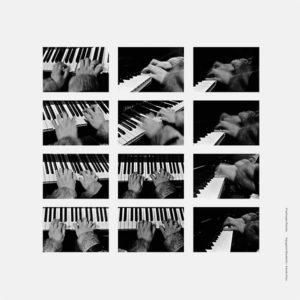
LP
Charlemagne PALESTINE
“Arpeggiated Bösendorfer + Falsetto Voice”
In 1974 Ileana Sonnabend commissioned Charlemagne Palestine to create a limited edition 2 LP in conjunction with a performance to celebrate the opening of her new Soho gallery at 420 West Broadway!
Charlemagne made several recording attempts, first at Swarthmore College in Pennsylvania where they had a Bösendorfer Imperial Piano in their theatre. He recorded “Bösendorfer + Voice”, “Voice Piece” as well as some Bösendorfer tests with Mayo Thompson as producer and Kurt Munkacsi as sound engineer. These ecstatic Swarthmore recordings, recorded late at night in the big empty theatre space represented the original elements on which Charlemagne Palestine later created the piano pieces for “Four Manifestations on Six Elements”.
For more than forty years since these recordings were made Palestine never went back to listen to them, but recently on re-listening to these Swarthmore recordings with alga marghen he found several blissful arpeggiated piano and falsetto voice studies which he feel now deserve to be heard.
Included in the alga marghen VocSon series, this LP is available now in an edition limited to 405 copies.
19,00€
Out of stock

LP
Philip CORNER
“PoorManMusic”
Historical recording of previously unpublished Fluxus classic masterpiece available now in an edition of 300 copies only. Pulse Polyphony!
“PoorManMusic” (1966).
The simplest materials and the things your own body is and does claps, slaps, stamps. Rubbing and scratching: body, all parts, and clothing if any voices. And all the sounds your voice and breath and throat may make except words. Although a mightbe rare&special one sound deep word and meaning / warning, affectations show up. If sincere, express.
Better a middle and easy utterance of like natural soundings & thus beyond outside things, but the matter might be simple sticks of every day life. The small stones and the fabrics papers and textures, easily picked up. Rattle, rattles, nuts
little bells, seeds this is not quite all of homemade noise makers.
Homemade noise made, among others, by Philip Corner, Max Neuhaus, Steve Reich, James Tenney, Malcolm Goldstein, Jackson Mac Low, Dick Higgins, Alison Knowles, Carolee Schneemann, Jerome Rothenberg… the Technicians of the Sacred.
Gift Event III: A Celebration for Poets, Musicians and Dancers, based on the orders of the Seneca Indian Eagle Dance and performed at the Judson Dance Theatre, Judson Memorial Church, New York City, March 21st and 22nd 1967.
A part of the Spring Happenings.
The group cohesion and reentering and listen
ing (ensemble sensitive)
Out of flux of differing individual tempi, to fuse into one
Felt agreed beat
(this is easier, very easy, than it may seem)
In period of pulse - polyphony.. non-rationalizable multipl
licity of the beats.
And the whole at ease. If ever at extremes
of intensity, and moving towards their implications of passions,
let it relax and tend intowards the mean, just the energy and
the continuing which is devotion in every day life and works.
“PoorManMusic” (1966).
The simplest materials and the things your own body is and does claps, slaps, stamps. Rubbing and scratching: body, all parts, and clothing if any voices. And all the sounds your voice and breath and throat may make except words. Although a mightbe rare&special one sound deep word and meaning / warning, affectations show up. If sincere, express.
Better a middle and easy utterance of like natural soundings & thus beyond outside things, but the matter might be simple sticks of every day life. The small stones and the fabrics papers and textures, easily picked up. Rattle, rattles, nuts
little bells, seeds this is not quite all of homemade noise makers.
Homemade noise made, among others, by Philip Corner, Max Neuhaus, Steve Reich, James Tenney, Malcolm Goldstein, Jackson Mac Low, Dick Higgins, Alison Knowles, Carolee Schneemann, Jerome Rothenberg… the Technicians of the Sacred.
Gift Event III: A Celebration for Poets, Musicians and Dancers, based on the orders of the Seneca Indian Eagle Dance and performed at the Judson Dance Theatre, Judson Memorial Church, New York City, March 21st and 22nd 1967.
A part of the Spring Happenings.
The group cohesion and reentering and listen
ing (ensemble sensitive)
Out of flux of differing individual tempi, to fuse into one
Felt agreed beat
(this is easier, very easy, than it may seem)
In period of pulse - polyphony.. non-rationalizable multipl
licity of the beats.
And the whole at ease. If ever at extremes
of intensity, and moving towards their implications of passions,
let it relax and tend intowards the mean, just the energy and
the continuing which is devotion in every day life and works.
19,00€
In stock

CD
MONOFONIC ORCHESTRA
“Earlyworks – Musicdesign”
“Monofonicorchestra is not a disc recorded in mono / is not ambient music / is not funky / is not experimental music / is not funny / Monofonicorchestra is not avant-garde / is not pop / is not op / is not dada / Monofonicorchestra is not fashion / is not hard-core / is not horror / is not Frigidaire was writing Maurizio Marsico at 10h20 on wednesday, december 23rd, 1981. A country: Italy. Several countries: Italies. Late seventies, early eighties. The ether of punk is in everyone’s nose and disco virus invades even the most reticent legs. New-wave for sure rules the underground. Neo dandyism attitude applied to the italian post-rock era; Dolce Vita with a dreamed revolution in the background. United Countries of Italy! Bologna and the Confusional Quartet, Gaznevada, The Stupid Set. Not to forget the Naif Orchestra from Florence and all trans-borders adventurous navigators such as Piermario Ciani, Vittore Baroni (Lieutenant Murnau, Trax), the members of the musical theatre Magazzini Criminali. The vivid eclecticism of the above mentioned is to be compared to the aesthetic manifesto of the AtaTak crew from Düsseldorf (Der Plan, DAF, Tödliche Doris, Pyrolator). or the Vanity label japanese explorers (Tolerance, Aunt Sally, Normal Brain, BGM, RNA Organism). These bands were not leading the italo disco movement neither were they really punk or industrial nor waving cold-wave banners. First pressing limited to 500 copies with full color digipack sleeve. Also including a 12 page full color booklet with original graphics, photos as well as liner notes by Samon Takahashi.”
15,00€
Out of stock

LP monoface
Philip CORNER
“Coldwater Basin No.2”
“Re-emerging from deep Fluxus celebrations in this 2012 summer, alga marghen realized that Philip Corner “Coldwater Basin” LP was instantly sold out. Could there be a better decision than issuing an alternative version of this masterpieces from the glorious 60s, by master of ecstatic music Philip Corner? If you fluctuated over sonic landscapes with the first version, then “Coldwater Basin No.2” will knock your socks off! More intense than Whitehouse, more liquid than your wildest dreams. “Remember? When you made these things at home, on the best equipment you or your other poor friends could find? And you had that Japanese tape recorder with built-in mike; indeed that was the only piece of furniture on your tatami floor on the Lower East Side that summer of 1961”. Coldwater Basin No.2” by Philip Corner. Again, a home recording of water running from a faucet into a sink. New York City, the Lower East Side, sometime in the 60s. With Bill Fontana still on microphone. “And I always dreamd of passing an entire night bathed in this… It was never long enough”. Edition limited to 310 copies with front sleeve design and calligraphies by Philip Corner.”
19,00€
Out of stock

LP monoface
Luc FERRARI
“Labyrinthe de violence – DANSE”
“Danse” was part of a sound & visual installation called "Labyrinthe de violence". Previously unpublished, this radical experimental work has now been released on LP record in collaboration with the New Media Dept of Centre Pompidou (National Museum of Modern Art) in Paris for “Œuvres sonores 2”, a 2-day-event organised by Emanuele Carcano at Beaubourg on April 5th & 6th, 2009. "Labyrinthe de violence" was an installation for tape sounds and 2 slide projectors conceived in 1975 by Luc Ferrari. The installation was a visual and sound metaphore of violence within contemporary civilised society. Four different rooms with a central space created the spacial context of this work. The specific environmental sonority (1. "Violence"; 2. "Pollution"; 3. "Profit"; 4. "Mechanism" / "Paysage" / "Danse") created for each of the four rooms naturally superposed themselves in the central space. "Danse" was one of those sonorities minimally constructed using 2 different sounds: a very low electronic drone deeply resonating for the whole duration with, in the end, the accumulation of deconstructed sequences played by Luc Ferrari on an electric organ. Documenting one of Luc Ferrari most beautiful and mysterious sonic works, this LP edition will be the first in a series of alga marghen projects presenting a still undiscovered side of the poetical universe of this foundamental composer. This 1-sided LP, issued in an edition limited to 500 copies only, will first be presented at Centre Pompidou in Paris and offered to the audience participating to the second “Œuvres sonores” event.
19,00€
Out of stock

LP monoface
Brunhild FERRARI
“Tranquilles impatiences”
“alga marghen proudly presents the first record edition ever by Brunhild Meyer-Ferrari, a very refined and talented german composer, wife of Luc Ferrari with whom she collaborated for over 40 years in creating some of the most beautiful sound works ever created in the past decades. First there was "Et tournent les sons dans la Garrigue" that Luc Ferrari composed in 1977 before "Exercises d’Improvisation" in the same year (a previous unreleased work, soon to be issued on the PLANAM label). These two pieces "...conceived for individual or collective improvisation for any instrument or instrumental group..." are based on identical sound elements. "Exercises d’Improvisation" consists of a sequence of 7 separate tapes, while for "Et tournent les sons dans la Garrigue" Luc Ferrari mixed these tapes into one. Listening to the separate tapes Brunhild Meyer-Ferrari felt the irresistible desire to compose a new piece using ad libitum five of these seven tapes. As she remarked: "Impatiences represents for me those high-pitched rhythmic sounds, those imperturbable wriggling interfering with the low rhythms which are falsely quiet, because each of them is submitted to different and contradictory rhythms. I wished these to be perturbing enough to make the physical balance stagger by fractions of seconds". Edition limited to 300 copies, issued by alga marghen to celebrate the "Oeuvres sonores 3" event conceived in collaboration with the New Media Department of Centre Pompidou and La maison rouge, Fondation Antoine de Galbert in Paris. This LP is the third in the "Oeuvres sonores" series after the now sold out Charlemagne Palestine "Sound I" LP and Luc Ferrari "Danse" LP.” label info
19,00€
In stock

LP
SMEGMA
“Look’n for Ya”
In 1973 when Smegma (The Band) was born they had only one rule… NO MUSICIANS! That way they could re-invent the musical wheel with a new Primitive, suburban, anti-hippie approach. 44 years later perhaps the world is ready for their previously unpublished first full LP of original and uncompromising sounds.
At the time we they thought they were on a solitary journey, but shortly after these recordings it was discovered that there was another local group, the Los Angeles Free Music Society, that we shared that we shortly became a part of to this day.
Originally recorded in 1973-75 at the house in Pasadena they all lived in by Ju Suk Reet Meate and Dr. Id. These previously unreleased tracks feature vocals of a different kind with no overdubs or mixing. Including the 1960’s L.A. Freak and street singer Wild Man Fischer reprising his dance tune “The Taster”, a straightforward Memphis/rockabilly slow dance ballad “Red Cadillac and a Black Moustache” and examples of their unique “Group-singing-style” that has to be heard to be believed. Opening and closing their first LP are vocals by someone they had never met, a local C.B. Radio operator who’s handle was Turkey Mon who had such a hi power transmitter that his signal was picked-up by the Tape-head as they recorded!
On this record Smegma is: Ace Farren Ford, Ju Suk Reet Meate, Cheez-it-Ritz, Chuck-O-Fats (D.K.), Amazon Bambi, Dennis Duck, the Rev. Toad-Eater, Paul Rioux, Cheezbro, Reed Burns, Binky Brown, Craig, Jason, Peter, Bev, Turkey Mon, and few others…
Smegma as you never heard them before!
White silkscreened sleeve on black cardboard paper reproducing the original artwork from 1973. This previously unpublished Smegma first LP classic is available now in an edition of 200 numbered copies!
At the time we they thought they were on a solitary journey, but shortly after these recordings it was discovered that there was another local group, the Los Angeles Free Music Society, that we shared that we shortly became a part of to this day.
Originally recorded in 1973-75 at the house in Pasadena they all lived in by Ju Suk Reet Meate and Dr. Id. These previously unreleased tracks feature vocals of a different kind with no overdubs or mixing. Including the 1960’s L.A. Freak and street singer Wild Man Fischer reprising his dance tune “The Taster”, a straightforward Memphis/rockabilly slow dance ballad “Red Cadillac and a Black Moustache” and examples of their unique “Group-singing-style” that has to be heard to be believed. Opening and closing their first LP are vocals by someone they had never met, a local C.B. Radio operator who’s handle was Turkey Mon who had such a hi power transmitter that his signal was picked-up by the Tape-head as they recorded!
On this record Smegma is: Ace Farren Ford, Ju Suk Reet Meate, Cheez-it-Ritz, Chuck-O-Fats (D.K.), Amazon Bambi, Dennis Duck, the Rev. Toad-Eater, Paul Rioux, Cheezbro, Reed Burns, Binky Brown, Craig, Jason, Peter, Bev, Turkey Mon, and few others…
Smegma as you never heard them before!
White silkscreened sleeve on black cardboard paper reproducing the original artwork from 1973. This previously unpublished Smegma first LP classic is available now in an edition of 200 numbered copies!
23,00€
In stock

LP
TAKIS
“Pendules magnétiques-Le siècle de Kafka”
“alga marghen proudly presents one of the highlights of his catalogue, an exclusive LP edition with the recordings of Takis electro-magnetic sculptures. Takis is the originator of this new approach to the musicality of sound, which consists in laying bare the repetitious structure of musical form and its functional derivation, thus rejecting the symbolism of representation. Takis was born in 1925 in Athens. Preferring, as a matter of principle, to teach himself rather study in a institution, he left Greece in 1954 and lived as a citizen of the world, traveling through Europe and the USA. Some of his earliest manifestations in the 1940s consisted of explosions carried out in open places. His first “Signals” date from 1954: they were rods consisting of piano wires which created musical vibrations as they stuck against each other in the wind. In fact they constituted the first appearance in his work and in contemporary art history of a form of musical expression in which sounds are called forth in an un-programmed way, owing to the action of natural forces. In 1961 Takis meets Marcel Duchamp in New York. Duchamp’s perpetual moving bicycle wheels inspired Takis’ hydromagnetic sculptures. In the period between 1964 and 1965 Takis conceives his “Pendules magnètiques” and constructs his first Sound Sculptures. After the exhibition of Takis titled “Electro-musical relief” at Indica Gallery in London in 1966, the New Scientist magazine in an article entitled "The sounds of tomorrow" commented that Takis, Iannis Xenakis and John Cage are the most promising musicians of the century. Takis’ “Pendules magnétiques” are based on the simple concept of using magnetic waves caused by electricity as a means to activate repeated musical sounds: the latter are to be heard every time a needle strikes a string, when attracted by a magnet. The sounds reproduced in this edition were recorded in 1993 by Samon Takahashi at Takis’ retrospective at Jeu de Paume in Paris. Takis participates in 1984 at the exhibition titled “The Century of Kafka” at Centre Pompidou in Paris and sound work with the same title is also reproduced on this LP edition. As an artist he seeks a natural origin for the construction of sound, and in particular that origin which is furthest removed from the artist’s arbitrary decision. For about forty years now, it has been Takis’s purpose to investigate language as a natural function, conceiving function as a form of work. Furthermore, he has broken down the frontiers between sculpture and music in a number of pieces which can only be read by identifying their functionalism as structured units, with their morphological, visual and acoustic aspects.Edition limited to 380 copies with full-color sleeve, printed inner-sleeve reproducing a testimony by Marcel Duchamp and insert with photos of the “Pendules magnètiques” and a testimony by William Burroughs.”
22,00€
In stock

LP
INTERSYSTEMS
“Peachy”
The sound work of Intersystems cannibalized stray bits of McLuhanism, psychedelia, Cagean experimentalism, and even the modernist gestural strains of nascent electronic music, yet it was all couched within a very particular DIY ethos.
“Peachy” (early 1968) pushes the meticulousness of “Number One Intersystems” even further and, as such, represents a more balanced amalgam of Intersystems’ various disparate stylistic and emotional elements. The truncated opening cut “Experienced Not Watched” is deceptive, beginning with lush, tuneful organ swells that almost border on the ecclesiastical and washed-out metallic pulsations. Yet this world is suddenly sealed off, as the track comes to an abrupt end. What follows is thinner and more gestural, imbued with both poise and awkward buoyancy, owing more to musique concrète than anything on “Number One Intersystems”. Each sound is framed within ample negative space, inviting listeners to savour each moment, yet its dynamism, and boisterousness, mischievous character steer it well away from being too precious. This impression is reinforced by the decidedly rugged and opaque timbre of much of the sonic activity – one of the (not so many elements) retained from “Number One Intersystems”. This is not to undercut the newfound lustre of higher spectra, which seems haunted by brilliant flickers of auditory light.
“Peachy”’s balance can also be attributed to its consistent flow. The album may superficially be divided into discrete tracks yet the pieces follow one another seamlessly, conveying a single arc, with many continuities and recurring motives. Many of these motives are just mere pithy jolts or shudders of white noise that dart in and out of the aural scenery. Even strains of the aforementioned organ prelude resurface at the beginning of “So They Took The Guns” and on the final cut of record albeit in drastically altered forms. In the former case, it matches the gestural profile of the opening cut – it’s suddenly lopped off, shifting decisively back toward a slice of Parker’s grim narrative, planted squarely in the foreground amidst various percolating abstract chatter.
Just as the musical textures have a more unified logic, Parker’s texts are also more integrated into the total picture, both aurally and thematically. The most discernible fragments unfold like a series of variations on the same twisted fable. The sardonic storybook tone with which he speaks the prose is eerily congruent with this fact. Despite its sharp veerings into death and violence, the abrupt leaps have a more absurd timbre, than one of abjection and morbidity. And the sudden shifts, of course, are complemented well by the restless intensity of Mills-Cockell’s contributions.
Parker’s voice is subject to a wider spectrum of electronic treatments than before. They’re also situated in various places, both spatially and within the mix. Sometimes it’s a hushed smear of voice within Mills-Cockell’s nimble collages, at other points a vaguely smutty phrase might sneak into the foreground, only to be smothered by a swarm of other peculiar sounds. Where his text is most legible, the electronics punctuate his sentences and follow their contours in playful counterpoint.
This edition of “Peachy” LP includes the correct tracks separations, timings and titles. Re-mastered by John Mills-Cockell. Mastered for cutting by Giuseppe Ielasi.
Edition limited to 300 copies.
“Peachy” (early 1968) pushes the meticulousness of “Number One Intersystems” even further and, as such, represents a more balanced amalgam of Intersystems’ various disparate stylistic and emotional elements. The truncated opening cut “Experienced Not Watched” is deceptive, beginning with lush, tuneful organ swells that almost border on the ecclesiastical and washed-out metallic pulsations. Yet this world is suddenly sealed off, as the track comes to an abrupt end. What follows is thinner and more gestural, imbued with both poise and awkward buoyancy, owing more to musique concrète than anything on “Number One Intersystems”. Each sound is framed within ample negative space, inviting listeners to savour each moment, yet its dynamism, and boisterousness, mischievous character steer it well away from being too precious. This impression is reinforced by the decidedly rugged and opaque timbre of much of the sonic activity – one of the (not so many elements) retained from “Number One Intersystems”. This is not to undercut the newfound lustre of higher spectra, which seems haunted by brilliant flickers of auditory light.
“Peachy”’s balance can also be attributed to its consistent flow. The album may superficially be divided into discrete tracks yet the pieces follow one another seamlessly, conveying a single arc, with many continuities and recurring motives. Many of these motives are just mere pithy jolts or shudders of white noise that dart in and out of the aural scenery. Even strains of the aforementioned organ prelude resurface at the beginning of “So They Took The Guns” and on the final cut of record albeit in drastically altered forms. In the former case, it matches the gestural profile of the opening cut – it’s suddenly lopped off, shifting decisively back toward a slice of Parker’s grim narrative, planted squarely in the foreground amidst various percolating abstract chatter.
Just as the musical textures have a more unified logic, Parker’s texts are also more integrated into the total picture, both aurally and thematically. The most discernible fragments unfold like a series of variations on the same twisted fable. The sardonic storybook tone with which he speaks the prose is eerily congruent with this fact. Despite its sharp veerings into death and violence, the abrupt leaps have a more absurd timbre, than one of abjection and morbidity. And the sudden shifts, of course, are complemented well by the restless intensity of Mills-Cockell’s contributions.
Parker’s voice is subject to a wider spectrum of electronic treatments than before. They’re also situated in various places, both spatially and within the mix. Sometimes it’s a hushed smear of voice within Mills-Cockell’s nimble collages, at other points a vaguely smutty phrase might sneak into the foreground, only to be smothered by a swarm of other peculiar sounds. Where his text is most legible, the electronics punctuate his sentences and follow their contours in playful counterpoint.
This edition of “Peachy” LP includes the correct tracks separations, timings and titles. Re-mastered by John Mills-Cockell. Mastered for cutting by Giuseppe Ielasi.
Edition limited to 300 copies.
20,00€
Out of stock

LP
INTERSYSTEMS
“Free Psychedelic Poster Inside”
Drawing on huge array of different sources, Intersystems occupied a difficult-to-reach critical nook between the many tropes that had established to frame the various artistic trends of 1960’s.
Announcing itself with a quivering beam of fluorescent sound, the beginning of Intersystems’ “Free Psychedelic Poster Inside” feels as though it’s slowly piercing right through your frontal lobe. As suggestive of hypnosis as it is of a sonic lobotomy, it makes a foreboding complement to Blake Parker’s poetry, this time a dark glimpse into mundane domesticity and the suburbs. One can’t help but sense that they’re being brainwashed: the slow metamorphosis of sound is juxtaposed against Parker’s even-tempered yet electronically-tampered-with speech.
There are occasional hints at the twitchy energy of “Peachy”, but everything is braced by a spine of lean, cool tones, making “Free Psychedelic Poster Inside” a far more stark outing than either of its predecessors. Yet the sense of impending danger and general volatility found in the rest of the catalogue is still present – if not amplified because of this more severe approach. In contrast to “Peachy”, the shapes the music cuts are smooth rather than jagged, but one is never sure just when Parker’s strangely uninflected voice will emerge from the blinding aggregates of pure colour. While these clusters of glowing sustain assert an aggressive mesmerism, they serve as a primer for the ears, ominously readying them for virtually anything to happen.
When something does, there’s often a sense mild alarm on the listener’s part even when said change comes in the form of a reprieve from the relentless swarms of high frequency – cascades of synthetic giggles, sliding slow elastic melodies, vigorous strobing modulations and bubbling passages of electronic fizz.
Musician and insatiable collector Julian Cope, on his exhaustive online chronicle of all things rare and psychedelic, “Head Heritage” calls Intersystems third LP “one of the densest, most oblique collections of sound ever”. While it’s hard not to feel smothered by its slow concentrated seep, there’s also a vague air of contemplation that permeates its gradual unfolding.
This edition of “Free Psychedelic Poster Inside” LP presents the original (double) title-tracks. Re-mastered by John Mills-Cockell. Mastered for cutting by Giuseppe Ielasi.
Edition limited to 300 copies with original LP graphics as well as a new insert .
Announcing itself with a quivering beam of fluorescent sound, the beginning of Intersystems’ “Free Psychedelic Poster Inside” feels as though it’s slowly piercing right through your frontal lobe. As suggestive of hypnosis as it is of a sonic lobotomy, it makes a foreboding complement to Blake Parker’s poetry, this time a dark glimpse into mundane domesticity and the suburbs. One can’t help but sense that they’re being brainwashed: the slow metamorphosis of sound is juxtaposed against Parker’s even-tempered yet electronically-tampered-with speech.
There are occasional hints at the twitchy energy of “Peachy”, but everything is braced by a spine of lean, cool tones, making “Free Psychedelic Poster Inside” a far more stark outing than either of its predecessors. Yet the sense of impending danger and general volatility found in the rest of the catalogue is still present – if not amplified because of this more severe approach. In contrast to “Peachy”, the shapes the music cuts are smooth rather than jagged, but one is never sure just when Parker’s strangely uninflected voice will emerge from the blinding aggregates of pure colour. While these clusters of glowing sustain assert an aggressive mesmerism, they serve as a primer for the ears, ominously readying them for virtually anything to happen.
When something does, there’s often a sense mild alarm on the listener’s part even when said change comes in the form of a reprieve from the relentless swarms of high frequency – cascades of synthetic giggles, sliding slow elastic melodies, vigorous strobing modulations and bubbling passages of electronic fizz.
Musician and insatiable collector Julian Cope, on his exhaustive online chronicle of all things rare and psychedelic, “Head Heritage” calls Intersystems third LP “one of the densest, most oblique collections of sound ever”. While it’s hard not to feel smothered by its slow concentrated seep, there’s also a vague air of contemplation that permeates its gradual unfolding.
This edition of “Free Psychedelic Poster Inside” LP presents the original (double) title-tracks. Re-mastered by John Mills-Cockell. Mastered for cutting by Giuseppe Ielasi.
Edition limited to 300 copies with original LP graphics as well as a new insert .
20,00€
Out of stock

LP
Michel POTAGE
“Occupé”
“alga marghen presents one of the treasures of the French avant scene of the 1970s, published now for the first time. An ideal parallel to Jac Berrocal cult LP “Paralleles”, the realization of these pieces recorded by Daniel Deshays and produced by d’Avantage in 1977 that also conceived a very elaborated sleeve design, was mysteriously discontinued making this record one of the lost jewels of the French underground. Together with Michel Potage (voice and various instruments) and Jac Berrocal (trumpet, valve trombone, tibetal oboe, percussions), the same ensemble that recorded Berrocal’s “Paralleles”, or Pierre Bastien of Nu Creative Methods fame (bass, tibetan reed instruments, trumpet, voice), the father of French free jazz Bernard Vitet (bugle, trumpet, reed instruments, violin, voice), Roger Ferlet (trumpet, slide trombone, voice), Claude Parle (accordion, reed instruments, voice), Françoise Achard (voice, chant, lao mouth organ, balano, rainstick), the legendary produced and sound engineer Daniel Deshays (voice), poet Jean-Marie Gibbal (voice) and a Ford Break (engine, speed, brakes, light, etc.), everyone is here following Michel Potage vision and enters into a magic sound territory. Michel Potage was co-founder with Berrocal of the d’Avantage label in 1976, he played in the first Catalogue band (with Jac Berrocal and Jean-François Pauvros), a performer close to Julian Beck’s Living Theatre on one side and to James Change no-wave Contortions on the other, musique concrete avant-gardist and poet of destroyed lyrism. After 3 years of elaboration in close connection with the author, alga marghen conceived a new layout with original photos of the recording sessions and proudly co-released this production with d’Avantage. The sound was restored from the original masters by Daniel Deshays. Edition limited to 385 copies (the first 35 copies are pressed on blue vinyl), including an LP-size 8-page booklet with complete lyrics and photos from the recording session.” label info
23,00€
Out of stock
LP
Maurice LEMAÎTRE
“Poèmes et musiques lettristes et hyperphonie”
alga marghen proudly presents an exceptionally wild sonic art and poetry document, Maurice Lemaître “Poémes et musiques lettristes et hyperphonie” recorded between 1952 and 1968. What does Lemaître contribute to the Isouian poetic creation? What… music as background to “lettries”? These are heretic hyperphonies forming such a specific corpus in the lettric sphere. Neither Isou, nor Pomerand, Dufrêne, Wolman, or Spacagna achieved what Lemaître did… Lemaître dares the unthinkable: neo-yéyé rhythmic muzak destroyed by "lettries" disseminated with the biggest care. One more treasure: the very "pop music" oriented Lemaître with his “I wanna go home mister” blues, here in a version with a borderline insane companion: Isidore Isou. Never a bluesman, thanks only to his irradiant genius, has ever been such a stoned sideman as Isou. This record includes an improvisation held at the Museum of Modern Art, Paris, 1961, in the context of a reading by Isidore Isou. Also included on this LP is a previously unreleased torrid “concerto” titled “L’alcove” for a lettrist male chorus and female solo orgasms, followed by “L’ascension du Phénix M.B.”, a sound collage from 1967 (predating more than 10 years M.B. first primitive concrete music assemblages under the name Sacher Pelz). No need of Yoko Ono’s loops for another “Revolution 9”… one year before Lemaître cuts the tape with a scalpel, leaving the cuts exposed: home revolution in between two manifestos and three hypergraphic paintings. Offer yourself the joy of listening to these recordings that alas Lemaître, whose hearing stops precisely at 250Hz, can no longer have the pleasure to taste. Edition limited to 240 copies, with liner notes by Frederic Acquaviva and a fantastic front cover drawing by Maurice Lemaître.
23,00€