
Out of stock
CD
Phill NIBLOCK
“Boston Tenor Index”
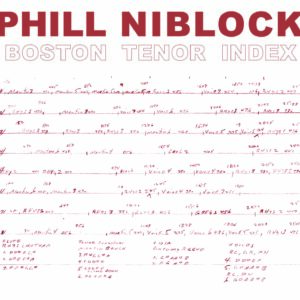
Phill Niblock "Boston / Tenor / Index", presents for the first time some of the earliest works by the American composer, inluding the three never before released "Index" (1969), "Tenor" and "Boston III" (both from 1972), thus making it possible to discover Niblock's starting point as a composer.
A filmmaker and photographer, Niblock began composing in the late 60s, while collaborating with the Judson Dance Theater in NY. As a composer his interest and field of research was connected to the layering of pre-recorded acoustic instruments into microtonal drones, which eventually led him to create some of the most unique tape collages in the second half of the 20th century minimal music. His earliest records, "Nothin To Look At Just A Record" and "Niblock For Celli / Celli Plays Niblock" were both issued by India Navigation in the first half of the 80s. Until now, it's been impossible to encounter Niblock's compositions from earlier than that period, a reality thankfully rectified by the long overdue publication of this "Boston / Tenor / Index" now on CD on alga marghen.
"Tenor" (1972) represents the first evolution of Niblock's musical thought towards the aesthetics of microtones, overtones, and drones which the composer would develop in following decades. The piece was recorded by the photographer Martin Bough on tenor saxophone and gradually dubbed back and forth by the composer in his New York studio. The sounds by the performer are submitted to the composer's techno-imaginative "acoustic optics" and deconstructed on behalf of structure, time and loudness. These specific aspects started to play an extremely important role in the artist's path as a composer.
The audio materials activated in "Tenor" through technologically de- and re-composed sounding textures, became a vehicle for those sound anomalies that would determine Niblock's audio poetics. Performing gestures are deconstructed though disseminating and editing processes by the imperceptible gestures of the composer. With its smooth flowing structure, "Boston III" (1972) stands at the very beginning of this illusion. It was recorded at the Intermedia Sound studio in Boston with Rhys Chatham (flute, voice), Martin Bough (tenor saxophone), Gregory Reeve (viola, voice); the composer himself also contributed with his voice. Using a 16-track Ampex tape recorder, at that time the world's newest recording device, Niblock was able to superimpose the recorded tones obtaining the desired aesthetic result which finally led him to a mesmerizing, immersive sound, a "very big, fat sound at fairly large volumes".
"Index" (1969) is an improvised sound performance by the composer himself. The listener is lucky to listen to (and imagine) the movements of the artist's fingers hitting a guitar string and the soundboard in breathtaking tempo. The piece itself represents early minimalism in its virgin state, untouched by distancing technology. Persistent percussive rhythm and corresponding resonances are irregular, the finger beats suffer natural dysrhythmia. Niblock's way of playing is very muscular here. It is more devoted to pure sensuality than to an intelligible order. This music is inscribed in the performer's body, it is a "body in a state of music". Guitar (both its body and strings), fingers and fingering fuse in a vehement action around which barely listenable sounds and resonances vibrate. Considering the extended pulsation as an organic blend of impulse, rhythm, drive, strength, vitality and passion, the end of this sole solo in Niblock's complete oeuvre is not defined by the fixed duration of the piece but as the consequence of the tiredness of the performer.
The CD also includes "Boston I" (1972), or the first chapter of the "Boston" series. This 25 minute bonus track is less massive than "Boston III"; still this version is much richer in dynamics and presents a more recognizable voice of each instrument.
As Niblock stated "This music is architectural. The intent is to fill the space. It's non-frontal music, non-proscenium space, anti-stage, not about an ensemble sitting in front of an audience, not about a single sound source. At least four speakers systems are desirable, arrayed around the periphery of the room, saturating the total space, engaging the air".
The music changes according to the loudness of playback. The interaction of the upper harmonics changes especially, with much richer overtone patterns being produced at louder levels.
Edition of 300 copies in digipak sleeve, including an 8-page booklet with photos and liner notes.
16,00€
Out of stock

LP
Phill NIBLOCK
“Boston Tenor Index”
Phill Niblock "Boston / Tenor / Index", presents for the first time some of the earliest works by the American composer, inluding the three never before released "Index" (1969), "Tenor" and "Boston III" (both from 1972), thus making it possible to discover Niblock's starting point as a composer.
A filmmaker and photographer, Niblock began composing in the late 60s, while collaborating with the Judson Dance Theater in NY. As a composer his interest and field of research was connected to the layering of pre-recorded acoustic instruments into microtonal drones, which eventually led him to create some of the most unique tape collages in the second half of the 20th century minimal music. His earliest records, "Nothin To Look At Just A Record" and "Niblock For Celli / Celli Plays Niblock" were both issued by India Navigation in the first half of the 80s. Until now, it's been impossible to encounter Niblock's compositions from earlier than that period, a reality thankfully rectified by the long overdue publication of this "Boston / Tenor / Index" LP on alga marghen.
"Tenor" (1972) represents the first evolution of Niblock's musical thought towards the aesthetics of microtones, overtones, and drones which the composer would develop in following decades. The piece was recorded by the photographer Martin Bough on tenor saxophone and gradually dubbed back and forth by the composer in his New York studio. The sounds by the performer are submitted to the composer's techno-imaginative "acoustic optics" and deconstructed on behalf of structure, time and loudness. These specific aspects started to play an extremely important role in the artist's path as a composer.
The audio materials activated in "Tenor" through technologically de- and re-composed sounding textures, became a vehicle for those sound anomalies that would determine Niblock's audio poetics. Performing gestures are deconstructed though disseminating and editing processes by the imperceptible gestures of the composer. With its smooth flowing structure, "Boston III" (1972) stands at the very beginning of this illusion. It was recorded at the Intermedia Sound studio in Boston with Rhys Chatham (flute, voice), Martin Bough (tenor saxophone), Gregory Reeve (viola, voice); the composer himself also contributed with his voice. Using a 16-track Ampex tape recorder, at that time the world's newest recording device, Niblock was able to superimpose the recorded tones obtaining the desired aesthetic result which finally led him to a mesmerizing, immersive sound, a "very big, fat sound at fairly large volumes".
The LP also includes "Index" (1969), an improvised sound performance by the composer himself. The listener is lucky to listen to (and imagine) the movements of the artist's fingers hitting a guitar string and the soundboard in breathtaking tempo. The piece itself represents early minimalism in its virgin state, untouched by distancing technology. Persistent percussive rhythm and corresponding resonances are irregular, the finger beats suffer natural dysrhythmia. Niblock's way of playing is very muscular here. It is more devoted to pure sensuality than to an intelligible order. This music is inscribed in the performer's body, it is a "body in a state of music". Guitar (both its body and strings), fingers and fingering fuse in a vehement action around which barely listenable sounds and resonances vibrate. Considering the extended pulsation as an organic blend of impulse, rhythm, drive, strength, vitality and passion, the end of this sole solo in Niblock's complete oeuvre is not defined by the fixed duration of the piece but as the consequence of the tiredness of the performer.
As Niblock stated "This music is architectural. The intent is to fill the space. It's non-frontal music, non-proscenium space, anti-stage, not about an ensemble sitting in front of an audience, not about a single sound source. At least four speakers systems are desirable, arrayed around the periphery of the room, saturating the total space, engaging the air".
The music changes according to the loudness of playback. The interaction of the upper harmonics changes especially, with much richer overtone patterns being produced at louder levels.
21,50€
Out of stock

CD
Phill NIBLOCK
“Ghosts And Others”
Lawrence English on Phill Niblock’s Ghosts And Others...
Ghosts And Others is a singular work in the Phill Niblock canon. It’s singular not just in its material content, but also in its methodology and approach. It represents a highly focused exercise in editing, location recording and acoustic observation.
In many ways, this work reflects a kind of acoustic mirroring of his practices as a film maker. It makes itself available to the world and in doing so reveals a particular perspective that says as much about its creator as it does about its subjects.
Like all of Niblock’s works this is a piece of patience. It is a work that dwells in the places it finds itself in, allowing certain moments to dominate in some sections, and seemingly vanish away in others. It suggests a movement within boundaries, in that it bounces from one locale to another counterpointing their gradual evolutions across time.
There’s a sense of collision throughout Ghost And Others. Explosions of Chinese percussion punctuate the piece, dynamic strikes to ward off ghosts during a funeral procession in Aberdeen, Hong Kong. They clang between bursts of car horn, the bellows of cows from collective Soviet-era farm in Hungary and various other sonic ephemera. Elsewhere a reeded instrument tries to carve a space for itself, but the world does not allow it to hold. It is a work that celebrates proximity as much as an aural vista.
Transit is also a theme here. What is a fascinating about Ghost And Others is the sense of movement in the work. Trains divide up this piece, marking points of transition, of distraction and of discovery. They act as gate-keepers almost, allowing us through into new spaces and suggesting new relations between the sounds as they combine or detach.
As a work of field recording, Ghosts And Others is generous, invitational and most of all effortlessly deep. It is resonate sensing of place, people and things.
14,00€
Out of stock

CD
Phill NIBLOCK
“Exploratory I & II”
We have the honor to present to you the new masterful work of Phill Niblock: Exploratory
One of the most beautiful and powerful works that Phill Niblock has ever offered to us! Phill reinvents and probes the oceans of drone music possibilities deeper than ever.
This piece has been performed and recorded for over a year by many great musicians around the world, under the supervision and direction of Phill.
Arditti String Quartet, David Watson, Lucy Railton, Phoenix Ensemble Basel, David Maranha, Ben Richter, David First, Andre Goncalves, and many more.
Matière Mémoire is now bringing the first two volumes to you by Arditti String Quartet, David Watson & Phoenix Ensemble Basel.
18,00€
In stock
LP
Phill NIBLOCK
“Exploratory I”
Vol. 1 performed by Arditti String Quartet & David Watson
We have the honor to present to you the new masterful work of Phill Niblock: Exploratory
One of the most beautiful and powerful works that Phill Niblock has ever offered to us! Phill reinvents and probes the oceans of drone music possibilities deeper than ever.
This piece has been performed and recorded for over a year by many great musicians around the world, under the supervision and direction of Phill.
Arditti String Quartet, David Watson, Lucy Railton, Phoenix Ensemble Basel, David Maranha, Ben Richter, David First, Andre Goncalves, and many more.
Matière Mémoire is now bringing the first two volumes to you by Arditti String Quartet, David Watson & Phoenix Ensemble Basel.
Each Vinyl is limited to 300 copies in transparent (Vol I) and transparent red (Vol II) vinyl. Also available on CD
26,00€
In stock
LP
Phill NIBLOCK
“Exploratory II”
Vol.2 performed by Phoenix Ensemble Basel.
We have the honor to present to you the new masterful work of Phill Niblock: Exploratory
One of the most beautiful and powerful works that Phill Niblock has ever offered to us! Phill reinvents and probes the oceans of drone music possibilities deeper than ever.
This piece has been performed and recorded for over a year by many great musicians around the world, under the supervision and direction of Phill.
Arditti String Quartet, David Watson, Lucy Railton, Phoenix Ensemble Basel, David Maranha, Ben Richter, David First, Andre Goncalves, and many more.
Matière Mémoire is now bringing the first two volumes to you by Arditti String Quartet, David Watson & Phoenix Ensemble Basel.
Each Vinyl is limited to 300 copies in transparent (Vol I) and transparent red (Vol II) vinyl. Also available on CD
26,00€
In stock
CD
Phill NIBLOCK
“NuDaf”
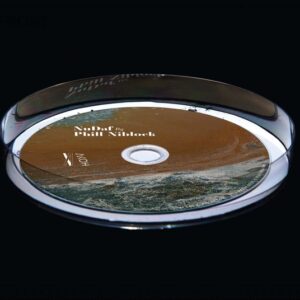
A 65-minute electroacoustic composition featuring Dafne Vicente-Sandoval, bassoon. "The aural effect is minimal to the max, but it isn't simplistic. The tones vibrate and glow, the densely packed texture shifting hues like a sonic aurora borealis" --John Rockwell, The New York Times. NuDaf (2020) is the second longest piece in Phill Niblock's repertoire of recorded audio works. NuDaf is a departure from his previous pieces in that he makes extensive use of multiphonics and constructed the work with fewer tracks than usual, creating uniquely transparent and ephemeral textures. The piece is the result of a collaboration between Niblock and the stellar bassoonist Dafne Vicente-Sandoval. Her musicality and breadth of knowledge, extended bassoon performance, and uncanny timing inspired the piece. This is the first of three collaborative projects between XI Records and Akoh Media. Akoh initiated the project, suggesting that Phill confront a longer form that also seemed eminently suitable to Dafne Vicente-Sandoval's interests. Akoh, as is its tradition, presents the work in a limited numbered edition of a one-of-a-kind Petri dish that incorporates Niblock's photos in an exquisite and unique design. From the liner notes by Michael Pisaro-Liu: "... over the course of the long duration of NuDaf we listen to a slow-motion explosion that frees it, creating a spectacular shape, right before our ears."
15,00€
Out of stock

CD
Phill NIBLOCK / OPENING PERFORMANCE ORCHESTRA
“Four Walls Full Of Sound”
"You should play the music very loud. If the neighbors don't complain, it's probably not loud enough." - Phill Niblock
Four Walls Full of Sound is an electronic interpretation of the works of Phill Niblock by the Prague-based group Opening Performance Orchestra. This studio version, recorded at the re-set studio, was preceded by a live performance at the 2017 Ostrava Days Festival of New and Experimental Music. The cover was designed by Jaroslav Buzek and the booklet includes essays by Kurt Gottschalk and Petr Ferenc. Sound designer Stephan Mathieu took part in shaping the resultant sound of the recording.
12,50€
In stock

CD, book
Phill NIBLOCK
“G2,44+/x2”
Liner Notes From Bill Meyer
In 2001, Phill Niblock wrote, "You should play the music very loud. If the neighbors don't complain, it's probably not loud enough."
In 2019, Niblock can no longer host his annual 6 hour-long solstice concert at the Experimental lntermedia loft; not only did the neighbors complain, the landlord sued. But the validity of his prescription is undiminished, for it takes sonic volume and spatial confinement to unlock his music's true nature. Give the sound waves a boost and something hard to smack against, and they begin to shiver and multiply so that tones transform tones and every turn of the head (or every new room) yields a new listening experience. But Guitar too, for four is notable in Niblock's oeuvre for its independence from loudness. While it sounds great turned up, the additive process that yielded the CD's two versions has resulted in music that changes most rewardingly, even when heard at modest volume.
Victor Frankl opined that in the hierarchy of essential human motivations, meaning eclipses pleasure. In some ways, this music hews closer to the pleasure principle. Once you let go of the yearning for tunes and grooves, it's a sensuous delight to dunk yourself in the warm sound-bath of his music. And Niblock would be the first person to scotch any efforts to assign the sort of cosmic significance fhaf certain other drone-oriented minimalists did to their art. But consider this notion; Niblock's music is fundamentally social. It only truly happens in spaces where people gather.
While he does much of the composing and assembling of this music alone, Niblock didn't treat Guitar too, for four as finished until he got some more people in on the act. He asked Rafael ToraI and Jim O'Rourke to contribute to a CD edition. And when O'Rourke declined to play on his own production, but instead invited Kevin Drumm, Alan Licht, Thurston Moore, and Lee Renaldo to do the honors, Niblock's reaction was the more, the merrier.
To the extent that connecting people is an essentially meaningful activity, this music is the connective tissue of meaning.
Matte laminate embossed sleeve, insert card, 24 page book with linear notes from Bill Meyer, interview and photos.
18,00€
In stock

LP
Phill NIBLOCK
“Music for organ”
Music for Organ is comprised of two, sidelong works - Unmounted / Muted Noun, composed in 2019 for organ and four pre-recorded tracks, and Nagro (aka - Organ), for organ and tape, from 2007. In the case of later, the tape material was recorded in 2007 by Emanuel Schmelzer-Ziringer, on an 18th century organ in Austria. The remaining recordings were made by Hampus Lindwall, in presence of the Niblock, in Belgium earlier this year.
Unmounted/ Muted Noun, 2019, for organ AND 4 pre-recorded tracks. Hampus Lindwall, organ.Nagro (aka - Organ), 2007, for organ and tape Tape material was recorded May 1, 2007 at the Joseph Gatto Organ (1787) in Sankt Kirchberg am Wagram, Austria by Emanuel Schmelzer-Ziringer.
Edition of 300 copies on ultra clear Vinyl.
23,00€
Out of stock
CD
Phill NIBLOCK
“Music for organ”
Music for Organ is comprised of two, sidelong works - Unmounted / Muted Noun, composed in 2019 for organ and four pre-recorded tracks, and Nagro (aka - Organ), for organ and tape, from 2007. In the case of later, the tape material was recorded in 2007 by Emanuel Schmelzer-Ziringer, on an 18th century organ in Austria. The remaining recordings were made by Hampus Lindwall, in presence of the Niblock, in Belgium earlier this year.
Unmounted/ Muted Noun, 2019, for organ AND 4 pre-recorded tracks. Hampus Lindwall, organ.Nagro (aka - Organ), 2007, for organ and tape Tape material was recorded May 1, 2007 at the Joseph Gatto Organ (1787) in Sankt Kirchberg am Wagram, Austria by Emanuel Schmelzer-Ziringer.
16,00€
Out of stock

CD
Phill NIBLOCK
“Music For Cello”
Phill Niblock's Music For Cello collects three pieces from the 70's and early 80's, performed by cellist David Gibson.
This CD includes a 16 page unpublished interview with Phill Niblock.
Since the late sixties Phill Niblock has been composing long-form acoustic drones with a focus on the rhythms and overtones that rise from closely tuned instruments. His highly original and influential music is an exploration of timbre, microtonality, stability, duration and psychoacoustic phenomenon.
"3 to 7 - 196 is very direct, aggressive, and gritty. The overtone patterns that are produced by the proximal pitches become more prominent with louder volume. So please, play this piece very loud. This was the first piece of mine in which the musician was precisely tuned, in which I chose exact pitches in hertz. We used a sine wave oscillator and frequency counter for the tuning.
Descent Plus has four cello tones descending one octave over twenty-two minutes, from 300 hertz to 150 hertz. David Gibson played these tones without lifting his bow from the strings, constantly retuning. I made four different scores, manually changing an oscillator to which he was tuning, for each track's recording. For the revision, we added six more tracks, with David playing long tones which were not descending. The second part of the recording was made nearly twenty years later.
Summing II (one of four parts) is mellow and sonorous. David plays two strings simultaneously, one of which is retuned for each successive recording of that pair of tones. This is a mix of an eight track tape. It's better played loud also."
Phill Niblock from liner notes
13,00€
In stock

LP
Phill NIBLOCK
“Niblock For Celli / Celli Plays Niblock”
Composer, filmmaker and photographer Phill Niblock is a true pillar of the New York avant-garde. In the past 50 years, he has curated over 1,000 performances at his Centre Street loft and steadfastly built a massive, multidisciplinary body of work. While his earliest musical compositions date back to 1968, Niblock waited until the early '80s to release any recordings. Nothin To Look At Just A Record, a powerful debut with densely layered trombones, would be the first to unfurl his unique approach to sound.
The second album and perhaps the most rare in Niblock’s vast catalogue, 1984’s Niblock For Celli / Celli Plays Niblock is a meeting of two great minds. Working with reed player Joseph Celli (a composer in his own right, who has collaborated with John Cage, Pauline Oliveros and Ornette Coleman), Niblock nimbly removes the breathing pauses from Celli’s oboe and English horn to create seamless, enchanting drones.
Niblock insists that his music be played loud: only in this way can one experience the visceral ringing of these long instrumental tones through the speakers and their natural overtones generated by the room. Niblock For Celli remains deeply absorbing.
This first-time reissue is recommended for fans of Alvin Lucier, Yoshi Wada and Dome.
22,00€
In stock

DVD
Phill NIBLOCK
“Thir”
A milestone film from American composer and filmmaker Phill Niblock, presented for the first time in DVD with two alternate soundtracks. T H I R is a mesmerizing and hypnotic film from his Environments series shot in upstate New York in 1972. This film is one of Niblock’s finest and undiscovered jewels. A must have classic release.
18,00€
In stock
CD
Phill NIBLOCK
“Music by”
Music by Phill Niblock features The Soldier String Quartet performing in Five More String Quartets, a piece for five multi-tracked string quartets and in Early Winter for flute, bass flute, string quartet and synthesizer, also featuring Susan Stenger-flute and Eberhard Blum-bass flute.
In Five More String Quartets the musicians are tuned to specific pitches by calibrated sine tones as they play and the sound they produce is recorded, unprocessed, to multitrack tape. The piece is built up by means of multitrack recording. Early Winter has a different structure: a mixing of recorded instruments, computer controlled electronic instruments, and live instruments in the studio.
12,00€
In stock
CD
Phill NIBLOCK
“Four full flutes”
Phill Niblock’s music has no precedents, invites no comparisons, and doesn’t even suggest any metaphors to me. It is simply itself and must be heard to be believed," wrote Tom Johnson in The Village Voice a decade ago. The same is true today--no one is doing what Phill Niblock is doing. Niblock takes the building blocks of music and stacks them in inimitable formations. In Four Full Flutes, adjacent tones beat violently against one another while clouds of harmonics hover above the wavering drone....When the piece ends, it takes the listener a few moments to recover. This physiological experience, when the ossicles slow their vibrating and the membrane hairs come to a standstill, is probably the only aspect of the music not regulated by the score....Playing this compact disc in a different room or moving around the room while the disc is being played actually alters the outcome. Similarly, the music can be experienced anew through different combinations, extra speakers, home stereo pyrotechnics, and volume level alterations. The effects intensify with louder levels of volume. The higher the volume goes, the higher you go.
12,00€
Out of stock
CD
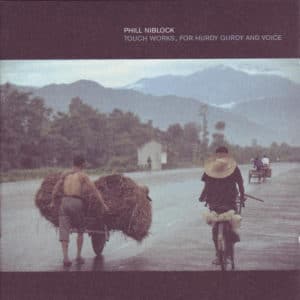
Phill NIBLOCK
“Touch works, for hurdy gurdy and voice”
This is the first CD by Phill Niblock for Touch. Thomas Buckner, baritone voice (samples and live) All were completed with Protools software in a Macintosh computer, and are 24 tracks mixed to stereo. There are two versions of the voice piece, one the original tape piece, the other a version with three added voices, live, plus four tracks of pitch shift on each, done in Robert Poss’s (Trace Elements) studio. Samples and live elements were recorded by Robert Poss at Trace Elements Studios in New York. The pieces were constructed and mixed in ProTools by Phill Niblock at Experimental Intermedia in New York. [AYU was commissioned by Thomas Buckner] Track Listing: "Hurdy Hurry" (October 1999) Jim O’Rourke, hurdy gurdy (samples). "A Y U", aka "as yet untitled" (October 1999) Thomas Buckner, baritone voice (samples). "A Y U, Live" (October 1999/2000).
12,00€
Out of stock
3 CD
Phill NIBLOCK
“Touch three”
“Sethwork” (2003) Seth Josel, acoustic unamplified guitars played with e-bow. “Harm” ( 2003) Arne Deforce, cello. “Lucid Sea” (2003) Lucia Mense, recorders. “Parker’s Altered Mood, aka, Owed to Bird” (2004) Ulrich Krieger, alto saxophone. “Zrost” (2004) Martin Zrost, soprano saxophone. “Not Yet Titled” (2003) Franz Hautzinger, trumpet. “Valence” (2005) Julia Eckhardt, viola. “Alto Tune” (2004) Ulrich Krieger, alto saxophone. “Sax Mix” (2004) Ulrich Krieger, alto, tenor and baritone saxo. These nine pieces were made from March 2003 to January 2005. They were all made (except "Sax Mix") by recording a single instrument with a single microphone. The recordings were direct to the computer-hard disk, most of them using my Powerbook G4, Protools, an M-box and an external firewire drive. The resulting mono sound files were edited to remove breathing spaces, leaving the natural decay of the tone, and the attack of the subsequent iteration of the same tone. Each note was represented by several repetitions, perhaps ten for each tone, of about 15 seconds duration each. Each piece uses a few tones. A simple chord, perhaps. Additional microtonal intervals were produced in Protools using pitch shift. The pieces were assembled in multitracks, usually either 24 or 32 tracks. The recording environment varied from a simple apartment in Berlin (Ulrich Krieger’s) to a very large hall used for symphony orchestra performances and recordings, with a sizable audience space (Deutschland Radio, Cologne). The recordings were generally done quite closely miked. One hears only the sound of the instrument. There is no electronic manipulation in the recording, the editing of the tones, or in the mix. The only changes to the recorded tones are the pitch shifts to create microtones. The microtones are doing the work.
20,00€
In stock
2 CD
Phill NIBLOCK
“YPGPN”
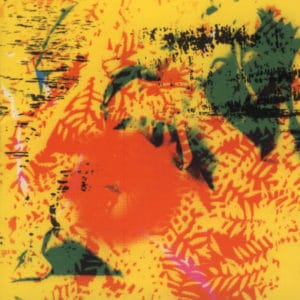
YPGPN (Young Person’s Guide to Phill Niblock) is the long-awaited re-release of a 2 CD-set that was a joint production by the UK based Blast First label and The Wire magazine in 1995. It includes the following works: Held Tones (1982-94) Barbara Held, flute; Didjeridoos and Don’ts (1992) Ulrich Krieger, didjeridu; Ten Auras (1994) Ulrich Krieger, tenor saxophone; Ten Auras Live (1994) Ulrich Krieger, tenor saxophone; A Trombone Piece (1978-94) James Fulkerson, trombone; A Third Trombone (1979-94) Jon English, trombone; Unmentionable Piece for Trombone and Sousaphone (1982-94) George Lewis, trombone and sousaphone.
15,00€
In stock
2 CD
Phill NIBLOCK
“Touch five”
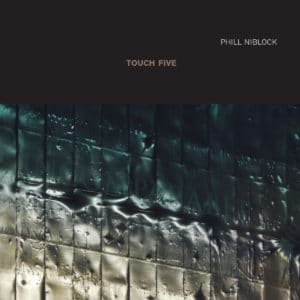
“FeedCorn Ear” (2012). Arne Deforce, cello. “A Cage of Stars” (2012). Rhodri Davies, electric harp. Two Lips (2011). Zwerm Guitar Quartet. “Two Lips” (2011). Dither Guitar Quartet. “Two Lips” (2011). Coh Da Guitar Quartet.
These CDs have pieces made in two different ways. Traditionally (since 1968), I recorded tones played by an instrument (by an instrumentalist), arranging these single tones into mutli-layered settings, making thick textured drones, with many microtones. In the early days, I prescribed the microtones, tuning the instrumentalist, when I was using audio tape. Later, I used the software ProTools, and made the microtones as I made the pieces. FeedCorn Ear and A Cage of Stars were made this way. In 1998, Petr Kotik asked me to make a piece for orchestra, so, I began to make scores for the musicians to play from. The form of that piece, and the subsequent six scored works, were patterned after a piece in 1992-94, where the musicians were tuned by hearing tones played from a tape through headphones. These are the instructions for the scored piece on the second CD, Two Lips. The score was prepared by Bob Gilmore, from specific directions by me. Two Lips, aka Nameless, is conceived as two scores, A and B, to be played simultaneously, lasting 23 minutes. Each score consists of ten instrumental parts. The twenty separate parts should be distributed randomly amongst the musicians of the ensemble; the ’A group’ and the ’B group’ are not separated spatially. In each part, one note changes to the next in a graded sequence of microtonal steps. In score A, G gradually goes to F
. In score B, G
gradually goes to A. The piece calls for very subtle gradations of tuning in order to achieve a richness of ensemble sound, full of beatings of near-unison pitches, and with clouds of overtones and difference tones. The microtonal displacements are conceived in gradations of 10 cents, therefore resulting in ten divisions of the equal-tempered semitone (100 cents). An electronic tuner may be useful in rehearsal, and perhaps in performance, to achieve these small gradations. Be careful not to use glissandi to move from one note to the next; these are antithetical to Niblock’s musical language.
In score A, the G of the beginning is presented ’straight’, without microtonal embellishments of any kind, whereas the F
(into which it slowly transforms) is heard by the end in a multitude of microtonal variants above and below.
In score B this process is reversed: the G
at the beginning is immediately presented with a multitude of microtonal variants above and below, the pitches slowly transforming into the unison A by the end.
General comments: Phill Niblock’s music utilizes dense collections of microtones to yield a unique sonic palette. The musicians should sense being part of an intonational cloud of sound. The density will change throughout the piece, but the ’cloud’ will always be present. This score was used in recording three different guitar quartets; Zwerm (of Belgium), Dither (of New York) and an assembled group of world widers, Coh Da (well, ad hoc spelled backwards).
Each quartet recorded 40 tracks from the score, each playing the 23 minute piece ten times in one day. Stamina.
Zwerm line up for this recording: Kobe Van Cauwenberghe, Matthias Koole, Toon Callier, Guy De Bièvre (guest).
Dither: Taylor Levine, David Linaburg, Joshua Lopes, James Moore
Coh Da Quartet David First, Seth Josel, Robert Poss and Susan Stenger.
These CDs have pieces made in two different ways. Traditionally (since 1968), I recorded tones played by an instrument (by an instrumentalist), arranging these single tones into mutli-layered settings, making thick textured drones, with many microtones. In the early days, I prescribed the microtones, tuning the instrumentalist, when I was using audio tape. Later, I used the software ProTools, and made the microtones as I made the pieces. FeedCorn Ear and A Cage of Stars were made this way. In 1998, Petr Kotik asked me to make a piece for orchestra, so, I began to make scores for the musicians to play from. The form of that piece, and the subsequent six scored works, were patterned after a piece in 1992-94, where the musicians were tuned by hearing tones played from a tape through headphones. These are the instructions for the scored piece on the second CD, Two Lips. The score was prepared by Bob Gilmore, from specific directions by me. Two Lips, aka Nameless, is conceived as two scores, A and B, to be played simultaneously, lasting 23 minutes. Each score consists of ten instrumental parts. The twenty separate parts should be distributed randomly amongst the musicians of the ensemble; the ’A group’ and the ’B group’ are not separated spatially. In each part, one note changes to the next in a graded sequence of microtonal steps. In score A, G gradually goes to F
. In score B, G
gradually goes to A. The piece calls for very subtle gradations of tuning in order to achieve a richness of ensemble sound, full of beatings of near-unison pitches, and with clouds of overtones and difference tones. The microtonal displacements are conceived in gradations of 10 cents, therefore resulting in ten divisions of the equal-tempered semitone (100 cents). An electronic tuner may be useful in rehearsal, and perhaps in performance, to achieve these small gradations. Be careful not to use glissandi to move from one note to the next; these are antithetical to Niblock’s musical language.
In score A, the G of the beginning is presented ’straight’, without microtonal embellishments of any kind, whereas the F
(into which it slowly transforms) is heard by the end in a multitude of microtonal variants above and below.
In score B this process is reversed: the G
at the beginning is immediately presented with a multitude of microtonal variants above and below, the pitches slowly transforming into the unison A by the end.
General comments: Phill Niblock’s music utilizes dense collections of microtones to yield a unique sonic palette. The musicians should sense being part of an intonational cloud of sound. The density will change throughout the piece, but the ’cloud’ will always be present. This score was used in recording three different guitar quartets; Zwerm (of Belgium), Dither (of New York) and an assembled group of world widers, Coh Da (well, ad hoc spelled backwards).
Each quartet recorded 40 tracks from the score, each playing the 23 minute piece ten times in one day. Stamina.
Zwerm line up for this recording: Kobe Van Cauwenberghe, Matthias Koole, Toon Callier, Guy De Bièvre (guest).
Dither: Taylor Levine, David Linaburg, Joshua Lopes, James Moore
Coh Da Quartet David First, Seth Josel, Robert Poss and Susan Stenger.
15,00€
Out of stock
2 CD
Phill NIBLOCK
“Touch strings”
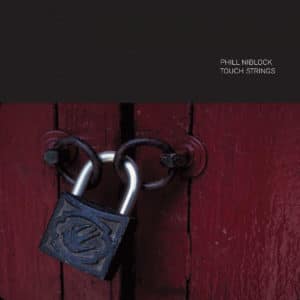
CD One - (6 tracks): 1. - 6. “Stosspeng”. Susan Stenger and Robert Poss, guitars and bass guitars. CD Two - (6 tracks): 1. “Poure”. Arne Deforce, cello. 2. - 6. “One Large Rose”. The Nelly Boyd Ensemble, Hamburg - Robert Engelbrecht, cello; Jan Feddersen, piano strummed with nylon strings; Peter Imig, violin; Jens Roehm, acoustic bass guitar strummed with nylon strings or e-bow. This is Phill Niblock’s 4th release on Touch, after Touch Works... [TO:49, 2000], Touch Food [TO:59, 2003] and Touch Three [TO:69, 2006]. “Stosspeng was completed in April 2007; Poure in September 2008 and One Large Rose in May 2008. The Stosspeng recording session to obtain the materials for the piece was on December 20 2006 at Robert Poss’s Trace Elements studio on E 4th Street and Ave A, in New York. Robert was the engineer. The piece was completed using Protools in April 2007, in Vienna, Austria. It was premiered at the Donau Festival in Krems Austria on April 30 2007. The material for Poure was recorded in Johan Vandermaelen’s Amplus studio in Aaigem Belgium, with technical assistance by Guy De Bievre. Much of the construction of the piece, in Protools, was done in a residency at Atelier Azur in Hoenefoss, Norway at the Hval Station, in mid August 2008. It was finished in Ellen Fullman’s studio in Berkeley California on September 7. It was premiered at Kasteel Schuurlo, Sint-Maria-Aalter, Belgium on September 12 2008 and it was commissioned by the Centre de Recherches et de Formation Musicales de Wallonie, CRFMW, Liege, Belgium. One Large Rose was made with the musicians playing from a score, and recorded acoustically and in real time. There are four recordings of 46 minutes each, superimposed. Recorded by Jens Roehm at Christianskirche, Hamburg, Germany, recording assistance by Julia Berg, on May 15 and 16 2008. Mixing was done by Jens Roehm and the ensemble in Hamburg, and the final mix was done in New York at Experimental Intermedia on October 13 2008. The mastering for CD, of all pieces, was done by Tom Hamilton, in New York.” Phill Niblock, August 2009. “Phill Niblock is a New York-based minimalist composer and multi-media musician and director of Experimental Intermedia, a foundation born in the flames of 1968’s barricade-hopping. He has been a maverick presence on the fringes of the avant garde ever since. In the history books Niblock is the forgotten Minimalist. That’s as maybe: no one ever said the history books were infallible anyway. His influence has had more impact on younger composers such as Susan Stenger, Lois V Vierk, David First, and Glenn Branca. He’s even worked with Sonic Youth’s Thurston Moore and Lee Ranaldo on “Guitar two, for four” which is actually for five guitarists. This is Minimalism in the classic sense of the word, if that makes sense. Niblock constructs big 24-track digitally-processed monolithic microtonal drones. The result is sound without melody or rhythm. Movement is slow, geologically slow. Changes are almost imperceptible, and his music has a tendency of creeping up on you. The vocal pieces are like some of Ligeti’s choral works, but a little more phased. And this isn’t choral work. “A Y U (as yet untitled)” is sampled from just one voice, the baritone Thomas Buckner. The results are pitch shifted and processed intense drones, one live and one studio edited. Unlike Ligeti, this isn’t just for voice or hurdy gurdy. Like Stockhausen’s electronic pieces, Musique Concrete, or even Fripp and Eno’s No Pussyfooting, the role of the producer-composer in “Hurdy Hurry” and “A Y U” is just as important as the role of the performer. He says: “What I am doing with my music is to produce something without rhythm or melody, by using many microtones that cause movements very, very slowly”. The stills in the booklet are from slides taken in China, while Niblock was making films which are painstaking studies of manual labour, giving a poetic dignity to sheer gruelling slog of fishermen at work, rice-planters, log-splitters, water-hole dredgers and other back-breaking toilers. Since 1968 Phill has also put on over 1000 concerts in his loft space, including Ryoji Ikeda, Zbigniew Karkowski, Jim O’Rourke.”
15,00€
Out of stock
2 CD
Phill NIBLOCK
“Touch food”
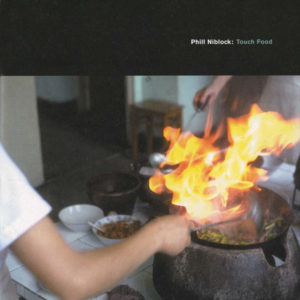
CD1: “Sea Jelly Yellow” [Ulrich Krieger, baritone saxophone]; “Sweet Potato” [Carol Robinson, bass clarinet, basset horn, and Eb clarinet]; “Yam almost May” [Kasper T. Toeplitz, electric bass]. CD2: “Pan Fried 70” [Reinhold Friedl, piano].
“In the music of Phill Niblock, we are confronted with the aural equivalent of trompe-l’oeil. Apparently static clouds of harmonically dense material turn out to be not so static as they appear. What’s more, one has the distinct impression that the music is changing spatially over time. How is all of this possible? The key is in Niblock’s use of time. In his music, the experience of time is as very slow and continuous. There are no disruptive, discontinuous musical events to disrupt the flow of time. Time is suspended. Niblock’s music gives the impression of having always been and continuing to be. Yet, this is not the idea of Being as stasis. Each time one feels that Niblock’s music isn’t changing, one realizes that it is never the same, an yet, always the same. Being and Becoming as one. Moving Immobility. This is a music that breathes slowly and deeply. It changes its spatial form slowly, as a person who is in deep meditation changes the form of his body ever so slowly as he peacefully expands and contracts the walls of his chest cavity with each new cycle of inspiration/expiration.” Gerard Pape.
15,00€
Out of stock

CD
Phill NIBLOCK
“Disseminate”
“Disseminate Ostrava” (1998) In this orchestra piece, the players read from a conventional score. There is no after-recording manipulation of the material. The recording comes from the Ostrava Days Festival in the Czech Republic, where the 41-piece Ensemble OCNM is supplemented by members of the Janacek Philharmonic. “Kontradictionaries” (1999, rev. 2003) This work was written for the KONTRA-trio. The trio (formed in 1992) of Bischof, Mejer and Bachmann concentrates on the sound of low wind instruments. The three wind contrabasses are used as sources for acoustic phenomena.
Here, the musicians recorded "samples" of the notes in a recording studio. Niblock then edited the samples, made pitch shifts of them, and combined this material in a multitrack score. There is no manipulation of the sound of the instruments, the combination of the different microtonal pitches and timbres of the instruments modifies the sound. The musicians later added "live" parts to the Niblock multitrack-mixed-to stereo recording. “Disseminate Q-O2” (1998) the Q-O2 Ensemble. Written for the Belgian ensemble for contemporary and improvised music, Q-O2. The work creates a haze of slowly shifting, vibrating sounds. Phill Niblock (born in Indiana, 1933) is a seminal figure in "drone" music who crosses the Downtown and Improv scenes. A characteristic of Niblock’s drone style is its subtle, gradual alteration of pitch which leads one to loose a sense of "time" and draws one deeper and deeper into the sound itself. The remarkable thing is that Niblock achieves this effect by almost always using traditional acoustic instruments. Niblock is an intermedia artist using music, film, photography, video and computers. He initially was trained in the visual arts and worked as a photographer; he takes inspiration from minimal artists, including Rothko, Judd and Andre.
Here, the musicians recorded "samples" of the notes in a recording studio. Niblock then edited the samples, made pitch shifts of them, and combined this material in a multitrack score. There is no manipulation of the sound of the instruments, the combination of the different microtonal pitches and timbres of the instruments modifies the sound. The musicians later added "live" parts to the Niblock multitrack-mixed-to stereo recording. “Disseminate Q-O2” (1998) the Q-O2 Ensemble. Written for the Belgian ensemble for contemporary and improvised music, Q-O2. The work creates a haze of slowly shifting, vibrating sounds. Phill Niblock (born in Indiana, 1933) is a seminal figure in "drone" music who crosses the Downtown and Improv scenes. A characteristic of Niblock’s drone style is its subtle, gradual alteration of pitch which leads one to loose a sense of "time" and draws one deeper and deeper into the sound itself. The remarkable thing is that Niblock achieves this effect by almost always using traditional acoustic instruments. Niblock is an intermedia artist using music, film, photography, video and computers. He initially was trained in the visual arts and worked as a photographer; he takes inspiration from minimal artists, including Rothko, Judd and Andre.
17,50€