
In stock
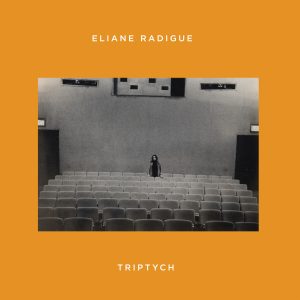
2 LP
Eliane RADIGUE
“Triptych”
The final collaboration between Eliane Radigue and Important Records is this double LP edition of Triptych. Radigue insisted that her music only be released on vinyl if the pieces would fit without being edited or cut. Triptych met those requirements leaving room for an etching on the 4th side.
Back to music after three years of silence... On the suggestion of Robert Ashley, Douglas Dunn commissioned Triptych from Eliane Radigue for choreography. Only the first part of Triptych was staged at the premiere at the Dancehall/Theatre of Nancy on February 27 1978. Recorded in the composer's studio in Paris.
After the 1974 premiere of Adnos in San Francisco, a group of French students introduced Eliane Radigue to Tibetan Buddhism. When she returned to Paris, she†began to explore this spirituality in depth, which slowed her musical production up until 1978. Triptych marks her return to composition, and draws its inspiration from "the spirit of the fundamental elements, water, air, fire, earth" Eliane Radigue likes to add that this has often been useful to her in her moments of research and transitions.
This three-part composition, with its great humility and contemplative simplicity, heralded a new period of her work and was the first in a series of masterpieces inspired by Tibetan Buddhism: Adnos Trilogy (1980), Songs of Milarepa (1983) - with the voices of Lama Kunga Rinpoche and Robert Ashley , "Jetsun Mila"(1986), as well as the Trilogy of Death: Kyema (1988), Kailasha†(1991) and Koume†(1993).
45,00€
In stock

CD
Eliane RADIGUE
“Asymptote Versatile (1963-64)”
Éliane Radigue completed her piece Asymptote Versatile in New York in 1964. The piece had never been performed publicly until Rhodri Davies convened an ensemble to perform the work at Huddersfield Contemporary Music Festival in November 2023. The first performance took place just short of sixty years after the piece was conceived, and that is the music that you hear on this CD.
The pioneering French artist referred to her 1960s works as propositions sonores, rather than compositions, and this piece is the only one she kept from the period. The graphic score comprises logarithmic curves devised from the Fibonacci sequence, superimposed over sheets of additional notation, to be performed as sustained tones by up to four groups of acoustic instrumentalists spanning the full range of the audible spectrum. ASYMPTOTE VERSATILE sows the seeds of Radigue’s exploration of long durational forms, bridging a 50-year gap between the school of composers she met in 1960s New York and her 2011- onwards OCCAM OCEAN series, where she composes for individual instrumentalists. This recording includes many of the OCCAM soloists who have worked closely with the composer and are steeped in Radigue’s aesthetics and working methods.
"I was young when I composed the Fibonacci suite. I was in New York at that time… During this period of my life I was very interested in mathematics and for this piece I constructed a logarithmic spiral. It is to do with the infinitesimal; the ever-changing, until its destruction in the dance of constant change. It is this versatility, nevertheless, which maintains the rule; it is about playing with the rule. So we gave this concept of a special equilibrium, which is forever being readjusted.”
Eliane Radigue in conversation with Rhodri Davies on 26 June 2023, Paris
Xavier Charles: clarinet
Angharad Davies: violin
Rhodri Davies: harp
Julia Eckhardt: viola
Bertrand Gauguet: alto saxophone
Susan Geaney: bass flute
Dominic Lash: double bass
Thierry Madiot: bass trombone
Aonghus McEvoy: guitar
Hannah Miller: french horn
Ailbhe Nic Oireachtaigh: viola
Carol Robinson: bass clarinet
Accompanying booklet in French and English.
Introduction by Rhodri Davies and Julia Eckhardt.
17,00€

14 CD box
Éliane RADIGUE
“Œuvres électroniques”
2024 repress
With a 80 pages booklet (french/english).
Tracklist
CD1
1. Chry-ptus (version 2001) 24’01
2. Geelriandre 29’57
CD2
1. Chry-ptus (version 2006) 23’10
2. Biogenesis 21’06
3. Arthesis 25’40
CD3
1. Ψ 847 (version concert) 71’08
CD4
1. Adnos I 71’28
CD5
1. Adnos II 72’44
CD6
1. Adnos III 72’40
CD7 Les Chants de Milarepa
1. Mila’s Song in the Rain 19’10
2. Song of the Path Guides 21’01
3. Elimination of Desires 17’22
4. Symbols for Yogic Experience 19’29
CD8 Les Chants de Milarepa
1. Mila’s Journey Inspired by a Dream 62’22
CD9 Jetsun Mila
1. Jetsun Mila (première partie) 44’25
CD10 Jetsun Mila
1. Jetsun Mila (seconde partie) 39’57
CD11 Trilogie de la Mort
1. Kyema 61’07
CD12 Trilogie de la Mort
1. Kailasha 56’09
CD13 Trilogie de la Mort
1. Koumé 51’18
CD14
1. L’Île re-sonante 55’04
70,00€
In stock

2 CD
Eliane RADIGUE
“Naldjorlak”
Saltern presents a thrilling new live recording of Naldjorlak for solo cello, composer Éliane Radigue's first piece for an acoustic instrument, paired with a remastered version of the long out-of-print, original 2006 recording. Composed in 2005 in close collaboration with cellist Charles Curtis, Naldjorlak marked a striking shift in the music of Radigue, who has since composed exclusively for instrumentalists with her celebrated Occam series. This double-CD album brings together two complete performances by Curtis, recorded nearly 15 years apart (Paris in 2006 and Los Angeles in 2020), drawing attention to the evolution of the piece and to its inherent mutability. The sound and spirit of Naldjorlak are centered around the re-tuning of the entire cello to the wolf tone, a uniquely unstable frequency, creating a haunting, almost feedback-like resonance within the instrument itself. Mastered by Stephan Mathieu with custom packaging and screen printing by Alan Sherry. Includes extensive liner notes by Gascia Ouzounian, Radigue, and Curtis, and a reproduction of Radigue's never-before published original drawing of Naldjorlak.
From Gascia Ouzounian's liner notes: "Even as it expands conceptions of what sound is, and thus what music can be, to understand Naldjorlak only as music would be to limit its scope. It is music, but it is also physics and philosophy. Naldjorlak is a detailed investigation of the physical properties of resonating bodies and dynamic systems; it is a meditation on the condition of instability; it is a metaphysics of chaos and uncertainty."
21,00€
Out of stock

CD
Eliane RADIGUE
“Hepta I – Occam XX”
In Eliane Radigue's work, one distinguishes or contrasts the electronic works (composed until the early 2000s) with those written for acoustic instruments. From 2002 onwards, the artist began a series of compositions, the Occams, in which, in her own words, she fully realised what she had always sought to achieve in her electronic works.
The disc devoted to her here brings together two pieces written at the same time; one for an instrumental ensemble (Dedalus) and the other for analogue synthesizer (Ryoko Akama). If the means seem to be opposed, this concordance of time lets us glimpse the deep unity that brings them together.
12,00€
In stock

2 CD
Eliane RADIGUE
“11 Dec 1980”
11 Dec 80 is a two CD set containing Eliane Radigue's live performance of Chry-Ptus (1971), her first work for modular synthesizer, and the world premier of parts one and three of Triptych (1978). Triptych part 2 is also performed. Upon hearing these performances for the first time in many years Radigue declared them to be the best versions she'd ever heard.
Radigue's sublime renderings of these major pieces are full of illusory stasis, slow change and dense, slow motion drone that has characterized her pioneering electronic work. These pieces move like a river with currents shifting beneath the surface. While you can't quite distinguish the individual components you get a clear feeling of motion and change.
23,00€
Out of stock

LP
Eliane RADIGUE
“In Memoriam-Ostinato / Danse des Dakinis
Alga Marghen presents the last chapter from the Feedback Works documentation series, a brand-new LP including "In Memoriam-Ostinato" and "Danse des Dakinis", two previous unreleased tracks by Eliane Radigue. Among the works of fixed duration from the feedback period, "In Memoriam-Ostinato" is the link between "Jouet Electronique" and "Opus 17", and allows you to understand the evolution of her approach. "In Memoriam-Ostinato" is a game of mirroring symbols which glide into a non-measured, bent and elastic, temporality. Eliane Radigue's working method and her aesthetic direction are evident in this work from 1969: her very own unique temporal space of sonic experiences. Even though it bears the same name as the third part of "Adnos III", "Danse des Dakinis" is a peculiar work in Eliane's oeuvre. Conceived in a short time, with all kind of tapes from the composer's past work, it fluently shows a kaleidoscopic vision of Radigue's sensibility for sound. In 1998 she put together a curious self-portrait in sound. There is a feedback ostinato conceived around 1969 and which refers to "In Memoriam-Ostinato" and "Opus 17". All through "Danse des Dakinis" you plunge into the sound of a creek recorded at Mills College campus that brings you back to the field-recordings from the beginning of the 1960s, made on the coasts of the Mediterranean Sea. Such elements construct "Elemental1" as well. There are also some discreet interventions on the ARP 2500 synthesizer. It is indeed a peculiar work, which doesn't have the same features of her other compositions, especially at that time of her compositional path. There is an explanation for the composer producing this kind of sound material in 1998, and not limited to the sound waves of the ARP synthesizer. Invited to a workshop at Mills College in 1998, Eliane Radigue could not load herself down with her bulky instrument on such a trip. So, she left with just a few tapes taken from her own collection, drawn from different periods, and composed "Danse des Dakinis" with those old elements. There is tension in this composition, a certain wildness, an unpredictability of elements, those which are recognized as fundamental elements, which give structure to the universe. "Dance des Dakinis" is an intimate and wild symphony, alive and unpredictable, which is to be the next-to-last gesture of the composer before completely stopping her work with electronics.
23,50€
Out of stock

LP
Éliane RADIGUE
“Jouet électronique / Elemental I”
New 2022 edition.
alga marghen proudly presents the new edition of two sublime pieces by Eliane Radigue, “Jouet Electronique” (1967) for feedback on magnetic tape and “Elemental I” (1968) for feedback of natural sounds on magnetic tape. This LP was first issued in 2010 on the occasion of an alga marghen presentation at Centre Pompidou in Paris and included in the series of publications connected to the Oeuvres Sonores events. We thought, after a long time this wonderful record was sold out, it's time now to have it available again, presenting it for the first time with it's own specific artwork and layout.
Both works were recorded at Pierre Henry's Studio Apsome in Paris. Between 1967 and 1968, Eliane Radigue was the assistant of Pierre Henry in his studio, mainly for the editing of "L'Apocalypse de Jean". He also put her in charge of organizing his sound archive according to different criteria. It was endless work - there were incredible sounds, a true sound library! Eliane Radigue really enjoyed doing this work, even if it took a long time. So, sometimes she decided to set the machines of the studio to do some little work on her own. "Jouet Electronique" and "Elemental I" were born this way as a kind of recreation during her time as a studio assistant.
Working with feedback is something that Eliane Radigue learned through Pierre Henry. Do you remember "Voyage"? There's that fluid part which is made of feedback constructed with a microphone. Everything had to be set at a precise distance from the loudspeakers because that is the specific problem with feedback - you have to be at the right distance. Afterwards, these high tone recordings were slowed down in order to discover the deeper character of their color. This work with feedback was in the end quite limited and the composer preferred working with two reel tape machines to produce sounds. The first was set on the recording mode while the other was playing and it was the accidents happening in this phase that made the feedback richer. With some fine-tuning you could reach very beautiful results: low pulsations, very high-pitched sounds - sometimes both at the same time - or long sounds. All of these sounds could be slowed down or accelerated, which gave her a beautiful material to work with.
With "Jouet Electronique" Eliane Radigue had a lot of fun, hence the title. As far as "Elemental I" is concerned, it was the first attempt at something which was very important to her based on the theme of the basic elements: water, fire, air and earth. Eliane had the chance to record in open air thanks to a small Stella Vox that Arman gave her in the beginning of the 1960s. At the time she was still living in Nice and every now and then she went for a walk to do some recordings of the sea, the wind, the rain, the fire - Eliane Radigue continued this way to build her very minimal sound library, consisting of not more than ten reel tapes. This was the starting point and in 1968 she used these recordings for her work with two reel tape machines.
New edition of 200 copies, with liner notes by Eliane Radigue and portrait photos by Arman.
20,00€
Out of stock

LP
Eliane RADIGUE
“Feedback works 1969-1970”
New 2022 edition.
alga marghen very proudly presents a remastered version of the complete documentation of Eliane Radigue sound installations from 1969-1970, including the broad tectonic vibrations of “Omnht“, the celestial voices of “Usral”, “Stress Osaka” massive chant… or the works of the feedback period finally revealed! It is amazing that she could build such formidably organic sonic edifices in her home studio with the primitive machines given to her by Pierre Henry: three tape recorders, a mixing board, an amplifier, two loudspeakers and a microphone. Eliane previously worked for him at the Studio d’Essai of the R.T.F. from 1955 to 1957, after having met Pierre Schaeffer almost by chance who invited her to learn the techniques of Musique Concrète. Created 10 years after her Studio d’Essai experience, the Feedback works of Eliane Radigue immediately take a new direction from the explorations of Musique Concrète. Her adventure is intuitively going towards flux, towards contemplative stasis - a music of continuous sounds, of apparently simple structures, which permits the revelations and expansion of rich acoustic phenomena. It is as if her musical work was in some way a martial art… as if she meditated for 10 years before striking the first blow, with an impressive precision! This is the context in which Eliane composed “Omnht” in 1970 for the architectonic spaces of the visual artist Tania Mouraud titled “One More Night”, presented at the Gallery of the Rive Gauche in Paris; “Usral” (the title comes from a phonetic compression of ultrasounds slowed-down, in French “ultra-sons ralentis”), one of the first works by Eliane Radigue to be given in public as sound environment for a sculpture by Marc Halpern in the Salon des Artistes Décorateurs at the Grand Palais of Paris in 1969; “Stress-Osaka”, conceived when the artist was invited to create a sonic environment for the International Fair in Osaka in 1970. There is no doubt that Eliane Radigue vocabulary is based on observing and entering into dialog with the fundamental behaviour of sounds: pulsing, beating, sustained, very light, a subtle and delicate evolution. When she moved from feedback sounds to the ARP synthesizer she naturally continued the same music. A continuity where the original use of feedback sounds stands out for its cruder and more savage inner character. One could say that somehow it’s the very texture of the sounds, which leads the form of her compositions. At the same time this approach favors an intense sensuality in the listening.
23,50€
Out of stock

LP
Eliane RADIGUE
“Vice-Versa, Etc…”
New 2022 edition.
alga marghen very proudly presents a remastered version of “Vice-Versa, Etc…” LP originally included in the first 400 copies of the now sold out Eliane Radigue “Feedback Works” 2LP. “Vice-Versa, Etc...” was originally a small handmade box, signed and numbered, realized as art multiple on the occasion of a show at Lara Vincy’s gallery in 1970. The box contained a reel of magnetic tape and the instructions for use. It indicates that all playback speeds are possible, forward or backward, as well as any combination of two channels, on several recorders, ad libitum… This LP presents two versions done by Emmanuel Hoelterbach following the indications of Eliane Radigue to the letter, respecting her composition methods. There is no doubt that Eliane Radigue vocabulary is based on observing and entering into dialog with the fundamental behaviour of sounds: pulsing, beating, sustained, very light, a subtle and delicate evolution. When she moved from feedback sounds to the ARP synthesizer she naturally continued the same music. A continuity where the original use of feedback sounds stands out for its cruder and more savage inner character. One could say that somehow it’s the very texture of the sounds, which leads the form of her compositions. At the same time this approach favors an intense sensuality in the listening. This edition limited to 300 copies includes an insert with liner notes.
20,00€
Out of stock

2 LP
Eliane RADIGUE
“Opus 17”
Repress. Remastered, improved sound quality.
alga marghen very proudly presents “Opus 17”, a major turning-point in the sonic oeuvre of Eliane Radigue. Finished in 1970 it was the last work composed with feedback materials. From that experimental period “Opus 17” preserves the plastic character: a music made of rough sonic phenomena, at once harsh and granular, possessing a quality of materiality and tactility. Its vibrations structure the air surrounding the listener with densities, thicknesses, indeed with palpable movement. Her compositions are frames which let us hear these phenomena, open frameworks from the sonic installations of her Endless Musics (cf. “Feedback Works 1969-70” LP issued on alga marghen) and here reinserted in the five scenes making up “Opus 17”.
In 1970, in her studio of very rudimentary means, she developed a completely unique body of work centered on sounds produced by feedback. “Opus 17” has the quality of showing off the sum of the achieved techniques and methods. Eliane Radigue’s music has never been rooted in ideas but in practice, the intimate experience of things in the wild which she has known how to tame. This dialog both intense and poetic which she keeps up with the solid matter of sound finds a remarkable concretization in “Opus 17”.
It is to be underlined that with “Opus 17” Eliane Radigue inaugurates a technique of composition which will be her footprint, her trademark: imperceptible transformations. For that she has developed a technique of meticulous mixings, based on the slow passage from one section to the next. Imperceptible, all during the piece, we pass, ceaselessly and without noticing the changes, from one frequency flux to another. Time is suspended, smoothed out, stretched. It is this technique which Eliane Radigue will be essentially using for all the electronic works to come and which she will never cease to refine and render always more subtile.
“Opus 17” is the great panoramic voyage through material sound, its electronic phenomena detailed as if in a microscope. Could feedback really contain such a universe? “Yes”, the work of Eliane Radigue answers, but that exploration was not that easy: one had to learn to listen. It required Eliane Radigue’s great demands on listening which led her to the discovery of such treasures. Unknown wealth in a material often rejected as trivial.
As Rhys Chatham recalls: “Eliane Radigue (...) had just moved to New York and had the idea of acquiring an analog modular synthesizer, which is why she worked at NYU in order to try out the possibilities of the Buchla 100 series which we had there. One day, while gossiping, she invited me to her loft, which was just on the corner. She had me listen to a piece composed in France; the piece called ‘Opus 17’. (...) What I heard changed to course of my life as a composer. (...) That piece, impressive source of inspiration, gave the impression of being in a grand cathedral, both for the sensation of immensity of being in such a large cathedral, as for the effect of being so close to God”. This anecdote has its importance because it is evident when listening to the feedback works that Eliane Radigue had already put in place the essential part of her musical æsthetic.
“Opus 17” was created at the artistic center of Verderonne on May 23, 1970, for the Fête en blanc (i.e. White Festival) organized by the visual artists Antoni Miralda, Joan Rabascall, Dorothée Selz and Jaume Xifra.
Previously unreleased, “Opus 17” is now issued on alga marghen in a first edition of 400 copies in gatefold sleeve.
34,00€
In stock

2 CD
Eliane RADIGUE
“Opus 17”
Eliane Radigue's complete Opus 17 (1970), her finest and final work created using feedback, is contained on this double CD. With Opus 17, Radigue perfected her slow mixing technique with sublime results. Imperceptible transformations envelop the attentive listener who is confronted with an immensely physical experience. Time is suspended in powerfully poetic and artful ways as Radigue masterfully sculpts the physical matter of sound using feedback for the last time. Opus 17 is an absolutely essential masterpiece in the realm of early electro-acoustic/drone/minimalist composition.
22,00€
Out of stock

CD
Eliane RADIGUE
“occam ocean vol.4”
01/ occam delta XIX pour voix, dessus de viole, birbyné et saxophone alto, 2019 bertrand gauguet, saxophone alto yannick guédon, voix / dessus de viole...
22,00€
In stock

CD
Eliane RADIGUE
“occam ocean vol.3”
Occam river II, for violon and cello
Occam VIII, for cello
Occam delta III, for violon, viola and cello
Silvia Tarozzi, violon.
Deborah Walker, cello.
Julia Eckhardt, viola.
Recorded in 2019 at l'Abbazia di Santa Maria Assunta, Monteveglio (Bologna)
With a 32 page booklet.
22,00€
In stock

2 LP
Eliane RADIGUE
“Chry-Ptus”
Eliane Radigue's Chry-Ptus is her very first piece for the modular synthesizer. It was composed in 1971 using a Buchla 100 which had recently been installed at NYU by Morton Subotnick.
This double LP was mastered by Golden and pressed at RTI for maximum fidelity.
From the original press release:
'Chry-Ptus' (1971). Originally two tapes which were to be played simultaneously, with or without synchronisation, which does not affect the structure of the work, but creates changes in the game of sub-harmonics and overtones.
Three variations on this piece were performed at the New York Cultural Center in 1971, with variations of amplitude and location modulation as well as synchronisation. Realized on the Buchla Synthesizer at the New York University.
The booklet contains a text by painter Paul Jenkins, who also realised the watercolor on the front cover, written on occasion of Radigue's first concert in New York, April 6th, 1971.
“It’s with the Buchla that I constructed Chry-ptus, a piece made up of two tapes with an analogue duration, 22 or 23 minutes, which could be played either simultaneously or with a slight time difference, so as to establish slight variations every time the piece was played. I spent the first months eliminating everything I did not want; I even used a notebook in which I tried to determine a writing system resembling chemical formulae.” Eliane Radigue
32,00€
Out of stock

CD
Eliane RADIGUE
“occam ocean vol.2”
Occam Ocean, for orchestra, 2015 (52:06)
Occam Ocean is a unique project, the result of two years of collaboration between Eliane Radigue, pioneer and emblematic figure of electronic music, and the musicians of ONCEIM (Orchestra of New Musical Creation, Experimentation and Improvisation). In the early 2000’s Eliane Radigue gives up her mythical ARP synthesizer to fully dedicate herself to the creation of instrumental pieces.
In 2013 when Frédéric Blondy invited her to collaborate with ONCEIM, she had mainly composed pieces for soloists or small ensembles of 2 or 3 musicians. She initially refused to do the piece for orchestra, the work seeming too enormous: « […] but Frédéric insisted, and I thank him for it. The orchestra is the most wonderful of instruments, its richness is unrivalled.»
ONCEIM directed by Frédéric Blondy with Pierre Cussac, accordion, Jean Dousteyssier, Jean-Brice Godet, Joris Rühl, Julien Pontvianne, Xavier Charles, clarinet, Benjamin Duboc, Fred Marty, Sébastien Beliah, contrabass, Jean Daufresne, Vianney Desplantes, euphonium, Giani Caserotto, Jean-Sébastien Mariage, Richard Comte, guitar, Akino Kamiya, Alvise Sinivia, Antonin Gerbal, percussions, Benjamin Dousteyssier, Bertrand Denzler, Carmen Lefrançois, Pierre-Antoine Badaroux, Stéphane Rives, Yoann Durant, saxophones, Alexis Persigan, trombone, Louis Laurain, trumpet, Robin Hayward, tuba, Charlotte Hug, Julia Robert, viola, Patricia Bosshard, violin, Anaïs Moreau, Félicie Bazelaire, cello.
18,50€
Out of stock

LP
Éliane RADIGUE
“Geelriandre – Arthesis”
Geelriandre/Arthesis is named for the pieces that fill its two sides. Geelriandre, realized on an ARP 2500 synthesizer in 1972, features Gérard Fremy on prepared piano. Arthesis, realized using the University of Iowa's Moog in 1973, comprises the full duration of side B.
Eliane Radigue has received much deserved praise for her transcendent compositions for tape, synthesizers and acoustic instruments. Her work is deep, slowly changing and timelessly resonant with slowly shifting timbres so dense that they seem infinite. Accute physicality, overtones and psychoacoustic activity fills your space, follows you, grounds you, pulls you in or lets you go. It's all here/hear.
24,00€
In stock

2 CD
Éliane RADIGUE
“Vice Versa, etc…”
"1970 was an important year in Eliane Radigue's musical life since it was the year just before she acquired her ARP 2500 synthesizer. Since 1967, she had been using the feedback as a material; feedback from two tape recorders reworked through intensive studio techniques: slowing down, alteration, superimposition, montage.
"In 1970, the last year she dedicated to feedback, several milestone pieces saw the light of day: Omnht, a wonderful sound installation for three out-of-phase tape loops and wall-mounted loudspeakers; the theoretical setting of Labyrinthe Sonore (eventually premiered at Mills College in 1998 in collaboration with Pauline Oliveros, Maggie Payne and William Winant, among others); Opus 17, one of her first compositions in fixed duration (according to Rhys Chatham, a decisive piece that would change his own compositional career); and Vice-Versa, etc…, which appears to be her very last feedback loop composition.
"Vice-Versa, etc… was conceived as a sound installation setting similar to S=a=b=a+b. A single magnetic tape can be played at any speed, a stereo tape of which allows three playings: left channel alone, right channel alone, left and right channels together. These different channels can be overlapped/crossed over as much as possible, at any speed. Thus the piece reveals itself in its whole dimension, its infinite grace. (...)" Manu Holterbach
18,00€
Out of stock

CD
Éliane RADIGUE
“Transamorem – Transmortem”
Transamorem - Transmortem was premiered on March 9, 1974 at The Kitchen in NYC, where the music programmer at the time was Rhys Chatham - this was right before his guitar phase. During this period, Transamorem - Transmortem was presented along with other compositions by Eliane Radigue in a linear mode of listening, although the piece had originally been conceived, during its composition, as a sound installation. Of course, both modes of listening are possible, and each works marvelously in its own way.
In their original form, Eliane Radigue's works are magnetic tapes. After being played a few times in public, the tape disappears to its case until a release proposal makes it available again through a disc.
During this period Eliane Radigue's compositions became fairly long, some lasting over an hour. Because the tracks could not be edited for some obvious reasons, a vinyl release was unthinkable. It was only in the 90s, with the advent of the CD format, that the long compositions of Eliane Radigue were made available (with the exception of the Song of Milarepa LP on Lovely Music, a work already divided into multiple movements and thus able to be fit onto two sides of an LP). For these reasons, the work of Eliane Radigue remained virtually unknown for twenty years - from the 70s to the 90s.
13,00€
In stock

CD
Éliane RADIGUE
“Triptych”
“Includes liner notes & archival photographs. On the suggestion of Robert Ashley, Douglas Dunn commissioned this piece from Eliane Radigue for choreography. Only the first part of Triptych was staged at the premiere at the Dancehall-Theatre of Nancy on February 27 1978. Recorded in the composer’s studio in Paris. After the premiere of Adnos I in San Francisco in 1974, a group of French students introduced Eliane Radigue to Tibetan Buddhism. When she returned to Paris, she began to explore this spirituality in depth, which slowed her musical production up until 1978. Triptych marks her return to composition, and draws its inspiration from the spirit of the fundamental elements", water, air, fire, earth... Eliane Radigue likes to add that this has often been useful to her in her moments of research and transitions. This three-part composition, with its great humility and contemplative simplicity, heralded a new period of work and was the first in a series of masterpieces inspired by Tibetan Buddhism: Adnos II (1980), Adnos III (1981), Songs of Milarepa (1983) - with the voices of Lama Kunga Rinpoche and Robert Ashley -, “Jetsun Mila” (1986), as well as the Trilogy of Death: Kyema (1988), Kailasha (1991) and Koume (1993). Archival images included in the accompanying booklet.”
15,00€
Out of stock

3 CD
Éliane RADIGUE
“Adnos I-III”
*** Back in stock, new edition ***
Initially produced by Table of the Elements in 2002. Eliane Radigue’s Adnos trilogy was composed between 1973 and 1980 and is among her finest compositions. Adnos is a deeply meditative work of infinite depth and sensitivity; one of the high points of modern minimal electronic composition. Packaged in a heavy duty 3CD jacket much like the recent Eleh releases and containing extensive archival materials.
31,00€
Out of stock

3 CD
Éliane RADIGUE
“Naldjorlak I, II, III”
Back in stock, warehouse find, few copies available.
The Naldjorlak trilogy composed between 2004 and 2009. "Naldjorlak I" for cello. Charles Curtis. "Naldjorlak II" for two basset horn. Carol Robinson and Bruno Martinez. "Naldjorlak III" for two basset horn and cello. Carol Robinson, Bruno Martinez and Charles Curtis. Recorded in Paris, June and September 2011 by Daniel Deshays. The recording of "Naldjorlak I" is different from the first one issued by the label.
"There is no score of Naldjorak and never will be. It was a mutual friend of Charles Curtis and Eliane Radigue who gave her the idea of composing a piece for cello. The work came into being, little by little, during sessions between the composer and the instrumentalist. Radigue speaks of choosing from among sounds proposed by the musicians, whereas Charles Curtis explains having learned to listen like Radigue, that she led him "to be sensitive to sonic details that normally pass by us, unnoticed". When seated in front of her ARP 2500, Eliane Radigue was in the position of a listener: she would listen to her own music as it unfolded beneath her fingertips. What she does today is rather similar, which explains why her music has not been radically transformed in passing it to acoustic instruments: she continues conversing with her instrumentalists in the same way she had lived for years with her "Jules" (the French nickname for boyfriend that she gave to her synthesizer), dialoguing and listening on a one-to one basis.
I like the idea that Eliane Radigue is a composer totally unhindered by scores and thus a part of the great historical lineage of the avant- gardes. Yves Klein practised Judo as a performance art and sold "immaterial sensitivity" at the price of gold. John Cage appreciated Zen and taught us to listen to what is found in silence. Eliane Radigue, with a perfect grasp of Tibetan thought, invites us to apprehend space and time in another way. This is perhaps the true lesson of Naldjorak (the title, invented by the composer to approximate Tibetan, evokes the concept of union): a spirituality liberated from all mysticism and from texts (or scores) too heavy to bear. Simply learn to listen to the "almost nothing", without having any need for a visual trace." Thibaut de Ruyter, translated by Jeffrey Grice.
40,00€
Out of stock

CD
Éliane RADIGUE
“L’île re-sonante”
Reissue. Composed in 2000 at CCMIX (Alfortville, near Paris). “The success of a piece such as ‘L’Île re-sonante’ lies in the fact that, more than he happy outcome of a synthesis of the composer’s earlier work, it now seems to be the result of a natural osmosis. It is a perfectly autonomous work which, in accordance with her wishes, ends up be escaping fromm its author because of the infinitely varied interpretations that can be placed on it every time is heard.” Daniel Caux
19,00€
In stock

CD
Éliane RADIGUE
“Elemental II”
“Elemental II is the first ever piece Eliane Radigue wrote for an instrument, without any pre-recorded sounds, without the use of her ARP synthesiser. I took a very long time to convince her to do so, the piece was some two years or more in the making - discussing about the sound a mountain makes after the rain. The first recording was released just after the premiere of the piece, in 2004. In 2011, seven years later, after having played the piece more 30 times in concert, after having spend a long time with it, after having “domesticated” it, it seemed interesting to rerecord it - something very common in classical music, but almost inexistant in those “other”, electronic, musics. However those musics also live, change, evolve ; the same score another point of wiev”.
10,00€
In stock

3 CD
Eliane RADIGUE
“Trilogie de la mort”
Trilogie de la Mort is a work in three parts for analogue Arp synthesizer. The first third of the work, Kyema is inspired by The Tibetan Book of the Dead and invokes the six intermediate states that constitute the existential continuity of the being. Kailasha, the second chapter, is structured on an imaginary pilgrimage around Mt. Kailash, one of the most sacred mountains in the Himalayas. Koumé, makes up the last part of the trilogy and emphasizes the transcendence of death.
28,00€
Out of stock

2 CD
Éliane RADIGUE
“occam ocean vol.1”
“occam river I” for birbyné and alto, 2012. Carol Robinson, birbyné, Julia Eckhardt, alto.
“occam I” for harp, 2011. Rhodri davies, harp.
“occam III” for birbyné, 2012. Carol Robinson, birbyné.
“occam IV” for alto, 2012. Julia Eckhardt, alto.
“occam delta II” for bass clarinet, alto and harp, 2012. Carol Robinson, bass clarinet, Julia Eckhardt, alto, Rhodri Davies, harp.
“It all began with an image seen so long ago at the Natural History Museum in Los Angeles, the image of a long chart showing known wavelengths. It was clear that in addition to the wavelength from the earth to the sun, there were long waves stretching between other planets, solar systems and galaxies. Our immersion in this wave-filled universe makes our heads spin. In the same way, our bodies are also driven by undulations and multiple rhythms. It is just as dizzying to move toward the minute: X-rays, gamma rays and other “nanos.” In these unfathomable dimensions, there is also that very tiny regionn between 50 and 60 Hertz, and for some species up to 12,000 Hz or more, where these vibrations become sounds.
To avoid succumbing to this dizziness, closer to us on this earth, there is the ocean. Through this ocean, contemplation becomes more accessible. Beyond its own cycle, it also gathers the rivers that nourish it. For that reason there are many river themes in the OCCAM pieces: tributaries, waterfalls, springs, wells, etc. All of the themes are inevitably associated with water. It is the element that moves through them, the image of life, life in its fluidness, like the flow of blood.
What I ask of the musicians is highly demanding. Rather than the virtuosity of speed, it concerns the virtuosity of absolute control of the instrument, an extreme, subtle and delicate kind of virtuosity. What I did with my synthesizer was almost comparable. Turning a potentiometer the value of a hair could change everything. During my feedback period, the same delicate protocol was necessary when working with microphones and speakers. There is a distance that must be respected very carefully: moving too far away, the sound disappears, moving too close, the sound explodes into feedback. You have to keep everything in control. I do not renounce my electronic work, though I never accomplished anything that completely satisfied me. The end result was always a compromise between what I wanted to do and what I was technically able to do using the means available. Conversely, with these musicians, I was finally able to hear, for the first time, the music that I call “my sound fantasies.”
Regardless of what is being used, the essential goal is to produce and bring out the partials, the overtones, the harmonics and sub harmonics, these vibrations in the air, not only those of the string or the breath, but the intangible contents of sound. An instrument vibrating beyond the fundamental(s) generates an extraordinary richness that turns into fascination. This calls for extreme simplicity, i.e. sounds maintained between piano and mezzo forte dynamic levels, beyond which the fundamental again becomes predominant. Hence the famous law from Occam’s Razor, never overdo anything, concentrate instead on breath control, or a gentle stroke, that caress of a key or a string that is sufficient to develop and enrich this infinite universe.” Éliane Radigue
“occam I” for harp, 2011. Rhodri davies, harp.
“occam III” for birbyné, 2012. Carol Robinson, birbyné.
“occam IV” for alto, 2012. Julia Eckhardt, alto.
“occam delta II” for bass clarinet, alto and harp, 2012. Carol Robinson, bass clarinet, Julia Eckhardt, alto, Rhodri Davies, harp.
“It all began with an image seen so long ago at the Natural History Museum in Los Angeles, the image of a long chart showing known wavelengths. It was clear that in addition to the wavelength from the earth to the sun, there were long waves stretching between other planets, solar systems and galaxies. Our immersion in this wave-filled universe makes our heads spin. In the same way, our bodies are also driven by undulations and multiple rhythms. It is just as dizzying to move toward the minute: X-rays, gamma rays and other “nanos.” In these unfathomable dimensions, there is also that very tiny regionn between 50 and 60 Hertz, and for some species up to 12,000 Hz or more, where these vibrations become sounds.
To avoid succumbing to this dizziness, closer to us on this earth, there is the ocean. Through this ocean, contemplation becomes more accessible. Beyond its own cycle, it also gathers the rivers that nourish it. For that reason there are many river themes in the OCCAM pieces: tributaries, waterfalls, springs, wells, etc. All of the themes are inevitably associated with water. It is the element that moves through them, the image of life, life in its fluidness, like the flow of blood.
What I ask of the musicians is highly demanding. Rather than the virtuosity of speed, it concerns the virtuosity of absolute control of the instrument, an extreme, subtle and delicate kind of virtuosity. What I did with my synthesizer was almost comparable. Turning a potentiometer the value of a hair could change everything. During my feedback period, the same delicate protocol was necessary when working with microphones and speakers. There is a distance that must be respected very carefully: moving too far away, the sound disappears, moving too close, the sound explodes into feedback. You have to keep everything in control. I do not renounce my electronic work, though I never accomplished anything that completely satisfied me. The end result was always a compromise between what I wanted to do and what I was technically able to do using the means available. Conversely, with these musicians, I was finally able to hear, for the first time, the music that I call “my sound fantasies.”
Regardless of what is being used, the essential goal is to produce and bring out the partials, the overtones, the harmonics and sub harmonics, these vibrations in the air, not only those of the string or the breath, but the intangible contents of sound. An instrument vibrating beyond the fundamental(s) generates an extraordinary richness that turns into fascination. This calls for extreme simplicity, i.e. sounds maintained between piano and mezzo forte dynamic levels, beyond which the fundamental again becomes predominant. Hence the famous law from Occam’s Razor, never overdo anything, concentrate instead on breath control, or a gentle stroke, that caress of a key or a string that is sufficient to develop and enrich this infinite universe.” Éliane Radigue
28,00€
Out of stock

2 CD
Eliane RADIGUE
“PSI 847”
Long awaited first ever release of one of Éliane Radigue’s masterpiece. She mentioned once that with PSI 847, she reached at that time exactly what she intended to do with the ARP synthetizer. Deluxe version with 2 CDs + 24 pages booklet, in French and English. Composition : Éliane Radigue. 1972. Interpretation : Lionel Marchetti. 2012. Textes : Lionel Marchetti, Thibaut de Ruyter. A short history of 847. 11.1972 - ARP 2500 Synthesizer on magnetic tapes. Produced at the composer’s studio. Final mixdown at GMEB, Bourges. 02.1973 - First creation while in residence at the Electronic Music Studios of the University of Iowa. 31.01.2012 - Concert : Club Transmediale, Berlin. Interpretation Lionel Marchetti’s interpretation with original magnetic tapes Direction : Éliane Radigue. 11.2012 - ORAL 57 : CD 1: Version concert. Live recording of the spatial interpretation by Lionel Marchetti. Stereophonic recording directed by Marcus Gammel (Deutschlandradio), mastered and remixed by Lionel Marchetti. CD 2: Version studio. Original magnetic tape, size 6/25, 19 cm/s, mastered by Lionel Marchetti, autumn 2012. “The performance of PSI 847 is about to begin. Once again, Radigue has employed one of her favoured sound dissemination tricks: directing the banks of loudspeakers not toward the audience, but toward the building…The soundboard is at the rear of the house, and Marchetti will be playing the tapes from there. Radigue is in a seat, like any other audience member. There will be nothing to see, no one on stage, no visual distractions. But what happens when you listen to this music? What sensations, feelings or thoughts emerge? Obviously, any drone-based music generates, first of all, a physical experience… You must give in, abandon yourself, forget about trying to figure out whether three minutes or an hour have elapsed. This is… truly an experience of slowness. A rare moment for which you must prepare, and be in the right condition (no need to meditate, or try to achieve a trance state, either: a little concentration will suffice!)… Once you’ve accepted the loss of physical bearings, you can then attempt to grasp Radigue’s compositional talent: locating motifs that modulate and transform at varying intervals; appreciating the evolution, the appearance of a new movement, or, as in the case of PSI 847, the insensible dissolution of the music.” Thibaut de Ruyter, Berlin 2012.
24,00€
Out of stock

2 CD
Eliane RADIGUE
“Jetsun Mila”
Performed (Arp synthesizer) and recorded digitally by Eliane Radigue. “Jetsun Mila (1986) is inspired by the life of Milarepa, a great yogi and poet of Tibet who lived in the 11th Century. The story of his life as told to his closest disciple, Rechungpa, represents one of the most famous works within Tibetan culture. The Mila Kabum, or Namthar, has been translated into several Western languages, including English and French. Eliane Radigue’s 84-minute musical evocation of Milarepa’s life is in nine sections, with prelude, which correspond to major periods of the life of this famous yogi. The sections flow from one to the other without breaks, one giving birth naturally to the next.”
24,00€
Out of stock

2 CD
Eliane RADIGUE
“Songs of Milarepa”
Performed (Arp synthesizer) and recorded by Eliane Radigue; Robert Ashley, English voice; Lama Kunga Rinpoche, Tibetan voice. “2 CD of all 5 of Radigue’s songs in tribute to the Tibetan saint and poet from the eleventh century. Two of the tracks date from an 1983 LP (Radigue’s first release), two are previously unreleased and the final 62-minute track was previously issued as a sole CD in 1987. The material is performed by Radigue (synthesizer and recording), Robert Ashley (English voice) and Lama Kunga Rinpoche (Tibetan voice). Radigue was born in France and has studied under Pierre Shaeffer and Pierre Henry; her musical has an extremely organic and mystical electronics vibe, and has been previously documented on Phill Niblock’s XI label, as well as Metamkine and Lovely. Milarepa is a great saint and poet of Tibet who lived in the 11th Century. Through years dedicated to meditation and related practices in the solitude of the mountains, Milarepa achieved the highest attainable illumination and the mental power that enabled him to guide innumerable disciples. His ability to present complex teachings in a simple, lucid style is astonishing. He had a fine voice and loved to sing. When his patrons and disciples made a request or asked him a question, he answered in spontaneously composed free-flowing poems or lyric songs. It is said that he composed 100,000 songs to communicate his ideas in his teachings and conversations.”
24,00€