
Out of stock
2 LP
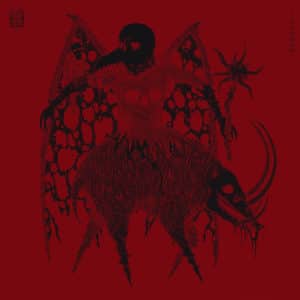
GRAVETEMPLE
“Ambient-Ruin”
Attila: chants & percussion & Fuji sounds recorded on location in Kamakura May 08. Stephen: guitars & korg polysix recorded in Paris & Saalfelden June 08. Matt: drums were recorded at 3 Phase studios, Melbourne by Sam Johnson March 06. Oren: guitars, motorised cymbal, electronics, bells, tympani, atmos recorded at Jerker House, Melbourne & BJB, Sydney 06-08. Track IV live recordings: Levontin 7, Tel Aviv by Kostya Gervis July 06. A/D Editing & Mix by Oren June 08 at Jerker House. Mastered by Joe Talia at Chinatown, Melbourne November 012.
Cut by Rashad Becker at Dubplates & Mastering, Berlin February 013.
Gravetemple was formed in 2006 as a side-project of the band Sunn O))) by Oren Ambarchi, Stephen O’Malley and Attila Csihar. The group formed initially to tour in Israel summer 06, creating several recordings which eventually became “The Holy Down” album, which was released on Southern Lord recordings in 2007. At the time of the Israel tour, the Lebanon War started and was in action. In Summer 08 the trio reformed together with the addition of Australian drummer Matt "Skitz" Sanders for a short European tour culminating at a headlining performance at Supersonic Festival in Birmingham. In late 2009 the original trio reconvened for a special one-off concert at London’s Institute of Contemporary Arts. April 2013 marks the first set of live action since that period, and a new chapter in the ongoing system of the related network. “Ambient/Ruin” was created with the 2008 quartet, elements of tape collage, concrete, field recordings blend within a strong geographically diverse (parts were recorded in Japan, Australia, Paris and Israel) suite of heavy minimalist/maximalist music, black/death metal and drone. The culmination of these efforts become the music, literally, of Sadistik Exekution meeting Phill Niblock.
Gravetemple clearly adapted the aspects more abstract and experimental related to Sunn O))) and has continued from that point, with continued ongoing focus on metaphysical construction of free music and will. The music became a geographically and metaphysically based effort.
19,00€
In stock

2 LP
KONSTRUKT and Alexander HAWKINS
“Live at Cafe OTO”
Istanbul-based free music ensemble Konstrukt perform alongside special guest Alexander Hawkins building the perfect groove in a sweaty Cafe OTO on August 10th 2015. Two sets from the same night, each a 40 minute long improvisation. First set is a psychedelic warm-up where the Turkish quartet welcomes Hawkins in a whirlwind of hypnotic funky tunes going electric in the Miles way. The second set starts with Hawkins piano keys bouncing along a silent background soon to be filled with a groovy odd drum tempo leading to a wall of sound where all parts build a perfectly unpredictable dialogue.
Pressing info: 200 copies on black.
28,00€
In stock

2 LP
Hartmut GEERKEN’S ROCK AND FREE JAZZ GROUP KABUL
“Live in Kabul 1976”
An incredible live recording of a concert hosted by the Goethe Institut of Kabul on September 22, 1976. More than sixty minutes of convulsive jams - and hypnotic obscure interludes to loop your head to - captured on reel-to-reel tape, edited and mastered for the best vinyl listening experience that will definitely prove you how free Afghanistan once was. The public too has never been this reactive, shouting and clapping to the music of the quartet directed by our beloved Hartmut Geerken, who also plays piano using both the keys and the chords. Cardboard album edition, first twenty copies come with an original copy of the program, signed and numbered on pink paper. ressing info: 250 copies on black.
24,00€
In stock

2 LP
Philip JECK
“Vinyl Coda III-IV”
‘In his hands, a tool as simple as a hammer that blocks the arm of the record
player creates a loop with a taste of eternity. Two or three such hammers can create musical galaxies far beyond the reach of traditional instruments, where no human ear has ever been before. From unidentifiable rumble and grinding to brilliant instrument-snippets and comical voice fragments, Philip Jeck glues sounds together as if they where never meant to exist on their own. Whether it be Pachelbel's Canon or some mid-90s dance music that's on Philip’s vinyl, but what we hear in the Vinyl Coda is his very unique musical voice – articulated with a perfect sense for structure, suspense and sound.” dieb13
31,00€
Out of stock

2 LP
Philip JECK
“Vinyl Coda I-II”
Philip Jeck works as composer, multimedia artist, choreographer... but above all, he is most well known as turntable manipulator. At the end of 90s, he produced something which later would be accepted as cult piece - his four part masterpiece Vinyl Coda. It is probably his most important work and peak of his art: it defines not only his musical language, but also the entire turntable culture, as well as deconstruction of vinyl. The work is nothing less than powerful low-fi symphony, which through magical looping allows us to hear to things we otherwise wouldn’t...
30,00€
In stock
2 LP
Eli KESZLER
“Last Signs of Speed”
Empty Editions is proud to present Eli Keszler’s Last Signs of Speed as our inaugural release. This release, our first vinyl record, has represented a labor of love for both Eli and ourselves.
Last Signs is Eli’s first solo release since 2012’s Catching Net (PAN Records) and explores a very different side of his unique acoustic universe. One in which the macrocosmic percussive collisions of his earlier work give way to a gradual unfolding of dub-influenced rhythmic constellations. Eli has described Last Signs as his response to playing in club environments over the last few years; an attempt to negotiate a delicate balance between the materiality of his acoustic
instrument and the hyper-mediated sonic ecosystem of the club sound system. Coming off like an inspired synthesis between Scientist and Xenakis, Last Signs of Speed is a truly unique work by an artist at the height of his powers.
Eli Keszler plays drums, percussion, fender rhodes, piano, mellotron, celeste, vibraceleste, glockenspiel, rocks, gravel. String Orchestra of Brooklyn. Leila Bordreuil, cello. Geoff Mullen, glass, metal, wood fragments. Recorded at
Bunker Studio, Seaside Lounge, and Ohio, NY, 2014-2016. Engineered by nolan thies and mitch rakin. Mastered by rashad becker. Cover Illustration by eli keszler
Liner Notes by david grubbs.
26,00€
In stock
2 LP
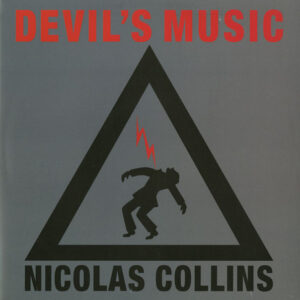
Nicolas COLLINS
“Devil’s music”
“LP version: Two LP set in gatefold sleeve. “Devil’s Music” and more! We presents the vinyl reissue of Nicolas Collins’ live radio sampling masterpiece, originally released on vinyl in 1986, served up in all its stuttering glory, a time capsule of the mid-80s New York City airwaves, acclaimed by Philip Sherburne as “an early template for techno”, with a feel somewhat akin to scratching turntablist madness, a block-rocking party put through a blender and reassembled by body-popping demons. And more: “Real Landscape”, a 1987 “remix” recorded in Europe (originally released on cassette).”
25,00€
Out of stock

2 LP
Terry FOX
“552 Steps Through 11 Pairs of Strings”
When Terry Fox went from San Francisco to Europe in 1972, he discovered the great pavement labyrinth at Chartres Cathedral. It consists of 11 concentric rings with 552 steps and 34 turns leading into the center. The discovery of the labyrinth became a revelation to him. He saw it as a metaphor for his own life, the numbers of rings and turns corresponding to cycles of health and sickness he had undergone. Thus he decided to base all of his works until 1978 on the labyrinth. These include two major sound works, one of which – “The Labyrinth Scored for the Purrs of 11 Cats” – was later released on cassette and LP, while the other has remained unreleased so far.
“552 Steps Through 11 Pairs of Strings” was a performance made in Fox’s loft in San Francisco on August 14, 1976, starting at 10 pm and lasting 4 1/2 hours. He stretched 11 pairs of piano wires of 11 different thicknesses across the floor, attached them to turnbuckles at each end which he hooked to eye-screws into the wooden floor. Each pair of wires passed over a wooden bridge at both ends. He played this instrument with a soft mallet in one hand and a score in the other. The score was a 34-foot string tied with 552 knots. Each knot represented a step in the labyrinth with the 34 turns indicated by either a piece of wire in a knot (a move to the next longer pair of wires) or a rubber band around a knot (a move to the next shorter pair). The audience was in the dark loft of the floor below.
“We were all mesmerized by the beauty of the piece and lost in its grace. Around midnight a light rain began to fall outside the windows completing the piece’s perfection. He played for another two hours or so. It also happened to be my birthday. It was the best birthday I ever had.” (from the liner notes by Alan Scarritt)
This 2 LP includes four selections from the performance. A gatefold sleeve reproduces the score, a photograph and a drawing of the instrument, and the invitation card to the performance. Texts by Terry Fox and Alan Scarritt. Edition of 300.
32,00€
Out of stock
2 LP
Michael MOSER
“Antiphon Stein”
“Antiphon Stein” is a site-specific sound installation in the nave and choir of Minoritenkirche in Krems-Stein that engages with the architecture and sound of this church space. The material used are hanging and lying flat objects of glass and metal that are played with sound pressure transducers. These objects thus become membranes that resonate in their entire surface and mass, exuding sound to the surrounding space. The initial sounds for the installation are largely generated using a special four-channel recording technique; after the digital editing, they are left in their special four-channel arrangement, since capturing the sound from various spatial perspectives and distances allows an acoustic image of the existing space to emerge. The sound of the specific space thus plays a central role in the overall acoustic image. By way of the stringency of the early Gothic architecture, the placement or hanging of the surface objects leads to the bipartite, responsorial form of the work. Below in the nave, the eight glass plate objects, each hanging between the powerful columns, above in the former choir the tripartite metal work, arranged on the floor on white felt, thus not visible, but only audible from below. The intimacy of the apse with its triptych of metal objects contrasts with the expansiveness of the nave, with the glass surfaces hanging at a great distance. The light design, from the dark nave to the apse flooded in light, seeks to continue this dialogue. The sounds - small compositional miniatures of a duration of three to seven minutes, above more organ, below more cymbal sounds, percussion, resonant glass - are combined by the computer on the basis of a precise score into ever new constellations: aleatory in part, sometimes in fixed series and interrupted by interludes that represent in temporal intervals of thirty minutes the only moment in which an individual sound file can access all surface objects in both spaces.
35,00€
Out of stock
2 LP
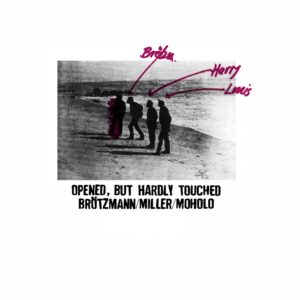
Peter BRÖTZMANN – Harry MILLER – Louis MOHOLO
“Opened but hardly touched”
Peter Brötzmann, alto, tenor & baritone saxophone, e-flat clarinet, tarogato. Harry Miller, double bass. Louis Moholo, drums. Recorded live by Jost Gebers on November 5th & 6th,1980 in Berlin. Produced by Brötzmann and Gebers. Cover: design by Peter Brötzmann, photos by Hans Reichel. “(...) On Opened, But Hardly Touched, the Brötzmann-Miller-Moholo combination, displays the most accessible approach of the live trio recordings surveyed. An extemporaneous master who puts the spur in the spur of the moment, reedman Peter Brötzmann is surely one of Albert Ayler’s most vital sons for his blowing stamina and savage sense of humor. Bassist Harry Miller and drummer Louis Moholo lend the muscle needed to anchor and counterpoint the saxophonist’s wildest flights. Elsewhere associated with projects having a decidedly ethnic flavor, the two South Africans show off an earthiness that swings hard, in meter and out. The clarity of FMP’s November 1980 recording beautifully underlines their contributions. The boundaries between composition and improvisation are intentionally blurred. (...) The music’s design suggests a certain inevitability as it effects pendular swings between quietness and intensity, solos and duets, microtones and staunch collective blowing. On the attractive opener, Eine Kleine
Nachtmarie, Miller and Moholo pull rhythmically in and out of sync, juggling time against free sections, against the bleat of Brötzmann’s soprano stand-in, the tarogato.
Special Request For Malibu perhaps best reveals the sonic extremes. The spasmodic throes of Brötzmann on clarinet and tenor contrast with his big soft “flaps” of breath in duet with arco bass - as Miller plays sinuous near-electronic sonorities, between notes and white noise. Through all of the performances Moholo pushes, restless and jabbing, but with flexible touch.” from: Down Beat 1983.
30,00€
Out of stock

2 LP
Keiji HAINO – Jim O’ROURKE – Oren AMBARCHI
“I wonder if you noticed “I’m sorry” is such a lovely sound It keeps things from getting worse”
2LP document of the complete set performed by Keiji Haino, Jim O’Rourke and Oren Ambarchi at Tokyo’s legendary SuperDeluxe on March 2, 2014.
This 2LP set marks the seventh chapter in this remarkable series of releases from this acclaimed trio.
Continuing to explore new instrumental and dynamic possibilities while remaining grounded in the trio’s previous work, this set also brings with it a unique pleasure for the non-Japonophone listener: for the first time Haino sings many of his metaphysically brooding lyrics in English.
Deluxe 2LP set with a gatefold sleeve with gorgeous photographs by Jim O’Rourke and design by Stephen O’Malley.
Vinyl cut by Rashad Becker at Dubplates & Mastering, Berlin.
The remarkable series of releases from the trio of Keiji Haino, Jim O’Rourke and Oren Ambarchi continues with I wonder if you noticed “I'm sorry” Is such a lovely sound It keeps things from getting worse , which presents the entirety of an 80 minute set performed at Tokyo’s SuperDeluxe in March 2014. Where their 2012 performance (BT011 and BT012) was divided into two releases, one continuing their exploration of the guitar/bass/drums power trio format and the other emphasizing new instrumental configurations, the single extended performance presented here ranges widely over terrain both new and familiar, from acoustic strings and collective chants to thunderous power trio moves.
Throughout all of its transformations, the music here is some of the riskiest and most abstract the trio have yet committed to record. Beginning with chiming percussion reminiscent of Haino’s classic Tenshi No Gijinka, the first side is dominated by Haino’s impassioned vocals and performance on the bulgari, a traditional Turkish string instrument. Together with the woozy, sliding foundation of O’Rourke FX-laden bass and Ambarchi’s ritualistic percussion, the trio craft a sort of epic, abstracted song that moves through its spontaneous episodes with all of the fluidity of the best free improvisation.
After a haunting passage in which Haino’s voice, descending from angelic high notes to guttural growls, is accompanied only by O’Rourke’s roaming bass, Haino turns to electronics, gradually building a thick cloud of cosmic sludge as Ambarchi’s drumming goes into free fall. The end of the second side presents a special treat: Haino’s first recorded outing on the contrabass harmonica, from which he coaxes bizarre, wheezing textures against a backdrop of spacious bass and percussion. When Haino eventually picks up the guitar midway through the epic performance, the spaciousness and sense of volatility remain, with the trio often moving in an instant from crescendos of ecstatic noise to near-silence.
O’Rourke and Ambarchi rarely adopt here the classic rock roles essayed on earlier releases. O’Rourke’s bass, which takes centre stage surprisingly often, is sometimes so heavily processed by his array of pedals that it becomes a shifting electronic mass; at other times his roving chromaticism suggests a sort of fuzzed-out free jazz. Ambarchi spends much of the set exploring areas of tumbling free pulse; and even when he locks into a constantly repeated figure on the set’s third side, he gestures as much toward Ronald Shannon Jackson’s stuttering marching band funk as toward any classic rock moves.
When the trio finally move in the final quarter of the performance into an extended passage of rock riffing, the payoff is immense, as they craft a thudding one-chord epic reminiscent of some of the early Fushitsusha classics, before Haino returns to the bulgari, bringing the set back to where it began. Continuing to explore new instrumental and dynamic possibilities while remaining grounded in the trio’s previous work, this set also brings with it a unique pleasure for the non-Japonophone listener: for the first time Haino sings many of his metaphysically brooding lyrics in English.
20,00€
In stock
2 LP
Crys COLE & Oren AMBARCHI
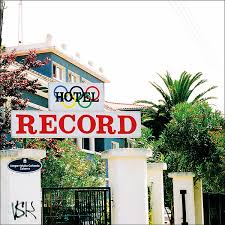
“Hotel Record”
Hotel Record is the second release from the duo/couple of crys cole and Oren Ambarchi, following on from Sonja Henies Vei 31 (Planam, 2014). Where their debut recording presented a disquieting portrait of the erotic dimension of romantic intimacy, the follow-up continues to explore the pair’s simultaneously musical and romantic relationship in a more subtle fashion, presenting four long-form pieces that touch on the variety of forms the life of this couple takes: as a musical duo, as a pair of travelers to exotic locations, as opponents in a game of cards…
Each of the 2 LP’s four sides presents a distinct sound-world, yet each manages to attain the same suspended, half-sleeping feeling, outlining a space where improbable combinations of the electronic and the acoustic, of extreme closeness and amorphous distance, occur with the gentle insistence of a dream.
The opening Call Myself calmly unfolds a fabric of long tones from electronic organ and guitar, combining the sliding, aleatoric effects of classic David Behrman with a more hands-on feel. Over the top of this slowly shifting tonal bed, cole’s voice mutters unintelligibly into a Buchla synth, teasing the listener by suggesting a meaning that remains always out of the ear’s reach. Francis Debacle (Uno) builds on the foundations of a heavily amplified session of the titular card game, overlaying vocal murmurs and exhalations and mysterious room-sounds to create an impossible aural environment. On Burrata, a palette of vintage 1980s digital synthesizer sounds combined with guitars create an irregular texture of lush chords and bubbling melodic details, into which cole’s voice processed by a vocoder, is interwoven, reading fragments of romantic correspondence. Finally, on Pad Phet Gob, field recordings made in Thailand become an ambiguously acoustic/electronic rainforest, eventually giving way to a mysterious, wavering electronic tone-field punctuated by sibilant, popping mouth-sounds.
Carving out an intimate and human sonic space across a diverse array of compositional approaches, sound sources, fidelities and textures, Hotel Record is the latest dispatch from the continuing explorations of a unique duo. Ambarchi and cole reimagine electro-acoustic music, not simply as ‘abstract’ sound, but as a diary, a love poem, a dream.
Deluxe gatefold sleeve with photography by crys cole and LP design via Stephen O’Malley.
Mastered and cut by Rashad Becker at D&M, Berlin February 2017
26,00€
Out of stock
2 LP
The DEAD C
“Trouble”
There’s a reason why our relationship with The Dead C is Ba Da Bing’s longest running. It’s not because they are the hardest working band we’ve ever met. It’s not because they are the largest selling band we’ve ever released. It’s not because we’re inspired to support our local music scene.
Yes, there’s definitely a reason....please give me a minute...oh ok, I got it (just put on this record). Like every time I hear their recordings, I’m reminded that they are one of the greatest rock bands to ever pick up a guitar and attempt to play it wrong. Listening to The Dead C causes me to think differently. It brings up emotions of which I’m otherwise unfamiliar. It strikes to the essence of my being and reveals that which otherwise remains hidden. I take solace in knowing that one out of every thirty of you reading this know exactly what I’m talking about.
On the spectrum of The Dead C’s sound output, Trouble could very well be seen as springing from the same realm as the massive “Driver UFO,” one of the band’s greatest tracks ever, off Harsh ‘70s Reality. There’s a youthful aggression here, a churning anger, deadened by pounding drone. Much like H70s, this record serves as a gateway drug - if you were ever looking for an album to play to a newbie curious about experimental rock, this would be it. The visceral strength of their performance trembles out of the speakers. The magnificence of their stamina survives each album side.
We are in a creative highpoint for the trio at the moment. Bruce Russell has just released a captivating solo album on Feeding Tube, while Michael Morley’s solo project Gate just put out a release on MIE. Robbie Yeats has been performing of recent as backup for Alastair Galbraith. The fact that there are still means to commute between Lyttelton and Port Chalmers on the South Island of New Zealand means these three can still find time to get together, and allows for what we have here today. And it’s fucking glorious.
25,00€
Out of stock

2 LP
ENSEMBLE BABEL – Christian MARCLAY
“Screenplay”
EnsemBle baBel has been collaborating with Christian Marclay since 2012. On this 2 LP we can hear three compositions: Screen Play, Shuffle and Graffiti Composition. Screen Play is a moving image musical score in which found film footage is combined with computer animation to create a visual projection to be interpreted by live musicians. One of the ways that performing a visual score differs from performing tradition musical notation is that the musician cannot read ahead to anticipate what comes next. With Graffiti Compositions ensemble baBel interprets a graphical score. End of the last century Christian Marclay posted blank music sheets around the streets of Berlin. After they had been covered with graffiti 150 sheets had been assembled to form a graphical music score. Finally, with Shuffle Christian Marclay explores the presence of music as graphics in our daily lives - a musical score compromised of photographs printed onto a deck of cards.
300 copies 180g Vinyl 2 LP, cut by Flo Kaufmann, cover by Francis Baudevin and Nicolas Eigenheer.
21,00€
In stock

2 LP
WUNDERLITZER
“Wolfed up and down”
“Wunderlitzer is a radical sonic super-imposition process, conducted since 2004 by Michael Sellam, Benoît Durandin and Christophe Degoutin, between the fields of music, sound, noise and art. Wolfed up and down”, their debut album, sees them construct a giant jukebox, whose component sound materials are drawn from six decades of recorded amplified music (1950-2010). The Wunderlitzer method consists of superimposing all the tracks from a cd, creating a soundblock as a result, then heading towards pure noise, mixing together different soundblocks obtained from the same process. Within the ensuing maelstrom, strains of the original textures remain discernible without being entirely recognisable. 2x12” white vinyl LPs housed in silkscreened cardboard inner sleeves and fold out art print, housed in silkscreened plastic jacket, strictly limited to 300 hand-numbered copies.
25,00€
Out of stock
2 LP
Terry RILEY
“Persian Surgery Dervishes”
This classic minimal music album is now available again on vinyl for the first time since the 70s.
Californian composer Terry Riley’s In C, first issued on vinyl in 1968, is widely acknowledged as a Minimalist landmark that altered the course of twentieth-century music. His influential album A Rainbow In Curved Air, which appeared the following year, is a vivid fusion of rock and raga, jazz and psychedelia realised through overdubbing on an 8-track machine which had recently been installed at the studios of Columbia Records.
In recent decades Riley has composed a series of critically acclaimed pieces for string quartet. He has also written for full orchestra and explored a variety of instrumental combinations. But during the 1970s, he concentrated on solo keyboard performances, continuing to make music yet writing down almost nothing. Riley selected a mode, chose a few motifs or basic patterns and then, seated on the floor in front of his audience, improvised on electronic keyboard. That instrument became an essential part of his musical identity for a while, although it was chosen in part for practical reasons. The electric organ, superseded at later concerts by a synthesizer, was portable and consistent. This enabled him to avoid unreliable pianos in venues which were less formal and more variable than the standard concert hall circuit.
By the early 70s Riley had come to feel that scores were a distraction. Faithful interpretation of an already written piece was a deviation from the true purpose of making music, which was spiritual quest. Fortunately, some of those live performances, personal journeys towards a state of transcendence, were captured on tape. Persian Surgery Dervishes, issued initially on the French label Shandar, features two such concerts for electric organ and reel-to-reel delay, one recorded in Los Angeles on 18th April 1971, the other in Paris on 24th May 1972.
At the start of that decade Riley became a dedicated student of the great Hindustani singer Pandit Pran Nath. Looking into North Indian classical tradition he found correspondences to modal and cyclic ideas that he was already working on. In 1971, as a way to learn more, Riley himself started teaching Indian music at Mills College, in Oakland. That experience fed directly into his solo keyboard performances, but other influences were also shaping the music heard on Persian Surgery Dervishes. Personal research into ancient Persian culture and the poetry of Rumi lit up his imagination, while the repetitive swirling of Sufi devotional music from North Africa, which Riley had first encountered in Europe during the early 60s, reverberates through these performances. Jazz, as conceived by such masters such as Bill Evans and John Coltrane, is also present as an enduring source of inspiration.
The Californian version of Persian Surgery Dervishes starts with low dark tones, dense and brooding like a huddled human figure, deep in introspection. But as the improvisation unfolds Riley’s buoyant spirit asserts itself, spiralling out in ecstatic coils, as though liberated from the grip of body consciousness. The Parisian concert conveys a different mood, brighter and more open in texture, more relaxed from the outset and breathing with greater freedom as it takes flight.
Echoes of Terry Riley’s inspired music have spread far and wide - into progressive rock, New Age and ambient soundings, film soundtracks, blissed-out electronica and dance-floor trance. His fluent and hypnotic keyboard playing can be heard as part of a continuum, transmitting energies from ancient and distant musical sources into the living here and now. Persian Surgery Dervishes is a significant part of that picture, a mesmerising record of a vital stage in Riley’s ongoing quest for connection with the universal mind and the sublime music that flows ceaselessly from it.
“Music is my spiritual path. It’s my way of finding out who I am.” Terry Riley, in 1976
28,00€
Out of stock
flexi disc
Michael ESPOSITO – Per SVENSSON
“The ghosts of Ogilvie Station”
“Sound localization relates to the listener being able to identify the origin of a specific sound signal by direction and distance. This passive acoustic location is based on a sound or vibration created is the object being detected. Active acoustic location creates a sound or vibration producing an echo, which can be measured for location. This is also known as echo location. One of the characteristics of Electronic Voice Phenomena is the lack of sound localization. In most recordings, human voice, sounds from animals, machines and nature have a sense of sound localization. Sound localization as we know it is a well studied biological effect. The human auditory system uses many cues for sound source localization such as spectral information, correlation information, timing analysis and analysis between time and level changes between both ears. This lateral information is analyzed by our ears in a very specific manner. Time changes are mainly observed in frequencies below 800 Hz. As sound from the right side reaches the right ear sooner than the left ear the interaural time difference is measured in phase delays for low frequencies and group delays at higher frequencies. Level changes are mainly observed in frequencies above 1600 Hz. As sound from the right side reaches the right ear sooner than the left ear the interaural level difference is measured at a higher level. Both time and level differences come into play for sounds between 800 Hz and 1600 Hz.
Human voices are roughly in the range of 80 Hz to 1100 Hz. The voice frequency or audio frequency used for the transmission of speech is between 300 Hz and 3400 Hz. Below 80 Hz on the auditory level, it is virtually impossible to use either time or level difference to determine a sound’s lateral source. The directional evaluation between the phase difference between the left and right ears becomes too small to tell any difference. Intelligible speech, where we should be able to speak words that can be heard, starts at about 200Hz. Human speech is a known spectrum and with the help of the perceived sound distance can be roughly estimated. In determining sound localization in the median plane; front, above, back and below, the shape of the outer ear plays a keen role. The outer ear, including the external ear canal, creates direction-selective filters that create filter resonances. These outer ear transfer functions create and implant resonance based direction-specific patterns to determine localization. One of the main auditory system clues we use to determine sound localization is reflection. The listener is subjected to two types of sound. The direct sound is a sound that a listener hears without being reflected off of some type of surface. A reflected sound is a sound that has reflected off of at least one object. Sound localization can be gained by the ratio of the direct sound to the reflected sound or echo. If the reflective object is too close to the direct sound and the listener, the sound created will be a reverberation versus an echoic reflection. In the case of reverberation, the phase difference overlaps with the direct sound and the difference will be too small to gain any useful localization information. An echo on the other hand, creates an independent sound, completely separate from the direct sound. Our auditory system will only analyze the direct sound, which arrives first, for sound localization. This is known as the law of the first wave front. This echo cancellation physically occurs in the Dorsal Nucleus of the Lateral Lemniscuses, allowing sound localization even in echoic environments.
In EVP, there is no direct sound source. Atmosphere is manipulated creating interference and air pressure too small to register a direct sound. Is it possible that it does create a reflected or echoic sound that can be picked up by recording devices? If an entity can only push wavelength towards an object and all we register is the reflected sound, then echo cancellation would cause the sound we hear upon playback to appear to have no sound localization. In order to determine direction, a strong attack in several critical bands of our hearing range must be experienced. This strong attack from a direct sound must prevail over reflections, which arrive later. Directional cues from the direct sound become unstable from the reflected sounds, which add no loudness inside the critical bands. So, no new directional information is triggered by the auditory system. One of the reasons the voices we capture seem to come from everywhere at once may be because what we are listening to is their echo and without the direct sound response with which to measure it, we cannot determine any sound localization. These psycho acoustical phenomena would be akin to an anti-audio masking where the absence of one sound affects the perception of another sound. In Ghosts of Ogilvie Station, Per Svensson and I look at just these phenomena. In the Ogilvie Station, Chicago, originally built in 1911, there are many ghosts. There is a great deal of sound localization also. Each of the 16 tracks has an individual speaker that allows a female voice to repeatedly call out the track number. By walking in front of, behind, in between and among the different speakers at varying paces, I was able to generate an almost unearthly sense of binaural simulated sound localization. In different areas of the station, I was able to capture EVP. This was well away from the speakers calling out the track identities. On the recording, the EVPs sound flat and as if coming from no direction at all, while the almost Vocoder like female voices of the loud speakers sound not only very specific in their direction but crash into each other and compete for the listener’s attention often creating new sounds and even a sort of musical sound. To further illustrate the purity of difference between the sounds with the passive acoustic location and the EVP seemingly without, Per uses an Oscilloscope, OSCILLOGRAPH UO963 NORDMENDE, to measure the frequency relationships and provide an audio output through its tone generator. The result is a very clear exercise in how we experience the audible and inaudible world around us.” Michael Esposito
5,00€
In stock
7"
John WIESE – Lasse MARHAUG
“Continous Loop Sheep”
The 7” it took 20 years to make: In 1997 Lasse Marhaug and John Wiese arranged to record a split cassette for Norwegian label Komkol Autoprod. The music was recorded on June 6th at the exact same time on opposite side of the Atlantic, as a form of musical telepathy. They also agreed to base the recordings on continous loops. The recordings were made, but the cassette was never released and the material remained forgotten until Marhaug found and digitized the master in 2014. It was agreed to wait until the recording was exactly 20 years and edit each other’s material down to 7” length, making it a 20 year long telepathic collaboration.
9,00€
In stock

7"
Matthieu SALADIN
“Pile ou face”
2013. There’s a riot goin’on”. One year’s exhibition.
A single with a locked groove on each side. The sound of a 1 euro coin spinning like a top. Very conceptual work creating a meeting between Karl Marx and Pierre Schaeffer !
1,00€
book + CD
Jean-Claude ELOY
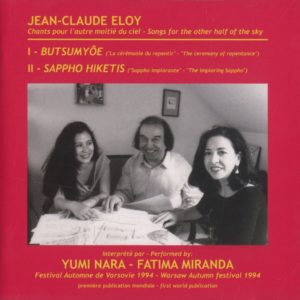
“Butsumyôe” – “Sappho hiketis”
*** Book and CD edition ***
A book (English or french text) around the cycle “Songs for the other half of the sky” with the following pieces “Butsumyoê”, “Sappho hikètis”, “Erkos”, “Galaxies”, “Gaia-songs”. Interview, documents, technicazl specification, photos. A CD with “Butsumyoê” and “Sappho hikètis”.
“Butsumyôe” (1989). For voices, percussions and electroacoustic. With Yumi Nara and Fatima Miranda, voice and percussions. In “Butsumyôe” (”The ceremony of Repentance”) the singer Yumi Nara (soprano) occupies the function of a first solo voice, whereas Fatima Miranda (vocalist) assures the function of the second accompanying voice. In Sappho hiketis, it is the opposite: Fatima Miranda occupies the function of the first solo voice, and Yumi Nara assures the function of the second accompanying voice. But in practice, the vocal activities are mixed, creating an actual creative vocal duet. These two works are freely conceived and of pure imagination, which lean on not any pre-existent "model". Butsumyôe is a long monologue for voice that sings, speaks, shouts, and is modulated with a host of techniques, punctuated by the exclamations of the accompanying voice and by various percussion instruments played by the two female singers. Basing myself on Saïkaku’s beautiful text, I have worked in the original language (ancient Japanese from the area of Osaka), striving to magnify the expressive capacity of each word. The point is to cause Western vocal techniques to expand towards more expressive possibilities, particularly in the very difficult and rich space between “sung” and “spoken” texts. Curiously, the recent practice of electro-acoustic techniques sheds light on these issues, forcing us to rediscover the acoustic, whose perception and conception had been gradually obscured, standardized and diminished by our cultural certainties.
“Sappho hiketis” (1989). For voice, percussions and electroacoustic. With Yumi Nara and Fatima Miranda, voice. A vocal duet articulated from an electro-acoustic piece (realized during the production of Anâhata at the Electronic Studio of the Sweelinck Conservatory in Amsterdam). The basic material is composed of pre-recorded metallic percussion instruments (samplings realized in 1984 by Michael W. Ranta).
Prosody and vocal technique: unlike the previous piece, the text is used in a very broken up mode, with somewhat scattered phonemes, also integrating a listing of the names of Sappho’s most famous female lovers. The adaptation of the text (in modern Greek) is totally free and makes no reference to the metrics or musical modes allegedly used by Sappho.
18,00€
CD
Jean-Claude ELOY
“Butsumyôe” – “Sappho hiketis”
*** regular edition without book ***
“Butsumyôe” (1989). For voices, percussions and electroacoustic. With Yumi Nara and Fatima Miranda, voice and percussions. In “Butsumyôe” (”The ceremony of Repentance”) the singer Yumi Nara (soprano) occupies the function of a first solo voice, whereas Fatima Miranda (vocalist) assures the function of the second accompanying voice. In Sappho hiketis, it is the opposite: Fatima Miranda occupies the function of the first solo voice, and Yumi Nara assures the function of the second accompanying voice. But in practice, the vocal activities are mixed, creating an actual creative vocal duet. These two works are freely conceived and of pure imagination, which lean on not any pre-existent “model”.
Butsumyôe is a long monologue for voice that sings, speaks, shouts, and is modulated with a host of techniques, punctuated by the exclamations of the accompanying voice and by various percussion instruments played by the two female singers. Basing myself on Saïkaku’s beautiful text, I have worked in the original language (ancient Japanese from the area of Osaka), striving to magnify the expressive capacity of each word. The point is to cause Western vocal techniques to expand towards more expressive possibilities, particularly in the very difficult and rich space between “sung” and “spoken” texts. Curiously, the recent practice of electro-acoustic techniques sheds light on these issues, forcing us to rediscover the acoustic, whose perception and conception had been gradually obscured, standardized and diminished by our cultural certainties.
“Sappho hiketis” (1989). For voice, percussions and electroacoustic. With Yumi Nara and Fatima Miranda, voice. A vocal duet articulated from an electro-acoustic piece (realized during the production of Anâhata at the Electronic Studio of the Sweelinck Conservatory in Amsterdam). The basic material is composed of pre-recorded metallic percussion instruments (samplings realized in 1984 by Michael W. Ranta). Prosody and vocal technique: unlike the previous piece, the text is used in a very broken up mode, with somewhat scattered phonemes, also integrating a listing of the names of Sappho’s most famous female lovers. The adaptation of the text (in modern Greek) is totally free and makes no reference to the metrics or musical modes allegedly used by Sappho.
13,00€
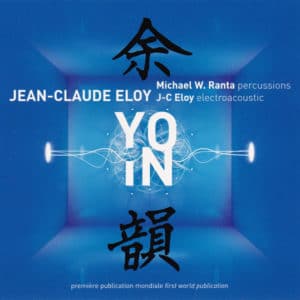
book + 4 CD
Jean-Claude ELOY
“Yo-In”
*** Book and CDs version ***
This is a book on the piece “Yo-in” + the piece on a digipack 4CDs. “Yo-In” (1980). Sound theater for an imaginary ritual, in four acts. For electronic and concrete sounds, fixed on multi-tracks. For a “percussionist-character” (solo percussionist). With about two hundred varied percussion instruments. Performed by Michael W. Ranta (solo percussionist) and Jean-Claude Eloy (electroacoustic projection, synchronisation, mixings). Recorded during a public concert given at the Warsaw Autumn festival Polish-Radio, Warsaw, September, 1994. Electro-acoustic production : Instituut voor Sonologie, Rijkuniversiteit, Utrecht. Institute of Sonology, State University, Utrecht. With the collaboration of NHK, Denshi Ongagu Studio, Tokyo. First world publication. Digipack 4 x CDs with a booklet of 20 pages.
The book on Yo-In : “Of literal and the oral”, documents (texts, photos, interview) from 1980 to 2010. Bilingual publication English-French, 154 pages, from which 20 pages of photos, format A5.
“Jean-Claude Eloy is a French composer, born in 1938. He studied at the Paris National Superior Conservatory of Music, where he won First Prizes in Piano, Chamber Music, Counterpoint, Ondes Martenot, and studied composition with Darius Milhaud. He attended summer courses at Darmstadt (Pousseur, Scherchen, Messiaen, Boulez, Stockhausen) and was a student in composition in Pierre Boulez’ master class at the Music Academy in Basel (1961-1963). Works by Jean-Claude Eloy have been performed all over the world. They have been conducted by Pierre Boulez, Ernest Bour, Michael Guilen, Bruno Maderna, Diego Masson, Michel Tabachnik, Arthur Weisberg and others ... He has lived in the United States (professor at the University of California, Berkeley, in the sixties), Germany (invited by the WDR studios in Cologne, the Technische Universität in Berlin, guest artist at the Berliner Künstlerprogramm), Holland, Japan (where he collaborated with NHK and the National Theater of Japan, among other activities). He participates regularly in numerous international festivals, principally in Europe, but also in Asia, the United States, Canada and Latin America as sound-projectionist for his electro-acoustic works and with the soloists closely associated with his compositions : Fatima Miranda (vocalist), Yumi Nara (soprano), Michael Ranta (percussionist), Junko Ueda (Shômyô singer and Satsuma-Biwa player), Kôshin Ebihara and Kôjun Arai (Buddhist monk singers), Mayumi Miyata (Shô player), etc.”
35,00€
4 CD
Jean-Claude ELOY
“Yo-In”
*** Regular edition without book ***
“Yo-In” (1980). Sound theater for an imaginary ritual, in four acts. For electronic and concrete sounds, fixed on multi-tracks. For a “percussionist-character” (solo percussionist). With about two hundred varied percussion instruments. Performed by Michael W. Ranta (solo percussionist) and Jean-Claude Eloy (electroacoustic projection, synchronisation, mixings). Recorded during a public concert given at the Warsaw Autumn festival Polish-Radio, Warsaw, September, 1994. Electro-acoustic production : Instituut voor Sonologie, Rijkuniversiteit, Utrecht. Institute of Sonology, State University, Utrecht. With the collaboration of NHK, Denshi Ongagu Studio, Tokyo. First world publication. Digipack 4 x CDs with a booklet of 20 pages.
26,00€
Out of stock
book + 2 CD
Guy DEBORD
“Enregistrements magnétiques (1952-1961)”
A book and two CDs where we can discover texts and voice of Guy Debord from the beginning of Internationale Lettriste (1952-1957) to the middle of Internationale (1957-1961). Great document ! With also the voices from Serge Berna, Michèle Bernstein, Jacques Fillon, Abdelhafid Khatib, Gil J Wolman, Claude Frère, Serge Korber, Giors Melanotte.
19,50€
Out of stock
4 CD + book
Walter MARCHETTI
“De musica inversa”
“alga marghen very proudly presents the only authorized reissue of all Walter Marchetti original recordings previously released by Cramps Records. An LP sized 4CD box set including “La caccia”, “In terram utopicam”, “Per la sete dell’orecchio”, “Natura morta” and “Vandalia”. Also included is the new book by Walter Marchetti titled “De musica inversa”, an instruction manual of both theory and practice for the proper and improper use of music. A method for perfecting oneself in composition annotated and commented upon by Gabriele Bonomo.
“The most amazing thing about music is its exterior aspect. High, vertical, translucent, almost turgid, maybe a bit too monolithic. One should, in any case, give a lot of attention to the large number of interstices which lead to the centre of the ear, wherefrom sounds spread out through a dense network leading to more circuits which direct these same and their relationships directly to the brain, in a logic of musical articulation which is nothing less than frightening. Even if, to attentive listening, dominating all is the eye of silence”.
CD1, titled “La caccia”, includes “La caccia” (1965), “Adversus” (Home-made electric music) (1966) and “Osmanthus fragrans” (Home-made electric music) (1973). The 16 page booklet presents the orginal scores, photos of both the 1965 ZAJ performances and of Marchetti recording “La caccia” in the 1970s, photos of the concert at Galleria Multhipla in 1974, and the reproduction of the original “La caccia” LP layout.
CD2, titled “In terram utopican”, includes “J’aimerais jouer avec un piano qui aurait une grosse queue” (1974/75) and “Per la sete dell’orecchio” (1981). The 16 page booklet presents the original score of “J’aimerais jouer”, photos of the performances in Milano and at the Venice Biennale, and the reproduction of the original “In terram utopicam” LP layout.
CD3, titled “Natura Morta”, includes the piece with the same title from 1980. The 8 page booklet reproduces original photos of the performance at Milanopoesia in 1988, as well as the text titled “In my music”.
CD4, titled “Vandalia”, includes “Perpetuum mobile” (1981), “Song for John Cage” (1985) and “Le secche del delirio” (1989). The 8 page booklet presents the photo of the “Perpetuum mobile” performance at Musicalia in 1981, the score of “Song for John Cage”, the photos of two “Musica da camera” installations, as well as the reproduction of the original “Vandalia” CD layout.
The 180 page “De musica inversa” book and all the texts included in the CD booklets are published in both English and Italian. “Too true: in all music there are, in effect, a lot of sounds henceforth... more than that, too many; everything that we listen to has become heavy beyond measure, completely unbearable. Rather than chasing it we should look for how to escape from music. Everything in it is monolithic, frozen, and the notes of music which slowly, more or less, are thickening around the listeners wrap them all in dripping blankets of death.” CD edition limited to 400 copies.” label info
80,00€
Out of stock
book
Max NEUHAUS
“Program notes”
Max Neuhaus’ Program Notes records the aphoristic statements of the innovative sound artist as he redefined the boundaries of his new audio practice. Seeking to eschew the “small area music [had] been concentrating on for the past several hundred years,” Neuhaus consciously relocated his work in the late ‘60s to what he deemed “the realm of space” as opposed to that of time—choosing to present his music in public and communal settings, decidedly outside of the “proscenium situation.” This short pamphlet was initially published in 1974 by York University Press.
Max Neuhaus (1939 – 2009) began his career as a percussionist and experimental musician in the late ‘50s, working with the likes of John Cage and Karlheinz Stockhausen. By the mid-‘60s however, Neuhaus became increasingly interested in the broader realm of sound, eventually becoming a pioneer in the field of sound art. His sound installations are permanently installed in New York’s Times Square, at Dia Beacon, and at Houston’s Menil Collection.
5.4 x 8.4 inches, 32 pages, Paperback, Edition of 500.
7,50€
Out of stock
book
Luc FERRARI
“Musiques dans les spasmes – Ecrits (1951-2005)”
Edited by Brunhild Ferrari and Jérôme Hansen. Foreword by Jim O’Rourke.Introduction by Brunhild Ferrari. Interview with Luc Ferrari by Pierre-Yves Macé and David Sanson. French edition. 17 x 24 cm (softcover), 236 pages (color & b/w ill.).
Luc Ferrari’s writings, most of them previously unpublished. A pioneer of musique concrète at the beginning of the Groupe de Recherche Musicales in Paris (GRM), Luc Ferrari (1929-2005) is one of the most important and intriguing figures of the last forty years.
22,00€
Out of stock
Out of stock
book
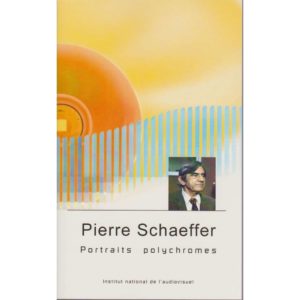
PORTRAITS POLYCHROMES 14
PIERRE SCHAEFFER
IN ENGLISH ONLY. “To celebrate the 50 years of the GRM founded by Pierre Schaeffer - and the 60th anniversary of musique concrète, this special issue of Polychrome Portraits is faithful to the collection’s usual format: a monoagraph that will be useful to all members of the artistic communityof today. Pierre Schaeffer was born on August 14, 1910 and died on August 19, 1995. A plural man with a singular career, he has managed to warn, surprise, shock, and invent. Neither a work of praise nor a history lesson, this little book aims at evocating the multiple, interdisciplinary Schaeffer, as he liked to introduce himself. Twenty-five recent and previously unpublished testimonies, some from foreign authors, take us back to the modernity and strength of the man’s ideas, along with his rich and complex personality.” Preface: Emmanuel Hoog, President & General Manager of Ina. Foreword: Évelyne Gayou. Authors: Pierre Shaeffer, Pierre Henry, Brian Kane, Réjean Beaucage, Marcus Erbe and Simon Grintsch, Martin Laliberté, Philippe Langlois, Jacques Perriault, Jean-Claude Risset, John Dack Rolf Inge Godøy, Jacqueline Schaeffer, Evelyne Gayou, François Bayle, Claude Guisard, Francis Coupigny, François Delalande, Beatriz Ferreyra, Roger Cochini, Nicolas Frize, Jean-Michel Jarre, Daniel Teruggi, Marie- Claire Schaeffer, Jocelyne Tournet.”
9,00€
Out of stock
book
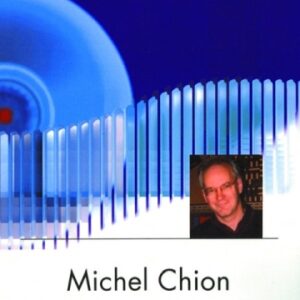
PORTRAITS POLYCHROMES 8
MICHEL CHION
Introduction by Albert Castanet. “L’en-delà du concret, notes pour une physionomie musicale de Michel Chion” by Martin Kaltenecker. “Construire le temps alors même qu’il se fissure”, interview with Évelyne Gayou. “Les tentations de Michel Chion”, by Marie-Noëlle Moyal. “Pour une musique concrète “mdédiatiste” , by Michel Chion. “L’élève-Maître” by Pierre Schaeffer. Lettrers of Lionel Marchetti to Michel Chion etc
Special offer : if you buy this book, we will offer you the book from Lionel Marchetti “La musique concrète de Michel Chion”.
9,00€
Out of stock
book
William BURROUGHS
“Révolution électronique”
The Electronic Revolution is an essay collection by William S. Burroughs that was first published in 1970. The French translation is by Jean Chopin.
6,50€
Out of stock
book
Peter SHAPIRO
Modulations. Une histoire de la musique électronique
“Modulations. A history of electronic music : throbbing words on sound” from 2000 under the direction of Peter Shapiro, with texts by Rob Young, Simon Reynolds, Kodwo Eshun, David Toop, Mike Rubin, Chris Sharp, Tony Marcus, Kurt B. Reighley, Mike Berk. French translation by Pauline Bruchet and Benjamin Fau.
20,00€