
In stock

CD
Lee Kwang GOH & Tim BLECHMANN
“Findars”
“Recorded earlier this year at the Finders Art Space in Kuala Lumpur, home base of Goh Lee Kwang and his Herbal International empire. The cover doesn’t mention what kind of instruments were used here, but me thinks there is Goh Lee Kwang’s turntable and no-input mixer and Blechmann’s lptop and software (free from the internet and/or self-built), but all of this is based upon earlier works by both. The recording lasts thirty-six minutes and while I like what I hear, I am not sure if it justifies to be released as a CD; Goh Lee Kwang also has a CDR division for more impromptus live recordings, called Theme Park. But something must have been captivating enough to put it on CD. There is a busy drone here, I assume from laptop and sound effects, along with the likewise busy manipulation of the stylus, feeding into a DJ mixer and maybe more effects. It’s intense music, with a mildly distorted edge to it, but it’s never loud, noisy or truly distorted, although I can imagine that in this Finders Art Space it might have sounded all quite loud and oppressive. It's solid, it's consistent, it's improvised (including flaws that may bring) and, as said, it's quite nice. Play loud for an optimum result”. (Vital, Frans De Waard)
5,00€
In stock

CD
P.O.P.
“Täbriz”
Reinhold Friedl, inside-piano, prepared piano, piano. Hannes Strobl, electric bass guitar, electric upright bass, electronics. Hayden Chisholm, alto saxophone. Composed and produced by Hannes Strobl and Reinhold Friedl, Berlin 2008 - 2013. P.O.P. (Psychology of Perception) Which sounds are similar to each other, which different, which repeated, which varied, which altered? Instrumentally played repetitions, digital repetitions in the effect path of the electric bass, repetitions in another position of the stereo panorama. Circular breathing repetitions of the saxophone, the repetitions inside the noise of air hissing. The same piano sound in different dynamics, differently prepared, the same prepared sound with different pitches, the same bass tone bowed shortly or longer, differently prepared, with different electronic treatment. Multiplication of perspectives: multi-phonics, multi-sounds, multinoises, multi-singing, circling. Perception of velocity: stoppage because of slowly sinking tones, unhurried swinging and swaying, tempo inside the vibrating tone of the saxophone, franticness through high sounds. The part of the listener decoding the acoustic cryptogram- psychology of perception. Music focussing on it’s own temporality. The impression of the depth of sound and auditory spaciousness, the flexibility of the electric bass, moving in the stereo panorama, in front of widely expanded inside-piano sounds, keyboard tones dabbed in the foreground, the unreal of the transparent sound of the saxophone tone, which seems to come from the background directly towards the listener. The equivocation of the third dimension. Slowly mutating patterns, that appear as musical bodies: sensual, three-dimensional, organic as connected elements. Similar elements, repetition and variation. Play and transformation. The limits of the similarity. differenciality. So the ears are focused on the time as the act of becoming itself being observed. Forgetting the time aspect, repetition and variation become identity and difference. Patterns of similarity. Varied sound colours. Rhythmical turning and lyre modules, asymmetric panning, tapestry and woven carpet…
5,00€
Out of stock
CD
Nick MOTT
“Here begins the great destroyer”
Discount price !
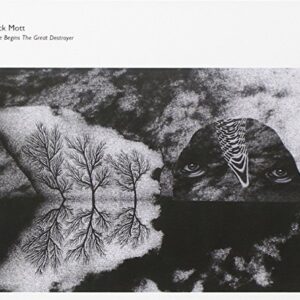
Nick Mott, previously known mostly for his work in and as a founding member of the eclectic group, Volcano The Bear, has since his departure been forging a path very much his own as, largely, a solo artist.
A couple of other projects aside, namely Skeleton Birds & the Number of God and Spectral Armies, his work under his own name commenced in 2011 via a one-sided 7”/art package also released on Lumberton Trading Company. Limited to 100 copies and featuring a print of his own incredible and unique fine art, this sold out very quickly and set the course for a second edition and, indeed, in 2012, an LP, The Visitors, on Alt Vinyl.
Similar to his drawings or art experiments with photocopied collages, his music beams in from some kind of distorted or fractured reality more focussed on those murkier twilight places the likes of H.P. Lovecraft cast their imaginations into. As the ten pieces on Here Begins the Great Destroyer pay witness to, a world of unfolding electronic textures, uneasy tones, rhythmic bursts and general sense of things not being quite as they seem serve as Nick’s main preoccupations. However, this is no daft ‘dark ambient’ muck. Rather, like certain other artists on LTCo, it uncomfortably resides in a space where the likes of Ranaldo & the Loaf, Tuxedo Moon, Nurse With Wound and Andrew Liles each all crawled from. A space, essentially, few others would dare, or wish, to venture to in the first instance. Of course, there is a crooked humour evident, too, as no artist can truly traverse such places without it. Well, at least not if they want to keep their sanity more or less functioning…
Here Begins the Great Destroyer is the first step towards what will, in due course, become a deluxe box set also containing an art booklet and vinyl by Nick Mott. The idea being that this release will not only promote it but can be added to the box set once ready by those interested in ordering it. More info is on the website.
In the meantime, this album exists in its own right via this digipak CD, which is limited to 300 and will not be reprinted.
Mastered, as often the case for a LTCo release, by Sion Orgon (known equally as a solo artist and working affiliate of Thighpaulsandra and the now unfortunately and tragically defunct Coil, amongst others), Here Begins the Great Destroyer is an album for those amongst us who command a more challenging listening experience.
5,00€
In stock

CD
COMPILATION
MOLE’S MILK AND OTHER PIECES
For many years now there is a strong connection between the three members of Kapotte Muziek - Frans de Waard, Roel Meelkop & Peter Duimelinks - and Rotterdam based visual artist Ben Schot. The first time they worked together was when Schot asked Kapotte Muziek to perform at a festival about Detroit, MC5, etc festival in 1998 (released on ‘Praag/Rotterdam’ CD by Kapotte Muziek) and since then there have been various collaborations and constellations. This CD, while technically a compilation, collects four of these pieces.
- As Wieman De Waard and Meelkop provided the musical backing for a performance by Schot as an introduction for a screening of Jodorowski’s film ‘El Topo’, which takes the musical score into the land of plunderphonics, noise, improv and techno (2010-2012)
- Kapotte Muziek performed a rare laptop concert when Ben Schot received the Pendrecht Cultuur Prize in 2003.
- The Whi was a quartet of Meelkop, De Waard, Ben Schot and his daughter Puck Schot playing the game ‘Rockband Wii’, on real amplifiers and computer distortion, much the hilarious reaction of the audience - as can be heard here.
- With DMDN (Jacques van Bussel), Duimelinks, De Waard and Meelkop played a final concert (?) as Death Pact in 1999, probably the loudest concerts they ever performed as part of a programme called ‘Withdrawel’. 250 copies.
This is a long CD, clocking in at just under 80 minutes and contains a rare example of the more noisy works of these artists. It comes in a retro vinyl gatefold sleeve and is co-released with Ben Schot’s own publishing house Sea Urchin.
5,00€
In stock
CD
Jose Luis REDONDO
“La réponse est aux pieds”
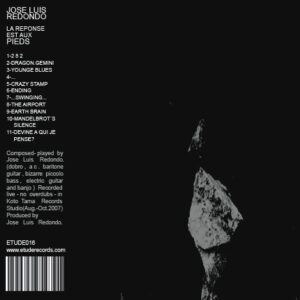
“Composed-played by Jose Luis Redondo (dobro, a.c baritone guitar, bizarre piccolo bass, electric guitar and banjo). Recorded live -no overdubs- in Hoto Tama Records Studio (Aug-Oct. 2007). Produced by Jode Luis Redondo. Etude Records is proud to present the first release statement of this unexpected and amazing guitar-composer-musician call Jose Luis Redondo. His first release for Etude Records “La reponse est aux pieds” (Etude017) is an astonishing 11 tracks suite with some of the most adventurous guitar pieces. Using a whole range of string instruments (Dobro, banjo, electric guitar, piccolo bass, etc…), Jose Luis develops an amazing and unique personal world of sounds, techniques and compositions. Beautiful, bizarre, strange and lovely ! Jose Luis Redondo is a well know musician from Barcelona whose work has appear in tons of different session recordings with local groups, from the Jazz-space-cabaret records of Le Diablo Mariachi, the traditional irish-funk music of Camalics, to the Gallegan-experimental work of Keympa. His solos shows at some squads are also remembered.”
5,00€
In stock

CD
Mark MCGUIRE
“Get lost”
“This album is dedicated to my family, friends, and the spirit of the summer night sky. Electric and acoustic guitar, vocals, and guitar-synthesizer recorded digitally between June 2010 and July 2011 in Westlake, Ohio and Portland, Oregon. Mixed at Hardbodies, July 2011 by Mark McGuire. Mastered and cut by Helmut Erler @ Dubplates & Mastering, Berlin. Photography and Art by Mark McGuire 2011. Layout by Julian Gulyas. And yet another killer album from the ever productive Mark McGuire. It just keeps getring better, as he delivers another fine set of tunes in his perfected style. A few more electronic elements than usual and even some voices, but still the unique blend feell good riffs, electric and acoustic loops and melodies that just stick in the head. Its game of 2 sides of course, with side one chocabloc a short hits with side two stretcning to one side long jam of blissed out McGuire ambience. Awesome.”
7,50€
Out of stock

CD
SULT
“Svimmeheld”
Sult is an acoustic noise ensemble with members from Oslo and the Bay Area. Their music reflects the noise genre’s concern with layers of sonic texture, though completely performed on acoustic instruments. Individual sounds run precariously aside one another as independent streams, and alternately blur into a unified mass.
Tony Dryer: contrabass. Jacob Felix Heule: percussion. Guro Skumsnes Moe: contrabass. Håvard Skaset: acoustic guitar. Recorded, mixed, & mastered by Jacob Felix Heule. Art direction by Lasse Marhaug.
Original price was: 13,00€.5,00€Current price is: 5,00€.
Out of stock

Out of stock

LP
LA TÈNE
“Tardive-Issime”
Collaborative release between Les Disques Bongo Joe and three:four.
If this second opus relies on the same method of composition, it employs a decidedly richer timbral palette, combining long heavy descending harmonium sweeps, relentless percussion, and the ever more precise patterns and drones of the hurdy-gurdy.
‘Tardive/Issime’, something of a mirror to its predecessor, nevertheless reveals a few phantoms in the course of listening, prefiguring a music still to come.
La Tène is a tricephale beast discharging a singular energy in which one may detect echoes of traditional music, saturated repetition, ethereal harmonics or imaginary choreographies...
Alexis Degrenier: hurdy-gurdy. Cyril Bondi: percussions. D'incise: Indian harmonium, electronic.
16,50€
Out of stock

4 CD
Jean-Claude ELOY
“Gaku-no-Michi (1977-78)”
“Gaku-no-michi”, Tao of music or Ways of music. Film without images for electronic and concrete sounds. Produced at the electronic music studio of NHK Radio, Tokyo 1977-78. Digitalized and revised version from 2006.
“Jean-Claude Eloy is a French composer, born in 1938. He studied at the Paris National Superior Conservatory of Music, where he won First Prizes in Piano, Chamber Music, Counterpoint, Ondes Martenot, and studied composition with Darius Milhaud. He attended summer courses at Darmstadt (Pousseur, Scherchen, Messiaen, Boulez, Stockhausen) and was a student in composition in Pierre Boulez’ master class at the Music Academy in Basel (1961-1963). Works by Jean-Claude Eloy have been performed all over the world. They have been conducted by Pierre Boulez, Ernest Bour, Michael Guilen, Bruno Maderna, Diego Masson, Michel Tabachnik, Arthur Weisberg and others ... He has lived in the United States (professor at the University of California, Berkeley, in the sixties), Germany (invited by the WDR studios in Cologne, the Technische Universität in Berlin, guest artist at the Berliner Künstlerprogramm), Holland, Japan (where he collaborated with NHK and the National Theater of Japan, among other activities). He participates regularly in numerous international festivals, principally in Europe, but also in Asia, the United States, Canada and Latin America as sound-projectionist for his electro-acoustic works and with the soloists closely associated with his compositions : Fatima Miranda (vocalist), Yumi Nara (soprano), Michael Ranta (percussionist), Junko Ueda (Shômyô singer and Satsuma-Biwa player), Kôshin Ebihara and Kôjun Arai (Buddhist monk singers), Mayumi Miyata (Shô player), etc.”
CD 1: “Pachinko” introduces “Tokyo” in a deliberately stiff, regular, almost mechanical and untranscended way while the big spiral of long successive waves, which further develops through Tokyo, becomes more and more varied in its material ending in the surpassing and searched-for transubstantiation taking place throughout the fi nal part.
CD 2: The second disc, “Fushiki-e”, takes us (through varied, complex, contrasted and sometimes violent sound episodes) towards the four “stages of contemplation” including the last one, “Mokuso”, which represents the ultimate stage of the contemplative. It is the longest part of the whole piece, lasting almost 80 minutes.
CD 3: “Banbutsu no Ryûdô” is a boundless continuous “weft” travelling so to say through all sorts of daily or exceptional « sound scenes » continually metamorphosing, going from political speeches to a Shishi Odoshi, transformed for a long time well before its pure, direct appearance.
CD 4: “Kaiso “ is a moment of gravity innervated and built around the annual commemorative ceremony of Hiroshima, which however leads us beyond the evoked drama to a place of surpassing with peace through the « Han » sound, extending the work to infinity…”
26,00€
Out of stock

CD
LA TÈNE
“Vouerca – Fahy”
Alexis Degrenier, hurdy-gurdy. Cyril Bondi, percussions. D’incise, Indian harmonium, electronic. Recording : Insub.studio, Geneva, July 2015.
La Tène collect, listen and probe folk melodies and motifs of large territories, from the Jura to the mountains of Auvergne, weaving them to repetition and continuous sounds, electronics and frenzy until exhaustion. Their music, drones played with traditional and acoustic instruments is an invitation to the dance frantically, leading to euphoria or trance.
Cyril Bondi and d’incise are well-known Swiss experimental musicians. They have a huge panel of collaborative and solo records. Cyril Bondi is also known for his playing in the jazz improv trio Plaistow. They play together in Diatribes.
Alexis Degrenier is a French composer, specialist in tranditionnal and slanted music. He plays in Ensemble Minisym that perform Moondog music.
10,50€

15 CD
François BAYLE
“50 ans d’acousmatique”
“François Bayle’s itinerary spans over five decades through which music was able to renovate its material through a sensible use of technology. The terms of Musique Concrète, Electroacoustics or Acousmatics, as conveniently proposed by François Bayle, ultimately explore a similar artistic approach: a creative and
expressive work on recorded sound. This last half-century saw many major technical mutations and François Bayle - in the fertile context of the Grm - seized the right opportunities, often initiating them through his function as director, so as to renovate and update creativity to serve what he called the Light Speed Sound. The fifty opuses in this box set are all markers or beacons illuminating this musical adventure firmly placed under the sign of modernity. Listening through them with a curious and active ear is also a way of witnessing how utopia can occur; how yesterday’s strange sounds are now fully part of our audible landscape.” Christian Zanési.
“Trois rêves d’oiseau” (1963, 1971). “Espaces inhabitables” (1967). “Jeîta, ou Murmure des eaux” (1970 - new version 2012). “L’expérience acoustique” (1969 - 1972). “Purgatoire d’après la Divine Comédie de Dante” (1972). “Vibrations composées” (1973). “Grande polyphonie” (1974). “Camera oscura” (1976). “Les Couleurs de la nuit” (1982 - new version 2012). “Erosphère” with “Tremblement de terre très doux” (1978), “La Fin du bruit” (1979-80 - new version 2009), “Eros” (1979-80), “Toupie dans le ciel” (1979-80 - new version 2009). “Son - Vitesse - Lumière” with “Grandeur nature” (1980), “Paysage, personnage, nuage” (1980), “Voyage au centre de la tête” (1981), “Le Sommeil d’Euclide” (1983), “Lumière ralentie” (1983). “Motion-Émotion” (1985). “Théâtre d’Ombres” (1988). “Fabulæ” with “Fabula” (1990), “Onoma” (1990), “Nota” (1991), “Sonora” (1992). “Mimaméta” (1989). “La main vide” (1994-95) with “Bâton de pluie”, “La Fleur future”, “Inventions”. “Morceaux de ciels” (1996). “Arc, pour Gérard Grisey” (unedited) (1999). “La forme du temps est un cercle” with “Concrescence” (2001), “Si loin, si proche…” (1998 - 2001 - new version 2012), “Tempi” (1999-2000), “Allures” (1999-2000), “Cercles” (2000-2001). “La forme de l’esprit est un papillon” (2002-04) with ”Ombrages et trouées” (2004 - new version 2012), “Couleurs inventées” (2003). “Univers nerveux - in memoriam K. Stockhausen” (unedited) (2005-2007). “L’oreille étonnée - in memoriam O. Messiaen” (unedited) (2006-2012). “Rien n’est réel” (unedited) (2009-2010) with “… sensations” (2010) et “… perceptions” (2009). “Déplacements” (unedited) (2011-12) with “Horizontal-vertical” (2012) et “Spiral” (2011).
70,00€

3 CD
Pierre SCHAEFFER
“L’œuvre musicale”
This is a new and final edition of this 3CD box. All the musical work from Pierre Schaeffer (1910-1995). From the first studies in 1948 to his electronic piece “Le trièdre fertile” in 1975, and of course the ones composed with Pierre Henry like “Symphonie pour un homme seul” (1950). + a booklet of text and photos 114 pages in French and English.
CD 1: Pierre Schaeffer : Les incunables 1948-1952 with “Cinq études de bruits”, “Diapason Concertino”, “Variations sur une flûte mexicaine”, “Suite pour 14 instruments”, “L’oiseau RAI”, “Masquerage”, “Les paroles dégelées”. CD 2: Pierre Schaeffer - Pierre Henry, les oeuvres communes 1950-1953 with “Symphonie pour un homme seul”, “Bidule en ut”, “Orphée 53, Suite de concerts”. CD 3: Pierre Schaeffer, les révisions 1958-1979 with “Etude aux allures”, “Etude aux sons animés”, “Etude aux objets”, “Continuo (with Luc Ferrari)”, “Musique de scène pour Phèdre”, “Trièdre fertile”, “Bidule”.
40,00€
Out of stock

Picture Disc
NURSE WITH WOUND
“Chromanatron”
2013. Chromanatron is the new album from Nurse with wound, collages of no less than 5 albums by the mythical German band from the late 60s SAND. These five psyche-experimental-krautrock albums include their first oddity Golem, that NWW discovered a long time ago and represented straight away a great source of inspiration for him.
A great dedication to Sand, and hat-in-hand, chapeau bas ! to Nurse with wound for this once again unique masterpiece.
Chromanatron is part of the series Inxodem released by Rotorelief. It is a series of new albums from Sand as well as a reissue of their obscure and rare album Golem. This series of albums is called Inxodem, the series title having one letter for each album. Current 93 is also part of the project with When the may rain comes, cover versions of the original track from Sand.
All paintings and collages of the Inxodem series are created by Babs Santini aka Steven Stapleton.
Limited and numbered edition of 500 copies on picture disc.
19,00€
Out of stock

CD
NURSE WITH WOUND
“Chromanatron”
2013.
Chromanatron is the new album from Nurse with wound, collages of no less than 5 albums by the mythical German band from the late 60s SAND. These five psyche-experimental-krautrock albums include their first oddity Golem, that NWW discovered a long time ago and represented straight away a great source of inspiration for him.
A great dedication to Sand, and hat-in-hand, chapeau bas ! to Nurse with wound for this once again unique masterpiece.
Chromanatron is part of the series Inxodem released by Rotorelief. It is a series of new albums from Sand as well as a reissue of their obscure and rare album Golem. This series of albums is called Inxodem, the series title having one letter for each album. Current 93 is also part of the project with When the may rain comes, cover versions of the original track from Sand.
All paintings and collages of the Inxodem series are created by Babs Santini aka Steven Stapleton.
CD 3 flaps 6 panels Digipak
12,50€

9 CD
COMPILATION
9 TRAJECTOIRES
9 CD with 9 composers of electroacoustic music who did work at INA-GRM.
Ludger Brümmer, “Deconstructing Double District” (2011), “Xronos” (2002), “Glasharfe” (2006), “Spin” (2014).
Philippe Leroux, “La guerre du faire” (1992), “M.É” (1998), “Objets trouvés… posés” (2009).
Diego Losa, “Cronicas del tiempo” (2005), “Historias de dos mundos” (2007), “Sortie d’un rêve dans une nuit étrange très loin d’ici…” (2012), “Horizons ou le récit d’un voyageur” (2015).
Mario Mary, “Signes émergents”v (2003), “2261” (2009), “Une bouffée d’air” (2006), “Portraits témoins” (1997).
Luis Naon, “La sphère et la pierre” (1993-94), “Perspectives” (2004 - 2017), “Lascaux rbana” (2004).
Ake Parmerud, “Les objets obscurs” (1991), “Renaissance” (1994), “Dreaming in darkness” (2005), “Electric birds” (2012).
Elzbieta Sikora, “Axerouge V” (2011), “Chicago Al Fresco” (2009), “Flashback” (1968-1997), “Derrière son double” (1982-83).
Kees Tazelaar, “Chatoyance” (2013), “Chroma” (2006), “Sternflüstern” (2003), “Sérénade” (2016).
Hans Tutschku, “Extrémités lointaines” (1998), “Distance liquide” (2007), “Monochord” (2008), “Migration pétrée” (2001).
55,00€
Out of stock

book + 2 CD
VIVENZA
“Fondements bruitistes”
Deluxe double-CD book, 108 pages in three languages: French, English, Japanese. Included The Art Of Noises - Futurist Manifesto - by Luigi Russolo (1913). “The Bruitist Foundations of Action” (French title “Fondements Bruitistes d'Action”), which came out in october 1984, opens the period in Vivenza’s work on Bruitist sound when he started to incorporate the question of the relationship that holds between the technological and mechanical industrial fabric - which makes up the reality of the modern world - and the human and social environment. It is released in double albums as two separate vinyl LPs in the context of the Archives of Industrial Music from France.
23,00€

5 CD
COMPILATION
ARCHIVES GRM
For the 30th birthday of INA, the GRM has decided to present in this CD box some of his archives. CD1 “les visiteurs de la musique concrète” : André Hodeir - Pierre Boulez - Jean Barraqué - Darius Milhaud - Roman Haubenstock-Ramati - Henri Sauguet - Edgar Varèse - André Boucourechliev - Claude Ballif - Iannis Xenakis - Olivier Messiaen. CD2 “L’art de l’étude : Pierre Schaeffer - Monique Rollin - Michel Philippot - Philippe Arthuys - Luc Ferrari - François-Bernard Mâche - Mireille Chamass-Kyrou - Ivo Malec - Philippe Carson - Akira Tamba - Beatriz Ferreyra - Alain Savouret. CD3 “Le son en nombres » : François Bayle - Dieter Kaufmann - Jean-Claude Risset - Ivo Malec - Denys Smalley - Gilles Racot - Yann Geslin - Bénédict Maillard - Jean Schwarz - Francis Dhomont. CD4 “Le temps du temps réel” : Bernard Parmegiani - Åke Parmerud - Denis Dufour - Horacio Vaggione - Alain Savouret - François Bayle - Gilles Racot - Daniel Teruggi - Ramon Gonzales-Arroyo - Michel Redolfi. CD5 “Le grm sans le savoir” : Bernard Parmegiani - Robert Wyatt/F. Bayle - François Bayle - Alain Savouret - Jean Schwarz - Michel Portal/J. Schwarz - Boris Vian/B. Parmegiani - Robert Cohen-Solal - Guy Reibel - Edgardo Canton - Christian Zanési.
30,00€
Out of stock

book + CD
VIVENZA
“Réalités servomécaniques”
Deluxe CD book, 32 pages, pictures & texts in three languages: French, English, Japanese.
“Réalités servomécaniques” is an improved version faithful to the original recordings with visuals specially reworked, answering to a categorical assertion, theoricaly and practicaly on Vivenza’s bruitist point of view, who presents sounds, “noises”, under their rawest and genuine aspect: sounds are machines / machines are sounds. Thus Vivenza captured the essence of factories with a strong sense of austerity, radicality, verticality, including thick smokes and intense darkness of industrial landscapes, as Réalités servomécaniques directly refers to the triumph but also decline of heavy industries in the 80s. The mechanics, cogwheels, forges and machines smash us in the face in a radically powerful way, being at the same time under our eyes and inside us, at the heart of our selves, in an ultra realistic way while listening. We are then, with Réalités servomécaniques, plunged in the midst the machines, and in the machines, with a surprising and striking strength. “Machines are sounds / sounds are machines!”
15,00€
Out of stock

book + 2 CD
NURSE WITH WOUND
“Spiral Insana”
Same content as the vinyl reissue but on two CDs inside an art book with screenprinted artworks.
20,00€
In stock

In stock

CD
Pierre HENRY
“Labyrinthe !”
First performance commissioned by Radio France, March 2003.
“For the first time during my journey and ventures into the world of creation, I dreamt of a breath of fresh air deriving from the electronic realm. “Labyrinthe” emer-ged as the result. All in all, a collaborative work achieved, overcoming the distance between its sources. The sound cuts from GRM reached me as set of reflections, like “cadavre exquis”. Fragments in any order, all on CD, sent by post, 7 composers, 7 colleagues sent me 58 tracks of varying lengths in various keys. this continuity inspired me to create a maze-like musical form, in concentric volumes, all thoroughly intertwining with each other. Above all, my contribution is intended to be harmonic. I take great care in attending to any drifting effects occuring with other sounds. A smooth descent for all, in their order of entry into the subterranean: Donato, Geslin, Gayou, Losa, Zanési, Terruggi, Dao.” Pierre Henry
15,00€
In stock

CD
Philippe MION
“Si c’était du jour…”
“Si c’était du jour…” (1999), “Des jambes de femmes tout le temps” (1997), “Statue” (1985).
15,00€
In stock

CD
Patrick ASCIONE
“Primitive – Espaces paradoxes”
“Primitive” (1995), “Espaces-Paradoxes” (1987-89).
15,00€
In stock

CD
Nicolas VÉRIN
“Quatre pièces pour solistes et sons fixés”
Four pieces : “Miroirs déformants” (1988-91). Pilar Fontalba, oboe. “Métalmorphose” (1989). Gérard Siracusa, percussion. “Mariposa clavada que dedita su vuelvo” (1996). Cécile Daroux, flute. “P’hioni” (2000). Jean-Paul Céléa, doublebasse.
15,00€
Out of stock

CD
Michel REDOLFI
“Appel d’air”
“Appel d’air” (1991), “Jazz, d’après Matisse” (1990), “Portrait de Jean-Paul Celea avec contrebasse” (1991) for doublebass and tape.
15,00€
In stock

CD
Jean SCHWARZ
“The sea maid’s music” (1990)
“The Sea Maid’s Music” (1990). Élise Caron: voice. Daniel Terruggi: syter.
15,00€
Out of stock

CD
Jean SCHWARZ
“Quatre saisons” (1982-83)
Composed in 1982-83, for voice, electronics, natural and instrumental sounds treated by a computer. Text based on Goethe’s poem “The four seasons”. Baritone: Jorge Chaminé.
15,00€
In stock

CD
Javier ALVAREZ
“Cactus géométries”
Javier Alvarez. “Cactus géométries” (2002). “Offrande” (2000).
15,00€
In stock

CD
Jacques LEJEUNE
“Fragments gourmands”
“Fragments gourmands”, for tape, voice and saxophones.“L’Eau primesautière” for tape and sopranino sax. With Daniel Kientzy (saxophones).
15,00€
Out of stock

CD
Jacques LEJEUNE
“Messe aux oiseaux”
“Messe aux oiseaux” (1986) new version (1999), “Ave Maria” (1987).
15,00€
Out of stock
