
In stock

LP
Michel REDOLFI
“Sonic Waters, Underwater Music 1979-1987”
A work that literally immerses the listener into an acoustical substance. The sound becomes almost like matter, like jelly. Soon, you're swimming in sound, getting lost inside it.
With the Sonic Waters project initiated in 1978, my aim was to situate field of electronic music within a liberating and futuristic experience, outside the concert halls and in sync with the development of new instruments - in particular the Synclavier digital synthesizer, the first model of which I acquired in 1977. As concert space, the Pacific Ocean seemed to me to be the ideal experimental medium for both acoustic and cultural reasons. I then developed the aesthetic and technical elements that would contribute to the conception of Underwater Music. Numerous performances would follow spanning four decades, in natural sites or in large public pools such as those of Sydney, Paris or Venice during the 2006 Biennale.
Michel Redolfi (1951), French composer and sound artist, is the founder of Underwater Music. The natural elements captured and highlighted by experimental technology are a constant in Redolfi's catalogue: many compositions explore the earth environments such as in 'Pacific Tubular Waves', 'Jungles', 'Desert Tracks' (re-released on Sub Rosa records) and especially with 'Sonic Waters', a work that literally immerses the listener into an acoustical substance. During the mid-seventies Redolfi carried out his electro-acoustic research in the United States, with major electronic music centers including the California Institute of the Arts and chiefly the University of California in San Diego. As invited resident of their studios, Michel Redolfi launched the underwater music concerts, with the series 'Sonic Waters' performed in the Pacific Ocean. Michel Redolfi's underwater creations have since been regularly programmed by major international festivals, with multi-media installations held in ecological marine reserves or in historical city pools. Among them, the Sydney Festival, Paris 'Nuit Blanche', Ars Electronica in Linz, the 2006 Venice Biennale (nominated Golden Lion) and lately the 2018 Ars Musica festival in Brussels. This record presents different variations of Sonic Waters from 1980 to 1987, alternating studio mixes with their re-recordings in the depths of the Pacific. Michel Redolfi CD's and LP's are currently published by Sub Rosa, INA-GRM and Radio France.
16,50€
In stock
CD
Michel REDOLFI
“Sonic Waters, Underwater Music 1979-1987”
A work that literally immerses the listener into an acoustical substance. The sound becomes almost like matter, like jelly. Soon, you're swimming in sound, getting lost inside it.
With the Sonic Waters project initiated in 1978, my aim was to situate field of electronic music within a liberating and futuristic experience, outside the concert halls and in sync with the development of new instruments - in particular the Synclavier digital synthesizer, the first model of which I acquired in 1977. As concert space, the Pacific Ocean seemed to me to be the ideal experimental medium for both acoustic and cultural reasons. I then developed the aesthetic and technical elements that would contribute to the conception of Underwater Music. Numerous performances would follow spanning four decades, in natural sites or in large public pools such as those of Sydney, Paris or Venice during the 2006 Biennale.
Michel Redolfi (1951), French composer and sound artist, is the founder of Underwater Music. The natural elements captured and highlighted by experimental technology are a constant in Redolfi's catalogue: many compositions explore the earth environments such as in 'Pacific Tubular Waves', 'Jungles', 'Desert Tracks' (re-released on Sub Rosa records) and especially with 'Sonic Waters', a work that literally immerses the listener into an acoustical substance. During the mid-seventies Redolfi carried out his electro-acoustic research in the United States, with major electronic music centers including the California Institute of the Arts and chiefly the University of California in San Diego. As invited resident of their studios, Michel Redolfi launched the underwater music concerts, with the series 'Sonic Waters' performed in the Pacific Ocean. Michel Redolfi's underwater creations have since been regularly programmed by major international festivals, with multi-media installations held in ecological marine reserves or in historical city pools. Among them, the Sydney Festival, Paris 'Nuit Blanche', Ars Electronica in Linz, the 2006 Venice Biennale (nominated Golden Lion) and lately the 2018 Ars Musica festival in Brussels. This record presents different variations of Sonic Waters from 1980 to 1987, alternating studio mixes with their re-recordings in the depths of the Pacific. Michel Redolfi CD's and LP's are currently published by Sub Rosa, INA-GRM and Radio France.
12,50€
Out of stock

2 LP
Mika VAINIO
“Last live”
*** Repress ****
This edition was produced and finalized in a particular context, Mika Vainio having left us on 12.04.2017 This material is the last concert he has gave. It took place at Cave12 on 02.02.2017. We needed time to listen to this archive again, which we did in situ in June 2020 with Cindy Van Acker.
After this listening, we felt invested in having to make this archive public.
In order to edit and work on this material, we asked Carl Michael von Hausswolff to do the mixing. At our request, this recording was organized in 4 movements. Stephen O’Malley kindly joined in the pre-edit process that took place on August 24 2020 at EMS Studios, Stockholm. Denis Blackham did the mastering.
This process was carried out in collaboration with Rikke Lundgreen.
Recorded 02.02.2017 at Cave12, Geneva by Benjamin Ephise
Edit by Stephen O'Malley & Carl Michael von Hausswolff at EMS, Stockholm.
Mastered by Denis Blackham
Vinyl cut by Andreas Kauffelt at Schnittstelle, Berlin
Artworks by Franz Graf, Mika Vainio Archive, Oslo and Cm von Hausswolff collection,
Cave12 / Editions Mego co-release
27,00€
In stock
CD
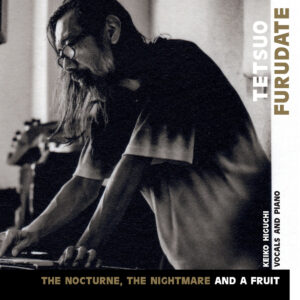
Tetsuo FURUDATE
“The nocturne, the nightmare and a fruit”
Tetsuo Furudate has been working on projects including electronic music, films, videos creating time passages between old and new pieces, re-reading the past through re-appropriations. All his recent pieces can be watched or just listened to. It is also a cultural mix embracing all eastern and western cultures (from JS Bach to Merzbow). Here he recreates a borderless and timeless universe, where voices and pianos reach emotional moments of great depth. The whole is driven by Tetsuo who, by a continuous mixing, conceives these different pieces as an editor would a film made of borrowings images, archives material and unpublished fragments.
Tetsuo Furudate was first the collaborator and friend of Zbigniew Karkowski in Japan, together they created some of the most radical but complex pieces under the name of "World as Will" (after Arthur Schopenhauer's book), some of which were rewritten for the viennese Zeitkratzer Ensemble (received worldwide attention when they created and performed a new version of Metal Machine Music by Lou Reed - including Ulrich Krieger and Anton Lukoszevieze).
Keiko Higuchi is above all a pianist and performer, linked to jazz and improvisation. She was revealed by Love Hotel (2008), her concerts are like real performances, she is considered as one of the most singular and impressive performing artists of her generation.
Olga Magieres, Russian pianist living in Denmark, specializes in improvised music and the syntactic relationship of languages. She has already collaborated with Tetsuo in 2010 with Introduction Of Blue Of Noon, her first opus Piano and Poetry had been praised.
14,50€
Out of stock

LP
Aaron DILLOWAY & Lucrecia DALT
“Lucy & Aaron”
Repressed !
Lucy & Aaron is the debut collaboration LP from the duo of Lucrecia Dalt (RVNG Intl.) and Aaron Dilloway (Dais Records). Full length LP in full color cover with printed inner sleeve featuring art by artist Pieter Schoolwerth.
File under Electronic / Tape Music.
“I met Aaron in Madeira around 10 years ago, and I was blown away by his set, when I was going to tour the US for the first time, Forest, my US my booking agent asked me if I wanted to tour with someone from his roster and I suggested Mr Dilloway, the first show we played together was in Toronto, he started with a very groovy loop, some kind of soul extract that felt just right. With that, he levelled the dynamics and the atmosphere of the room, moving back and forth from the stage to the audience to double check if everything was sounding right. I have never seen such an elegant, disturbing and powerful show at the same time, it was a wild combination. We played a couple more shows together and on my journey throughout the states I was never in a place where his name didn’t pop up with a positive comment of admiration. We became extremely close and utopian. We started this record during a two week visit of mine in NYC, we crossed our signals, sometimes his affecting mine, or the other way around, we just wanted to make a fun, weird and inevitably emotive record that somehow captured so many things we love about music, to put oneself in character and go with the flow.”
-- Lucrecia Dalt
“Lucrecia and I met briefly 10 years ago while performing at a festival together. We traded some releases and I was very excited by what I heard. Her records stuck out to me over the years as something very special. I was a fan. We met again recently while performing on a bill together in Toronto, and while watching her perform, I was mesmerized by her selections of sounds, as well as her movements and control of the mixing board. I felt like we worked similarly. We struck up a very close friendship and what followed was a year of intense discussions about art, music, performance and recording. Immediately we began working on music together and her expertise in mixing and her highly trained ears and overall drive were very inspirational. This album was recorded in 3 different locations, Pioneer Works in Brooklyn, NY where Lu was doing a residency, sessions at Lu’s home in Berlin, Germany and finally at my home in Oberlin, OH. It was one of the most inspirational periods of my life and helped me overcome some intense musical and psychological obstacles. I learned so much by making this record.”
-- Aaron Dilloway
Recorded by Lucrecia Dalt & Aaron Dilloway 2019 - 2020
Mastered by Rashad Becker
Cut by Warren Defever
Art by Pieter Schoolwerth
22,00€
Out of stock

CD
Phill NIBLOCK
“Exploratory I & II”
We have the honor to present to you the new masterful work of Phill Niblock: Exploratory
One of the most beautiful and powerful works that Phill Niblock has ever offered to us! Phill reinvents and probes the oceans of drone music possibilities deeper than ever.
This piece has been performed and recorded for over a year by many great musicians around the world, under the supervision and direction of Phill.
Arditti String Quartet, David Watson, Lucy Railton, Phoenix Ensemble Basel, David Maranha, Ben Richter, David First, Andre Goncalves, and many more.
Matière Mémoire is now bringing the first two volumes to you by Arditti String Quartet, David Watson & Phoenix Ensemble Basel.
18,00€
In stock
LP
Phill NIBLOCK
“Exploratory I”
Vol. 1 performed by Arditti String Quartet & David Watson
We have the honor to present to you the new masterful work of Phill Niblock: Exploratory
One of the most beautiful and powerful works that Phill Niblock has ever offered to us! Phill reinvents and probes the oceans of drone music possibilities deeper than ever.
This piece has been performed and recorded for over a year by many great musicians around the world, under the supervision and direction of Phill.
Arditti String Quartet, David Watson, Lucy Railton, Phoenix Ensemble Basel, David Maranha, Ben Richter, David First, Andre Goncalves, and many more.
Matière Mémoire is now bringing the first two volumes to you by Arditti String Quartet, David Watson & Phoenix Ensemble Basel.
Each Vinyl is limited to 300 copies in transparent (Vol I) and transparent red (Vol II) vinyl. Also available on CD
26,00€
In stock
LP
Phill NIBLOCK
“Exploratory II”
Vol.2 performed by Phoenix Ensemble Basel.
We have the honor to present to you the new masterful work of Phill Niblock: Exploratory
One of the most beautiful and powerful works that Phill Niblock has ever offered to us! Phill reinvents and probes the oceans of drone music possibilities deeper than ever.
This piece has been performed and recorded for over a year by many great musicians around the world, under the supervision and direction of Phill.
Arditti String Quartet, David Watson, Lucy Railton, Phoenix Ensemble Basel, David Maranha, Ben Richter, David First, Andre Goncalves, and many more.
Matière Mémoire is now bringing the first two volumes to you by Arditti String Quartet, David Watson & Phoenix Ensemble Basel.
Each Vinyl is limited to 300 copies in transparent (Vol I) and transparent red (Vol II) vinyl. Also available on CD
26,00€
In stock
CD
Charlemagne PALESTINE
“October 24, 1975 – Performance Icc Antwerp Belgium”
A few months after the release of the legendary Strumming in 1974, Charlemagne gave a masterful and powerful 56 minutes performance in Antwerp in an exciting concert series.
With the work and the precious help of M KHA and Lotte Beckwé, we were able to find this recording. We are pleased to offer you this unreleased performance on cassette and CD.
This release takes place in parallel with the magnificent M KHA exhibition which will begin on September 11, 2021
16,00€
Out of stock
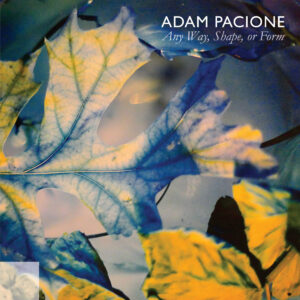
4 CD box
Adam PACIONE
“Any Way, Shape, or Form”
Adam Pacione's finely crafted, deeply affecting drone work has found its place in the upper echelon of modern ambient artistry. Once heard, the gorgeous fluidity of his music is instantly recognizable.
Now, an absolutely crucial addition to Pacione's relatively slim oeuvre is here, offering more than four hours of aural color and visual sound from a master of the medium. "Any Way, Shape, or Form," a stunning 4CD box set, compiles all the material from Pacione’s "Still Life" series of 3" CDRs, originally offered via monthly subscription throughout 2009 and now long out of print. The late night ambient/drone sessions in this set were pulled from recordings made from 1999-2009, many of which originally served as soundtracks to Pacione’s photography exhibitions in galleries throughout Texas. These recordings have been meticulously remastered and two previously unreleased tracks from this period have been added, resulting in an absolute must-have for aficionados of haunting, textural, electronic music.
Pacione’s work largely centers around early Portastudio tape loop experiments, synthesizers, samples, and processed field recordings that gradually decompress to form a hypnotic serenade of becalmed tones. After years of experimentation, his first releases appeared in 2004, leading up to his proper debut album, "Sisyphus," a year later. By this time, Pacione's name was becoming synonymous with lush, atmospheric sonances of the highest caliber. His reputation strengthened even more with his next full-length, 2007's masterful "From Stills to Motion," which fully delivered on the promise of his earlier efforts. Since then, Pacione has stayed active with performances and recordings (see 2020's excellent digital-only "Mâché"). His physical output has been sparse over the last decade or so, however, and copies of the earlier releases are now quite scarce. "Any Way, Shape, or Form" then is particularly essential in making this vital section of Pacione's discography widely available for the first time.
The sixteen tracks included here are mostly long-form pieces: contemplative soundscapes evolving at a deliberate pace. There is an inherent spaciousness in these works; sounds are free to move and breathe as they shift between tension and tranquility. These extended audial ruminations allow Pacione to examine and subtly emphasize the details of each arrangement. And these details have been brought into sharp focus by the rigorous mastering job executed by renowned sound artist Alex Keller: a drifting haze sharply underscored by a biting frost.
In addition to the peerless audio in this set is a 20-page booklet reproducing all of Pacione's photography from the original CDRs as well as several previously unpublished images. These truly are the visual equivalents of his recordings: otherworldly snapshots of a stylized vision of nature, neither artificial nor entirely organic but a harmonious amalgamation. These rich photographs are somehow both crisply intricate and dreamily impressionistic: the ideal accompaniment for Pacione's evocative sound, perfectly rounding out his world-building.
This beautiful artefact is simply a rare pleasure for the senses. And a welcome reintroduction to Adam Pacione's singular aesthetic. A treasure not to be missed.
32,00€
Out of stock
2 CD
Bob BELLERUE
“Radioactive Desire”
"The music is intense on every level, and there is a great underlying tension in these pieces, a mysterious force if you will."
- Frans de Waard, Vital Weekly
Recorded on the hottest days in the longest year, "Radioactive Desire" is a work for free chamber music in feedback environments. Simple improvisational structures gave focus to the exquisite playing of the musicians, and the performers were physically located within speakers of varying sizes to create multidimensional feedback systems.
It is a project borne of feedback between speakers and instruments, but the context in which it came to fruition demonstrated the deep interconnections between people and systems of collaboration. The project was a way to activate musical signals with the push and pull of chthonic energy, yet we felt and lived that in the improvisation of our lives to a more visceral extent than we may have ever thought possible. Working with these sounds, processes, and ideas provided substance and process for me to work through these difficult times.
Bob Bellerue is a sound artist, experimental musician, sound/video curator, and creative technician based in Ridgewood NY. Over the last 30+ years he has been involved in creating and presenting a wide range of sonic activities – experimental music, sound art, noise, junk metal percussion ensembles, soundtracks for dance/ theater/ video/ performance art, and sound / video installations. Bob’s electronic sound work is focused on resonant feedback systems, using amplified instruments, objects, recordings, and spaces, in combination with electronics and software written in the Supercollider audio synthesis programming language.
Bob works as an audio engineer and technical director, working presently for Issue Project Room, and a handful of clients in the NYC area once the coast is clear.
16,00€
In stock
LP
Will GUTHRIE – Jean-Luc GUIONNET
“Electric Rag”
Jean-Luc Guionnet - electric organs, electronics, alto saxophone
Will Guthrie - drums, percussion, microphones
Maxed out and burning hot nasty, Electric Rag brings together the electric organs, electronics and alto sax of Jean-Luc Guionnet, with the closely amplified drums and percussion of Will Guthrie.
After years of playing together in the minimalist pointillist free jazz noise core trio ‘The Ames Room’ (with Clayton Thomas on bass) Electric Rag offers up another point of view on a musical history of nearly 15 years of playing together.
The 8 titles of Electric Rag draw on their various experience in electronic music, free improvisation and experimental sound research, however the music is deeply rooted in their love of jazz, in its most potent, aggressive and antisocial form.
Ali Buh Baeh Records / Editions Memoire
White Vinyl. Edition of 300
Mastered by Joe Talia
17,00€
In stock
LP
BUNTE TRUPPE
“Träumen Ohne Dinge”
"Bunte Truppe came together in 2017 and consists of Limpe Fuchs, Ruth-Maria Adam, Ignaz Schick and Ronnie Oliveras, who play a variety of percussion, wind and string instruments as well various electronic means in front of their audience. At this point it is absolutely necessary to point out how such a 'colorful troupe acts at the height of its time and improvisedly moves beyond so-called genre boundaries and musical conventions. Of course, this full-bodied announcement includes that the Colorful Troupe knows how to challenge their audience! Naturally.
What else?
Evidence of historical contexts or other cultural contexts, such as that Limpe Fuchs has been internationally known as a musician since God knows how long (and many years of it in the free improv duo Anima-Sound) and is on the move, The fact that Ruth-Maria Adam and Ronnie Oliveras also make a noise at Datashock and the Flamingo Creatures, while Ignaz Schick hurries from artist residency to artist residency with the record player under his arm, is (not) important. It may also be (un) helpful to use one or the other international benchmark to classify the music for orientation. But before we get lost in the music library, we prefer to prick up our ears and dedicate ourselves to the astonishing sounds that this record contains: lively and seemingly carefree, But the colorful troupe starts to play with each other attentively and free themselves, and so supposedly incompatible, musically disparate things come together casually. The material does not want to be mastered, it has suffered enough." - Holger Adam
17,50€
In stock

CD
Éric LA CASA
“Everyday Unknown 4 & 5”
These compositions were conceived mainly from researches on the Inaudible, and the Unspeakable. Everyday Unknown is a series devoted to the representation of infraliminary sound phenomenon of reality, of everyday life.
During these past years, exploring my daily environment and also my archives, I have discovered a missing part of my listening : beyond the threshold of my hearing, or my measure. I was interested in these territories of the Inaudible, while questioning myself about the making of the present time, with microphones and recordings : the dynamic relationship between the body and the listening of his/her environment. In these infraliminary dimensions, my perception of the reality is constantly stretched to the limits of the comprehensible.
Recordings and Mixings : 2017-2021
10,00€
Out of stock

CD
Éric LA CASA
“Installations”
Stereophonic versions based on the recordings and mixes used for the 4 sound installations
Surface-témoin / Show surface (2005)
by Jean-Luc Guionnet & Eric La Casa
De la dilation du paysage / Enlarging the landscape (2006)
by Michaële-Andréa Schatt & Eric La Casa
Double exposition / Double exposure (2010)
by Seijiro Murayama & Eric La Casa
Tentative d’épuisement (sonore) d’un lieu / Attempt at exhausting the sound of a place (2016)
by Arnau Horta & Eric La Casa
Book (24 pages 15x15cm) + CD
Published by Swarming - Collection Paris
12,00€
In stock

2 CD
COMPILATION
“Banc d’essai 2011-2019”
Between 2011 and 2019, INA Grm organised a yearly competition, called Banc d’essai. During this period, the jury listened to nearly a thousand works, with an ever-renewed curiosity for what seemed to be the voice of a new generation of creators. Every year, about ten pieces were selected to be performed on the Acousmonium, and it’s on those occasions that all these talents have revealed themselves to us with the most forcefullness. In 2020, as the competition renews itself, we wanted to close this chapter with a record release featuring eighteen works whose depth and sensitivity have particularly moved us, and which, through a remarkable spirit of research and invention, have, each in their own way, contributed to the gradual, stimulating and ongoing transformation of music at large.
CD 1
01. Benjamin Miller Zond-9 07’18
02. Hideki Umezawa Inutile 08’08
03. Lydia Debeer Tremble Garden 08’01
04. Gaëtan Parseihian La forêt mécanique 07’30
05. François Buffet Le songe du retour 07’31
06. Loïse Bulot Daphnia 09’05
07. :such: Monte-Charge 07’11
08. Thomas Hilbert Fluage 06’13
09. Christophe Ratier et Julia Hanadi
Al abed Eubulie 06’54
CD2
01. Scarabj Nos yeux 09’36
02. Raphaël Mouterde Violens 09’20
03. Rocío Cano Valiño Astérion 08’22
04. Renaud Bajeux Leaving the Nest 07’55
05. Florent Colautti Jupiter 09’06
06. Sophie Delafontaine
Respire marche pars va-t-en 09’48
07. Thomas Manoury Soundtrains 05’03
08. Kristian M. Roberts Seashell Music 05’04
09. Tucuxi Rayon vert 07’02
17,00€
In stock

2 LP
Luc FERRARI – Ensemble LABORINTUS
“…et après”
PLANAM presents "...et après" a suite created by Ensemble Laborintus highlighting their collaboration with Luc Ferrari and well underlining the creative heights reached by the composer during the last years of his career.
Laborintus, so named in homage to Luciano Berio, was an ensemble born in 1993 and dissolved in 2014, formed by Hélène Breschand (harp), César Carcopino (percussions), Sylvain Kassap (clarinets), Franck Masquelier (flutes) and Anaïs Moreau (cello). The main vocation of the ensemble was to give voice to the music of today by working in close collaboration with living and active composers, confronting current technologies, as well as practicing improvisation and musical theater. Laborintus developed a special relationship with composers, with Luc Ferrari in particular. Each creation was the occasion for an in-depth encounter.
For Laborintus the music of Luc Ferrari was always a bearer of joy, a carnal joy - a joy of sound, and a joy of playing. There is a balance between the concrete character of the sounds that builds a poetic topology, and the virtuosity of the score, which allows a pleasurable physical involvement in the heart of sound. This music, and the state of being beyond music itself, has ever since been with the ensemble.
Bristling with stunning dances of acoustic and electronic sound, "...et après" - collecting a full two LPs worth of material - presents the final unreleased work that Ensemble Laborintus created in collaboration with Ferrari, including "Bonjour, comment ça va?", two realizations of "Tautologos III" featuring the voice of Brunhild Ferrari and a new version of Ferrai's work "À la recherche du rythme perdu", created under the supervision of Brunhild Ferrari for harp and percussion; as well as an homage to the composer, composed by Sylvain Kassap titled "Arezzo" (after the name of the city where Luc died, who that day was to join Laborintus to record and together play "Archives sauvées des eaux") and Hélène Breschand "L", for flute, clarinet, cello, harp, percussion & fixed sounds. Both "Arezzo" and "L" were composed using sound archives by Luc Ferrari. This double LP also includes as a 'bonus' the realization of Ferrari's "À la recherche du rythme perdu", recorded live by Hélène Breschand and eRikm in 2019.
The selection of tracks and the title of the album "...et après" were chosen in the spirit of a continuation with the legacy of Luc Ferrari: a balance between heritage, transmission, and continuity, transformation over time.
Like Russian dolls that fit together Luc encouraged encounters and bonds are still forged today, through his music.
Privately produced by Laborintus and issued by PLANAM, this double LP is limited to 500 copies of which only 250 are made available for distribution.
34,00€
In stock
2 LP
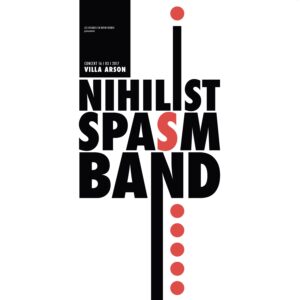
NIHILIST SPASM BAND
“Concert Villa Arson Nice”
Lorsque le premier album du Nihilist Spasm Band sort en 1968, aucun autre groupe au monde n’a enregistré pareil boucan. Chez ces Canadiens, qui s’exercent...
25,00€

2 LP
Pascal COMELADE & Marc HURTADO
“Larme secrète”
2 LPS, gatefold cover, cut at 45rpm. With 3 bonus tracks exclusive for this vinyl edition.
"Larme secrète" is the result of an astonishing encounter between a minimal and discreet musician attracted as much by Erik Satie as he is by various pop classics, and a poet/performer who has worked with Lydia Lunch, Genesis P-Orridge , Michael Gira as well as Alan Vega. Pascal Comelade et Marc Hurtado (Étant Donnés) are two important figures of a french underground and alternative music scene which has always attempted to interfere with other musical genres. They are both also producers, fans and cultured listeners who meld a vast array of elements and references into a dark synthesis, a hypnotic and cosmic electroshock.
This project was born following the collaboration on stage by Pascal Comelade and Marc Hurtado during a tribute to Alan Vega that Marc Hurtado organized in Paris in 2018. Larme Secrète is the sound of an electric shock, the sound of two hearts beating at the same rhythm, united in the thrilling and hypnotic music of Pascal Comelade, melted in the fire of the celestial poems of Marc Hurtado. Synthesizers, guitars, drums, organ, piano, sound loops seem to collide high in the sky with whispered, yelled, possessed voices.
Pascal Comelade was born in Montpellier. After living in Barcelona for several years, he produced his first album, under the name of Fluence, influenced by electronic music and by the group Heldon. Since 1980, Pascal Comelade has released music under his own name. Since then, his music has become more acoustic and is often characterized by the sounds of toy instruments, used as solo instruments or as part of the sound of his group, the Bel Canto Orchestra.
Marc Hurtado is half of the French experimental duo Etant Donnés. Active since the late 1970s, the group has released several albums, also collaborating with people like Alan Vega, Lydia Lunch, Michael Gira or Genesis P-Orridge. Marc Hurtado has directed many films and has also released several solo albums under his own name.
27,00€
In stock

LP
Costin MIERANU
“Luna Cinese”
At long last, after decades out of print, the Milan based imprint, Dialogo, dives into the legendary catalog of Cramps, bringing forth the first ever vinyl reissue of Costin Miereanu's "Luna Cinese", part of an ongoing initiative dedicated to bring the imprint’s seminal output back into the light. Easily one of the most singular and important experimental albums of the 1970s that remains as engrossing, creatively riveting, and as ahead of its time today as it was in 1975, this is as exciting as reissues come. Complete with new English translation of their original liner notes.
Edition of 300 LP on black vinyl. Audiophile pressing, including printed inner. Perfect replica of the original packaging and newly remastered for optimal sound.
The course of Luna Cinese (side X or Y) consists of continuous low-density repetitions – the kind of “woven” silence you find on mountains – occasionally disturbed by irregular and very dense insertions – the kind of intense noise you find in the city.
The purpose of these subsequent insertions is, on the one hand, given their relentless character, to deceive any desire of discovering a linear evolution, and on the other hand, due to their composite nature (= stasis of the present moment, in which past-present-future are mixed, as in a tourbillon), to break the straight-forward logic of development, thus assuming working as an interference. It is not about a “negative”, aphasic interference, but on the contrary a ‘positive’ burst of quantitatively immeasurable super-memorization.
Hence a constant ambiguity in the text’s montage – scattered fragments or a continuous series of rings as in a rosary: several stories develop together or in parallel lines, without being able to know which one is the real one. This kind of development recalls those tales – apparently all true and based on the same real facts, although they change from time to time – which are told on different occasions by those people who, in medical terms, are said to suffer from a certain mental disorder. Artistically speaking, I believe that such examples speak of an extraordinary ability to produce surrealism in its pure and/or unconscious state. Basing my work on this kind of ‘schizoid’ development, I have recently produced a number of “plural” works, which are both sonic and visual.
The formal structure of Luna Cinese (side X or Y) is circular and symmetrical on all sides, like a sphere that could be spun in any direction without shaking its perfect balance, transient and smooth as it is. It is a simple dreamy image of a sphere rotating around an axis that is itself the object of a rotating motion. It is likewise the simple, mechanical image of a spinning disc.
Semantically speaking, it is the superimposition of concentric spherical layers, like parallel, autonomous levels – a bit akin to geological strata’s curves. Many stories (German text) gravitate independently from each other around this sort of centre. They appear as fast as meteors (once only) or in subtle ways (2 to 7 times), creating a linear discourse and thus a meaning through disparate fragments, only to then destroy (erase) it, or to repeat the same mood over and over again, etc.
Such texts, short and to the point, will trigger, at each burst-flash, characteristic musical mini-situations that will always accompany them as involuntary leitmotifs.
Cooking recipes, childish songs, sarabandes of messy memories, mental transcriptions of actual or only imaginary discussions, will cross their paths in a rather sophisticated and structuralist montage. A musical science fiction tale, built from the smallest and most insignificant elements of everyday life.
A reading over time could, among other things, show a slow motion photoflash from “Journey to the Centre of the Earth”, an initiation journey towards the discovery of the idea of “centre”, the erotic-hermetic symbolism of the “shell”, the spiral of Marxist dialectics, the mechanical operation of the record player, the needle passing through coil after coil until the final stop, the empty centre, the silence of sound, the absence of music. Now, it is here that the initial ambiguity finally blooms: what do we find at the bottom of this “final” point, of this centre, shell, cul de sac or mantra? First of all, the progressive cancellation of every sonic being and the clear enunciation of the title itself, Luna Cinese (“Kinesische Mond”, “lune chinoise”, “Chinese Moon”) – a large and round flying disc. Theoretically, we can call the record’s A or B side a meaning-making process, a creeping or nascent process. Through a progressive (re)discovery that reached the title itself, we have now achieved a sonic seeding.
26,00€
Out of stock
LP
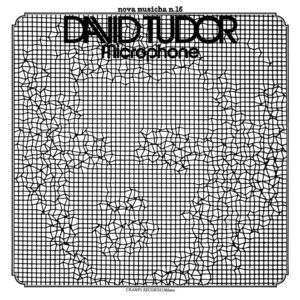
David TUDOR
“Microphone”
At long last, after decades out of print, the Milan based imprint, Dialogo, dives into the legendary catalog of Cramps, bringing forth the first ever vinyl reissue of David Tudor’s legendary LP, "Microphone", part of an ongoing initiative dedicated to bring the imprint’s seminal output back into the light. Still mind-blowing nearly half a century after it was first released, now complete with a new English translation of the album’s original liner notes, this is just about as exciting as reissues come and not to be missed.
Edition of 300 LP on black vinyl. Audiophile pressing, including printed inner. Perfect replica of the original packaging and newly remastered for optimal sound.
The only source of Microphone’s sound is the modulation of a microphone feedback produced in a distant echo chamber. The incidence and duration of the sounds are produced by the action of extremely close (narrow band) peak/notch filters (used in both modes), inserted into the lead signal. Each of the 9 versions is performed by the composer and simultaneously recorded on four tracks. Then the four tracks are spliced onto two, using a pan-matrix. The final product is a library of 9 stereo tapes, each about 32 min. long, which can be used in any combination, for live performances or for electronic installations. In these performances the tapes are played and stopped at any point, rewound and played again, altered in amplitude and/or equalisation, rotated on any given channel, etc., at will, for any period of time.
A live performance of Microphone (for instance without tapes) can be achieved by employing (a minimum of 4) performers using duplication systems, each one with 2 speakers.
This 1973 instantiation of Microphone covers a work originally conceived for the Pepsi Pavilion of Expo ‘70, in Osaka, Japan. Conceptually, the original work derives from discoveries made through the composer’s collaboration in the design of the Pavilion’s acoustic system. Sound diffusion was achieved through the use of 37 loudspeakers placed in a rhomboid grid system covering 3/4 of the sphere.
The loudspeakers could be “temporalised” at the entrance and exit of sounds, at variable speeds, following predetermined spatial models. The composer experimented with highly directional microphones, randomly pointed in space and amplified at the feedback level. The resulting signals were controlled in incidence and duration solely by the action of the loudspeaker’s temporaliser. Modulators, with variable features, designed and incorporated into the sound system by Gordon Mumma, were placed in the lead signals in order to vary the musical content of the feedback signals.
These experiments, although carried out through a compositional process, were not recorded in the Pavilion, due to the presence of “ambient noise” created by the multiple electrical fields. However, since the “tuned space” concept is now involved in Tudor’s compositional processes, the work could be recovered using variable bandpass filters (but capable of accommodating or excluding a cycle), and “q” variables, such as “tuning” elements, instead of operative loudspeakers. The used filters are manufactured by Ling Electronics, California.
The original tapes for Microphone were recorded in May 1973, at the Mills College Centre for Contemporary Music, using funds from their multi-track recording research project.
The recordings were conducted by Robert Sheff, with assistance from John Bischoff.
The two versions of Microphone featured in this recording were made with the assistance of the ZBS Foundation, Fort Edward, New York. Such grants were possible thanks to the public funds from the New York State Council of the Arts.
26,00€
Out of stock
LP
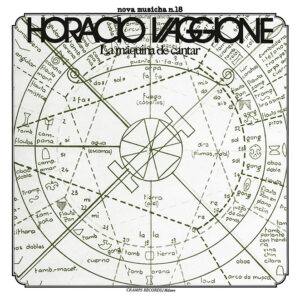
Horacio VAGGIONE
“La Maquina de Cantar”
At long last, after remaining out of print for decades, the Milan based imprint, Dialogo, dives into the legendary catalog of Cramps, bringing forth the first ever vinyl reissue of Horacio Vaggione’s LP, "La Maquina de Cantar", issued as the 18th instalment of the label’s Nova Musicha series in 1978 and among the most important examples of Latin American experimental music from the 1970s. Engrossing and creatively riveting, heard more than 40 years on its rippling electronic tones recast the terms of minimal music and shatter the historic perceptions of these sounds.
Edition of 300 LP on black vinyl. Audiophile pressing, including printed inner. Perfect replica of the original packaging and newly remastered for optimal sound.
Horacio Vaggione was born in Cordoba (Argentina) in 1943. He co-founded, in 1965, the Centro de Música Experimental de la Universidad de Cordoba, Argentina.
In 1966, he was awarded a Fullbright scholarship that allowed him to travel through the USA, where he visited several electronic music studios (Columbia, Illinois, California) and met John Cage. From 1969 to 1972, while living in Madrid, he belonged to a “live” electronic music group with Eduardo Polonio and Luis de Pablo. He was also in charge of the ALEA group’s electronic music studio.
In 1973, he visited the Far East. In 1974/75 he toured in the USA and Europe, more precisely with E. Wiener and the Kevan Cleary and Dance Company, while he was working in various electronic music studios (New York, Oakland, Montreal and Paris).
La Maquina de Cantar was produced in 1971, using the IBM 7090 computer owned by the data processing centre of the University of Madrid. Sound synthesis was carried out by a team under the technical advice of Florentino Briones, director of the centre.
The complete system is a “hybrid”, as it is made up of digital and analogue operations. To begin, the composer writes his “score” in musical notation and then transcribes it into decimal numerical notation. This numerical notation is then transcribed into the machine’s language, in the form of punch cards; in this way, the computer receives all the data that it has to process and translate into sound. At the same time, the POPOVA program, which supports all the operations, is also launched. The sound is produced in the central unit of the IBM 7090, via high-speed magnetisation changes. So, the sound values will be expressed in the form of the number of magnetisation changes (bits). Once the sound and its envelope have been generated through this digital process, the next step is to send this information to an analogue section, consisting of a series of filters, a VCO (voltage-controlled oscillator), and an echo chamber.
Contrastingly, Ending is a work for live electronic keyboards. In this version, three Minimoog synthesisers (played by the composer) and a Yamaha organ (played by E. Wiener) were used. The work is dedicated to Robert Ashley.
26,00€
Out of stock
LP
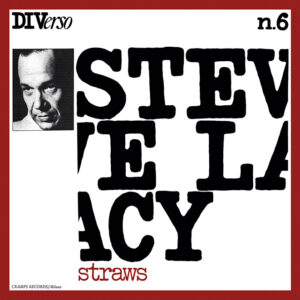
Steve LACY
“Straws”
At long last, after remaining out of print for decades, the Milan based imprint, Dialogo, dives into the legendary catalog of Cramps, bringing forth the first ever vinyl reissue of Steve Lacy’s LP, "Straws", issued as the sixth instalment of the label’s DIVerso series in 1977. Truly singular in the legendary American saxophonist’s discography - featuring stunning solo excursions and dialogs with himself - it remains one of the great documents of 1970s improvisation, and is as engrossing, creatively riveting, and as ahead of its time today as it was when it was laid to tape. Complete with original liner notes penned by Lacy himself.
Edition of 300 LP on black vinyl. Audiophile pressing, including printed inner. Perfect replica of the original packaging and newly remastered for optimal sound.
I can’t explain my work in words. For me, the music explains itself in sounds.
The saxophone is a machine like another, and it is only by breathing life into it, that it becomes of human interest. When I began to explore the possibilities in the soprano sax in 1950, it was in almost total disuse. By now, due largely to the example and inspiration of John Coltrane, but also somewhat to my own efforts, this instrument is in full flower.
Performance and composition are the two principal sides of my musical activities. Naturally, there is a constant feedback from one to the other. However, a musician is a sort of «medium», and quite often, the work is done in a state of trance, and only afterwards, can one realise what has happened, especially in a music which deals in large doses of improvisation.
This record contains two solo pieces, two more with celeste accompaniment, as well as two collages with background tapes.
Pinochle is a game of cards, enjoyed by the great pianist, Art Tatum. One of the most important «players» in jazz, Tatum had an enormous influence on me, especially as virtuoso, self-contained, soloist. In the course of this interpretation, I quote from a standard tune that Tatum used to like to play («Get happy» by Vincent Youmans).
Straws was written when Igor Stravinsky died, but has not been played ‘til now. This version uses a single strand of the melody, superimposed on a tape I made of three clarinet players and two saxophonists (myself included), trying out reeds, in a room at the Vandoren Reed factory in Paris. The piece is a solemn blues with joyou’s interferences.
Hemline is a recent tune, dedicated to Janis Joplin, the rock star, who was a tragic swinger, and one of the more interesting of the «new style» ladies on the scene in the late 60’s.
Bound to Irene Aebi, my «old» lady, whose voice I prefer to all others. This song (written in 1971), begins as a ballad, then turns blue (finally becoming grey and wise, at the and.
Feline (portrait of Marilyn Monroe). I wanted to capture the allure of the ordinary girl within the goddess, and the solitary space surrounding a «star». The celeste was discovered in the studio. The pussy-cat improvisation was sipped through the saxophone, as if it were a straw.
The rise is built upon a tape recording of sounds from the construction of the, still unfinished, centre culturel de Beaubourg, in Paris. Five layers of soprano sax are added on, all of them, improvised. A sort of « poeme sonore », it is dedicated to my good friend, Brion Gysin, the many-sided artist, who is himself, a «rising star».
Steve Lacy
26,00€
In stock

CD
Asmus TIETCHENS
“Ptomaine 1”
Asmus Tietchens is a sound artist and composer from Hamburg, Germany. He got interested in Musique Concrete by listening to a German radio programme when he was 10 years old. In 1965, at the age of 18, Asmus started experimenting with tape loops and turned them into musical collages. Soon, the use of synthesizers was added. In 1980 his debut album Nachtstücke was released, produced by Peter Baumann of Tangerine Dream. This was soon followed by a series of albums of electronic pop music for the Sky label, home of many Krautrock bands. Tietchens often uses special source materials for his compositions such as water (Seuchengebiete), human voices (Von Mund zu Mund), paper (Papier ist geduldig). He is associated with the Industrial music scene through his collaborations and releases on labels such as United Dairies, Esplendor Geometrico or Dom Records. Tietchens never studied composition, he has no academic background, everything he does is self taught or learnign by doing. Nevertheless, he was professor for sound design in Hamburg in recent years. Ptomaine was originally released on RRRecords in 1996 as a 3 LP set. This is the first volume of the first ever CD re-issue.
12,50€
Out of stock

CD
Joke LANZ & DIEB13
“Musical Education”
Joke Lanz was born in Basel, Switzerland and is a well-know noise musician, performance artist and turntablist. He is also founding member and singer in the art rock group Sudden Infant, a meber of the legendary Schimpfluch group (alongside Rudolf Eb.er, Dave Phillips, Marc Zeier and Daniel Löwenbrück) and performs in many duos and and other forms in the improvisation scene. He also writes music for theatre and film, radio, installations and objects. Dieter Kovačič aka Dieb13 is an Austrian improvisational musician who mostly works with turntables. Since the late 1980s he has been experimenting with cassette players, vinyl records, CDs and harddiscs. He has a duo with Billy Roisz which combines electronic music with experimental filmmaking. In autumn 2020, the two met in Vienna for a concert at GrillX. Three turntables were used and the result was amazing: stunning sounds, great humor, heads full of ideas. This CD is a recording of that show.
12,50€
Out of stock
CD
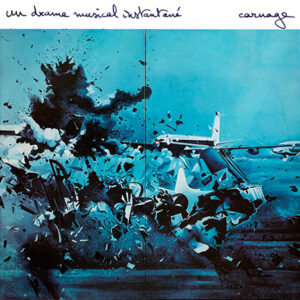
UN DRAME MUSICAL INSTANTANÉ
“Carnage”
Un Drame Musical Instantané were founded in 1976, featuring Jean-Jacques Birgé, Bernard Vitet and Francis Gorgé. Their aim was to promote collective musical creation, co-signing their albums, which they consider as artworks in themselves, or their live shows which they tried to renew every time they played. Their sound was created with many influences: They borrowed their sources from rock (synthesizer player Birgé and guitarist Gorgé, both authors of the album, Défense de); jazz (trumpeter Vitet who founded the first free jazz band in France, together with François Tusques, as well as Michel Portal who played with many American and European jazzmen); classical modern music; as well as movies or world news; they were the first in France to give a new impetus to live music on silent movies. After having improvised freely for many years, they led a fifteen piece orchestra from 1981 to 1986, and from 1989 onwards they produced multimedia shows (live video remix on a giant screen, fireworks, choreographies). Still their music was the most important technique, they called their recordings "blind cinema". The Drame used to mix acoustic and electronic instruments in real time as well as original instruments built by Vitet (a reed trumpet, a multiphonic French horn, a variable tension double-bass, a giant balafon with frying pans and flower pots keyboard, a fire organ, plexiglas flutes, etc.). After Francis Gorgé left the band in 1992, Birgé and Vitet went on recording and producing with other musicians close to the "family" such as percussionist, Gérard Siracusa, or multi-instrumentalist, Hélène Sage. Un Drame Musical Instantané always remained independent (they always owned their own recording studio and record label GRRR) and stopped its activities in 2008, with Birgé being the only one active until this day. Carnage was the band's 6th album, released in 1985 on their own GRRR label. It sees the band back to their most famous trio format consisting of Birge, Gorge and Vitet.
12,50€
Out of stock
CD
Giuseppe IELASI
“its appearance, reflected by three copies”
Electronic music, composed and mixed in May 2021.
Original materials recorded in January 2018.
12,00€
Out of stock
CD
Luigi TURRA
“Prisma”
“It forms slowly, through the refraction of light. It penetrates and breaks it down, radiating the listening space among the windows oriented to the spring sun. Oblique plates, breath and transparencies. Stillness. Sound prisms.”
'Prisma' is the first solo album from Italian composer Luigi Turra on 901 Editions, despite his long-term relationship with the label and appearances on various collaborations and compilations: 'Ma 間' with Fabio Perletta (2020), 'Kailash' with Shinkei (2016) and the piece 'Ki IV' (2016) for the series 'Quark: How Does The Invisible Sound?'.
Three years after 'Fukinsei', his latest solo album released by the Japanese label mAtter, Turra further develops his sound path, free from compromises and inclined toward radicalism. With Prisma, he continues to stylise his personal electroacoustic research, through a renewed reductionist guise in which corrosive metallic abrasions placed on the proscenium are retracted as sudden caesuras to leave space for rarefied and distilled piano styles, close to the most essential Ryūichi Sakamoto.
'Prisma' transfigures the sound images through an elegant impulse of refractions, consisting of sound / pause / noise that originate from silence and that are reabsorbed into it, through iridescent elliptic tensions.
A silence that reveals itself as suspension and antithesis to the suffocating fullness of language in order to trace a sound idiom, a balance between action and expectation.
The articulation of the elements is intimate, suspended and the logic of the combinations/juxtapositions subjectively unfolds in the progressive listening experience through an incorporeal diffusion, resolved in sound textures that dig out matter to highlight its residues.
13,00€
In stock
CD
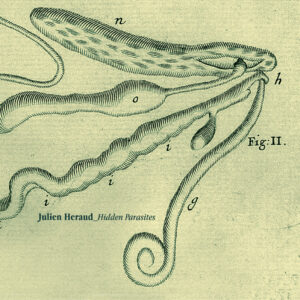
Julien HERAUD
“Hidden Parasites”
Hidden parasites is a collection of electronic pieces pretty minimal and simple for those I tried to conserve the intensity of harsh and abrasive noise and the subtlety and narrativity of electroacoustic compositions.
Hidden Parasites is an immersive work into subtle high feedbacks, destroyed samples, bass drones and weird raw recordings. It's not meditative, but all the tracks explore modulation and change into a range of long durations where I tried to create organic landscapes and a contemplative narration form. [Julien Heraud]
10,00€
Out of stock
LP
Francisco LÓPEZ
“Animast”
"Few albums would be as fitted for vinyl release as this one. Drawing on both analog-material and digital-immaterial undisclosed sources, "Animast" plays with the sonic textures and responses most suited for the characteristics of this particular analog medium: noisy crispness, compositional 'loopiness', contrasting sharp-and-thick textures and cycling dynamics. A must for experimental heads and adventurous DJs alike!"
untitled #369
Created at mobile messor (Anatananarivo, Dublin, Madrid, Den Haag and Dune Studio (Loosduinen), 2018-2019
untitled #365
Created at mobile messor (Paris, Valencia, Oslo, Venice and Dune Studio (Loosduinen), 2018-2019
20,00€
In stock

LP
Pascal BATTUS & Magali SANHEIRA
“Froid solaire”
Pascal Battus : guitar pickups, objects
Magali Sanheira : microphones, metal, stone, motorized bow, effects
Coming from different backgrounds and driven by an experimental (and plastic) relationship to music, these two improvisers come together through the choice of their instruments and aggregates of so-called poor materials, which they use for their qualities of texture and color, in order to create a composition where the importance of the sound gesture is primordial.
It is this gesture, always delicate, which by insistence or intermittence comes to draw fleeting figures of a bottomless background, thus developing an abstract and vibrant landscape that invites the listener to travel in the sound wave.
100 copies.
22,00€
In stock

CD
CARBON SINK
“Matière noire”
Gaël Angelis : Enigma DIY Synth, granular sampler, effects, field recordings
Magali Sanheira : Guitar, vehicle spring, bows, objects, effects
Recorded live @ Centre d'art Les Tanneries, Amilly 2018
10,00€