
In stock

Book + CD
Philip SAMARTZIS + Eugene UGHETTI
“Polar Force”
From Eugene Ughetti
As Philip was preparing to leave for his second Australian Antarctic Division residency, he invited me to lunch to discuss the possibility of collaborating on a new work. He recounted his first experience on the ice, where the surrounding landscapes seemed to articulate avant-garde percussion works of an epic scale. On this visit, he wanted his field work to explicitly shape the formation of a new performance work with a particular focus on katabatic winds in and around Casey Base station.
Intrigued, I accepted the challenge provided I could create a live performance utilising the same recorded materials of ice, air and water. We undertook an ambitious collaboration with sound, instrument, lighting and industrial designers, a dramaturg and percussionist.
For Polar Force we built an environment, a white inflatable structure reminiscent of a remote research station on the ice. Emanating from outside the space come the complex and foreboding sounds of the natural environment, inside, a live event akin to scientific research in sound occurs. This hour-long performance installation work gives rise to a hyper-realistic sensing of Antarctica, bursting with natural beauty, power and the audible evidence of human impact.
Concept, Composition & Instrument Design - Eugene Ughetti
Direction - Clare Britton and Eugene Ughetti
Field Recordings - Philip Samartzis
Performance - Matthias Schack-Arnott & Eugene Ughetti
18,00€
Out of stock

CD
Toshimaru NAKAMURA
“Culvert – No-Input Mixing Board 10”
From Toshimaru Nakamura
There used to be several small streams in west Tokyo, where I live. Some of them were natural rivers flowing from springs in this area. Others were from further west.
Towards the east, down to the sea of Tokyo Bay, there are others which were man-made, created to distribute water. Now, most of these rivers are covered by concrete lids and many parts of them are converted into pathways with nicely lined-up trees and benches. Some stretches of these rivers even have an artificial brooks on top of the lids to recreate the landscape of the old days. Sort of a “double decker river”.
Sitting on one of those benches, I think of the water flowing below, in the dark.
Played, recorded, edited, processed and mastered by Toshimaru Nakamura at his home in Tokyo from April to June, 2021
12,00€
In stock

CD
Megan Alice CLUNE
“If You Do”
From Megan
On the 9th of August 2020 I had a dream I wrote an opera. I had been unable to write much music since February, when I returned from 3-months in Tokyo where this album was initially conceived. It was possibly the longest creative break I have undergone in the last 5 years. But suddenly, the small melodies I had been singing closely into my microphone late at night, quietly so my neighbours wouldn’t hear, took on a larger scale, and one that seemed to echo the scale engendered by 2020. The confinement to the home, the epic events going on outside. My small, timid voice filtered through a myriad of technologies as I talked to friends, taught online; amplified, distorted, compressed, equalised. Sped up, slowed down as my wifi drops in and out.
If You Do became an album for solo voice and an ensemble of technologies. An album about contorting the body (voice) through time (rhythm, pulse), repetition and form. The work is nostalgic for past futures: wishing for the technological optimism of the late 70’s and early 80’s, of Timothy Leary believing the computer would offer a liberation to the masses. A time before Big Tech, Big Data. It’s a record made alone, dreaming of unmediated interaction with an audience that may never arrive. A sense of longing for the future that could have been, sung by a wordless choir and sometimes a clarinet. A return to my first instrument, and another kind of technology, I guess.
Back in Tokyo, I noticed how physical and digital spaces were being dislocated. I was wondering how we got here, thinking about where that leaves my music in light of this. I began collecting each of the track names from my surroundings - things read or overheard or gathered both in Japan (the title If You Do came from a necklace found at Ohi Racecourse Flea Market) and, later, at home, online. As such, the album occupies an amorphous space. Within the genre of ambient music but only just. It creates a space that is still heavily mediated, but hopes to locate and communicate directly.
Then, at my computer, stuck in a glitching, echoing loop, I was looking for signs to keep writing. I listened to Laurie Anderson’s Big Science or David Bowie’s Subterraneans or Underworld’s Born Slippy.Nuxx once more. I thought about re-reading Homesick for Another World; I watched some interviews with Laurie Spiegel on YouTube. After the dream, in the verge outside, clover kept appearing and suddenly it was Spring and there are flowers. And here we are: If You Do.
Vocals, clarinet, production, recording and mixing by Megan Alice Clune
12,00€
In stock

Book + CD
Lawrence ENGLISH
“A Mirror Holds The Sky”
From Lawrence English
In late months of 2008, I had the great fortune to spend some weeks in the Amazon. The visit, facilitated through Francisco Lopez’s Mamori Artlab residency, remains one of the most deeply affecting experiences I have had. Each time I hear a Screaming Piha, which many would identify instantly thanks to their prevalence in Werner Herzog’s Aguirre Wrath Of God and Fitzcarraldo, I am transported back into a place that, to this day, features regularly in my daydreams.
The reason this place made such an impression is simple; the Amazon dwarfs us. This is not some vulgar display of power on its behalf, rather its a tangible reminder of our place in, and on, this planet. Once you step into the Amazon it prompts us (strongly) to refocus the perspective we hold of ourselves, of our ways of being, of our understandings and it (not so gently) reminds us that we are but one very minor function in an equation that extends in all directions across time, and space.
Living in Australia, tropical rainforests are not foreign to me. I would even say I am rather at home in them. My family, who lived and worked on the land of the Ngajanji people, had an admiration for, or in the very least a respect of, the rainforest. What makes time spent in the jungles of the Amazon different however is the scale and sheer volume (metaphoric and literal) of the life that inhabits it. Hundreds of thousands of narratives are in play moment to moment, their interactions flow together forming a perpetual cascade of arrival and departure, fertility and decay - these fundamental states are intrinsically linked and constantly informing one another.
The jungle is never silent. Even when you might expect the Amazon to be hushed, in those hours before dawn or in the heat of the midday sun, it is hardly what could be described as quiet. What might be true to say though is during these moments where the chorus of insects takes a step back, the jungle opens just a little. To listen in the jungle is to listen in close relief - in every square metre, thousands of insect cry out, their voices reducing the horizon of listening to a matter of centimetres at certain times of the day (and night). The sensation is sensorially disorienting and frankly, overpowering.
In those moments where you can get a sense of dimension and depth, the dynamism of the environment comes to the for. The abundance of birds, mammals, beetles, flies, ants and so many other creatures are a source of constant and evolving fascination. In the lakes and rivers too, the hydro-sonic environments are perpetual and effortlessly deep. It’s humbling to acknowledge how little we come to know of that which lies just below us.
A Mirror Holds The Sky is in some ways an act of acoustic and temporal compression. It is a rendering down of the lived in moments and environments that became points of intense listenership. If I am to be honest, it has taken me the better part of a decade to know how to approach this archive of materials. I owe a debt of gratitude to Chico Dub at Festival Novas Frequências, who very gently encouraged me to realise a piece for diffusion as part of his program in 2019. That invitation retuned my ears and in the process unlocked a way of approaching the mammoth 50+ hours of recordings I had gathered during my time there. I also owe a special debt of gratitude to my wife Rebecca, who was instrumental in gathering some of these recordings. Her ears reflected an entirely other set of interests than my own and without that, this piece would be substantially less than what it is.
Recorded in Dec 2008, Lago Mamori, Amazonas.
18,00€
Out of stock

Book + CD
David TOOP – Akio SUZUKI – Lawrence ENGLISH
“Breathing Spirit Forms”
From Lawrence English
I am ceaselessly fascinated by how memory operates and, I’m regularly struck by how individually subjective a collective experience can be when recalled by its participants. Lynch’s Lost Highway comes to mind here, specifically Bill Pullman’s character Fred Madison who says “I like to remember things my own way. How I remembered them, not necessarily the way they happened.” Like Madison, I can’t help but sense that memory takes shape through an accumulative process that reflects how each of us have lived (and maybe even wanted to live) up to that point in time.
Going back to listen again to these recordings of which I was a part with David and Akio, I was surprised by what elements had stayed with me and what others had slipped into the eternal greying of my mind. I have vivid recollections of listening to a Lyre bird before recording the pieces together at Witches Falls. I remember both Akio and David finding musicality in decaying palm fronds. I remember Akio’s voice, amplified through his Analpos, bouncing off the stones and trees. I remember David’s flute, so quiet in the pitch black of the night forest as to appear like a hushed tone of wind or a distant animal calling. I also remember trying to match my modest hand held electronics with the pulsing and pitching of the insects around me.
Reading David’s text, which is included in the book published alongside this edition, he recounts several things I had forgotten. Conversations about memory, ironically enough, had vanished from my mind until reading his words. I also didn’t really remember my role as tick surgeon, removing a living insect from David’s ear. I do remember his cooking though, as does Akio (captured aptly in his drawings), no doubt a testament to David’s improvisational culinary expertise.
Breathing Spirit Forms represents a distinctive exchange between friends and collaborators. Tamborine commands a special presence and encourages a deep patience from those who are willing to give time to its varied environments. For the three of us, we were fortunate to share these moments together, fleeting in our lives as they might be, to sense the mountain’s unique qualities, to respond to them through our exchanges and to form memories (as disparate as they might be) we carry forward with us in time.
David Toop - Flutes, sticks
Akio Suzuki - Analapos, flutes, stones, sponge & hand mirror, pocket bottle & mallet
Lawrence English - Shortwave radio, handheld electronics, percussion.
18,00€
In stock

CD
CELER
“In Light Of Blues”
From Will Long
It was months ago, but it could have been weeks, days, or even hours since then. I stopped wanting to hear loops, I wanted to stop it. I added brass; trumpets, trombones, and more horns. I cut it out like words from a book, and sewed it back together. Burroughs. These movements are merely to stay alive, to stay moving.
You wake up from a truck horn passing in the early morning hours on the nearby freeway, or from a dream that you can't tell was a nightmare or a loving memory.
Someone walks by on the street wearing the same perfume. I drew out each place, each scene, and put the story there. It might have been with you, or without you. All I know is that you were there somehow the whole time, even if you weren't.
I saw rainbows from under the bridge by the river, and the sun shot up through the clouds of the golden hour. It didn't help, and there was no one around. Your chest is even with your knees, and you're sitting in the dirt. The sun keeps going down, and eventually you make your way home. It's not very much the same as it was anymore. The horns are deafening, but after, the echoes let me see the way away.
The light keeps coming, and it keeps going. Songs of surroundings, the silent, the heartbeats, the tears. We've all had them, and we'll never be rid of them.
12,00€
In stock

CD
Yann NOVAK
“Lifeblood of Light and Rapture”
When I began working on Lifeblood of Light and Rapture I was thinking a lot about both my personal and society’s tendencies towards nihilism. When I was in grade school, I was taught that 2020 would be the turning point in our collective fight against climate change—that if we did not change by then, there would be no turning back.
After learning this at a young age, I watched helplessly as little was done to save the planet. It made me certain that I would not live to see past 2020. It was this moment in my childhood, along with so many other experiences in the 80s and 90s, that led me to a hedonistic coming of age. I pursued anything that would transport me away from the darkness in the world and its inevitable doom.
Now that 2020 has come and gone, I have the luxury of hindsight. I can look back and see that so many of my decisions were made not to destroy myself, but in order to self-medicate. In my teens and twenties, the world was a difficult place to inhabit, but I could use chemicals and other distractions to cope. Similarly, as it turns out, this is also the story of the industrial, technological, and digital revolutions. Even though the intention of these eras was to make the world an easier place to live in, most of the progress attributed to them over the last two centuries has directly contributed to the climate crisis. On Lifeblood of Light and Rapture, I wanted to explore this parallel—that so many of the things we do to try and make this world liveable also contribute to its destruction.
Formally, this album follows the path I set out on with Slowly Dismantling. I sought to express myself in a more immediate and honest way through the use of digital and analog synthesis. With Lifeblood of Light and Rapture, I built upon this same path; but I also tried to imagine the listening experience over the process of making it, focusing solely on the pure pleasure of listening. I hope this record breaks that cycle, that it can achieve its intended purpose of bringing light into the world without causing any damage.
12,00€
Out of stock

CD
Siavash AMINI
“A Trail of Laughters”
rom Siavash Amini
A series of distressing dreams started this whole thing. A few years ago someone pointed out that my repeating dreams of being lost in what seemed to be a maze of pits, reminded them of stories about wonders of wells and pits in the Book of Marvels.
More than a year ago I started having those dreams again, so I read the book. There were similarities with a few of the stories but nothing more. One of the stories made an impression on me more than the others. After being done with the vain project of finding my dreams in a book from 12th century, I started obsessing about every detail of that certain story. Borrowing from distressing artifacts of my own subconscious and mixing them with all the details described or all the things left out of that particular one story, a musical project was starting to take shape in my mind.
Working outside the systems suggested by 12 tone equal temperament, has been a passion of mine from the start of my musical life. I released one track on my first EP doing that, a failed experiment. After that I kept on studying the subject. Whenever I got the chance, I tested out an idea borrowing from other systems of tuning and their suggested compositional techniques.
Imagining a musical equivalent to those distressing dreams and the scenes from the book was a very good opportunity to test out the oddest juxtapositions of the said systems, a formidable but suitable task. The sound, in my mind had to be murky, hazy, highly textured, crackling, resonant yet dingy and distant. It eventually took the shape of an album. The techniques I learned and used during the making of these pieces will remain in use in my musical activities for a long time. This album with all its shortcomings is about distressing dreams/realities of being lost in the darkness of a pit and the sounds/creatures that lead you to it, based on my own dreams and a few lines from an old book.
12,00€
Out of stock

CD
MERZBOW
“Scandal”
Scandal collects together three newly unearthed and revised pieces from Merzbow recorded between 1992 and 1995.
Each of the pieces here typifies work that sits at a nexus between the experimental cassette and electronic collisions of Masami Akita’s late 1980s works and the emergent noise language that resolved into a series of now legendary recordings completed during the mid 1990s. Scandal marks out a decidedly tandem path and acts as a critical linkage, forging the trajectory of Merzbow’s music across that decade.
One critical aspect these recordings capture, in a very essential way, is the role that field recordings and tape manipulation play in his music. Throughout the 1980s, cassettes, tape editing and found sound played a significant role in the development of Merzbow’s sound.
On Tokyo Blue Sky, Merzbow collates a series of field recordings made around his home during a period of construction in his neighbourhood and merges these with sampled recordings from various ritual records. In these recordings are striking, hammered blasts that feel innately tied to the aggressive metal percussion work that was featured heavily on numerous live recordings during this time. They also maintain a sense of dynamic eruption that characterises the shifts between states of intense noise that are the core of Merzbow recording strategies.
The editions final piece Evening Scandal was originally released in 1992 on RRR as part of their recycled music project; a project that sought to reuse thrown away cassettes, re-recording over them with various recordings including some of those heard here. Scandal bares the marks of its medium, tape wow and flutter flicker across various sections of this piece, revealing a tactile relationship with the medium. The version collected here is different to that which was released in 1992, this version being uninterrupted by the pop song from which it borrows its name. This piece, in moments, maintains a decidedly minimalist compositional form, using repeated single strikes as a means of creating a deep sense of unease and recurrent tension. It’s a technique later deployed with devastating ferocity later in the 1990s.
This edition is also published with a special fold out poster featuring a previously unseen collage from Masami Akita.
12,00€
Out of stock

CD
Richard CHARTIER
“Interreferences”
A note from Richard Chartier
I find myself at the collision of an inflection point and more over a reflection point. 50 years on this planet. I still find it difficult to write about my work. This is not because I cannot, but because I want the listener to approach my compositions of sound as such. Focus on the sensorial nature rather than an explicit narrative or reasoning.
I do not see my work as abstraction but rather purely abstract.
I chose sound as my medium after many years as a painter. I slowly came to conclusion that I no longer understood how to communicate sensation via a pigmented surface. The visual language I was using had become foreign to me.
Sound allowed me a language that was wordless, open, moving, shapeless yet full of forms, connections, and progressions. It raised questions though and these are still part of what I struggle with in the ways I chose to create and then speak of my work
why these sounds?
what is the attraction to these sounds?
how did I arrive at these compositions and their placements?
The pieces exist then as less of a statement, more of a question, but a question that will be different for each listener. For me, listening to them over and over, they will take another form as time passes. They evolve. For now though, they are in limbo on a piece of plastic or a series of lines of data
Often i am puzzled by how other artists create their work, how they come to decide arrangements, sequences of sounds or just the sounds themselves.
That is the magic of music.
12,00€
In stock

CD
David SHEA
“The Thousand Buddha Caves”
A Note from David
My path to the caves began when I was about 14, with my passion for reading Taoist, Buddhist and Zen texts, my love of Hong Kong films, Bruce Lee’s influence, martial arts more broadly and meditation practice which has continued since that time.
In 1980 the series of films The Silk Road produced as a collaboration between NHK television in Japan and CCTV in China explored areas of the “Silk Road” in great detail and knocked me sideways. It laid the foundation for a life of exploring what these trading routes were and what the reality of the people living along it, travellers on it and the culture, music, art, history and rituals they created.
My works Hsi -Yu Chi, The Tower of Mirrors, Satyricon and Rituals were all recordings based on adaptations of the myths, historical adaptations and connections to the many trading routes throughout the ancient world and its connection and relevance to current technological culture, through the process of building a new work on the structure of an existing novel, film adaptations or sets of ritual practices.
The more I explored the specific history of the trading route from ancient Xian to Rome, the clearer it became that the Silk Road itself was a myth, a simplified 19th century explanation for a vast and very complex network of information, religious teachings, economic trade, spices and silks etc. that involved thousands of tribes, nation states, indigenous cultures, belief systems and spanned what only much later historically do we now speak of as the divide between east and west. The mountain of archaeological finds and research over the last two centuries is just beginning to be unravelled and the complexity of the purposes of the trade routes is exposing many new connections between the ancient realities of Africa, Asia, India, Europe and the Pacific region. The trading was contact and interest in difference, what does your culture have that we need, an economy of difference with less need to synthesise the traditions than to find practical connections to the value each culture may or may not have for another culture.
It was this trading of cultural traditions, cosmologies, mysticisms, esoteric knowledge, historical eras and forms of rituals that became the entrance into the Caves for me. I immersed myself in the music, stories, history and Buddhist influences, looking for connections to this century; the technology, the underlying belief systems, the dance, design, architecture, painting, film, mixed forms and including the misunderstandings that create hybrid forms as cultures and time periods absorb, fight, steal, destroy, mythologise and trade from and with each other.
12,00€
Out of stock
CD
Lawrence ENGLISH & Stephen VITIELLO
“Fable”
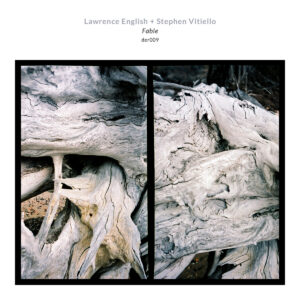
Lawrence English and Stephen Vitiello are creators of mythology. Their mythology renders a series of acoustic spaces, haunted by narrative and hinting at happenings unseen, but certainly heard.
With Fable, we are presented with their second duet. It chronicles three years of intermittent audio communications in search of new collaborative approaches. The results focus on the pair’s joint interests in modular synthesis, field recordings and the blurry boundaries between acoustic instrumentation and electronics. The album’s multiplicity of sources creates a weaving and at times overwhelming collage of materials that coalesce with considered intent. Its palette, whilst diverse remains focused and as the album progresses themes of arrhythmic percussion, electronic-like field recording, prepared piano and vintage synthesis begin to take form.
Like the photography of the cover, these musical pieces bare witness to time, they exist in the moment, but are formed outside of a sense of singularity. Their textured qualities and intricate variations are evidence of an iterative production methodology that invites a depth of listening. A pondering and the intended goal that one may hear or even see their own internal spaces, haunted by a cast of sonic characters.
12,00€
Out of stock

CD
Chris ABRAHAMS
“Appearance”
A note from Lawrence English:
I first met Chris Abrahams sometime in the early part of the 00s.
In 2003, I had the pleasure of spending a very late night glued to his sofa, lights diminished, being introduced to his solo work. That listening experience became known as Thrown, a record that to this day haunts me with its electronic timbral shifts and wheezing positive organ textures.
Since that release, Chris’s work has resided at the very heart of Room40. His music captured across his five solo editions is, I believe, both utterly personal and compellingly diverse. It is music that has been a source of respite, provocation and, most of all, inspiration for me (and many of you I am sure).
Over the years, I have gently encouraged Chris to consider making a solo piano recording to compliment the series of electro-acoustic works he has made for us. Appearance is the manifestation of this encouragement.
Appearance typifies a very particular approach to piano that Chris has cultivated across three decades. He creates a pairing of rippling cascades of tonality with a macro-minimalist compositional form that invites a sense of perpetual release. Notes cycle and gently coalesce to create weaving melodic patterns that accumulate into a slow unfolding of form, across time.
Chris Abrahams’ pieces, in many respects, defy an easy categorisation. He creates music that is unto itself, but profoundly open to the situations in which is it encountered. It’s this porous quality that makes his work so intoxicating. It is a music of moments, cycling in memory and accumulating across time in a way that is without compare. I can’t recommend Appearance to you strongly enough.
Chris Abrahams, Piano
Recorded by Phil Punch at electric avenue studios November 28, 2019
12,00€
In stock

CD
Lionel MARCHETTI + Cat HOPE
“The Last Days Of Reality”
2018 release.
From Cat Hope
I first met Lionel Marchetti in Australia during the Liquid Architecture Festival in 2010. Decibel were touring our Alvin Lucier program, and Lionel was on the same bill performing a live performance set manipulating electro-acoustic materials with dancer Yoko Higashi. I was so taken with Lionel’s performances and the resulting music, that I asked him if he would write a piece for Decibel.
I didn’t realise that he hadn’t done something like this before. The first work was “Première étude (les ombres)”, communicated as a text score, and premiered in 2012. I was asked by Lionel to make some recordings of ocarinas, harmonicas, and folk instruments – and I sent these to him for the creation of a ‘partition concrète d'accompagnement’– a fixed media part that is featured in the live performance. For this piece, the part comes from speakers beside each performer, and a bass amplifier beneath the piano. Like his own performances I had seen the year before, the work was naturally performative – with unique speaker and performer configurations, interesting and odd additional instruments. It was such a rich work, a remarkable combination of electronic, spatial, acoustic and textural music. The performers use the partition concrete as a score.
I visited Lionel in Lyon, France in 2014, recording flute improvisations in his studio. He used these as a basis for “Une série de reflets”, again communicating via text instructions and each performer having their own dedicated speaker to interact with. “Pour un enfant qui dort”, which again requested flute sounds that were this time part of the live performance as well as the partition concrète, was also written around that time. The next work saw a more ‘compositional’ collaboration - “The Earth defeats me" began as a graphically scored work written by me and recorded by Decibel in the studio. That recording was used to make the partition concrète which is now an embedded as part of the animated score file, thanks to the software we had developed to do so.
These works exist as live performances, but also as singular concrète works, when heard without the instruments. Working with Lionel has been remarkable: he has a singular way of thinking about sound and its relationship to works and images. Music concrete is a lifestyle for him, it is a way of thinking, communicating and being. These pieces enable the acoustic instruments to be part of that – extending the ideas in the partition concrete, using them structurally and texturally, as well as being part of them.
When I first met Lionel, I didn’t realise he was in Australia because it was originally planned he would be travelling with French composer Éliane Radigue, performing some of her electroacoustic works, as her preferred diffuser. I would commission a work for Decibel from Élaine (“Occam Hexa II”) in 2014 and it was during that process I realised the link between them. Decibel performed Lionel and Eliane’s music together – it is music that concerns itself with the incredible power of sound, but from the most delicate and dream like perspective.
12,00€
In stock

Book + CD
Akio SUZUKI
“Analapos”
In 1979, Akio Suzuki recorded a performance, ’New Sense Of Hearing’, at the Nagoya American Centre. During the performance, Suzuki used voice, turntables, glass harmonica and his self-designed instrument the Analapos to create a series of improvised pieces that effectively charted out his sonic investigations for the proceeding decades.
In 1980 these recordings were issued by ALM records as Analapos, the first work made publicly available by Akio Suzuki.
For going on six decades now, Akio Suzuki has been responsible for creating amongst the most otherworldly, yet deeply affective sound works of his generation. As a musician, sculptor and sound artist, Suzuki’s work threads an important linkage between Eastern and Western sound art practices. His approaches, that focus primarily on intense states of listening, ’throwing and following’ and a relentless sense of open curiosity, have allowed him to continuously deepen his work.
Originally published in an edition of just 200 copies in 1980, Analapos has been out of print literally since its release. Clocking in an over an hour, the original pressing of the recordings to a single LP, presented some technical limitations.
This 40th anniversary edition of Analapos is entirely remastered and is published with a booklet that includes a long form interview with Akio Suzuki conducted by sound artist and collaborator Aki Onda, plus extensive photographic documentation of the development of the Analapos. The publication of this edition is announced in conjunction with the Sense Of Ekō retrospective exhibition which opens at The Substation in Melbourne late January.
18,00€
In stock

LP
Francis PLAGNE
“The Refrain”
"Black Truffle proudly present The Refrain from Melbourne-based artist Francis Plagne, whose growing catalog of collaborative and solo releases range from song-based work to abstract audio collages. Closely aligned with Plagne's Moss Trumpet LP (released by Penultimate Press in 2018, PP 038LP), The Refrain's two side-long tracks mix sounds of the mundane with the otherworldly; rising, receding and overlapping. The result feels like being led through a series of scenes devoid of context or direction. Furthermore, it's hard to define the scenes as either inviting or disconcerting, as they're often both at the same time. As the record progresses sounds reappear and are juxtaposed so as to only hint at the familiar. A hall of mirrors, perhaps? Completed in 2020 using material recorded from 2012-2020, the record uses tapes of shelved, unfinished, and forgotten projects that featured field recordings from various locations, domestic sounds of plastic bottles, bubble wrap, creaking chairs, voice, and instrumental recordings, including an appearance from crys cole on Casio. These pieces were re-amped, processed and edited, then additional instrumental pieces featuring synths, guitars, plastic saxophone, melodica, and percussion were added, the results shaped into drifting, episodic assemblages. Although essentially a tape piece, The Refrain presents as a crude, non-idiomatic composition that feels both timeless and transitory. It's a million miles from the polish and rigor of GRM, perhaps more in line with Jacques Bekaert's eponymous Igloo LP, or Costin Miereanu's Luna Cinese. The Refrain could be read as a psychedelic Krapp's Last Tape; one man's response to listening through forgotten and discarded tapes, reflecting, reconciling, and forging a new path. A potent tonic for these absurd times." --Nick Hamilton, August 2021
25,00€
In stock

LP
Eiko ISHIBASHI
“For McCoy”
Black Truffle is pleased to announce For McCoy, a new work by Eiko Ishibashi dedicated to the widely loved character of Jack McCoy, portrayed by Sam Waterston in Law & Order. Following on from Hyakki Yagyō (BT064), For McCoy finds Ishibashi further exploring the unique space she has carved out in recent years, bringing together musique concrète techniques, ECM-inspired jazz, lush layers of synths and hints of pop into immersive and affecting structures crafted in her home studio, aided by a group of close collaborators.
Beginning with overlapping layers of descending flute lines, the expansive ‘I Can Feel Guilty About Anything’ (whose two parts stretch out over more than thirty minutes) unfolds with a free-associative logic, embracing dreamlike transitions and unexpected cinematic cuts. As a hovering cloud of synthetic tones and multi-tracked voices fans out from the spare opening moments, Joe Talia’s skittering cymbals settle into a gently propulsive groove, soon joined by melodic fragments performed by Daisuke Fujiwara on multi-tracked saxophone. As the drums cede to field recordings and ominous synth figures, the uncommon meeting of saxophone and electroacoustic techniques call to mind the more spacious moments of Michel Redolfi and André Jaume’s Synclavier-propelled oddity Hardscore or the early work of Gilbert Artman’s Urban Sax. As the piece continues on the LP’s second side, distant dialogue rumbles beneath a surface of processed flutes, blurring into a cavernously reverberant backdrop for stark ascending lines performed by MIO.O on violin. Eventually, the piece settles into a gorgeous passage of abstracted dream pop, where Ishibashi’s multitracked vocal harmonies glide atop synth chords, errant pings and snatches of outdoor sound.
Fragments of melodic material reappear throughout the spacious opening piece, finally stepping to the forefront on the closing track, ‘Ask Me How I Sleep at Night’. Here, over a shuffling groove supplied by Jim O’Rourke on double bass and Tatsuhisa Yamamoto on drums, layers of flutes, saxophones and guitars sound out melodies whose combination of twisting irregularity and soulful immediacy calls up prime Keith Jarrett, while their closely voiced harmonies suggest Kenny Wheeler or even Wayne Shorter’s Atlantis. In a classical gesture of closure, the web of melodic lines eventually leads back to the descending flute figures with which the record began. Presented in an immersive, impeccably detailed mix by Jim O’Rourke and arriving in a sleeve featuring Ishibashi’s beautiful drawings of Jack McCoy, For McCoy is an essential release for anyone following the enchanted and unique path being forged by Eiko Ishibashi.
24,50€
In stock

LP
David BEHRMAN
“ViewFinder / Hide & Seek”
Black Truffle is thrilled to announce ViewFinder / Hide & Seek, a new release from acclaimed American experimental composer David Behrman, presenting recordings made in collaboration with Jon Gibson and Werner Durand between 1989 and 2020. Last heard from on Black Truffle as part of the collaborative art song/live electronics madness of She’s More Wild, these recordings find Behrman continuing the pioneering work in interactive electronics that have established him as one of the major living experimental composers.
Side A presents excerpts from two live realisations of Unforeseen Events (1989), the fourth in a series of pieces focussing on the interactions between instrumental performers and responsive software. Like the classic earlier works in the series, On the Other Ocean (1977), Interspecies Smalltalk (1984) and Leapday Night (1986), Unforeseen Events is an “unfinished composition” in which a computer system listens for and responds to specific pitch cues from an instrumentalist. Performed by the composer on electronics and Werner Durand on soprano saxophone in Berlin in 1989, the first realisation immediately ushers the listener into an environment of long soprano notes, lush, sustained synth harmonies, randomised percussive interjections and distantly burbling arpeggiated patterns.
The 1999 realisation recorded in New York with Jon Gibson on soprano shows how much room for the instrumentalist to affect the course of the music exists in Behrman’s interactive pieces, in which, as he notes, ‘performers have options rather than instructions’. Beginning in a roughly similar area to the version with Durand, this later recording eventually becomes substantially more active, as polyrhythmically layered arpeggios and percussive patterns respond to fast chromatic lines and dynamic phrases from the saxophone, moving Gibson in turn to respond with cycling figures and moments of extended technique that touch on the soprano languages pioneered by players like Steve Lacy and Evan Parker. Yet even at its most active, the lack of conventional forward movement in the music allows it to retain what Behrman’s friend Jacques Bekaert called its ‘fragile tranquillity’, as episodes of activity appear only as momentary disruptions of an underlying calm.
On the B side, we are treated to a new collaborative work from Behrman and Werner Durand, building on the 2002 installation work ViewFinder, in which a camera detecting physical motion triggered changes to electronic sound. The piece presented here is a long-distance studio construction, recorded by Behrman in the Hudson Valley and Durand in Berlin, offering up an expansive duet between Behrman’s lush, gliding synth tones and the alien, untempered tones of Durand’s invented and adapted wind instruments. Presented in a stunning gatefold sleeve with art from Terri Hanlon, archival photographs and new liner notes from Behrman and Durand,ViewFinder / Hide & Seek is an essential release showcasing the continuing vitality of a legendary figure in experimental music.
20,00€
Out of stock

LP
Richard YOUNGS
“CXXI”
Black Truffle is pleased to announce the latest offering from underground legend Richard Youngs. Hyperactive since the late 1980s, Youngs is widely celebrated for his remarkably extensive and varied body of recordings. His works range freely over a vast terrain, wandering from tender acoustic balladry to raging psychedelic noise and orchestral D-beat, always imbued with his distinctive, often mournful, melodic sensibility and irrepressible sense of joyous experimentation.
Comprised of two side-long pieces, CXXI carried on the experiments with chance operations used to generate material on many of Youngs’ recent releases. On ‘Tokyo Photograph’, a slowly changing, randomly generated sequence of 121 minor chords played by sine waves and accented with a brushed snare hit on every change provides the harmonic foundation for Youngs’ fragile yet impassioned vocal performance, shards of field recordings and electronics and Sophie Cooper’s long, tape-echoed trombone notes. While the melancholic drift of the chords calls up prime Robert Wyatt sides like Old Rottenhat or Dondestan, only the most vestigial sense of song remains here, as Youngs arranges his minimal ingredients over a spacious fifteen-minute expanse that often drops to nothing more than the rich hum of sine waves.
‘The Unlearning’ carries on directly from the first side, presenting another, more harmonically varied, sequence of randomly generated chords played by sine waves, distressed with tape echo flourishes and sparsely sprinkled with electronic touches. Like some of Youngs’ most single-minded instrumental works in recent years, such as his recordings of foot-played guitar or his shakuhachi pieces, ‘The Unlearning’ is deeply meditative but entirely remote from ambient or minimalist cliches.
Named after the number of chord changes on the opening piece and (Chicago-style) the number of records Youngs has released, CXXI arrives in a striking monochrome sleeve featuring play-along chord charts for both pieces. Both rigorously conceptual and endearingly off-the-cuff, CXXI is classic Richard Youngs.
20,00€
Out of stock
CD
CONTUMACE
“Matt”
Lionel Fernandez temporarily abandons his Sister Iodine power trio to engage in a static bullfight with himself.
Synthetic miniatures & frequency lacerations.
Austere concatenations & petrified movements.
666 pairs of sunglasses in the country of eternal night.
7,50€
Out of stock
CD
Carine DONNEGER
s/t
Two electroacoustic pieces composed between the music school and the bedroom.
Etheric ramblings and contemplative wanderings.
Soviet tunes, siberian drone, sparse atmospheres.
7,50€
Out of stock
CD
Ken CLINGER
s/t
30 titles published by hyper-productive Ken Clinger over 26 cassettes between 1983 and 1988 and carefully selected for your greatest pleasure.
Mutant songs, hypnotic spoken words, obsessive synthesizers.
7,50€
In stock
LP
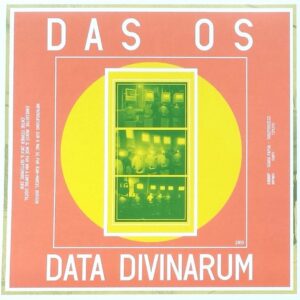
Das Os
“Data Divinarum”
jean-marcel busson is controlling 6 altered/mistreated mac SE
performative installation, organic technology, acoustic persistence, electrical ceremony, computer spectra
6 mac SE are controlling jean-marcel busson
co-produced w/ a1000p & suara papua
recording, editing & mix by mim
_
Excellent !
13,50€
Out of stock

2 CD
Tasos STAMOU
“Monoliths”
asos Stamou returns to Moving Furniture Records for his third album Monoliths. On this new album his electroacoustic studio works and live performances come together in a total of 5 exciting tracks. On the studioworks one sound source is used, while in the live works everything comes together.
About Monoliths:
The occasion of this double album is to present the two different practices in my music, live performance and studio work.
Although phenomenally coming from a different place, it is a result of years of experimentations to bring a simple yet complete electroacoustic set up both on stage and in studio. The original idea was to compose or perform with acoustic instruments generating sustained sounds in a way that, although electronically manipulated, would retain all the organic and sensual qualities of traditional organized sound making devices, often called “instruments”.
This release overall is presenting my most recent attempts to collide these two sides of music production and to deliver a sonic journey to my personal engagement with sustained music. ‘Moving Furniture Records’ has been my platform to release this sort of music since the beginning of this journey.
While studying the art of prolonging a sound for long enough to physically affects the listener, yet complicated and narrative enough to stimulate the mind too, these exploratory sounds are inspired by the acoustic instruments’ sonic qualities, always under the influence of the distorting mirror/ magnifying glass effects of electronic manipulation.
Tasos Stamou
16,00€
In stock

CD
John DUNCAN & T.R. KIRSTEIN
“John Duncan & T.R. Kirstein”
With the CD John Duncan & T. R. Kirstein we present the first collaboration works by Danish composer/artist Tobias R. Kirstein and American composer/artist John Duncan.
John Duncan & T. R. Kirstein is released on CD mastered by Jos Smolders in artwork designed by Kasper Vang with illustrations by Vernon Lee and photography by T.R. Kirstein.
About John Duncan & T.R. Kirstein
On May 31st, 2019, the day Roky Erickson from 13th Elevators died (I later found out), I woke up from a dream of sound and text. I dreamt that John Duncan kept repeating the words YOU ARE SAFE entangled with sine waves.
So I instantly shot him a message asking if it was too weird to do exactly that. He replied: “not too weird”.
(Tobias R. Kirstein)
11,00€
In stock

CD
ORPHAX
“Less is more”
With Less Is More we see Orphax return with his 4th live album for Moving Furniture Records. It is a live album recorded at the exhibition Less Is More at Amsterdam art gallery Factor IJ.
Less Is More is released as CD mastered by Jos Smolders in artwork with work Wladimir Zwaagstra.
About Less Is More
In August 2021 Moving Furniture Records curated a music program accompanying the minimal art exhibition ‘Less is More’, presented by Polderlicht at Factor-IJ, Amsterdam.
On this occasion the Orphax performance was recorded live. This CD features the full set – no edits, no cuts.
This live set merges Orphax’s fascination for minimalist art and his idiosyncratic take on drone music, offering warm and organic atmospheres in which the listener drifts away, losing not only senses of time and space, but – maybe, too – oneself.
11,00€
In stock

CD
Claudio F. BARONI & Dario CALDERONE
“Ursae Minoris”
Dario Calderone performs the new compositions Ursae Minoris by Claudio F. Baroni. Music inspired by the constellation Ursa Minor and the diaries of Italian humanist Ciriaco d'Ancona (1391-1455). Three new works composed specially for Calderone his double bass performance.
13,00€
Out of stock

CD
ORGANUM ELECTRONICS
“Fearceness”
4th volume of Organum Electronics project
An abandoned silence
Dreams of drifting, living a fateful solitude
Wrapped around a grey and foaming voice
Reaping impulse and mass like a forgotten beast
Lost to countless days and nights
Rocks and soil, sand and stars
In the sadness of being
Standing apart
Remember the rising flame from time long ago
A sound that shook deeply from the bottom of a boiling ocean
One voice of Mother Magma
Formless lava fashioned a primeval landscape
Ash, smoke and seething seas
A red-hot avalanche cascades endlessly
The Awakened Voice
Predestined from beyond the FEARCENESS
14,50€
Out of stock

CD
ORGANUM
“Raven”
2018
'RAVEN' is the first new Organum album release since that of 'SOROW' in 2010 (Siren Records) and was recorded in 2017. For the realisation of RAVEN, Organum was comprised of David Jackman, Alan Jones, and Daisuke Suzuki.
'RAVEN' is composed of striking piano-keys, church bells, temple gongs, a crow, a raven and a rook and is divided into 13 parts.
In 'RAVEN', sounds appear from silence and then return again into that silence.
'RAVEN' is a work within those very silences.
You can contemplate emptiness intently after the sounds have ended.
14,50€
In stock

CD
Thomas TILLY
“Codex amphibia (Phonotaxis)”
A new interpretation of the explosive frog breeding phenomenon.
Recorded, composed and mixed between 2016 and 2020 in French Guiana and France by Thomas Tilly, this pieces are part of a both scientific and artistic collaborative project conducted with herpetologist Antoine Fouquet, research associate at French National Center for Scienctific Research Cnrs. These compositions follow Codex amphibia (an interpretation of the explosive breeding), released in 2018 on Glistening Examples.
Thomas Tilly is a musician using the microphone and speaker as the main instruments of creation.
16,00€
In stock
CD
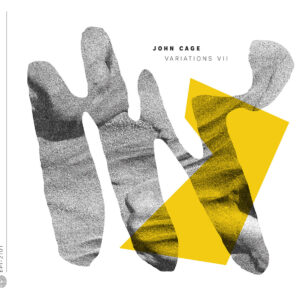
John CAGE
“Variations VII”
Variations VII was created by John Cage to be performed at a special event, 9 Evenings, Theatre & Engineering, held from 13th to 23rd October 1966 in New York and in which a team of engineers, led by Billy Klüver, worked with ten artists from the American “avant-garde”, with the aim of enabling them to extend their exploration of the possibilities of electronics in their own art. Here is how John Cage described this piece in the programme for the event:
« It is a piece of music, Variations VII, indeterminate in form and detail, making use of the sound system which has been devised collectively for this festival, further making use of modulation means organized by David Tudor, using as sound sources only those sounds which are in the air at the moment of performance, picked up via the communication bands, telephone lines, microphones together with, instead of musical instruments, a variety of household appliances, and frequency generators. »
Ten telephone lines connected to the sounds of ten different locations in New York City. History has taught us that one of the first uses of the telephone at the end of the 19th century was, besides transporting voices, the live re-transmission of concert performances of opera. A few privileged listeners could therefore listen to the music in their own homes. Several decades later, John Cage reversed this, so to speak, by inviting the sounds of several distant environments into the concert venue!
This recording of Variations VII by John Cage was made in public on 15th August 2020 as part of the 8th edition of Le Bruit de la Musique festival at Domeyrot (Creuse). 6 artists were present, supported by a sound engineer, and 17 others participated remotely.
John Cage did not really write a score for Variations VII. We therefore had to rely on the one hand, on precious documents from the time kindly sent to us by Julie Martin, and on the other, on our experience of performing other works by the composer.
The 6 participants present decided to use Andrew Culver’s IC and TIC programmes, available online, which allowed them to perform chance operations similar to those used by John Cage for the composition of all his musical, literary and pictural works from 1951 onwards.
There is no space here to enumerate all the questions that were put to these programmes for this performance, but the answers given included the total length of the piece, its division into sections for each participant, the order of the alternation between sound and silence, the families of objects and means used for each of these sections and even, when radios were used, their frequency range, etc.
Some used optical sensors which, when the audience moved, switched on various electrical devices. Moreover, the 6 artists had their own computer through which each received the audio of some of the online participants via videoconferencing software, each of these participants having received a time bracket score resulting from the same procedure, allowing them to turn the micro of their computer or smartphone on or off.
Although the context was very different from that of the 1966 evenings, we opted for simplicity by reproducing the same staging, that is, two long parallel tables on which all the equipment was placed, all subtly lit by Sébastien Daubord. The 6 stereo sources were mixed by Laurent Sassi and distributed over 6 loudspeakers arranged all around the audience.
The recording is presented in extenso with no editing, combining the action of the 6 live participants, the 17 remote participants and with the presence of the audience revealed by their remarks and comments and by their involuntary interaction with the optical sensors.
Lê Quan Ninh, translation by Elizabeth Guill
Artists live on location : Lê Quan Ninh, Nadia Lena, Aurélie Maisonneuve, Émilie Mousset, Jérôme Noetinger, Julien Rabin.
Artists live by distance : Brian Archinal, Victor Barceló, Fabien Bernard, Tiziana Bertoncini, Alexandre Chanoine, Ying-Hsueh Chen, Julien Desprez, Anna-Liisa Eller, eRikm, Jean-Christophe Feldhandler, Pauline Floury, Nathalie Forget, Miguel Ángel García Martín, Jared Gradinger, Bastian Pfefferli,
Angela Schubot, Séverin Valière.
Recorded live on August 15th, 2020 at the 8th edition of the festival Le Bruit de la Musique in Domeyrot (Creuse, France).
Recording : Lê Quan Ninh. Mix and mastering : Laurent Sassi
12,00€
In stock

2 CD
Eliane RADIGUE
“Opus 17”
Eliane Radigue's complete Opus 17 (1970), her finest and final work created using feedback, is contained on this double CD. With Opus 17, Radigue perfected her slow mixing technique with sublime results. Imperceptible transformations envelop the attentive listener who is confronted with an immensely physical experience. Time is suspended in powerfully poetic and artful ways as Radigue masterfully sculpts the physical matter of sound using feedback for the last time. Opus 17 is an absolutely essential masterpiece in the realm of early electro-acoustic/drone/minimalist composition.
22,00€