
In stock
LP
Antoine CHESSEX – Francisco MEIRINO – Jérôme NOETINGER
“Maiandros”
Testimony to the first encounter of the trio during a concert given at the cave12 on the 28.10.2020, on the same evening of the new Covid announcements which brought on a re-confinement in France, and eve to a six-month long shutdown of cultural places in Switzerland. A concert from which we emerged staggering and with burning ears due to the ongoing crisis surrounding us. A masterful sonic performance. Before silence.
Drawing from the dense and intense sound material of the evening, Francisco Meirino carried out a work of mixing and cutting, thus releasing an account of it, conceived for vinyl support and domestic use, an auditory result with a fascinating tension/frame.
Swirling field recordings, urban/mechanical sounds, ghostly radio, cannibal revoxian magnetic tape, unrecognizable saxophone chants from hell, synthesizer manipulations, intermingle and merge into a sonic flow of pure permanent tension. An uncompromising and hallucinating sound journey of the very first order. A captivating back-and-forth, rich and spiralling between different levels of listening, filled with recognizable or unrecognizable sound materials and disturbing textures à la perfectly mastered dynamics, on a knife edge of abyss & time. And with, on the album, a simply gargantuan, corrosive, and overwhelming B-side!
Antoine Chessex: Tenor saxophone, amplifier, electronics
Francisco Meirino: Modular synthesizer, contact microphone and transducer
Jérôme Noetinger: Revox B77, electronics
19,00€
In stock

LP
ENSEMBLE NIST-NAH
“Elders”
Elders is the debut release from Ensemble Nist-Nah, a nine-piece percussion group led by Nantes-based Australian drummer and percussionist Will Guthrie. The diverse group of French musicians that make up Ensemble Nist-Nah – whose collective experience encompasses traditional Gamelan performance, contemporary composition, noise, jazz, and everything in between – perform on drum kits, traditional and junk percussion, and a complete set of Javanese Gamelan instruments. Though building on the foundations of Guthrie’s solo work with Gamelan instruments (Nist-Nah, BT057) and primarily performing his compositions, Ensemble Nist-Nah is a collective endeavour, propelled by a breathtaking enthusiasm that has seen the ensemble manage to rehearse, perform, and even tour Europe during the Covid-19 pandemic.
From the first seconds of opening track ‘Geni / Tirta’, it becomes immediately obvious that this is no dry academic exercise or exotic indulgence. Rapid arpeggiated figures are propelled by manically busy kit drumming while slow-motion melodic lines float above. After a series of abrupt tempo changes and fragmented unison passages that crossbreed the rhythmic intensity of the Balinese Kecak with the joyride of an Ornette Coleman head, the music slows to a monumental groove, equal parts Javanese court music and Dark Magus. Another sequence of thrilling divagations leads us to the unexpected guest appearance of acclaimed vocalist Jessica Kenney, who elaborates a haunting Javanese Bedhaya across a spacious backdrop of massive gong hits, shimmering cymbals, rustling bells, and gritty textures.
The remaining pieces that make up Elders explore a dizzying variety of approaches, from the shifting rapid-fire muted textures of ‘Overtime’ to the ghostly bowed tones and ominous swells of the title piece (developed from a track on Guthrie’s solo Nist-Nah release), which gradually builds into waves of shuddering low resonance and asynchronous percussive clicks like a haunted clock mechanism. On the aptly titled ‘Rollin’, virtuosic twin drum kits criss-cross errant metallophone patterns in propulsive polyrhythms, while ‘Planeker’ manages to achieve a bizarrely effective fusion of Harry Partch and Autechre. Arriving bedecked in beautiful monochrome images of gongs drawn by ensemble member Charles Dubois, Elders is a feast for the ears: music that burrows deep into timbral and rhythmic possibility while possessing an intoxicating physicality and revelling in the joy of collective performance.
Ensemble Nist-Nah is:
Prune Bécheau, Charles Dubois, Thibault Florent, Will Guthrie, Amélie Grould, Mark Lockett, Sven Michel, Lucas Pizzini, Arno Tukiman
Playing Gamelan Kyai Bremånå
Special Guests:
Jessika Kenney
Toma Gouband
Annalee-Rose Guthrie
25,00€
Out of stock
CD
ENSEMBLE NIST-NAH
“Elders”
Elders is the debut release from Ensemble Nist-Nah, a nine-piece percussion group led by Nantes-based Australian drummer and percussionist Will Guthrie. The diverse group of French musicians that make up Ensemble Nist-Nah – whose collective experience encompasses traditional Gamelan performance, contemporary composition, noise, jazz, and everything in between – perform on drum kits, traditional and junk percussion, and a complete set of Javanese Gamelan instruments. Though building on the foundations of Guthrie’s solo work with Gamelan instruments (Nist-Nah, BT057) and primarily performing his compositions, Ensemble Nist-Nah is a collective endeavour, propelled by a breathtaking enthusiasm that has seen the ensemble manage to rehearse, perform, and even tour Europe during the Covid-19 pandemic.
From the first seconds of opening track ‘Geni / Tirta’, it becomes immediately obvious that this is no dry academic exercise or exotic indulgence. Rapid arpeggiated figures are propelled by manically busy kit drumming while slow-motion melodic lines float above. After a series of abrupt tempo changes and fragmented unison passages that crossbreed the rhythmic intensity of the Balinese Kecak with the joyride of an Ornette Coleman head, the music slows to a monumental groove, equal parts Javanese court music and Dark Magus. Another sequence of thrilling divagations leads us to the unexpected guest appearance of acclaimed vocalist Jessica Kenney, who elaborates a haunting Javanese Bedhaya across a spacious backdrop of massive gong hits, shimmering cymbals, rustling bells, and gritty textures.
The remaining pieces that make up Elders explore a dizzying variety of approaches, from the shifting rapid-fire muted textures of ‘Overtime’ to the ghostly bowed tones and ominous swells of the title piece (developed from a track on Guthrie’s solo Nist-Nah release), which gradually builds into waves of shuddering low resonance and asynchronous percussive clicks like a haunted clock mechanism. On the aptly titled ‘Rollin’, virtuosic twin drum kits criss-cross errant metallophone patterns in propulsive polyrhythms, while ‘Planeker’ manages to achieve a bizarrely effective fusion of Harry Partch and Autechre. Arriving bedecked in beautiful monochrome images of gongs drawn by ensemble member Charles Dubois, Elders is a feast for the ears: music that burrows deep into timbral and rhythmic possibility while possessing an intoxicating physicality and revelling in the joy of collective performance.
Ensemble Nist-Nah is:
Prune Bécheau, Charles Dubois, Thibault Florent, Will Guthrie, Amélie Grould, Mark Lockett, Sven Michel, Lucas Pizzini, Arno Tukiman
Playing Gamelan Kyai Bremånå
Special Guests:
Jessika Kenney
Toma Gouband
Annalee-Rose Guthrie
15,00€
In stock

LP
Oren AMBARCHI
“Sagittarian Domain”
10th anniversary reissue of this rhythmically churning one-man-band monster of an album, recorded in a single inspired studio session & originally released in 2012 on Editions Mego.
From the original Editions Mego press release:
“For anyone who still associates Oren Ambarchi exclusively with the clipped, bass-heavy tones of solo electric guitar works such as Suspension, this rhythmically churning one-man-band monster of an album-length piece might seem to come out of nowhere. However, listeners who have followed the breadth of his work for the last few years (solo and in projects with collaborators from Jim O’Rourke to Stephen O’Malley and Keith Rowe to Keiji Haino) will have noted how Ambarchi has allowed increasingly clear traces of his enthusiasms as a music listener (for classic rock, minimal techno and 70’s fusion, among other areas) to surface in his performances and recordings, all the time filtering them through his signature long-form structures and psychoacoustic sonics.
Recorded in a single inspired studio session, Sagittarian Domain displaces Ambarchi’s trademark guitar sound from the centre of the mix, its presence felt only as an occasional ghostly reverberated shimmer. Endlessly pulsating guitar and bass lines sit alongside electronic percussion and thundering motorik drumming (familiar from his work with Keiji Haino) at the core of the piece, locking into a voodoo groove like Faust covering a 70’s cop show theme. The work is founded on hypnotic almost-repetition, the accents of the drum hits and interlocking bass and guitar lines shifting almost imperceptibly back and forwards over the beat as they undergo gradual transformations of timbre. Cut-up and phase-shifted strings enter around the half-way mark like an abstracted memory of the eastern-tinged fusion of the Mahavishnu Orchestra’s classic Visions of the Emerald Beyond, before returning for an extended, stark yet affecting come-down coda, equal parts Gavin Bryars and Purple Rain.
While Sagittarian Domain contains traces of a diversity of influences, it mines all of them to uncover something that is clearly an extension of Ambarchi’s own investigations up to this point, exhibiting the same care for micro-detail and surrender to the physicality of sound that are present in all of his work, extending them in new ways to repetition, pulse and rhythm”.
25,00€
Out of stock
CD
Oren AMBARCHI
“Sagittarian Domain”
10th anniversary reissue of this rhythmically churning one-man-band monster of an album, recorded in a single inspired studio session & originally released in 2012 on Editions Mego.
From the original Editions Mego press release:
“For anyone who still associates Oren Ambarchi exclusively with the clipped, bass-heavy tones of solo electric guitar works such as Suspension, this rhythmically churning one-man-band monster of an album-length piece might seem to come out of nowhere. However, listeners who have followed the breadth of his work for the last few years (solo and in projects with collaborators from Jim O’Rourke to Stephen O’Malley and Keith Rowe to Keiji Haino) will have noted how Ambarchi has allowed increasingly clear traces of his enthusiasms as a music listener (for classic rock, minimal techno and 70’s fusion, among other areas) to surface in his performances and recordings, all the time filtering them through his signature long-form structures and psychoacoustic sonics.
Recorded in a single inspired studio session, Sagittarian Domain displaces Ambarchi’s trademark guitar sound from the centre of the mix, its presence felt only as an occasional ghostly reverberated shimmer. Endlessly pulsating guitar and bass lines sit alongside electronic percussion and thundering motorik drumming (familiar from his work with Keiji Haino) at the core of the piece, locking into a voodoo groove like Faust covering a 70’s cop show theme. The work is founded on hypnotic almost-repetition, the accents of the drum hits and interlocking bass and guitar lines shifting almost imperceptibly back and forwards over the beat as they undergo gradual transformations of timbre. Cut-up and phase-shifted strings enter around the half-way mark like an abstracted memory of the eastern-tinged fusion of the Mahavishnu Orchestra’s classic Visions of the Emerald Beyond, before returning for an extended, stark yet affecting come-down coda, equal parts Gavin Bryars and Purple Rain.
While Sagittarian Domain contains traces of a diversity of influences, it mines all of them to uncover something that is clearly an extension of Ambarchi’s own investigations up to this point, exhibiting the same care for micro-detail and surrender to the physicality of sound that are present in all of his work, extending them in new ways to repetition, pulse and rhythm”.
15,00€
Out of stock

3 CD box
NURSE WITH WOUND
“Soliloquy For Lilith”
The NWW classic 3CD set is back in stock. For those of you that missed out on the green foil version, it’s now repressed with “iridescent” foil on the front and spine. It changes colour as the light catches it. 500 copies of this new edition
Originally a limited-edition three-album set housed in a handsome 12-inch gold and black foil embossed box, this new edition, a CD facsimile of the original vinyl set, contains the entire album plus 40 minutes of superb quality, previously unreleased music from the original sessions.
23,00€
In stock
LP
Colin POTTER
“A Long Time”
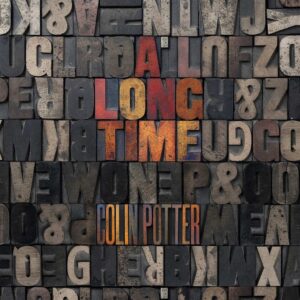
Released by the wonderful Polytechnic Youth, this is a selection of tracks made in the 80s for the two 'Recent History' ICR cassettes, which escaped in 1989. First time on vinyl (except for 'The State') with a wonderful cover by Jonathan Coleclough.
Rough Trade Review : This release is a collection of first-time-on-vinyl tracks from the 1989 cassette only releases Recent History Vols. I and II on ICR. 8 fantastic experimental, synth pieces recorded at his then home of Tollerton nr. York at various points between 1982 and 1989 and remastered by Colin in 2020. He says of this collection: “Over 30 years does seem like a long time, but in terms of how I worked then and how I work now, it seems even longer. The way these tracks were made feels like another world. Yet I’m still very connected to them and when I remastered them I was taken back to when I was exploring new equipment and ways of working. Primitive sampling and looping had arrived, to use alongside older analogue machines, guitars and early digital synths and effects processors. Happy daze……”
18,00€
In stock

LP + CD
LE UN
“Le Havre”
Large ensemble improvisation has a history and already many historical references such as Globe Unity Orchestra, King Übü Örchestrü, The Celestrial Communication Orchestra, London Improvisers Orchestra... or more recent ones like Splitter Orchester, Insub Meta Orchestra, GGRIL, ONCEIM...
How to combine energy, individuality, unexpectedness... with 26 people?
How to develop different improvisation strategies without falling into the obvious drone?
How can you simply improvise freely with 26 people?
Le UN (new version) was initiated by David Chiesa in 2019.
Le UN acts as an improvisation society: each member is involved in the artistic realisation as much as in the social, non-hierarchical organisation of the ensemble.
The individual and their practice - and not its dilution in the collective - are at the centre of this orchestral experimentation. Importantly, each individual preserves their singularity within a protean mass without obstructing the collective space.
This LP (+ CD) was recorded during a three-day residency at Le Volcan, Scène Nationale du Havre, in April 2021.
This recording is a manifestation of a collective practice of free improvisation beyond genres, a music full of effervescence and turbulence, where the acoustic and electric sources attempt the wager of spontaneous collective fabrication without any direction, irradiated by strong flickering light, with a flight of incongruous actions!
Sophie AGNEL, piano
Pascal BATTUS, rotating surfaces
Claire BERGERAULT, voice and accordion
Benjamin BONDONNEAU, clarinet
Christophe CARDOEN, lighting apparatus
Patrick CHARBONNIER, trombone
David CHIESA, double bass
Michel DONEDA, soprano saxophone
Camille EMAILLE, percussion
Nina GARCIA, electric guitar
Amanda GARDONE, double bass
Bertrand GAUGUET, alto saxophone
Anouck GENTHON, violin
Rozemarie HEGGEN, double bass
Benoit KILIAN, percussion
Soizic LEBRAT, cello
Lionel MARCHETTI, electronics
Michel MATHIEU, actions
Natacha MUSLERA, voice
Jérôme NOETINGER, electronics
Jean-Luc PETIT, contrabass clarinet, sopranino saxophone
Christian PRUVOST, trumpet
Aude ROMARY, cello
Mathieu WERCHOWSKI, violin and viola
20,00€
In stock
LP
Guilhem LACROUX
“Libellule Ebouli”
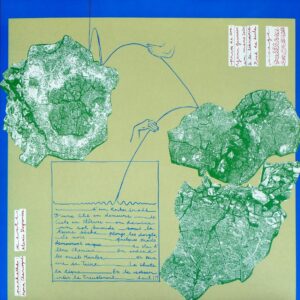
LP, 300 copies. 45rpm and 33rpm. Offset printed cover with two Pantones, offset printed, blank labels.
Released March 2022 in coproduction with la Novià and Mental Groove.
Normal speed runs in 45rpm and enables the listener to access a time suspending version while on 33rpm mode.
Interview between Guilhem Lacroux and Alexis Degrenier where they exchange on their latest albums.
Recorded by Yann Gourdon on the 13th of March 2020 in Haute-Loire.
Mixed and mastered by Guilhem Lacroux
Cut by Daniel Krieger
Cover artwork by Mona Chancogne
Texte pochette par Alexis Degrenier
17,50€
Out of stock
LP
SOCIÉTÉ ÉTRANGE
“Chance”
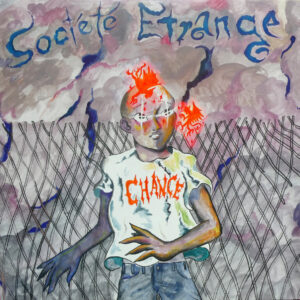
Chance, is the second album of Société Étrange,composed of 6 love songs without words, with equivocal rhythms, glaucous turquoise bass and melodies affectionately tinged with melancholy.The album was recorded in July 2020 in Vaulx-en-Velin from a collection of materials and collective drift. Composed in studio, it is by the live that is shaped their pieces, several years to test them together so that these three musicians let us glimpse a possible civilization. Not fantasies that cannot be apprehended, but a future that we can hope to desire. Their hypnotic compositions, drunk with dub, iron harmonics and polymetric measures, play a music that is a bit shady, one of those that provoke the space for the dance to happen, without anesthesia.
Mixing : D'Incise
Mastering : Ernest Bergez
Illustrations : Gaia Vincensini
Artwork : Félicité Landrivon
17,50€
Out of stock
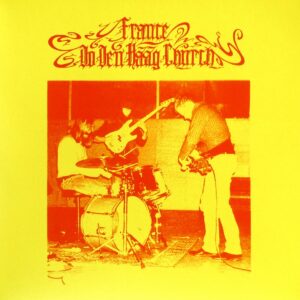
LP
FRANCE
“Do Den Haag Church”
LP, 500 copies. 180g vinyl, offset printed uncoated cover with Pantone 803U and 2028U,
paste-on stamped credit-etiquette and offset printed labels.
Released November 2021 in coproduction with Stoned To Death and Mental Groove
An eastern-europe special-run of the band's natural reverb drenched classic.
Recorded back in 2008 in minus zero temperatures and hosted by none other than mighty-maryjane-huffing John Bangma.
Mental Groove and Standard In-Fi are very glad to add Czech based label Stoned To Death to the DDHC adventure.
This edition is the occasion to visualy revisit the original Cdr aesthetic and enhancing the title's typography.
Recorded on H2 by who-ever on the 15th of December 2008 in Den Haag
24,50€
Out of stock
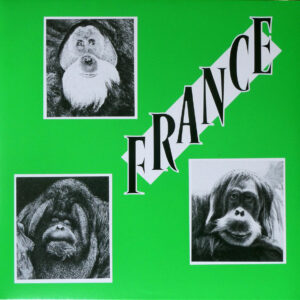
LP
FRANCE
“Meltdown Of Planet Earth”
LP, 500 copies. Offset printed coated cover with Pantone 2271C, offset printed insert and offset printed labels.
Released November 2021 in coproduction with Desastre records.
Live in Paris, 12th of June 2014... top-notch re-issue of this classic slice.
Recorded on H2 by who-ever
Mixed and mastered by Vincent Mare
Cover artwork by Sauvage, cover typography by Lionel Catelan, insert artwork by Donnie K.
24,50€
In stock

LP
Rudolf EB.ER & Will GUTHRIE
“Hilt”
Based in Osaka and Nantes respectively, Rudolf Eb.er and Will Guthrie have both forged unique and quite different paths in numerous disciplines of experimental music over the past decades and created extensive bodies of work, both as soloists and in collaboration with other artists from around the world.
Austrian-born Eb.er (aka Runzelstirn & Gurgelstøck) might be best known as the initiator and head of the Swiss artist collective Schimpfluch-Gruppe, which has constantly been pushing the boundaries of extreme music and performance art since its foundation in 1987. Among his many audio releases, »Hilt« is his third work for Fragment Factory, following »Nigredo« (as Schimpfluch-Gruppe, 2013) and »Wellenfeld« (with Joke Lanz, GX Jupitter-Larsen and Mike Dando, 2014).
Australian-born Guthrie, on the other hand, has become synonym for breaking new grounds in drumming and percussion, delivering the missing link between radical and forward-thinking jazz, traditional musics and experimental/improvised electronic music. Rather recent collaborators include the likes of Jean-Luc Guionnet (note: »Stones, Air, Axioms / Delme« w/ Thomas Tilly, Fragment Factory, 2015), Mark Fell and Oren Ambarchi.
»Hilt« is the first collaboration of two artists who, based on their previous musical work, seem very different at first glance. However, it quickly becomes apparent, that the distinct approaches to composition and sound complement each other perfectly and make this album a very special and exciting affair. The closer you listen, the more you will be drawn into it and realize that the rhythmic drumming, the careful arrangements of hiss, crackle and eerie muttering paired with fragmented bits of percussive noises make »Hilt« a very coherent whole. A very organic and ritual-like album I would say, captivating and a little daunting at the same time.
Fragment Factory is thrilled to present »Hilt« in its final revelation, pressed in an edition of 300 copies on black vinyl with smashing artwork by Alice Kemp, long-time friend and co-conspirator of the label and Herrn Eb.er.
Drums, Percussion, Microphones – Will Guthrie
Electro-Acoustics, Artwork, Layout, Microphone – Rudolf Eb.er
Dolls, Photography – Alice Kemp
19,50€
In stock
LP
BJ NILSEN – Judith HAMANN – Sigtryggur Berg SIGMARSSON
“Heiligenstadt”
BJ Nilsen is a Swedish composer and sound artist based in Amsterdam. His work primarily focuses on the sounds of nature and how they affect humans. Recent work has explored the urban acoustic realm and industrial geography and mining in the Arctic region of Norway and Russia. His original scores and soundtracks have featured in theatre, dance performances and film.
Judith Hamann is a cellist and performer/composer from Melbourne, Australia, now based in Berlin. Her performance practice stretches across various genres encompassing elements of improvised, contemporary classical, experimental, and popular music. She has studied contemporary classical repertoire with renowned cellists including Charles Curtis and Séverine Ballon, and developed a strong practice in improvisation and sonic arts through collaborative projects both in Australia and internationally.
Sigtryggur Berg Sigmarsson is an Icelandic musician, painter, sound- and performance artist and founding member of Stilluppsteypa. He studied sound art in Hannover, Germany from 1998 to 2003, where he is currently living. His musical output has been variously described as collage, quiet drone manipulations, and calm and minimal, which offers a range of still, contemplative momants, contrasted with more discordant (though not necessarily noisy) ones.
Heiligenstadt is the documentation of an encounter of the three artists in 2018.
19,50€
In stock

CD
ILLUSION OF SAFETY
“New Rules, Same Game, Less Instruction”
Chicago's post ambient industrial legend is back with a work that combines electronic sounds and field recordings: microscopic audio events, loops, heavily processed material of all kinds form seven multi-layered collages that seem to be full of electro-magnetic static, morphing and transforming like a hallucinogenic object in every second and in all possible directions... in all it's subtleness this is far away from the shock treatment noises of the early IOS times.
'New Rules, Same Game, Less Instruction' is the first release of new IOS compositions since 'Surrender' in 2015.
Featuring extensive synthesizer source material as well as other now familiar electro-acoustic techniques it is conceived as a follow up to the 1995 3” CD release of 'Rules Of The Game', alluding to the social, political, and psychological games humans engage in for validation, survival, or dominance. New Rules, same game, less instruction, harsher penalty.
Illusion Of Safety now more than ever.
Mastering: Thomas Dimuzio / Artwork: Dan Burke
13,50€
Out of stock

CD
DDAA
“Objet: when a cap is raising”
Jean-Luc André, Sylvie Martineau-Fee and Jean-Philippe Fee started DDAA (Deficit Des Annees Anterieures) in 1977. They are pioneers of the French experimental and indie scene, also connected with Industrial 80s music and audiovisual projects. Approaching music in a completely unique way, and brilliantly produced by their own Illusion Production label (with more 40 published items), DDAA was and is undoubtedly one of the most legendary groups of the French underground for the past 30 years. Their early albums are classics - the self-titled debut, Action and Japanese Demonstration or Les Ambulants (re-issued and still available on Klanggalerie) are a must-have for every connoisseur of usual music. They appeared on the compilation album of music by outsider artist Adolf Wölfli alongside Nurse With Wound and Graeme Revell of SPK. The 10" album When A Cap Is Raising came out originally in 1988 on UK label Big Noise in Archgate. For this re-issue, the band has remastered the music and added bonus tracks from the compilation album Objet, and other sources, some previously unavailable.
12,50€
In stock

CD
GEINS’T NAÏT
“L’Or’n’Cät”
Geins't Naït was founded in Nancy, France, in 1986 by Thierry Merigout and Vincent Hachet, both students at the Architecture School of Nancy. A year later Laurent Petitgrand joined the band. Their sound is often described as an equivalent of bands like Einstürzende Neubauten, Coil or Test Dept., but Geins't Naït is not pure classic Industrial. While Geins't Naït offers rough pieces of music as an extension of its punk attitude, Petitgand refines them to create some musicality within the post-industrial collages, adding guitars, piano, and classical instruments. Geins't Naït and Laurent Petitgand sharpen sounds, giving them a kind of balance and density and ensuring that the musical language evokes a deep experience. Their music is raw and fascinating, and largely influenced by Surrealists and Situationists. Their early albums were released by French label Permis De Construire, with L'Or'n Cat being the second, released in 1987. It features ten tracks which have been carefully remastered for this first ever CD re-issue by Martin Bowes.
12,50€
In stock

CD
Elisabeth HARNIK – Didi KERN – Jaap BLONK
“Steamology”
Elisabeth Harnik, an Austrian based pianist and composer has created a multi-faceted body of work by blurring genre boundaries through various collaborations in the field of improvised music, interdisciplinary projects and contemporary compositional works. She studied classical piano and later – with Beat Furrer – composition at the University of Music and Performing Arts, Graz. As an improviser she works within an electro-acoustic inspired sound-world, using specific preparations and extended techniques while pushing the limitations of the piano. Amongst others she has collaborated with Frank Gratkowski, Dave Rempis & Michael Zerang, Joelle Leandre and Ken Vandermark.
Didi Kern is an Austrian drummer who is best known for his work with Bul But, Fuckhead or Glutamat. He is equally at home in the rock scene and in the free improvisation scene. He has a duo with keyboarder Philip Quehenberger, plays drums with KGB and has performed with jazz greats like Peter Brötzmann, Mats Gustafson, Weasel Walter, Saadet Türköz or Ken Vandermark.
Jaap Blonk is a Dutch avant-garde composer and performance artist. He is primarily self-taught both as a sound artist and as a visual/stage performer. He studied physics, mathematics, and musicology for a time, but did not complete his studies. One of his early influences was Kurt Schwitters, whose Ursonate he first heard in 1979; he memorized the entire work, and it became one of the cornerstones of his repertory.
For Wels Unlimited 2020, the trio got together for a live stream during one of the Covid lockdowns. This album is a recording of that show.
12,50€
Out of stock
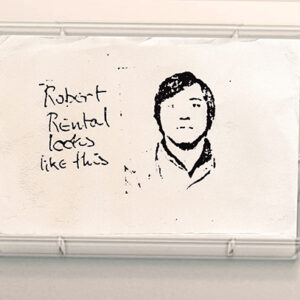
CD
Robert RENTAL
“Mental Detentions”
Robert Rental was a British pioneer of the post-punk DIY industrial electronic music scene in the United Kingdom. Originally from Port Glasgow, Scotland, he moved to the south of England with Thomas Leer in the late 1970s, and became involved with the local music scene. Robert Rental however released very little of his solo music, preferring to collaborate with Thomas Leer, as well as with Daniel Miller. The only solo recording from The 1970s is the 7" single "Paralysis" first released on the homemade Regular Records, then re-released on Company Records in 1978. Mental Detentions was released as a cassette in 1979, the same year as his masterpiece The Bridge with Thomas Leer (who also features on several tracks on this album). It is an album full of electronic songs ranging from abstract Industrial to rhythmic proto pop. Robert spoke to friends of his frustration at being unable to replicate his sound in a commercial studio – it was these demos’ sound that he wanted to create. Sometimes having only access to the most rudimentary of equipment can hone the creative talent into something sharper and more focused – necessity is the mother of invention, indeed.
12,50€
Out of stock

2 LP
Julius EASTMAN
“Two Extended Pieces For Four Pianos”
Four Pianos (1979-80): It is recognized today that these tutelary pieces for four pianos are among the most powerful in contemporary music, their impact is almost unparalleled. After the historical version recorded forty years ago, this one, featuring four of the greatest European performers, is now regaining its full power. High level recordings too. Red vinyl; includes color insert.
Julius Eastman: There was some for John Cage, then came Christian Wolff, and finally Morton Feldman, from this school in New York. Only Julius Eastman remained outside the game, the last figure, the most solitary and enigmatic -- undoubtedly also one of the most powerful, and it is this power that is revealed through these recordings. In the 1970s and 1980s, Eastman was one of the very few African-Americans to gain recognition in the New York avant-garde music scene. He was politically committed, a figure of queer culture and a solar and solitary poet whose melancholy influenced his genius as well as his tragic destiny: suffering from various addictions, declared missing, actually homeless. During Winter of 1981-82, he got deported from his apartment by the police, who destroyed most of what he owned - including scores and recordings. He was found dead in 1990, on the streets of Buffalo, after years of vagrancy.
The Performers: Nicolas Horvath, pianist and electroacoustic composer; Melaine Dalibert, a French composer and pianist; Stephane Ginsburgh, a tireless surveyor of the repertoire but also explorer of new music; Wilhem Latchoumia, embraces both new music and the classical repertoire with success and charisma.
20,00€
In stock

CD
Pauline OLIVEROS – Gyorgy LIGETI
“Musica Nuvolosa”
After its reading of Julius Eastman's Feminine, released in 2021 (SR 501CD), the Ensemble 0 revisit the repertoires of Pauline Oliveros and György Ligeti from another angle. From the works of Oliveros, they exhumed a deeply meditative piece for accordion and voice, giving it a new life in the form of vaporous, cloud-riding chamber music. With Ligeti, the piano radicalism of the Musica Ricercata miniatures crop up again in a new and as yet unreleased orchestration.
György Ligeti (1923-2006): György Ligeti was a Hungarian-Austrian composer of contemporary classical music. He has been described as "one of the most important avant-garde composers in the latter half of the twentieth century" and "one of the most innovative and influential among progressive figures of his time."
Pauline Oliveros (1932-2016): Pauline Oliveros was an American composer, accordionist and a central figure in the development of post-war experimental and electronic music.
Ensemble 0: "Music that's immediately attractive and persistently elusive" --The Wire, UK. The Ensemble 0 (pronounced "zero") is a collective created in 2004 whose full-time members are Stéphane Garin, Joël Merah, and Sylvain Chauveau. They are based in Bayonne (France), Barcelona (Spain), and Brussels (Belgium). The ensemble performs mainly pieces by living composers, as well as compositions by its members. The band has many regular collaborators and guests, allowing the line-up to increase or decrease according to each specific project. The ensemble 0 has played live around Europe (France, Switzerland, Spain, Belgium, Netherlands, Portugal, Germany) and in Asia (Japan, Taiwan). They have released a number of records on international labels and have been reviewed or interviewed in magazines and websites such as The Wire, Vital Weekly, Fluid Radio, Mouvement, Ecocolo, The Sound Projector, Textura.
13,00€
In stock

CD
SOTE
“Majestic Noise Made in Beautiful Rotten Iran”
It's an all-electronic affair, harmonically maximalist, predominantly symphonic-synthetic, requiring active listening. Some pieces function as challengers of musical structural habits, provoking the short attention span culture, others present a problem-solution scenario, collectively via a neoteric noise aesthetic and detailed melodic weaving. Ultimately, the objective was to engineer an assortment of works full of sound, euphonic, and vivid in nature. The making of this album was intentionally a very personal process, going into self-therapy territory at times interpreting the composer's contemplating mind dealing with tolerance, destruction, compassion, misery, grace and tyranny in an auditory manner. Some pieces function as challengers of musical structural habits, provoking the short attention span culture, others present a problem-solution scenario, collectively via a neoteric noise aesthetic and detailed melodic weaving. Ultimately, the objective was to engineer an assortment of works, awash with euphonic sound vivid in its essence, with a deep focus on various synthesis techniques within a compositional framework. Dedicated to Peter Rehberg aka Pita.
Ata "Sote" Ebtekar composes music with a deeply-held conviction that rules and formulas should be deconstructed and rethought. He alters musical modal codes from their original tonality and rhythmic tradition to achieve vivid, synthetic soundscapes. Over the last three decades, his work has been published by labels such as Warp, Sub Rosa, Opal Tapes, Diagonal, Mute, and Morphine, among others.
13,00€
In stock

LP
Carl Michael von HAUSSWOLFF
“Conductor / Life and Death of Pboc”
Two rare historical recordings (1983 and 1986) originally released as single sides and gathered here for the first time. Carl Michael von Hausswolff on the pieces: "'Conductor' might be my favorite composition and 'Life and Death of Pboc' might be my most sincere. 'Conductor' was my first composed piece with no obvious reference points . . . 'Life and Death of Pboc' was the second. These two compositions gave me the title Godfather of Dark Ambient." Edition of 300.
Carl Michael von Hausswolff (b. 1956 in Linköping, Sweden, lives and works in Stockholm): Since the end of the '70s, von Hausswolff has worked as a composer using recording technology as his main instrument and as a visual artist using light projections, film/video and still photography as well as other media. He has exhibited at dOCUMENTA (Kassel), the biennials in Venice, Moscow, Liverpool, Istanbul, Sarajevo etc. and in Copenhagen, Stockholm, Nicosia, Kaliningrad, Tokyo, London, New York, Philadelphia etc. His music has been played in festivals such as Sonar (Barcelona), CTM (Berlin), L'audible (Paris), el niche Aural (Mexico City), MUTEK, (Montreal) etc. and release works on LP, CD, and download by labels like Erototox (Ashevile), Sub Rosa (Brussels), Touch (London), Pomperipossa (Göteborg), and iDeal (Göteborg). He recently curated the second part the sound-installation FREQ_OUT named freq_wave in co-operation with TBA21-Academy and collaborates with artist Leif Elggren, EVP re-searcher Michael Esposito, composers Hans-Joachim Roedelius, Mark Fell, Jim O'Rourke, author Leslie Winer and as Dark Morph (with Jónsi of Sigur Rós). He has also collaborated with Pan Sonic, The Hafler Trio, Freddie Wadling, and Erik Pauser (as PHAUSS).
15,00€
In stock
LP
Okkyung LEE / Jérôme NOETINGER / Nadia RATSIMANDRESY
“Two Duos”
“Two Duos” is pressed from cellist Okkyung Lee’s most recent OTO Residency; the first side a duo with Jérôme Noetinger on Revox B77 and the second with Nadia Ratsimandresy on ondes Martenot. Cut together, the two meetings seem to raise three cellos in the search for expressive voice: the cello, it’s magnetic reproduction, and the dual controls of the machine invented to expand on its musical qualities.
On the A side Noetinger’s opening tape hiss establishes a current; an electrical partner who gives Lee room to slide across and stretch out. Progressively the cello is returned, duplicated and manipulated with increased velocity and distortion. Noetinger draws out the full extent of Lee’s extended technique; rewinding strands of Lee's horse hair and transmuting her percussive attacks into shuddering echos, before letting his own concrete interjections spin the duo's sonic tussle into an almost romantic daydream.
On side B the ondes (invented by French cellist and wartime radio operator Maurice Eugene Louis Martenot and so loved by Bernard Parmegiani, Varese and Messiaen) seems shaken from classical tradition and those long, drawn out horrorscapes it has come to be associated with. In a duel with Lee, Ratsimandresy grasps the ondes’ extraordinary capacity for dexterity, nuance and speed, hounding Lee’s cello in a bid to drive her instrument out of the past and into the future.
Two fantastic pairings and a testament to the freshness with which Lee and her collaborators continue to work with their instruments.
---
Okkyung Lee / cello
Jérôme Noetinger / revox b77
Nadia Ratsimandresy / ondes martenot
---
Recorded live at Cafe OTO on Thursday 28th March & Friday 29th March by Paul Skinner and Shaun Crook. Mixed and mastered by Lasse Marhaug. Designed by Maja Larrson.
18,00€
In stock
LP
Maja JANTAR
“In / Canti”
New meta-poem from multilingual and polysonic voice artist Maja Jantar, this LP delivers two magnificent subtle and sensorial haunting pieces of free tonal modulations, exploring the voice as a tool to create musical textures shifting from free layered tones and vivid harmonics to free sound poetry channeling inner and outer streams of imaginary landscapes - where poetry walks into the field of contemporary music.
Maja Jantar is a multilingual and polysonic voice artist living in Finland after long period in Belgium, whose work spans the fields of performance, music theatre and opera, poetry and visual arts. A co-founder of the group Krikri, she has been giving individual and collaborative performances throughout Europe and experimenting with poetic sound works since 1995. Born as daughter of opera singers, she spends her childhood travelling through Europe with her mother, enters and exits various languages, cultures; nomadic migrant, balances between the opera world and playing in her grandma’s garden, between ducks, sheep and sunset. Distant Tartar decendance echo’s in her soundings – weaving the operatic, poetic, abstract influences together to vocal sound works that landscape into performance.
From 2001 to present, Jantar has directed ten operas, i ncluding Monteverdi’s classic Incoronatione di Poppea and Sciarrino’s contemporary Infinito Nero. Her work invites to enter the field of the imaginary, the inner world, the inner
stream, the shamanistic, enchanting, prophetic. Circumventing the stage of the rational, in an attempt to enter through the back door of the intuitive.
A manifestation of poetry and voice, sound poetry or vocal art, VOXXX is a new sound poetry magazine. a joined adventure by sonhoras (barcelona) and erratum musical (paris). Behind the project we are Gerard Altaió, Martin Bakero, Eduard Escoffet and Joachim Montessuis. VOXXX will publish 4 LP by year, with care and dedication to bring the newest voices and sounds to your ears. we will take care of doing a precious cut and sound edition, along with a beautiful artisan work by printing all covers by hand with letterpress at L’Automàtica (barcelona).
mastered by Frederic Alstadt at Mont Analogue
track A mixed by Joachim Montessuis
recorded by Martin Bakero
design and letterpress print by Gerard Altaió
printed at l’Automàtica, Barcelona
pressed by Optimal, Germany
published by Erratum Musical and Sonhoras
23,00€
In stock

CD
Jos SMOLDERS & Jim O’ROURKE
“Additive Inverse”
*** Repressed ***
What if sounds were to fold in on themselves? Quite quickly after being 'born', even. Only to be released back into the 'normal' world of linear projection and moving waveforms from a resonant source to the ear drum to hearing and listening, some album length later?
Through a looking glass of sorts, as if emerging from an anechoic chamber through the backdoor. From absolute silence into all hearing, all sound anew, flooding over, rushing in. A ghostly aural universe with perspective shift, familiar knowns flipped upside down and inside out.
Could this inverted aural space be the one which is always there to begin with, like the inverse of an acoustic emission - the literal backside of the speaker? The inverse as diametrically opposed or quintessentially other, but with identical value and properties. The hitherto unheard side as sine qua non to the heard.
This collaboration between Jos Smolders and Jim O'Rourke offers a unique opportunity to investigate the intricate, topological complexities of (deep) hearing and its inverse; an exploration into the very essence of sound herself.
- Sven Schlijper-Karssenberg
Jos Smolders and Jim O'Rourke - Field recordings and electronics
Sleeve by Rutger Zuydervelt
11,50€
In stock

CD
Kaori SUZUKI
“Music For Modified Melodica”
Music for Modified Melodica was born out of two explorations: one of tuning (and subsequently degrading) the small reeds of a melodica, and the other to modify it playable with foot pumps, allowing for the sustained excitation of the reeds.
Playing with the highly resistive foot bellows introduced massive ‘volumes’ of air to the reeds, overblowing them to vibrate loudly. This aspect led me to work with the sound potentials of combination tones which appear at high acoustical volumes- an area which has been elemental, especially to my durational sound works, over recent years.
The pumped breaths of the melodica are amplified and brought through time delays, with electronically manipulated high frequencies and oscillators to further activate the mix. The resulting experience, as a performer, lends affinity to what a participant to the music previously called it—one which “rewards endurance with transcendence”.
MMM was performed and recorded live. Similar iterations have been performed in New York, Osaka, and Tokyo in various settings, and at least once in an abandoned naval magazine.
Intended for hi-volume listening!
11,00€
Out of stock
CD
Éliane RADIGUE – Frédéric BLONDY
“Occam XXV”
In 2018 experimental festival Organ Reframed commissioned Éliane Radigue to write her first work for organ, 'Occam Ocean XXV'. Radigue worked closely with organist Frédéric Blondy at the Église Saint Merry in Paris before transferring the piece to Union Chapel for its premiere at Organ Reframed on 13 October 2018. The recording on this compact disc was made at a private session at Union Chapel on 8 January 2020.
'Occam XXV' inaugurates the very special record series of works exclusively commissioned by Organ Reframed, the organ-only, one of a kind experimental music festival, carefully curated by Scottish composer/performer and London's Union Chapel organ music director Claire M Singer.
'Occam XXV' is the latest chapter of Radigue's broader series of works Occam Ocean which she has been composing in the last decade. Carefully selected by Radigue she has closely collaborated with various extremely experienced yet sensitive instrumentalists. For Occam XXV Radigue collaborated with pianist, organist, composer, improviser, artistic director of the Orchestra of New Musical Creation, Experimentation and Improvisation (ONCEIM) Frédéric Blondy, which is their second collaboration in the Occam Ocean series. 'Occam XXV' premiered in 2018, and was later recorded privately in 2020 at London's Organ Reframed headquarters Union Chapel.
Packaged in a matt A5/DVD style digipack. Includes a full colour 16 page booklet containing text from Éliane Radigue, photographs of her writing Occam XXV in Paris and of the 1877 Henry Willis organ at Union Chapel.
18,00€
Out of stock

LP
Alvin LUCIER & Jordan DYKSTRA
“Out of our hands”
“Out of Our Hands” brings together Alvin Lucier and Jordan Dykstra who, through the hands of Ordinary Affects, have created debut recordings of two new compositions. Pressed at RTI for maximum fidelity with a full color printed inner sleeve....
These companion pieces have similar orbits as they were not only both composed in Middletown, CT (where Alvin and Jordan lived for a number of years), but are about Middletown, at least from a starting point. Alvin’s piece — a homage to the location of the house in which he recorded “I am sitting in a room” back in 1969 — continues his study into slow-moving glissandi and carefully crafted beating patters by interweaving three string players within a minor third (voiced by two vibraphonists). The result is entrancing, almost psychedelic, and opens space where one didn’t expect. Like much of his previous work, it is conceptual and process-based; once the wheels get turning they go on and on, giving the listener time to approach the piece, sit with it, and then move back inward.
On the other hand, Dykstra’s piece “32 Middle Tones” (a pun on his Middletown street address and the harmonic microtonality utilized in the composition) is a very textural work. His piece asks the cellist to sustain pitches for extended durations — at times quietly singing in close proximity to the stopped pitch coming from the cello — while the rest of the ensemble (violin, viola, and 2 percussion) voice a sequence of chords separated by notated silences. The cello voice is sometimes alone, but never for too long as it finds itself supported from both the top and bottom in a harmonic embrace. This supportive structure involves a percussion section which colors the seemingly simple chords (major 6th, inverted minor 7th, inverted minor 2nd, etc.) with a non-traditional toolkit of bowed singing bowls, stone sheets, harmonicas, and even leaves.
This is music that gently gives the listener a sense of predictability but always in an unexpected (and subtly indeterminate) shade. Speaking of shade, the album’s cover photo was taken in 2019 in Alvin’s backyard in Middletown. Alvin and Jordan sit with similar demeanors in front of his favorite tree — a crooked aspen which early on looked to be doomed — but which he would often saunter over to spend time with, giving it whispers of blessings and encouraging words.The world was blessed with Alvin’s presence and hopefully this album will whisper to you and yours.
26,50€
In stock

LP
Anton BRUHIN
“Rotomotor / InOut”
In the mid-1970s Anton Bruhin was surely at the peak of his tape manipulation works. Always using poor techniques and equipment he sculpted everyday-life sonic objects turning them into very accomplished and yet totally experimental music artifacts. The works presented here surely are among the most accomplished results of his expanded creativity.
"InOut", a masterpiece for tuning whistle, mouthharps, flutes, toy and party gag instruments, percussion, bells, electric razor, model ship engine with propeller, birdcall whistles, CH-Phon, feedback speaker-microphone, siren, double shawm, falling down spoon, jew's harp (only two short notes), tearing scotch tape from the spool, ocarina, hair dryer and other noise makers plus occasionally radio tuner was recorded in Zurich between May 17th and May 22nd, 1981, on a Sanyo M7300L stereo radio cassette recorder with both integrated and external microphone. The recorder is in the recording standby position, both RECORD and PAUSE buttons are pushed. Then Bruhin sings or plays a tone into the microphone. During this tone he releases the PAUSE button by pushing it. Subsequently he presses the PAUSE button again within a fraction of a second. Now the first short note is recorded. In "InOut" thousands of very short notes were added this way, like a patchwork, like an acoustic quilt with geometric irregularities and varied patterns.
"Rotomotor", subtitled "ein motorische Idiotikon", is a 28 minutes long reading representing one of Bruhin's major works. Written in Zurich between 1976 and 1977, then recorded in August 1978 at Etienne Conod's Sunrise Studio. "Rotomotor" is a poetic Idiotikon of the swiss-german dialect where, instead of the straight alphabetical order, the words are organized according to the similarities of their letters (each word differ from the previous one by just one letter). For this reading a delay equipment which repeated the signal after 0.6 seconds was used and each word is superimposed to the echo of the preceding one. On one hand this echo generates the rhythm of the performance, on the other it supports the acoustic metamorphosis of the words. As always in Anton Buhin poetics, a very simple concept perfectly accomplished.
Anton Bruhin in the 1960s began organizing happenings and performances, creating sound works, designing and typesetting his own books (which he self-published with Hannes R. Bossert through April-Verlag), drawing and writing poetry. Anton Bruhin was a member of the first class to study at the F+F School with Serge Stauffer, famous art teacher and specialist in Marcel Duchamp, where he came into contact with concrete poetry, Fluxus and experimental music.
22,50€
Out of stock

LP
Katalin LADIK
“Water Angels”
alga marghen proudly presents "Water Angels" an LP with previously unreleased tracks by Katalin Ladik, following the monumental "Phonopoetics" from 2019.
"Water Angel", the title track, is a side-long work from 1989. It began its life containing a plice of "O Fortuna" from Carl Orff's "Carmina Burana" and was first staged in an artificial fog on a lake at the 1989 Spoleto Festival in Italy.The texts include fragments of her own lyrics mixed with parts from James Joyce and Lewis Carroll in a kind of sonic-textual collage of processed sounds superimposed to environmental field recordings. One can also hear the composer Erno Király, her first husband, playing his self-built instrument called "zitherphone", a 58-stringed huge engine of sounds assembling five zithers in a single body, with pick-ups placed on some of the strings.
The first part of "Water Angel" was used as a starting point for "Three Orphans", another composition juxtaposing electronically modified voice with recordings of folk songs, this time Hungarian. It's a kind of "adaptation of a Hungarian folk ballad", utilizing recordings done in Transylvania in 1940, registered with a wax cylinder phonograph and gathered by Radio Novi Sad. Thanks to the collaboration with Boris Kovač, the sound engineer for this project, the quality of Katalin Ladik's screams, whispers, chants, laughter, giggles is now significantly improved, and in some ways the subtle nuances of her virtuoso interpretation find here their most powerful rendition.
Also presented on this record are three and never before issued works created by Katalin Ladik in collaboration with the composer Svetlana Marasch at the Electronic Studio of Radio Belgrade in 2019, "Electric Bird", "White Bird" and "Ice Bird". Combining extended vocal techniques, processing and modular synthesis, these tracks confirm the artist's radical temperaments that helped to define her work during the 60s and 70s, while pushing it further into new territories thus revealing an artist with almost no peer in the experimental landscape today.
Ladik, born into the Hungarian minority of Yugoslavia in 1942, is an artist who resists categorization. She is an experimental writer, a sonic artist, a writer as interested in the sound of the words as its meaning. She is an actor as well as a performance artist, a visual artist whose graphic scores generates from her early contacts with the work of Stockhausen and Acezantez, also addressing the relations between sound and woman's body. Katalin Ladik can be considered a phenomenon of music excesses and voice miracles, combining music, theatre and poetry. It was the music of a female body and its motions, transformation, action and expression: when she produced sounds with her body as a music instrument, playing folk or self-made instruments nude; when she voiced poetry or transformed voice into linguistically inarticulate sounds of phonic poetry; when her voice turned into a scream transforming poetry into acoustic event; or when she borrowed her transgressive voice to experimental musicians.
22,50€
Out of stock

LP
Jean-Yves BOSSEUR
“Musiques Vertes”
First ever vinyl reissue of Jean-Yves Bosseur's visionary LP "Musiques Vertes", recorded by the legendary French ornithologist and wildlife field recordist Jean-Claude Roché, originally issued by Atelier 82. Utilising handmade instruments constructed from plants and other natural materials, played by a collective of children and untrained musicians, its radically experimental sounds build a revelatory bridge between the avant-garde and ancient forms of folk.
Jean-Yves Bosseur is a relatively obscure figure in the history of the French avant-garde. A student of Henri Pousseur and Karlheinz Stockhausen, as well as a close associate of Knud Viktor, he belonged to the legendary collective Groupe d'Etude et Réalisation Musicale GERM, widely celebrated for their realization of Terry Riley's Keyboard Study 2, issued by BYG / Actuel in 1970.
The "Musiques Vertes" project began in South East France during the late 1970s, spearheaded by Christine Armengaud, who was investigating, via elderly people in the region, a long tradition of musical instruments made with organic materials and plants. With their help, she was able to construct 240 instruments, collected in her book "Musiques Vertes", published in 1978 by Christine Bonneton éditeur, that had long been used for bird calls, dancing, toys of young shepherds and children, and much more, but had been lost to common usage following the First World War.
In 1980 the Direction de la Musique awarded the composer Jean-Yves Bosseur a grant to start a collective practice of music using the instrument constructed / reconstructed by Armengaud. Rather than working with professional musicians, he chose to use locals and children he encountered in Aix-en-Provence between 1981 and 1982. The Musiques Vertes album is the result of hours of practice and recording by these players, in each case, within the album 11 musical excursions, utilising a series of instructions or games set up by the composer in an attempt to create collective musical exchange, as well as a dialogic exchange between this practice and active listening within a natural environment.
While the acoustic practises that underscore Musiques Vertes display a deep resonance with those embarked upon by artists like Akio Suzuki, Toshiya Tsunoda, and Jeph Jerman, the structural resemblance, held deeply within utopian avant-garde principles, falls far closer to experimental electronic works that might have emerged from experimental electronic studios like Groupe de Recherches Musicales or EMS, or subtle object oriented efforts in free improvisation. Bubbling textures and atonalities, blended with sounds from the natural environment, intermingle with staggering birdsong-alike tonalities and rattling percussive passages, producing striking moments of abstraction that retain a remarkable sense of humanity and ease. A document of pure sonic magic and stunningly organic creativity.
300 copies, black vinyl, 20 page booklet
23,00€