
Out of stock

4 CD box
TONGUES OF MOUNT MERU
“Naga Mountain”
Lasse Marhaug and Jon Wesseltoft have collaborated in a variety of projects over the years, but started the Tongues of Mount Meru duo back in 2008 as a collaboration to pursue their shared interest in sustained and closely calibrated sounds, and the phenomenological impact they have on the act of listening. They started recording a session each year from 2008 to 2011 in Oslo utilising harmoniums, organs, shruti boxes, oscillators, and computers and accumulated a large pool of material. Some of that material wound up on tapes and vinyls over the years, but they kept the hour-long pieces with an intended major future release in mind. These pieces are now collected in this monumental 4 disc box set.
Clocking in at the total of over 4 hours, with over 10 years in the making, this music was crafted with a clear intent to influence its listeners sense of time and mental colour analogous to the music's stringently, and at times claustrophobic, unfolding narrative. Slowly blooming clusters of wave interference kaleidoscopic blending together with lower frequency binaural pulse patterns. It is as if light has been pitched down, and its oscillating and shimmering coating of gradually shifting overtone cycles opens up and crashes down again into the ocean of waves continually churning around its own time axis.
Drawing upon their joint interest in minimalism and long-form music, raga theory and electro-acoustics, Marhaug and Wesseltoft conjures up a focused power of both beauty and unease to deeply establish a state of hypnotic attentiveness. The result is a hallucinatory and intense set of finely tuned and tectonic long-form pieces, and is a must for anyone even remotely interested in any form of sustained sounds, and its impact on the mind.
200 copies, black cardboard box set with embossed gold print
35,00€
In stock

2 LP
Alessandro BOSETTI
“Plane/Talea 31-34”
Since a few years Alessandro Bosetti has been collecting voices that become part of the Plane/Talea archive. The creation of the archive stems from dozens of individual meetings and recording sessions, in which each voice is detached from its owner or originator and anonymized. With each new iteration and performance, Bosetti plays the archive as if it were an instrument. He searches for hidden details and correspondences through exploration, immersion and contemplation. Each re-activation of the archive results in a dense and
swarming polyphony made up of thousands of short utterances - shorter than any word bearing a meaning - recombined and interwoven into complex textures. The particularity of the grain of Plane/Talea lies in the autonomous and darting life that each of these fragments lives in a teeming community of voices. Such polyphonies are rich in microtonal detail emerging from the incessant juxtaposition of vocal objets trouvés. Harmonic relationships are sometimes rough and chaotic, other times surprisingly just. The voices are never treated electronically but only recombined and musical tension is provided by the particular grain, inflection, energy of each one of them in counterpoint to the others and to a frugally used instrumentarium (Harpsichord, Ondes Martenot, Cristal Baschet, grand piano, analog synth, Hammond organ). Implicit reference goes to ancient, modern and postmodern forms of vocal polyphony. "Plane/Talea 31-34" - the continuation of the homonymous 2016 LP - is a work of sampling that projects an imaginary community and a disembodied choir. The four arching and extensive tracks were created between 2017 and 2018 and bear the trace of two specific moments: August nights in a country house in Vicobarone, in the hills of Piacenza (31-32) and a week-long residency at the "Studio Venezia", an environment created by French artist Xavier Veilhan in the French pavilion at the 2017 Venice Biennale (33-34).
« Encounters of this sort did happen, with the voice still clinging onto its own origin, and then seen, as it were, coming out of the original mouth and caught saying other things, with a slightly different intonation, a slightly different timbre, maybe due to a little aging, an extra cigarette, a cold. At that point we would come out unsettled, or maybe convinced that it was not the same voice anymore, but another. »
28,00€
In stock
LP
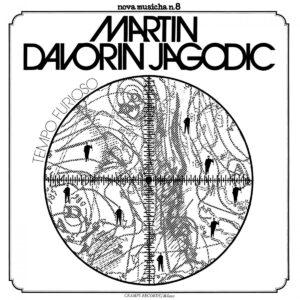
Martin DAVORIN JAGODIC
“Tempo Furioso”
Digging deep into the catalog of Cramps records, Dialogo returns with another stunning entry in their reissue series dedicated to the seminal imprint, the Croatian composer Martin Davorin Jagodić’s 1975 masterstroke, "Tempo Furioso (Tolles Wetter)". A bristling work of monumental scale at the vanguard of electroacoustic composition and musique concrète, its stunning two sides, created by his sinfully under-recognized associate of Groupe de Recherches Musicales, reshapes history at every turn. Issued by Dialogo in a limited edition of 300 copies on black vinyl, with fully remastered audio, housed in a gatefold sleeve that beautifully reproduces the original design, and complete with brand new English translations of the original liner notes.
26,00€
In stock
LP
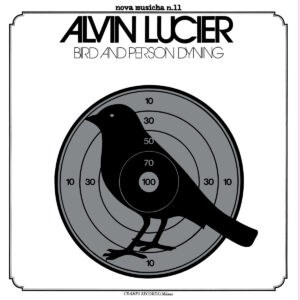
Alvin LUCIER
“Bird And Person Dyning”
At long last, after decades out of print, joining their growing Cramps Records Reissue Series, Dialogo brings us the long-awaited vinyl reissue of Alvin Lucier's "Bird and Person Dyning", the composer's first solo LP. As legendary as they come, and easily among the most important and groundbreaking efforts in experimental music ever recorded, this is Lucier at his most visionary. Issued in a limited edition of 300 copies of black vinyl, with fully remastered audio, housed in a sleeve that beautifully reproduces the original design, complete with brand new English translations of the original liner notes, it doesn't get better than this.
26,00€
Out of stock
LP
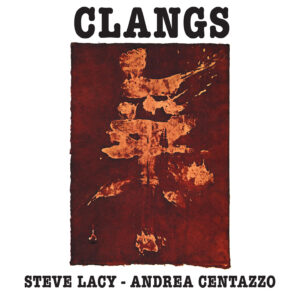
Steve LACY & Andrea CENTAZZO
“Clangs”
Ictus Records' reissue initiative fittingly begins with Clangs, the first LP issued by the label in 1976. Featuring Steve Lacy on soprano saxophone, bird calls, and pocket synthesizer (or "crack box"), with Andrea Centazzo on drums, percussion, whistle, and vocals, the album is the culmination of a couple of weeks that the two artists spent together while Lacy was touring Italy during that year.
Clangs encounters Lacy - one of the giants of American free jazz - already two decades into a career defined by brilliant collaborations with Cecil Taylor, Don Cherry, and Thelonious Monk, as well as a sprawling body of visionary work as a leader. Like so much of his work leading into this period, it draws upon the saxophonist's belief that an artist should 'play what you feel', a position that Centazzo - roughly 15 years Lacy's junior - recalls as having torn down the curtain that separated his technique from his creativity.
Comprising a series of duets that investigate timbral relationships, the fragmentation of melody, and abrasive, provocative noise - shifting from the sparse, airy, and restrained, to dance clusters of interplay and back again - Clangs, for all its radicalism and forward-thinking gestures, rests firmly within the historic structures of jazz, deploying the idiom of theme / solo / theme. Lacy's playing is at the top of his form - fluttering and dancing with a primal touch - met by Centazzo's rattle and pattern of percussive interventions, the notes and polyrhythms of each respective player being the product of careful listening, response, and raising the bar.
22,00€
Out of stock
LP
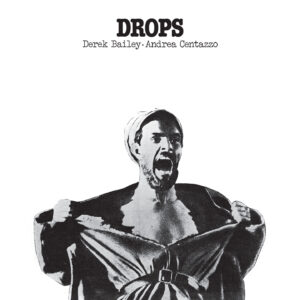
Derek BAILEY & Andrea CENTAZZO
“Drops”
In the history of free improvised music, there has been arguably no greater advocate for the idiom's power and potential than the English guitarist Derek Bailey. Fiercely principled, between his emergence during the 1960s and his death in 2005, he cut a wide path, positioning this music at the height of creativity, transpiring in real time, and a means through which people from diverse backgrounds could come together, express, and commune. For Bailey, "playing is about playing with other people... Improvisation is a process that gets relationships sorted out."
Among many great examples of this within Bailey's sprawling discography, a stand out is his 1977 duo LP Drops - originally issued as the third album on Ictus - recorded with the Italian percussionist / drummer Andrea Centazzo. Capturing the guitarist during one of his most prolific and creatively visionary periods - overflowing with explosive clarity, dialogic energy, and imagination - he clearly found a perfect foil in Centazzo, who recalls of the sessions "The kaleidoscopic quality of Drops was created by this restraint of performing limits, i.e. the choice of instrumental timbres, dynamics and metronome speeds to suit each piece. We explored some aspects of our improvisational art, gleaned the best elements from our baggage of music memories and exposed them clearly and confidently."
Comprising nine individual improvisations, Drops encounters each of its players at their best, finding a strange middle ground between the intuitive logics of their instruments; Bailey's tones taking on decidedly percussive approaches, while Centazzo's fractured polyrhythms and beats often veer toward the presence of a notable tonality. Remarkably expressive and diverse in the approach of each piece, Drops presents creative interplay at its most striking and challenging, rethinking the terms of musicality and collaboration every step of the way. Flurries of rattle back and forth, sculpting barbed and pointillistic landscapes of texture, stripped of reference and precedent, and abstract as real time organised sound comes.
22,00€
Out of stock
LP
Steve LACY – Andrea CENTAZZO – Kent CARTER
“Trio Live”
Originally issued in 1977, Trio Live was recorded in 1976, only a handful of days after Steve Lacy and Andrea Centazzo's Clangs was laid to tape, presumably capturing another moment on the same two-week tour that had rendered the recordings for its brilliant predecessor. This time, the pair - Lacy and Centazzo - is joined by the American bassist, Kent Carter, a sinfully under-appreciated artist who had worked extensively in Steve Lacy's group, played on the two Jazz Composer's Orchestra LPs, and toured in the bands of Don Cherry, Alan Silva, Mal Waldron, Bobby Bradford, Max Roach, Roswell Rudd, Derek Bailey, John Stevens, Trevor Watts, Steve McCall and many others. The previous year, he had also delivered the stellar LP, Kent Carter Solo With Claude Bernard, as Ictus' second LP, allowing Trio Live to be understood as a narrowing of an already tight circle, despite its slightly expanded ensemble.
Arguably best defining the first two entries in the Ictus reissue series - Clangs and Drops - is a sense of rigorous and artistry. While no less present across the length Trio Live, what takes the forward charge throughout its five tracks is a sense of joy and pure pleasure in playing together. The sounds and structural interventions are locked in and tight, feeling at ease and intuitively responsive in the ways that players with a history of collaboration are only able to produce.
From swinging and chugging to stepped back and sparse combinations of rhythm and tone - moving from the lingering sensibilities of straight-ahead jazz to radically out hard blow fire - Trio Live is a cornucopia of brilliant artistry and improvised music.
22,00€
Out of stock
LP
ZORN – CENTAZZO – CHADBOURNE – CORRA – KONDO – BRADFIELD
“Environment for Sextet”
John Zorn / Andrea Centazzo / Eugene Chadbourne / Tom Corra / Toshinori Kondo / Polly Bradfield
Recorded live at WKCR Radio in New York City in 1978 and issued by Ictus the following year, Environment for Sextet encounters John Zorn at the earliest stages of his career, resting within a sextet of a new generation of stunning improvisers emerging at the tail end of the '70s who would go on to define a vast swath of the '80s sound - Polly Bradfield on violin, Andrea Centazzo on percussion, Eugene Chadbourne on guitar, Tom Corra on cello, and Toshinori Kondo on trumpet - it roughly builds on the series of collaborations that had featured on Centazzo's 1978 Ictus LP U.S.A. Concerts.
Launching from a total wall of sound - full throttle fire on the boundaries of outright noise - Environment for Sextet takes the listening on an endlessly surprising journey through its players' inner world, shifting between airy open passages that feature endless combinations of one or more players, to furious moments of sonorous lashings where the group falls in together in brilliant dialogical periods of converstant texture and tonal intervention.
An engrossing and relentless listen from the first moment to the last - featuring two works built from two of Andrea Centazzo's earliest graphic scores - Environment for Sextet is an absolutely stunning body of improvised work by what were then among the most important rising stars on the free music scene.
22,00€
In stock

LP
Mark VERNON
“Time Deferred”
Mark Vernon’s solo noir album on Gagarin Records comes in an edition of 300 copies.
Cover art by Dennis “Ultra” Tyfus. Design by Meeuw. Caution: this record can cause dreamless nights.
Followers of the artist Mark Vernon will note a subdued and pensive mood on this new record. Muted and sepulchral, these tracks are in a minor key, a key which opens the door to a damp cellar of the imagination. Too-many legged spiders crawl over dusty violins. Time lurches, loops and echoes like excursions on slow motion railways in reverse. Concrète noir sombre séances for non-believers. Tauntological voices from the past provoke us. Half guessed ghosts, magnetic phantoms from funereal-to-reel tape recordings. The sibilant persistence of the deceased evokes the exhausted dread of waiting for a medical test result. Enigmatic messages thrown to the werewolves with nothing but cheap medication and some breathing exercises for support.
---
Mark Vernon is a Glasgow based sound artist who works with found tapes and acousmatic presence. His oeuvre explores themes of magnetic memory, audio archaeology, voyeurism and nostalgia.
A rich collection of domestic tape recordings; audio letters, dictated notes, answer-phone messages and other lost voices often find their way into his unorthodox soundworlds. These diverse elements are distilled into radiophonic compositions for broadcast, multi-channel diffusion, fixed media and live performances.
Together with his colleague Barry Burns he runs the renowned radio art festival Radiophrenia. Under the moniker Vernon & Burns the plunderfrolic duo's beguiling mix of Music Hall Revue and Musique Unconcrète has materialized in two critically acclaimed Gagarin albums, "The tune the old cow died of" and "The light at the end of the dial".
His and Hers and the Sun from Mark Vernon on Vimeo.
22,00€
In stock

2 LP
Reinhold WEBER
“Complete Electronic And Phonetic Works 1968-74”
Reinhold Weber, born in 1927, was known as a pioneer of electronic music. In his compositions, Weber placed a focus on twelve-tone music, he became increasingly fascinated in the field of computer music since the 1970s. He produced numerous works at the Studio for Electronic Music at the University of Karlsruhe. Released in Sub Rosa's Early Electronic series.
Reinhold Weber was born in Gießen on July 18, 1927. He studied at Robert Schumann Conservatory in Düsseldorf (including composition with Jürg Baur, piano with Max Martin Stein) and passed his exam in composition, theory, piano, and ear training with distinction. He completed further masterclasses with Wolfgang Fortner, Hermann Heiss, Oliver Messiaen (composition), Kurt Thomas (choral conducting), Andor Foldes (piano), and Gerhard Nestler (electronic music). Reinhold Weber was a professor at the Baden Conservatory of Music in Karlsruhe and also worked in the Studio for Electronic Music of the University of Karlsruhe. His works have been performed in numerous concerts and were broadcasted by SDR, WDR, NDR, HR, SWF, and Radio Bremen. Reinhold Weber died March 25, 2013.
Actor Kurt Müller-Graf was born in 1913. After visiting the Theater Academy of Baden in Karlsruhe, he appeared on stage at National Theaters of Karlsruhe, Kassel and Munich since 1935. During World War II, he performed in about ten feature films by Bavaria Film Munich. After 1945, he played at National Theaters in Karlsruhe, Stuttgart and at Theaters in Nuremberg, Cologne, Munich, Mannheim, Baden-Baden and Burgtheater Vienna. Furthermore, he had guest performances in Zurich, Basel, Salzburg and Heidelberg. Kurt Müller-Graf was touring and had broadcasts on radio and television shows at home and abroad. Kurt Müller-Graf died August 10, 2013.
19,00€
Out of stock

3 CD
Léo KUPPER
“Complete Electronic & Voices Works 1961-1987”
The complete works of one of the pioneers of Belgian early electronics. This three-CD set highlights Leo Kupper's earliest unique compositions produced during the '60s to '90s when he was ardently seeking out structures distinctly applicable to purely electronic sounds. His GAME machine -- Générateur Automatique de Musique Electronique (Automatic Generator of Electronic Music) was constructed during such period and spirit of renewal and technical explorations. Released in Sub Rosa's Early Electronic series. Includes 20-page booklet.
Leo Kupper was born in Nidrum, Hautes Fagnes (Eastern Belgium) on April 16th, 1935. He studied musicology at the Liège Conservatory, then became the assistant of Henri Pousseur who, in 1958, had just founded the Apelac Studio in Brussels. Kupper started to work on his first pieces there, but he would finalize them only upon putting together his own studio in 1967: the Studio de Recherches et de Structurations Electroniques Auditives (Studio Of Audio Electronic Research And Structuring). That is where he would compose, to this day, over forty works, most of them on instruments of his own design. In the '70s and '80s, he built a series of Sound Domes (briefly established in Rome, Linz, Venice, and Avignon), places where every sound, every phoneme uttered by the listening audience was transformed by hundreds of loudspeakers of various sizes organized in a dome shape. This device transformed sounds through space and time: something said could be morphed into another sound hours, days, perhaps years later. Leo had envisioned that a device like his, a place for contemplation, would be much-needed in cities where nature had been evacuated. In the late '70s, after discovering Iranian music master Hussein Malek, Kupper became one of the very few Western virtuosos of the santur. His first pieces were released by Deutsche Grammophon and, later, Igloo. His latest works have been released by the New York-based label Pogus.
The GAME machine: In 1961, having terminated his musicology studies, Leo Kupper left Liège for Brussels. By that time, centers for music research such as those in Cologne, Paris, and Milan had already produced works of experimental music, where pioneers were forging new and diverse routes in electronic music, "musique concrete", and electro-vocal music. The GAME machine was constructed during such period and spirit of renewal and technical exploration. The GAME consisted of a collection of variable "sonic cells" sensitive to modulations of positive and negative voltages and programmable manually through the aid of color-coded cables. Complex electronic loops and sound from loudspeakers and from microphone pick-ups were then either recorded by tape-machines or performed and interpreted by musicians who opened automatic channels, thus triggering automatic sound to exit the speakers.
18,00€
In stock

CD
Frederic RZEWSKI
“Speaking Rzewski: Performed by Stephane Ginsburgh”
Released in Sub Rosa's Unclassical series. "This album is the result of years of work and friendship with the composer. It started with 'De Profundis', a piece which has had a deep impact on me as a musician and a person, and ended with it. Frederic attended many of my performances of the piece, the last one during our last public concert together in early 2020 in Brussels. In the meantime, he wrote 'Dear Diary' (2014) and 'America: A Poem' (2020) for me which were both premiered at Ars Musica festival. I am very happy to present these pieces to you on this new and special album coming out on Sub Rosa." --Stephane Ginsburgh
Frederic Rzewski (1938-2021): Frederic Rzewski was born in Westfield, Massachusetts in 1938. He initially studied piano with Charles Mackey in Springfield and went on to study composition with Walter Piston (orchestration) and Randall Thompson at Harvard University and with Roger Sessions and Milton Babbitt at Princeton University, where he also took courses in philosophy and Greek. A Fulbright-Scholarship enabled him to study with Luigi Dallapiccola in Florence in 1960-61. His musical collaboration with Dallapiccola marked the beginning of his career as a pianist for contemporary piano music. His friendship with Christian Wolff and David Behrman and his acquaintance with John Cage and David Tudor influenced his development, both as a composer and as a pianist. During the 1960s, Rzewski taught and took part in the first performances of Karlheinz Stockhausen's "Klavierstück X" (1962) and "Plus Minus" (1964). From 1977 to 2003, he was a professor for composition at the Conservatoire Royal in Liège, Belgium. He also taught at various other universities, among them Yale University, the California Institute of the Arts and the Berlin University of the Arts. Rzewski founded the live electronics ensemble Musica Elettronica Viva with Alvin Curran and Richard Teitelbaum in Rome in 1966. After his return to New York in the early 1970s, his politically outspoken compositions probably made it difficult for him to obtain a long-term teaching position in the US. Frederic Rzewski lived and worked in Brussels. He left us on June 24, 2021 in his Italian home in Montiano.
Stephane Ginsburgh (1969): A tireless surveyor of the repertoire but also explorer of new combinations including voice, percussion, performance or electronics, Stephane Ginsburgh performs as a soloist in many international festivals such as Ars Musica (Brussels), Quincena Musical (San Sebastian), ZKM Imatronic (Karksruhe), Agora (Paris), Bach Academie Brugge, Ultima Oslo, Darmstadt Internationale Ferienkurse, Gaida (Vilnius), Warsaw Autumn, Klara Festival (Brussels), Festival Forum (Moscow), and Musica Strasbourg. He has collaborated with many contemporary composers such as Frederic Rzewski, James Tenney, Philippe Boesmans, Jean-Luc Fafchamps, Stefan Prins or Matthew Shlomowitz as well as with choreographers such as Anne Teresa de Keersmaeker (Rosas) and visual artists such as Peter Downsbrough and Kurt Ralske.
12,50€
In stock

CD
Milan KNIZAK
“Aktual Univerzita”
Milan Knízak canonical text Aktual University, dating from 1967, contains ten short lectures outlining the university's character -- On Conflict, On Dreams, On Revolutions, On Love, On Belief, On Art, etc. These lectures were to serve as inspirational schemes for lectures, seminars and discussions held at an ideal university. In the first piece, Aktual University, Milan Knízak reads his own text, with Opening Performance Orchestra providing the musical accompaniment. It was performed live in October 2019 at the Movement-Sound-Space festival in Opava, where this recording was made. The second track, titled "Broken Suite", is a studio remix, in which Opening Performance Orchestra used fragments and quotations from Milan Knizák's compositions, conceived over the past fifty years, applying the "broken" method. The majority of them are made public for the very first time in the newly created "Broken Suite". The booklet features English translations of ten Aktual University lectures, as well as Milan Knizak's contemporary initiation text. Includes 12-page booklet.
12,50€
Out of stock

LP
Maurice LOUCA
“Saet El-Hazz (The Luck Hour)”
Maurice Louca is one of the most gifted musicians and composers on Egypt's thriving underground music scene. This forthcoming full-length album draws voraciously on Arabic music, psychedelic folk. The title Saet El-Hazz is a coded saying in Egypt to refer to a good time and usually implies a great deal of debauchery. "When you mention to someone that you've had a saet hazz, there are no questions asked. It is what it is." The initial spark for Saet El-Hazz (The Luck Hour) was Louca's desire to collaborate with "A" Trio, the Lebanese improvisational group featuring Mazen Kerbaj on prepared trumpet, Sharif Sehnaoui on prepared guitar, and Raed Yassin on prepared double bass. "When the three of them come together they create a sonic cosmos entirely their own. I started by composing music that I wanted to have exist within this sonic world- at times in harmony, or clashing with it, and all the emotional ranges in between." Just as "A" Trio served as the spark, a commission from Mophradat, an arts organization based out of Brussels, was the tinder. The commission was for a new composition to be performed using instruments that Louca would modify to play microtonally. This led him to Turkey and Indonesia. In Istanbul, he worked with a luthier to custom-make a guitar. In Surakarta, he ended up with an instrument maker tuning a Serang-referred to as the Indonesian xylophone, part of the family of Gamelan tuned percussion instruments. These new modified instruments opened up the composition to new tonal possibilities which drove Louca to expand his line up to include Khaled Yassine, a longtime collaborator and versatile percussionist and drummer, Christine Kazaryan, a dynamic harpist whom he met via Praed Orchestra, and Anthea Caddy, a cellist who came highly recommended from the Berlin free improv scene. Saet El-Hazz (The Luck Hour) is a long form composition of six movements, recorded over the course of a week in August 2019 at A/B studios in Brussels. RIYL: Sun City Girls, Tortoise, Nadah El Shazly, Amirtha Kidambi, Don Cherry, Jaubi, Pharoah Sanders, Sunil Ganguly. Marbled vinyl with insert.
15,00€
Out of stock

2 LP
Joris DE LAET
“Experimental & Parametric Music 1976-2017”
Double LP version. Includes insert. Through Experimental & Parametric Music 1976-2017, more than 40 years of composer Joris De Laet's work is unveiled. The collection discovers for the first time the great coherence of this work: from "Signalisations" (1976) to "Mnemosyne Pour Une Acousmaman" (2017). The compositions are annotated and explained in detail by the composer, as well as a kind of wild autobiography. Released in Sub Rosa's Early Electronic series.
Joris De Laet was born in 1947. Belgian by birth, self-taught by definition, parametric music and art video composer by choice. Founder of the S.E.M. (Studio voor Experimentele Muziek) in Antwerp, 1973. Internships at the IPEM (Instituut voor Psychoakoestiek en Elektronische Muziek) in Ghent, 1972-1975, under Karel Goeyvaerts, Lucien Goethals, and Dr. Herman Sabbe. De Laet is the founder of the SEMensemble, a group of musicians-composers specialized in performing experimental music and live electronics. From 1975 until 1990, he gave concerts with this ensemble throughout Europe (Germany, France, The Netherlands, Austria, Poland, Croatia, etc.) and in Canada (Montreal, Kingston, Toronto). Inspired by the deep control on electronic sonics, De Laet has been defining his work since 1979 as "Parametric Music", music where composition is based on transformation flows of one or several parameters, selected by the composer, that form, through their converging (or diverging) processes the main characteristics of the regulated sonics of the composition.
19,00€
Out of stock
7" single
Steve RODEN
“O.T.R. and U.T.R.”
Limited edition of 150 copies (of which only 100 are for sale) with unique hand made collages on every cover
In Steve Roden's onw words: "a few years ago, my mother gave me a small stack of 45s of some of her favorite songs as a kid; chuck berry, the platters, and others. when i began to listen to the records, i was not only excited about the music, but the surface-scuffs from my mother¹s repeated listening over the years of wear and tear.
the source for u.t.r. and o.t.r. is a recording of 'somewhere over the rainbow' by the dimensions.
What you are hearing are the processed sounds of the surface noise at the beginning and end of the record - the first and last notes of the song.
the experience of listening to a vinyl record is not only a durational experience, but a physical experience. when the needle is dropped upon the record at the beginning and picking it up at the end, it is a kind of performance.
in this piece, i wanted to explore the unintentional sounds - to emphasize the 'before-song' and the 'after-song'.
In the final seconds of listening to a 45, when the needle becomes trapped in the repetitive rhythm that is born of a locked groove, these clicks become a process of disintegration. the constant clicks offer a kind of lullaby like the aging process of a human being¹s body and skin as it changes. every time a piece of vinyl is played, new wrinkles, scars, scratches, scrapes, chips, and detritus are created and so here, i wanted to highlight the unintentional soundings caused by handling, to move away from the perfect veneer. The more a record is handled, the more the music is transformed to an entirely different atmosphere - where disturbances and interruptions can overwhelm a song. Listening to the sound of a needle trapped within the final groove of one of my mother's records, i think i must be hearing the exact thing she heard while listening to the same object possibly 10 years before i was born. as the record continues to offer the clicks and nothing else, i imagine my mother falling asleep to one of her favorite songs. there, in her darkened bedroom, she sleeps to the after-sound of the needle stuck in a groove.
As she sleeps, her ears absorb the minimalist rhythmic click, like a lullaby - and as the needle endlessly circles the outer realm of the record label clicking until morning..."
25,00€
In stock

LP
Philip SAMARTZIS + Eugene UGHETTI
“Array”
Array expresses the experience of a remote Antarctic research station through the convergence of sound, site and performance. The result is an immersive and affective experience of the spaces, protocols and conditions comprising the bracing polar environment. Array is a companion piece to Polar Force, a performance-installation work by Philip Samartzis and Eugene Ughetti, presented by Speak Percussion.
Array features recordings of radar and scientific instrumentation used for upper atmospheric research and terrestrial communication. These sounds reveal the sophisticated technology and architecture used and heard within the Australian Antarctic Territory. Many of the recordings focus on the way the built environment is transformed through stress and fatigue caused by extreme climate and weather events including freezing temperatures and high velocity winds.
Together with the field recordings are layers of live performance using custom built instrumentation to produce a unique series of textures, rhythmic cycles, resonances and timbral phenomena. The application of tension and pressure upon the assorted instruments recalls the distressed state of highly specialised infrastructure found within the perimeters of a research station.
A polar research station comprises many types and volumes of prefabricated space. In dialogue with this are the unique spaces used to record the instrumental performance. By merging different spaces Array brings into focus various industrial resonances, spatial characteristics, timbres of metal and concrete, and sonic artefacts produced by hard and permeable materials and surfaces.
In three parts, Array presents Antarctica as a liminal space oscillating between representation and abstraction to challenge often repeated tropes. The intent is to blur the relationship between the recorded and performed to produce a hyper-realistic encounter of the powerful forces that operate at the margins of our planet. One hears the precariousness of a remote research station contorted by unrelenting stress, compressed air forced through waterborne fipples and the volatility of weather events.
Life on remote research stations is progressively resembling the broader contemporary experience, in which strict protocols are used to govern and preserve life. The resilient communities who live and work in these places have learnt how to co-exist with an increasingly hostile environment, along with its unknowns and necessity for hyper-vigilance. Rather than consider it as a place on the edge of elsewhere, Antarctica and its assemblage of durable, super modern colonies provides an archetype for an uncertain future in anticipation of the volatility that awaits.
24,00€
In stock

LP
HEXA
“Material Interstices”
‘Material Interstices’ is another collaboration between Room40 label head Lawrence English and Xiu Xiu’s Jamie Stewart, known collectively as HEXA. The ominous, nightmarish soundscapes of dark ambient drones and industrial music the pair create apparently came from English detailing a recurring dream he had of a maze underneath his house. (Norman Records)
***
A note from Lawrence English
When I was child I had two recurring dreams. Both these dreams were tethered to the house I lived in. It was a rambling home which was high set but underneath it was largely unfinished. The underside of the house was a labyrinth of small rooms, concrete pits and a collection of building materials, piping and leftover furniture sat alongside beds of dirt that had a consistency of lunar dust.
The first recurring dream was of a burning bird, falling from the sky past the kitchen window in the early hours of the morning. The bird I’m pretty sure was some devolved version of a tabernacle candle, that shape of the twisted eternal flame often symbolised with twitching wings. This dream has never returned to me as an adult, though I can vividly recount it.
The second dream has recently emerged, albeit a distant hazy reference to the tangible intensity that I experienced when I was younger. This dream was one buried deep within the labyrinthian, unfinished features that existed under my house. The dream usually started with me playing on the lunar dirt and gradually a sound would emerge from a large concrete pit that was in the centre of the space. The sound would get louder and eventually I would have to go and inspect it. It called me in, there’s no other way to describe it. As I looked into the pit, there was always some kind of hatch, often resembling a pressure door, the type you might see in a Submarine film, and the sound would emanate from underneath that hatch. It was also a throbbing, hammering type of sound, deeply diminished and buried, like hearing bass music from a car parked up the block.
Inevitably, I would twist open the hatch and inside it was a mechanical world that today brings to mind the interior psyche of Tetsuo The Iron Man. It was dark, almost entirely duotone, shaded in heavy grey and black, and wet with a thick, humid, oil like moisture. As I climbed into the hatch and down the ladder (there was always a ladder too) the pressure of the sound increased and it was as if my whole body was being consumed by this monolithic subterranean machine. I never got to understand what the machine did, or if in fact it was a machine at all, the system was never revealed, but what I was made to feel was that there was something beyond my usual understanding that forged away night and day and was infinitely more powerful and commanding than I ever could comprehend.
I was surprised that, over the past year, this dream has returned to me. Perhaps it’s a result of the general quietening of the world and that innate way our ears can open up to even the most subtle acoustic shifts when we are sleeping. Remote sounds, usually hidden in the din of the urban nightscape, were filtering into my dreams and triggering some kind of speculative consciousness. This post-hypnogogic state ushered in a return to that imagined place from my childhood dreams, but simultaneously I was never allowed full access to that place, rather it felt more reserved. I could not enter it in the same way, even if the hatch was there, I was not the same mind and could not unlock it in the same way.
Last year, I mentioned this dream to Jamie, and he too reported unsteady sleep patterns. This got us to thinking about how the dynamics of the world have recently shifted towards the emergence of the natural world. Equally though it has shifted in favour of its shadow; those ongoing industrial, mechanical and other acoustic by-products of human (and unhuman) labour reach out from the hushed ambient noise floor. What is usually soaked up in the everyday (sub)urbanscape has been exhumed and in these particular moments it haunts us from a distance, an exterior force that unlocks interior uncertainties. This music is transposed of this experience and is written for those moments were consciousness is arguably speculative.
Written and produced by Lawrence English and Jamie Stewart
Mixed at Negative Space 2020-2021
22,00€
In stock

LP
Marina ROSENFELD
“Teenage Lontano”
Teenage Lontano and roygbiv&b, from 2008 and 2011 respectively, comprise two key works by composer and artist Marina Rosenfeld. Both works are choral compositions imagined for and enacted by teenagers.
Premiered in New York’s immense Park Avenue Armory, Teenage Lontano is Rosenfeld’s groundbreaking "cover version" of Hungarian composer György Ligeti’s 1960s classic for orchestra. Teenage Lontano is reimagined as an immersive sound environment bisected by a column of teenagers in headphones. Beneath a loudspeaker rotating at the phonographic speed of 33 1/3 rpm, the teens' collective voices produce a hauntingly vulnerable account of Ligeti’s dissonant polychords. Teenage Lontano has been performed on three continents, including a French premiere in 2020 as part of Musica Strasbourg.
In roygbiv&b, asynchronous, sometimes raucous incantations of song fragments swell and dissipate, loosely organized around a purposeful mis-hearing of the acronym ROYGBIV: in Rosenfeld’s version, “r” evokes ‘are' (as in, "Are you that somebody...”);, o is 'oh' (“Oh, oh, oh…”); y becomes 'why' (“Why should my heart...); g is 'je (sus)', and so on. The extra 'b' in the work’s title pays homage to the ‘blue(s)’ of r&b.
Rosenfeld’s punning, spectral composition had its debut performance at the Museum of Modern Art in 2011. The recording featured on this edition took place at the South London Gallery in 2014 realised by local south Londoners, the recording highlighting their style and genre affiliations. Both works have remained unpublished until now.
Side A
Teenage Lontano, 2008
Recorded on March 8, 2008 at the Park Avenue Armory by Arup Acoustics for the 2008 Whitney Biennial. Special thanks to Art Production Fund, Bob Bielecki, Raj Patel and all of the NYC performers
Side B
roygbiv&b (Version for South London), 2014
Recorded on June 11, 2014 at South London Gallery, London by Mick Ritchie. Special thanks to Simon Parris, Avid Williams and the talented vocal stylists of Peckham and Brooklyn
Mastered by Lawrence English at Negative Space
22,00€
In stock

LP
MERZBOW
“Flare Blues”
Flare Blues reimagines two of Merzbow’s long out of print EPs from 1994, Flare Gun and White Blues. Revisiting the original pieces and adding previously unreleased materials recorded during these sessions, Flare Blues tethers together a set of Merzbow’s most exploratory work, creating a visceral linkage between a pair of vital works.
Originally recorded in June 1994, Merzbow's Flare Gun is a pulsating and hammering collection of pieces that grinds ever forward with a sense of bludgeoning determination. By contrast, White Blues recorded the following month (which draws its title from several of the samples used as raw material that originate from blues inspired British rock bands), maintains a more unsteady sense of movement and musicality, matching degraded samples against a flurry of theremin and electronics which are overdriven and saturated in ways that would later go on to become some of the trademark sonic actions of Merzbow's live performances.
On Flare Blues not only are the pieces remastered by Merzbow, but they are recontextualised and when heard together with the previously unreleased bonus materials open up a new sense of his studio experimentation at the time.
What marks these recordings as critical is they trace a line through a period of significant discovery and refinement for Merzbow. Having been recorded just months after Venereology, this set of works bares the marks of Merzbow’s deepening awareness of extreme forms of distortion, compression and also his dynamic mixing approaches that simultaneously allow multiple or singular elements to occupy the entirety of the available sound spectrum.
Ultimately, these works are morphic, often churning and erupting with a magma like quality. When they do fall into waves of pulse, those patterns are never held long and the intense sense of cutting into the sound creates a feeling of endless anticipation as Merzbow guides you through an ever-evolving sound world that is uncompromisingly restless and relentless.
All Music by Masami Akita
Recorded & Mixed at ZSF Produkt, Tokyo June-July 1994
Remastered at Munemihouse Feb-March 2021
22,00€
Out of stock

LP
Beatriz FERREYRA
“Canto+”
From Lawrence English
I’m not really sure when I first heard Beatriz Ferreyra’s music. My best guess would be in the early to mid 2000s when I was working alongside the curatorial team at Liquid Architecture. Given the focus of the festival at that time, GRM and musique concrète more generally was very much a point of focus.
That said, it wasn’t until this decade that her work was sharply in focus for me (and I am guessing a great many others). In 2017, I had the great pleasure to meet Beatriz in Braga, where we both were performing as part of the excellent Semibreve Festival. Subsequent to that I invited her to perform in Australia and we also had the pleasure to send time together this year in Rio during the Novas Frequencies Festival. Across these meetings, I have come to realise the incredible focus, generosity and vision that Beatriz has maintained across her life in sound.
Beatriz Ferreyra is one of only a few female concrète composers who were active across the second half of the 20th century through to today. Her work, which is still very much an active investigation, is simultaneously complex and elegantly simple. Often drawing upon singular object of focus, Ferreyra’s use of tape and other forms of manipulation radically reconfigure her chosen sound materials, opening them outward.
Canto+, collects works from almost 40 years of her life in music and pays homage to her unerring interests in dynamism, rhythm, voice and the morphic potentials of concrète materials. Two of the works are also dedication to close friends; Jingle Bayle’s (to François Bayle) and Au revoir l’Ami (to Bernard Bashet). This edition picks up where Echos+ leaves off and opens her sound worlds even further.
22,00€
In stock

LP
Mike COOPER
“Playing With Water”
From Mike Cooper
Playing With Water is a novel written by James Hamilton-Paterson. I was introduced to his writing by the Australian poet Peter Bakowski who gave me a copy of his book ‘Seven Tenths - The Sea And Its Thresholds’; a book that influenced my record Globe Notes and subsequent works immensely. Another of his books ‘Playing With Water: Passion And Solitude On A Philippine Island’ is about exactly what the title describes it as and provided me with the title.
The first edition on my Hipshot c.d.r label in 1999 was titled Kiribati and was dedicated to the people of that Pacific Island nation as I shared their concern, then as now, with the fact of rising sea levels due to global warming which threatens to destroy or make uninhabitable their low lying island homes. That album was the start of a long musical and artistic journey for me.
In the years that followed I have visited many places around the North and South Pacific, South East Asia and The Caribbean that are also in danger of being inundated as water levels rise, both coastal and inland, due to melting ice or weather patterns that change drastically bringing untypical amounts of rainfall.
Cities such as Venice, Bangkok, Jakarta, London, Manhattan or any coastal, or near a major river, city will be subject to serious flooding and subsidence and may well become uninhabitable in the same way in the very near future.
Bangkok was previously known as ‘The Venice Of South East Asia’ and its now roads were once canals. I have been in that city during the monsoon season and seen water coming up through the floor of shops and houses exiting to the street through the door. Jakarta is currently sinking at such an alarming rate that the Indonesian Government is building a new capital city in Kalimantan (Borneo)
Several of my albums subsequent to Kiribati - Globe Notes, Rayon Hula, Reluctant Swimmer/Virtual Surfer, Fratello Mare, Raft, Oceanic Feeling-Like (with Chris Abrahams) and now Playing With Water are all conceptually concerned with this same subject.
Another conceptual thread connecting them is my concern for the co-habitation of the human and non-human world expressed through my use of unprocessed avian or insect field recordings of song, signs and signals. Climate change, as well as the destruction by humans of the natural habitat of many species, is disturbing the balanced relationship we need to have with nature. Indigenous and small, often nomadic, coastal communities are very aware of this balance and the incursion of the industrial world into their way of life is having disastrous effects which will ( if not already ) have similar effects and repercussions on ours.
There are field recordings on this edition from Pulau Ubin, Ko Phayan, Ko Lanta, Sri Lanka, Bangkok, St.Lucia and Martinique; all places that can look forward to or are already witnessing the Postdiluvian Future.
We could quite possibly all be looking forward to an island existence in that future where all of our cities, or Wetropolis, will be floating worlds of Aquatecture and Aquaculture will provide all our food, powered by wind, solar or mechanical energy from the tides and the waves. Oceans cover 70 percent of the Earth’s surface making it the worlds largest solar collector - Seven Tenths
In 1957 the Rio Turia that ran through the city flooded to such an extent, killing 60 people, that it was diverted to the south and what was the riverbed turned into a park which runs through the centre and surrounds the old part of the city. Within a few weeks after finishing recording this collection in my studio in Valencia the city experienced the biggest storm recorded in over a hundred years. Within a day the normally 135 metre wide, several kilometres long, Malvarrosa beach and the 10 metre paseo and road beyond it was completely flooded, as were the restaurants lining it. After cleaning and repairs some weeks later they re-opened only to be closed again two weeks after by the pandemic and subsequent lockdown in which I am now writing this.
My guitar playing here, as always, draws on a number of styles and genres influenced by Hawaiian Slack Key and Lap Steel guitar.
22,00€
Out of stock

LP
Akio SUZUKI
“Zeitstudie”
Referring to "Study Time", Zeitstudie presents two works each for two instruments developed by sound artist Akio Suzuki and recorded in Germany in 1984: the ANALAPOS, an echo instrument used to project the performer's voice across a coil spring; and the "De Koolmees" glass harmonica, 5 glass tubes in a metal frame that are struck or rubbed to create unique sounds.
22,00€
Out of stock

LP
Joe COLLEY
“Deformation Of Tone”
Joe Colley’s skeleton key is an intra-dimensional sense of humor. It exists in a place between and beyond dry, deadpan, and defeatist, and is not actually funny. He has a knack for unlocking the essence of the absurdly uncomplicated, elevating it to a place of near-iconic significance and leaving it there. Hovering in a void. Or mashed in the jowl of an insect getting doused with regurgitated chyme and rumen bacteria. Consistent with his past efforts, Deformation Of Tone contains no sturm und drang or exhausting drama. This spectacle-free album delivers abrasive-adjacent electronic judders cloaked in a feeling of intimacy distilled from primordial ooze. Opening voices dissolve into Lucierian mosaic yammer, and plummet into a negative space populated by an unadorned clicking, that most elemental physical manifestation of audio phenomena, the antithesis of awareness and enlightenment and transcendence. Of sentience, even. A quintessential example of his streamlined, efficient hilarity. The episodes continue without pause, as if one is moving through an exhibition. Compared to Colley’s work, which he once described as “little noises arranged on a piece of plastic,” a lot of other noise seems hell-bent on shameless over-compensation. Embarrassingly so. His material has always been low-key, and Deformation Of Tone finds him shuffling in a colder, harsher, more desolate direction. The single-malt rasp of an unnamed conspiracy theorist / motivational speaker, present more for his intonation than anything else, punctuates this rather sculptural 33 minutes of machines whirring, devices beeping, blank-face rotary drones swelling and merging with unnaturally regimented hive rustlings and perfectly unpleasant high-gain squelch — all constructed with a master’s timing and sense of scale.
- Seymour Glass / Bananafish
21,00€
In stock

2 CD
Henning CHRISTIANSEN
“To look inside music”
The Henning Christiansen Archive is proud to present a collection of previously unreleased ‘classical works’ by Henning Christiansen, a large part of his oeuvre which has remained out of sight, until now. This 2CD compilation encompasses a variety of stylistic approaches written in the years from 1963 to 1988.
“This collection gathers music by Christiansen targeted on (in one sense or another) the concert hall. All the recordings presented here are previously unreleased. The majority of publicly available Christiansen recordings have focused on music related to dramatic works, soundtrack works, music made for and within artist performance and tape music. This time, Christiansen as composer is truly at the forefront. His voice is always recognisable even as his expressive range is surprisingly broad; his approach ranges from the conventional to the radical. Any niggling concert-hall questions about craft are settled, yet at the same time he continues to question the role of form and genre in music”. From the liner notes written by Ben Harper
25,00€
In stock

CD
Henning CHRISTIANSEN
“Op.1984 (160C) Goodday, Mr Orwell, Green Ear-Year”
Previously unreleased Henning Christiansen work from 1984. A dedication to George Orwell. Someone he was very fond of. In 1977 Henning visited the USSR only to become a staunch anti Stalinist. A pro Trotskyite who, when visiting the USA, also saw Big Brother watching the US in the same way in the USSR through media and the journalists that worked for each side to manipulate the masses. Henning painted his ear green that year because he wanted to listen to nature and not the media and politicians. Performed at the Møn Musikfestival in the green ear year, 1984 with his first son, Esben, a local celebrity for his work in rock music. Encountering this performance people were very upset that Esben was not playing the rock music he was known for resulting in them setting fires and yelling at our trusty duo throughout the performance. Henning and Esben continued until the end. This was the last performance Esben did, he never played rock music or performed again after this.
Version 1. Esben and Henning Christiansen action tape
First performed 11-12:00 duration: 44 min.
Version 2. Esben and Henning Christiansen radio version duration: 43 min. 45 sec.
finished the 11th of October 1984 culture and society department Danish Radio
Broadcast in Danish Radio Program 1. 25.12.1984
12,50€
In stock

CD
KOREA UNDOK GROUP
“Senescence”
Following on from the 2016 Korea Undok Group compilation LP Penultimate Press is proud to release the follow up, Senescence. Covering material recorded in the last two and a half years, this new cd comprises 50% works previously available on private tiny run cassettes and 50% works made for an abandoned lp. Abandoned being a good word to use again here as this collection of barely there trace element songs and decaying acoustic snapshots will leave the listener with a sensation not so dissimilar to the feeling abandonment conjures.
Please note there has been zero mastering on this release as we wanted it to sound as shit as possible.
12,50€
In stock
LP
Mark HARWOOD
“Offering”
Offering is Mark Harwood’s second LP and is an album of songs about geography and placement and the way people choose to move across the surface of our planet. His simple tools of acoustic guitar, voice, tapes and bric-a-brac give Mark the freedom and clarity of vision to offer hope in song to those who choose to hear him. Offering is more than we deserve in these lousy times – it is calm and it is forgiving, but it is also sharp and can cut. It is wise and all-inclusive but Offering is never blind and sees the world as truth, as if on a TV screen. Recorded in Berlin 2021 and mixed/edited in London by Graham Lambkin, Offering is only that, but it asks to be accepted.
Recorded in Berlin, Winter/Spring 2021
All music/words Mark Harwood
Mixed/edited by Graham Lambkin
Mastered by Bhob Rainey
Artwork by Graham Lambkin and Mark Harwood
25,00€
In stock
LP
Tim GOSS
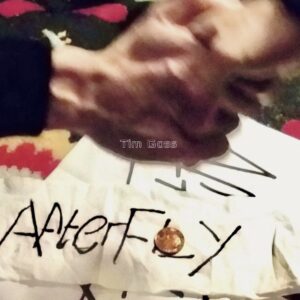
“Afterfly”
Tim Goss (The Shadow Ring / Call Back The Giants) returns with his first outing under his birth name. Afterfly is a mature and compelling work that observes life as a set of repeating patterns, no matter the apparent differences everything has already happened. After one fly comes another and another and another ad infinitum.
You have the face of an old man, catch me if you can.
Afterfly serves as an initiation into a more thorough overview of Tim’s current practise followed with a book of recent illustrations to be released on Penultimate Press in 2022.
Edition of 300 copies. Comes with a booklet with a story to be read alongside Fly 4 (merely a rehash of the conquistadors, life forever repeating with no obvious improvement).
25,00€
Out of stock
2 LP
ETANT DONNES
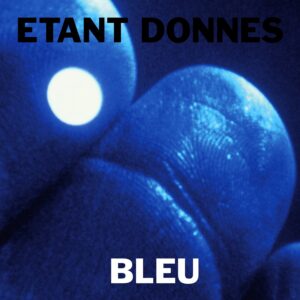
“Bleu”
Following the first ever vinyl reissues of Aurore and Royaume, Aimant + Aimant – Penultimate Press is finally proud to make available the final part of this extraordinary trilogy.
Bleu is the final gesture and culmination of this period of creation where poésie and la nature form a magical alliance that resonates as an alchemical wedding. Having the conviction that Bleu was the ultimate arc based on the purity of natural sound and poetry, leaning towards a mystical spiritual search towards their own souls the band moved into commadere and collaboration with friends and ideals such as Lydia Lunch and Alan Vega.
33,00€
Out of stock

2 CD
Asger JORN & Jean DUBUFFET
“Musique Phénoménale”
Musique Phénomenale was recorded by Asger Jorn & Jean Dubuffet between December 1960 and March 1961 in Paris, and first published in 1961 as a box containing four 10" records in an edition of 50 copies (+ 6 copies H.C.) by Galleria del Cavallino, Venice. 61 years after its original release this first ever reissue was produced in an edition of 600 copies by Daniel Löwenbrück / Edition Hans Pumpestok, København, in cooperation with Fondation Dubuffet, Paris.
"It's a curious feeling to implement and test a spontaneous form of orchestration with an artist who has such an extremely independent background. It really felt like we were experiencing an event of singular importance and significance. I can't say if this importance was greater than our own personal joy. But I do know that this music illuminated many ideas for me that had previously remained obscure. For me it remains a kind of phenomenal music, in the sense that in our productions the music became it's own specific phenomenon, and yet one that was still connected to all the other sensorial phenomena. (…)"
Asger Jorn (from the liner notes)
Double CD in 6-panel digipak in slipcase, with 12-page illustrated booklet and linernotes by Asger Jorn in French & English.
Founding member of CoBrA and Situationist International movements, Danish painter, sculptor, and ceramic artist Asger Jorn (1914-1973) is one of the major figures of the post-war avant-garde, whose work can be characterized by its artistic and political radicalism.
Jean Dubuffet (1901-1985) was a French painter, sculptor, lithographer and writer. He was one of the main protagonists of “Art Brut” (a term he invented in 1945).
23,00€
In stock
2 CD
Hermann NITSCH
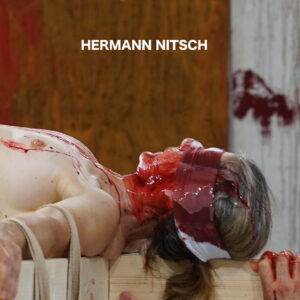
“Musik der 155. Aktion”
Large-scale symphony composed for the 155. Action of Hermann Nitsch’s Orgien-Mysterien-Theater
Performed and recorded 1. September 2018 at the Nitsch Museum, in Mistelbach, Austria.
Directed by Hermann Nitsch and Leonhard Kopp
Conducted by Andrea Cusumano
Performed by Klangvereinigung Wien, Stadtkapelle Mistelbach, and Chor con cor & Musik- und Gesangsverein Asparn a.d. Zaya.
Photography: Reinhard Ehn, Wolfgang Kober
Recording: Daniel Löwenbrück, Patrick Quick
Mastering: Giuseppe Ielasi
21,00€