
In stock

LP
Phill NIBLOCK
“Music for organ”
Music for Organ is comprised of two, sidelong works - Unmounted / Muted Noun, composed in 2019 for organ and four pre-recorded tracks, and Nagro (aka - Organ), for organ and tape, from 2007. In the case of later, the tape material was recorded in 2007 by Emanuel Schmelzer-Ziringer, on an 18th century organ in Austria. The remaining recordings were made by Hampus Lindwall, in presence of the Niblock, in Belgium earlier this year.
Unmounted/ Muted Noun, 2019, for organ AND 4 pre-recorded tracks. Hampus Lindwall, organ.Nagro (aka - Organ), 2007, for organ and tape Tape material was recorded May 1, 2007 at the Joseph Gatto Organ (1787) in Sankt Kirchberg am Wagram, Austria by Emanuel Schmelzer-Ziringer.
Edition of 300 copies on ultra clear Vinyl.
23,00€
In stock
LP
Manuel PESSÔA DE LIMA
“Realejo”
Black Truffle is pleased to present Realejo, the first vinyl release from Brazilian sound artist and composer
Manuel Pessoa de Lima. Having composed works for diverse contexts including cinema, contemporary dance, theatre and television, Lima’s live appearances often take the form of self-reflexive lecture performances that combine electro-acoustic sound, red light, video and spoken text, moving unpredictably from the hilarious to the distressing.
Realejo consists of two side-long pieces of highly idiosyncratic electro-acoustic collage, beginning with recordings Lima made of himself playing the organ in the Schloss Solitude Chapel in Stuttgart. Exploring the peculiarities of the instrument’s mechanics, Lima made hours of recordings with the organ stops half-way open, moving from haunting gliding tones to oddly tuned fair-ground melodies reminiscent of the record’s namesake realejo, a hand-cranked organ traditionally found in Brazil as the musical accompaniment to the work of fortune-telling parrots.
To these organ sounds, Lima added recordings of a security guard made in São Paulo: ‘Just before coming to Stuttgart, I started making field recordings of a security guard in São Paulo. It’s something pretty common in residential areas: they sit in a chair with a whistle, and use that to signal when people arrive, leave or pass by in the street. This particular security guard, Miguel Viana, works on the same street my parents live, and where I had my childhood, and he has worked there since I was a small child. He has watched the street at night, from 8PM to 6AM, every single day, except Sundays, for over 30 years’.
The poignant sounds of the security guard’s whistles punctuate Lima’s electro-acoustic environment, which also includes raw digital synthesis, recordings of his friends’ infant child, audio lifted from Youtube, and, on the LP’s second side, elements taken from an earlier work, ‘36 English to Portuguese Lessons’.
Finely chiselled from dozens of hours of source material into a detail-rich, mercurial structure, Realejo is alternately jarring and seductive, introducing listeners to a young composer with a powerfully individual voice.
Pipe Organ, Electronics, Voice: Manuel Pessoa de Lima
Whistling: Miguel José Viana
Baby: Hanako
Mixing: Joe Talia
Limited Edition pressed on red vinyl
23,00€
In stock

LP
Julia REIDY
“In real life”
Black Truffle present In Real Life, the latest in a flurry of releases from Berlin-based guitarist and composer Julia Reidy. Having drawn acclaim for solo performances on 12-string acoustic guitar that bridge microtonality, 'American primitive' stylings and classic minimalism, Reidy's recent releases have utilised an increasingly broad sonic palette, fleshing out guitar-based composition with electronics, field recordings, and – most strikingly – heavily auto-tuned vocals. On In Real Life, Reidy pushes one step further, crafting an epic LP-length suite that moves from abstracted song to lush electronics and explorations in contemporary musique concrète.
Beginning with a passage of eerie electronics and creaking percussive interjections, Reidy's heavily auto-tuned voice quickly takes centre stage. Surrounded by explosions of electric guitar and synthesised arpeggios, the auto-tuned voice delivers a melancholic ode, bringing together poetic images to reflect on the instability of experience and mutability of identity in a contemporary world saturated by digital technology. This concern with the unsettled relationship between the physical and digital is reflected musically by the constantly shifts in emphasis between Reidy's physically demanding guitar-picking and the various forms of synthesis deployed. Similarly, the dynamic imagery of cutting, shattering, and 'racing streams' present in Reidy's lyrics also serves to characterise the structure of In Real Life, which ceaselessly shifts between distinct episodes. The song-based opening, long sequences of frenetic 12-string guitar shadowed and eventually overtaken by synth tones, passages of delicate chiming harmonics, electro-acoustic cut-ups – each flows seamlessly into the next, often recurring throughout the record's duration, which lingers over interstitial moments between these episodes.
Mixed and mastered by Joe Talia at Good Mixture, Tokyo.
Vinyl cut by Rashad Becker at D&M, Berlin.
20,00€
Out of stock
2 LP
Luigi ARCHETTI – Bo WIGET
“Weltformat”
Edition of 200 copies pressed on 2x 180g clear vinyl housed in a six-panel gatefold cover that unfolds to reveal the musical score of the album.
Ending the decade of silence which followed more than ten years of remarkable, critically acclaimed activity by the partnership of veteran experimentalists, Luigi Archetti and Bo Wiget, the duo returns with what may be their most ambitions effort to date, "Weltformat", issued by Die Schachtel.
Switzerland-based Luigi Archetti and Bo Wiget began collaborating in 1998, the fruits of which initially emerged as the critically heralded, three-part "Low Tide Digitals" series, released by Rune Grammofon between 2001 and 2009. "Weltformat", like its predecessors, builds on decades of solo and collaborative efforts by its creators - Archetti with famed Krautrock pioneers, Guru Guru, among many others, and Wiget with Werner Lüdi, Taku Sugimoto, Tetuzi Akiyama, and others. Sculpted from the intricate tonal interventions and responses of Archetti on guitar, mandolin, and electronics, and Wiget on cello, electronics, and vocals, across the album's four sides the duo constructs a remarkably diverse landscape in sound, folding touchstones of modern classical, free improvisation, minimalism, harsh noise, and ambient music, into a seamless, singular expanse.
Clusters of tone and dissonance merge, collide, and abrade against drones, textures, and pulsing electronics, each element a representative voice of its creator, caught in an imagistic conversation beyond words, which feels as immediate and intuitive, as it does perfectly balanced and thoughtful. "Weltformat", encountering Archetti and Wiget just past the 20 year mark of their collaborative partnership, bears the fruit of rigorous experiments in sound - an immersive, effortless form of sonic realism, built from the optimism and hope which lays at the root of the avant-garde. As beautiful, inviting, immersive, and slow moving, as it is challenging, destabilizing, and thought provoking, Die Schachtel is overwhelmingly proud to release "Weltformat" in both clear double LP and CD formats.
Original price was: 27,50€.15,00€Current price is: 15,00€.
In stock

LP
Donald McPHERSON
“Some Songs”
Alga Marghen present a reissue of Donald McPherson's Some Songs LP, self-released in 1994 in an edition of 20 lathe-cut. As Stefan Neville, coordinator for this edition, suggests: "... the first time I heard anything about Donald McPherson was when my friend David Muir told me excitedly about this guitarist from Ravensbourne who could play really beautifully properly but also just as wonderfully wrongly. I first heard him playing a rare live performance in Dunedin in about 1997. It remains one of the most heavily self-deprecating sets I've ever seen. Abandoning songs halfway through, Donald couldn't contain his belief that his efforts were worthless and that he hadn't practiced as much as we were idiots for listening. He made a good show of appearing not to care but the quality of the few pieces of music he did play showed a personality and idiosyncratic natural ability that could only come from the most meaningful places. And he was totally right... we were idiots tolerating any old shit, just as he was an idiot for being so ridiculously good. Donald is most well-known for the free range guitar instrumentals of his Bramble CD (Metonymic, 2001) and the Vinegar & Rum (WEAVIL 012CD/LP, 2006) collaboration with Tetuzi Akiyama, but it's his 1994 album Some Songs that his friends and fans hold in the highest regard. It sparkles with beauty, wit, and wonder and it crumbles under its own self-sabotaging cynicism. Lyrical flowing folk melodies with playful irritations and grafted on textures, bare-boned hyper-sensitive pop songs, and scrambled spontaneous sketches. Donald always sounds to me like he is resisting his talents as they are too embarrassing, but at the same time embracing the chance to express everything he is feeling no matter how awkward or humiliating it may be. It seems like such a crippling difficult perspective to create from but Some Songs always sounds playful, honest, humble and hopeful to me!" Includes extra tracks taken from Decap (1995) and The Trees (1996) 7" lathe editions. Edition of 200.
Original price was: 23,50€.12,00€Current price is: 12,00€.
In stock
LP
LITTLE SKULL
“A Light In The Window Will Guide Us Safely Home”
A Light In The Window Will Guide Us Safely Home, the new and unique LP by Little Skull, is an album defined by places, journeys between them, and the traces we leave: Warbly guitars and a town hall in rural Waikato; Wheezing melodicas and a train through Tongariro; Tinny autoharps and a bus stop on the Canterbury coast; Scratching violins and mattresses on the floor in flats in Dunedin and Wellington; Squalling saws and the detritus of a life abandoned and rediscovered in Waitati -- These all jostle to be heard over the murk and cassette hiss whether they deserve to be or not. Insignificant instrumentation congregates on insignificant locations, leaving behind ghosts in a place of their own. We each choose our own light to follow in the hope it is the right one. Handmade paper-cut, fold-out sleeves; micro-edition of 200.
23,50€
In stock

LP
Katalin LADIK
“Phonopoetics”
Phonopoetics is the first ever survey of seminal Hungarian artist Katalin Ladik's sonic efforts. A thing of beauty, drawing from the period between 1968 and 1993, its two stunning sides shatter the lines between performance, the spoken word, fine art, and experimental music, offering the terms to rethink how each is understood. Born in 1942, Katalin Ladik has lived a wild and multifaceted creative life -- beginning primarily as a poet of the written word, expanding into experimental theatre during the mid-1970s, and ultimately becoming an artist whose practice also incorporates sound and visual poetry, performance art, experimental music, audio plays, happenings, mail art, collage, and photography, built around visual and vocal expression, as well as movement and gesture. Phonopoetics, Alga Marghen's remarkably diverse survey of Ladik's audio work, is a refracting lens into this dense and dynamic world -- a totem which belongs to a sprawling puzzle of highly nuanced personal, social, political, and existential themes, springing from the feminist and gender neutral concerns of Eastern Europe during the 1960s and '70s. The totality of Ladik's practice, particularly as it unfolds across the two sides of Phonopoetics, can be understood as a radical rethinking of the potential, manifestation, and application of poetry, as well as the fundamentals of vocalization. Delving toward the very origins of consciously created sound -- spoken or otherwise, her efforts unseat the divisions placed between literary, musical, theatrical, and visual disciplines, joining them through the fundamental need and right to express. With the excepting of two works, "Shaman Song / Sámánének" (1968), and "Ufo-Nopoetica" (1976-1993), the featured body of work was created between 1974 and 1979, a prolific period which also witnessed her working within the Novi Sad Theatre and Radio Novi Sad. Primal and poetic, with shamanic overtones and therapeutic mechanisms of liberation, capturing the image of an almost entirely unheard history within the field of feminist expression developed by pioneering figures like Simone Forti and Joan La Barbara. In the words of visionary sound poet Henri Chopin, Ladik is "a great, magical voice." Alga Marghen's issue of Phonopoetics places this little heard, and profoundly important artist into the center of your consciousness where she will no doubt remain. A vital entry in the field of sound art, historic Eastern European experimental practice, and sound poetry. Introduction by Henri Chopin. Edition of 300.
20,00€
In stock

LP
Michael ZERANG
“Assyrian Caesarean”
Chicago-based percussionist Michael Zerang presents his first solo recording after a long career as an exploratory musician and composer. Recorded and mixed by Matt Bordin in the woods at (the new) Outside Inside Studio, the album features a range of approaches to percussion that Zerang has developed over the years, including the use of vibrating drumhead surfaces, expressive friction passages, multiple timbre percussion, and straight up trap-set drumming - all infused with a rich sense of melodic, rhythmic and textural innovation.
Zerang has performed and recorded with some of the most adventurous artists of his era, including a fourteen-year stint with The Peter Brotzmann Chicago Tentet, Joe McPhee’s Survival Unit III, and an extended collaboration with drummer and percussionist Hamid Drake. Frequent collaborators also include cellist Fred Lonberg-Holm, pianist and synthesist Jim Baker, bassist Kent Kessler, trumpeter Axel Dorner, along with an ever-widening pool of international improvisors. He also recently began performing with the experimental Middle-Eastern super group Karkhana - with Mazen Kerbaj, Sharif Sehnaoui, Maurice Louca, Tony Elieh, Sam Shalabi and Umut Çağlar.
19,00€
In stock
2 LP
Hüseyin ERTUNÇ Sextet
“A new world”
We consider ourselves extremely fortunate having met Hüseyin Ęrtunc during his terrestrial transit. After we reissued his wonderful album Mûsikî (privately released on Intex Sound in 1974) and a few collaborative albums with the Konstrukt collective, in 2017 we finally managed to invite him, Doğan Doğusel, Cem Tan and Umut Çağlar to play some shows in Italy as a quartet. Things got really complicated when their visas got rejected - one week before their plane was scheduled to take off - but we found a stalwart supporter of free jazz music at the phone when we contacted the Italian Embassy with a tiny bit of hope and (incredibly) we got the visas in time so we could spend a whole week with Hüseyin and his band, touring Italy and playing four shows of the best spiritual free jazz we heard in a long while.
Right after that, we took the chance to book a recording session at the good old Outside Inside Studio where our loyal partner Matt Bordin captured on tape two days of improvisation by Hüseyin Ęrtunc (Fender Rhodes electric piano, Philicorda organ and chant), Umut Çağlar (percussion and bamboo flutes), Doğan Doğusel (double bass), Cem Tan (drums), joined for this special occasion by the Jooklos Virginia Genta (tenor and sopranino saxophones, clarinet, flutes), and David Vanzan (percussion) leaving an incredible musical document, not only for the fact that - unfortunately - it was Hüseyin's last session on this world.
"Most of Ertunç’s recorded appearances have been on drum set, where he’s employed a massive and materialist cymbal approach that takes Sunny Murray’s explosive chatter as a lifting-off point. Ertunç waxed one LP as a leader in 1974, Mûsikî (with then-regular partners Michael Cosmic and Phill Musra, issued on the tiny Intex label), and returned to Turkey in the early 1990s. Ertunç’s playing, relentless as it might be, evinces a strident, swinging quality that reaches back decades. His pianistic approach is rooted in the outpouring of voluminous, allover rhythm in concentrated shards. One might first think of early Cecil Taylor, though another Boston resident is also worth mentioning – Jaki Byard, who could move from barrelhouse to crepuscular romanticism and dense chordal superimpositions at the drop of a hat. If he and Ertunç didn’t necessarily work together, their spirits are kindred." (Clifford Allen)
Original price was: 30,00€.18,00€Current price is: 18,00€.
In stock
LP
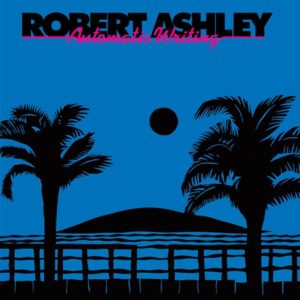
Robert ASHLEY
“Automatic Writing”
“Robert Ashley, Cynthia Liddell, Mary Ashley, Mary Lucier, and Barbara Lloyd,The Brandeis University Chamber Chorus, Alvin Lucier, Director. Three of Ashley’s landmark recordings, Automatic Writing (1979), Purposeful Lady Slow Afternoon (1971) and She Was A Visitor (1967). Composed in recorded form over a period of five years, Automatic Writing is the result of Robert Ashley’s fascination with involuntary speech. He has recorded and analyzed the repeated lines of his own mantra and extracted four musical characters. The result is quiet, mysterious, melancholy and an early form of ambient music. Purposeful Lady Slow Afternoon, and She Was a Visitor are excerpts from an opera entitled That Morning Thing that was composed in 1966-67, as a result of Ashley’s impulse to express something about the suicides of three friends, in particular the intellectual problem of the idea of suicide. The opera takes the form of an alternation of scenes of rationalizations (or explanations) and scenes of descriptions. Purposeful Lady Slow Afternoon is a woman’s description of a sexual experience. It is Ashley’s attempt "to demonstrate the dichotomy between the rational-whatever can be explained in words-and its opposite-which is not irrational or a-rational, but which cannot be explained in words." The lead voice, the processed back-up chorus, the recurring bell tone, and the pervading tape hiss, create an unsettling mood. She Was a Visitor is another form of description, it is intended to be understood as a form of rumor. The chorus is divided into groups, each headed by a leader. A lone speaker repeats the title sentence throughout the entire performance. The separate phonemes of this sentence are picked up freely by the group leaders and are relayed to the group members, who sustain them softly and for the duration of one natural breath. The time lag between the group leaders’ phoneme choices and those phonemes being picked up by members of the group produces a staggered, chant-like effect, with the sounds moving outward from the nearest performer to the farthest. Booklet notes by Robert Ashley.”
27,00€
Out of stock

3 LP Box
Jac BERROCAL
“1973-1976-1979”
This luxurious pink Cadillac colour box set, “1973-1976-1979” brings back the first 3 albums of Jac Berrocal (Musiq Musik – Paralleles – Catalogue) in which countless personalities of the crossover music of the hexagon participate. 200g vinyl records remastered colorful metal covers, an impressive booklet of photos and unpublished documents come to decorate this numbered and limited edition.
MUSIQ MUSIK
First album of Berrocal, recorded in 1973 with excessives reverberations of the crypt of the church Saint-Savinien in Sens, is a real notebook of sound travels, of instruments reported by jac Berrocal and Roger Ferlet during their numerous journeys : Pakistan, Afghanistan, Nepal, India, Jordan, Iraq, Syria, various instruments: bells, muezzins, conches, shenaïs, cymbals, gongs … embellished with urban and incongruous sounds: horns, whistles, chickens, harmonium and washing machine, the all installed on a kiosk. The idea? Make music together, Jac Berrocal, Roger Ferlet, Dominique Coster.
PARALLELES
1976, Vince Taylor, the Black Archangel of Rock’n’roll, agrees to come and record “Rock’n’Roll Station”, a piece of futuristic clinking of a bicycle wheel. Other sessions contrary to custom, a pigsty with microphones mired in the middle of unruly pigs, towels shaken by Pierre Bastien in the middle of this “bric-a-brac” a noisy piece in homage to Luigi Russolo repertoire reorganized by bonuses and unpublished from the same period.
CATALOGUE
1979, the year of the album Catalogue. Jac Berrocal and his “Marquises of disorder” make the guitars rattle in primrose-sprayed vomit, patchwork of uncontrollable slows, furious accordion (Claude Parle) and martial rocks. Kind of “Micro-cinemas put end-to-end”, a maelstrom of cries and saturation which, paradoxically, an album that is worth the respect of the Punks and the contempt of jazz purists. Berrocal is certainly the only French cousin of New York’s no wave.
75,00€
Out of stock

LP
DOME
“Dome 4”
"With the demise of the group Wire in 1980, founder members Bruce Gilbert and Graham Lewis joined forces to create Dome. With the assistance of engineer Eric Radcliffe and his Blackwing Studio Dome took the ethic of “using the studio as a compositional tool” and recorded and released three Dome albums on their own label in the space of 12 months: DOME (July 1980), DOME 2 (October 1980) and DOME 3 (October 1981). A final fourth album, WILL YOU SPEAK THIS WORD: DOME IV was released on the Norwegian Uniton label in May 1983. These albums represent some of the most beautifuly stark and above all timeless exercises in studio experimentation from early 1980s alternative music scene."
16,00€
In stock

LP
OTO HIAX
“Two”
"Second phantasmagorical audio outing from former Seefeel and Loops Haunt members, Mark Clifford and Scott Gordon. ‘Two’ expands the duo’s unique take on spectral synthesis incorporating a diverse amount of approaches to experimental sound. Two expounds a hybrid mix of acoustic based audio design, ambient tonality, sound effects, music, abstraction and world’s hybrid video game soundtrack.There is something of an onomatopoeia quality to the release as the six tracks take on the character of their individual title. Silt, Dapple, Overcurve, Scutter, Strain and Plates appear as extremely well executed versions of the inferred intent of their namesake. This inquisitive approach will appeal to those interested in the more exploratory end of sound production providing hope as newly formed methods and colours are exposed from the duo’s contemporary audio tactics.
Seasoned veterans can lie in a bed of laurels whereas ‘Two’ is an exemplary release revelling in the enthusiasm that comes from the joy of nabated exploration."
Original price was: 17,00€.10,00€Current price is: 10,00€.
Out of stock
LP
Gaël SEGALEN
“Sofia says”
"Three years after the danceable field recordings of her "L'Ange Le Sage" debut LP, the Parisian sound artist, activist and musician Gaël Segalen delivers her third album, "Sofia Says", picking up where her "Memoir of My Manor" cassette stopped. Gaël connects here to a complex mythological entity, Sofia, in a spontaneous mediumnic way - and through her own filtered integration she presents a dynamic sample of her compositional psyche, creatinga compelling mixture of abstract noise experimentations, field recordings and ecstatic electronic manipulation."
17,00€
In stock

LP
Sir Richard BISHOP & Ed YAZIJIAN
“s/t”
"Ex-Sun City Girls master guitarist Richard Bishop teams up with Cul De Sac’s long time Girls live collaborator Ed Yazijian. Two Grand Seigneurs of underground deliver an unique album deeply Western rooted, filled with the musical spirit and structures of Indian music at the same time. Elegant interplay, brilliantly arranged, using mostly guitar (lapsteel, tenor) and strings (viola), and some Indian stringed instrument which I can’t pronounce, and some piano… A classic Saraswati Series sonic adventure. A contemporary polaroid, state of the art in today’s underground music."
Original price was: 21,50€.12,00€Current price is: 12,00€.
In stock

LP
William ENGELEN
“32 bpm”
After "Today, the organ has played beautifully again", released earlier in 2019, Edition Telemark presents the second instalment of what will become a series of LPs of sound works by Dutch artist William Engelen. "32 bpm" was recorded at Kunsthalle Mannheim for an exhibition in summer 2019 and is a slowed down version of "38 bpm", previously released on Engelen's double LP "Partitur Belval" in 2016.
The piece – played here by Mannheimer Schlagwerk – is written for 8 percussionists, each using a set of 9 different instruments varying in their timbre and in the duration of their resonance. The composition is played in a monorhythmic pulse of 32 beats per minute and in unison. To determine the order in which the instruments are played, each percussionist draws their own path through the score consisting of a 32x32 grid of dots of different sizes, with larger dots representing instruments with long resonance and smaller dots those with short resonance. Because each musician has chosen their own path, different instruments are played at each pulse. Neither does the pulse ever change nor do the musicians play out-of-sync at any time. As the piece progresses through its 5 parts, more and more dots are skipped, leaving only 64 beats per musician in part 5, as opposed to 320 in part 1.
The composition "38 bpm" was written in 2016 and now adapted by Engelen to take into account the acoustic qualities of the atrium of the Kunsthalle Mannheim, leading to the slower tempo and a different selection of instruments, now focusing on more resonant ones. The instruments played are mokushos, wood blocks, bongos, reyongs, crotales, triangles, timpanis, gongs, and tubular bells. For the performance, each player stood at a different spot and the audience moved freely between them, feeling out the space by listening to the resonance. The piece thus turned into a sound sculpture inside the architecture of the museum.
The LP is a co-release between Edition Telemark and Kunsthalle Mannheim and comes in a full-color gatefold sleeve with a 12-page LP-sized booklet with photos, a reproduction of the score, and extensive liner notes by Björn Gottstein, director of the Musiktage festival in Donaueschingen, and Sebastian Baden, curator at Kunsthalle Mannheim.
Original price was: 21,50€.12,00€Current price is: 12,00€.
In stock

2 LP
The OVAL LANGUAGE
“Waldkonzerte”
Second LP release by The Oval Language on Edition Telemark after "Hibernation" in 2017, this time showcaseing Klaus-Peter John's Waldkonzerte (woodland concerts), recorded in 2016. The Oval Language is an autonomous art project founded in 1987 in Leipzig, East Germany, by Klaus-Peter John and Frank Berendt. Since Berendt left in 1995, it has been continued by John, sometimes with collaborators, but recently mostly for solo activities. Its fields of activity have included sound-noise performances, conceptual works in open spaces, installations, land art projects, photography, and more.
From the beginning, the space or location itself has been a central aspect within many of their site-specific sound-noise performances. When working at a certain location, the performers tried to not bring in anything from outside, but exclusively use material already available at the space. This way, it becomes possible to thoroughly feel out and explore the site, allowing a distinct site-specific sound to emerge that is integrated into the performance. Throughout the 1990s, the sites used often were abandoned buildings in Leipzig, available in nearly unlimited quantity, from vacant factories to unused former public bathing facilities. During the recent years, Klaus-Peter John has focused on a minimisation of means and developed a unique vocal technique without amplification that he has used in a number of performances. In 2016, he attempted to integrate his voice into pure nature, in his own words the biggest challenge to date. His goal was not to perform any kind of singing or the like, but to use voice as a means similar to the site-specific tools used in previous performances by The Oval Language. He performed five concerts without audiences in a forest ravine in Döben, near Grimma, between June and November. The concerts parallel the course of the seasons and their related acoustic changes and conditions.
This double LP is presented in a die-cut single sleeve with two printed inner sleeves. The inner sleeves contain one photo made during a Waldkonzert on each side. By switching the order of the inner sleeves, four different front sleeves can be generated. Edition of 200.
32,00€
In stock

LP
Arturas BUMSTEINAS
“Bad Weather Long Play”
"Bad Weather" is a performative sound art event of a group of performers engaging with reconstructions of Baroque theater noise machines. The project started in 2017 when Lithuanian artist Arturas Bumšteinas teamed up with theater carpenter Ernestas Volodzka to re-create wind, rain, sea and thunder imitation devices, identical to the ones whose canon settled in European theater in the 17th century. Commissioned and produced by contemporary music theater production house Operomanija, "Bad Weather" events have since been presented in Lithuania and Poland. During each performance, the ensemble plays the machines in keeping with meteorological maps and charts from various centuries that serve as scores. Contemporary artist Ivan Cheng was invited to write and perform a libretto that is integrated into every performance in different ways. In the Baroque era, the noise machines constituted only a small part of the theatrical illusion, lurking behind the scenes, invisible to the audience. Meanwhile in "Bad Weather", they take the spotlight and become generators of conceptual climate.
"Bad Weather Long Play" is a collage of sound materials from performances, rehearsals, soundchecks and other occasions related to the project, as documented with various recording devices between 2017 and 2019. The sides of the LP don't function as A and B sides but can be played in any order. The LP is presented in a full-color sleeve with a printed inner sleeve containing photos of the various stages of the project and liner notes by Salomé Voegelin. An included 8-page booklet reproduces Ivan Cheng's libretto.
"Produced from a selection of recordings made at rehearsals, workshops and performances with an alternating team of seven performers, Bumšteinas convokes a work that sounds its process on the mobile blueprint of meteorological maps as scores. Creating a mis-en-scène of invisible occurrences that talk with each other in the language of a storm that is brewing, raising and petering out, and that leaves a trace in our ears, an imprint and a movement that might only clear the next day." (from the liner notes by Salomé Voegelin)
Arturas Bumšteinas (b. 1982 in Vilnius, Lithuania) is an artist working within the intersections of sound, music and art. His practices include performative sound art, radio art, exhibitions, experimental acoustic and electronic music. He started exploring theater noise machines in 2012 when he was commissioned by Deutschlandradio Kultur to compose "Epiloghi. Six Ways of Saying Zangtumbtumb".
21,50€
In stock
LP
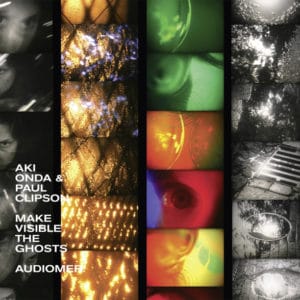
Aki ONDA + Paul CLIPSON
“Make visible the ghosts”
audioMER. is honoured to announce the release of a new LP; Make Visible the Ghosts with music by Aki Onda (US/JP) and artwork by Paul Clipson (US). This album is the follow-up of Aki Onda's Cinemage project Lost City—with Loren Connors and Alan Licht—released on audioMER. in 2015.
On Make Visible the Ghosts, New York-based musician Aki Onda composed the soundtrack for the images of the San Francisco experimental filmmaker Paul Clipson, who suddenly passed away on February 3, 2018.
In 2009, Clipson and Onda met at the Amsterdam Schiphol Airport for the first time and shared a ride to the International Film Festival Rotterdam, where they presented audio-visual works in the same bill. Since then, the two artists – known for their highly personal approach with Super 8, 16mm, cassette Walkman and radio – maintained a close friendship over the next nine years. Their works deal with memory, time, space, and those reflections, and they had a lot to share.
Onda and Clipson completed their collaboration work Make Visible The Ghosts—a combination of vinyl LP of Onda's music and large-size collage artwork by Clipson—a few months before Clipson's departure from life. The work is composed of the materials they used for their performance in New York in 2012 and developed over the three years from 2015 to 2017. Onda notes: "The loss of Paul has left a huge hole in our mind including his friends and collaborators. Paul is no longer here, and this is a chance to remember him and his images that extended and expanded our perception of how the world can be seen and heard."
21,50€
Out of stock
LP
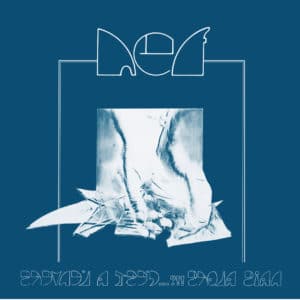
NEF
“Mais alors !!?… c’est à l’envers”
In 1983, NEF released their first and only album, Mais Alors !!?... c’est à l’envers. At that point, the band already had a long history, interwoven with that of various musical trends and alternative movements from the late sixties to the early eighties. That’s certainly what makes this record so special and able to conciliate such different worlds as Electronic Prog, Film Score, New Wave …
The band’s destiny was most certainly tied to their native region, the South of France, an idyllic environment that attracted a number of musicians during the 1970s, allowing the group to attend many concerts or share the bill with several groups that have gone on to become well known: Can, Ash Ra Tempel, Magma, Catherine Ribeiro, Zao, Chêne Noir, Art Zoyd …
Founded in 1975 by Richard Lorenzi, NEF started as a kind of Free Rock band with multiple influences, going from Prog to Musique Concrete, in which any method of making sound, any way of bringing out sounds was good … 2 musicians and a photographer, full member of the band who was projecting slides over the music and influenced their dreamlike universe. In 1978, Vincent Tronc came on board with his keyboards and synths. While the group had been influenced by electroacoustic techniques until then, Vincent broadened NEF’s horizons, bringing in a host of new influences: Ash Ra Tempel, Kraftwerk, Klaus Schulze … the beginnings of electronic music.
When the album is recorded in 1983, new directions were taken and changed NEF’s usual sound. First, the idea of playing the accordion, clearly not a common thing and a new Drum Machine, the Roland CJ-5000. Pressed the day a figure of French Chanson died, NEF’s pressing is botched up, a good part of the records were unusable since the records came out totally warped. Then, at the end of the eighties the small stock of remaining records is lost in the sadly famous flood of Nîmes. 2000 records had been pressed, but very few survived!
All the more reason to reissue Mais Alors !!?... c’est à l’envers, an unsung record, free and multifaceted, a quirky and daring musical ovni, transcending eras and genres, between synthetic Krautrock and Film Score, reminiscent of NEU! (with a red nose), François de Roubaix and Pascal Comelade.
22,50€
Out of stock
LP
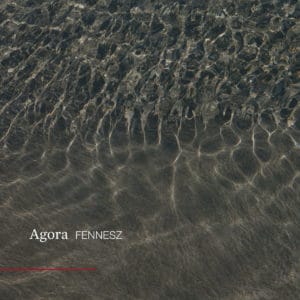
FENNESZ
“Agora”
Agora is Christian Fennesz's first solo album since 'Mahler Remixed' [Touch, 2014] and 'Bécs' [Editions Mego, 2014]. Fennesz writes: "Its a simple story. i had temporarily lost a proper studio workspace and had to move all my gear back to a small bedroom in my flat where I recorded this album. It was all done on headphones, which was rather a frustrating situation at first but later on it felt like back in the day when I produced my first records in the 1990s. In the end it was inspiring. I used very minimal equipment; I didn't even have the courage to plug in all the gear and instruments which were at my disposal. I just used what was to hand.
Fennesz uses guitar and computer to create shimmering, swirling electronic sound of enormous range and complex musicality. "Imagine the electric guitar severed from cliché and all of its physical limitations, shaping a bold new musical language." - (City Newspaper, USA). His lush and luminant compositions are anything but sterile computer experiments. They resemble sensitive, telescopic recordings of rainforest insect life or natural atmospheric occurrences, an inherent naturalism permeating each piece. He lives and works in Vienna.
19,00€
In stock

2 LP
RENALDO AND THE LOAF
“The elbow is taboo / Elbonus”
The Elbow is Taboo was Renaldo & The Loaf's fourth and last album of their initial phase prior to their return in 2010. Released by Ralph in America and Some Bizzare in the UK in 1987 this work represents a development in the overall sound as they utilize an 8 track recorder along with early digital effects. A large arsenal of acoustic instrumentation gives the record an additional unsettling atmosphere. Recorded over a 3 year period this remains the definitive statement by the group in this early period.
As clarified by Brian from the band, the themes remain as obtuse and alluring as ever with each song containing it’s own story. “be it a child's desire to control (A Street Called Straight), the ridiculous purdah of an innocent part of the body (The Elbow is Taboo), a call for help in times of angst (Here's To the Oblong Boys), the rigours of a bread fetish (The Bread Song), the anger of a dance teacher to the terminally inept (Critical/Dance) or a ritual call to prayer, somewhere (Extracting the Re-re)”.
Disorientating and delightful this is a must for all fans of the Loaf and for those tickled by the more deranged spectrum of song.
Original price was: 24,00€.15,00€Current price is: 15,00€.
In stock

LP
Thomas BRINKMANN
“Raupenbahn”
Editions Mego is proud to present the latest addition to the compelling discography of Thomas Brinkmann. Throughout his career Brinkmann has focussed on the human operating amongst industry alongside rhythms that manifest as a result of technological advancement. With this new release Brinkmann makes a u-turn, looking back to the early industrial age. Comprised of recordings of various looms, Raupenbahn investigates the sonic properties and consequences of the first automatic loom as constructed by Jacques de Vaucanson in 1745. Thomas Brinkmann once again adheres to his tendency for clarity and simplicity whilst further investigating not only the sound and rhythms of the machines (looms) but also what role they serve in society and what consequences they have on the environment. Raupenbahn presents 21 tracks in total, 11 feature on the vinyl, the remaining 10 as digital bonus tracks. The majority of recordings were undertaken by Brinkmann in 2017 with a Neumann KM 184 stereo set. Additional recordings were sourced with permission from Monika W. recs. from 2014 Central Museum of Textiles Łódź, Poland. Each piece presents a diversity of material which borders on the breathtaking and beautiful in richness and complexity. The various looms unravel rhythms and patterns unexpected from machines of the early industrial age.
The loom holds a significant role in shaping our world being the catalyst for Charles Babbage’s Analytical Engine which, alongside the subsequent work of Byron’s daughter Ada Lovelace, paved the way for modern computing. There is a linage of the loom that fits succinctly in Brinkmann’s overall argument. Here we encounter a parallel between machine driven economies and the music that rose from such places, consider the Sheffield steel industries, the Manchester weaving industry or the Rhineland / Düsseldorf loom and machine industry. Is it a coincidence that the practice of such machines in the environment gave rise to today’s predilection for electronic dance music, in pop, soundtracks, etc
Raupenbahn features no treatment or processing and explicitly displays varying tempo and timbres which ascertain a wide range of acoustic structures. The artwork features Ingrid Wiener, Rosemarie Trockel and Alexandra Bircken, three different generations who would with ideas of fabric weaving, loming and the like. This exceptional release works on a number of levels alongside it’s striking sonic palette.
Original price was: 17,00€.10,00€Current price is: 10,00€.
In stock
2 LP
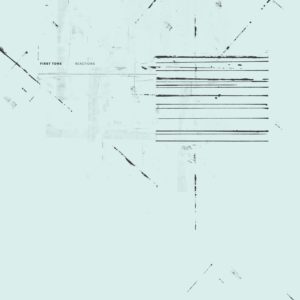
FIRST TONE
“Reactions”
"Reactions" is the debut album from First Tone, the musical partnership of New Orleans-based artists Turk Dietrich (Second Woman, Belong) and composer Duane Pitre (Important Records). While the project has been at work quietly sculpting their sound for years, "Reactions" is the first available set of recordings. Those familiar with the respective works of the two artists will be happy to find a collection of music that is very much of the duo, and yet totally unlike anything they've produced before.
Over six tracks, First Tone unfurl poignant, flickering compositional works that utilize pitch material that is tuned using the system known as Just Intonation (which Pitre has studied for nearly 15 years) in conjunction with various software and a single hardware synth. The result is a collection of music that is both organic and alien. Layers of tone and texture build and dissolve from the ultra minimal to the enormous, on occasion seamlessly blending the two. A wide array of striking timbres patiently wash over one another, at times sounding like organic instruments, at other times sounding completely otherworldly.
"Reactions" is a masterclass not only in sound design and dynamic range, but also in sonic depth. The album’s approach to the usage of time and dynamics work together to create the perception of a three-dimensional spaciousness of sound. The holographic effects produced from the spaces between the album’s sounds are mesmerizing, with discreet arrangements that demand repeat listens to fully absorb.
23,00€
In stock

LP
Yoshi WADA
“Lament for the rise and fall of the elephantine crocodile”
Yoshi Wada's Lament For The Rise And Fall Of The Elephantine Crocodile, originally released in 1982 on India Navigation, remains one of the most remarkable flowers to grow in the rarefied air of American minimalism – akin to Terry Riley's Reed Streams and Pauline Oliveros' Accordion & Voice, yet with a wild, liberated energy all of its own.
After graduating from Kyoto University of Fine Arts with a degree in sculpture, Wada moved to New York City in 1967 and quickly fell in with the community of artists known as Fluxus. In the early '70s, he began building his own instruments and writing musical compositions, studying with La Monte Young and Hindustani singer Pandit Pran Nath.
Recorded during an epic three-day session in an empty swimming pool in upstate New York, Wada's first album brings together two of the oldest drone instruments – the human voice and bagpipes – to simple and glorious effect. A visit to the Scottish Highlands spurred Wada's interest in bagpipes, which the composer integrated into these sparse, otherworldly sounds heard on Lament.
"That swimming pool was quite hallucinatory," recalls Wada. “It was another world. I felt it in terms of resonance. I slept in the pool, and whenever I moved, I woke up because of the reverberations.... The piece itself is an experiment with reeds and improvisational singing within the modal structure."
This first-time vinyl reissue is limited to 750 numbered copies. Comes with poster.
28,00€
In stock

LP
TAJ MAHAL TRAVELLERS
“July 15, 1972”
For over half a century, Takehisa Kosugi was one of the most unique and enduring figures in the Japanese underground. As an art student in Tokyo in the early '60s, he joined the Fluxus-styled performance unit Hi Re Centre and founded the improvisational ensemble Group Ongaku, but his most legendary project was The Taj-Mahal Travelers – a multicellular organism that included Kosugi, Ryo Koike, Yukio Tsuchiya, Seiji Nagai, Michihiro Kimura, Tokio Hasegawa and sound engineer Kinji Hayashi.
With a penchant for long psychedelic jams (some lasting 12 hours or more) The Taj-Mahal Travelers lived up to their name. Touring in a Volkswagen van across Europe and Asia in the early '70s, they eventually reached the actual Taj Mahal in India. Upon their return to Japan, they held a concert to raise more touring funds and released their very first recordings. Their debut album, July 15, 1972, would extend the band's matter-of-fact titling: all the tracks were named precisely for the times they began and ended.
With a grab bag of instrumentation (electric violin, double bass, santoor, vibraphone, harmonica, radio oscillators, sheet iron, etc.), The Taj-Mahal Travelers weave together mesmerizing waves of sonic texture. Featuring longtone concepts that Kosugi discovered while working with sound generators in New York in the mid-'60s, July 15, 1972 remains just as much a collective tone poem as psych workout. These leader-less sounds coalesce into a unified whole that feels both subconscious and sublime, as if the waveforms bypass the listener's ears and land directly inside one's synapses.
This first-time vinyl reissue is limited to 900 numbered copies. Comes with poster.
32,00€
In stock

2 LP
Eliane RADIGUE
“Chry-Ptus”
Eliane Radigue's Chry-Ptus is her very first piece for the modular synthesizer. It was composed in 1971 using a Buchla 100 which had recently been installed at NYU by Morton Subotnick.
This double LP was mastered by Golden and pressed at RTI for maximum fidelity.
From the original press release:
'Chry-Ptus' (1971). Originally two tapes which were to be played simultaneously, with or without synchronisation, which does not affect the structure of the work, but creates changes in the game of sub-harmonics and overtones.
Three variations on this piece were performed at the New York Cultural Center in 1971, with variations of amplitude and location modulation as well as synchronisation. Realized on the Buchla Synthesizer at the New York University.
The booklet contains a text by painter Paul Jenkins, who also realised the watercolor on the front cover, written on occasion of Radigue's first concert in New York, April 6th, 1971.
“It’s with the Buchla that I constructed Chry-ptus, a piece made up of two tapes with an analogue duration, 22 or 23 minutes, which could be played either simultaneously or with a slight time difference, so as to establish slight variations every time the piece was played. I spent the first months eliminating everything I did not want; I even used a notebook in which I tried to determine a writing system resembling chemical formulae.” Eliane Radigue
32,00€
Out of stock

LP
RTVS
“1981-2001 … approximately”
"The connection with and love for Radio Centraal runs through Ultra Eczema’s veins. The Antwerp-based station has functioned as a voice for myriad local underground movements for nearly forty years. From its inception, architect and ex-Situationist Rudi Renson and restaurateur Roland Rom were a critical, hilarious, and provocative voice in its repertoire of weirdos, chiefly via the weekly RTVS (Radio & Television Salon) programme. Lots of ‘music’ was made within this show, largely enabled by its presenters’ revolving door policy of regularly inviting others to contribute or host: musician and artist George Smits, actionist and performer Jacques ‘Jack The Rapper’ Ambach, artist Jörgen Voordeckers, jazz saxophonist Mike Zinzen, aspiring philosopher and bass player Filip Baert, political activist Peter Terryn, troublemaker Jan ‘JAC’ Van Den Eynde, renaissance man Mark Meulemans, graphic designer Dominic Gregoire, fashion photographer Ronald Stoops, communist activist Leo Dierckx, feminist Ellen Verryt, translator and teacher Linda Greeve, biologist and Cassis Cornuta’s sole member Daniel Renders… You get the picture.
This compilation is far from complete. It is merely a selection from over 200 cassettes from the archives of Rudi Renson and Roland Rom’s families. The book features interviews (in Dutch) with some of the show’s main protagonists, and a long essay by Peter Terryn (in English).
Limited edition of 250 copies.
Original price was: 24,50€.12,00€Current price is: 12,00€.
In stock
LP
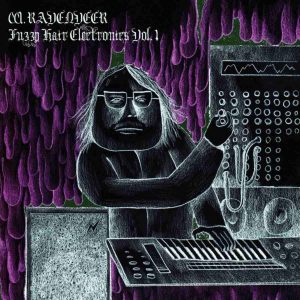
W. RAVENVEER
“Fuzzy Hair Electronics Vol. 1”
"W. Ravenveer – Erwin Van Looveren – has been a friend for over 20 years. Erwin is a magnet and connoisseur of strange and obscure music, and prone to nervous sweating should you mention a band or weirdo he doesn’t know. His early guitar gigs (as Schidzoid) are the stuff of legend, a reputation largely based on altercations with members of the audience. Having thumped everyone in sight, Erwin’s focus shifted to buying and mastering synthesizers with his customary zeal. After self-publishing a dozen or so cassettes, usually adorned with his neon horror vacui drawings, UE is pleased to present the first W. Ravenveer LP.
Synth blubber! Mental boogie! Spoken intro and outro!
And still in your face: the front cover is a portrait of the artist.
Glossy, full-colour sleeve.
Limited edition of 250 copies"
19,50€
Out of stock

LP
Frank HURRICANE
“Pymp World”
"Frank Hurricane’s legend is such that many have heard his name years before hearing his music. Hurricane Frank, if you will, is the kind of character that can spin an audience into a psychedelic vortex that will have you yelping HOLY PYMP BREW repeatedly as you zigzag your way back home. His music possesses a nagging quality: a dizzying mix of scruffy rap, Casio tones and raw dictaphone poetry that sounds like it always existed in that quattro formaggi part of your mind. Originally released as a self-published cassette, and subsequently on CDR by Joshua Burkett’s Mystra label; both in ridiculously small runs.
Limited to 250 numbered copies. Includes insert."
19,50€
In stock

LP
PITA
“Get on”
With over 2 decades of formal exploration and exhilarating abstraction Get On is, somewhat surprisingly, only the fourth solo Pita full length. Peter Rehberg has always been vouched for pushing the very limits of the technology du jour, be it software or in recent years a complex modular set. Rehberg’s motives are one of unbridled exploration often resulting in extreme and exhilarating audio works.
Having spearheaded the contemporary electronic sound with his uncompromising explorations of noise, rhythm and extreme computer music, he has also worked with numerous experimental musicians in collaboration. Rehberg stands in the wake of a sonic revolution, once fringe, which transformed over time into the sound of a generation of experimental geeks and club freaks worldwide.
Get On follows on from the 2016 release Get In. As with other titles in his ‘Get’ series we have an unwieldy blend of noise, abstraction, gnarled rhythm and blurred melody. Both analogue and digital tools are deployed as a means of expressing something outside of everyday electronics. ‘AMFM’ launches proceedings with some delightfully disorientating ricocheting electronics setting off a subversive sonic spectrum. ‘Frozen Jumper’ presents some ugly skittering electronics which rotate into exquisitely mangled forms before launching into an unsettling euphoria. The last piece ‘Motivation’ is a towering sensitive work, simultaneously haunted and emotionally moving. Get On marks another monumental work in the ongoing evolution from one of the ground zero pioneers of contemporary radical electronic music. As uncompromising as ever this is Pita in his prime. Emotion rung from the most twisted of frames.
Recorded and mixed by Peter Rehberg at Twisted, Wien, 2018/2019
Mastered by Russell Haswell, July 2019
Cut by Rashad Becker at D&M, Berlin, August 2019
Original price was: 17,00€.10,00€Current price is: 10,00€.
Out of stock

LP
Jérôme NOETINGER – Anthony PATERAS
“A Sunset for Walter”
Penultimate Press present A Sunset for Walter, the first duo release from long-time collaborators Jérôme Noetinger and Anthony Pateras. "Having worked together in a number of different collaborative contexts over the years, the pair used Pateras' 2018 residency at Schloss Solitude in Stuttgart as an opportunity to develop a major durational work for Steinway piano and multiple Revox tape machines. Presenting four excerpts from a three-hour concert, the LP's opening moments immediately establish its distinctive sound-world: an austere sequence of octaves slowly sounded by the piano gradually develops into passages of fragmentary lyricism as Noetinger's tape manipulations dilate the sonic space with rumbling sub-bass, distant echoes, and hints of uncanny backmasking. A Sunset for Walter was conceived as a loose tribute to the piano works of Walter Marchetti, particularly the slowed-down subaquatic expanse of Nel Mari Del Sud. As Marchetti described his own work, A Sunset for Walter is 'music without beginning, or end, or development', where the lack of obvious structural divisions creates something like an endless present. But where the monochrome surface of Marchetti's work — in its willingness to descend, in his own words to the 'pits of aesthetic poverty' — often approaches total stasis, A Sunset for Walter is calmly immovable in its overall texture but perpetually changing in detail, as the performers respond intuitively to each other, their instruments, and the environment. Noetinger's tape manipulations range from nearly imperceptible shadowing of the live piano to anarchic bursts of rewinding tape, floating wisps of feedback, and dreamlike concrète interjections of children's voices and splashing water. Pateras' piano performance moves from single pitches left hanging over a backdrop of silence to almost Messiaen-esque sequences of complex chords and arpeggios, all sounded within a temporal framework that seems to follow internal rhythms of breath and bodily movements. Caught in this hall of mirrors, the listener is often unable to distinguish the live piano from its tape-manipulated reflection. Like the sunset of the title, here outlines blur into a crepuscular haze, as fleeting effects of light and shade catch our attention just as they disappear." – Francis Plagne
20,00€