
Out of stock
CD
Beatriz FERREYRA
Argentinian composer born in 1937, Beatriz Ferreyra is living and working in France since the sixties. She is famous for her incredible work of all sound examples for the Pierre Schaeffer’s “Solfège de l’objet sonore”. She is also a great tape player. “Dans un point infini” (2005), “L’autre rive” (2007), “Les larmes de l’inconnu” (2011), “Un fil invisible” (2009).
15,00€
In stock
CD
COMPILATION
RYTHMÉ BRUT
“With Dragibus, Guylain Damonneville, Jaber, Fred Thabaut, André Robillard, Paul Bourre, Jean Clerembaux, Mordysabbath, Michel Dalmaso, Donna Collins. Does “raw” music exist? Is there any correlation with Raw Art? Don’t be afraid, this cd does not give any clue. One could find everything he wants in these recordings: musicians which could belong to the “Neuve Invention”, improvisers of noisy belches on a microphone, outstanding technicians accumulating several keyboards like other obsessionaly accumulate things (I think of the puppets of Michel Nedjar), soft and-or violent musicians. But from what I have listened to, there were sincere people, an essential quality for the raw approach. For some of them, their music was never “exported” before. This cd has the defaults and the advantages of a compilation. Default of heterogeneity and advantage of heterogeneity. Everybody can pick what he needs to imagine... Fullishly destroyed.”
12,00€
Out of stock

CD
Jean-François PAUVROS
“La belle décisive”
New edition in digisleeve !
1996. Jean-François Pauvros: guitar, voice. “Jean-François Pauvros is still a far lesser known name to those outside France, but he has a solid-gold history in European free-rock shenanigans stretching all the way back to the late seventies, when he played alongside Jac Berrocal in Catalogue. Recent years have seen many collaborations with dancers, poets, and Japanese musicians such as Makoto Sato, Setsuko Chiba, and Keiji Haino.” Alan Cummings
1996. Jean-François Pauvros: guitar, voice. “Jean-François Pauvros is still a far lesser known name to those outside France, but he has a solid-gold history in European free-rock shenanigans stretching all the way back to the late seventies, when he played alongside Jac Berrocal in Catalogue. Recent years have seen many collaborations with dancers, poets, and Japanese musicians such as Makoto Sato, Setsuko Chiba, and Keiji Haino.” Alan Cummings
10,50€
In stock
CD
BERTHET – LE JUNTER
“L’enclume des jours”
“(This title is taken for « foam of the days », a novel by Boris Vian. « Foams » has been changed for « anvil » since in french, « foam » stands for « écume » and « anvil » for « enclume »). Raw concrete music. Tubular dums, horns, nails, wind and rotary organs, water droplets, automatic bow, springs, foot bass, iron wires, tins, barrels, mirrors, singing... So many indications to penetrate the music of Pierre Berthet and Frédéric Le Junter, two french artists. This is a clever mix between the soundscape of our society (the concrete item of the music) and the creative diversion for construction and composition, in order to give an expressive signification of this world. We really are in the center of the globalization of our lifes; our urban future based on our agricultural roots. These recordings of the CD professionnaly duplicated (27 min long) were performed in the mid 90’s, when Pierre Berthet and Frédéric Le Junter played duo, with already some memories recorded on a CD published in 1994 on the Vand’Oeuvre french label. Today, InPolySons produces unreleased material from the same days, composed for the ballet show « Love is a stranger» of the late William Douglas (1953-1996) (excepted the last piece which appeared on a Vand’Oeuvre compilation). These are sounds staged for us, meaning sounds through simple and raw words, as a metaphor of the real life.”
9,50€
In stock
CD
GRIMO
“Rag-time”
Dominique Grimaud plays guitar, synthesizer, banjo, mandolin, harmonica with old 78rpm. He plays with our memory, with the history of recording and with the surface noises of the old records.
Original price was: 12,00€.5,00€Current price is: 5,00€.
In stock
CD
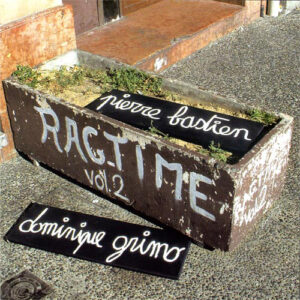
Dominique GRIMO-Pierre BASTIEN
“Rag-time vol.2”
“Rag-Time: jazz precursor, plenti-syncopes. Bastien et Grimo converted themselves into two analogical DJs, slicing old 78 rpm Lps and assembling them into Mecano wheels: with the aim to construct a true concept-album to criticize our present time which is getting irreversibly slashed. The different pieces of this cd are connected together by old and new diseases such as pest and cholera, the misery of our world. For that, Grimo took out his old Teppaz, cleaned the needle, wiped off the dust of his old 78 rpm Lps with their brownish sleeves and prepared-composed a strange program to his colleague Bastien. The so-call colleague sweap his little trumpet, oiled the movements of his mecanic robots and arranged the last year’s melodies, giddy and charming tunes. This produced a transe music, trans-duced, trans-versed and trans-formed that resembles nothing but the imaginary world we hear. Volume 2: the first (already on InPolySons) was a solo. Grimo-Bastien today act as a duo. Two mechanical DJs who officiate without mix artifice, recording in mono.”
12,00€
Out of stock

CD
Han BENNINK & Kazuo IMAI
“Across the desert”
European free jazz/free improvisation pioneer Han Bennink (drums) made this studio recording with Kazuo Imai (guitar) in Tokyo in May of 2002. Imai, who in the ’70s studied with Masayuki Takayanagi and Takehisa Kosugi, currently performs both on his own and with the annual five-member collective improvisation project Marginal Consort. Across the Desert contains nine duo pieces. Imai plays both acoustic and electric guitar while Bennink delivers strong, constantly changing rhythms. Here are two musicians who know their instruments inside out. Their unique affinity is powerfully conveyed in these dynamic exchanges.
14,00€
Out of stock

CD
Pauline OLIVEROS
“Accordion & voice”
Back in stock. “Utterly essential document of early American minimalism from this pioneering composer. Remastered from the original analog tapes by Carl Saff. Pauline Oliveros (b. 1930) is an accordionist and composer who currently resides in Kingston, New York. Her instrument is tuned in Just Intonation and she often includes it in her meditative improvisational music. Her music is not meditative in the sense that it is intended for listening to while meditating, rather each piece is a form of meditation, such as her aptly titled Sonic Meditations. A central figure in post-war electronic art music, Oliveros is one of the original members of the San Francisco Tape Music Center (along with Morton Subotnick, Ramon Sender, Terry Riley, and Anthony Martin), which was the resource on the U.S. west coast for electronic music during the 1960s. The Center later moved to Mills College, where she was its first director, and is now called the Center for Contemporary Music. Oliveros often improvises with the Expanded Instrument System, an electronic signal processing system she designed, in her performances and recordings. “Accordion and Voice was the first of my recordings as a soloist. I was living in an A-frame house in a meadow just below Mount Tremper at Zen Mountain Center. I had a wonderful view of the graceful saddle mountain top. When away on a performance trip I would imagine the mountain as I played Rattlesnake Mountain. I followed the feelings and sensations of my many experiences of the mountain - the changing colors of the season, the breezes and winds blowing through the grasses and trees. Horse Sings From Cloud taught me to listen to the depth of a tone and to have patience. Rather than initiating musical impulses of motion, melody and harmony I wanted to hear the subtlety of a tone taking space and time to develop. The tones linger and resonate in the body, mind, instrument and performance space. My thanks to Important Records for bringing these pieces to be heard again.” Pauline Oliveros 2007
13,00€
In stock

CD
Pauline OLIVEROS
“The wanderer”
Reissue. “This is the first time The Wanderer has been made available on cd after over 20 years out of print. Included as a bonus track is a lengthy live recording of Oliveros with David Tudor that was discovered on the reels during the digital transfer! Remastered from the original analog tapes by Carl Saff. Utterly essential document of early American minimalism from this pioneering composer. The Wanderer is the sister record to Accordion & Voice also available on cd from Important. The Wanderer is based on a single modal scale (B C
D D
E F
G
) and rhythmic modes based on a meter consisting of 3-4 and 3-8. Part I, Song, is intended to explore the unique resonant qualities of accordion reeds through long sounds. Subtle variations come about from differences in tuning and air pressure. Part II, Dance, demonstrates the sharp accenting power of the accordion bellows in a mixture of cross rhythms characteristic of jigs, reels, batucadas, Bulgars, klezmer forms, Cajun dances, and music of other diverse cultures. The Wanderer was composed in November, 1982 especially for the Springfield Accordion Orchestra, directed by Sam Falcetti. This recording documents The Wanderer’s world premiere, as it was performed 27 January, 1983 at Marymount Manhattan Theatre. The orchestra consists of twenty accordions, two bass accordions, and five percussion, with Pauline Oliveros as soloist, Sam Falcetti conducting. Horse Sings From Cloud, written in 1975, is one of Oliveros’ best known works. Like most of her Sonic Meditations, it can be performed vocally and/or instrumentally, solo or in collaboration. A solo version of Horse Sings From Cloud has been recorded on Accordion & Voice. An early version of the score reads, “Sustain a tone or sound until any desire to change it disappears. When there is no longer any desire to change the tone or sound, then change it.” This time, Horse Sings From Cloud is performed in ensemble. Joining Pauline Oliveros on bandoneion are Heloise Gold on harmonium, Julia Haines on accordion, and Linda Montano on concertina. This quartet version incorporates the microtonal differences in tuning of the selected instruments, creating shimmering reed sounds somewhat similar to the shimmering of a Balinese gamelan.”
D D
E F
G
) and rhythmic modes based on a meter consisting of 3-4 and 3-8. Part I, Song, is intended to explore the unique resonant qualities of accordion reeds through long sounds. Subtle variations come about from differences in tuning and air pressure. Part II, Dance, demonstrates the sharp accenting power of the accordion bellows in a mixture of cross rhythms characteristic of jigs, reels, batucadas, Bulgars, klezmer forms, Cajun dances, and music of other diverse cultures. The Wanderer was composed in November, 1982 especially for the Springfield Accordion Orchestra, directed by Sam Falcetti. This recording documents The Wanderer’s world premiere, as it was performed 27 January, 1983 at Marymount Manhattan Theatre. The orchestra consists of twenty accordions, two bass accordions, and five percussion, with Pauline Oliveros as soloist, Sam Falcetti conducting. Horse Sings From Cloud, written in 1975, is one of Oliveros’ best known works. Like most of her Sonic Meditations, it can be performed vocally and/or instrumentally, solo or in collaboration. A solo version of Horse Sings From Cloud has been recorded on Accordion & Voice. An early version of the score reads, “Sustain a tone or sound until any desire to change it disappears. When there is no longer any desire to change the tone or sound, then change it.” This time, Horse Sings From Cloud is performed in ensemble. Joining Pauline Oliveros on bandoneion are Heloise Gold on harmonium, Julia Haines on accordion, and Linda Montano on concertina. This quartet version incorporates the microtonal differences in tuning of the selected instruments, creating shimmering reed sounds somewhat similar to the shimmering of a Balinese gamelan.”
13,00€
In stock

CD
Pauline OLIVEROS and Connie CROTHERS
“Live At The Stone”
Live At The Stone was intended to be Pauline Oliveros’ tribute to the life and work of pianist Connie Crothers who passed away on August 13, 2016. Sadly, Pauline Oliveros passed away on November 25, 2016. This CD, Pauline’s memorial for Connie, is now a memorial for both women.
Pauline’s original dedication: “This recording resulted from my one and only performance with Connie Crothers at her invitation during her amazing residency at The Stone in August 2014. I was honored to play with Connie and did not realize that this would be a memorial recording. We have lost an extraordinarily original musician too soon on August 13, 2016. Here is her statement about her week-long residency: “I will be performing in every set with these great musicians–from Tuesday, August 19 through Sunday, the 24th. I am very happy about this, especially since every set will be very different from the other sets. Not only are the musicians different, the way they approach improvisation is different. A friend, noting this, said, “You like a challenge.” I responded, “Yes, I thrive from a challenge. That is where the fun is.” That's also where the surprises are, and the joy.”
I certainly was challenged by the energy and power of Connie’s performance during our set. Like Connie I thrive with challenges. The concert felt remarkable and very satisfying for me. I am grateful that Connie had the foresight to arrange for this excellent recording. She was looking forward to this release. May this recording be a tribute to Connie Crothers. Her spirit will always be present in the wonderful community of musicians in New York and around the world and most certainly in my heart.”
Pauline’s original dedication: “This recording resulted from my one and only performance with Connie Crothers at her invitation during her amazing residency at The Stone in August 2014. I was honored to play with Connie and did not realize that this would be a memorial recording. We have lost an extraordinarily original musician too soon on August 13, 2016. Here is her statement about her week-long residency: “I will be performing in every set with these great musicians–from Tuesday, August 19 through Sunday, the 24th. I am very happy about this, especially since every set will be very different from the other sets. Not only are the musicians different, the way they approach improvisation is different. A friend, noting this, said, “You like a challenge.” I responded, “Yes, I thrive from a challenge. That is where the fun is.” That's also where the surprises are, and the joy.”
I certainly was challenged by the energy and power of Connie’s performance during our set. Like Connie I thrive with challenges. The concert felt remarkable and very satisfying for me. I am grateful that Connie had the foresight to arrange for this excellent recording. She was looking forward to this release. May this recording be a tribute to Connie Crothers. Her spirit will always be present in the wonderful community of musicians in New York and around the world and most certainly in my heart.”
15,00€
Out of stock
CD
Maurizio BIANCHI & Francisco LÓPEZ
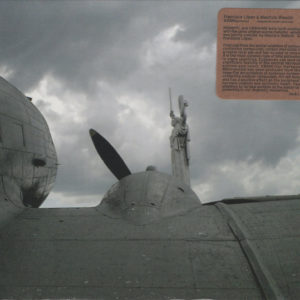
“KRMN”
“KRMN-FL and KRMN-MB were both created with the same original source
materials, jointly created by Maurizio Bianchi and Francisco López. Produced from the partial oxidation of carbon-containing compounds, carbon monoxide is a highly toxic gas and has no odor or colour. It is the most common type of fatal poisoning in many countries. Exposures can lead to significant toxicity of the central nervous system and heart. KRMN (for Karbona Monooksido) has been produced from the impartial de-oxidation of sonorous carbon-containing modular compounds. It’s not toxic and has a positive effect on the peripheral nervous system and symbolic heart. Pay
attention to its fatal antidote to the industrial poisoning in our dogmatic modernity (M.B.).” label info
12,00€
In stock
CD
Francisco LÓPEZ
“Untitled #274”
Untitled
274 was composed by Francisco Lopez and performed by Kasper T. Toeplitz at GRM Studios in Paris, France.
Francisco López is internationally recognized as one of the major figures of the sound art and experimental music. For more than thirty years he has developed an astonishing sonic universe, absolutely personal and iconoclastic, based on a profound listening of the world. Destroying boundaries between industrial sounds and wilderness sound environments, shifting with passion from the limits of perception to the most dreadful abyss of sonic power, proposing a blind, profound and transcendental listening, freed from the imperatives of knowledge and open to sensory and spiritual expansion.
Kasper T. Toeplitz has worked with academic research organizations, such as GMEM, GRM, IRCAM, and Radio-France, as well as with experimental musicians, such as Éliane Radigue, Zbigniew Karkowski, Dror Feiler, Tetsuo Furudate, Phill Niblock and Art Zoyd. Citing Giacinto Scelsi and Iannis Xenakis as influences, his early work was mostly written for traditional instruments.
15,00€
Out of stock
CD
Else Marie PADE & Jacob KIRKEGAARD
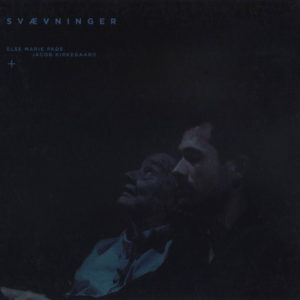
“Svævninger”
Gorgeous electronic collaboration between Jacob Kirkegaard and Else Marie Pade. Urgent CD reissue of the sold out LP edition. This CD includes a beautiful 15 minute bonus track not included on the LP release.
Else Marie Pade (born December 2, 1924 in Aarhus) is a Danish composer who pioneered electronic and concrete music in Denmark beginning in 1954 . Pade was active in the resistance movement during the Second World War, and was interned at the Frøslev prison camp from 1944 till the end of the war. An archival collection of Else Marie Pade’s electronic work is now available on Important Records.
Danish artist Jacob Kirkegaard’s works are focused on scientific and aesthetic aspects of sonic perception. He explores acoustic spaces and phenomena that usually remain imperceptible to the immediate ear. Kirkegaard’s installations, compositions & photographs are created from within a variety of environments such as subterranean geyser vibrations, empty rooms in Chernobyl, a rotating TV tower, and even sounds from the human inner ear itself.
Based in Berlin, Germany, Kirkegaard is a graduate of the Academy for Media Arts in Cologne. Since 1995, Kirkegaard has presented his works at galleries, museums, venues & conferences throughout the world. His sound works are primarily released by the British record label Touch and he is a member of the sound art collective freq_out.
"For all the scientific rigour to Kirkegaard's research into the sonic possibilities of various materials, his work reveals an underlying fascination for the mysteries and myths embedded in them. His work channels an access to an inner world." Anne Hilde Neset, The Wire, 07/09
Despite an age difference of 51 years, Else Marie Pade and Jacob Kirkegaard speak a similar musical language and are prominent listeners and communicators of sounds that we tend to overhear. For the first time these two pioneers are collaborating on a new work: Svævninger investigates the variations that one can hear when sound waves collide. Both artists have previously worked on this phenomenon; Jacob Kirkegaard in his work Labyrinthitis (2007) and Else Marie Pade in her work "Faust Suite" (1962). For their new joint piece Svævninger, they remixed some of Pade's early (and hitherto unreleased) sound experiments with some of Kirkegaard's recordings from his own ear, thus leading the audience straight into the undiscovered labyrinths of their own hearing.
15,00€
Out of stock
CD
Ellen FULLMAN
“Through glass planes”
“Ellen Fullmans’s first proper full length for Important Records follows her collaborative work with Barn Owl (IMPREC277) and a split LP with Eleh (IMPREC318). She was also featured on The Harmonic Series: A Collection Of Work In Just Intonation (IMPREC272).
In 1981 Ellen Fullman began developing the “Long String Instrument,” an installation of dozens of wires fifty feet or more in length, tuned in Just Intonation and ‘bowed’ with rosin coated fingers. Fullman has developed a unique notation system to choreograph the performer’s movements, exploring sonic events that occur at specific nodal point locations along the string-length of the instrument. She has recorded extensively with this unusual instrument and has collaborated with such luminary figures as composer Pauline Oliveros, choreographer Deborah Hay, the Kronos Quartet, and Keiji Haino. She has been the recipient of numerous awards, commissions and residencies.
Through Glass Panes
In composing “Event Locations No. 2”, I set out to focus more strictly than I ever had on detail in the choreography of my notation. Through writing the piece I designed ways to add more specific information in the score. The tuning uses a set of pitches based in the key of A, in combination with Arnold Dreyblatt’s tuning system based on F. These two roots generate tones in common but also complex or “dissonant” tones. I wanted to find a way to incorporate more dissonance into my sound and intentionally worked with beating frequencies in this piece.
“Never Gets Out of Me”, a duet with cellist Theresa Wong, and “Flowers”, a trio recorded with Travis Weller and Henna Cho, are adaptations from Stratified Bands: Last Kind Words”, originally composed for the Kronos Quartet in the Other Minds Festival. The composition is based on Last Kind Words Blues, a haunting song by Geeshie Wiley recorded in 1930. An excerpt of the lyrics:
If I get killed, if I get killed, please don’t bury my soul, I’d pro’bly just leave me out, let the buzzards eat me whole.
The cello and violin writing for these pieces was influenced by my study of North Indian vocal music. My intention is that the sounds of all instruments mesh into an undulation like water flowing. Composed melodic phrases are based on fragments from the song lyrics in combination with impressions from the overtone melodies produced by the long string instrument. “Flowers” was recorded at Seaholm, a decommissioned electric power plant in Austin, Texas. A flock of sparrows that nest inside the cathedral-like cast-concrete space can be heard chirping on this recording.
“Through Glass Panes” is constructed around a sequence of rhythmic patterns played using the “box bow”. Homage to the harmonica, the box bow is a hand held hollow wooden box with a curved lower surface used to play my instrument percussively. Techniques based on hand drumming inform the articulations of the tool used to strike groupings of strings tuned to chords. Two box bow performers stand facing each other at a double-sided resonator to play hocketed parts providing a stable framework from which to measure spectral changes in the sustained texture.” label info
14,00€
Out of stock
CD
Christina KUBISCH
“Magnetic flights”
“Two brand new pieces from one of the most exciting, active & relevant members of the first generation sound artists. Magnetic Flights is a perfect follow up to Five Electrical Walks (imprec167) and it is being released at the same time as a collection of two of Kubisch’s unreleased archival pieces, also on Important.
Magnetic Flights is entirely made of electromagnetic field recordings of international airports and inside airplanes. The recordings of this piece were made by Christina Kubisch on her travels in 2007 from and to the airports of Bukarest, Manchester, Chicago, Seoul, Munich, Amsterdam, Zurich, Frankfort, Paris, Lisbon, Berlin, Pisa, Milan and London. The sounds were not altered electronically nor changed in any other way. The only tool, which was used for a part of it, was a filtering program (DINR)
All recordings were made with the help of special sensitive wireless headphones, by which the aboveground and underground electromagnetic fields are detected, amplified and made audible. The headphones are custom made and have been develeoped by myself and constructed by the engineer Manfred Fox, Berlin. The sounds are much more musical than one could expect. There are complex layers of high and low frequencies, loops of rhythmic sequences, groups of tiny signals, long drones and many things which change constantly and are hard to describe.
Magnetic Flights consists of three parts with a short special sound at the beginning and another one at the end. The piece starts with an electromagnetic sound recorded just before departure and continues with the material of flight radiations recorded inside different airplanes. These electromagnetic fields slightly change pitch during departure and arrival, but remain quite constant during the flight itself. The relatively high and compact sounds gradually build up a dense layer of vibrations with continuous minimal variations. In the second part some of the previous flight radiations gradually become filtered. The single signals mingle into a mix of small, short, nervous and very rhythmic signals. Their origin might be radio waves, communication signals with the tower , internet and atmospheric disturbances., but this is only a guess. The third part, the situation of arrival or transition, is a mix of typical electromagnetic sounds in the waiting areas of airports such as the deep vibrations of the screens of monitors which slowly fade in and out. The piece ends with the electrical flickering of an electromagnetic field of unknown origin.”
Magnetic Flights is entirely made of electromagnetic field recordings of international airports and inside airplanes. The recordings of this piece were made by Christina Kubisch on her travels in 2007 from and to the airports of Bukarest, Manchester, Chicago, Seoul, Munich, Amsterdam, Zurich, Frankfort, Paris, Lisbon, Berlin, Pisa, Milan and London. The sounds were not altered electronically nor changed in any other way. The only tool, which was used for a part of it, was a filtering program (DINR)
All recordings were made with the help of special sensitive wireless headphones, by which the aboveground and underground electromagnetic fields are detected, amplified and made audible. The headphones are custom made and have been develeoped by myself and constructed by the engineer Manfred Fox, Berlin. The sounds are much more musical than one could expect. There are complex layers of high and low frequencies, loops of rhythmic sequences, groups of tiny signals, long drones and many things which change constantly and are hard to describe.
Magnetic Flights consists of three parts with a short special sound at the beginning and another one at the end. The piece starts with an electromagnetic sound recorded just before departure and continues with the material of flight radiations recorded inside different airplanes. These electromagnetic fields slightly change pitch during departure and arrival, but remain quite constant during the flight itself. The relatively high and compact sounds gradually build up a dense layer of vibrations with continuous minimal variations. In the second part some of the previous flight radiations gradually become filtered. The single signals mingle into a mix of small, short, nervous and very rhythmic signals. Their origin might be radio waves, communication signals with the tower , internet and atmospheric disturbances., but this is only a guess. The third part, the situation of arrival or transition, is a mix of typical electromagnetic sounds in the waiting areas of airports such as the deep vibrations of the screens of monitors which slowly fade in and out. The piece ends with the electrical flickering of an electromagnetic field of unknown origin.”
12,00€
In stock

CD
Catherine Christer HENNIX
“Central Palace Music”
Central Palace Music, performed by Catherine Christer Hennix's just-intonation ensemble The Deontic Miracle, is the first in a series of archival Hennix releases to be issued via IMPREC. This previously unheard piece was taken from an eight day festival organized in the Spring of 1976 at the Museum of Modern Art in Stockholm. The group features Catherine Christer Hennix on Renaissance oboe and custom sinewave generators, Peter Hennix on Renaissance oboe and Hans Isgren on sheng.
Central Palace Music is packaged in a deluxe letterpressed package and is being released at the same time as a recent recording of Hennix's new ensemble live at Issue Project Room.
“…Hennix has created a sound that reliably taps into our subconscious and frees us from linear time…” The Quietus
Catherine Christer Hennix (1948, Stockholm) is an artist, poet, composer and philosopher witha strong interest in logic and formal music theory. She was among the pioneers in Sweden experimenting with main-frame computer generated composite sound wave forms in the late 1960's and in the 1970's she was a key protagonist in the Downtown School along with La Monte Young and Henry Flynt, with whom she has collbaborated with on numerous occasions. She pursued studies with raga master Pandit Pran Nath and led the just intonation live-electronic ensembles Hilbert Hotel and The Deontic Miracle, the recordings of the latter are presently being released by Important Records. She was a professor of mathematics and computer science and assistant to and coauthor with A.S. Esenin-Volpin for which she was viven the Centenary Prize Fellow Award by the Clay Mathematics Insitute in 2000. Hennix's interest in drone music and the meditative, trance-like state it induces is apparent in her exploration of similar music in many other cultures and traditions, drawing inspiration from the Japanese Gagaku music and the early, vocal, thirteenth-century music of Perotinus and Leoninus, for example.
In 2003 she returned to computer generated composite sound wave forms now called Soliton(e)s of which Soliton(e) Star was the first result. Subsequently she formed the just intonation ensemble The Choras(s)an Time-Court Mirage which performs Blues Dhikir al- Salam (Live at the Grimmuseum, vol. 1, Berlin, 2011, Important Records 2012). In 2012 Henry Flynt asked Hennix for a new, expanded realization of ISE for an installation at ZKM in Karlsruhe, Germany, to be featured in his retrospective/ prospective show Henry Flynt Activities 1959 – at ZKM. In response Hennix realized a 4-channel composition, Rag Infinity/Rag Cosmosis, her first 4-channel computer assisted composition since 1969.
18,00€
Out of stock

CD
Catherine Christer HENNIX
“Live At Issue Project Room”
Live At Issue Project Room is the first recording from Catherine Christer Hennix's expanded just-intonation ensemble, the Chora(s)san Time-Court Mirage. This expanded ensemble includes vocalists Imam Ahmet Muhsin Tüzer, Amir Elsaffan and Amirtha Kidambi, an expanded brass section with the addition of Paul Schwingesnschlögl and Elena Kakaliagou as well as the additon of Marcus Pal and Stefan Tiedje on electronics.
Live At Issue Project Room is packaged in a deluxe letterpressed package and is being released at the same time as a recent recording of Hennix’s new ensemble live at Issue Project Room.
“...Hennix has created a sound that reliably taps into our subconscious and frees us from linear time...” The Quietus
Catherine Christer Hennix (1948, Stockholm) is an artist, poet, composer and philosopher witha strong interest in logic and formal music theory. She was among the pioneers in Sweden experimenting with main-frame computer generated composite sound wave forms in the late 1960’s and in the 1970’s she was a key protagonist in the Downtown School along with La Monte Young and Henry Flynt, with whom she has collbaborated with on numerous occasions. She pursued studies with raga master Pandit Pran Nath and led the just intonation live-electronic ensembles Hilbert Hotel and The Deontic Miracle, the recordings of the latter are presently being released by Important Records. She was a professor of mathematics and computer science and assistant to and coauthor with A.S. Esenin-Volpin for which she was viven the Centenary Prize Fellow Award by the Clay Mathematics Insitute in 2000. Hennix’s interest in drone music and the meditative, trance-like state it induces is apparent in her exploration of similar music in many other cultures and traditions, drawing inspiration from the Japanese Gagaku music and the early, vocal, thirteenth-century music of Perotinus and Leoninus, for example.
In 2003 she returned to computer generated composite sound wave forms now called Soliton(e)s of which Soliton(e) Star was the first result. Subsequently she formed the just intonation ensemble The Choras(s)an Time-Court Mirage which performs Blues Dhikir al- Salam (Live at the Grimmuseum, vol. 1, Berlin, 2011, Important Records 2012). In 2012 Henry Flynt asked Hennix for a new, expanded realization of ISE for an installation at ZKM in Karlsruhe, Germany, to be featured in his retrospective/ prospective show Henry Flynt Activities 1959 – at ZKM. In response Hennix realized a 4-channel composition, Rag Infinity/Rag Cosmosis, her first 4-channel computer assisted composition since 1969.
18,00€
In stock
CD
Arnold DREYBLATT
“Turntable history”
“Arnold Dreyblatt (b.1953) is an American composer who has studied with La Monte Young, Pauline Oliveros and Alvin Lucier. He is a member of the German Academy Of Art. He has released work on labels such as Table Of The Elements, Canteloupe, Tzadik, Hat Art and Dexter’s Cigar.
Turntable History is a recording of a 40 minute multi-channel sound composition which was concieved as part of an audio-visual installation installed in the circular vaulted brick space of a historical water container in Berlin in 2009. The original sound content is derived from recordings made by Arnold Dreyblatt of a Magnetic Resonance Imagining Scanner (“Siemens Magnetom Symphony Maestro Class”) in a radiological practice in Berlin. Dreyblatt was fortunate to gain rare permission to record this device in operation without patients being involved. A technician from Siemens manned the machine especially for these recordings, searching for software settings related to their resulting sonic output rather for scanning particular body areas. Dreyblatt treated the device as a giant “Tesla coil”, in which the alignment and resonances of a powerful magnetic field is gradually altered by rotating radio frequencies. Dreyblatt analysed and deconstructed the original recordings and grouped the audio segments by pitch, rhythm and density. The resulting five-channel composition of harmonically resonating, pulsating signals, sounded within this voluminous reflective space (with long delay times) is wonderfully captured in this recording.” label info
12,00€
Out of stock
CD
COMPILATION
CULTURES ÉLECTRONIQUES 11
Prix Magisterium Bourges 1998. Wlodzimierz Kotonski “Tierra caliente”, “Alea”. Jean-Claude Risset “Invible” for soprano and tape, “Attracteurs étranges” for clarinet and tape.
8,00€
Out of stock
CD
COMPILATION
CULTURES ÉLECTRONIQUES 9 – Magistères Bourges 1996
1996. Larry Austin “BluesAx” pour saxophone et bande, “Quadrants”, Lars Gunnar Bodin “Halsningar Fran Syrenbersan”, “For Jon - Fragments of a time to come”.
8,00€
In stock
CD
COMPILATION
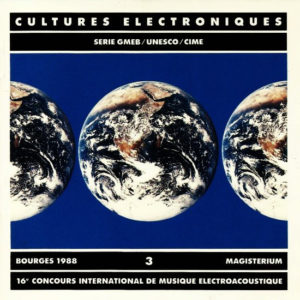
CULTURES ÉLECTRONIQUES 3 – Magistères
Back in stock.
Dieter Kaufmann: “Le Voyage au Paradis”, Francis Dhomont: “Chiaroscuro… ou les jeux de l’ambiguïté”, Zoltan Pongracz: “Contrastes Polaires et Successifs”, Dieter Kaufmann: “Le Ciel et la Terre”, Zoltan Pongracz: “Histoire d’un Accord de Do Dièze Majeur”.
8,00€
Out of stock
CD
DDAA
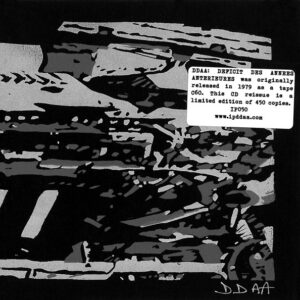
“Déficit Des Années Antérieures”
Déficit Des Années Antérieures was originally released in 1979 as a C60 tape. This CD reissue is a limited edition of 450 copies, numbered and signed, silkscreen cover with 2 colors + one bonus live in Cherbourg in 1979.
15,00€
Out of stock
CD
DDAA
“20 ans de vieille musique nouvelle”
“IP041 was wrapped in a 2 CD pack with a card, in the place of IP042, for the order of this one. IP042 was recorded live in 1994 at the Univerity of Caen in France, is titled “De Gaule A Bayeux, Un Opéra Maracayace” and have as special guest: Jean-François Pauvros (Guitar & Vocals).”
12,00€
Out of stock
CD
Charlemagne PALESTINE
“Ssingggg Sschlllingg Sshpppingg”
This awesome full length album by Charlemagne solo has been recorded especially for idiosyncratics. It has been brilliantly engineered by our long term associate Fredéric Alstadt (Angström Studio) and mixed by maestro Aymeric De Tapol.
The artwork is an original collaboration between Charlemagne Palestine, labelboss Yannick Franck and Frau label designer Helena Dietrich, immortalized by photographer Laurent Meurice. It comes with a color 3 panels cardboard and includes the download of the digital version (in the format you want).
“Charlemagne Palestine releases this absorbing 51 minute dronescape that's at once enormous and intimate - and easily a career highlight” Rolling Stone
7 Best Avant Albums of 2015.
“Not only my favourite record of 2015, but maybe the best work I have ever heard from Mr. Palestine” Jim O’Rourke (Wire magazine, dec 2015).
“One of the very best releases in the American maverick’s recent output” Touching Extremes
The artwork is an original collaboration between Charlemagne Palestine, labelboss Yannick Franck and Frau label designer Helena Dietrich, immortalized by photographer Laurent Meurice. It comes with a color 3 panels cardboard and includes the download of the digital version (in the format you want).
“Charlemagne Palestine releases this absorbing 51 minute dronescape that's at once enormous and intimate - and easily a career highlight” Rolling Stone
7 Best Avant Albums of 2015.
“Not only my favourite record of 2015, but maybe the best work I have ever heard from Mr. Palestine” Jim O’Rourke (Wire magazine, dec 2015).
“One of the very best releases in the American maverick’s recent output” Touching Extremes
12,50€
Out of stock

CD
ELODIE
“Vieux Silence”
Music by Andrew Chalk & Timo van Luijk with Tom James Scott - piano, Jean-Noël Rebilly - clarinette, Daniel Morris - guitare pedal steel. Mastered & cut by Rashad Becker at Dubplates & Mastering, Berlin 0417.
“Having been entranced by both Andrew Chalk’s work with Mirror (and back to his solo works as Ferial Confine, plus multiple collaborations with David Jackman, The New Blockaders, Daisuke Suzuki, etc ) and Timo van Luijk (as Af Ursin, In Camera, La Poupée Vivante, and collaborations with Kris Vanderstraeten and others) for many years, I was naturally intrigued to hear about and hear their duo project Elodie. The project formed in 2010, and has spanned eleven beautiful albums already, to date. “Vieux Silence” for Ideologic Organ is their first release presented outside of their own record publishing nook, Faraway Press & La Scie Dorée. However this is not the first encounter between Ideologic Organ & Elodie, they performed at a night in London I curated in February 2012, alongside Jessika Kenney & Eyvind Kang. Elodie’s performance was among the most delicately engaging and savant I have witnessed… so very quiet, with snow falling in London outside Cafe Oto’s windows, the audience palpably entered a high intensity listening focus. The impression of this vivid memory is striking, considering how spare each of the individual elements present that night were. “Vieux Silence”, and Elodie in general provoke a visual imagination in an instant, perhaps filtered through aged watercolour, tape grain, antique lenses, forgotten levels of listening and observational patience. Each detail carefully considered and colouring step by step, like an impressionist watercolour.” Stephen O’Malley, Les Lilas 2017
“Having been entranced by both Andrew Chalk’s work with Mirror (and back to his solo works as Ferial Confine, plus multiple collaborations with David Jackman, The New Blockaders, Daisuke Suzuki, etc ) and Timo van Luijk (as Af Ursin, In Camera, La Poupée Vivante, and collaborations with Kris Vanderstraeten and others) for many years, I was naturally intrigued to hear about and hear their duo project Elodie. The project formed in 2010, and has spanned eleven beautiful albums already, to date. “Vieux Silence” for Ideologic Organ is their first release presented outside of their own record publishing nook, Faraway Press & La Scie Dorée. However this is not the first encounter between Ideologic Organ & Elodie, they performed at a night in London I curated in February 2012, alongside Jessika Kenney & Eyvind Kang. Elodie’s performance was among the most delicately engaging and savant I have witnessed… so very quiet, with snow falling in London outside Cafe Oto’s windows, the audience palpably entered a high intensity listening focus. The impression of this vivid memory is striking, considering how spare each of the individual elements present that night were. “Vieux Silence”, and Elodie in general provoke a visual imagination in an instant, perhaps filtered through aged watercolour, tape grain, antique lenses, forgotten levels of listening and observational patience. Each detail carefully considered and colouring step by step, like an impressionist watercolour.” Stephen O’Malley, Les Lilas 2017
12,50€
Out of stock

CD
Kevin DRUMM
“Purge”
Kevin Drumm’s 2007 cassette “Purge” on iDEAL went out of stock in less than a week. This is the CD version of that killer thing. Intense listening taking
you deep into the known unknown, or perhaps the unknown known. Drumm’s noise is extremely powerful and dynamic.; travelling frequencies, rich with
details, with very little hope, with guaranteed exhaustion after frequent listening. I always think about Black Metal when I am listening to Drumm’s works,
they share the same cold and darkness. “Purge” is no exception. This is a dark composition with fucked feedback and comfortably stuck in the deepest
underworld. - Joachim Nordwall, Stockholm, March 2013. Released in a b/w digipack in a limited edition of 500 copies.
you deep into the known unknown, or perhaps the unknown known. Drumm’s noise is extremely powerful and dynamic.; travelling frequencies, rich with
details, with very little hope, with guaranteed exhaustion after frequent listening. I always think about Black Metal when I am listening to Drumm’s works,
they share the same cold and darkness. “Purge” is no exception. This is a dark composition with fucked feedback and comfortably stuck in the deepest
underworld. - Joachim Nordwall, Stockholm, March 2013. Released in a b/w digipack in a limited edition of 500 copies.
11,00€

CD
Jean-Claude ELOY
“Etats-Limites ou les cris de Petra”
“Borderlines or Petra’s shouts. Songs for the other half of the sky N°VII” (2013) After some reissue or first edition of old composition, here’s a brand new composition from Jean-Claude Eloy. Made mostly with voice, bells and synthetic sounds this piece works like an electroacoustic lightning. “A kind of salutary madness”.
13,00€
CD
Jean-Claude ELOY
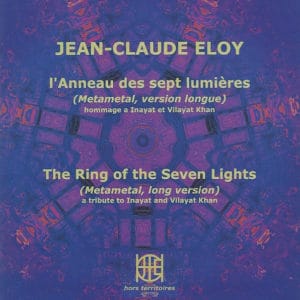
“L’anneau des sept lumières”
The Ring of the Seven Lights (Metametal, long version) (1994-95 / revision and new master: 2013). Seven continuous variations from a single Bonshô sample (Buddhist temple traditional bell from Japan), a tribute to Inayat and Vilayat Khan.
Jean-Claude Eloy: “I created and partially realized it in 1994-95 during this conversion of Anâhata into an electro-acoustic version alone. I first made a short version out of it which integrated into Electro-Anâhata and became the fourth station within the first part (around Âhata-Anâhata). It was an entirely new part that had never been realized during the final mixing of the original Anâhata cycle.”
13,00€

CD
Jean-Claude ELOY
“Galaxies full-electro”
“Galaxies” (Warsaw version), electro-acoustic alone. Fully electro-acoustic version of Anâhata / Galaxies realized on the composer’s personal computer from the original electro-acoustic recordings of this work.
Electronic music studios where the original Anâhata / Galaxies were produced (1984-86): Studio of the Sweelinck Conservatory of Music, Amsterdam (1984 and 1986): the entire production (pre-recorded material processing, new material generation, premixing) and all final mixing processes. Tokyo-Gakuso studio, Tokyo (1983): for the Shô and Ô-Shô (traditional mouth organs from Japan) sampling with Mayumi Miyata. Conny’s Studio, Neuenkirchen, near Cologne (1984) with Asian Sound and Michael W. Ranta: metal percussion instrument sampling, including Bonshôs (Buddhist temple bells from Japan) sampling. INA-GRM, Paris (1985): pre-recorded material processing. Studio ART, Geneva (1985): pre-recorded material processing and pre-mixing. Studio of Technische Universität (TU), Berlin (1985-86): pre-recorded material processing, new material production, pre-mixing. Jean-Claude Eloy: “In 1994 I had (for purely practical reasons) to remove these big electro-acoustic parts making up the two Galaxies works from the piece they were connected with until then: Part III of my Anâhata cycle, entitled Nimîlana-Unmîlana ("that which awakens - that which slumbers"). An electro-acoustic work integrating instrumental acoustic parts that required the performance of a Shô player from Japan.
Those electro-acoustic parts were substantial enough to warrant a new configuration ensuring their stand-alone nature, independent of whether a performer was available or not. Therefore I used (apart from the two Galaxies) a set of particular sounds that I had generated during that production (all of them resulting from Shô sampled sound processing and modulations) entitled sons d’infinitude ("sounds of indefiniteness"). These sustained sounds were very fixed, quite contemplative, almost motionless or maintained through short fluctuations that were more or less regular. They were five of them altogether. Four of them were grouped together into a consistent set and occurred after the first Galaxy, before the Shô solo. I had used them to compose a sequence called Awakening, which formed the first Shô appearance in the version realized for the Donaueschingen Festival in 1990. The fifth one took place at the end of the second Galaxy and was used to support the conclusion played on the Ô-Shô. In this purely electro-acoustic version the first four sons d’infinitude came quite naturally as a "bridge" between both Galaxies. The fifth sound kept its conclusive place, making it bigger and using it as a genuine "extension sound" that could be infinite, with no limit!”
Electronic music studios where the original Anâhata / Galaxies were produced (1984-86): Studio of the Sweelinck Conservatory of Music, Amsterdam (1984 and 1986): the entire production (pre-recorded material processing, new material generation, premixing) and all final mixing processes. Tokyo-Gakuso studio, Tokyo (1983): for the Shô and Ô-Shô (traditional mouth organs from Japan) sampling with Mayumi Miyata. Conny’s Studio, Neuenkirchen, near Cologne (1984) with Asian Sound and Michael W. Ranta: metal percussion instrument sampling, including Bonshôs (Buddhist temple bells from Japan) sampling. INA-GRM, Paris (1985): pre-recorded material processing. Studio ART, Geneva (1985): pre-recorded material processing and pre-mixing. Studio of Technische Universität (TU), Berlin (1985-86): pre-recorded material processing, new material production, pre-mixing. Jean-Claude Eloy: “In 1994 I had (for purely practical reasons) to remove these big electro-acoustic parts making up the two Galaxies works from the piece they were connected with until then: Part III of my Anâhata cycle, entitled Nimîlana-Unmîlana ("that which awakens - that which slumbers"). An electro-acoustic work integrating instrumental acoustic parts that required the performance of a Shô player from Japan.
Those electro-acoustic parts were substantial enough to warrant a new configuration ensuring their stand-alone nature, independent of whether a performer was available or not. Therefore I used (apart from the two Galaxies) a set of particular sounds that I had generated during that production (all of them resulting from Shô sampled sound processing and modulations) entitled sons d’infinitude ("sounds of indefiniteness"). These sustained sounds were very fixed, quite contemplative, almost motionless or maintained through short fluctuations that were more or less regular. They were five of them altogether. Four of them were grouped together into a consistent set and occurred after the first Galaxy, before the Shô solo. I had used them to compose a sequence called Awakening, which formed the first Shô appearance in the version realized for the Donaueschingen Festival in 1990. The fifth one took place at the end of the second Galaxy and was used to support the conclusion played on the Ô-Shô. In this purely electro-acoustic version the first four sons d’infinitude came quite naturally as a "bridge" between both Galaxies. The fifth sound kept its conclusive place, making it bigger and using it as a genuine "extension sound" that could be infinite, with no limit!”
13,00€

CD
Jean-Claude ELOY
“Kâmakalâ – Étude III – Fluctuante immuable”
CD with 60 pages booklet with photos + texts in French and English.
“Kâmakalâ. The Energy Triangle” (1971). For three orchestra ensembles, five chorus ensembles, with three conductors. Orchestra and chorus of the WDR, Schola Cantorum, Stuttgart. Conductors : Michel Tabachnik, Bernhard Kontarsky, Jacques Mercier. Kâmakalâ - a Sankrit term meaning energy triangle - refers to India’s philosophy (Tantric Shivaïsm) and is expresses here as the appearance of energy, which is the erotic and cosmic energy (Kama), that which helps Shiva uniting with his Shakti (feminine energy), create every self-subdivision (Kalâ), hence gradually generating the whole complexity of the universe. It is that idea of a vast and slow crescendo of the various parameters of a musical score, of an infinite division and infinite multiplication of the material contained in it that appealed to Eloy. At the time he would complain about a type of contemporary music aesthetics only focusing on the quick scattering of all kinds of points within short periods of time, sometimes in just a few seconds (pointillism). As a result music pieces were almost inevitably bound to be brief, unable to sustain time as it would distribute the entire sound energy from the very first minutes. On the contrary, Eloy wanted to create music in which the energy was sustained, non distributed and reserved to intense inner blossoming at a later point; music expanding very slowly as in Indian Raga, yet Western music definitely modern, atonal and athematic.
“Étude III” (1962) for orchestra, with piano and five percussionists. Orchestra of the SWF, Baden-Baden. Conductor : Ernest Bour. Etude III, which was composed in May and June of 1962 in Zurich and Paris, uses the configuration of a traditional orchestra (wood and brass instruments by pair) opposite to an ensemble of five percussionists, piano, harp and celesta. A dialectic stands out of this opposition as it is emphasized through the writing and conducting (measured for the orchestral mass, a-measured and cued for the entire ensemble on the foreground).
The instruments, which form cohesive timber families, come in according to an irregular pattern as the piece develops, with the entire configuration not coming into play until the last developments. The frequent use of very long durations, related to the steadiness of the pitch registers, leads to a rising static sound phenomenon reminiscent of oriental music in some regards: the tone and use of Shô in Japanese Gagaku, the slow and steady increase of complexity in Indian Raga. “Fluctuante - Immuable” (1977) for full orchestra. New Philharmonic Orchestra from Radio-France. Conductor : Gilbert Amy. Fluctuante-Immuable, which was composed in 1977 as Gaku-no-Michi was produced in the Nippon Hoso Kyokai (NHK) electronic studio in Tokyo, is the result of a commission by the Secretariat of Cultural Affairs made for the Orchestre de Paris, which premiered it in May 1977. This work clearly shows the influence and the alterations that electro-acoustic practices infer on orchestral writing practices. Besides Eloy’s long electro-acoustic productions, Fluctuante-Immuable suggested a new (theoretical and practical) way of addressing issues related to "composing with notes". The formal issue that the composer faces at the beginning is that of a dialectic between "Order and Disorder" (or between order and organized chaos) topped by an issue about the relation between the conductor and his orchestra (techniques of synchronization or desynchronization with the mass of musicians).
The instruments, which form cohesive timber families, come in according to an irregular pattern as the piece develops, with the entire configuration not coming into play until the last developments. The frequent use of very long durations, related to the steadiness of the pitch registers, leads to a rising static sound phenomenon reminiscent of oriental music in some regards: the tone and use of Shô in Japanese Gagaku, the slow and steady increase of complexity in Indian Raga. “Fluctuante - Immuable” (1977) for full orchestra. New Philharmonic Orchestra from Radio-France. Conductor : Gilbert Amy. Fluctuante-Immuable, which was composed in 1977 as Gaku-no-Michi was produced in the Nippon Hoso Kyokai (NHK) electronic studio in Tokyo, is the result of a commission by the Secretariat of Cultural Affairs made for the Orchestre de Paris, which premiered it in May 1977. This work clearly shows the influence and the alterations that electro-acoustic practices infer on orchestral writing practices. Besides Eloy’s long electro-acoustic productions, Fluctuante-Immuable suggested a new (theoretical and practical) way of addressing issues related to "composing with notes". The formal issue that the composer faces at the beginning is that of a dialectic between "Order and Disorder" (or between order and organized chaos) topped by an issue about the relation between the conductor and his orchestra (techniques of synchronization or desynchronization with the mass of musicians).
18,00€

CD
Jean-Claude ELOY
“Étude IV – … d’une étoile oubliée – La grande vague”
“Etude IV: points-lines-landscapes” (1979). This work is designed as an all-electronic piece without considering any configuration with soloist parts for later use (unlike the two following pieces featured on this CD). It was realized by Jean-Claude Eloy in 1979 on the CEMAMu’s UPIC upon Iannis Xenakis’s invitation to whom this work is dedicated as a friend. The UPIC (Unité Polyagogique Informatique du CEMAMu) is an electronic tool invented by Iannis Xenakis in the 1970s. It is a graphic interface designed to create sound and compose music, whose first version featured a big drawing board (a sort of architect desk) equipped with a ballpoint electromagnetic pencil, surrounded by a computer (mini-computer solar 16/55 ESMS - memory of 32 K) and a monitor. All kinds of forms could thus be drawn with the electronic pencil based on time parameters (moving from left to right) and frequency spaces (from bottom to top, from the lowest to the highest register). Before each drawing (or for every line or "arch" - from an architectural point of view) the appropriate banks would be successively selected with the electromagnetic pencil: a waveform bank, an envelope bank, which could also be drawn and stored in advance. Piling up such arches you could obtained more or less complex drawings filling a "page" that could be calculated by the computer upon completion. Today, such operations are widely used by every computer (including consumer computer) whiz. However, in 1979 (when this work was produced) such opportunities were unique and, as Eloy said "... were like a miracle for the instrumental and orchestral composer that I mostly was".
“…Of a Forgotten Star” (1986), electro-acoustic part alone from Sappho hiketis. Originally, this work was part of Anâhata but did not end up in its final production. It was later used as a supporting structure for the Sappho hiketis piece with the solo vocal parts especially written for Fatima Miranda and Yumi Nara. During the electro-acoustic production of Anâhata this mixing was entitled Indian-Plates. The basic material is exclusively made of prerecorded sounds from metal percussion instruments (sampled in 1984 in the early stage of the production of Anâhata with Michael W. Ranta, Asian Sound, Cologne).
“The Great Wave…” (1991) (a tribute to Hokusai), electro-acoustic part alone from She (from the Gaia-Songs cycle). This work was originally realized to fit into Erkos but was not used in the final production. It was later integrated into the Gaia-Songs cycle for the fourth piece: She ("The consecrating mother") based on Anne Sexton’s poem (integral part of Two American Women) serving as a backbone for a written piece completed in keeping with the sung-spoken voice technique (Sprechgesang). During the production of Erkos this terminal mixing was entitled Biwa-Tutti because of the various Biwa sounds and glissandi that were stacked and sampled at the studio by Junko Ueda, solo performer for Erkos. This work was completed in 1990-91 at the WDR (Westdeutscher Rundfunk) Electronic Studio of Cologne.
13,00€
Out of stock
CD
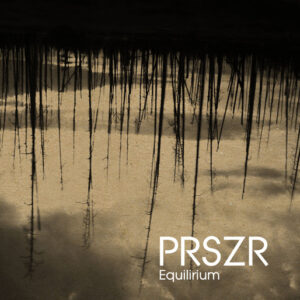
PRSZR
“Equilibrium”
PRSZR is Pure (Peter Votava) and Hati (Rafal Iwanski & Rafal Kolacki). PRSZR (pronounced pressure) combines the eerie, computer generated sound world of Austrian electronic music veteran Pure with the archaic, outer-worldly spaceyness of Polish duo Hati’s percussion play. Multi-layered syncopatic polyrhythms alternate with gong-based drones, both built on top of computer-generated loops and pulsating patterns. Melting acoustic with electronic aesthetics in a unique way, the trio explores strategies for a highly hypnotic, cathartic sonic experience. PRSZR formed in 2008 and played a few promising live shows since. “Equilirium” is their first album release. Peter Votava is a composer and performer of electronic music since more than 20 years. Starting as a DJ and Techno producer in the early 1990s he turned towards experimental electronic music. This went hand in hand with his engagement in computer programming which led him to develop his own software instruments. He now uses this knowledge for computer based live performances and teaching. Together with Erich Berger he founded the Heart Chamber Orchestra in 2003. His latest studio album als PURE, «Ification», was released by Portuguese label Cronica in 2008. Votava holds a Master of Arts in Computer Music from the University of Plymouth (UK). HATI (Rafal Iwanski and Rafal Kolacki) is an audio project based on sounds of ethnic instruments as well as hand-made instruments and found objects. HATI forms a link between a personal interest in improvised acoustic music and ritual and meditation. The band has performed many times throughout Europe and in the USA since 2003. Live collaborations took place with John Zorn, Steve Buchanan & Heike Fiedler, Robert Curgenven, Raymond Salvatore Harmon and Z’EV with whom they also released two full length albums. Both members curate the CoCArt Music Festival in cooperation with the Centre of Contemporary Art in Torun, Poland. Rafal Iwanski performs solo as X-NAVI:ET, presenting a combination of analog electronic devices, acoustic instruments and field/found recordings. Rafal Kolacki is responsible for the audio-visual project Tonopolis, consisting of field recordings from Torun, remixed by various sound artists including himself.
5,00€