
Out of stock

CD
COMPILATION
OTO NO HAJIMARI WO MOTOMETE 8. Inamura, Tokuono, Sasaki, Ohtsu’s works
Brand new issue of archve series of NHK electronic music studio. Contents: Toshira Mayuzumi : “Princess Hollyhock” (1957), Shinichi Matsushita : “Le Cloitre Noir” for voice and electronic music (1959), Toshi Ichiyanagi : “Parallel Music” (1962), Shiro Ima : “Music for 12 players and Electronic sounds” (1965)”.
29,00€
Out of stock

CD
COMPILATION
OTO NO HAJIMARI WO MOTOMETE 7. TSUTOMU KOJIMA.
Recent issue of Japanese electronic music made by NHK electronic music studio after EXPO’70. This CD consists of 4 works assisted by engineer Tsutomu Kojima since vol.5. Conrtents: Kiyotomi Yoshizaki "Palace of Green Space for Electronic Music" (1979). Akira Nishimura "Ode for Ekstasis" (1981). Shoko Shida "Lazy Garnet" (1974). Michio Kitazume "Reincarnation" (1982).
29,00€
Out of stock

CD
COMPILATION
OTO NO HAJIMARI WO MOTOMETE 6. NISHITA SHIOTANI TAKAYANAGI
Contents: unknown engineer “Electronic Music for stereophonic-broadcast” (1960). Minao Shibata: “Music Concrete for stereophonic-broadcast” (1955). Ryohei Hirose: “Flora 1971” (1971). Yori-Aki Matsudaira: “Assemblages for Tape” (1968) - collage work. Toru Takemitsu: “Sky, Horse and Deth” (1958) - great concrete work. Toshiro Mayuzumi: “Campanology for electronic music” (1959).
29,00€
Out of stock

CD
COMPILATION
OTO NO HAJIMARI WO MOTOMETE 5. Tsutomu Kojima’s works.
“5th issue of Japanese electronic music made by NHK electronic music studio after engineer Kojima assisted many electronic works of avant-garde composers. (Jean Claude Eloy’s well known concrete music “Gaku-no-Michi” was also assisted by Tsutomu Kojima). Contents : Keiki Okasaka “Beyond the Cloud”(1975), Joji Yuasa “My Blue Sky”(1975), Jo Kondo “Never Return”(1971), Sessyu Kai “Music for Tape”(1978), Katsuhiro Tsubonoh “Requiem”(1978,) Hifumi Shimoyama “Fumon IV”(1983).”
29,00€
Out of stock
CD
COMPILATION
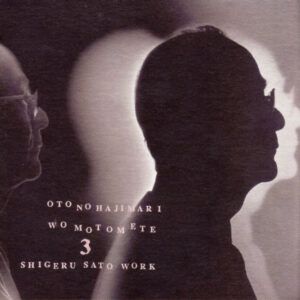
OTO NO HAJIMARI WO MOTOMETE 3. Sigeru Satou’s works
“The 3rd issue of early Japanese electronic music made by NHK (Nippon Housou Kyoukai : National Broadcasting association) electronic music studio. Engineer Satou assisted many electronic works of avant-garde composers. Contents : Makoto Moroi “Shosange” (1967), Minao Shibata “Display ’70” (1969), Toshiro Mayuzumi “MANDARA with source of Voice and Electric sound” (1969), Joji Yuasa “Voices Coming” (1969), Makoto Shinohara “Broadcasting” (1973).
29,00€
In stock
CD
COMPILATION
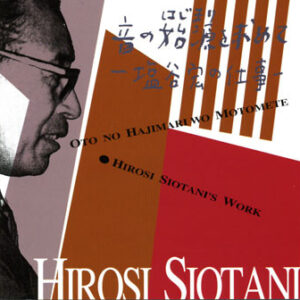
OTO NO HAJIMARI WO MOTOMETE 1. Hiroshi Shiotani’s works
(issued 1993-2001, 2nd edition) “Hiroshi Shiotani was an engineer of NHK (Nippon Housou Kyoukai: National Broadcasting association) electronic music studio, and then he cooperated with some avant-garde composers of Japan. This CD get Shiotani’s works together, and released several years ago as a memorial of him when he died. It was repressed 500 copies by a private studio. All tracks are legendary early electronic works of Toshiro Matuzumi and Makoto Moroi. These works had originally released in ’50s-’60s, but we have not been able to listen long time because all LPs was out of print long ago. This repress edition included the original source of Stockhausen’s "Telemusik" (he had come to Japan and made this work at NHK studio. Shiotani helped him).” Contents : Toshiro Matuzumi "Music for sine wave by propotion of prime number" (1954), "Music for modulated wave by propotion of prime number" (1954), "Invention for square wave and saw-tooth wave" (1954), "Olympic Campanology"(1964). Toshiro Matuzumi & Makoto Moroi "Variations on numerical principle of 7" (1956), Makoto Moroi "Stars of Pythagoras" (1959), "Variete"(1962), Karlheinz Stockhausen "Telemusik"(1966).
32,00€
In stock

LP
Sloboda KAJKUT
“Sick Nature – City of Bore”
Slobodan Kajkut, composition. Heifetz (Arne Glöckner, guitar. Patrick Wurzwallner, drums. Maggot (Gottfried Krienzer, guitar. Martin Pfeiffer, percussion).
For Slobodan Kajkut there was always and intention to write a piece for hardcore/trash/speed/reaction duet Heifetz. Fascinated not only with their variety of different musical styles, that are part of their musical language, but also with their ability to perform with extreme level of passion and variation of sarcasm and severity, Kajkut wrote a piece that musically and physically tests their patience. Somehow, the piece titled City of Bore (named by Heifetz), illustrates the character of the piece. Literally, there is nothing happening, the piece is a half an hour of emptiness, filled with periodical points. There is nothing new in the piece itself, many artists, such as Taku Sugimoto and many others, wrote thousands of such pieces, but in this case, interesting is to hear how Heifetz perform such music, always on the border to explode, though with ability to abstain. On the other side, Sick Nature (played by Maggot, duet formed to perform this particularly piece), also explores punctuality but in a rhythmical way, and with slightly extended instrumentation. Each single note of the piece is performed with almost mechanical precision, which make the piece extremely cold. Various percussions and dynamic extremes from very silent, to extremely loud, make a great correspondence to boredom of City of Bore. This is the music where Nothing makes sense
Original price was: 20,00€.10,00€Current price is: 10,00€.
Out of stock

CD
Jakob ULLMANN
“Voice, books and fire 3”
“Voice, books and fire is the result of my reflections about the relationships between music and language: language as sound and language as text, the numerous relationships between texts of different cultural and religious traditions, between the work of the human spirit in the present and in the past and the questions arising from the problem of understanding these different traditions, languages and texts and representing them in a present, which has lost knowledge about substantial parts, even of its own tradition and history.” Ensemble für experimentelle Musik 2006. Stimmen: Susanne Friedrich, Judith Geier-Leisch, Daniela Hornung, Ida Maria Kastner, Anja Kienborn, Annegret Kornmann, Christina Reis, Corinna Schmid. Instrumente: Leif Bergerhoff (Saxophon), Isabelle Fontius (Querflöte), Tobias Keck (Viola), Philipp Thimm (Violoncello). Einstudierung: Hans-Peter Schulz. Aufnahme, Mischung und Schnitt: Hans Lorenzen. Mastering: Timour Klouche.
15,00€
Out of stock
CD
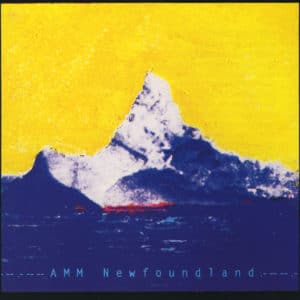
AMM
“Newfoundland” (1992)
“This music speaks for itself. So any attempt at characterization should be hedged with a warning that it might deflect the listener’s attention. The very fact of the attempt supposes the pre eminence of ‘character’. In Epilogue , one of his Essays Before A Sonata, Charles Ives made a strong case for what he called ‘substance.’ Substance, he wrote, “has something to do with character.” But what of sheer beauty? For Ives, ‘beauty’ was a problematical concept: “We like the beautiful and don’t like the ugly: therefore, what we like is beautiful, and what we don’t like is ugly - and hence we are glad the beautiful is not ugly, for if it were we would like something we don’t like. So having unsettled what beauty is, let us go on.” Ives contrasted ‘substance’ with ‘manner’ which “breeds a cussed cleverness only to be clever (a satellite of super industrialism) and perhaps to be witty in the bargain - not the wit in mother wit, but a kind of indoor, artificial, mental arrangement of things quickly put together which have to be learned and studied.” Well, there is nothing mannered about AMM. In place of the ‘indoor’ and the ‘artificial’, we discover breath taking openness and inventiveness. The sound of AMM is preterhumanly spacious and it makes sense to characterize this music less in human terms (as ‘lively’ and ‘graceful’, for example) than in terms of landscape. However, any landscape suggested by an AMM improvisation is light years from the affectively pastoral. It is akin perhaps to the paradoxically abstract landscapes of musique concrete. This writer’s own description, written for his own benefit, of the recorded performance in Newfoundland frequently resorts to Arctic and aquatic imagery. So there are dangers in knowing even a little! It is surely too easy to resort to adjectives such as ‘rumbling’, ‘juddering’, ‘thudding’, rippling’ and ‘growling.’ This music is so stunningly immediate, so palpable, that it makes a nonsense of such musings.” Howard Skempton September 1993.
14,00€
In stock

CD
Iannis XENAKIS
“La légende d’Eer”
“Crucial reissue of the most important, sonically devastating Xenakis electronic work (previously issued by the now defunct Montaigne label). "New stereo mix from the original master tape. La légende d’Eer is a powerful 7-channel electroacoustic composition which Xenakis created in 1977-78 to be played in ’Le Diatope,’ a curvaceous architectural construction designed by the composer, together with a visual component including laser lights. This ’multi-media’ work was composed for the opening of the Centre Georges Pompidou in Paris, where it was performed for three months and seen by thousands of people. The sound materials of a La légende d’Eer stem from three sources: instrumental sounds, noises, and electronically generated sounds. The work suggests an initial departure, a journey, and a final return. Xenakis surrounds the work with a compilation of five texts, reflecting or reacting upon each other across the distances in time, space, and culture which separate them. This new stereo mix was created by Gerard Pape -- director of Xenakis’ CCMIX studio in Paris -- from the original analog master tape. The analog master was transferred at high-resolution 96khz/24-bit sound for the optimum quality, revealing details not heard in the previous stereo CD release." Richard Scott’s review in The Wire hardly exaggerates: "It is difficult to think of another contemporary composition which carries the sheer force of ’The Legend of Eer.’ It is a gigantic, awesome, staggering piece; certainly I haven’t heard anything to touch it with electronic music’s short, if dense, history.”
17,50€
Out of stock
CD
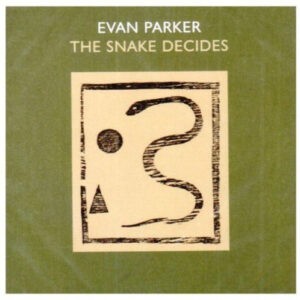
Evan PARKER
“The snake decides”
Soprano saxophone solos recorded in 1986 in St. Paul’s Church, Oxford by the late Michael Gerzon -- ’a giant in the field of audio’. Reissue of Incus LP 49.
14,00€
In stock

CD
Lionel MARCHETTI & Olivier CAPPAROS
“Equus”
“Equus is a collaborative work of musique concrète recorded in 2001-02 on a commission from the INA-GRM. It is truly a delight for Pogus to add this title to our catalog. As Capparos notes: "Equus guides us through human memory and history. It may sound a bit strange that sound & music would appear as a "vehicle", or as we had cast a lead into a labyrinth. This brings us to the question of whether we are alive or not; travelling the path throughout these soundings would drive us down and up our consciousness and our listening, not to mention that we are dead or alive."
13,00€
In stock

CD
DEK TRIO
“Burning below zero”
Ken Vandermark, reeds. Elisabeth Harnik, piano. Didi Kern, drums.
DEK is a new improvised music trio that features Austrians Elisabeth Harnik (piano) and Didi Kern (drums), and American Ken Vandermark (reeds), who have been performing together since September of 2014, both in Europe and in the United States. 2016 has been an exciting year for the band- in January they were featured as part of Vandermark’s residency at the Stone in New York City, 2017 will bring them on tour in Europe.
Their music has a wide range of influences, coming from sources based in Harnik’s work as an internationally acclaimed new music composer, Kern’s profile on European rock scene, and Vandermark’s two decades of work at both home and abroad, touring, recording, and collaborating with dozens of world renowned musicians as diverse as Getachew Mekuria and John Tilbury. The end result of these backgrounds and the open ended musical curiosity of the group is an extraordinary group aesthetic, inclusive and expressive and instantaneous.
Original price was: 15,00€.5,00€Current price is: 5,00€.
In stock
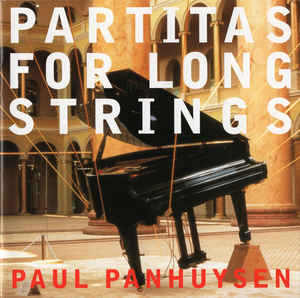
CD
Paul PANHUYSEN
“Partitas for long strings”
The basic ingredients of Paul Panhuysen’s art, both visual and aural, are all here, and I think that can be fairly well summarized with three words: minimal, rational and libertarian. The partitas are minimal, because there is really only one idea - playing unamplified long strings. They are rational, because as always, Panhuysen has found a way to place a rational structure on top of his work - in this case a form and a tuning system. It is libertarian, because like John Cage, and so many since John Cage, he lets the music do what it wants to do - in this case the wires vibrate however they need to.
Included with the CD is a 32-page booklet which details the history of Paul Panhuysen’s work with installations through pictures and text.
12,00€
Out of stock
CD
Eva-Maria HOUBEN
“Orgelbuch”
14 five-minute pieces from Eva-Maria Houben’s “Organ Book”. Eva-Maria Houben (organ).
10,50€
In stock

CD
Rhodri DAVIES-David LACEY-Dennis McNULTY
“Poor trade”
“In September 2006 a Welshman, Rhodri Davies, travelled to Ireland to play harp with two Irishmen, David Lacey (percussion and electronics) and Dennis McNulty (computer). The trio recorded in St Patrick’s church in Dalkey, just south of Dublin as children played in the school playground next door and roadworkers went about their business along the road. Poor Trade, the resulting CD is a rich, colourful swell of detailed improvisation captured in the moment by the skilled microphone of David Reid. Sensually brooding in places, gloriously alive in others this is passionate, joyous music.”
Original price was: 10,00€.5,00€Current price is: 5,00€.
Out of stock
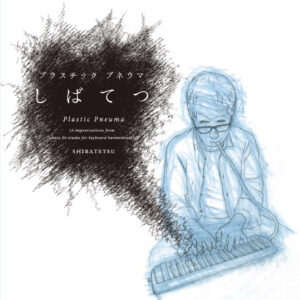
CD
SHIBATETSU
“Plastic Pneuma”
Shibatetsu was born in Tokyo in 1959. Since the 1980s he has been active as a piano and keyboard harmonica player, improviser, and composer. This album is made up of his improvisational performances on keyboard harmonica. Each of the 13 tunes, recorded in 2013, are about 1-3 minutes in length (total time, 28 minutes 26 seconds). The keyboard harmonica’s distinctive quality is its simple, comfortable tone, and from this instrument Shibatetsu’s technique and sensitivity create amazingly varied sound textures, and striking melodies even amid abstractness.
Original price was: 12,00€.5,00€Current price is: 5,00€.
In stock

LP
BJ NILSEN & STILLUPPSTEYPA
“Big shadow Montana”
“After producing their frozen trilogy of intoxicated dronemuzik for the Agency, these Scandinavian gentlemen have ventured into more absurdist territories through fictionalized soundtracks for imagined Mondo films and science fiction serials. It is in this context that BJ Nilsen & Stilluppsteypa present the apparitional Big Shadow Montana, an album of slow-motion delirium manifested in occluded smears, nocturnal gasps, and arcane tones from a variety of analogue synthesizers. Amidst the near constant wash of bleary-eyed etherialism, Big Shadow Montana cycles through several sonic themes and leitmotifs, displayed in varying states of clarity. In these transitions between half-remembered phrases and bleary-eyed thrumming, the album emerges as if it were the aftermath from a protracted bout of metaphysical channel surfing. Flickered impressions flash in conjunction with Breton’s manifesto of Surrealism in the form of the memories from happily drunk escapades in the heart of winter, the sidereal spells cast by the innerspace travelers Klaus Schulze and Coil, and the nagging questions of existential portent: "Was that bassline from Goblin, or was it German Oak? Maybe something from Faust IV?"
The trio of Nilsen, Sigmarsson, and Thorsson elegantly twist and bend these fleeting images into a spiraling symphony of bubbling electronics and spectral drones that mutate on both sides of the record into lugubrious yet carnivalesque waltzes. When this first appears, it is the echoing undercarriage of a simple melody, bobbing amidst rattling chains and cascading cymbal crashes only to dissolve into sequences of cold-war era tone beacons and empathic swaths of maudlin sound design. At the second occurrence, the melody washes ashore on the Iceland beach, where nude Viking men and women try in vain to get a tan when the sun is just barely going to rise above the horizon in the winter months. It is a pyrrhic jubilation of calliope harmonies set down by organs and synths turning a pale-blue hue in the wake of all that white skin shivering underneath the arctic sky. A hauntological album? Quite certainly. And yes, the vinyl does come with a download code.” label info
15,00€
Out of stock
LP
HEINZ HOPF
“Ultra primitiv”
Finest Gothenburg duo Heinz Hopf returns with their second LP, always on Wendy. Dan Johansson and Matthias Andersson created maybe the definitvie harsh noise record. Their noise is solid, dense, created with metal and feedback abuse, with right mix of power to experimental touch, but with a hint of pure pleasure. 40 minutes of pure harsh noise worship. If you vote for Incapacitants, grab this LP. Deluxe packaging, inner printer sleeve, printed labels, black vinyl. Single pressing of 100.
21,00€
Out of stock
CD
COMPILATION
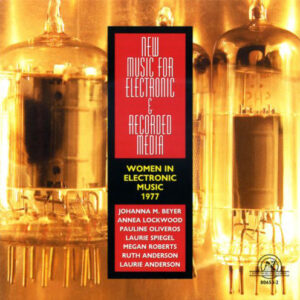
WOMEN IN ELECTRONIC MUSIC
“This is a long-awaited reissue of the CRI CD of the classic 1750 Arch LP. "The music on this album exhibits an exciting, wide-open, freewheeling approach to the medium of electronic music which has come to be typical of this genre in the late 1970s. No longer are composers obsessively concerned with the agonizing, expressionistic, and purely “electronic” (synthesized) sound formulas which marked much of this music composed between the mid Fifties and the late Sixties. Instead, today we have composers willing to mix media and sonic materials in thoroughly inventive ways to achieve ends which are new-sounding, and often more engaging, than that of the “academic” avant-garde. This is the outgrowth of a fundamental change in concerns which has been evolving not only among the composers on this album but also in a growing segment of the musical avant-garde, of which these members are some of the most fecund and inspired. These new sources of inspiration certainly were not as widely shared fifteen years ago. Several composers represented here are deeply concerned with Eastern influences: meditation, healing, trance, states of serenity. Others are inspired by traditional (or “ethnic”) musics and their subsequent metamorphoses into such popular forms as rock and roll. Still others bring to bear a sense of wit and satire, rarely a prominent feature of avant-garde music in the early 1960s. This first anthology of women’s electronic music demonstrates great refinement and skill at work in a variety of different styles, several of which are unfamiliar or new even to those who follow contemporary music. The fact that these pieces are more listenable than that of the Sixties avant-garde does not point to a musical regression as some critics have overeagerly assumed when discussing modern works using, say, consonant harmonic structures. Rather, and I think this is common denominator for these pieces and something which women composers and artists have been instrumental in legitimizing again for this period in time, these works signify a new consciousness of the relationship of art to human life and the important and positive interaction which can be the role of a more personalized art in our day-to-day experience.” Charles Amirkhanian, August 1977. “Music of the Spheres” (1938) (Johanna M. Beyer), “World Rhythms” (1975) (Annea Lockwood), “Bye Bye Butterfly” (1965) (Pauline Oliveros), “Appalachian Grove I” (1974) (Laurie Spiegel), “I Could Sit Here All Day” (1976) (Megan Roberts), “Points” (1973-74) (Ruth Anderson), “New York Social Life” (1977), “Time to Go” (1977) (Laurie Anderson).
15,00€
Out of stock
CD
Evan PARKER
“Conic sections”
“Reissue of ah um 015. Soprano saxophone solos recorded in 1989 in the Holywell Music Room, Oxford by the late Michael Gerzon - the follow up to The Snake Decides.”
12,00€
Out of stock
CD
Evan PARKER & Matthew WRIGHT
“Trance map”
“Evan Parker (soprano saxophone, sample collection, co-composition), Matthew Wright (live sampling, turntables, co-composition and sound design). In which the studio becomes the arena for an expanded method of improvisation where successive layers of sound making are built up, revised, scrapped, edited, revisited... (As the notes say ‘the tweaks went down to the wire.’) In short, the way many musicians have been working for decades, but a new experience for a hard-core, real-time free improviser like Parker. ‘I blame that demon Matt Wright,’ said Parker in a recent interview.” label info
12,00€
Out of stock
CD
Evan PARKER – Mark NAUSEEF – Toma GOUBAND
“as the wind”
A 2012 set of trio improvisations by Evan Parker playing soprano saxophone, Mark Nauseef playing metallophone based percussion and Toma Gouband playing lithophone based percussion. Recorded by genius engineer Adam Skeaping in the warm, natural acoustics of St Peters, Whitstable. Parker feels strongly that this is one of the best records he has ever made.
12,00€
In stock

CD
Kay GRANT & Alex WARD
“Fast talk”
“Singer Kay Grant left the Downtown New York scene some twenty years ago and crossed the Atlantic. Around the same time, schoolboy clarinettist Alex Ward donned long trousers and played in public with Derek Bailey. Since then, they have both been vital members of the London improvising scene, as these duo improvisations - recorded at four recent gigs and one studio session - attest. (Three of the ten pieces also involve live electronic vocal processing.)”
Original price was: 13,00€.5,00€Current price is: 5,00€.
In stock

CD
Rev. Dwight FRIZZELL & ANAL MAGIC
“beyond the black crack”
“Beyond the Black Crack was the concept of Reverend Dwight Frizzell, a musician, film maker, Doctor of Metaphysics and minister in the Universal Church of Life. It remains a little known classic, and one of the most unique listening experiences in modern experimental music. Recorded between 1974 and 1976 in locations as diverse as factories, the pyramid opposite Harry Truman’s grave site as well as more ’conventional’ concert settings. Beyond the Black Crack is a dark, dizzying and exhilarating journey through free jazz, electronics and environmental sound, all shattered by Frizzell’s radical tape editing. This CD re-release adds further material to the original LP: - "The Wandering Madness of Basilea", a suite from 1977 unheard until now, as well as unreleased material from the Black Crack sessions. Beyond the black crack was originally released in mono in an edition of 200 copies by Cavern Custom in 1976 (cat. no. 6104-12), to commemorate the First Annual End of the World Celebration, November 18 1976.”
13,00€
Out of stock
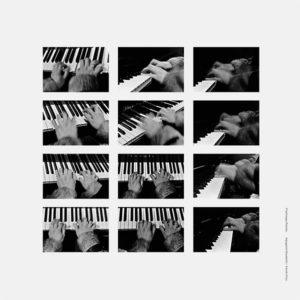
LP
Charlemagne PALESTINE
“Arpeggiated Bösendorfer + Falsetto Voice”
In 1974 Ileana Sonnabend commissioned Charlemagne Palestine to create a limited edition 2 LP in conjunction with a performance to celebrate the opening of her new Soho gallery at 420 West Broadway!
Charlemagne made several recording attempts, first at Swarthmore College in Pennsylvania where they had a Bösendorfer Imperial Piano in their theatre. He recorded “Bösendorfer + Voice”, “Voice Piece” as well as some Bösendorfer tests with Mayo Thompson as producer and Kurt Munkacsi as sound engineer. These ecstatic Swarthmore recordings, recorded late at night in the big empty theatre space represented the original elements on which Charlemagne Palestine later created the piano pieces for “Four Manifestations on Six Elements”.
For more than forty years since these recordings were made Palestine never went back to listen to them, but recently on re-listening to these Swarthmore recordings with alga marghen he found several blissful arpeggiated piano and falsetto voice studies which he feel now deserve to be heard.
Included in the alga marghen VocSon series, this LP is available now in an edition limited to 405 copies.
19,00€
In stock

LP
Philip CORNER
“Battutosso – Bone pulse (and other nature musics)”
Philip Corner (b. 1933) studied composition with Henry Cowell and Otto Luening and musical analysis with Oliver Messiaen. During the 1960s and 70s he was an active member of Fluxus, a founder (along with James Tenney and Malcolm Goldstein) of the Tone Roads Chamber ensemble, the resident musician and composer for the Judson Dance Theatre, and co-founder of Gamelan Son Of Lion (with Barbara Benary and Daniel Goode).
"Battutosso" presents four previously unpublished compositions by Philip Corner, recorded in various locations. The first one is a very hypnotic and beating piece recorded in July, 1989: Philip Corner has used some bones to create his percussive and pulsating piece. The second track recorded with bells creates a “liquid” sound, recorded in Zouz (western Alps) in July 1992, with Kurt Hofer (the cowherd) and Laura Donnelly as dancer. The first track on Side B has a noisy background with a natural flute played by Kurt Hofer. The fourth and last track was a short piece recorded at Caterina Gualco’s “Genova - Expo” (July, 1997) with Geoff Hendricks’ xylophone sculpture. Edition of 300 copies.
Original price was: 18,00€.10,00€Current price is: 10,00€.
In stock

LP
Philip CORNER
“OM Entering. and Once Enterd”
Kye is proud to announce the release of “OM Entering. and Once Enterd”, the latest LP from veteran fluxus composer Philip Corner. “OM Entering. and Once Enterd” comprises four previously unreleased recordings with the Barton Workshop, taken from performances in the Netherlands, and South Korea, between 2000-2007.
“Om Entrance” which one does.... because the performance is a real “passage from the material to the spiritual” unless the “real” world is just as spiritual already which i like to think it is. As perhaps an everyday awareness is already to be entranced which i have been told it is, really. To the facts: musicians’ coming-in already the performance of everything has to be done to get ready from unpacking to tuning and all that is done in the concentrated and exalted spirit of real music. Multiplicity moves noise to instrument possibilities with virtuosity show-offs slowing down to a perfect tuning in a quiet circle from where there is nowhere else to go but the sustaining of a quiet long tone.
My old friend and colleague also great composer Jim Fulkerson is there as he has be, as he was even at the first performance way back must be almost 50 years by now joining the Creative Associates at the University of Buffalo on his initiative as likewise these performances in Holland with his group he calls The Barton Workshop and for sure he is there playing trombone too.
The movement from Sang/Teh (Situations). Guard duty in a cold Korean winter. This piece was a major turning-point in my work. My life too you-could-say. “Of Ancient Times and Modern Sounds” i wrote then: a better world---much much better---than being in the American Army. The heterophonic melody-only texture learned from their “Ah Ahk” court music (“Soo Je Chun” the most beautiful music in the history of the world!) imposed on a thoroughly modern chromatic note structure. Occidental instruments absorbing the traditions of subtle sound colours so-long absent from the West.
Public performance in Seoul. That must have been the Spring of 1961 just before they “shipped me out”, to bring all that back home.
Before that the wonderful and exceptional opportunity to “run through” some of it with the indigenous instruments of the Koog Ahk Wun (National Music Institute) thanks to the cultural open-mindedness of the classical kayageum master Byungki Hwang. And Jim has not only played the 3rd movement often, but brought if back to Korea once at the Pan Music Festival. But my long-waiting-for performance in Korea on native instruments has yet to take place.
The Chopin Prelude piece is one of two, reworking passages from his D Major Prelude for piano, and a part of the “as a revelation” series which “looks into” moments from the classics which usually go by too fast. Begun with Mozart, the series has “got a lot of mileage” out of Satie, as well as including Buxtehude, Bach, Rimsky-Korsakoff, Verdi, Ives, Berlioz, and others.” (Philip Corner, 2015)
“OM Entering. and Once Enterd” arrives in a full color, high gloss Philip Corner designed sleeve, with insert, 350 copies black vinyl.
Original price was: 20,00€.10,00€Current price is: 10,00€.
In stock

LP
BEAM SPLITTER
“Rough Tongue”
Beam Splitter (Audrey Chen and Henrik Munkeby Nørstebø) is a duo for amplified voice and trombone.
Beam Splitter’s debut album “Rough Tongue” on Corvo Records is one part, a timbral collage of carefully extracted sound material and in another, a longer moment taken from an intimate room below the din.
All tracks are taken from three live concerts in 2016. Utilizing the pure sounds of acoustic and closely amplified trombone and voice, the record exemplifies the joining together of these two individual voices into a distinct dialog that delves beyond the borders of the corporeal elements of extended technique and sound.
There is an intimacy and conflict that becomes evident as the two personas intertwine, in moments joining together seamlessly and in the next, being left with the feeling of irrevocable fracture. The two manage between these extremes with a kind of improvised grace that reveals an effort towards a common goal. It is an honest metaphor for human relationship in process that even in the most serene moments can leave one raw and entirely exposed.
Red Gatefold Vinyl LP + Download Code. Limited to 300 copies, comes shrink-wrapped.
Original price was: 17,00€.10,00€Current price is: 10,00€.
In stock

LP
Greg KELLEY – Bill NACE
“Live at Disjecta”
Fourth in Open Mouths “Live At.......” Series. Greg Kelley, trumpet. Bill Nace, electric guitar. Recorded March 9, 2016 by Daniel Menche. Edition of 300.
Original price was: 20,00€.14,00€Current price is: 14,00€.
In stock

LP
Greg CAMPBELL – Greg KELLEY – Bill NACE – Wally SHOUP
“One end to the other”
Greg Campbell, drums, percussion, cornet, french horn. Greg Kelley, trumpet, microphone/mini-amp. Bill Nace, electric guitar. Wally Shoup, alto sax.
“Recorded during a recent trek to the Pacific Northwest, this session is very damaged by the post-tongue explosive devices packed by each of the quartet’s members. Skittering along the most devious edge of improvisational madness, Greg, Greg, Bill and Mr. Shoup bring four chunks of deep underground moisture into the air for the first time. Let us make to examine them.
“Morning” greets the listener beneath a raucous grackle filled tree, mounting to a commuters’ rage. Then along comes a mage with mushrooms, and the growl and rasp spreads out into what one must imagine a stoned rabbit’s brain records from a dawn.
In “Separating a door from a window”, Mr. Shoup’s sax limns the wall of sound into permeable spaces. The horns and percussion throw up bramble hollers of humorous squawk, but in the end, Wally is triumphant.
Like smoke snaking over the door, “Transom” is a very present and seductive piece. If you are a programmer, this is an excellent sound experience to loop, as it is both loving and bossy.
Horn and reed lead you into ‘Nothing is deprived of its warmth,’ and then gleefully pierce your eardrums with needles. Once the path has been cleared to your brain, molten notes are poured in and, like a Dead Head prostrate with his pipe, you become one with the universe. A warm universe.
At first I thought it was weird they named this album after the lost book of Tolkien’s Simarillion. Now I’m not so sure.” Lili Dwight/Byron Coley, Deerfield MA 2015
300 copies.
Original price was: 20,00€.14,00€Current price is: 14,00€.
In stock

LP
Jake MEGINSKY
“Gates and Variations”
“Gates and Variations rounds out a loose trilogy of records by Jake Meginsky for Open Mouth. Not an intended trilogy on Jakes part but it has become one to my mind. It has come to be how I listen to them and experience them, all informing each other, echoing and challenging each other and growing into each others space and light like a garden of plants that would never actually coexist anywhere in reality. Jake is always tirelessly reaching for something new yet I’d avoid using the word progression here. It instead feels to me like the last piece of a puzzle, or of a world created by some Jack Kirby demigod. Something has been completed and now all the pieces are interchangeable. The first can go last. The middle can be first. The whole thing becoming a universe looping in on itself with a multitude of entry points and not a lot of exits. These are dense environments where sections can move from microscopic to macroscopic, day to night and back again, so effortlessly that its hard to tell if its intended or if something imperceptible within you shifted the locus of yr perception. But it is all very intentional, something carefully carved to give the feeling of something, though unfamiliar and strange, organic and grown. Theres a sense of danger here like warning transmissions, concussive roiling rhythms and jagged disturbances. Yet also clear straight lines giving way to enveloping curve and staggering beauty. Supplant the beginning with the end with the beginning.”
Original price was: 22,00€.14,00€Current price is: 14,00€.