
In stock

CD
LE UN ENSEMBLE
“The Coast”
The UN Ensemble is performing « The Coast » by Lionel Marchetti, « 3LS4 » by Mathias Pontevia, « Canicule » and « Attentats » by David Chiesa.
With Julia-Hanadi Al Abed, electronics, Tanguy Bernard, sousaphone, Eric Camara, viola da gamba, Patrick Charbonnier, trombone, Paolo Chatet, trumpet, David Chiesa, electric piano frame, Anouck Genthon, violin, Thomas Lachaize, saxophones, Loic Lachaize, sound, Juliette Lacroix, cello, Delphine Lafon, voice, Guillaume Laidain, analog synthesis, Bruno Laurent, double bass, Johann Loiseau, flutes, small percussions, Johann Mazé, drums, Jean-Luc Petit, contrabas clarinet, Mathias Pontevia, percussions, Jean Marc Reilla, analog synthesis, electronics, Julia Robin, double bass, Jean Rougier, double bass, Frédéric Roumagne, electric guitar, Ian Saboya, electric guitar, Claude Saubole, acoustic guitar, Julien Sellam, violin, Stéphane Torré-Truéba, indian harmonium, voice.
12,00€
Out of stock
CD
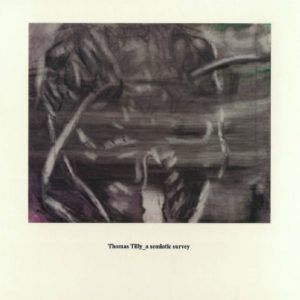
Thomas TILLY
“A Semiotic Survey”
Limited to 200 copies. Field recordings made by Thomas Tilly at Saül and on the Rorota road, French Guiana, May 2015. Composed using field recordings, electronic sounds and microphones dysfunctions, from 2015 to 2018 by Thomas Tilly.
10,50€
Out of stock
CD
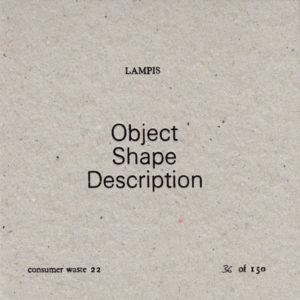
Marco LAMPIS
“Object Shape Description”
Object Shape Description is the debut recording by Brussels based Italian artist Marco Lampis. Lampis works between the visual and auditory disciplines, creating installations both with and without sound, in which discrete sensory perceptions become entangled. How might we understand sound through sight or be able hear by looking? This collection of recordings is inspired by the rhetorical figure of Ekphrasis in which a visual artwork is described verbally. Here, Lampis uses experimental voice process akin to echo location to describe using disjointed phonemes the shape of various vases. Dense clouds of fragmented annunciations ricochet between subject and object.
The CD is released in an edition of 150 in an oversized 7” sleeve accompanied by a 12 page risographed booklet featuring drawings and 3D scans by Lampis, an essay by Elena Biserna, and a letterpressed backpanel.
14,50€
Out of stock
CD
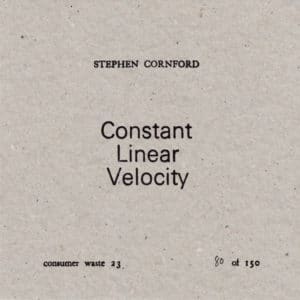
Stephen CORNFORD
“Constant Linear Velocity”
This CD features recordings of a now lost sculptural work that was originally commissioned in 2016 for Colour Out of Space festival. The work consists of over 100 empty computer cases, fitted with 16 customised and automated DVD drives. Between 2016 and 2018 it was exhibited in Brighton, Athens, Croydon, Oxford and Rennes, on each occasion being reconfigured into a new form. The most ambitious of these being at Detritus Festival in 2018, where a new and larger version of the work was constructed at the Onassis Cultural Centre from used computer sourced in the city. The work was sadly lost in transit between France and the UK, returning to the global trade in e-waste which its production initially sought to intervene in, so all that remains are these recordings.
The CD is released in an edition of 150 in an oversized 7” sleeve accompanied by a 16 page risographed booklet featuring photographs and scans of the sculpture, essays by Danae Stefanou and Stephen Cornford, and a letterpressed backpanel.
14,50€
Out of stock

2 CD
COMPILATION
“Troum Transformation Tapes: The 20th Anniversary Celebration (1997-2017)”
For the 20th anniversary of the band, TROUM invited friends and admired artists from their own history to cover, re-interpretate, re-process, collage, morph or just being inspired (by) any TROUM basic material; after one year of collecting masterial the result is a unique compilation of 19 tracks with a wide range of creative approaches - much more than your standard "remix" collection. All material was exclusively recorded for this compilation ! With tracks from Contrastate, Inade, Vance Orchestra, Tarkatak, raison d'etre, Nadja, Martyn Bates, Multer, QST, Ure Thrall, Bad Sector, Cisfinitum, etc
Original price was: 11,50€.6,00€Current price is: 6,00€.
In stock
CD
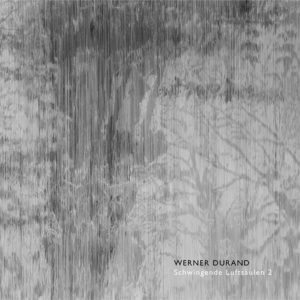
Werner DURAND
“Schwingende Luftsäulen 2”
Werner Durand "Schwingende Luftsäulen 2" (CD), the second chapter dedicated to Durand's music applied to the Pan-Ney, the wind instrument of his own invention.
From the liner notes:
"Schwingende Luftsäulen 2 is the second chapter of a trilogy featuring the Pan-Ney with its tubes or columns of vibrating air. This second chapter, in which the Pan-Ney is flanked by the tenor sax, reconnects where the first one ends (ANTS, 2017), and proceeds along a path that is coherent and uniform, and whose imaginative ideas go beyond the strictly musical sphere.
Wald (forest) is the centerpiece of the three works that make up Schwingende Luftsäulen 2. It is the forest with its multiple meanings, real and symbolic, mythological, religious, literary, folkloric. The forest as a place that is sacred or magical, dreamlike or fairy-tale. A place of adventure and misadventure, to trek through with a view toward growth or rebirth.
In Spiegel (Mirror), dedicated to the Tonaliens Ensemble, the Pan-Ney and the tenor saxophone weave a layered dialogue in which they call and respond to each other. Not only. In their 'mirroring conversation' the two instruments seem to suggest a choreography. Durand's music stands out for its ability to make some 'scenes' visible. In the dance evoked in Spiegel, the gestures - and perhaps even the bodies - appear suspended and rarefied, just as the music is suspended and rarefied, while, during listening, time expands beyond the duration of the piece. Music and dance remain there, in midair, even at the end of the ritual.
Panga, for Pan-Ney, tenor sax and digital delay, contains an allusion to nature. Panga (note the morpheme "pan", which refers to Durand's instrument) is the name of a plant that grows in New Zealand but that occurs in the botany of other areas of the planet (for example, in the Amazon) in connection with ancient practices both pharmacological and aphrodisiac. But the plant could easily belong to a manual of imaginary botany, if one thinks that nature, for Durand, is both a source of real inspiration and a place to reinvent according to subjective visions and coordinates."
With gorgeous artworks by Karlheinz Bux and extensive liner notes by Adelio Fusé.
12,00€
Out of stock

LP
KUKANGENDAI
“Palm”
Kukangendai is a kick ass rock trio from Kyoto (Tokyo transplants). When I first hear this band live I was instantly transfixed by their minimalist yet illusory primitive, polyrythmic and structural, memory evoking rock narratives. Their energy is completely and transparently palpable yet handled with restraint of the pleasure of a disciplined form dealing with time and articulation. They are a power trio of bass, drums and guitar but the music they play is as much the limbic system of a forest than it is a geode. They started in 2006. They left Tokyo to Kyoto and started the cult venue Soto (“Outside”) “to listen to music they hadn’t heard yet” a few years later. They collaborated with Ryuichi Sakamoto last year. They reminded me of James Brown on a heavy binge of Bastro, there’s a deep current of both archaic musical tastes and the human desire for articulating that archaism in there, but you shake your ass and get the shouting in… in a punk basement … 13th century version of Breadwinner, the bare soul version. I’m honoured and proud to work with this tribe, and to count them amongst friends.
-Stephen O’Malley, February 2019, Paris
16,00€
Out of stock
CD
Tetuzi AKIYAMA
“Misrepresenting Memory”
A solo album by guitarist Tetuzi Akiyama, who carries out an energetic performance schedule in and out of Japan. Amazingly, this is his first solo album since the 2008 release of The Ancient Balance to Control Death on the U.S. label Western Vinyl. That album included both acoustic guitar and singing, so Misrepresenting Memory is actually Akiyama's first instrumental solo album with guitar in 13 years, since the release of the CD-R Terrifying Street Trees in January 2006 on the Portuguese label Esquilo Records.
Misrepresenting Memory consists of one piece (31 min. 27 sec.) performed in concert at the Tokyo venue Apollo on December 14, 2018. The performance—using electric guitar and tape echo—was recorded directly to cassette tape. Making full use of soft, lo-fi tones and distorted choppy sounds, this extremely high-quality work is a fascinating expression of Akiyama's musical artistry. Limited edition of 200, numbered consecutively.
12,00€
Out of stock
CD
Yasumune MORISHIGE – Yoko IKEDA – Takashi MASUBUCHI
“Shade”
This CD documents the complete first and second sets (each a little over 30 minutes) of a concert at Ftarri on September 29, 2018, performed by Yasumune Morishige (cello) Yoko Ikeda (viola), and Takashi Masubuchi (guitar), three improvisers active mainly in Tokyo. The tones produced by the three acoustic stringed instruments are rich and vivid, and the listener can't help but be mesmerized by the interweaving of the sounds. And although the performances are improvised, they're so superbly structured that they could almost be compositions comprised of several movements. You can listen to this recording again and again and always hear something new. This was the first time the three musicians had ever performed together. That first encounter produced a rare masterpiece.
12,00€
Out of stock

CD
Bruno DUPLANT
“Deux songes (les jours sont faits pour expliquer les nuits)”
French musician Bruno Duplant is one of the most talked-about artists on the experimental music scene today. In recent years he's presented many outstanding composed pieces and released a succession of excellent recordings on labels around the world. The abundance and vitality of his work are remarkable.
On this album, two compositions by Duplant are performed by Ordinary Affects, led by Boston-based musician/composer Morgan Evans-Weiler. Ordinary Affects is an experimental music ensemble with an established reputation for performing works by contemporary composers such as Christian Wolff, Antoine Beuger, Michael Pisaro, Jürg Frey, and Kyoko Akama. Track 1 (21 minutes) is a quintet and Track 2 (26 minutes) is a string quartet. The performers are Laura Cetilia (cello), Jordan Dykstra (viola), Morgan Evans-Weiler (violin), J.P.A. Falzone (Fender Rhodes, Track 1 only), Luke Martin (guitar, Track 1 only), and Ashley Frith (viola, Track 2 only).
Each piece has a highly controlled, spacious tempo throughout. The sounds' overlapping and their successive emergence have a dreamlike quality that gently beckons the listener into a state of abstraction. Bruno Duplant's talent and originality as a composer and Ordinary Affects' excellence as performers are fully on display in this superb recording.
12,00€
In stock

CD
Axel DÖRNER – Toshimaru NAKAMURA
“In Cotton and Wool”
With his innovative performances, Berlin-based trumpeter Axel Dörner has been a leading figure on the improvised music scene since the 1990s. Internationally popular no-input mixing board player/improviser Toshimaru Nakamura structures sound by controlling mixer feedback. These two musicians released the CD Vorhernach on the Ftarri label in 2007, and In Cotton and Wool is their second duo album.
The four tracks on this album (each between 7 and 12 minutes) were recorded in a studio in Berlin in May 2017. Dörner uses electronics in addition to trumpet. In striking contrast with the 2007 first release, which is permeated with delicate sound creation making extensive use of soft tones, this second album is sure to overwhelm listeners with its radical, aggressive musical back-and-forth. What's more, there's never a monotonous moment--the overall structure is diverse and richly varied. This is a powerful masterpiece born of the two musicians' incomparable technique and musicianship.
13,00€
In stock
CD
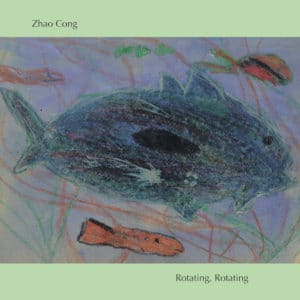
Zhao CONG
“Rotating, Rotating”
Zhao Cong is a Beijing-based experimental/improvisational musician. In addition to performing in live events in Beijing such as Zooming' Night, organized by composer/performer Zhu Wenbo, she has in recent years been expanding her range of activity, visiting Japan each year and performing in various locations around the country. She has also released solo and duo albums on Zhu Wenbo's cassette label, Zoomin' Night.
This CD contains three solo tracks by Zhao Cong. Tracks 1 and 2, each about 20 minutes, were recorded at her home in Beijing in June 2016. Track 3 (about 29 minutes) was recorded in concert at Ftarri, Tokyo, in January 2018. Only the second track is previously released--on Zhao Cong's debut solo album, Afternoon, a cassette tape that came out on Zoomin' Night in 2016 and has since sold out. On that album the title was "Twice, or More," and on this CD it has changed to "Electric Rotating." Tracks 1 and 3, respectively called "Acousting Rotating" and "Rotating, Rotating," are previously unreleased works.
Zhao Cong arranges a mixer, a cardboard cylinder, household items, and a hemispherical lamp (whose small light has a visual effect) on the same table, manipulates mixer feedback and contact mike, and produces delicate sustained sounds and (as if inserting them into the sustained sounds) numerous and varied noises. While her performance style and sounds are restrained, listeners drifting along in these sounds and the gentle flow of time are left with an indescribable and vivid impression. A masterpiece.
Mastered by Hiroyuki Ura in January 2019
Artwork and design by Cathy Fishman
13,00€
In stock

CD
NOISE POETRY
“Wolf Rayet”
David Chiesa : double bass. Didier Lasserre : drums. Mathias Pontevia : horizontal drums.
Noise Poetry is a beautiful example of a concrete attitude of improvisors more concerned with collectively constructing a sonic complexity than gestural free expression. All three of them plunge into a universe akin to that of a Japanese garden – where the space between the stones is more important than the stones themselves – inventing an acoustic synthesis in a development of stratified objects that act like a giant mobile.
12,00€
Out of stock
7"
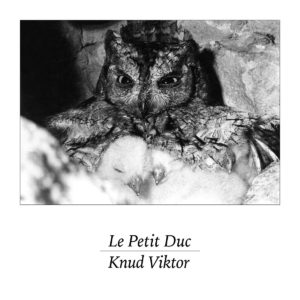
Knud VIKTOR
“Le Petit Duc”
Le Petit Duc' [The Little Scops Owl] is a sound work by Danish artist Knud Viktor, made between 1978 and 1983. Viktor was classically trained as a painter at The Royal Danish Academy of Fine Arts in the 1950’s. In 1961 he moved to France to live and work, but was overwhelmed by the sounds of the wildlife in Provence, and instead of painting began listening to and recording his surroundings. With these recordings, he composed what he called sound images – images sonores – and throughout the rest of his career, sound was his main medium.
12,50€
In stock

CD
Zachary PAUL
“A Meditation on Discord”
On Zachary Paul’s debut album for Touch, “A Meditation on Discord” compiles two live recordings from 2018 and a short film score, showcasing his expressive range and unique playing style. Both live recordings — “Premonition” and “Slow Ascent” — were fully improvised on his violin (“The Duke,” 1878), a minimal assortment of pedals (Earthquaker Afterneath, Diamond Memory Lane Jr, and Boss RC-30) and looped vocals.
Original price was: 10,50€.6,00€Current price is: 6,00€.
In stock

LP
James RUSHFORD
“The Body’s Night”
Black Truffle is pleased to announce the release of Australian composer-performer James Rushford’s The Body’s Night. Known to many through his collaborative works with Oren Ambarchi, crys cole, Kassel Jaeger, Klaus Lang, Joe Talia and many others, this LP is Rushford’s first solo release in a decade and the very first he has composed, performed and recorded entirely alone.
Primarily recorded in Los Angeles in 2017, The Body’s Night is a single electro-acoustic suite stretching over thirty minutes, utilising field recordings, flutes, ocarina, microphones, organ, percussion, piano, tape, analogue synthesizers, viola and voice. True to its title, the record immediately ushers into a nocturnal, intimate, claustrophobic space where the hyper-amplified rustle of clothing and vocal mumbles are shadowed by uneasy synth tones, fluttering white noise and distant filigrees of ultra-high-pitched tones at the edges of aural perception. While the influence of contemporary composers such as Klaus Lang and Jakob Ullmann (both of whose music Rushford has performed extensively) makes itself felt in the music’s attention to the liminal space between sounds, Rushford also draws on the bedroom synth explorations of 80s acts like DDAA and the harmonies and production values of black metal, drawing a common thread between these influences in terms of their shared interest in atmosphere and deliberate retreat from perspicuity. Relief from this claustrophobic atmosphere comes through the episodic structure of the piece, where like an already dark shot fading to black, each sequence retreats from our ears before we feel we have properly grasped it.
Rushford uses classical electro-acoustic techniques and plays elegantly on the fundamental ambiguity of the acousmatic situation, in which we can never be sure of the source of the sound we are hearing. But rather than a tribute to the masterworks of musique concrete, this is defiantly idiosyncratic and personal music. Meticulous in production values and exploratory in timbre, tonality and form, The Body’s Night is a key work from one of the most singular young composers at work today.
Stunning artwork by O.B. De Alessi. Design by Lasse Marhaug. Mastered and cut at 45rpm for maximum fidelity by Rashad Becker at D&M, Berlin
Original price was: 21,50€.12,00€Current price is: 12,00€.
Out of stock

2 LP
Ernstalbrecht STIEBLER
“Zwischen den Tönen”
Ernstalbrecht Stiebler (b. 1934) is a German composer of minimalist and reductionist contemporary music. Since the early 1960s, he has been developing a unique compositional style that draws on minimalist structures and repetitions, though not in any way related to the so-called Minimal Music, but rather influenced by Minimalism in visual art and characterized by long static tones that slowly change and evolve over the course of a piece.
Stiebler has composed for solo instruments as well as for different chamber musical and orchestral line-ups. Many of his ensemble pieces are built around long tones coming together in specific intervals, often alternating between dissonance and harmony, sometimes involving microtonal structures. Often, the single instruments are hard to distinguish, instead the musical space opened up by the complex harmonies, disharmonies and pulses of interference becomes the focus of listening.
This double LP collects four live recordings of pieces journeying "between the tones" ("zwischen den Tönen"): "Intervall 19" and "Slow Motion", composed in 1997 and 2003, respectively, are apt examples of Stiebler's style employed for chamber ensembles, with static tones putting every tonal nuance under microscopic view, and slow movement allowing for observation of the slightest variations. The third piece, "Zwischen den Tönen" (1997) is an anomaly in his oeuvre in that it makes use of his distinct techniques but is written for women's choir. The edition is rounded off by a recent recording, "ortung" (2018), again for chamber ensemble, that displays a newfound ease and compositional intuition that has become apparent in his recent work. All recordings are previously unreleased.
"With great concentration the essence of sound becomes clear in Stiebler's late work, here in the heyday of his advanced age, and this has brought his music to the listeners and locations of the alternative avant-garde of noise, ambient and the real-time music scene, in which a culture of heartfelt dedication to sound has long existed. The fact that Stiebler's initiation of precise listening also constitutes a challenge to the cultivation of classical music (he is a great admirer of Mozart) has not yet been properly recognized." (from the liner notes by Matthias R. Entreß)
Edition of 300 in single sleeve with two printed inner sleeves. Liner notes in German and English by Matthias R. Entreß and Ernstalbrecht Stiebler.
31,00€
In stock

LP
Barbara PROKSCH
“OPTO_PHON”
Barbara Proksch (born 1943 in Berlin, living in Salching, Lower Bavaria) is a German visual artist. After having studied Lettering and Illustration, she first worked in graphic design and theatrical painting before in 1982 deciding to become a freelance artist, concerning herself mainly with drawing. Her works are characterized by her long lasting fascination for letters and geometrical figures, and often incorporate signs, characters and writing as well as calligraphic elements. Another thread of influence stems from her background in theatrical painting: the body language and the physical aspects of painting which come to the fore when working on huge canvas with large brushes and liters of paint.
From the beginning, a further aspect has drawn her attention, namely the sounds that occur while drawing and writing, and the way they influence the resulting work. She noticed that the sounds made by the tools she uses feed back into her drawing process, and that just like speech and writing – in a linguistic sense – cannot be decoupled from each other, drawing and listening cannot either: Eye and ear become partners, drawing becomes a performance with the specific tools and materials used as musical instruments.
This observation has led to the development of her group of works called OPTO_PHON, a name which, from the 1990s onwards, Proksch uses for performances that draw upon this synaesthetic process: Usually, Proksch works on large sheets of paper mounted like drumheads and treated with various tools (scrapers, brushes, pens, knives, twigs, etc.), the sounds amplified through contact microphones. The early OPTO_PHON performances were made with herself standing in front of the paper sheets, visible to the audience while drawing. Later, she decided to stand in the back of the paper with a spotlight behind her, so that light shines through it while it is being cut and ripped.
Side A of this LP contains excerpts from OPTO_PHON performances, the first made in a church in Cheb, Czechia, in 2003, led by the strong echo emerging in the hall, the others recorded in her studio. They are contrasted on side B with a very different performance that is, however, conceptually related to OPTO_PHON: While travelling on the Trans-Siberian Railway, Proksch experienced a similar synaesthetic process while listening to the repetitive rattling of the train and watching the landscape passing by. In 2010, this experience was transformed into a sound piece for amplified sewing machine. Edition of 300 in full-color sleeve with printed inner sleeve and insert, containing images of optophonic tools and drawings, and extensive liner notes.
Original price was: 21,50€.13,00€Current price is: 13,00€.
In stock

CD
Anthony BURR – Charles CURTIS
“Chamber Music: Alvin Lucier & Morton Feldman”
1. Alvin Lucier: August Moon (2015)
2. Morton Feldman: Two Instruments (1958)
3. Alvin Lucier: Trio For Clarinet, Cello & Tuba (2008)
4. Morton Feldman: Three Clarinets, Cello And Piano (1971)
5. Alvin Lucier: Step, Slide and Sustain (2014)
6. Morton Feldman: Durations 2 (1960)
Anthony Burr and Charles Curtis present this collection of curated compositions from Alvin Lucier and Morton Feldman. Two Lucier pieces, August Moon and Trio For Clarinet, Cello & Tuba are presented here for the first time. Liner notes are excerpted from a lecture on Morton Feldman given by Alvin Lucier.
"For Feldman, dynamics serve an acoustical function. When he mitigates a piano attack he reduces that spike of noise that's at the onset of every piano sound leaving only the sinusoidal pure after-sound. It's as if he invented electronic music with the piano." Alvin Lucier from liner notes.
"Lucier manages to hear a layer of acoustical physics in Feldman's music that perhaps no one else would hear. He's hearing something in Feldman that is actually coming from his own musical world; in a way, hearing his own music in Feldman's, and drawing inspiration from that."
14,00€
In stock

CD
Alvin LUCIER
“Orpheus Variations”
Orpheus Variations is a new composition by Alvin Lucier for solo cello and seven wind instruments. It is based on a particular sonority from the first movement of Igor Stravinsky's ballet score, Orpheus; a sonority that has haunted Lucier for decades.
Orpheus Variations is one of eight large-scale compositions made expressly for Charles Curtis by Alvin Lucier in the last 15 years. This performance was conducted by Petr Kotik, with Charles Curtis playing solo cello alongside members of the SEM Ensemble.
"Lucier speaks first of a sonority, and only then of a chord. He discusses the chord, its notes and their disposition, but what haunts him is a "particular sonority." A sonority is the product of physical action on physical materials: the instruments, the registers in which they are activated, the breath of the musicians, the waveforms thus produced, their merging and interfering, and finally the moment and place of these actions. An energy field, certain to vanish completely once the musicians put down their instruments. However concrete and real the actions and materials, the sonority they produce is a phantom."
14,00€
In stock

CD
Maryanne AMACHER
“Petra”
Maryanne Amacher (1938-2009) was a composer of large-scale fixed-duration sound installations and a highly original thinker in the areas of perception, sound spatialization, creative intelligence, and aural architecture. She is frequently cited as a pioneer of what has come to be called "sound art", although her thought and creative practice consistently challenge key assumptions about the capacities and limitations of the genre. Amacher's work anticipates some of the most important developments in network culture, media arts, acoustic ecology, and sound studies, yet due to its expansive interdisciplinary nature, it has rarely been documented. Following two CDs for Tzadik and her inclusion in the monumental collection OHM: The Early Gurus Of Electronic Music (1948-1980), this publication of Amacher's 1991 piece Petra marks her first commercially available instrumental work.
Petra was originally commissioned for the ICSM World Music Days in Boswil, Switzerland. Written for two pianos, the piece is a unique example of Amacher's late work, a direct extension of her working methodologies for electronic composition taken into an acoustic realm that alludes to the music of Giacinto Scelsi and Galina Ustvolskaya. Petra is a sweeping, durational work based on both Amacher's impressions of the church at Boswil and science-fiction writer Greg Bear's short story of the same name, in which gargoyles come to life and breed with humans in a post-apocalyptic Notre Dame.
This solemn interpretation of Petra was recorded at its 2017 American premiere at New York's St. Peter's Episcopal Church with pianists Marianne Schroeder, who originally performed the piece alongside Amacher in 1991, and Stefan Tcherepnin, who performed it alongside Schroeder in 2012 at Hamburger Bahnhof, Berlin. Weighing tranquilizing passages of glacially-paced serenity against stretches of dilapidated, jagged dissonance, the recording illuminates a crucial node in the constellation of Amacher's enigmatic oeuvre.
13,50€
In stock
LP
NAPPE
“mmemm nolain”
Nappe is Pierre Faure and Christian Malfray (also members of La Morte Young, Sun Stabbed or pFeM). A slow and mysterious music between drone, electroacoustic and improvisation made with electric guitar, modular synth, filters, ... then reworked on analogue tape.
100 numbered copies.
28,00€
In stock
CD
SEARCH ENSEMBLES
“Prescient / Legend”
The second Search Ensembles artifact sees the return of Cédric Peyronnet (Toy Bizarre, Kaon / Ingeos, Sechres Mound,), Cyril Herry (Ninth Desert, Sechres Mound), Phil Legard (Xenis Emputae Travelling Band, Hawthonn), Michael Northam, Alan Courtis (Anla Courtis, Reynols), Jani Hirvonen (Uton), Slavek Kwi (Artificial Memory Trace), Jon Tulchin and Dale Lloyd (and/OAR, Seattle Phonographers Union, Lucid), plus first time involvement from Eric Lanzillotta (Eye Music, Ri Be Xibalba, Anomalous Records), Mark Reynolds and Mike Hallenbeck (Archive, Junior Birdman Audio).
Whereas the first album mostly presented unrefined aural snapshots of elusive and impenetrable civilizations and phenomena, the second album continues along similar lines with longer pieces while also presenting an increased utilization of electronic instruments and processes. The title is partially in reference to what were initially two different albums gradually becoming combined into one after a long process of being reworked and revised into one integrated whole. Furthermore, the title points toward a mental state of foretelling and recollection which in turn illustrates the idea that everything really exists in the eternal present (on an infinite number of time lines) rather than on one locked linear time line. Many indigenous people around the world have traditionally perceived life this way.
Limited to 150 copies.
Alan Courtis: field recording
Cedric Peyronnet: bass guitar, electronics, field recording,
objects, percussion, synthesizer, voice
Cyril Herry: objects, voice
Dale Lloyd: bass guitar, field recordings, vocal sounds, objects,
percussion, plexiglass, production, recorder (flute), synthesizer
Eric Lanzillotta: synthesizer
Jani Hirvonen: electronics
Jon Tulchin: field recording
Mark Reynolds: percussion
Michael Northam: field recordings, flute
Mike Hallenbeck: field recording
Phil Legard: flute
Slavek Kwi: percussion, synthesizer
8,50€
Out of stock

CD
Jakob ULLMANN
“Fremde Zeit – 5”
« Solo V für Klavier » (2013/2014) by Lukas Rickli, piano. This piece ends the cycle Fremde Zeit in a very minimal way, like a close-up on all small sounds and resonance of the strings, bringing the sound close to a molecular level.
As addition to Fremde Zeit addendum Box CDs 1–4 with Booklet German/English.
"Do we hear what we know? How, if this is obscured? Sent on a journey of discovery into the audible, at first almost nothing appears here. But once the ear has become accustomed to the intermediate realm of the pianissimo, an abundance of timbres becomes apparent, everyday noises unexpectedly dispersing in their non-spatial aura, then the surprising appearances of short tonal shapes, which enter the flow of time standing still as if they were revelations of the ear itself with no possibility to guess their origin, verifiable on the instrument. After all, it is in fact the tone which is the improbable, out of all that is weaving in and out within the grounding, static sound, like a distant army of constellations below, taking place uneventfully at the level of the permanent. 'solo V' is not an instrumental piece for a soloist in the ordinary sense. The grand piano becomes an unknown sound body. Although there is a soloist, they could hardly carry out the performance on their own, requiring either pre-produced electronic playback or, as in the present recording by Lukas Rickli, the participation of three assistants sustaining a soundscape. Ullmann conceived a sonic space in which sound is subjected to the laws of a specific 'gravity'. Its meridians range continuously from noise to tone and from shortest single event to sustained continuity, but what constitutes the true aura of this space is its reduced dynamics, and a rhythmic sense that is averse to any kind of melody in the usual sense. 'solo V' is also 'solistic' in another way: there is no fixed notated score, it must first be created individually, and so hardly ever will any performance score be the same as another. Rickli and his partner Zora Marti had a variety of graphic and notated material at their disposal for the development of the temporal form. Following the composer's graphically notated glissandi, Rickli and Marti modify the sound of the centers and generate transitions with them. The piece to be heard unfolds in a pulsating, breathing pianissimo. Hardly bringing any instrument to mind, it opens up a harmonic cosmos, urging the listener into it - because other than through listening to the barely recognizable, nothing is revealed."
Rainer Schmusch
14,00€
Out of stock

CD
Turgut ERÇETIN
“Panopticon Specularities”
A native of Istanbul, Turgut Erçetin (1983) studied composition and completed his doctorate studies at Stanford University. In 2016, Erçetin was awarded with DAAD Artists-In-Berlin program for a year-long residency in Berlin, and since then he has been based in Berlin. Erçetin's works engage with issues of sound, not as colors but as sonic entities that interface with time and space. Most of his works, therefore, are involved with acoustics and psychoacoustics as well as computer aided compositional processes. "String Quartet No.2" performed by Arditti Quartet; "Im Keller" performed by Neue Vocalsolisten Stuttgart; "Panopticon Specularities" performed by Ensemble Mosaik, Ensemble Apparat, Ensemble Adapter, and Sonar Quartett.
17,50€
In stock

2 LP
A HANDFUL OF DUST
“Dragging her wings of rusty knives: selected recordings 1994-2016”
A Handful of Dust was founded over three decades ago by two giants of the New Zealand underground, Bruce Russell (The Dead C, Xpressway, Corpus Hermeticum) and Alastair Galbraith (Plagal Grind, The Rip).
Declaring their raison d’être in the now infamous Free Noise Manifesto the group has advanced a radical aesthetic; Rejecting any notion of structure or comfort they’ve ground music to it’s sub-elemental parts. A scraping and howling electricity, spontaneous, unrestrained, physical.
i) Being beyond “music,” it is noise.
ii) Being beyond “rules,” it is free.
Dragging Her Wings of Rusty Knives contains expanded and unreleased works spanning the group’s history including their first studio recordings since 1995 and new writings, a late coda to The Journal of Vain Erudition, Logopandocy.
Alastair Galbraith: Violin, Guitar, Clavioline, Glass Harmonica, Keyboard
Bruce Russell: Guitar, Farfisa, Clavioline
Peter Stapelton: Percussion (1i, 2iii)
Mastered by Lasse Marhaug.
34,00€
In stock

LP
François DUFRÊNE
“Cri-Rythmes”
Recital presents a reissue of François Dufrêne's Cri-Rythmes, originally issued in 1977. A remastered vinyl issue of the impossible-to-find cassette by French sound poet Dufrêne (1930-1982), this LP holds tracks not available since then. Dufrêne swallows the microphone, gargles the capsule, then vomits up the cables. Claustrophobic, verbal seizures, revealing once more that Dufrêne is king and all the pages of poetic history now have his spit on them. Includes memorial/tribute written by Bernard Heidsieck in 1983. Edition of 250.
26,00€
In stock

LP
Jean DUPUY
“All of the time”
All Of The Time is the first comprehensive album of Jean Dupuy's sound works, collecting recordings from 1969-2017. Dupuy started his artistic career as a painter but shifted his practice when he moved from France to New York in 1967. Dupuy experimented with new technologies, and soon became a prominent figure in the Art and Technology movement. In 1968 he participated with an inventive sound, light and color installation, Heart Beats Dust, in the landmark exhibition The Machine as Seen at the End of the Mechanical Age at The Museum of Modern Art in New York. In the early 1970s Dupuy started performing collectively with other New York artists, and his loft at 405 East 13th Street turned into a center for these performances. Dupuy also arranged similar events at the Whitney Museum, the Kitchen and the Judson Church. During his time in New York, which lasted until the early 1980s, Dupuy collaborated with over 200 artists, as an organizer of events and as an artist. Charlie Morrow poses the question: "But what about his sound art? Jean has a particular affinity for sound and vocalizing. The songs of his childhood, the French church tradition and the charming puzzlement of letter games and graphics. He has created an amplified heartbeat machine with blood red puffs of pigment, and short jingles, such as 'I like bananas; ain't no bone inside.'" In aligning this collection, a new piece came to be recorded specially for this LP, Concert of Seconds, a recording of a symphony of painted clocks that live in Jean's gallery in Nice, France. This LP was organized with the assistance of Christian Xatric and Charlie Morrow. 20-page insert with scores and texts, introduction sheet by Charlie Morrow. Edition of 220.
26,00€
Out of stock
LP
Robert ASHLEY
“Private parts”
Lovely Music presents a reissue of Robert Ashley's Private Parts, originally issued in 1978. This newly mastered LP release is a must-have for aficionados as well as a perfect introductory work to Ashley's oeuvre. Among Lovely Music's first six releases, it came to be known as "the yellow record". No one had ever heard anything like it; Ashley presented an unvarnished exposition of the inner workings of a man's mind. And on the other side, those of a woman. These two episodes were the foundation for Ashley's seven-part opera, Perfect Lives (LCD 4917CD, 2017), which was performed by his ensemble throughout the 1980s and was completed for television broadcast by Britain's Channel Four. New arrangements of Perfect Lives, notably Varispeed's site-specific version, continue to intrigue and enchant. Recorded at the Center for Contemporary Music, Mills College, Oakland, California, July 1977, produced by Ashley. Personnel: Robert Ashley - voice; "Blue" Gene Tyranny - keyboards; Kris - tablas. 180 gram vinyl, Stoughton Old Style sleeve, includes libretto.
25,00€
Out of stock
LP
David BEHRMAN
“On the Other Ocean”
Lovely Music present a reissue of David Behrman's On the Other Ocean, originally issued as one of Lovely Music's first six releases in 1978. This newly-mastered LP is a must-have for Behrman aficionados or a perfect introduction to his work.
"I've been engaged for many years in an exploration of ways to make music and intermedia installations in which software and electronic devices interact with human performers. I've wanted to make works that have personalities, which remain distinct and recognizable, yet are open to surprising changes that can come about when they are performed or exhibited." --David Behrman
"Remarkable achievements on a purely technological level. Behrman's carefully programmed Kim-I system listens to tones played by the live performers, instantly analyzes the situation, and responds by playing back electronic tones of its own. This is undoubtedly the first time that humans and electronic sound equipment have communicated with one another with high degrees of spontaneity and intelligence on both ends of the wire. But the music that results is perhaps even more remarkable. Subtle, sustained, serene, sophisticated, super." --Tom Johnson, The Village Voice, Dec. 18, 1978
Recorded at the Center for Contemporary Music, Mills College, Oakland, California, Sept. 18, 1977, and at the Electronic Music Studio, State University of New York at Albany, June 9, 1977. Personnel: On the Other Ocean: David Behrman - electronics; Maggi Payne - flute; Arthur Stidfole - bassoon Figure in a Clearing: David Behrman - electronics; David Gibson - cello. 180 gram vinyl, Stoughton Old Style sleeve.
22,50€
In stock

LP
Bernard PARMEGIANI
“Rock”
Back in stock.
Limited edition (500 copies) remastered from the original master tapes by Jonathan Fitoussi.
This is the first release by the French label Transversales founded by Sebastien Rosat and Jonathan Fitoussi. The never before released soundtrack of the film “Rock” (1982) directed by Michel Treguer and composed by Bernard Parmegiani (1927-2013).
Major figure of electroacoustic music and member of the historic GRM where he composed among others his masterpiece, “De Natura Sonorum”, Bernard Parmegiani produced also a large number of jingles, soundtracks, and indicatives.
On listening to Rock, one is reminded of John Carpenter or François de Roubaix: a work which mixes the sounds of the TR-808 drum-machine, Synthi AKS, Farfisa organ, and Clavinet. Remastered from the original master tapes.
Includes exclusive liner notes.
20,90€
Out of stock
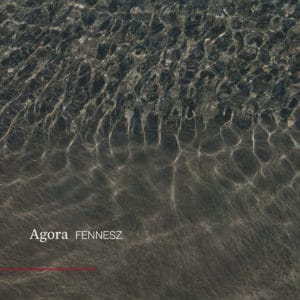
CD
FENNESZ
“Agora”
Agora is Christian Fennesz's first solo album since 'Mahler Remixed' [Touch, 2014] and 'Bécs' [Editions Mego, 2014]. Fennesz writes: "Its a simple story. i had temporarily lost a proper studio workspace and had to move all my gear back to a small bedroom in my flat where I recorded this album. It was all done on headphones, which was rather a frustrating situation at first but later on it felt like back in the day when I produced my first records in the 1990s. In the end it was inspiring. I used very minimal equipment; I didn't even have the courage to plug in all the gear and instruments which were at my disposal. I just used what was to hand.
Fennesz uses guitar and computer to create shimmering, swirling electronic sound of enormous range and complex musicality. "Imagine the electric guitar severed from cliché and all of its physical limitations, shaping a bold new musical language." - (City Newspaper, USA). His lush and luminant compositions are anything but sterile computer experiments. They resemble sensitive, telescopic recordings of rainforest insect life or natural atmospheric occurrences, an inherent naturalism permeating each piece. He lives and works in Vienna.
13,00€