
Out of stock

CD
Annie MAHTANI
“Racines”
Annie Mahtani (UK, 1981) is an electroacoustic composer, sound artist and performer working and living in Birmingham (UK). She studied with Jonty Harrison at master’s and doctoral level at the University of Birmingham, completing her PhD in 2008.
Her output encompasses electronic music composition from acousmatic music to free improvisation. As a collaborator, Annie Mahtani has worked extensively with dance and theatre, and on site-specific installations. With a strong interest in field recording, her work often explores the inherent sonic nature and identity of environmental sound, amplifying sonic characteristics that are not normally audible to the naked ear. Her music explores abstract and recognizable sound worlds and all the spaces in between. Annie works extensively with multichannel audio both in fixed medium works and in live performance.
« Past Links » (2008), « Round Midnight » (2010, 18), « Inversions » (2015), « Aeolian » (2015-16), « Racines tordues » (2019).
13,00€
In stock

3 CD
COMPILATION
“Changez Retravaillé”
Changez Les Blockeurs has attained a somewhat mythical / legendary status (Record Collector magazine included it in a list of the rarest, most collectable records ever) and 2017 was the 35th anniversary of its original release. In celebration of this, TNB invited some of their favourite artists to compose a reworking which have been issued collectively as Changez Retravaillé (Changez Reworked.)
Nurse With Wound, Philip Sanderson (Storm Bugs), Mark Durgan (Putrefier), Phil Julian (Cheapmachines), The Prestidigitators, Anomali, Spoils & Relics, Asmus Tietchens, Ralf Wehowsky (a.k.a. RLW), Das Synthetische Mischgewebe, Kommissar Hjuler, Rudolf Eb.er (Schimphluch Gruppe), Frans de Waard (QST), Jerome Noetinger, Giancarlo / Massimo Toniutti, Alexei Borisov, TNM, Thurston Moore, Jim O'Rourke, GX Jupitter-Larsen (The Haters), John Wiese, Idea Fire Company, Irr. App. (Ext.), Merzbow, K2, Toshiji Mikawa (Incapacitants), Kazumoto Endo, Nobuo Yamada, Daisuke Suzuki, Veltz.
Nurse With Wound open the Changez Retravaillé compilation, 30 tracks over three CDs. Consistent with their efforts to forge links with the global Noise community, and indeed a strong influence on it, it’s fair to think of this as a gathering of TNB’s peers. Most people in the market for this could have predicted the appearance of Mark Durgan (Putrefier), Rudolf Eb.er (Schimpfluch Gruppe), GX Jupitter-Larsen (The Haters), Merzbow et al. Durgan submits a rather invigorating aural firework display; Anomali and QST (Frans de Waard)’s Techno leanings feel considerably bolder than noise remixed as noise. With that said, harsh noise tornados like that served up by K2 can still rattle your senses. The Wire
30,00€
Out of stock
LP
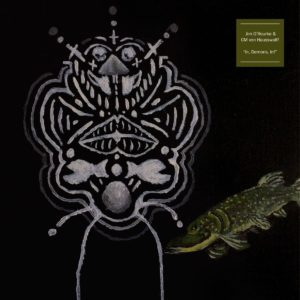
Jim O’ROURKE & CM von HAUSSWOLF
“In, Demons, In!”
The time-stopping tract of ’In Demons In!’ is a naturally elemental drone collaboration between eminent experimentalists Jim O’Rourke and CM Von Hausswolf for their eternal admirers at iDEAL Recordings
Offering a transfixing peek behind the curtain of pure black hole drone dynamics, ‘In Demons In!’ finds the American in Japanese exile and the proclaimed monarch of the imaginary kingdoms of Elgaland-Vargaland meeting on common ground after 26 years of international correspondence. Initiated in Tokyo 2016 and completed over the proceeding two years in Japan and Sweden, the uncompromisingly adventurous results are galactic in scope and viscerally metaphysical in presence, conjuring scales of abyssal bass and diffused, atomised, abstract dark matter that make the listener feel like a speck of stardust floating in infinity.
Using sound as a magickal tool for psychic transport and to finely model notions of the metaphysical that typically elude human comprehension, the near 40’ work feels to collapse billions of years into a glacial moment. Location recordings made in Kathmandu lend an barely there iridescence, like microbial filaments flickering in the endless darkness, to their plunging, subharmonic basses and vaporised mid-upper registers, where spectral forces comb thru the piece, only very gradually altering the weightless keen of its planetary mass and mental traction.
Ultimately, and fans are likely to agree, ‘In Demons In!’ amounts to a vitally definitive entry in both artists’ catalogues, marking right up there with the most abstract wonders of O’Rourke’s electro-acoustic Steamroom volumes, while manifesting some of the most fascinating results from Von Hausswolff’s ongoing investigations into drone music’s paranormal properties. In other words: it’s Grade A+ zoner music.
20,00€
In stock

CD
Fred GALES
“Het Jacoba Prieel”
Originally released on tape by Sound Reporters in 1986. Het Jacoba Prieel is a very weird compendium of imaginary soundscapes, in which every coordinate seems lost and totally deviated. Fred Gales, in collaboration with Walter Maioli and Pit Piccinelli, presents his idea of a concrete organic music, a diary of signals and sound impressions inspired by the great tradition of primitive music, an extreme investigation of love on the primordial beauty of sound expression. Travelling into the properties of all matter of the sonic environment, the members of the legendary Sound Reporters generate, transform, mix, filter and modulate natural and electronic sounds in the magical analogical studio of the Utrecht Institute of Sonology. From a single movement of sound fragments are opened catalyst flows and circuits, flickering sequencers and oscillations of luminous channels. Futuristic tribalism, hypnotic fossil percussion, alien sounds, dreamlike trips in the jungle, echoes of rustling and rumbles otherworldly, rain waterfalls and shells in the pond, calls of animals and insects, heart beats and radar waves. Everything is just pure sound and surrounds us.
16,00€
In stock

2 LP
COMPILATION
“Ethnoelectronics”
Originally released on tape by Sound Reporters in 1986. Ethnoelectronics is a further episode of pioneering fusion between ethnic and electronic music, involving dauntless explorers such as Walter Maioli, Nirodh Fortini, Fred Gales, Raffaele Serra, John Zandijk and the visionary sculptor Edward Luyken. As the soundtrack of an obscure science-fiction saga, the six parts of these recordings retain something profoundly osmotic and sidereal. In these hybridizations, it's the heart of personal spiritual cosmos and stratospheric portals to pulse, but always remains the devotion to wild nature and ethnographic differences. In this way, the sinusoidal movements of electronic synthesizers and radiophonic frequencies interact with the pounding sounds of the jungle, with frogs, sea waves, buzz insects, leaves and rain. From flutes, rattles, steel sound sculptures or rustling idiophones, mysterious samples appeared like weird interferences, with rhythms and ritual voices from Tibet, West Papua, Burundi, Tahiti or the shamanic Japan of the Ainu.
30,00€
In stock
CD
COMPILATION
“Ethnoelectronics”
Originally released on tape by Sound Reporters in 1986. Ethnoelectronics is a further episode of pioneering fusion between ethnic and electronic music, involving dauntless explorers such as Walter Maioli, Nirodh Fortini, Fred Gales, Raffaele Serra, John Zandijk and the visionary sculptor Edward Luyken. As the soundtrack of an obscure science-fiction saga, the six parts of these recordings retain something profoundly osmotic and sidereal. In these hybridizations, it's the heart of personal spiritual cosmos and stratospheric portals to pulse, but always remains the devotion to wild nature and ethnographic differences. In this way, the sinusoidal movements of electronic synthesizers and radiophonic frequencies interact with the pounding sounds of the jungle, with frogs, sea waves, buzz insects, leaves and rain. From flutes, rattles, steel sound sculptures or rustling idiophones, mysterious samples appeared like weird interferences, with rhythms and ritual voices from Tibet, West Papua, Burundi, Tahiti or the shamanic Japan of the Ainu.
16,00€
Out of stock

CD
Bertrand DENZLER
“Arc”
Arc is a Bertrand Denzler's composition performed by string ensemble CoÔ.
Founded by Félicie Bazelaire, CoÔ is a string ensemble bringing together string players of ONCEIM (Orchestre des Nouvelles Créations, Expérimentations et Improvisations Musicales, created and directed by Frédéric Blondy). CoÔ aims to build new directions in instrument research, and create a new repertoire for bowed strings. Félicie Bazelaire works with musicians who are composers and improvisers such as saxophonist Bertrand Denzler with this composition Arc.
The fruitful collaboration between musicians and composer helps to organize new ways of playing, and produce minimalist and innovative forms. Score gives priority to specific techniques applied to bowed strings, allowing musicians to experiment rich material, and focus on collective sound potentials.
CoÔ: Patricia Bosshard violin, Cyprien Busolini alto, Elodie Gaudet alto, Anaïs Moreau cello, Félicie Bazelaire double bass, Benjamin Duboc double bass, Fred Marty double bass.
Recorded on may 2018.
10,00€
In stock

CD
James ANDEAN
“Assemblance(s)”
James Andean is active as a composer and performer in a range of fields, with primary interests including acousmatic music and improvisation. He is a founding member of several groups and ensembles, including Rank Ensemble, LOS Duo, and VCA. He has degrees from McGill University in Montréal (Québec) and the Sibelius Academy in Helsinki (Finland), and is a lecturer at the Music, Technology and Innovation — Institute for Sonic Creativity of De Montfort University in Leicester (England, UK).
His work has been recognized by the Prix biennal Presque rien (France), Lumen Prize (England, UK), MADATAC (Muestra de Arte Digital Audiovisual y Tecnologías Avanzadas Acontemporáneas, Spain), Sonic Arts Award (Italy), and Destellos Electroacoustic Composition Competition (Argentina).
« Déchirure » (2013), « Hyvät matkustajat » (2012, 14), « Valdrada » (2018), « Psygeío » (2013-14), « Spores » (2014), « Maledetta » (2011), « Medusan Torso » (2010-11), « Between the Leaves » (2012).
13,00€
Out of stock

CD
Sophie DELAFONTAINE
“Accord ouvert”
Studied acousmatic composition at the Conservatoire royal de Mons / Arts2 — École supérieure des arts (Mons, Belgium) with Annette Vande Gorne, Philippe Mion, and Ingrid Drese. She obtained her master’s degree in 2014. In her practice of composition, Sophie Delafontaine likes to recover, recycle, and renew her sonic materials. Her acousmatic works are strongly influenced by her creations for dance and the theatre. She draws inspiration from the ambience, atmospheres, texts, stories and characters found in the various shows for which she makes music.
« Ondiésop » (2015), « Respire marche pars va-t-en » (2013), « Dormir, aujourd’hui » (2018), « Ressort spiral » (2014-16), « Creux-du-Van » (2014), « Tout ça à cause de Junon » (2013).
13,00€
Out of stock

LP
Joanna JOHN
“No End”
From Felt Hat Reviews site : "I guess it's pretty difficult to look beyond the profile of a certain label if you think of new releases coming from it. With Bocian records who releases improvisational stuff or modern composition, sometimes more or less obscure drone noise aspects of the former two, I was pretty surprised to hear about Joanna's album. It was also intersting since I know her from her visual art side which doesn't change the fact that it was a bit surprising to see her upcoming release on Bocian. (...) Joanna's debut album is a nice promise to something, I am sure, she will develop in her own time. It has lots of subtle hues and undertones. An element of mystery and even whimsicality. An aspect of arcane eroticism and even synergy of the elements. It has a rubber stamp of her associations with the creative background which by all means is not a blemish. And foremostly there is something else. A courage to step into a larger world with something that creates a new profile, a new aspect of expression. Re-modelling, re-defining, self-actualising and at the end of the day self-discovery is growing pains in artist's life but hats off to those who do it. Well done!"
16,50€
Out of stock

LP
Wojciech PUŚ
“Endless: Music for Performers”
Since 2016, Wojciech Puś has been developing Endless, a sensual architecture of images, light, and sound that serves as a base structure for a poetic essay, a dream about identities in process.
The music result is a fascinating electronic masterpiece showcasing his talent as a performer and producer creating his own unique universe
This works sound very ancient and probably very alien as well. This is music of hope, love, despair and sadness and probably all at the same time.
16,00€
Out of stock
10"
PEÜR
s/t
Originally, Peür acts as a duo, armed with an electric guitar sharpened like a billhook, a saturated drumkit that hammers the sound space like a construction machine, and other sources of sound transformed by DIY devices. Sometimes, and this is the case, Fabrice Decemme and Mathieu Gratedoux, are joined by Didier Bourgoin, historical figure of the music scene from Poitiers (france) and creator of the Fanzinotheque, for the voice, the text thrown without artifice in the music, in a kind of brutal letting go to make many self-proclaimed improvisers pale.
Autobio / Motobio, between anecdotes, feelings and free digression of thought, the voice carried by the voice races like the projections of the guitar of the comrade, the sounds call sense that call others in a metonymic urgency that allows despite everything to stand above the void.
Peür is an enigma. You won't know much more, you will just find links with other french musical activists, limited edition productions, a split tape with Jean-Louis Costes... clues, therefore, signs of a state of mind frankly engaged in the margins and the « pratiques brutes de la musique ».
La Belle Brute is very proud to collaborate with Les Potagers Natures in the edition of this beautiful 10-inch silkscreen printed at 300 copies.
14,00€
In stock

LP
ORA
“Time out of Mind”
15 track album recorded by Darren Tate & Andrew Chalk, 1986 to 1996, on locations and at ICR Studios in York, engineered by Colin Potter.
Arrangements made at Impression Lointaine.
With Daisuke Suzuki as guest on two tracks.
‘Music first and foremost, with odd numbers that drift and dissolve better in the air, with nothing heavy or static about them.
Shaded tints we desire, no colour only tints and hues.
Nothing lovelier than a grey song, where uncertainty and precision meet.
Beautiful eyes veiled and dim, the quivering bright light of noon, and the blue tangle of clear stars in a mild autumn sky.
Only the shaded tint can link dream to dream and flute to horn.’ (adaptation of a poem by Verlaine)
Edition of 400 copies.
17,50€
In stock

LP
LUMINE
“Quiet Ends”
Played, recorded and mixed by Timo van Luijk & Graham Stewart at Kulta Saha, 2017-2018.
Sleeve drawing, design and text by John Whyte.
‘Quiet Ends’, the 2nd album by Lumine, draws an isolationist scenery with subtly merging halftones of twilight. The penumbra diffuses mysterious textures and a melancholic hypnotic atmosphere conductive to introspection. In the gathering darkness all troubling details of reality melt into large evocative masses and abstract surfaces.
Edition of 350 copies, with download code.
17,50€
In stock

LP
AF URSIN
“Itinera”
*** Limited re-pressing (200 copies) on transparent vinyl ***
First full electronic album, played, recorded and mixed by Timo van Luijk at Kulta Saha 2016-2017
"An imaginary one way trip through microcosmic oscillations in seven macrosonic constellations. The space of sound versus the sound of space."
16,00€
Out of stock

2 LP
David ROSENBOOM
“Brainwave music”
Black Truffle is honoured to announce the first ever vinyl reissue of David Rosenboom's legendary Brainwave Music, originally released on A.R.C. Records in 1975 and here expanded to a double LP with the addition of over 40 minutes of contemporaneous material. Pioneer of live electronics, innovator in music education, collaborator with artists as diverse as Jon Hassell, Jacqueline Humbert, Terry Riley and Anthony Braxton, Rosenboom is renowned for his ground-breaking experiments with the use of brain biofeedback to control live electronic systems.
Each of the three pieces that make up the original Brainwave Music LP integrates biofeedback with musical technology in different ways. In the side-long opening piece "Portable Gold and Philosophers' Stones", four performers have electrodes and monitoring devices attached to their bodies to receive information about brainwaves, temperature, and galvanic skin response. This information is analysed and fed into a complex set of frequency dividers and filters, manned by Rosenboom, but essentially played by each of the performers through their psychophysiological responses to the situation. The result is a slowly unfolding web of filtered electronic tones over a tanpura-esque fundamental, possessing the unhurried, stately grandeur of an electronic raga. In "Chilean Drought", three different variations of a text about a drought in Chile, each read by a different voice in a different style, are associated with the Beta, Alpha, and Theta brainwave bands. Alongside an insistent piano accompaniment, we hear a constantly shifting combination of the three vocal recordings controlled by the relative preponderance of each of the brainwave bands in the soloist whose brainwaves are being monitored. "Piano Etude I (Alpha)", the earliest piece included here, is based on research into the link between Alpha brain wave production and the execution of repetitive motor tasks. As Rosenboom plays a very rapid, incessantly repeated pattern in both hands – deliberately designed to be difficult to execute without being in an alert, non-thinking state similar to that associated with strong Alpha brainwave production – two filters controlled by monitoring his brainwaves process the piano sound, moving gradually higher in frequency as the average Alpha amplitude increases, resulting in a hypnotic, constantly shifting blur of repeated notes reflected through the shimmering, watery lights of the filters.
For this reissue, the original LP is supplemented with an additional LP containing an unreleased 1977 live recording of Rosenboom's "On Being Invisible", in which the composer himself performs on an array of electronics that are fed information from his brainwaves. Stretching out over 40 minutes, the piece begins in similar territory to "Portable Gold and Philosophers' Stones" but eventually becomes far wilder, building up to pointillistic bleeps and dense layers of electronic fizz that unexpectedly cut to near-silence. As Rosenboom explains, the piece creates a situation in which the 'performer's active imaginative listening became one of the ways to play their instrument, as well as an active agent in how self-organizing musical forms might emerge.' Enriched with archival images and new notes from the composer, this expanded reissue of Brainwave Music is essential listening for anyone interested in the history of live electronic music and alive to the possibilities it might still contain.
Includes archival images and new notes from the composer.
Gatefold sleeve design by Lasse Marhaug.
Mastered by David Rosenboom from the original analog tape masters. Cut by Rashad Becker at Dubplates & Mastering, Berlin.
27,00€
Out of stock
LP
DOME
“Dome 2”
With the demise of the group Wire in 1980, founder members Bruce Gilbert and Graham Lewis joined forces to create Dome. With the assistance of engineer Eric Radcliffe and his Blackwing Studio Dome took the ethic of “using the studio as a compositional tool” and recorded and released three Dome albums on their own label in the space of 12 months.
These albums represent some of the most beautifuly stark and above all timeless exercises in studio experimentation from early 1980s alternative music scene.
Previously issued in the out of print DOME 1-4+5 box set in 2011. Now available as standalone LP with download card.
G. Lewis + B.C. Gilbert. August 1980.
Engineer: Eric Radcliffe. Asst. Engineer: John Fryer.
Recorded at Blackwing Studio
Floating-point re-master by Russell Haswell, August 2011
Cut at Dubplates & Mastering by Rashad Becker, August 2011
New artwork and layout: Dave Coppenhall
19,00€
Out of stock

LP + CD
eRikm – Anthony PATERAS
“Albédo”
eRikm : CD-J, Idiosyncrasie system / Anthony Pateras : synth, sampler.
In Autumn 2017, eRikm and Anthony Pateras embarked on an acoustic encounter, a direct dialogue through their machines. Each brought their own experiences and know-how together with a shared desire to explore sound landscapes in complete freedom. From this meeting, Albédo was born. Their material was developed sometimes in the studio, sometimes in concert. This dialogue, articulated within the unpolished depths of the sound’s structure, is captured in Albédo with one side recorded live in Ljubljana and the other in the CCAM studio in Vandoeuvre.
23,00€
Out of stock
LP + CD
Anthony LAGUERRE
“Myotis”
About the release : In Myotis, Anthony Laguerre goes beyond rhythm using improvisation and a free approach as main technical support of invention. In a research based on rhythm and sound material around drums, he expresses sensitivity, softness and power thanks to expert skills and sound recording techniques. The union of these materials create songs made of multiple tones combined with percussions and occasionally harmonica.
About the artist : Anthony Laguerre is a versatile musician, composer, improviser and sound engineer. Growing up listening to modern music such as noise, rock and improvised music, developed his taste for electronics and sound techniques and compeled him to become a studio and live show recording engineer. His work as a musician is based on sound treated as music. The combination of his influences led him to work on audio forms, mixing harmonies and sound materials. His proclivity for produceing developed over the years now allows him to be autonomous in his productions and thus to deepen the research between sounds and music. Anthony collaborates with G.W. Sok, Jérome Noetinger, Isabelle Duthoit, Eric Thomas, Guigou Chenevier, Michel Deltruc and many others.
23,00€
In stock
LP
John DUNCAN & Joachim NORDWALL
“Conventional Wisdom”
Venerable avant-garde composer John Duncan follows his prized cycle of cover versions ‘Bitter Earth’ [2016] with ‘Conventional Wisdom’; a truly beguiling new suite of original, stony avant-blooz songs produced in collaboration with iDEAL boss Joachim Nordwall, and marking another high point in both of their catalogues After coming out as a vocalist to memorably striking effect in 2016, Duncan compounds the effect with ‘Conventional Wisdom’, placing his original lyrics in stark arrangements ranging from shortwave radio-streaked dark ambient settings and Mika Vainio-esque isolationism, to deathly dubs driven by Nordwall’s rugged rhythms in a style that heavily recalls Jay Glass Dubs’ recent ‘Epitaph’ LP.
An original and close associate of LAFMS co-founder Tom Recchion, and collaborator with everyone from Chris & Cosey to Asmus Tietchens, Merzbow and Andrew Mckenzie (The Hafler Trio), Duncan is well versed in the art of f*cking with music. Doing so since the ‘70s, it’s only in recent years that more “typical” song structures have crept into his style with most transfixing effect, gathering the attention of many who previously weren’t necessarily exposed to his music. Whether stemming from a perverse pleasure in twisting popular music, or a matter of changing with age (dude is 65), we’re just not sure, but either way Duncan is now coming out with some of the most broadly appealing, yet incomparable work in his 50 year-wide catalogue.
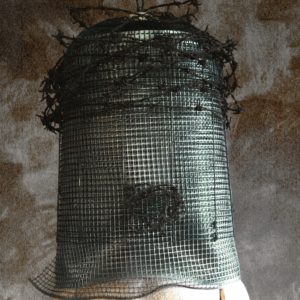
Aided by Joachim Nordwall, the pair convene a set of songs every bit as fascinating, eerie as the cover image of a birdcage mask bound in barbed wire. The title track emphasises the stark mystery with nothing more than meditative vocals, gamelan strikes and daubs of shortwave, before ‘Hard Swallow’ catches him huskily channelling Lee ‘Scratch’ Perry at a spooky distance, while the disembodied dub tropes of ’Soft Eyes’ come uncannily close to aspects of Jay Glass Dubs, and ‘Say No’ says it in the bluntest, most bluesy terms. The most desiccated, strung-out material however is saved for the B-side, with the sferic resonance and stereo-strafing vocal of ‘The Joke’ planing out into the cracked hush of ‘The Beautiful Attempt’, before he and Nordwall effectively duet in the finale ‘The Red Hot Alternative’, where Nordwall also supplies pranging percussion and Coil-esque synth abstraction.
19,00€
In stock
LP
HELM
“Chemical Flowers”
Luke Younger returns to PAN with an eight-track album of his most direct work to date.
Composed alone at NO studio in the Essex countryside, to start an album with a piece called ‘Capital Crisis (New City Loop)’ seems an intentional misnomer. Long, sustained periods in the rural studio setting see Younger working with an array of fragmented, disassociated sound sourcesto build upon 2015’s ‘Olympic Mess’. It shares a similarly inclined vision of the urban environment, but here ‘Chemical Flowers’ makes reference to paradoxical notions of authenticity and creative practice by way of questioning the structures around us.
Collages are assembled and dismantled, temporal and spatial boundaries fluctuate and movement is an overarching theme. Surrealist drowned world atmospheres sculpted far enough away from the source of inspiration leave plenty of room for ambiguity. The nocturnal nature of the recording process is self-evident, and pieces like ‘Leave Them All Behind’ tap into a deep psychedelic undercurrent. Confused narratives, emotions and aleatory hallucinations ebb and flow throughout. ‘I Knew You Would Respond’ evokes murky soundtrack terrain with eerie repetitive strings and ambient respite, disrupted periodically by brief bursts of granular noise. It’s one of the records most unnerving moments, possibly as it’s one of the most recognisably human.
The album navigates dense passages with recurring signifiers. Hollow percussion, modulating delay and curious field recordings come and go, maintaining a perpetual state of flux where nnothing stays the same for long. The drowned world theatricals return on the swamp-like ‘Lizard in Fear’ whilst string rhythms creep in on the penultimate track to incite momentary electroacoustic harmony. Floating synthesis slowly washes over and the title track unfolds - five minutes of reverb-laced portamento, visions of decay and Editions EG influenced world-building. ‘Movement is key’..
Original price was: 20,00€.14,00€Current price is: 14,00€.
In stock

CD
HELM
“Chemical Flowers”
Luke Younger returns to PAN with an eight-track album of his most direct work to date.
Composed alone at NO studio in the Essex countryside, to start an album with a piece called ‘Capital Crisis (New City Loop)’ seems an intentional misnomer. Long, sustained periods in the rural studio setting see Younger working with an array of fragmented, disassociated sound sourcesto build upon 2015’s ‘Olympic Mess’. It shares a similarly inclined vision of the urban environment, but here ‘Chemical Flowers’ makes reference to paradoxical notions of authenticity and creative practice by way of questioning the structures around us.
Collages are assembled and dismantled, temporal and spatial boundaries fluctuate and movement is an overarching theme. Surrealist drowned world atmospheres sculpted far enough away from the source of inspiration leave plenty of room for ambiguity. The nocturnal nature of the recording process is self-evident, and pieces like ‘Leave Them All Behind’ tap into a deep psychedelic undercurrent. Confused narratives, emotions and aleatory hallucinations ebb and flow throughout. ‘I Knew You Would Respond’ evokes murky soundtrack terrain with eerie repetitive strings and ambient respite, disrupted periodically by brief bursts of granular noise. It’s one of the records most unnerving moments, possibly as it’s one of the most recognisably human.
The album navigates dense passages with recurring signifiers. Hollow percussion, modulating delay and curious field recordings come and go, maintaining a perpetual state of flux where nnothing stays the same for long. The drowned world theatricals return on the swamp-like ‘Lizard in Fear’ whilst string rhythms creep in on the penultimate track to incite momentary electroacoustic harmony. Floating synthesis slowly washes over and the title track unfolds - five minutes of reverb-laced portamento, visions of decay and Editions EG influenced world-building. ‘Movement is key’..
12,50€
In stock
LP
BLACK ZONE MAGICK CHANT
“Voyage Sacrifice”
Black Zone Myth Chant acts as a dark interpreter for chemical elves in the steep sided, sunless psychedelia of ‘Voyage Sacrifice’ for Félicia Atkinson & Bartolomé Sanson’s faultless Shelter Press, under the slightly altered Black Zone Magick Chant alias.
Commendably, and temporarily sacrificing his consciousness for the good of your trip, on this release Maxime Primault aka BZMC has realised some of the most phantasmagoric sounds in his entire catalogue, which now stretches back over ten years and includes notable highlights in his psych drone project as High Wolf, and pulsing rhythmic noise as Iibiis Rooge. It’s perhaps testament to Shelter Press’ irrepressible vision that they have coaxed out this project’s most potent and far-out work, bar none.
Gutting out his screwed hip hop and dancehall inspirations in three durational parts embracing pitch black, miasmic abstraction, perceptions of time and rhythm become dissolved in the process, aided by a severely down pitched vocal growl that absorbs the listener into its tantric pacing on ‘Lightless Mountain’, holding the senses under as deathly bells peal for someone or something, and scattered metronomes occasionally accentuate the temporal smudge, spilling over into the seasick brownian slosh of ‘Incineration of Thoughts’.
But like the potential of any trip worth the effort, the darkness and the sublime become entwined in the 22 minute counterbalance of ‘Where will we meet when our ashes are spread in the wind’, which, thru its convincing, iridescent detail and lack of a ? in the track title, seems to describe from the inside, rather than speculate, a divine space or spirited beyond as the result of lived experience.
20,00€
Out of stock

LP
Kassel JAEGER
“Le Lisse et le Strié”
‘Le Lisse et le Strié’ is a new work by french composer François J. Bonnet, released under his project name Kassel Jaeger. Based in Paris, Bonnet is the Director of INA-GRM. He is also a writer and theoretician (The Order of Sounds, A Sonorous Archipelago and The Infra-World have been published in english by Urbanomic). As a musician, Bonnet has been collaborating with artists such as Stephen O’Malley, Oren Ambarchi or Jim O’Rourke and most of his recent work has been published by Editions Mego.
‘Le Lisse et le Strié’ has been conceived as an exploration of the two antagonist concepts of “smooth” and “striated”, applied to the realm of electroacoustic sounds. If the “smooth” is linked to “nomos” as an open space of organic distribution, the “striated”, on the contrary, is associated to “logos”, as an enclosed space defined by a grid.
Elaborating a dialogue between these aspects, Kassel Jaeger draws an intermediary space where pulsations become textures and layers, and where rhythmic elements are found in the qualities and bodies of sounds instead of being functionalised, pre-determined sound objects, abstracted and frozen onto a temporal grid. The concept of “striated” is audible only through the sonic landscape it inhabits, like the stripes of the camouflage fur of wild animals only exist as such in the woods and long grass, disappearing into a potential uselessness in a desert plain.
18,00€
Out of stock
LP
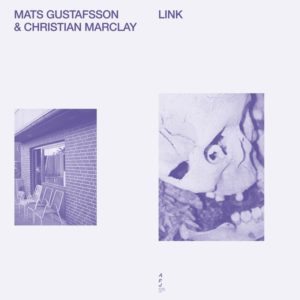
Mats GUSTAFSSON & Christian MARCLAY
“Link”
Christian Marclay: turntables
Mats Gustafsson: live electronics & slide, tenor and baritone saxes
Recorded and mixed April 2006 by Christoffer Roth and Olof Madsen at Studio Dubois, Stockholm
Mastered by Martin Siewert
Executive production by Joakim Haugland and Lasse Marhaug
500 copies
19,50€
In stock

CD
Sholto DOBIE & Mark HARWOOD
“The Blue Horse”
Sholto Dobie is an artist and performer born in Edinburgh and living in London. His solo output is marked by live performances that are characteristically delicate, evocative and absurd. He uses his own instruments, crudely assembled from materials such as reeds, whistles, bin bags, fans and air compressors, alongside loose performative structures, to respond to places and situations. He plays in Al Fresco (with Lia Mazzari & Tom White) and regularly collaborates with Ben Pritchard, he has also worked with Ashley Paul. He continues to run the event series Muckle Mouth which he founded in 2014. Mark Harwood is a musician and performer born in Ferntree Gully and living in London. His output veers towards uncanny audio both delicate and unsettling whilst his performances rely on teasing out and playing with the mood embedded within any given environment and audience situation. He has collaborated with Graham Lambkin, Aine O’Dwyer, Timo Van Luijk and MP Hopkins and runs the Penultimate Press label which brings forth this very release.
The Blue Horse is a beautiful strange journey through a landscape where little is familiar but all are welcome. Made from predominantly acoustic sources, The Blue Horse gracefully hisses, puffs, wheezes, whirls, and clunks it’s way through a series of distinct musical and non musical environments. Sounding both at times like a dark and stormy night… and “an elephant trying to get laid”, the ambiguous style of The Blue Horse conceals the artists’ unsettling, fantastical and quietly humorous sensibility. Whilst The Blue Horse lacks any obvious precursors, it’s elemental and environmental leanings potentially tread a path initially mapped out by Moniek Darge and Godfried-Willem Raes in the works coming out of the Logos Foundation in Ghent, Belgium in the mid 80’s. The Blue Horse is the debut recording from Sholto Dobie and Mark Harwood and features a guest appearance from cellist Judith Hamann.
Original price was: 10,50€.6,00€Current price is: 6,00€.
In stock

CD
Michael RANTA
“Yuen Shan”
16 track composition for pre recorded sounds and live percussion performed by Michael Ranta (entirely different work from the Yuen Shan CD released in 2005).
All material previously unreleased.
Yuen Shan (Round Mountain in Chinese) was conceived in 1972 and finalized in 2014. It’s a musical cosmogony in four cycles based on different levels of ancient Asian spiritual principles and mechanisms. A major work in Ranta’s oeuvre (his first solo release in almost 25 years), highly personal and spiritual.
12,50€
In stock

LP
A HANDFUL OF DUST
“The Eightness of Adam Qadmon”
Originally released on cassette by Corpus Hermeticum (Hermes003), 1994. All sounds by Alastair Galbraith and Bruce Russell.
"New Zealand is on summer holidays all through the month of January. For some reason I had the house to myself, the wife and kids were elsewhere. Alastair Galbraith brought over some instruments and we plugged in a cassette recorder. We spent the sunny afternoon setting up combinations of instruments and seeing what happened.
We had recorded the Concord LP the year before and done two gigs at the Empire tavern that became The Philosophick Mercury. The idea of Dust was taking shape through experimental practice. Some of it worked better than other bits, but it all made sense as a collage of sound, pointing in the direction of freedom. Our collective practice was making leaps and bounds; and starting to get heard abroad. In Australia the young Jon Dale was listening:
'The Eightness Of Adam Qadmon was one of the first releases I heard from A Handful of Dust… I've always been drawn to this cassette for its utterly unique, acroamatic sensibility - it seems less interested in third-eye-rupturing … and more about a late night session, bleeding into early morning, under the influence of heady wisdom and headier substances… What we had here was very much the real deal, collective and solo eviscerations from the heart of sound itself. I love it, unconditionally.'
Jon got the time of day wrong, but not much else. Going back to this session recently, I became aware of the strange, ungainly and unrepeatable shapes our practice assumed during these first forays into total free improvisation. Re-mastered with help from Lasse Marhaug, at the request of some visionary Finns; here Adam Qadmon, the ur-Golem, comes again. Walking from the graveyard of the past, blinking in the autumn sun, and shaking twenty-five years of clay from his coat."
Bruce Russell, Lyttelton 2019
300 copies. Remastered by Lasse Marhaug.
17,00€
In stock

LP
SANDOZ LAB TECHNICIANS
“Grey Orders, Distant Trails”
Improvised soundtrack to a non-existent Western, recorded in the late ‘90s by James Kirk, Nathan Thompson and Tim Cornelius.
"Deep South kitchen-sink explorers have been circling the drain in counterclockwise fashion for at least half my life and yet I am still reduced to shameless gobsmackery in the presence of this sterling new collection of historic treasures. Committed live-to-tape in the comfy climes of a living room/recording studio/temple affectionately known as 'Canongate' (a kinda homespun CBGBs of Dunedin's out-sound universe) Sandoz here bristle with the million-ideas-per-minute glory that hovers over their finest blossoms. Unrivalled in their inventiveness and the seemingly infinite permutations of 'shouldn't work but does' instrumentation, 'Grey Orders...' creaks and rattles like ringing spurs on the empty bar floor of some unseen antipodean western. Whether this makes more sense envisioning the cactus-pronged wastes of Arizona or the deserted main streets deep in the blistering badlands of central Otago is best left to the ear of the beholder, but one things for goddamnsure... there's gold in these here hills and I'm gettin' me a mule and a pick-axe." - Campbell Kneale
James Kirk • Nathan Thompson • Tim Cornelius - Playing electric and acoustic guitars, drums, violin, autoharp, bass, reed and bamboo flutes, clarinet, vocals, ukulele, electric piano, analog synthesizer, tapes/field recordings, toys, percussion, whistling.
Recorded by James Kirk live to Sony TC-580 quarter-inch tape recorder at 8 Canongate, Dunedin, New Zealand 1997-1999. Mastered by Forbes Williams.
Edition of 250 copies.
Original price was: 17,00€.9,00€Current price is: 9,00€.
Out of stock
CD
PUCE MARY
“The Drought”
"Bringing together introspective examination with literary frameworks by writers such as Charles Baudelaire and Jean Genet, Puce Mary’s compositions manifest an ongoing power struggle within the self towards preservation. The traumatised body serves as a dry landscape of which obscured memories and escape mechanisms fold reality into fiction, making sense of desire, loss and control. The Drought presents both danger and opportunity; through rebuilding a creative practice centred on first person narrative and a deliberate collage of field recordings and sound sources Puce Mary injects an acute urgency across the album seeking resilience. "
12,50€
Out of stock
LP
PUCE MARY
“The Drought”
"Bringing together introspective examination with literary frameworks by writers such as Charles Baudelaire and Jean Genet, Puce Mary’s compositions manifest an ongoing power struggle within the self towards preservation. The traumatised body serves as a dry landscape of which obscured memories and escape mechanisms fold reality into fiction, making sense of desire, loss and control. The Drought presents both danger and opportunity; through rebuilding a creative practice centred on first person narrative and a deliberate collage of field recordings and sound sources Puce Mary injects an acute urgency across the album seeking resilience"
20,50€
Out of stock
CD
Tujiko NORIKO
“Kuro (OST)”
"Composed and recorded during the editing of the film in Berlin, the Kuro OST by Tujiko Noriko (with contributions from Joji Koyama, Sam Britton and Will Worsely), is a crucial and integral part of the film, acting not only as a glue to bind the layers of the film together, but along with the sonic palette of the film’s sound design, evokes it’s claustrophobic atmospheres and moments of haunting beauty.
I tried to think of the pieces in abstract terms, like moods and atmospheres. In a way, the process was quite similar to how I usually make music, in the sense that I have images in my head. Of course in this case there were actual images and a lot of them very close to me, but I didn't want to get overly conscious about them either—I didn't want to get stuck by trying to be too specific."
-Tujiko Noriko
12,50€