
In stock
LP
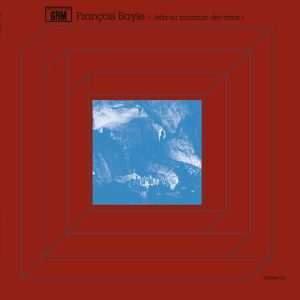
François BAYLE
“Jeita ou murmure des eaux”
A major work in François Bayle’s repertoire, Jeîta ou murmure des eaux provides a journey and an immersion into a world of unleashed energies, with the Jeîta cave serving both as a backdrop and a particle accelerator. Here, the cave indeed stands for the concrete source of the composer’s inspiration as much as the mind space where metamorphoses occur. By combining such figurative spaces and immaterial sound projections, François Bayle evokes another subject, an inhabitant of the multiple and symbolic cave: the listening subject, who always reveals himself, implicitly, at the heart of François Bayle’s musical concerns and the path he has always defended: the acousmatic approach.
28,00€
In stock

2 LP
Pierre HENRY
“Labyrinthe !”
« Labyrinthe ! » (2003), 56’41
Premiered on March 29th 2003, salle Olivier Messiaen de Radio France, Paris. Commissioned by Radio France.
An expedition in sound in 10 sequences: Enfoncement [Deep Sink], Gouffre circulaire [Circular Abyss], Noyau secret [Secret Core], Apesanteur [Weightlessness], Entrailles [Entrails], Four solaire [Solar Furnace], Fissures [Cracks], Mer intérieure [Inner Sea], Éruption [Eruption], Remontée [Ascension].
Labyrinthe ! is not only a very unique piece in Pierre Henry’s masterful repertoire, but also a remarkable demonstration of his compositional skills and musical singularity. Indeed, for this piece, Pierre Henry was deprived of his own, otherwise essential, sonic material. Here, the sounds, provided by GRM collaborators at the time, carry their own distinct stories, sensitivities and qualities. Yet, despite this discrepancy, Pierre Henry’s voice, the breath and dynamics of his own music, quickly appear. Through this sonic maze, a music arises, utterly focused on sounds, their development and their use, which Pierre Henry applies with extraordinary clarity and determination.
François J. Bonnet, Paris, 2023
33,00€
In stock

4 LP
Bernard PARMEGIANI & François BAYLE
“Divine Comédie”
Divine Comedy stands as a magnum opus crafted by two of the foremost composers of their era, boasting a musical ambition akin to Dante’s poem and its visual interpretation by Sandro Botticelli or Gustave Doré. For a long time, this triptych was presented as a two-sided work in which Bernard Parmegiani’s Hell and François Bayle’s Purgatory responded to and extended each other, guided by Michel Hermon’s voice through the listener’s imagination. Because Paradise, a mixed piece co-composed and performed live, had never been released on record before. Indeed, fifty years after its premiere, Paradise is unveiled to our ears, thereby rounding off the very first complete edition of the Divine Comedy.
• 4xLPs
• 60 x 90 cm (24x36 in) foldout poster
• The piece 'Paradis' is exclusive to this new edition
• Embossed gatefold sleeve
47,00€
In stock

LP
Robert CAHEN
“La nef des fous”
In the 1970s, Robert Cahen turned to the burgeoning field of video art, where he became a pioneering artist. He was originally trained in musique concrète, his creative background, and joined the Groupe de Recherches Musicales in 1972. The pieces on this record were composed in the GRM studios between 1971 and 1974. They testify to a lively inspiration and imagination combined with a precocious formal mastery that already carries the seeds of later developments, which the artist cleverly and inventively deployed in the field of visual arts. (François Bonnet, Paris, 2022)
--
«La nef des fous» (1974), 12’00
There are pieces of music whose title is obviously a mere label given afterwards to a finished product. And others, on the contrary, which develop in spiral around a bundle of images and impressions condensed into a few words. This is the case indeed with La nef des fous. However, this work by Robert Cahen oddly wraps itself around its title, with bends, breaks, and an impetus driven further every time to close a new circle, for such is the very essence of the spiral. This, at least, is the way I perceive the form of the work, with its theme-chorus which, in part one, both ponctuates and disrupts the emerging musical curve in various ways and at irregular intervals, as well as its broader and more open second part, which closes with a recollection of the beginning of the work. The challenge of a musical form justified by the topic it illustrates, right down to its gaps, its wanderings and its twists, and which would confer upon it the necessity of a profound logic, that of insanity, is the challenge attempted by Robert Cahen. In such a genre as tape music, so careful with respect to form, one can appreciate its audacity. La nef des fous, or Unity through heterogeneity, or Each to their own madness, but all in the same boat. This means that if we can listen to each of these sound characters, “broken chants”, which create the work for themselves, through the singularity of their delirium, we can also, from one to the other, trace the continuous chanting of a music that is inherently and spontaneously poetic, a music that carries “the unconscious under its skin” (Christiane Sacco). (Michel Chion, January 1976)
«Masques 2» (1973), 08’34
Concert version (for tape only) of an audiovisual work entitled Masques, in which the faces of old dolls and «masks», filmed during the Basel Carnival, were projected in 16mm. Masques 2 is a metaphorical version of Masques in which music is featured in its arcane musicality.
Through its concrete and suggestive music Masques 2 aims to bring to light hidden memories, buried within us, thus enabling an awakening, the resurgence of events from our own history. (R. C.)
«Plurielles» (1971), 08’35
Premiered at the Paris Biennale, 24 September 1971. Suite based on the score of a TV film directed by Sophie Talmon.
«Persona» (1971), 08’34
Premiered at the Paris Biennale, 24 September 1971.
«Passé composé» (1971), 05’29
23,50€
In stock

LP
Horacio VAGGIONE
“Schall / Rechant”
A discreet but essential figure in the field of musical creation, Horacio Vaggione has been crafting an ambitious, precise and highly significant body of work for over the last fifty years, coupled with a demanding research activity. This disc offers four purely electroacoustic pieces which illustrate, each in their own way, this singular and fascinating grammar developed by Horacio Vaggione, a complex but fertile grammar which establishes a very special relationship between structure and texture, between matter and formula, to create a fascinating musical space, made up of polyphonies and metamorphoses. (François Bonnet, Paris, 2022)
--
«Schall» (1994), 07’30
Schall exclusively uses piano sounds sampled and processed with various digital techniques. The sound palette focuses on several shapes of various sizes which reiterate, altered to varying degrees, throughout the process. The granular paradigm is clearly assumed here, as is also that of the interactions between various temporal scales. Basically, there is a concern for the articulation of micro-events. The piece essentially plays with low-intensity frames, composed of various planes and punctuated by stronger objects, in a kind of polyphonic dialogue between proximity and distance. (H. V.)
«Rechant» (1995), 15’51
Initially, a few brief sounds of instrumental origin — percussions, flutes, strings. Processed by means of various digital techniques, projected on various temporal scales, analyzed and re-synthesized, worked in their parts (in their saliences), articulated in their edges as well as in their interactions, these sounds show, as Bachelard would say, «pluralism under identity». I thus tried to compose morphologies by targeting properties contained in the material and by projecting them on temporal perspectives of all sizes. The title, an allusion to the old polyphonic technique, refers to the iterative content of these morphologies as well as to the modalities of their interweaving. (H. V.)
«24 Variations» (2001), 09’50
The word «variations» applies here to the morphological transformations of the material, as well as to the various contexts in which these transformations appear. The result can be heard as a continuous interaction between sound particles of different sizes, composed of several layers, reflecting a preoccupation with detailed articulation spanning different time scales. (H. V.)
«Gymel» (2002), 09’25
In Gymel I tried to compose a space-trajectory using layered sounds, produced by morphological operations (splits, clusterings) that spread out from location to location in variously dense objects. The space was treated through phase-decorrelation, a technique which I use extensively, both to create spaces and to locate sounds and movements within a polyphonic (stratified) context. (H. V.)
26,00€
In stock

LP
Daniel TERUGGI
“Sphæra”
« Sphæra » (1984/89), 42’09
Between 1984 and 1989, my acousmatic work was focused on processing and merging the four fundamental substances. Each « element » gradually became articulated with the others, thus crystallizing my subjective perception of their materiality. Over the years, helped by the enthusiasm of a Greek friend who propelled me into the Socratic universe, what started out as an exploratory path has become a circular, spherical unity, in which each occurrence simultaneously belongs to one of the four substances as well as the whole.
These four sections, of uneven durations, embody the different resonances of each « element » upon my imagination. The movements are ordered compositionally and range from the intangibility of the air to the extreme density of the earth.
In Eterea, the dual nature of air, a space for the dissemination of sounds and an environment for mobile masses, shaped the work and the development of its forms. Whether it be the vast expanse of particles as organised movement or the displacement of sources in our three-dimensional perception, ethereal air fills the space and drives the immaterial motions and gestures.
Aquatica locates the materiality of water in relation to its amazing extremes: from the drop to the ocean, an extensive journey unfolds through the various phases of the reinvented liquid. Still waters, deadly waters, raging waters follow one another, leading to the aerial fusion of a primordial equilibrium eventually retrieved.
Then comes Focolaria and the unsteady fires, the elusive and wild will-o’-the-wisps that open and adorn the gates leading to the depths of the earth.
The land of Terra is devoid of atmosphere, a land of matters before the advent of life. The sounds of the original matter merge and evolve into purer forms. The motions trigger progressions towards new equilibriums of forces, the ultimate fusion, the very last attempt, needed for the emergence of life.
The sphere is now complete, the world ready for creation…
Daniel Teruggi
While the theme of the four elements has been a constant source of inspiration in the arts, its setting to music using electroacoustic techniques seems highly auspicious, since the notion of matter and its transformation is consubstantial with the concrete approach. In Sphæra, Daniel Teruggi precisely addresses this question, transcending matter with the help of novel digital audio techniques so as to draw out forms, trajectories, layers, and musical objects, all of which result from the merging or sublimation of primordial sounds. Indeed, this is where Daniel Teruggi’s music and compositional approach stand out: by engaging sounds, with strength, will and inspiration, in a close encounter with energies, whether tectonic or electrical. Such collisions, such metamorphoses, are then appeased in the whole space of the composition, a fascinating landscape, the final destination of all transmutations.
François Bonnet, Paris, 2021
26,00€
In stock

LP
Beatriz FERREYRA
“Senderos de luz y sombras”
Senderos de luz y sombras (Paths of Light and Shadows) – Commissioned by the French State for INA grm – 2016-2020
In memoriam Bernard Baschet, Bernard Parmegiani and Carlos Pellegrino.
A 16-channel piece inspired by astrophysics, the mystery of the pre-Big Bang era and some of the uncanny motions of the unconscious mind, where strangeness meets the ordinary.
The themes that permeate Senderos de luz y sombras simultaneously engage the overwhelming, unyielding immensity of the beginnings of the universe and the forces at work in the unconscious mind. What connects these themes are the dark energies operating outside our knowledge, far beyond the conceptual scope of our limited thinking. How to convey all this and build music from these concealed forces? What Beatriz Ferreyra achieves, thanks to her trademark virtuosity, is precisely to summon energies, to bring in the raw forces that govern the laws of Acoustics, so as to trigger sonic storms as one would call the rain, to transform all sound matters into the core of a ritual. Indeed, Beatriz Ferreyra addresses the mind-body reconciliation, for in providing this unique sound and musical experience, with a rare sensitive intensity, the great composer simultaneously invites us to engage in a personal experience.
François Bonnet, Paris, 2021
26,00€
In stock

LP
Lionel MARCHETTI
“La grande vallée / Micro-climat”
2022 repress
LA GRANDE VALLÉE (1993/95), 20’41
Musical composition, design and sound production carried out at the INA grm Studios (Paris) in 1993/95
Original audio recordings in the Drôme and the Mont Ventoux areas
Voice: Hélène Bettencourt
Vocal occurrences: Frédéric Malenfer, Bruno Roche, Lionel Marchetti
Bass clarinet (for processing): Jean Andréo
Commissioned by INA GRM and produced in its studios
Premiered during the Cycle Acousmatique/Maison de Radio France, INA grm (Paris) — 1996
Thanks: François Donato, Jérôme Nœtinger, William Pellier, Bruno Roche, Daniel Teruggi and Christian Zanési
MICRO-CLIMAT (1989/90), 21’33
Micro-climat is the first movement of the Sirrus cycle (Micro-climat, Passerelle, Sirrus) composed in 1989/90.
Musical composition, sound design and production, audio recordings in 1989/90 at the CFMI studios in Lyon (Lumière University, Lyon 2)
Premiered at Cycle Acousmatique/Maison de Radio France, INA grm (Paris) — 1991
Special thanks to Xavier Garcia
*
"Lionel Marchetti is a major figure of the “third generation” of concrète musicians, a term he values. Listening to these works, imbued with poetry and traversed by micro-narratives, one can indeed retrieve the original concrète spirit, the one that draws from the sonic world, with ears wide open, so as to extract a fertile, rich and multiple substance then shaped and conveyed towards a formal and musical abstraction. Lionel Marchetti has mastered this process, but his real distinctive feature is a truly unique talent for setting climates (as one sets traps) and keeping us on constant alert. The two pieces in this record perfectly illustrate the entrancing dimension of Lionel Marchetti's music, whose charm leads us, through each successive listening, to become voluntary captives so as to better liberate ourselves."
François Bonnet, Paris, 2020
20,00€
In stock

LP
Bernard FORT
“Fractals / Brain Fever”
2022 repress
FRACTALS (1981), 21’26
Composed at the GMVL from December 1979 to September 1981, this work was commissioned by Fnac.
Fractals are mathematical oddities that, when crossing our path, turn the smallest island into an immensity to be explored.
FRACTALS is a series of short studies, all based on the same sound source. Seeking in the sound and its very logic a proposal upon which a construction is elaborated, each Fractal remains open and is a mere fragment of itself.
FRACTALS, music pieces sculpted in four dimensions, are vast microcosms that can only be inhabited by the mind. Each Fractal can be approached from several angles, far, near, etc. Some can be listened to at different speeds, forwards or backwards.
FRACTALS: amorphous and endless music pieces whose centre is everywhere and circumference nowhere.
Brain Fever (2017), 18'00
Wherever you may be in the forest of South India, the Brain Fever bird, together with the Seven Sisters, literally gets into your head. Whether it be early morning, daytime, or nighttime, amidst the stridulations of insects, its song utterly reflects Indian life: sonorous, noisy, insistent, dense, overcrowded, mobile, swarming, frantic, overheated, deprived of rest and sleep.
Brain Fever echoes sonic images caught in the Aurovillian forest, near Pondicherry, and rich fragments of improvisations made in Lyon on analog sound synthesis or feedback devices, the kind I used to do in the first GMVL studios.
Brain Fever is dedicated to Sofia Jannok, a musician and sàmi singer.
26,00€
Out of stock

2 LP
Bernard PARMEGIANI
“De Natura Sonorum”
2022 repress
"De Natura Sonorum, Première série, 1975 (28'03)
- incidences / résonances
- accidents / harmoniques
- géologie sonore
- dynamique de la résonance
- étude élastique
- conjugaison du timbre
De Natura Sonorum, Deuxième série, 1975 (28'40)
- incidences / battements
- natures éphémères
- matières induites
- ondes croisées
- pleins et déliés
- points contre champs
Premiered at the Salle Wagram in Paris on 3rd June 1975.
A suite of twelve movements, divided into two series of six."
25,00€
In stock

LP
Luc FERRARI
“Music Promenade / Unheimlich Schön”
2022 repress
Music Promenade (1964–1969), 20’29"
Electroacoustic Music
World premiere for the Théâtre de la musique, March 16, 1970
Permanent version for four stand-alone tape recorders. A series of colliding realistic sounds and sonic images. Whilst walking, a man is struck by the violence of his surroundings.
Nature has disappeared in a whirlwind of warfare and industry in the midst of which he encounters a dying folklore and a lost young girl.
The "Installation" version is used to sonify a place in which walkers are free to choose their musical itinerary.
Unheimlich Schön (1971), 15’40"
Musique concrète made in 1971 in the studios of the Südwestfunk in Baden-Baden.
Voice: Ilse Mengel.
“How does a young woman breathe when thinking about something else ?”
To be listened to at a low volume.
26,00€
Out of stock
LP
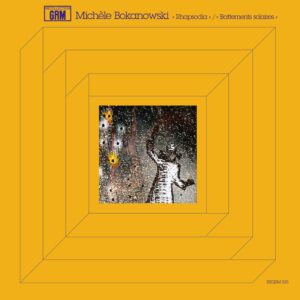
Michèle BOKANOWSKI
“Rhapsodia / Battements solaires”
*** Repressed ***
Michèle Bokanowski's art is one of densities, much like the density of a given colour, a given depth. Her sound textures are, indeed, profound, both in the space occupied by their frequencies and the sharp temporal trail they leave behind. Here lies the composer's immense talent that finds the right development for each sound, letting it blossom before altering it, adapting the musical structure to let the sounds “be”, even if it sometimes means returning to the most basic form, such as a loop. This is a sign of great honesty and artistic sensitivity; able to stand back and let the music become music. It is the most radical, the most accurate gesture of composition. The two pieces on this record, dissociated in time, both in their approach and destination, nevertheless reflect, each in its own way, Michèle Bokanowski's highly singular and insightful musical intuition. - François Bonnet, Paris, 2020
20,00€
Out of stock

LP
Iannis XENAKIS
“GRM Works 1957-1962”
Concret PH (1958)
Brussels World Fair, 1958 : The industrialist Philips commissioned Le Corbusier's famous "Philips Pavilion": "I'll create an electronic poem for you, he said. Everything will happen inside: sound, light, colour and rhythm." Iannis Xenakis designed the architectural blueprint and composed "Concret PH", meant to psychologically prepare the public to the show created inside, accompanied by a musical piece by Varese.
The 400 speakers that lined the inner shell were meant to fill the space through the sound sparkles of "Concret PH" and achieve a joint emanation of architecture and music, conceived as a whole: the roughness of the concrete and its internal friction coefficient found an echo in the timbre of the sparkles.
Orient-Occident (1960)
The work was originally composed for a film by Enrico Fulchignoni for UNESCO. The film describes a visit to the museum suggesting to compare artefacts produced by various cultures and highlighting their interaction that dates back to the most ancient times.
From an abstract point of view, the composer regards this work as a solution to the problem of finding highly diversified means of transition, meant to link a type of material to another. One indeed witnesses a varied gradation of mutations, interplays, overlaps, cross-fading, sudden shifts and hidden junction points.
Diamorphoses (1957-58)
Continuity and discontinuity within evolution, here are two aspects of the being, whether in opposition or in communion. In "Diamorphoses" this antithesis was worked on in the sections of some sounds strongly opposed to others, and particularly in organisations of continuous variations of average or "statistical" heights.
Bohor (1962)
Bohor (referring to Bors the Younger, Lancelot's cousin), is a character from the medieval cycle of King Arthur and the Knights of the Round Table. “Bohor” is dedicated to Pierre Schaeffer. The author deliberately abstained from giving and descriptive information on his piece, letting the listener choose an imaginary route for himself. For this release, we have chosen the 1968 version, revised by Iannis Xenakis himself and as yet not made available to the public.
------------
Even though Iannis Xenakis never made "musique concrète" in the sense given by Pierre Schaeffer, the GRM was a locus for experimenting with his ideas about sound and sound structures. The works, composed between 1958 and 1962, show a boldness as advanced as in his orchestral approach.
The relationship between Xenakis and Schaeffer was often tense. It nevertheless entailed mutual recognition and respect towards each other's musical approach. Moreover, "Bohor" is dedicated to Schaeffer, as evidenced by the letter Xenakis sent him on October 8th, 1968: "Dear Pierre, I have decided to dedicate Bohor to you, out of friendship and gratitude for your contribution to music. I hope you are pleased with this." Schaeffer found the piece disproportionate in terms of intensity but was indeed pleased by the dedication.
The four pieces presented here, all produced at the GRM, undoubtedly demonstrate the experimental intent and the strictly "physical" character of Xenakis' music, in that it provides the audience with a listening experience of a rare intensity.
(François Bonnet & Christian Zanési)
18,00€
Out of stock

LP
Bernard PARMEGIANI
“Violostries”
Violostries (1963/64), 16'39
Premiered and recorded in April 1965 at the Royan Festival - France, by Devy Erlih (violin) & Bernard Parmegiani (sound projection).
Violostries represents the intersection of several musical research directions, presented as two simultaneous dialogues - composer/performer and instrument/orchestra.
After a short introduction tutti very spatialized:
1. Pulsion/Miroirs: multiplied by itself, the violin is projected into the four corners of the sound space.
2. Jeu de cellules: concertante piece for violin and audio medium, the latter being made up of very tightly woven microsounds.
3. Végétal: slow and invisible development following a continuous time, resulting from an internal and permanent processing of the matter.
Capture éphémère (1967, 1988 version), 11'48
This work was composed in four tracks in 1967 for quadraphonic diffusion.
Remixed in stereo in 1988.
Premiered at the Studio 105 of the Maison de la Radio, Paris, May 1967.
Sounds - noises that circulate as time unfolds - continue to exist despite our recording them.
Breaths, fluttering wings: ephemeral microsonic sounds streaking space, sound scratches, landslides, bounces, vertigo of solid objects falling into an abyssal void, multiple snapshots forever frozen in their fall. As many symbols leave inside us the permanent trace of their ephemeral brushing against our ear.
Some day, a desert, a sound, then never again....
Somewhere, in my head and body something still resonates... resonance, what could be more ephemeral.
La Roue Ferris (1971), 10'45
Premiered at the Festival des chantiers navals, Menton, on August 26, 1971.
Sound projection: Bernard Parmegiani.
La Roue Ferris (Ferris wheel) spins, merging with its own resonance, stubbornly perpetuating its variations. It only sketches a regularly evolving movement around a constant axis. Each of its towers generates thick sonic layers that penetrate each other, producing a very fluid interweaving. The crackling of the origin eventually metamorphoses into sonic threads whose lightness recalls high-altitude clouds, cirrus clouds, haunted by the cries of swifts twirling in the warm air. The wondrous arises and dies off, leaving us with an illusion of duration.
17,00€
In stock

LP
Régis RENOUARD LARIVIÈRE
“Contrée”
SIDE A
Contrée (2013), 20’
SIDE B
Allégeance volatile (2002), 8’46
Esquive (2010), 10’10
Allégeance volatile and Esquive each tackle the same issue in their own way. Overcoming time: whether it be successive, additional, enumerative, or repetitive. However, there is nothing here about the ensuing nature of so-called "repetitive" music. These are types of high-end music. And it is more about insistence, the obstinacy of an individual who keeps knocking on a door that will never open.
Allégeance's rustic drumming, talkative, acidulous, colourful and overarticulated, with almost clownish desinences, eventually dies out in this very respite. The iterative and puffy shimmering of Esquive with its dull, thin and precise sounds, shifts and is engulfed into another sonic world — which appears as a gaping and collapsed response to this prime insistency.
This is, indeed, a ‘volatile allegiance’ and ‘avoidance’ from the sonic to the musical elements: the musical phenomenon anticipated and pursued as the non-sound of sound — or, in other words, the void of sound. This seems to be the lesson of the concrete attitude in music. Such is the kind of questioning that stirs the composer.
He returns with another title: Contrée, which, once again, speaks of a counter-event. Here, the movement is broader, more generous, more confident. Time spreads and stretches out. What seems to be a landscape of entanglements, trajectories, influx, masses and points emerges. “Something” rises and presents itself out of the sounds - these escaping beings, these "relatively short combustion flames " (Schaeffer).
The piece consists of five consecutive and uninterrupted parts: Entrée and Stance I — Véhémence de l’air and Stance II — Grande Allure. It is the central section of an electroacoustic triptych with Sables (2011) as the first and Nil (2017) as the last.
Contrée is dedicated to Philippe Mion, whose friendly ears have been entrusted with my music for so many years.
26,00€
Out of stock

LP
Luc FERRARI
“Hétérozygote – Petite symphonie…”
Cut by Rashad Becker at Dubplates & Mastering, Berlin, October 2016. Digital Transfer: Jonathan Fitoussi. Translations: Valérie Vivancos. Layout: Stephen O’Malley. Coordination GRM: Daniel Teruggi & François Bonnet.
“Hétérozygote” (1963–1964).
Composed between December 1963 and March 1964. In the field of biology Heterozygous (Hétérozygote) means: a plant whose heredity is mixed. It implies that this composition is an attempt to engineer a language located both on the musical and on the dramatic plane. You could call this music “Anecdotal Music” for if the organisation of events is purely musical, their choice suggests situations justified at two levels: the music and the anecdote. However, the anecdote is hardly formulated and is open to plural interpretations. The listener is then asked to imagine their own story by rejecting – if necessary – the one suggested by the author. More specifically, the author suggests an anecdotal complex, potentially bearing several meanings. The work preceded by an opening is made of eight scenes, separated (or not) by interludes. And if we wished to push the paradox further, we could say that the titles of the scenes are optional and the interludes are also scenes, etc.
Petite symphonie intuitive pour un paysage de printemps (1973–1974), 25’09
“This electroacoustic music is part of a series that could be called “imaginary soundscape”. Unlike ‘Presque rien ou le lever du jour au bord de la mer (almost nothing or daybreak by the seaside)’, where the landscape narrates itself, here a traveller discovers a landscape which he tries to convey as a musical landscape.
Brunhild and I were in the Gorges du Tarn area. We chose to take a small path that was going up a rocky mountain for about ten kilometres. After a last turn, a totally unexpected landscape opened before my eyes. It was sunset. Before us, a vast plateau spread open with soft curves up to the horizon, up to the sun. The colours ranged from dry grass yellow to purple, in the distance, with the darkness of a few small groves punctuating the space. The almost bare nature was presenting itself to the eye, free from any obstacle. We could see everything. Later, when I recollected this place and the sensations I had experienced there, I tried to compose a music that could revive this memory. The "Causse Méjean" is a high plateau, about 1000 m high, in the Massif Central mountain range. It is dotted by scattered farms. A few people bring their flocks of sheep home. I thought about evoking this solitary and hazy human presence by including snippets of conversations I had had with some of the shepherds. Human language is woven into the musical texture; the sound of the voice says more than its actually meaning. Once, a shepherd told me “... I am never bored. I listen to the landscape. Sometimes I play my flute and then I listen to the echo responding...” Thinking of him, I used the flute and its echo in my music.” Luc Ferrari. October 18, 2002
————
Ten years separate Hétérozygote, a concrete piece regarded as the first to use “anecdotal sound materials” from the Petite symphonie intuitive pour un paysage de printemps, an “attempt to musically reproduce the impression of a landscape.” Ten years out of the fifty during which Luc Ferrari’s truly unique body of work unfolded, a work free from dogma which, through a singular type of listening, wrought a hymn to the living world, to the exploration and discovery of things, men and women who inhabit it. François Bonnet, Paris, 2016
“Hétérozygote” (1963–1964).
Composed between December 1963 and March 1964. In the field of biology Heterozygous (Hétérozygote) means: a plant whose heredity is mixed. It implies that this composition is an attempt to engineer a language located both on the musical and on the dramatic plane. You could call this music “Anecdotal Music” for if the organisation of events is purely musical, their choice suggests situations justified at two levels: the music and the anecdote. However, the anecdote is hardly formulated and is open to plural interpretations. The listener is then asked to imagine their own story by rejecting – if necessary – the one suggested by the author. More specifically, the author suggests an anecdotal complex, potentially bearing several meanings. The work preceded by an opening is made of eight scenes, separated (or not) by interludes. And if we wished to push the paradox further, we could say that the titles of the scenes are optional and the interludes are also scenes, etc.
Petite symphonie intuitive pour un paysage de printemps (1973–1974), 25’09
“This electroacoustic music is part of a series that could be called “imaginary soundscape”. Unlike ‘Presque rien ou le lever du jour au bord de la mer (almost nothing or daybreak by the seaside)’, where the landscape narrates itself, here a traveller discovers a landscape which he tries to convey as a musical landscape.
Brunhild and I were in the Gorges du Tarn area. We chose to take a small path that was going up a rocky mountain for about ten kilometres. After a last turn, a totally unexpected landscape opened before my eyes. It was sunset. Before us, a vast plateau spread open with soft curves up to the horizon, up to the sun. The colours ranged from dry grass yellow to purple, in the distance, with the darkness of a few small groves punctuating the space. The almost bare nature was presenting itself to the eye, free from any obstacle. We could see everything. Later, when I recollected this place and the sensations I had experienced there, I tried to compose a music that could revive this memory. The "Causse Méjean" is a high plateau, about 1000 m high, in the Massif Central mountain range. It is dotted by scattered farms. A few people bring their flocks of sheep home. I thought about evoking this solitary and hazy human presence by including snippets of conversations I had had with some of the shepherds. Human language is woven into the musical texture; the sound of the voice says more than its actually meaning. Once, a shepherd told me “... I am never bored. I listen to the landscape. Sometimes I play my flute and then I listen to the echo responding...” Thinking of him, I used the flute and its echo in my music.” Luc Ferrari. October 18, 2002
————
Ten years separate Hétérozygote, a concrete piece regarded as the first to use “anecdotal sound materials” from the Petite symphonie intuitive pour un paysage de printemps, an “attempt to musically reproduce the impression of a landscape.” Ten years out of the fifty during which Luc Ferrari’s truly unique body of work unfolded, a work free from dogma which, through a singular type of listening, wrought a hymn to the living world, to the exploration and discovery of things, men and women who inhabit it. François Bonnet, Paris, 2016
15,50€
Out of stock

LP
François BAYLE
“Tremblements…”
“Tremblement de terre très doux” (1978).
The familiar generates the strange. These rolls, these hums, these sudden rushes; this song, these peaceful circlings; these sudden outbursts, these returns to quiescence – what do they remind us of?
This piece’s trajectory could also be a representation of the dramatic unfolding of a day - of a life - from sunrise (climate 1) to night-time (landscape 4) via restless encounters, transitions (1 to 3) that announce the drama climaxing in landscape 3, before reaching its denouement in climate 4… A whole concrete ‘story’.
The subterranean properties inherent to listening gently shift our ideas…
François Bayle
First performance: 19 March 1979 – Grand Auditorium of Radio-France,
Ina-GRM’s Cycle Acousmatique. .
“Toupie dans le ciel” (1979)
A wave is swaying on two minors thirds. This constantly uniform yet constantly varied swaying revolves in a swarm of sharp designs that blink on and off in a layer of growing density and mobility. Distance, speed, pressure, density, temperature, colour, intensity, are the “themes” of the 27 short interconnected cells flowing together though this seemingly unified movement. Occasionally, a breach in the texture reveals skyes dotted with little comets. In the centre, a slow
gliding picks up the distant harmonics of a basic chord. Toward the end, this gliding returns with a fiery burst.
Fine lines and whirs are generated from the song of a spinning antique top.
To end on a lighter note the title Toupie dans le ciel – Spinning Top in the Sky reminds us of Lucy in the Sky with Diamonds by The Beatles as well as Lucy, the oldest Australopithecine (3 million years), our African grandmother in the Erosphere…The overall title Erosphere alludes to the desire inherent to the listening experience, and to the very primitive cues that sustain the auditory attention and are the basis of all musical pleasure.
François Bayle
First performance: 21 January 1980 – Grand Auditorium of Radio-France,
Ina-GRM’s Cycle Acousmatique.
The familiar generates the strange. These rolls, these hums, these sudden rushes; this song, these peaceful circlings; these sudden outbursts, these returns to quiescence – what do they remind us of?
This piece’s trajectory could also be a representation of the dramatic unfolding of a day - of a life - from sunrise (climate 1) to night-time (landscape 4) via restless encounters, transitions (1 to 3) that announce the drama climaxing in landscape 3, before reaching its denouement in climate 4… A whole concrete ‘story’.
The subterranean properties inherent to listening gently shift our ideas…
François Bayle
First performance: 19 March 1979 – Grand Auditorium of Radio-France,
Ina-GRM’s Cycle Acousmatique. .
“Toupie dans le ciel” (1979)
A wave is swaying on two minors thirds. This constantly uniform yet constantly varied swaying revolves in a swarm of sharp designs that blink on and off in a layer of growing density and mobility. Distance, speed, pressure, density, temperature, colour, intensity, are the “themes” of the 27 short interconnected cells flowing together though this seemingly unified movement. Occasionally, a breach in the texture reveals skyes dotted with little comets. In the centre, a slow
gliding picks up the distant harmonics of a basic chord. Toward the end, this gliding returns with a fiery burst.
Fine lines and whirs are generated from the song of a spinning antique top.
To end on a lighter note the title Toupie dans le ciel – Spinning Top in the Sky reminds us of Lucy in the Sky with Diamonds by The Beatles as well as Lucy, the oldest Australopithecine (3 million years), our African grandmother in the Erosphere…The overall title Erosphere alludes to the desire inherent to the listening experience, and to the very primitive cues that sustain the auditory attention and are the basis of all musical pleasure.
François Bayle
First performance: 21 January 1980 – Grand Auditorium of Radio-France,
Ina-GRM’s Cycle Acousmatique.
15,50€
Out of stock

LP
Christian ZANÉSI
“Grand Bruit – Stop! l’horizon”
“Grand Bruit” (1991).
The great mobile sound bodies have an ordinary yet amazing ability to place the listener-traveller within, as if he or she was inside a giant double bass, in this case a train stroked by a double bow: the rails and the air.
In 1991, I explored this phenomenon during my daily commute from the studio to my home. I used only a 21 minutes recording and treated it as a single sound object. I then processed and enhanced it as a photographer would have done, immersing it in successive 'baths'. The title I chose for this singular form was Grand Bruit.
“Stop ! l’horizon” (1983).
Saturday morning, nine o’clock as I reach the studio. No one here. I only turn on the spotlights as the fluorescent tubes are too noisy. I switch the power on, shut the door, unplug the telephone. I then switch the mixing desk on, which sends an electronic impulse into the amps. The four speakers react individually with a very brief and low hiss. A kind of presence. I haven’t listened to anything since the evening before and my ear is refreshed by a night’s sleep.
I feed the original mix into the master recorder and sit down in the centre.
Remote control: PLAY. With the first sound I close my eyes. The studio instantly vanishes. Another place, a much larger space opens up. I enter it. I have the very distinct feeling that music is merely a “great noise”, chiselled inside with a thousand details. It opens up like a living organism to let my hearing wander across it. A magnetic relation quickly occur and all the sounds that constitute this great noise draw me towards the East. I accept this direction. Later, much later, I reach a distant point on the horizon which pulls me towards it.
The great mobile sound bodies have an ordinary yet amazing ability to place the listener-traveller within, as if he or she was inside a giant double bass, in this case a train stroked by a double bow: the rails and the air.
In 1991, I explored this phenomenon during my daily commute from the studio to my home. I used only a 21 minutes recording and treated it as a single sound object. I then processed and enhanced it as a photographer would have done, immersing it in successive 'baths'. The title I chose for this singular form was Grand Bruit.
“Stop ! l’horizon” (1983).
Saturday morning, nine o’clock as I reach the studio. No one here. I only turn on the spotlights as the fluorescent tubes are too noisy. I switch the power on, shut the door, unplug the telephone. I then switch the mixing desk on, which sends an electronic impulse into the amps. The four speakers react individually with a very brief and low hiss. A kind of presence. I haven’t listened to anything since the evening before and my ear is refreshed by a night’s sleep.
I feed the original mix into the master recorder and sit down in the centre.
Remote control: PLAY. With the first sound I close my eyes. The studio instantly vanishes. Another place, a much larger space opens up. I enter it. I have the very distinct feeling that music is merely a “great noise”, chiselled inside with a thousand details. It opens up like a living organism to let my hearing wander across it. A magnetic relation quickly occur and all the sounds that constitute this great noise draw me towards the East. I accept this direction. Later, much later, I reach a distant point on the horizon which pulls me towards it.
15,50€
Out of stock

2 LP
Luc FERRARI
“Presque rien”
Reissue.
“Presque rien n°1, le lever du jour au bord de la mer” (1967-1970). Following the complete disappearance of abstract sounds, we can regard this piece as a sonic snapshot and the culmination of an evolution. This is a realistic rendering (as faithful as possible) of a fishing village waking up. The first idea of minimalism.
“Presque rien n°2, ainsi continue la nuit dans ma tête multiple” (1977). Description of a landscape at night that a soundman attempts to define through microphones, but the night surprises the "hunter" and creeps inside his head. It then becomes a double description: The inner landscape transforms the outer night and by composing it, adds its own reality (a fantasy of reality) or, perhaps, a
psychoanalysis of his ’nightscape’?
“Presque rien avec filles” (1989). Within paradoxical landscapes, a photographer/composer is hidden whilst girls are having a sort of picnic on the grass. Without being aware of it, they offer him the spectacle of their intimacy.
“Presque rien n°4, la remontée du village” (1990-1998). I always hesitated before releasing a Presque rien. For instance, it took two years for the first one to come out and things went on this way. The fourth one, took nine years of hesitating. But here it is. Perhaps because this is a real Presque rien fake where reality and lies mix. This is the ascend into the old town of Ventimiglia.
“Presque rien n°1, le lever du jour au bord de la mer” (1967-1970). Following the complete disappearance of abstract sounds, we can regard this piece as a sonic snapshot and the culmination of an evolution. This is a realistic rendering (as faithful as possible) of a fishing village waking up. The first idea of minimalism.
“Presque rien n°2, ainsi continue la nuit dans ma tête multiple” (1977). Description of a landscape at night that a soundman attempts to define through microphones, but the night surprises the "hunter" and creeps inside his head. It then becomes a double description: The inner landscape transforms the outer night and by composing it, adds its own reality (a fantasy of reality) or, perhaps, a
psychoanalysis of his ’nightscape’?
“Presque rien avec filles” (1989). Within paradoxical landscapes, a photographer/composer is hidden whilst girls are having a sort of picnic on the grass. Without being aware of it, they offer him the spectacle of their intimacy.
“Presque rien n°4, la remontée du village” (1990-1998). I always hesitated before releasing a Presque rien. For instance, it took two years for the first one to come out and things went on this way. The fourth one, took nine years of hesitating. But here it is. Perhaps because this is a real Presque rien fake where reality and lies mix. This is the ascend into the old town of Ventimiglia.
21,00€