
In stock
2 CD
Michael RANTA
“Transits Volume 1”
2024 release
American percussionist and composer Michael Ranta is a legendary figure who has worked with some of the most significant names of 20th century music but despite this and impressive body of work of his own, he has remained an obscure figure. Important Records presents Transits Volume 1 the first in a series of releases by composer/percussionist Sarah Hennies documenting never-before-heard chamber works mostly composed in the 1970s while Ranta was living in Taiwan. Mastered by Tom Eaton at Sounds & Substance. Based overseas since the late '60s, Ranta is known primarily as a percussionist who worked closely with Harry Partch, Karlheinz Stockhausen, Helmut Lachenmann, Toru Takemitsu, and Jean-Claude Éloy but is also an accomplished artist himself with a vast body of work spanning improvisation, electronic music, and composition. The works in the Transits series comprise a dozen works of scored compositions for solo and chamber ensembles almost all of which are completely unknown with no known performances or recordings since their original premieres. Volume 1 includes "Mharuva," a 30-minute marathon tour-deforce for solo marimba, "Seven Pieces for Three Percussionists," and the 40-minute "Continuum II," a stunning display of virtuosity for two bass clarinets, percussion, and electronics. Transits, Volume 1 features performances by Sarah Hennies, NYC clarinetists Madison Greenstone and Katie Porter, and the Bard College Conservatory Percussion Ensemble.
16,00€
In stock

CD
Alvin LUCIER
“One Arm Bandits”
2023 release
"One Arm Bandits is an hour-long piece in four parts, scored for four cellists. The cellists play only open strings, thus using only their right arms, never fingering the strings with the left hand. Recorded in Alvin Lucier's dining room, this work features cellists Tyler J. Borden, Laura Cetilia, Charles Curtis and Judith Hamann. Lucier oversaw and produced the recording, and approved the final takes. One Arm Bandits was an important project for Alvin Lucier. The idea for the piece goes back to conversations we first had in 2007 about the relationship between bow direction changes and shifts in phase. In the summer of 2015 we worked these ideas out in long sessions with Judith Hamann and T. J. Borden in New York, and the resulting piece received its first performances in Graz and Zürich in 2016. Alvin thought of One Arm Bandits as a radical statement, I think primarily in view of the severe reduction in material -- even in the context of his music -- and the physical restraint required in performance. The unusually long duration attests to Alvin's recognition that an expansion of scale was required in order to magnify acoustical details of such subtlety. In November 2021 Alvin saw proofs for the CD artwork. He passed away at the age of 90 on December 1, before he could see the album in its final form. Work with Alvin was always joyful, stimulating, and surprising. We dedicate this recording to the continuing spirit of this remarkable musician and friend." --Charles Curtis
15,50€
In stock
CD
RAZEN
“Postcards From Hereafter”
2023 release
Razen's Postcards From Hereafter was recorded using a 17th century organ tuned at 398 Hz (meantone) in a Belgian cathedral erected in 1305. The ensemble explored, with rich results, the organ's strict and limiting tuning with an arrangement that included hurdy gurdy, recorders, chalumeau, violone and nyckelharpa. The pieces on Postcards From Hereafter explore the crossover between this world and the next with improvised spiritual, religious music. Brussels-based ensemble Razen use the unique timbral and drone characteristics of their chosen string and wind instruments in improvised, instinctive music that mixes pre-industrial, spectral and ethnic dreamtones with trance and medieval mysticism. The group includes Brecht Ameel and Kim Delcour as well as Pieter Lenaerts on five-string double bass and sarangi, Paul Garriau on hurdy-gurdy, David Poltrock on Ondes Martenot, Berlinde Deman on serpent, and Jean-Philippe Poncin on chalumeau and bass clarinet. RIYL: Olivier Messiaen, Sun Ra, Popol Vuh.
Over the past twelve years, the Brussels-based ensemble Razen has been forging a singular path that rethinks the idiom of minimalism and pushes it toward a higher plane; tapping the primal root, while pushing toward the future. Founded in 2010 as duo of Brecht Ameel (organ and string instruments) and Kim Delcour (wind instruments), growing and contracting as an ensemble over the years, the band deploys improvisation and the unique timbral and drone characteristics of string and wind instruments to sculpt landscapes of intuitive long tones, combining the trance-inducing roots of music with a progressive vanguardism that seeks the intangible and the unknown. The band's releases are emblematic of the hybrid between psychedelic music, Early Music and contemporary spectral approaches. Razen has performed all over Europe on numerous occasions, on international festivals and well-known venues, from Fylkingen in Stockholm to Berghain in Berlin to the small church of Dranouter (Belgium).
"... an intoxicating sauce of stark and tripped out ritual music... which conspires to keep listeners in a semi-permanent trance state" --Julian Cope (Head Heritage).
"... a heady brew of deep listening music that is almost medieval in mood and wholly reverential in technique" --Edwin Pouncey (Wire Magazine).
"Razen push the drone potential of medieval instruments like hurdy gurdy as well as shawm and recorders... into realms of total sensory overload" --David Keenan (Volcanic Tongue).
14,00€
In stock
CD
OVERTONE ENSEMBLE
“2”
2021 release
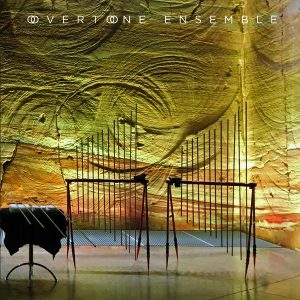
Tim Catlin formed the Overtone Ensemble in 2012 in order to perform works using his self-made "Vibrissa" instruments. The Vibrissa includes twelve vertically mounted aluminum rods that are longitudinally stroked with gloved hands to produce ethereal "singing" tones. The long sustaining nature of the rods sound and microtonal tunings allow players a sonic palette of complex textures and harmonic complexity. Expanding from the instrumentation on their first album, these new recordings utilize Vibrissa instruments, plus a range of extended techniques on old instruments including timpani, bowed piano, bowed glockenspiel, bowed guitar, as well as some new instruments, like doppler rods and whirled tubes. The majority of the recordings were done in the Old Chapel building in Melbourne, Australia. The chapel, formerly attached to the Old Melbourne Gaol boasts ten-meter-high ceilings which added an enveloping acoustic ambience. At times it felt as though the spectral presences of former inmates were hovering benevolently in the rafters watching on.
14,50€
In stock

7 CD box
Meredith YOUNG-SOWERS
“Agartha: Personal Meditation Music”
Agartha, Personal Meditation Music is a 7CD box set, originally released on cassette in 1986, at the height of New Age, as an aid for meditation and alignment. Bringing to mind 20th century composers like Eliane Radigue, La Monte Young or even Brian Eno's Shutov Assembly, the time-stopping, enveloping, electronic music contained in this series sounds eerily modern, mysterious and moving. Characterized by deep analog drones, rising overtones, floating frequencies surfing on sine-waves and intervals with mystic modulation, this is truly moving, vibrational music.
In Agartha, the individual notes of each Harmonic Triad proceed in a fashion that is neither improvisational nor chance-based, nor is it generative. Instead the music flows outward as if being transmitted— or channeled — from a place outside human consciousness. There is a profound sense of cosmic depth expanding ever outward as the music fills the listener with waves of emotion, and a palpable somatic response is felt, although there are subtle differences with each unique Triad.
Each disc is individually packaged in original replica sleeves and housed in a heavy duty cardboard clamshell box. Digitized and remastered by Jessica Thompson. Liner notes include extensive instructions for use from the original text and an essay by library music scholar David Hollander.
The original edition of Agartha, Personal Meditation Music, featured one 30 minute track per tape repeated on both sides. Subsequent editions had unique Side B tracks on all but two of the 7 volumes. We have included all tracks in this boxed set.
48,00€
Out of stock

2 LP
Pauline OLIVEROS
“The Well & The Gentle”
The Well & The Gentle, two of the major works of Pauline Oliveros, are presented here in a first time reissue on double vinyl in a gatefold sleeve with extensive liner notes.
If Oliveros had followed a more conventional path she may have, all social obstacles aside, been considered among the major composers of her time. However, Oliveros approached composition in a more egalitarian manner. She wrote music for musicians to interact with or, in the composers words, she wished to create "an inclusive and interdependent and unfolding world of relationships."
Oliveros' propensity towards inclusion is part of what makes this work so remarkably distinctive. The Well & The Gentle is carefully crafted, allowing performers to participate in the creation of the work. Players are asked to collaborate, focus, react and make imaginative choices. Only then can the performers "pass through stages of awakening to the possibilities inherent in making music, working together, leading to the essence of what can shape musical impulses and individual freedom simultaneously."
Unlike most major composers of the era, Oliveros' work focuses on collaboration and improvisation. For Oliveros, the processes involved in making music are as fundamental as the music itself. Oliveros creates, as Arthur Sabatini put it so eloquently in the liner notes, "A world in which sound and the practices entailed in making music merge; become, at once, source and atmosphere, energy and essence, presence and dynamic."
Pauline Oliveros was an electronic music pioneer, accordionist, composer and educator who resided in Kingston, New York. Her instrument was tuned in Just Intonation and she often included it in her meditative improvisational music. Her music is not meditative in the sense that it is intended for listening to while meditating, rather each piece is a form of meditation, such as her aptly titled Sonic Meditations.
A central figure in post-war electronic art music, Oliveros is one of the original members of the San Francisco Tape Music Center (along with Morton Subotnick, Ramon Sender, Terry Riley, Steve Reich and Anthony Martin), which was the resource on the U.S. West coast for electronic music during the 1960s. The Center later moved to Mills College, where she was its first director, and is now called the Center for Contemporary Music. Oliveros often improvised with the Expanded Instrument System, an electronic signal processing system she designed, in her performances and recordings.
39,00€
In stock

2 CD
Eliane RADIGUE
“11 Dec 1980”
11 Dec 80 is a two CD set containing Eliane Radigue's live performance of Chry-Ptus (1971), her first work for modular synthesizer, and the world premier of parts one and three of Triptych (1978). Triptych part 2 is also performed. Upon hearing these performances for the first time in many years Radigue declared them to be the best versions she'd ever heard.
Radigue's sublime renderings of these major pieces are full of illusory stasis, slow change and dense, slow motion drone that has characterized her pioneering electronic work. These pieces move like a river with currents shifting beneath the surface. While you can't quite distinguish the individual components you get a clear feeling of motion and change.
23,00€
In stock

11 CD
Pauline OLIVEROS
“Reverberations : Tape & electronic music 1961-1970”
Reissue 2022, new version with 11 cds..
“Dense 11 disc collection of Pauline Oliveros’ early and unreleased electronic work including her very first piece for tape made in 1961. The majority of these pieces have never before been released.Organized chronologically by studio this set not only documents Pauline’s earliest electronic music but it also functions as an early history of electronic music itself. Extensive liner notes including essays from Pauline Oliveros, Alex Chechile, Ramon Sender, David Bernstein, Corey Arcangel and Benjamin Tinker. This box set is being released in conjunction with Pauline Oliveros’ 80th birthday celebrations. Pauline Oliveros, composer, performer and humanitarian is an important pioneer in American Music. Acclaimed internationally, for four decades she has explored sound -- forging new ground for herself and others. Through improvisation, electronic music, ritual, teaching and meditation she has created a body of work with such breadth of vision that it profoundly effects those who experience it and eludes many who try to write about it. "On some level, music, sound consciousness and religion are all one, and she would seem to be very close to that level." John Rockwell Oliveros has been honored with awards, grants and concerts internationally. Whether performing at the John F. Kennedy Center in Washington D.C., in an underground cavern, or in the studios of West German Radio, Oliveros’ commitment to interaction with the moment is unchanged. She can make the sound of a sweeping siren into another instrument of the ensemble.
Through Deep Listening Pieces and earlier Sonic Meditations Oliveros introduced the concept of incorporating all environmental sounds into musical performance. To make a pleasurable experience of this requires focused concentration, skilled musicianship and strong improvisational skills, which are the hallmarks of Oliveros’ form. In performance Oliveros uses an accordion which has been re-tuned in two different systems of her just intonation in addition to electronics to alter the sound of the accordion and to explore the individual characteristics of each room. (Tuning Chart)
Pauline Oliveros has built a loyal following through her concerts, recordings, publications and musical compositions that she has written for soloists and ensembles in music, dance, theater and interarts companies. She has also provided leadership within the music community from her early years as the first Director of the Center for Contemporary Music (formerly the Tape Music Center at Mills), director of the Center for Music Experiment during her 14 year tenure as professor of music at the University of California at San Diego to acting in an advisory capacity for organizations such as The National Endowment for the Arts, The New York State Council for the Arts, and many private foundations. She now serves as Distinguished Research Professor of Music at Rensselaer Polytechnic Institute and Darius Milhaud Composer in Residence at Mills College. Oliveros has been vocal about representing the needs of individual artists, about the need for diversity and experimentation in the arts, and promoting cooperation and good will among people.
“Time Perspectives”, “Mnemonics I”, “Mnemonics II”, “Mnemonics III”, “Mnemonics IV”, “Mnemonics V”, “II Of IV”, “III Of IV”, “IV Of IV”, “V Of IV”, “III”,
“Team & Desecrations Improvisation”, “The Day I Disconnected The Erase Head And Forgot To Reconnect It”, “Jar Piece”, “Another Big Mother”, “Fed Back 1”, “Fed Back 2”, “5000 Miles”, “Angel Fix”, “Bottoms Up 1”, “Nite”, “Ringing The Mods 1 Heads”, “Ringing The Mods 2 Tails”, “Three Pieces I”, “Three Pieces II”, “Three Pieces III”, “Big Slow Bog”, “Boone Bog”, “Bog Bog”, “Mind Bog”, “Mewsack”, “50-50 1 Heads”, “50=50 2 Tails”, “A Little Noise In The System”, “Red Horse Headache”.
85,00€
Out of stock

LP
Alvin LUCIER & Jordan DYKSTRA
“Out of our hands”
“Out of Our Hands” brings together Alvin Lucier and Jordan Dykstra who, through the hands of Ordinary Affects, have created debut recordings of two new compositions. Pressed at RTI for maximum fidelity with a full color printed inner sleeve....
These companion pieces have similar orbits as they were not only both composed in Middletown, CT (where Alvin and Jordan lived for a number of years), but are about Middletown, at least from a starting point. Alvin’s piece — a homage to the location of the house in which he recorded “I am sitting in a room” back in 1969 — continues his study into slow-moving glissandi and carefully crafted beating patters by interweaving three string players within a minor third (voiced by two vibraphonists). The result is entrancing, almost psychedelic, and opens space where one didn’t expect. Like much of his previous work, it is conceptual and process-based; once the wheels get turning they go on and on, giving the listener time to approach the piece, sit with it, and then move back inward.
On the other hand, Dykstra’s piece “32 Middle Tones” (a pun on his Middletown street address and the harmonic microtonality utilized in the composition) is a very textural work. His piece asks the cellist to sustain pitches for extended durations — at times quietly singing in close proximity to the stopped pitch coming from the cello — while the rest of the ensemble (violin, viola, and 2 percussion) voice a sequence of chords separated by notated silences. The cello voice is sometimes alone, but never for too long as it finds itself supported from both the top and bottom in a harmonic embrace. This supportive structure involves a percussion section which colors the seemingly simple chords (major 6th, inverted minor 7th, inverted minor 2nd, etc.) with a non-traditional toolkit of bowed singing bowls, stone sheets, harmonicas, and even leaves.
This is music that gently gives the listener a sense of predictability but always in an unexpected (and subtly indeterminate) shade. Speaking of shade, the album’s cover photo was taken in 2019 in Alvin’s backyard in Middletown. Alvin and Jordan sit with similar demeanors in front of his favorite tree — a crooked aspen which early on looked to be doomed — but which he would often saunter over to spend time with, giving it whispers of blessings and encouraging words.The world was blessed with Alvin’s presence and hopefully this album will whisper to you and yours.
26,50€
In stock

2 CD
Eliane RADIGUE
“Opus 17”
Eliane Radigue's complete Opus 17 (1970), her finest and final work created using feedback, is contained on this double CD. With Opus 17, Radigue perfected her slow mixing technique with sublime results. Imperceptible transformations envelop the attentive listener who is confronted with an immensely physical experience. Time is suspended in powerfully poetic and artful ways as Radigue masterfully sculpts the physical matter of sound using feedback for the last time. Opus 17 is an absolutely essential masterpiece in the realm of early electro-acoustic/drone/minimalist composition.
22,00€
In stock

4 CD box
Alessandro CORTINI
“Forse”
Alessandro Cortini's acclaimed Forse series is available for the first time on CD including an exclusive disc of Forse performed live. Composed using only an original Buchla Music Easel, an incredibly rare electronic music instrument designed by Don Buchla, the Forse series features long, romantic compositions full of voluminous, bombastic tones and dripping with thick timbre.
2021 digital master by Stephan Mathieu. Packaged in matte-coated digipacks, housed in a heavy-duty tip-on style outer box.
45,00€
In stock

LP
Duane PITRE
“Omniscient Voices”
Duane Pitre returns to Imprec with Omniscient Voices, an articulate, intense and emotionally resonant set of five pieces for justly tuned piano and electronics.
Omniscient Voices is a uniquely distinct work that follows Pitre's trilogy of releases which culminated with 2015’s Bayou Electric and included the critically acclaimed Feel Free (2012) and Bridges (2013) albums. Where those albums were rooted in long form pieces, Omniscient Voices is a collection of shorter pieces, offering more harmonic variety than previous works, with a unique sound and feel that is still unmistakably the work of Duane Pitre.
25,00€
Out of stock

CD
ELEH
“Snoweight”
Recorded during two days of extreme weather, ELEH's Snoweight conveys the mesmerizing force of a winter storm with sonic realism and romanticism.
These two new compositions evoke both warm security and wild, blanketing intensity in ways that are both emotionally arresting and time stopping.
CD is packaged in a heavy duty single pocket sleeve printed using metallic silver ink.
13,50€
In stock
LP
ELEH
“Snoweight”
Recorded during two days of extreme weather, ELEH's Snoweight conveys the mesmerizing force of a winter storm with sonic realism and romanticism.
These two new compositions evoke both warm security and wild, blanketing intensity in ways that are both emotionally arresting and time stopping.
LP is pressed in a hand numbered edition of 305.
Paste on covers screen printed by Monoroid.
33,00€
Out of stock

CD
Pauline OLIVEROS – Stuart DEMPSTER – PANAIOTIS
“Deep Listening”
To celebrate the 30th anniversary of Deep Listening, we offer you the definitive CD combining the classic, complete original 1989 release with selected tracks from the Deep Listening Band’s 1991 album The Readymade Boomerang.
Recorded in a cistern, this CD reverberates with brilliant sonic clarity and masterfully improvised performances combining live electronics, vocals, trombone and accordion. Deep Listening is a classic in the fields of improvisation, minimalism, ambient/drone and modern classical.
Listen with attentiveness, listen while lying down, listen with headphones - as recording engineer Al Swanson entices the listener to become a virtual performer in selecting the many different ways to perceive these phenomenal tracks. Whatever you do, listen deeply.
13,50€
Out of stock
2 LP
Pauline OLIVEROS – Stuart DEMPSTER – PANAIOTIS
“Deep Listening”
To celebrate the 30th anniversary of Deep Listening, we offer you the definitive double LP combining the classic, complete original 1989 release with selected tracks from the Deep Listening Band’s 1991 album The Readymade Boomerang.
This elegant double LP is packaged in a gatefold sleeve with original and updated recollections from the performers, the recording engineer and a mesostic from John Cage, to which these recordings are inextricably linked.
Recorded in a cistern, this double LP reverberates with brilliant sonic clarity and masterfully improvised performances combining live electronics, vocals, trombone and accordion. Deep Listening is a classic in the fields of improvisation, minimalism, ambient/drone and modern classical.
Listen with attentiveness, listen while lying down, listen with headphones - as recording engineer Al Swanson entices the listener to become a virtual performer in selecting the many different ways to perceive these phenomenal tracks. Whatever you do, listen deeply.
33,00€
Out of stock

3 LP
COMPILATION
“The Harmonic Series Volume 2”
A collection of long-form works in just intonation by Kali Malone, Duane Pitre, Catherine Lamb, Tashi Wada, Byron Westbrook, and Caterina Barbieri. Each artist occupies an entire side of the collection's three LPs.
Curated by Duane Pitre, Important Records returns with its second volume of compiled works in just intonation. The Harmonic Series II, issued as a triple LP collection, features a series of long-form compositions by six of the most important emerging voices of contemporary experimental music;
Unlike equal temperament - the tuning system most commonly encountered in contemporary music - which equally divides an octave into 12 fixed notes, just intonation utilizes intervals of whole number ratios - chosen by a composer - to determine tonal positions, which can result in a highly individualised tonal language and holds the potential for more nuanced relationships and striking, sympathetic resonances. Rooted in ideas that trace their way across the last 2500 years - seeking to mirror the natural behaviour of sound within music - just intonation lays at the foundation for numerous Indian, Persian, and East Asian musical traditions, as well as a substantial amount of European music prior to the 17th century. Reintroduced into western music during the 20th century by composers like Harry Partch, Ben Johnston, Lou Harrison, James Tenney, Terry Riley, and La Monte Young, it has left an indelible mark on experimental practice ever since.
In the years following the appearance of The Harmonic Series in 2009 - presenting works by Ellen Fullman & Theresa Wong, Michael Harrison, Pauline Oliveros, Charles Curtis, and others - the broad interest in just intonation has continued to swell, inspiring Duane Pitre to curate a second compilation, exploring the work of a new generation of composers that have been drawn toward its remarkable potential.
The full scope of The Harmonic Series II engages the possibility of a multitude of intertwining sequences and relationships between its works. Kali Malone’s "Pipe Inversions” - played by Malone on a small pipe organ, joined by Isak Hedtjärn on bass clarinet - belongs to a larger body of microtonal organ works that have increasingly placed the composer at the forefront of contemporary minimalism and drone music. Thick blankets of shimmering harmonics - sliding at a glacial pace within a fractal structure of rhythmical and melodic sequence - converge as a poignant unwinding of cultural, temporal, and historical location, embedded within the disarming beauty of its interwoven tones.
Across the length of Duane Pitre’s "Three for Rhodes” - a chamber piece for ”unknown instrumentation” - deconstructed rhythms and melodic fragments swell in a dance of harmonic interplay, rising and falling within the work’s engrossing architectural complexity. Imbued with a startling sense of humanity, tonal footsteps and syntactic patterns flower with life, delivering an exacting image of the metaphorical potential of sound.
Catherine Lamb’s "inter sum” - one of a tiny number of available works to encounter the composer and renowned violist working on synthesizer - endeavours to break the visualisation of harmony as a vertical reality, rendering it multidimensionally in space. With its materiality drawn from Lamb’s own environmental field and filtered by the synth - presenting a radical rethinking of the terms of composition and musical mater - subtle tonalities and harmonics, embedded within sheets of textural atmosphere, culminate as a spectral vision of the latent musicality of the natural world.
A canon for eight-violins played by Marc Sabat, Tashi Wada’s "Midheaven (Alignment Mix)” - guided by the internal logic of its tuning system - shape-shifts into an elegantly poetic form of musical conceptualism. Interlacing long-tones bloom with complex harmonic interplay and delicate overtones, as two mirroring, overlain realizations of the composition - one moving forward as the other simultaneously moves backward - slowly converge toward a crescendo of dissonance at the midpoint, imbuing the work with emotive tension, before returning to a final ecstatic release.
Byron Westbrook’s "Memory Phasings”, composed and recorded on a combination of computer controlled modular synthesizers and a Yamaha TX802, employs the ratios of just intonation as harmonic building blocks for texture. Shifting long-tones and insectile buzzes underscore patterns of rapid appreciations and carefully balanced punctuations, forming a shimmering collective of abstractions, that blurs the lines between synthetic and organic readings of sound.
Deploying just intonation as a means for psycho-physiological exploration, Caterina Barbieri’s "Firmamento” - composed for synthesizer - deftly intervenes with the expectations of minimalism, durational music, and drone. Brooding and ecstatic - pushing the possibilities of organised sound into unexplored realms via the triggering of emotional and mental states of being - across the work’s slow evolution, sublime tonalities ride a razors edge between darkness and light, colliding in dense layers that rethink ancient modes in futuristic terms.
Taking form within the gestures of six crucial voices of contemporary experimental music - Malone, Pitre, Lamb, Wada, Westbrook, and Barbieri - The Harmonic Series II sculpts a profoundly human vision of the potential of art, where the historic becomes present and future, and the divisions imposed by cultural and temporal boundaries dissolve. Like the generations that have embraced it before them, each artist harnesses just intonation as a means to progress toward unknown territories of creative possibility and to readdress how we hear, arriving at a musical space that is highly individual and personal - captured by the diversity of the works presented within - while speaking within a collective whole.
45,00€
Out of stock

3 CD
David FIRST & THE WESTERN ENISPHERE
“The Consummation of Right and Wrong”
David First likes to use the phrase "the virtuosity of slowness" to describe his musical philosophy. In The Consummation of Right and Wrong, he and his eight-piece ensemble, The Western Enisphere, practice this virtuosity to great effect in closely examining the universes that fall between the cracks of convention, reflecting a wide continuum of complex relationships, all the while creating music that is simply ravishing to listen to. This is "drone music" as dynamic organism, moving from compact and ruminative to spacious and serene and back. In this triple-CD, two-and-half-hours of sonic tessellation, First has alchemized his own personal opposites like never before, combining and transmuting his free-jazz experience with avant-legend Cecil Taylor, his influential noise-rock n' roll band Notekillers, his long-abiding love for minimalist, mathematical excavation on dozens of instruments, and a highly refined ear for pop-melodic architectures into a singular, epic set of vibrational possibilities that leaves very few stones unturned in his ongoing quest for the resolution of all extremes.
18,00€
Out of stock

CD
Caterina BARBIERI
“Born again in the voltage”
“Born Again In The Voltage” is an astonishing collection of electro-acoustic pieces for Buchla 200 system, cello and voice composed and produced by Caterina Barbieri at Elektronmusikstudion (SE) between 2014 and 2015. Edition of 500.
Music produced by Caterina Barbieri between August 2014 and August 2015.
Recorded and mixed at EMS (Elektronmusikstudion) in Stockholm (SE).
Buchla 200 modular synthesizer + vocals + cello.
Cello by Antonello Manzo
Includes the bonus track "Bestie Infinite" from her 2018 split LP with Eleh.
13,00€
Out of stock

CD
Caterina BARBIERI
“Patterns of Consciousness”
Patterns Of Consciousness is the powerful second full length album from analog synth composer Caterina Barbieri. Gorgeous high resolution analog textures and algorithmic melodies unfold under Barbieri's careful control, exploring the basic nature of sound and consciousness. These pieces are minimal in arrangement but maximal in presence asserting Barbieri as a unique voice in contemporary electronic music composition. Highly recommended to fans of Alessandro Cortini and Eleh.
13,00€
In stock

2 LP
Eliane RADIGUE
“Chry-Ptus”
Eliane Radigue's Chry-Ptus is her very first piece for the modular synthesizer. It was composed in 1971 using a Buchla 100 which had recently been installed at NYU by Morton Subotnick.
This double LP was mastered by Golden and pressed at RTI for maximum fidelity.
From the original press release:
'Chry-Ptus' (1971). Originally two tapes which were to be played simultaneously, with or without synchronisation, which does not affect the structure of the work, but creates changes in the game of sub-harmonics and overtones.
Three variations on this piece were performed at the New York Cultural Center in 1971, with variations of amplitude and location modulation as well as synchronisation. Realized on the Buchla Synthesizer at the New York University.
The booklet contains a text by painter Paul Jenkins, who also realised the watercolor on the front cover, written on occasion of Radigue's first concert in New York, April 6th, 1971.
“It’s with the Buchla that I constructed Chry-ptus, a piece made up of two tapes with an analogue duration, 22 or 23 minutes, which could be played either simultaneously or with a slight time difference, so as to establish slight variations every time the piece was played. I spent the first months eliminating everything I did not want; I even used a notebook in which I tried to determine a writing system resembling chemical formulae.” Eliane Radigue
32,00€
In stock

CD
SHASTA CULTS
“Configurations”
A ship sinks beneath the silver mirror of the sea-top, temple gongs ring through an empty valley, industrial machinery sputters, heaves, lurches forward, stops, falls apart… These sound events may be the most acute musical referents of Shasta Cults, the music project of Canadian synthesizer technician Richard Smith. Using obsolete electronics, Shasta Cults pursues the true sound of the instrument, freed from the tyranny of emulation, no strings/woodwinds/piano presets. Shasta Cults' compositions seek out unchartered territories where sustained drones may swell, build, or evaporate; where timbres collide, amplitudes fluctuate, sounds emerge, raw, primeval, new hybrids form from the collisions of electricity and frequency. There may be stretches of silence punctuated by bell-ish tones from futures unheard; a sequence of notes may verge upon melody before mutating into ugly moans, the sonic equivalent of funhouse mirrors. But the end result is far more than chance operation, sporadic sound fields, or indeterminate academic exercise. Instead, Shasta Cults brings us back to nature, back to the possibilities inherent in nature, to the truth of evolution, stitching both musical tones, and the sounds of 21st century living into a form which is as real, as imponderable, and as ungovernable as our own memories.
Recorded in 2017, employing the processes of non-linear waveshaping, frequency modulation and feedback, Configurations consists of eight programs captured live to multitrack using a rare, fully functional Buchla 700 digital-hybrid instrument designed in the late 1980s. Whereas previously released works made with the 700 almost always consist in simple manipulations of the single factory preset, this album delves deep into the instrument's rich sonic vocabulary to offer the listener a more elaborate demonstration of the system's capabilities.
Presented here in limited quantities this release is intended as a high fidelity audio archive of this obscure musical artifact.
Original price was: 12,50€.7,00€Current price is: 7,00€.
In stock

LP
EXTENDED ORGAN
“Vibe”
Important Records announces Vibe, the new LP from Extended Organ, the Los Angeles-based quintet associated with the Los Angeles Free Music Society (LAFMS). Vibe, Extended Organ’s first full-length studio LP since 2000’s XOXO was recorded in April 2016 by members Joe Potts, Fredrik Nilsen, Paul McCarthy, Tom Recchion, and Alex Stevens. The album consists of two side-long tracks, Hate and Vibe, recorded live at LACM Studio in Pasadena, California by acclaimed engineer André Knecht. On Vibe, the band employs prepared piano, junk percussion, Joe Potts’ Chopped Optigan, electric guitar, voice, Rheem organ, various electronics, and homemade instruments. Each track is improvised, then assembled and edited without overdubbing in studio. The music moves with velocity and direction revealing surprises at every turn. The resulting sound is ominous, humorous, harmonious, chaotic and at times quietly erotic. This is abstractly powerful music. The highly provocative cover image, created collaboratively by Joe Potts, Fredrik Nilsen, and Tom Recchion, is shrouded inside a unique laser-cut outer sleeve. Like the music contained within, the cover reveal is a beguiling experience in and of itself. This intriguing package was art directed and designed by Tom Recchion. Formed in 1994, Extended Organ produces a dynamic otherworldly ambience which can be simultaneously hilarious and frightening. Joe Potts lays down a carpet of sound using and his self-engineered drone instrument, the “Chopped Optigan,” over which Paul Mc-Carthy performs vocal and guitar improvisations channeled and processed by Alex Stevens. Alex also adds his own keyboard triggered synthesized sounds. Tom Recchion, renowned as an inventor of homemade instruments, a free improviser, and an accomplished composer of acoustic, electronic and tape music, performs an array of sounds folding lush beauty and horror sensibility into the matrix. Fredrik Nilsen plays an antique Rheem Mark 7 organ along with electronic sound and recordings created by Mike Kelley. Kelley was a member of the group from 2000 until his death in 2012 and continues to be a contributing member by virtue of sound recordings he provided before his death; “In case I can’t make a gig, I can still play.” The LAFMS formed in the early 1970s around a loosely knit group of like-minded musical improvising sound experimenters in eastern Los Angeles who discovered their mutual interest and banded together to design modes of self production and distribution of recordings and publications, helping to develop and propel the DIY movement. In the ensuing 45 years the LAFMS has gone on to create dozens of records and groups (including Doo-Dooettes, AIRWAY, Le Forte Four, Smegma, John Duncan and Extended Organ), hundreds of concerts, festivals in both US and Europe, a full-scale gallery retrospective and volumes of artwork, sculptures, homemade instruments, videos, recordings, and other ephemera.
Original price was: 24,00€.14,00€Current price is: 14,00€.
In stock

CD
Anthony BURR – Charles CURTIS
“Chamber Music: Alvin Lucier & Morton Feldman”
1. Alvin Lucier: August Moon (2015)
2. Morton Feldman: Two Instruments (1958)
3. Alvin Lucier: Trio For Clarinet, Cello & Tuba (2008)
4. Morton Feldman: Three Clarinets, Cello And Piano (1971)
5. Alvin Lucier: Step, Slide and Sustain (2014)
6. Morton Feldman: Durations 2 (1960)
Anthony Burr and Charles Curtis present this collection of curated compositions from Alvin Lucier and Morton Feldman. Two Lucier pieces, August Moon and Trio For Clarinet, Cello & Tuba are presented here for the first time. Liner notes are excerpted from a lecture on Morton Feldman given by Alvin Lucier.
"For Feldman, dynamics serve an acoustical function. When he mitigates a piano attack he reduces that spike of noise that's at the onset of every piano sound leaving only the sinusoidal pure after-sound. It's as if he invented electronic music with the piano." Alvin Lucier from liner notes.
"Lucier manages to hear a layer of acoustical physics in Feldman's music that perhaps no one else would hear. He's hearing something in Feldman that is actually coming from his own musical world; in a way, hearing his own music in Feldman's, and drawing inspiration from that."
14,00€
In stock

CD
Alvin LUCIER
“Orpheus Variations”
Orpheus Variations is a new composition by Alvin Lucier for solo cello and seven wind instruments. It is based on a particular sonority from the first movement of Igor Stravinsky's ballet score, Orpheus; a sonority that has haunted Lucier for decades.
Orpheus Variations is one of eight large-scale compositions made expressly for Charles Curtis by Alvin Lucier in the last 15 years. This performance was conducted by Petr Kotik, with Charles Curtis playing solo cello alongside members of the SEM Ensemble.
"Lucier speaks first of a sonority, and only then of a chord. He discusses the chord, its notes and their disposition, but what haunts him is a "particular sonority." A sonority is the product of physical action on physical materials: the instruments, the registers in which they are activated, the breath of the musicians, the waveforms thus produced, their merging and interfering, and finally the moment and place of these actions. An energy field, certain to vanish completely once the musicians put down their instruments. However concrete and real the actions and materials, the sonority they produce is a phantom."
14,00€
Out of stock

LP
Éliane RADIGUE
“Geelriandre – Arthesis”
Geelriandre/Arthesis is named for the pieces that fill its two sides. Geelriandre, realized on an ARP 2500 synthesizer in 1972, features Gérard Fremy on prepared piano. Arthesis, realized using the University of Iowa's Moog in 1973, comprises the full duration of side B.
Eliane Radigue has received much deserved praise for her transcendent compositions for tape, synthesizers and acoustic instruments. Her work is deep, slowly changing and timelessly resonant with slowly shifting timbres so dense that they seem infinite. Accute physicality, overtones and psychoacoustic activity fills your space, follows you, grounds you, pulls you in or lets you go. It's all here/hear.
24,00€
Out of stock

2 LP
Pauline OLIVEROS
“Reverberations 1”
Pauline Oliveros Home Electronic Music Studio (1961)
Time Perspectives 19:38
San Francisco Tape Music Center (1964-1966)
Mnemonics I (15:09)
Mnemonics II (9:55)
Mnemonics III (17:34)
Mnemonics IV (18:64)
In 2012 Important Records released a historic 12 CD box set compiling much of Pauline Oliveros' early and unreleased electronic work. Reverberations 1 is the first release in an ongoing series dedicated to releasing the entire 12 CD box set on vinyl.
Organized chronologically by studio, the complete Reverberations not only documents Pauline's earliest electronic music but it also functions as an early history of electronic music itself.
Pauline Oliveros, composer, performer and humanitarian was an important pioneer in American Music. Acclaimed internationally, for four decades she explored found, forging new ground for herself and others. Through improvisation, electronic music, ritual, teaching and meditation she has created a body of work with such breadth of vision that it profoundly effects those who experience it and it eludes many who try to write about it.
In partnership with the Pauline Oliveros Trust, Imprec will be releasing essential titles from Pauline Oliveros' catalog on vinyl including the complete Reverberations box set, Tara's Room, Sounding/Way (with Guy Klucevsek) and many more.
"On some level, music, sound consciousness and religion are all one, and she would seem to be very close to that level." John Rockwell
"Through Pauline Oliveros and Deep Listening, I now know what harmony is. It's about the pleasure of making music." John Cage
31,50€
Out of stock

CD
Phill NIBLOCK
“Music For Cello”
Phill Niblock's Music For Cello collects three pieces from the 70's and early 80's, performed by cellist David Gibson.
This CD includes a 16 page unpublished interview with Phill Niblock.
Since the late sixties Phill Niblock has been composing long-form acoustic drones with a focus on the rhythms and overtones that rise from closely tuned instruments. His highly original and influential music is an exploration of timbre, microtonality, stability, duration and psychoacoustic phenomenon.
"3 to 7 - 196 is very direct, aggressive, and gritty. The overtone patterns that are produced by the proximal pitches become more prominent with louder volume. So please, play this piece very loud. This was the first piece of mine in which the musician was precisely tuned, in which I chose exact pitches in hertz. We used a sine wave oscillator and frequency counter for the tuning.
Descent Plus has four cello tones descending one octave over twenty-two minutes, from 300 hertz to 150 hertz. David Gibson played these tones without lifting his bow from the strings, constantly retuning. I made four different scores, manually changing an oscillator to which he was tuning, for each track's recording. For the revision, we added six more tracks, with David playing long tones which were not descending. The second part of the recording was made nearly twenty years later.
Summing II (one of four parts) is mellow and sonorous. David plays two strings simultaneously, one of which is retuned for each successive recording of that pair of tones. This is a mix of an eight track tape. It's better played loud also."
Phill Niblock from liner notes
13,00€
In stock

CD
ELEH
“Home Age 2”
ELEH’s Home Age series was composed and recorded over a period of 5 years and it reflects a search for color, form, connection and growth. The handmade artwork contained in each package was created during the same period of time the music was composed and is an integral part of the meaning of Home Age.
For this release Eleh plays modular & analog synthesizers, piano, organ, bass and symphonic chimes.
Although Home Age is a 2 part set, Eleh’s upcoming Living Space CD/LP for Touch is very much the conclusion of this era of Eleh. ELEH’s Home Age 2 is packaged in a thick, letterpress printed Arigato Pak by Stumptown Printers in Portland, Oregon. This is a one time CD edition of 480 copies.
13,50€
In stock

2 CD
Éliane RADIGUE
“Vice Versa, etc…”
"1970 was an important year in Eliane Radigue's musical life since it was the year just before she acquired her ARP 2500 synthesizer. Since 1967, she had been using the feedback as a material; feedback from two tape recorders reworked through intensive studio techniques: slowing down, alteration, superimposition, montage.
"In 1970, the last year she dedicated to feedback, several milestone pieces saw the light of day: Omnht, a wonderful sound installation for three out-of-phase tape loops and wall-mounted loudspeakers; the theoretical setting of Labyrinthe Sonore (eventually premiered at Mills College in 1998 in collaboration with Pauline Oliveros, Maggie Payne and William Winant, among others); Opus 17, one of her first compositions in fixed duration (according to Rhys Chatham, a decisive piece that would change his own compositional career); and Vice-Versa, etc…, which appears to be her very last feedback loop composition.
"Vice-Versa, etc… was conceived as a sound installation setting similar to S=a=b=a+b. A single magnetic tape can be played at any speed, a stereo tape of which allows three playings: left channel alone, right channel alone, left and right channels together. These different channels can be overlapped/crossed over as much as possible, at any speed. Thus the piece reveals itself in its whole dimension, its infinite grace. (...)" Manu Holterbach
18,00€
Out of stock

CD
Éliane RADIGUE
“Transamorem – Transmortem”
Transamorem - Transmortem was premiered on March 9, 1974 at The Kitchen in NYC, where the music programmer at the time was Rhys Chatham - this was right before his guitar phase. During this period, Transamorem - Transmortem was presented along with other compositions by Eliane Radigue in a linear mode of listening, although the piece had originally been conceived, during its composition, as a sound installation. Of course, both modes of listening are possible, and each works marvelously in its own way.
In their original form, Eliane Radigue's works are magnetic tapes. After being played a few times in public, the tape disappears to its case until a release proposal makes it available again through a disc.
During this period Eliane Radigue's compositions became fairly long, some lasting over an hour. Because the tracks could not be edited for some obvious reasons, a vinyl release was unthinkable. It was only in the 90s, with the advent of the CD format, that the long compositions of Eliane Radigue were made available (with the exception of the Song of Milarepa LP on Lovely Music, a work already divided into multiple movements and thus able to be fit onto two sides of an LP). For these reasons, the work of Eliane Radigue remained virtually unknown for twenty years - from the 70s to the 90s.
13,00€
In stock

CD
Éliane RADIGUE
“Triptych”
“Includes liner notes & archival photographs. On the suggestion of Robert Ashley, Douglas Dunn commissioned this piece from Eliane Radigue for choreography. Only the first part of Triptych was staged at the premiere at the Dancehall-Theatre of Nancy on February 27 1978. Recorded in the composer’s studio in Paris. After the premiere of Adnos I in San Francisco in 1974, a group of French students introduced Eliane Radigue to Tibetan Buddhism. When she returned to Paris, she began to explore this spirituality in depth, which slowed her musical production up until 1978. Triptych marks her return to composition, and draws its inspiration from the spirit of the fundamental elements", water, air, fire, earth... Eliane Radigue likes to add that this has often been useful to her in her moments of research and transitions. This three-part composition, with its great humility and contemplative simplicity, heralded a new period of work and was the first in a series of masterpieces inspired by Tibetan Buddhism: Adnos II (1980), Adnos III (1981), Songs of Milarepa (1983) - with the voices of Lama Kunga Rinpoche and Robert Ashley -, “Jetsun Mila” (1986), as well as the Trilogy of Death: Kyema (1988), Kailasha (1991) and Koume (1993). Archival images included in the accompanying booklet.”
15,00€