
Out of stock

CD
Stéphane ROY
“L’inaudible”
In my approach to composition, the path a piece will take is never determined upfront. Form and structure do not exist prior to the realization of the piece: when I probe the imaginary world, indeterminacy is my modus operandi.
This approach begins with observations and explorations of sonic materials usually drawn from acoustic sources. As any good plastic artist, I explore every nook and cranny of this material: I knead it, chisel it, scratch it, cut it and colour it, until the material acts as a catalyst that reveals underground meanings. Through what I call “transcendent listening,” my explorations push me to neutralize the sediments of accrued meanings (the nature of reduced listening), allowing me to be on the lookout for deep-running trends that run through “unconscious space.”
"Maelström" (2014-16), "Train d’enfer" (2010-11), "Les aurores pourpres" (2017-19), "Les territoires secrets" (2008, 19), "Voies crépusculaires" (2013-14).
Stéphane Roy is an acousmatic composer. His art esthetics allow him, after thorough experimentations with sound materials, to extract expressive properties and give these works teleological motion. He is also a musicologist. He has written a number of papers and a book on the analysis of electroacoustic music.
13,00€
Out of stock

CD
Elsa JUSTEL
“Yegl”
“The electroacoustic works of Elsa Justel are striking for their rich morphological invention: canvases made of minuscule yet consistently varied sounds; stratified figures made of multiple simultaneous shots, intertwining with one another; tremblings turning into sharp and lightning objects; objects of all sizes, objects so diverse they relentlessly keep hold of your attention. […] This music imitates nothing; it is there, warm and savant, controlled yet free, vigorous and intelligent.” Horacio Vaggione
"Cercles et surfaces" (2012), "L" (2003), "La radio, ça détend" (2001), "Marelle ou Les instants de la vie" (2017), "Purzelbäume" (2002-03), "Tapage nocturne" (2015), "Yegl" (2006-07).
Born in 1944 in Mar del Plata (Argentina), Elsa Justel obtained a Professor Diploma in Music Education and Choral conducting at the Conservatory of Mar del Plata. She studied composition at the University of Rosario with Virtú Maragno and electroacoustic music in Buenos Aires with José Maranzano and Francisco Kröpfl. In 1998 she moves to France where she graduated with a Doctorate in Esthetics, Sciences and Technologies of Arts at the Université de Paris VIII, under the direction of Horacio Vaggione.
Elsa Justel has also realized audiovisual projects and music for films and the stage.
13,00€
Out of stock

CD
Todor TODOROFF
“Univers parallèles”
"The work of Todor Todoroff might be a bit closer to architecture and structural engineering than to conventional electro-acoustic composition. Almost all of the pieces on Univers parallèles are based on gestures and movements which create a sound, whether that’s a dancer on stage doing avant-garde steps, or a painter applying the brush to the canvas, or the action of flowing water. From quite small and intimate movements, large-scaled and mysterious sounds emerge. On Rupture d’équilibre, one of the more dramatic pieces here, it’s done by a pendulum swinging back and forth — or at any rate, a virtual pendulum. Rather than rig up an old grandfather clock, as you or I might have tended to do, Todoroff elected to created a simulation of a pendulum and “played” it like an instrument in a set-up that also included potentiometers (instrument of choice in Stockhausen’s electronic experiments). Interesting methods for sure, though the transformations and distortions that result are not especially bold or unusual, and I found the compositions to be very shapeless and uncertain. However, this Belgian composer has a knack of sometimes turning that uncertainty into intrigue and mystery." Ed Pinsent, The Sound Projector, January 2020.
"Dédales" (2008), "Matières" (2003), "Solo feu" (2001), "Obsession" (1991), "Rupture d’équilibre" (1993, 95, 97), "Requiem for a City" (2015, 16, 17).
Todor Todoroff graduated in civil engineering, with a specialization in telecommunications, from the Université Libre de Bruxelles (ULB, Brussels, Belgium) in 1987. First a researcher in the field of speech analysis and synthesis at the Laboratoire de phonétique expérimentale (Laboratory of Experimental Phonetics) at the ULB.
Alongside this work and within the context of ARTeM (Art, recherche, technologie et musique [Art, Research, Technology, and Music]), since 1993 he has been developing interactive systems for studio environments, concerts, sound installations and dance performances which explore the possibilities of a wide variety of sensors. His electroacoustic music demonstrates a special interest in multichannel composition and the use of space, as well as in experimenting with new methods of interaction and sound transformation, where gesture plays an important role. He revisits the concept of the séquence-jeu (play-sequences associated with specific gestures) in the digital domain, in order to achieve a greater degree of expressivity.
13,00€
Out of stock

CD
Nikos STAVROPOULOS
“Micro-lieux”
Nikos Stavropoulos (Athens, Greece, 1975) is a composer of predominantly acousmatic and mixed music. He read music at the University of Wales (Bangor, Wales, UK), where he studied composition with Andrew Lewis and completed a doctorate at the University of Sheffield (England, UK) under the supervision of Adrian Moore.
His music is performed and broadcast regularly around the world and has been awarded internationally on several occasions. His practice is concerned with notions of tangibility and immersivity in acousmatic experiences and the articulation of acoustic space, in the pursuit of probable aural impossibilities.
Since 2006, he has been a member of the Music, Sound & Performance Group at Leeds Beckett University (Leeds, England, UK), where he is a Reader in Composition and lectures on Electroacoustic Music. He is a founding member of the Echochroma New Music Research Group, a member of the British ElectroAcoustic Network (BEAN) and the Hellenic Electroacoustic Music Composers Association (HELMCA).
« Topophilia » (2016), « Karst Grotto » (2017), « Granicus » (2016), pour percussions et support (avec Alexander Pepelasis, percussions), « Ballistichory » (2015), « Nyctinasty » (2009), « Atropos » (2003), « Granatum » (2011), « Polychoron » (2007).
13,00€
Out of stock

CD
Annie MAHTANI
“Racines”
Annie Mahtani (UK, 1981) is an electroacoustic composer, sound artist and performer working and living in Birmingham (UK). She studied with Jonty Harrison at master’s and doctoral level at the University of Birmingham, completing her PhD in 2008.
Her output encompasses electronic music composition from acousmatic music to free improvisation. As a collaborator, Annie Mahtani has worked extensively with dance and theatre, and on site-specific installations. With a strong interest in field recording, her work often explores the inherent sonic nature and identity of environmental sound, amplifying sonic characteristics that are not normally audible to the naked ear. Her music explores abstract and recognizable sound worlds and all the spaces in between. Annie works extensively with multichannel audio both in fixed medium works and in live performance.
« Past Links » (2008), « Round Midnight » (2010, 18), « Inversions » (2015), « Aeolian » (2015-16), « Racines tordues » (2019).
13,00€
In stock

CD
James ANDEAN
“Assemblance(s)”
James Andean is active as a composer and performer in a range of fields, with primary interests including acousmatic music and improvisation. He is a founding member of several groups and ensembles, including Rank Ensemble, LOS Duo, and VCA. He has degrees from McGill University in Montréal (Québec) and the Sibelius Academy in Helsinki (Finland), and is a lecturer at the Music, Technology and Innovation — Institute for Sonic Creativity of De Montfort University in Leicester (England, UK).
His work has been recognized by the Prix biennal Presque rien (France), Lumen Prize (England, UK), MADATAC (Muestra de Arte Digital Audiovisual y Tecnologías Avanzadas Acontemporáneas, Spain), Sonic Arts Award (Italy), and Destellos Electroacoustic Composition Competition (Argentina).
« Déchirure » (2013), « Hyvät matkustajat » (2012, 14), « Valdrada » (2018), « Psygeío » (2013-14), « Spores » (2014), « Maledetta » (2011), « Medusan Torso » (2010-11), « Between the Leaves » (2012).
13,00€
Out of stock

CD
Sophie DELAFONTAINE
“Accord ouvert”
Studied acousmatic composition at the Conservatoire royal de Mons / Arts2 — École supérieure des arts (Mons, Belgium) with Annette Vande Gorne, Philippe Mion, and Ingrid Drese. She obtained her master’s degree in 2014. In her practice of composition, Sophie Delafontaine likes to recover, recycle, and renew her sonic materials. Her acousmatic works are strongly influenced by her creations for dance and the theatre. She draws inspiration from the ambience, atmospheres, texts, stories and characters found in the various shows for which she makes music.
« Ondiésop » (2015), « Respire marche pars va-t-en » (2013), « Dormir, aujourd’hui » (2018), « Ressort spiral » (2014-16), « Creux-du-Van » (2014), « Tout ça à cause de Junon » (2013).
13,00€
Out of stock

CD
David BEREZAN
“Cycle nautique”
3rd solo disc by Canadian composer David Berezan living in the United Kingdom.
"Nautical Cycle" (2011-17).
After completing a BA in History (1988) at the University of Calgary, a Diploma in Composition (1996) at Grant MacEwan College (Edmonton) and an MMus in Composition (2000) at the University of Calgary, David Berezan moved to the UK and completed a PhD in Electroacoustic Composition (2003) at the University of Birmingham (UK). In 2012 he was appointed Professor in Electroacoustic Music Composition at The University of Manchester (UK), where he has acted, since 2003, as Director of the Electroacoustic Music Studios and MANTIS (Manchester Theatre in Sound).
Since 2000 he has primarily composed acousmatic music, though he has also composed and performed solo and ensemble live-electronics works. He is a practitioner and proponent of sound diffusion performance and the interpretation of fixed-media work.
13,00€
In stock

CD
Alistair MACDONALD
“Cabinets de curiosité”
"Wunderkammern or 'cabinets of curiosities,' of the 16th and 17th centuries, were fabulous collections of objects brought together, ordered and displayed to inspire curiosity and wonder. They might include religious relics, stuffed birds and animals, shells, artefacts from distant and ancient cultures, mineral and plant specimens, paintings and drawings. In fact, almost anything.
As a small boy, the 'cabinet of curiosity' that intrigued me was the large, tabletop radio in our kitchen, with its 'magic-eye' tuning indicator and its exotic world of sounds veiled in hiss and crackle. Language, music and noise combined as I spun the dial. Assembled here are some of the sounds I have collected, ordered and displayed in subsequent years."
"The Tincture of Physical Things" (2000). "Scintilla" (2013). "Final Times" (1998). "Psychedelian Streams" (2004). "Bound for Glory (Postcard from Poland)" (2002). "Equivalence" (2007). "Wunderkammer" (2010).
Alistair MacDonald is a composer, performer and sound artist. His work draws on a wide range of influences reflecting his interest in improvisation, transformation of sound, and space. Many of his works are made in collaboration with other artists from a range of media, and explore a range of contexts beyond the concert hall, often using interactive technology.
He has a longstanding live electroacoustic improvising duo with Scottish harp player Catriona McKay, and another with singer Anne-Liis Poll.
13,00€
Out of stock

CD
Adam STANOVIC
“Ténébrisme”
"Ctrl c" (2016). "Metallurgic" (2015). "Inam" (2016). "Inja" (2017). "Foundry Flux" (2015). "Would be to Seek" (2017).
Adam Stanović (né Stansbie) started composing electronic music over twenty years ago. Initial experiments with tape recorders and a four-track mini-disc player led him to read music and technology at both Leeds College of Music (England, UK) and University of Leeds (England, UK), where he was introduced to computer music by Dale Jonathan Perkins. During this time, he started to enjoy international performances of his musical works, and he ultimately graduated with a university prize for outstanding achievement. Adam Stanovi went on to complete a PhD at City University London (England, UK), where he devoted himself to acousmatic music under the supervision and guidance of Denis Smalley. Nowadays, Stanović's music continues to employ a fixed-medium. Rather than purely acousmatic, however, his recent works have also included instruments, electronics, film, and animation. In all such cases, his musical works explore relations between pitch and noise. Still, it is the ongoing fascination with musical form that occupies the primary focus of his compositional attention.
Adam Stanović (né Stansbie) started composing electronic music over twenty years ago. Initial experiments with tape recorders and a four-track mini-disc player led him to read music and technology at both Leeds College of Music (England, UK) and University of Leeds (England, UK), where he was introduced to computer music by Dale Jonathan Perkins. During this time, he started to enjoy international performances of his musical works, and he ultimately graduated with a university prize for outstanding achievement. Adam Stanovi went on to complete a PhD at City University London (England, UK), where he devoted himself to acousmatic music under the supervision and guidance of Denis Smalley. Nowadays, Stanović's music continues to employ a fixed-medium. Rather than purely acousmatic, however, his recent works have also included instruments, electronics, film, and animation. In all such cases, his musical works explore relations between pitch and noise. Still, it is the ongoing fascination with musical form that occupies the primary focus of his compositional attention.
13,00€
Out of stock

CD
Monique JEAN
“Troubles”
"T.A.G." (2013).
T.A.G. (trottoir, asphalte, goudron: sidewalk, asphalt, tar) is a work inspired by crowds of demonstrators, and more particularly by the energized shapes that become flood, drift and multitude. The mass drifts and undulates, subjected to sudden bifurcations, breakthroughs, and tensions charged with colliding multitudinous, heterogeneous beings. The sounds, mainly synthesized, are simultaneously organic and urban in their subterranean movements, breakaways, accelerations, and walls of resistance.
"Out of Joint" (2009, 11).
Out of Joint is an essay in sound hybridization on Shakespeare's Macbeth and the various silver screen adaptations, stagings and rewrites it inspired through time. This is not musical theatre nor is it opera or audio documentary. What I am trying to do instead is to develop a form that operates through grafts of time, interpretations, meanings, and references.
Be it electroacoustic music, mixed music, sound installations or improvisations, the music of Monique Jean is engaging a present that happens now. She focuses on the tensions, fractures, and shocks of sound materials to transmute reality into poetry. She works on sound materials as if they were complex organisms animated by forces that keep them in constant evolution.
13,00€
In stock

CD
eRikm
“Mistpouffers”
"Draugalimur" (2014-15, 16).
Draugalimur (Phantom Limb, in English) is a crossing from the intimate to vast open spaces, traversed by the elements in motion. Ice, air, gas and fire are in perpetual activity in the chaotic and primitive far off. It resembles the more than five hundred million years ago surface of the earth.
"Poudre" (2013, 16).
Poudre was a puff of nocturnal aroma on the Berliner asphalt of the Eberswalder Straße in Alexanderplatz (Germany). New Year's Eve, where everyone lits a firework in front of their apartment building, evokes an acoustic afterglow echoing with the history and architecture of the city. From this popular event comes a subjacent feeling that oscillates between a state of insurrection, movements of rebellion or of a carnival party.
"L'aire de la Moure 2" (2013; arr. 2015-16).
It was not my sense of telluric magnetic or vibratory power, as when one is facing with a glacier, a rainforest or when making the experience of being in the middle of the Roland rift...
eRikm is an improviser, composer and visual artist based in Marseille (France). He has extended the field of artistic experimentation on the international scene. Maintaining a constant fusion between thought, instinct and sensitivity, eRikm pursues a simultaneity of practices and addresses the interplay between various compositional modes, relating to and using all languages.
From his early experience as a guitarist through to his later visual work, he is a maverick genre-bender who breaks down anyone's attempts to conveniently classify him. Quickly recognised as a virtuoso turntablist and sound artist (1996), eRikm has made a longlife habit of crossing "world-systems" deemed 'independent' and 'institutional' and all territories.
13,00€
Out of stock

CD
Ake PARMERUD
“Grains”
4th solo disc by Swedish composer Åke Parmerud.
Rerelease of 4 of his major acousmatic works. These works had been recorded in 1994 and '96 on discs that have been sold out for many years.
"Grains of Voices" (1994-95). "Jeux imaginaires" (1993). "Les objets obscurs" (1991). "Alias" (1990).
Åke Parmerud has successfully pursued a professional career in contemporary music and multimedia art since the late 70s. Although he originally trained as a photographer (1972-74) he went on to study music at the University and later at the Conservatory of Music in Göteborg (Sweden). In addition to his electroacoustic and instrumental music, his work includes a broad cross-section of modern experimental music in the fields of dance, film, interactive art, multimedia, theatre, and video.
13,00€
Out of stock

CD
Ana DALL’ARA-MAJEK
“Nano-Cosmos”
April 2018.
"Akheta's Blues" (2012, 13). "Diaphanous Acarina" (2015). "Bacillus Chorus" (2016). "Pixel Springtail Promenade" (2014-15). "Xylocopa Ransbecka" (2017).
A cycle of acousmatic pieces dedicated to insects, small arthropods and microorganisms.
Ana Dall'Ara-Majek is a composer, sound artist and researcher living in Montréal (Québec). She is devoted to the study of how instrumental, electroacoustic and computational-thinking approaches interact in musical composition. In 2016, she obtained a doctorate in composition from the Université de Montréal, where she also taught a number of courses in the digital music section.
13,00€
In stock

CD
KRISTOFF K.ROLL
“À l’ombre des ondes”
Three pieces designed to be listen to on headphones. ’Méridienne allongée’ (2011), ’Récit de rêve’ (2011), ’Méridienne inclinée’ (2011). Kristoff K.Roll has the sense of intrigue, of poetry, of the sublime. They use parsimony, streamlining elements of discourse to bring out the most exciting soundscapes. With their previous album published by empreintes DIGITALes, Corazón Road, the duet had propelled us on a journey into the heart of Central America. This time the journey take place in the intimate universe of dreams. We will hear people telling their dreams, sometimes confused, sometimes funny but always colorful, offering an access to unsuspected stories. Within these allegorical fables are also a few long moments of purely textural developments, slowly immersing the listener in a introspective fog, like counterpoint to the narrative. Once again, the duo of Carole Rieussec and J-Kristoff Camps brings us into totally an absorbing universe.
12,00€
In stock

DVD audio
Mathew ADKINS
“Mondes inconnus”
Mapping (1995-97). Aerial (2002). Deepfield (2000). Still Time (2001) for flûte and electronics. Melt (1994). Symbiont (2002). Silk to Steel (2005). Cortex (2004-05). DVD-Audio with several versions: Surround 5.1, Stéréo and Stéréo (Dolby Digital). “Composition is, for me, like a giant puzzle in which the overall shape is fixed but the pieces and the picture itself change and undergo subtle transformations as one is constructing it. The computer tools that I use, enable me to fix the edges - the large scale rhythmic and harmonic movement and other global parameters, whilst also allowing me to improvise with these materials at the surface level. Using these tools allows me to manipulate and play with sound - like a child with a chemistry kit - reveling in the novel colours and explosive concoctions that result.” Mathew Adkins. “Mathew Adkins is a composer, performer and lecturer in electroacoustic music. He read music at Pembroke College (Cambridge, UK) and then, in 1993, became a member of the BEAST (Birmingham ElectroAcoustic Sound Theatre). He studied electronic music with Jonty Harrison and then Simon Waters. It was at the age of 22 that he first came to international attention with the electroacoustic works Melt and Clothed in the Soft Horizon. Between them these works were awarded the Stockholm Electronic Arts Award (Sweden), the Résidence Prize (Bourges, France) and the Grand Prix of Musica Nova (Prague, Czech Republic). He has since won more than a dozen international prizes for his work, which has been performed and broadcasted throughout Europe, USA, Canada, Australasia, China, and Asia. He has worked in a number of prestigious European studios, including EMS (Stockholm, Sweden), Ina-GRM and IRCAM (Paris, France), Césare (Reims, France), and Heinrich Strobel Studio (Freiburg, Germany). In the early 1990s, Adkins concentrated predominantly on acousmatic concert music but has since diversified into composing electronic works for contemporary dance, multimedia works, and electroacoustic music. What he is particularly drawn to in writing such works is the collaborative process that evolves between the composer and artist-performers. The most notable of these have been Neurotransmission (1998), an hour-long acousmatic dance score written for Wayne McGregor and Random Dance in 1998, Still Time (2001) for the flutist Alejandro Escuer, Symbiont (2002) a multimedia collaboration with Miles Chalcaft, and nights bright daies (2003) for the Ictus piano and percussion quartet; the latter premiered in June 2004 at the Festival Agora No 7 at IRCAM (Paris, France).”
12,00€
In stock

DVD audio
Gilles GOBEIL
“Trilogie d’ondes”
Works for ondes martenot and tape. DVD audio. DVD vidéo. DVD rom.
“Voix blanche” (1988-89), “Là où vont les nuages...” (1990-91), “La perle et l’oubli” (1999-2002). All works were recorded and mixed in 2004-05.
About this Trilogy by Suzanne Binet-Audet. Gilles Gobeil’s body of work to date has been characterized by a rupture or break æsthetics, in which large-scale musical gestures are developed and brought to their acme before being immediately crushed into silence. It is a musical way of being, of breathing, a natural mark, a style, immediately identifiable and thus much more than a habit. The Trilogie d’ondes is testimony to this approach, so deeply rooted in the composer’s musical thought. The ondes Martenot’s electronic timbre and acoustic resonance are perfectly suited to the musical fabric of the electroacoustic tape part, turning it into a rich and complex mixed work. In places the instrument melds almost perfectly with the tape, while in others the ondes stand out from the sonic material, due either to the expressive quality of some melodic interventions or the contrast between the ethereal quality of the timbre and the colorful complexity of the tape sounds. In this case, Gilles Gobeil has chosen to rely mostly on the musician’s expressive accuracy in addition to virtuosity. Among the various contributions from the ondes, two themes stand out and underpin the entire structure: the “wrench theme,” which is always tightly woven into the tape and manifests itself through a long rising glissando, and the “cell theme” - or “soul theme” -, a cell consisting of four neighboring, distempered notes.
“Voix blanche” (1988-89)
The wrench theme, with its slow dramatic build-up, appears at the very beginning of this movement. Halfway through, the soul theme emerges, very legato. Following its long unfolding, it will be reintroduced in a form that is more spelled-out than linear, a form which will become definitive in the other two parts of the trilogy. Inhabited by a subtle form of poetry, this is the most lyrical movement of the cycle.
“Là où vont les nuages…” (1990-91)
This movement features a different technique. The ondes are almost always used as a trigger for prerecorded sound elements that are juxtaposed with the ondist’s playing. Through the ondes’ various interventions, the aforementioned themes are transformed into something more closely related to a sense of traveling. This movement is full of vitality and playfulness; at times, sound masses are built and taken down at vertiginous speed.
“La perle et l’oubli” (1999-2002)
Inspired by an apocryphal initiatory text from the second century, this piece consists of twelve sequences, six of which are variations on the “soul theme” cell played by the ondes. In this movement, the ondes play the part of the soul in its journey of incarnation. The final coda brings back the wrench and soul themes. The latter, modified one last time, closes the work in the bass register; its missing fourth note seems to irradiate from the dark aura of the last note played.
Suzanne Binet-Audet, iii-2005 [English translation: François Couture
“Voix blanche” (1988-89), “Là où vont les nuages...” (1990-91), “La perle et l’oubli” (1999-2002). All works were recorded and mixed in 2004-05.
About this Trilogy by Suzanne Binet-Audet. Gilles Gobeil’s body of work to date has been characterized by a rupture or break æsthetics, in which large-scale musical gestures are developed and brought to their acme before being immediately crushed into silence. It is a musical way of being, of breathing, a natural mark, a style, immediately identifiable and thus much more than a habit. The Trilogie d’ondes is testimony to this approach, so deeply rooted in the composer’s musical thought. The ondes Martenot’s electronic timbre and acoustic resonance are perfectly suited to the musical fabric of the electroacoustic tape part, turning it into a rich and complex mixed work. In places the instrument melds almost perfectly with the tape, while in others the ondes stand out from the sonic material, due either to the expressive quality of some melodic interventions or the contrast between the ethereal quality of the timbre and the colorful complexity of the tape sounds. In this case, Gilles Gobeil has chosen to rely mostly on the musician’s expressive accuracy in addition to virtuosity. Among the various contributions from the ondes, two themes stand out and underpin the entire structure: the “wrench theme,” which is always tightly woven into the tape and manifests itself through a long rising glissando, and the “cell theme” - or “soul theme” -, a cell consisting of four neighboring, distempered notes.
“Voix blanche” (1988-89)
The wrench theme, with its slow dramatic build-up, appears at the very beginning of this movement. Halfway through, the soul theme emerges, very legato. Following its long unfolding, it will be reintroduced in a form that is more spelled-out than linear, a form which will become definitive in the other two parts of the trilogy. Inhabited by a subtle form of poetry, this is the most lyrical movement of the cycle.
“Là où vont les nuages…” (1990-91)
This movement features a different technique. The ondes are almost always used as a trigger for prerecorded sound elements that are juxtaposed with the ondist’s playing. Through the ondes’ various interventions, the aforementioned themes are transformed into something more closely related to a sense of traveling. This movement is full of vitality and playfulness; at times, sound masses are built and taken down at vertiginous speed.
“La perle et l’oubli” (1999-2002)
Inspired by an apocryphal initiatory text from the second century, this piece consists of twelve sequences, six of which are variations on the “soul theme” cell played by the ondes. In this movement, the ondes play the part of the soul in its journey of incarnation. The final coda brings back the wrench and soul themes. The latter, modified one last time, closes the work in the bass register; its missing fourth note seems to irradiate from the dark aura of the last note played.
Suzanne Binet-Audet, iii-2005 [English translation: François Couture
13,00€
Out of stock

CD
Robert NORMANDEAU
“Puzzles”
Reissue in CD !
‘Empreintes DIGITALes innovates again! Fifteen years after its foundation, the 100% ’digital’ label jumps from CD to DVD, bringing the sound’s richness and spaciousness from concert halls to the living room of music lovers. DVD offers very high fidelity with its 24-bit encoding and immersive sound spatialization with the famous ‘5.1’ home theatre sound. The first release in this new format is Puzzles from composer Robert Normandeau. Available since February 3, 2005 this disc was officially launched on February 12 at the ’trans_canada’ festival at the ZKM in Germany.’
1. Puzzle (2003) 16-track multichannel work. Adapted from the music composed for the play ’Farces conjugales’ by Georges Feydeau, staged by Brigitte Haentjens, at Théâtre du Rideau Vert (Montréal) in March 2003.
2. Éden (2003) 16-track multichannel work. Adapted from the music composed for the play ’L’Éden cinéma’ by Marguerite Duras, staged by Brigitte Haentjens at the National Arts Centre (Ottawa), and at Festival de théâtre des Amériques (Montréal), in May 2003.
3. Chorus (2002) Overture; Judaism ; Christianity ; Islamism; War; Pain ; Peace.
16-track multichannel work. To the victims of September 11, 2001.
4. StrinGDberg (2001-03) 16-track multichannel work. Adapted from the music composed for the play ’Miss Julie’ by August Strindberg (Stockholm, Sweden, January 22, 1849-Stockholm, Sweden, May 14, 1912), staged by Brigitte Haentjens at Espace GO (Montréal) in May 2001.
5. Hamlet-Machine with Actors (2003) 16-track multichannel work. To Marc Béland. Adapted from the music composed for the play ’Hamletmachine’ (1979) by Heiner Müller (1929-1995), staged by Brigitte Haentjens in Montreal in 2001. The actors were Marc Béland, Céline Bonnier, Annie Berthiaume, Louise de Beaumont, Gaétan Nadeau, Line Naud, Guy Triffero, and François Trudel.
‘Empreintes DIGITALes innovates again! Fifteen years after its foundation, the 100% ’digital’ label jumps from CD to DVD, bringing the sound’s richness and spaciousness from concert halls to the living room of music lovers. DVD offers very high fidelity with its 24-bit encoding and immersive sound spatialization with the famous ‘5.1’ home theatre sound. The first release in this new format is Puzzles from composer Robert Normandeau. Available since February 3, 2005 this disc was officially launched on February 12 at the ’trans_canada’ festival at the ZKM in Germany.’
1. Puzzle (2003) 16-track multichannel work. Adapted from the music composed for the play ’Farces conjugales’ by Georges Feydeau, staged by Brigitte Haentjens, at Théâtre du Rideau Vert (Montréal) in March 2003.
2. Éden (2003) 16-track multichannel work. Adapted from the music composed for the play ’L’Éden cinéma’ by Marguerite Duras, staged by Brigitte Haentjens at the National Arts Centre (Ottawa), and at Festival de théâtre des Amériques (Montréal), in May 2003.
3. Chorus (2002) Overture; Judaism ; Christianity ; Islamism; War; Pain ; Peace.
16-track multichannel work. To the victims of September 11, 2001.
4. StrinGDberg (2001-03) 16-track multichannel work. Adapted from the music composed for the play ’Miss Julie’ by August Strindberg (Stockholm, Sweden, January 22, 1849-Stockholm, Sweden, May 14, 1912), staged by Brigitte Haentjens at Espace GO (Montréal) in May 2001.
5. Hamlet-Machine with Actors (2003) 16-track multichannel work. To Marc Béland. Adapted from the music composed for the play ’Hamletmachine’ (1979) by Heiner Müller (1929-1995), staged by Brigitte Haentjens in Montreal in 2001. The actors were Marc Béland, Céline Bonnier, Annie Berthiaume, Louise de Beaumont, Gaétan Nadeau, Line Naud, Guy Triffero, and François Trudel.
13,00€
In stock

CD
KRISTOFF K.ROLL
“Corazón road”
“It’s a mix of two cultures, but not a fair one , because one is over the other, explains a disembodied Mexican voice in Juan et Cecilio. “In this case, it’s the European culture over ours.” The point raised is as old as Columbus, but it takes on a new significance considering the voice (Juan or Cecilio?) was captured , sampled, and spliced into a new electroacoustic work, Corazón Road, by the French electroacoustic duo, Kristoff K. Roll. Corazón Road is neither an exemple of ethnological forgery nor a subjective soundtrack. Shooting for, as they put it, “The poetry of everyday life,” Carole Rieussec and Jean-Christophe Camps began reaserch for their sprawling work during a trip to Mexico City in 1990. Ovr the next year, they made a circuitous path through Central America, recording everything from a New Year’s celebration in Guatemala City to cascading waterfalls to a morning stroll in Uxmal to young rappers in Belize. Hours of field recordings and notes resulted in a work in three “tableaux” with interludes.” Reissue of IMSO 9303.
12,00€
Out of stock

CD
Theodore LOTIS
“Époque de l’eau”
Arioso Dolente - Beethoven Op. 110 (2002). A South Wind will Bring the Sand (2002). Underwater Theories (2002). Sibylla’s Voice (2001). Shadows (2000). La mer (1996).
“What most attracts me to the music of Theodore Lotis is his mastery of the spatial image. This is not so much to do with constructing perspective - relations between near and far, or the movement of sound across the stereo field - but with the nature of the textural fabric, how he deploys his sounds in spectral space. The spectral texture is distributed in multiple registers. Layers interact, come and go, relate sympathetically, or pressurise each other as they seek their place, or move on. Our mental image of space and spaciousness gathers over time as we observe these behaviours, as we absorb the accumulation of microcosmic detail. (...) Although there are traces of known sounds, not always firmly identifiable, and although the metaphors revealed in works’ titles evoke the spaces of natural phenomena like water, wind, air and light, we do not remain anchored in our world. This music seeks to transport us to an imagined, highly expressive, other-worldliness.” Denis Smalley
“What most attracts me to the music of Theodore Lotis is his mastery of the spatial image. This is not so much to do with constructing perspective - relations between near and far, or the movement of sound across the stereo field - but with the nature of the textural fabric, how he deploys his sounds in spectral space. The spectral texture is distributed in multiple registers. Layers interact, come and go, relate sympathetically, or pressurise each other as they seek their place, or move on. Our mental image of space and spaciousness gathers over time as we observe these behaviours, as we absorb the accumulation of microcosmic detail. (...) Although there are traces of known sounds, not always firmly identifiable, and although the metaphors revealed in works’ titles evoke the spaces of natural phenomena like water, wind, air and light, we do not remain anchored in our world. This music seeks to transport us to an imagined, highly expressive, other-worldliness.” Denis Smalley
13,00€
In stock

CD
Roxanne TURCOTTE
“Fenêtres intérieures”
“De la fenêtre” (2010-12), “Bestiaire” (2010-11, 14), “Petit ange” (2012-14), “Alibi des voltigeurs” (2012-14), “OVI (Objet volant identifié)” (2009-14), “Zone d’exclusion” (2013, 14), “Tout en rouge” (2012-14), “Le piano d’Horowitz” (2014).
After piano studies at the Conservatoire de musique de Montréal, Roxanne Turcotte focused on composition and music technology, earning a master’s degree in electroacoustic composition from the Université de Montréal, where she studied under Marcelle Deschênes, Francis Dhomont and Serge Garant.
Active as a composer and sound designer, Turcotte has built her aesthetics around a cinema-like art of integration. She also creates and performs music for television, cinema, radio, the stage, the Internet, and circus arts, in addition to creating sound, music, and visual installations. She is asked to sit on composition juries, and she regularly performs composition training sessions and workshops.
Turcotte has received grants from the Canada Council for the Arts (CCA) and the Conseil des arts et des lettres du Québec (CALQ). Under her belt, she has ten recordings, a few publications, numerous concerts with various music ensembles, and multiple tours and concerts in Canada, the USA, and Europe.
The music of Roxanne Turcotte has won numerous awards and distinctions: International New Music Composers Competition (USA, 1987, ’89), Hugh Le Caine Award from the SOCAN Foundation (Canada, 1985, ’89), Luigi Russolo International Competition (Italy, 1989), 6th “Villes manifestes” Radio Art Competition (La Muse en circuit, France, 2005), Bourges Electroacoustic and Sound Art International Competition (France, 2005, ’07, ’08), and Prix collégien de musique contemporaine (Sherbrooke, Québec, 2010).
Roxanne Turcotte is currently working on the integration of sound installations and live performance.
After piano studies at the Conservatoire de musique de Montréal, Roxanne Turcotte focused on composition and music technology, earning a master’s degree in electroacoustic composition from the Université de Montréal, where she studied under Marcelle Deschênes, Francis Dhomont and Serge Garant.
Active as a composer and sound designer, Turcotte has built her aesthetics around a cinema-like art of integration. She also creates and performs music for television, cinema, radio, the stage, the Internet, and circus arts, in addition to creating sound, music, and visual installations. She is asked to sit on composition juries, and she regularly performs composition training sessions and workshops.
Turcotte has received grants from the Canada Council for the Arts (CCA) and the Conseil des arts et des lettres du Québec (CALQ). Under her belt, she has ten recordings, a few publications, numerous concerts with various music ensembles, and multiple tours and concerts in Canada, the USA, and Europe.
The music of Roxanne Turcotte has won numerous awards and distinctions: International New Music Composers Competition (USA, 1987, ’89), Hugh Le Caine Award from the SOCAN Foundation (Canada, 1985, ’89), Luigi Russolo International Competition (Italy, 1989), 6th “Villes manifestes” Radio Art Competition (La Muse en circuit, France, 2005), Bourges Electroacoustic and Sound Art International Competition (France, 2005, ’07, ’08), and Prix collégien de musique contemporaine (Sherbrooke, Québec, 2010).
Roxanne Turcotte is currently working on the integration of sound installations and live performance.
13,00€
Out of stock

CD
Roxanne TURCOTTE
“Libellune”
by François Couture in All-Music Guide (USA), October 21, 2003
“The drawing gracing the cover of Roxanne Turcotte’s Libellune may convey the message that this album is not cut from the same block as empreintes DIGITALes’ other productions, but it is not that remote from electroacoustic music. Her previous album (going back a decade) had already shown her interest in music that is more soundtrack-like than abstract, more interested in sound quotes and storylines than sculpting masses of sound. Libellune innovates as it is addressed in part to children. The 26-minute title piece pictures a dragonfly’s journey around the world with the help of flutist Michel Dubeau and his arsenal of ethnic wind instruments. Gentle and graceful, it doesn’t trade in fascination for simplicity and because of that stands as Turcotte’s finest work to date. Sons et Tintamarre, a suite of short vignettes featuring children voices is less convincing, although the voice manipulations will amuse. The conversation/miscommunication theme that dominated Amore is revisited in two pieces: Y---OW (as in yellow pages) and Micro-trottoir. The latter, an orchestrated collage of street interviews, hardly rises above the anecdote. Dreamier pieces like DMXnébula and Poussière d’étoiles hold more interest and remind us of Turcotte’s studies with Francis Dhomont. The tiny bells at the beginning of the first movement of Poussière d’étoiles lure us into a soundworld that recalls in part childhood wonder but also the more grown-up aspect of tape music. Libellune’s occasional naivete may not please every listener -- and it’s not quite yet the album to introduce your children to the genre -- but it takes a refreshing stance.”
“The drawing gracing the cover of Roxanne Turcotte’s Libellune may convey the message that this album is not cut from the same block as empreintes DIGITALes’ other productions, but it is not that remote from electroacoustic music. Her previous album (going back a decade) had already shown her interest in music that is more soundtrack-like than abstract, more interested in sound quotes and storylines than sculpting masses of sound. Libellune innovates as it is addressed in part to children. The 26-minute title piece pictures a dragonfly’s journey around the world with the help of flutist Michel Dubeau and his arsenal of ethnic wind instruments. Gentle and graceful, it doesn’t trade in fascination for simplicity and because of that stands as Turcotte’s finest work to date. Sons et Tintamarre, a suite of short vignettes featuring children voices is less convincing, although the voice manipulations will amuse. The conversation/miscommunication theme that dominated Amore is revisited in two pieces: Y---OW (as in yellow pages) and Micro-trottoir. The latter, an orchestrated collage of street interviews, hardly rises above the anecdote. Dreamier pieces like DMXnébula and Poussière d’étoiles hold more interest and remind us of Turcotte’s studies with Francis Dhomont. The tiny bells at the beginning of the first movement of Poussière d’étoiles lure us into a soundworld that recalls in part childhood wonder but also the more grown-up aspect of tape music. Libellune’s occasional naivete may not please every listener -- and it’s not quite yet the album to introduce your children to the genre -- but it takes a refreshing stance.”
12,00€
Out of stock

CD
Robert NORMANDEAU
“Dômes”
“La part des anges” (2011, 12), “Kuppel” (2005-06, 14), “Pluies noires” (2008, 14), “Hamlet-Machine without Actors” (2014), “Baobabs” (2012-13) with Stéphanie Lessard, soprano; Marie-Annick Béliveau, alto; Michiel Schrey, ténor; Pierre-Étienne Bergeron, bass; Sixtrum (João Catalão, Julien Compagne, Julien Grégoire, Philip Hornsey, Kristie Ibrahim, Fabrice Marandola).
After a BMus in Composition (Electroacoustics) from the Université Laval (Québec City, 1984) Robert Normandeau moved to Montréal and completed an MMus in Composition (1988) and the first PhDMus in Electroacoustic Composition (1992), under Marcelle Deschênes and Francis Dhomont. He is a founding member of the Canadian Electroacoustic Community (CEC, 1987). From 1986 to ’93, he was an active member of the Association pour la création et la recherche électroacoustiques du Québec (ACREQ), where he produced the Clair de terre concert series at the Planétarium de Montréal. In 1991, he co-founded Réseaux, an organization for the presentation of media arts events, notably the acousmatic concert series Rien à voir and Akousma.
After a certain interest in instrumental and mixed works, his current endeavours are focused on acousmatic music. More specifically, his compositions employ esthetical criteria whereby he creates a ‘cinema for the ear’ in which ‘meaning’ as well as ‘sound’ become the elements that elaborate his works. Along with concert music he now writes incidental music, especially for the theatre.
After a BMus in Composition (Electroacoustics) from the Université Laval (Québec City, 1984) Robert Normandeau moved to Montréal and completed an MMus in Composition (1988) and the first PhDMus in Electroacoustic Composition (1992), under Marcelle Deschênes and Francis Dhomont. He is a founding member of the Canadian Electroacoustic Community (CEC, 1987). From 1986 to ’93, he was an active member of the Association pour la création et la recherche électroacoustiques du Québec (ACREQ), where he produced the Clair de terre concert series at the Planétarium de Montréal. In 1991, he co-founded Réseaux, an organization for the presentation of media arts events, notably the acousmatic concert series Rien à voir and Akousma.
After a certain interest in instrumental and mixed works, his current endeavours are focused on acousmatic music. More specifically, his compositions employ esthetical criteria whereby he creates a ‘cinema for the ear’ in which ‘meaning’ as well as ‘sound’ become the elements that elaborate his works. Along with concert music he now writes incidental music, especially for the theatre.
12,00€
Out of stock

CD
Robert NORMANDEAU
“Palimpsestes”
“Palimpseste” (2005, 11), “Murmures” (2007, 11), “Jeu de langues” (2009), “Anadliad” (2010), “Palindrome” (2005-06, 07). Robert Normandeau (1955) is a Canadian electroacoustic music composer who studied with Marcelle Deschênes and Francis Dhomont. Today he’s Professor of Electroacoustic Music Composition in Montreal since 1999.
13,00€
Out of stock

CD
Robert NORMANDEAU
“Clair de terre”
“One of the stongest images of the achievements we witnessed during the 20th century. These pictures of the earth taken from space will forever stay in our minds. Normandeau’s Clair de terre is build up with a cinematic structure as the titles of each movement reveals. The two other titles introduces us to Normandeau’s world when he composes for th estage (theater). They are made up of sonic elements he used for music composed for the stage. This is Robert Normandeau’s fourth release on empreintes DIGITALes”. “Malina” (2000), “Erinyes” (2001), “Clair de terre” (1999).
12,00€
Out of stock
CD
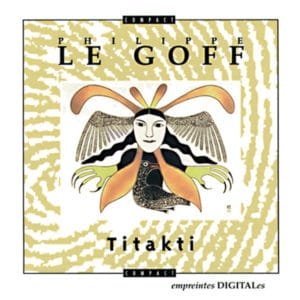
Philippe LE GOFF
“Titakti” (1991-95)
All of the pieces where composed at studio Canope (Lyon, France), with the support of Sacem, the Muse en circuit (Paris) and at the villa Médicis Hors les murs program. Final mastering was realized at the GMEM (Marseille, France). The recordings were made between 1988 and 1993, in Nunavik (Québec Arctic) in the villages of Puvirnituq, Kuujjuaraapik and Akulivik; in Nunavut (Northwestern Territories), on Coat Island and on Baffin Island in the villages of Iqualuit, Apex and Kimmirut.
“Meta incognita”, “Nipingit - La parole”, “La guerre”, “Plan séquence”.
“Meta incognita”, “Nipingit - La parole”, “La guerre”, “Plan séquence”.
8,00€
Out of stock
CD
Paul DOLDEN
“L’ivresse de la vitesse 1”
Reissue of 2 CD. “L’ivresse de la vitesse”, en deux CDs séparés. “L’ivresse de la vitesse” (1992-93), “Physics of Seduction. Invocation
3” (1992), “Revenge of the Repressed. Resonance
2” (1993), “Dancing on the Walls of Jericho” (1990), “Physics of Seduction. Invocation
2” (1991).
3” (1992), “Revenge of the Repressed. Resonance
2” (1993), “Dancing on the Walls of Jericho” (1990), “Physics of Seduction. Invocation
2” (1991).
12,00€
Out of stock
CD
Paul DOLDEN
“Histoires d’histoire”
“Music of Another Present Era” (2013-16), stereo tape. Music of Another Present Era plays freely with our ability to imagine another time and culture. At the same time, it recognizes that this historical imagining is necessarily conditioned by our own time and place. We do not know exactly what ancient music sounded like, as we are left with only inaudible details such as the microtonal scales that were used. This work appropriates a number of these ancient tuning systems to create a sense of the past within our present era. While the music of ancient times can at best only be approximated, stories and myths have been passed down for generations that can further illuminate the past while still speaking to us now. These stories stimulated my musical imagination, bridging past and present, a pilgrimage through musical time and place. This is not a programmatic work, instead these stories appear in the music metaphorically. This metaphoric use of myths is so that the musical content be recognized without it being diminished or reduced, as often occurs in programmatic music in which the musical content threatens to vanish behind an unequivocal verbal interpretation. In other words, as the group of late 20th century philosophers known as Guns N’ Roses said: “use your illusion.”
“BeBop Baghdad” (2013), electric guitar, and stereo tape. Maurizio Grandinetti, electric guitar. Many guitarists cut their musical teeth via jamming. With players taking turns soloing and sensitively backing up the other soloists, it remains the ideal forum to display your chops and pick up new tricks through careful listening. BeBop Baghdad is a fantasy based on the jam session. A live guitarist solos through most of the work, while a room full of musical playmates is simulated by a pre-recorded tape part. Like in a live jam session, musical styles can quickly change on a player’s whim, and the musicians must remain alert to follow the flow. In the first half of BeBop Baghdad, the soloist is surrounded by free-jazz style reeds, winds and brass. In the second half the soloist is supported and challenged by a rhythm section that hops from a Latin music club to a Nashville Country music stage, and from a New York City jazz club to a suburban basement seething with speed metal. Surprisingly, every locale is visited by an ensemble of Arabian musicians, lending an exotic flavor and further testing the soloist's abilities. Fortunately, our guitar hero has just returned from a tour of Iraq, where he was swinging, rocking and trilling with the locals. The recurring themes based on Arabic scales lend continuity to BeBop Baghdad through the wildly shifting scenes.
“Show Tunes in Samarian Starlight” (2012), B-flat trumpet, and stereo tape. ukasz Gothszalk, B-flat trumpet. The work plays freely with our historical imagination, specifically, our ability to imagine another time and culture. At the same time, this imagining is always conditioned by our own time. We know the microtonal scales used by many ancient cultures. However we have no idea of how they were used or what the music sounded like. Show Tunes in Samarian Starlight appropriates a number of ancient scales to create a musical fantasy of ‘show tunes’ and ‘nightclub music’ for ancient times. The work is based on the same melodies recreated in different tuning systems. These fluctuate between two musical moods — plaintive and calm, like a ballad, and energized, like a rock, swing, or Latin groove. Similarly, the structure of the work fluctuates between the microtonality of an imagined past and our modern tuning system.
“BeBop Baghdad” (2013), electric guitar, and stereo tape. Maurizio Grandinetti, electric guitar. Many guitarists cut their musical teeth via jamming. With players taking turns soloing and sensitively backing up the other soloists, it remains the ideal forum to display your chops and pick up new tricks through careful listening. BeBop Baghdad is a fantasy based on the jam session. A live guitarist solos through most of the work, while a room full of musical playmates is simulated by a pre-recorded tape part. Like in a live jam session, musical styles can quickly change on a player’s whim, and the musicians must remain alert to follow the flow. In the first half of BeBop Baghdad, the soloist is surrounded by free-jazz style reeds, winds and brass. In the second half the soloist is supported and challenged by a rhythm section that hops from a Latin music club to a Nashville Country music stage, and from a New York City jazz club to a suburban basement seething with speed metal. Surprisingly, every locale is visited by an ensemble of Arabian musicians, lending an exotic flavor and further testing the soloist's abilities. Fortunately, our guitar hero has just returned from a tour of Iraq, where he was swinging, rocking and trilling with the locals. The recurring themes based on Arabic scales lend continuity to BeBop Baghdad through the wildly shifting scenes.
“Show Tunes in Samarian Starlight” (2012), B-flat trumpet, and stereo tape. ukasz Gothszalk, B-flat trumpet. The work plays freely with our historical imagination, specifically, our ability to imagine another time and culture. At the same time, this imagining is always conditioned by our own time. We know the microtonal scales used by many ancient cultures. However we have no idea of how they were used or what the music sounded like. Show Tunes in Samarian Starlight appropriates a number of ancient scales to create a musical fantasy of ‘show tunes’ and ‘nightclub music’ for ancient times. The work is based on the same melodies recreated in different tuning systems. These fluctuate between two musical moods — plaintive and calm, like a ballad, and energized, like a rock, swing, or Latin groove. Similarly, the structure of the work fluctuates between the microtonality of an imagined past and our modern tuning system.
13,00€
Out of stock
CD
Natasha BARRETT
“Isostasie”
A former student of Jonty Harrison and Denis Smalley - two important figures of the British electroacoustics school - Natasha Barrett integrates the approach of these two composers into a proposition which recalls both sound ecology and properly abstract composition. Isostasie is full of these poetic, disconcerting environments, impressionistic pictures of various formats, evocative of her country of adoption, Norway. In this CD, one will encounter various meteorological happenings, the midnight sun, «Red Snow» (a phenomenon due to the growth of algae or diatoms), as well as an ode to the forest, «Viva la Selva!» Plenty of illustrations and impressions of the Norwegian landscape, postfaced with an «exploration of spatial musical structure» («The Utility of Space»), all fabricated with utmost delicacy by a young composer with an attuned ear, of whom this is the third album already (following two self-produced CDs, «Rocks & Wraiths» and «Chillies & Shells».)
12,00€
Out of stock
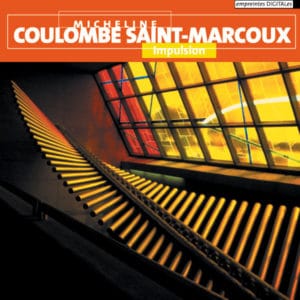
CD
Micheline COULOMBE SAINT-MARCOUX
“Impulsion”
“For the first time with Impulsion are presented all of the works for tape by Coulombe Saint-Marcoux (all but two which have disappeared). This historical disc is the occasion to discover the work of one of the Canadian electroacoustic pioneer.”
12,00€
Out of stock
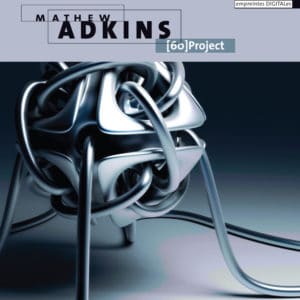
CD
Mathew ADKINS
“(60) Project”
The involvement and the contribution of sound materials by over 60 of the world’s leading electronic composers and sound artists, under the control of Mathew Adkins. Composed in 2008, mixed at the GRM and created in the Huddersfield Contemporary Music Festival for the 60 years birthday of Musique Concrete. With A_dontigny, AGF, Lars Åkerlund, Michael Alcorn, Javier Álvarez, Miguel Azguime, Natasha Barrett, François Bayle, Gonzalo Biffarella, Ludger Brümmer, Mira Calix, Christian Calon, Lawrence Casserley, Richard Chartier, Rhodri Davies, Vladislav Delay, Donnacha Dennehy, Francis Dhomont, Lawrence English, eRikm, Dror Feiler, Christian Fennesz, Ambrose Field, Iris Garrelfs, Gilles Gobeil, Kink Gong, Jonty Harrison, Tim Hecker, Erdem Helvacioglu, Zoë Irvine, Christina Kubisch, Diane Labrosse, Andrew Lewis, Mats Lindström, Francisco López, Eric Lyon, Stephan Mathieu, Adrian Moore, Åke Parmerud, Gert-Jan Prins, Maja Solveig Kjelstrup Ratkje, Pedro Rebelo, Steve Roden, Sébastien Roux, Scanner, Janek Schaefer, Conrad Schnitzler, Si-cut.db, Wayne Siegel, Rodrigo Sigal, Pete Stollery, Paulina Sundin, Kees Tazelaar, Terre Thaemlitz, Todor Todoroff, Kasper T Toeplitz, David Toop, Germán Toro-Pérez, Pierre Alexandre Tremblay, Hans Tutschku, Rodrigo Cicchelli Velloso, Marc Weiser-Rechenzentrum, Yeoh Yin Pin, John Young, and Christian Zanési.
12,00€
Out of stock
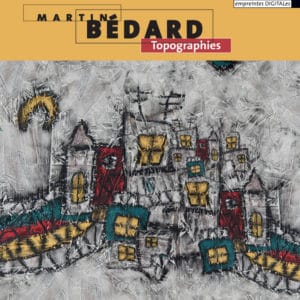
CD
Martin BÉDARD
“Topographies”
“The title of Martin Bédard highly anticipated release speaks by itself: Topographies. It is a music full of relief showing a remarkable work on high dynamics. Not one second of downtime will be met, the music being filled of a rarely seen energy. The tight discourse will bring the listener within dense and opaque spaces where he will hold his breath, left by a feeling of emptiness after a complete listening. A technically and aesthetically dazzling release”.
“Grand dehors” (2011), “Topographie de la noirceur” (2004-2005), “Push & Pull” (2010), “Métal fatigue” (2012), “Champs de fouilles” (2008).
“Grand dehors” (2011), “Topographie de la noirceur” (2004-2005), “Push & Pull” (2010), “Métal fatigue” (2012), “Champs de fouilles” (2008).
13,00€