
Out of stock
CD
Manuella BLACKBURN
“Petites étincelles”
“Javaari” (2012-13). “Ice breaker” (2015). “Snap happy” (2016-17). “Time will tell” (2013). “New Shruti” (2013).
Manuella Blackburn is an electroacoustic music composer who specializes in acousmatic music creation. However, she also has composed for instruments and electronics, laptop ensemble improvisations, and music for dance.
She studied music at The University of Manchester (England, UK), followed by a Masters in Electroacoustic Composition with David Berezan. She became a member of Manchester Theatre in Sound (MANTIS) in 2006 and completed a PhD at The University of Manchester with Ricardo Climent in 2010.
Manuella Blackburn has worked in residence in the studios of Miso Music (Lisbon, Portugal), EMS (Stockholm, Sweden), Atlantic Centre for the Arts (New Smyrna Beach, FL, USA), and Kunitachi College of Music (Tokyo, Japan).
Her music has been performed at concerts, festivals, conferences and gallery exhibitions in Argentina, Belgium, Brazil, Canada, Chile, Costa Rica, Cuba, France, Germany, Italy, Japan, Korea, Mexico, Portugal, Spain, Sweden, and the USA.
Manuella Blackburn has received a number of international awards and prizes for her acousmatic music including: Grand Prize in the Digital Art Awards (Fujisawa, Japan, 2007), First Prize in the 7th and 10th Concurso Internacional de Composição Electroacústica Música Viva (Lisbon, Portugal, 2006, ’09), First Prize in the Musica Nova International Competition of Electroacoustic Music (Prague, Czech Republic, 2014), International Computer Music Association European Regional Award (Australia, 2013), 3rd Prize in the Diffusion Competition (Ireland, 2008), Public Prize in the Concurso Internacional de Composição Eletroacústica (CEMJKO, Brazil, 2007) and Honorary Mentions in the Centro Mexicano para la Música y las Artes Sonoras (CMMAS) competition (Morelia, Mexico, 2008) and in the Concurso Internacional de Música Eletroacústica de São Paulo (CIMESP ’07, Brazil).
She is currently Senior Lecturer in Music at Liverpool Hope University (England, UK).
13,00€
Out of stock
CD
Manuella BLACKBURN
“Formes audibles”
First solo disc by British composer Manuella Blackburn. Manuella Blackburn’s work brilliantly embodies the vivid side of modern acousmatic music. This first disc of the Manchester-based British composer will keep the listener’s mind awake from the first to the last second. One will find dynamic works where the discourse is articulated with incredible finesse. Each element is precisely organized within complex timbre structures of great clarity. Each piece is based on sound materials carefully selected and delicately processed: from the electric guitar, to electronic switches to traditional musical instruments. In these bursts of sound remains an emphasis on pitch, uttering a reference to tonal musical history, keeping the listener drawn into the singular narrative of a frankly lively work. “Vista points” (2009), “Switched on” (2011), “Karita oto” (2009), “Kitchen Alchemy” (2007), “Cajón!” (2008), “Spectral spaces” (2008).
13,00€
Out of stock
CD
John OSWALD
“Aparanthesi”
The master of plundephonics takes us on a wild ride with “the one-note idea.”
"Now when I say that aparanthesi is one note I mean that it is one specific pitch and manifestations of that pitch in the various audible octaves. For A there are ten audible octaves, from the lowest note on most pianos (A=27.5 Hz) to 5 octaves above A 440, which is 14,080 Hz. These ten manifestations of simple halvings and doublings of a set frequency are the entire harmonic content of aparanthesi - any deviations from this frequency gravitate back to it, by various means."
13,00€
Out of stock
CD
James O’CALLAGHAN
“Espaces tautologiques”
1st disc by Montréal-based young Canadian composer James O’Callaghan.Includes the trytich of acousmatic works that imagine the sounding bodies of instruments as resonant spaces. “Objects-Interiors” (2013), “Bodies-Soundings” (2014), “Empties-Impetus” (2014-15), “Isomorphic” (2011-14).
James O’Callaghan is a composer and sound artist based in Montréal praised for his “mastery of materials and musical form” (Électromania, Radio France) and “highly refined sense of colour” (Vancouver Sun).
His music intersects acoustic and electroacoustic media, employing field recordings, amplified found objects, computer-assisted transcription of environmental sounds, and unique performance conditions.
His work, spanning chamber, orchestral, live electronic and acousmatic idioms, audio installations, and site-specific performances, has been variously commissioned by the Groupe de recherches musicales (GRM), NYO Canada, Ensemble Paramirabo, Quasar, and Standing Wave, among others.
James O’Callaghan is the recipient of the Canada Council for the Arts’ Robert Fleming Prize (Canada, 2015), and his music has been awarded first prizes in the Salvatore Martirano Memorial Composition Award (USA, 2016), the Musicworks’ electronic music competition (Canada, 2015), the SOCAN Foundation Awards for Young Composers (Canada, 2013, ’14), including its 2014 John Weinzweig Grand Prize, and the Canadian Electroacoustic Community’s competition Jeu de temps / Times Play (CEC, Canada, 2013). His music was nominated for the Gaudeamus Award (The Netherlands, 2016) and the Juno Award for Classical Composition of the Year (Canada, 2014), and was a finalist in the the 8e Prix collégien de musique contemporaine (Québec, 2016) and the Klang competition (France, 2015).
Originally from Vancouver, he received a Master of Music degree in composition from McGill University in 2014, studying with Philippe Leroux, and a Bachelor of Fine Arts honours degree from Simon Fraser University in 2011, studying with Barry Truax.
12,50€
Out of stock
CD
Jacques TREMBLAY
“Chroniques d’une séduction”
“Espresso espressivo” (2003-04). “L’énigme anima (1997, 2001)”. “Empathies entropiques (1998-2001)”. “The main theme running through all three of the works included on this cd is otherness. Each piece illustrates different facets of this theme. O the irony! As I try to fold back around my memories, my ability to focus is suddenly challenged by my noisy neighbour going by and talking loudly into his cell phone headset. The noise of this undesired speech immediately ties up my memory. This foreign tongue and its strong accents are heckling me. However, I persist in writing, which soon relegates the surrounding audio flow to the background. Since I cannot grasp the meaning of the words, my neighbour’s conversation becomes beat, movement, pace. And my listening finds purchase on the musicality of the sound. Later, when I resume my active listening, I realize that elsewhere in the background, over my head in fact, the patrons of the fruit store are ‘pacing around,’ influenced by the ebb of a radio, whose sound reaches me through the floor-ceiling in a highly-filtered form. Finally, further in the background is an animated layer of vehicle sounds pulsated by the clock mounted on the wall… An Arabian song comes from a car, panning from left to right... Multiplicity is here and now and... My attitude hesitates between shutting it all out or marveling at it. I listen... looking from the inside out... and rather than closing itself up, my perception tries to feed off these sonic imprints. The above sums up pretty well how I found my pace in realizing these works. My vision extrapolated into numerous ramifications along the way. My attention still thought it was focusing on a familiar sound, but it was actually slipping into the chronicles of intrigue and fascination. And for this experience, the ‘I’ becomes the ‘other.’ And being able to dissociate oneself from it is strangely fascinating. Isn’t that part of the Other’s seductive power? This very otherness holds the power to awake us, dust down our old ready-to-ware suits-ideas, initiating a new fresh attitude toward astonishment and discovery.” Jacques Tremblay
13,00€
Out of stock
CD
Horacio VAGGIONE
“Fluides”
“Mécanique des fluides” (2014-15). “PianoHertz” (2012). “Consort for Convolved Violins” (2011). “Préludes suspendus III” (2009, 10). “Fractal C” (1983-84).
Horacio Vaggione has been integrating computers to his approach to composition since the 1970s. His body of work includes electroacoustic pieces, mixed pieces, and instrumental music.
Born in 1943 in Argentina, Vaggione has been residing in France since 1978. He studied piano with Ornella Ballestreri and composition at Universidad Nacional de Córdoba (Argentina, 1959-62) and in Buenos Aires (Argentina) with Juan Carlos Paz. He holds a PhD in musicology from Université Paris 8 (France, 1983), where he worked under Daniel Charles.
Horacio Vaggione cofounded the Universidad Nacional de Córdoba’s Centro de música experimental (CME) in 1965. A year later, on a Fulbright fellowship, he was introduced to the computer as a music tool by Lejaren Hiller and Herbert Brün at University of Illinois (Urbana, Illinois, USA). In 1969-73, he joined Luis de Pablo in the electroacoustic music studio Alea in Madrid (Spain), after which he worked in various French studios — GRM, IRCAM, IMEB — and in several European and North-American universities. He was artist-in-residence in Berlin (Germany) in 1987-88 on a fellowship from DAAD.
Horacio Vaggione won awards in numerous international competitions, including NewComp (Cambridge, Massachusetts, USA, 1983); the ICMA Award (1992), the Euphonie d’or (Bourges, France, 1996), the Ton Bruynèl Award (The Netherlands, 2010), and the Giga-Hertz-Preis 2012 (Karlsruhe, Germany).
Starting in 1989, Horacio Vaggione worked at the Music Department of Université Paris 8 (France) as a professor, PhD research director, and director of the Centre de recherche informatique et création musicale (CICM). He became Professor Emeritus in 2012.
13,00€
Out of stock
CD
Hildegard WESTERKAMP
“Transformations”
“Hildegard Westerkamp says: "I hear the soundscape as a language with which places and societies express themselves." Her Transformations CD presents five of her soundscape compositions, reflecting work composed from 1979 to 1992, each sounding the depths of a different place, creating a different inner landscape each time I hear them. She works with the sonic and sociopolitical potentials of each place, recording, mixing, and subtly transforming sounds to heighten listeners’ awareness and appreciation of these sites. She is a skilled and careful interpreter of their languages.”Andra McCartney. New catalog number, new box but music stays the same.
13,00€
Out of stock
CD
Hans TUTSCHKU
“Moment”
Hans Tutschku (Weimar, Germany, 1966), composer living in USA, member of Ensemble für Intuitive Musik Weimar. “Extrémités lointaines” (1998), “… Erinnerung…” (1996), “Les invisibles” (1996), “Sieben Stufen” (1995), “Die zerschlagene Stimme” (1991).
12,00€
Out of stock
CD
Hans TUTSCHKU
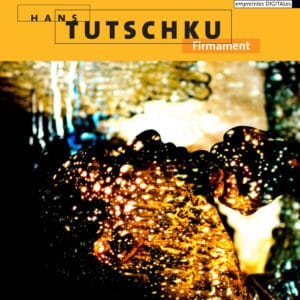
“Firmament”
“Firmament - schlaflos” (2010), “Klaviersammlung” (2011), “Issho ni” (2014).
Hans Tutschku began to study music at an early age. In 1982 he joined the Ensemble für Intuitive Musik Weimar, playing synthesizer and live electronics. He studied electroacoustic composition at the Hochschule für Musik in Dresden (Germany), and accompanied Karlheinz Stockhausen on several concert tours in 1989-91 for the purpose of studying sound diffusion.
In 1989 he co-founded with Michael von Hintzenstern the Klang Projekte Weimar, a presenter of contemporary music, which presents an annual festival as well as a concert series.
In 1991-92 he took part in the international year-long course at the Institute of Sonology (The Hague, The Netherlands). In 1994 he followed the annual composition and computer music course at IRCAM (Paris, France). In 1995-96, he taught electroacoustic composition at the Franz Liszt Academy in Weimar (Germany) where he also set up the studio. In 1996, he attended the Royaumont Composition Workshop with Brian Ferneyhough and Klaus Huber (France).
He taught at IRCAM (Paris, France) from 1997 to 2001, and at the Conservatoire de Montbéliard (France) from 2001 to 2004. In May 2003 he completed a PhD in composition at the University of Birmingham (England, UK) with Jonty Harrison. Since September 2004 he has been working as professor of composition and director of the electroacoustic studios at Harvard University (Cambridge, MA, USA).
12,00€
Out of stock
CD
Gilles GOBEIL
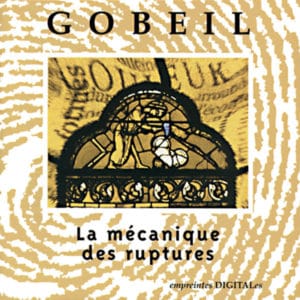
“La mécanique des ruptures”
Le vertige inconnu (The Mysterious Vertigo) was produced in 1993 at the studios of the Groupe de musique expérimentale de Bourges (GMEB, France). It premiered in June 1993 at the 23rd Bourges International Electroacoustic Music Festival (France). Le vertige inconnu received the 1994 Stockholm Electronic Arts Award (Sweden) and was selected for the 1994 World Music Days (Stockholm, Sweden) and the 1994 International Computer Music Conference (ICMC’94) in Danmark. The piece was commissioned by the GMEB, with the assistance of the Canada Council [for the Arts].[v-94] Since, Le vertige inconnu was awarded the prize of international competition Stockholm Electronic Arts Award (Sweden, 1994) and the 2nd prize of the international competition Prix Ars Electronica (Linz, Austria, 1995).
12,00€
In stock
CD
Gilles GOBEIL
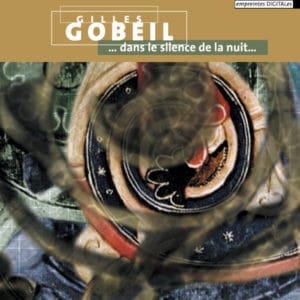
“… dans le silence de la nuit…”
“Derrière la porte la plus éloignée…” (1998), “Projet Proust” (1995-2001), “Point de passage” (1997), “Nuit cendre” (1995).
“… one of the most talented and sensitive jugglers of sounds we’ve heard” (Sonoloco Record Reviews, Sweden). “Since its release, Gilles Gobeil’s new disc, … dans le silence de la nuit…, attracts a lot of praises and attention. Dark and fascinating, his sonic universe routs bias and produces extraordinary sonic depth. Inspired by both readings (Proust, HG Wells, Verne) and travels (Venice), Gobeil’s compositions leaves the listener breathless with its moving images and secret atmospheres. 50 minutes expressly remastered for this edition, illustrated by Luc Beauchemin.”
13,00€
Out of stock
CD
Gilles GOBEIL
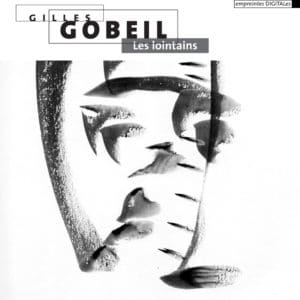
“Les lointains”
“Les lointains noirs et rouges” (2008-09), “Castalie” (2008), “Bol-Hydre” (2011), “Sibylle” (2010), “Golem” (2013), “Des temps oubliés” (2012).
Gilles Gobeil has completed a master’s degree in composition at Université de Montréal, after studying writing techniques. He has been focusing his work on acousmatic and mixed music since 1985. His works fall close to what is called ‘cinema for the ear.’ Many of his pieces have been inspired by literary works and attempt to let us ‘see’ through sound.
Gilles Gobeil has won over 20 national and international awards including the Ars Electronica (Austria, 1995, 2005), Black & White (Portugal, 2009), Bourges (France, 1988, ’89, ’99, 2009), British Design & Art Direction (UK, 2002), Brock University (Canada, 1985), Canadian Music Council (1985), Ciber@rt (Spain, 1999), CICEM (Monaco, 2014), CIMESP (Brazil, 1997, ’99, 2001), Destellos (Argentina, 2011, ’12), Luigi Russolo (Italy, 1987, ’88, ’89), Métamorphoses (Belgium, 2000, ’02), Newcomp (USA, 1987), SDE Canada (1984), SOCAN (Canada, 1993), and Stockholm Electronic Arts Award (Sweden, 1994, ’97) competitions. His DVD-Audio Trilogie d’ondes has won the Conseil québécois de la musique (CQM)’s Prix Opus for Best Album in 2004-05; his CD Le contrat was nominated in the same category in 2003-04.
Gobeil has received commissions from Codes d’accès (Montréal), DAAD (Berlin, Germany), empreintes DIGITALes (Montréal), Groupe de musique expérimentale de Bourges (GMEB, France), Groupe de recherches musicales (GRM, France), Musiques & Recherches (Belgium), Réseaux des arts médiatiques (Montréal), Société Radio-Canada, Totem contemporain (Montréal), Zentrum für Kunst und Medientechnologie (ZKM, Germany), from Folkmar Hein, Uli Aumüller, Camille Mutel, and Oscar Wiggli, and from performers Suzanne Binet-Audet, René Lussier, Arturo Parra, and Rick Sacks.
He has been composer-in-residence in Banff (Canada, 1993, ’95), Bourges (France, 1991), EMS (Sweden, 2013), GRM (France, 1993, 2012), Franz Liszt Academy (Weimar, Germany, 2010), Miso Music Portugal (2012), Musiques & Recherches (Belgium, 2012), PANaroma (Brazil, 2014), and ZKM (Germany, 2005, ’06, ’07, ’09, ’10, ’12, ’13), and guest composer at DAAD (Germany, 2008).
Gilles Gobeil is a member of the Canadian Electroacoustic Community (CEC), and co-founder of Réseaux, an organization devoted to producing media arts events.
13,00€
Out of stock
CD
Francis DHOMONT
“Sous le regard d’un soleil noir” (1979-81)
“Francis Dhomont is among the foremost composers in the acousmatic tradition. Since 1963, he has produced several dozens of works for tape. Sous le regard d’un soleil noir (Under the glare of a black sun) was done between 1979 and 1981. Its CD release dates from 1996. This is the first work of a trilogy inspired by psychoanalytic thought.
According to Dhomont, this work proposes a meeting of the imagination (‘psychology of depths’) with the mental images produced by the acousmatic treatment of sounds. Dhomont uses texts by psychiatrist - psychoanalyst Ronald D. Laing (among other authors) to describe the journey of a schizophrenic mind from the ‘incarcerated self’ to the catatonic state. The piece is structured in eight sections lasting four to eight minutes each. Dhomont uses three strategies to achieve formal unity: (1) The text is delivered almost without inflections and it is clearly articulated to keep it comprehensible. Little processing is applied. (2) Material from previous sections is recycled achieving an impressive economy of means. (3) The pitch class B natural is employed as a pivot and as a recurring motive throughout the piece.
Dhomont shows his compositional craftsmanship by keeping the pace of the sections masterly balanced. Sound objects are carefully designed to keep sources’ identities hidden. When these can be identified, they are meant to fulfill a specific formal function. For example, after the listener has been exposed to several minutes of abstract sound, the sudden appearance of a talking crowd (Inner Citadel, at 1:10) provides a striking contrast. The voice of the narrator is usually kept as a layer separate from the musical material. After twenty years of its conception, Sous le regard d’un soleil noir starts to feel the weight of time. Some of the sound processing techniques employed may sound a bit artificial today, e.g., the low pass and high pass filtering of the voice. The use of amplitude envelopes on natural time varying sounds eliminates important temporal cues. Thus, the spectral characteristics of these sounds do not fit their temporal structure creating a perceptual paradox. Check, for example, the articulation on the B natural in the section titled Implosion.
Keeping in mind the year of its realization and the concepts underlying its formal plan, Sous le regard d’un soleil noir stands as a landmark of acousmatic composition.”
13,00€
Out of stock
CD
Francis DHOMONT
“Les dérives du signe”
“Mobility here is that of quicksand. One believes one holds the image but it sifts between the fingers, or allows itself to be covered, engulfed by a new image closing in upon it.Ubiquity and ambiguity of signs inform us and lead us astray. These four works play with diversion. The diversion: of musical discourse in Novars, of sound sources in Chiaroscuro, of sensory perception (synesthesia) in Météores (Meteors), and of nature in Signé Dionysos. Under the title Mouvances~Métaphores (Mobility~Metaphors), seven works are united around the common theme of movement as with virtual displacement of sound in geometric space, or metaphorical transferences of meaning into the realms of imagination.” Francis Dhomont
“Novars” (1989), “Chiaroscuro” (1987), “Météores” (1989), “Signé Dionysos” (1986-91). (Disque 2 du coffret double-CD “Mouvances ~ Métaphores” de 1991 (IMED 9107/08).)
12,00€
Out of stock
CD
Francis DHOMONT
“Cycle de l’errance”
“Francis Dhomont’s ’Cycle de l’errance (Mouvances-Metaphores, 1)’, includes several of his important works, including ’Points de fuite’ (1982), ’. . . mourir un peu’ (1987), and an excerpt from ’Espace/Escape’ (1989). Dhomont is distinguished not only as a composer but also as a professor at the University of Montreal whose thoughts on sound and approach to composing electronic music have been influential in creating the rich spectrums of the so-called ’Montreal sound’.”
12,00€
Out of stock
CD
Francis DHOMONT
“Études pour Kafka”
Behind major works of the scope of “mourir un peu”, “Sous le regard d’un soleil noir”, and “Forêt profonde”, is a long period of thinking - sometimes years - and several studies where I experiment with the themes, try out sound materials, and unveil glimpses of the final work. These etudes are the work’s prolegomena. However, with their finished form, the studies presented here have gone beyond that stage, beyond the sketch. They are self-standing compositions prefiguring Le cri du Choucas, a long work on the world and character of Franz Kafka initiated twelve years ago. So here are three of these self-standing sketches, these pieces of sonic research and impressionistic approaches of Kafkaian themes guided by the enlightening analysis by Marthe Robert (1914-1996) (Seul, comme Franz Kafka Calmann-Lévy: Paris, 1979). Francis Dhomont [English translation: François Couture, x-09]
“Premières traces du Choucas” (Dhomont) (2006). “Brief an den Vater” (Dhomont-Kafka) (2005-06). “À propos de K” (Dhomont) (2006).
12,00€
Out of stock
CD
Francis DHOMONT
“… et autres utopies”
“Utopian, these aural mirages surely are - not in the political sense of the Ideal City, but in the etymological sense of ou-topos: belonging to no specific location, except for imaginary territories; creatures of illusion and, in this case, sound. These aural “non-lieux,” these chimeras of perception, resulting from treatments and made from unlikely parts that are loosing their identity, stripped off of any audible source, are fictional beings born out of a dreamer’s nomadic invention.Also utopian are - haven’t it been said often enough? - these sonic structures attempting to avoid traditional music codes, disregarding their imperatives, and offering a stream of mental images to our psyche. However, do we really have to be reminded of all these things that we know so well? Certainly, for in these cybernetic times, is there anything more necessary than the reality of utopia? So, here are five fantasies to be listened to with eyes closed; in sequence, they dream up sound in space, mankind’s revolt against its own nature, a few light phenomena, a symbolic journey, and the tumultuous manifestations of exaltation.” “Here and There” (2003), “Je te salue, vieil océan!” (1998, 2000-04), “Chroniques de la lumière” (1989, 2005), “Voyage-miroir” (2004), “Corps et âme” (2001-02).
12,00€
Out of stock
CD
Francis DHOMONT
“Jalons”
“Vol d’Arondes” (1999), “En cuerdas” (1998), “Les moirures du temps” (1999-2000), “Studio de nuit” (1992), “Lettre de Sarajevo” (1995-96), “Un autre printemps” (2000), “Drôles d’oiseaux” (1985-2001), “L’électro” (1990).
12,00€
Out of stock
CD
Francis DHOMONT
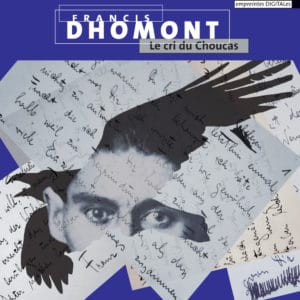
“Le cri du Choucas”
“Le cri du Choucas” (2014, 15) stereo tape.
Conceived in 1997 and left to mature slowly, Le cri du Choucas is the third and final instalment in my “Cycle des profondeurs” [Cycle of Depths], the first two parts of this long triptych (about three hours) being Sous le regard d’un soleil noir (1981) and Forêt profonde (1994-96), of which a few reminders are included in this instalment. All three are “electroacoustic melodramas” (Michel Chion) inspired by a psychoanalytic approach — Marthe Robert’s in this case, especially an insightful essay by this literary critic, translator, and psychoanalyst entitled As Lonely as Franz Kafka (1979). As Pierre Schaeffer said, “[…] how could we not wonder about the development of music itself, which mysteriously seems to build a bridge between psychology of perceptions and psychology of depths?” and, a fortiori, about the origins of this perceptive music that is acousmatic music, “psychology of depths” being just another name for psychoanalysis.
About the title Le cri du choucas, which means “The Jackdaw’s Call”… Kavka is the Czech word for jackdaw, a bird akin to a crow whose effigy Hermann Kafka, Franz’s father, used for his store sign. Kafka himself wrote “I am a jackdaw, a helpless kavka.” This match and this title are inspired by the animal symbolism found in Kafka’s works: the deep call, the solitary, unusual, often-choked, never-emphasized cry that you can hear in every single tale, however fragmentary, by this author.
Before the Law, a famous section of The Trial, serves as the red thread of my piece, the Law being a metaphoric representation of the impenetrable realms the human mind hits, and not — as what the Vulgate and the adjective “Kafkaesque” usually reduce Kafka’s complex thoughts to — a portrait of bureaucratic aberrations. It is mostly “what you cannot possibly escape from”: a doorway to knowledge is open especially for the man who gets to it, although he is also forbidden to pass through it. Which means that his — metaphysical — question remains unanswered. Symmetrically, a crucial message is addressed to him, although it will never reach him. “In The Penal Colony,” writes Marthe Robert, Kafka “reduces the law to nothing more than an inordinate power of coercion whose sole function is to automatically enforce punishment” [our translation].
Before this long piece, there were four Études pour Kafka which form, alongside new elements, the musical materials of this melodrama. However, these materials are assembled in a different order to fit a script highlighted by texts by and about Kafka told by multiple voices, some of them known, unknown, or transformed.
These are some of the themes covered in this work: the Law, guilt, the father, solitude, dreams, impossible messages, and death. You will hear, by order of appearance, excerpts from The Trial, The Penal Colony, Letter to His Father, The Verdict, Diary, Letters to Felice, The Burrow, A Message from the Emperor, and The Metamorphosis.
13,00€
Out of stock
CD
Francis DHOMONT
“Cycle du son”
“This Cycle celebrates sound (a major discovery of the twentieth century) and concrete music. It is a fiftieth-anniversary homage to the inventiveness of Pierre Schaeffer, who clearly created an upheaval in the world of music that has had no precedent. Drawing on the same sound material which was forged from the first movement of Schaeffer’s Étude aux objets, as well as from a personal collection of sounds that have been stored away over the years, these four pieces go through a process where they develop out of each other, question each other, echo each other, and complete each other through allusions, commentaries, metonymies, and continuations. With poetic freedom they both evoke a historic journey and propose a connection between the object of sage Schaefferian observation and the wildest “metamorphologies” of sound art. Years after its composition, Novars, the third part of this cycle but the first to be composed, remains the section around which the entire work turns. Cycle du son (Cycle of Sound) premiered on November 22nd, 1998 as part of the 5th L’espace du son Festival acousmatique international in Brussels (Belgium).” Francis Dhomont
13,00€
Out of stock
CD
Erik NYSTRÖM
“Morphogenèse”
“Catabolisms” (2011-12), “Latitudes” (2011), “Lucent Voids” (2012), “Cataract” (2010), “Far-from-equilibrium” (2008). Erik Nyström is specialised in electroacoustic music and is currently pursuing an aesthetic interest in spatial texture, and visual and physical experiences in acousmatic listening. He holds a PhD from City University London (UK), awarded in 2013 for his research entitled Topology of Spatial Texture in the Acousmatic Medium. The work was supervised by Denis Smalley and develops, in both theoretical concepts and composition practice, an approach to spatiotemporal processes and structures in electroacoustic music, especially applicable to multichannel circumspatial compositions. His educational background includes studies in Recording Arts at SAE Institute London (UK), Computer Music Composition at CCMIX (Paris, France), with Gerard Pape, and Electroacoustic Composition (MA, PhD) at City University London (UK), with Denis Smalley. Erik Nyström lives in London (UK) where he also teaches at SAE Institute London and freelances as sound engineer. His music is frequently performed internationally and has received prizes and mentions, including the Public Prize at the Métamorphoses 2010 competition (Belgium).
13,00€
Out of stock
CD
Elainie LILLIOS
“Entre espaces”
“Elainie Lillios’s music reflects her fascination with listening, sound, space, time, immersion and anecdote. Her music explores many sound worlds; sometimes referential ones such as the human voice, cars, wind chimes, or water. Other times her materials are less obvious, like crunching branches, walking through snow, or pebbles shuffling in water. Her compositional output includes electroacoustic works, music for instruments with live interactive electroacoustics, and collaborative immersive multimedia audiovisual installation environments. Her research interests include sound diffusion as the performance practice of electroacoustic music, audio spatialization employing Ambisonics, critical listening as a creative aid and Deep Listening.” “Dreams in the Desert” (2001), “Arturo” (1998), “Hastening Toward the Half Moon” (2004), “Backroads” (2002), “Threads” (1998), “Stumbling Dance” (1998-99), “Listening Beyond…” (2007).
13,00€
Out of stock
CD
Denis SMALLEY
“Sources – scènes”
“Base metals” (2000), “Empty vessels” (1997), “Tides” (1984), “Pentes” (1974).
“The idea of a principal sound source as provider of the central material and concept unites three works on this CD, and is embodied in their titles - Tides, Empty Vessels, and Base Metals. In each case a characteristic sound acts as a central reference as well as ‘irrigating’ the piece. But it also inspires and guides the choice of other sounds and the play of relationships among them, thereby influencing musical form. In Empty Vessels it is the sound of air resonating in large garden pots along with recordings of the surrounding environment. In Tides it is two water recordings - a closely recorded water texture which furnishes the ‘pool’ sequences, and a recording of the approaching sea which gives the second movement (Sea Flight) its wave forms. Finally, in Base Metals, the resonances of a family of metal sound sculptures provide the rich reservoir of colorful sound spectra which enable harmonic and timbral evolutions.
This idea of sources and their musical development is central to the more abstract preoccupations of the composer’s agenda, as a vehicle for creating families of relationships, and as a means for building musical logic and coherence. But the invisible world of acousmatic imagery also conjures up scenes in the imagination. Such ‘scenes’ can be quite close to reality. This is the case with Empty Vessels where nature, environment, the elements and broad exterior spaces are graphically featured, often without much alteration. However, recording techniques can considerably transform our aural view of the sounds: exaggerated magnification can turn peaceful bees into a threatening swarm, or allow us to perceive the finer timbral changes of raindrops falling on a hollow ceramic pot. Empty Vessels can be regarded a series of episodes which have a visual and experiential logic as a well as making musical sense. This is the closest my music gets to composition based on the soundscape. In Tides the water-based proposition is clear enough, but the more literal references are left behind as the concepts of ‘pool,’ ‘current,’ and wave-shaped morphologies are developed more abstractly. With Pentes the only clear link with the real world is the Northumbrian pipes, and so this piece is only scenic by analogy and metaphor - its spectral energies and motions. With Base Metals, too, the imagery is evoked by spaces and motion, quite remote from reality, although the energetic metallic impacts, which act as reference-points, are a type of sound we are all familiar with.
Quite noticeable in all these works is the absence of a human presence in the sonic fabric. With the exception of the pipes in Pentes, a few distant traces of human activity near the start of Empty Vessels, and possibly some reminders of instrumentally instigated timbres in Base Metals, the listener-spectator is left to observe and experience the scenes and spaces, alone. Between and beyond the loudspeakers virtual, metaphorical worlds approach and encroach in sonic flow, and are revealed for imaginative contemplation.” Denis Smalley
13,00€
Out of stock
CD
David BEREZAN
“Allusions sonores”
“Buoy” (2011), “Thumbs” (2011), “Badlands” (2008), “Galungan” (2010), “Nij ” (2009).
After completing a BA in History (1988) at the University of Calgary, a Diploma in Composition (1996) at Grant MacEwan College (Edmonton) and a MMus in Composition (2000) at the University of Calgary, David Berezan moved to the UK and completed a PhD in Electroacoustic Composition (2003) at the University of Birmingham (UK). In 2012 he was appointed Professor in Electroacoustic Music Composition at The University of Manchester (UK), where he has acted, since 2003, as Director of the Electroacoustic Music Studios and MANTIS (Manchester Theatre in Sound).
Since 2000 he has primarily composed acousmatic music, though he has also composed and performed solo and ensemble live-electronics works. He is a practitioner and proponent of sound diffusion performance and the interpretation of fixed-media work.
13,00€
In stock
CD
Daniel LEDUC
“Le voyage d’hiver”
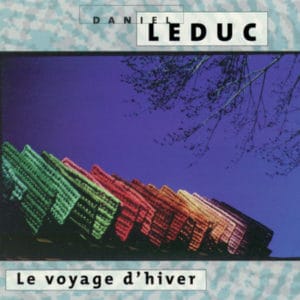
“The four pieces on this compact disc mark an important stage (dating from 1994 to 1997) in the dozen years that I have been involved in sound production. They were realized in the middle of the period of aesthetic and technical transition that confirmed my compositional style, which is one that draws from a range of influences and approaches to sound work. These include the transition from analogue to digital techniques, the confirmation of a compositional style that draws on the sources of acousmatics, from techniques used in radio and from the sound environment, and the choice of a fixed sound medium, be it magnetic tape or the digital file in its many forms, including the compact disc. It was through a process of ‘active’ listening to my sound work that I produced the pieces presented here. They are miniatures intended for the stereophonic medium. While in Die Winterreise (The Winter’s Journey), the main work, the contribution of the speaking voice in all of its forms is important, references to, evocations of and inspiration from the sound landscape are absolute, above all as metaphorical illustrations. The same is true for the other pieces on the disc, where the spoken voice gives way to the singing voice or to the voice transformed, and to the sound landscape. Regarding matters of style, my affinities run to the minimalist and the impressionistic. The ultimate goal of such a preference is to allow the fusion of the various sound elements selected to take place. These components will finally retain their character even as they give birth to something quite different and autonomous. Finally, my method of composing relies on portable sound-sampling equipment and synthesizers for the pre-production stage (sound generation) and on a computer for production (composition and processing) and post-production (mixing). Current work in sound creation sets up a dynamic that is very different from the one created in the past, when we were using analogue tools. Nevertheless, a few minor variations aside, composition technique remains completely unchanged; it is rather the technical precision that is unequaled today.”
12,00€
Out of stock
CD
Christian BOUCHARD
“Broken Ground”
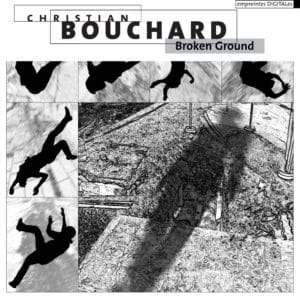
Broken Ground was realized in 2011-12 at the composer’s studio in Montréal (Québec) and premiered on February 11, 2012 during the exhibition Broken Ground by Derek Besant at Phoenix Brighton in Brighton (England, UK); the work was revised in 2013 and premiered on April 18, 2013 during the 55th Vienna Biennale at the Künstlerhaus in Vienna (Austria).
About the Exhibition Broken Ground
“The exhibition Broken Ground looks at seven cities over ten years, and how redevelopment infrastructure changes our perception of cityscapes. These cities could be anywhere (everywhere). Reconstructed from the opportunities of street level construction, I treat the sites more like stage sets, where there are props, actors, entries and exits, and evidence through the debris, disarray, shadows of figures and randomness throughout.
In our contemporary world the works have taken on hybrid references of displaced people from war zones, or natural disasters that fill nightly newscasts in the media.
The collision of my imaging with Christian Bouchard's electronic soundtrack builds the exhibition installation into a hypothetical representation of the constant change cities are in over time, and how components leave traces or clues to the ones that might have existed here…
Even in destruction, there lies the possibility for beauty and reinterpretation. Broken Ground invites reconsiderations into how our surroundings decompose around us and the phoenix-like reconfigurations that grow out of such interferences. Cities exist as ideas that we consistently negotiate our ways through and look for signposts to traverse the artificial landscape. Yet, at the heart of the exhibition is a recognition of things that feel familiar to us in our exposure to media and events that are particular to other parts of the world.”Derek Besant, Calgary [xi-16]
12,00€
Out of stock
CD
Bernard FORT
Lumière dans la nuit
by Alison Melville in The WholeNote (Canada), April 1, 2004
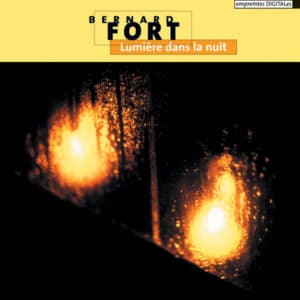
“Another in empreintes DIGITALes’s series of excellent electroacoustic CDs, this disc features three “essential” works by France’s Bernard Fort. The composer’s self-described modus operandi is “to fix time on media, then to penetrate it through slow motion, to experiment with duration, [and] to explore the depth of acoustic images.” The results of his work recorded here, written between 1992 and 2002, are striking and provocative.The program opens with L’impatience des limites, an electroacoustic reflection on the nature of time. It’s rather like a sonic answer to some Zen koan which asks, “what is the sound of life passing by?” - in fact all three pieces are Fort’s responses to this question - and its breadth and spaciousness is mesmerizing. La paix de l’entendre, for which the composer manipulated a recording made in a small boat as it sat for hours in the middle of an enormous lake, provides a different sort of aural meditation. Given the many ornithological contributions throughout the piece, it is perhaps worth mentioning that its premiere, most appropriately, took place in the Salle Olivier Messiaen in Paris. For the third work, Silence radieux, Fort’s original material was recorded on a winter’s walk and on the same route taken- in summer. Perhaps the most ethereal work on the disc, it explores an abstract sound world just underneath the surface of a “real” one; and again the results are philosophically provocative. While some readers might not consider this to be “music” as it is more strictly defined, Fort’s works are his own unique explorations of the “music of life”, and provide many terraced moments of wonderment.”
12,00€
In stock
CD
Benjamin THIGPEN
“Flux”
“Still” (2007-09). “pulse” (2010-15).
Benjamin Thigpen, nomad, born in the United States of America, naturalized in France. After dropping out of conservatory, he studied literature and aesthetics, travelled extensively and lived…
He returned to music through electronic composition, moved to Europe and abandoned his doctoral studies. He taught computer music at IRCAM (Paris, France), at the University of Washington (USA), and at the Conservatorio di Cuneo (Italy); he currently teaches at the Conservatoire royal de Mons / Arts2 (Belgium).
He creates music for loudspeakers — as a composer and as a performing electronic musician. He composes in various European electroacoustic studios (GRM, EMS, VICC, STEIM) and gives concerts throughout the world.
He performs in the duo Rust with instrument inventor and composer Jean-François Laporte, in Les Frères Bobine with composer and electronic musician Stefano Bassanese, and in Fluid Identities with cellist Benjamin Carat.
He thinks that music is not a language but a lived visceral experience, and that it is not the art of sound but the art of the transcendence of sound.
13,00€
In stock
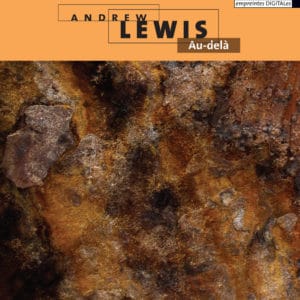
CD
Andrew LEWIS
“Au-delà”
“Lexicon” (2012), “Dark Glass” (2009-11, 13), “Ascent” (1994, 97), “Time and Fire” (1987-90, 2013), “Cân” (1997), “Scherzo” (1992, 93).
Andrew Lewis read music at the University of Birmingham (UK) between 1981 and ’84, and subsequently studied composition there with Jonty Harrison, completing a doctorate in 1991. He was one of the original members of BEAST, and throughout the 1980s and early ’90s worked with them on many electroacoustic concerts and events.
He is Professor of Music at Bangor University (Wales, UK), where he heads composition studies and directs the work of the Electroacoustic Music Studios. He also directs Electroacoustic Wales, which acts as a focus for the creation and dissemination of electroacoustic music throughout Wales.
Andrew Lewis newest release presents a captivating showcase of acousmatic compositions created over a decade, between 1992 and 2012. The works of Lewis have this exceptional quality to musicalize specific concepts: “Lexicon” approaches dyslexia; “Dark Glass” reveals the unsuspected harmonies of broken glass; “Ascent” translates into sounds the mountainous landscape around the Bangor University studios; at the speed of light, “Time and Fire” reveals and consumes its sound elements; “Cân” reinvents Wales’s sonic culture; and “Scherzo” brings the listener back to the world of childhood. Thus, each piece reveals a unique color that puts all these concepts within new perspectives that strikes by their depths.
13,00€
Out of stock
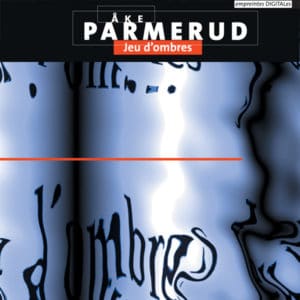
CD
Ake PARMERUD
“Jeu d’ombres”
“Strings & shadows” (1993) pour harpe et bande, “Stringquartett” (1988), “Renaissance” (1994), “Retur” (1992-93) pour quatuor de saxophones et bande, “Les flûtes en feu” (1999), “Repulse” (1986).
12,00€
Out of stock
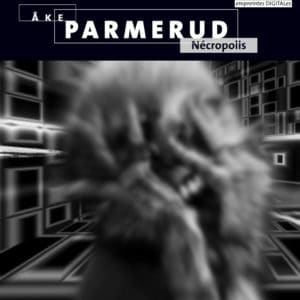
CD
Ake PARMERUD
“Nécropolis”
“Dreaming in Darkness” (2005), “Crystal Counterpoint” (2009), “ReVoiced” (2009), “Necropolis - City of the Dead” (2011).
“Dreaming in Darkness is forged primarily from small sounds, spaced apart from one another. A chime, a chink or a clunk, and then silence before a scrape or a click or a bump. It’s fragmentary, the origins of the sounds unclear. Taking the question of what a person who cannot see dreams about, Parmerud explains that the piece is an attempt to create surrealistic fragments of a blind person’s dreams. As the piece progresses, the sounds become increasingly densely packed, and with longer durations and overlaid, building sinister abstract scenes: in fact, not so much scenes as shifting shadows and variations in light.
The bubble of conversation marks the opening moments of Crystal Counterpoint: a recording which sounds like a restaurant or party, the chinking of classes and general hubbub of people grows and stops abruptly with the chime of a glass. Inspired by the sounds of the parties Åke’s parents used to host, and which he would hear from upstairs, the piece uses the very same glasses to create a wealth of sounds, from long, low drones to higher hums, elongated undulations and quick, bright glissandos. Grand swells of sound rise and cease suddenly, replaced by strange, quiet drifts of sound: it’s very easy to forget exactly what you’re listening to. But if anything, awareness of the origin of the sounds only heightens the experience, as you’re likely to marvel and wonder just how glasses could sound like an oboe or high winds across mountain tops. In his notes, Parmerud notes that there already exist a large number of recordings which explore glass sounds, and it is, indeed, an interesting piece to place alongside Miguel Frasconi’s Standing Breakage (for Stan Brakhage) (clang records, 2016).
ReVoiced moves away from musical abstraction and instead uses the voice as its instrument. A single voice is layered up on top of itself exponentially until a whole crowd of one voice is speaking. It’s actually quite a disconcerting experience. Voices are subject to all kinds of manipulation: sped up, slowed down, pitch adjusted, stretched, overlaid, echoed and delayed, in myriad permutations. Chants and dialogue and ululations, crowds and multiple languages meld together, and gradually, extraneous sounds — hard, heavy slabs of sound — crash in, while sharp-edged sounds slash for create a dull, percussive element to the slow-building torture of the familiar becoming twisted, distorted, abstracted and unfamiliar.
The final track, Necropolis — City of the Dead, is a musical tour through the catacombs of an imaginary city which contain the remains of some of the greatest music of all time. ‘But the condition of the musical bodies that rest in the crypts is unfortunately in various states of decomposition’. As such, in combining a well-worn joke (which is usually about Mozart when I’ve heard it) with a project to assimilate and deconstruct fragments of existing works, Necropolis is a sort of a collage. Classical, jazz, film soundtracks, many renowned and bordering on recognisable, at least in essence, all fade in and out and collide against one another.
While the title track may pick over the bones of musical history, it equally breathes new life, and the same is very much true of the work as a whole: the parts are disparate, fragmentary, scattered in origin from around the globe and individually amount to not very much at all. But the sum is spectacular, an experience which is thought-provoking and which has the capacity to be quite unexpectedly affecting.” By Christopher Nosnibor in Aural Aggravation, May 3, 2016
13,00€
Out of stock
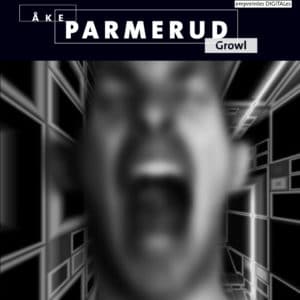
CD
Ake PARMERUD
“Growl”
“La vie mécanique” (2004), “Grooves” (2011), “Electric Birds” (2014), “Growl!” (2014-15), “Transmissions II” (2015).
Åke Parmerud has successfully pursued a professional career in contemporary music and multimedia art since the late 70s. Although he originally trained as a photographer (1972-74) he went on to study music at the University and later at the Conservatory of Music in Göteborg (Sweden). In addition to his electroacoustic and instrumental music, his work includes a broad cross-section of modern experimental music in the fields of dance, film, interactive art, multimedia, theatre, and video.
The last ten years have seen Åke Parmerud working as an innovative sound and software designer for interactive audiovisual installations at home and through several creative international collaborations. From 1999 to 2006 he worked closely with Boxiganga (Denmark) developing interactive video installations, exploring telematic concepts and interactive solutions for live performance. In 2000, ’01, and ’02 he worked as composer, sound designer, and software designer with choreographer Pierre-Paul Savoie (Québec). Finally, with Olle Niklasson, he formed AudioTechture, a project specialized in acoustic interior design for diverse environments, from private houses to public spaces.
He is a member of Kungliga Musikaliska Akademien (Royal Swedish Academy of Music) since 1998.
13,00€