
In stock

2 LP
NIJIUMU (K. Haino, T. Akiyama and T. Matsuoka)
“When I sing, I slip into the microphone.”
Among the true Keiji Haino devotees, Nijiumu’s Era of Sad Wings (released on P.S.F. in 1993) has always held a special place in the pantheon. Operating for only a few years in the early 90s and apparently only performing a handful of shows, Nijiumu operated at the opposite end of the dynamic spectrum to Haino’s famed power trio Fushitsusha, dwelling in a hushed, meditative realm of mysterious droning sonorities and free-floating melodies that occasionally erupts into violence. Black Truffle is pleased to announce a new double-LP edition of a lesser-known 1994 Nijiumu recording, When I sing, I slip into the microphone. Into that void, I bring comrade “prayers”, then, turning to face the outside, together we explode. Here, Nijiumu is the trio of Haino, Tetuzi Akiyama and the obscure Takashi Matsuoka, the three performing on a wide variety of string, wind and percussion instruments, as well as electric guitar and bass, and Haino’s unmistakeable voice.
Like on the early solo Haino album that shares the group’s name (released on P.S.F. in 1993), the instrumentation swims in reverb (the use of which Akiyama recalls as ‘a kind of point of the band’), often obscuring the instrumental sources. On the short opening piece, a distant reed instrument arcs long buzzing melodies over a bed of cymbals and gongs, like a psychedelic take on Tibetan music. The epic second part, occupying almost 50 minutes, begins as a splayed, near-formless cloud of electric guitar and bass, shadowed by bowed and plucked strings, the three elements working through twisting atonal shapes. At various points in the recording, we hear what seems to be the sounds of musicians moving between instruments, their shuffling and bumps fitting seamlessly into this radically open music. Eventually, what sounds like electric guitar moves closer to the foreground, fixing on a repeated melodic cell around which hover mysterious clouds of long tones and a sporadic shaker. At the half-hour mark, the music begins to build to a violently emotive climax, Haino’s impassioned vocal cries punctuating a lumbering, bass-heavy murk, contrasted at points by what sounds like a tin whistle. Suddenly, the volume drops to a near-whisper, opening the way for the stunning final moments, which touch on the slow-motion balladry of Haino’s classic Affection, here given an eccentric twist by an occasional woodblock hit. The third piece opens with a hazy trio of rumbling bass, bowed strings and abstracted slide guitar, the latter calling to mind some of Akiyama’s later solo work. Eventually joined by Haino’s voice, its fragile, haunted tone might remind the listener of the man in black’s documented love of the madrigals of the murderous Count Gesualdo, before the recording abruptly breaks off mid-note. In this new edition, the Nijiumu trio recording is supplemented by a piece recorded solo by Haino in 1973, a bracing electronic blowout stretching almost half an hour. Using a homemade electronics setup to unleash a barrage of crunching distortion and shuddering harmonic fuzz, it takes its place in the canon of extreme live electronics next to Robert Ashley’s Wolfman and Walter Marchetti’s Osmanthus fragrans, looking forward to extreme noise years before Merzbow. Taken as a whole, these four sides of music are a stunning document of some of the lesser-known waystations of Haino’s singular creative path.
40,00€
In stock

2 LP
Kevin DRUMM
“Sheer Hellish Miasma”
Widely regarded as one of the most uncompromising works in experimental noise, Kevin Drumm’s Sheer Hellish Miasma is once again available on vinyl. First released on CD in 2002 on the original Mego label, the album remains a landmark in extreme electronic sound and is an essential and ferocious document of Drumm at his most inventive.
The history of Drumm’s Sheer Hellish Miasma is one of resilience to the twists of underground trends that have come and gone since its initial release. Using guitar, tape manipulation, microphones, pedals, analog synthesizers, and subtle computer processing, Sheer Hellish Miasma is an overwhelming experience: a sonic onslaught of storming feedback, fractured textures and an unrelenting energy. At once brutal and meticulously composed, the album offers a singular vision at the outermost edges of sound art.
For seasoned noise veterans, Sheer Hellish Miasma offers a bracing soundscape filled with exquisitely abrasive textures and more than enough hidden detail to warrant repeated listening – a distinct voice in the increasingly same-sounding world of abstract electronic noise. For everyone else, Drumm’s journey through the noisy underworld is likely to inspire fear or, in an optimistic case, fearful admiration.
Drumm’s Sheer Hellish Miasma is an abstract noise classic with this 2LP reissue being an artefact of eternal power.
Kevin Drumm Guitar, Tapes, Mics, Pedals, Analog Synthesizer, Computer Assistance
Greg Kelley trumpet on Inferno
Dedicated to Malachi Ritscher
Recorded in 2000-2001 Chicago
Mastered at Piethopraxis, Köln, December 2006
Cut at Clunk, Berlin 2025 by Rashad Becker
34,00€
In stock

2 LP
DEDALUS ENSEMBLE – Philip GLASS
“Music with Changing Parts”
Founding work of minimalism, Music with Changing Parts is a piece with free instrumentation. The musicians choose which part to play among the eight staves of the score. At each indicated cue, the musicians can change part, which produces an abrupt change of instrumentation. While the music is based on a melodic material limited to a few notes that are repeated in patterns that expand or contract, the changes in orchestration refresh the listening experience by producing sonic contrasts. These techniques at work in Music with Changing Parts, written in 1970, will lead Philip Glass to renew his language and move from the monochromatic works that precede it to more dramatic works such as music in 12 parts and especially the opera Einstein on the Beach. When Philip Glass began rehearsing the piece, he was surprised to hear long notes when everything was written in eighth notes. After making sure that none of the musicians were playing held notes, he realized that the fact that the same notes were played by all the instruments in the ensemble produced, through a psycho-acoustic effect, a harmonic substrate of resonant frequencies. He then decided to add to the score the possibility of playing long notes to reinforce this effect. "For this recording, we chose to record first the eighth notes, then the long notes in re-recording. This utopian version, with each musician playing short and long notes at the same time (!), illustrates the minimalist aesthetic that plays with our perception and allows us to reconcile opposites and cultivate the apparent paradox of a music that moves forward without Moving and changes constantly while remaining the same." --Dedalus Ensemble
20,00€
In stock

2 LP
SISSY SPACEK
“Entrance”
Entering its 26th year of activity, the morphing, Los Angeles based experimental outfit, Sissy Spacek, joins Shelter Press with Entrance, among the project’s most captivating outings to date. Encountering the duo of John Wiese and Charlie Mumma joined in various configurations by an incredible cast of collaborators - Tim Barnes, Marco Fusinato, Aaron Hemphill, Brad Laner, Katsura Mouri, Ralf Wehowsky, and C Spencer Yeh - collectively transformed into a series a deeply intimate and delicate gestures of musique concrète, Entrance radically repositions the possibilities presented by group improvisation outside of time and place.
Founded at the end of the last millennium, the Los Angeles based project, Sissy Spacek, initially emerged from the knotted, fiery context 1990s American noise and grindcore, producing sheets of visceral sonority that quickly set the scene on its head. Going through numerous evolutions, before eventually settling as a duo of John Wiese and Charlie Mumma - joined by a rotating and often recurring cast collaborators - over the last 25 years the band has continuously entered states of evolution that have defied the expectations of its own context, seeding the sonic extremes noise with subtle and sophisticated approaches to free improvisation and musique concrète.
Fiercely positioning its efforts within the outer reaches of contemporary experimental music, while resisting the constraints of a singular sound or proximity, Wiese regards Sissy Spacek as being primarily centred around the practice of musique concrète and the pursuit of extremes. From its earliest releases - collage treatments of material gathered from the band’s full throttle practice sessions - the project’s conceptual framework has continuously evolved within a deeply engaged process of experimentation, not only reworking tactical approaches, but also definitions and perception regarding the location and action of their work. In recent years, this has led to an increasingly varied and diverse output. Percolating within, is a thread marked by a striking sense of delicacy and intimacy, driving forward while doubling as an unexpected challenge, in real time, to perceptions connected to the band’s past. Entrance is the most recent of these.
Embarking upon the four compositions that comprise the finalized four sides of Entrance, Wiese and Mumma enlisted longstanding collaborators, Tim Barnes, Marco Fusinato, Aaron Hemphill, Brad Laner, Katsura Mouri, and C Spencer Yeh, as well as new initiate, Ralf Wehowsky (of the seminal German electronic noise collective P16.D4), requesting a contribution of sounds from each, determined by a general set guidelines that dictated certain qualities the given sonorities, while allowing for the expression of each player’s distinct creative voice. The sets of resulting recordings were then chopped, harvested, manipulated, and reassembled as the four tape compositions that make up the album - Web Of Unfolding Appearance, Figure Of Reflected Light, Trancher And The Inheritors, True Dimension (From The Opaque - Spike) - each blurring the lines of authorship and clear creative proximity in remarkable ways.
Where historical gestures of musique concrète tend to draw upon non-instrumental sound sources - regarding its sonorous material as raw elements, unburdened by inherent meaning or association, to be transformed and imbued with musicality - Sissy Spacek turns this position on its head. Entrance comprises works of musique concrète that not only draw upon instrumental sound sources, with all their possible meanings or associations, but also individual characters and personalities of their players, crediting each resulting piece to its respective configuration of contributors.
As such, Entrance is an effort of sound collage defined by a rare sense of intimacy and humanity: four pieces that often take on the resemblance of group improvisation, but have, in fact, been assembled outside of time and place. Bent under the ever-present hand of Wiese’s tape treatments and manipulation, each of the album’s four compositions unfurl startling states of sonic abstraction and percolating texture, marked by a striking sense of hard-shifting structure, that culminate as tense, driven manifestations of ambient music: scrapes, squeals, rattles feedback, rolling drums, bouncing tones, whispers, bent electronics, electric artefacts, and seemingly everything else under the sun, configured into immersive, sublime mediations in sound from the most improbable events.
33,00€
In stock

2 LP
Kali MALONE
“The Sacrificial Code (2025 edition)”
Kali Malone’s landmark album The Sacrificial Code emerged from a momentous confluence of dedication and inspiration. In 2019, Malone was finishing a master's thesis in electroacoustic composition at The Royal College of Music in Stockholm, having spent several years studying how sound and space interact, both academically and as a part of Sweden’s underground music community. An apprenticeship with the organ tuner Jan Börjeson opened up the instrument’s history as a laboratory for the development of various tuning systems, resonating with her interest in the sublime, uncanny soundworlds that exist beyond equal temperament. Countless hours were spent imagining new ways to conceptualize archaic compositional forms like canons, embracing their limitations as a way to peel away dramatic flourishes so only a stark core remains. A vision of music began to crystalize that was instilled with koan-like dualities of restraint and spectacle, stasis and variation, intimacy and grandeur.
Six years after its initial release, Ideologic Organ has reissued The Sacrificial Code, adorned with striking archival organ photography by Malone and including a new arrangement of the titular composition recorded in 2023 on the 16th-century meantone organ at Malmö Konstmuseum. The album remains one of the defining works of 21st-century minimalism, singular in its approach and impact. Its legacy has been defined by the revelatory experiences of those who encountered it, passed from listener to listener by word of mouth. The intensely personal experience of taking in these sounds, sitting with them for over an hour, absorbing each chordal shift in countless repetitions and finding oneself within them, became the driver of its slow cultural saturation. As she began regularly performing these pieces in churches and concert halls around the world, their impact deepened.
To produce the reissue, Malone went so far as to return to the copy machine at the legendary EMS studios in Stockholm to lay out the typography, revisiting the physical spaces in which it was created and remaining faithful to its DIY roots. The album’s first three pieces - “Spectacle of Ritual,” “Sacrificial Code,” and “Rose Wreath Crown (for CW)” - were captured voice by voice, each in single takes, on the Mats Arvidsson organ in Kirnberger III temperament as a part of her thesis. They were realized in isolation, and were originally presented as electroacoustic works on multi-channel speaker arrays in acousmoniums, speaker domes, and an abandoned iron mine. “Sacer Profanare,” “Litanic Cloth Wrung,” and “Fifth Worship II” were all recorded within two-hours of borrowed studio time on the Woehl organ at Studio Acusticum in Piteå; their patient and deliberate nature cutting through the hasty timeline of their capture. With each, Malone was developing and deploying self-taught close micing techniques to reproduce the most granular, air-filled sound of the instrument, bringing the listener into its stoically heaving guts.
The effect of all this careful work is a sense of time dilation, the physicality of the sound itself - the thunderous rolls of bass, the pitched hiss of the flue, the quivering dance of air molecules animated by dissonance - drawing attention away from the clock. Each piece cycles through purposefully constructed chord progressions, the repetition creating moments that can feel anthemic or mournful depending on the harmonic resonance and duration of the piece. These reiterations become so steady and expected that at the end of “Fifth Worship II,” when Malone switches off the organ mid-stream and the harmonics wither and fall, it feels like the ground slips away from under us. Repetition becomes the magnetic force shaping and stabilizing space and time.
Recurrence has also been a hallmark of Malone’s work on a larger scale, as evidenced by the third, new iteration of “Sacrificial Code” included on this reissue. She frequently returns to compositions, including multiple versions across various releases (“Fifth Worship” was originally heard on Organ Dirges 2016-2017, an experimental precursor to The Sacrificial Code), and they often change as they are performed over successive years and on different organs. Recorded five years after the two versions originally included on the album, “Sacrificial Code III” is absent the sense of sorrowful gravity heard in the previous versions, replaced by a sense of relative tranquility and performed in a higher register - an expressive shift that naturally occurred through years of repeated live performances. As The Sacrificial Code resurfaces, it retains its power but feels rejuvenated in this new context, inevitably changed by the years between then and now. Like any highly personal work, how those changes manifest depend on the listener, how they meet the sounds, and how those years have changed them in return.
–Jonathan Williger, February 2025
37,00€
Out of stock

2 LP
Tashi WADA
“What Is Not Strange?”
Composer and performer based in Los Angeles. Son of artist Yoshi Wada. Runs the label Saltern.
What Is Not Strange? is the first full-length solo album by Los Angeles-based composer Tashi Wada, comprising his most far-reaching and impassioned music to date. Written and recorded over a period that encompassed the death of his father and the birth of his daughter, the album sees Wada reflecting inward to explore broad narratives—being alive, mortality, finding one’s place in the world—through new modes of ecstatic, song-based expression. While the denser forms, stark contrasts, and overt surreality may carry a different weight than Wada’s earlier work, which elicited perceptual effects with minimal means, the heart of What Is Not Strange? is still in experimentation and unforeseen outcomes.
All music written by Tashi Wada
The melody from “Calling” is based on a traditional Swedish herding call, or kulning, as sung by Elin Lisslass.
Ezra Buchla – viola, electric viola
Corey Fogel – drums, percussion
Devin Hoff – double bass
Julia Holter – vocals, additional keyboard
Tashi Wada – keyboards, sirens
36,00€
In stock

2 LP
Pierre HENRY
“Labyrinthe !”
« Labyrinthe ! » (2003), 56’41
Premiered on March 29th 2003, salle Olivier Messiaen de Radio France, Paris. Commissioned by Radio France.
An expedition in sound in 10 sequences: Enfoncement [Deep Sink], Gouffre circulaire [Circular Abyss], Noyau secret [Secret Core], Apesanteur [Weightlessness], Entrailles [Entrails], Four solaire [Solar Furnace], Fissures [Cracks], Mer intérieure [Inner Sea], Éruption [Eruption], Remontée [Ascension].
Labyrinthe ! is not only a very unique piece in Pierre Henry’s masterful repertoire, but also a remarkable demonstration of his compositional skills and musical singularity. Indeed, for this piece, Pierre Henry was deprived of his own, otherwise essential, sonic material. Here, the sounds, provided by GRM collaborators at the time, carry their own distinct stories, sensitivities and qualities. Yet, despite this discrepancy, Pierre Henry’s voice, the breath and dynamics of his own music, quickly appear. Through this sonic maze, a music arises, utterly focused on sounds, their development and their use, which Pierre Henry applies with extraordinary clarity and determination.
François J. Bonnet, Paris, 2023
33,00€
In stock
2 LP
COMPILATION
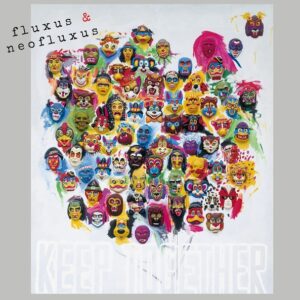
“Fluxus & Neofluxus: Keep Together (Part II)”
In April 2023, the first part of the Fluxus edition called Stolen Symphony was released. Now, in 2024, there is the second part, called Keep Together. At the center of this edition was a broken piano, acquired by the Opening Performance Orchestra for the purpose of making live and studio recordings. During this time other new works for this broken piano were written by diverse Fluxus and non-Fluxus composers. In the spring of 2022, the Opening Performance Orchestra and the broken piano participated in an event hosted by Mieko Shiomi. This was a new version of her early work Spatial Poem, documentation of which was presented at the 2022 Aichi Triennale in Tokyo. At present, the broken piano lies in the open air in Prague and is subject to gradual decay. This edition contains new and old pieces, live and studio recordings, finished pieces and scores to be performed, solos and pieces for ensemble, using classical and special instruments from 33 Fluxus artists, which have been played by ten soloists and four ensembles. There are new essays and articles from 15 writers on the theme Fluxus, as well as original photos and other documentation in the booklets. The Belgian label Sub Rosa provided technical support and a good place for the grand-scale release. The audio restauration and mastering were done by Gabriel Séverin at Laboratoire central, Brussels, and Kakaxa, 3bees, Prague. Archivio Conz in Berlin provided access to their extensive archives and Edizioni Conz provided co-production. Ursula and René Block made possible the realization of John Cage's historical composition "Mozart Mix" from the Edition Block archive. The photographic material comes from Marie Knízáková and Milan Knízák's private archive, the German photographer Wolfgang Träger, Archivio Conz's Fluxus archive, the private archives from diverse Fluxus artists and Opening Performance Orchestra's digital archive. Milan Knízák, Henning Christiansen, La Monte Young, Philip Corner, Bengt af Klintberg, George Maciunas, Takako Saito, Toshi Ichiyanagi, John Cage, Geoffrey Hendricks, Nam June Paik, Sara Miyamoto, Ken Friedman, Yoko Ono, Josef Anton Riedl, Giancarlo Cardini, Ay-O, and George Brecht.
27,00€
In stock

2 LP
CRANIOCLAST
“Arctic Salon”
Planned in the early 90's executed in the early 20's: The Arctic Salon. Another Cranioclast Expedition, this time to the Pole. A long time between planning and execution, but much shorter than the time between the first fake reports of having reached the North Pole on foot across the ice and the first expedition that really made it without motorization. But also a long time in which things in the Arctic and Antarctic got worse and worse and continue.
Double LP almost completely transparent like ice but hotter or cooler (we hope ;- ).
Cranioclast is a project which produces various artistic endeavours, most commonly music. Active since the 1980ies.
Icy clear vinyl in transparent pvc sleeves with sticker, 300 copies
28,00€
In stock

2 LP
Ustad Zia Mohiuddin DAGAR
“Vrindavan 1982”
Black Truffle is thrilled to present a previously unheard performance by rudra veena master Ustad Zia Mohiuddin Dagar, recorded in the North Indian city of Vrindavan at the Druhpad Samaroh festival in 1982. Z.M. Dagar was a nineteenth-generation descendant of the Dagar family of musicians, famed for their profoundly meditative approach to the tradition of Hindustani court music. Perhaps the most revered members of the family were the brothers Mohinuddin and Aminuddin Dagar, who played a key role in reawakening interest in dhrupad in the mid-20th century. The great exponents of the tradition from whom Z.M. Dagar descended were all singers, and dhrupad is essentially vocal music. However, as Z.M. Dagar explained, the veena family of instruments plays an important role in the education and practice of dhrupad singers, especially as an aid to mastering the fine microtonal nuances of pitch essential to the genre. Introduced as a child by his father to the rudra veena, a large and low-pitched veena amplified by two enormous gourds, Z.M. Dagar became the first modern dhrupad musician to perform with it as an instrumental soloist, giving his first recital at the age of 16. Devoted to the instrument throughout his life, he made innovations to its design and materials, as well as introducing novel techniques (such as playing without the use of the traditional wire plectrum, resulting in the remarkable warmth of his tone). In the great Dagar family tradition, his approach to the various ragas that make up the dhrupad repertoire was stately, slow, and considered, with a great emphasis on the alap, the heavily improvised exposition section. True to form, in this recording of Dagar performing the night raga Yaman Kalyan, the alap section stretches out to more than forty minutes of slow-motion bliss, a frozen tanpura drone hovering above Dagar’s gracefully bent notes and elegantly twisting phrases. In the alap’s first half, Dagar’s figures are so intently focused on the lower reaches of the rudra veena’s range that they register more as shudders and moans than melodic patterns. As the performance continues, he slowly climbs in pitch, though continuing with the same intent focus on the articulation of single notes and subtle microtonal variations. This leads to the jod section of the performance, which, though still accompanied only by the tanpura, gradually takes on a more rhythmic character. Developing almost imperceptibly over the course of nearly thirty minutes, the jod moves from the stillness of the opening alap to a rapid pulse that announces the closing section of the piece, where Dagar is joined by Shrikant Mishra on the pakhawaj (a double headed hand drum). Where many performers use the final section of the raga as an exercise in unrestrained virtuosity, Dagar and Mishra subtly weave a web of finely shifting accents and hypnotic melodic variations, bringing the recording to a fitting conclusion while remaining within the meditative space occupied by the performance as a whole. Adorned with beautiful archival photographs of Dagar taken by Swedish percussion legend Bengt Berger and accompanied by detailed notes from Bradford Bailey, Vrindavan 1982 is a stunning document of music unmatched in its patient focus and mysterious emotional depth.
35,00€
In stock

2 LP
DEDALUS ENSEMBLE
“Brian Eno Performed by Dedalus Ensemble”
Double LP version. With Discreet Music (1975), Music for Airports (1978), and Thursday Afternoon (1985), Brian Eno invented a new music genre, ambient music, which he defined as "able to accommodate many levels of listening attention without enforcing one in particular; it must be as ignorable as it is interesting." These versions performed and arranged by Dedalus Ensemble, according to the musicians and the critics who listened to it, goes beyond what you expect from it. A mental base that takes you far away. One of the only music without beginning or end in which we want to stay as long as possible.
Dedalus Ensemble: Founded in 1996 by Didier Aschour, Dedalus is a contemporary music ensemble based in Toulouse. Its repertoire includes works by classics of minimalism: Christian Wolff, Phill Niblock, Frederic Rzewski, Tom Johnson, Moondog, or Philip Glass. Personnel: Didier Aschour - guitar, arrangements and artistic direction; Denis Chouillet - piano; Amélie Berson - flute; Fabrice Villard - clarinet; Pierre-Stéphane Meugé - saxophone; Christian Pruvost - trumpet; Thierry Madiot - trombone; Silvia Tarozzi - violin; Cyprien Busolini - viola; Deborah Walker - cello; Eric Chalan - double bass, vibraphone.
Inspired by Erik Satie's furniture music, Cage's indeterminacy and La Monte Young's drones, Eno's series of compositions were based on strict formal protocols bringing the listener into an enthralling world of sounds. Brian Eno was widely seen as a pioneering and influential figure of popular music and worked with icons of pop culture such as David Bowie, U2, etc.
20,00€
In stock

2 LP
Julius EASTMAN
“Femenine”
In 2016, frozen reeds published the première release of Julius Eastman’s Femenine, for chamber ensemble. Laying unheard for decades prior, the release documented a 1974 performance by the S.E.M. Ensemble with the composer himself on piano.
It is now available on vinyl for the first time, in a revelatory new remaster by Jim O’Rourke.
The first release of Femenine served as the catalyst that propelled Eastman’s music into the mainstream. Articles on Eastman’s music and its immediate disruptive impact on the classical canon began to appear in every major news organ in the English-speaking world and beyond. His music began to be programmed in major concerts and festivals, several of these entirely themed around his life and work. New recordings sprang up from a fresh generation of musicians engaging with his ideas and interpreting them for a modern audience hungry to hear more.
But the raw, emotionally cascading spirit of the original performance continues to inspire listeners. Joyous, insistent, and immersive, Femenine bathes the listener in surges of tonal colour from intertwining winds, piano, violin, pitched percussion, synthesizer and – uniquely – the composer’s own invention of mechanised sleigh bells, which provide the 72-minute piece with its characteristic pulse.
Femenine was recorded live by Steve Cellum – co-producer of Arthur Russell’s World of Echo – and the new vinyl reissue has been remastered from the original high-definition tape transfer by Jim O’Rourke at his Steamroom studio in the Japanese mountains.
Illuminating sleeve notes are provided by composer and author Mary Jane Leach, key figure of the Eastman revival and co-editor of the Gay Guerrilla collection of essays on his life and music.
35,00€
Out of stock

2 LP
Oren AMBARCHI
“Grapes From The Estate”
2023 repress.
Black Truffle is pleased to make Oren Ambarchi’s Grapes from The Estate available once more on vinyl. Originally released on CD on Touch in 2004 and reissued on Southern Lord as a limited 2 LP in 2006 during Ambarchi’s tenure as a member of Sunn O))), Grapes from the Estate was a landmark release for Ambarchi, seeing him expand his sonic palette beyond the clipped, bass-heavy electric guitar tones he was known for at that point. Incorporating subtle layers of strings, keyboards, percussion over a bedrock of his signature guitar tones, in retrospect this album can be seen as the beginning of a broadening and evolution in Ambarchi’s work that would lead to his acclaimed, densely layered epics for Editions Mego, Quixotism (2014) and Hubris (2016). Beginning with the shuddering pure tones of opener ‘Corkscrew’, which looks back to previous guitar-only releases such as Suspension (2001), the album’s next two pieces show a progressive broadening of the instrumental palette and a corresponding move away from textural abstraction and sustained tones towards more traditional notions of musicality. This reached its high point on the album’s third piece, the fifteen-minute long ‘Remedios The Beauty’, where guitars, both acoustic and electric, strings, piano, and bells build from a murmur to an interlockinging web of repeating melodic patterns over gently swinging brushed snare and cymbals. The epic closer, ‘Stars Aligned, Webs Spun’, returns us to a space populated only by the electric guitar, but unlike everything Ambarchi had produced up until this point in his career, the piece has a liquid, psychedelic edge that looks forward to the shimmering harmonics of his more recent work. As Brendan Walls wrote at the time of the original release, this is ‘another outpouring of personal, intimate and enduring music from Oren Ambarchi’. Presented in a stunning gatefold sleeve featuring the original artwork and design by Jon Wozencroft. Redesigned by Stephen O’Malley. Remastered and cut by Rashad Becker at D&M, Berlin.
32,00€
In stock

2 LP
Pauline OLIVEROS
“The Well & The Gentle”
The Well & The Gentle, two of the major works of Pauline Oliveros, are presented here in a first time reissue on double vinyl in a gatefold sleeve with extensive liner notes.
If Oliveros had followed a more conventional path she may have, all social obstacles aside, been considered among the major composers of her time. However, Oliveros approached composition in a more egalitarian manner. She wrote music for musicians to interact with or, in the composers words, she wished to create "an inclusive and interdependent and unfolding world of relationships."
Oliveros' propensity towards inclusion is part of what makes this work so remarkably distinctive. The Well & The Gentle is carefully crafted, allowing performers to participate in the creation of the work. Players are asked to collaborate, focus, react and make imaginative choices. Only then can the performers "pass through stages of awakening to the possibilities inherent in making music, working together, leading to the essence of what can shape musical impulses and individual freedom simultaneously."
Unlike most major composers of the era, Oliveros' work focuses on collaboration and improvisation. For Oliveros, the processes involved in making music are as fundamental as the music itself. Oliveros creates, as Arthur Sabatini put it so eloquently in the liner notes, "A world in which sound and the practices entailed in making music merge; become, at once, source and atmosphere, energy and essence, presence and dynamic."
Pauline Oliveros was an electronic music pioneer, accordionist, composer and educator who resided in Kingston, New York. Her instrument was tuned in Just Intonation and she often included it in her meditative improvisational music. Her music is not meditative in the sense that it is intended for listening to while meditating, rather each piece is a form of meditation, such as her aptly titled Sonic Meditations.
A central figure in post-war electronic art music, Oliveros is one of the original members of the San Francisco Tape Music Center (along with Morton Subotnick, Ramon Sender, Terry Riley, Steve Reich and Anthony Martin), which was the resource on the U.S. West coast for electronic music during the 1960s. The Center later moved to Mills College, where she was its first director, and is now called the Center for Contemporary Music. Oliveros often improvised with the Expanded Instrument System, an electronic signal processing system she designed, in her performances and recordings.
39,00€
In stock

2 LP
PITA / FRIEDL
“Pita / Friedl”
Electronic music legend and head of Editions Mego, Peter Rehberg, teams up with zeitkratzer mastermind Reinhold Friedl. 3 side-long pieces melting electronic / contemporary avantgarde. Uncompromising.
When Peter "Pita" Rehberg and Reinhold Friedl first met each other, they did not like each other "at all," as Friedl emphasises with a hearty laugh. The two would however eventually bond over the years thanks to a mutual respect for each other's music. In the summer of 2021, they entered the studio together for the first time. Their joint album for Berlin's Karlrecords is a faithful document—no editing, no overdubs—of their improvisations during two recording sessions shortly before Rehberg's sudden and untimely passing on July 22nd of that year. The three pieces see Rehberg working with electronics and Friedl with his inside piano, proving that they had indeed managed to find a common ground—up to a point where it at times becomes hard to tell who plays what on this record.
27,00€
Out of stock

2 LP
Julius EASTMAN
“Two Extended Pieces For Four Pianos”
2023 repress, black vinyl.
Four Pianos (1979-80): It is recognized today that these tutelary pieces for four pianos are among the most powerful in contemporary music, their impact is almost unparalleled. After the historical version recorded forty years ago, this one, featuring four of the greatest European performers, is now regaining its full power. High level recordings too.
Julius Eastman: There was some for John Cage, then came Christian Wolff, and finally Morton Feldman, from this school in New York. Only Julius Eastman remained outside the game, the last figure, the most solitary and enigmatic -- undoubtedly also one of the most powerful, and it is this power that is revealed through these recordings. In the 1970s and 1980s, Eastman was one of the very few African-Americans to gain recognition in the New York avant-garde music scene. He was politically committed, a figure of queer culture and a solar and solitary poet whose melancholy influenced his genius as well as his tragic destiny: suffering from various addictions, declared missing, actually homeless. During Winter of 1981-82, he got deported from his apartment by the police, who destroyed most of what he owned - including scores and recordings. He was found dead in 1990, on the streets of Buffalo, after years of vagrancy.
The Performers: Nicolas Horvath, pianist and electroacoustic composer; Melaine Dalibert, a French composer and pianist; Stephane Ginsburgh, a tireless surveyor of the repertoire but also explorer of new music; Wilhem Latchoumia, embraces both new music and the classical repertoire with success and charisma.
20,00€
Out of stock

2 LP
Peter “Sleazy” CHRISTOPHERSON
“The Art Of Mirrors (Homage To Derek Jarman)”
2108, warhouse find. White/Black Splatter Vinyl.
Shortly before his musical partnership as Coil ended following the death of Jhon Balance, Peter Christopherson performed a live soundtrack to his old friend and collaborator Derek Jarman's abstract 1973 Super 8 short The Art Of Mirrors in Paris.
Sleazy had worked with Jarman on many occasions, including providing the music as a member of Throbbing Gristle for In The Shadow Of The Sun in 1974, Coil's highly-charged compositions for The Angelic Conversation, as well as their singularly psychedelic disco contributions to the director's final swansong, Blue.
Since The Art Of Mirrors is barely six minutes long, quite how Christopherson made more than an hour of music to accompany the film's screening is something those who were there can answer best, but ultimately it's more or less irrelevant to the music as it appears here.
Split carefully across three sides of vinyl, the LP divides a continuous performance into what are now essentially three interrelated movements.
Each ebbs and flows with the same hallucinatory feeling that so much of the music that Christopherson made with others has, especially in Coil, and it soon begins to seem that time itself has become far more of an unnecessary frippery than usual.
20,00€
Out of stock

2 LP
Bernard PARMEGIANI
“De Natura Sonorum”
2022 repress
"De Natura Sonorum, Première série, 1975 (28'03)
- incidences / résonances
- accidents / harmoniques
- géologie sonore
- dynamique de la résonance
- étude élastique
- conjugaison du timbre
De Natura Sonorum, Deuxième série, 1975 (28'40)
- incidences / battements
- natures éphémères
- matières induites
- ondes croisées
- pleins et déliés
- points contre champs
Premiered at the Salle Wagram in Paris on 3rd June 1975.
A suite of twelve movements, divided into two series of six."
25,00€
Out of stock

2 LP
Eliane RADIGUE
“Opus 17”
Repress. Remastered, improved sound quality.
alga marghen very proudly presents “Opus 17”, a major turning-point in the sonic oeuvre of Eliane Radigue. Finished in 1970 it was the last work composed with feedback materials. From that experimental period “Opus 17” preserves the plastic character: a music made of rough sonic phenomena, at once harsh and granular, possessing a quality of materiality and tactility. Its vibrations structure the air surrounding the listener with densities, thicknesses, indeed with palpable movement. Her compositions are frames which let us hear these phenomena, open frameworks from the sonic installations of her Endless Musics (cf. “Feedback Works 1969-70” LP issued on alga marghen) and here reinserted in the five scenes making up “Opus 17”.
In 1970, in her studio of very rudimentary means, she developed a completely unique body of work centered on sounds produced by feedback. “Opus 17” has the quality of showing off the sum of the achieved techniques and methods. Eliane Radigue’s music has never been rooted in ideas but in practice, the intimate experience of things in the wild which she has known how to tame. This dialog both intense and poetic which she keeps up with the solid matter of sound finds a remarkable concretization in “Opus 17”.
It is to be underlined that with “Opus 17” Eliane Radigue inaugurates a technique of composition which will be her footprint, her trademark: imperceptible transformations. For that she has developed a technique of meticulous mixings, based on the slow passage from one section to the next. Imperceptible, all during the piece, we pass, ceaselessly and without noticing the changes, from one frequency flux to another. Time is suspended, smoothed out, stretched. It is this technique which Eliane Radigue will be essentially using for all the electronic works to come and which she will never cease to refine and render always more subtile.
“Opus 17” is the great panoramic voyage through material sound, its electronic phenomena detailed as if in a microscope. Could feedback really contain such a universe? “Yes”, the work of Eliane Radigue answers, but that exploration was not that easy: one had to learn to listen. It required Eliane Radigue’s great demands on listening which led her to the discovery of such treasures. Unknown wealth in a material often rejected as trivial.
As Rhys Chatham recalls: “Eliane Radigue (...) had just moved to New York and had the idea of acquiring an analog modular synthesizer, which is why she worked at NYU in order to try out the possibilities of the Buchla 100 series which we had there. One day, while gossiping, she invited me to her loft, which was just on the corner. She had me listen to a piece composed in France; the piece called ‘Opus 17’. (...) What I heard changed to course of my life as a composer. (...) That piece, impressive source of inspiration, gave the impression of being in a grand cathedral, both for the sensation of immensity of being in such a large cathedral, as for the effect of being so close to God”. This anecdote has its importance because it is evident when listening to the feedback works that Eliane Radigue had already put in place the essential part of her musical æsthetic.
“Opus 17” was created at the artistic center of Verderonne on May 23, 1970, for the Fête en blanc (i.e. White Festival) organized by the visual artists Antoni Miralda, Joan Rabascall, Dorothée Selz and Jaume Xifra.
Previously unreleased, “Opus 17” is now issued on alga marghen in a first edition of 400 copies in gatefold sleeve.
34,00€
Out of stock

2 LP
Henning CHRISTIANSEN
“OP.163 Penthesilea”
A previously unreleased project of Henning Christiansen, monumental in scope, traversing years, countries and now, formats. The Henning Christiansen Archive is proud to finally present one of the crown jewels of the archive, the masterpiece ‘Penthesilea’ as a 2LP and 5CD set.
Pentheseila is one of the most ambitious works in the entire Henning Christiansen oeuvre. A large-scale work from the mid eighties based on the play of the same name by Heinrich von Kleist (1808). Both Henning and his widow, Ursula Reuter Christiansen, were enthusiastic about Kleist’s text, both making works around the themes within this portent text.
Henning Christiansen first developed a work around this text for the Rosenfest festival performed in Berlin in 1984. Rosenfest was curated by René Block and featured a variety of composers presenting works in response to Kleist’s work including Robert Ashley, “Blue” Gene Tyranny etc. Henning formulated a composition utilising tape, field recordings, voice, soprano, and violoncello alongside the home made instruments of Werner Durand.
The live presentation was then expanded upon and first performed two years later at Teatro Olímpico, Rome on the 8th November 1986 as directed by Carlo Quartucci. The two releases presented here include a 2 x vinyl LP of the Rosenfest recordings in 1984 and a 5CD set sharing the four and a half hour backing track prepared for the Teatro Olímpico performance in Rome in 1986. Together these two releases make up a substantial overview of one of the most significant works in the entire Christiansen canon.
45,00€
In stock

2 LP
Kiyoshi MIZUTANI
“Inferior’s Betrayal”
Reissue of the self-produced K7 in 1994 on Kiyoshi Mizutani's Ulcer House label.
Mizutani was a member of Merzbow in the '80s and has done solo work since 1989. He has recordings on Ulcer House, ZSF Produkt, Shirocoal Recordings, NEdS, Sounds For Consciousness Rape, Pure, Artware, Kaon, e(r)ostrate, Povertech Industries, and Flenix Records.
27,00€
In stock
2 LP
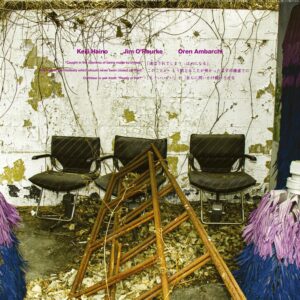
Keiji HAINO – Jim O’ROURKE – Oren AMBARCHI
“Caught in the dilemma of being made to choose”
The renowned trio of Keiji Haino, Jim O’Rourke and Oren Ambarchi return to Black Truffle with their 11th release, “Caught in the dilemma of being made to choose” This makes the modesty which should never been closed off itself Continue to ask itself: “Ready or not?” Demonstrating once again their commitment to continual experimentation in instrumentation and approach, the record begins with a long-distance collaboration made in response to a commission from New York’s Issue Project Room in 2021 during widespread lockdowns and travel limitations. A unique piece in the trio’s extensive body of work, this side-long epic finds Haino performing on metal percussion, O’Rourke on electronics and Ambarchi on gongs and bells. Initially dominated by rapid patterns on resonant, high-pitched tuned percussion, the piece sets Haino’s dynamic and dramatic performance against a calm backdrop of cycling electronics, thrumming gong strikes and hanging bell tones. The performance develops a heightened, intensely concentrated atmosphere reminiscent of Haino’s classic Tenshi No Ginjinka or his Nijiumu project; when Haino moves to clashing hand cymbals in its second half, the piece’s ritualistic energy suggests aspects of the music of Tibetan Buddhism.
The remainder of the double LP documents the trio live at Tokyo’s SuperDeluxe (the location of all but their very first recording) in a wide-ranging set recorded in December 2017. The concert opens, in another first for the trio, with Haino on drums, O’Rourke on Hammond organ and Ambarchi on his signature Leslie cabinet guitar tones. Haino’s explosively untutored approach to the drumkit will be familiar to some listeners from the radical duo iteration of Fushitsusha heard on Origin’s Hesitation. Setting flurries of rapid activity against moments of silence, his drumming here at times suggests Milford Graves in its tumbling toms and thudding kick-drum propulsion. Accompanied by O’Rourke’s organ and Ambarchi’s guitar, which in their shared use of long tones and shifting modulation speeds almost blend into a single voice, the opening sections of this performance are some of the most magical music the trio has committed to tape thus far.
After an interlude of spoken vocals in both Japanese and English, Haino makes a dramatic entrance on guitar. Against O’Rourke and Ambarchi’s increasingly intense electronic backdrop, Haino unleashes a stunning passage of slowly moving chromatic melodies and sudden shrieking explosions bathed in distortion and reverb. By the time we reach the third side, the guitar/bass/drums power trio is established and lurches into a passage of massive, lumbering rock that threatens to fall apart at every beat, O’Rourke’s strummed chordal work on six string bass creating a harmonic density equivalent to a second guitar. An abrupt edit throws the listener in media res into a frantic locked groove grounded by fuzzed out bass patterns and caveman drums. As Haino moves through a variety of approaches, from massive edifices of stuttering fuzz to ominous swarms of feedback, the trio eventually stumble into a kind of Harmolodic military tattoo, Haino’s guitar weaving and slashing across the rhythm section’s irregular accents. Moving through an epic opening duet for O’Rourke on Hammond and Haino’s wailing guitar, the fourth side eventually ramps up into a frenetic finale of mad bass riffing, crackling snare hits and guitar squall.“Caught in the dilemma of being made to choose” This makes the modesty which should never been closed off itself Continue to ask itself: “Ready or not?” is a testament to the continuing power and invention of this trio, who continue to seek out new terrain after over a decade working together. 2LP set presented in a lavish gatefold sleeve on heavy stock along with inner sleeves containing live pics by Tsuyoshi Kamaike. Photography by Jim O’Rourke, design by Lasse Marhaug and translation by Alan Cummings.
32,00€
Out of stock
2 LP
Uri KATZENSTEIN
“Audio Works”
Black Truffle is pleased to announce Uri Katzenstein’s Audio Works, produced in collaboration with Holon’s Centre for Digital Art. Spanning sculptural installation, performance, video art, and many other media, Katzenstein’s absurdist, poetic, and often hilarious work made extensive use of sound and music. This, however, is the first release dedicated to the artist’s audio work, collecting 28 tracks produced between the early 1980s and 2017. Compiled from dozens of hours of recordings left uncatalogued (and in some instances unheard) at the artist’s death in 2018, these four sides are a treasure trove, offering a captivating glimpse into a uniquely uninhibited creative practice. Predominantly recorded alone, with some contributions from regular collaborators such as Ohad Fishof on the later pieces, many of these tracks stem from Katzenstein’s time living in New York in the 1980s. Feeding on the cross-pollination of post-punk energy, radical art practice, and new media possibilities that characterised the New York scene at this time, many of Katzenstein’s recordings squeeze multilayered vocal experimentation into synth-based miniatures with a distinctively pop twist, their forms ruptured with anarchic bursts of free-form electronics, sounds from self-built instruments, and field-recorded snatches of the outside world. Katzenstein’s electronic production calls up touchstones of skewed 80s art pop like Laurie Anderson, Ambitious Lovers, and Scritti Politti, but imbued with DIY directness and economy of means. The arrangements of synths, percussion, and noise elements are invigoratingly raw and, at times, almost austerely minimal. On ‘Intermission’, thick distorted chords accompany a wandering portamento melody, inhabiting the wayward carnival space of Roedelius’ most unhinged efforts. Many of the tracks centre on Katzenstein’s multi-tracked vocal performances, often moving between multiple languages, (most commonly English, German, French, and Hebrew). A bewildering range of vocal approaches are present on these pieces, from sweet wordless harmonies to hammed-up growls and monastic recitations. On ‘Skin O. Daayba – Complex Habits no. 3’, improvised resonance singing against a backdrop of echoing electronics and radio snatches. ‘Half Monk Half Herring’ layers multi-lingual syllabic fragments, crossing sound poetry techniques with melodic invention in a way rarely heard outside of Caetano Veloso’s Araçá Azul. On ‘Attempt to Raise Hell’, Katzenstein’s distorted voice spits out streams of alliterative nonsense (‘the hemlock of Henry, he was a hermit…purple pumpkin pulsates to pops’), while on the hilarious ‘Eric’, Katzenstein appears to instruct a small boy simultaneously in basic French and German conversation. On ‘Chicken’, vocal harmonies accompany the pecking and clucking of the titular fowl. Moving from bent, outsider synth pop to snatches of Jo Jones-esque automated instrumental clang and absurdist linguistic experiments, these are far more than footnotes to an artist’s gallery works. Accompanied by extensive, beautifully written liner notes by Roee Rosen and the little information that exists on the individual tracks, Katzenstein’s Audio Works inhabits an outer fringe of DIY pop and sonic experiment reminiscent of Pascal Comelade or Die Welttraumforscher, where accessible forms convey radical interrogations of song, word, and sound.
Deluxe 2LP set presented in a gatefold sleeve with extensive liner notes and an insert with track info.
29,00€
Out of stock

2 LP
Amelia CUNI
“Mumbai 04.02.1996”
Following on from the stunning recording of her 1992 performance at the Berlin Parampara Festival (BT079), Black Truffle is pleased to continue its documentation of the work of Berlin-based Italian singer Amelia Cuni, one of the great contemporary exponents of dhrupad, the oldest surviving style of North Indian classical vocal music. Beautifully recorded in concert at Vishweshwarayya Hall, Mumbai. 04.02.1996 presents expansive performances of three ragas stretching across four sides and almost one and a half hours of music. Beginning with the serene Raga Lalit, Cuni dwells for over twenty-five minutes on its opening alap movement, accompanied only by tanpura, her limpid yet full-bodied voice moving from graceful exposition in free tempo to increasingly rhythmically active variations, gradually spiralling upward in register. She is then joined by master pakwahaj player Manik Munde for the raga’s dhrupad and dhamar sections, the resonant tone of the drum and his constant invention with the complex 14-beat cycle serving as the perfect accompaniment for Cuni’s ecstatic melodic developments. On the more solemn Raga Bhairav, Cuni’s alap, again stretching out over a whole side, is particularly notable for its powerful held notes and mastery of microtonal movement of pitch. After Munde returns for another rhythmically intricate dhamar movement, the record ends with the buoyancy of the Raga Alhaiya Bilaval, whose mode has, for the Western listener, an unmistakably ‘major’ quality. The rapturous applause that greets the performance is reflected in a remarkable selection of press clippings contemporary with the recording, which demonstrate Cuni’s success with Indian critics. Arriving in a gorgeous gatefold featuring stunning colour photographs of Cuni taken by legendary Australian fashion photographer Robyn Beeche (who resided in India from the early 90s), Mumbai. 04.02.1996 is a document of indescribable beauty and a moving testament to music’s ability to cross national and cultural borders.
32,00€
In stock
2 LP
KONSTRUKT & Peter BRÖTZMANN
“Dolunay”
The ongoing series / tradition of a Konstrukt release in august this time returns to the early beginning: the overdue double vinyl reissue of the turkish free-formers’ studio meeting with the german free jazz titan Peter Brötzmann from 2008. Remastered by Kassian Troyer at D&M, Berlin.
As written in several info sheets before, the Istanbul-based collective led by multi-instrumentalist Umut Çağlar (also member of Karkhana) and reeds player Korhan Futaci has since its formation in 2008 created an impressive catalogue including collaborations / performances with significant musicians like Keiji Haino, Joe Mcphee, William Parker, Akira Sakata, Marshall Allen, Evan Parker, Thurston Moore, Michael Zerang, Alfred Harth Or Alexander Hawkins – and Peter Brötzmann. The German Free Jazz titan was invited to the Deneyevi Studio in the Turkish capital in november 2008 where they recorded „Dolunay“, an album that was released three years later on a small label in Turkey only. Back then a quartet with drums and percussion, guitar, reeds but no bass player, Konstrukt and their iconic guest took off on a session full of fire and fury: shrieking reeds, thundering drums andandand … Free Jazz of the wildest, most energetic and kathartic (afterwards) kind!
27,00€
In stock

2 LP
Léo KUPPER
“Electronic Works & Voices 1977-1987”
Perfect follow up to our precedent 2LP (Electronic Works & Voices 1961-1979), this release highlights Leo Kupper's earliest compositions with his GAME machine - Générateur Automatique de Musique Electronique (Automatic Generatorof Electronic Music) constructed during the 1960's. Purely electronic sounds into new structures, Leo Kupper shows through his 4 tracks a real spirit of renewal.
Leo Kupper was born in Nidrum, Hautes Fagnes (Eastern Belgium)`on the 16th of April 1935. He studied musicology at the Liège Conservatory, then became the assistant of Henri Pousseur who, in 1958, had just founded the Apelac Studio in Brussels. Kupper started to work on his first pieces there, but he would finalize them only upon putting together his own studio in 1967: the Studio de Recherches et de Structurations Electroniques Auditives (which means 'studio of audio electronic research & structuring'). That is where he would compose, to this day, over forty works, most of them on instruments of his own design. In the '70s and '80s, he built a series of Sound Domes (briefly established in Rome, Linz, Venice, and Avignon), places where every sound, every phonem uttered by the listening audience was transformed by hundreds of loudspeakers of various sizes organized in a dome shape.
This device transformed sounds through space AND time: something said could be morphed into another sound hours, days, perhaps years later.
Leo had envisioned that a device like his, a place for contemplation, would be much-needed in cities where Nature had been evacuated.
In the late '70s, after discovering Iranian music master Hussein Malek, Kupper became one of the very few Western virtuosos of the santur.
His first pieces were released by Deutsche Grammophon and, later, Igloo.
His latest works have been released by the New York-based label Pogus.
The GAME machine
In 1961, having terminated his musicology studies, Leo Kupper left Liège for Brussels. By that time, centres for music research such as those in Cologne, Paris and Milan had already produced works of experimental music, where pioneers were forging new and diverse routes in electronic music, 'musique concrète' and electro-vocal music. The GAME machine - Générateur Automatique de Musique Electronique (Automatic Generator of Electronic Music) was constructed during such period and spirit of renewal and technical exploration. The GAME consisted of a collection of variable 'sonic cells' sensitive to modulations of positive and negative voltages and programmable manually through the aid of colour-coded cables. Complex electronic loops and sound from loudspeakers and from microphone pick-ups were then either recorded by tape-machines or performed and interpreted by musicians who opened automatic channels, thus triggering automatic sound to exit the speakers. This in turn penetrated the machines by means of microphones and was replayed. Here then was an entirely new way of playing a musical instrument and how the works here were composed and performed.
20,00€
In stock

2 LP
Jérôme NOETINGER
“Sur quelques mondes étranges”
The music on this long-awaited solo vinyl album by legendary tape artist Jérôme Noetinger was recorded live in the studio with no overdubs. Signals were sent through tube broadcast monitors and picked up with room microphones. Produced by Tobias Levin. Cover by Meeuw.
--
Long-time touchstone of international experimental music presents his monolithic (and first) solo vinyl Sur quelques mondes étranges on Felix Kubin’s Gagarin Records. Jérôme Noetinger is known to most for the audio-visual trio Cellule d’Intervention Metamkine, alongside his countless recorded & live collaborations, compositions for radio & stage, and breathtaking multi-channel diffusions in the acousmatic tradition.
Discovering the ReVox B77 tape machine as his tool for live electro-acoustic music in 1987, Noetinger has doggedly investigated his instrument over 35 years, establishing him as a vital contemporary composer/performer of the medium. His work is radical and interrogatory, using a pan-historical array of analogue devices to construct soundworlds which sidestep digital monochrome, landing in a galaxy of simmering malfunction, dynamic physicality & rhythmic debris. Programming Le 102 in Grenoble for over a decade, as well as directing Metamkine distribution for over three, his encyclopaedic knowledge of manifold sonic traditions is on display here; unified by a staunch discipline, impressive dedication and flat rejection of empty trends.
The results synthesise his tireless timbral research into 11 striking sonic investigations which combine modern studio possibilities with years of performance experience worldwide. An ominous malaise hovers over proceedings; yet it never feels nihilistic, presenting solutions which electrify the listener with ecstatic discovery. The perceptual orchestration therein - from throwing our ears right against the body of the tape machine to flinging them into cavernous space alive with the aurally strange - is both delirious & calming. Noetinger is all too aware things are bad, but his drive for discovery and joyous belief in music somehow coruscates brilliantly through contemporary gloom.
Meticulously recorded & produced with Tobias Levin in Hamburg, Sur quelques mondes étranges presents a detailed & rich vocabulary both real & unreal: gesture & repetition, structure & collapse, familiar & uncanny all dance with each in the most pumping discothèque concrète in this universe. This is a powerful and exacting statement from an elegant composer & extraordinary musician who has humbly dedicated his life to his practice.
– Anthony Pateras
30,00€
In stock

2 LP
NURSE WITH WOUND
“Gyllensköld, Geijerstam And I At Rydberg’s” (silver)
Silver and black record
*
"This 1983 period in which Gyllensköld was recorded was a fantastic time for the evolution of Steven Stapleton's audio art. His collaborations with Diana Rogerson, Robert Haigh (Sema), David Tibet, and Thirlwell around this time elicited some of the most exciting work Nurse With Wound had yet recorded. Listen to this material and compare it to Chance Meeting and it becomes clear that in just a few years, Stapleton's art had grown by leaps and bounds. The production quality on these tracks is remarkable, and the widening out of the NWW soundworld opened up a whole new audio toybox that Stapleton has continued to experiment with up to today. This new sound encompasses vocal experiments, vintage LPs of easy listening music, demented nursery rhymes, lateral references to disposable pop music, avant-garde jazz and minimalistic piano composition, all glued together with evocative atmospheres redolent of things unholy, troubling and perverse, but always oddly indefinable and puzzlingly misshapen. In retrospect, Gyllensköld can be seen as the beginning of the 'mature;' period of NWW, and thus it is an indispensable release for fans of the project. Perhaps influenced by the obsessions of his friend and collaborator Tibet, Stapleton also began weaving religious and occult references into his usual name-dropping of avant-garde artists and movements . . . NWW's Gyllensköld comes across at times as the soundtrack to a schizoid episode: disembodied voices intoning nonsense, floating subliminally across the stereo channels, or cackling in evil delight. The sounds are denser here than on earlier works such as Homotopy To Marie. Areas of silence are mostly gone, replaced by layers of drone, cartoonish noises and mutated voices. 'Several Odd Moments Prior to Lunch' opens the brief album, setting the stage with its lysergically altered vocals and a frightening, yawning chasm of haunted, spectral sound. Stapleton, Thirlwell, and company learned how to wield the studio like an instrument on these and other recordings of the period. Effects such as reverb, delay, ring modulation and backwards tracking are utilized to create evolving textures and darkly psychedelic dreamspaces. 'Phenomenon of Aquarium and Bearded Lady' utilizes a number of instruments, including horns and piano, to create a bizarre dislocated funeral dirge in which the sounds of a slowly cycling jack-in-the-box are not out of place. For fans of musicians like Jacques Berrocal, who prefer their free jazz with a heavy dose of whacked-out eccentricity, this is about as good as it gets. 'Dirty Fingernails' is something else entirely, a longform exploration of outré textures, combining mysterious trebly noises with percussive bleeps of mysterious origin." --Brainwashed
35,00€
Out of stock
2 LP
NURSE WITH WOUND
“Gyllensköld, Geijerstam And I At Rydberg’s”
"This 1983 period in which Gyllensköld was recorded was a fantastic time for the evolution of Steven Stapleton's audio art. His collaborations with Diana Rogerson, Robert Haigh (Sema), David Tibet, and Thirlwell around this time elicited some of the most exciting work Nurse With Wound had yet recorded. Listen to this material and compare it to Chance Meeting and it becomes clear that in just a few years, Stapleton's art had grown by leaps and bounds. The production quality on these tracks is remarkable, and the widening out of the NWW soundworld opened up a whole new audio toybox that Stapleton has continued to experiment with up to today. This new sound encompasses vocal experiments, vintage LPs of easy listening music, demented nursery rhymes, lateral references to disposable pop music, avant-garde jazz and minimalistic piano composition, all glued together with evocative atmospheres redolent of things unholy, troubling and perverse, but always oddly indefinable and puzzlingly misshapen. In retrospect, Gyllensköld can be seen as the beginning of the 'mature;' period of NWW, and thus it is an indispensable release for fans of the project. Perhaps influenced by the obsessions of his friend and collaborator Tibet, Stapleton also began weaving religious and occult references into his usual name-dropping of avant-garde artists and movements . . . NWW's Gyllensköld comes across at times as the soundtrack to a schizoid episode: disembodied voices intoning nonsense, floating subliminally across the stereo channels, or cackling in evil delight. The sounds are denser here than on earlier works such as Homotopy To Marie. Areas of silence are mostly gone, replaced by layers of drone, cartoonish noises and mutated voices. 'Several Odd Moments Prior to Lunch' opens the brief album, setting the stage with its lysergically altered vocals and a frightening, yawning chasm of haunted, spectral sound. Stapleton, Thirlwell, and company learned how to wield the studio like an instrument on these and other recordings of the period. Effects such as reverb, delay, ring modulation and backwards tracking are utilized to create evolving textures and darkly psychedelic dreamspaces. 'Phenomenon of Aquarium and Bearded Lady' utilizes a number of instruments, including horns and piano, to create a bizarre dislocated funeral dirge in which the sounds of a slowly cycling jack-in-the-box are not out of place. For fans of musicians like Jacques Berrocal, who prefer their free jazz with a heavy dose of whacked-out eccentricity, this is about as good as it gets. 'Dirty Fingernails' is something else entirely, a longform exploration of outré textures, combining mysterious trebly noises with percussive bleeps of mysterious origin." --Brainwashed
29,00€
In stock
2 LP
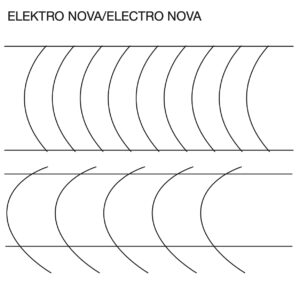
ELEKTRO NOVA
“Electro Nova”
Like a rediscovered Viking burial ship, Electro Nova compiles near-mythical drone recordings produced in 1998 and described by Helge Sten aka Deathprod as some of the most important music to ever come out of Norway. It’s the work of Kåre Dehlie Thorstad and compiles two of the earliest releases on Smalltown Supersound, back when it was basically no more than a bedroom operation. It’s taken over two decades, but finally the label have given the material a first ever proper release on vinyl, complete with mixing and mastering by Deathprod. If you’re into the ice cold swells of anyone from Thomas Köner to Harley Gaber, Biosphere, Kali Malone or, of course, Deathprod - this one’s as essential as they come.
Kaare Dehlie Thorstad’s Elektro Nova produced just two releases during the late ‘90s that have since slipped into drone lore - Trans-Inter-Ference and Elektro Nova/Electro Nova. Admired not only by Deathprod and Joakim Haugland of Smalltown, but also by his contemporaries Lasse Marhaug and Biosphere, his work has evaded pretty much any attention outside of Norway these last two decades. Following a chance meeting with Thorstad at Oslo airport a few years back, Smalltown were prompted to give the recordings a second wind, presenting what is essentially a captivating new release, and crucial addition to the Norsk drone canon.
As the story goes, Thorstad was studying photography in the late 90’s in Scotland, but instead of delivering a photo for his final exam he made a record - a double album (2CDs) and a 10” to be precise. That should provide some idea of the textural synaesthetic and landscaping qualities evoked by his music, which he ended up sending to a then-young Smalltown label, who were mostly issuing tapes at the time. With no proper distribution the records largely bypassed wider attention, and become a personal favourite of Smalltown’s Joakim Haugland, as well as avowed fan Helge Sten (Deathprod), who helped render its diaphanous scale in mix down, and Lasse Marhaug who describes them as “two perfect records that deserved much bigger attention”.
Between its jaw-dropping opener; the post-apocalyptic vision of its untitled part; and the cinematic white-out of the 10” tracks; Thorstad comes as close as we’ve ever heard to evoking the inhospitable nature and stark beauty of the wild far north. We can hear those landscapes palpably internalised and alchemically transmuted into its coarse grained textural swells and a reverberating multi-dimensionality, variously sustained to extents that evoke an abandonment of the senses, or likewise squashed and isolated to imply the relative anxiety relief of atmospheric flux, where a few degrees temperature rise or a drop in the wind speed can make the difference between life and death.
30,00€
In stock

2 LP
Robert TURMAN
“Flux” (clear)
"Flux" is the 1981 debut solo outing of Robert Turman, an American multi-instrumentalist and avant-garde composer. Until recently, Turman was perhaps best known for his contributions to the ballistic NON project with Boyd Rice, as well as other obscured U.S. industrial acts such as Z.O. Voider.
In the summer of 1981 Turman decided he would take a drastic turn from the noisy/electronic/industrial work of his compatriots, and began work on what is now the classic "Flux" cassette. "Flux" was originally self-released in extremely limited numbers. Weary of the noisescapes of old, he set out to create long-form minimalism utilizing kalimba, piano, "Mini-Pops Jr." drum machine, and tape loops to create a complex bed of interweaving micro-stasis'. The results of these new experiments were as beautiful as they were perplexing.
A curious dusty fidelity carries these classic tracks across four sides of vinyl, including all of the original "Flux" content. These compositions glow with a sprawling, slow motion haze that's light years ahead of its time. "Flux" reveals wide spectrums of sound from melancholic kalimba and percussion patterns to slowed down, syrupy Exotica. Turman had complex ideas in his mind yet only the simple technologies of the day were at hand. Hear the click of the stopping and starting Tascam 3340 open-reel tape machine as one hand presses the "record" and "play" buttons and the other plays piano phrases. While there are similarities in style to Classical Minimalism, Turman's sound and vision is his own and is exclusive to his limited discography.
Released in a limited edition 2xLP set, Lovingly remastered and cut by Rashad Becker at Dubplates and Mastering from the original c-60 cassette master.
Original cassette artwork and scans provided by Aaron Dilloway.
2022 repress, clear vinyl.
24,50€
In stock
2 LP
Robert TURMAN
“Flux”
"Flux" is the 1981 debut solo outing of Robert Turman, an American multi-instrumentalist and avant-garde composer. Until recently, Turman was perhaps best known for his contributions to the ballistic NON project with Boyd Rice, as well as other obscured U.S. industrial acts such as Z.O. Voider.
In the summer of 1981 Turman decided he would take a drastic turn from the noisy/electronic/industrial work of his compatriots, and began work on what is now the classic "Flux" cassette. "Flux" was originally self-released in extremely limited numbers. Weary of the noisescapes of old, he set out to create long-form minimalism utilizing kalimba, piano, "Mini-Pops Jr." drum machine, and tape loops to create a complex bed of interweaving micro-stasis'. The results of these new experiments were as beautiful as they were perplexing.
A curious dusty fidelity carries these classic tracks across four sides of vinyl, including all of the original "Flux" content. These compositions glow with a sprawling, slow motion haze that's light years ahead of its time. "Flux" reveals wide spectrums of sound from melancholic kalimba and percussion patterns to slowed down, syrupy Exotica. Turman had complex ideas in his mind yet only the simple technologies of the day were at hand. Hear the click of the stopping and starting Tascam 3340 open-reel tape machine as one hand presses the "record" and "play" buttons and the other plays piano phrases. While there are similarities in style to Classical Minimalism, Turman's sound and vision is his own and is exclusive to his limited discography.
Released in a limited edition 2xLP set, Lovingly remastered and cut by Rashad Becker at Dubplates and Mastering from the original c-60 cassette master.
Original cassette artwork and scans provided by Aaron Dilloway.
2022 repress, black vinyl..
23,50€