

2 CD
Francisco LÓPEZ – Michael GENDREAU
“TDDM”
This 2CD set gathers two compositions each by Michael Gendreau and Francisco Lopez.
TDDM is based on sound materials recorded in factories in Asia. The 2 Michael Gendreau tracks focus on factories sound environment meanwhile Francisco Lopez works more on machinery and engines. The result is a strong and intense body of work, a total immersion into industrial estates sounds. This isn’t a work on microsound or lowercase music but a real physical experience.
Michael Gendreau (San Francisco), former member of the underground duo Crawling with Tarts, studied composition at Mills College and now works as an acoustician specialized in machinery vibration isolation and environmental noise studies (among other things). He releases now his works under his own name.
Francisco Lopez (Madrid) : "Francisco López is internationally recognized as one of the major figures of the underground experimental music scene. Over the last twenty five years he has developed an astonishing sonic universe, absolutely personal and iconoclastic, based on a profound listening of the world. Destroying boundaries between industrial sounds and wilderness sound environments, shifting with passion from the limits of perception to the most dreadful abyss of sonic power, proposing a blind, profound and transcendental listening, freed from the imperatives of knowledge and open to sensory and spiritual expansion." [Pedro Higueras, Sonom Studios]
Vital : “One morning this week I played an old 7" by Vivenza - the futurist inspired musician, who used machine like sounds. I was thinking about Vivenza and that someone told me he didn’t use actual machine recordings, but a Putney synthesizer, which somehow sounded like machines. Curiously enough in the afternoon a new 2 CD arrived from Micheal Gendreau and Francisco Lopez. Looking at the sparse credits on the cover this seems not to be a collaborative effort, but both deliver two long pieces entirely based on their own recordings of machines in Taiwan and Malaysia (Gendreau) and Singapore, China, Taiwan and Japan (Lopez). In the first Lopez piece he comes close to the old Vivenza sound: hammering machine rhythms with lots of sound effects to transform the sound, but his other is entirely different. Very low in volume, and the sounds of the machines seem to be pushed to the background. There is a sense of rhythm to it, but it sounds quite strange. Ultimately, in fine Lopezian twist, things go up and the real machines comes in and as suddenly disappear. In the two pieces by Micheal Gendreau machine sounds play, obviously I say, a role too, but somehow he seems to be interested to create ’more music’ out of it, especially in ’M928’, with its organ like tones comes in and out of the piece, before it slips into silence first and then into noise. The first piece by him has a similar built-up but a different ending. Four different sides of the same coin. Excellent stuff, but I don’t think I expected something else”. (FdW)
12,00€

CD
David MARANHA + Z’EV
“Obsidiana”
David Maranha, hammond organ. Z’ev, stainless steel discs, bass drum, maracas. Recorded live at zdb, Lisbon, 24 june 2010. Certain musicians names can speak for themselves, before even a note of music has been played. Their reputations proceed them, although of course there will also be those ignorant of both reputation and name. David Maranha - solo or with Osso Exotico - explores the territories opened up half a century ago by John Cale and Tony Conrad. Z’ev is the grandmaster of industrial/ tribal percussion. The fusion they create together is a magma of movement and stasis before which only legless cripples will remain motionless.
5,00€

CD
Yannick DAUBY
“Overflows”
“Yannick Dauby, originated from Mediterranean Alps and currently based in Taiwan. Sound and location, sound and community, sound and ecology, are the main topics of his projects. Overflows is a composition based on field recordings in natural, industrial and urban environments dealing with the overwhelming of listening. Fans of Francisco Lopez, Jean-François Laporte or Eric La Casa will be delighted.”
5,00€
CD
Seth NEHIL
“Furl”
“Furl is the sequel to Seth Nehil’s critically acclaimed 2009 release Flock & Tumble, also on Sonoris. Continuing his exploration of physically charged, acousmatic sound, these compositions whip, crash, swoop, glide and burble. Clusters of bell-like tones pierce hazy, corroded atmospheres. Animalistic yelps, distant pings, percussive bursts and glassy swells all merge in this unique sound-world. These five pieces are both rigorously-assembled and gracefully sparse. Furl will be a welcome addition to the expanding catalogue in Nehil’s futuristic organic paradox.
What others had to say about Flock & Tumble : “Extraordinary… a wonderful sense of confidence in the material, an ability to go somewhere quite new.” - Richard Pinnell (The Watchful Ear). “Not too often you come across something that just sounds like little else.” - Brian Olewnick (Just Outside). “An important demonstration of Nehil’s abilities, this is a classic sleeper which deserves immediate exposure, well beyond the small circle of experts to which music like this is usually addressed.” - Massimo Ricci (Touching Extremes). Biography : Seth Nehil is an artist, performance-maker, and composer with a practice that crosses between sound, performance-events and the visual arts. In recent years he has created large-scale sound performances, collaborated with choreographers including Liz Gerring (NYC) and Linda Austin (Portland, Ore), and has published music on various international labels, including Sonoris (France) and Senufo Editions (Italy). Seth Nehil has also been an editor of arts publications, an organizer of performance festivals and a curator of exhibitions. He currently teaches sound, video and art theory at WSU Vancouver and the Pacific Northwest College of Art.
5,00€

CD
Mike SHIFLET & Daniel MENCHE
“Stalemate”
“Mike Shiflet and Daniel Menche: Hammond organs and electronics. Recorded in 2007-2008. Mastered in the analog domain at Stereophonic Masting in Portland, Oregon.
Mike Shiflet is one of the most interesting artists of the new US noise scene. He ran the Gameboy label with 100 releases in 10 years and, as musician, besides his solo recordings, he worked with C. Spencer Yeh-Burning Star Core, Brendan Murray, Francisco Meirino-Phroq & many others.
Daniel Menche is recognized since late eighties as a major figure of the experimental music world, exploring the fringe between noise and drone in a heavy and organic way. For 20 years Daniel Menche has harvested a vast discography of solo and collaborations.
Stalemate, the first collaborative work between these two prolific American artists, is based on Hammond organ sounds and electronics. The result is a heavy body of work - a powerful drone based music with densely textured sounds and some deep bass that’ll make your walls shaking.”
5,00€

CD
Jean-Michel RIVET
“À fleur de quai”
New CD on Sonoris from this French composer of electroacoustic music. Seven pieces (2005 - 2009) made mostly of sound events recorded through daily life.
5,00€

CD
Seth NEHIL
“Flock & tumble”
Seth Nehil is an American artist involved in various projects ranging from compositions for dance, installations, multimedia performances, publications and visual art. Over the years, he has collaborated with other significant sound researchers (John Grzinich, Olivia Block, Michael Northam, Matt Marble and Brendan Murray) and has released many CDs on international labels such as Kaon, Alluvial and Edition… It’s not so easy to describe the music of Seth Nehil: like a compound of several substances, obtained by capturing natural and urban sounds, manipulated instruments, as well as by electronic treatments and textured objects. Flock & Tumble is another fine example of his new direction : shorter tracks with an almost song-like structure and a large sound palette that includes the human voice as material. Flock & Tumble explores haphazard clusters, abrupt shifts, percussive rattles and gentle clouds.
5,00€

CD
BOWLINE
s/t
“Behind Bowline we find the more and more present musician David Maranha, who was once best known as Osso Exotico, and these days also works as a solo musician and one Francesco Dillon. He is from Italy and studied the cello. These days he is a member of Alter-Ego (see Vital Weekly 602 for their work with Gavin Bryars) as well as playing with people like Matmos, Pan Sonic and Scanner. A man of many talents. Here too Dillon plays cello, whereas Maranha gets credit for “hammond organ, violin, vox amplifier (with Francesco cello signal), glass harmonica, tremolo and distortion pedals”. Of the four tracks, the first is the most silent one, taking several minutes to get started. Like with so many other projects of David Maranha, in which ever form it takes, this is a work of minimalism. Of sheer, utter minimalism and what beauty, once again. The careful strumming of various string instruments, the drones added, sparsely of course, from the other instruments. Three short tracks which eventually culminate in the fourth track, which takes up about two-third of the cd and in which the three previous excursions return but glorified. Everything comes together here. If you love Osso Exotico or any of the works Maranha did after that, this is will be a most welcome addition. Also fans of traditional minimal music, especially Lamonte Young will find this a great release, I’m sure of that.” FdW -Vital Weekly 605
5,00€

CD
Kozo INADA
“j[ ]”
Special price.
"Kozo Inada is a japanese sound artist who has previously released records on various labels around the world (Staalplaat, Selektion, Digital Narcis, V2). His last record published is a collaborative work with Philip Samartzis on the australian label Room40. His music is a balance between austere minimalism and immense spaces in sound that creates a very strong tension and keeps the listener captivated from the beginning to the end. For J[], he uses samples and loops of classical music as sound materials for Max-Msp treatments. The result is a densely layered and strong sound work, with slow rises and falls, hypnotic loops and some ruptures that give texture to silence. A sonic journey into aerial and hypnotic universes sometimes also visited by P. Niblock or Hafler trio.”
"Moving away from the field recordings which Inada used in his previous releases, for this release he concentrates solely on classical music samples and loops. At first that sounded a bit cheap to me, clearly since they are not too difficult to recognize. Inada produces perfect loops that don't skip or anything, but make a sustaining wave of sound. In each of the five pieces things move slowly but steadily and Inada continues his working methods: from soft to loud, although it seems to me this time on a less radical level than before. It's again quite a powerful work, and opening up new worlds to explore for Inada. It would be great to see more of his work being available." (FdW - Vital Weekly 566)
5,00€

CD
Paul O’HARA
“Senseless acts of beauty”
Special price. “Minimal pastoralism influenced by the American and European Avant garde played on acoustic instruments with very sparse effects but plenty of beautiful accidents. First Sonoris C.D. release by English instrumentalist / composer takes it’s title from the story of counterculture revolution since the 60’s. A quiet revolution against attitude overload. (Paul O’Hara)
This records contains ten compositions mostly played on Wurlitzer piano. A very beautiful music (and I mean music) with cool bits of classic tonality, played like a cat lying in the sun, that might recall to the listener early 20th century french music (Satie, Debussy, ...), Brian Eno’s Obscure collection and also some aspects of the post-rock scene. A perfect music to do nothing, just looking at the ceiling and thinking of the persons you loved, ... something that recalls silence and absence. (Love it or hate it, this is the first record released on the label after a spontaneous demo and one of my favorite records so far)”
5,00€

CD
Steve RODEN
“Three roots carved to look like stones”
Special price. “This work was originally installed at inmo gallery in chinatown los angeles, december 2000. The piece was created using 3 objects purchased at chinatown giftshops as source material: a wooden toy flute, a small aluminum wind chime, and a small paper accordion. Each track used one of these objects as the only sound source. The installation was installed in front of a large picture window facing the chinatown pedestrian area.”
5,00€

CD
eRikm
“Mono face mirror”
Special price. “Beginning his recorded career as a turntablist, Erik M advanced over the years to include all manner of electronic manipulation, his work becoming progressively richer and more mysterious. Mono.Face.Mirror, a brief (26-minute) disc, offered one of the most compelling examples of his sonic investigations, piling allusion upon allusion into a huge and healthy sandwich of sound. There are surprising free jazz sax squalls toward the beginning of the single track that merge into what might be some ultra-low Tibetan horns, all overlaid on vinyl scratches and humming drones. A jumpy piano attack surfaces, is looped, and competes against whirring synth-like tones before abating, then reappears several minutes later as though grabbed from a parallel universe. Shards of contemporary strings appear, set against light percussion in a "sampled" manner that recalls some of John Wall’s work. Eventually, a male voice speaking in French is heard over a mix of natural sounds and drums, very reminiscent of the musique concrete of Luc Ferrari. Still, Erik M manages to make this particular sound world very much his own and, despite its apparent fragmentation, Mono.Face.Mirror ultimately coheres into a powerful, abstract statement, if one which belies easy explanation. Though brief, it’s a fine, mature statement and highly recommended. (Brian Olewnick / All Music Guide)”
5,00€

CD
Laurent DAILLEAU
“Supersternal notch”
“Laurent Dailleau (1959 - 2013) is a member of Triolid and Le Complexe de la Viande and perfoms from time to time with Helmut Schafer and Atau Tanaka. I’m unfamiliar with the bands but I know the two others as composers of powerbook music, both in their very own style. This CD is a solo CD recorded at various concerts, where he performed on theremin, msp-propelled theremin, aks synth and computer. These eight pieces can be best described as dense. Layered sounds with a drone like character, which can grow into noise (but it never reaches the peak of noise). Although some of the tracks remind me of laptop like cracklings and even a rhythm, such as ’Little Odyssey’, Dailleau never gets out of control and structure of the music remains important. The drone like character remains his important thing. Therefore this is an utmost enjoyable CD if you like the work of Asmus Tietchens, Troum but also Mego. Not the least names to be compared with. Great stuff indeed.” (FdW / Vital weekly)
5,00€
CD
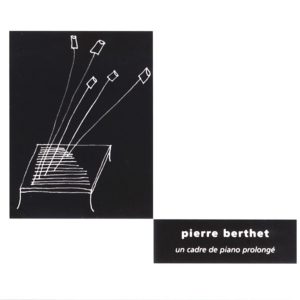
Pierre BERTHET
“Un cadre de piano prolongé”
Special Price.
"Hanging above the audience, metal cans are linked to some strings of a piano frame by long steel wires (3 to 5 m.). Strings are excited by percussion, friction, magnetic fields and electric motors." (extract from inner notes) First solo record, before the CD released by Sub Rosa, from this musician/instrument builder from Liege, Belgium (after a collaboration CD of strange songs with Frederic le Junter and one long track on a Sub Rosa compilation), also collaborator of Arnold Dreyblatt for performances. A first part in a Dreyblatt style, a center part of layered and droning sounds (but without any effects) and a more strong finale.
5,00€
In stock

CD
Laurent GRAPPE
“Le luxe de la réflexion”
Special price. “For his first CD, Laurent Grappe has created a fascinating electro-acoustic tale. Le Luxe de la Réflexion! (The Luxury of Reflection!) blurs distinctions between field recording and acousmatics, urban and rural, French and Arab. At the center of the work is Isabelle Bassil, a Lebanese woman splitting her time between France and Lebanon. Her life experience, bridging two cultures, provides the main thread. Her interventions are spoken in Arab and other protagonists speak French, but comprehension of any or both languages is not a requisite to appreciate the listening experience - the same way understanding Spanish did not constitute an obstacle in Kristoff K. Roll’s South American sonic travel diary, Corazon Road. Grappe plays with the sound of speech, the emotions it conveys on a musical level transcending linguistic signification. His sound constructions at times evoke Fred Frith’s soundtrack to the film Middle of the Moment: atmospheric nomadic journeys into another culture. In other places, the music is resolutely musique concrete. The three "Interludes" feature vocal performances similar to Shelley Hirsch or Joane Hetu. Although a reduction of "life," Le Luxe de la Réflexion! feels surprisingly non-abstract. Of course, the unsuspecting listener will be destabilized, but most sound elements are traceable to their sources and many bits of music are left untouched. It makes a rewarding listening experience, even for seasoned sound art fans - a very impressive debut.” (François Couture - All Music Guide)
5,00€

CD
SENSORBAND
“Area – Puls”
Special Price.
"Sensorband is a trio of musicians using interactive technology. Gestural interfaces -- ultrasound, infrared, and bioelectric sensors -- become musical instruments. The group, Edwin van der Heide, Zbigniew Karkowski, Atau Tanaka, each soloists on their instruments for over six years, formed Sensorband to create a performance ensemble. Edwin plays the MIDIconductor, machines worn on his hands that send and receive ultrasound signals, measuring the hands’ rotational positions of and relative distance. Zbigniew activates his instrument by the movement of his arms in the space around him. This cuts through invisible infrared beams mounted on a scaffolding structure. Atau plays the BioMuse, a system that tracks neural signals (EMG), translating electrical signals from the body into digital data. Together, Sensorband creates a live group dynamic, bringing a visceral physical element to interactive technologies. The basic materials are pure oscillator waves. The result can be considered as the missing point between Hafler trio (Z. Karkowski used to be a regular member), Ryoji Ikeda and no-rhythmical Panasonic."
-
"Shame of course upon myself: I have never seen the Sensorband live, and that is a pity. Three guys with a bunch of ropes, connected with sensors. By moving around, climbing in the ropes, the sound is changed by the sensors. These three guys are Edwin van der Heide, Atau Tanaka and Zbigniew Karkowski - three guys with a wide experience in sound, electronic music and performances. The question of course is: will their sound last on CD? Since they use pure tones and oscillations which change because of bodily movements, nothing might happen if you play this at home. It's unclear wether these four tracks, one analogue and three digital, are recorded live, or used in live performances. The CD opens with 'digtal.1', a slowly moving static line with small pulses, gradually increasing tension. The 'analogue' track is much a like, but much slower. The built-up takes more time (no surprise in a track that lasts 28 minutes) and is very austere in setting. The two shorter 'digital.2' and 'digital.3' are like the opening track. More pulsating, without getting anywhere near a beat. Number is almost like a sentimental song, with a tone of sadness in there. The presstext talks about the missing link between Hafler Trio and Pan Sonic, I'd like to add a link to Alvin Lucier's Music On A Long Thin Wire: pure tones changed by the environment. A very minimal, but very nice work..." (FdW / Vital Weekly)
5,00€

CD
David MARANHA
“Piano suspenso”
Reissue of this 1999 release and out of print since a long time. Some reviews at the time of release : « After a tentative opening consisting of damp harmonic scrapes, the piece takes off like a single-engined light aircraft when Maranha kickstarts his four-motored piano effect and then starts to tease single notes from the bubbling background with his bow. This is a great and physically affecting slab of sound, where the slightest minimal shift causes tectonic plates to groan. It’s gravy train stuff for fans of Maryanne Amacher, Arnold Dreyblatt and - perhaps Maranha’s major influence - Phill Niblock. » David Keenan - The wire (aug. 99) « David Maranha, one third of Osso Exotico, recorded a hauntingely beautiful piece in New York, using four motors and a violin bow to play the grandpiano. The motors create rich textures of overtones that slowly go in and out of phase and make unknown harmonies audible. The bow plays something like the melody off and on. There is a very special thanks to Phill Niblock and if you know his music, then you know what to expect as it fits his tradition of minimal music very well. » Frans de Waard - Vital weekly
5,00€
CD
Christian ALATI – Giuseppe IELASI – Ruggero RADAELE
s/t
“Sonoris isn’t exactely known as an improv label, but they make an exception here with the work of three Italian improvisers, which are closely linked to the super improv label Fringes. I didn’t glance very much at the cover very much while playing this CD, so the notion that these are two guitarists and a percussionist struck me. Whatever they produce, its hard to pin down as guitar and percussion. They go by a slow curve from almost silence to almost noisy, with crackles (what sort of guitar produces crackles like a lap-top, me wonder in mild curiosity). There those recognizable AMM influenced bits (although their curve is usually even longer) and even a link to industrial music (the motor like buzz in ’Text Piece’). This makes this into a somewhat more varied CD, and you could even wonder if the variations aren’t too much. Myself, I thought it was ok and thought it was a well-entertaining CD.” (Frans de Waard / Vital weekly)
5,00€

CD
Peter DUIMELINKS – Roel MEELKOP – Ralf WEHOWSKY
“Verklärte Tage”
Ralf Wehowsky (RLW) was founding member, and most important conspirator in P16D4. Peter Duimelinks and Roel Meelkop were members of THU20. Profitable postal collaboration (or each one composes from another one’s material) and between three current figures of electroacoustic musics. Stratified resonances, shocks of sounds like tectonic plates, brutal ruptures opening on different spaces. A formal and structural work of the most interestings.
5,00€

CD
Dan BURKE – Thomas DIMUZIO
“Hz”
Special price.
Illusion of Safety mainstay Burke and sonicist errant Dimuzio are a perfect pair. Their common chosen path is one of electroacoustic exploration, combining sampling, processing, tapes, and live noise-making (calling their enthusiastic instrumental and radio-knob manhandling "musicianship" would be overly generous) in live and studio settings. Each artist brings to the workbench an affinity for the nature of sound.
HZ documents a series of California performances presented by Burke and Dimuzio in October of 1997. The improvised tracks operate in the desolate arena of post-industrial sound, but the perpetrators take a page from the example of AMM's jazz-like metamusical interplay to imply a certain, if covert, human presence. Motors purr, hiss, scrape, and groan, setting up a foundation of sonorous drones for Burke and Dimuzio's sonic manipulations and electronic outbursts. The duo's efforts range from freakish alien-zoo atmospheres ("Aware," "Dross," "Outflow") to the labored workings of arcane machinery ("Dropforge," "Rota"). HZ strikes an especially poignant note on "Charastrigor," as radio strains drift sadly across the rubble of a bomb-scarred city square.
(Allmusic)
The truth is, you found something incomprehensibly comforting in these sounds, this noise, this audible darkness. It occupies the space and fills your lungs, so in such a short time you grew accustomed to this nightmare, probably just in time for Burke and Dimuzio to sever the umbilical cord so suddenly, leaving you helpless and in silence. (Richard di Santo / Incursion)
Dan Burke has called this one of his favorite works he’s put out. Dimuzio is the guy behind Gench Studios, the place where so many experimental labels get their stuff mastered. HZ is a refined, driving, eclectic nightmare of beats, darkhop and odd sound tones and soundscapes. The listen deepens as it progresses, with varied layers of styles developing and fading. Very nice little digipack item. (Manifold web site)
5,00€

CD
ARTIFICIAL MEMORY TRACE
“Vol. 9: Distori (Noah)”
Special Prices. Artifical Memory Trace sort of is the right person to fit these traditions of electro-acoustic music: intelligentely composed with modern means (read: sampling), into relatively short pieces that hold the attention. Without any limitation he jumps back and forth in his sound material. Sometimes all the events seem to be apparent at the same time, but at other times one long curve is drawn, such as in the beautiful opening piece ’Skeletune(s)’. AMT can be placed among the likes of Illusion Of Safety and Brume. With the latter AMT shares something odd: presenting a large body of work, which ranges from good to excellent, it is hard to see the difference between each work. (FdW / Vital Weekly)
Slavek Kwi continues its excellent work of organization of sounds in time and spaces exploiting great dynamic scales, unexpected ruptures, complex morphologies and astonishing changes. He pays much importance to the environmental sounds.
5,00€

CD
Jean-Michel RIVET
“Embrasement”
Special price.
French composer from Bordeaux influenced by Pierre Henry and Luc Ferrari.
1. Embrasement (February 95)
2. Mains brisées = Broken hands (June 97)
3. Elle somnole jolie (June 95)
4. Etude aux sons canelés = Study for bells and other ringing sounds (December 95)
5. La chute d'Icare = The fall of Icarus (February 97)
Track 6 is not mentioned on the release (this is just water sounds).
6-panel digipak cover. Contains 12-page booklet with lyrics in French and English.
5,00€
In stock

CD
MONOFONIC ORCHESTRA
“Earlyworks – Musicdesign”
“Monofonicorchestra is not a disc recorded in mono / is not ambient music / is not funky / is not experimental music / is not funny / Monofonicorchestra is not avant-garde / is not pop / is not op / is not dada / Monofonicorchestra is not fashion / is not hard-core / is not horror / is not Frigidaire was writing Maurizio Marsico at 10h20 on wednesday, december 23rd, 1981. A country: Italy. Several countries: Italies. Late seventies, early eighties. The ether of punk is in everyone’s nose and disco virus invades even the most reticent legs. New-wave for sure rules the underground. Neo dandyism attitude applied to the italian post-rock era; Dolce Vita with a dreamed revolution in the background. United Countries of Italy! Bologna and the Confusional Quartet, Gaznevada, The Stupid Set. Not to forget the Naif Orchestra from Florence and all trans-borders adventurous navigators such as Piermario Ciani, Vittore Baroni (Lieutenant Murnau, Trax), the members of the musical theatre Magazzini Criminali. The vivid eclecticism of the above mentioned is to be compared to the aesthetic manifesto of the AtaTak crew from Düsseldorf (Der Plan, DAF, Tödliche Doris, Pyrolator). or the Vanity label japanese explorers (Tolerance, Aunt Sally, Normal Brain, BGM, RNA Organism). These bands were not leading the italo disco movement neither were they really punk or industrial nor waving cold-wave banners. First pressing limited to 500 copies with full color digipack sleeve. Also including a 12 page full color booklet with original graphics, photos as well as liner notes by Samon Takahashi.”
15,00€
In stock

CD
LETHE
“Catastrophe Point #5”
“The latest in Kuwayama Kiyoharu’s signature series of compositions that explore the charged, mysterious atmosphere of disused industrial sites. For this album, Lethe turns his attention to an abandoned warehouse by a pier in his hometown of Nagoya, Japan, using objects discovered in situ to perform a ritual of sonic resurrection. He brings a dead space back to life, giving it a voice and allowing it to speak. Metal chains, sheet metal, broken machinery, and factory debris are bowed, struck, and dragged across the concrete floors of the massive hall, reverberating and responding as Kuwayama and his microphones scuttle across the desolate terrain. Growling cello and unstable horns underscore the torrents of percussive clatter. Catastrophe Point
5 is a haunting album of volatile, malevolent ambience. For fans of Christoph Heemann, Surface of the Earth, The New Blockaders, Z’ev, or Organum.”
4,00€
In stock

CD
NMPERIGN
“Ommatidia”
“Nmperign are one of the most celebrated and influential bands in contemporary improvised music. Yet surprisingly, more than a decade after their debut, Greg Kelley (trumpet) and Bhob Rainey (soprano sax) have never recorded a studio album as an unaccompanied duo... until now ! Intransitive is proud to present the nmperig album that fans have been waiting for: the core duo, beautifully recorded in an actual studio with excellent microphones. The music is spare and peerlessly inventive as always, but the mood remains light and joyful, with a subtle undercurrent of absurd humor. While improvised music can sometimes seem airless and precious, Ommatidia opens the window on a sunny afternoon... the album’s gusts of breath, percussive splatter, and controlled explosions form six succinct pieces that feel alive and vital, while still speaking in nmperign’s utterly unique sonic language. A perfect way in for newcomers and a revelation for long-time fans, Ommatidia is the essential Nmperign.”
4,00€
In stock

CD
FAILING LIGHTS
“Failing lights”
“An evocative work of bleak electronic atmosphere and suffocating dread, Failing Lights is the intensely personal vision of Michigan (via Lexington, KY) artist Mike Connelly. While he has toured the world as 1-3 of legendary industrial-noise units Hair Police and Wolf Eyes, Connelly spends his days crafting a much different sound on his own. Under the Failing Lights flag, he has self-published a nearly uncountable number of cassettes and CDRs of rough drones, detuned improvised grit, blown-out burl, and unstable acoustics in tiny editions that quickly vanish into collector-land. Intransitive is proud to present the defining - and first widely available - Failing Lights statement, an album of sinewy horror with a fine-tuned beauty within its darkness. A single piece in five sections, Failing Lights begins with disquietingly barren negative space. As the album creeps forward, it steadily dispenses sheets of diffuse throat-scratch and skittering strings, culminating in a blast of molten organ. Not noise, ambient, improv, black metal, or anything else: this is pure Failing Lights.” label info “Mike Connelly’s Failing Lights CD is a deep trip into darkness, density and dimension. This work is not random noise. Connelly is able to bend sound and texture at will, with a great deal of control. He sculpts huge amounts of space and intensity with a great deal of grip. Really good!” Henry Rollins
4,00€
In stock

CD
Roel MEELKOP
“5 (ambiences)”
The music of 5 (Ambiences) deals with ways of approaching and conceptualizing ambient sound, of abstracting sounds from the world until they become much more than documentary observations. The music plays with some referential material (are they field recordings ? digitally generated ? does it matter ?), a very wide dynamic range (to encourage active listening), evocative and even dramatic structures but also forbiddingly impersonal distance. It toys with the notion of ’ambient music’ (as New Age wallpaper) by using ambiences to create deeply involving compositions which change as one changes one’s listening focus. This music is open to any interpretation, or no interpretation at all. This is Meelkop’s second CD on Intransitive. He is also a member of Kapotte Muziek, Goem, THU20, and the Audio.nl label.”2,502,503,00
4,00€
In stock

CD
KAPOTTE MUZIEK & LETHE
“Tsurumai”
Recorded in the industrial city of Nagoya, Japan, Tsurumai is an expansive album of rough electro-acoustic music. Starting from a few small clicks, the music steadily grows outward, uneasily shifting and expanding. Rude bumps interrupt narcotic drones, the telltale human hands of improvisation disappear into a mysterious group sound, acoustic and digital elements blur, vision fails, and time stops...Frans de Waard began his Kapotte Muziek (literally ’broken music’) project in Nijmegen, the Netherlands, in 1984, and went on to found the Korm Plastics label. In Nagoya, KM met up with Kuwyama Kiyoharu, aka Lethe, an omnivorous multi-instrumentalist whose work typically takes advantage of some acoustic peculiarity of the space in which it is recorded."
4,00€
In stock
CD
Jim HAYNES
“Sever”
“It gives me great pleasure to present Sever, the third solo album by San Francisco-based composer Jim Haynes, whose singular music evades simple attempts to describe it. The process of decaying and wearing down materials is implied in Sever; its passages of rough clang and cyclic scraping metal seem implacably tangible, as if one is witnessing time-lapsed erosion in action. For me, Sever conjures images of oncoming storms, abandoned industrial sites, huge empty warehouses, creaking glass, ships rocking in a port, the middle of the ocean far from land. Sever is an engaging album of evocative, highly visual drone music made up of layers upon organic layers that are in constant motion, and yet seem somehow still. Jim Haynes has exhibited at Westspace (Melbourne, Australia), Diapason (New York), Jack Straw Productions (Seattle), and Works (San Jose), Eyedrum (Atlanta). He has collaborated with Loren Chasse (as the duo Coelacanth), Keith Evans, Steve Stapleton (Nurse With Wound), and irr.app.(ext.). He runs the acclaimed Helen Scarsdale label, and works as the Editorial Director for 23five, a nonprofit organization dedicated to the development and increased awareness of sound arts within the public arena. He has written extensively on sound art, noise culture, minimalism, and general music experimentation for The Wire, The San Francisco Bay Guardian, Metro Pulse, The Sound Projector, and Chunklet.”
4,00€
In stock

CD
SEHT & STELZER
“Exactly what you lost”
“This first album of cross-hemisphere hum by Seht (the nom de musique of one Stephen Clover) and Howard Stelzer emerged organically via tapes shared through the post between New Zealand and Boston over the course of a year or so. Without any spoken agenda or external organizing concept from the start, the music willed itself into a darkly psychedelic, implacably melancholy haze. A quick scramble of caffeinated tape action kicks things off, then the album rapidly dissipates into a thick, black sleep of environmental debris and humid fog. Worn loops were played into various outdoor acoustic environments (playgrounds, front porches, trees, other prosaic spots), then fed back into low-tech machines for further harmonic decay. Shapes form in the shadows and slip away as the edges blur. After a few attempts to heave itself up onto its feet, Exactly What You Lost eventually huffs its last breath and dissolves in a cavern of industrial tics. “
4,00€
In stock

CD
NERVE NET NOISE
“Dark garden”
“Dark Garden, the new album of thrillingly idiosyncratic analog buzz by Nerve Net Noise (aka homemade synth duo of Hiroshi Kumakiri and Tagomago) , is the perfect entry-point for listeners new to their singular sonic world. This album of short, song-like synthesizer pieces might take its cues from manga, science fiction, early electronic music, and minimal techno… but as always, the Tokyo band resides firmly in their own inexplicable universe. Dark Garden assimilates fractured beats, stuttering pulses, naked static, and impatient drones into an album that’s somehow both playfully alive and coldly menacing. In his liner notes, synth builder Kumakiri describes spirits that lurk in the shadows and watch people go about their lives, existing in a parallel world that bring to mind fairy tales and myth. Nerve Net Noise’s music is similarly just out of reach, present in the natural world but not quite a part of it. For fans of Klaus Schultze, Jessica Rylan, Henri Pousseur, or Pan Sonic…”
4,00€
In stock

CD
C. Spencer YEH
“1975”
“Intransitive Recordings is extra-proud to present 1975, the debut solo album of tightly-coiled, crackling electronic ambience by C. Spencer Yeh. While “debut” may seem a strange word to use to describe an album by a guy with such a deep discography, Yeh explains that 1975 is like nothing anyone has heard from him before. “One thing is I really wanted to focus on a certain feeling of stasis. So much of what else I do just kinda pushes and pushes forward. 1975 is more vertical than horizontal, even though one can’t escape the horizontal completely.” Taking a confident step away from his familiar work as an improvising violinist and vocalist, from the mythology of his rock/noise band Burning Star Core, and from his recent forays into pop music, the omnivorous Yeh here reveals himself to be a composer of unsettling electro-acoustic miniatures. Yeh approached his source material with a desire to be transparent, even literal, and to avoid straightforward narrative. The literal is there in the deceptively matter-of-fact track titles - “Drone”, “Voice”, “Shrinkwrap from Solo Saxophone CD”, “Two Guitars” - but knowing which sound source is buried beneath these tones does little to remove 1975’s sense of enveloping mystery. This is sensual abstract music with a light touch, a confident minimalism that only reveals its unsettling depth, sharp corners, and playful malevolence with repeat listens. For fans of Eliane Radigue, Hecker, Pita, or Kevin Drumm. Born in Taiwan, and now based in Brooklyn NY, C. Spencer Yeh is the one constant of the “band” Burning Star Core, whose other members have included Mike Shiflet and Trevor Tremaine & Robert Beatty of Hair Police. He has collaborated with a staggeringly diverse range of artists, including John Wiese, Tony Conrad, New Humans w/ Vito Aconcci, Aaron Dilloway, Okkyung Lee, Evan Parker, Yellow Swans, Greg Kelley, Paul Flaherty, Don Dietrich (of Borbetomagus), and Chris Corsano (to name just a few).”
4,00€