
In stock

LP
CONTINUITY
“Continuity”
Eponymous first album by ‘Continuity’, the new project of Swedish artist Martin Herterich, whose sonic explorations of memory and imagination have come to full bloom in this atmospheric and elusive narrative of seven intense cityscapes.
Martin Herterich previously released music (as Sand Circles, etc) on labels like Posh Isolation, Not Not Fun Records, iDEAL and Irrlicht.
“Have you ever felt like all you want is to go back?
Continuity is a sonic narrative, a story arc set in a fictional East Asian metropolis. It is not a city you have been to.
When you have fallen in love with a place, you long to go back; but it’s a memory; fiction if you like. You want to catch the fleeting moment of leaves rustling in the wind, the sun reflecting from the glass panels of the roof above.
These memory cycles create emotional patterns. But unlike reality, these spaces are limited. They carry elements of reality in them, narrative components that evoke feelings and signify meaning. Traveling there becomes impossible. Through streetview surfing and 4K walking videos on Youtube, these spaces that are very much real become fictionalized, much like the virtual spaces of video games. Movement is narration. Fiction is something that is, but at the same time isn’t, real. In order to understand an imaginary place, one needs to travel there.” (Martin Herterich, 2023)
24,00€
In stock

LP
MONOPOLY CHILD STAR SEARCHERS
“Barbados Wild Horses”
After the not-quite-reissue of »Prince of Parrot Shooters/The Aqueducts of Cannel Island«, wide-eyed mystic and tireless searcher of the netherworld Spencer Clark returns to the Discrepant fold with »Barbados Wild Horses« under his Monopoly Child Star Searchers moniker. Recorded while Clark was living in the Canary Island's by Tupperware and Lagoss' Dani Tupper, 'Barbados Wild Horses' brims with insular romanticism and escapist bliss, with sunkissed synth-lines interwoven around his trademark hand percussion bouncy rhythms reflecting the scenery of the islands as a liberating utopia.
With track titles taking an almost self explanatory stance, the album starts with the crepuscular vibes of »Upper Romantico«, a poetic meditation on the lovelorn potential of the fading sunlight, setting the tone for the rest of the tour. »Lava Tube Solos on Horseback«, the first of two tracks featuring Sun Araw's Cameron Stallones, sees the latter's guitar noodles riding the cascading rhythms and digital choir harmonies while in »Neopreno Antiguo« he solos freely around an hypnotic synth line. Finishing off the escapade, »Nightcharcos Punta Brava« drifts in ethereal starlit contemplation, with the percussion taking a more backseat approach, setting into a steady pulse for Clark's gliding synth tapestries. Nightswimming as transcendence. Another piece of the fascinating puzzle Clark's been assembling for over two decades now, 'Barbados Wild Horses' glimmers with a laid back sensibility that's as unhinged as enveloping. Not an easy feat by any measure. Clark succeeds again.
24,50€
Out of stock

LP
The PITCH & Julia REIDY
“Neutral Star”
The Pitch is a quartet made up of Boris Baltschun, Koen Nutters, Michael Thieke and Morten Joh. Founded in Berlin in 2009, they play a hypnotic form of structured improvisation full of acoustic exploration and electronic intervention. On Neutral Star, The Pitch are joined by Australian guitarist/composer extraordinaire Julia Reidy for a record of star gazing electro-acoustic jazz.
Reidy's playing and compositional technique between Takoma-style fingerpicking and Glenn Branca'esque microtonality, perfectly complements the loose improvisational framework The Pitch is providing. Endless ≠ Limitless, a recent piece by Reidy and Joh, is transformed from a washed-out/obscured tape delay composition into a colorful, meandering ensemble piece with a swarming character - blooming with intrigue for the patient ear. The B-side strikes a more gentle tone: the 24-minute Neutral Star begins with a siren-like overtone whose drone-like flowing slowly morphs into a deterritorial modality with jazzy undertone. Accompanied by constant eruptions of vibraphone, clarinet, electronics and double bass punctuation – while permanently questioned by Reidy's drippingly pearly steel guitar work. Slowly evolving into new territories through the expansive instrumentation and keen listening between the players.
The fact that Neutral Star was recorded in one take (by Rabih Beaini in his Morphine Raum studio/venue) in front of a live audience and without overdubs is hard to believe, even for the trained ear. The recording appears to be too multilayered for a single snapshot, with its compositional structures constantly shifting and moving against themselves, counterintuitively and anti-cyclically. Reidy´s playing has been described as "unstable harmonic territory, and the collaboration with The Pitch interprets this concept brilliantly - adding further non-places to the territory. And the listener, however, is never left alone in the process of tectonic shifts - at least as long as their listening is attentive and contemplative at once.
28,50€
Out of stock

CD
Francisco MEIRINO & Jérôme NOETINGER
“Drainage, In Six Parts”
Francisco Meirino is a sound artist based in Switzerland. His music explores the tension between programmable material and the potential for its failure. His interest lies primarily in what is not supposed to be recorded : the end of life of electronic devices, electrostatic noise, magnetic fields and the unconventional use of music hardware and sound systems and how to exploit these sonic failures in radically different ways in his sound pieces. His music combines intricate textures, sonic precision, wide spatial panning and is fascinating by its physical intensity and detail precision. Born April 1966, in Marseille, Jérôme Noetinger discovered experimental music under the influence of the Déficit Des Années Antérieures in Caen. He is a composer/improviser/sound artist working with electroacoustic devices. Composing sometimes musique concrete in the studio, and performing improvised music using electroacoustic devices such as: the reel to reel tape recorder Revox B77 and magnetic tape, analogue synthesizers, mixing desks, speakers, microphones, various electronic household objects and home-made electronica. Performing both solo and in ensembles, and collaborating often, and touring extensively internationally. Jerome also used to be the director of Metamkine, a non-profit organisation dedicated to the distribution of improvised and electroacoustic music, which has now been changed to Corticalart with a different personnel.. The music on this CD was recorded by the duo in 2019 in Switzerland.
12,50€
In stock

CD
Rhys CHATHAM & David FENECH
“Tomorrowstartstonight”
The first duet album by Rhys Chatham and David Fenech, two well-known musicians of the experimental scene. It is a long piece of music in a minimalist spirit, where the two guitarists meet and merge with Rhys’ trumpets, flutes and vocals and David’s small percussion.This record has an organic feel and natural development that makes it unique. Tomorrow starts tonight ! Rhys Chatham is best known for his compositions for electric guitar orchestra… he began his musical career as a harpsichord tuner, studied flute with Sue Ann Kahn, studied shortly thereafter with electronic music pioneer Morton Subotnick and later with La Monte Young (also as a member of his famous “Theatre of Eternal Music” ensemble). He also played with Tony Conrad in an early version of his band The Dream Syndicate. In 1971, while still a teenager, Chatham became the first musical director of the famous venue The Kitchen in New York. He has played and recorded with musicians as varied as Charlemagne Palestine, Sonic Youth, Arthur Russell, Jonathan Kane (Swans), George Lewis, Band of Susans, David Toop, and in his large guitar ensembles with members of Tortoise, Godspeed You! Black Emperor, Hüsker Dü… David Fenech is a French musician living in Paris, guitarist, singer, improviser. He plays a wide variety of instruments and is an accomplished guitarist with his own technique… but his main instrument may well be the microphone, his music being composed of whatever he records with it. His distinctive, slightly baroque style, on the bangs of rock, jazz and improvised music, has often been described as “a kind of musique concrète punk”. He has performed and recorded with musicians as diverse as Felix Kubin, Tom Cora, Pierre Bastien, Jac Berrocal, Ghédalia Tazartès, Nurse With Wound… The music on this CD was recorded live at two concerts, one in Paris and one in Vienna. It was mastered by James Plotkin
12,50€
Out of stock

CD
GEINS’T NAÏT
“Fishes”
Geins't Naït was founded in Nancy, France, in 1986 by Thierry Merigout and Vincent Hachet, both students at the Architecture School of Nancy. A year later Laurent Petitgrand joined the band. Their sound is often described as an equivalent of bands like Einstürzende Neubauten, Coil or Test Dept., but Geins't Naït is not pure classic Industrial. While Geins't Naït offers rough pieces of music as an extension of its punk attitude, Petitgand refines them to create some musicality within the post-industrial collages, adding guitars, piano, and classical instruments. Geins't Naït and Laurent Petitgand sharpen sounds, giving them a kind of balance and density and ensuring that the musical language evokes a deep experience. Their music is raw and fascinating, and largely influenced by Surrealists and Situationists. Their early albums were released by French label Permis De Construire, with Fishes being the band's fifth album, originally released in 1989. It features fifteen tracks which have been carefully remastered for this first ever CD re-issue by Martin Bowes.
12,50€
In stock

CD
HASTINGS OF MALAWI
“Visceral Underskinnings”
Hastings of Malawi are Heman Pathak, David Hodes and John Grieve. They recorded the album in one night in 1981 with no plan and no idea of what they were doing. They played drums, clarinet, synthesiser and piano but also made use of things that they found lying around the studio – old records, cookery books, telephone directories and a telephone. The recordings were played down the phone to randomly dialled numbers and the reactions added to the recording. All three had been involved in the recording of the first Nurse with Wound album Chance Meeting On A Dissecting Table Of A Sewing Machine And An Umbrella and had contributed metal scrapings, piano, effects, clarinet and guitar during the session. Their debut album, Vibrant Stapler Obscures Characteristic Growth, is a masterpiece from 1981, re-issued on vinyl by Sub Rosa and on CD by Klanggalerie. Originally 1000 copies pressed on orange/red vinyl. 120 copies were sold through Rough Trade and Virgin Records. 800 copies were bought and later destroyed by the United Dairies label, making this record even more rare. 35 years later, the British dadaist group Hastings of Malawi have released a new album - an epic sound poem entitled Visceral Underskinnings. It is a 40 minute film without light that reflects on the human condition, on modern society, on the nature of telephony and electricity and an attempt to make sense of the world in which we live that provides no answers. It is a sound collage of diverse elements including the voices of George Washington Johnson (First African American star of the phonograph 1846-1914) and Dr Hastings Banda - the first president of Malawi. It includes randomly generated computer music, voice synthesis, recordings of cold war number stations, American military sound weaponry and recordings of the some of the many sound sculptures produced by Hastings of Malawi over the last 30 years. Hastings of Malawi produce sounds that sit in that grey area where sound art and music meet but they reject both labels and cannot be comfortably placed in either camp. This is not an easy album to listen to but persevere and you may or may not be able to decipher its meaning.
12,50€
In stock

CD
Kevin TOMKINS
“Music For An Unprepared Autoharp”
Kevin Tomkins is best known for his work in Whitehouse and his own group Sutcliffe Jugend, now called Sutcliffe No More. He also worked with Bodychoke, Inertia and Patient K. Most of his music has its background in the power electronics scene that evolved in Great Britain around the label Come Organisation and the group Whitehouse. Power electronics is a style of noise music that typically consists of static, screeching waves of feedback, analogue synthesizers making sub-bass pulses or high frequency squealing sounds; with screamed and distorted vocals. The genre is noted for its influence from industrial. It is generally atonal, like most noise music and also features a lack of conventional melodies or rhythms. To match its sonic excess, power electronics relies heavily upon extreme thematic and visual content: whether in lyrics, album art, or live performance actions. For his solo work, Kevin sometimes uses a very different style to his group work. An autoharp or chord zither is a string instrument belonging to the zither family. It uses a series of bars individually configured to mute all strings other than those needed for the intended chord. This album's music was all generated on such an instrument and is totally different to Sutcliffe No More. Its roots lie in avantgarde music rather than noise, with rhythms and melodies generated on the instrument. It was edited from over 20 different recordings to present an album of stunning variety and beauty.
12,50€
In stock

LP
VOMIR & Anla COURTIS
“Sin Comentarios”
The dense HNW blocks of sound does not dominate or overpower the more dynamic guitar excursions of Courtis, but instead there is a good balance of the elements, making room for both artists to shine. The two sidelong pieces that makes up “Sin Comentarios” appears to be composed in a considered manner. The first piece is a full-on ferocious hailstorm of electronic shards, like a thousand pieces of scarp metal disappearing into a prehistoric black hole. Midway through piece a metallic drone appears and slowly takes over the music. This leads us into the second part, which feels like the grinding cosmos of part one twisted inside out, like an alternate reality, all elements in an inverted state of weightlessness. The piece is more open, the elements more clearly defined, there’s a different sense of both space and pace, but the piece is no less intense. Towards the end the music slowly builds down, almost like a sonic origami that folds itself into nothing. I’m sure it was not intended as a symbolic Zen-like closure, but it in the context of what happened, it’s hard not let the thought cross your mind when listening to this remarkable last Vomir recording. (extract from Lasse MARHAUG's liner notes)
22,50€
In stock

LP
Z.B. AIDS
“For Franz”
A bad torrent file for the theme from Miami Vice rings in your ears as you struggle to get out of an elevator that’s crashing real fast while you were waiting for a phone call from Bill Orcutt. Enjoy life while it lasts.
– Guy Mercier
22,50€
Out of stock

LP
Michel HENRITZI – Michael MORLEY
“Mirrors”
For their first collaboration as a duo, rather than succumb to the devastating fury that is the hallmark of so-called 'noise' music, Michael Morley (electric guitar) and Michel Henritzi (lapsteel) have opted for the open sea, and the interior landscapes with the ghostly strangeness that is usually associated with them. The emergence of embryonic melodies under their fingers never frightens them. On the contrary, it allows them to delve deeply into the contemplative and hypnotic dimensions of listening, through skilful interweaving of constantly shifting masses of sound. Although they conceived Mirrors at a distance from each other, what emerges is a fascinating maelstrom, sculpted over time like a long blast spread over two sides. The first, in the form of effluvia, relays primitive forces in gestation since the appearance of the blues. The second, majestic and devoid of ostentation, explores a succession of stases that could have been extended ad infinitum, so much so that the suspension that constantly postpones the fall abolishes any notion of time.
(Philippe Robert)
22,50€
In stock

CD
Sophie AGNEL – Joke LANZ – Michael VATCHER
“Animals”
With solid training as a classical musician, Sophie Agnel took a close interest in modern jazz before committing in the early Nineties to the shifting, deliciously uncertain ground of free improvisation, thanks to her fascination for the powers of expression displayed by a few great keyboard-heretics such as Keith Tippett, Fred Van Hove or Christine Wodrascka. She began reworking the prepared piano techniques imagined by John Cage and transformed her instrument into a sort of extended piano. Coming from a Punk music background Joke Lanz started in the mid 80s to play Experimental- and Noise music. Best known for his internationally acclaimed project Sudden Infant, Lanz is presenting his work since 30 years all over the world. Born in Switzerland and currently operating out of Berlin, he is one of the most prolific and profound artists working in the border zones where performance and body art meet Improvisation and Noise. California native Michael Vatcher, now residing in Amsterdam, quickly progressed from hitting household furniture to taking vibraphone and snare drum lessons as a child. The trio impresses with precise playing, intensity, spontaneity and a great sense of musical humour. Radical playing techniques, curiosity and the exploration of sound possibilities create constant tension. Their first trio release Animals brings together 13 tracks full of twists and turns, creative lightness and complex virtuosity.
12,50€
In stock

CD
Asmus TIETCHENS
“Ptomaine 2”
Asmus Tietchens is a sound artist and composer from Hamburg, Germany. He got interested in Musique Concrete by listening to a German radio programme when he was 10 years old. In 1965, at the age of 18, Asmus started experimenting with tape loops and turned them into musical collages. Soon, the use of synthesizers was added. In 1980 his debut album Nachtstücke was released, produced by Peter Baumann of Tangerine Dream. This was soon followed by a series of albums of electronic pop music for the Sky label, home of many Krautrock bands. Tietchens often uses special source materials for his compositions such as water (Seuchengebiete), human voices (Von Mund zu Mund), paper (Papier ist geduldig). He is associated with the Industrial music scene through his collaborations and releases on labels such as United Dairies, Esplendor Geometrico or Dom Records. Tietchens never studied composition, he has no academic background, everything he does is self taught or learnign by doing. Nevertheless, he was professor for sound design in Hamburg in recent years. Ptomaine was originally released on RRRecords in 1996 as a 3 LP set. This is the second volume of the first ever CD re-issue.
12,50€
In stock

CD
Joe McPHEE & John EDWARDS
“Tell Me How Long Has Trane Been Gone”
Joe McPhee, born 1939 in Florida, USA, is a multi-instrumentalist, composer, improviser, conceptualist and theoretician. He is currently the member of Trio X, Survival Unit III and has collaborated with Pauline Oliveros, Peter Brötzmann, Evan Parker, Raymond Boni, The Thing, Trespass Trio, and Universal Indians among many others. With a career spanning nearly 50 years and over 100 recordings, he continues to tour internationally, forge new connections and reach for music’s outer limits. John Edwards is a true virtuoso on the double bass whose staggering range of techniques and boundless musical imagination have redefined the possibility of the double bass and dramatically expanded its role, whether playing solo or with others. Perpetually in demand, he has played with Evan Parker, Sunny Murray, Derek Bailey, Joe McPhee, Lol Coxhill, Peter Brötzmann, Mulatu Astatke and many others. In 2019 McPhee and Edwards met at Artacts festival in Austria and performed together as a duo for the first time. The concert was held at a public school with the duo performing in front of the Wilder Kaiser mountain and left the audience stunned and speechless. This CD is a recording of this amazing concert. Joe McPhee plays sax and sings, John Edwards plays the double bass.
12,50€
In stock

CD
HET ZWEET
“Het Zweet”
Het Zweet (Sweat) was the band project by Marien van Oers, native of Breda in the Netherlands active from 1983 to about 1988. The music consisted of long 10 minute percussion pieces played on self built instruments (shopping trolleys amplified with pickups, blown cardboard tubes etc.) with repetitive shouted vocals by Marien. The music was often placed in the industrial camp and linked with the likes of Test Dept. but in fact Het Zweet were more concerned with ‘tribal’ music, physicality and trance effects like Z'ev. During concerts he often performed together with other players. Marien Van Oers sadly passed away in 2013. This self-titled album originally came out on the great Dossier label in Germany in 1987. The bonus material included on this reissue consists entirely of previously unreleased material. There's three untitled tracks and two live excerpts presented as long experiences that belie their disparate origins with a unity of sound and purpose. Van Oers’ percussive nous and distantly yelled chants certainly sound capable of working up a sweat in both the performer and any movement-minded listeners, but maybe the most striking thing about Het Zweet is how vital it still sounds, despite its age and relative obscurity.
12,50€
In stock

CD
Jac BERROCAL – David FENECH – Vincent EPPLAY
“Transcodex”
Jac Berrocal is a 1946-born musician (trumpet player), poet and sometime film actor who came of age in the ‘70s Paris improv scene, where the boundaries between music, art and theatre were porous and begging to be breached. Inspired by bebop, chanson, free jazz, beat poetry, early rock ‘n roll and myriad Eastern influences, and with an iconoclastic, anything-goes approach to instrumentation and technique that would later align him with post-punk sensibilities, Berrocal blazed an eccentric and unstoppable trail across the underground throughout the ‘70s and ‘80s, both solo and as part of the Catalogue group he co-founded. During this time his uproarious performances routinely wound up jazz and rock audiences alike, but earned the admiration of many musicians: Steven Stapleton invited him to perform on two Nurse With Wound albums, and other notable collaborators in his career include Sunny Murray, Lizzy Mercier-Descloux, Lol Coxhill, Yvette Horner and James Chance. In the 90s his protean achievements were celebrated on the Fatal Encounters compilation, but far from slowing down in the autumn of his life, Berrocal has maintained an extraordinary work-rate, keeping studio dates with Pascal Comelade, Telectu and Jaki Liebezeit, among others. Now Berrocal has found the perfect foil in David Fenech and Vincent Epplay, two fearlessly inventive improvisers, composers and catalysts who create challenging, acutely modernist yet historically aware settings – wrought out of synthesis, guitars, computer processing, field recordings and unorthodox percussions – for Berrocal’s unmistakeable voice and breathtakingly lyrical horn sound to flourish. Fenech cut his teeth in the mail-art scene of the early ‘90s, leading the Peu Importe collective in Grenoble. His 2000 solo debut was recently reissued by Felix Kubin’s Gagarin label, and he has also worked as a software developer at IRCAM, and played with Jad Fair, Tom Cora, Rhys Chatham and James Plotkin; in 2011 he formed a trio with Berrocal and Ghedalia Tazartes for the Superdisque LP. Epplay is a highly regarded sonic and visual artist with a particular interest in aleatory composition and autonomous pieces, concrète, and the puckish reappropriation of vintage sound and film material, with dozens of published works to his name on labels like Alga Marghen and PPT/Stembogen. Transcodex is the fourth album by the trio. Turning more towards pop than in their beginnings, this fourth record follows the footsteps of their previous album, Exterior Lux. The trio seems limitless: they experiment with a large variety of styles (pop, dub, electronica, dark jazz), always coloured by their very own touch. For this album, they invited two amazing musicians. Jah Wobble, founding member of the mighty Public Image Ltd. and Jean-Hervé Peron, one of the fathers of German krautrock legend Faust.
12,50€
In stock

CD
COMPILATION
“Mysterious Kitchens (Terse Tapes)”
A special delicacy for all you Severed Heads fans: In the 1980s the cassette was a much desired format. They were cheap, inexpensive to buy, easy to duplicate and manageable for less technically skilled people, too. The sound was raw and hissy, encouraging raw and hissy ideas. If you couldn't afford to have a vinyl LP pressed, you could still get heard. It was the most DIY product ever.
Terse Tapes was one the first cassette labels in Australia ever, although the label started with two vinyl releases. Bands like Severed Heads soon found vinyl production too slow - by the time an album was finished, they had recorded much more music and has changed stylistically. Mysterious Kitchens was billed as a various artists compilation, but in reality it was a group of ten friends that swapped roles and instruments as the mood took them. Future Severed Heads members are here under obvious multiple band names. Wet Taxis are the only real band on the album. Many other participants formed their own groups later. In 1980, shops were kind to Terse Tapes. They hung their cassette releases on shop walls and so encouraged other people to start their own DIY labels. This is the first ever CD release of this legendary "compilation" album. It is, of course, more of a Severed Heads release.
12,50€
Out of stock

LP
ORION MUSIC WORKSHOP
“Mâlemort”
« We left our hero in his previous adventures embarking on a journey to the edges, where the music of a fantasized desert was playing in an outsider art gallery. Percussions of death, flutes leading to a weird ceremony, the new chapter hits hard. We sail in a canoe on a flow of organic sounds, this second volume follows the quest for a cosmic Grail where the dancefloor makes primitive rhyme with pleasurable. A fruitful novelty, the machine invites itself into the ancestral cave, a metronomic pulse plays the spinal column of an exciting and wonky groove. Result, a record taking his source in an after punk under the Bazooka standard. Kind of Throbbing Gristle in the forest of Brocéliande, La Perversita and Neu wandering off in the Atlas… A sonic restlessness which certainly evokes a venerable sensibility. Caught between two stools but the choice of not choosing will be the chosen option. Here and there, today and tomorrow, this music of the future and past is mesmerizing to the highest degree. »
Electronics, flutes, voice, zither, kalimba, glass, percussions (darbuka, hand percussion, balafon) by Tom Val. Recorded and mixed at Bâtiment 8 between October 2022 and December 2022.
200 copies
26,50€
Out of stock

LP
ROEDELIUS / HAUSSWOLFF
“II” [!!damaged cover!!]
Pochette abimée avec au minimum 2 coins pliés.
Damaged cover with at least 2 corners bumped / folded.
Deep and beautiful ambient experimentalism from two true masters. “Roedelius / Hausswolff II”is this duo’s second album. The two met in Vienna in 2016 when Carl Michael invited Hans-Joachim to participate in the collective sound-installation and concert””freq_out ”. Since H-J had been, and still is, organizing the festival “More Ohr Les“ in his home town Baden just outside Vienna it has been natural for him to invite CM to collaborate and perform here. As a result of this iDEAL Recording released the CD “Zurufe“ in 2021 where H-J and CM collaborated with American Tim Story and Brit/Swiss Christopher Chaplin. Like the duo’s first album - ”Nordlicht” (released in the USA in 2017) - this new one follows the path where a dark ambient drone style reveals several epic landscapes and formulas.
Original price was: 23,50€.10,00€Current price is: 10,00€.
In stock

LP
Marja AHTI
“Tender Membranes”
Black Truffle is pleased to announce Tender Membranes, the label’s first release from Swedish-Finnish sound artist and electro-acoustic composer Marja Ahti. Active for a decade in the Finnish underground music scene, in recent years Ahti has developed a distinctive approach to patiently unfolding electro-acoustic constructions, documented on a string of solo releases and collaborative projects with Judith Hamann and her husband Niko-Matti Ahti. Working with concrete and instrumental sounds, field recordings, and electronics, Ahti favours neither disjunctive collage nor monolithic consistency; rather, her work is composed of organically unfolding sequences of details and textures, which, as she says, ‘can stretch out or cut fast as long as they have a sense of inner stillness’, a sense that she connects to moments of heightened attention in everyday life. Tender Membranes consists of four lengthy pieces, partly inspired by the image of the senses and mind as membranes allowing for the passage between inner and outer spaces, sensation and its causes, creating a world. Ahti’s unhurried pacing encourages this sense of listening as an opening or surrender to sound, which can often create the impression that the listener is moving through a space zooming in on details. The opening Shrine (Aether) exemplifies this aspect of Ahti’s approach: a bell clears the air with a single long tone, followed by the ambience of outdoor spaces, crackling electronics, an archival recording of a horsefly on a windowpane. Dozens of these moments, varying in length, density, and intensity, move past the listener’s attention, momentarily brought into focus then slipping away. Like those of the masters of the French musique concrète tradition, Ahti’s sounds are not often recognisable, though they might suggest proximity or distance, open environments or closed spaces, the urban or rural, day or night. In Ahti’s work, we do not encounter spectacular metamorphoses à la Parmegiani but rather a state of ambiguity where the listener is often unsure what is organic and what is inorganic, where the careful productions of the synthesizer might end and sounds discovered in the environment begin. What Ahti calls her ‘poetic way of experiencing and organising the familiar and the unfamiliar’ is sustained throughout Tender Membranes, but each piece has its own character. On Dust / Light, human presence is more overt, as what appear to be whispers, singing, and distant speech thread between high frequencies, untraceable drips and pops, and metallic shimmers. In all this there is a melody that you can sing and to which you may dance makes more prominent use of musical instruments, gaining a sombre beauty from half-buried piano chords and organ tones. On the closing Oh Fragrant Witness, a delicate cloud of subtly bending pitches is repeatedly disrupted by a resounding, almost ominous mass of low tones, at once a strange detour from much of what has gone before and an almost classical finale. Arriving in a sleeve reproducing contemporary Finnish photographer Sini Pelkki’s fragmented visions of the everyday, Tender Membranes is a balm to reawaken tired ears.
26,00€
In stock

LP
Cassandra MILLER
“Traveller Song / Thanksong”
Black Truffle is pleased to announce its first release from celebrated London-based Canadian composer Cassandra Miller. Though her body of mature work stretches back almost twenty years, many listeners were introduced to Miller through the success of her astonishing 2015 Duet for Cello and Orchestra, which sets an imperturbable two-note cello part against a series of increasingly dense orchestrations of an Italian folk melody; in 2019, it was selected by The Guardian as one of the ‘best classical music works of the 21st century’. Traveller Song / Thanksong, the first release of her music on vinyl, presents a pair of compositions for voice and ensemble that exemplify Miller’s gently absurd, strikingly beautiful, and utterly unique work.
Like many of Miller’s compositions, these pieces originate in existing music. Traveller Song (2016/2018) begins from a 1950s song of an anonymous Sicilian cart driver recorded by Alan Lomax and Diego Carpitella, which Miller recorded herself singing along to, going on to then record herself singing to her own layered voices. Miller’s untutored voice is an unsteady, wavering wail that has, in her words, ‘more in common with a quasi-shamanistic keening than anything Sicilian’. Heard sometimes alone, sometimes layered, her pre-recorded voice is accompanied by a chamber sextet drawn from London’s Plus-Minus Ensemble. In the first section, Miller’s exposed warble is set to a spare piano accompaniment, somehow both faintly preposterous and magisterial. Following the voice note for note, the piano part often makes use of almost mechanical sequences of parallel chords, reminiscent both of Satie’s Rosicrucian period and the abrupt harmonic movements of a chord organ. The orchestration then opens up to guitar, clarinet, and sliding strings, a delicate environment for Miller’s voice, which, especially when it begins to be layered, generates a powerful sense of intimacy. In its concluding minutes, the folk roots of the original melody return in the form of a glorious full ensemble setting dominated by accordion, clarinet, and strummed guitar. Thanksong begins from recordings of Miller singing along to the third movement of Beethoven’s late quartet in A minor (Op. 132), the ‘holy song of thanks’ the composer wrote to express his gratitude for (temporarily) recovering from illness. Recording herself singing along repeatedly to each of the individual parts of the quartet, Miller created an aural score where each member of the string quartet listens to their own part on headphones, playing by ear. Performed on this recording by Montreal's Quatuor Bozzini, with whom Miller has a decades-long relationship, they are joined by the British soprano Juliet Fraser, who sings material from the Beethoven quartet ‘as slowly and quietly as possible’. The atmosphere of the opening of Beethoven’s Dankgesang, of hushed reawakening and thoughtful reflection, is sustained throughout the fourteen minutes of Miller’s piece, building at points almost to sentimentality before the five individual parts again fall back into a gentle burble of unsynchronised melodic gestures. Like Traveller Song, here the use of the voice is a long way from the mannered performance of much contemporary music, reaching for a human and bodily presence more connected to the reality of the everyday, albeit suffused with wonder. Presented in a stylish sleeve adorned with photography by Lasse Marhaug and liner notes by Cassandra Miller, this is a key release from a major contemporary composer whose work challenges and dazzles in equal measure.
25,50€
In stock

LP
Joe McPHEE – Mette RASMUSSEN – Dennis TYFUS
“Oblique Strategies”
Black Truffle is pleased to welcome free jazz legend Joe McPhee back to the fold with Oblique Strategies, a wild trio recorded in Antwerp in 2018 in the company of Mette Rasmussen’s fire-breathing alto saxophone and Dennis Tyfus’s post-Fluxus antics on tape, voice, and percussion. Rasmussen and Tyfus have previously recorded together as Bazuinschal, and some similar strategies are on display here: mysterious metallic scrapes, extended tones in which voice and sax become indistinguishable, comic explosions of varispeed tape. With McPhee on board, however, proceedings are more sumptuous, with the two horns moving fluidly from expeditions into the extremes of their instruments’ registers to pointillistic note-splatter and Ayler-esque folk melodies; we even get to bask in some of the slow-motion free blues that McPhee has now been playing for half a century.
McPhee is heard primarily on tenor, Rasmussen mainly on alto, but with Rasmussen doubling on sundry objects, and the whole trio contributing vocals, certainty about who is doing what becomes nigh impossible. The recording and production add to this hazy unclarity. Where much contemporary improvised music aims at dryly clinical hi-fi, the lively reverberant space of Oblique Strategies calls to mind the less-than-pristine sonics of classic free jazz artefacts like John Tchicai’s Afrodisiaca or McPhee’s own Underground Railroad. A further dimension of oblique unpredictability is added by subtle changes in the sense of space: at times merely a reverb tail glimpsed between phrases, at other points the whole mix seems to be momentarily swallowed up in slap-back, blurring the lines between acoustic instruments and the decayed fidelity of Tyfus’ tape playback.
Spread across four pieces ranging from four to nineteen minutes in length, Oblique Strategies moves with anarchic swagger from explosions of clattering cymbals and bellowing horns to near-silent episodes of mysterious rumble and clunk. ‘Death or Dinner?’ opens the record with a lovely duet of climbing melodic patterns shared between the two saxophones, played with a buzzing oboe-like tone. A long, wavering note sung by Tyfus cues the first of countless changes of direction, eventually leading to a crescendo of watery splutters and duelling saxes. At points Tyfus’ keening resemble the signature moves of his friend and collaborator, Ghédelia Tazartès; at others, his tape-sped huffs and puffs possess a rawness reminiscent of Henri Chopin or Gil Wolman. The dialogue between wailing saxophones and vocal cries, punctuated by percussive thuds and crashes, can at times feel less like a musical performance and more like the calls of some mysterious forest creatures, possessing a primordial energy that might remind some listeners of the outdoor antics of Brötzmann and Bennink’s Schwarzwaldfahrt.
Oblique Strategies can also be delicate at times, as on the beautiful third piece, ‘Destilled Edible’, dominated by a slow, microtonal melody played with a breathy tone resembling a shakuhachi. The closing side-long ‘Light My Fire’ ranges across classic improv call and response, skittering trumpet blurts, inept cymbal clatter, mock-operatic vocals, and crude tape manoeuvres. Momentarily pausing at the ten-minute mark for an interlude of ghostly room sound and crackling texture, its closing moments unfurl a glorious dual saxophone finale, the almost epic tone subtly undermined by Tyfus quietly tapping out swing rhythms. Arriving in a striking sleeve adorned with Tyfus’ drawings, Oblique Strategies is an invigoratingly free-spirited blast of improvisation.
25,50€
In stock
LP
MUSICA ELETTRONICA VIVA
“Symphony No. 107 – The Bard”
Black Truffle is pleased to announce Symphony No. 107 –The Bard, a previously unheard archival recording of the legendary improvising ensemble MEV (Musica Elettronica Viva), captured in concert at Bard College, New York in 2012. Formed by a group of American expat composers in Rome in 1966, the MEV ensemble played an important role in the development of free improvisation, bridging the live electronics tradition begun by Cage and Tudor and the high-energy squall of free jazz. Early recordings like Spacecraft or The Sound Pool unleash volleys of metal and glass amplified with contact microphones, howling winds, primitive synthesizer bleep and raucous audience participation, the intensity of which puts much later ‘noise’ to shame. In later decades, the ensemble would go through many iterations, often including legendary free players like Steve Lacy and George Lewis. In its final years, MEV settled into the core trio of founding members heard here: Alvin Curran, Frederic Rzewski, and Richard Teitelbaum, using piano, electronics, and small instruments.
Curran, Rzewski, and Teitelbaum were life-long friends blessed, as Curran says, with ‘incompatible personalities’: major figures in the post-Cagean experimental tradition, they explored countless divergent and even contradictory paths as composers and performers, from agitprop songs to brainwave-controlled synthesis. MEV is the sound of these three personalities coming together, their contributions radically individual yet attaining a state of ‘fundamental unity’ that Rzewski, in a text written in the collective’s earliest years, defined as the ‘final goal of improvisation’. Of course, listeners familiar with aspect of the trio’s individual works might hazard some guesses about who is doing what: the crisp piano figures are probably Rzewski’s, the cut-up hip-hop samples most likely Curran’s, the sliding, squelching synth possibly Teitelbaum’s. But often these identities are dissolved in a constantly shifting hall of mirrors, the listener unable to tell which of these pianos is live and which is a sample of a past virtuoso, or whether a horn blast derives from ethnographic documentation or Curran cutting loose on Shofar.
The two side-long sets here occupy a similar terrain of constantly shifting texture and instrumentation, unexpected interruptions, and moments of sudden beauty. The first set is sparser, at times almost ominous, as a bell repeatedly sounds across wheezing harmonica, seasick orchestral textures, and creaking wood, making room for episodes of yodelling and delicate prepared piano before exploding into a storm of buzzing synth and piano fragments. The second set is more frenetic, moving rapidly across centuries and continents: cars crash into post-serial piano pointillism, wailing voices collide with chopped and screwed hip-hop samples, Hollywood strings are buried under layers of electronic gurgles. The performance slows in its final moments, making way for a sampled voice repeating the phrase ‘protest and the good of the world’, reminding us that MEV’s idea of freedom was always more than musical.
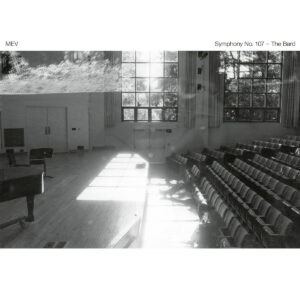
Symphony No. 107 –The Bard is a beautifully recorded example of the endlessly multi-layered later MEV sound, accompanied by new liner notes by Alvin Curran (now the only surviving member of the group) and a selection of previously unseen photographs from across the many decades of the group’s activity. Arriving in an elegant sleeve bearing a beautiful photograph by Francis Zhou of the Olin Hall at Bard College where the concert was recorded, this is an essential document from a major group in the history of experimental music. As Rzewski wrote, this music is ‘like life, unpredictable, sometimes making sense, mostly not’.
28,00€
In stock

LP
Jeanne LEE – Gunter HAMPEL – Michel WAISVISZ – Freddy GOSSEYE – Sven-Åke JOHANSSON
“Scheiße ’71”
Following on from the Bergisch-Brandenburgisches Quartett’s anarchic Live ’82 (BT095), Black Truffle continues its deep dive into the archives of legendary drummer/accordionist/photographer/composer/conceptual prankster Sven-Åke Johansson with Scheisse ’71. Recorded in November 1971 during the Berliner Jazztage at a heavy-hitting concert that also included the Spontaneous Music Ensemble and groups led by Peter Brötzmann, Manfred Schoof, and Masahiko Sato, Scheisse ’71 is the only document of a wild, otherwise unrecorded quintet featuring Johansson on drums, accordion and oboe d’amore, legendary free jazz vocalist Jeanne Lee, her husband Gunter Hampel on vibes, flute and bass clarinet, live electronics pioneer Michael Waisvisz on modified Putney (VCS 3) synthesizer, and the unknown Freddy Gosseye on electric bass. Part of a festival centred on giants of jazz like Duke Ellignton and Dizzy Gillespie, the radical performance shocked its audience, who can be heard heckling and yelling abuse at points, including the titular exclamation of ‘Scheiße!’
Clocking at just over half an hour and recorded in raw but detailed stereo by Johansson himself, the music burns with intensity while also making room for spacious passages and frequent dynamic movement. Beginning with Lee’s voice, Hampel on flute and Johansson on oboe d’amore in a bird-like game of call and response, the unexpected entry of Waisvisz’s tortured, squelching synth bursts prompts the first of many changes in energy and instrumentation, as Gosseye’s busy, roving bass enters and Johansson moves to the kit, his swinging cymbal work and juddering toms extending the approach of Sunny Murray or early Milford Graves.
The presence of synthesizer, electric bass, and Lee’s highly amplified voice moves the quintet away from conventional free jazz textures, at times pushing into zones of abstract free sound reminiscent of what groups like MEV, AMM or Johansson’s MND were exploring in the same years. But the energy and joyful melodicism of the music keep it rooted in the tradition of American fire music and its European inheritors. Capable of changing gears in an instant from ferocious blow outs to fragile tapestries of chiming vibes and fizzing synth, the music finds space for Lee’s post-bop free scat (which integrates shrieks and howls just as a post-Ayler saxophonist might), Gosseye’s virtuosic bass runs (a rare attempt to apply the classic free jazz style of players like Alan Silva or Henry Grimes to the electric instrument), Johansson’s folkish accordion interjections, and even a sustained passage of unison bass clarinet and electric bass riffing in its second half.
Special mention should be made of Waisvisz’s Putney performance, one of the earliest documents of this under-recorded instrument inventor and player, here playing a major role in giving the music its wildly exploratory, primordial air, his buzzing glissandi and bubbling filter sweeps at times howling like a distressed monkey. Arriving in an austerely stylish sleeve with beautiful black and white photographs by Johansson, Scheisse ’71 is an essential recording that adds yet another layer to our appreciation of this golden era of radical free music.
25,50€
Out of stock

CD
Alfredo COSTA MONTEIRO
“Abstand”
"Abstand" was conceived to enhance the particularities of the combination of accordion and melodica, both wind instruments, one played with movement and the other by blowing. This dichotomy of difference and similarity resulted in intricate textures, not only thanks to the instruments’ particular timbres, but also through the natural microtonal distances in their fixed tunings, especially when it comes to old and worn out instruments like the ones used here.
These micro-intervals were enriched by a whole range of very minimal and subtle feedback, sometimes almost undetectable and sometimes tuned with one of the two instruments, creating many beat frequencies in order to produce active and organic listening. The sparse use of the cymbal goes in that direction and generates one more layer. Interferences formed by minimal distances as traces of other distances induced by thought. (Alfredo Costa Monteiro, Barcelona, February 2023)
10,00€
Out of stock

CD
Junji HIROSE / Kazuo IMAI / Darren MOORE
“Be Quiet!!!”
Sax player Junji Hirose and guitarist Kazuo Imai, both Tokyo residents born in 1955, are renowned Japanese improvisers who have long propelled the country’s improvised music scene. Australian drummer Darren Moore, who is currently based in Singapore, carries on his performance activity while also teaching at Lasalle College of the Arts.
Darren Moore lived in Tokyo for several years in the mid-2010s. Since then he has often visited the country and performed with Japanese musicians. In 2022 he came to Japan and gave a numerous concerts. On August 4, Moore performed with Hirose and Imai in a trio concert planned by Hirose and held at GOK Studio in Tokyo. Their performance that day is documented on this recording.
On these two tracks (both about 28 minutes long), the combination of tenor sax (Hirose), electric guitar (Imai) and drums (Moore) creates extremely powerful improvised performances filled with a sense of driving speed. The three musicians’ multifaceted talent is clearly on display in this outstanding release.
10,00€
In stock

CD
Sergio MERCE
“Traslasierra (expanded landscape)”
Sergio Merce is a saxophonist and sound artist based in Buenos Aires, Argentina. He is known for his use of a microtonal sax that he built by radically modifying the mechanisms of an alto saxophone and synthesizers to create rich harmonics and slowly moving tonal works, layering aberrant and alluring tones in restrained configurations that allow each stratum of sound to be distinguished and appreciated, creating mesmerizing compositions of elusive and illusionistic sound.
The piece "Traslasierra (expanded landscape)" is a composition made up of different moments. In this case Merce plays the EWI (Electronic Wind Instrument), virtual stringed and wind instruments controlled with the EWI, field recordings and synthesizer.
10,00€
Out of stock

CD
Lance Austin OLSEN / Bruno DUPLANT
“Coïncidence”
Born in 1943, Lance Austin Olsen is a Canadian artist and composer. He started painting in his youth and has since continued developing his work as an artist. In 1997, Olsen met sound and visual artist Jamie Drouin and became interested in experimental music. In Olsen’s creative process, composition and painting are closely related and inspired by each other. French musician Bruno Duplant is an energetic and acclaimed creator on the contemporary experimental music scene.
This CD’s single 33-minute track, “Coïncidence,” is a duo performance by Lance Austin Olsen (guitar, field recordings, wax cylinder recordings, MIDI organ, amplified objects) and Bruno Duplant (piano and sounds). Several types of indistinct and rather soft sounds, and hard piano sounds that resonate slowly one by one, create contrast as they continue throughout the piece along with a disturbing mood.
10,00€
In stock

CD
Akira SAKATA / Ken IKEDA
“Gauche”
Alto sax/clarinet player Akira Sakata is a legend of Japan’s free jazz scene. Ken Ikeda is a musician who resided for many years in New York and London, and has been based in Tokyo since his return to Japan from the UK in 2020. In 2021, Ikeda released "Signal and Signaless," a duo CD with Rie Nakajima, on the Ftarri label. This album, "GAUCHE," is Sakata’s first release from Ftarri.
On May 21, 2022, Akira Sakata and Ken Ikeda gave a duo concert at Ftarri, Tokyo. This CD consists of two improvised performances (29 and 36 minutes long) from that concert. Sakata played alto sax, clarinet and several types of bells, while Ikeda played synthesizer. When people think of Akira Sakata, they usually think of the kind of extremely powerful, ferocious performances he gave many years ago with the Yosuke Yamashita trio—but on this album we hear a different Sakata. Perhaps influenced in part by Ikeda, whose distinctive electronic sound features smooth and supple timbres, Sakata’s winds playing throughout is calm and composed—the epitome of self-possession. Partway through, he rings bells in silent spaces, adding further to the broadminded mood. This superb album was born of the auspicious combination of these two musicians’ distinctive musical styles.
10,00€
In stock

CD
Tetuzi AKIYAMA / Ayami SUZUKI
“Allelopathy”
Ayami Suzuki, a musician based in the Tokyo area, performs a unique kind of ambient drone using electronics and voice. Since 2020 she has been performing at Ftarri in Tokyo, both as a soloist and with other musicians. Acclaimed guitarist Tetuzi Akiyama is active on the international improvised music scene. In 2021 Akiyama gave many outstanding performances at Ftarri; recordings of a number of these concerts were subsequently released as CDs. "Allelopathy" is one of these recordings.
Akiyama and Suzuki performed together at Ftarri on October 10, 2021. This CD contains two of the pieces they played in that concert. In alignment with Suzuki’s characteristic ambient drones and carried along on her electronics and Akiyama’s electric guitar playing, a voice performance incorporating Suzuki’s cryptic word-like sounds unfolds calmly and spaciously throughout. This superb work abounds in entrancing charm.
10,00€
Out of stock

CD
Junji HIROSE / Otomo YOSHIHIDE
“DUO-1”
Improviser Junji Hirose is not just a sax player; in the 1980s he started playing the SSI (self-made sound instrument), which he created by combining numerous devices and everyday objects from which noise sounds are produced in a scattered way. In 1989, Hirose recorded the SSI/turntables duo album Silanganan Ingay with Otomo Yoshihide and released it independently as an LP. Three decades later, in 2022, a new SSI/turntables duo album by Hirose and Otomo has finally been made!
This CD contains live performances of three works that took place at Pool, Tokyo, on June 6, 2021. Otomo produces wild, wriggling noise sounds on two turntables. Hirose, in the first piece, uses the self-made sound instrument, version 4 (SSI4), which he set up with two bicycle wheels as central components. In the second, he plays the SSI6, which produces white noise by directing powerful bursts of air onto PE tape with two air compressors. And in track three, he uses the no-instrument air noise (NIAN), which turns powerful bursts of compressed air directly onto a mike set up on a stand, creating roaring noise that sounds like fierce wind.
10,00€
In stock

CD
Magnus GRANBERG
“How Lonely Sits the City? (version for quartet)”
Composer/improviser Magnus Granberg, who lives in Stockholm, has presented outstanding composed works through Skogen, the ensemble he directs, and experimental music ensembles, projects and labels from around the world. He has released three CDs on the Meenna label: Whose Words? (meenna-983 / 2017), documenting a trio improvisation performance with Tetuzi Akiyama and Henrik Olsson; and two albums titled Come Down to Earth Where Sorrow Dwelleth (meenna-970, meenna-966 / 2020), each containing a different version, performed by a different ensemble, of the same composition by Granberg.
When Granberg accepted an invitation he received in September 2019 to participate in a project planned by Swedish artists including Leo Svensson Sander (cello), Stina Hellberg Agback (harp) and Eva Lindal (violin), it was the first step on the road to creating the work recorded on this CD. Granberg wrote the composition in the midst of the Covid-19 pandemic that began the following year, completing the quartet version, "How Lonely Sits the City?" (54 minutes). In October 2020, Sander, Agback, Lindal and Granberg (on prepared piano) recorded the work, and that recording is presented on this album.
Granberg subsequently prepared the extended version of "How Lonely Sits the City?" for his own group, Skogen. This was recorded by a seven-member Skogen ensemble, and released on the UK label Another Timbre in February 2022.
10,00€