
Out of stock

LP
ORION MUSIC WORKSHOP
“Mâlemort”
« We left our hero in his previous adventures embarking on a journey to the edges, where the music of a fantasized desert was playing in an outsider art gallery. Percussions of death, flutes leading to a weird ceremony, the new chapter hits hard. We sail in a canoe on a flow of organic sounds, this second volume follows the quest for a cosmic Grail where the dancefloor makes primitive rhyme with pleasurable. A fruitful novelty, the machine invites itself into the ancestral cave, a metronomic pulse plays the spinal column of an exciting and wonky groove. Result, a record taking his source in an after punk under the Bazooka standard. Kind of Throbbing Gristle in the forest of Brocéliande, La Perversita and Neu wandering off in the Atlas… A sonic restlessness which certainly evokes a venerable sensibility. Caught between two stools but the choice of not choosing will be the chosen option. Here and there, today and tomorrow, this music of the future and past is mesmerizing to the highest degree. »
Electronics, flutes, voice, zither, kalimba, glass, percussions (darbuka, hand percussion, balafon) by Tom Val. Recorded and mixed at Bâtiment 8 between October 2022 and December 2022.
200 copies
26,50€
Out of stock

LP
ROEDELIUS / HAUSSWOLFF
“II” [!!damaged cover!!]
Pochette abimée avec au minimum 2 coins pliés.
Damaged cover with at least 2 corners bumped / folded.
Deep and beautiful ambient experimentalism from two true masters. “Roedelius / Hausswolff II”is this duo’s second album. The two met in Vienna in 2016 when Carl Michael invited Hans-Joachim to participate in the collective sound-installation and concert””freq_out ”. Since H-J had been, and still is, organizing the festival “More Ohr Les“ in his home town Baden just outside Vienna it has been natural for him to invite CM to collaborate and perform here. As a result of this iDEAL Recording released the CD “Zurufe“ in 2021 where H-J and CM collaborated with American Tim Story and Brit/Swiss Christopher Chaplin. Like the duo’s first album - ”Nordlicht” (released in the USA in 2017) - this new one follows the path where a dark ambient drone style reveals several epic landscapes and formulas.
Original price was: 23,50€.10,00€Current price is: 10,00€.
In stock

LP
Marja AHTI
“Tender Membranes”
Black Truffle is pleased to announce Tender Membranes, the label’s first release from Swedish-Finnish sound artist and electro-acoustic composer Marja Ahti. Active for a decade in the Finnish underground music scene, in recent years Ahti has developed a distinctive approach to patiently unfolding electro-acoustic constructions, documented on a string of solo releases and collaborative projects with Judith Hamann and her husband Niko-Matti Ahti. Working with concrete and instrumental sounds, field recordings, and electronics, Ahti favours neither disjunctive collage nor monolithic consistency; rather, her work is composed of organically unfolding sequences of details and textures, which, as she says, ‘can stretch out or cut fast as long as they have a sense of inner stillness’, a sense that she connects to moments of heightened attention in everyday life. Tender Membranes consists of four lengthy pieces, partly inspired by the image of the senses and mind as membranes allowing for the passage between inner and outer spaces, sensation and its causes, creating a world. Ahti’s unhurried pacing encourages this sense of listening as an opening or surrender to sound, which can often create the impression that the listener is moving through a space zooming in on details. The opening Shrine (Aether) exemplifies this aspect of Ahti’s approach: a bell clears the air with a single long tone, followed by the ambience of outdoor spaces, crackling electronics, an archival recording of a horsefly on a windowpane. Dozens of these moments, varying in length, density, and intensity, move past the listener’s attention, momentarily brought into focus then slipping away. Like those of the masters of the French musique concrète tradition, Ahti’s sounds are not often recognisable, though they might suggest proximity or distance, open environments or closed spaces, the urban or rural, day or night. In Ahti’s work, we do not encounter spectacular metamorphoses à la Parmegiani but rather a state of ambiguity where the listener is often unsure what is organic and what is inorganic, where the careful productions of the synthesizer might end and sounds discovered in the environment begin. What Ahti calls her ‘poetic way of experiencing and organising the familiar and the unfamiliar’ is sustained throughout Tender Membranes, but each piece has its own character. On Dust / Light, human presence is more overt, as what appear to be whispers, singing, and distant speech thread between high frequencies, untraceable drips and pops, and metallic shimmers. In all this there is a melody that you can sing and to which you may dance makes more prominent use of musical instruments, gaining a sombre beauty from half-buried piano chords and organ tones. On the closing Oh Fragrant Witness, a delicate cloud of subtly bending pitches is repeatedly disrupted by a resounding, almost ominous mass of low tones, at once a strange detour from much of what has gone before and an almost classical finale. Arriving in a sleeve reproducing contemporary Finnish photographer Sini Pelkki’s fragmented visions of the everyday, Tender Membranes is a balm to reawaken tired ears.
26,00€
In stock

LP
Cassandra MILLER
“Traveller Song / Thanksong”
Black Truffle is pleased to announce its first release from celebrated London-based Canadian composer Cassandra Miller. Though her body of mature work stretches back almost twenty years, many listeners were introduced to Miller through the success of her astonishing 2015 Duet for Cello and Orchestra, which sets an imperturbable two-note cello part against a series of increasingly dense orchestrations of an Italian folk melody; in 2019, it was selected by The Guardian as one of the ‘best classical music works of the 21st century’. Traveller Song / Thanksong, the first release of her music on vinyl, presents a pair of compositions for voice and ensemble that exemplify Miller’s gently absurd, strikingly beautiful, and utterly unique work.
Like many of Miller’s compositions, these pieces originate in existing music. Traveller Song (2016/2018) begins from a 1950s song of an anonymous Sicilian cart driver recorded by Alan Lomax and Diego Carpitella, which Miller recorded herself singing along to, going on to then record herself singing to her own layered voices. Miller’s untutored voice is an unsteady, wavering wail that has, in her words, ‘more in common with a quasi-shamanistic keening than anything Sicilian’. Heard sometimes alone, sometimes layered, her pre-recorded voice is accompanied by a chamber sextet drawn from London’s Plus-Minus Ensemble. In the first section, Miller’s exposed warble is set to a spare piano accompaniment, somehow both faintly preposterous and magisterial. Following the voice note for note, the piano part often makes use of almost mechanical sequences of parallel chords, reminiscent both of Satie’s Rosicrucian period and the abrupt harmonic movements of a chord organ. The orchestration then opens up to guitar, clarinet, and sliding strings, a delicate environment for Miller’s voice, which, especially when it begins to be layered, generates a powerful sense of intimacy. In its concluding minutes, the folk roots of the original melody return in the form of a glorious full ensemble setting dominated by accordion, clarinet, and strummed guitar. Thanksong begins from recordings of Miller singing along to the third movement of Beethoven’s late quartet in A minor (Op. 132), the ‘holy song of thanks’ the composer wrote to express his gratitude for (temporarily) recovering from illness. Recording herself singing along repeatedly to each of the individual parts of the quartet, Miller created an aural score where each member of the string quartet listens to their own part on headphones, playing by ear. Performed on this recording by Montreal's Quatuor Bozzini, with whom Miller has a decades-long relationship, they are joined by the British soprano Juliet Fraser, who sings material from the Beethoven quartet ‘as slowly and quietly as possible’. The atmosphere of the opening of Beethoven’s Dankgesang, of hushed reawakening and thoughtful reflection, is sustained throughout the fourteen minutes of Miller’s piece, building at points almost to sentimentality before the five individual parts again fall back into a gentle burble of unsynchronised melodic gestures. Like Traveller Song, here the use of the voice is a long way from the mannered performance of much contemporary music, reaching for a human and bodily presence more connected to the reality of the everyday, albeit suffused with wonder. Presented in a stylish sleeve adorned with photography by Lasse Marhaug and liner notes by Cassandra Miller, this is a key release from a major contemporary composer whose work challenges and dazzles in equal measure.
25,50€
In stock

LP
Joe McPHEE – Mette RASMUSSEN – Dennis TYFUS
“Oblique Strategies”
Black Truffle is pleased to welcome free jazz legend Joe McPhee back to the fold with Oblique Strategies, a wild trio recorded in Antwerp in 2018 in the company of Mette Rasmussen’s fire-breathing alto saxophone and Dennis Tyfus’s post-Fluxus antics on tape, voice, and percussion. Rasmussen and Tyfus have previously recorded together as Bazuinschal, and some similar strategies are on display here: mysterious metallic scrapes, extended tones in which voice and sax become indistinguishable, comic explosions of varispeed tape. With McPhee on board, however, proceedings are more sumptuous, with the two horns moving fluidly from expeditions into the extremes of their instruments’ registers to pointillistic note-splatter and Ayler-esque folk melodies; we even get to bask in some of the slow-motion free blues that McPhee has now been playing for half a century.
McPhee is heard primarily on tenor, Rasmussen mainly on alto, but with Rasmussen doubling on sundry objects, and the whole trio contributing vocals, certainty about who is doing what becomes nigh impossible. The recording and production add to this hazy unclarity. Where much contemporary improvised music aims at dryly clinical hi-fi, the lively reverberant space of Oblique Strategies calls to mind the less-than-pristine sonics of classic free jazz artefacts like John Tchicai’s Afrodisiaca or McPhee’s own Underground Railroad. A further dimension of oblique unpredictability is added by subtle changes in the sense of space: at times merely a reverb tail glimpsed between phrases, at other points the whole mix seems to be momentarily swallowed up in slap-back, blurring the lines between acoustic instruments and the decayed fidelity of Tyfus’ tape playback.
Spread across four pieces ranging from four to nineteen minutes in length, Oblique Strategies moves with anarchic swagger from explosions of clattering cymbals and bellowing horns to near-silent episodes of mysterious rumble and clunk. ‘Death or Dinner?’ opens the record with a lovely duet of climbing melodic patterns shared between the two saxophones, played with a buzzing oboe-like tone. A long, wavering note sung by Tyfus cues the first of countless changes of direction, eventually leading to a crescendo of watery splutters and duelling saxes. At points Tyfus’ keening resemble the signature moves of his friend and collaborator, Ghédelia Tazartès; at others, his tape-sped huffs and puffs possess a rawness reminiscent of Henri Chopin or Gil Wolman. The dialogue between wailing saxophones and vocal cries, punctuated by percussive thuds and crashes, can at times feel less like a musical performance and more like the calls of some mysterious forest creatures, possessing a primordial energy that might remind some listeners of the outdoor antics of Brötzmann and Bennink’s Schwarzwaldfahrt.
Oblique Strategies can also be delicate at times, as on the beautiful third piece, ‘Destilled Edible’, dominated by a slow, microtonal melody played with a breathy tone resembling a shakuhachi. The closing side-long ‘Light My Fire’ ranges across classic improv call and response, skittering trumpet blurts, inept cymbal clatter, mock-operatic vocals, and crude tape manoeuvres. Momentarily pausing at the ten-minute mark for an interlude of ghostly room sound and crackling texture, its closing moments unfurl a glorious dual saxophone finale, the almost epic tone subtly undermined by Tyfus quietly tapping out swing rhythms. Arriving in a striking sleeve adorned with Tyfus’ drawings, Oblique Strategies is an invigoratingly free-spirited blast of improvisation.
25,50€
In stock
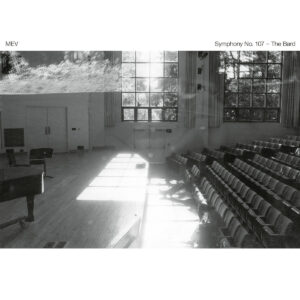
LP
MUSICA ELETTRONICA VIVA
“Symphony No. 107 – The Bard”
Black Truffle is pleased to announce Symphony No. 107 –The Bard, a previously unheard archival recording of the legendary improvising ensemble MEV (Musica Elettronica Viva), captured in concert at Bard College, New York in 2012. Formed by a group of American expat composers in Rome in 1966, the MEV ensemble played an important role in the development of free improvisation, bridging the live electronics tradition begun by Cage and Tudor and the high-energy squall of free jazz. Early recordings like Spacecraft or The Sound Pool unleash volleys of metal and glass amplified with contact microphones, howling winds, primitive synthesizer bleep and raucous audience participation, the intensity of which puts much later ‘noise’ to shame. In later decades, the ensemble would go through many iterations, often including legendary free players like Steve Lacy and George Lewis. In its final years, MEV settled into the core trio of founding members heard here: Alvin Curran, Frederic Rzewski, and Richard Teitelbaum, using piano, electronics, and small instruments.
Curran, Rzewski, and Teitelbaum were life-long friends blessed, as Curran says, with ‘incompatible personalities’: major figures in the post-Cagean experimental tradition, they explored countless divergent and even contradictory paths as composers and performers, from agitprop songs to brainwave-controlled synthesis. MEV is the sound of these three personalities coming together, their contributions radically individual yet attaining a state of ‘fundamental unity’ that Rzewski, in a text written in the collective’s earliest years, defined as the ‘final goal of improvisation’. Of course, listeners familiar with aspect of the trio’s individual works might hazard some guesses about who is doing what: the crisp piano figures are probably Rzewski’s, the cut-up hip-hop samples most likely Curran’s, the sliding, squelching synth possibly Teitelbaum’s. But often these identities are dissolved in a constantly shifting hall of mirrors, the listener unable to tell which of these pianos is live and which is a sample of a past virtuoso, or whether a horn blast derives from ethnographic documentation or Curran cutting loose on Shofar.
The two side-long sets here occupy a similar terrain of constantly shifting texture and instrumentation, unexpected interruptions, and moments of sudden beauty. The first set is sparser, at times almost ominous, as a bell repeatedly sounds across wheezing harmonica, seasick orchestral textures, and creaking wood, making room for episodes of yodelling and delicate prepared piano before exploding into a storm of buzzing synth and piano fragments. The second set is more frenetic, moving rapidly across centuries and continents: cars crash into post-serial piano pointillism, wailing voices collide with chopped and screwed hip-hop samples, Hollywood strings are buried under layers of electronic gurgles. The performance slows in its final moments, making way for a sampled voice repeating the phrase ‘protest and the good of the world’, reminding us that MEV’s idea of freedom was always more than musical.
Symphony No. 107 –The Bard is a beautifully recorded example of the endlessly multi-layered later MEV sound, accompanied by new liner notes by Alvin Curran (now the only surviving member of the group) and a selection of previously unseen photographs from across the many decades of the group’s activity. Arriving in an elegant sleeve bearing a beautiful photograph by Francis Zhou of the Olin Hall at Bard College where the concert was recorded, this is an essential document from a major group in the history of experimental music. As Rzewski wrote, this music is ‘like life, unpredictable, sometimes making sense, mostly not’.
28,00€
In stock

LP
Jeanne LEE – Gunter HAMPEL – Michel WAISVISZ – Freddy GOSSEYE – Sven-Åke JOHANSSON
“Scheiße ’71”
Following on from the Bergisch-Brandenburgisches Quartett’s anarchic Live ’82 (BT095), Black Truffle continues its deep dive into the archives of legendary drummer/accordionist/photographer/composer/conceptual prankster Sven-Åke Johansson with Scheisse ’71. Recorded in November 1971 during the Berliner Jazztage at a heavy-hitting concert that also included the Spontaneous Music Ensemble and groups led by Peter Brötzmann, Manfred Schoof, and Masahiko Sato, Scheisse ’71 is the only document of a wild, otherwise unrecorded quintet featuring Johansson on drums, accordion and oboe d’amore, legendary free jazz vocalist Jeanne Lee, her husband Gunter Hampel on vibes, flute and bass clarinet, live electronics pioneer Michael Waisvisz on modified Putney (VCS 3) synthesizer, and the unknown Freddy Gosseye on electric bass. Part of a festival centred on giants of jazz like Duke Ellignton and Dizzy Gillespie, the radical performance shocked its audience, who can be heard heckling and yelling abuse at points, including the titular exclamation of ‘Scheiße!’
Clocking at just over half an hour and recorded in raw but detailed stereo by Johansson himself, the music burns with intensity while also making room for spacious passages and frequent dynamic movement. Beginning with Lee’s voice, Hampel on flute and Johansson on oboe d’amore in a bird-like game of call and response, the unexpected entry of Waisvisz’s tortured, squelching synth bursts prompts the first of many changes in energy and instrumentation, as Gosseye’s busy, roving bass enters and Johansson moves to the kit, his swinging cymbal work and juddering toms extending the approach of Sunny Murray or early Milford Graves.
The presence of synthesizer, electric bass, and Lee’s highly amplified voice moves the quintet away from conventional free jazz textures, at times pushing into zones of abstract free sound reminiscent of what groups like MEV, AMM or Johansson’s MND were exploring in the same years. But the energy and joyful melodicism of the music keep it rooted in the tradition of American fire music and its European inheritors. Capable of changing gears in an instant from ferocious blow outs to fragile tapestries of chiming vibes and fizzing synth, the music finds space for Lee’s post-bop free scat (which integrates shrieks and howls just as a post-Ayler saxophonist might), Gosseye’s virtuosic bass runs (a rare attempt to apply the classic free jazz style of players like Alan Silva or Henry Grimes to the electric instrument), Johansson’s folkish accordion interjections, and even a sustained passage of unison bass clarinet and electric bass riffing in its second half.
Special mention should be made of Waisvisz’s Putney performance, one of the earliest documents of this under-recorded instrument inventor and player, here playing a major role in giving the music its wildly exploratory, primordial air, his buzzing glissandi and bubbling filter sweeps at times howling like a distressed monkey. Arriving in an austerely stylish sleeve with beautiful black and white photographs by Johansson, Scheisse ’71 is an essential recording that adds yet another layer to our appreciation of this golden era of radical free music.
25,50€
Out of stock

CD
Alfredo COSTA MONTEIRO
“Abstand”
"Abstand" was conceived to enhance the particularities of the combination of accordion and melodica, both wind instruments, one played with movement and the other by blowing. This dichotomy of difference and similarity resulted in intricate textures, not only thanks to the instruments’ particular timbres, but also through the natural microtonal distances in their fixed tunings, especially when it comes to old and worn out instruments like the ones used here.
These micro-intervals were enriched by a whole range of very minimal and subtle feedback, sometimes almost undetectable and sometimes tuned with one of the two instruments, creating many beat frequencies in order to produce active and organic listening. The sparse use of the cymbal goes in that direction and generates one more layer. Interferences formed by minimal distances as traces of other distances induced by thought. (Alfredo Costa Monteiro, Barcelona, February 2023)
10,00€
Out of stock

CD
Junji HIROSE / Kazuo IMAI / Darren MOORE
“Be Quiet!!!”
Sax player Junji Hirose and guitarist Kazuo Imai, both Tokyo residents born in 1955, are renowned Japanese improvisers who have long propelled the country’s improvised music scene. Australian drummer Darren Moore, who is currently based in Singapore, carries on his performance activity while also teaching at Lasalle College of the Arts.
Darren Moore lived in Tokyo for several years in the mid-2010s. Since then he has often visited the country and performed with Japanese musicians. In 2022 he came to Japan and gave a numerous concerts. On August 4, Moore performed with Hirose and Imai in a trio concert planned by Hirose and held at GOK Studio in Tokyo. Their performance that day is documented on this recording.
On these two tracks (both about 28 minutes long), the combination of tenor sax (Hirose), electric guitar (Imai) and drums (Moore) creates extremely powerful improvised performances filled with a sense of driving speed. The three musicians’ multifaceted talent is clearly on display in this outstanding release.
10,00€
In stock

CD
Sergio MERCE
“Traslasierra (expanded landscape)”
Sergio Merce is a saxophonist and sound artist based in Buenos Aires, Argentina. He is known for his use of a microtonal sax that he built by radically modifying the mechanisms of an alto saxophone and synthesizers to create rich harmonics and slowly moving tonal works, layering aberrant and alluring tones in restrained configurations that allow each stratum of sound to be distinguished and appreciated, creating mesmerizing compositions of elusive and illusionistic sound.
The piece "Traslasierra (expanded landscape)" is a composition made up of different moments. In this case Merce plays the EWI (Electronic Wind Instrument), virtual stringed and wind instruments controlled with the EWI, field recordings and synthesizer.
10,00€
Out of stock

CD
Lance Austin OLSEN / Bruno DUPLANT
“Coïncidence”
Born in 1943, Lance Austin Olsen is a Canadian artist and composer. He started painting in his youth and has since continued developing his work as an artist. In 1997, Olsen met sound and visual artist Jamie Drouin and became interested in experimental music. In Olsen’s creative process, composition and painting are closely related and inspired by each other. French musician Bruno Duplant is an energetic and acclaimed creator on the contemporary experimental music scene.
This CD’s single 33-minute track, “Coïncidence,” is a duo performance by Lance Austin Olsen (guitar, field recordings, wax cylinder recordings, MIDI organ, amplified objects) and Bruno Duplant (piano and sounds). Several types of indistinct and rather soft sounds, and hard piano sounds that resonate slowly one by one, create contrast as they continue throughout the piece along with a disturbing mood.
10,00€
In stock

CD
Akira SAKATA / Ken IKEDA
“Gauche”
Alto sax/clarinet player Akira Sakata is a legend of Japan’s free jazz scene. Ken Ikeda is a musician who resided for many years in New York and London, and has been based in Tokyo since his return to Japan from the UK in 2020. In 2021, Ikeda released "Signal and Signaless," a duo CD with Rie Nakajima, on the Ftarri label. This album, "GAUCHE," is Sakata’s first release from Ftarri.
On May 21, 2022, Akira Sakata and Ken Ikeda gave a duo concert at Ftarri, Tokyo. This CD consists of two improvised performances (29 and 36 minutes long) from that concert. Sakata played alto sax, clarinet and several types of bells, while Ikeda played synthesizer. When people think of Akira Sakata, they usually think of the kind of extremely powerful, ferocious performances he gave many years ago with the Yosuke Yamashita trio—but on this album we hear a different Sakata. Perhaps influenced in part by Ikeda, whose distinctive electronic sound features smooth and supple timbres, Sakata’s winds playing throughout is calm and composed—the epitome of self-possession. Partway through, he rings bells in silent spaces, adding further to the broadminded mood. This superb album was born of the auspicious combination of these two musicians’ distinctive musical styles.
10,00€
In stock

CD
Tetuzi AKIYAMA / Ayami SUZUKI
“Allelopathy”
Ayami Suzuki, a musician based in the Tokyo area, performs a unique kind of ambient drone using electronics and voice. Since 2020 she has been performing at Ftarri in Tokyo, both as a soloist and with other musicians. Acclaimed guitarist Tetuzi Akiyama is active on the international improvised music scene. In 2021 Akiyama gave many outstanding performances at Ftarri; recordings of a number of these concerts were subsequently released as CDs. "Allelopathy" is one of these recordings.
Akiyama and Suzuki performed together at Ftarri on October 10, 2021. This CD contains two of the pieces they played in that concert. In alignment with Suzuki’s characteristic ambient drones and carried along on her electronics and Akiyama’s electric guitar playing, a voice performance incorporating Suzuki’s cryptic word-like sounds unfolds calmly and spaciously throughout. This superb work abounds in entrancing charm.
10,00€
Out of stock

CD
Junji HIROSE / Otomo YOSHIHIDE
“DUO-1”
Improviser Junji Hirose is not just a sax player; in the 1980s he started playing the SSI (self-made sound instrument), which he created by combining numerous devices and everyday objects from which noise sounds are produced in a scattered way. In 1989, Hirose recorded the SSI/turntables duo album Silanganan Ingay with Otomo Yoshihide and released it independently as an LP. Three decades later, in 2022, a new SSI/turntables duo album by Hirose and Otomo has finally been made!
This CD contains live performances of three works that took place at Pool, Tokyo, on June 6, 2021. Otomo produces wild, wriggling noise sounds on two turntables. Hirose, in the first piece, uses the self-made sound instrument, version 4 (SSI4), which he set up with two bicycle wheels as central components. In the second, he plays the SSI6, which produces white noise by directing powerful bursts of air onto PE tape with two air compressors. And in track three, he uses the no-instrument air noise (NIAN), which turns powerful bursts of compressed air directly onto a mike set up on a stand, creating roaring noise that sounds like fierce wind.
10,00€
In stock

CD
Magnus GRANBERG
“How Lonely Sits the City? (version for quartet)”
Composer/improviser Magnus Granberg, who lives in Stockholm, has presented outstanding composed works through Skogen, the ensemble he directs, and experimental music ensembles, projects and labels from around the world. He has released three CDs on the Meenna label: Whose Words? (meenna-983 / 2017), documenting a trio improvisation performance with Tetuzi Akiyama and Henrik Olsson; and two albums titled Come Down to Earth Where Sorrow Dwelleth (meenna-970, meenna-966 / 2020), each containing a different version, performed by a different ensemble, of the same composition by Granberg.
When Granberg accepted an invitation he received in September 2019 to participate in a project planned by Swedish artists including Leo Svensson Sander (cello), Stina Hellberg Agback (harp) and Eva Lindal (violin), it was the first step on the road to creating the work recorded on this CD. Granberg wrote the composition in the midst of the Covid-19 pandemic that began the following year, completing the quartet version, "How Lonely Sits the City?" (54 minutes). In October 2020, Sander, Agback, Lindal and Granberg (on prepared piano) recorded the work, and that recording is presented on this album.
Granberg subsequently prepared the extended version of "How Lonely Sits the City?" for his own group, Skogen. This was recorded by a seven-member Skogen ensemble, and released on the UK label Another Timbre in February 2022.
10,00€
Out of stock

CD
Tetuzi AKIYAMA / Leo OKAGAWA
“Metaphor of Metamorphosis”
This is one in a trilogy of live recordings made at Ftarri, Tokyo, documenting some of guitarist/improviser Tetuzi Akiyama's outstanding performances of 2021. The CD releases feature covers drawn by artist Shigeo Mizuta. The two tracks on this CD, each around 25 minutes in length, were recorded at Akiyama's duo concert with electronics player Leo Okagawa at Ftarri on June 21, 2021.
Okagawa is known for releases on overseas labels of many collage works using environmental sounds, noise and so on. He's also a gifted improviser on electronics. There's a highly effective contrast between Okagawa's sound, comprised mainly of static sustained tones, and the sound produced by Akiyama's electric guitar, which is dynamic and hard-edged and has a psychedelic feeling.
10,00€
In stock

CD
Tetuzi AKIYAMA / Ryotaro MIYASAKA
“Odd Jobs Are the High Road of Work”
This is one in a trilogy of live recordings made at Ftarri, Tokyo, documenting some of guitarist/improviser Tetuzi Akiyama's outstanding performances of 2021. The CD releases feature covers drawn by artist Shigeo Mizuta. The two tracks here (31 and 39 minutes respectively) were recorded at Akiyama's duo concert with percussionist Ryotaro Miyasaka at Ftarri on February 8, 2021.
Born in 1995, percussionist Ryotaro Miyasaka lives in Tokyo. In this concert he placed numerous percussion instruments on the floor--snare drum, bongos, cymbal, tambourine, bell, cowbell, etc.--and picked up one instrument at a time to produce various sounds. Akiyama played electric guitar and fired off a series of spiky, noisy sounds. The contrast between myriad colorful, dry percussion sounds and abstract guitar noise makes for an exquisite performance.
10,00€
In stock

CD
Seijiro MURAYAMA
“To listen To As far As possible”
Seijiro Murayama is a drummer/percussionist and improviser/composer who lives in Paris. His first CDs on Ftarri's three labels (Hitorri, Ftarri and Meenna) came out in 2009, and he has since released a total of 12 solo, duo, trio and quartet albums on Ftarri labels. Of the solo albums, the first was Downdate (2017), followed by The Empire of Slip of the Tongue (2018) and mi-tai (2020). While Downdate and The Empire of Slip of the Tongue are electro-acoustic works, mi-tai is an album of improvisation with percussion and voice.
This album is Murayama's fourth solo release on the Hitorri label. Like the preceding album, it's a compilation of improvisational performances. The seven tracks (each between 4 and 11 minutes long) were recorded in Ljubljana, Slovenia, in January 2022. Murayama uses instruments including cymbal, bass drum, snare drum, voice, and various small objects. Along with the previous work (mi-tai), this album is an ideal introduction to Murayama's boundlessly original and distinctive work as an improviser.
10,00€
In stock

CD
Taku SUGIMOTO
“Octet”
On this album, works composed in 2018 and '19 by Tokyo-based composer/guitarist Taku Sugimoto are performed by musicians based in Berlin. Sugimoto has in recent years been working on a series in which pieces written as scores for solo performance can also be played as ensembles, with each musician using their respective solo score. For example, a score for guitar solo and a score for cello solo can be played as a duo performance by a guitarist and a cellist using their respective scores. "Solo for Violoncello 1," one of the tracks on this CD, is the first work of this type composed by Sugimoto. It's also the first piece in the series he named "Solo for Strings," which is performed on bowed stringed instruments using only natural harmonics. In the pieces in this series, the lengths of tones and performances can be changed by the performers.
When he was asked by Berlin-based clarinetists Michiko Ogawa and Sam Dunscombe to write a composition for their ensemble, Sugimoto thought of using the pieces in the "Solo for Strings" series. He prepared one piece for wind instruments to be performed by the trio of Ogawa (clarinet), Dunscombe (bass clarinet) and Rebecca Lane (flute), and five solo pieces from "Solo for Strings"--one each for contrabass, cello, and guitar, and two for viola. These pieces were performed and recorded in Berlin. Also recorded was the 25-minute work "Octet," performed by an ensemble of eight musicians using all six scores. This album is comprised of these seven pieces.
In addition to Michiko Ogawa, Sam Dunscombe and Rebecca Lane, the performing musicians are Johnny Chang (viola), Catherine Lamb (viola), Lucy Railton (cello), Jon Heilbron (contrabass), and Fredrik Rasten (guitar).
11,00€
Out of stock

CD
Toshimaru NAKAMURA / Tetuzi AKIYAMA
“Idiomatic Expressionism”
Both Toshimaru Nakamura and Tetuzi Akiyama started their musical activities in earnest in the 1990s. Today, both hold concert tours around the world on a yearly basis, have a long list of releases, and count among Japan's leading improvisers. Nakamura constructs sound with the instrument he calls the no-input mixing board, which creates feedback through irregular hard wiring of an analog audio mixer. Guitarist Akiyama plays either acoustic or electric guitar in highly original performances ranging from lyrical to noisy.
Nakamura and Akiyama have been collaborating for a long time. Over a period of several years in the early 2000s, they co-organized the monthly improvised music series "Meeting at Off Site" (held at the now-defunct gallery Off Site). While they have since appeared together many times in performances with other musicians, they've given a relatively small number of duo concerts. Surprisingly, Idiomatic Expressionism is only the second duo album by Nakamura and Akiyama and the first since their debut duo CD Semi-Impressionism (Spekk) was released 12 years ago (in 2009). While that CD consists of edited live recordings of overseas concerts, Idiomatic Expressionism is made up of studio recordings. This ambitious work was created in a deliberate, unhurried way from 2020 to 2021. In the album's five improvised music tracks, Nakamura's no-input mixing board and Akiyama's acoustic guitar produce an accumulation of sounds in a profound and exquisite manner.
10,00€
In stock

CD
Brad E. ROSE
“Annular Silhouettes”
From Brad E. Rose
There are many times when I’m working on a music project that, in the moment, I’m not sure what I’m really doing. I don’t believe there’s some otherworldly power guiding my hands or thought processes unless our own subconscious could be classified as such a thing. It’s mostly about trying to be present at that moment and letting the ideas and sounds unfold in a way that isn’t forced. Oftentimes, after the fact, it will become clearer to me that certain feelings or thoughts were trying to find their way out, but my brain, as is often the case, wasn’t sure how to process them and let them go. Sound has often acted as that medium for me over the last three decades; a way to channel difficult thoughts into a language I can understand.
One evening as I watched the snowfall in mid-January, after thinking about what Annular Silhouettes was, it finally hit me. Recorded during the depths of 2020, during a time spent within the vicinity of where I live, it’s a bit of a love letter to the place I grew up. I live in the house that my grandparents lived in for over 20 years, that my grandfather gutted and rebuilt with his own hands. It’s the last place he ever called home and his spirit remains firmly etched into its walls. I live less than 10 minutes from my childhood home, where both my parents still live. I moved away and eventually came back. I am lucky to gain a different understanding of this place than I had growing up.
Place is a strange thing in the way it can influence and shape us, for better or worse. Nearly 20 years ago, when I moved back here with my partner, she would tell me how she couldn’t get over how big the sky felt in Oklahoma. I still think about that often. For a place that is stuck moving backward in so many ways, the possibilities above us can be endless beyond the forces dragging us back into the soil. We all find our way to the dirt eventually and one circle will close, but during my time inhabiting this space, I hope to have started a few new circles along the way so that the cycle will grow.
14,00€
In stock

CD
SENYAWA + ENGLISH / ENDEAN / KNIGHT / SVOBODA / TALIA
“The Prey And The Ruler”
From Lawrence English
The first time I witnessed Senyawa was in the early 2010s. We shared a bill at the MonaFoma festival in Hobart. Some memories hold strongly in your mind and Senyawa’s performance that day did just that. It was a monstrous portent of things to come. A promise, in sound, of the energetic force that has since come to mark them as one of the truly unique and visionary musical pairings from South East Asia.
This project, The Prey And The Ruler, finds its root in the unsteady months of mid 2021. As the pandemic plodded onward, and lockdowns were a thing of the everyday here in Australia, Peter Knight and I were talking about the situations unfolding in our respective states. We also got to talking about friends in the region and found ourselves pondering the situation just north of us, in Indonesia. It was around this time we thought to reach out to Rully and Wukir from Senyawa and to hear how things were first hand for them, and their communities.
Following that initial conversation we collectively decided that it was a good moment to commence a project that could cut through the geographic isolation of those long months, and also seek to create some opportunities for a community of instrument builders, friends of Senyawa, who had been significantly hit by the force of the pandemic.
A few weeks after this exchange, Wukir sent a series of videos; grabs from his cellphone. The videos were of plastic moulds, smoke, spray paint and sound. In each short clip, instruments were being conceived, tested and forged. These were new instruments coming to life before our eyes, and ears. It was these instruments, and the audio possibilities they suggested, that are at the very heart of this edition.
Following several more exchanges we started passing recordings to one another. The process of sharing materials back and forth quickly took on the shape of the works you hear on this album.
Once all the contributions were in place I set about forging them. On the first listen there was a deep sense of intensity to all the performances, like an outpouring or eruption. This was no doubt the result of people being largely locked away, a chance to break the looping around of their own daily routines. These sonic offerings from Senyawa, these instruments with their sounds so unfamiliar and at times unexpected, seemingly unlocked approaches from everyone in surprising ways. It was as if everyone was leaning into the sounds, applying themselves to the particular qualities of these new instruments.
What you hear on this edition then is a collective effort at expanded listening. It is an album that affords a certain act of leaning in. The results trace many individual minds, applied to the same collective actions.
Wukir Suryadi - Industrial Mutant instrument
Rully Shabara - voice
Helen Svoboda - double bass & voice
Peter Knight - trumpet & Revox B77 reel-to reel tape machine
Joe Talia - drums
Aviva Endean - clarinets & harmonic flute
Lawrence English - organ, electronics
14,00€
In stock

CD
Aviva ENDEAN
“Moths & Stars”
From Aviva Endean
Coming from a background as a performer and clarinet player, the opportunity to record my own music opened up a whole new context to think about music. Sounds are freed from being confined to one place, one time, or even one perspective. I wanted the recording to have a right-up-in-your-ear kind of intimacy - so close, that you could hear the beating of a moth’s wing, but I also wanted the listener to experience the expansiveness of the recorded space, like the vast night sky.
The microphones became extensions of my instruments, getting right up close to capture the microscopic, creating tones of feedback which captivated me, or zooming out to capture multiple acoustic spaces. My recording and composing process became more intuitive and explorative, another form of play. I could start creating and see where the piece would take me, and notice how new relationships were formed as I folded multiple time/spaces in and over each other.
Sometimes I would begin by gleaning sounds from my archives, and listening to how they could be reimagined and transformed alongside the discoveries my microphones and instruments were finding. In ‘Nightwork’ I wanted to find a way to revisit some microtonal humming that I had recorded for a sound design project, and then discovered the Leslie speaker as a way to spin my bass clarinet sound around the microphones, creating bass tones emerging as waves out of the densely layered pitches. Sometimes a new instrumental fascination, such as the e-bows and magnets on ‘Mirror Signals’ or the binaural microphone feedback on ‘Moths & Stars’ would call for me to find further layers of clarinets and field recordings to be woven into their story.
14,00€
In stock

LP
Peter KNIGHT
“Shadow Phase”
From Peter Knight
Most of this record was created in the shadow of COVID and deep in the maw of Melbourne’s 2020 long winter lockdown. It is a meditation on the nature of connection.
Restricted to a 5km zone, one of the only people I saw outside my family during this time was my old friend and teacher, Ania Walwicz. We met in the overlap between our zones on the waterfront near Docklands to walk and talk on bright, cool winter afternoons.
Those conversations became large in my thoughts when Ania suddenly passed away in September. Her voice was in my head as I worked on this music, trawling through threads of ideas, recordings made on my phone, and thoughts jotted down in notebooks.
Ania’s practice as a writer relied on ‘automatic’ processes. Her work was informed by everything she had read (a lot) but it was created in the manner of dreams. In a state where the subconscious might bubble up and the words arrange themselves into meaning bearing forms that resonate more than represent.
I thought a lot about that as I made this music. I recorded everyday using the trumpet, my old Revox reel-to-reel, a couple of synths, a harmonium I lent from a friend, and whatever else was around. I worked mostly on just diving a little deeper each time I sat down to it.
Through the simple process of exhalation, I explored my relationship with the trumpet, which has been through so many twists and turns. I let the tones produced by my breath unfurl on long tape loops and degrade beyond recognition through pedal and plugin chains, until the only imprint of the initial gesture remained.
My process also involved long bike rides during which I’d listen to the work of previous days on ear buds, gliding through familiar streets made slightly strange by the absence of people and movement. Often my rides took me along Footscray Rd next to the port, and as I washed down towards Docklands past the old boat moorings I stopped pedalling to coast. The sounds from my darkened studio mingled with the low rush of air past my helmet, the click and whirr of my bike gears, a squalling bird, a whooshing car. And I remembered my last conversation with Ania. Sitting in the late afternoon sun, squinting against the light that raked across the water, she was telling me about all the different words for they have for blue in Polish and Russian, and how words don’t just change our perception of things, but also actually change the thing being perceived.
As I rode home that afternoon, I felt like anything was possible.
Peter Knight - trumpet, voice, synthesisers, laptop electronics, Revox B77 reel-to-reel
Fia Fiell - synthesiser (Eunoia)
Jacques Emery - bass (The Softened Shore)
Katherine Philp - cello (The Softened Shore)
Rachael Kim - violin (The Softened Shore)
Tamara Saulwick - whispered voice (The Softened Shore)
Tony Buck - percussion (Shadow Phase)
Ania Walwicz - spoken voice
24,00€
Out of stock

CD
Lawrence ENGLISH
“Approach”
From Lawrence English
I often find myself thinking about the opening line of William Gibson’s Neuromancer, "The sky above the port was the color of television, tuned to a dead channel." When the book was written in early 1980s, a dead TV channel was a deadened grey of noise. Revisit the book now though and its character has shifted, for in the digital age a dead channel is a richly saturated sky blue. The referential effects of time are not constant, but they rather provoke new perspectives and ideally new understandings.
This album, Approach, is an echo that has travelled with me for 33 years, even if I wasn’t fully aware of it. It’s a record about memory, about how seemingly cursory encounters shape us and how experiences accumulate in time. It’s a distorted mirror catching the diminished glow of the fires that forged me.
The record draws its root from Yoshihisa Tagami’s seminal manga Grey. In many respects this album is a soundtrack to that manga. What makes Grey unique, in the west at least, is that it was amongst one of the first Manga to be translated and distributed outside of Japan (yes, even before the touchstone that is Akira). It was one of the first droplets that has since become a torrent pouring outward from Japan. It was also the first Manga I bought for myself, when I was 13, and read as a serial.
I tend not to think or speak very much about my teenage years. I had some profound experiences that have carried forward, I forged deep emotional partnerships that carry to this day. The majority of that time however was something of a slog, a day by day performance of self-preservation. Those years were a quiet war to push back against expectations for a way of being I had no interest in sharing.
All boys’ schools, one of which I attended, are a maleficent prison if you are not participating in, or as was my case you are maintaining an antithetical position to, hegemonic masculinity. There’s no real need to detail my experiences but suffice to say several years after high school a classmate approached me in a stationery store and asked for my forgiveness for what he had done to me. I was only too happy to give him that relief, it was obvious he wore scars from those experiences that seemingly ran deeper than my own.
I don’t find myself dwelling on those negative experiences partly because during those years I was a sponge for culture. It’s difficult for me to quantify how much cultural consumption happened during my teen years, but I recognise now how formative so many of those exposures have become. An example of this came into sharp focus last year when I happened to remember, and then re-read Tagami’s Grey.
As laconic and occasionally unlikable as the main character, Grey, might have been I associated deeply with their sense of determination. Grey’s rejection of societal expectation (which is foregrounded by the edition’s introduction penned by speculative fiction author Harlan Ellison, who highlighted the class politics that haunt the storyline), and his refusal to accept the immobility of systems, and social codes, clearly resonated with me. Add to this a delightfully nihilistic optimism matched with unquenchable rage and that young version of me was sold; I knew already that sensation of rage, when applied with focus, would be my fuel throughout those years.
This record then is also a kind of sonic postcard retrospectively drafted for that very unsteady and volatile version of myself. It’s more than that of course, but I want to recognise and thank that belligerent young person, who seems so distant to me now. I recognise that their way of navigation, their determination to be curious and try to discover who they were, not who they were told to be, allowed this version of me to exist today. It also pays homage to the family and friends (and the cultural artefacts such as this manga) that helped cushion and guide that young body and mind. Without them, it’s difficult to know how I might be in the here and now.
14,00€
In stock

CD
Manuel MOTA & David GRUBBS
“na margem sul”
From David Grubbs
This recording documents Manuel Mota’s and my first public performance as a duo. We had played together previously for a recording session—a relaxed afternoon at Lisbon’s ZDB, where I recall zoning out, guitar in my hands, watching the endless throng of people Sunday-strolling past the plate glass window next to the stage. That deeply pleasurable afternoon session felt like a live accompaniment to a film.
This recording also documents, for the both of us, a first indoor collaborative performance since the beginning of the pandemic. It felt familiar—I do remember how to do these things—and yet upped in its intensity of focus, and afterward that much more imprinted in memory, even prior to sitting down with this recording. It seemed I could have narrated it after the fact, its various twists and turns, which is not often the case for me with improvised concerts, details of which often vanish—to return who knows when—or transform into a series of disconnected impressions.
One of the things that I love about Manuel’s playing is that as a listener I quickly abandon my search for the logics of continuity that apply to most performers. With Manuel I rarely feel that I anticipate the shape of a given phrase in the time of its unfolding—as a duo we’re definitely not finishing one another’s sentences—nor do I sense that I’m tracking larger structures in the making to serve as signposts for the performance as a whole. The two of us first met more than a decade ago, but throughout many conversations we haven’t spent much time speaking analytically about playing, never really compared notes from inside. It’s not that we’ve chosen not to talk about music, or that there’s a barrier or unspoken ideology to doing so. There’s always something else to talk about.
This concert took place in the Biblioteca Municipal of Barreiro, a smaller city to the southeast of Lisbon across the Tejo River estuary. “Na margem sul” means “on the south bank,” and is commonly used to refer to the area south of the Tejo. For a first time returning in many months to playing in an indoor setting, the library seemed an especially welcoming location.
14,00€
In stock

CD
Pierce WARNECKE
“Deafened By The Noise Of Time”
From Pierce Warnecke:
‘The darkness does not lift but becomes yet heavier as I think how little we can hold in mind, how everything is constantly lapsing into oblivion with every extinguished life, how the world is, as it were, draining itself, in that the history of countless places and objects which themselves have no power of memory is never heard, never described or passed on.’ - W.G. Sebald, ‘Austerlitz’
Deafened by the Noise of Time is a speculative take on how sound might decay and disappear; a reflection on the unavoidable entropy and dislocation of all things over time through 4 compositions, one with video. The titled is borrowed from Julian Barnes' novel 'The Noise of Time' (itself borrowed from Jewish Russian poet Osip Mandelstam), a fictional biography of Shostakovitch.
I first started working on the material for this album for a performance at Eglise Saint-Merry in Paris in 2017. Following the concert, I sat down to edit the music but struggled with the pieces, every time finding new flaws, unable to follow through with the original compositional ideas. Somewhat frustrated, I decided to strip down the musical content to form more bare-bone structures and look for a different principle or process to tie everything together.
For this, I shifted focus to a long running part of my video practice: the deterioration of things over time, where I use my camera with simple lighting and slow movements to focus on rusty, dirty, burned or broken found objects. I like the idea of these things being both recent and ancient, contemporary artefacts of a world in constant decay. I like the idea of being able to still sense memory on objects even when they’ve become almost entirely unrecognizable. I like how this pushes back against the inevitability of impermanence. I like the act of scavenging and reusing discarded objects to put them in new but uncertain light. I like to think of it as a kind of ritualistic transformation of 'trash-to-treasure', a conjuring of a thing's entire past through imperceptible clues left on it's surface.
For Deafened by the Noise of Time I wanted to apply these ideas to sound, and consider how a musical idea might disappear under an accumulation of interferences, as a kind of sonic sedimentation and erosion. External elements such as conversations, field recordings, generative noises, silence and inharmonic tones cover the original music similar to the way rust covers metal, or how memories dim and fade, or the way debris accumulates and compresses an object, casting it in stone. For these pieces I looked at Time as a continual burying of the present moment, leaving visible only small details of the 'now' (and the things within it) as echoes towards the future.
14,00€
In stock

CD
Madeleine COCOLAS
“Spectral”
From Madeleine Cocolas
Spectral is built on a foundation of sounds I collected from my immediate surroundings in recent times. It’s a familiar story, casting your ears close to home. I captured these sounds as a type of aural diary to mark days and weeks as they passed. As our physical worlds seemed to become smaller, my senses of observation and perception of my immediate surroundings sharpened. Inside these small spaces I found a wellspring of materials that seemed to offer themselves up.
At the time I didn’t know why I was collecting sounds or what I would do with them, it just felt like something I needed to do and it helped me stay connected and feel tethered to my surroundings. With my phone on hand, ready to record on walks around the block, past whirring industrial machines, deafening crickets and crashing storms, I found so much beauty and meaning in the sounds and the recordings I collected.
As the collection grew, I could sense these links between them, some sounds seemed to gravitate towards one another, they self arranged almost. It felt very natural to then build layers over the top of them, to be able to express some of the emotions that the sounds triggered, of memories from the moments from when they were captured.
At its core, Spectral is about deep stillness, observation and perception underpinned by emotional expression. It is a subtle shift in memory, a recolouring of the world we think we know and a willingness to lean into that possibility.
14,00€
In stock

CD
Yui ONODERA
“Too Ne”
From Yui Onodera:
These pieces are what can be described as almost static ambient tracks. They are about a recognition of perceived stillness, even when there is change in the sounds’ relationships with each other, and with the listener.
“Too Ne" is an old Japanese word that refers to a sound that is sounding from far away. It is about distance, and also perhaps about reaching out to those sounds that seem to exist far away from us.
Too Ne is a word that is not often used in modern Japan, but it has a long history, and can be found in the oldest extant collections of Japanese waka (poetry in Classical Japanese), such as "Manyoshu".
It is sometimes understood that there are many sounds that appear in people’s minds here, when they think of an imagined landscape. Sounds as memory markers, but also as devices to help us imagine more deeply the places we visit and recollect with our minds. Here, I recall in my mind the distance of static sounds like vague clouds, delicate sounds like a state where cherry blossoms whirl in the wind and resemble snow falling.
14,00€
Out of stock

CD
Phill NIBLOCK
“Ghosts And Others”
Lawrence English on Phill Niblock’s Ghosts And Others...
Ghosts And Others is a singular work in the Phill Niblock canon. It’s singular not just in its material content, but also in its methodology and approach. It represents a highly focused exercise in editing, location recording and acoustic observation.
In many ways, this work reflects a kind of acoustic mirroring of his practices as a film maker. It makes itself available to the world and in doing so reveals a particular perspective that says as much about its creator as it does about its subjects.
Like all of Niblock’s works this is a piece of patience. It is a work that dwells in the places it finds itself in, allowing certain moments to dominate in some sections, and seemingly vanish away in others. It suggests a movement within boundaries, in that it bounces from one locale to another counterpointing their gradual evolutions across time.
There’s a sense of collision throughout Ghost And Others. Explosions of Chinese percussion punctuate the piece, dynamic strikes to ward off ghosts during a funeral procession in Aberdeen, Hong Kong. They clang between bursts of car horn, the bellows of cows from collective Soviet-era farm in Hungary and various other sonic ephemera. Elsewhere a reeded instrument tries to carve a space for itself, but the world does not allow it to hold. It is a work that celebrates proximity as much as an aural vista.
Transit is also a theme here. What is a fascinating about Ghost And Others is the sense of movement in the work. Trains divide up this piece, marking points of transition, of distraction and of discovery. They act as gate-keepers almost, allowing us through into new spaces and suggesting new relations between the sounds as they combine or detach.
As a work of field recording, Ghosts And Others is generous, invitational and most of all effortlessly deep. It is resonate sensing of place, people and things.
14,00€
In stock

CD
PINKCOURTESYPHONE
“All Intensive Purposes”
A decade has passed since Pinkcourtesyphone's unexpected debut album 'Foley Folly Folio' (LINE)... time does fly in face of expectations, since expectations are just future resentments. 'All Intensive Purposes' is a lush compliment to Pinkcourtesyphone's previous outing for Room40 'Leaving Everything To Be Desired'
Immured within the deep deep pink velvet lining of their sonic smudge satchel ooze forth the obsessions and peculiar delicacies that have captivated both Pinkcourtesyphone and audiences alike. Moody glowering, ghostly utterances re-situated, hissy, distant and sad, all the while light and tender. It is that Sound that is at the fluffy heart of a long string of successful though surprisingly varied albums. A new sparkling jewel that already gathers cloudiness in its facets. This album can be best characterized by one word — charm, well, maybe two words — questionable charm.
"I could listen to it for hours" — a possible proclamation for these inconsistent consistencies.
Theoretical A and B sides makes one long for the warmth of antiquated plastic possibilities, if only for a moment to distill the gnawing hungry need for consumption within. Seven "songs" lilt and wallow, indefinable, intangible, yet always... there.
This is "catastrophe muzak", the sound of sympathy amplified, leaving the room.
Here is a collection of moods which we anticipate and enjoy with no misgivings. A long trail of evening debris awaits your ears' pleasure. Let it procure that pleasure for you, let it devour you.
I can’t imagine... you will.
14,00€
In stock

CD, Book
ZIMOUN
“Guitar Studies I-III”
From Zimoun
With the Guitar Studies series I’ve dealt solely with noises and sounds produced by guitars.
Partly I played the guitars by hand in a more conventional way, but more often I prepared them, or activated them by using small DC motors. I used various microphones for the recordings, as well as the loose contact of a pickup and many different amps; from a small toy amp that was partially defective to a beautiful Magnatone amp with analogue tremolo from the sixties and an old Fender Amp I bought together with my first guitar when I was 10 years old.
I also played recorded sounds back in different environments, for example inside a cardboard tube or in different rooms with various sizes, and then recorded them again. This way I added natural resonate and spatiality to the sounds. I also created a distorted sounds by sending the signal of the guitar to a naked speaker membrane lying on the table, and then put some sand on the membrane itself. The friction between the membrane and the sand then created various forms of distortion. I was trying to test various processes of iteration to discover how transformed the guitar might become.
I did not work with loops in any of the compositions. For each layer in each piece, I recorded whatever I was exploring over the whole period of about an hour. In this way, I put together countless hours of sounds. Through the almost endless overlaying and long recording takes, I have tried to achieve a kind of liveliness, even if at the same time no major changes happen in the composition. It’s never exactly the same, but never going somewhere else either. In that sense these compositions also have a strong sculptural component.
After this process, I started working on the microstructures of the recordings. For example, I recorded slow equalizer shifts in some of these tracks over the whole period of time. I also played these live via various controllers and analogue equalizers. This approach allowed the individual frequencies to become more present over long periods of time or mix with others. Figuratively speaking, this is similar to using a lamp (or various lamps) to illuminate a sculpture from different perspectives, or to create slow changes in light, which affects our perception of the sculpture. At different sonic stages, this can also provoke additional psychoacoustic phenomena. Through these methods I have tried to create a complexity in the microstructures of the sounds and their evolutions.
All three compositions last about an hour each. Digitally, they are released in their full length, while the CD contains shortened versions.
18,00€