
Out of stock

2 CD
Morton FELDMAN
“Two pianos and other pieces, 1953-1969”
A 2 CD of music for multiple pianos from what is arguably the most experimental and interesting period of Morton Feldman’s development as a composer. Some of the pieces have been very rarely performed or recorded, and have probably never been in better hands.
John Tilbury, Philip Thomas, Catherine Laws & Mark Knoop, pianos. Anton Lukoszevieze & Seth Woods, cellos. Mira Benjamin & Linda Jankowska, violins. Rodrigo Constanzo & Taneli Clarke, percussion. Barrie Webb, trombone. Naomi Atherton, horn.
“Two Pianos (1957). “Four Instruments” (1965). “Vertical Thoughts 1” (1963), “Between Categories” (1969), “Piece for Four Pianos” (1957). “Piano Four Hands” (1958). “Intermission 6” (1953), “De Kooning” (1963), “Two Pieces for Three Pianos” (1966), “Piano Three Hands” (1957), “False Relationships and the Extended Ending” (1968), “Two Pianos second version” (1957).
Notes on Morton Feldman’s “Two Pianos and other pieces” by Philip Thomas. The music featured on these two discs testifies to the intensity of Feldman’s experimentation with notation and sound during the 1950s and 60s. Considering the works chronologically one senses the composer trying out, teasing and developing means of notation to get close to his desired elasticity of time and duration. His experiments with indeterminacy of pitch - whereby Feldman specified only the register (high, middle, low) of sound rather than the exact notes themselves - do not feature here; after trying this method in a series of works in the early 1950s he abandoned the technique, with a few notable exceptions straying into the 1960s, because he was too ‘attached’ to the pitches he wanted.
All notes are specified exactly in the pieces on these discs - the experiments are instead with duration and time. Durations of sounds are variously free, dependent upon the decay of the sound, worked out in coordination with other players, as well as at times exactly and complexly notated within a specific tempo. Sometimes the freedoms of notating time are worked through in combination with listening closely to the sounds of other players, allowing patterns to emerge without forcing the situation, whilst at other times different ways of notating time are combined, creating false alignments in the score and thus placing greater emphasis upon the individual performer’s journey.
The piano is an inherently indeterminate instrument - any given note will have a very different afterlife dependent upon the touch of the performer, the register of the note, the type and size of the piano, the acoustic of the space in which the piano is situated, and so forth. Put six or seven of these notes together as a chord and the situation becomes complex. In all these pieces Feldman specifies the dynamics to be quiet, or as quiet as possible, or very quiet. However the notion that Feldman’s music is ‘about’ quiet-ness is a misconception: the subject is sound, and in order for that subject to be properly attended to those sounds are quiet. The range of pieces presented here depict very many different types of quietness - from the delicate sounds of Piano Three Hands and Piano Four Hands to the massed complexities of Two Pieces for Three Pianos. Quietness in Feldman’s piano music is a performance instruction which is everything to do with touch and the desire to really hear the instrument. As such these recordings are a celebration of the piano (its tone and its decay) and piano playing, for all its frustrations and challenges - an instrument which is at the heart of Feldman’s music.
23,00€
Out of stock

2 CD
Linda CATLIN SMITH
“Drifter”
The first in the Canadian Composers Series of CDs is a double album of chamber works by Linda Catlin Smith, who was born in New York, but studied in Canada and has lived in Toronto for over 25 years. The album ‘Drifter’ contains ten pieces dating from 1995 to 2015 played by Quatuor Bozzini and Apartment House. In his introductory essay to the booklet accompanying the Canadian Composers CDs, Nick Storring says that “One of the primary tensions in Linda Catlin Smith’s music is between its equal and simultaneous drive toward abstraction and lyricism… Those who gravitate to the alluring melodic contours of Smith’s music and expect it to unfold along familiar lines will struggle when confronted with its lack of dramatic arc or formalised development. Conversely, those who are initially repelled by this same appearance are apt to be won over by its singular lucid-dream atmospherics.”
“Cantilena” (2013) by Emma Richards (viola), Simon Limbrick (vibraphone). “Piano Quintet” (2014) by Quatuor Bozzini with PhilipThomas (piano). “Drifter” (2009) by Philip Thomas (piano), Diego Castro Magas (guitar). “Gondola” (2007) by Quatuor Bozzini. “Moi Qui Tremblais” (1999) by Philip Thomas (piano), Mira Benjamin (violin), Simon Limbrick (percussion). “Ricercar” (2015) by Anton Lukoszevieze (cello). “Far From Shore” (2010) by Philip Thomas (piano), Anton Lukoszevieze (cello), Mira Benjamin (violin). “Galanthus” (2011) by Mira Benjamin (violin). “Poire” (1995) by Philip Thomas (piano). “Folkestone” (1999) by Quatuor Bozzini.
“Cantilena” (2013) by Emma Richards (viola), Simon Limbrick (vibraphone). “Piano Quintet” (2014) by Quatuor Bozzini with PhilipThomas (piano). “Drifter” (2009) by Philip Thomas (piano), Diego Castro Magas (guitar). “Gondola” (2007) by Quatuor Bozzini. “Moi Qui Tremblais” (1999) by Philip Thomas (piano), Mira Benjamin (violin), Simon Limbrick (percussion). “Ricercar” (2015) by Anton Lukoszevieze (cello). “Far From Shore” (2010) by Philip Thomas (piano), Anton Lukoszevieze (cello), Mira Benjamin (violin). “Galanthus” (2011) by Mira Benjamin (violin). “Poire” (1995) by Philip Thomas (piano). “Folkestone” (1999) by Quatuor Bozzini.
23,00€
In stock

2 CD
Laurence CRANE
“Chamber Works 1992-2009”
2 CD of composer-supervised recordings of 14 chamber pieces by a truly unique and individual voice in contemporary composition. Performed by the UK’s leading experimental music ensemble Apartment House, who have championed Crane’s music since the mid-90’s.
“This is not minimalism. It does not take justification in “less is more” or “only what is necessary”. It takes us beyond those points: it is less than necessary. It says, basically, nothing is necessary. And perhaps, also, “let’s be happy with this.” Michael Pisaro
23,00€
In stock

2 CD
Jurg FREY
“Collection Gustave Roud”
2 CD of pieces engaging with the work of the French-Swiss poet Gustave Roud.
“Paysage pour Gustave Roud” (2007 / 2008), Jürg Frey clarinet, Stefan Thut cello, Dante Boon piano. “Haut-Jorat” (2009), Andrew McIntosh violin, Jürg Frey clarinet, Dante Boon piano. “La présence, les silences” (2013-2016), Dante Boon piano. “Farblose Wolken, Glück, Wind” (2009-2011). Regula Konrad soprano, Stephen Altoft trumpet, Stefan Thut cello, Lee Ferguson percussion. “Ombre si fragile” (2007 / 2008 / 2010). Andrew McIntosh violin, Stefan Thut cello, Dante Boon piano.
“Paysage pour Gustave Roud” (2007 / 2008), Jürg Frey clarinet, Stefan Thut cello, Dante Boon piano. “Haut-Jorat” (2009), Andrew McIntosh violin, Jürg Frey clarinet, Dante Boon piano. “La présence, les silences” (2013-2016), Dante Boon piano. “Farblose Wolken, Glück, Wind” (2009-2011). Regula Konrad soprano, Stephen Altoft trumpet, Stefan Thut cello, Lee Ferguson percussion. “Ombre si fragile” (2007 / 2008 / 2010). Andrew McIntosh violin, Stefan Thut cello, Dante Boon piano.
23,00€
Out of stock

2 CD
Jurg FREY
“Grizzana and other pieces 2009-2014”
A 2 CD of beautiful chamber pieces by the wonderful Swiss composer and clarinetist Jurg Frey, who will be composer in residence at this year’s Huddersfield Contemporary Music Festival. Played by Ensemble Grizzana: Jurg Frey (clarinet), Ryoko Akama (organ & electronics), Mira Benjamin (violin), Richard Craig (flute), Emma Richards (viola), Philip Thomas (piano) and Seth Woods (cello).
The CD cover features a watercolour by Giorgio Morandi, whose work is one of the inspirations for the music.
The CD cover features a watercolour by Giorgio Morandi, whose work is one of the inspirations for the music.
23,00€
In stock

2 CD
Antoine BEUGER
“Cantor quartets”
Played by Jurg Frey (clarinet), Sarah Hughes (e-bow zither), Dominic Lash (contrabass) and Radu Malfatti (trombone). A 2 CD presenting 4 pages from Antoine Beuger 2003 composition which ingeniously adapts the musical form of the round to Wandelweiser music. Beautiful recording in a church in Oxfordshire, UK from June 2012.
23,00€
Out of stock

2 CD
Walter MARCHETTI
“Utopia andata e ritorno”
“Music: the foundation of that presence in which we find ourselves shows itself as pure negatin. Everyting is founded on a demonstration of its own negativity: as awareness of its being negative, and does not look for an escape into a future presence, that is an objective future. But, accepting its negativity, makes of this self-negation the real act, the true reality - the true foundation, the real and actual continuity: this is music’s sense.
"Utopia andata e ritorno" is the title of the new composition by Walter Marchetti, recorded in MIlano in 2005. It has two parts, each one CD long. The first part, "L’andata", puts together two former recordings of Marchetti. The recording of a real storm and a recital for solo piano. This is not the first time that Marchetti mixes a piano solo recital with the recording of a natural live event, thus creating a "piano concert". The second CD, "Il ritorno", reverses the direction of the first record and literally destroys itself.
In the first part of this work, Marchetti puts music successfully in the place it has to have today: on the road to renewal in contact with reality, a reality that is a synonym for vacuity, that is the interdependence of phenomena, music, reality, technology. There is nothing mimetic or anecdotical in this work. The storm is a real storm and the solo piano recital is a modern work of pure music, without the excesses that the society expects of a piano recital from composer and virtuoso player. Pure music, in the best sense of the word. "L’andata" is one of the great works of music of our time, or, as José Luis Castillejo remarked, "it may be the best modern piano concert since Brahms".
In the second part, "Il ritorno", sound waves are deformed when one tries a reverse hearing and the turn around trip becomes an aural nightmare. Of course, avant-gardism has made us accustomed to noises and silences and to the arbitrary idea that anything is music. "Il ritorno" announcs the end of musical avant-gardism and its technocratic aspirations. It points the end of music avant-gardism because it exposes the technological manipulation not only of technology beyond its powers, but also the manipulation of both music and sound. "Il ritorno" is such a problematic work also because its subject is failure and impossibility.
Three-folded digipack 2CD edition. It includes a 32 pges booklet with essays by Water Marchetti, Gabriele Bonomo and José Luis Castillejo. First edition limited to 500 copies.”
"Utopia andata e ritorno" is the title of the new composition by Walter Marchetti, recorded in MIlano in 2005. It has two parts, each one CD long. The first part, "L’andata", puts together two former recordings of Marchetti. The recording of a real storm and a recital for solo piano. This is not the first time that Marchetti mixes a piano solo recital with the recording of a natural live event, thus creating a "piano concert". The second CD, "Il ritorno", reverses the direction of the first record and literally destroys itself.
In the first part of this work, Marchetti puts music successfully in the place it has to have today: on the road to renewal in contact with reality, a reality that is a synonym for vacuity, that is the interdependence of phenomena, music, reality, technology. There is nothing mimetic or anecdotical in this work. The storm is a real storm and the solo piano recital is a modern work of pure music, without the excesses that the society expects of a piano recital from composer and virtuoso player. Pure music, in the best sense of the word. "L’andata" is one of the great works of music of our time, or, as José Luis Castillejo remarked, "it may be the best modern piano concert since Brahms".
In the second part, "Il ritorno", sound waves are deformed when one tries a reverse hearing and the turn around trip becomes an aural nightmare. Of course, avant-gardism has made us accustomed to noises and silences and to the arbitrary idea that anything is music. "Il ritorno" announcs the end of musical avant-gardism and its technocratic aspirations. It points the end of music avant-gardism because it exposes the technological manipulation not only of technology beyond its powers, but also the manipulation of both music and sound. "Il ritorno" is such a problematic work also because its subject is failure and impossibility.
Three-folded digipack 2CD edition. It includes a 32 pges booklet with essays by Water Marchetti, Gabriele Bonomo and José Luis Castillejo. First edition limited to 500 copies.”
20,00€
Out of stock

16 CD
Roland KAYN
“A Little Electronic Milky Way of Sound
Roland Kayn’s truly epic ‘A Little Electronic Milky Way of Sound’ is both a major late opus and a summation of his vast contribution to the fields of electronic music and composition. Hearing the briefest passage of this piece, assembled in 2009 and totalling almost fourteen hours in length, is enough to date the material it is comprised of back to the era of his noteworthy LP boxed sets, released on the Colosseum label in the late 70s and early 80s.
Kayn’s so-called “cybernetic music”, to use the term he preferred, resolutely refuses to showcase the methods employed in its creation. The mass of logical interactions and correspondences underpinning the sounds we hear are submerged so deeply below the surface as to defy analysis. We are left only with the results, which grant the listener a profound and unique experience.
With ‘A Little Electronic Milky Way of Sound’, Kayn provides both a vast sonic territory and the invitation to explore it. From glacial, drone-like vistas to violent staccato sequences, the piece’s twenty-two movements chart the length and breadth of electronic music in as comprehensive a manner as has ever been attempted.
The resurgence of the modular synthesizer as a popular musical tool in recent years belies the possibility that its boldest virtuosi may already lie in the instrument’s past. In his work in Europe’s electronic music studios alongside colleagues such as Leo Küpper and Jaap Vink, Kayn created sonic textures in such abundant variety as to make genre categorisation redundant. Photographs
of the one-off, hand-built systems upon which they were realised have inspired the awe of electronic-music connoisseurs for years, but their output has been all too little heard and appreciated.
In 2017, Roland Kayn represents perhaps one of the last titanic figures of 20th-century music to receive their due recognition, and to have their vital music restored to availability.
Sixteen-CD boxed set. Edition of 750. Audio restoration by Jim O’Rourke. Artwork by Robert Beatty.
Kayn’s so-called “cybernetic music”, to use the term he preferred, resolutely refuses to showcase the methods employed in its creation. The mass of logical interactions and correspondences underpinning the sounds we hear are submerged so deeply below the surface as to defy analysis. We are left only with the results, which grant the listener a profound and unique experience.
With ‘A Little Electronic Milky Way of Sound’, Kayn provides both a vast sonic territory and the invitation to explore it. From glacial, drone-like vistas to violent staccato sequences, the piece’s twenty-two movements chart the length and breadth of electronic music in as comprehensive a manner as has ever been attempted.
The resurgence of the modular synthesizer as a popular musical tool in recent years belies the possibility that its boldest virtuosi may already lie in the instrument’s past. In his work in Europe’s electronic music studios alongside colleagues such as Leo Küpper and Jaap Vink, Kayn created sonic textures in such abundant variety as to make genre categorisation redundant. Photographs
of the one-off, hand-built systems upon which they were realised have inspired the awe of electronic-music connoisseurs for years, but their output has been all too little heard and appreciated.
In 2017, Roland Kayn represents perhaps one of the last titanic figures of 20th-century music to receive their due recognition, and to have their vital music restored to availability.
Sixteen-CD boxed set. Edition of 750. Audio restoration by Jim O’Rourke. Artwork by Robert Beatty.
100,00€
Out of stock

11 CD
Harry BERTOIA
“Sonambient: Recordings Of Harry Bertoia”
“I don’t hold onto terms like music and sculpture anymore. Those old distinctions have lost all their meaning.” Harry Bertoia, 1976
Harry Bertoia's Complete Sonambient Collection features all 11 of Bertoia's original records newly restored from their master tapes and housed in replica jackets. A heavy duty box, printed with metallic inks, holds the 11 discs as well as a 100 page book containing a lengthy historic essay, Smithsonian interview with Harry Bertoia, exclusive Sonambient era material from the Bertoia archive, modern and archival photos of the Bertoia barn as well as reflections on Bertoia from David Sefton, Tom Welsh, David Harrington (Kronos Quartet) and all three of Bertoia's children. The Complete Sonambient Collection celebrates 100 years of Harry Bertoia in 2015, the centennial of his birth.
In the late 1950's Harry Bertoia (1915-1978), already a renowned American sculptor, began creating long-form, improvised pieces of music utilizing pure acoustic tones evoked from his sound sculptures. Around this time Bertoia came up with the term “Sonambient” to describe the music and environment created by his tonal sculptures and their lush harmonic overtones. In a renovated barn on his property deep in the Pennsylvania woods Harry curated a harmonious selection of his sculptures and gongs, often recording his frequent, intuitive sound experiments using 4 overhead microphones and a 1/4” tape recorder. Bertoia dedicated the last twenty years of his life to his Sonambient work and in 1970 he released the first Sonambient LP. In 1978, in the final months of his life, he selected recordings from his archive and produced 10 more Sonambient records. He would not live long enough to see or hear these records himself. Bertoia died in 1978, at age 63, and was buried beneath a giant gong behind his Sonamient barn.
Bertoia's recordings are as much a celebration of sustained tones, slow decay, healing vibrations and shimmering harmonics as Indian Classical music, singing bowls, The Well Tuned Piano or Benjamin Franklin's glass armonica. Through these rich harmonics, pulsing tones and pure gongs Bertoia was able to more clearly articulate his inner spirit than he could with sculpture alone – a point he made himself many times in interview. Harry’s single greatest piece of art is the totality of his life which is nearly impossible to measure but easy to feel. It’s our hope that somehow this box set evokes some of the same sacred, personal feeling that one has in Bertoia’s barn.
85,00€
Out of stock

CD
Iannis XENAKIS
“Works with piano”
“Iannis Xenakis (1922-2001) is among the most important composers of the twentieth century. A musician, architect, engineer, he conceived his music following other criteria than those stemming from the musical tradition. He was inspired not only by mathematics and sciences but also by architecture and philosophy. For these reasons it is difficult to place his original approaches within a musical tradition.” “Aki Takahashi (piano). “Eonta” (1963) for piano, 2 trumpets & 3 trombones. The Callithumpian Consort, Stephen Drury, conductor. “Morsima-Amorsima” (1962) for piano, violin, cello & double-bass. The Callithumpian Consort, Stephen Drury, conductor. “Akea” (1986), for piano and string quartet. The Jack Quartet. “Paille in the Wind” (1992), for piano and cello. Roham de Saram, cello. Program notes (English, German, French) by Benoît Gibson.” “Play loud”.
15,00€
Out of stock
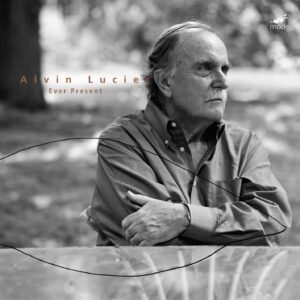
CD
Alvin LUCIER
“Ever Present”
“Piper” (2000) Matt Welch, bagpipe. Fan” (2003) Miki Maruta, Ryuko Mizutani, Kayoko Nakagawa, and Yoko Nishi, kotos. “947” (2001) Jacqueline Martelle, flute. Silver Streetcar for the Orchestra” (1988) Brian Johnson, triangle. “Ever Present” (2002) Drescher-Okabe-Armbruster Trio: Erik Drescher, flute; Akiko Okabe, piano; Sascha Armbruster, alto saxophone. Alvin Lucier’s (b. 1931) works on this CD, for solos and trios, continue to explore his unique sound world, exploration of microtones, and use of unusual instrumentation. Liner notes by the composer: “Piper is probably one of the few avant-garde pieces composed for the bagpipe. The piper is asked to walk slowly around the performance space, sounding his instrument as he does so. From time to time he detunes the chanters, creating beating patterns of slightly varying speeds and minor spatial disturbances (imaginary dopplers). In Fan, 4 koto players play a long series of plucked tones over a 12-minute time span, gradually stepping up to 4 semitones above the starting tone and slowing down to 1 beat every 2, 3, 4, and 5 seconds. As they do so, audible beating at various speeds occurs among the plucked sounds of the instruments. During the course of 947, 4 pure tones are sounded in all their combinations. As they do so a flutist sustains closely tuned long tones against them, creating audible beats at speeds determined by the distances between her tones and those of the pure waves. The farther apart the faster the beating. At unison no beating occurs. Occasionally the flutist bends her pitches a few cycles per second causing the beating patterns to slow down and speed up. In Silver Streetcar, the player dampens the triangle with the thumb and forefinger of one hand while tapping the instrument with the other. The performance consists of moving the geographical locations of these two activities and changing the pressure of the fingers on the triangles as well as the speed and loudness of the tapping. During the course of the performance, the acoustic characteristics of the folded metal bar are revealed. Ever Present is inspired by Robert Irwin’s garden at the Getty Center in Los Angeles. Tone waves in constant motion sweep up and down as the players sustain long tones across them, creating beating patterns at speeds determined by the closeness of the tunings. Four first recordings.”
15,00€
Out of stock

CD
Phill NIBLOCK
“Disseminate”
“Disseminate Ostrava” (1998) In this orchestra piece, the players read from a conventional score. There is no after-recording manipulation of the material. The recording comes from the Ostrava Days Festival in the Czech Republic, where the 41-piece Ensemble OCNM is supplemented by members of the Janacek Philharmonic. “Kontradictionaries” (1999, rev. 2003) This work was written for the KONTRA-trio. The trio (formed in 1992) of Bischof, Mejer and Bachmann concentrates on the sound of low wind instruments. The three wind contrabasses are used as sources for acoustic phenomena.
Here, the musicians recorded "samples" of the notes in a recording studio. Niblock then edited the samples, made pitch shifts of them, and combined this material in a multitrack score. There is no manipulation of the sound of the instruments, the combination of the different microtonal pitches and timbres of the instruments modifies the sound. The musicians later added "live" parts to the Niblock multitrack-mixed-to stereo recording. “Disseminate Q-O2” (1998) the Q-O2 Ensemble. Written for the Belgian ensemble for contemporary and improvised music, Q-O2. The work creates a haze of slowly shifting, vibrating sounds. Phill Niblock (born in Indiana, 1933) is a seminal figure in "drone" music who crosses the Downtown and Improv scenes. A characteristic of Niblock’s drone style is its subtle, gradual alteration of pitch which leads one to loose a sense of "time" and draws one deeper and deeper into the sound itself. The remarkable thing is that Niblock achieves this effect by almost always using traditional acoustic instruments. Niblock is an intermedia artist using music, film, photography, video and computers. He initially was trained in the visual arts and worked as a photographer; he takes inspiration from minimal artists, including Rothko, Judd and Andre.
Here, the musicians recorded "samples" of the notes in a recording studio. Niblock then edited the samples, made pitch shifts of them, and combined this material in a multitrack score. There is no manipulation of the sound of the instruments, the combination of the different microtonal pitches and timbres of the instruments modifies the sound. The musicians later added "live" parts to the Niblock multitrack-mixed-to stereo recording. “Disseminate Q-O2” (1998) the Q-O2 Ensemble. Written for the Belgian ensemble for contemporary and improvised music, Q-O2. The work creates a haze of slowly shifting, vibrating sounds. Phill Niblock (born in Indiana, 1933) is a seminal figure in "drone" music who crosses the Downtown and Improv scenes. A characteristic of Niblock’s drone style is its subtle, gradual alteration of pitch which leads one to loose a sense of "time" and draws one deeper and deeper into the sound itself. The remarkable thing is that Niblock achieves this effect by almost always using traditional acoustic instruments. Niblock is an intermedia artist using music, film, photography, video and computers. He initially was trained in the visual arts and worked as a photographer; he takes inspiration from minimal artists, including Rothko, Judd and Andre.
17,50€
In stock

CD
Alvin LUCIER
“Two Circles”
“Two Circles” (2012) for flute, clarinet, violin, cello, piano and pure wave oscillators. “Fideliotrio” (1986) for viola, cello and piano. “Three Translations of the Works of Maurizio Mochetti” (2008) for flute, clarinet, violin, cello and piano.
All performed by Alter Ego.
“I am Sitting in a Room” (1968) for speaking voice and electronics. Performed by Alvin Lucier.
Alvin Lucier’s (b.1931) work has been more often described in terms of science than of art and his scores often contain experimental procedures. Lucier perfectly represents the fusion of a scientist with an artist. His pieces arise from an inspection of a pure physical phenomenon.
The performers on Mode’s fourth disc of Lucier’s music are the Italian experimental music ensemble Alter Ego — two of the works were written for or dedicated to them — and Alvin Lucier himself.
This new recording of his classic I am Sitting in a Room is from the Biennale Musica 2012 in Italy. This is Lucier’s first new recording of the work since the original from 1980.
The interaction of electronic and acoustic sounds is the central point of Two Circles. These electronic sounds move from the same note in two glissandi, ascending and descending. The acoustic instruments interfere, generating beating (so-called binaural beats) from the interaction of closed frequencies. In some cases, these pulsations give the impression to expand the sonic space, whilst in others they appear to bring to an ending.
In a comparable way, Fideliotrio focuses its attention on the tonal interplays between instruments. In this case, cello, viola and piano form a steady flux: the central note of the piano designs a sort of line around which the string instruments move. When the viola and cello start to drift away from piano’s tone, one may have the impression that the sonic stream is bending and is losing its center of gravity.
Artist Mochetti’s work focuses on light, space, time; it explores the use of materials and often includes a unique conception of the geometry, made of trajectories, lines and surfaces. In the Three Translations of the Works of Maurizio Mochetti, Lucier transfers the exploration of these elements to sound as he literally designs sonic profiles, reflections and music shapes.
The booklet includes an interview with Lucier and flutist Manuel Zurria and liner notes by Riccardo Dillon Wanke and Alvin Lucier.
16,00€
In stock

CD
James TENNEY
“Melody, Ergodicity and Indeterminacy”
Poem (1955). Jos Zwaanenburg, flute. "Ergodos I" (1963) computer music. "Monody" (1959). John Anderson, clarinet. "Ergodos II" (1964) computer music. "Seegersong
1" (1999). John Anderson, clarinet. "String Complement (with Ergodos II)" (1964) computer music with violin, viola, cello, bass. "Seegersong
2" (1999). Jos Zwaanenburg, flute. "Instrumental Responses (with Ergodos I)" (1964) computer music with flute, bass clarinet, trombone, bassoon, violin, viola, cello, bass, percussion, baritone. "Ergodos III" (1994). Frank Denyer and Nora Mulder, pianos. "Percussion Response" (with Ergodos I) (1964) computer music with Tobias Liebezeit, percussion.
Barton Workshop. James Fulkerson & Frank Denyer, directors. First Recordings. “James Tenney (1934-2006) was probably the first composer to develop an aesthetic for computer music, realizing that electronic music almost forced the composer to accept noise as music and to abandon the idea of absolute control over a composition. He came to accept Cage’s passion for randomness, but from a different angle: computer music can be “unpredictable” (rather than “random”). This CD looks at how Tenney persistently asked two questions: “What if?” and “How does it work?” Entitled Melody, Ergodicity and Indeterminacy, it brings an understanding of Tenney’s exploration of the act of listening and the factors of composition, of how materials can be assembled, how a composer creates musical continuity. It contains four solos for flute and clarinet which are taken both from some of his earliest works, Poem (1955) and Monody (1959) and from relatively late in his career, Seegersong
1 & 2 (1999). The cd features Tenney’s Ergodos compositions (forerunners of minimal music or drones) - instead of a fixed object, the listener hears a process and assembles his own experience from the sounds which have enveloped him. The reel-to-reel source tapes for Ergodos I and II are unique in that they may be played in either direction, beginning and ending at any point and-or with any number of super-impositions of parts (channels). On this cd, both Ergodos tape pieces are presented along with the tape and its String complement, Instrumental responses (10 performers) and also with a percussion soloist (Percussion responses). Like so many of Tenney’s pieces, these works walk a line between the composers input and the choices of the performers in order to come to fruition. Tenney’s conscious inclusion of the performer’s input is a consistent characteristic of his music and remains a factor which distinguishes him from many other composers.”
16,00€
Out of stock

CD
David TUDOR
“Rainforest”
“Sounds electronically derived from the resonant characteristics of physical materials. First version (1968), a sound-score for Merce Cunningham’s dance work of the same name, established a means of sound transformations without the use of electronic modulation: the source sounds, when transmitted through the physical materials, will be modified by the resonant nodes of those materials. Fourth version (1973): A collaborative environmental work, spatially mixing the live sounds of suspended sculptures and found objects, with their transformed reflections in an audio system.
"In the first version, I made objects which I could travel with. The object were so small, however, that they didn’t have any sounding presence in the space, so I then amplified the outputs with the use of contact microphones. Then for the second version, I wanted to have a different kind of input... because for the first I had used oscillators that made animal and bird-like sounds. In the second version I wanted to use a vocal input to the system, the natural resonance of the object and its subsequent amplification. Its a kind of mechanical filter. The third version had to deal with the ability to have any input go to any transducer. I made that system for a simultaneous performance with John Cage (Mureau). It was one of those pieces that changes all the time so I needed to have a sort of continuous thing, so I used tape sources, but having the ability to mix them or separate them into different output channels. So the next step was "Rainforest IV"... the object was to make the sculptures sound in the space themselves. Part of that process is that you are actually creating a an environment. The contact mikes on the objects pickup the resonant frequencies which one hears when very close to the object, and then are amplified through a loudspeaker as an enhancement." (this transcription is partially edited from the original)”. David Tudor, form interview by John Fullemann 10/12/85
17,50€
In stock

CD
John CAGE
“Number pieces 5. Two2 for 2 pianos”
The Complete John Cage Edition, Volume 39. The Number Pieces 5. “Two2” (1989). Rob Haskins, piano I. Laurel Karlik Sheehan, piano II. Laurel Karlik Sheehan gave the Canadian premiere of Two2 with Jack Behrens in 1990. Rob Haskins is a respected Cage expert and scholar. Together they bring an authority and expertise to this performance of Two2. In most of the Number Pieces, all the performers have some freedom through Cage’s use of time brackets, flexible measures that show a range of possible starting and ending times. The time bracket system of notation used in these works allows a certain amount of flexibility in the performance: individual notes or chords may always occur in the same general time frame, but their specific order and duration varies slightly and unpredictably from performance to performance. In this way Cage could create a new kind of harmony of "...several sounds...being noticed at the same time." Cage based Two2 on renga, a Japanese poetic design of five, seven, five, seven, and seven syllables expressed at least thirty-six times. Each line of music is divided into five measures, just like the five lines of the poetry. The first measure contains five separate musical events - chords or single tones, usually shared between the two pianists - which correspond to the five syllables of the first line; the second measure has seven events, and so on. There are a total of thirty-six such five-measure sections in the piece. While the pianists can take any amount of time to perform each measure, each pianist must wait until both have finished the same measure before proceeding to the next. Given this flexibility, Haskins and Karlik Sheehan’s performance is the longest of the recordings to date - emphasizing the sense of spaciousness and interest in harmony that marks many of Cage’s late pieces. Liner notes by Rob Haskins.
15,00€
Out of stock

CD
Giacinto SCELSI
“The piano works 2”
“Mode’s Scelsi Edition continues with the second volume devoted to his piano works, consisting of two works from different periods in Scelsi’s oeuvre. The Suite No. 2 is one of the earliest of Scelsi’s published piano works. A highly virtuosic and expressive work, this Suite receives its first recording here. Written in 1955, Action Music is among Scelsi’s last piano works. Action Music was premiered by Geoffrey Douglas Madge in 1986 in Darmstadt. The title Action Music points to the high energy and physical and gestural elements of the music. The work’s vigorous character is underscored by predominantly fast tempi and directions for playing, including violento, con fuoco, martellato, fragroso (deafening!) and come percussione. In Action Music the performers are asked to play the piano in unusual ways by using their palms parallel to the keyboard, and employing fists and forearms to perform single pitches, chords, clusters and glissandi. One of Canada’s leading pianists, Stephen Clarke has performed as a soloist in festivals in Europe, Canada, and the U.S. He has worked with a number of ensembles and has performed as a soloist with the Los Angeles Philharmonic New Music Group, the Toronto Symphony Orchestra and the Composers’ Orchestra. This audiophile quality recording was made using high-resolution 96khz/24-bit technology.”
15,00€
In stock

CD
Giacinto SCELSI
“The piano works 4”
“Hispania “Triptyque pour piano” (1939). Suite No. 5 “Il Circo” (1935). Suite No. 6 “I Capricci di Ty” (1939). Stephen Clarke, piano. Mode’s Scelsi Edition continues with the fourth volume devoted to his piano works - three first recordings of major, large scale works from his early period of the 1930s. The piano plays a role of undeniable importance in Scelsi’s life and work. From 1930 to 1941, and again from 1952 to 1956, the composer produced an enormous repertoire for the instrument, including 40 Preludes, 11 Suites, four Sonatas, and many solo works. The works on this CD attest to his brilliance as an improviser, his sensitivity to rhythm and color, and the originality of his compositional identity. Hispania is a fascinating work, where passages show some signs of Scelsi’s later style, yet other features remain more closely connected to earlier practice. The “tryptique pour piano” is arranged in three distinct movements, fast-slow-fast. While much of Scelsi’s work is highly chromatic, reflecting the influence of Scriabin and Berg, Hispania contains long passages of predominantly diatonic material, using mostly the white keys of the piano with very few accidentals. It also shows the influence of French neoclassicism and impressionism, with certain moments recalling the Spanish-themed works of Ravel and Debussy. Suite No. 5: Il Circo or “The Circus,” an image that is full of possible connotations from the ancient (as in Rome’s Circus Maximus) to the exotic. Rhythm, an aspect of music which Scelsi held as equivalent to vitality, is the true shaping force in these short vignettes. Suite No. 6: I Capricci di Ty takes more steps in the direction of Scelsi’s later minimalistic style, with entire movements focusing on this type of material, some with variable beats in each measure, and time signatures often omitted altogether. Ty was Scelsi’s nickname for his wife, Dorothy. This audiophile quality recording was made using high-resolution 96khz/24-bit technology. Liner notes by Benjamin R. Levy (in English, German & French).” label info
15,00€
In stock

CD
John CAGE
“Complete string quartets, volume 2”
The Complete String Quartets Vol. 2. “String Quartet in Four Parts” (1949-50). “Four” (1989). The Arditti Quartet. The second volume of Cage’s String Quartets features his first and last works in this repertoire. The well known and exquisitely beautiful, serenely Zen-like early quartet receives its first new recording in 16 years. It is a pivotal work in Cage’s oeuvre, showing the composer’s transition between the rhytmically complex percussion works before it and the chance works of the 1950s. Four was written for the Arditti Quartet, its "time-bracket" form opens a world of microtones, the four independent players forming constantly shifting textures. The pairing of these two quartets on this recording offers a striking demonstration that the silent compositional voice which Cage discovered in 1949 has remained with hin ever since. The booklet features another etching by Cage and extensive liner notes by Cage scholar James Pritchett. Composer supervised recordings.
15,00€
Out of stock

CD
John CAGE
“Freeman etudes (books 1 & 2)”
Reissued. By Irvine Arditti, violin. John Cage’s Freeman Etudes are the modern equivalent of Paganini’s virtuoso solo violin etudes. Each etude is completely notated down to the smallest detail, and the composer states "...are as intentionally as difficult as I can make them...So I think that this music, which is almost impossible, gives an instance of the practicality of the impossible." The detail and complexity of these etudes give them a unique and unusual spot in Cage’s oeuvre. These first two books (there are 8 etudes per book) were composed between 1977 and 1980 with the help of Paul Zukofsky, who answered Cage’s questions about what was (and wasn’t) possible to play on the violin. Cage also composed the 17th Etude in 1980, but abandoned writing the remaining fifteen, believing them to be "almost impossible" music. They were abandoned until 1990, that is, when Cage heard Irvine Arditti’s remarkable rendition of the first 16 Etudes. Once again, Cage had the inspiration and the impetus to complete the last two books, which Arditti has recorded on mode 37. A goal of the Etudes is to make each one the same duration: as fast as one can play the most difficult Etude with accuracy. Arditti’s performances are at blistering speed and center around three minutes per Etude, far faster than any other recorded version. Mode had the pleasure to record the first 2 books under Cage’s extremely pleased and helpful supervision. The booklet contains photos from the recording session. Liner notes are by Cage scholar James Pritchett, who helped Cage with the materials to complete books 3 & 4 of the Etudes.
15,00€
Out of stock

CD
Giacinto SCELSI
“The viola works”
“Vincent Royer, viola & voice. “Manto” (1957). First recording with male voice. “Coelocanth” (1955). “Elegia per Ty” (1958). Séverine Ballon, cello. “Three Studies” (1956). First recording. “Xnoybis” (1964). First recording. Volume 9 of Mode’s Scelsi Edition is devoted to the first complete recording of Giacinto Scelsi’s works for viola solo and duo. Manto was a prophet in ancient Greece. Scelsi translated her oracle maxims into cryptic phonemes which the viola player has to sing simultaneously in the third movement. In Manto, the sound of the viola is expanded and explored via experimental playing techniques. This is the first recording of the third movement. In Xnoybis, Scelsi’s exploration “into the inside of the sound” is taken to its extreme. A central tone, variously colored and surrounded, moves in microtonal steps - no melody in the traditional sense, but a sole wandering sound. This is the first recording of the viola version in a transcription by Vincent Royer. Elegia per Ty for viola and violoncello is Scelsi’s tender rememberance of his former wife Dorothy (nicknamed “Ty”). It is among his most important chamber works. Coelocanth and the Three Studies belong to Scelsi’s earlier style of composing. Concise motivic gestures are developed by improvisation. These expressive, virtuoso pieces are overwhelming in their ecstatic ferocity. This is the first recording of the “Three Studies”. Violist Vincent Royer is one of the most outstanding performers of contemporary music today. Mr. Royer, who was born in France but now lives in Cologne, Germany, is among a handful of musicians who have truly mastered the works of the Spectral composers, such as Gerard Grisey. In his hands, these challenging and complex works give way to new forms of musical expression that are mysterious, powerful and filled with beautiful colors. A key to his deep understanding of new music is his close collaboration with living composers, like Horatiu Radulescu and Tristan Murail, two important composers with whom Mr. Royer has enjoyed a close working relationship. Liner notes by Friedrich Jaecker and Sharon Kanach.”
16,00€
Out of stock

2 CD
Cornelius CARDEW
“Treatise”
“Treatise” (1963-67). For any number of musicians with any instruments, may be performed whole or in part. The QUaX Ensemble, directed by Petr Kotik. Live recording from Prague, Czechoslovakia, 1967. Program notes Petr Kotik & John Tilbury. This performance of Cardew’s monumental 193-page graphic score Treatise was recorded live in Prague in 1967 by the Czech QUaX Ensemble, directed by composer, flutist, conductor Petr Kotik. This historical recording offers a unique perspective to hear Treatise as interpreted by Cardew’s contemporaries. Kotik met Cardew in Warsaw in 1962, and they began exchanging scores by mail, including Treatise, which was a work in progress. Upon meeting again in London (1966), Cardew provided Kotik with additional portions of the score and insights. Fresh from this encounter, Kotik started the QUaX Ensemble upon his return to Prague in 1966. The first thing QUaX did was to rehearse Treatise, working through the pages Kotik had: "The piece was very important for getting all of us together, musically speaking, besides having a lot of fun working out individual pages by having all the musicians contribute ideas and suggestions. We worked regularly over a long period of time, ending up with a 2-hour version of the piece ... only performed once, at the concert on October 15, 1967 in Prague." It is presented here. Cardew said: “Treatise is a continuous weaving and combining of a host of graphic elements (of which only a few are recognizably related to musical symbols) into a long visual composition, the meaning of which in terms of sound is not specified in any way. ... Any number of musicians using any media are free to participate in a ’reading’ of this score ... and each is free to interpret it in his own way”. Liner notes by Petr Kotik and Cardew’s friend and colleague John Tilbury. Tilbury says of this performance: "There is much to admire in this 1967 version of Treatise by the QUaX Ensemble from Prague: the feeling of spontaneity, its uninhibitedness, the rough-hewn sounds, the accidental, the half-intended, the blurred." High resolution 96khz, 24-bit remastering from the original analog tape.
26,00€
In stock

CD
John CAGE
“Freeman etudes books 3 & 4”
Reisued. By Irvine Arditti, violin. This CD presents the first recording of the second half of John Cage’s Freeman Etudes for violin. Those familiar with the previously-released volume of this work will already know what to expect: the bewildering complexity of the Etudes and the astonishing virtuosity of Irvine Arditti’s performance. Convinced that the later, more complex etudes were unplayable, Cage abandoned work on the Freeman Etudes in 1980, after completing the first sixteen and beginning the eighteenth Etude. It wasn’t until 1990, after hearing Irvine Arditti’s blistering performances that Cage was encouraged to complete the cycle with the last two books of sixteen etudes. Considering his role in the history of the Freeman Etudes, it is only fitting that Arditti should be the first to record them. This is the second release with Irvine Arditti in his traversal of The Complete Works for Violin by John Cage for Mode Records. Released 1989.
15,00€
Out of stock

2 CD
John CAGE
“44 harmonies from appartment house 1776”
Volume 32 of Mode’s Complete John Cage Edition. Features 2 long works: "Cheap Imitation" (1977, for solo violin; peformed by Irving Arditti); "44 Harmonies from Apartment House 1776" (1976, for string quartet, performed by Arditti Quartet). World Premiere Recording of "44 Harmonies" which is 103 minutes long. "Irvine Arditti completes his complete traversal of Cage’s works for solo violin with ’Cheap Imitation’ in this set. In 1969, John Cage transcribed a two piano version of Erik Satie’s 1918 music drama ’Socrate’ to accompany Merce Cunningham’s choreography ’Second Hand’. At the last minute, the French firm that held the copyright to Satie’s score refused to allow the performance. With an ingenious rewriting, Cage retained the rhythmical architecture of the musical lines, but replaced each note with a new tonal value, creating a melodically original work with an identical rhythmic structure."
26,00€
Out of stock

CD
Giacinto SCELSI
“The orchestral works 1”
“Hymnos” (1963) for organ & 2 orchestras. “Hurqualia” (1960) for large orchestra.
“Konx-Om-Pax” (1968) for large orchestra & chorus. The Carnegie Mellon Philharmonic & Concert Choir. Juan Pablo Izquierdo, conductor. “Canti del Capricorno” for voices & instruments. Pauline Vaillancourt, soprano. Douglas Ahlstedt, tenor. Volume 2 in Mode’s Scelsi Edition presents three of his rarely heard and recorded orchestral works, vividly captured in outstanding sound. Hymnos’ large orchestra is divided antiphonally into two almost identical groups, symmetrically placed on each side of a central axis made up of the organ, timpani, and percussion. About halfway through the piece, as a result of accumulated pedal tones and their harmonics, the aura of a phantom choir miraculously appears-or so it seems-in a spine-tingling sonic revelation. Hurqualia was written at the height of the composer’s maturity. As with Hymnos, Scelsi obsesses on a single note-in this case a different note for each of the four movements. It reveals a shocking Scelsi: violent, impulsive, loud, fast. Konx-Om-Pax is the word ’peace’ in three languages: ancient Assyrian, Sanskrit, and Latin. This 20-minute work for choir and orchestra is his crowning achievement. The orchestra is the largest ever assembled by Scelsi, projected onto an enormous landscape of sound. The joining of ’all’ in the third movement, combining the massive forces of orchestra and choir, makes an inevitable allusion to a previous ’ode to joy.’ The orchestral works are interspersed with selections from Canti del Capricorno. A collection of twenty songs, some of the Canti are written specifically for soprano voice, while for others the exact voice is not specified. Improvisation and ’personal inspiration’ play a large part in the interpretation of the songs. Presented here are some for solo voice and others with instruments, performed by soprano Pauline Vaillancourt and tenor Douglas Ahlstedt. A student of Hermann Scherchen, Juan Pablo Izquierdo’s interpretations of the Viennese masters of the 19th century continue a long-standing European tradition, while also being internationally for his bold interpretations of avant-garde music of the 20th century. His first Mode disc with the superb Carnegie Mellon Philharmonic garnered rave reviews.
17,00€
In stock

CD
Luc FERRARI
“Visage 2, Après presque rien, Madame de Shanghai”
“Visage 2” (1955-56) for brass, piano and percussion. Musiques Nouvelles. Jean-Paul Dessy, conductor. First recording. “Après presque rien” (2004) for fourteen instruments and two samplers. Art Zoyd, samplers. Musiques Nouvelles. Jean-Paul Dessy, conductor. First recording. “Madame de Shanghai” (1996) for three flutes and digitally stored sounds. Li Ping Ting as “Madame Shanghai”. Scottish Flute Trio. Although not as well known as some of his composer colleagues in France, Luc Ferrari (1929-2005) was a remarkable French composer who distinguished himself with a wide variety of works from traditionally notated compositions for conventional instruments to indeterminate scores, improvisations, experimental tape works, radio pieces, films and multimedia installations. This CD, Mode Records’ second disc featuring music by Ferrari, vividly confirms this fact. • Après presque rien (after almost nothing) is an unusual, moody musical reaction to Ferrari’s series of six Presque rien works spanning more than three decades of his career (1967-2001), conceived for tape recorder and displaying Ferrari’s concept of “anecdotal” music and love of nature. Après presque rien is a vivid instrumental work interspersed with a broad range of taped environmental sounds. It was a special commission from the avant-garde band Art Zoyd, Musiques Nouvelles and CCMIX. • Visage 2 for two trumpets, trombone, tuba, piano and six percussionists (on this disc) is the second piece in a five-part series of works carrying the same title and spanning the period between 1955 and 1959. While most of the works in this series reflect Ferrari’s fascination with serialism, Visage 2 is a physical confrontation of two sexual bodies, telling gestures with notes, rhythms and instruments. • Madame de Shanghai blends flute sounds with field recordings from the Asian commercial center of Paris (Avenue d’Ivry), including Chinese and Vietnamese voices. At the end of this piece, Ferrari features the voice of Orson Welles, who directed the 1947 film noir The Lady of Shanghai and acted the lover of “The Lady of Shanghai” (Rita Hayworth). Ferrari says “… I can say that this “dramatic comedy” is a bit of a tribute to the film by Orson Welles.”
• Liner notes by Sabine Feisst and Luc Ferrari.” label info
16,50€
In stock

2 CD
John CAGE
“Roaratorio”
“Roaratorio is one of Cage’s most attractive larger assemblages...the piece is a landmark in the composer’s later output, and a credit to all involved in its elaborate realization.” - Peter Dickinson, Gramophone, 1994. Roaratorio was a commission from the West German Radio and IRCAM for Cage to realize a work based on his favorite book, Finnegans Wake by James Joyce. Cage began by making a text from the original (which became Writing for the Second Time Through Finnegans Wake, also issued here in its entirety), and cataloging the many sounds and locations mentioned in the book. A recording of each sound was made at the noted locations - virtually every sound/location was recorded. These were then laid out in the sequence in which they are mentioned in the Wake and mixed, along with Cage’s rendering of the text, into a massive collage of 62 tracks of tape lasting about an hour. Added to this is live accompaniment from leading Irish musicians on traditional instruments, performing traditional Irish music. The result is an enthralling stew of words, sound and music unlike anything you’ve encountered before. Because Cage’s beautiful reading of the text often gets submerged in the density of Roaratorio, the unadorned recording of Writing for the Second Time... is also included. Special insight on the works can be had from Laughtears, with Cage interviewed by Klaus Schöning of the WDR regarding the project. “Roaratorio: An Irish Circus on Finnegans Wake” (1976/79). First CD recording. John Cage, voice. Joe Heaney, singer. Seamus Ennis, Uillean pipes. Paddy Glackin, fiddle. Matt Malloy, flute. Peadher Mercier, Mell Mercier, bodhran with 62 track tape. “Laughtears: Conversation on Roaratorio” (1979). First CD recording. John Cage and Klaus Schöning, speakers. “Writing for the Second Time Through Finnegans Wake” (1976/79). First CD recording. John Cage, speaker.
26,00€
Out of stock

CD
Horatiu RADULESCU
“Piano sonatas & string quartets 1”
Stephen Clarke, piano. The JACK Quartet.
“String Quartet No.5 “before the universe was born”, op. 89” (1990-95).
“’Piano Sonata No.5 “settle your dust, this is the primal identity”, op. 106” (2003)
“Piano Sonata No.2 “being and non-being create each other”, op.82” (1991)
The first volume in a projected series combining Radulescu’s complete Piano Sonatas and String Quartets — there are six of each — on Mode performed by the superb JACK Quartet and Stephen Clarke (piano).
In the 1970s, Horatiu Radulescu (1942 - 2008) began exploring and composing begun composing what he called “plasmatic music,” in which sound was conceived as an “endless ocean of vibrations,” as opposed to the traditional way in which music treats sound as a fabric of discrete scale steps. His music is linked to the “spectral music” school.
Radulescu’s Fifth String Quartet is one of the key works in his output. It is in some ways the richest manifestation of the body of string techniques he had developed for his music. It consists of 29 sections/pages which richly evocative titles, each lasting about 1 minute.
The Second Piano Sonata is inspired by the Tao of Chinese philosopher Lao tzu (6-5 BC). The first movement, “Immanence,” opens with a powerful sonority built from spectral functions which gives a sense of immensity and strength.
The Fifth Piano Sonata makes abundant use — more so than any of the other sonatas — of Romanian folk material, which is absorbed and integrated into Radulescu’s spectral language.
Liner notes by Bob Gilmore.
16,50€
In stock

CD
Luc FERRARI – Brunhild FERRARI – Vincent ROYER
“Ephémère”
“Ephémère” (1974) new version for viola & tape by Brunhild Ferrari (2012). Vincent Royer, viola.
“Le Piano Englouti” (2012) by Brunhild Ferrari, version for viola & tape. Vincent Royer, viola.
“Pour que le vent soit propice” (2011) based on “Ce qu’a vu le Cers” (1978) by Luc Ferrari. Vincent Royer, viola, voice, percussion & electronics.
This album tells stories about wind, ocean and a village feast in the southern France… The listener is led into a poetic journey about freedom and impermanence. It brings together three Ferrari-related works: by Ferrari himself, by Ferrari’s wife Brunhild Meyer-Ferrari and an improvisation by Royer to one of
Ferrari’s soundscapes.
Luc Ferrari was very interested in collaboration.
New music violist Vincent Royer began collaborating with Ferrari following their meeting in 2001.
Regarding “Ephémère” (1974), Ferrari wrote: “This musical piece – which, as its name says, is based on the effects of the sea – is intended for musicians open to all types of music. As the name says too, this tape has been conceived as a snap of time.” In 2012 Brunhild Ferrari realized this new version for Royer’s viola.
Brunhild Ferrari’s “Le piano englouti” (“The Sunken Piano”) is a tape piece comprised of recorded and processed sounds. The sounds were recorded over 14 years, at a Greek island almost swallowed by the noisy Aegean Sea, and in 2010, at a very discreet and silent Japanese island. Originally composed to accompany a piano, as in Debussy’s work of the same name, this version is arranged for Royer’s viola.
The Royer / Ferrari “Pour que le vent soit propice “uses Ferrari’s tape piece “Ce qu’a vu le Cers” as the basis for a viola & electronics improvisation. This live recording captures the special mood of the intimate concert surroundings it was recorded at.
Liner notes by Brunhild Ferrari and Royer.
17,00€
In stock

CD
Luc FERRARI
“Volume 1: Chansons pour le corps”
Includes "Chansons Pour Le Corps" (1988-94; for voice, clarinets, percussion, piano and synthesizer; Elise Caron, voice), and "Et Si Tout Entiere Maintenant" (1986-87; symphonic tale for voice, orchestral sound and tape; with texts by Collette Fellous; Anne See, voice; Nouvel Orchestre Philharmonique; Yves Prin, conductor). "The works on this disc show a combination of Ferrari’s musique concrete and instrumental styles. The point of departure for ’Chansons Pour le Corps’ was a series of spontaneous interviews with women on the subject of female form which Ferrari recorded in the Jardin du Luxembourg. It’s a great image, a young woman out for a Sunday afternoon stroll approached by a man wondering if she might allow him to record her talking about various intimate parts of her body. The interviewees were invited to speak about their eyes, hands, breasts and sex, and those who accepted did so with extraordinary candor. Novelist and radio presenter Colette Fellous was then asked to write texts based on the tapes to be set for soprano and ensemble interspersed with extracts from the original interviews. ’Et Si Tout Entiere Maintenant’ a ’symphonic tale’ for voice, orchestral sound and tape is an extraordinary work. The orchestral score was performed, recorded and then treated electronically in his studio, though the orchestra is never deformed beyond all recognition. This is incorporated into the piece along with the authentic sounds of the Swedish icebreaker and its crew, and Fellous’ spoken text. What results is typical Ferrari genre blending, inhabiting a region somewhere between fact and fiction, documentary and poetry, orchestral and electronic music."
16,50€
Out of stock
2 CD
Morton FELDMAN
“Trio”
“Trio” (1980). “Aki Takahashi (piano), Rohan de Saram (cello), Marc Sabat, violin. The expansive length of Feldman’s Trio (105 min. 22 sec) requires a new approach to listening, which takes scale, the physical experience of sound, and novel uses of musical memory into consideration. With his delicate manipulation of musical materials, Feldman blurs the listeners’ sense of time as their musical memory struggles to distinguish between past and present sounds - listeners are free to lose themselves in the beauty of each musical moment. Aki Takahashi and Rohan de Saram (formerly of the Arditti Quartet) both worked closely with Feldman. Marc Sabat is among today’s great Feldman interpreters, having recorded Feldman’s complete music for violin & piano on Mode. Available also as a single DVD with full video and extras. This is the only readily available performance of the Trio available in the U.S.A. Original recording in superb 96khz, 24-bit sonics. For the stereo mix, the violin and piano are clearly separated left and right to accentuate their interplay. Feldman’s use of extended string techniques can blur the timbral separation between cello and violin, creating unified sonic events exploring the qualities and possibilities of the combination of instruments - for example, utilizing the resonance of the piano and the sustaining qualities and dynamic control of the strings. These subtle nuances are brought out by the detail of the recording.”
22,00€
In stock

magazine
MULTIPLE
“Numéro zéro”
100% text, 0% image.
300 copies.
French, English, German.
“Here is issue number zero of Multiple, a multilingual publication focusing
on some transversal artistic practices happening in Switzerland today.
Find herein multiple attempts to present some of the actors working for the promotion and diffusion of non-commercial and adventurous arts happening outside of the mainstream cultural industries.
[…]
Multiple does not only focus on the artists themselves but on some of the curators and organisers who make it possible to have experimental music & arts still happening in Switzerland these days.
[…]
The first edition of this magazine presents two structures that are fundamental for the cultural life in Switzerland : the cave12 in Geneva and the LUFF Festival in Lausanne. Plus Dave Phillips, Humus, Michi Zaugg…”
0,00€